
Saatleri, tarihleri ve günlük rutinleri İngilizce olarak ifade etmeyi öğrenmek...
 İngilizce779 views·Updated Jun 17, 2026·7 pages
6. Sınıf İngilizce Ders Notları

Ayşenur Hazırlar@aygenurrr


1 / 7
1
of 7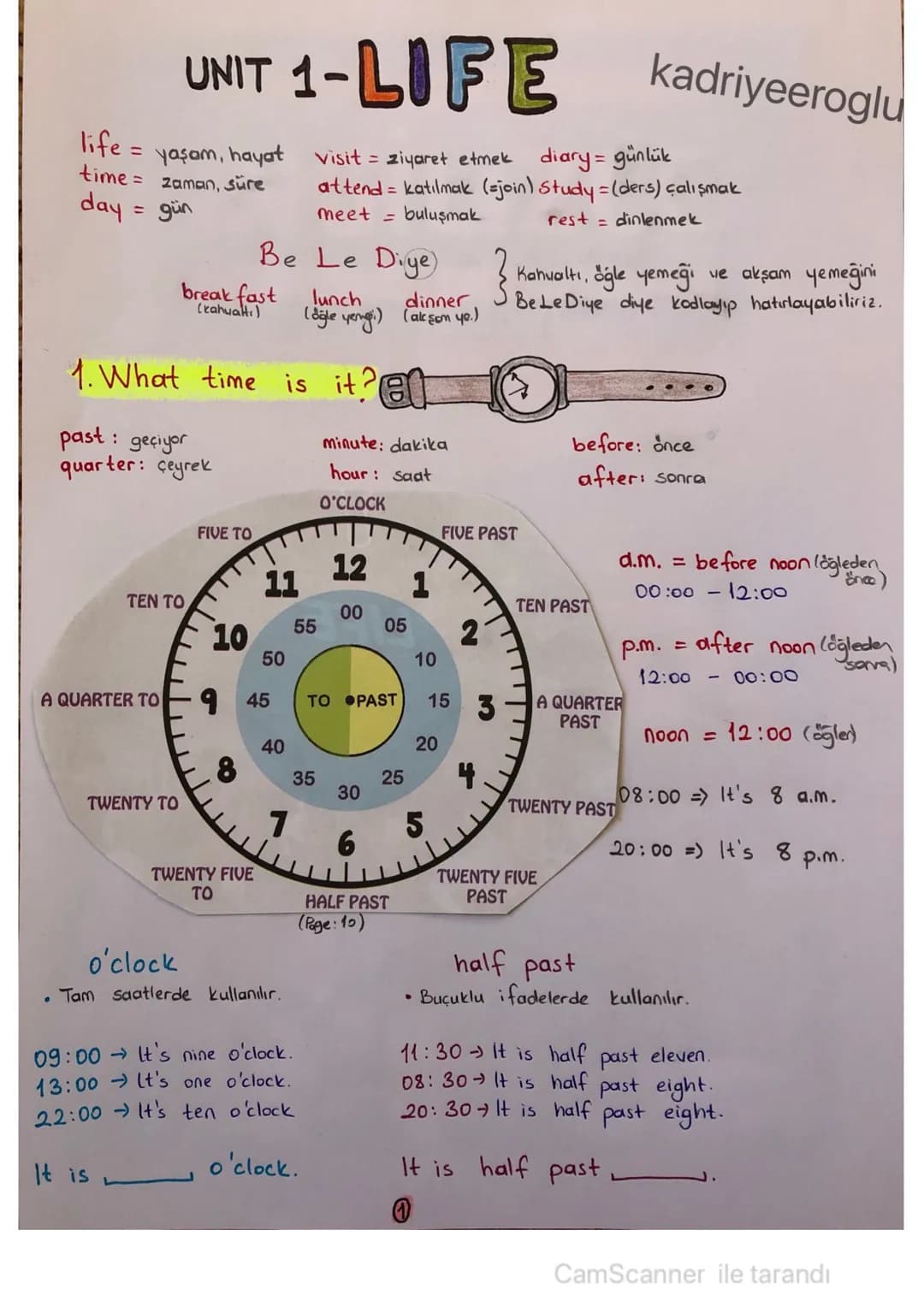
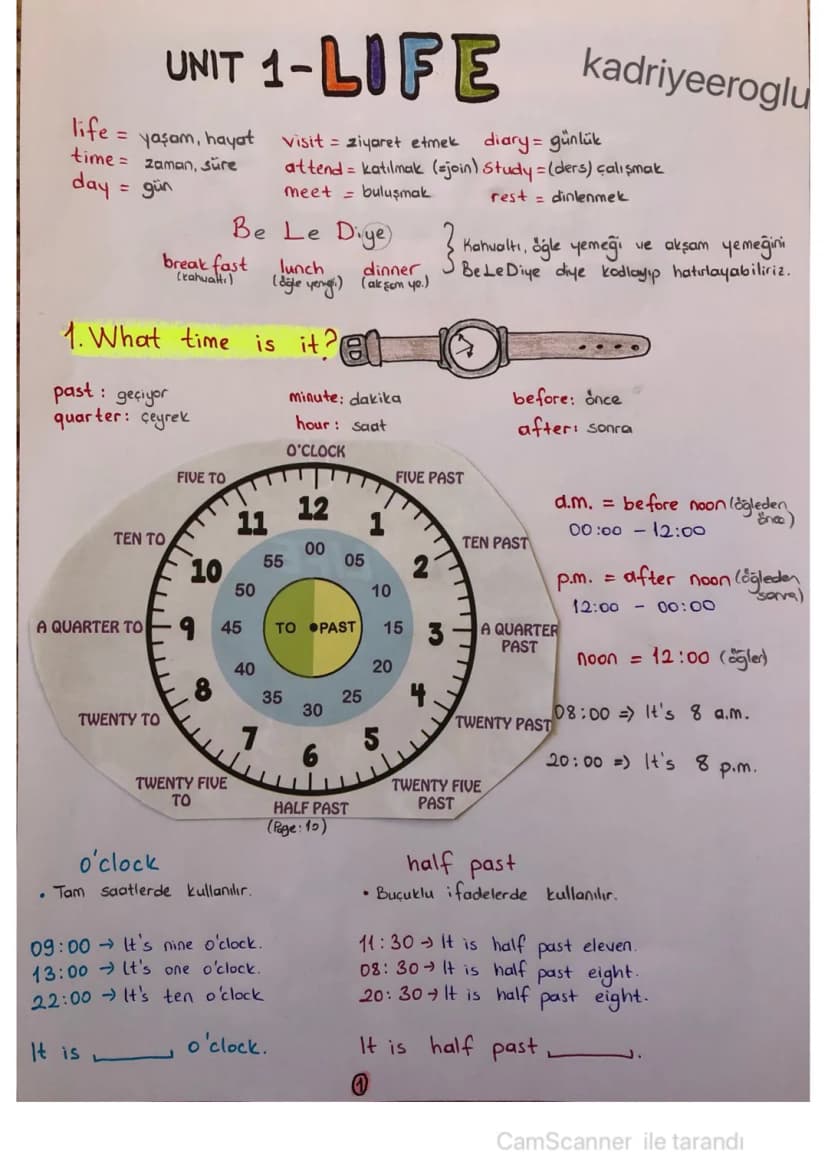
İngilizce Saat İfadeleri
Saat söylemenin birkaç farklı yolu vardır. Gününün farklı zamanlarını öğrenelim!
Saati söylerken kullandığımız önemli kelimeler: past (geçiyor), quarter (çeyrek), minute (dakika), hour (saat), before/to (var) ve after/past (geçe).
Tam saatlerde "o'clock" kullanırız:
- 09:00 → It's nine o'clock.
- 13:00 → It's one o'clock.
Buçuklu saatlerde "half past" deriz:
- 11:30 → It's half past eleven.
- 08:30 → It's half past eight.
🔔 İpucu: a.m. ve p.m. ifadelerini kullanarak sabah mı akşam mı olduğunu belirtebilirsin. Örneğin: 08:00 → It's 8 a.m. (sabah), 20:00 → It's 8 p.m. (akşam)
2
of 7
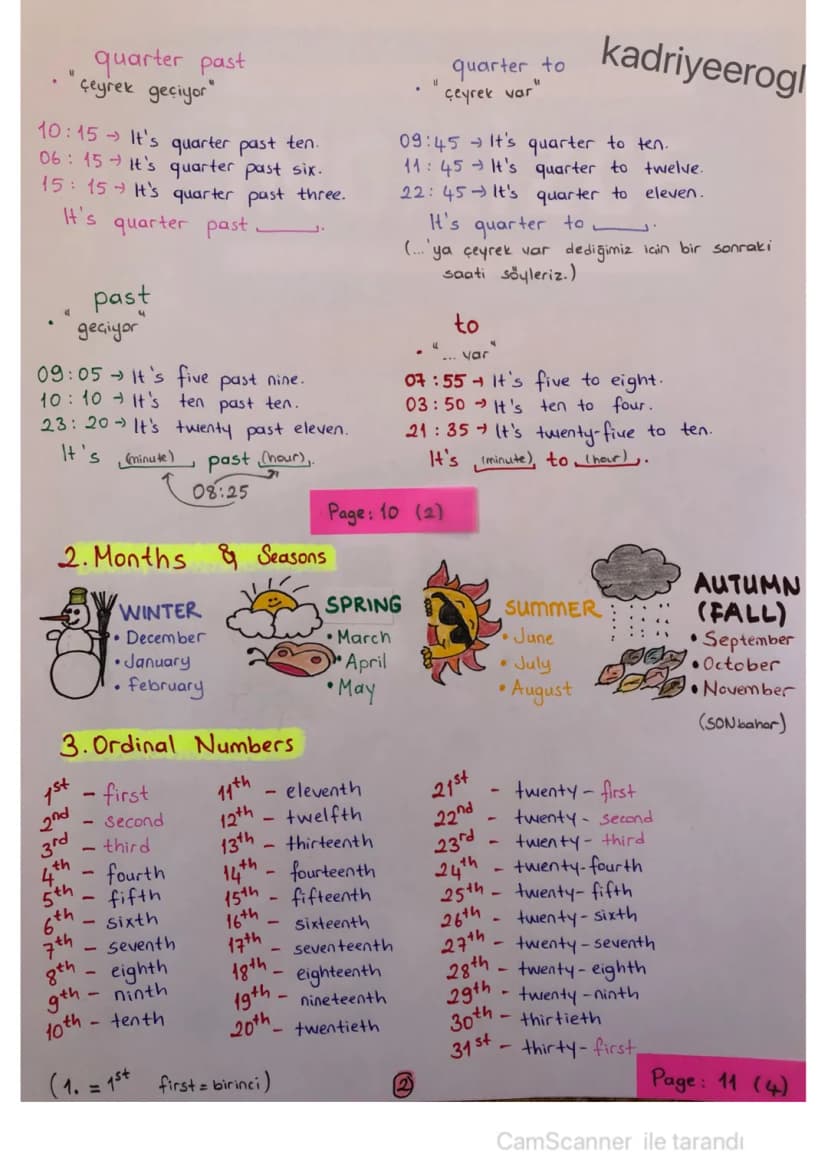
Saat İfadeleri (Devam)
Saati söylemenin diğer yolları da var:
"Quarter past" (çeyrek geçe):
- 10:15 → It's quarter past ten.
- 15:15 → It's quarter past three.
"Past" (geçiyor):
- 09:05 → It's five past nine.
- 23:20 → It's twenty past eleven.
"Quarter to" (çeyrek var):
- 09:45 → It's quarter to ten. (Dikkat! Bir sonraki saati söyleriz)
- 22:45 → It's quarter to eleven.
"To" (var):
- 07:55 → It's five to eight.
- 21:35 → It's twenty-five to ten.
Aylar ve Mevsimler
Mevsimleri ve ayları bilmek çok önemli:
- Kış: Aralık, Ocak, Şubat
- İlkbahar: Mart, Nisan, Mayıs
- Yaz: Haziran, Temmuz, Ağustos
- Sonbahar: Eylül, Ekim, Kasım
Sıra Sayıları
Sıra sayıları (1st, 2nd, 3rd...) tarihleri söylerken kullanılır. Bazı örnekler:
- 1st (first) - birinci
- 2nd (second) - ikinci
- 3rd (third) - üçüncü
- 4th (fourth) - dördüncü
3
of 7
Tarih Söyleme
Tarihleri İngilizce söylemenin farklı yolları vardır.
Örnekler:
- 08.03.2020 → It's 8 March, 2020. VEYA It's the eighth of March, two thousand and twenty.
- 02.01.2005 → It's 2 January, 2005. VEYA It's the second of January, two thousand and five.
- 10.11.1938 → It's 10 November, 1938. VEYA It's the tenth of November, nineteen thirty-eight.
Gün ve ay söylerken: It's 3 May. VEYA It's the third of May. VEYA May the third.
🔔 Hatırlatma: Tarihleri okurken sıra sayıları (ordinal numbers) kullanırız!
Özel Günler ve Bayramlar
Bazı önemli özel günler:
- Children's Day: 23/04 (the 23rd of April)
- New Year's Day: 01/01 (the 1st of January)
- Victory Day: 30/08 (the 30th of August)
- Republic Day: 29/10 (the 29th of October)
- Democracy and National Unity Day: 15/07 (the 15th of July)
4
of 7
Doğum Günleri
Doğum gününün ne zaman olduğunu sormak için:
- When is your birthday? (Doğum günün ne zaman?)
- When is your best friend's birthday? (En iyi arkadaşının doğum günü ne zaman?)
Cevap verirken: My birthday is on... / His/Her birthday is on...
İngilizce'de tarih ve zaman bildiriminde farklı edatlar kullanırız:
- in: Aylar ve yıllardan önce (in June, in 2008)
- on: Günlerden önce (on Friday, on 10th May)
- at: Saatlerden önce (at 3 o'clock, at 9 p.m.)
Haftanın Günleri ve Günün Zamanları
Haftanın günleri:
- Monday, Tuesday, Wednesday, Thursday, Friday
- Saturday, Sunday
Günün farklı zamanları:
- in the morning (sabah)
- at noon (öğle)
- in the evening (akşam)
- at night (gece)
Günlük Rutinler
Bazı günlük aktiviteler:
- wake up / get up
- have a bath / take a shower
- get dressed (giyinmek)
- have breakfast (kahvaltı yapmak)
- leave home (evden çıkmak)
- have classes (derslere girmek)
- have lunch (öğle yemeği yemek)
5
of 7
Günlük Rutinler (Devam)
Günün diğer aktiviteleri:
- arrive home / come home
- have tea and cookies (çay ve kurabiye yemek)
- do homework (ödev yapmak)
- have dinner (akşam yemeği yemek)
- read magazines/books
- surf on the internet (internette gezinmek)
- watch TV (televizyon izlemek)
- go to bed (yatmak)
- sleep (uyumak)
Hafta sonu yapabileceğimiz aktiviteler:
- wake up late (geç uyanmak)
- do shopping (alışveriş yapmak)
- visit grandparents
- meet friends (arkadaşlarla buluşmak)
Geniş Zaman (Simple Present Tense)
Günlük aktivitelerimizi anlatırken geniş zaman kullanırız.
Olumlu cümle yapısı:
- I/You/We/They + fiil: I get up early.
- He/She/It + fiil + s/es/ies: She gets up early.
🔔 Not: He, She, It özneleriyle fiillere -s, -es veya -ies eki gelir. Örnek: go → goes, play → plays, study → studies
6
of 7
Geniş Zaman (Devam)
Olumsuz cümle yapısı:
- I/You/We/They + don't + fiil: I don't get up early.
- He/She/It + doesn't + fiil: She doesn't get up early.
Soru cümlesi yapısı:
- Do + I/you/we/they + fiil...?: Do you watch TV?
- Does + he/she/it + fiil...?: Does she take a bath?
Kısa cevaplar:
- Yes, I/you/we/they do. / No, I/you/we/they don't.
- Yes, he/she/it does. / No, he/she/it doesn't.
Soru kelimeleri ve kullanımları:
- What: ne - What time does Han wake up? (Han kaçta uyanır?)
- Where: nerede, nereye - Where do you go on Sundays? (Pazar günleri nereye gidersin?)
- Which: hangi - Which courses do you attend? (Hangi kurslara katılırsın?)
- How: nasıl - How does she go to school? (O okula nasıl gider?)
Günlük aktiviteler için bazı faydalı ifadeler:
- do cleaning (temizlik yapmak)
- meet friends (arkadaşlarla buluşmak)
- run errands (ayak işleri yapmak)
- take care of (ilgilenmek)
- feed the pet (evcil hayvanı beslemek)
7
of 7
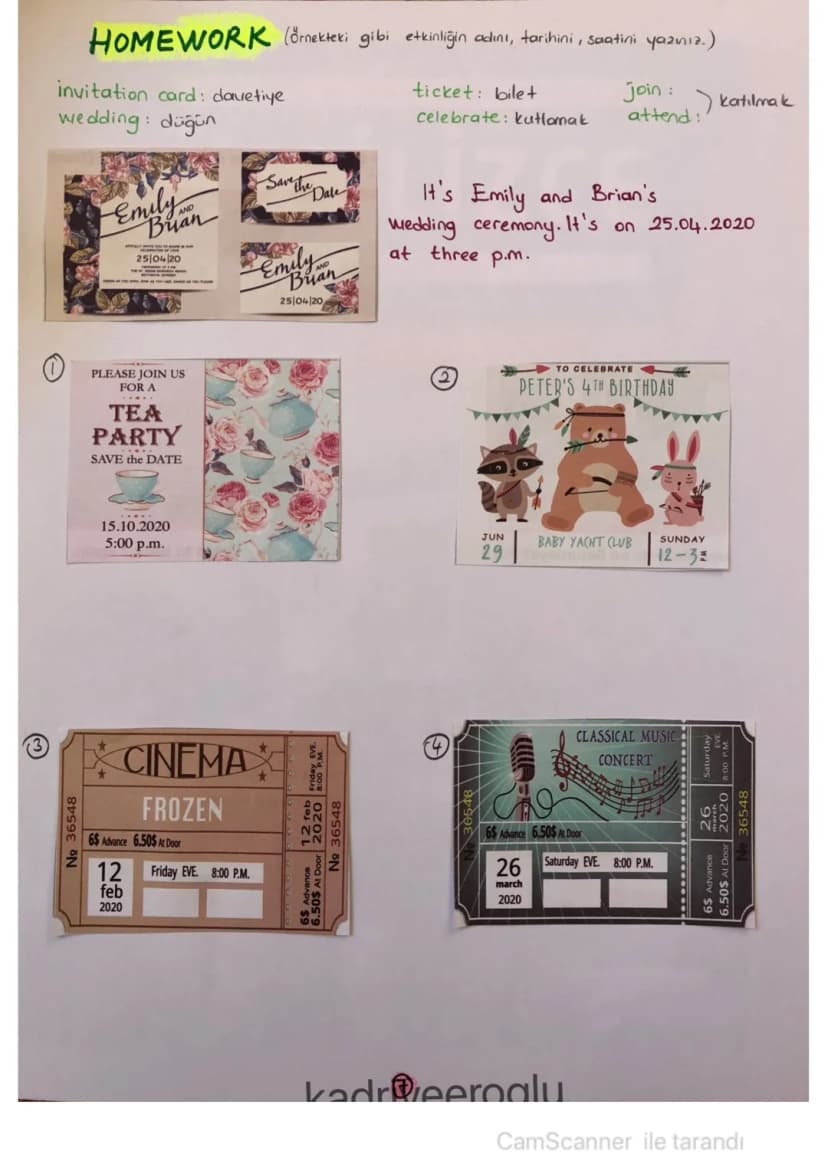
Davetiye ve Etkinlikleri Anlama
Davetiye ve biletlerde tarih, saat ve etkinliğin adı gibi önemli bilgileri okuyabilmek çok önemlidir.
Etkinliklerle ilgili faydalı kelimeler:
- invitation card (davetiye)
- ticket (bilet)
- join/attend (katılmak)
- wedding (düğün)
- celebrate (kutlamak)
- tea party (çay partisi)
- concert (konser)
- birthday (doğum günü)
Davetiye örneği: "It's Emily and Brian's wedding ceremony. It's on 25.04.2020 at three p.m."
🔔 İpucu: Bir davetiyeyi veya bileti okuduğunda, etkinliğin ne olduğu, ne zaman (tarih ve saat) ve nerede olacağı en önemli bilgilerdir. Bu bilgileri hızlıca bulabilmelisin.
Bir davetiyeyi tanımlarken örnek cümle şekli: "It's a/an [event type]. It's on [date] at [time]."
We thought you’d never ask...
What is the Knowunity AI companion?
Our AI companion is specifically built for the needs of students. Based on the millions of content pieces we have on the platform we can provide truly meaningful and relevant answers to students. But its not only about answers, the companion is even more about guiding students through their daily learning challenges, with personalised study plans, quizzes or content pieces in the chat and 100% personalisation based on the students skills and developments.
Where can I download the Knowunity app?
You can download the app in the Google Play Store and in the Apple App Store.
Is Knowunity really free of charge?
That's right! Enjoy free access to study content, connect with fellow students, and get instant help – all at your fingertips.
Similar Content
 Anglais
Most popular content: Times of the Day
6İngilizceİngilizce saatler
İngilizce saatler
61692
İngilizce6.sınıf İngilizce 1. Ünite konu anlatımı
1. Ünite İngilizce
61,37934
İngilizceSaatler
İngilizce saatler
633918
 Türkçe
8. SINIF MEVSİMLER VE İKLİM ÖZET
Fen Bilimleri "MEVSİMLER VE İKLİM"
8943
İngilizceİngilizce saatler
İngilizce saatler
61274
İngilizceTelling Time
Konu anlatımı ve örnekleri
65747
Most popular content in İngilizce
9İngilizce8. Sınıf ingilizce
Tüm üniteleri içeriyor!
877733
İngilizceİngilizce 9.Sınıf
9.sınıf İngilizce
95,24260
İngilizceİngilizce guiz
ingilizce meslekler
68660
İngilizceİngilizce 7. Sınıf 1. Ünite ders notu
İngilizce
72,73840
İngilizce6. Sınıf İngilizce Yummy breakfast
6. Sınıf İngilizce
61,49815
İngilizce8.Sınıf İngilizce 4.Ünite Kelimeleri
İngilizce kelimeler
88617
İngilizce6 sınıf İngilizce 1 ünite konu tekrarı
6 sınıf İngilizce
65,25653
İngilizceingilizce
1. ünite ingilizce kelimeleri
74220
I
İngilizceingilizce 6. sınıf
Bu sınav, 6. sınıf İngilizce dersi konularını kapsayan çeşitli sorulardan oluşmaktadır.
61560
Most popular content
9 Tarih
Tarih9. Sınıf Tarih Konu Anlatımı
9. sınıf tarih tüm ünite konu anlatımı
94,16066
 Matematik
8.sınıf matematik
Tüm üniteleri içermektedir!
85,207185
 Biyoloji
Tyt biyoloji
Bio
95,100132
Tarih9.sınıf tarih ders notları
Yeni maarif modele uygundur
92,20748
Biyoloji11. sınıf biyoloji dolaşım sistemi ders notları
11. sınıf biyoloji dolaşım sistemi ders notları
114,34185
TarihTYT AYT TARİH
Tarih
92,58362
T.C. İnkılâp Tarihi ve Atatürkçülükİnkılap tarihi
Beğenin
82,76154
 Fen Bilimleri
7. Sınıf Fen Bilimleri
Tüm üniteler
79,269188
 Felsefe
11.Sınıf Felsefe 2.Dönem 2.Yazılı sınavı ders notları
20.yüzyıl felsefesini hazırlayan düşünce ortamı, 20.yüzyıl felsefesi temel problemleri ve akımları konularını içermektedir
113,596113
Can't find what you're looking for? Explore other subjects.
Students love us — and so will you.
4.6/5App Store
4.7/5Google Play
The app is very easy to use and well designed. I have found everything I was looking for so far and have been able to learn a lot from the presentations! I will definitely use the app for a class assignment! And of course it also helps a lot as an inspiration.
Stefan SiOS user
This app is really great. There are so many study notes and help [...]. My problem subject is French, for example, and the app has so many options for help. Thanks to this app, I have improved my French. I would recommend it to anyone.
Samantha KlichAndroid user
Wow, I am really amazed. I just tried the app because I've seen it advertised many times and was absolutely stunned. This app is THE HELP you want for school and above all, it offers so many things, such as workouts and fact sheets, which have been VERY helpful to me personally.
AnnaiOS user
İngilizce779 views·Updated Jun 17, 2026·7 pages6. Sınıf İngilizce Ders Notları
Ayşenur Hazırlar@aygenurrr
Saatleri, tarihleri ve günlük rutinleri İngilizce olarak ifade etmeyi öğrenmek hayatımızın önemli bir parçasıdır. Bu ünite, saati söyleme, tarihleri yazma ve günlük aktivitelerimizi anlatırken Simple Present Tense kullanımını kapsıyor.
1
of 7
Sign up to see the content. It's free!
- Access to all documents
- Improve your grades
- Join milions of students
İngilizce Saat İfadeleri
Saat söylemenin birkaç farklı yolu vardır. Gününün farklı zamanlarını öğrenelim!
Saati söylerken kullandığımız önemli kelimeler: past (geçiyor), quarter (çeyrek), minute (dakika), hour (saat), before/to (var) ve after/past (geçe).
Tam saatlerde "o'clock" kullanırız:
- 09:00 → It's nine o'clock.
- 13:00 → It's one o'clock.
Buçuklu saatlerde "half past" deriz:
- 11:30 → It's half past eleven.
- 08:30 → It's half past eight.
🔔 İpucu: a.m. ve p.m. ifadelerini kullanarak sabah mı akşam mı olduğunu belirtebilirsin. Örneğin: 08:00 → It's 8 a.m. (sabah), 20:00 → It's 8 p.m. (akşam)
2
of 7Sign up to see the content. It's free!
- Access to all documents
- Improve your grades
- Join milions of students
Saat İfadeleri (Devam)
Saati söylemenin diğer yolları da var:
"Quarter past" (çeyrek geçe):
- 10:15 → It's quarter past ten.
- 15:15 → It's quarter past three.
"Past" (geçiyor):
- 09:05 → It's five past nine.
- 23:20 → It's twenty past eleven.
"Quarter to" (çeyrek var):
- 09:45 → It's quarter to ten. (Dikkat! Bir sonraki saati söyleriz)
- 22:45 → It's quarter to eleven.
"To" (var):
- 07:55 → It's five to eight.
- 21:35 → It's twenty-five to ten.
Aylar ve Mevsimler
Mevsimleri ve ayları bilmek çok önemli:
- Kış: Aralık, Ocak, Şubat
- İlkbahar: Mart, Nisan, Mayıs
- Yaz: Haziran, Temmuz, Ağustos
- Sonbahar: Eylül, Ekim, Kasım
Sıra Sayıları
Sıra sayıları (1st, 2nd, 3rd...) tarihleri söylerken kullanılır. Bazı örnekler:
- 1st (first) - birinci
- 2nd (second) - ikinci
- 3rd (third) - üçüncü
- 4th (fourth) - dördüncü
3
of 7Sign up to see the content. It's free!
- Access to all documents
- Improve your grades
- Join milions of students
Tarih Söyleme
Tarihleri İngilizce söylemenin farklı yolları vardır.
Örnekler:
- 08.03.2020 → It's 8 March, 2020. VEYA It's the eighth of March, two thousand and twenty.
- 02.01.2005 → It's 2 January, 2005. VEYA It's the second of January, two thousand and five.
- 10.11.1938 → It's 10 November, 1938. VEYA It's the tenth of November, nineteen thirty-eight.
Gün ve ay söylerken: It's 3 May. VEYA It's the third of May. VEYA May the third.
🔔 Hatırlatma: Tarihleri okurken sıra sayıları (ordinal numbers) kullanırız!
Özel Günler ve Bayramlar
Bazı önemli özel günler:
- Children's Day: 23/04 (the 23rd of April)
- New Year's Day: 01/01 (the 1st of January)
- Victory Day: 30/08 (the 30th of August)
- Republic Day: 29/10 (the 29th of October)
- Democracy and National Unity Day: 15/07 (the 15th of July)
4
of 7Sign up to see the content. It's free!
- Access to all documents
- Improve your grades
- Join milions of students
Doğum Günleri
Doğum gününün ne zaman olduğunu sormak için:
- When is your birthday? (Doğum günün ne zaman?)
- When is your best friend's birthday? (En iyi arkadaşının doğum günü ne zaman?)
Cevap verirken: My birthday is on... / His/Her birthday is on...
İngilizce'de tarih ve zaman bildiriminde farklı edatlar kullanırız:
- in: Aylar ve yıllardan önce (in June, in 2008)
- on: Günlerden önce (on Friday, on 10th May)
- at: Saatlerden önce (at 3 o'clock, at 9 p.m.)
Haftanın Günleri ve Günün Zamanları
Haftanın günleri:
- Monday, Tuesday, Wednesday, Thursday, Friday
- Saturday, Sunday
Günün farklı zamanları:
- in the morning (sabah)
- at noon (öğle)
- in the evening (akşam)
- at night (gece)
Günlük Rutinler
Bazı günlük aktiviteler:
- wake up / get up
- have a bath / take a shower
- get dressed (giyinmek)
- have breakfast (kahvaltı yapmak)
- leave home (evden çıkmak)
- have classes (derslere girmek)
- have lunch (öğle yemeği yemek)
5
of 7Sign up to see the content. It's free!
- Access to all documents
- Improve your grades
- Join milions of students
Günlük Rutinler (Devam)
Günün diğer aktiviteleri:
- arrive home / come home
- have tea and cookies (çay ve kurabiye yemek)
- do homework (ödev yapmak)
- have dinner (akşam yemeği yemek)
- read magazines/books
- surf on the internet (internette gezinmek)
- watch TV (televizyon izlemek)
- go to bed (yatmak)
- sleep (uyumak)
Hafta sonu yapabileceğimiz aktiviteler:
- wake up late (geç uyanmak)
- do shopping (alışveriş yapmak)
- visit grandparents
- meet friends (arkadaşlarla buluşmak)
Geniş Zaman (Simple Present Tense)
Günlük aktivitelerimizi anlatırken geniş zaman kullanırız.
Olumlu cümle yapısı:
- I/You/We/They + fiil: I get up early.
- He/She/It + fiil + s/es/ies: She gets up early.
🔔 Not: He, She, It özneleriyle fiillere -s, -es veya -ies eki gelir. Örnek: go → goes, play → plays, study → studies
6
of 7Sign up to see the content. It's free!
- Access to all documents
- Improve your grades
- Join milions of students
Geniş Zaman (Devam)
Olumsuz cümle yapısı:
- I/You/We/They + don't + fiil: I don't get up early.
- He/She/It + doesn't + fiil: She doesn't get up early.
Soru cümlesi yapısı:
- Do + I/you/we/they + fiil...?: Do you watch TV?
- Does + he/she/it + fiil...?: Does she take a bath?
Kısa cevaplar:
- Yes, I/you/we/they do. / No, I/you/we/they don't.
- Yes, he/she/it does. / No, he/she/it doesn't.
Soru kelimeleri ve kullanımları:
- What: ne - What time does Han wake up? (Han kaçta uyanır?)
- Where: nerede, nereye - Where do you go on Sundays? (Pazar günleri nereye gidersin?)
- Which: hangi - Which courses do you attend? (Hangi kurslara katılırsın?)
- How: nasıl - How does she go to school? (O okula nasıl gider?)
Günlük aktiviteler için bazı faydalı ifadeler:
- do cleaning (temizlik yapmak)
- meet friends (arkadaşlarla buluşmak)
- run errands (ayak işleri yapmak)
- take care of (ilgilenmek)
- feed the pet (evcil hayvanı beslemek)
7
of 7Sign up to see the content. It's free!
- Access to all documents
- Improve your grades
- Join milions of students
Davetiye ve Etkinlikleri Anlama
Davetiye ve biletlerde tarih, saat ve etkinliğin adı gibi önemli bilgileri okuyabilmek çok önemlidir.
Etkinliklerle ilgili faydalı kelimeler:
- invitation card (davetiye)
- ticket (bilet)
- join/attend (katılmak)
- wedding (düğün)
- celebrate (kutlamak)
- tea party (çay partisi)
- concert (konser)
- birthday (doğum günü)
Davetiye örneği: "It's Emily and Brian's wedding ceremony. It's on 25.04.2020 at three p.m."
🔔 İpucu: Bir davetiyeyi veya bileti okuduğunda, etkinliğin ne olduğu, ne zaman (tarih ve saat) ve nerede olacağı en önemli bilgilerdir. Bu bilgileri hızlıca bulabilmelisin.
Bir davetiyeyi tanımlarken örnek cümle şekli: "It's a/an [event type]. It's on [date] at [time]."
We thought you’d never ask...
What is the Knowunity AI companion?
Our AI companion is specifically built for the needs of students. Based on the millions of content pieces we have on the platform we can provide truly meaningful and relevant answers to students. But its not only about answers, the companion is even more about guiding students through their daily learning challenges, with personalised study plans, quizzes or content pieces in the chat and 100% personalisation based on the students skills and developments.
Where can I download the Knowunity app?
You can download the app in the Google Play Store and in the Apple App Store.
Is Knowunity really free of charge?
That's right! Enjoy free access to study content, connect with fellow students, and get instant help – all at your fingertips.
Similar Content
Most popular content: Times of the Day
6İngilizceİngilizce saatler
İngilizce saatler
61692
İngilizce6.sınıf İngilizce 1. Ünite konu anlatımı
1. Ünite İngilizce
61,37934
İngilizceSaatler
İngilizce saatler
633918
Türkçe8. SINIF MEVSİMLER VE İKLİM ÖZET
Fen Bilimleri "MEVSİMLER VE İKLİM"
8943
İngilizceİngilizce saatler
İngilizce saatler
61274
İngilizceTelling Time
Konu anlatımı ve örnekleri
65747
Most popular content in İngilizce
9İngilizce8. Sınıf ingilizce
Tüm üniteleri içeriyor!
877733
İngilizceİngilizce 9.Sınıf
9.sınıf İngilizce
95,24260
İngilizceİngilizce guiz
ingilizce meslekler
68660
İngilizceİngilizce 7. Sınıf 1. Ünite ders notu
İngilizce
72,73840
İngilizce6. Sınıf İngilizce Yummy breakfast
6. Sınıf İngilizce
61,49815
İngilizce8.Sınıf İngilizce 4.Ünite Kelimeleri
İngilizce kelimeler
88617
İngilizce6 sınıf İngilizce 1 ünite konu tekrarı
6 sınıf İngilizce
65,25653
İngilizceingilizce
1. ünite ingilizce kelimeleri
74220
I
İngilizceingilizce 6. sınıf
Bu sınav, 6. sınıf İngilizce dersi konularını kapsayan çeşitli sorulardan oluşmaktadır.
61560
Most popular content
9Tarih9. Sınıf Tarih Konu Anlatımı
9. sınıf tarih tüm ünite konu anlatımı
94,16066
Matematik8.sınıf matematik
Tüm üniteleri içermektedir!
85,207185
BiyolojiTyt biyoloji
Bio
95,100132
Tarih9.sınıf tarih ders notları
Yeni maarif modele uygundur
92,20748
Biyoloji11. sınıf biyoloji dolaşım sistemi ders notları
11. sınıf biyoloji dolaşım sistemi ders notları
114,34185
TarihTYT AYT TARİH
Tarih
92,58362
T.C. İnkılâp Tarihi ve Atatürkçülükİnkılap tarihi
Beğenin
82,76154
Fen Bilimleri7. Sınıf Fen Bilimleri
Tüm üniteler
79,269188
Felsefe11.Sınıf Felsefe 2.Dönem 2.Yazılı sınavı ders notları
20.yüzyıl felsefesini hazırlayan düşünce ortamı, 20.yüzyıl felsefesi temel problemleri ve akımları konularını içermektedir
113,596113
Can't find what you're looking for? Explore other subjects.
Students love us — and so will you.
4.6/5App Store
4.7/5Google Play
The app is very easy to use and well designed. I have found everything I was looking for so far and have been able to learn a lot from the presentations! I will definitely use the app for a class assignment! And of course it also helps a lot as an inspiration.
Stefan SiOS user
This app is really great. There are so many study notes and help [...]. My problem subject is French, for example, and the app has so many options for help. Thanks to this app, I have improved my French. I would recommend it to anyone.
Samantha KlichAndroid user
Wow, I am really amazed. I just tried the app because I've seen it advertised many times and was absolutely stunned. This app is THE HELP you want for school and above all, it offers so many things, such as workouts and fact sheets, which have been VERY helpful to me personally.
AnnaiOS user