
Voltaire was an influential writer and philosopher born in Paris...
 World History20 views·Updated Jun 17, 2026·2 pages
Voltaire and His Impact on World History
S
Shannon Jefferson (Student)@hannoneffersontudent_xycg
1
of 2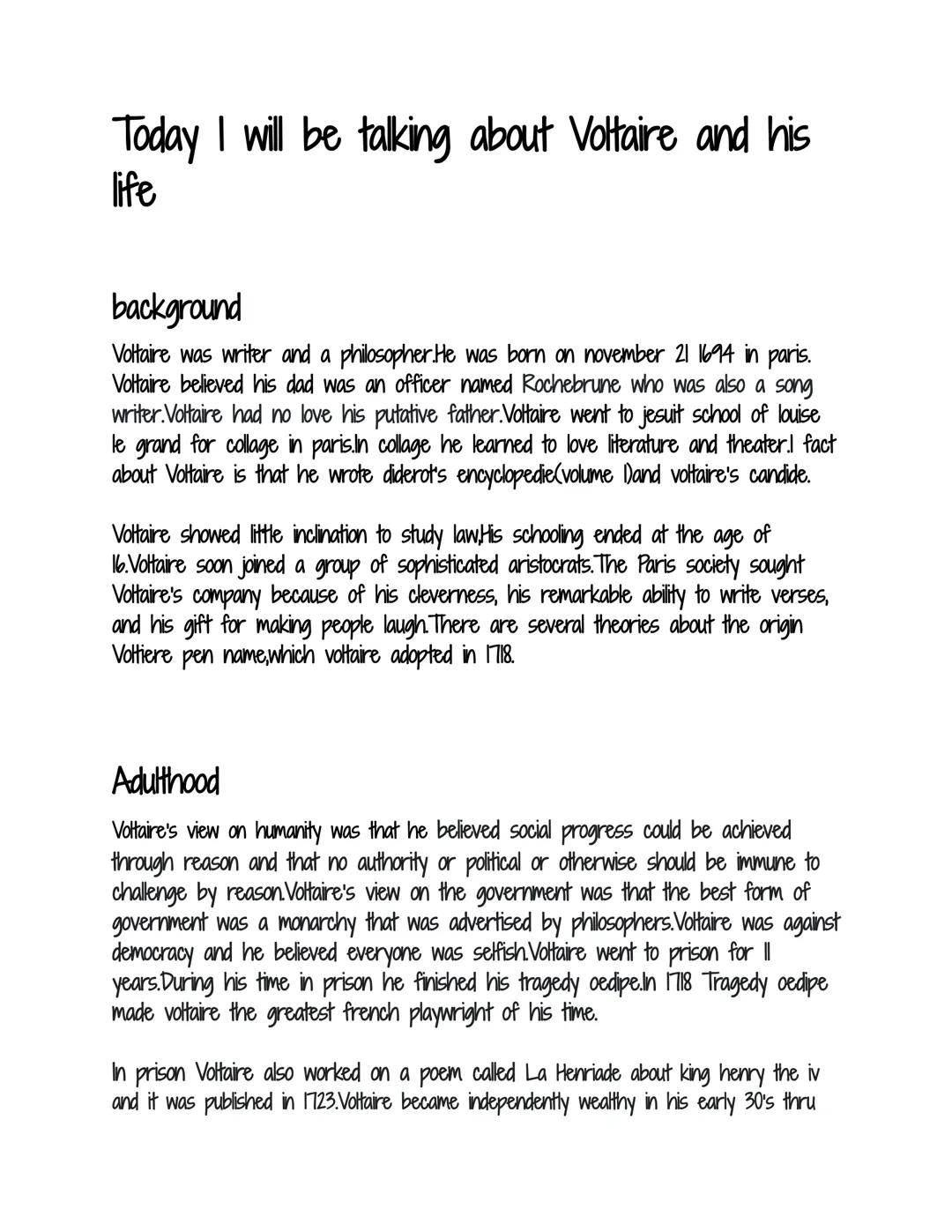
Early Life and Education
François-Marie Arouet, better known as Voltaire, was born on November 21, 1694, in Paris. Rather than following his father's wishes to study law, Voltaire developed a passion for literature and theater while attending the Jesuit school of Louis le Grand. By age 16, his formal education ended, and he quickly found himself among sophisticated aristocrats who enjoyed his cleverness and gift for making people laugh.
Voltaire's sharp wit and remarkable ability to write verses made him popular in Parisian society. In 1718, he adopted his famous pen name "Voltaire" and began his journey as a writer. His beliefs centered around using reason to challenge authority - he thought social progress could only be achieved through rational thinking.
Despite his opposition to democracy (believing people were inherently selfish), Voltaire faced consequences for his outspoken views. He spent eleven years in prison, during which he completed his tragedy "Oedipe." When published in 1718, this work established him as the greatest French playwright of his time. While imprisoned, he also worked on "La Henriade," a poem about King Henry IV.
Did you know? Voltaire became independently wealthy in his early 30s through inheritance and smart investments, giving him the financial freedom to focus on his writing and philosophical work.
2
of 2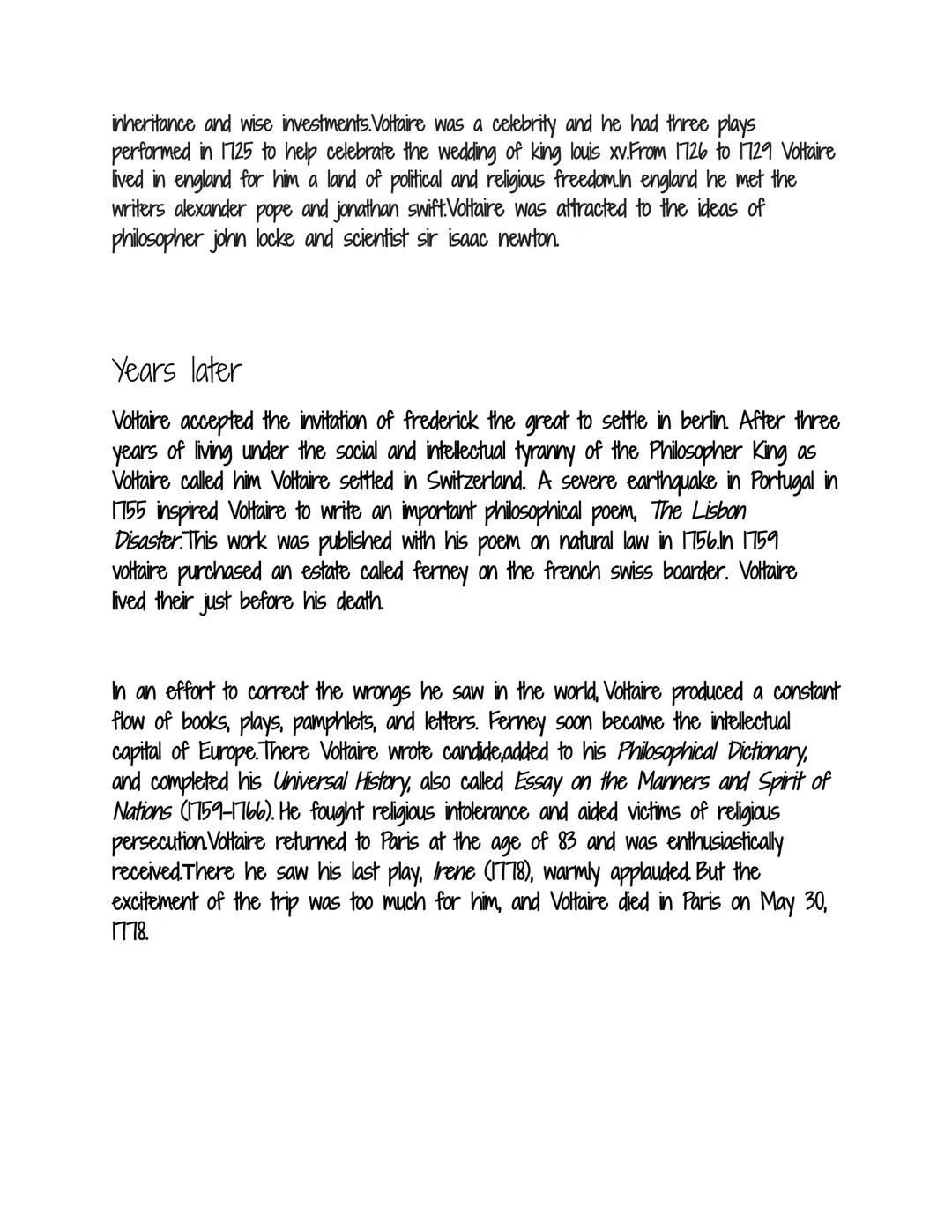
Later Life and Legacy
Voltaire's fame grew rapidly - he had three plays performed to celebrate King Louis XV's wedding in 1725. Seeking greater intellectual freedom, he lived in England from 1726 to 1729, where he encountered the ideas of philosopher John Locke and scientist Sir Isaac Newton. These influences shaped his developing philosophy about reason and freedom.
After briefly settling in Berlin at the invitation of Frederick the Great, Voltaire found the environment too restrictive and moved to Switzerland. The devastating 1755 Portuguese earthquake inspired him to write "The Lisbon Disaster," an important philosophical poem questioning divine providence. In 1759, he purchased an estate called Ferney near the French-Swiss border, where he would spend most of his remaining years.
Ferney became Europe's intellectual capital under Voltaire's influence. There, he wrote his famous work "Candide" and completed other major writings including his "Philosophical Dictionary" and "Essay on the Manners and Spirit of Nations." Throughout these years, Voltaire fought relentlessly against religious intolerance and helped victims of religious persecution.
At age 83, Voltaire returned triumphantly to Paris where his play "Irene" received warm acclaim. However, the excitement proved too much for the elderly philosopher, and he died in Paris on May 30, 1778, leaving behind a legacy of challenging authority and championing rational thought.
Think about it: Voltaire's commitment to fighting against injustice through his writings shows how the pen can be mightier than the sword. How might his approach to challenging authority through reason and writing apply to social issues today?
We thought you’d never ask...
What is the Knowunity AI companion?
Our AI companion is specifically built for the needs of students. Based on the millions of content pieces we have on the platform we can provide truly meaningful and relevant answers to students. But its not only about answers, the companion is even more about guiding students through their daily learning challenges, with personalised study plans, quizzes or content pieces in the chat and 100% personalisation based on the students skills and developments.
Where can I download the Knowunity app?
You can download the app in the Google Play Store and in the Apple App Store.
Is Knowunity really free of charge?
That's right! Enjoy free access to study content, connect with fellow students, and get instant help – all at your fingertips.
Similar Content
Most popular content in World History
9W
World HistoryWorld War 1 Multiple Choice Question Quiz
This quiz was created to test your knowledge of World War 1. This quiz contains questions about the war's events, alliances, significant battles, and the aftermath.
7th3800
World HistoryHumanism in the European Renaissance
Learn about Renaissance Humanism, an intellectual movement emphasizing human potential, achievements, and the revival of classical learning during the European transformation.
9th2323
World HistoryAncient River Civilizations: Mesopotamia, Egypt, and the Indus Valley
Covers the rise and characteristics of foundational early societies in Mesopotamia, the Nile Valley (Egypt), and the Indus Valley regions.
9th3602
P
World HistoryPaleolithic Era
This is a short little quiz based off of my notes from Advanced Global
9th1340
World HistoryAP 10 - QUARTER 2 NOTES
Globalisasyon SDG Migrasyon Teritoryal Dinastiyang Politikal
10th820
 English
A Raisin in the Sun Comprehension Questions [Act I, Scene One]
A Raisin in the Sun comprehension questions with answers.
9th1250
World HistoryAP World History Unit 1 Notes
Unit 1 Notes
2,830432
World HistoryByzantine Empire Study Guide
Covers: Justinian and Theodora, Constantinople, art and architecture, split of Catholic Church, etc.
9th1855
World HistoryThe Mongols
world history
632
Most popular content
9O
 AP US History
Origins and Dynamics of the Columbian Exchange
Analyze the ecological and economic motivations behind the initial transfer of goods, people, and diseases between the Old and New Worlds.
9th3,1280
I
AP US HistoryIntroduction to Early Cultural Interactions
Analyze the initial social and religious encounters between Europeans, Africans, and Indigenous peoples in the colonial Americas.
9th2,7730
O
AP World HistoryOrigins of Ancient River Civilizations
Analyze the environmental factors and technological innovations that led to the rise of early states in Mesopotamia, Egypt, and the Indus Valley.
9th3,1870
M
AP US HistoryMotivations for European Exploration
Analyze the economic, religious, and political factors that drove European powers to the Americas during the 15th and 16th centuries.
9th1,7780
F
 AP Psychology
Foundations of Ethical Guidelines in Research
Practice the core principles of the APA ethical code including informed consent, debriefing, and the role of Institutional Review Boards.
9th1,3360
I
AP US HistoryIntroduction to Native American Societies
Examine the diverse social, political, and economic structures of North American indigenous groups prior to European contact.
9th1,1100
I
 AP Biology
Introduction to Biological Elements of Life
Practice identifying the essential elements including carbon, nitrogen, phosphorus, and sulfur that compose biological macromolecules.
9th1,7390
I
AP US HistoryIntroduction to the Spanish Encomienda System
Explore the fundamental economic and social structures of the Spanish colonial system, focusing on the encomienda and the casta social hierarchy.
9th8890
O
AP World HistoryOrigins and Continuity of the Byzantine Empire
Analyze the political and cultural transitions from the Roman Empire to the Byzantine Empire, focusing on the reign of Justinian I and his code.
9th1,6320
Can't find what you're looking for? Explore other subjects.
Students love us — and so will you.
4.6/5App Store
4.7/5Google Play
The app is very easy to use and well designed. I have found everything I was looking for so far and have been able to learn a lot from the presentations! I will definitely use the app for a class assignment! And of course it also helps a lot as an inspiration.
Stefan SiOS user
This app is really great. There are so many study notes and help [...]. My problem subject is French, for example, and the app has so many options for help. Thanks to this app, I have improved my French. I would recommend it to anyone.
Samantha KlichAndroid user
Wow, I am really amazed. I just tried the app because I've seen it advertised many times and was absolutely stunned. This app is THE HELP you want for school and above all, it offers so many things, such as workouts and fact sheets, which have been VERY helpful to me personally.
AnnaiOS user
World History20 views·Updated Jun 17, 2026·2 pagesVoltaire and His Impact on World History
S
Shannon Jefferson (Student)@hannoneffersontudent_xycg
Voltaire was an influential writer and philosopher born in Paris in 1694 who shaped Enlightenment thinking. His clever wit, remarkable writing abilities, and challenging of authority made him one of the most significant intellectual figures of his time.
1
of 2
Sign up to see the content. It's free!
- Access to all documents
- Improve your grades
- Join milions of students
Early Life and Education
François-Marie Arouet, better known as Voltaire, was born on November 21, 1694, in Paris. Rather than following his father's wishes to study law, Voltaire developed a passion for literature and theater while attending the Jesuit school of Louis le Grand. By age 16, his formal education ended, and he quickly found himself among sophisticated aristocrats who enjoyed his cleverness and gift for making people laugh.
Voltaire's sharp wit and remarkable ability to write verses made him popular in Parisian society. In 1718, he adopted his famous pen name "Voltaire" and began his journey as a writer. His beliefs centered around using reason to challenge authority - he thought social progress could only be achieved through rational thinking.
Despite his opposition to democracy (believing people were inherently selfish), Voltaire faced consequences for his outspoken views. He spent eleven years in prison, during which he completed his tragedy "Oedipe." When published in 1718, this work established him as the greatest French playwright of his time. While imprisoned, he also worked on "La Henriade," a poem about King Henry IV.
Did you know? Voltaire became independently wealthy in his early 30s through inheritance and smart investments, giving him the financial freedom to focus on his writing and philosophical work.
2
of 2Sign up to see the content. It's free!
- Access to all documents
- Improve your grades
- Join milions of students
Later Life and Legacy
Voltaire's fame grew rapidly - he had three plays performed to celebrate King Louis XV's wedding in 1725. Seeking greater intellectual freedom, he lived in England from 1726 to 1729, where he encountered the ideas of philosopher John Locke and scientist Sir Isaac Newton. These influences shaped his developing philosophy about reason and freedom.
After briefly settling in Berlin at the invitation of Frederick the Great, Voltaire found the environment too restrictive and moved to Switzerland. The devastating 1755 Portuguese earthquake inspired him to write "The Lisbon Disaster," an important philosophical poem questioning divine providence. In 1759, he purchased an estate called Ferney near the French-Swiss border, where he would spend most of his remaining years.
Ferney became Europe's intellectual capital under Voltaire's influence. There, he wrote his famous work "Candide" and completed other major writings including his "Philosophical Dictionary" and "Essay on the Manners and Spirit of Nations." Throughout these years, Voltaire fought relentlessly against religious intolerance and helped victims of religious persecution.
At age 83, Voltaire returned triumphantly to Paris where his play "Irene" received warm acclaim. However, the excitement proved too much for the elderly philosopher, and he died in Paris on May 30, 1778, leaving behind a legacy of challenging authority and championing rational thought.
Think about it: Voltaire's commitment to fighting against injustice through his writings shows how the pen can be mightier than the sword. How might his approach to challenging authority through reason and writing apply to social issues today?
We thought you’d never ask...
What is the Knowunity AI companion?
Our AI companion is specifically built for the needs of students. Based on the millions of content pieces we have on the platform we can provide truly meaningful and relevant answers to students. But its not only about answers, the companion is even more about guiding students through their daily learning challenges, with personalised study plans, quizzes or content pieces in the chat and 100% personalisation based on the students skills and developments.
Where can I download the Knowunity app?
You can download the app in the Google Play Store and in the Apple App Store.
Is Knowunity really free of charge?
That's right! Enjoy free access to study content, connect with fellow students, and get instant help – all at your fingertips.
Similar Content
Most popular content in World History
9W
World HistoryWorld War 1 Multiple Choice Question Quiz
This quiz was created to test your knowledge of World War 1. This quiz contains questions about the war's events, alliances, significant battles, and the aftermath.
7th3800
World HistoryHumanism in the European Renaissance
Learn about Renaissance Humanism, an intellectual movement emphasizing human potential, achievements, and the revival of classical learning during the European transformation.
9th2323
World HistoryAncient River Civilizations: Mesopotamia, Egypt, and the Indus Valley
Covers the rise and characteristics of foundational early societies in Mesopotamia, the Nile Valley (Egypt), and the Indus Valley regions.
9th3602
P
World HistoryPaleolithic Era
This is a short little quiz based off of my notes from Advanced Global
9th1340
World HistoryAP 10 - QUARTER 2 NOTES
Globalisasyon SDG Migrasyon Teritoryal Dinastiyang Politikal
10th820
EnglishA Raisin in the Sun Comprehension Questions [Act I, Scene One]
A Raisin in the Sun comprehension questions with answers.
9th1250
World HistoryAP World History Unit 1 Notes
Unit 1 Notes
2,830432
World HistoryByzantine Empire Study Guide
Covers: Justinian and Theodora, Constantinople, art and architecture, split of Catholic Church, etc.
9th1855
World HistoryThe Mongols
world history
632
Most popular content
9O
AP US HistoryOrigins and Dynamics of the Columbian Exchange
Analyze the ecological and economic motivations behind the initial transfer of goods, people, and diseases between the Old and New Worlds.
9th3,1280
I
AP US HistoryIntroduction to Early Cultural Interactions
Analyze the initial social and religious encounters between Europeans, Africans, and Indigenous peoples in the colonial Americas.
9th2,7730
O
AP World HistoryOrigins of Ancient River Civilizations
Analyze the environmental factors and technological innovations that led to the rise of early states in Mesopotamia, Egypt, and the Indus Valley.
9th3,1870
M
AP US HistoryMotivations for European Exploration
Analyze the economic, religious, and political factors that drove European powers to the Americas during the 15th and 16th centuries.
9th1,7780
F
AP PsychologyFoundations of Ethical Guidelines in Research
Practice the core principles of the APA ethical code including informed consent, debriefing, and the role of Institutional Review Boards.
9th1,3360
I
AP US HistoryIntroduction to Native American Societies
Examine the diverse social, political, and economic structures of North American indigenous groups prior to European contact.
9th1,1100
I
AP BiologyIntroduction to Biological Elements of Life
Practice identifying the essential elements including carbon, nitrogen, phosphorus, and sulfur that compose biological macromolecules.
9th1,7390
I
AP US HistoryIntroduction to the Spanish Encomienda System
Explore the fundamental economic and social structures of the Spanish colonial system, focusing on the encomienda and the casta social hierarchy.
9th8890
O
AP World HistoryOrigins and Continuity of the Byzantine Empire
Analyze the political and cultural transitions from the Roman Empire to the Byzantine Empire, focusing on the reign of Justinian I and his code.
9th1,6320
Can't find what you're looking for? Explore other subjects.
Students love us — and so will you.
4.6/5App Store
4.7/5Google Play
The app is very easy to use and well designed. I have found everything I was looking for so far and have been able to learn a lot from the presentations! I will definitely use the app for a class assignment! And of course it also helps a lot as an inspiration.
Stefan SiOS user
This app is really great. There are so many study notes and help [...]. My problem subject is French, for example, and the app has so many options for help. Thanks to this app, I have improved my French. I would recommend it to anyone.
Samantha KlichAndroid user
Wow, I am really amazed. I just tried the app because I've seen it advertised many times and was absolutely stunned. This app is THE HELP you want for school and above all, it offers so many things, such as workouts and fact sheets, which have been VERY helpful to me personally.
AnnaiOS user