

The French Revolution was a pivotal historical event that transformed...
 World History90 views·Updated Jun 19, 2026·2 pages
The French Revolution: Causes, Events, and Effects
1
of 2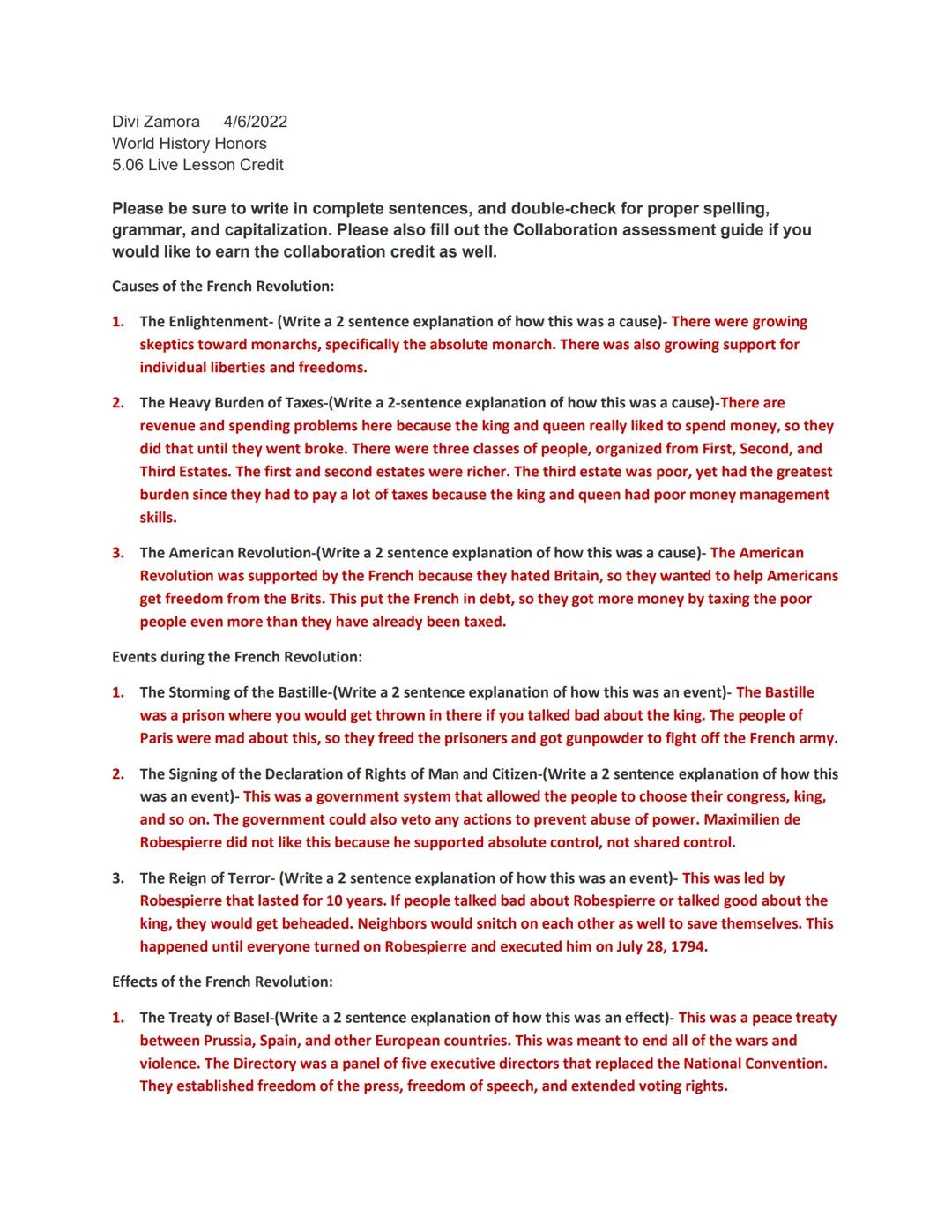
Causes and Early Events of the French Revolution
The Enlightenment sparked the revolution by breeding skepticism toward absolute monarchs while promoting individual liberties and freedoms. These new ideas gave people the intellectual framework to question traditional authority structures.
The Heavy Burden of Taxes created immense social tension. While King Louis XVI and Marie Antoinette indulged in lavish spending that drained the treasury, the Third Estate (common people) bore the crushing weight of taxation. The wealthy First and Second Estates (clergy and nobility) remained largely exempt, creating a perfect storm of resentment.
France's support of the American Revolution against their British rivals ultimately backfired financially. While helping Americans gain independence satisfied their rivalry with Britain, it plunged France deeper into debt, forcing them to further increase taxes on the already struggling Third Estate.
Did you know? The storming of the Bastille prison on July 14, 1789 is still celebrated as a national holiday in France (Bastille Day), marking the beginning of the French Revolution.
The Storming of the Bastille became a defining moment when Parisians attacked the infamous prison where critics of the king were held. The revolutionaries freed prisoners and seized gunpowder to arm themselves against royal forces, transforming political discontent into direct action.
The Declaration of the Rights of Man and Citizen established a government system with elected representatives and checks on power. This revolutionary document, inspired by Enlightenment ideals, was opposed by radicals like Maximilien Robespierre who sought more absolute control.
Robespierre later led the notorious Reign of Terror, a 10-year period of extreme violence where those suspected of opposing the revolution or supporting the monarchy faced the guillotine. The climate of fear encouraged citizens to denounce neighbors until Robespierre himself was eventually executed on July 28, 1794, ending the Terror.
2
of 2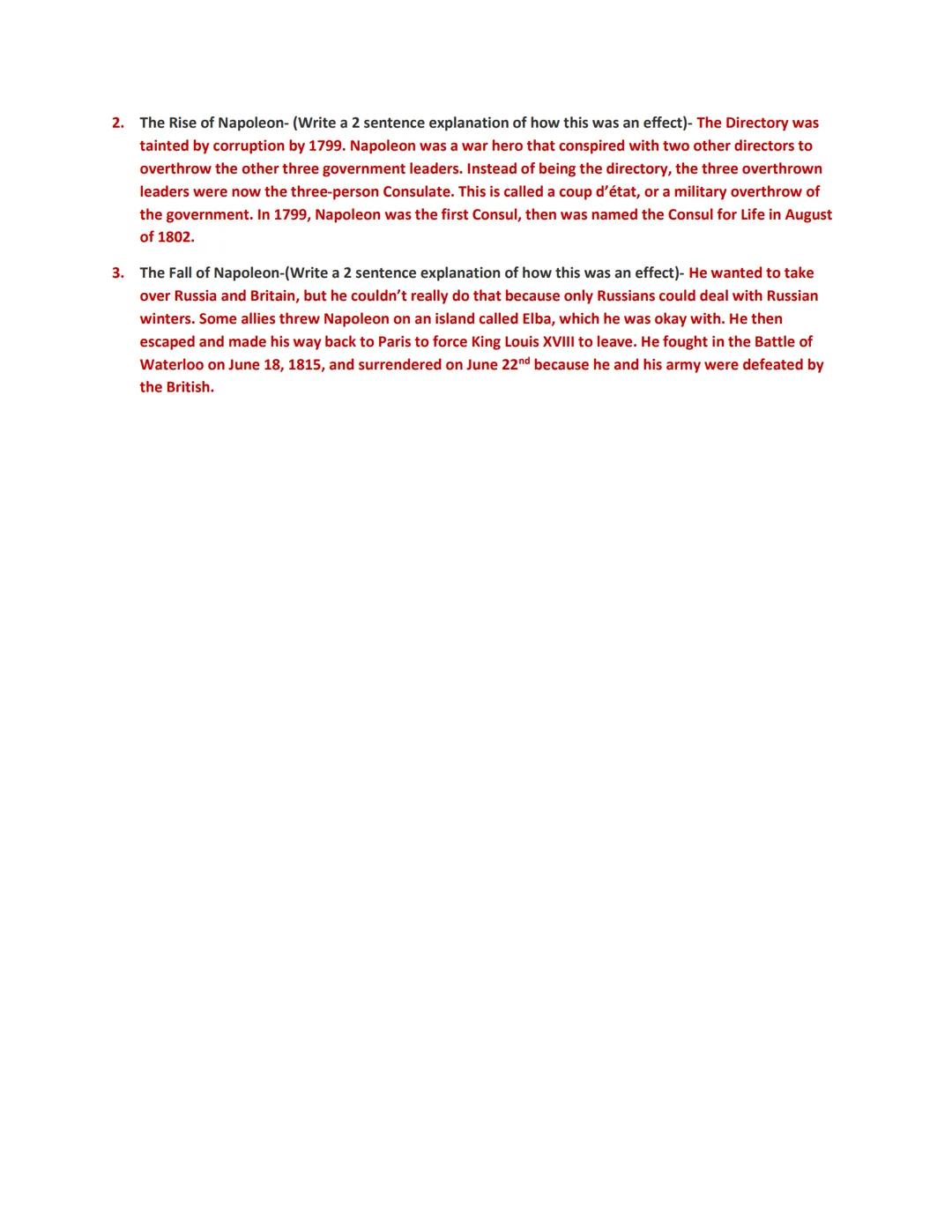
Aftermath and Napoleon's Influence
The Treaty of Basel brought much-needed peace between France and several European nations after years of revolutionary violence. Following this treaty, the Directory—a panel of five executive directors—replaced the National Convention and established critical freedoms like freedom of speech, press, and expanded voting rights.
Corruption eventually undermined the Directory, setting the stage for Napoleon Bonaparte's rise to power. As a celebrated war hero, Napoleon collaborated with two directors to overthrow the other three in a coup d'état (military overthrow) in 1799. The new government became the three-person Consulate, with Napoleon as First Consul before being named Consul for Life in 1802.
Napoleon's ambitious military campaigns eventually led to his downfall. His invasion of Russia proved disastrous as his forces couldn't withstand the harsh Russian winter. After being exiled to Elba, he escaped and returned to Paris, forcing King Louis XVIII to flee.
Think about it: Napoleon's final defeat at Waterloo in 1815 ended his rule, but his legal reforms (the Napoleonic Code) continue to influence legal systems around the world today.
Napoleon's comeback was short-lived. He suffered a crushing defeat at the Battle of Waterloo on June 18, 1815, at the hands of British forces. Just four days later, on June 22nd, he surrendered, bringing an end to his rule and marking the conclusion of this turbulent chapter in French history.
The French Revolution's legacy extended far beyond France's borders, inspiring revolutionary movements worldwide and establishing principles of liberty, equality, and democracy that continue to shape modern governments.
We thought you’d never ask...
What is the Knowunity AI companion?
Our AI companion is specifically built for the needs of students. Based on the millions of content pieces we have on the platform we can provide truly meaningful and relevant answers to students. But its not only about answers, the companion is even more about guiding students through their daily learning challenges, with personalised study plans, quizzes or content pieces in the chat and 100% personalisation based on the students skills and developments.
Where can I download the Knowunity app?
You can download the app in the Google Play Store and in the Apple App Store.
Is Knowunity really free of charge?
That's right! Enjoy free access to study content, connect with fellow students, and get instant help – all at your fingertips.
Similar Content
Most popular content in World History
9W
World HistoryWorld War 1 Multiple Choice Question Quiz
This quiz was created to test your knowledge of World War 1. This quiz contains questions about the war's events, alliances, significant battles, and the aftermath.
7th3800
World HistoryHumanism in the European Renaissance
Learn about Renaissance Humanism, an intellectual movement emphasizing human potential, achievements, and the revival of classical learning during the European transformation.
9th2323
World HistoryAncient River Civilizations: Mesopotamia, Egypt, and the Indus Valley
Covers the rise and characteristics of foundational early societies in Mesopotamia, the Nile Valley (Egypt), and the Indus Valley regions.
9th3602
P
World HistoryPaleolithic Era
This is a short little quiz based off of my notes from Advanced Global
9th1340
World HistoryAP 10 - QUARTER 2 NOTES
Globalisasyon SDG Migrasyon Teritoryal Dinastiyang Politikal
10th820
 English
A Raisin in the Sun Comprehension Questions [Act I, Scene One]
A Raisin in the Sun comprehension questions with answers.
9th1250
World HistoryAP World History Unit 1 Notes
Unit 1 Notes
2,830432
World HistoryByzantine Empire Study Guide
Covers: Justinian and Theodora, Constantinople, art and architecture, split of Catholic Church, etc.
9th1855
World HistoryThe Mongols
world history
632
Most popular content
9O
 AP US History
Origins and Dynamics of the Columbian Exchange
Analyze the ecological and economic motivations behind the initial transfer of goods, people, and diseases between the Old and New Worlds.
9th3,1280
I
AP US HistoryIntroduction to Early Cultural Interactions
Analyze the initial social and religious encounters between Europeans, Africans, and Indigenous peoples in the colonial Americas.
9th2,7730
O
AP World HistoryOrigins of Ancient River Civilizations
Analyze the environmental factors and technological innovations that led to the rise of early states in Mesopotamia, Egypt, and the Indus Valley.
9th3,1870
M
AP US HistoryMotivations for European Exploration
Analyze the economic, religious, and political factors that drove European powers to the Americas during the 15th and 16th centuries.
9th1,7780
F
 AP Psychology
Foundations of Ethical Guidelines in Research
Practice the core principles of the APA ethical code including informed consent, debriefing, and the role of Institutional Review Boards.
9th1,3360
I
AP US HistoryIntroduction to Native American Societies
Examine the diverse social, political, and economic structures of North American indigenous groups prior to European contact.
9th1,1100
I
 AP Biology
Introduction to Biological Elements of Life
Practice identifying the essential elements including carbon, nitrogen, phosphorus, and sulfur that compose biological macromolecules.
9th1,7390
I
AP US HistoryIntroduction to the Spanish Encomienda System
Explore the fundamental economic and social structures of the Spanish colonial system, focusing on the encomienda and the casta social hierarchy.
9th8890
O
AP World HistoryOrigins and Continuity of the Byzantine Empire
Analyze the political and cultural transitions from the Roman Empire to the Byzantine Empire, focusing on the reign of Justinian I and his code.
9th1,6320
Can't find what you're looking for? Explore other subjects.
Students love us — and so will you.
4.6/5App Store
4.7/5Google Play
The app is very easy to use and well designed. I have found everything I was looking for so far and have been able to learn a lot from the presentations! I will definitely use the app for a class assignment! And of course it also helps a lot as an inspiration.
Stefan SiOS user
This app is really great. There are so many study notes and help [...]. My problem subject is French, for example, and the app has so many options for help. Thanks to this app, I have improved my French. I would recommend it to anyone.
Samantha KlichAndroid user
Wow, I am really amazed. I just tried the app because I've seen it advertised many times and was absolutely stunned. This app is THE HELP you want for school and above all, it offers so many things, such as workouts and fact sheets, which have been VERY helpful to me personally.
AnnaiOS user
World History90 views·Updated Jun 19, 2026·2 pagesThe French Revolution: Causes, Events, and Effects
The French Revolution was a pivotal historical event that transformed France from an absolute monarchy to a republic. This period of radical social and political upheaval was driven by deep inequalities, financial crisis, and new ideas about government and individual...
1
of 2
Sign up to see the content. It's free!
- Access to all documents
- Improve your grades
- Join milions of students
Causes and Early Events of the French Revolution
The Enlightenment sparked the revolution by breeding skepticism toward absolute monarchs while promoting individual liberties and freedoms. These new ideas gave people the intellectual framework to question traditional authority structures.
The Heavy Burden of Taxes created immense social tension. While King Louis XVI and Marie Antoinette indulged in lavish spending that drained the treasury, the Third Estate (common people) bore the crushing weight of taxation. The wealthy First and Second Estates (clergy and nobility) remained largely exempt, creating a perfect storm of resentment.
France's support of the American Revolution against their British rivals ultimately backfired financially. While helping Americans gain independence satisfied their rivalry with Britain, it plunged France deeper into debt, forcing them to further increase taxes on the already struggling Third Estate.
Did you know? The storming of the Bastille prison on July 14, 1789 is still celebrated as a national holiday in France (Bastille Day), marking the beginning of the French Revolution.
The Storming of the Bastille became a defining moment when Parisians attacked the infamous prison where critics of the king were held. The revolutionaries freed prisoners and seized gunpowder to arm themselves against royal forces, transforming political discontent into direct action.
The Declaration of the Rights of Man and Citizen established a government system with elected representatives and checks on power. This revolutionary document, inspired by Enlightenment ideals, was opposed by radicals like Maximilien Robespierre who sought more absolute control.
Robespierre later led the notorious Reign of Terror, a 10-year period of extreme violence where those suspected of opposing the revolution or supporting the monarchy faced the guillotine. The climate of fear encouraged citizens to denounce neighbors until Robespierre himself was eventually executed on July 28, 1794, ending the Terror.
2
of 2Sign up to see the content. It's free!
- Access to all documents
- Improve your grades
- Join milions of students
Aftermath and Napoleon's Influence
The Treaty of Basel brought much-needed peace between France and several European nations after years of revolutionary violence. Following this treaty, the Directory—a panel of five executive directors—replaced the National Convention and established critical freedoms like freedom of speech, press, and expanded voting rights.
Corruption eventually undermined the Directory, setting the stage for Napoleon Bonaparte's rise to power. As a celebrated war hero, Napoleon collaborated with two directors to overthrow the other three in a coup d'état (military overthrow) in 1799. The new government became the three-person Consulate, with Napoleon as First Consul before being named Consul for Life in 1802.
Napoleon's ambitious military campaigns eventually led to his downfall. His invasion of Russia proved disastrous as his forces couldn't withstand the harsh Russian winter. After being exiled to Elba, he escaped and returned to Paris, forcing King Louis XVIII to flee.
Think about it: Napoleon's final defeat at Waterloo in 1815 ended his rule, but his legal reforms (the Napoleonic Code) continue to influence legal systems around the world today.
Napoleon's comeback was short-lived. He suffered a crushing defeat at the Battle of Waterloo on June 18, 1815, at the hands of British forces. Just four days later, on June 22nd, he surrendered, bringing an end to his rule and marking the conclusion of this turbulent chapter in French history.
The French Revolution's legacy extended far beyond France's borders, inspiring revolutionary movements worldwide and establishing principles of liberty, equality, and democracy that continue to shape modern governments.
We thought you’d never ask...
What is the Knowunity AI companion?
Our AI companion is specifically built for the needs of students. Based on the millions of content pieces we have on the platform we can provide truly meaningful and relevant answers to students. But its not only about answers, the companion is even more about guiding students through their daily learning challenges, with personalised study plans, quizzes or content pieces in the chat and 100% personalisation based on the students skills and developments.
Where can I download the Knowunity app?
You can download the app in the Google Play Store and in the Apple App Store.
Is Knowunity really free of charge?
That's right! Enjoy free access to study content, connect with fellow students, and get instant help – all at your fingertips.
Similar Content
Most popular content in World History
9W
World HistoryWorld War 1 Multiple Choice Question Quiz
This quiz was created to test your knowledge of World War 1. This quiz contains questions about the war's events, alliances, significant battles, and the aftermath.
7th3800
World HistoryHumanism in the European Renaissance
Learn about Renaissance Humanism, an intellectual movement emphasizing human potential, achievements, and the revival of classical learning during the European transformation.
9th2323
World HistoryAncient River Civilizations: Mesopotamia, Egypt, and the Indus Valley
Covers the rise and characteristics of foundational early societies in Mesopotamia, the Nile Valley (Egypt), and the Indus Valley regions.
9th3602
P
World HistoryPaleolithic Era
This is a short little quiz based off of my notes from Advanced Global
9th1340
World HistoryAP 10 - QUARTER 2 NOTES
Globalisasyon SDG Migrasyon Teritoryal Dinastiyang Politikal
10th820
EnglishA Raisin in the Sun Comprehension Questions [Act I, Scene One]
A Raisin in the Sun comprehension questions with answers.
9th1250
World HistoryAP World History Unit 1 Notes
Unit 1 Notes
2,830432
World HistoryByzantine Empire Study Guide
Covers: Justinian and Theodora, Constantinople, art and architecture, split of Catholic Church, etc.
9th1855
World HistoryThe Mongols
world history
632
Most popular content
9O
AP US HistoryOrigins and Dynamics of the Columbian Exchange
Analyze the ecological and economic motivations behind the initial transfer of goods, people, and diseases between the Old and New Worlds.
9th3,1280
I
AP US HistoryIntroduction to Early Cultural Interactions
Analyze the initial social and religious encounters between Europeans, Africans, and Indigenous peoples in the colonial Americas.
9th2,7730
O
AP World HistoryOrigins of Ancient River Civilizations
Analyze the environmental factors and technological innovations that led to the rise of early states in Mesopotamia, Egypt, and the Indus Valley.
9th3,1870
M
AP US HistoryMotivations for European Exploration
Analyze the economic, religious, and political factors that drove European powers to the Americas during the 15th and 16th centuries.
9th1,7780
F
AP PsychologyFoundations of Ethical Guidelines in Research
Practice the core principles of the APA ethical code including informed consent, debriefing, and the role of Institutional Review Boards.
9th1,3360
I
AP US HistoryIntroduction to Native American Societies
Examine the diverse social, political, and economic structures of North American indigenous groups prior to European contact.
9th1,1100
I
AP BiologyIntroduction to Biological Elements of Life
Practice identifying the essential elements including carbon, nitrogen, phosphorus, and sulfur that compose biological macromolecules.
9th1,7390
I
AP US HistoryIntroduction to the Spanish Encomienda System
Explore the fundamental economic and social structures of the Spanish colonial system, focusing on the encomienda and the casta social hierarchy.
9th8890
O
AP World HistoryOrigins and Continuity of the Byzantine Empire
Analyze the political and cultural transitions from the Roman Empire to the Byzantine Empire, focusing on the reign of Justinian I and his code.
9th1,6320
Can't find what you're looking for? Explore other subjects.
Students love us — and so will you.
4.6/5App Store
4.7/5Google Play
The app is very easy to use and well designed. I have found everything I was looking for so far and have been able to learn a lot from the presentations! I will definitely use the app for a class assignment! And of course it also helps a lot as an inspiration.
Stefan SiOS user
This app is really great. There are so many study notes and help [...]. My problem subject is French, for example, and the app has so many options for help. Thanks to this app, I have improved my French. I would recommend it to anyone.
Samantha KlichAndroid user
Wow, I am really amazed. I just tried the app because I've seen it advertised many times and was absolutely stunned. This app is THE HELP you want for school and above all, it offers so many things, such as workouts and fact sheets, which have been VERY helpful to me personally.
AnnaiOS user