

The Enlightenment was an influential 18th-century intellectual movement that challenged...
 World History87 views·Updated Jun 14, 2026·4 pages
Key Enlightenment Thinkers and Their Ideas
1 / 4
1
of 4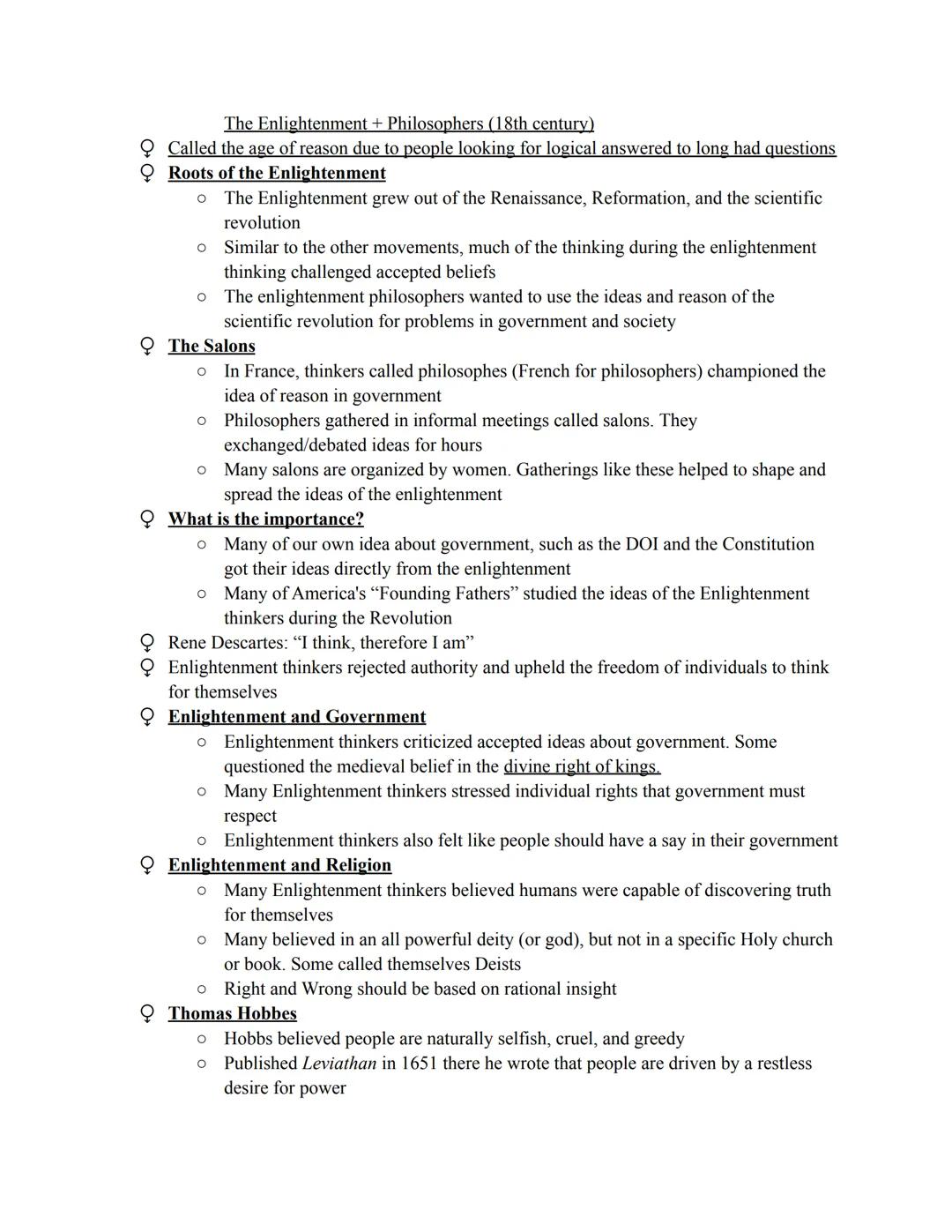
The Enlightenment: Age of Reason
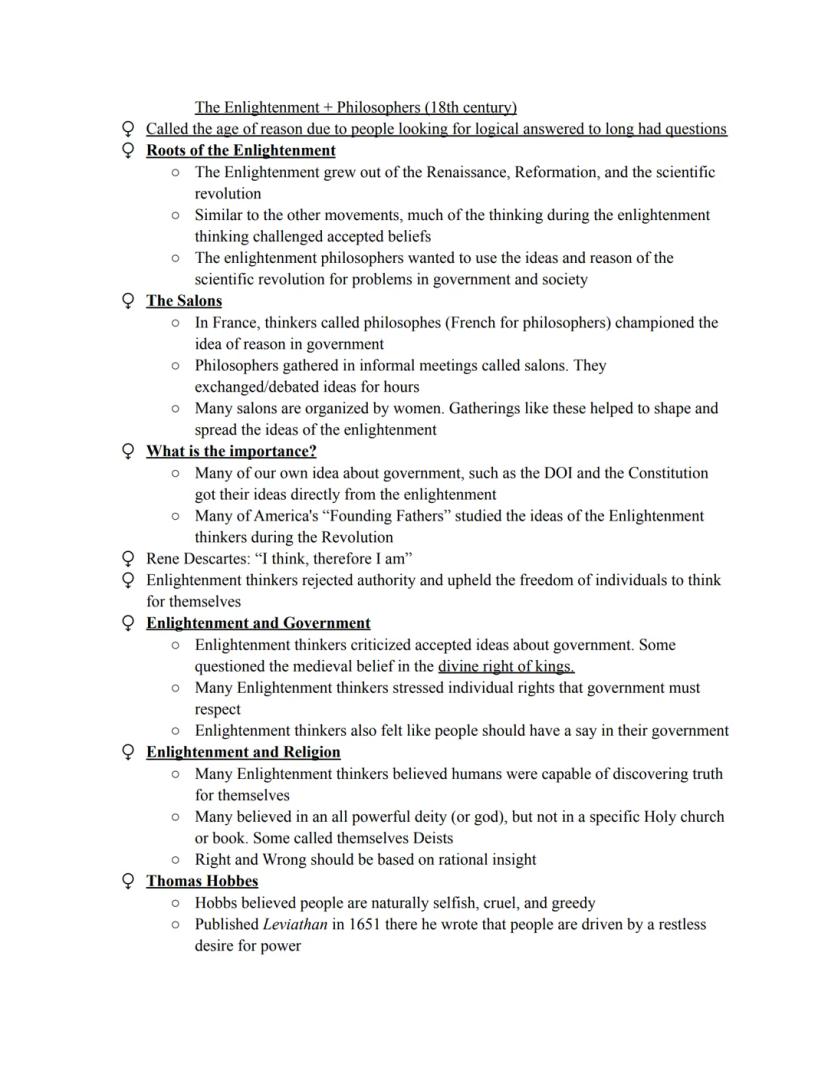
Ever wondered where the ideas behind the U.S. Constitution came from? The Enlightenment, an 18th-century movement, gave birth to many of them! This "Age of Reason" emerged from earlier movements like the Renaissance and Scientific Revolution, with thinkers applying scientific reasoning to solve problems in government and society.
In France, philosophers (called philosophes) gathered in informal meetings called salons, often organized by women. These lively gatherings became intellectual hotspots where ideas were debated and spread throughout society. The basic principle? Reject authority and think for yourself.
Enlightenment thinkers questioned traditional ideas about government, challenging concepts like the divine right of kings. Instead, they emphasized individual rights that governments must respect and argued people should have a say in how they're governed. Many were Deists who believed in a deity but rejected organized religion, preferring to base morality on rational thinking.
Did you know? Many of America's Founding Fathers studied Enlightenment philosophy extensively, which directly influenced the Declaration of Independence and Constitution that shape our country today!
2
of 4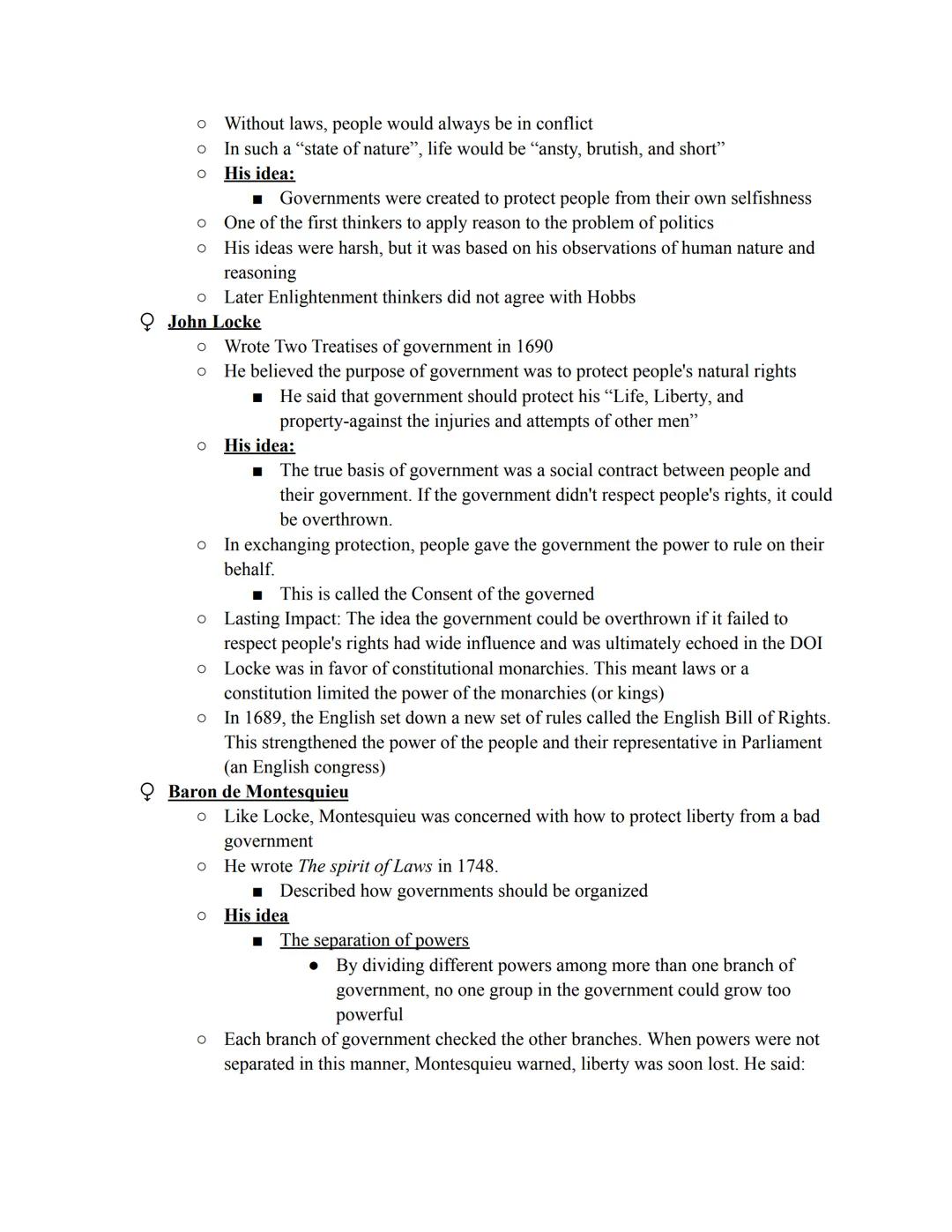
Key Enlightenment Philosophers
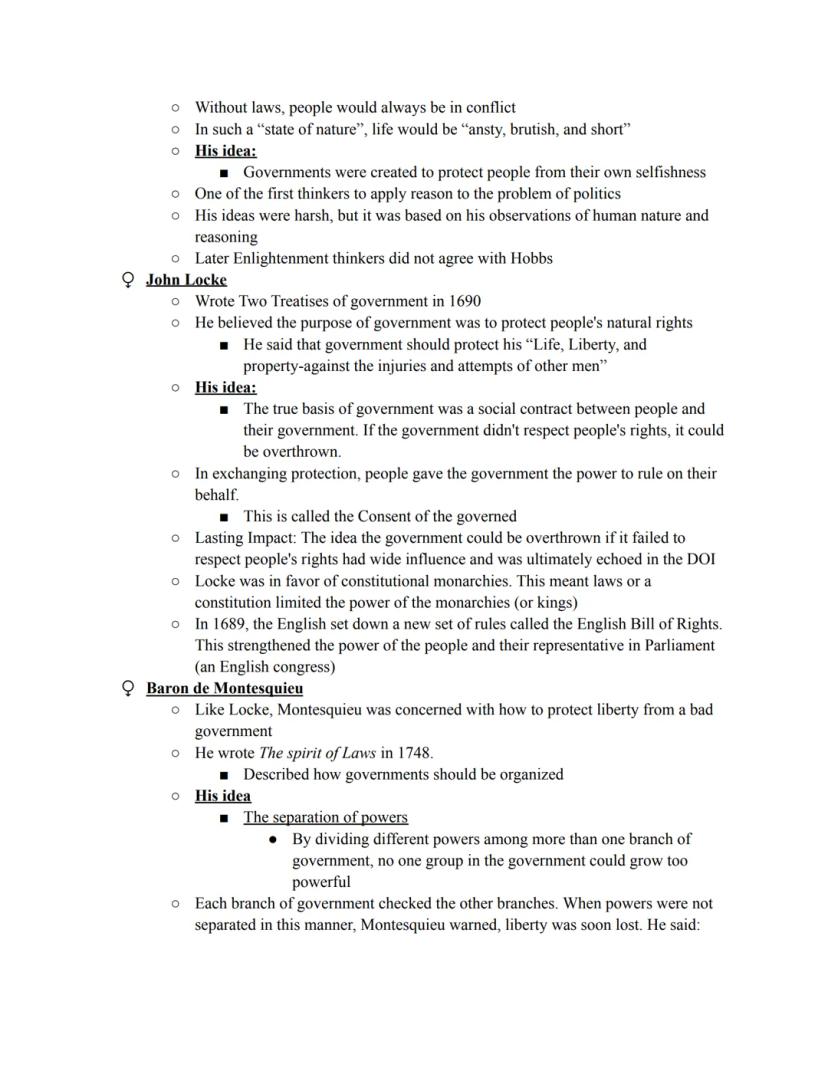
Thomas Hobbes had a pretty grim view of human nature. In his 1651 work Leviathan, he argued that people are naturally selfish and power-hungry. Without laws, Hobbes believed life would be "nasty, brutish, and short." His solution? Strong governments exist to protect people from their own worst instincts.
John Locke offered a more optimistic perspective in his Two Treatises of Government (1690). He believed governments should protect people's natural rights to "life, liberty, and property." Locke introduced the revolutionary idea of a social contract between citizens and government—if rulers failed to respect rights, people could overthrow them. This concept later appeared in the Declaration of Independence!
Baron de Montesquieu worried about preventing government abuse. In The Spirit of Laws (1748), he introduced the concept of separation of powers, dividing government into different branches to prevent any single group from becoming too powerful. He warned: "When legislative and executive powers are united in the same person... there can be no liberty."
Think about it: Our three-branch government system with checks and balances comes directly from Montesquieu's ideas. Next time you learn about the executive, legislative, and judicial branches, you're seeing Enlightenment philosophy in action!
3
of 4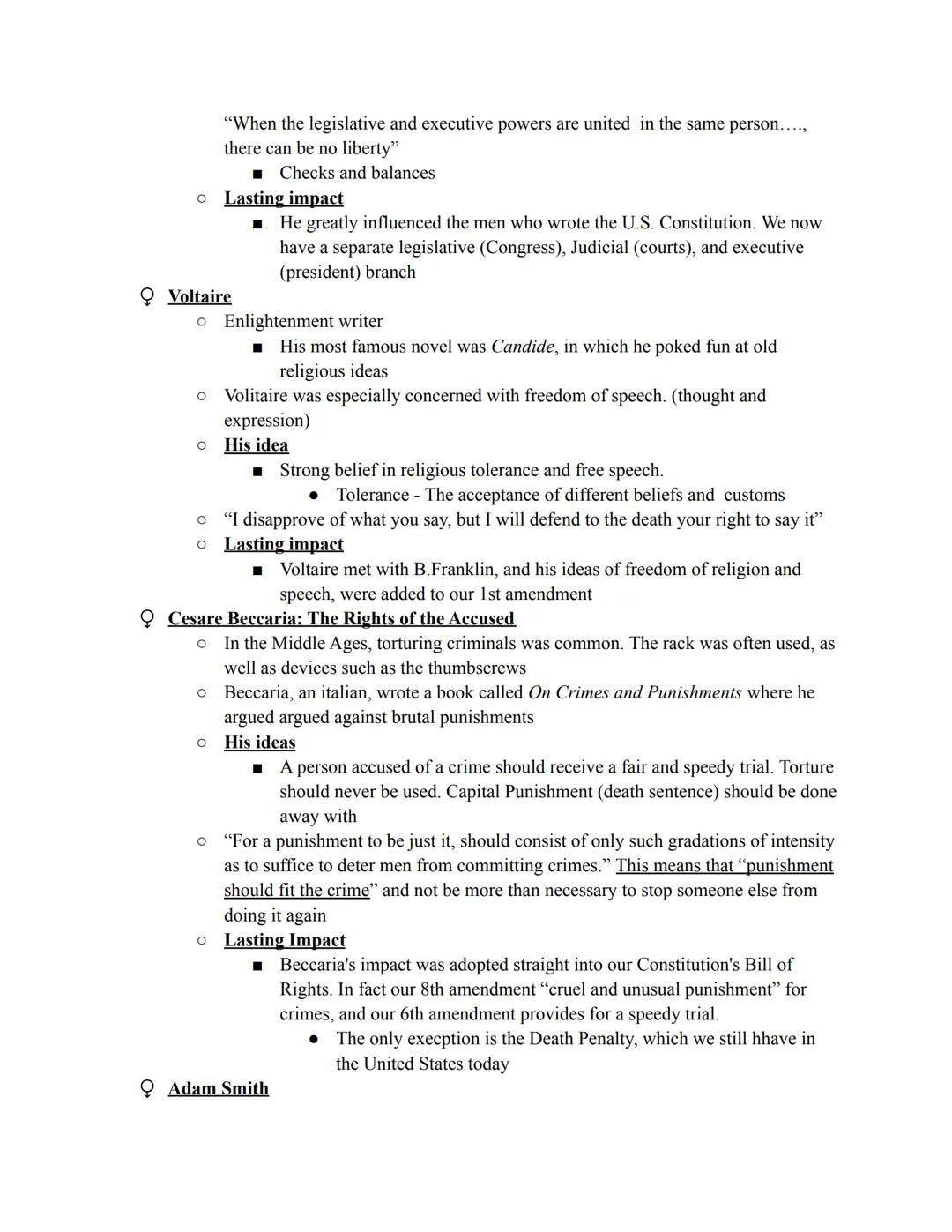
More Influential Thinkers
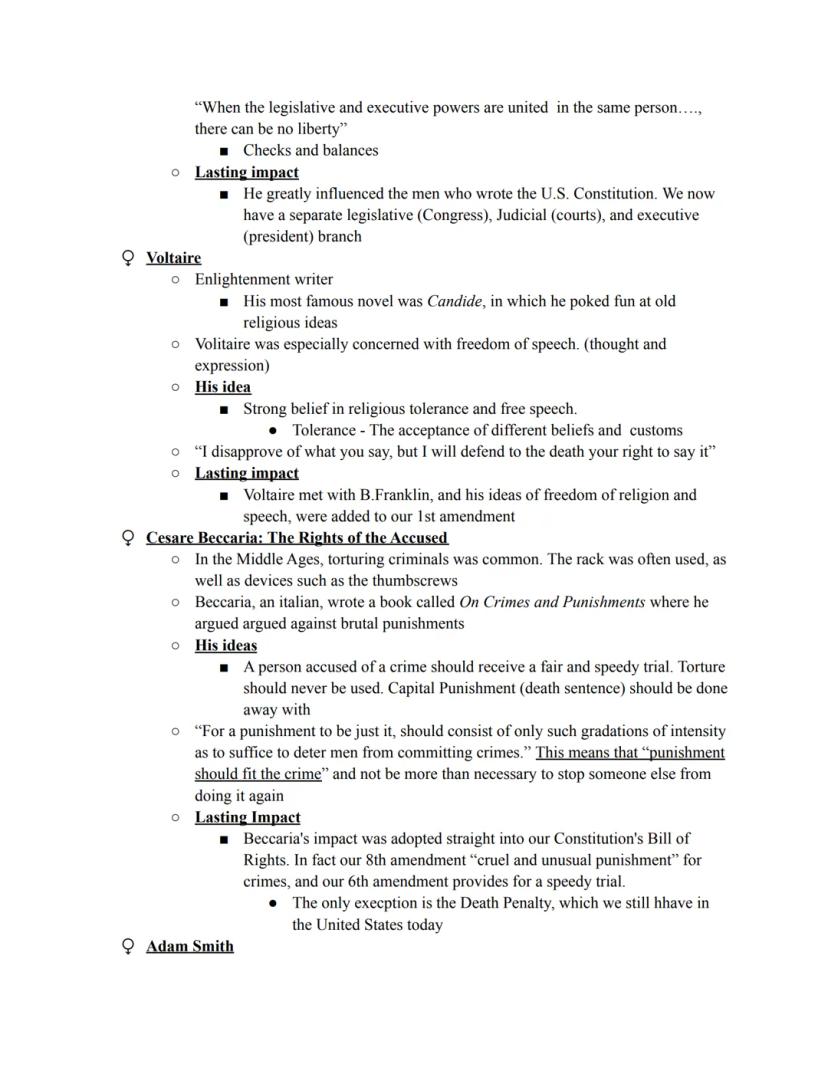
Voltaire championed freedom of speech and religious tolerance like nobody else. In his famous novel Candide, he cleverly mocked outdated religious ideas. His commitment to free expression is captured in his famous quote: "I disapprove of what you say, but I will defend to the death your right to say it." Voltaire later met with Benjamin Franklin, and his ideas directly influenced our First Amendment rights!
Criminal justice needed serious reform, and Cesare Beccaria led the charge. In the Middle Ages, torture devices like the rack and thumbscrews were common. Beccaria's book On Crimes and Punishments argued for fair, speedy trials and opposed brutal punishments. His principle that "punishment should fit the crime" revolutionized justice systems.
Our Constitution's Sixth Amendment (right to speedy trial) and Eighth Amendment (prohibition against cruel punishment) directly reflect Beccaria's thinking. The only exception? The death penalty, which the U.S. still maintains despite Beccaria arguing against it.
Connect the dots: The next time you hear about constitutional rights for accused persons, remember these weren't always guaranteed—they came from Enlightenment thinkers who fought against centuries of brutal criminal justice practices.
4
of 4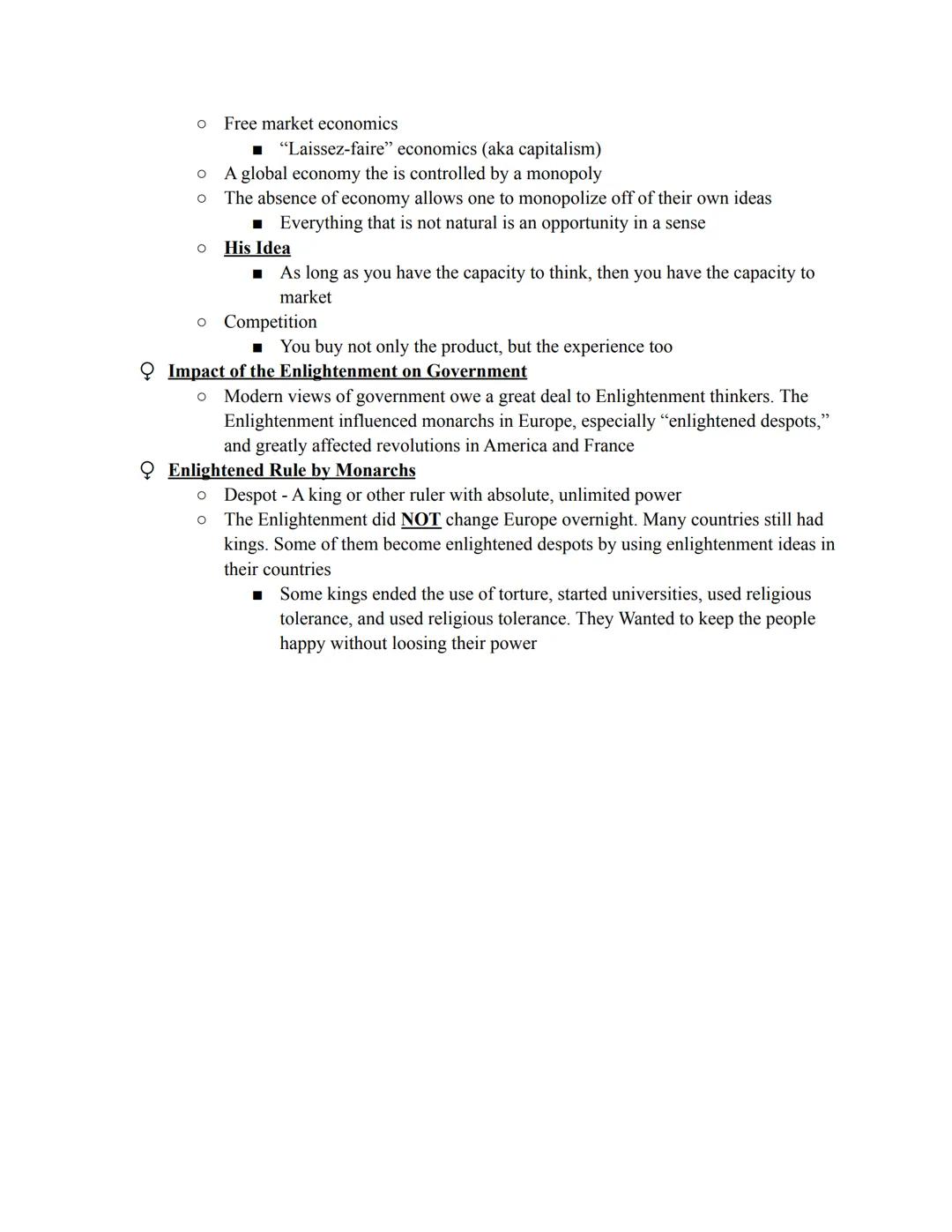
Economic Thought and Legacy
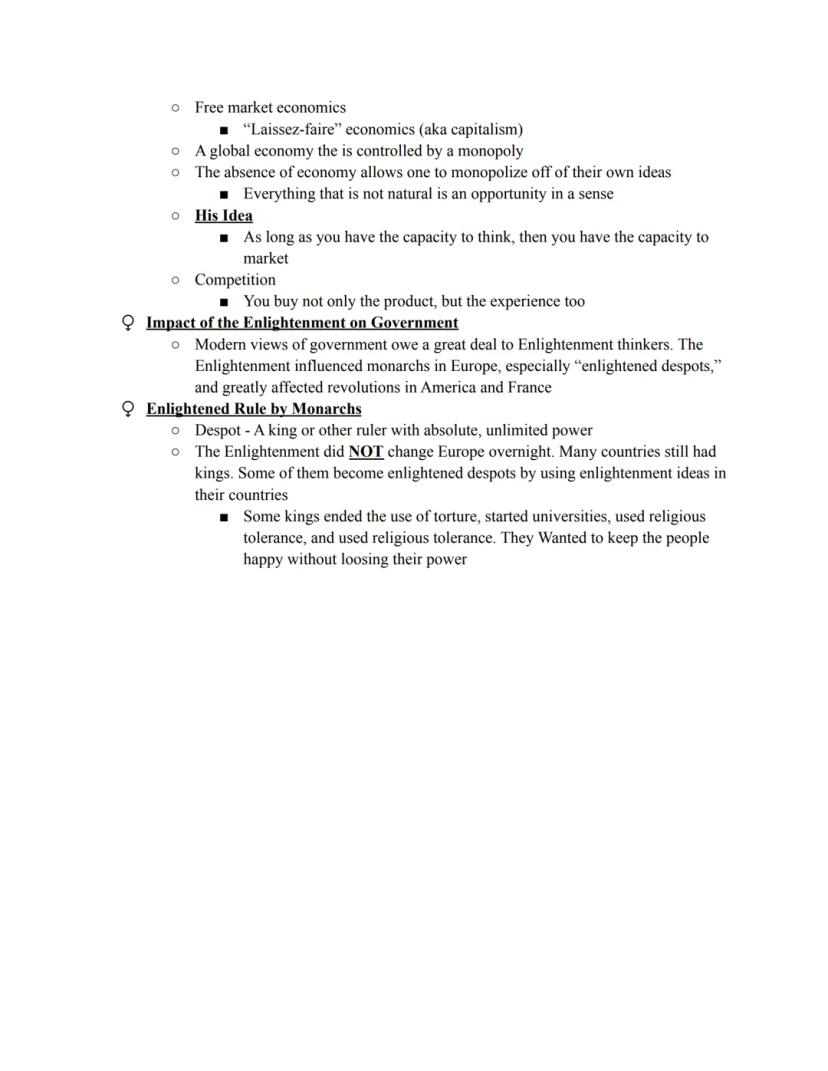
Adam Smith revolutionized economics with his ideas about free markets. He advocated for laissez-faire economics (capitalism), where competition drives prosperity. Smith believed that as long as people can think, they can participate in the market. His vision went beyond just buying products—he understood that consumers purchase experiences too.
The Enlightenment dramatically influenced modern government, though change didn't happen overnight. In Europe, some monarchs became enlightened despots—rulers with absolute power who nevertheless applied Enlightenment principles. They abolished torture, established universities, and practiced religious tolerance, all while trying to keep their people satisfied without surrendering their authority.
These Enlightenment ideas eventually fueled revolutions in America and France. The movement's emphasis on reason, individual rights, and limits on government power created the foundation for democratic systems that continue to evolve today.
Make it relevant: Many political debates today—about free speech, religious freedom, criminal justice reform, and limits on government power—have their roots in these Enlightenment discussions from nearly 300 years ago!
We thought you’d never ask...
What is the Knowunity AI companion?
Our AI companion is specifically built for the needs of students. Based on the millions of content pieces we have on the platform we can provide truly meaningful and relevant answers to students. But its not only about answers, the companion is even more about guiding students through their daily learning challenges, with personalised study plans, quizzes or content pieces in the chat and 100% personalisation based on the students skills and developments.
Where can I download the Knowunity app?
You can download the app in the Google Play Store and in the Apple App Store.
Is Knowunity really free of charge?
That's right! Enjoy free access to study content, connect with fellow students, and get instant help – all at your fingertips.
Similar Content
Most popular content in World History
9W
World HistoryWorld War 1 Multiple Choice Question Quiz
This quiz was created to test your knowledge of World War 1. This quiz contains questions about the war's events, alliances, significant battles, and the aftermath.
7th3800
World HistoryHumanism in the European Renaissance
Learn about Renaissance Humanism, an intellectual movement emphasizing human potential, achievements, and the revival of classical learning during the European transformation.
9th2323
World HistoryAncient River Civilizations: Mesopotamia, Egypt, and the Indus Valley
Covers the rise and characteristics of foundational early societies in Mesopotamia, the Nile Valley (Egypt), and the Indus Valley regions.
9th3602
P
World HistoryPaleolithic Era
This is a short little quiz based off of my notes from Advanced Global
9th1340
World HistoryAP 10 - QUARTER 2 NOTES
Globalisasyon SDG Migrasyon Teritoryal Dinastiyang Politikal
10th820
 English
A Raisin in the Sun Comprehension Questions [Act I, Scene One]
A Raisin in the Sun comprehension questions with answers.
9th1250
World HistoryAP World History Unit 1 Notes
Unit 1 Notes
2,830432
World HistoryByzantine Empire Study Guide
Covers: Justinian and Theodora, Constantinople, art and architecture, split of Catholic Church, etc.
9th1855
World HistoryThe Mongols
world history
632
Most popular content
9O
 AP US History
Origins and Dynamics of the Columbian Exchange
Analyze the ecological and economic motivations behind the initial transfer of goods, people, and diseases between the Old and New Worlds.
9th3,1280
I
AP US HistoryIntroduction to Early Cultural Interactions
Analyze the initial social and religious encounters between Europeans, Africans, and Indigenous peoples in the colonial Americas.
9th2,7730
O
AP World HistoryOrigins of Ancient River Civilizations
Analyze the environmental factors and technological innovations that led to the rise of early states in Mesopotamia, Egypt, and the Indus Valley.
9th3,1870
M
AP US HistoryMotivations for European Exploration
Analyze the economic, religious, and political factors that drove European powers to the Americas during the 15th and 16th centuries.
9th1,7780
F
 AP Psychology
Foundations of Ethical Guidelines in Research
Practice the core principles of the APA ethical code including informed consent, debriefing, and the role of Institutional Review Boards.
9th1,3360
I
AP US HistoryIntroduction to Native American Societies
Examine the diverse social, political, and economic structures of North American indigenous groups prior to European contact.
9th1,1100
I
 AP Biology
Introduction to Biological Elements of Life
Practice identifying the essential elements including carbon, nitrogen, phosphorus, and sulfur that compose biological macromolecules.
9th1,7390
I
AP US HistoryIntroduction to the Spanish Encomienda System
Explore the fundamental economic and social structures of the Spanish colonial system, focusing on the encomienda and the casta social hierarchy.
9th8890
O
AP World HistoryOrigins and Continuity of the Byzantine Empire
Analyze the political and cultural transitions from the Roman Empire to the Byzantine Empire, focusing on the reign of Justinian I and his code.
9th1,6320
Can't find what you're looking for? Explore other subjects.
Students love us — and so will you.
4.6/5App Store
4.7/5Google Play
The app is very easy to use and well designed. I have found everything I was looking for so far and have been able to learn a lot from the presentations! I will definitely use the app for a class assignment! And of course it also helps a lot as an inspiration.
Stefan SiOS user
This app is really great. There are so many study notes and help [...]. My problem subject is French, for example, and the app has so many options for help. Thanks to this app, I have improved my French. I would recommend it to anyone.
Samantha KlichAndroid user
Wow, I am really amazed. I just tried the app because I've seen it advertised many times and was absolutely stunned. This app is THE HELP you want for school and above all, it offers so many things, such as workouts and fact sheets, which have been VERY helpful to me personally.
AnnaiOS user
World History87 views·Updated Jun 14, 2026·4 pagesKey Enlightenment Thinkers and Their Ideas
The Enlightenment was an influential 18th-century intellectual movement that challenged traditional beliefs and championed reason and individual rights. Often called the "Age of Reason," this period saw philosophers develop revolutionary ideas about government, religion, and society that would later shape...
1
of 4
Sign up to see the content. It's free!
- Access to all documents
- Improve your grades
- Join milions of students
The Enlightenment: Age of Reason
Ever wondered where the ideas behind the U.S. Constitution came from? The Enlightenment, an 18th-century movement, gave birth to many of them! This "Age of Reason" emerged from earlier movements like the Renaissance and Scientific Revolution, with thinkers applying scientific reasoning to solve problems in government and society.
In France, philosophers (called philosophes) gathered in informal meetings called salons, often organized by women. These lively gatherings became intellectual hotspots where ideas were debated and spread throughout society. The basic principle? Reject authority and think for yourself.
Enlightenment thinkers questioned traditional ideas about government, challenging concepts like the divine right of kings. Instead, they emphasized individual rights that governments must respect and argued people should have a say in how they're governed. Many were Deists who believed in a deity but rejected organized religion, preferring to base morality on rational thinking.
Did you know? Many of America's Founding Fathers studied Enlightenment philosophy extensively, which directly influenced the Declaration of Independence and Constitution that shape our country today!
2
of 4Sign up to see the content. It's free!
- Access to all documents
- Improve your grades
- Join milions of students
Key Enlightenment Philosophers
Thomas Hobbes had a pretty grim view of human nature. In his 1651 work Leviathan, he argued that people are naturally selfish and power-hungry. Without laws, Hobbes believed life would be "nasty, brutish, and short." His solution? Strong governments exist to protect people from their own worst instincts.
John Locke offered a more optimistic perspective in his Two Treatises of Government (1690). He believed governments should protect people's natural rights to "life, liberty, and property." Locke introduced the revolutionary idea of a social contract between citizens and government—if rulers failed to respect rights, people could overthrow them. This concept later appeared in the Declaration of Independence!
Baron de Montesquieu worried about preventing government abuse. In The Spirit of Laws (1748), he introduced the concept of separation of powers, dividing government into different branches to prevent any single group from becoming too powerful. He warned: "When legislative and executive powers are united in the same person... there can be no liberty."
Think about it: Our three-branch government system with checks and balances comes directly from Montesquieu's ideas. Next time you learn about the executive, legislative, and judicial branches, you're seeing Enlightenment philosophy in action!
3
of 4Sign up to see the content. It's free!
- Access to all documents
- Improve your grades
- Join milions of students
More Influential Thinkers
Voltaire championed freedom of speech and religious tolerance like nobody else. In his famous novel Candide, he cleverly mocked outdated religious ideas. His commitment to free expression is captured in his famous quote: "I disapprove of what you say, but I will defend to the death your right to say it." Voltaire later met with Benjamin Franklin, and his ideas directly influenced our First Amendment rights!
Criminal justice needed serious reform, and Cesare Beccaria led the charge. In the Middle Ages, torture devices like the rack and thumbscrews were common. Beccaria's book On Crimes and Punishments argued for fair, speedy trials and opposed brutal punishments. His principle that "punishment should fit the crime" revolutionized justice systems.
Our Constitution's Sixth Amendment (right to speedy trial) and Eighth Amendment (prohibition against cruel punishment) directly reflect Beccaria's thinking. The only exception? The death penalty, which the U.S. still maintains despite Beccaria arguing against it.
Connect the dots: The next time you hear about constitutional rights for accused persons, remember these weren't always guaranteed—they came from Enlightenment thinkers who fought against centuries of brutal criminal justice practices.
4
of 4Sign up to see the content. It's free!
- Access to all documents
- Improve your grades
- Join milions of students
Economic Thought and Legacy
Adam Smith revolutionized economics with his ideas about free markets. He advocated for laissez-faire economics (capitalism), where competition drives prosperity. Smith believed that as long as people can think, they can participate in the market. His vision went beyond just buying products—he understood that consumers purchase experiences too.
The Enlightenment dramatically influenced modern government, though change didn't happen overnight. In Europe, some monarchs became enlightened despots—rulers with absolute power who nevertheless applied Enlightenment principles. They abolished torture, established universities, and practiced religious tolerance, all while trying to keep their people satisfied without surrendering their authority.
These Enlightenment ideas eventually fueled revolutions in America and France. The movement's emphasis on reason, individual rights, and limits on government power created the foundation for democratic systems that continue to evolve today.
Make it relevant: Many political debates today—about free speech, religious freedom, criminal justice reform, and limits on government power—have their roots in these Enlightenment discussions from nearly 300 years ago!
We thought you’d never ask...
What is the Knowunity AI companion?
Our AI companion is specifically built for the needs of students. Based on the millions of content pieces we have on the platform we can provide truly meaningful and relevant answers to students. But its not only about answers, the companion is even more about guiding students through their daily learning challenges, with personalised study plans, quizzes or content pieces in the chat and 100% personalisation based on the students skills and developments.
Where can I download the Knowunity app?
You can download the app in the Google Play Store and in the Apple App Store.
Is Knowunity really free of charge?
That's right! Enjoy free access to study content, connect with fellow students, and get instant help – all at your fingertips.
Similar Content
Most popular content in World History
9W
World HistoryWorld War 1 Multiple Choice Question Quiz
This quiz was created to test your knowledge of World War 1. This quiz contains questions about the war's events, alliances, significant battles, and the aftermath.
7th3800
World HistoryHumanism in the European Renaissance
Learn about Renaissance Humanism, an intellectual movement emphasizing human potential, achievements, and the revival of classical learning during the European transformation.
9th2323
World HistoryAncient River Civilizations: Mesopotamia, Egypt, and the Indus Valley
Covers the rise and characteristics of foundational early societies in Mesopotamia, the Nile Valley (Egypt), and the Indus Valley regions.
9th3602
P
World HistoryPaleolithic Era
This is a short little quiz based off of my notes from Advanced Global
9th1340
World HistoryAP 10 - QUARTER 2 NOTES
Globalisasyon SDG Migrasyon Teritoryal Dinastiyang Politikal
10th820
EnglishA Raisin in the Sun Comprehension Questions [Act I, Scene One]
A Raisin in the Sun comprehension questions with answers.
9th1250
World HistoryAP World History Unit 1 Notes
Unit 1 Notes
2,830432
World HistoryByzantine Empire Study Guide
Covers: Justinian and Theodora, Constantinople, art and architecture, split of Catholic Church, etc.
9th1855
World HistoryThe Mongols
world history
632
Most popular content
9O
AP US HistoryOrigins and Dynamics of the Columbian Exchange
Analyze the ecological and economic motivations behind the initial transfer of goods, people, and diseases between the Old and New Worlds.
9th3,1280
I
AP US HistoryIntroduction to Early Cultural Interactions
Analyze the initial social and religious encounters between Europeans, Africans, and Indigenous peoples in the colonial Americas.
9th2,7730
O
AP World HistoryOrigins of Ancient River Civilizations
Analyze the environmental factors and technological innovations that led to the rise of early states in Mesopotamia, Egypt, and the Indus Valley.
9th3,1870
M
AP US HistoryMotivations for European Exploration
Analyze the economic, religious, and political factors that drove European powers to the Americas during the 15th and 16th centuries.
9th1,7780
F
AP PsychologyFoundations of Ethical Guidelines in Research
Practice the core principles of the APA ethical code including informed consent, debriefing, and the role of Institutional Review Boards.
9th1,3360
I
AP US HistoryIntroduction to Native American Societies
Examine the diverse social, political, and economic structures of North American indigenous groups prior to European contact.
9th1,1100
I
AP BiologyIntroduction to Biological Elements of Life
Practice identifying the essential elements including carbon, nitrogen, phosphorus, and sulfur that compose biological macromolecules.
9th1,7390
I
AP US HistoryIntroduction to the Spanish Encomienda System
Explore the fundamental economic and social structures of the Spanish colonial system, focusing on the encomienda and the casta social hierarchy.
9th8890
O
AP World HistoryOrigins and Continuity of the Byzantine Empire
Analyze the political and cultural transitions from the Roman Empire to the Byzantine Empire, focusing on the reign of Justinian I and his code.
9th1,6320
Can't find what you're looking for? Explore other subjects.
Students love us — and so will you.
4.6/5App Store
4.7/5Google Play
The app is very easy to use and well designed. I have found everything I was looking for so far and have been able to learn a lot from the presentations! I will definitely use the app for a class assignment! And of course it also helps a lot as an inspiration.
Stefan SiOS user
This app is really great. There are so many study notes and help [...]. My problem subject is French, for example, and the app has so many options for help. Thanks to this app, I have improved my French. I would recommend it to anyone.
Samantha KlichAndroid user
Wow, I am really amazed. I just tried the app because I've seen it advertised many times and was absolutely stunned. This app is THE HELP you want for school and above all, it offers so many things, such as workouts and fact sheets, which have been VERY helpful to me personally.
AnnaiOS user