

The Renaissance and Reformation period marked a dramatic shift in...
 World History186 views·Updated Jun 12, 2026·8 pages
Comprehensive Study Guide for Test 2: Renaissance and English Reformation


1 / 8
1
of 8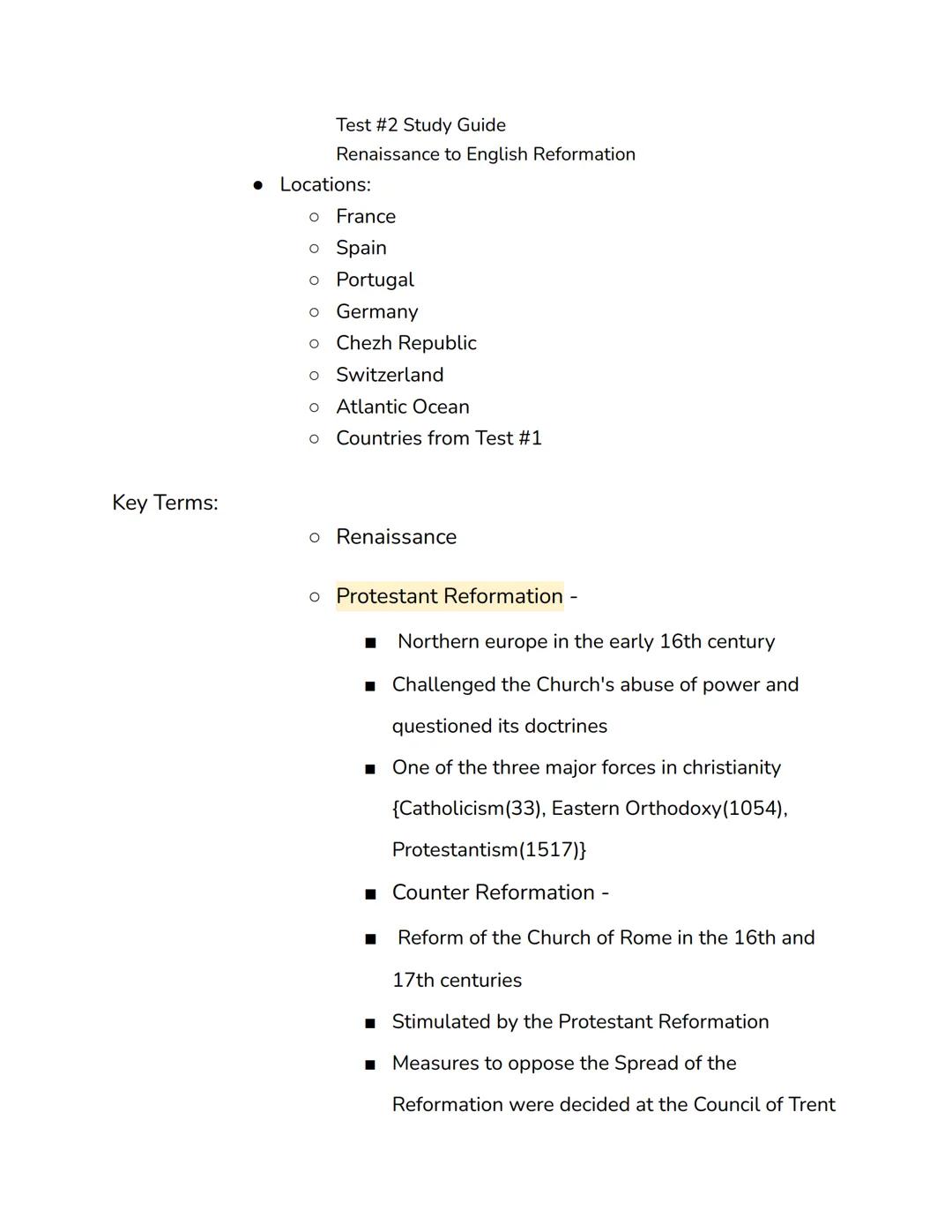
Renaissance and Protestant Reformation Foundations
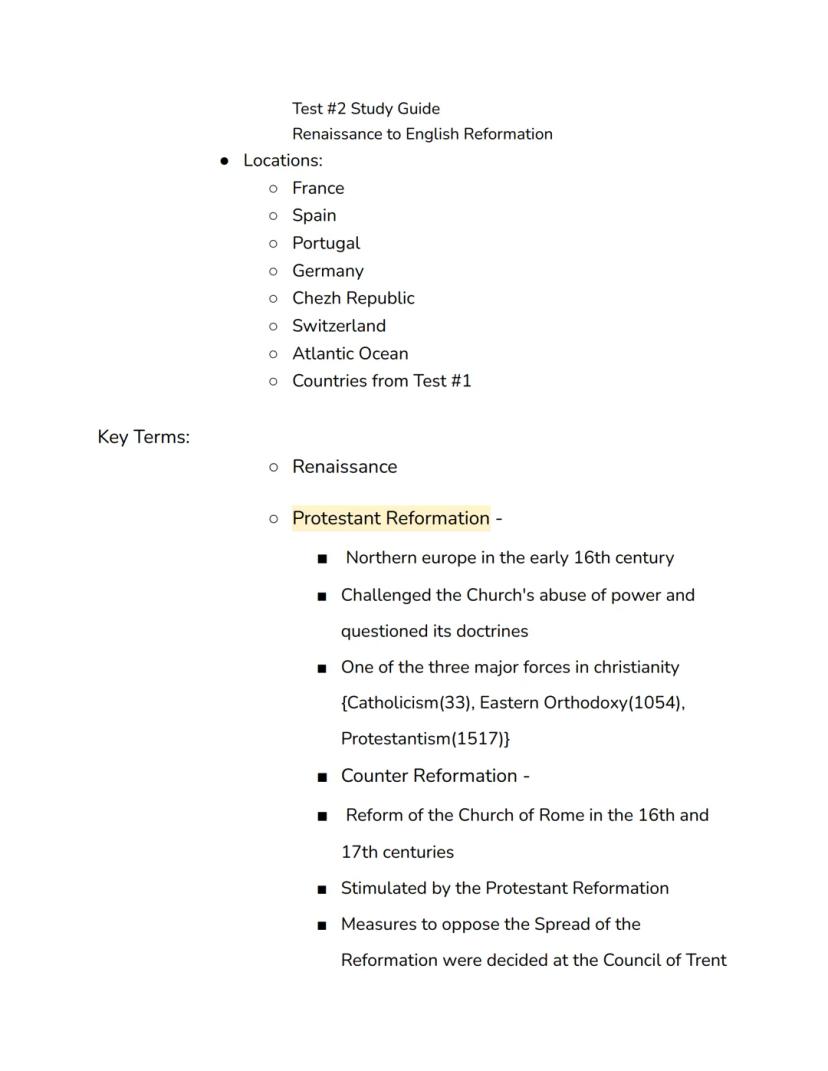
The Renaissance emerged as Europe recovered from the Black Death, beginning in Italy before spreading northward. This cultural rebirth emphasized humanism and classical learning, setting the stage for religious reform.
The Protestant Reformation erupted in Northern Europe during the early 16th century when reformers challenged the Catholic Church's power and doctrines. This movement fundamentally split Western Christianity into three major branches: Catholicism (established 33 CE), Eastern Orthodoxy (split in 1054), and Protestantism (beginning 1517).
In response, the Catholic Church launched the Counter Reformation, implementing reforms at the Council of Trent while actively opposing Protestant expansion. This defensive reaction sought to address corruption while preserving Catholic doctrine.
Remember This: The Protestant Reformation wasn't just a religious movement—it permanently changed European power structures, literacy rates, and national identities!
2
of 8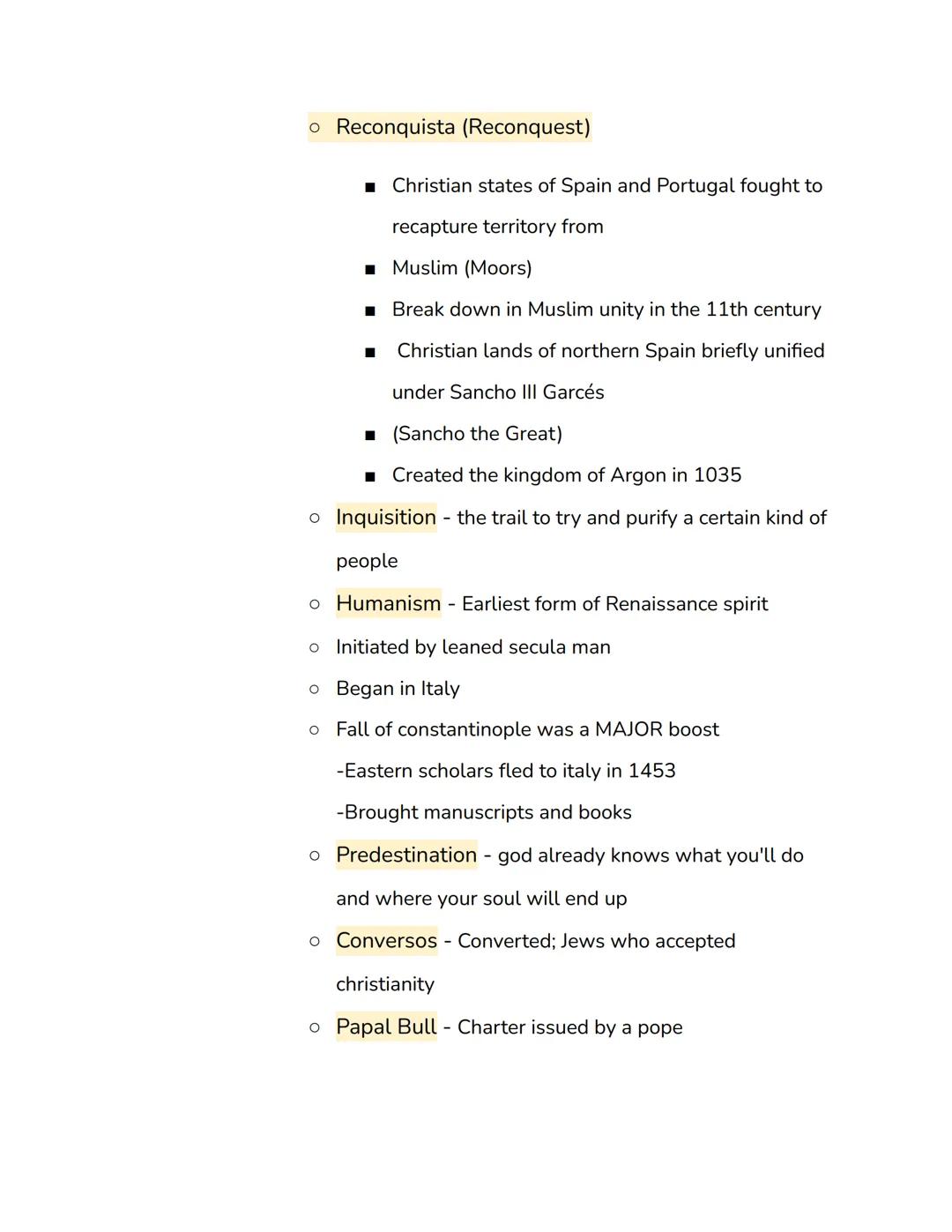
Key Movements and Concepts
The Reconquista (Reconquest) saw Christian states in Spain and Portugal fight to reclaim territories from Muslim Moors. This centuries-long struggle accelerated after Muslim unity broke down in the 11th century, leading to the creation of the Kingdom of Aragon in 1035 under Sancho III Garcés.
Humanism emerged as the earliest form of Renaissance spirit, initiated by secular scholars in Italy. The movement gained tremendous momentum after Constantinople fell in 1453, sending Eastern scholars fleeing to Italy with precious manuscripts and knowledge.
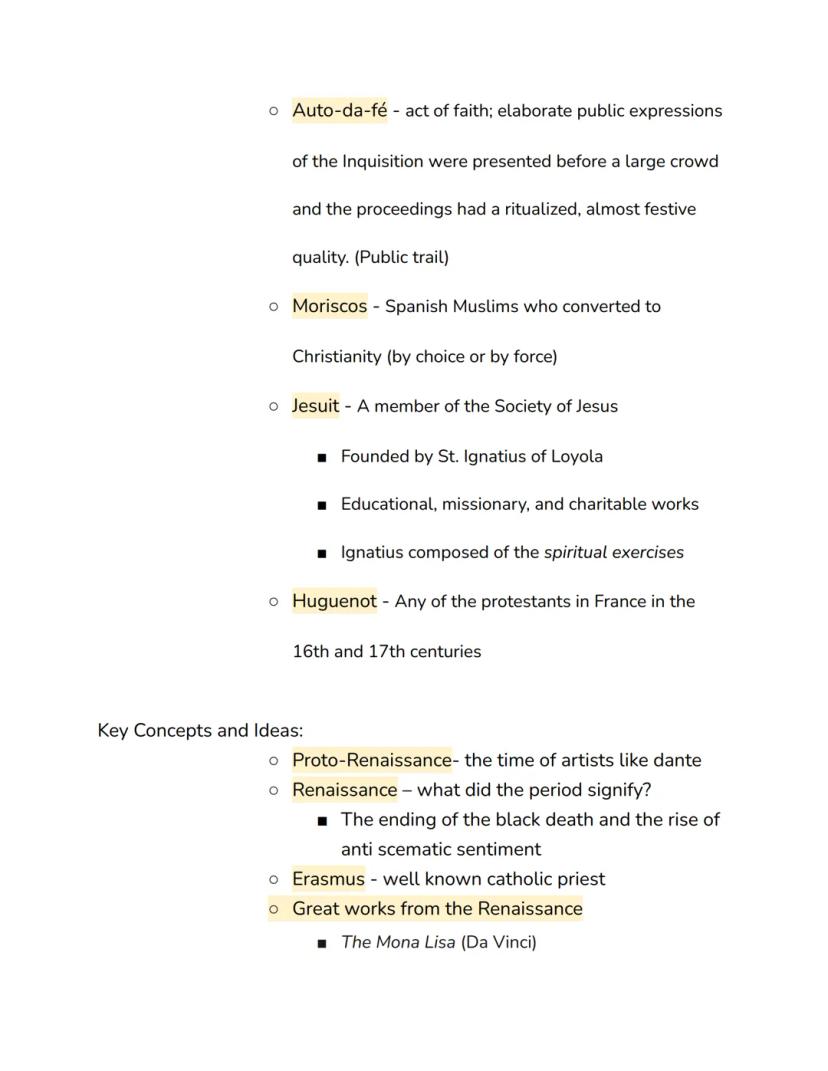
Religious persecution intensified during this period through the Inquisition, which conducted trials to "purify" certain groups. In Spain, Conversos (converted Jews) and Moriscos (converted Muslims) faced scrutiny despite their conversions, often forced to participate in the auto-da-fé ("act of faith")—public trials with an almost festive, ritualized quality.
Quick Fact: When Constantinople fell in 1453, the flood of Eastern scholars to Italy with their ancient texts supercharged the Renaissance, connecting Europe with classical knowledge that had been preserved in the Byzantine Empire.
3
of 8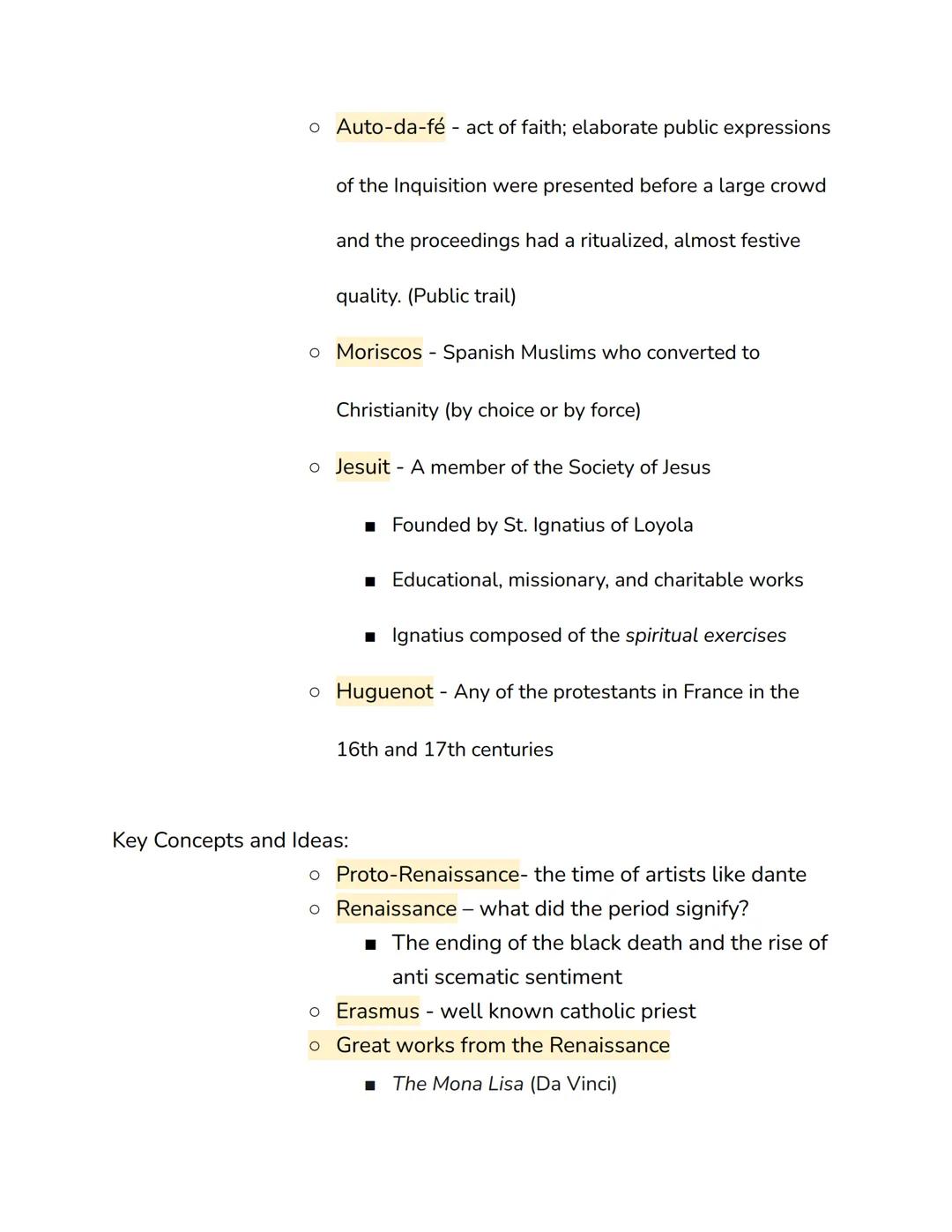
Religious Orders and Movements
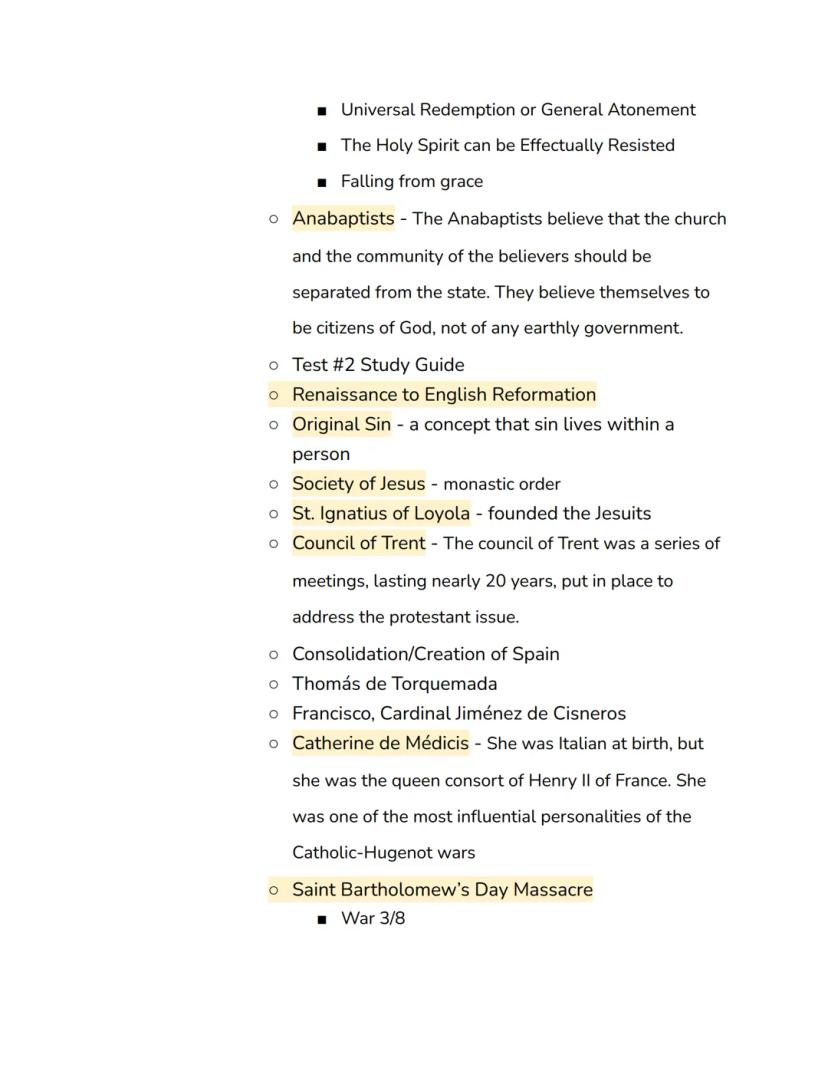
The Jesuits (Society of Jesus), founded by St. Ignatius of Loyola, became a powerful force in the Counter Reformation. This order focused on education, missionary work, and charitable activities, with Ignatius creating the influential "Spiritual Exercises" as a devotional guide.
Huguenots, French Protestants of the 16th and 17th centuries, faced significant persecution in Catholic France. Their struggle highlights how the Reformation created religious minorities throughout Europe who fought for the right to worship according to their conscience.
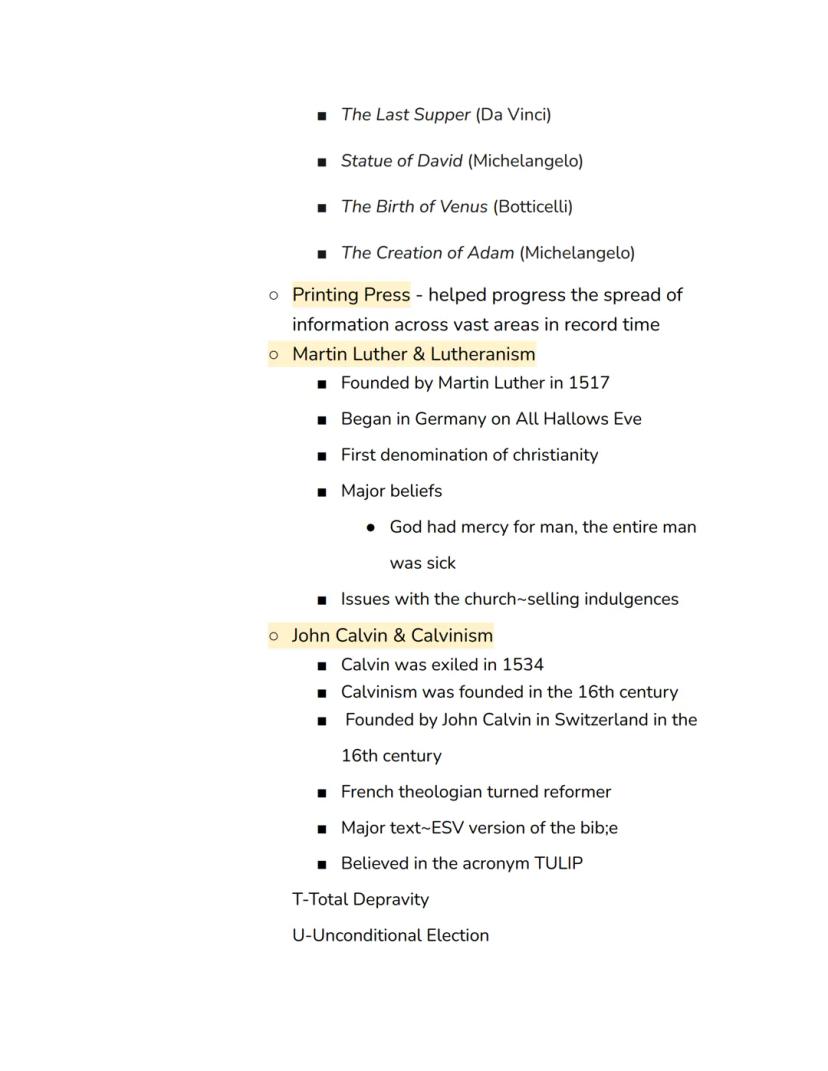
The Proto-Renaissance period included artists like Dante, setting the stage for the full Renaissance that flourished after the Black Death. This cultural explosion produced masterpieces like Da Vinci's Mona Lisa and The Last Supper, Michelangelo's Statue of David and The Creation of Adam, and Botticelli's The Birth of Venus.
Important Connection: Erasmus, though remaining a Catholic priest, created critical editions of Biblical texts that later reformers would use to challenge Church teachings—showing how Renaissance scholarship laid the groundwork for religious reform.
4
of 8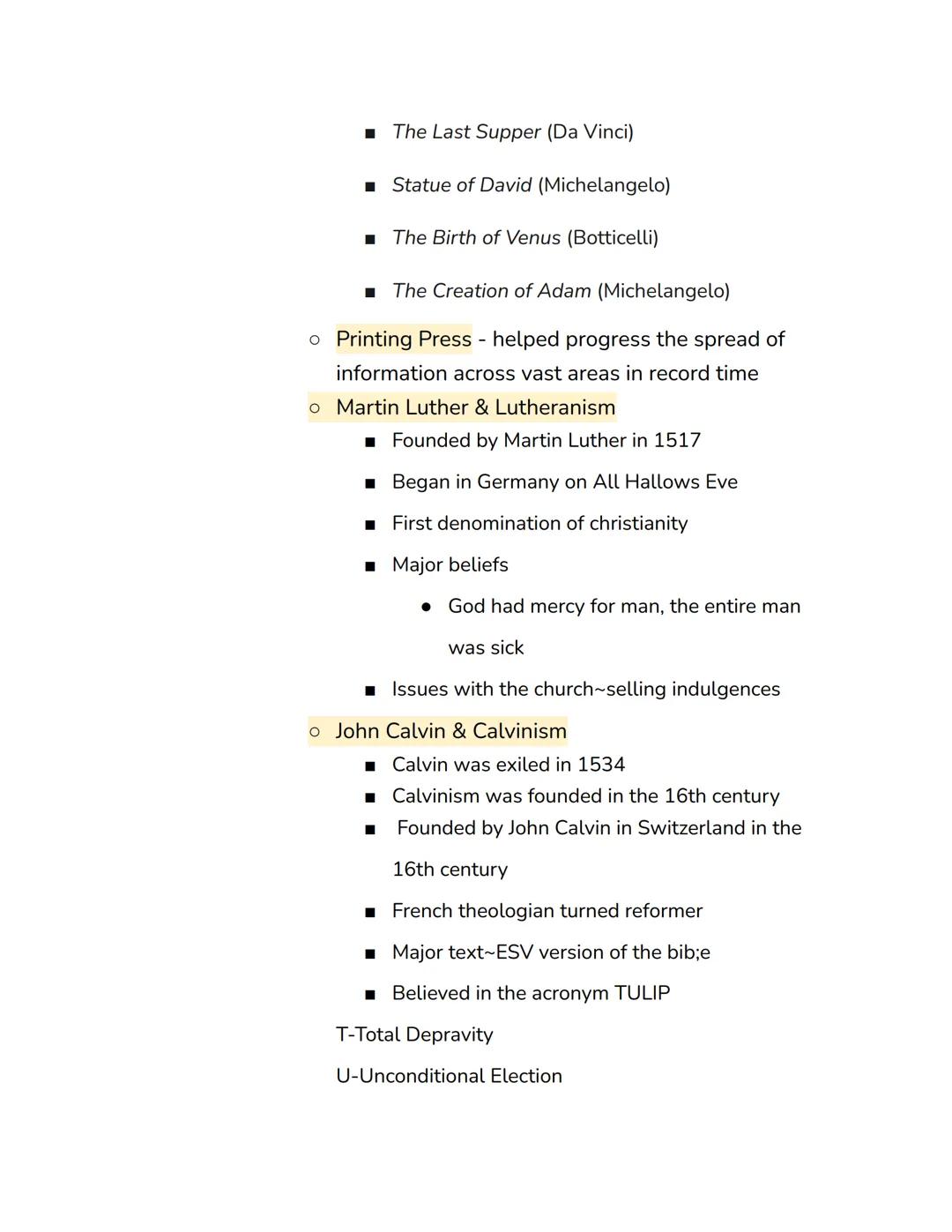
Reformation Leaders and Their Ideas
Martin Luther launched Protestantism in Germany in 1517 (on All Hallows' Eve) when he challenged the Church's sale of indulgences. Luther's theology emphasized that God's mercy extended to the whole person and that salvation came through faith, not works or payments.
The invention of the printing press dramatically accelerated the Reformation by allowing reformers' ideas to spread rapidly across Europe. Without this technology, the movement might have been easily suppressed like earlier reform attempts.
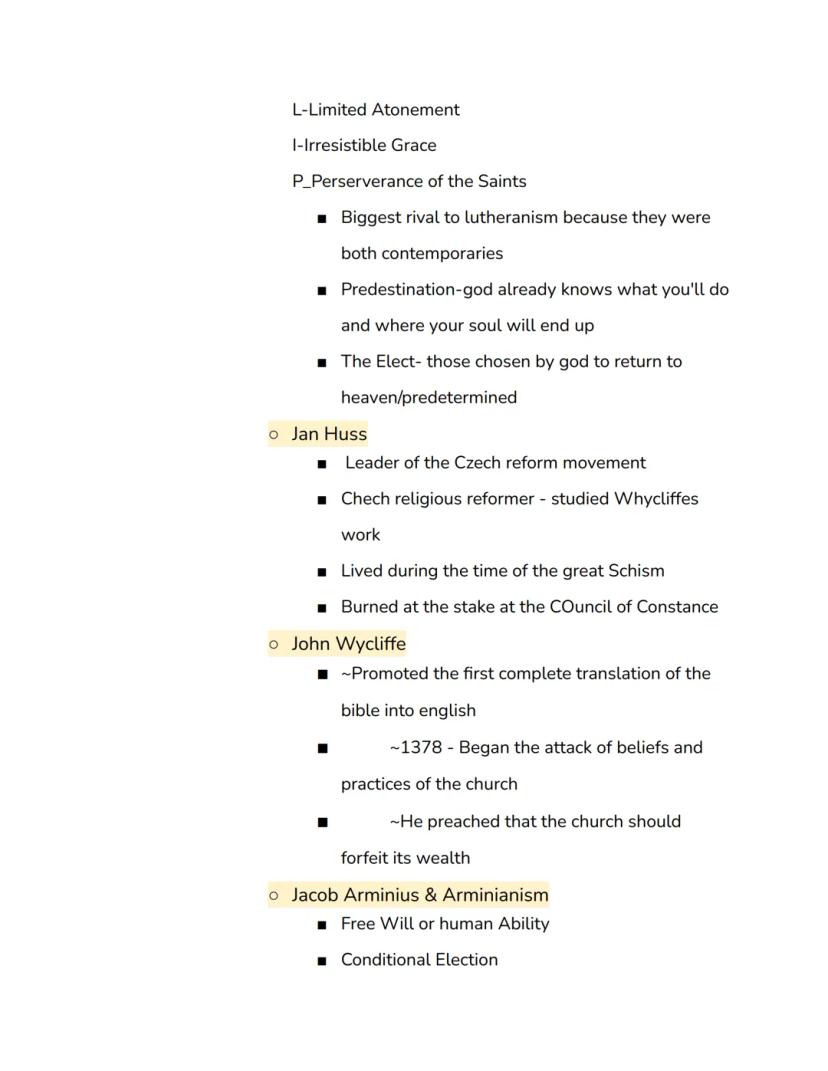
John Calvin, exiled from France in 1534, established a different Protestant tradition in Switzerland. Calvinism emphasized the doctrine of predestination—the belief that God predetermined who would be saved—summarized in the acronym TULIP (Total Depravity, Unconditional Election, Limited Atonement, Irresistible Grace, Perseverance of the Saints).
Study Tip: Remember that Luther and Calvin were contemporaries and rivals—their different approaches to reformation explain why Protestantism immediately fractured into multiple denominations rather than creating a unified alternative to Catholicism.
5
of 8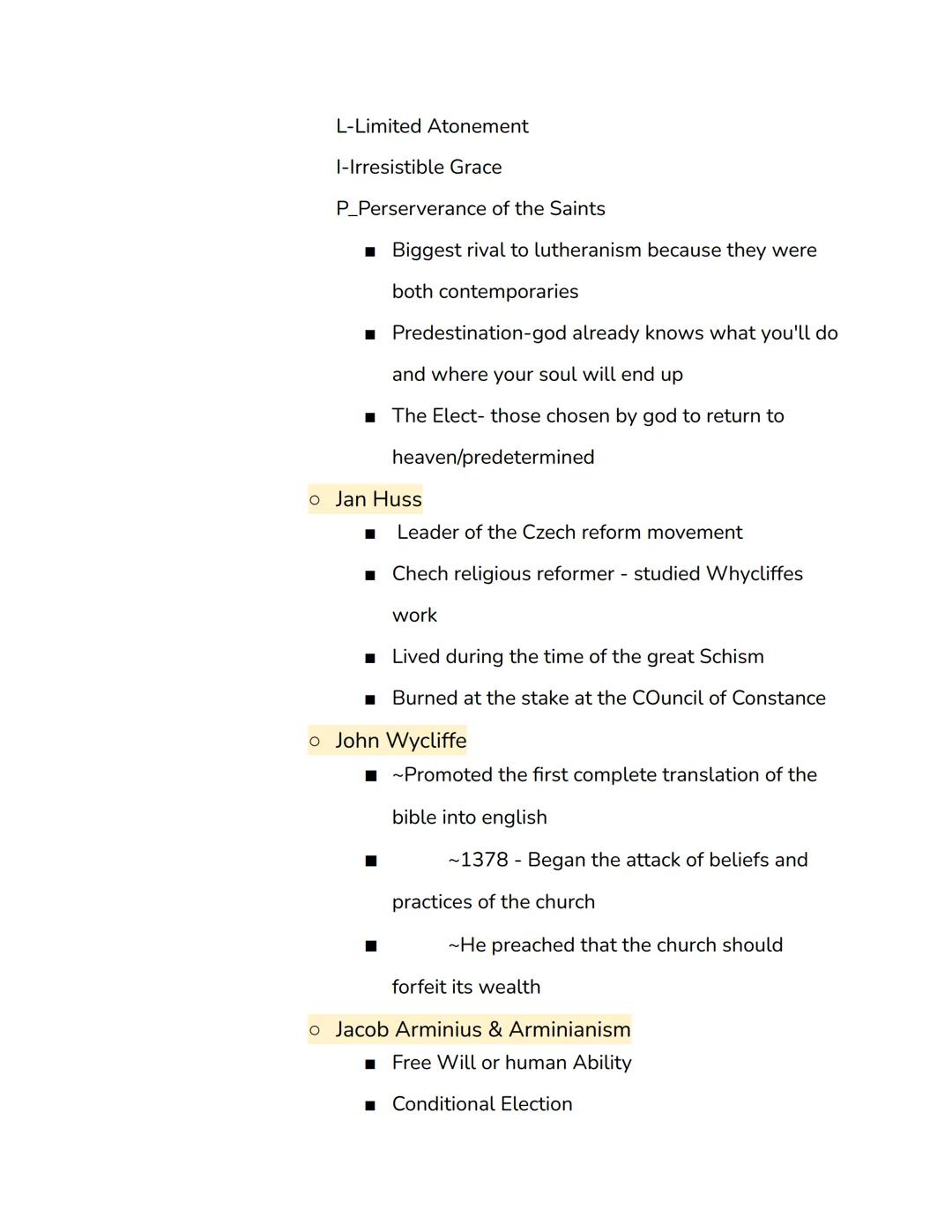
Early Reformers and Theological Disputes
Before Luther and Calvin, earlier reformers laid important groundwork. Jan Huss, a Czech reformer who studied John Wycliffe's works, was burned at the stake at the Council of Constance for challenging church practices during the Great Schism.
John Wycliffe attacked church wealth and practices around 1378 and promoted the first complete translation of the Bible into English. His ideas survived despite persecution and influenced later reformers.
Jacob Arminius developed a theological framework opposing Calvin's predestination. Arminianism emphasized free will, conditional election, universal redemption, resistible grace, and the possibility of falling from grace—essentially the opposite of Calvinism's TULIP doctrine.
The Anabaptists took reformation further, believing in complete separation of church and state. They considered themselves citizens of God rather than earthly governments and practiced adult baptism, rejecting infant baptism as meaningless.
Connect the Dots: The theological battle between Calvinism and Arminianism continues today in many Protestant denominations, showing how Reformation-era debates still shape modern Christianity!
6
of 8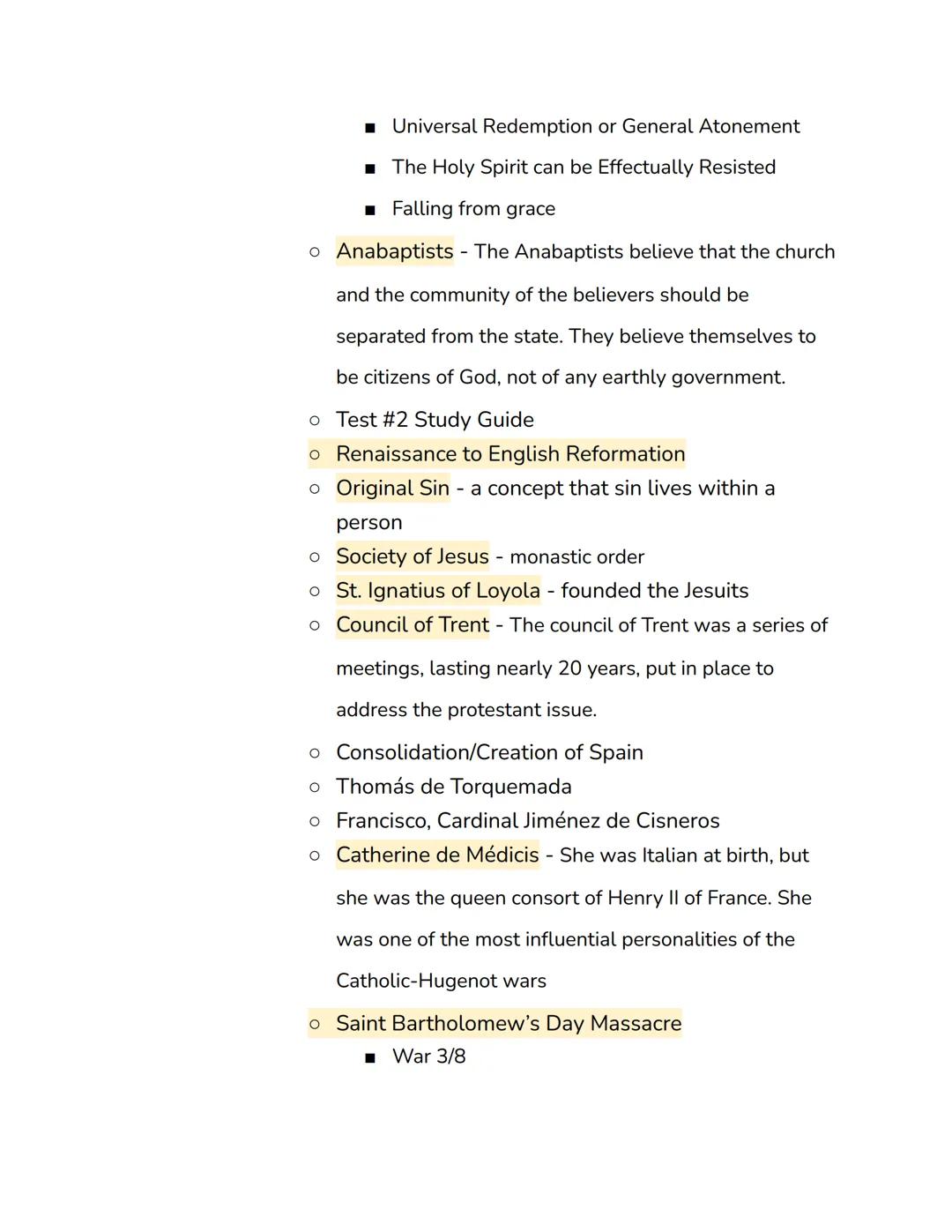
Catholic Response and Spanish Power
The Council of Trent, a series of meetings spanning nearly 20 years, formed the Catholic Church's official response to Protestantism. This council clarified Catholic doctrine, addressed corruption, and strengthened church authority.
The Society of Jesus (Jesuits), founded by St. Ignatius of Loyola, became the intellectual and missionary force of the Counter-Reformation. Jesuits established schools throughout Europe and led missionary efforts around the world.
Spain emerged as the champion of Catholicism during this period. The consolidation of Spanish power came through the marriage of Isabella of Castile and Ferdinand of Aragon, who completed the Reconquista and established the Spanish Inquisition under Tomás de Torquemada.
Catherine de Médicis, Italian by birth but Queen Consort of France, became one of the most influential figures during the French Wars of Religion between Catholics and Huguenots. Her complex political maneuvering sought to preserve royal authority amid religious conflict.
Historical Impact: The Catholic Counter-Reformation wasn't just defensive—it created new religious orders, art styles, and missionary movements that spread Catholicism globally even as it lost ground in parts of Europe.
7
of 8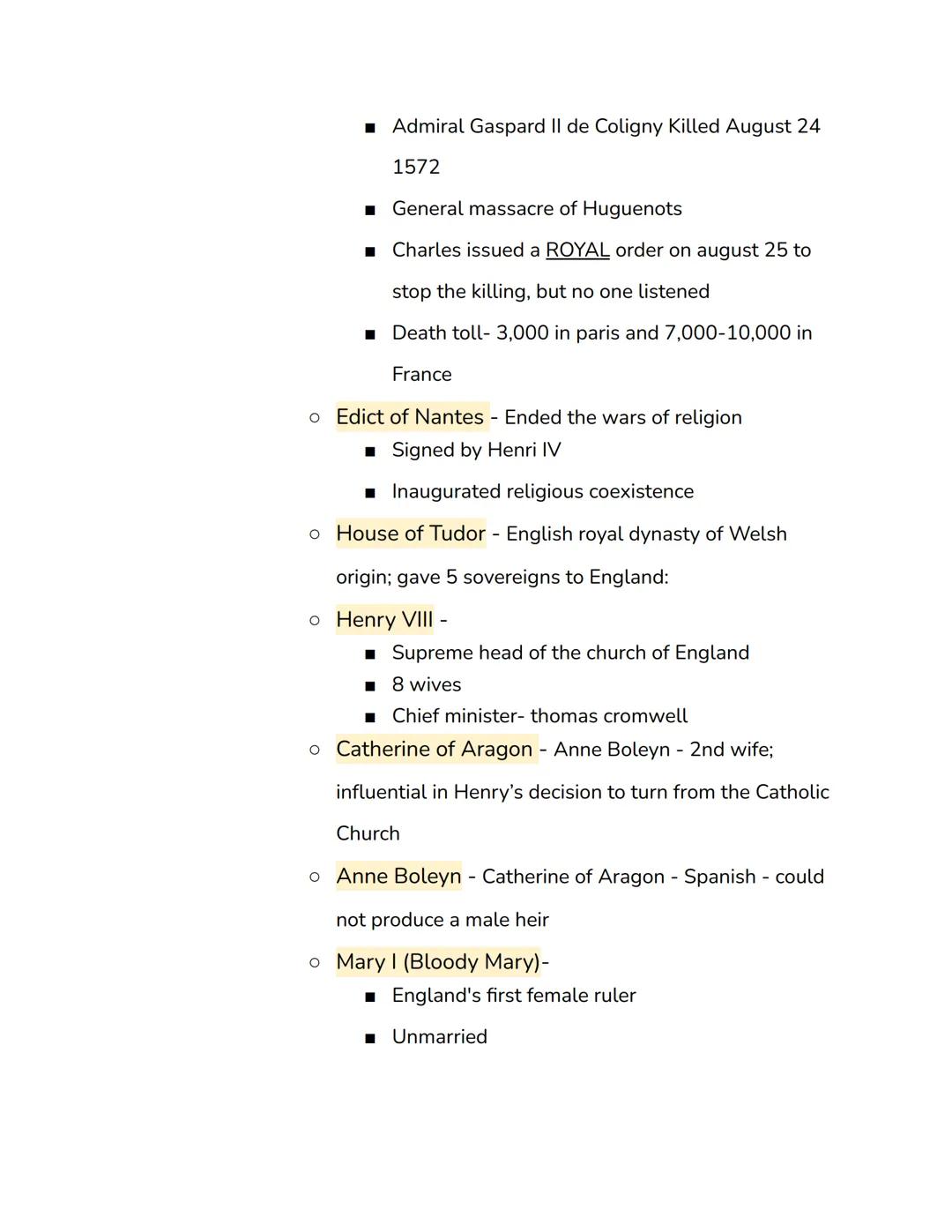
Religious Conflicts in France and England
The St. Bartholomew's Day Massacre marked a horrific escalation in France's religious wars. Beginning with the assassination of Huguenot leader Admiral Gaspard II de Coligny on August 24, 1572, it spiraled into widespread killing. Despite King Charles issuing a royal order to stop the violence, the massacre claimed about 3,000 lives in Paris and 7,000-10,000 throughout France.
The Edict of Nantes, signed by Henri IV, finally ended France's Wars of Religion. This landmark decree established religious coexistence, allowing Huguenots to worship freely in designated areas while maintaining Catholicism as the state religion.
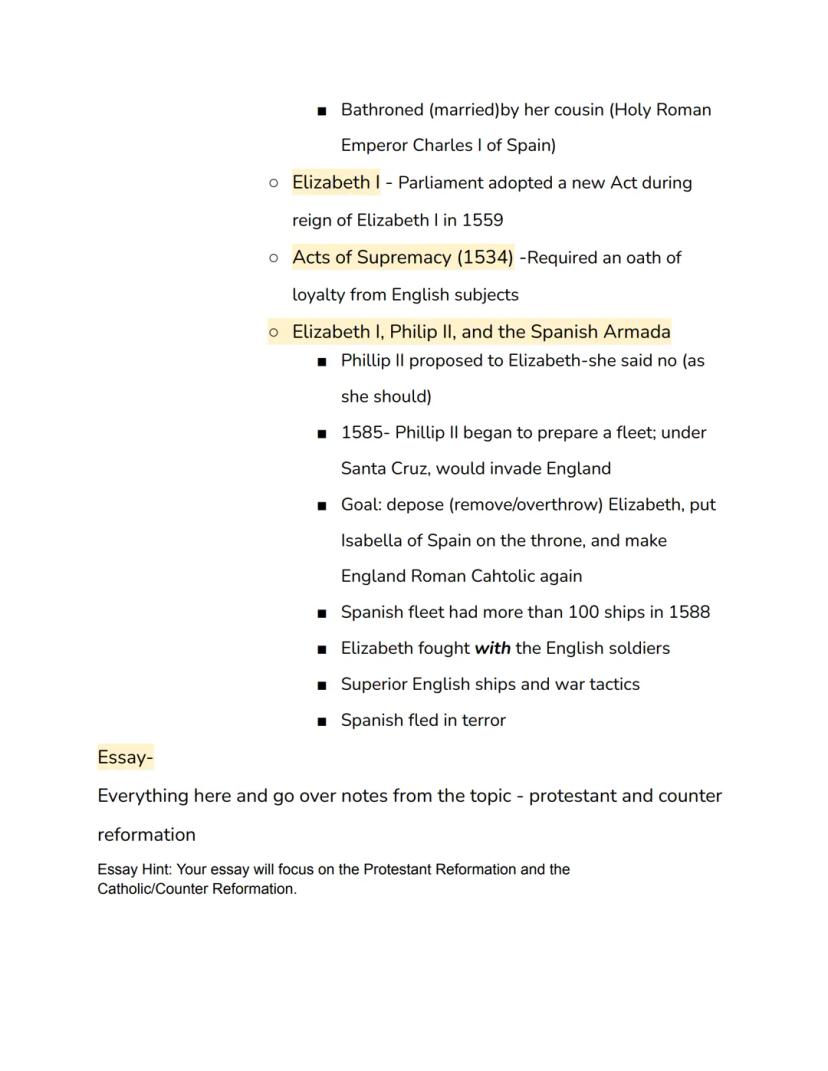
In England, the House of Tudor initiated religious transformation for political reasons. Henry VIII declared himself Supreme Head of the Church of England after Pope Clement VII refused to annul his marriage to Catherine of Aragon. His subsequent marriage to Anne Boleyn deepened the break with Rome, while the Acts of Supremacy (1534) required all English subjects to swear loyalty to the king as head of the church.
Critical Turning Point: Unlike continental reforms based on theology, England's break with Rome began with Henry VIII's marital problems—showing how personal and political motivations often drove religious change as much as spiritual concerns!
8
of 8
Tudor England and the Spanish Armada
Mary I ("Bloody Mary"), England's first female ruler, attempted to restore Catholicism during her reign. She married her cousin, Holy Roman Emperor Charles I of Spain, tying England briefly to continental Catholic powers and persecuting Protestants.
When Elizabeth I took the throne, Parliament adopted a new Act of Supremacy in 1559, reestablishing the Anglican Church. Elizabeth's "middle way" tried to create a church that could accommodate both Catholic and Protestant elements while maintaining royal control.
The conflict between Protestant England and Catholic Spain culminated in the Spanish Armada of 1588. After Elizabeth rejected Philip II's marriage proposal, he prepared a fleet of over 100 ships to invade England, depose Elizabeth, and restore Catholicism. Superior English ships and tactics defeated the Spanish fleet, securing Protestant England's independence.
This period's religious conflicts would continue to shape European politics and culture for centuries. The Protestant Reformation and Catholic Counter-Reformation created lasting divisions while transforming education, art, politics, and national identities throughout Europe.
Exam Focus: For your essay on the Protestant Reformation and Counter-Reformation, focus on how each movement responded to the other—reforms often accelerated in reaction to rival religious movements rather than developing independently.
We thought you’d never ask...
What is the Knowunity AI companion?
Our AI companion is specifically built for the needs of students. Based on the millions of content pieces we have on the platform we can provide truly meaningful and relevant answers to students. But its not only about answers, the companion is even more about guiding students through their daily learning challenges, with personalised study plans, quizzes or content pieces in the chat and 100% personalisation based on the students skills and developments.
Where can I download the Knowunity app?
You can download the app in the Google Play Store and in the Apple App Store.
Is Knowunity really free of charge?
That's right! Enjoy free access to study content, connect with fellow students, and get instant help – all at your fingertips.
Similar Content
 History
Most popular content in World History
9W
World HistoryWorld War 1 Multiple Choice Question Quiz
This quiz was created to test your knowledge of World War 1. This quiz contains questions about the war's events, alliances, significant battles, and the aftermath.
7th3800
World HistoryHumanism in the European Renaissance
Learn about Renaissance Humanism, an intellectual movement emphasizing human potential, achievements, and the revival of classical learning during the European transformation.
9th2323
World HistoryAncient River Civilizations: Mesopotamia, Egypt, and the Indus Valley
Covers the rise and characteristics of foundational early societies in Mesopotamia, the Nile Valley (Egypt), and the Indus Valley regions.
9th3602
P
World HistoryPaleolithic Era
This is a short little quiz based off of my notes from Advanced Global
9th1340
World HistoryAP 10 - QUARTER 2 NOTES
Globalisasyon SDG Migrasyon Teritoryal Dinastiyang Politikal
10th820
 English
A Raisin in the Sun Comprehension Questions [Act I, Scene One]
A Raisin in the Sun comprehension questions with answers.
9th1250
World HistoryAP World History Unit 1 Notes
Unit 1 Notes
2,830432
World HistoryByzantine Empire Study Guide
Covers: Justinian and Theodora, Constantinople, art and architecture, split of Catholic Church, etc.
9th1855
World HistoryThe Mongols
world history
632
Most popular content
9O
 AP US History
Origins and Dynamics of the Columbian Exchange
Analyze the ecological and economic motivations behind the initial transfer of goods, people, and diseases between the Old and New Worlds.
9th3,1280
I
AP US HistoryIntroduction to Early Cultural Interactions
Analyze the initial social and religious encounters between Europeans, Africans, and Indigenous peoples in the colonial Americas.
9th2,7730
O
AP World HistoryOrigins of Ancient River Civilizations
Analyze the environmental factors and technological innovations that led to the rise of early states in Mesopotamia, Egypt, and the Indus Valley.
9th3,1870
M
AP US HistoryMotivations for European Exploration
Analyze the economic, religious, and political factors that drove European powers to the Americas during the 15th and 16th centuries.
9th1,7780
F
 AP Psychology
Foundations of Ethical Guidelines in Research
Practice the core principles of the APA ethical code including informed consent, debriefing, and the role of Institutional Review Boards.
9th1,3360
I
AP US HistoryIntroduction to Native American Societies
Examine the diverse social, political, and economic structures of North American indigenous groups prior to European contact.
9th1,1100
I
 AP Biology
Introduction to Biological Elements of Life
Practice identifying the essential elements including carbon, nitrogen, phosphorus, and sulfur that compose biological macromolecules.
9th1,7390
I
AP US HistoryIntroduction to the Spanish Encomienda System
Explore the fundamental economic and social structures of the Spanish colonial system, focusing on the encomienda and the casta social hierarchy.
9th8890
O
AP World HistoryOrigins and Continuity of the Byzantine Empire
Analyze the political and cultural transitions from the Roman Empire to the Byzantine Empire, focusing on the reign of Justinian I and his code.
9th1,6320
Can't find what you're looking for? Explore other subjects.
Students love us — and so will you.
4.6/5App Store
4.7/5Google Play
The app is very easy to use and well designed. I have found everything I was looking for so far and have been able to learn a lot from the presentations! I will definitely use the app for a class assignment! And of course it also helps a lot as an inspiration.
Stefan SiOS user
This app is really great. There are so many study notes and help [...]. My problem subject is French, for example, and the app has so many options for help. Thanks to this app, I have improved my French. I would recommend it to anyone.
Samantha KlichAndroid user
Wow, I am really amazed. I just tried the app because I've seen it advertised many times and was absolutely stunned. This app is THE HELP you want for school and above all, it offers so many things, such as workouts and fact sheets, which have been VERY helpful to me personally.
AnnaiOS user
World History186 views·Updated Jun 12, 2026·8 pagesComprehensive Study Guide for Test 2: Renaissance and English Reformation
The Renaissance and Reformation period marked a dramatic shift in European history, transforming religion, politics, and culture. This pivotal era saw the rebirth of classical learning alongside religious upheaval that permanently fractured Christianity in Western Europe.
1
of 8
Sign up to see the content. It's free!
- Access to all documents
- Improve your grades
- Join milions of students
Renaissance and Protestant Reformation Foundations
The Renaissance emerged as Europe recovered from the Black Death, beginning in Italy before spreading northward. This cultural rebirth emphasized humanism and classical learning, setting the stage for religious reform.
The Protestant Reformation erupted in Northern Europe during the early 16th century when reformers challenged the Catholic Church's power and doctrines. This movement fundamentally split Western Christianity into three major branches: Catholicism (established 33 CE), Eastern Orthodoxy (split in 1054), and Protestantism (beginning 1517).
In response, the Catholic Church launched the Counter Reformation, implementing reforms at the Council of Trent while actively opposing Protestant expansion. This defensive reaction sought to address corruption while preserving Catholic doctrine.
Remember This: The Protestant Reformation wasn't just a religious movement—it permanently changed European power structures, literacy rates, and national identities!
2
of 8Sign up to see the content. It's free!
- Access to all documents
- Improve your grades
- Join milions of students
Key Movements and Concepts
The Reconquista (Reconquest) saw Christian states in Spain and Portugal fight to reclaim territories from Muslim Moors. This centuries-long struggle accelerated after Muslim unity broke down in the 11th century, leading to the creation of the Kingdom of Aragon in 1035 under Sancho III Garcés.
Humanism emerged as the earliest form of Renaissance spirit, initiated by secular scholars in Italy. The movement gained tremendous momentum after Constantinople fell in 1453, sending Eastern scholars fleeing to Italy with precious manuscripts and knowledge.
Religious persecution intensified during this period through the Inquisition, which conducted trials to "purify" certain groups. In Spain, Conversos (converted Jews) and Moriscos (converted Muslims) faced scrutiny despite their conversions, often forced to participate in the auto-da-fé ("act of faith")—public trials with an almost festive, ritualized quality.
Quick Fact: When Constantinople fell in 1453, the flood of Eastern scholars to Italy with their ancient texts supercharged the Renaissance, connecting Europe with classical knowledge that had been preserved in the Byzantine Empire.
3
of 8Sign up to see the content. It's free!
- Access to all documents
- Improve your grades
- Join milions of students
Religious Orders and Movements
The Jesuits (Society of Jesus), founded by St. Ignatius of Loyola, became a powerful force in the Counter Reformation. This order focused on education, missionary work, and charitable activities, with Ignatius creating the influential "Spiritual Exercises" as a devotional guide.
Huguenots, French Protestants of the 16th and 17th centuries, faced significant persecution in Catholic France. Their struggle highlights how the Reformation created religious minorities throughout Europe who fought for the right to worship according to their conscience.
The Proto-Renaissance period included artists like Dante, setting the stage for the full Renaissance that flourished after the Black Death. This cultural explosion produced masterpieces like Da Vinci's Mona Lisa and The Last Supper, Michelangelo's Statue of David and The Creation of Adam, and Botticelli's The Birth of Venus.
Important Connection: Erasmus, though remaining a Catholic priest, created critical editions of Biblical texts that later reformers would use to challenge Church teachings—showing how Renaissance scholarship laid the groundwork for religious reform.
4
of 8Sign up to see the content. It's free!
- Access to all documents
- Improve your grades
- Join milions of students
Reformation Leaders and Their Ideas
Martin Luther launched Protestantism in Germany in 1517 (on All Hallows' Eve) when he challenged the Church's sale of indulgences. Luther's theology emphasized that God's mercy extended to the whole person and that salvation came through faith, not works or payments.
The invention of the printing press dramatically accelerated the Reformation by allowing reformers' ideas to spread rapidly across Europe. Without this technology, the movement might have been easily suppressed like earlier reform attempts.
John Calvin, exiled from France in 1534, established a different Protestant tradition in Switzerland. Calvinism emphasized the doctrine of predestination—the belief that God predetermined who would be saved—summarized in the acronym TULIP (Total Depravity, Unconditional Election, Limited Atonement, Irresistible Grace, Perseverance of the Saints).
Study Tip: Remember that Luther and Calvin were contemporaries and rivals—their different approaches to reformation explain why Protestantism immediately fractured into multiple denominations rather than creating a unified alternative to Catholicism.
5
of 8Sign up to see the content. It's free!
- Access to all documents
- Improve your grades
- Join milions of students
Early Reformers and Theological Disputes
Before Luther and Calvin, earlier reformers laid important groundwork. Jan Huss, a Czech reformer who studied John Wycliffe's works, was burned at the stake at the Council of Constance for challenging church practices during the Great Schism.
John Wycliffe attacked church wealth and practices around 1378 and promoted the first complete translation of the Bible into English. His ideas survived despite persecution and influenced later reformers.
Jacob Arminius developed a theological framework opposing Calvin's predestination. Arminianism emphasized free will, conditional election, universal redemption, resistible grace, and the possibility of falling from grace—essentially the opposite of Calvinism's TULIP doctrine.
The Anabaptists took reformation further, believing in complete separation of church and state. They considered themselves citizens of God rather than earthly governments and practiced adult baptism, rejecting infant baptism as meaningless.
Connect the Dots: The theological battle between Calvinism and Arminianism continues today in many Protestant denominations, showing how Reformation-era debates still shape modern Christianity!
6
of 8Sign up to see the content. It's free!
- Access to all documents
- Improve your grades
- Join milions of students
Catholic Response and Spanish Power
The Council of Trent, a series of meetings spanning nearly 20 years, formed the Catholic Church's official response to Protestantism. This council clarified Catholic doctrine, addressed corruption, and strengthened church authority.
The Society of Jesus (Jesuits), founded by St. Ignatius of Loyola, became the intellectual and missionary force of the Counter-Reformation. Jesuits established schools throughout Europe and led missionary efforts around the world.
Spain emerged as the champion of Catholicism during this period. The consolidation of Spanish power came through the marriage of Isabella of Castile and Ferdinand of Aragon, who completed the Reconquista and established the Spanish Inquisition under Tomás de Torquemada.
Catherine de Médicis, Italian by birth but Queen Consort of France, became one of the most influential figures during the French Wars of Religion between Catholics and Huguenots. Her complex political maneuvering sought to preserve royal authority amid religious conflict.
Historical Impact: The Catholic Counter-Reformation wasn't just defensive—it created new religious orders, art styles, and missionary movements that spread Catholicism globally even as it lost ground in parts of Europe.
7
of 8Sign up to see the content. It's free!
- Access to all documents
- Improve your grades
- Join milions of students
Religious Conflicts in France and England
The St. Bartholomew's Day Massacre marked a horrific escalation in France's religious wars. Beginning with the assassination of Huguenot leader Admiral Gaspard II de Coligny on August 24, 1572, it spiraled into widespread killing. Despite King Charles issuing a royal order to stop the violence, the massacre claimed about 3,000 lives in Paris and 7,000-10,000 throughout France.
The Edict of Nantes, signed by Henri IV, finally ended France's Wars of Religion. This landmark decree established religious coexistence, allowing Huguenots to worship freely in designated areas while maintaining Catholicism as the state religion.
In England, the House of Tudor initiated religious transformation for political reasons. Henry VIII declared himself Supreme Head of the Church of England after Pope Clement VII refused to annul his marriage to Catherine of Aragon. His subsequent marriage to Anne Boleyn deepened the break with Rome, while the Acts of Supremacy (1534) required all English subjects to swear loyalty to the king as head of the church.
Critical Turning Point: Unlike continental reforms based on theology, England's break with Rome began with Henry VIII's marital problems—showing how personal and political motivations often drove religious change as much as spiritual concerns!
8
of 8Sign up to see the content. It's free!
- Access to all documents
- Improve your grades
- Join milions of students
Tudor England and the Spanish Armada
Mary I ("Bloody Mary"), England's first female ruler, attempted to restore Catholicism during her reign. She married her cousin, Holy Roman Emperor Charles I of Spain, tying England briefly to continental Catholic powers and persecuting Protestants.
When Elizabeth I took the throne, Parliament adopted a new Act of Supremacy in 1559, reestablishing the Anglican Church. Elizabeth's "middle way" tried to create a church that could accommodate both Catholic and Protestant elements while maintaining royal control.
The conflict between Protestant England and Catholic Spain culminated in the Spanish Armada of 1588. After Elizabeth rejected Philip II's marriage proposal, he prepared a fleet of over 100 ships to invade England, depose Elizabeth, and restore Catholicism. Superior English ships and tactics defeated the Spanish fleet, securing Protestant England's independence.
This period's religious conflicts would continue to shape European politics and culture for centuries. The Protestant Reformation and Catholic Counter-Reformation created lasting divisions while transforming education, art, politics, and national identities throughout Europe.
Exam Focus: For your essay on the Protestant Reformation and Counter-Reformation, focus on how each movement responded to the other—reforms often accelerated in reaction to rival religious movements rather than developing independently.
We thought you’d never ask...
What is the Knowunity AI companion?
Our AI companion is specifically built for the needs of students. Based on the millions of content pieces we have on the platform we can provide truly meaningful and relevant answers to students. But its not only about answers, the companion is even more about guiding students through their daily learning challenges, with personalised study plans, quizzes or content pieces in the chat and 100% personalisation based on the students skills and developments.
Where can I download the Knowunity app?
You can download the app in the Google Play Store and in the Apple App Store.
Is Knowunity really free of charge?
That's right! Enjoy free access to study content, connect with fellow students, and get instant help – all at your fingertips.
Similar Content
Most popular content in World History
9W
World HistoryWorld War 1 Multiple Choice Question Quiz
This quiz was created to test your knowledge of World War 1. This quiz contains questions about the war's events, alliances, significant battles, and the aftermath.
7th3800
World HistoryHumanism in the European Renaissance
Learn about Renaissance Humanism, an intellectual movement emphasizing human potential, achievements, and the revival of classical learning during the European transformation.
9th2323
World HistoryAncient River Civilizations: Mesopotamia, Egypt, and the Indus Valley
Covers the rise and characteristics of foundational early societies in Mesopotamia, the Nile Valley (Egypt), and the Indus Valley regions.
9th3602
P
World HistoryPaleolithic Era
This is a short little quiz based off of my notes from Advanced Global
9th1340
World HistoryAP 10 - QUARTER 2 NOTES
Globalisasyon SDG Migrasyon Teritoryal Dinastiyang Politikal
10th820
EnglishA Raisin in the Sun Comprehension Questions [Act I, Scene One]
A Raisin in the Sun comprehension questions with answers.
9th1250
World HistoryAP World History Unit 1 Notes
Unit 1 Notes
2,830432
World HistoryByzantine Empire Study Guide
Covers: Justinian and Theodora, Constantinople, art and architecture, split of Catholic Church, etc.
9th1855
World HistoryThe Mongols
world history
632
Most popular content
9O
AP US HistoryOrigins and Dynamics of the Columbian Exchange
Analyze the ecological and economic motivations behind the initial transfer of goods, people, and diseases between the Old and New Worlds.
9th3,1280
I
AP US HistoryIntroduction to Early Cultural Interactions
Analyze the initial social and religious encounters between Europeans, Africans, and Indigenous peoples in the colonial Americas.
9th2,7730
O
AP World HistoryOrigins of Ancient River Civilizations
Analyze the environmental factors and technological innovations that led to the rise of early states in Mesopotamia, Egypt, and the Indus Valley.
9th3,1870
M
AP US HistoryMotivations for European Exploration
Analyze the economic, religious, and political factors that drove European powers to the Americas during the 15th and 16th centuries.
9th1,7780
F
AP PsychologyFoundations of Ethical Guidelines in Research
Practice the core principles of the APA ethical code including informed consent, debriefing, and the role of Institutional Review Boards.
9th1,3360
I
AP US HistoryIntroduction to Native American Societies
Examine the diverse social, political, and economic structures of North American indigenous groups prior to European contact.
9th1,1100
I
AP BiologyIntroduction to Biological Elements of Life
Practice identifying the essential elements including carbon, nitrogen, phosphorus, and sulfur that compose biological macromolecules.
9th1,7390
I
AP US HistoryIntroduction to the Spanish Encomienda System
Explore the fundamental economic and social structures of the Spanish colonial system, focusing on the encomienda and the casta social hierarchy.
9th8890
O
AP World HistoryOrigins and Continuity of the Byzantine Empire
Analyze the political and cultural transitions from the Roman Empire to the Byzantine Empire, focusing on the reign of Justinian I and his code.
9th1,6320
Can't find what you're looking for? Explore other subjects.
Students love us — and so will you.
4.6/5App Store
4.7/5Google Play
The app is very easy to use and well designed. I have found everything I was looking for so far and have been able to learn a lot from the presentations! I will definitely use the app for a class assignment! And of course it also helps a lot as an inspiration.
Stefan SiOS user
This app is really great. There are so many study notes and help [...]. My problem subject is French, for example, and the app has so many options for help. Thanks to this app, I have improved my French. I would recommend it to anyone.
Samantha KlichAndroid user
Wow, I am really amazed. I just tried the app because I've seen it advertised many times and was absolutely stunned. This app is THE HELP you want for school and above all, it offers so many things, such as workouts and fact sheets, which have been VERY helpful to me personally.
AnnaiOS user