

The Renaissance marked a crucial period of rebirth in Western...
 World History143 views·Updated Jun 8, 2026·7 pages
Comprehensive Renaissance Study Guide

1 / 7
1
of 7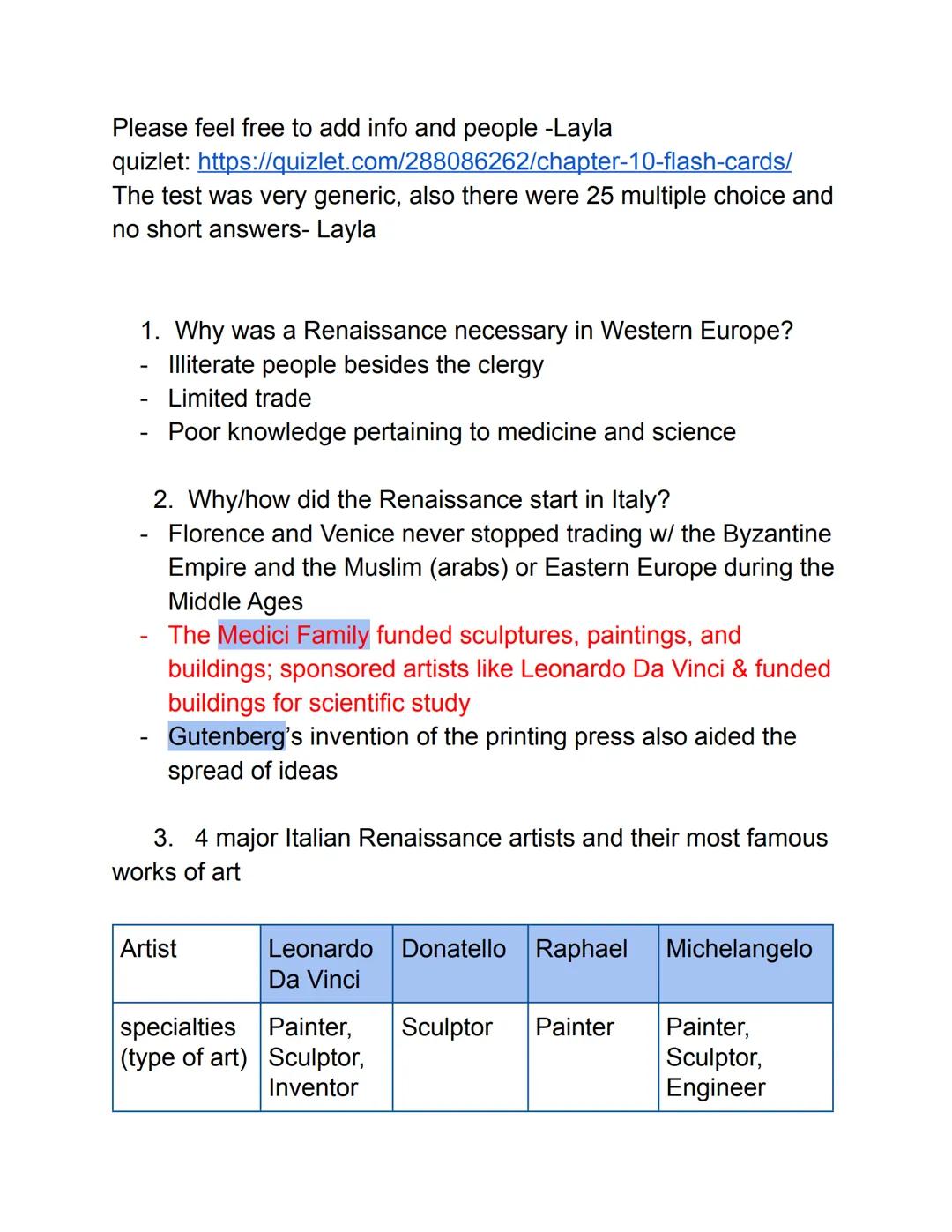
Renaissance Origins and Early Development
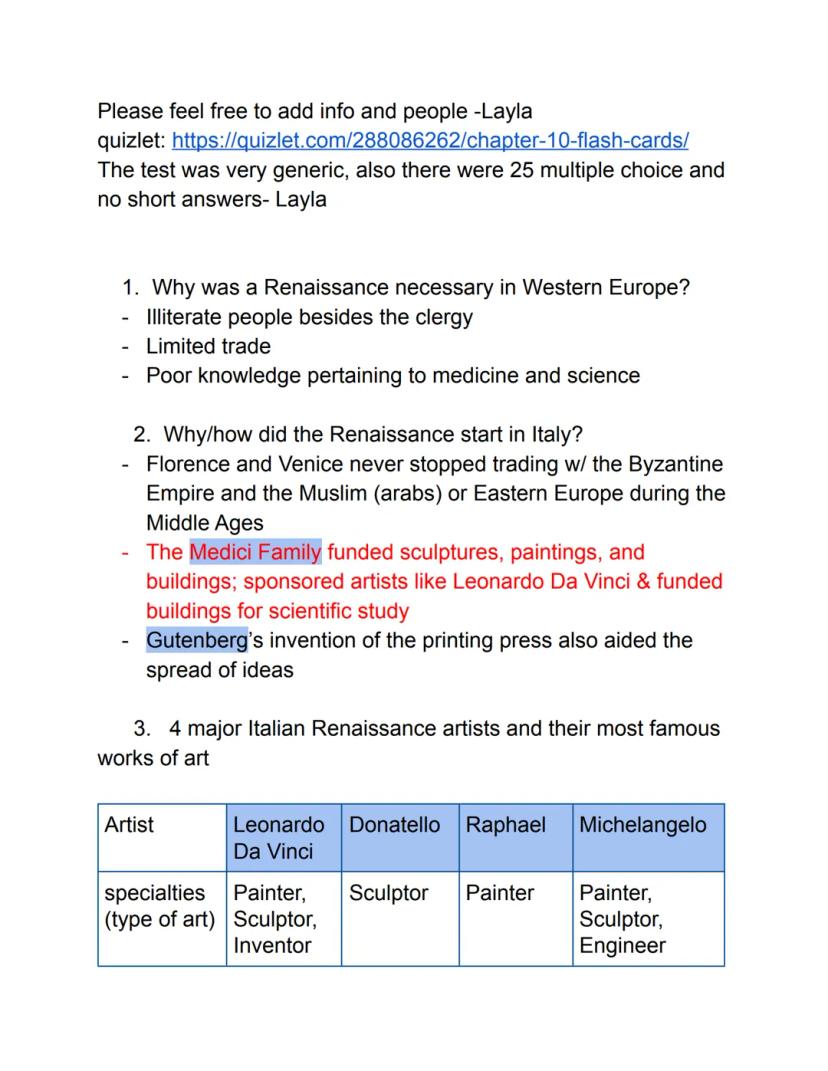
Ever wonder why Europe needed a complete cultural reset? Before the Renaissance, most people couldn't read, trade was limited, and medical knowledge was primitive. The Renaissance emerged as a necessary awakening to these challenges.
Italy became the birthplace of this movement for several key reasons. Florence and Venice maintained crucial trade connections with the Byzantine Empire, Muslim territories, and Eastern Europe throughout the Middle Ages, creating cultural exchange. The wealthy Medici family became powerful patrons who funded sculptures, paintings, and buildings while sponsoring legendary artists like Leonardo Da Vinci.
The invention of the printing press by Gutenberg revolutionized information sharing, allowing Renaissance ideas to spread rapidly across Europe. This technological innovation transformed society by making books and knowledge accessible beyond elite circles.
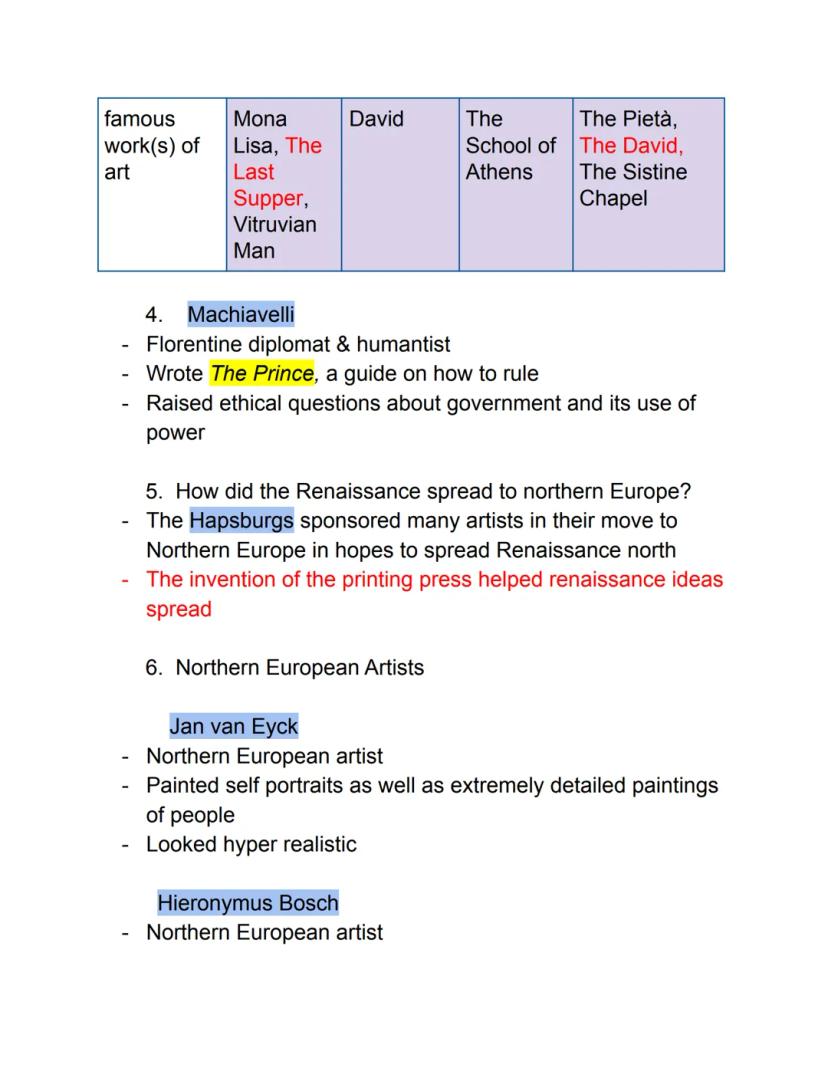
Did you know? The Italian Renaissance produced some of history's most celebrated artists. Leonardo Da Vinci wasn't just a painter but also a sculptor and inventor. Other masters included Donatello (sculptor), Raphael (painter), and Michelangelo (painter, sculptor, and engineer) who created iconic works like the Mona Lisa, David sculptures, and the Sistine Chapel.
2
of 7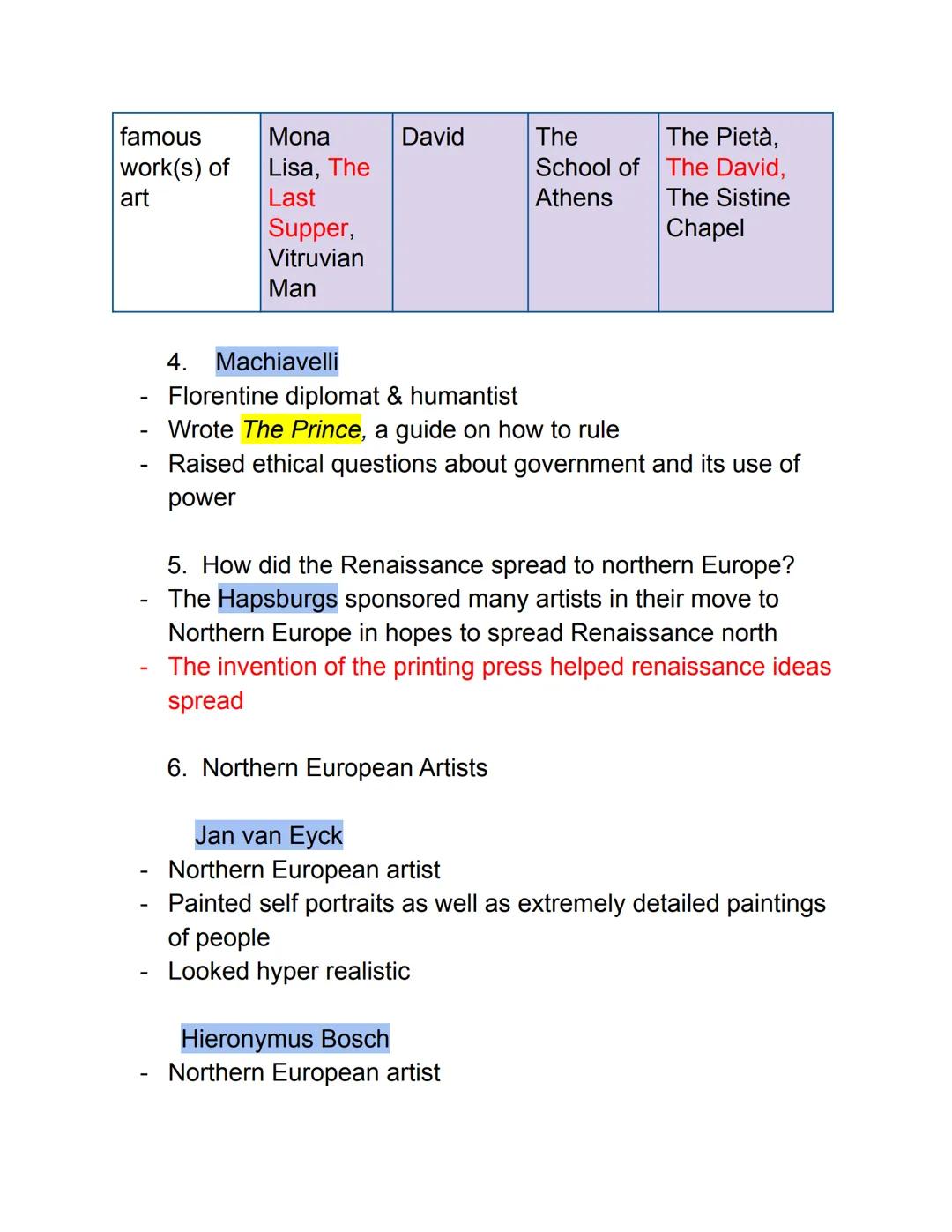
Renaissance Thought and Northern Expansion
Machiavelli changed how people thought about politics forever. As a Florentine diplomat and humanist, his famous work The Prince provided a guide on effective ruling that raised uncomfortable ethical questions about government and power. His ideas were revolutionary—suggesting rulers should be practical rather than idealistic.
The Renaissance didn't stay confined to Italy. The powerful Habsburg family sponsored artists moving northward, hoping to spread Renaissance influence throughout their territories. With the printing press accelerating the exchange of ideas, Renaissance thinking quickly took root beyond Italian borders.
Northern European artists developed their own distinctive styles. Jan van Eyck created hyper-realistic portraits with incredible detail, while Hieronymus Bosch painted elaborate scenes like "The Art of Earthly Beings" featuring meticulously detailed (and sometimes nude) human figures.
Connect the dots: Notice how technology (the printing press) and wealthy patrons (like the Medicis and Habsburgs) created the perfect conditions for cultural transformation. This pattern of technology plus funding driving cultural change continues today!
3
of 7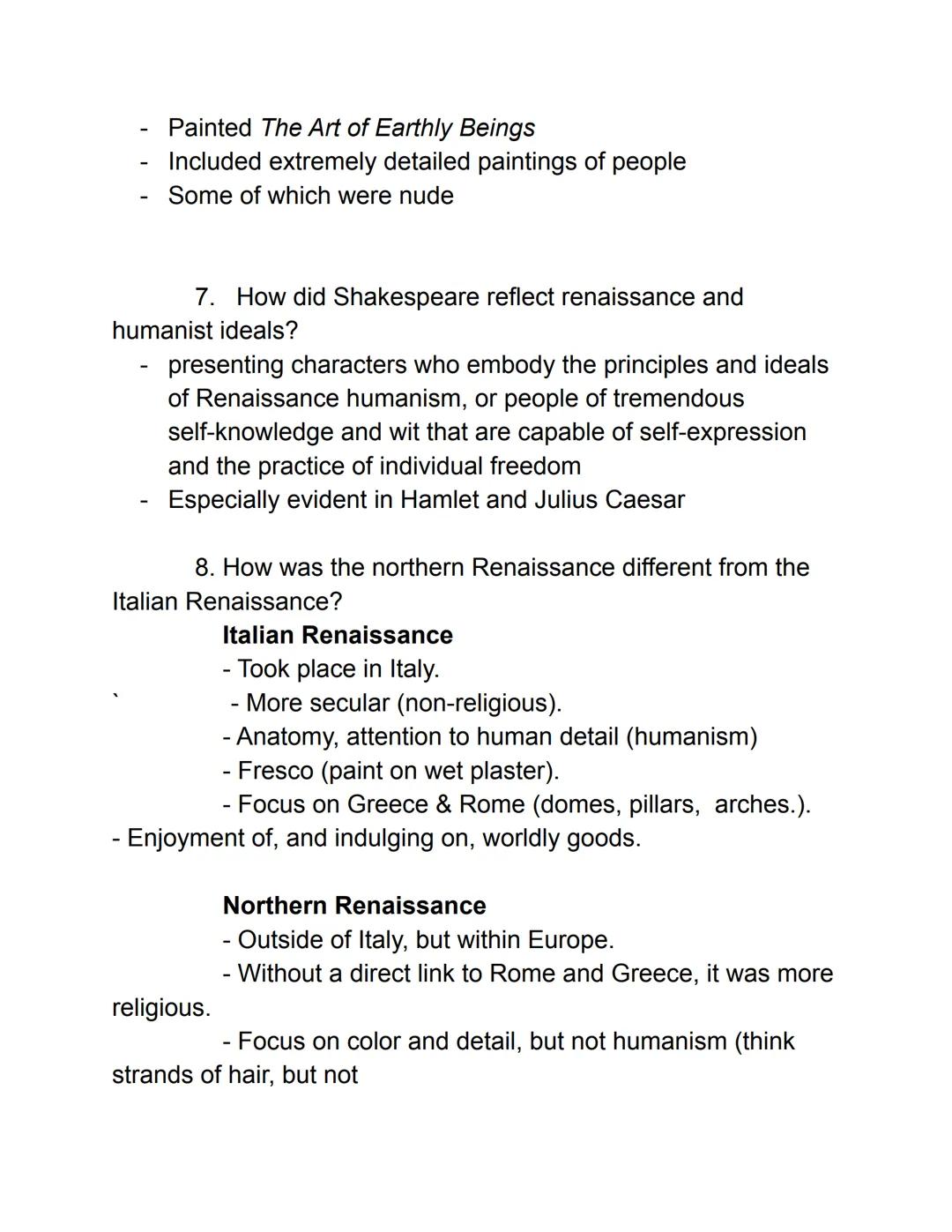
Renaissance Literature and Regional Differences
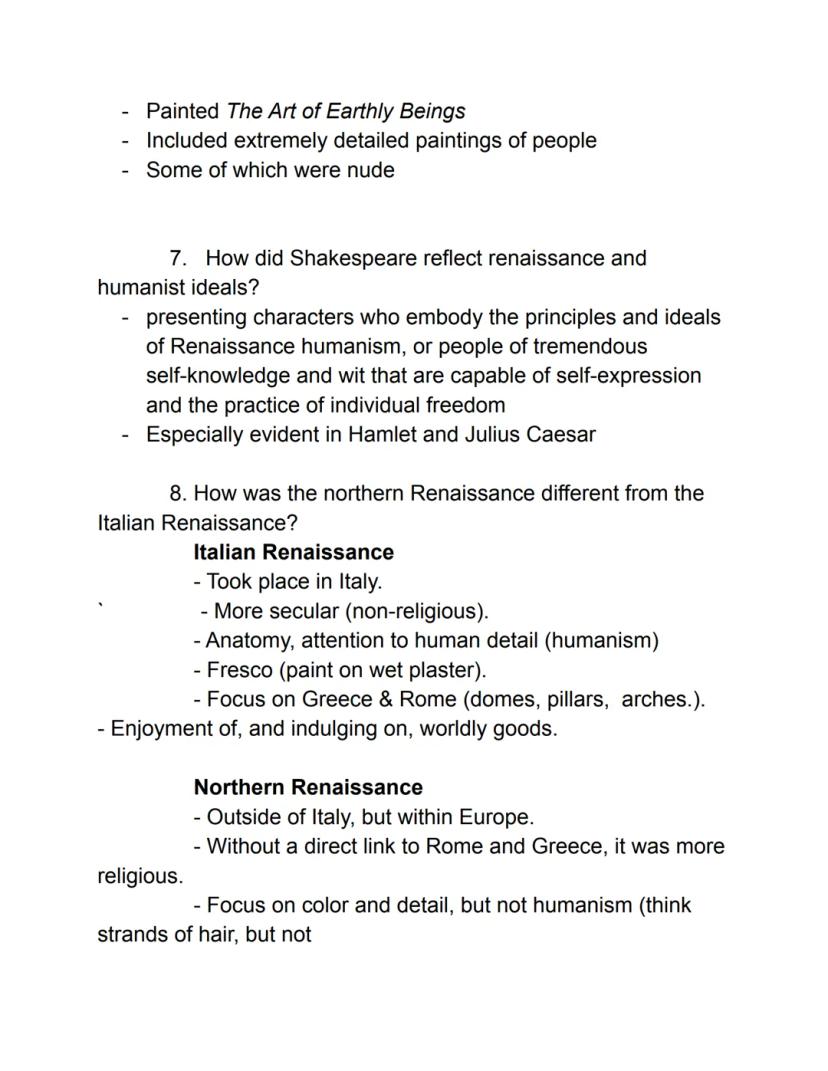
Shakespeare perfectly captured Renaissance spirit in his plays. His works featured characters with tremendous self-knowledge and wit who embodied humanist ideals through their capacity for self-expression and individual freedom. These qualities shine especially bright in plays like Hamlet and Julius Caesar, where characters struggle with profound questions about existence and power.
The Italian and Northern Renaissance had distinct characteristics despite their shared inspiration. Italian Renaissance art was more secular, focusing intensely on human anatomy and classical influences from Greece and Rome. Artists used fresco techniques (paint on wet plaster) and celebrated worldly pleasures.
The Northern Renaissance developed differently due to its distance from Rome. It maintained stronger religious themes while emphasizing scientific and mathematical advancement. Northern artists preferred oil painting on wood and paid extraordinary attention to small details like individual strands of hair rather than anatomical perfection.
Test tip: Remember that the Italian Renaissance was more directly tied to classical models and humanism, while the Northern Renaissance blended medieval traditions with new ideas and emphasized detail and religious themes.
4
of 7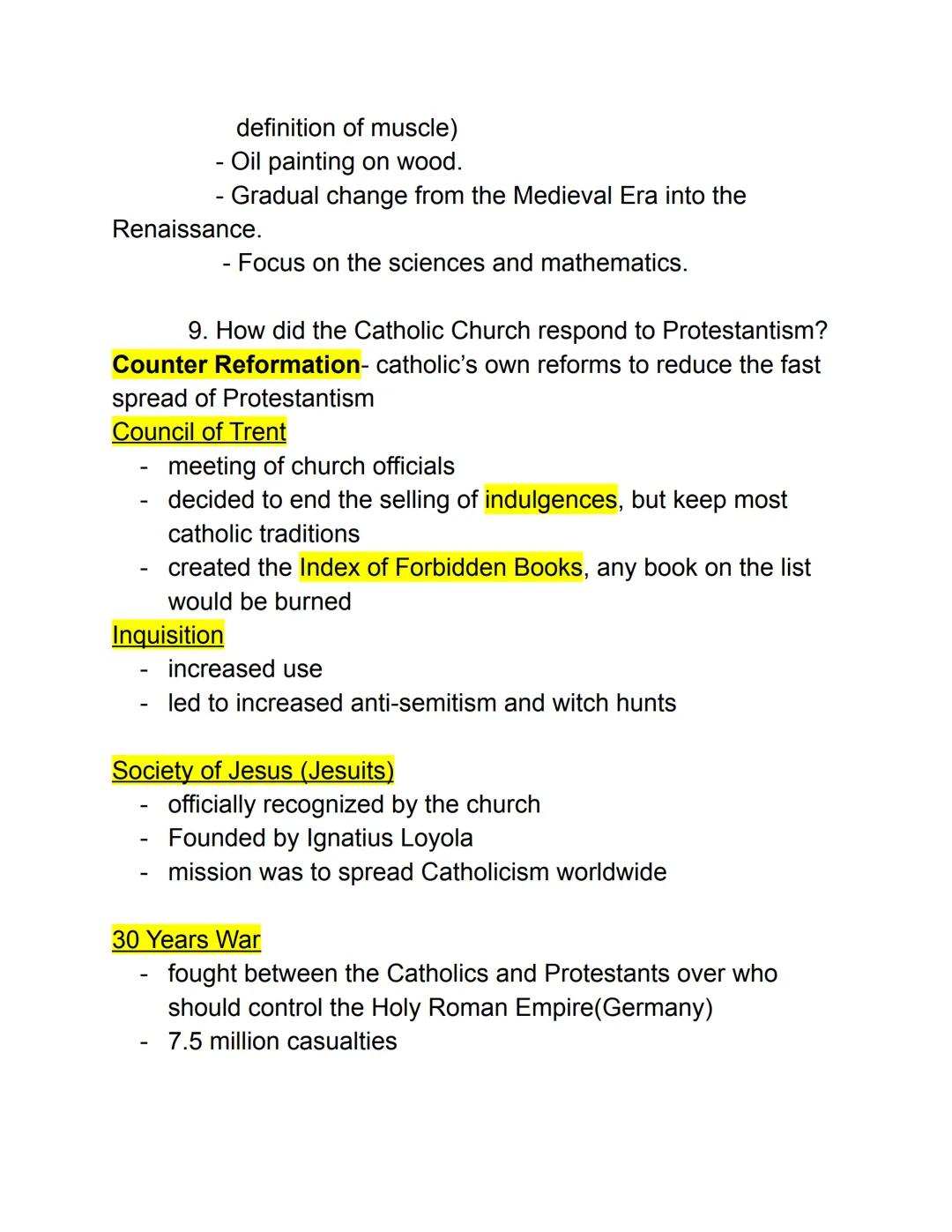
The Protestant Reformation and Catholic Response
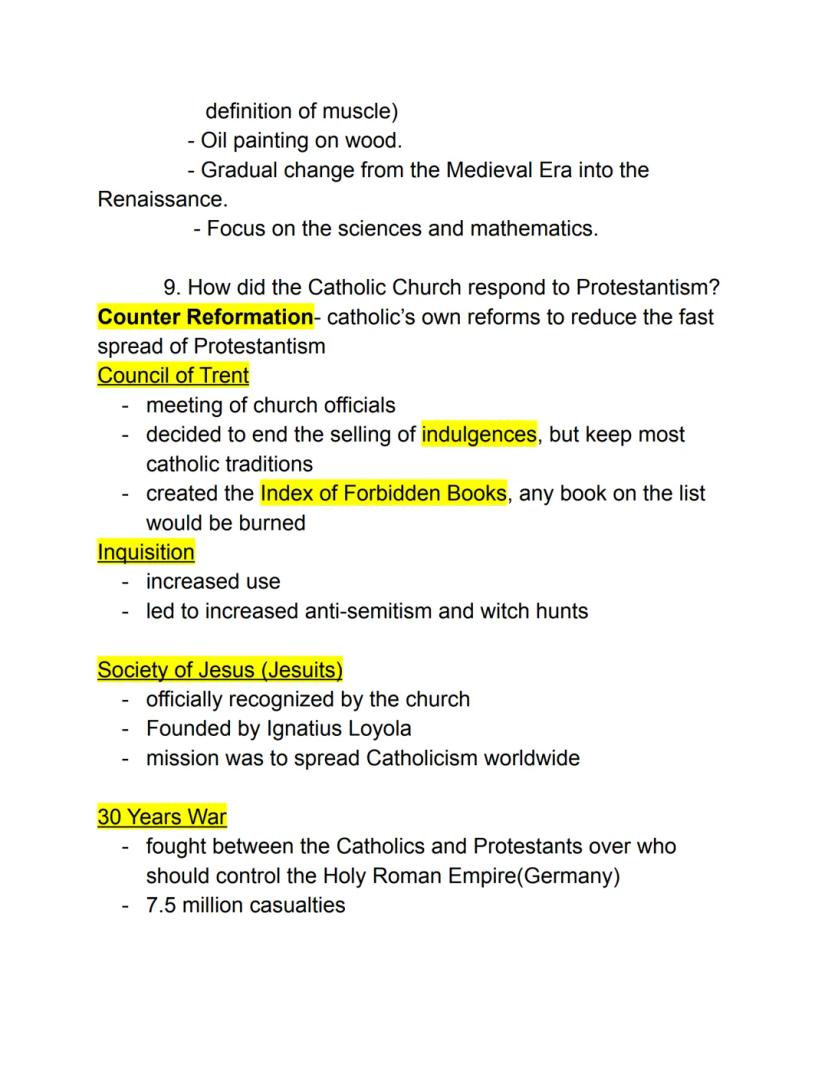
When Protestantism threatened Catholic authority, the Church launched the Counter Reformation to slow its spread. This defensive strategy included several major initiatives to maintain control.
The Council of Trent brought church officials together to address criticisms. They ended the controversial practice of selling indulgences but kept most Catholic traditions intact. They also created the Index of Forbidden Books, ordering the burning of any literature deemed dangerous to faith.
The Church strengthened the Inquisition to root out heresy, which unfortunately led to increased anti-Semitism and witch hunts across Europe. Meanwhile, the Society of Jesus (Jesuits), founded by Ignatius Loyola, received official recognition and began worldwide missionary work to spread Catholicism.
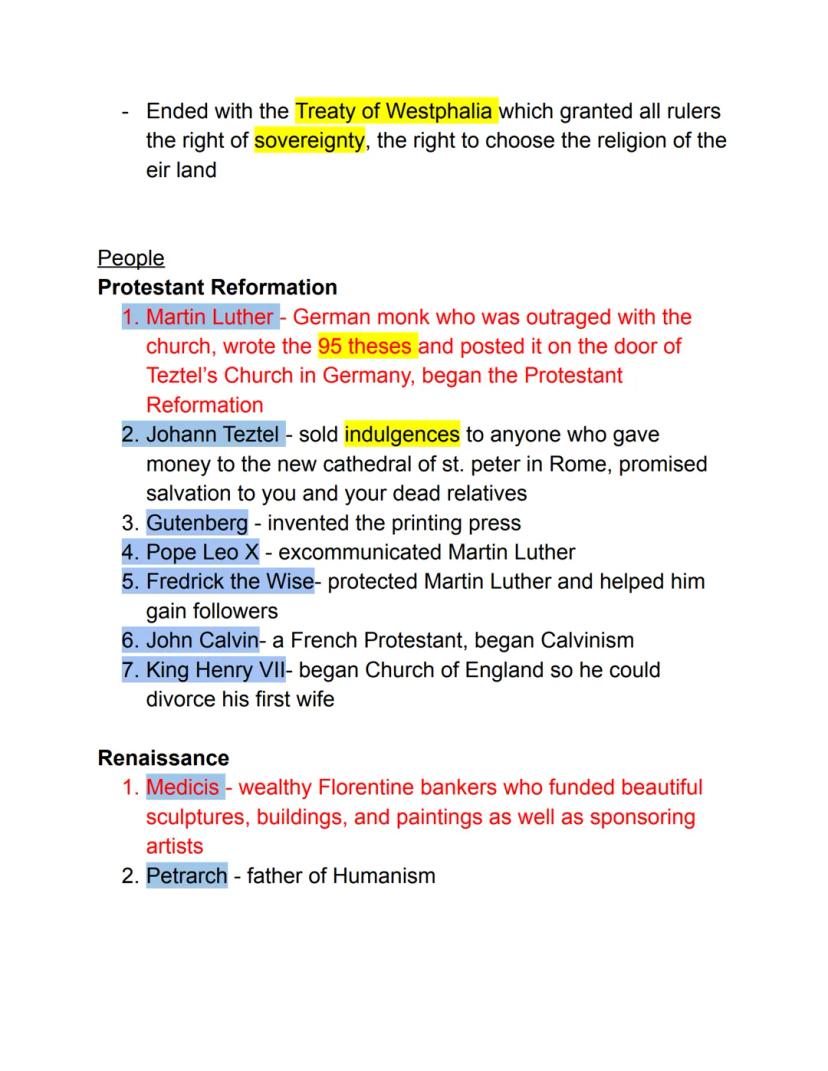
History impact: The religious tensions erupted into the devastating Thirty Years' War between Catholics and Protestants fighting for control of the Holy Roman Empire. With 7.5 million casualties, it ranks among history's deadliest religious conflicts. The war finally ended with the Treaty of Westphalia, which established the principle of sovereignty—allowing rulers to choose their territories' official religion.
5
of 7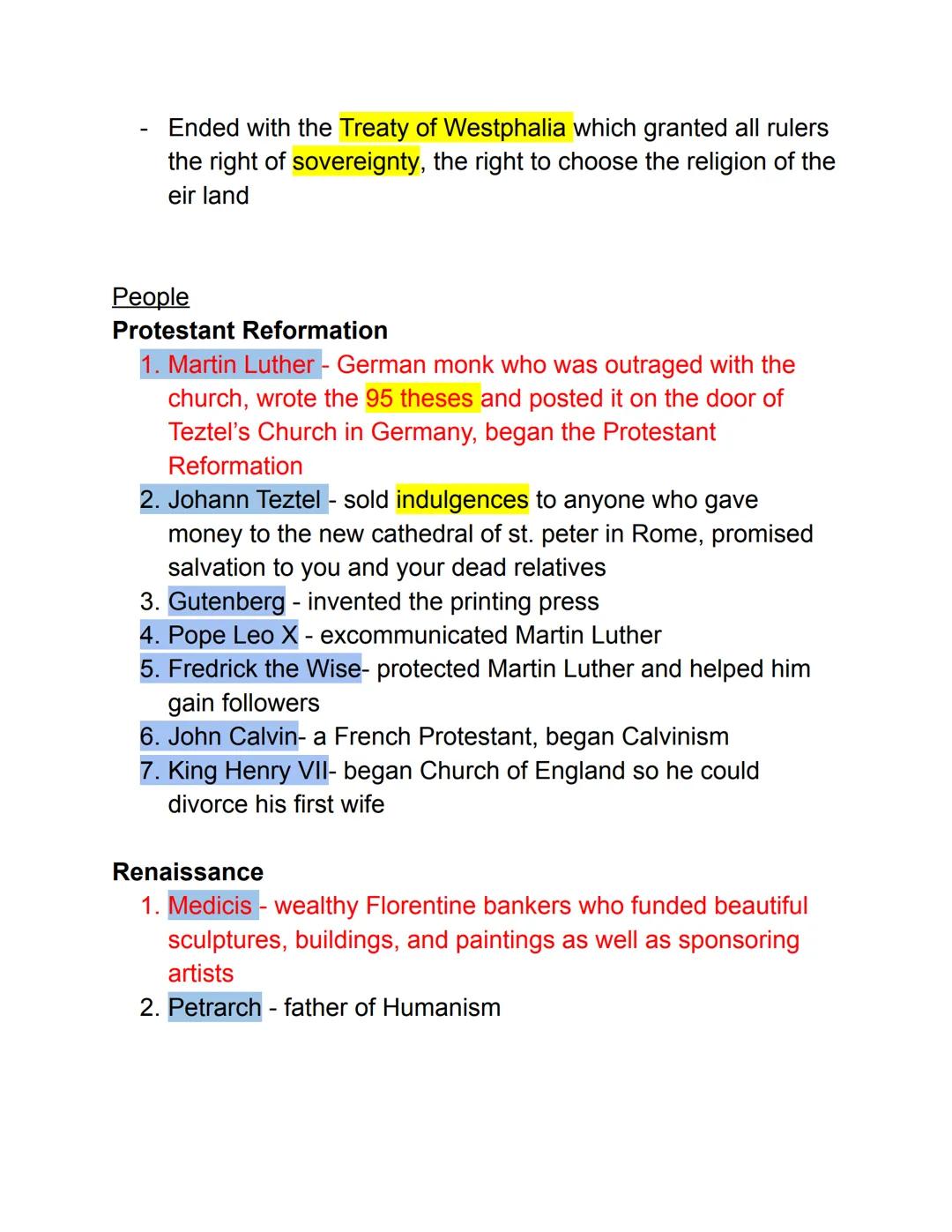
Key Figures of the Protestant Reformation and Renaissance
The Protestant Reformation began with one frustrated monk. Martin Luther posted his 95 theses on a church door in Germany, challenging church practices—especially Johann Tetzel's selling of indulgences that promised salvation in exchange for money. While Pope Leo X excommunicated Luther, Frederick the Wise protected him, helping spread his ideas.
Other Protestant reformers expanded the movement. John Calvin established Calvinism in France, while King Henry VIII created the Church of England primarily to divorce his first wife—changing England's religious landscape forever.
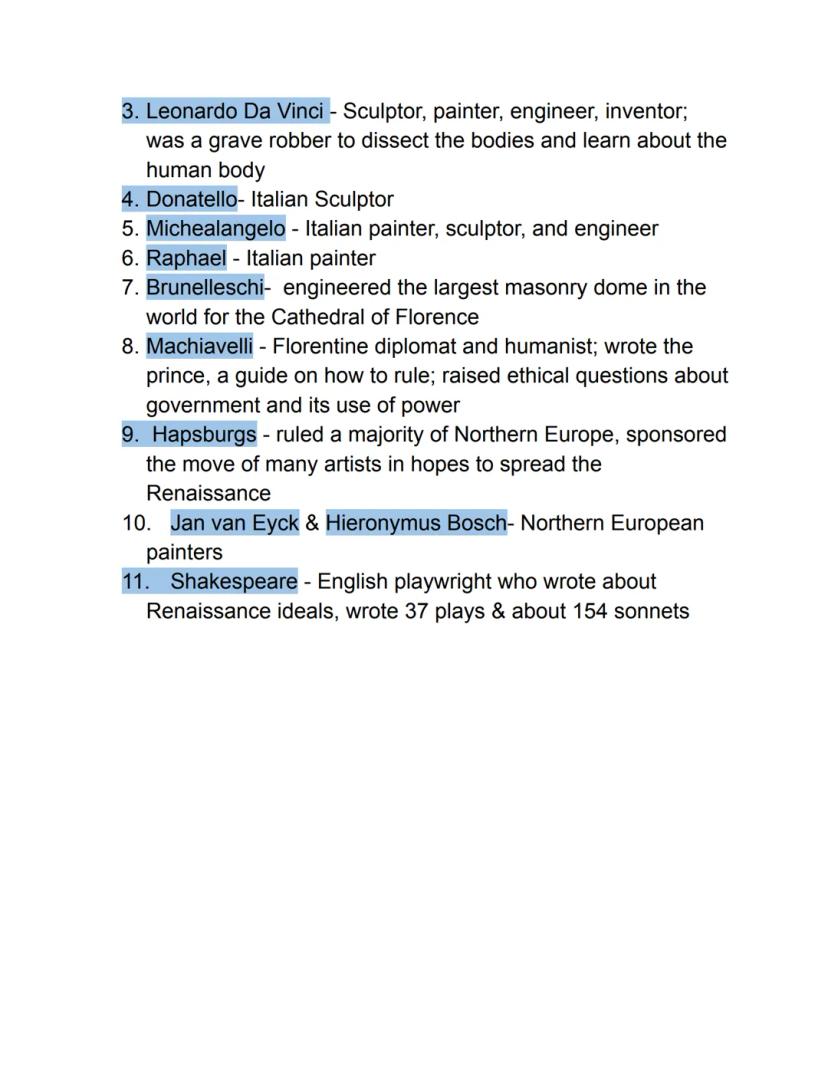
The Renaissance thrived through the contributions of brilliant minds. The Medici family bankrolled much of the Italian Renaissance as wealthy Florentine bankers. Petrarch, considered the father of Humanism, championed classical learning. Artists like Leonardo Da Vinci (who even robbed graves to study anatomy) and Michelangelo created masterpieces that still amaze us today.
Make the connection: Notice how both the Renaissance and Reformation challenged established authority—whether artistic traditions or religious practices. This spirit of questioning would become a cornerstone of modern thinking.
6
of 7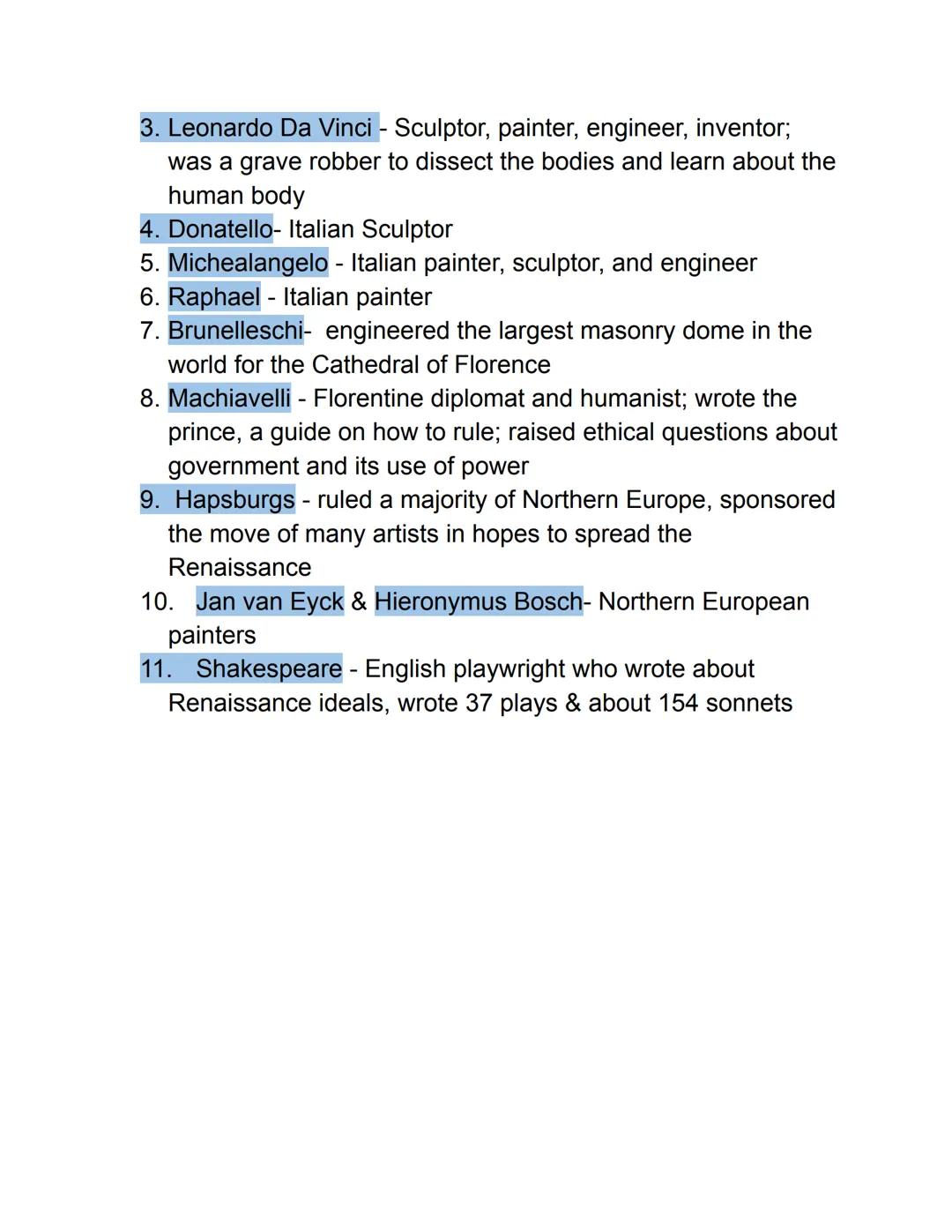
Renaissance Innovators and Legacy
The Renaissance transformed society through its extraordinary thinkers and creators. Brunelleschi engineered the largest masonry dome in the world for Florence's Cathedral, solving architectural problems that had stumped builders for generations. His innovations in mathematics and engineering made impossible structures possible.
Political philosophy found its modern voice through Machiavelli's controversial writings. His work "The Prince" offered rulers a pragmatic approach to maintaining power rather than following moral ideals, fundamentally changing how people thought about government and leadership.
Northern Europe embraced Renaissance ideas through artistic innovation. Painters like Jan van Eyck and Hieronymus Bosch developed distinctively northern styles, while in England, Shakespeare produced 37 plays and 154 sonnets that explored Renaissance ideals through unforgettable characters and stories. His work continues to be performed worldwide, bringing Renaissance thinking to new generations.
Big picture view: The Renaissance wasn't just about beautiful art—it represented a fundamental shift in how people understood themselves and their world. By celebrating human potential and questioning traditional authorities, Renaissance thinkers laid groundwork for modern society.
7
of 7
We thought you’d never ask...
What is the Knowunity AI companion?
Our AI companion is specifically built for the needs of students. Based on the millions of content pieces we have on the platform we can provide truly meaningful and relevant answers to students. But its not only about answers, the companion is even more about guiding students through their daily learning challenges, with personalised study plans, quizzes or content pieces in the chat and 100% personalisation based on the students skills and developments.
Where can I download the Knowunity app?
You can download the app in the Google Play Store and in the Apple App Store.
Is Knowunity really free of charge?
That's right! Enjoy free access to study content, connect with fellow students, and get instant help – all at your fingertips.
Most popular content in World History
9W
World HistoryWorld War 1 Multiple Choice Question Quiz
This quiz was created to test your knowledge of World War 1. This quiz contains questions about the war's events, alliances, significant battles, and the aftermath.
7th3800
World HistoryHumanism in the European Renaissance
Learn about Renaissance Humanism, an intellectual movement emphasizing human potential, achievements, and the revival of classical learning during the European transformation.
9th2323
World HistoryAncient River Civilizations: Mesopotamia, Egypt, and the Indus Valley
Covers the rise and characteristics of foundational early societies in Mesopotamia, the Nile Valley (Egypt), and the Indus Valley regions.
9th3602
P
World HistoryPaleolithic Era
This is a short little quiz based off of my notes from Advanced Global
9th1340
World HistoryAP 10 - QUARTER 2 NOTES
Globalisasyon SDG Migrasyon Teritoryal Dinastiyang Politikal
10th820
 English
A Raisin in the Sun Comprehension Questions [Act I, Scene One]
A Raisin in the Sun comprehension questions with answers.
9th1250
World HistoryAP World History Unit 1 Notes
Unit 1 Notes
2,830432
World HistoryByzantine Empire Study Guide
Covers: Justinian and Theodora, Constantinople, art and architecture, split of Catholic Church, etc.
9th1855
World HistoryThe Mongols
world history
632
Most popular content
9O
 AP US History
Origins and Dynamics of the Columbian Exchange
Analyze the ecological and economic motivations behind the initial transfer of goods, people, and diseases between the Old and New Worlds.
9th3,1280
I
AP US HistoryIntroduction to Early Cultural Interactions
Analyze the initial social and religious encounters between Europeans, Africans, and Indigenous peoples in the colonial Americas.
9th2,7730
O
AP World HistoryOrigins of Ancient River Civilizations
Analyze the environmental factors and technological innovations that led to the rise of early states in Mesopotamia, Egypt, and the Indus Valley.
9th3,1870
M
AP US HistoryMotivations for European Exploration
Analyze the economic, religious, and political factors that drove European powers to the Americas during the 15th and 16th centuries.
9th1,7780
F
 AP Psychology
Foundations of Ethical Guidelines in Research
Practice the core principles of the APA ethical code including informed consent, debriefing, and the role of Institutional Review Boards.
9th1,3360
I
AP US HistoryIntroduction to Native American Societies
Examine the diverse social, political, and economic structures of North American indigenous groups prior to European contact.
9th1,1100
I
 AP Biology
Introduction to Biological Elements of Life
Practice identifying the essential elements including carbon, nitrogen, phosphorus, and sulfur that compose biological macromolecules.
9th1,7390
I
AP US HistoryIntroduction to the Spanish Encomienda System
Explore the fundamental economic and social structures of the Spanish colonial system, focusing on the encomienda and the casta social hierarchy.
9th8890
O
AP World HistoryOrigins and Continuity of the Byzantine Empire
Analyze the political and cultural transitions from the Roman Empire to the Byzantine Empire, focusing on the reign of Justinian I and his code.
9th1,6320
Can't find what you're looking for? Explore other subjects.
Students love us — and so will you.
4.6/5App Store
4.7/5Google Play
The app is very easy to use and well designed. I have found everything I was looking for so far and have been able to learn a lot from the presentations! I will definitely use the app for a class assignment! And of course it also helps a lot as an inspiration.
Stefan SiOS user
This app is really great. There are so many study notes and help [...]. My problem subject is French, for example, and the app has so many options for help. Thanks to this app, I have improved my French. I would recommend it to anyone.
Samantha KlichAndroid user
Wow, I am really amazed. I just tried the app because I've seen it advertised many times and was absolutely stunned. This app is THE HELP you want for school and above all, it offers so many things, such as workouts and fact sheets, which have been VERY helpful to me personally.
AnnaiOS user
World History143 views·Updated Jun 8, 2026·7 pagesComprehensive Renaissance Study Guide
The Renaissance marked a crucial period of rebirth in Western Europe, bringing about dramatic cultural, artistic, and intellectual changes after the Middle Ages. This transformation revived classical learning, sparked artistic innovation, and laid foundations for the modern world through advancements...
1
of 7
Sign up to see the content. It's free!
- Access to all documents
- Improve your grades
- Join milions of students
Renaissance Origins and Early Development
Ever wonder why Europe needed a complete cultural reset? Before the Renaissance, most people couldn't read, trade was limited, and medical knowledge was primitive. The Renaissance emerged as a necessary awakening to these challenges.
Italy became the birthplace of this movement for several key reasons. Florence and Venice maintained crucial trade connections with the Byzantine Empire, Muslim territories, and Eastern Europe throughout the Middle Ages, creating cultural exchange. The wealthy Medici family became powerful patrons who funded sculptures, paintings, and buildings while sponsoring legendary artists like Leonardo Da Vinci.
The invention of the printing press by Gutenberg revolutionized information sharing, allowing Renaissance ideas to spread rapidly across Europe. This technological innovation transformed society by making books and knowledge accessible beyond elite circles.
Did you know? The Italian Renaissance produced some of history's most celebrated artists. Leonardo Da Vinci wasn't just a painter but also a sculptor and inventor. Other masters included Donatello (sculptor), Raphael (painter), and Michelangelo (painter, sculptor, and engineer) who created iconic works like the Mona Lisa, David sculptures, and the Sistine Chapel.
2
of 7Sign up to see the content. It's free!
- Access to all documents
- Improve your grades
- Join milions of students
Renaissance Thought and Northern Expansion
Machiavelli changed how people thought about politics forever. As a Florentine diplomat and humanist, his famous work The Prince provided a guide on effective ruling that raised uncomfortable ethical questions about government and power. His ideas were revolutionary—suggesting rulers should be practical rather than idealistic.
The Renaissance didn't stay confined to Italy. The powerful Habsburg family sponsored artists moving northward, hoping to spread Renaissance influence throughout their territories. With the printing press accelerating the exchange of ideas, Renaissance thinking quickly took root beyond Italian borders.
Northern European artists developed their own distinctive styles. Jan van Eyck created hyper-realistic portraits with incredible detail, while Hieronymus Bosch painted elaborate scenes like "The Art of Earthly Beings" featuring meticulously detailed (and sometimes nude) human figures.
Connect the dots: Notice how technology (the printing press) and wealthy patrons (like the Medicis and Habsburgs) created the perfect conditions for cultural transformation. This pattern of technology plus funding driving cultural change continues today!
3
of 7Sign up to see the content. It's free!
- Access to all documents
- Improve your grades
- Join milions of students
Renaissance Literature and Regional Differences
Shakespeare perfectly captured Renaissance spirit in his plays. His works featured characters with tremendous self-knowledge and wit who embodied humanist ideals through their capacity for self-expression and individual freedom. These qualities shine especially bright in plays like Hamlet and Julius Caesar, where characters struggle with profound questions about existence and power.
The Italian and Northern Renaissance had distinct characteristics despite their shared inspiration. Italian Renaissance art was more secular, focusing intensely on human anatomy and classical influences from Greece and Rome. Artists used fresco techniques (paint on wet plaster) and celebrated worldly pleasures.
The Northern Renaissance developed differently due to its distance from Rome. It maintained stronger religious themes while emphasizing scientific and mathematical advancement. Northern artists preferred oil painting on wood and paid extraordinary attention to small details like individual strands of hair rather than anatomical perfection.
Test tip: Remember that the Italian Renaissance was more directly tied to classical models and humanism, while the Northern Renaissance blended medieval traditions with new ideas and emphasized detail and religious themes.
4
of 7Sign up to see the content. It's free!
- Access to all documents
- Improve your grades
- Join milions of students
The Protestant Reformation and Catholic Response
When Protestantism threatened Catholic authority, the Church launched the Counter Reformation to slow its spread. This defensive strategy included several major initiatives to maintain control.
The Council of Trent brought church officials together to address criticisms. They ended the controversial practice of selling indulgences but kept most Catholic traditions intact. They also created the Index of Forbidden Books, ordering the burning of any literature deemed dangerous to faith.
The Church strengthened the Inquisition to root out heresy, which unfortunately led to increased anti-Semitism and witch hunts across Europe. Meanwhile, the Society of Jesus (Jesuits), founded by Ignatius Loyola, received official recognition and began worldwide missionary work to spread Catholicism.
History impact: The religious tensions erupted into the devastating Thirty Years' War between Catholics and Protestants fighting for control of the Holy Roman Empire. With 7.5 million casualties, it ranks among history's deadliest religious conflicts. The war finally ended with the Treaty of Westphalia, which established the principle of sovereignty—allowing rulers to choose their territories' official religion.
5
of 7Sign up to see the content. It's free!
- Access to all documents
- Improve your grades
- Join milions of students
Key Figures of the Protestant Reformation and Renaissance
The Protestant Reformation began with one frustrated monk. Martin Luther posted his 95 theses on a church door in Germany, challenging church practices—especially Johann Tetzel's selling of indulgences that promised salvation in exchange for money. While Pope Leo X excommunicated Luther, Frederick the Wise protected him, helping spread his ideas.
Other Protestant reformers expanded the movement. John Calvin established Calvinism in France, while King Henry VIII created the Church of England primarily to divorce his first wife—changing England's religious landscape forever.
The Renaissance thrived through the contributions of brilliant minds. The Medici family bankrolled much of the Italian Renaissance as wealthy Florentine bankers. Petrarch, considered the father of Humanism, championed classical learning. Artists like Leonardo Da Vinci (who even robbed graves to study anatomy) and Michelangelo created masterpieces that still amaze us today.
Make the connection: Notice how both the Renaissance and Reformation challenged established authority—whether artistic traditions or religious practices. This spirit of questioning would become a cornerstone of modern thinking.
6
of 7Sign up to see the content. It's free!
- Access to all documents
- Improve your grades
- Join milions of students
Renaissance Innovators and Legacy
The Renaissance transformed society through its extraordinary thinkers and creators. Brunelleschi engineered the largest masonry dome in the world for Florence's Cathedral, solving architectural problems that had stumped builders for generations. His innovations in mathematics and engineering made impossible structures possible.
Political philosophy found its modern voice through Machiavelli's controversial writings. His work "The Prince" offered rulers a pragmatic approach to maintaining power rather than following moral ideals, fundamentally changing how people thought about government and leadership.
Northern Europe embraced Renaissance ideas through artistic innovation. Painters like Jan van Eyck and Hieronymus Bosch developed distinctively northern styles, while in England, Shakespeare produced 37 plays and 154 sonnets that explored Renaissance ideals through unforgettable characters and stories. His work continues to be performed worldwide, bringing Renaissance thinking to new generations.
Big picture view: The Renaissance wasn't just about beautiful art—it represented a fundamental shift in how people understood themselves and their world. By celebrating human potential and questioning traditional authorities, Renaissance thinkers laid groundwork for modern society.
7
of 7Sign up to see the content. It's free!
- Access to all documents
- Improve your grades
- Join milions of students
We thought you’d never ask...
What is the Knowunity AI companion?
Our AI companion is specifically built for the needs of students. Based on the millions of content pieces we have on the platform we can provide truly meaningful and relevant answers to students. But its not only about answers, the companion is even more about guiding students through their daily learning challenges, with personalised study plans, quizzes or content pieces in the chat and 100% personalisation based on the students skills and developments.
Where can I download the Knowunity app?
You can download the app in the Google Play Store and in the Apple App Store.
Is Knowunity really free of charge?
That's right! Enjoy free access to study content, connect with fellow students, and get instant help – all at your fingertips.
Most popular content in World History
9W
World HistoryWorld War 1 Multiple Choice Question Quiz
This quiz was created to test your knowledge of World War 1. This quiz contains questions about the war's events, alliances, significant battles, and the aftermath.
7th3800
World HistoryHumanism in the European Renaissance
Learn about Renaissance Humanism, an intellectual movement emphasizing human potential, achievements, and the revival of classical learning during the European transformation.
9th2323
World HistoryAncient River Civilizations: Mesopotamia, Egypt, and the Indus Valley
Covers the rise and characteristics of foundational early societies in Mesopotamia, the Nile Valley (Egypt), and the Indus Valley regions.
9th3602
P
World HistoryPaleolithic Era
This is a short little quiz based off of my notes from Advanced Global
9th1340
World HistoryAP 10 - QUARTER 2 NOTES
Globalisasyon SDG Migrasyon Teritoryal Dinastiyang Politikal
10th820
EnglishA Raisin in the Sun Comprehension Questions [Act I, Scene One]
A Raisin in the Sun comprehension questions with answers.
9th1250
World HistoryAP World History Unit 1 Notes
Unit 1 Notes
2,830432
World HistoryByzantine Empire Study Guide
Covers: Justinian and Theodora, Constantinople, art and architecture, split of Catholic Church, etc.
9th1855
World HistoryThe Mongols
world history
632
Most popular content
9O
AP US HistoryOrigins and Dynamics of the Columbian Exchange
Analyze the ecological and economic motivations behind the initial transfer of goods, people, and diseases between the Old and New Worlds.
9th3,1280
I
AP US HistoryIntroduction to Early Cultural Interactions
Analyze the initial social and religious encounters between Europeans, Africans, and Indigenous peoples in the colonial Americas.
9th2,7730
O
AP World HistoryOrigins of Ancient River Civilizations
Analyze the environmental factors and technological innovations that led to the rise of early states in Mesopotamia, Egypt, and the Indus Valley.
9th3,1870
M
AP US HistoryMotivations for European Exploration
Analyze the economic, religious, and political factors that drove European powers to the Americas during the 15th and 16th centuries.
9th1,7780
F
AP PsychologyFoundations of Ethical Guidelines in Research
Practice the core principles of the APA ethical code including informed consent, debriefing, and the role of Institutional Review Boards.
9th1,3360
I
AP US HistoryIntroduction to Native American Societies
Examine the diverse social, political, and economic structures of North American indigenous groups prior to European contact.
9th1,1100
I
AP BiologyIntroduction to Biological Elements of Life
Practice identifying the essential elements including carbon, nitrogen, phosphorus, and sulfur that compose biological macromolecules.
9th1,7390
I
AP US HistoryIntroduction to the Spanish Encomienda System
Explore the fundamental economic and social structures of the Spanish colonial system, focusing on the encomienda and the casta social hierarchy.
9th8890
O
AP World HistoryOrigins and Continuity of the Byzantine Empire
Analyze the political and cultural transitions from the Roman Empire to the Byzantine Empire, focusing on the reign of Justinian I and his code.
9th1,6320
Can't find what you're looking for? Explore other subjects.
Students love us — and so will you.
4.6/5App Store
4.7/5Google Play
The app is very easy to use and well designed. I have found everything I was looking for so far and have been able to learn a lot from the presentations! I will definitely use the app for a class assignment! And of course it also helps a lot as an inspiration.
Stefan SiOS user
This app is really great. There are so many study notes and help [...]. My problem subject is French, for example, and the app has so many options for help. Thanks to this app, I have improved my French. I would recommend it to anyone.
Samantha KlichAndroid user
Wow, I am really amazed. I just tried the app because I've seen it advertised many times and was absolutely stunned. This app is THE HELP you want for school and above all, it offers so many things, such as workouts and fact sheets, which have been VERY helpful to me personally.
AnnaiOS user