
The Byzantine Empire rose as the Eastern Roman Empire, surviving...
 World History185 views·Updated Jun 19, 2026·1 page
Comprehensive Byzantine Empire Study Guide

Bee Hyder@beehyder_lanm
1
of 1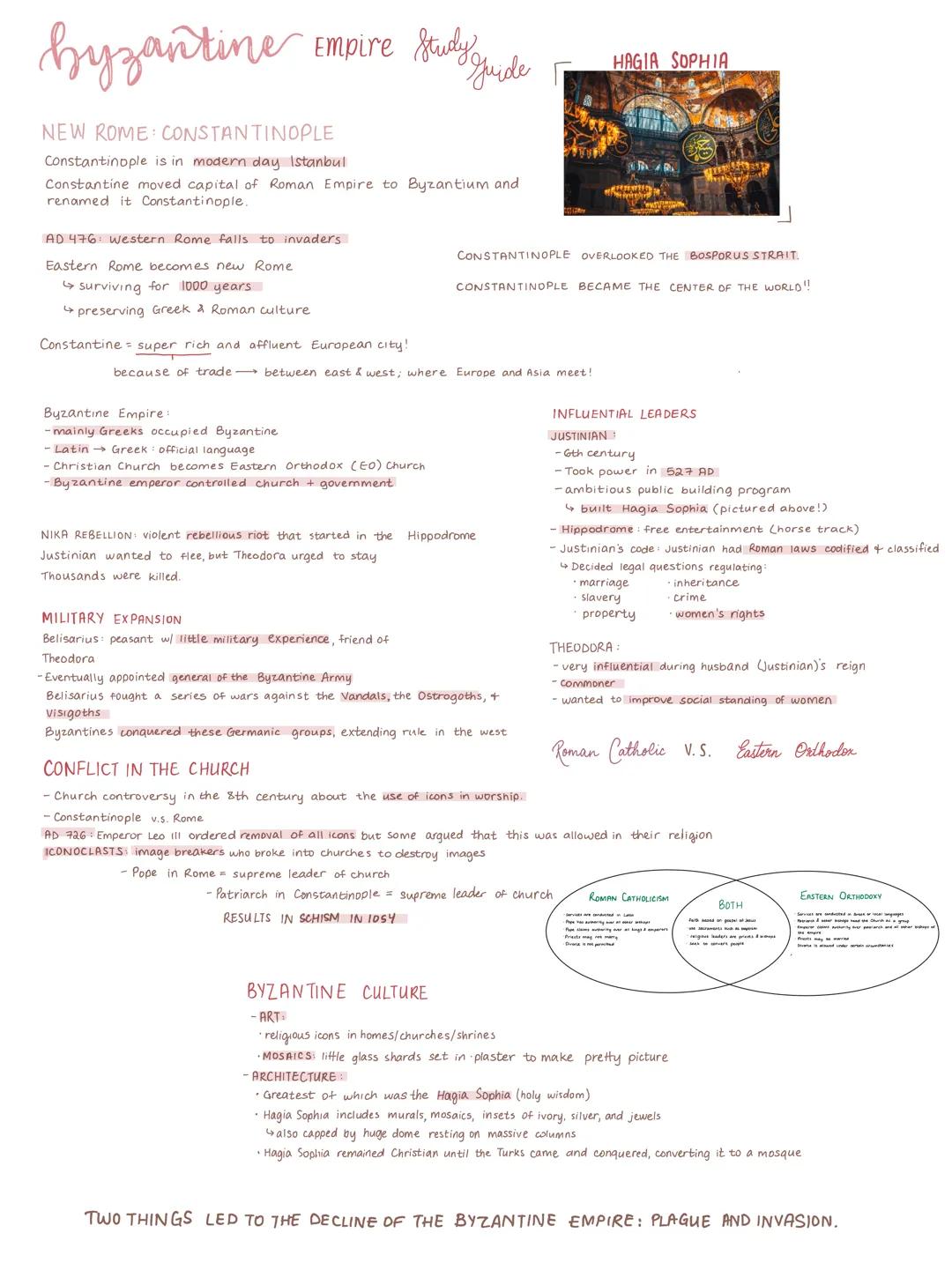
New Rome: Constantinople and the Byzantine Empire
Constantinople became the heart of the Byzantine Empire after Constantine moved the Roman capital to Byzantium. While Western Rome collapsed in 476 AD, the Eastern half thrived for another millennium. This super-rich city prospered through its perfect trading location where Europe meets Asia.
The Byzantine Empire developed its own identity distinct from Rome. Though mainly populated by Greeks, it preserved Roman traditions while adopting Greek as its official language. The Christian church evolved into the Eastern Orthodox Church, with Byzantine emperors controlling both church and government, unlike in Western Europe.
Justinian and Theodora emerged as influential 6th-century leaders. Justinian launched ambitious building projects, including the magnificent Hagia Sophia with its massive dome and beautiful mosaics. His most lasting achievement was Justinian's Code, which organized Roman laws on everything from marriage and inheritance to women's rights. His wife Theodora, though a commoner, wielded significant influence and advocated for improving women's social standing.
Did you know? The Nika Rebellion nearly ended Justinian's rule. When violent riots broke out in the Hippodrome, Justinian wanted to flee, but Theodora urged him to stay, famously saying "purple makes a fine shroud" (meaning she'd rather die as empress than live as a fugitive).
The empire expanded militarily under General Belisarius, who conquered Germanic groups including the Vandals and Ostrogoths. However, internal conflicts weakened the empire over time. A major religious controversy erupted over the use of icons in worship, with iconoclasts destroying religious images. This disagreement contributed to the Great Schism of 1054, permanently dividing Eastern Orthodox and Roman Catholic churches.
Byzantine culture produced remarkable achievements in art and architecture. Religious icons and mosaics (pictures created from tiny glass pieces set in plaster) adorned homes and churches. The greatest architectural achievement was the Hagia Sophia ("Holy Wisdom"), featuring murals, mosaics, and precious materials beneath its massive dome. Eventually, plague and invasions led to the empire's decline, with the Hagia Sophia later converted to a mosque when Constantinople fell to Turkish forces.
We thought you’d never ask...
What is the Knowunity AI companion?
Our AI companion is specifically built for the needs of students. Based on the millions of content pieces we have on the platform we can provide truly meaningful and relevant answers to students. But its not only about answers, the companion is even more about guiding students through their daily learning challenges, with personalised study plans, quizzes or content pieces in the chat and 100% personalisation based on the students skills and developments.
Where can I download the Knowunity app?
You can download the app in the Google Play Store and in the Apple App Store.
Is Knowunity really free of charge?
That's right! Enjoy free access to study content, connect with fellow students, and get instant help – all at your fingertips.
Similar Content
 History
Most popular content in World History
9W
World HistoryWorld War 1 Multiple Choice Question Quiz
This quiz was created to test your knowledge of World War 1. This quiz contains questions about the war's events, alliances, significant battles, and the aftermath.
7th3800
World HistoryHumanism in the European Renaissance
Learn about Renaissance Humanism, an intellectual movement emphasizing human potential, achievements, and the revival of classical learning during the European transformation.
9th2323
World HistoryAncient River Civilizations: Mesopotamia, Egypt, and the Indus Valley
Covers the rise and characteristics of foundational early societies in Mesopotamia, the Nile Valley (Egypt), and the Indus Valley regions.
9th3602
P
World HistoryPaleolithic Era
This is a short little quiz based off of my notes from Advanced Global
9th1340
World HistoryAP 10 - QUARTER 2 NOTES
Globalisasyon SDG Migrasyon Teritoryal Dinastiyang Politikal
10th820
 English
A Raisin in the Sun Comprehension Questions [Act I, Scene One]
A Raisin in the Sun comprehension questions with answers.
9th1250
World HistoryAP World History Unit 1 Notes
Unit 1 Notes
2,830432
World HistoryThe Mongols
world history
632
World HistoryWorld War I
This is a slideshow that summarizes World War I. In this slideshow you will find how the war started, some consequences, and a summary of the War's most important events :).
8th535
Most popular content
9O
 AP US History
Origins and Dynamics of the Columbian Exchange
Analyze the ecological and economic motivations behind the initial transfer of goods, people, and diseases between the Old and New Worlds.
9th3,1280
I
AP US HistoryIntroduction to Early Cultural Interactions
Analyze the initial social and religious encounters between Europeans, Africans, and Indigenous peoples in the colonial Americas.
9th2,7730
O
AP World HistoryOrigins of Ancient River Civilizations
Analyze the environmental factors and technological innovations that led to the rise of early states in Mesopotamia, Egypt, and the Indus Valley.
9th3,1870
M
AP US HistoryMotivations for European Exploration
Analyze the economic, religious, and political factors that drove European powers to the Americas during the 15th and 16th centuries.
9th1,7780
F
 AP Psychology
Foundations of Ethical Guidelines in Research
Practice the core principles of the APA ethical code including informed consent, debriefing, and the role of Institutional Review Boards.
9th1,3360
I
AP US HistoryIntroduction to Native American Societies
Examine the diverse social, political, and economic structures of North American indigenous groups prior to European contact.
9th1,1100
I
 AP Biology
Introduction to Biological Elements of Life
Practice identifying the essential elements including carbon, nitrogen, phosphorus, and sulfur that compose biological macromolecules.
9th1,7390
I
AP US HistoryIntroduction to the Spanish Encomienda System
Explore the fundamental economic and social structures of the Spanish colonial system, focusing on the encomienda and the casta social hierarchy.
9th8890
O
AP World HistoryOrigins and Continuity of the Byzantine Empire
Analyze the political and cultural transitions from the Roman Empire to the Byzantine Empire, focusing on the reign of Justinian I and his code.
9th1,6320
Can't find what you're looking for? Explore other subjects.
Students love us — and so will you.
4.6/5App Store
4.7/5Google Play
The app is very easy to use and well designed. I have found everything I was looking for so far and have been able to learn a lot from the presentations! I will definitely use the app for a class assignment! And of course it also helps a lot as an inspiration.
Stefan SiOS user
This app is really great. There are so many study notes and help [...]. My problem subject is French, for example, and the app has so many options for help. Thanks to this app, I have improved my French. I would recommend it to anyone.
Samantha KlichAndroid user
Wow, I am really amazed. I just tried the app because I've seen it advertised many times and was absolutely stunned. This app is THE HELP you want for school and above all, it offers so many things, such as workouts and fact sheets, which have been VERY helpful to me personally.
AnnaiOS user
World History185 views·Updated Jun 19, 2026·1 pageComprehensive Byzantine Empire Study Guide
Bee Hyder@beehyder_lanm
The Byzantine Empire rose as the Eastern Roman Empire, surviving for 1000 years after Western Rome fell in 476 AD. With Constantinople as its capital, this powerful civilization preserved Greek and Roman culture while developing its own distinct identity at...
1
of 1
Sign up to see the content. It's free!
- Access to all documents
- Improve your grades
- Join milions of students
New Rome: Constantinople and the Byzantine Empire
Constantinople became the heart of the Byzantine Empire after Constantine moved the Roman capital to Byzantium. While Western Rome collapsed in 476 AD, the Eastern half thrived for another millennium. This super-rich city prospered through its perfect trading location where Europe meets Asia.
The Byzantine Empire developed its own identity distinct from Rome. Though mainly populated by Greeks, it preserved Roman traditions while adopting Greek as its official language. The Christian church evolved into the Eastern Orthodox Church, with Byzantine emperors controlling both church and government, unlike in Western Europe.
Justinian and Theodora emerged as influential 6th-century leaders. Justinian launched ambitious building projects, including the magnificent Hagia Sophia with its massive dome and beautiful mosaics. His most lasting achievement was Justinian's Code, which organized Roman laws on everything from marriage and inheritance to women's rights. His wife Theodora, though a commoner, wielded significant influence and advocated for improving women's social standing.
Did you know? The Nika Rebellion nearly ended Justinian's rule. When violent riots broke out in the Hippodrome, Justinian wanted to flee, but Theodora urged him to stay, famously saying "purple makes a fine shroud" (meaning she'd rather die as empress than live as a fugitive).
The empire expanded militarily under General Belisarius, who conquered Germanic groups including the Vandals and Ostrogoths. However, internal conflicts weakened the empire over time. A major religious controversy erupted over the use of icons in worship, with iconoclasts destroying religious images. This disagreement contributed to the Great Schism of 1054, permanently dividing Eastern Orthodox and Roman Catholic churches.
Byzantine culture produced remarkable achievements in art and architecture. Religious icons and mosaics (pictures created from tiny glass pieces set in plaster) adorned homes and churches. The greatest architectural achievement was the Hagia Sophia ("Holy Wisdom"), featuring murals, mosaics, and precious materials beneath its massive dome. Eventually, plague and invasions led to the empire's decline, with the Hagia Sophia later converted to a mosque when Constantinople fell to Turkish forces.
We thought you’d never ask...
What is the Knowunity AI companion?
Our AI companion is specifically built for the needs of students. Based on the millions of content pieces we have on the platform we can provide truly meaningful and relevant answers to students. But its not only about answers, the companion is even more about guiding students through their daily learning challenges, with personalised study plans, quizzes or content pieces in the chat and 100% personalisation based on the students skills and developments.
Where can I download the Knowunity app?
You can download the app in the Google Play Store and in the Apple App Store.
Is Knowunity really free of charge?
That's right! Enjoy free access to study content, connect with fellow students, and get instant help – all at your fingertips.
Similar Content
Most popular content in World History
9W
World HistoryWorld War 1 Multiple Choice Question Quiz
This quiz was created to test your knowledge of World War 1. This quiz contains questions about the war's events, alliances, significant battles, and the aftermath.
7th3800
World HistoryHumanism in the European Renaissance
Learn about Renaissance Humanism, an intellectual movement emphasizing human potential, achievements, and the revival of classical learning during the European transformation.
9th2323
World HistoryAncient River Civilizations: Mesopotamia, Egypt, and the Indus Valley
Covers the rise and characteristics of foundational early societies in Mesopotamia, the Nile Valley (Egypt), and the Indus Valley regions.
9th3602
P
World HistoryPaleolithic Era
This is a short little quiz based off of my notes from Advanced Global
9th1340
World HistoryAP 10 - QUARTER 2 NOTES
Globalisasyon SDG Migrasyon Teritoryal Dinastiyang Politikal
10th820
EnglishA Raisin in the Sun Comprehension Questions [Act I, Scene One]
A Raisin in the Sun comprehension questions with answers.
9th1250
World HistoryAP World History Unit 1 Notes
Unit 1 Notes
2,830432
World HistoryThe Mongols
world history
632
World HistoryWorld War I
This is a slideshow that summarizes World War I. In this slideshow you will find how the war started, some consequences, and a summary of the War's most important events :).
8th535
Most popular content
9O
AP US HistoryOrigins and Dynamics of the Columbian Exchange
Analyze the ecological and economic motivations behind the initial transfer of goods, people, and diseases between the Old and New Worlds.
9th3,1280
I
AP US HistoryIntroduction to Early Cultural Interactions
Analyze the initial social and religious encounters between Europeans, Africans, and Indigenous peoples in the colonial Americas.
9th2,7730
O
AP World HistoryOrigins of Ancient River Civilizations
Analyze the environmental factors and technological innovations that led to the rise of early states in Mesopotamia, Egypt, and the Indus Valley.
9th3,1870
M
AP US HistoryMotivations for European Exploration
Analyze the economic, religious, and political factors that drove European powers to the Americas during the 15th and 16th centuries.
9th1,7780
F
AP PsychologyFoundations of Ethical Guidelines in Research
Practice the core principles of the APA ethical code including informed consent, debriefing, and the role of Institutional Review Boards.
9th1,3360
I
AP US HistoryIntroduction to Native American Societies
Examine the diverse social, political, and economic structures of North American indigenous groups prior to European contact.
9th1,1100
I
AP BiologyIntroduction to Biological Elements of Life
Practice identifying the essential elements including carbon, nitrogen, phosphorus, and sulfur that compose biological macromolecules.
9th1,7390
I
AP US HistoryIntroduction to the Spanish Encomienda System
Explore the fundamental economic and social structures of the Spanish colonial system, focusing on the encomienda and the casta social hierarchy.
9th8890
O
AP World HistoryOrigins and Continuity of the Byzantine Empire
Analyze the political and cultural transitions from the Roman Empire to the Byzantine Empire, focusing on the reign of Justinian I and his code.
9th1,6320
Can't find what you're looking for? Explore other subjects.
Students love us — and so will you.
4.6/5App Store
4.7/5Google Play
The app is very easy to use and well designed. I have found everything I was looking for so far and have been able to learn a lot from the presentations! I will definitely use the app for a class assignment! And of course it also helps a lot as an inspiration.
Stefan SiOS user
This app is really great. There are so many study notes and help [...]. My problem subject is French, for example, and the app has so many options for help. Thanks to this app, I have improved my French. I would recommend it to anyone.
Samantha KlichAndroid user
Wow, I am really amazed. I just tried the app because I've seen it advertised many times and was absolutely stunned. This app is THE HELP you want for school and above all, it offers so many things, such as workouts and fact sheets, which have been VERY helpful to me personally.
AnnaiOS user