
Apartheid in South Africa was one of history's most brutal...
 World History167 views·Updated Jun 14, 2026·2 pages
Understanding Apartheid: An Overview
H
Hailey Hall@haileyhall_afgu
1
of 2
The Rise of Apartheid
Racial segregation in South Africa has deep historical roots. As early as 1685, laws were passed forbidding interracial relationships, showing early signs of white supremacy policies. After the British seized South Africa from Dutch settlers in the Boer War, colonization intensified when Great Britain established the Union of South Africa in 1910, giving governing power exclusively to whites.
The system of apartheid (literally meaning "apartness" in Afrikaans) was formally implemented in 1948 when the National Party came to power. This comprehensive system of racial segregation restricted where Black South Africans could live, work, travel, eat, and even use the bathroom. Multiple laws enforced this separation, including the Population Registration Act (assigning each citizen a single racial identity), Mixed Marriages Act (criminalizing interracial relationships), and Group Areas Act (dividing living areas by race).
The government created segregated "homelands" (Bantustans) for Black South Africans in the 1950s. These areas lacked basic amenities like electricity and plumbing. Though whites represented only 10% of the population, they controlled 80% of the country's land. Every Black person over 16 had to carry passbooks at all times or face arrest.
Did you know? Signs in public spaces during apartheid sometimes literally read "WARNING BEWARE OF MONKEYS" to dehumanize Black South Africans and reinforce racial segregation.
In response to this oppression, the African National Congress (ANC) began actively fighting apartheid in 1950. Led by activists like Steve Biko and Nelson Mandela, the ANC advocated resistance through strikes and protests. Mandela, who became South Africa's first Black lawyer and opened the country's first Black law firm, initially favored non-violent protest inspired by Gandhi's methods in India.
2
of 2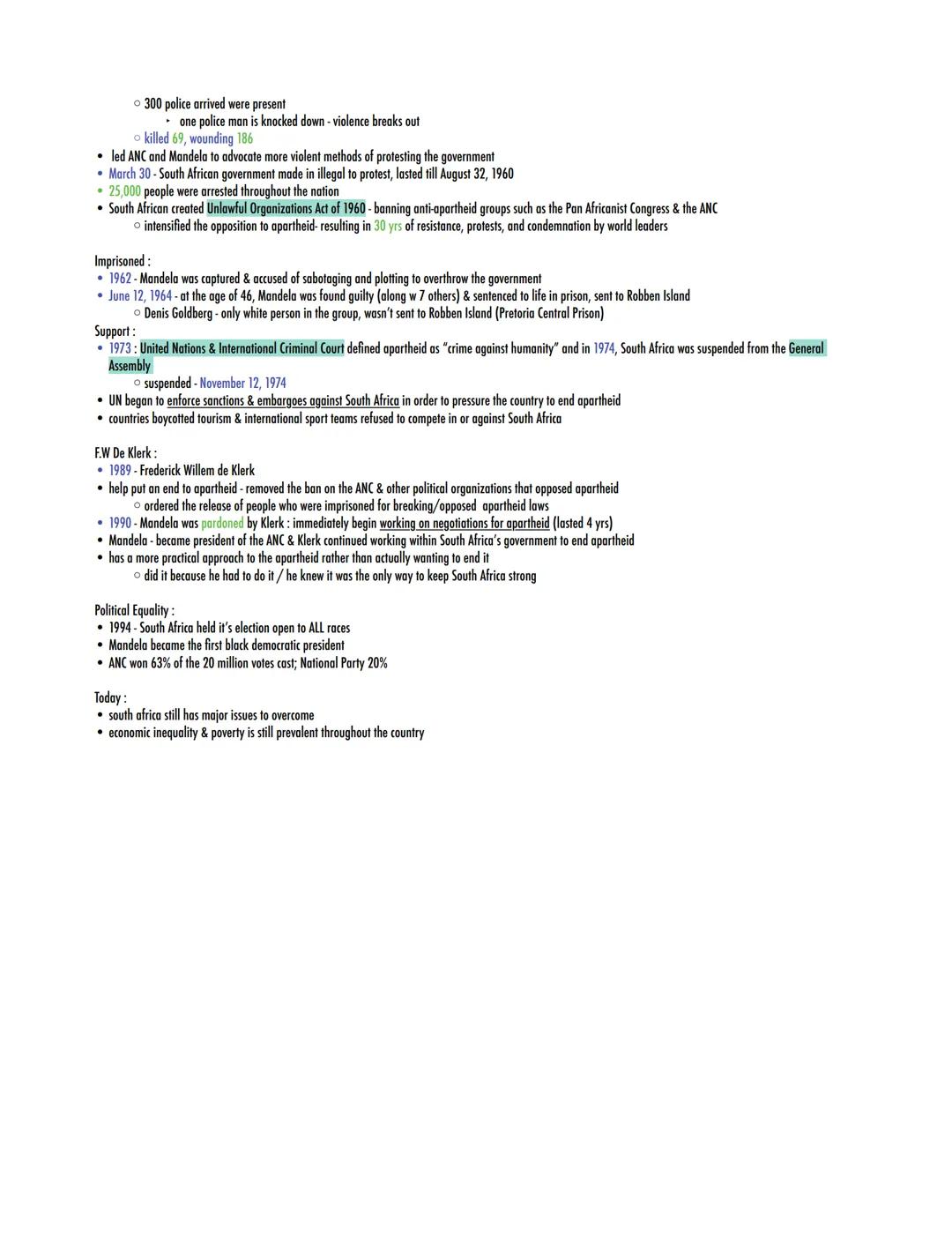
Resistance, Violence, and Change
The turning point came with the Sharpeville Massacre on March 21, 1960. During a peaceful protest of 7,000 South Africans, police opened fire, killing 69 people and wounding 186. This tragedy pushed the ANC and Mandela to adopt more confrontational methods. In response, the government banned protests and passed the Unlawful Organizations Act, outlawing anti-apartheid groups like the ANC.
In 1962, Mandela was captured and accused of sabotage. By 1964, he was sentenced to life imprisonment on Robben Island, where he would remain for 27 years. The world began to take notice of South Africa's human rights violations. In 1973, the United Nations defined apartheid as a "crime against humanity" and suspended South Africa from the General Assembly in 1974. International sanctions, embargoes, and boycotts followed to pressure South Africa to end the system.
Change finally came in 1989 when F.W. de Klerk became president. Though motivated more by practicality than moral conviction, de Klerk removed bans on the ANC and other political organizations and ordered the release of political prisoners. Mandela was freed in 1990 and immediately began working with de Klerk on negotiations to end apartheid.
Remember this: The 1994 election was a watershed moment—South Africa's first democratic election open to all races resulted in Nelson Mandela becoming the country's first Black president, with the ANC winning 63% of the 20 million votes cast.
Despite this remarkable transition to democracy, modern South Africa still faces significant challenges. The legacy of apartheid lives on through economic inequality and widespread poverty throughout the country. The dismantling of legal segregation was just the beginning of a long journey toward true equality.
We thought you’d never ask...
What is the Knowunity AI companion?
Our AI companion is specifically built for the needs of students. Based on the millions of content pieces we have on the platform we can provide truly meaningful and relevant answers to students. But its not only about answers, the companion is even more about guiding students through their daily learning challenges, with personalised study plans, quizzes or content pieces in the chat and 100% personalisation based on the students skills and developments.
Where can I download the Knowunity app?
You can download the app in the Google Play Store and in the Apple App Store.
Is Knowunity really free of charge?
That's right! Enjoy free access to study content, connect with fellow students, and get instant help – all at your fingertips.
Similar Content
 History
Most popular content in World History
9W
World HistoryWorld War 1 Multiple Choice Question Quiz
This quiz was created to test your knowledge of World War 1. This quiz contains questions about the war's events, alliances, significant battles, and the aftermath.
7th3800
World HistoryHumanism in the European Renaissance
Learn about Renaissance Humanism, an intellectual movement emphasizing human potential, achievements, and the revival of classical learning during the European transformation.
9th2323
World HistoryAncient River Civilizations: Mesopotamia, Egypt, and the Indus Valley
Covers the rise and characteristics of foundational early societies in Mesopotamia, the Nile Valley (Egypt), and the Indus Valley regions.
9th3602
P
World HistoryPaleolithic Era
This is a short little quiz based off of my notes from Advanced Global
9th1340
World HistoryAP 10 - QUARTER 2 NOTES
Globalisasyon SDG Migrasyon Teritoryal Dinastiyang Politikal
10th820
 English
A Raisin in the Sun Comprehension Questions [Act I, Scene One]
A Raisin in the Sun comprehension questions with answers.
9th1250
World HistoryAP World History Unit 1 Notes
Unit 1 Notes
2,830432
World HistoryByzantine Empire Study Guide
Covers: Justinian and Theodora, Constantinople, art and architecture, split of Catholic Church, etc.
9th1855
World HistoryThe Mongols
world history
632
Most popular content
9O
 AP US History
Origins and Dynamics of the Columbian Exchange
Analyze the ecological and economic motivations behind the initial transfer of goods, people, and diseases between the Old and New Worlds.
9th3,1280
I
AP US HistoryIntroduction to Early Cultural Interactions
Analyze the initial social and religious encounters between Europeans, Africans, and Indigenous peoples in the colonial Americas.
9th2,7730
O
AP World HistoryOrigins of Ancient River Civilizations
Analyze the environmental factors and technological innovations that led to the rise of early states in Mesopotamia, Egypt, and the Indus Valley.
9th3,1870
M
AP US HistoryMotivations for European Exploration
Analyze the economic, religious, and political factors that drove European powers to the Americas during the 15th and 16th centuries.
9th1,7780
F
 AP Psychology
Foundations of Ethical Guidelines in Research
Practice the core principles of the APA ethical code including informed consent, debriefing, and the role of Institutional Review Boards.
9th1,3360
I
AP US HistoryIntroduction to Native American Societies
Examine the diverse social, political, and economic structures of North American indigenous groups prior to European contact.
9th1,1100
I
 AP Biology
Introduction to Biological Elements of Life
Practice identifying the essential elements including carbon, nitrogen, phosphorus, and sulfur that compose biological macromolecules.
9th1,7390
I
AP US HistoryIntroduction to the Spanish Encomienda System
Explore the fundamental economic and social structures of the Spanish colonial system, focusing on the encomienda and the casta social hierarchy.
9th8890
O
AP World HistoryOrigins and Continuity of the Byzantine Empire
Analyze the political and cultural transitions from the Roman Empire to the Byzantine Empire, focusing on the reign of Justinian I and his code.
9th1,6320
Can't find what you're looking for? Explore other subjects.
Students love us — and so will you.
4.6/5App Store
4.7/5Google Play
The app is very easy to use and well designed. I have found everything I was looking for so far and have been able to learn a lot from the presentations! I will definitely use the app for a class assignment! And of course it also helps a lot as an inspiration.
Stefan SiOS user
This app is really great. There are so many study notes and help [...]. My problem subject is French, for example, and the app has so many options for help. Thanks to this app, I have improved my French. I would recommend it to anyone.
Samantha KlichAndroid user
Wow, I am really amazed. I just tried the app because I've seen it advertised many times and was absolutely stunned. This app is THE HELP you want for school and above all, it offers so many things, such as workouts and fact sheets, which have been VERY helpful to me personally.
AnnaiOS user
World History167 views·Updated Jun 14, 2026·2 pagesUnderstanding Apartheid: An Overview
H
Hailey Hall@haileyhall_afgu
Apartheid in South Africa was one of history's most brutal systems of racial segregation. From 1948 to 1994, the white minority government enforced legal racial separation that denied basic rights to the Black majority. This struggle for equality eventually led...
1
of 2
Sign up to see the content. It's free!
- Access to all documents
- Improve your grades
- Join milions of students
The Rise of Apartheid
Racial segregation in South Africa has deep historical roots. As early as 1685, laws were passed forbidding interracial relationships, showing early signs of white supremacy policies. After the British seized South Africa from Dutch settlers in the Boer War, colonization intensified when Great Britain established the Union of South Africa in 1910, giving governing power exclusively to whites.
The system of apartheid (literally meaning "apartness" in Afrikaans) was formally implemented in 1948 when the National Party came to power. This comprehensive system of racial segregation restricted where Black South Africans could live, work, travel, eat, and even use the bathroom. Multiple laws enforced this separation, including the Population Registration Act (assigning each citizen a single racial identity), Mixed Marriages Act (criminalizing interracial relationships), and Group Areas Act (dividing living areas by race).
The government created segregated "homelands" (Bantustans) for Black South Africans in the 1950s. These areas lacked basic amenities like electricity and plumbing. Though whites represented only 10% of the population, they controlled 80% of the country's land. Every Black person over 16 had to carry passbooks at all times or face arrest.
Did you know? Signs in public spaces during apartheid sometimes literally read "WARNING BEWARE OF MONKEYS" to dehumanize Black South Africans and reinforce racial segregation.
In response to this oppression, the African National Congress (ANC) began actively fighting apartheid in 1950. Led by activists like Steve Biko and Nelson Mandela, the ANC advocated resistance through strikes and protests. Mandela, who became South Africa's first Black lawyer and opened the country's first Black law firm, initially favored non-violent protest inspired by Gandhi's methods in India.
2
of 2Sign up to see the content. It's free!
- Access to all documents
- Improve your grades
- Join milions of students
Resistance, Violence, and Change
The turning point came with the Sharpeville Massacre on March 21, 1960. During a peaceful protest of 7,000 South Africans, police opened fire, killing 69 people and wounding 186. This tragedy pushed the ANC and Mandela to adopt more confrontational methods. In response, the government banned protests and passed the Unlawful Organizations Act, outlawing anti-apartheid groups like the ANC.
In 1962, Mandela was captured and accused of sabotage. By 1964, he was sentenced to life imprisonment on Robben Island, where he would remain for 27 years. The world began to take notice of South Africa's human rights violations. In 1973, the United Nations defined apartheid as a "crime against humanity" and suspended South Africa from the General Assembly in 1974. International sanctions, embargoes, and boycotts followed to pressure South Africa to end the system.
Change finally came in 1989 when F.W. de Klerk became president. Though motivated more by practicality than moral conviction, de Klerk removed bans on the ANC and other political organizations and ordered the release of political prisoners. Mandela was freed in 1990 and immediately began working with de Klerk on negotiations to end apartheid.
Remember this: The 1994 election was a watershed moment—South Africa's first democratic election open to all races resulted in Nelson Mandela becoming the country's first Black president, with the ANC winning 63% of the 20 million votes cast.
Despite this remarkable transition to democracy, modern South Africa still faces significant challenges. The legacy of apartheid lives on through economic inequality and widespread poverty throughout the country. The dismantling of legal segregation was just the beginning of a long journey toward true equality.
We thought you’d never ask...
What is the Knowunity AI companion?
Our AI companion is specifically built for the needs of students. Based on the millions of content pieces we have on the platform we can provide truly meaningful and relevant answers to students. But its not only about answers, the companion is even more about guiding students through their daily learning challenges, with personalised study plans, quizzes or content pieces in the chat and 100% personalisation based on the students skills and developments.
Where can I download the Knowunity app?
You can download the app in the Google Play Store and in the Apple App Store.
Is Knowunity really free of charge?
That's right! Enjoy free access to study content, connect with fellow students, and get instant help – all at your fingertips.
Similar Content
Most popular content in World History
9W
World HistoryWorld War 1 Multiple Choice Question Quiz
This quiz was created to test your knowledge of World War 1. This quiz contains questions about the war's events, alliances, significant battles, and the aftermath.
7th3800
World HistoryHumanism in the European Renaissance
Learn about Renaissance Humanism, an intellectual movement emphasizing human potential, achievements, and the revival of classical learning during the European transformation.
9th2323
World HistoryAncient River Civilizations: Mesopotamia, Egypt, and the Indus Valley
Covers the rise and characteristics of foundational early societies in Mesopotamia, the Nile Valley (Egypt), and the Indus Valley regions.
9th3602
P
World HistoryPaleolithic Era
This is a short little quiz based off of my notes from Advanced Global
9th1340
World HistoryAP 10 - QUARTER 2 NOTES
Globalisasyon SDG Migrasyon Teritoryal Dinastiyang Politikal
10th820
EnglishA Raisin in the Sun Comprehension Questions [Act I, Scene One]
A Raisin in the Sun comprehension questions with answers.
9th1250
World HistoryAP World History Unit 1 Notes
Unit 1 Notes
2,830432
World HistoryByzantine Empire Study Guide
Covers: Justinian and Theodora, Constantinople, art and architecture, split of Catholic Church, etc.
9th1855
World HistoryThe Mongols
world history
632
Most popular content
9O
AP US HistoryOrigins and Dynamics of the Columbian Exchange
Analyze the ecological and economic motivations behind the initial transfer of goods, people, and diseases between the Old and New Worlds.
9th3,1280
I
AP US HistoryIntroduction to Early Cultural Interactions
Analyze the initial social and religious encounters between Europeans, Africans, and Indigenous peoples in the colonial Americas.
9th2,7730
O
AP World HistoryOrigins of Ancient River Civilizations
Analyze the environmental factors and technological innovations that led to the rise of early states in Mesopotamia, Egypt, and the Indus Valley.
9th3,1870
M
AP US HistoryMotivations for European Exploration
Analyze the economic, religious, and political factors that drove European powers to the Americas during the 15th and 16th centuries.
9th1,7780
F
AP PsychologyFoundations of Ethical Guidelines in Research
Practice the core principles of the APA ethical code including informed consent, debriefing, and the role of Institutional Review Boards.
9th1,3360
I
AP US HistoryIntroduction to Native American Societies
Examine the diverse social, political, and economic structures of North American indigenous groups prior to European contact.
9th1,1100
I
AP BiologyIntroduction to Biological Elements of Life
Practice identifying the essential elements including carbon, nitrogen, phosphorus, and sulfur that compose biological macromolecules.
9th1,7390
I
AP US HistoryIntroduction to the Spanish Encomienda System
Explore the fundamental economic and social structures of the Spanish colonial system, focusing on the encomienda and the casta social hierarchy.
9th8890
O
AP World HistoryOrigins and Continuity of the Byzantine Empire
Analyze the political and cultural transitions from the Roman Empire to the Byzantine Empire, focusing on the reign of Justinian I and his code.
9th1,6320
Can't find what you're looking for? Explore other subjects.
Students love us — and so will you.
4.6/5App Store
4.7/5Google Play
The app is very easy to use and well designed. I have found everything I was looking for so far and have been able to learn a lot from the presentations! I will definitely use the app for a class assignment! And of course it also helps a lot as an inspiration.
Stefan SiOS user
This app is really great. There are so many study notes and help [...]. My problem subject is French, for example, and the app has so many options for help. Thanks to this app, I have improved my French. I would recommend it to anyone.
Samantha KlichAndroid user
Wow, I am really amazed. I just tried the app because I've seen it advertised many times and was absolutely stunned. This app is THE HELP you want for school and above all, it offers so many things, such as workouts and fact sheets, which have been VERY helpful to me personally.
AnnaiOS user