
Human Geography of Southeast Asia explores how different cultural groups,...
 World History86 views·Updated Jun 11, 2026·26 pages
Heograpiya at Demograpiya ng Timog-Silangang Asya (AP 7 Q1 L2)
D
doloresrosedavid@doloresrosedavi



1 / 10
1
of 10
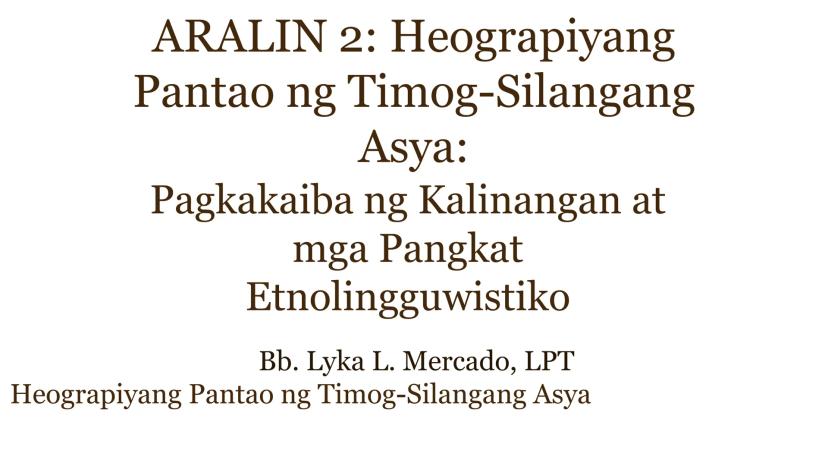
Human Geography of Southeast Asia
Have you ever wondered what makes Southeast Asian countries so unique? Human geography helps us understand the people, cultures, and languages that give this region its incredible diversity.
This lesson will explore different ethnic-linguistic groups across Southeast Asia and what makes them special. You'll discover how language, religion, traditions, and customs vary from country to country.
Understanding these differences will help you appreciate the rich cultural mosaic that makes Southeast Asia one of the world's most fascinating regions!
Did you know? Southeast Asia is home to thousands of different languages and ethnic groups, making it one of the most culturally diverse regions on Earth!
2
of 10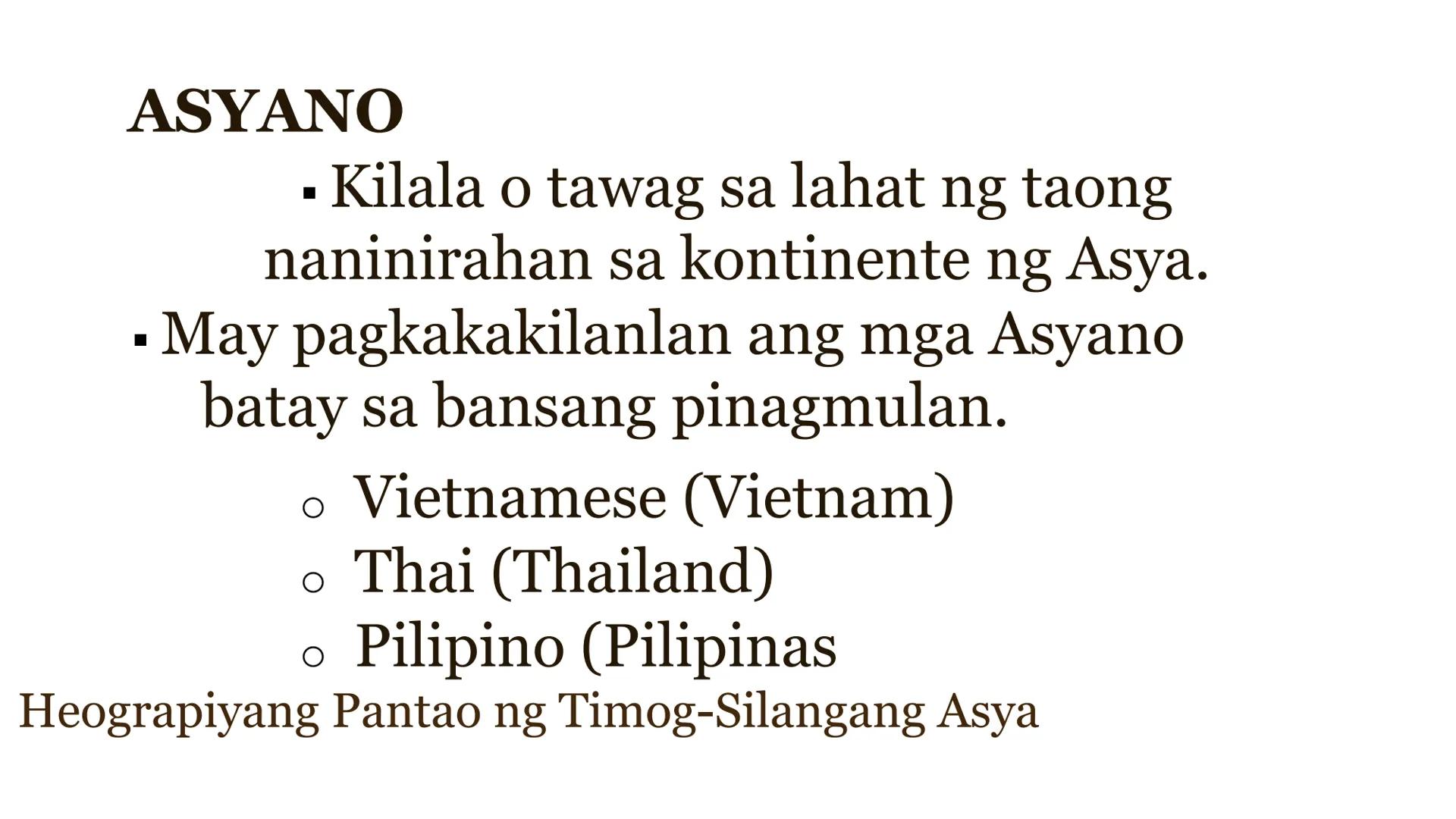
Who Are the Asians?
The term "Asian" refers to anyone who lives in the continent of Asia. But people are usually identified by their specific country of origin.
Someone from Vietnam is called Vietnamese, a person from Thailand is Thai, and a person from the Philippines is Filipino. This gives people a more specific identity than simply being called "Asian."
Each country in Southeast Asia has its own unique cultural identity, traditions, and history that shape how people see themselves and others.
Fun fact: Asia is the largest and most populous continent on Earth, containing about 60% of the world's population!
3
of 10
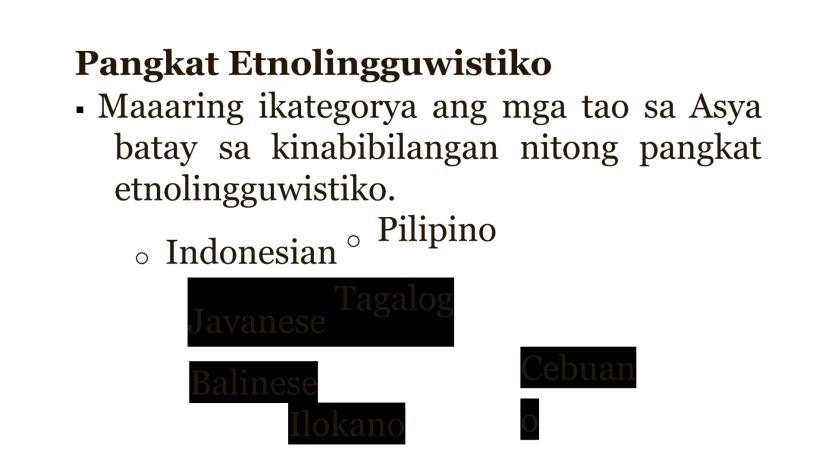
Ethnic-Linguistic Groups
People in Asia can be categorized based on their ethnic-linguistic groups. These are communities that share similar languages, cultures, and ethnic backgrounds.
In Indonesia, you'll find groups like the Javanese and Balinese people. Meanwhile, in the Philippines, there are several ethnic-linguistic groups including Tagalog, Cebuano, and Ilokano.
Each of these groups has their own distinct language, customs, and cultural traditions that have developed over many generations.
Think about it: How many different languages are spoken in your country or community? How does language help shape your cultural identity?
4
of 10
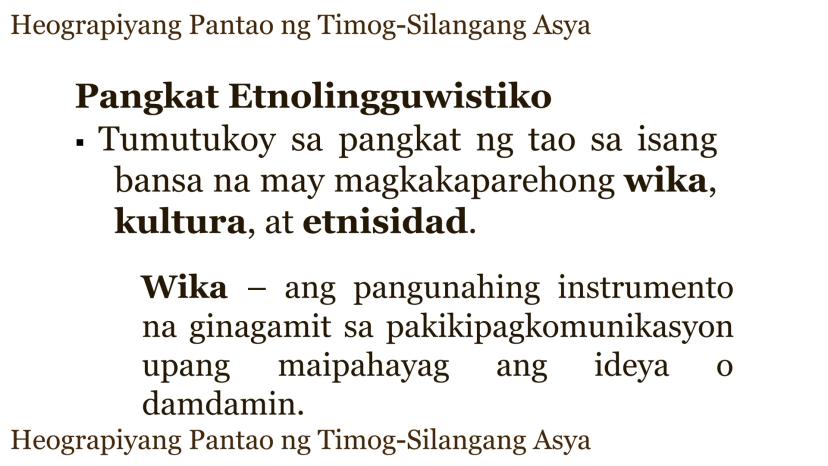
What Are Ethnic-Linguistic Groups?
An ethnic-linguistic group refers to people in a country who share the same language, culture, and ethnicity. These shared characteristics create a sense of identity and belonging.
Language is the primary tool used to communicate ideas and feelings between people. It shapes how we think and express ourselves. Different languages can lead to different worldviews!
The way people speak, the words they use, and their language's structure all reflect their cultural history and values.
Important: Language isn't just for communication—it's a key part of cultural identity and heritage that gets passed down through generations.
5
of 10
Culture and Ethnicity
Culture refers to the complete set of ideas, customs, traditions, and practices of a society. It includes everything from food and music to values and beliefs.
Ethnicity is like an extended family relationship. People are recognized as part of a group because of similarities in their origins, and they often consider themselves distant relatives.
These shared cultural and ethnic connections create strong bonds between people and help maintain traditions over time, even as societies change and develop.
Remember: Your cultural identity is shaped by many factors including your family history, where you live, and the traditions you practice!
6
of 10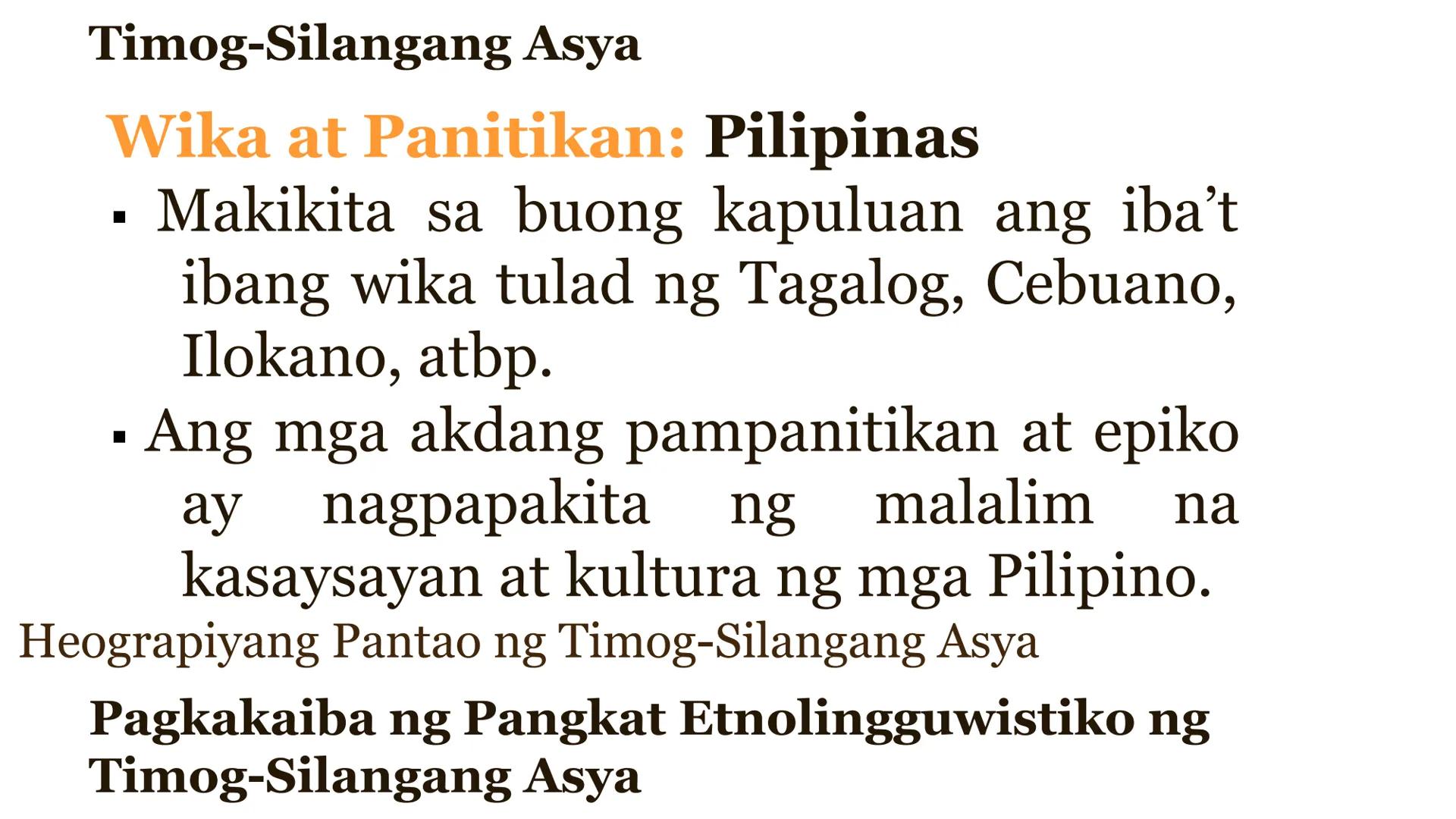
Languages and Literature: Philippines
Across the Philippine archipelago, you'll discover a rich tapestry of languages including Tagalog, Cebuano, Ilokano, and many others. These languages reflect the country's island geography that historically separated communities.
Filipino literary works and epics reveal the deep history and culture of the Filipino people. Stories like the Biag ni Lam-ang (Ilokano) and Darangen (Maranao) have been passed down through generations.
These cultural treasures help preserve the unique identities of different Filipino ethnic groups while contributing to the nation's diverse cultural heritage.
Amazing fact: The Philippines has over 180 languages spoken across its 7,000+ islands!
7
of 10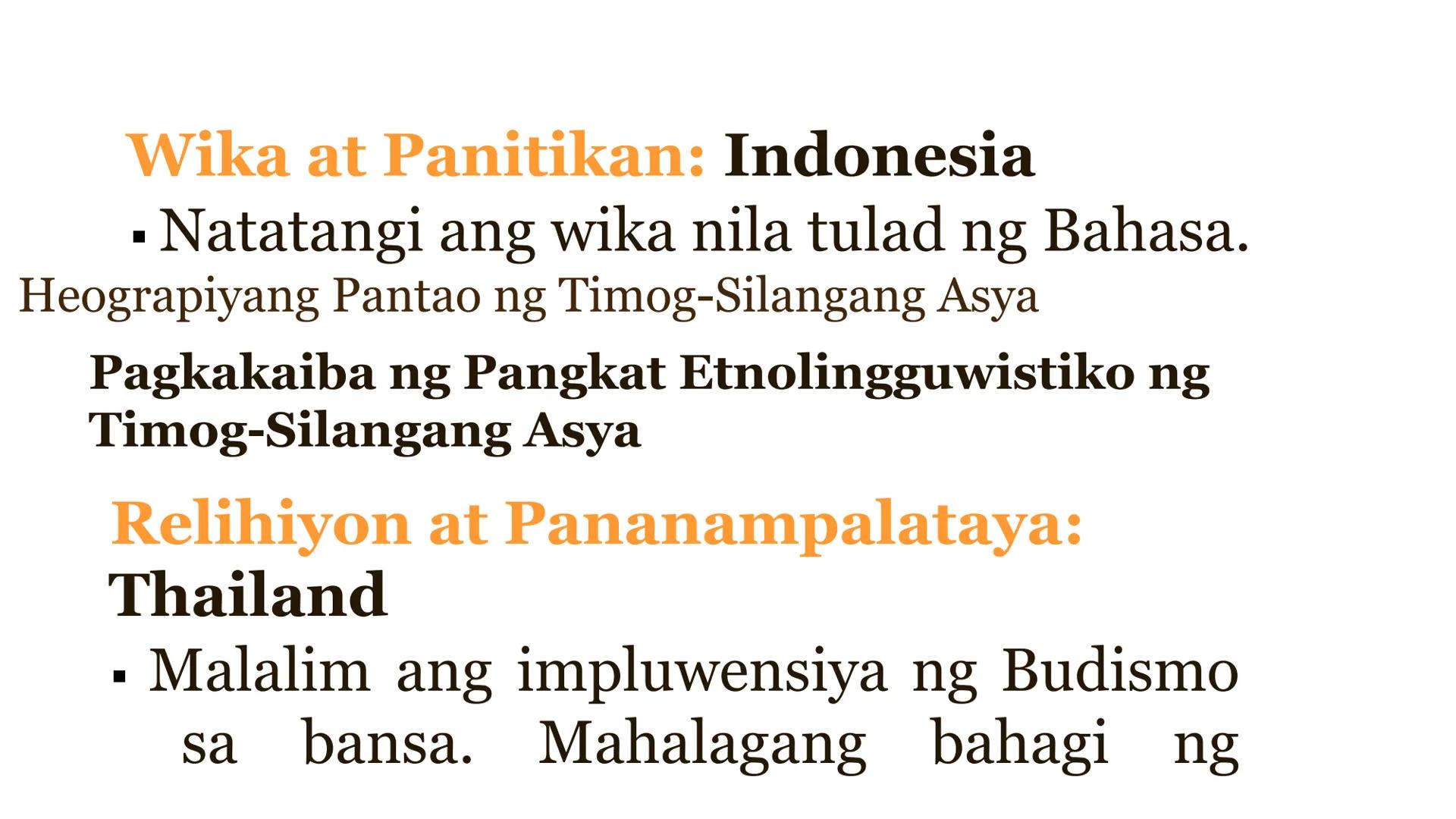
Languages and Literature: Indonesia
Indonesia has its own distinctive languages, with Bahasa Indonesia serving as the national language that unites the country's diverse population.
Religion and Faith: Thailand
Buddhism has a profound influence on Thai culture. Buddhist temples, known as "wat," are important cultural and spiritual centers throughout Thailand.
Thai people integrate Buddhist practices into their daily lives, and many young men temporarily become monks as part of their cultural tradition.
Interesting: In Thailand, over 90% of the population practices Theravada Buddhism, making it central to Thai identity and culture.
8
of 10
Religion and Faith: Philippines
Christianity, particularly Roman Catholicism, has a strong influence in the Philippines. This religious tradition was introduced during Spanish colonization and has become deeply embedded in Filipino culture.
Churches and religious celebrations are important parts of Filipino culture. Festivals like Sinulog, Ati-Atihan, and Holy Week celebrations showcase how religious practices have blended with local traditions.
The Philippines stands out in Southeast Asia as the region's only predominantly Christian nation, creating a unique cultural identity compared to its neighbors.
Did you know? The Philippines has the third-largest Catholic population in the world, after Brazil and Mexico!
9
of 10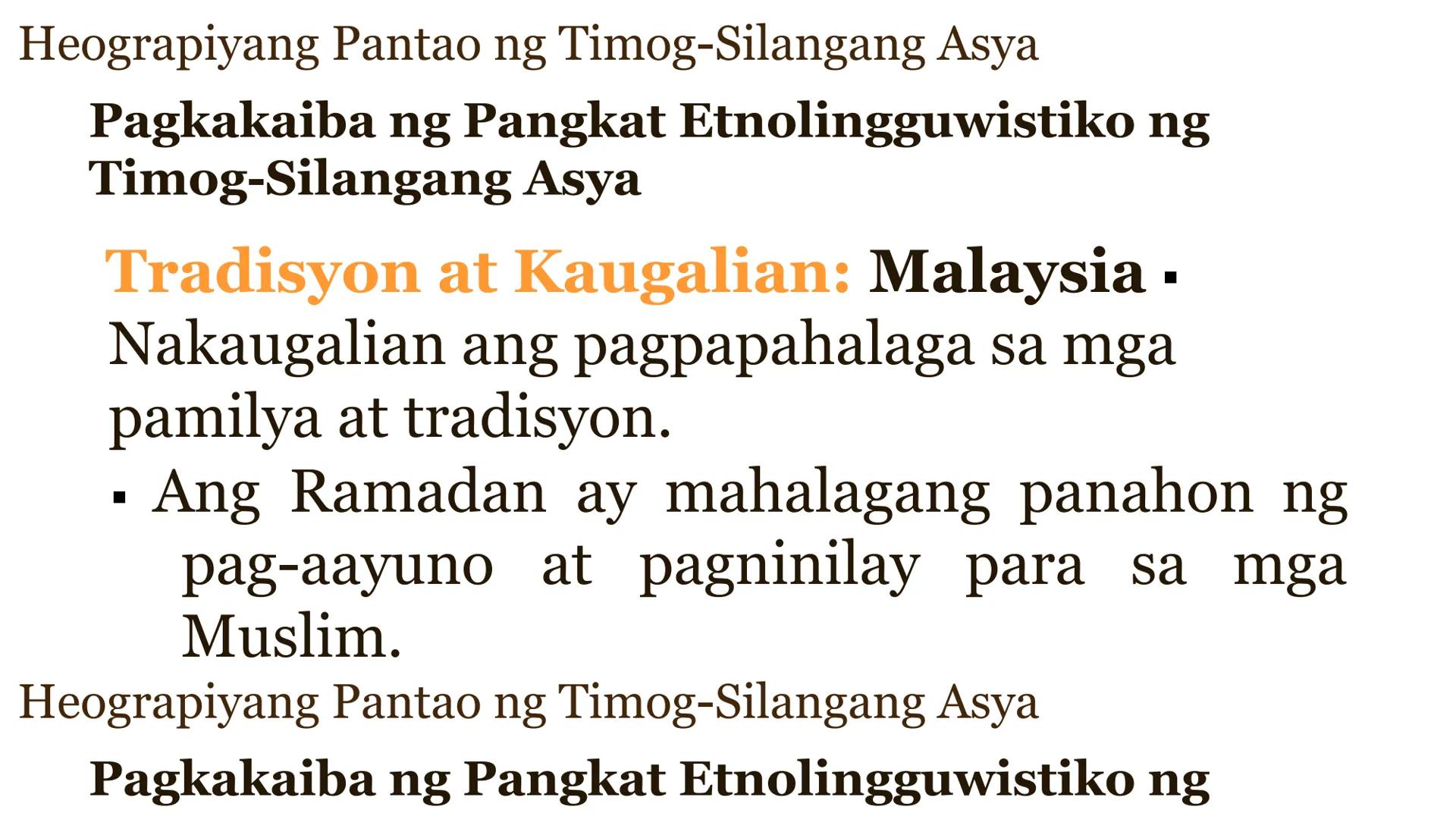
Traditions and Customs: Malaysia
Family values and traditions are highly valued in Malaysian culture. Multiple generations often live together or stay closely connected, and family gatherings are important social events.
Ramadan is a significant period of fasting and reflection for Malaysian Muslims. During this holy month, people fast from dawn until sunset and participate in special prayers and community activities.
Malaysia's diverse population of Malays, Chinese, and Indians creates a unique multicultural society where different traditions often blend together in daily life.
Cultural insight: Malaysia's "open house" tradition during festivals encourages people to open their homes to visitors of all backgrounds, promoting cultural understanding.
10
of 10
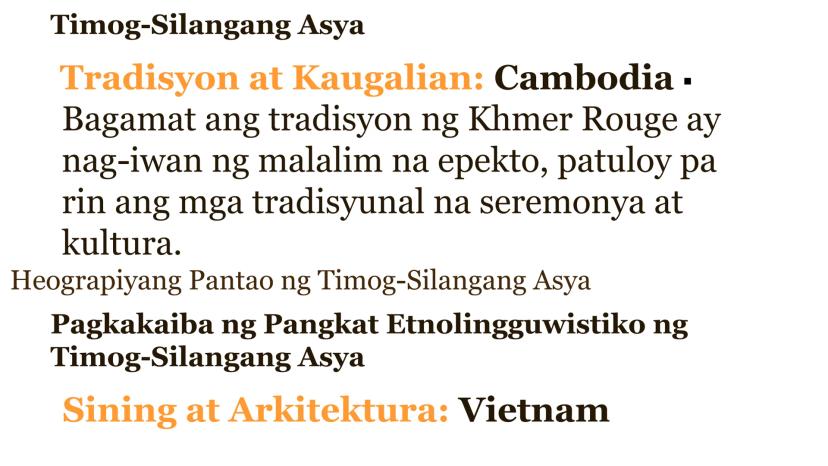
Traditions and Customs: Cambodia
Although the Khmer Rouge era left a profound impact on Cambodia, traditional ceremonies and cultural practices continue to thrive. The Cambodian people have worked to preserve their cultural heritage despite historical challenges.
Art and Architecture: Vietnam
Vietnamese art and architecture reflect influences from China, France, and local traditions. From ancient temples to colonial buildings, Vietnam's architecture tells the story of its complex history.
Traditional Vietnamese art forms include water puppetry, silk painting, and elaborate bronze casting. These artistic traditions have survived for centuries and continue to be celebrated today.
Remember: Each Southeast Asian country's unique traditions developed over thousands of years and continue to evolve today!
We thought you’d never ask...
What is the Knowunity AI companion?
Our AI companion is specifically built for the needs of students. Based on the millions of content pieces we have on the platform we can provide truly meaningful and relevant answers to students. But its not only about answers, the companion is even more about guiding students through their daily learning challenges, with personalised study plans, quizzes or content pieces in the chat and 100% personalisation based on the students skills and developments.
Where can I download the Knowunity app?
You can download the app in the Google Play Store and in the Apple App Store.
Is Knowunity really free of charge?
That's right! Enjoy free access to study content, connect with fellow students, and get instant help – all at your fingertips.
Most popular content in World History
9W
World HistoryWorld War 1 Multiple Choice Question Quiz
This quiz was created to test your knowledge of World War 1. This quiz contains questions about the war's events, alliances, significant battles, and the aftermath.
7th3800
World HistoryHumanism in the European Renaissance
Learn about Renaissance Humanism, an intellectual movement emphasizing human potential, achievements, and the revival of classical learning during the European transformation.
9th2323
World HistoryAncient River Civilizations: Mesopotamia, Egypt, and the Indus Valley
Covers the rise and characteristics of foundational early societies in Mesopotamia, the Nile Valley (Egypt), and the Indus Valley regions.
9th3602
P
World HistoryPaleolithic Era
This is a short little quiz based off of my notes from Advanced Global
9th1340
World HistoryAP 10 - QUARTER 2 NOTES
Globalisasyon SDG Migrasyon Teritoryal Dinastiyang Politikal
10th820
 English
A Raisin in the Sun Comprehension Questions [Act I, Scene One]
A Raisin in the Sun comprehension questions with answers.
9th1250
World HistoryAP World History Unit 1 Notes
Unit 1 Notes
2,830432
World HistoryByzantine Empire Study Guide
Covers: Justinian and Theodora, Constantinople, art and architecture, split of Catholic Church, etc.
9th1855
World HistoryThe Mongols
world history
632
Most popular content
9O
 AP US History
Origins and Dynamics of the Columbian Exchange
Analyze the ecological and economic motivations behind the initial transfer of goods, people, and diseases between the Old and New Worlds.
9th3,1280
I
AP US HistoryIntroduction to Early Cultural Interactions
Analyze the initial social and religious encounters between Europeans, Africans, and Indigenous peoples in the colonial Americas.
9th2,7730
O
AP World HistoryOrigins of Ancient River Civilizations
Analyze the environmental factors and technological innovations that led to the rise of early states in Mesopotamia, Egypt, and the Indus Valley.
9th3,1870
M
AP US HistoryMotivations for European Exploration
Analyze the economic, religious, and political factors that drove European powers to the Americas during the 15th and 16th centuries.
9th1,7780
F
 AP Psychology
Foundations of Ethical Guidelines in Research
Practice the core principles of the APA ethical code including informed consent, debriefing, and the role of Institutional Review Boards.
9th1,3360
I
AP US HistoryIntroduction to Native American Societies
Examine the diverse social, political, and economic structures of North American indigenous groups prior to European contact.
9th1,1100
I
 AP Biology
Introduction to Biological Elements of Life
Practice identifying the essential elements including carbon, nitrogen, phosphorus, and sulfur that compose biological macromolecules.
9th1,7390
I
AP US HistoryIntroduction to the Spanish Encomienda System
Explore the fundamental economic and social structures of the Spanish colonial system, focusing on the encomienda and the casta social hierarchy.
9th8890
O
AP World HistoryOrigins and Continuity of the Byzantine Empire
Analyze the political and cultural transitions from the Roman Empire to the Byzantine Empire, focusing on the reign of Justinian I and his code.
9th1,6320
Can't find what you're looking for? Explore other subjects.
Students love us — and so will you.
4.6/5App Store
4.7/5Google Play
The app is very easy to use and well designed. I have found everything I was looking for so far and have been able to learn a lot from the presentations! I will definitely use the app for a class assignment! And of course it also helps a lot as an inspiration.
Stefan SiOS user
This app is really great. There are so many study notes and help [...]. My problem subject is French, for example, and the app has so many options for help. Thanks to this app, I have improved my French. I would recommend it to anyone.
Samantha KlichAndroid user
Wow, I am really amazed. I just tried the app because I've seen it advertised many times and was absolutely stunned. This app is THE HELP you want for school and above all, it offers so many things, such as workouts and fact sheets, which have been VERY helpful to me personally.
AnnaiOS user
World History86 views·Updated Jun 11, 2026·26 pagesHeograpiya at Demograpiya ng Timog-Silangang Asya (AP 7 Q1 L2)
D
doloresrosedavid@doloresrosedavi
Human Geography of Southeast Asia explores how different cultural groups, languages, and traditions shape this diverse region. This study focuses on the ethnic-linguistic groups of Southeast Asia and their unique cultural characteristics that define each country's identity.
1
of 10
Sign up to see the content. It's free!
- Access to all documents
- Improve your grades
- Join milions of students
Human Geography of Southeast Asia
Have you ever wondered what makes Southeast Asian countries so unique? Human geography helps us understand the people, cultures, and languages that give this region its incredible diversity.
This lesson will explore different ethnic-linguistic groups across Southeast Asia and what makes them special. You'll discover how language, religion, traditions, and customs vary from country to country.
Understanding these differences will help you appreciate the rich cultural mosaic that makes Southeast Asia one of the world's most fascinating regions!
Did you know? Southeast Asia is home to thousands of different languages and ethnic groups, making it one of the most culturally diverse regions on Earth!
2
of 10Sign up to see the content. It's free!
- Access to all documents
- Improve your grades
- Join milions of students
Who Are the Asians?
The term "Asian" refers to anyone who lives in the continent of Asia. But people are usually identified by their specific country of origin.
Someone from Vietnam is called Vietnamese, a person from Thailand is Thai, and a person from the Philippines is Filipino. This gives people a more specific identity than simply being called "Asian."
Each country in Southeast Asia has its own unique cultural identity, traditions, and history that shape how people see themselves and others.
Fun fact: Asia is the largest and most populous continent on Earth, containing about 60% of the world's population!
3
of 10Sign up to see the content. It's free!
- Access to all documents
- Improve your grades
- Join milions of students
Ethnic-Linguistic Groups
People in Asia can be categorized based on their ethnic-linguistic groups. These are communities that share similar languages, cultures, and ethnic backgrounds.
In Indonesia, you'll find groups like the Javanese and Balinese people. Meanwhile, in the Philippines, there are several ethnic-linguistic groups including Tagalog, Cebuano, and Ilokano.
Each of these groups has their own distinct language, customs, and cultural traditions that have developed over many generations.
Think about it: How many different languages are spoken in your country or community? How does language help shape your cultural identity?
4
of 10Sign up to see the content. It's free!
- Access to all documents
- Improve your grades
- Join milions of students
What Are Ethnic-Linguistic Groups?
An ethnic-linguistic group refers to people in a country who share the same language, culture, and ethnicity. These shared characteristics create a sense of identity and belonging.
Language is the primary tool used to communicate ideas and feelings between people. It shapes how we think and express ourselves. Different languages can lead to different worldviews!
The way people speak, the words they use, and their language's structure all reflect their cultural history and values.
Important: Language isn't just for communication—it's a key part of cultural identity and heritage that gets passed down through generations.
5
of 10Sign up to see the content. It's free!
- Access to all documents
- Improve your grades
- Join milions of students
Culture and Ethnicity
Culture refers to the complete set of ideas, customs, traditions, and practices of a society. It includes everything from food and music to values and beliefs.
Ethnicity is like an extended family relationship. People are recognized as part of a group because of similarities in their origins, and they often consider themselves distant relatives.
These shared cultural and ethnic connections create strong bonds between people and help maintain traditions over time, even as societies change and develop.
Remember: Your cultural identity is shaped by many factors including your family history, where you live, and the traditions you practice!
6
of 10Sign up to see the content. It's free!
- Access to all documents
- Improve your grades
- Join milions of students
Languages and Literature: Philippines
Across the Philippine archipelago, you'll discover a rich tapestry of languages including Tagalog, Cebuano, Ilokano, and many others. These languages reflect the country's island geography that historically separated communities.
Filipino literary works and epics reveal the deep history and culture of the Filipino people. Stories like the Biag ni Lam-ang (Ilokano) and Darangen (Maranao) have been passed down through generations.
These cultural treasures help preserve the unique identities of different Filipino ethnic groups while contributing to the nation's diverse cultural heritage.
Amazing fact: The Philippines has over 180 languages spoken across its 7,000+ islands!
7
of 10Sign up to see the content. It's free!
- Access to all documents
- Improve your grades
- Join milions of students
Languages and Literature: Indonesia
Indonesia has its own distinctive languages, with Bahasa Indonesia serving as the national language that unites the country's diverse population.
Religion and Faith: Thailand
Buddhism has a profound influence on Thai culture. Buddhist temples, known as "wat," are important cultural and spiritual centers throughout Thailand.
Thai people integrate Buddhist practices into their daily lives, and many young men temporarily become monks as part of their cultural tradition.
Interesting: In Thailand, over 90% of the population practices Theravada Buddhism, making it central to Thai identity and culture.
8
of 10Sign up to see the content. It's free!
- Access to all documents
- Improve your grades
- Join milions of students
Religion and Faith: Philippines
Christianity, particularly Roman Catholicism, has a strong influence in the Philippines. This religious tradition was introduced during Spanish colonization and has become deeply embedded in Filipino culture.
Churches and religious celebrations are important parts of Filipino culture. Festivals like Sinulog, Ati-Atihan, and Holy Week celebrations showcase how religious practices have blended with local traditions.
The Philippines stands out in Southeast Asia as the region's only predominantly Christian nation, creating a unique cultural identity compared to its neighbors.
Did you know? The Philippines has the third-largest Catholic population in the world, after Brazil and Mexico!
9
of 10Sign up to see the content. It's free!
- Access to all documents
- Improve your grades
- Join milions of students
Traditions and Customs: Malaysia
Family values and traditions are highly valued in Malaysian culture. Multiple generations often live together or stay closely connected, and family gatherings are important social events.
Ramadan is a significant period of fasting and reflection for Malaysian Muslims. During this holy month, people fast from dawn until sunset and participate in special prayers and community activities.
Malaysia's diverse population of Malays, Chinese, and Indians creates a unique multicultural society where different traditions often blend together in daily life.
Cultural insight: Malaysia's "open house" tradition during festivals encourages people to open their homes to visitors of all backgrounds, promoting cultural understanding.
10
of 10Sign up to see the content. It's free!
- Access to all documents
- Improve your grades
- Join milions of students
Traditions and Customs: Cambodia
Although the Khmer Rouge era left a profound impact on Cambodia, traditional ceremonies and cultural practices continue to thrive. The Cambodian people have worked to preserve their cultural heritage despite historical challenges.
Art and Architecture: Vietnam
Vietnamese art and architecture reflect influences from China, France, and local traditions. From ancient temples to colonial buildings, Vietnam's architecture tells the story of its complex history.
Traditional Vietnamese art forms include water puppetry, silk painting, and elaborate bronze casting. These artistic traditions have survived for centuries and continue to be celebrated today.
Remember: Each Southeast Asian country's unique traditions developed over thousands of years and continue to evolve today!
We thought you’d never ask...
What is the Knowunity AI companion?
Our AI companion is specifically built for the needs of students. Based on the millions of content pieces we have on the platform we can provide truly meaningful and relevant answers to students. But its not only about answers, the companion is even more about guiding students through their daily learning challenges, with personalised study plans, quizzes or content pieces in the chat and 100% personalisation based on the students skills and developments.
Where can I download the Knowunity app?
You can download the app in the Google Play Store and in the Apple App Store.
Is Knowunity really free of charge?
That's right! Enjoy free access to study content, connect with fellow students, and get instant help – all at your fingertips.
Most popular content in World History
9W
World HistoryWorld War 1 Multiple Choice Question Quiz
This quiz was created to test your knowledge of World War 1. This quiz contains questions about the war's events, alliances, significant battles, and the aftermath.
7th3800
World HistoryHumanism in the European Renaissance
Learn about Renaissance Humanism, an intellectual movement emphasizing human potential, achievements, and the revival of classical learning during the European transformation.
9th2323
World HistoryAncient River Civilizations: Mesopotamia, Egypt, and the Indus Valley
Covers the rise and characteristics of foundational early societies in Mesopotamia, the Nile Valley (Egypt), and the Indus Valley regions.
9th3602
P
World HistoryPaleolithic Era
This is a short little quiz based off of my notes from Advanced Global
9th1340
World HistoryAP 10 - QUARTER 2 NOTES
Globalisasyon SDG Migrasyon Teritoryal Dinastiyang Politikal
10th820
EnglishA Raisin in the Sun Comprehension Questions [Act I, Scene One]
A Raisin in the Sun comprehension questions with answers.
9th1250
World HistoryAP World History Unit 1 Notes
Unit 1 Notes
2,830432
World HistoryByzantine Empire Study Guide
Covers: Justinian and Theodora, Constantinople, art and architecture, split of Catholic Church, etc.
9th1855
World HistoryThe Mongols
world history
632
Most popular content
9O
AP US HistoryOrigins and Dynamics of the Columbian Exchange
Analyze the ecological and economic motivations behind the initial transfer of goods, people, and diseases between the Old and New Worlds.
9th3,1280
I
AP US HistoryIntroduction to Early Cultural Interactions
Analyze the initial social and religious encounters between Europeans, Africans, and Indigenous peoples in the colonial Americas.
9th2,7730
O
AP World HistoryOrigins of Ancient River Civilizations
Analyze the environmental factors and technological innovations that led to the rise of early states in Mesopotamia, Egypt, and the Indus Valley.
9th3,1870
M
AP US HistoryMotivations for European Exploration
Analyze the economic, religious, and political factors that drove European powers to the Americas during the 15th and 16th centuries.
9th1,7780
F
AP PsychologyFoundations of Ethical Guidelines in Research
Practice the core principles of the APA ethical code including informed consent, debriefing, and the role of Institutional Review Boards.
9th1,3360
I
AP US HistoryIntroduction to Native American Societies
Examine the diverse social, political, and economic structures of North American indigenous groups prior to European contact.
9th1,1100
I
AP BiologyIntroduction to Biological Elements of Life
Practice identifying the essential elements including carbon, nitrogen, phosphorus, and sulfur that compose biological macromolecules.
9th1,7390
I
AP US HistoryIntroduction to the Spanish Encomienda System
Explore the fundamental economic and social structures of the Spanish colonial system, focusing on the encomienda and the casta social hierarchy.
9th8890
O
AP World HistoryOrigins and Continuity of the Byzantine Empire
Analyze the political and cultural transitions from the Roman Empire to the Byzantine Empire, focusing on the reign of Justinian I and his code.
9th1,6320
Can't find what you're looking for? Explore other subjects.
Students love us — and so will you.
4.6/5App Store
4.7/5Google Play
The app is very easy to use and well designed. I have found everything I was looking for so far and have been able to learn a lot from the presentations! I will definitely use the app for a class assignment! And of course it also helps a lot as an inspiration.
Stefan SiOS user
This app is really great. There are so many study notes and help [...]. My problem subject is French, for example, and the app has so many options for help. Thanks to this app, I have improved my French. I would recommend it to anyone.
Samantha KlichAndroid user
Wow, I am really amazed. I just tried the app because I've seen it advertised many times and was absolutely stunned. This app is THE HELP you want for school and above all, it offers so many things, such as workouts and fact sheets, which have been VERY helpful to me personally.
AnnaiOS user