
The Age of Exploration transformed our world as European powers...
 World History62 views·Updated Jun 12, 2026·3 pages
The Age of Exploration: Transforming the World (1500-1800)

Thalia Fickett@frostyfeet

1 / 3
1
of 3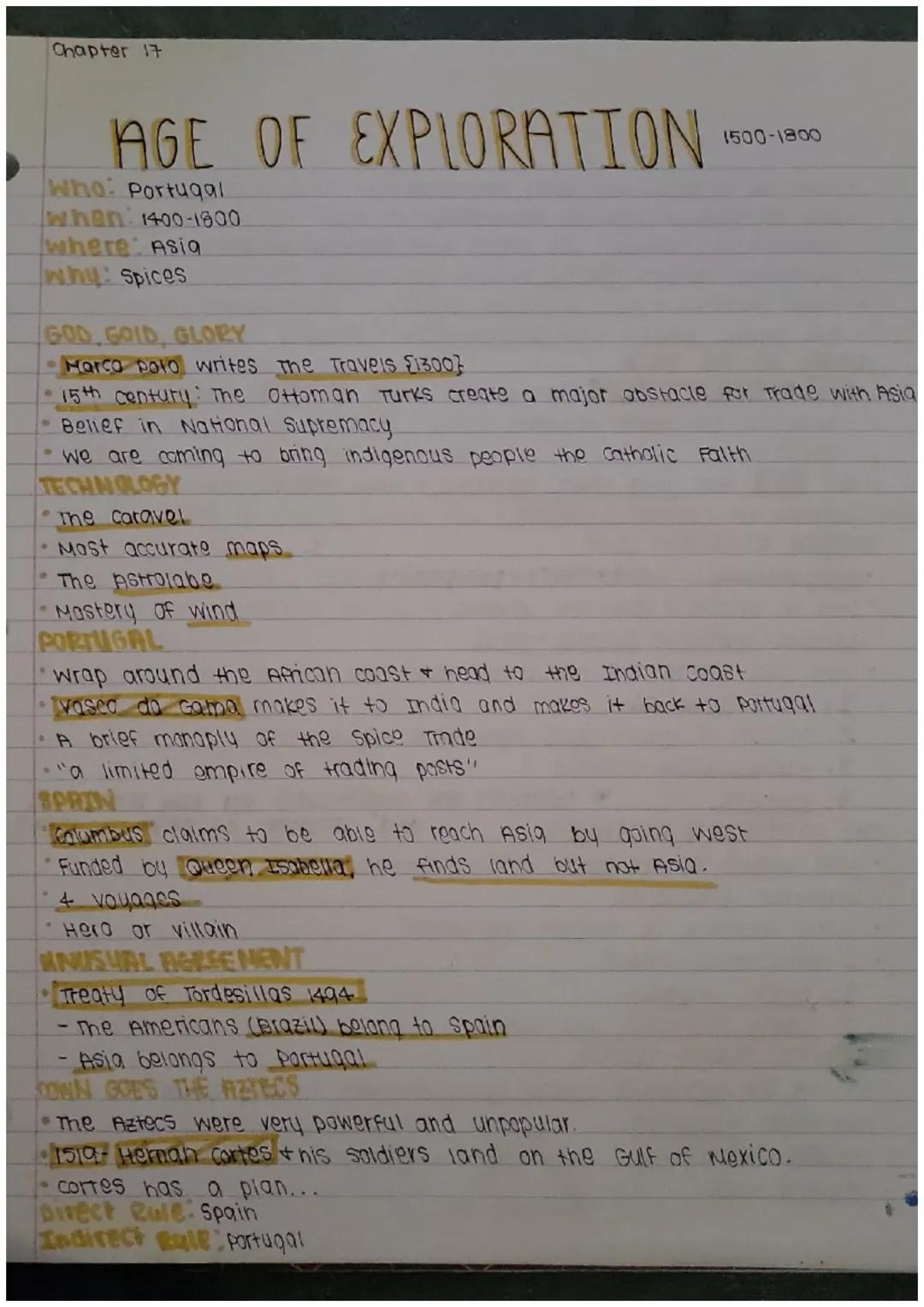
Motivations and Technologies of Exploration
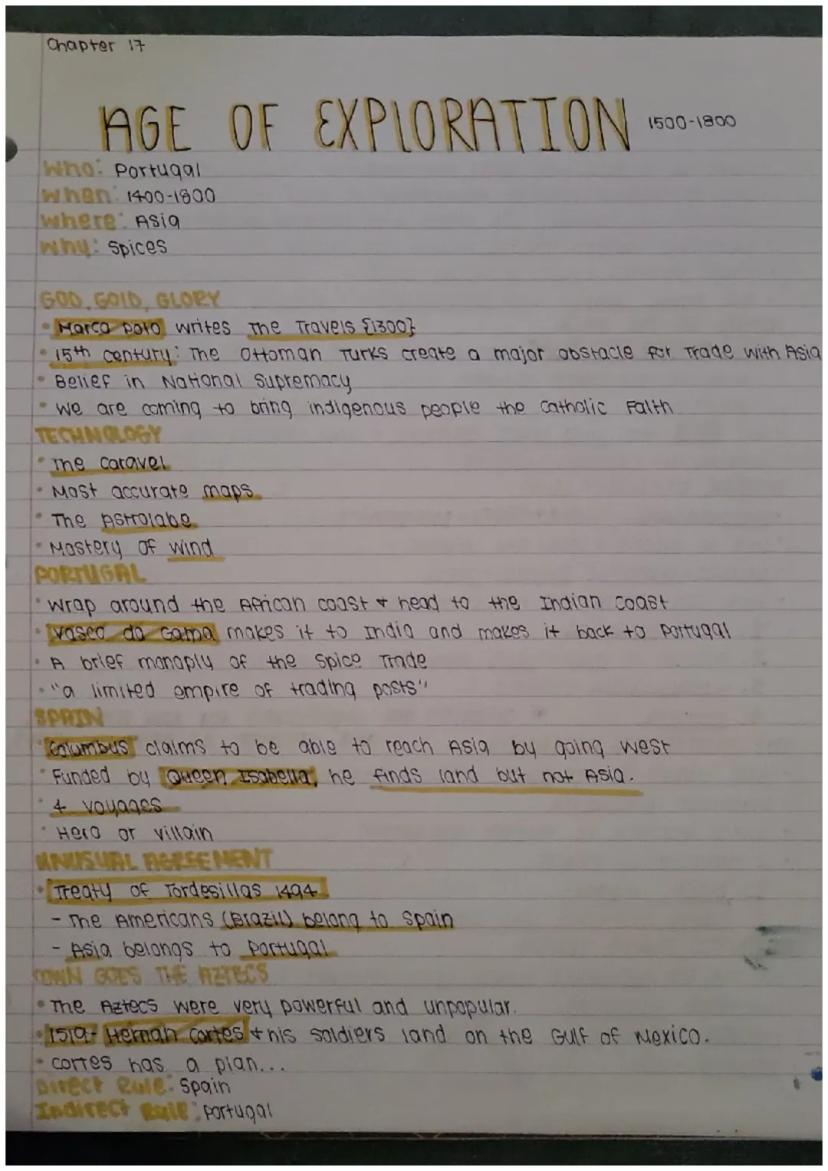
Why did Europeans suddenly sail across unknown oceans? They sought God, Gold, and Glory - spreading Christianity, finding wealth (especially spices), and gaining national prestige. Marco Polo's writings about Asia in 1300 had fueled European imagination, while Ottoman control of land routes to Asia made sea routes necessary.
New technologies made these journeys possible. The caravel ship design allowed better navigation in rough waters, while more accurate maps, the astrolabe for navigation, and better understanding of wind patterns enabled long voyages. Portugal led early explorations, sailing around Africa to reach India with Vasco da Gama establishing valuable trading posts.
Spain followed with Columbus's westward voyages seeking Asia but finding the Americas instead. The 1494 Treaty of Tordesillas divided these new discoveries - most of the Americas going to Spain and routes to Asia to Portugal. This agreement shaped colonial boundaries for centuries.
Quick Fact: The Spanish conquest of the Americas wasn't just about superior weapons. Disease played a devastating role, with smallpox killing millions of indigenous people who had no immunity to European illnesses.
2
of 3
Conquest and Global Economy
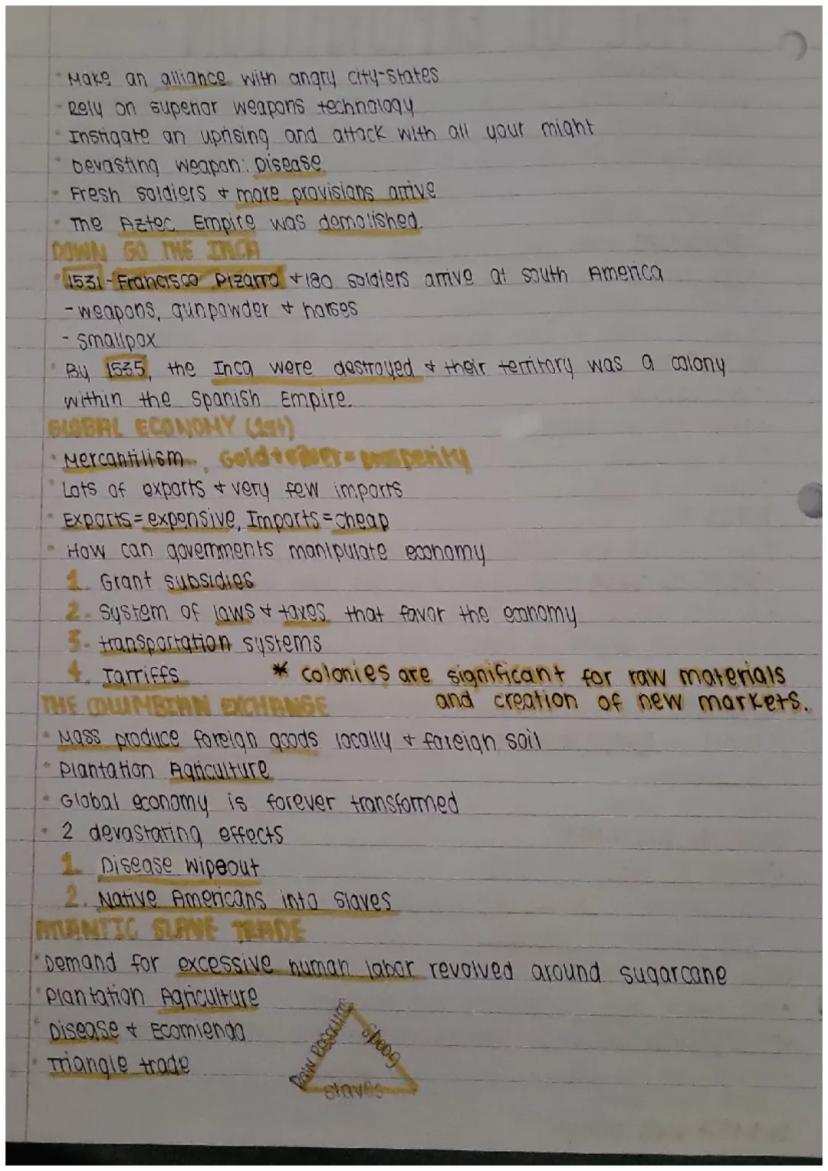
The Spanish conquered powerful indigenous empires through clever tactics. Hernán Cortés defeated the Aztecs in 1519 by forming alliances with their enemies, using superior weapons, and unintentionally spreading disease. Similarly, Francisco Pizarro destroyed the Inca Empire with just 180 soldiers, helped by smallpox that had already weakened the population.
A new global economy emerged based on mercantilism - the belief that national wealth depended on accumulating gold and silver while maintaining favorable trade balances. European powers wanted colonies to provide raw materials while buying finished goods. Governments manipulated economies through subsidies, tax systems, and transportation networks to maintain this advantage.
The Columbian Exchange transformed the world as plants, animals, and diseases moved between hemispheres. Europeans created plantation agriculture in the Americas, producing sugar, tobacco, and cotton. This system had devastating effects: disease killed millions of indigenous people, and the demand for labor led to the Atlantic slave trade.
Remember this: The Triangle Trade connected Europe, Africa and the Americas in a profitable but deadly system - European goods to Africa, enslaved people to the Americas, and colonial products back to Europe.
3
of 3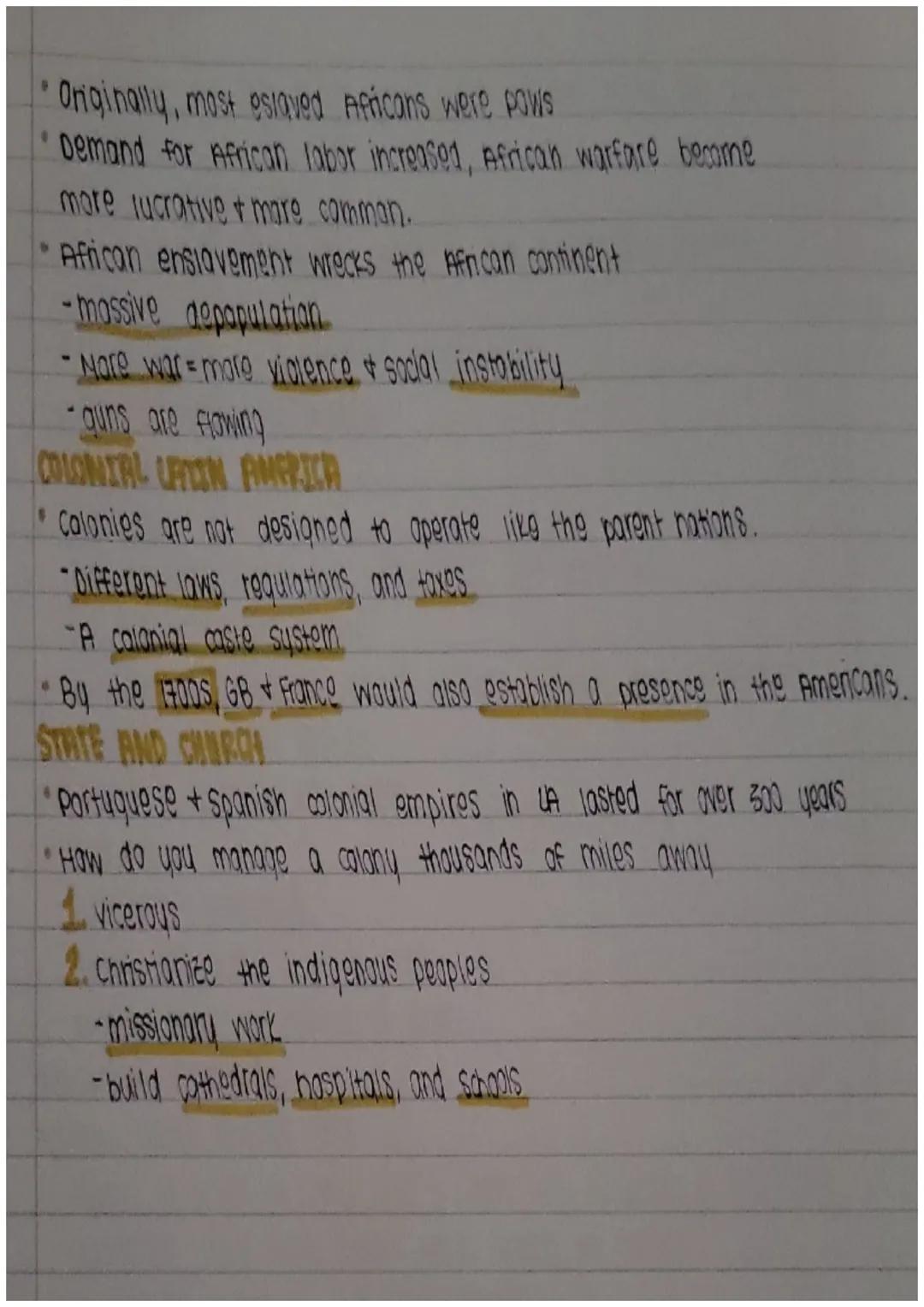
Slavery and Colonial Control
The Atlantic slave trade devastated Africa for centuries. Initially, most enslaved Africans were prisoners of war, but as European demand increased, African warfare became more common. The continent suffered massive depopulation, increased violence, and social instability as guns flowed in and people flowed out.
Colonial systems in Latin America weren't designed to benefit local populations. The Spanish and Portuguese established different laws, regulations, and taxes for their colonies, with a strict colonial caste system based on birth and race. By the 1700s, Britain and France had also established American colonies using similar systems.
Managing colonies thousands of miles away required careful organization. Spain and Portugal appointed viceroys as royal representatives with extensive powers. The Catholic Church played a crucial role in colonial control through missionary work and building cathedrals, hospitals, and schools - helping to spread European culture while establishing long-lasting colonial empires that would continue for over 300 years.
Think about: How did technology enable exploration, and how did exploration transform technology? This cycle of innovation and expansion continues to shape our world today.
We thought you’d never ask...
What is the Knowunity AI companion?
Our AI companion is specifically built for the needs of students. Based on the millions of content pieces we have on the platform we can provide truly meaningful and relevant answers to students. But its not only about answers, the companion is even more about guiding students through their daily learning challenges, with personalised study plans, quizzes or content pieces in the chat and 100% personalisation based on the students skills and developments.
Where can I download the Knowunity app?
You can download the app in the Google Play Store and in the Apple App Store.
Is Knowunity really free of charge?
That's right! Enjoy free access to study content, connect with fellow students, and get instant help – all at your fingertips.
Similar Content
 History
Most popular content in World History
9W
World HistoryWorld War 1 Multiple Choice Question Quiz
This quiz was created to test your knowledge of World War 1. This quiz contains questions about the war's events, alliances, significant battles, and the aftermath.
7th3800
World HistoryHumanism in the European Renaissance
Learn about Renaissance Humanism, an intellectual movement emphasizing human potential, achievements, and the revival of classical learning during the European transformation.
9th2323
World HistoryAncient River Civilizations: Mesopotamia, Egypt, and the Indus Valley
Covers the rise and characteristics of foundational early societies in Mesopotamia, the Nile Valley (Egypt), and the Indus Valley regions.
9th3602
P
World HistoryPaleolithic Era
This is a short little quiz based off of my notes from Advanced Global
9th1340
World HistoryAP 10 - QUARTER 2 NOTES
Globalisasyon SDG Migrasyon Teritoryal Dinastiyang Politikal
10th820
 English
A Raisin in the Sun Comprehension Questions [Act I, Scene One]
A Raisin in the Sun comprehension questions with answers.
9th1250
World HistoryAP World History Unit 1 Notes
Unit 1 Notes
2,830432
World HistoryByzantine Empire Study Guide
Covers: Justinian and Theodora, Constantinople, art and architecture, split of Catholic Church, etc.
9th1855
World HistoryThe Mongols
world history
632
Most popular content
9O
 AP US History
Origins and Dynamics of the Columbian Exchange
Analyze the ecological and economic motivations behind the initial transfer of goods, people, and diseases between the Old and New Worlds.
9th3,1280
I
AP US HistoryIntroduction to Early Cultural Interactions
Analyze the initial social and religious encounters between Europeans, Africans, and Indigenous peoples in the colonial Americas.
9th2,7730
O
AP World HistoryOrigins of Ancient River Civilizations
Analyze the environmental factors and technological innovations that led to the rise of early states in Mesopotamia, Egypt, and the Indus Valley.
9th3,1870
M
AP US HistoryMotivations for European Exploration
Analyze the economic, religious, and political factors that drove European powers to the Americas during the 15th and 16th centuries.
9th1,7780
F
 AP Psychology
Foundations of Ethical Guidelines in Research
Practice the core principles of the APA ethical code including informed consent, debriefing, and the role of Institutional Review Boards.
9th1,3360
I
AP US HistoryIntroduction to Native American Societies
Examine the diverse social, political, and economic structures of North American indigenous groups prior to European contact.
9th1,1100
I
 AP Biology
Introduction to Biological Elements of Life
Practice identifying the essential elements including carbon, nitrogen, phosphorus, and sulfur that compose biological macromolecules.
9th1,7390
I
AP US HistoryIntroduction to the Spanish Encomienda System
Explore the fundamental economic and social structures of the Spanish colonial system, focusing on the encomienda and the casta social hierarchy.
9th8890
O
AP World HistoryOrigins and Continuity of the Byzantine Empire
Analyze the political and cultural transitions from the Roman Empire to the Byzantine Empire, focusing on the reign of Justinian I and his code.
9th1,6320
Can't find what you're looking for? Explore other subjects.
Students love us — and so will you.
4.6/5App Store
4.7/5Google Play
The app is very easy to use and well designed. I have found everything I was looking for so far and have been able to learn a lot from the presentations! I will definitely use the app for a class assignment! And of course it also helps a lot as an inspiration.
Stefan SiOS user
This app is really great. There are so many study notes and help [...]. My problem subject is French, for example, and the app has so many options for help. Thanks to this app, I have improved my French. I would recommend it to anyone.
Samantha KlichAndroid user
Wow, I am really amazed. I just tried the app because I've seen it advertised many times and was absolutely stunned. This app is THE HELP you want for school and above all, it offers so many things, such as workouts and fact sheets, which have been VERY helpful to me personally.
AnnaiOS user
World History62 views·Updated Jun 12, 2026·3 pagesThe Age of Exploration: Transforming the World (1500-1800)
Thalia Fickett@frostyfeet
The Age of Exploration transformed our world as European powers ventured across oceans in search of new trade routes, wealth, and territories. From 1500-1800, countries like Portugal and Spain led expeditions that changed global power dynamics, established colonies, and created...
1
of 3
Sign up to see the content. It's free!
- Access to all documents
- Improve your grades
- Join milions of students
Motivations and Technologies of Exploration
Why did Europeans suddenly sail across unknown oceans? They sought God, Gold, and Glory - spreading Christianity, finding wealth (especially spices), and gaining national prestige. Marco Polo's writings about Asia in 1300 had fueled European imagination, while Ottoman control of land routes to Asia made sea routes necessary.
New technologies made these journeys possible. The caravel ship design allowed better navigation in rough waters, while more accurate maps, the astrolabe for navigation, and better understanding of wind patterns enabled long voyages. Portugal led early explorations, sailing around Africa to reach India with Vasco da Gama establishing valuable trading posts.
Spain followed with Columbus's westward voyages seeking Asia but finding the Americas instead. The 1494 Treaty of Tordesillas divided these new discoveries - most of the Americas going to Spain and routes to Asia to Portugal. This agreement shaped colonial boundaries for centuries.
Quick Fact: The Spanish conquest of the Americas wasn't just about superior weapons. Disease played a devastating role, with smallpox killing millions of indigenous people who had no immunity to European illnesses.
2
of 3Sign up to see the content. It's free!
- Access to all documents
- Improve your grades
- Join milions of students
Conquest and Global Economy
The Spanish conquered powerful indigenous empires through clever tactics. Hernán Cortés defeated the Aztecs in 1519 by forming alliances with their enemies, using superior weapons, and unintentionally spreading disease. Similarly, Francisco Pizarro destroyed the Inca Empire with just 180 soldiers, helped by smallpox that had already weakened the population.
A new global economy emerged based on mercantilism - the belief that national wealth depended on accumulating gold and silver while maintaining favorable trade balances. European powers wanted colonies to provide raw materials while buying finished goods. Governments manipulated economies through subsidies, tax systems, and transportation networks to maintain this advantage.
The Columbian Exchange transformed the world as plants, animals, and diseases moved between hemispheres. Europeans created plantation agriculture in the Americas, producing sugar, tobacco, and cotton. This system had devastating effects: disease killed millions of indigenous people, and the demand for labor led to the Atlantic slave trade.
Remember this: The Triangle Trade connected Europe, Africa and the Americas in a profitable but deadly system - European goods to Africa, enslaved people to the Americas, and colonial products back to Europe.
3
of 3Sign up to see the content. It's free!
- Access to all documents
- Improve your grades
- Join milions of students
Slavery and Colonial Control
The Atlantic slave trade devastated Africa for centuries. Initially, most enslaved Africans were prisoners of war, but as European demand increased, African warfare became more common. The continent suffered massive depopulation, increased violence, and social instability as guns flowed in and people flowed out.
Colonial systems in Latin America weren't designed to benefit local populations. The Spanish and Portuguese established different laws, regulations, and taxes for their colonies, with a strict colonial caste system based on birth and race. By the 1700s, Britain and France had also established American colonies using similar systems.
Managing colonies thousands of miles away required careful organization. Spain and Portugal appointed viceroys as royal representatives with extensive powers. The Catholic Church played a crucial role in colonial control through missionary work and building cathedrals, hospitals, and schools - helping to spread European culture while establishing long-lasting colonial empires that would continue for over 300 years.
Think about: How did technology enable exploration, and how did exploration transform technology? This cycle of innovation and expansion continues to shape our world today.
We thought you’d never ask...
What is the Knowunity AI companion?
Our AI companion is specifically built for the needs of students. Based on the millions of content pieces we have on the platform we can provide truly meaningful and relevant answers to students. But its not only about answers, the companion is even more about guiding students through their daily learning challenges, with personalised study plans, quizzes or content pieces in the chat and 100% personalisation based on the students skills and developments.
Where can I download the Knowunity app?
You can download the app in the Google Play Store and in the Apple App Store.
Is Knowunity really free of charge?
That's right! Enjoy free access to study content, connect with fellow students, and get instant help – all at your fingertips.
Similar Content
Most popular content in World History
9W
World HistoryWorld War 1 Multiple Choice Question Quiz
This quiz was created to test your knowledge of World War 1. This quiz contains questions about the war's events, alliances, significant battles, and the aftermath.
7th3800
World HistoryHumanism in the European Renaissance
Learn about Renaissance Humanism, an intellectual movement emphasizing human potential, achievements, and the revival of classical learning during the European transformation.
9th2323
World HistoryAncient River Civilizations: Mesopotamia, Egypt, and the Indus Valley
Covers the rise and characteristics of foundational early societies in Mesopotamia, the Nile Valley (Egypt), and the Indus Valley regions.
9th3602
P
World HistoryPaleolithic Era
This is a short little quiz based off of my notes from Advanced Global
9th1340
World HistoryAP 10 - QUARTER 2 NOTES
Globalisasyon SDG Migrasyon Teritoryal Dinastiyang Politikal
10th820
EnglishA Raisin in the Sun Comprehension Questions [Act I, Scene One]
A Raisin in the Sun comprehension questions with answers.
9th1250
World HistoryAP World History Unit 1 Notes
Unit 1 Notes
2,830432
World HistoryByzantine Empire Study Guide
Covers: Justinian and Theodora, Constantinople, art and architecture, split of Catholic Church, etc.
9th1855
World HistoryThe Mongols
world history
632
Most popular content
9O
AP US HistoryOrigins and Dynamics of the Columbian Exchange
Analyze the ecological and economic motivations behind the initial transfer of goods, people, and diseases between the Old and New Worlds.
9th3,1280
I
AP US HistoryIntroduction to Early Cultural Interactions
Analyze the initial social and religious encounters between Europeans, Africans, and Indigenous peoples in the colonial Americas.
9th2,7730
O
AP World HistoryOrigins of Ancient River Civilizations
Analyze the environmental factors and technological innovations that led to the rise of early states in Mesopotamia, Egypt, and the Indus Valley.
9th3,1870
M
AP US HistoryMotivations for European Exploration
Analyze the economic, religious, and political factors that drove European powers to the Americas during the 15th and 16th centuries.
9th1,7780
F
AP PsychologyFoundations of Ethical Guidelines in Research
Practice the core principles of the APA ethical code including informed consent, debriefing, and the role of Institutional Review Boards.
9th1,3360
I
AP US HistoryIntroduction to Native American Societies
Examine the diverse social, political, and economic structures of North American indigenous groups prior to European contact.
9th1,1100
I
AP BiologyIntroduction to Biological Elements of Life
Practice identifying the essential elements including carbon, nitrogen, phosphorus, and sulfur that compose biological macromolecules.
9th1,7390
I
AP US HistoryIntroduction to the Spanish Encomienda System
Explore the fundamental economic and social structures of the Spanish colonial system, focusing on the encomienda and the casta social hierarchy.
9th8890
O
AP World HistoryOrigins and Continuity of the Byzantine Empire
Analyze the political and cultural transitions from the Roman Empire to the Byzantine Empire, focusing on the reign of Justinian I and his code.
9th1,6320
Can't find what you're looking for? Explore other subjects.
Students love us — and so will you.
4.6/5App Store
4.7/5Google Play
The app is very easy to use and well designed. I have found everything I was looking for so far and have been able to learn a lot from the presentations! I will definitely use the app for a class assignment! And of course it also helps a lot as an inspiration.
Stefan SiOS user
This app is really great. There are so many study notes and help [...]. My problem subject is French, for example, and the app has so many options for help. Thanks to this app, I have improved my French. I would recommend it to anyone.
Samantha KlichAndroid user
Wow, I am really amazed. I just tried the app because I've seen it advertised many times and was absolutely stunned. This app is THE HELP you want for school and above all, it offers so many things, such as workouts and fact sheets, which have been VERY helpful to me personally.
AnnaiOS user