
The American Civil War's beginning was marked by deep political...
 US History52 views·Updated Jun 11, 2026·4 pages
The Start of the Civil War: Key Early Events
1 / 4
1
of 4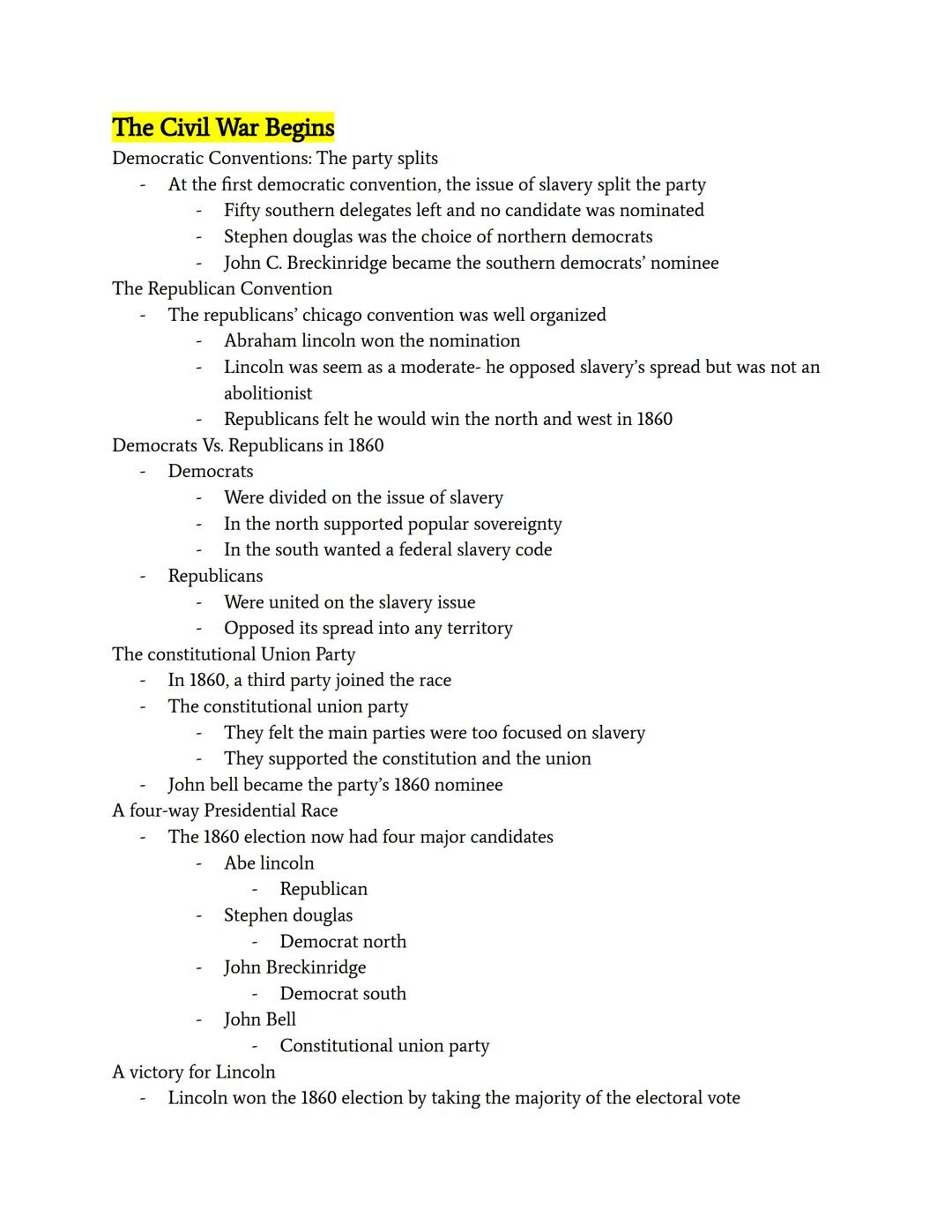
The Election of 1860
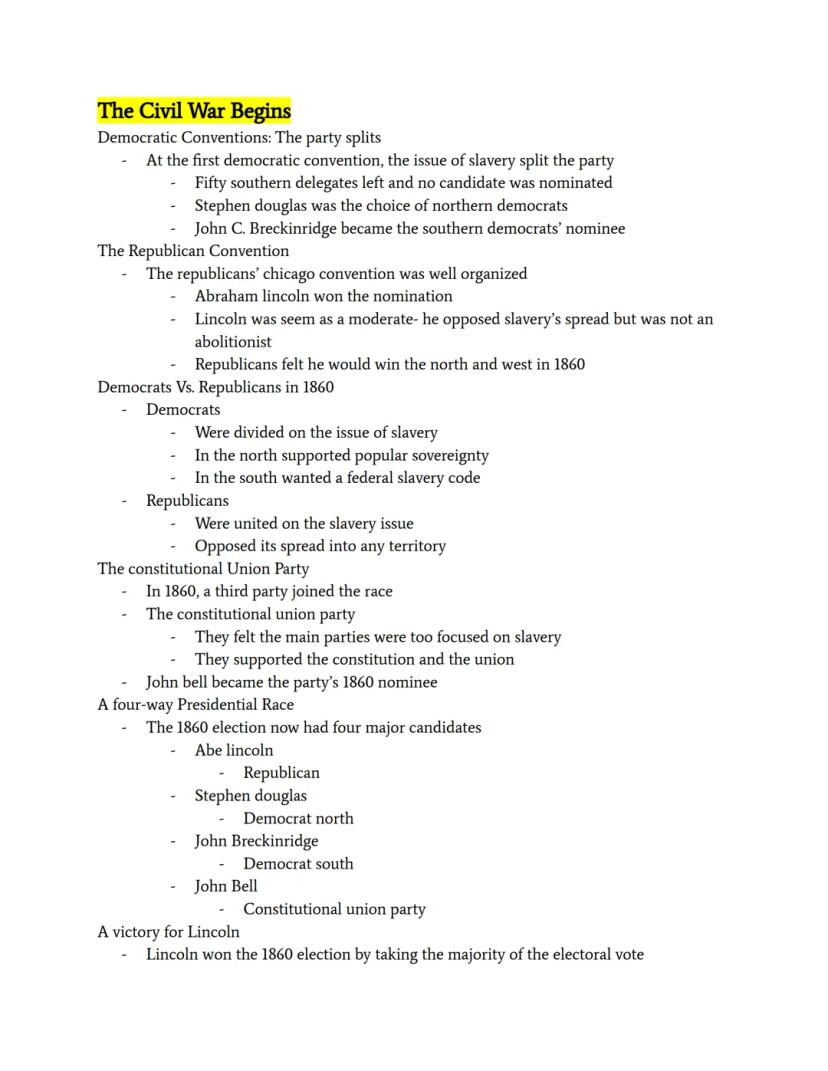
The 1860 presidential election was unlike any before it, featuring four major candidates after the Democratic party split over slavery. While northern Democrats backed Stephen Douglas and his popular sovereignty approach, southern Democrats rallied behind John C. Breckinridge who supported a federal slavery code.
The Republican party presented a united front with Abraham Lincoln as their nominee. Though not an abolitionist, Lincoln firmly opposed the expansion of slavery into new territories, making him appealing to northern and western voters. Meanwhile, the Constitutional Union Party emerged with John Bell as their candidate, hoping to shift focus away from slavery toward preserving the Union.
When the votes were counted, Lincoln won the electoral majority despite not securing 50% of the popular vote. Notably, he didn't win a single southern state, highlighting the nation's deep regional divisions.
History Connection: Lincoln's victory without southern support demonstrated how the electoral system could produce a president who lacked nationwide approval - a political situation that would help trigger the Civil War.
2
of 4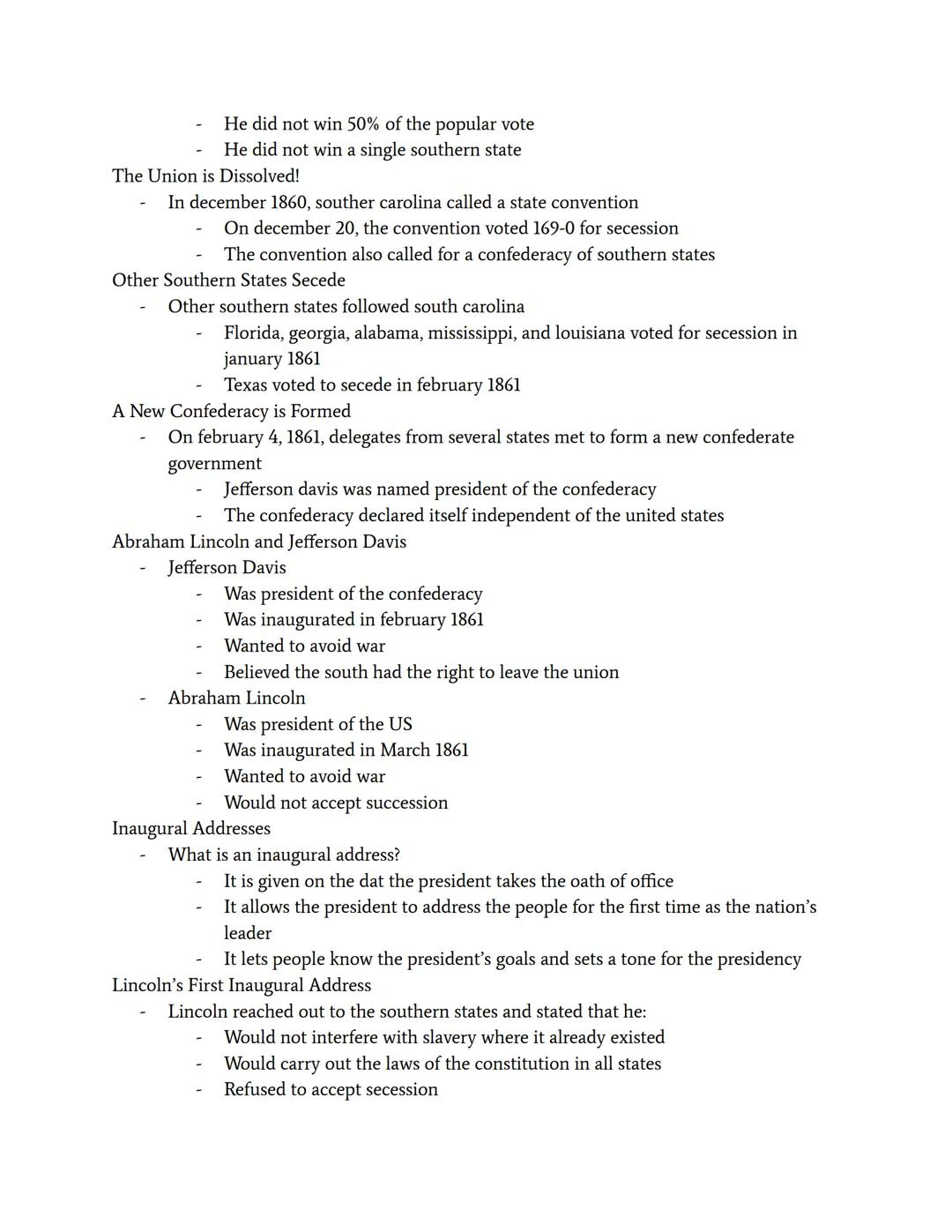
The South Secedes
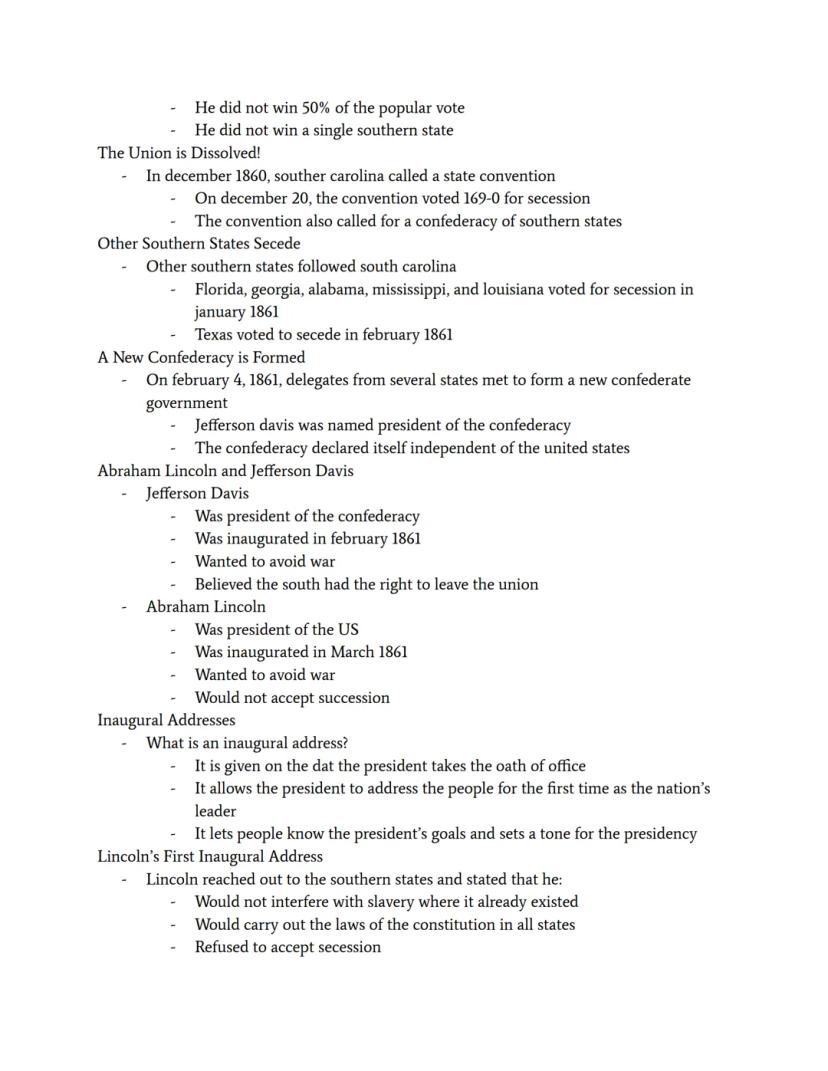
Southern states responded swiftly to Lincoln's election. South Carolina led the way on December 20, 1860, when its state convention voted unanimously for secession - a formal withdrawal from the United States. Within two months, six more southern states had followed: Florida, Georgia, Alabama, Mississippi, Louisiana, and Texas.
On February 4, 1861, these seceded states formed the Confederate States of America, establishing a rival government with Jefferson Davis as president. The Confederacy declared its independence from the United States, setting the stage for conflict.
The newly elected presidents gave inaugural addresses that reflected their opposing positions. Lincoln reached out to southerners, promising not to interfere with existing slavery but refusing to accept secession. Davis, meanwhile, explained the Confederacy's reasons for seceding and outlined their new government, noting they didn't want war but would fight if necessary.
Important Point: Both Lincoln and Davis claimed they wanted peace, but neither would compromise on the fundamental issue: Lincoln wouldn't accept secession, and Davis wouldn't return to the Union.
3
of 4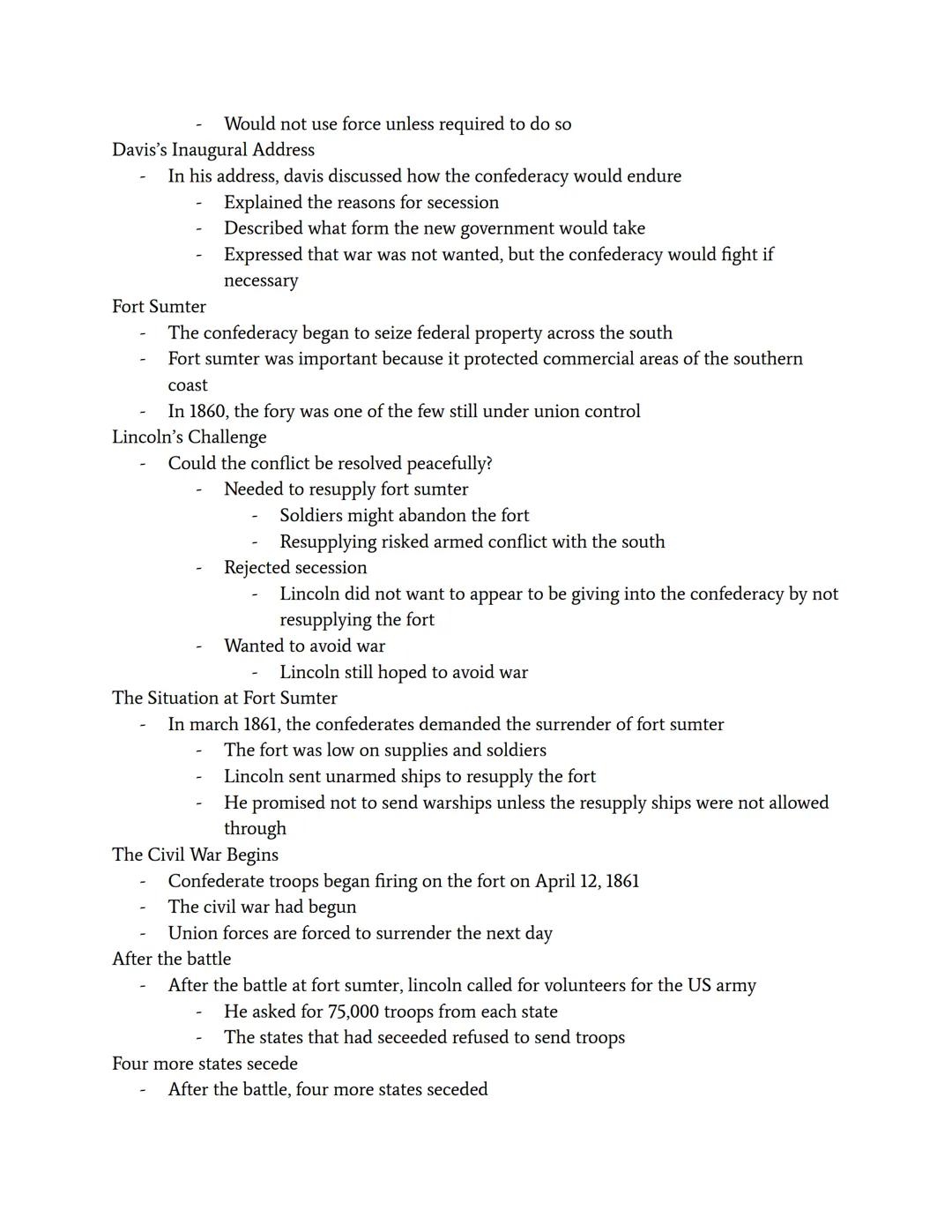
Fort Sumter and the Start of War
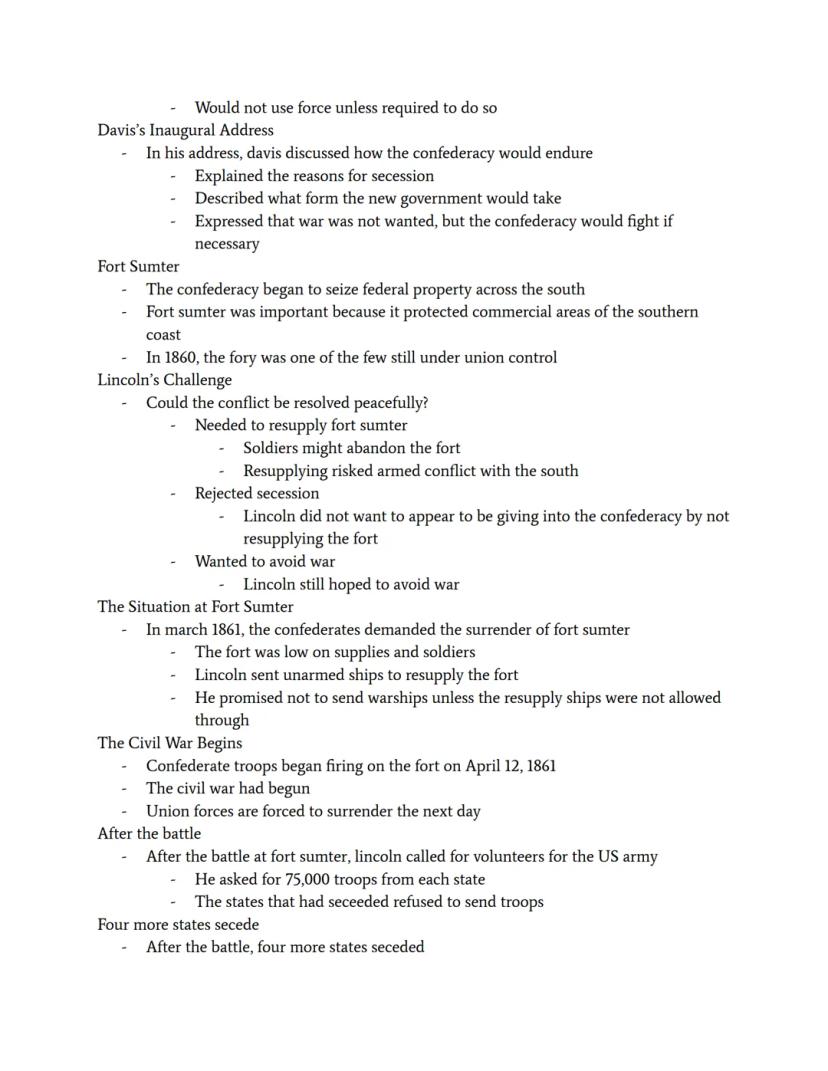
As the Confederacy began seizing federal properties across the South, Fort Sumter in South Carolina became a flashpoint. This fort protected important southern commercial areas and remained under Union control, creating a dilemma for Lincoln. He needed to resupply the fort's starving soldiers but risked triggering armed conflict.
Lincoln's solution was to send unarmed supply ships to the fort, promising not to send warships unless these were blocked. This careful approach aimed to avoid war while not surrendering federal property. The Confederates, however, saw this as a challenge to their authority.
On April 12, 1861, Confederate troops opened fire on Fort Sumter, marking the official beginning of the Civil War. Union forces surrendered the next day, and Lincoln immediately called for 75,000 volunteer troops from each state to put down the rebellion.
Critical Moment: The Fort Sumter battle prompted four more states to secede - Tennessee, Arkansas, North Carolina, and Virginia - though western Virginians opposed secession and eventually formed their own Union-loyal state.
4
of 4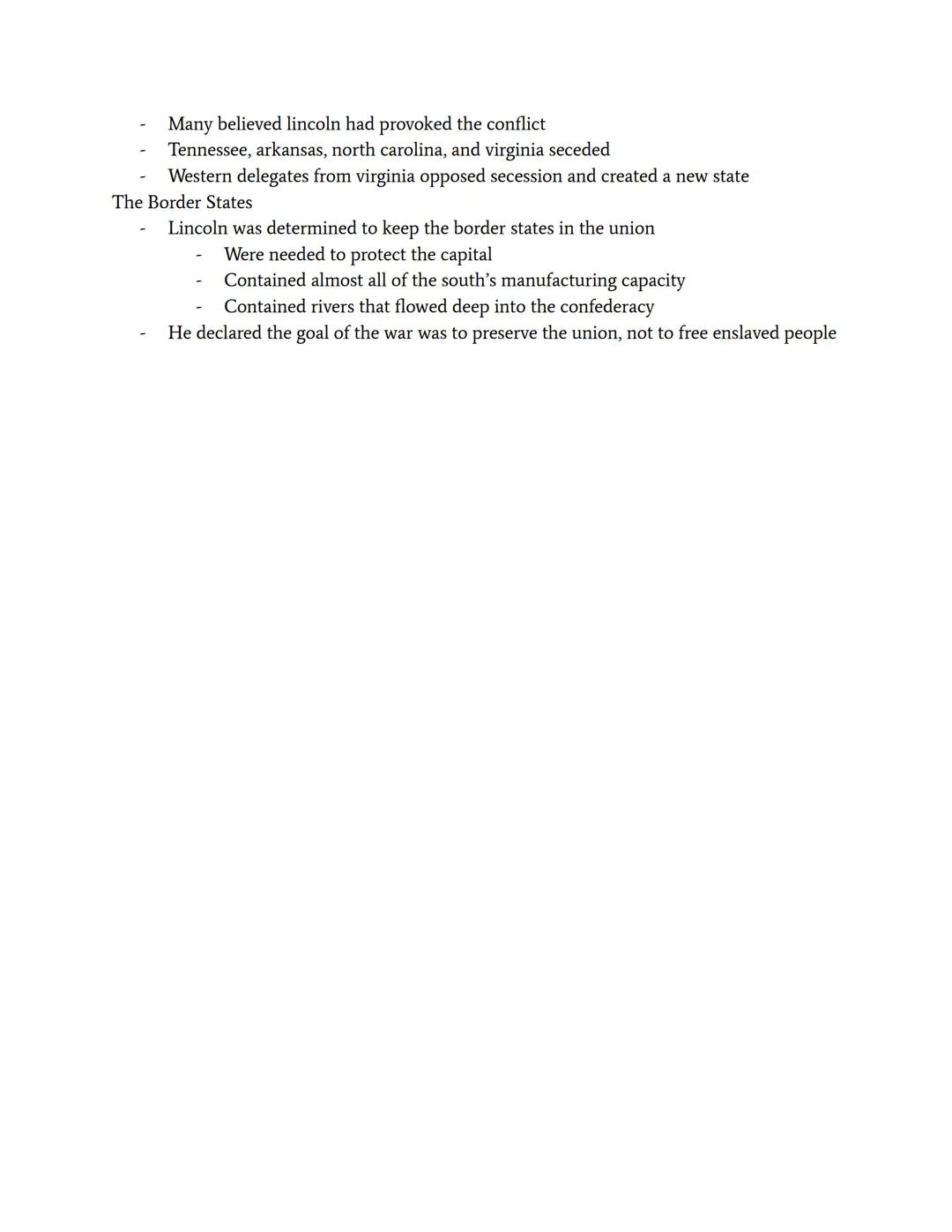
The Border States Strategy
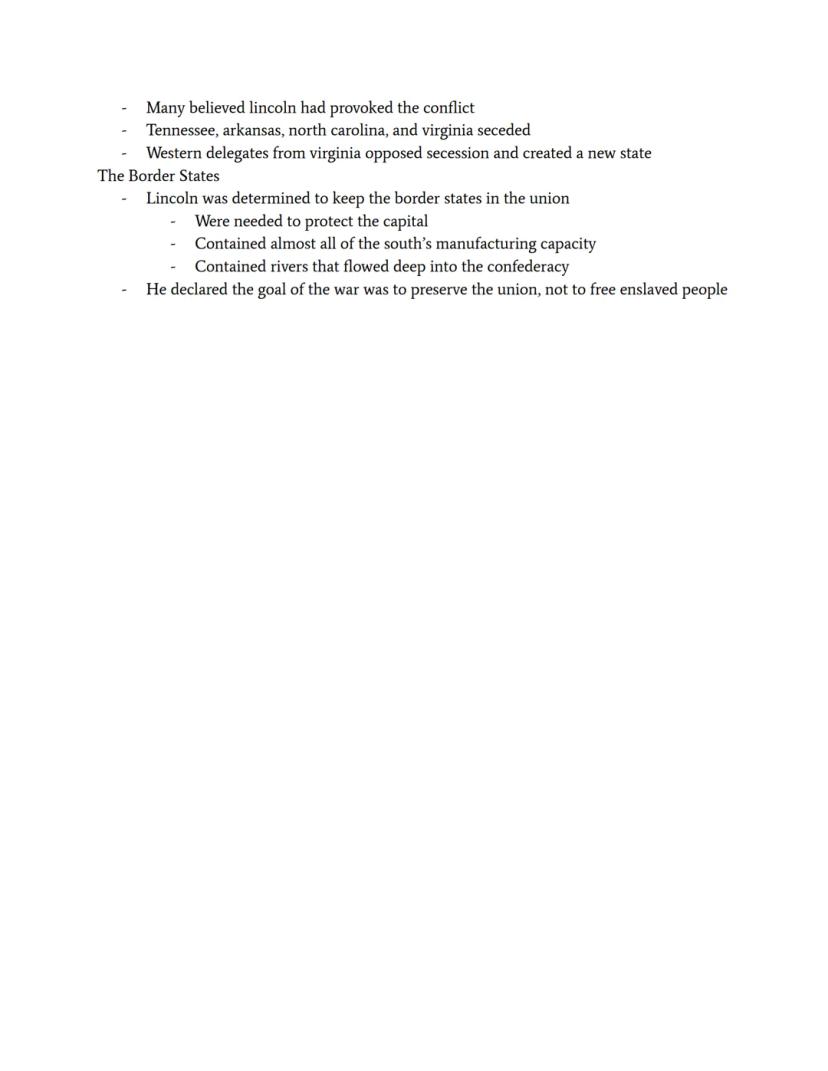
Lincoln quickly recognized the strategic importance of keeping the border states - slave states that hadn't seceded - in the Union. These states were crucial for multiple reasons: they protected Washington D.C., contained most of the South's manufacturing capacity, and included rivers that provided access deep into Confederate territory.
To maintain their loyalty, Lincoln carefully framed the war's purpose. He declared that the conflict wasn't about freeing enslaved people but about preserving the Union - a position designed to prevent further secession by slave-holding states that hadn't yet left.
This strategic approach shaped early Union war policy and helped Lincoln secure the border states' continued allegiance. His careful political maneuvering prevented the Confederacy from gaining additional territory and resources that might have dramatically changed the war's outcome.
Strategic Insight: Lincoln's focus on preserving the Union rather than ending slavery was a practical political strategy, not his personal moral position. This pragmatic approach helped keep the vital border states loyal.
We thought you’d never ask...
What is the Knowunity AI companion?
Our AI companion is specifically built for the needs of students. Based on the millions of content pieces we have on the platform we can provide truly meaningful and relevant answers to students. But its not only about answers, the companion is even more about guiding students through their daily learning challenges, with personalised study plans, quizzes or content pieces in the chat and 100% personalisation based on the students skills and developments.
Where can I download the Knowunity app?
You can download the app in the Google Play Store and in the Apple App Store.
Is Knowunity really free of charge?
That's right! Enjoy free access to study content, connect with fellow students, and get instant help – all at your fingertips.
Similar Content
Most popular content in US History
9T
US HistoryThe Civil War
Explore the dangerous war of America with this quiz, practice yourself for a quiz or test you need, this will answer all your questions (for eighth grade or for people who just like to learn about it ahead of time)
8th4550
S
US HistoryShort Quiz on US Government/Founding History
A 5-question quiz including questions about modern American government as well as the history of its’ founding.
9th4190
W
US HistoryWW2 refresher
Use this to refresh you memory about world War 2
7th2770
S
US HistoryShort Quiz on US Government/Founding History
A 5-question quiz including questions about modern American government as well as the history of its’ founding.
10th2650
C
US Historycivil rights movement quiz
Vocab
8th2220
T
US HistoryThe Louisiana Purchase; EASY
Simple flashcards for US History
9th2700
B
US HistoryBasic Presidency and Stuff Review
Presidency, Bill of Rights, Constitution
6th2650
U
US HistoryUnited States Review Quiz
This is a bunch of random questions based on US History.
9th2080
US HistoryHistory EOC EXAM REVIEW
HISTROY EOC EXAM REVIEW
50031
Most popular content
9O
AP US HistoryOrigins and Dynamics of the Columbian Exchange
Analyze the ecological and economic motivations behind the initial transfer of goods, people, and diseases between the Old and New Worlds.
9th3,1280
I
AP US HistoryIntroduction to Early Cultural Interactions
Analyze the initial social and religious encounters between Europeans, Africans, and Indigenous peoples in the colonial Americas.
9th2,7730
O
 AP World History
Origins of Ancient River Civilizations
Analyze the environmental factors and technological innovations that led to the rise of early states in Mesopotamia, Egypt, and the Indus Valley.
9th3,1870
M
AP US HistoryMotivations for European Exploration
Analyze the economic, religious, and political factors that drove European powers to the Americas during the 15th and 16th centuries.
9th1,7780
F
 AP Psychology
Foundations of Ethical Guidelines in Research
Practice the core principles of the APA ethical code including informed consent, debriefing, and the role of Institutional Review Boards.
9th1,3360
I
AP US HistoryIntroduction to Native American Societies
Examine the diverse social, political, and economic structures of North American indigenous groups prior to European contact.
9th1,1100
I
 AP Biology
Introduction to Biological Elements of Life
Practice identifying the essential elements including carbon, nitrogen, phosphorus, and sulfur that compose biological macromolecules.
9th1,7390
I
AP US HistoryIntroduction to the Spanish Encomienda System
Explore the fundamental economic and social structures of the Spanish colonial system, focusing on the encomienda and the casta social hierarchy.
9th8890
O
AP World HistoryOrigins and Continuity of the Byzantine Empire
Analyze the political and cultural transitions from the Roman Empire to the Byzantine Empire, focusing on the reign of Justinian I and his code.
9th1,6320
Can't find what you're looking for? Explore other subjects.
Students love us — and so will you.
4.6/5App Store
4.7/5Google Play
The app is very easy to use and well designed. I have found everything I was looking for so far and have been able to learn a lot from the presentations! I will definitely use the app for a class assignment! And of course it also helps a lot as an inspiration.
Stefan SiOS user
This app is really great. There are so many study notes and help [...]. My problem subject is French, for example, and the app has so many options for help. Thanks to this app, I have improved my French. I would recommend it to anyone.
Samantha KlichAndroid user
Wow, I am really amazed. I just tried the app because I've seen it advertised many times and was absolutely stunned. This app is THE HELP you want for school and above all, it offers so many things, such as workouts and fact sheets, which have been VERY helpful to me personally.
AnnaiOS user
US History52 views·Updated Jun 11, 2026·4 pagesThe Start of the Civil War: Key Early Events
The American Civil War's beginning was marked by deep political divisions over slavery, leading to the fracturing of the Democratic party and the election of Abraham Lincoln in 1860. This pivotal moment in American history triggered a chain of events...
1
of 4
Sign up to see the content. It's free!
- Access to all documents
- Improve your grades
- Join milions of students
The Election of 1860
The 1860 presidential election was unlike any before it, featuring four major candidates after the Democratic party split over slavery. While northern Democrats backed Stephen Douglas and his popular sovereignty approach, southern Democrats rallied behind John C. Breckinridge who supported a federal slavery code.
The Republican party presented a united front with Abraham Lincoln as their nominee. Though not an abolitionist, Lincoln firmly opposed the expansion of slavery into new territories, making him appealing to northern and western voters. Meanwhile, the Constitutional Union Party emerged with John Bell as their candidate, hoping to shift focus away from slavery toward preserving the Union.
When the votes were counted, Lincoln won the electoral majority despite not securing 50% of the popular vote. Notably, he didn't win a single southern state, highlighting the nation's deep regional divisions.
History Connection: Lincoln's victory without southern support demonstrated how the electoral system could produce a president who lacked nationwide approval - a political situation that would help trigger the Civil War.
2
of 4Sign up to see the content. It's free!
- Access to all documents
- Improve your grades
- Join milions of students
The South Secedes
Southern states responded swiftly to Lincoln's election. South Carolina led the way on December 20, 1860, when its state convention voted unanimously for secession - a formal withdrawal from the United States. Within two months, six more southern states had followed: Florida, Georgia, Alabama, Mississippi, Louisiana, and Texas.
On February 4, 1861, these seceded states formed the Confederate States of America, establishing a rival government with Jefferson Davis as president. The Confederacy declared its independence from the United States, setting the stage for conflict.
The newly elected presidents gave inaugural addresses that reflected their opposing positions. Lincoln reached out to southerners, promising not to interfere with existing slavery but refusing to accept secession. Davis, meanwhile, explained the Confederacy's reasons for seceding and outlined their new government, noting they didn't want war but would fight if necessary.
Important Point: Both Lincoln and Davis claimed they wanted peace, but neither would compromise on the fundamental issue: Lincoln wouldn't accept secession, and Davis wouldn't return to the Union.
3
of 4Sign up to see the content. It's free!
- Access to all documents
- Improve your grades
- Join milions of students
Fort Sumter and the Start of War
As the Confederacy began seizing federal properties across the South, Fort Sumter in South Carolina became a flashpoint. This fort protected important southern commercial areas and remained under Union control, creating a dilemma for Lincoln. He needed to resupply the fort's starving soldiers but risked triggering armed conflict.
Lincoln's solution was to send unarmed supply ships to the fort, promising not to send warships unless these were blocked. This careful approach aimed to avoid war while not surrendering federal property. The Confederates, however, saw this as a challenge to their authority.
On April 12, 1861, Confederate troops opened fire on Fort Sumter, marking the official beginning of the Civil War. Union forces surrendered the next day, and Lincoln immediately called for 75,000 volunteer troops from each state to put down the rebellion.
Critical Moment: The Fort Sumter battle prompted four more states to secede - Tennessee, Arkansas, North Carolina, and Virginia - though western Virginians opposed secession and eventually formed their own Union-loyal state.
4
of 4Sign up to see the content. It's free!
- Access to all documents
- Improve your grades
- Join milions of students
The Border States Strategy
Lincoln quickly recognized the strategic importance of keeping the border states - slave states that hadn't seceded - in the Union. These states were crucial for multiple reasons: they protected Washington D.C., contained most of the South's manufacturing capacity, and included rivers that provided access deep into Confederate territory.
To maintain their loyalty, Lincoln carefully framed the war's purpose. He declared that the conflict wasn't about freeing enslaved people but about preserving the Union - a position designed to prevent further secession by slave-holding states that hadn't yet left.
This strategic approach shaped early Union war policy and helped Lincoln secure the border states' continued allegiance. His careful political maneuvering prevented the Confederacy from gaining additional territory and resources that might have dramatically changed the war's outcome.
Strategic Insight: Lincoln's focus on preserving the Union rather than ending slavery was a practical political strategy, not his personal moral position. This pragmatic approach helped keep the vital border states loyal.
We thought you’d never ask...
What is the Knowunity AI companion?
Our AI companion is specifically built for the needs of students. Based on the millions of content pieces we have on the platform we can provide truly meaningful and relevant answers to students. But its not only about answers, the companion is even more about guiding students through their daily learning challenges, with personalised study plans, quizzes or content pieces in the chat and 100% personalisation based on the students skills and developments.
Where can I download the Knowunity app?
You can download the app in the Google Play Store and in the Apple App Store.
Is Knowunity really free of charge?
That's right! Enjoy free access to study content, connect with fellow students, and get instant help – all at your fingertips.
Similar Content
Most popular content in US History
9T
US HistoryThe Civil War
Explore the dangerous war of America with this quiz, practice yourself for a quiz or test you need, this will answer all your questions (for eighth grade or for people who just like to learn about it ahead of time)
8th4550
S
US HistoryShort Quiz on US Government/Founding History
A 5-question quiz including questions about modern American government as well as the history of its’ founding.
9th4190
W
US HistoryWW2 refresher
Use this to refresh you memory about world War 2
7th2770
S
US HistoryShort Quiz on US Government/Founding History
A 5-question quiz including questions about modern American government as well as the history of its’ founding.
10th2650
C
US Historycivil rights movement quiz
Vocab
8th2220
T
US HistoryThe Louisiana Purchase; EASY
Simple flashcards for US History
9th2700
B
US HistoryBasic Presidency and Stuff Review
Presidency, Bill of Rights, Constitution
6th2650
U
US HistoryUnited States Review Quiz
This is a bunch of random questions based on US History.
9th2080
US HistoryHistory EOC EXAM REVIEW
HISTROY EOC EXAM REVIEW
50031
Most popular content
9O
AP US HistoryOrigins and Dynamics of the Columbian Exchange
Analyze the ecological and economic motivations behind the initial transfer of goods, people, and diseases between the Old and New Worlds.
9th3,1280
I
AP US HistoryIntroduction to Early Cultural Interactions
Analyze the initial social and religious encounters between Europeans, Africans, and Indigenous peoples in the colonial Americas.
9th2,7730
O
AP World HistoryOrigins of Ancient River Civilizations
Analyze the environmental factors and technological innovations that led to the rise of early states in Mesopotamia, Egypt, and the Indus Valley.
9th3,1870
M
AP US HistoryMotivations for European Exploration
Analyze the economic, religious, and political factors that drove European powers to the Americas during the 15th and 16th centuries.
9th1,7780
F
AP PsychologyFoundations of Ethical Guidelines in Research
Practice the core principles of the APA ethical code including informed consent, debriefing, and the role of Institutional Review Boards.
9th1,3360
I
AP US HistoryIntroduction to Native American Societies
Examine the diverse social, political, and economic structures of North American indigenous groups prior to European contact.
9th1,1100
I
AP BiologyIntroduction to Biological Elements of Life
Practice identifying the essential elements including carbon, nitrogen, phosphorus, and sulfur that compose biological macromolecules.
9th1,7390
I
AP US HistoryIntroduction to the Spanish Encomienda System
Explore the fundamental economic and social structures of the Spanish colonial system, focusing on the encomienda and the casta social hierarchy.
9th8890
O
AP World HistoryOrigins and Continuity of the Byzantine Empire
Analyze the political and cultural transitions from the Roman Empire to the Byzantine Empire, focusing on the reign of Justinian I and his code.
9th1,6320
Can't find what you're looking for? Explore other subjects.
Students love us — and so will you.
4.6/5App Store
4.7/5Google Play
The app is very easy to use and well designed. I have found everything I was looking for so far and have been able to learn a lot from the presentations! I will definitely use the app for a class assignment! And of course it also helps a lot as an inspiration.
Stefan SiOS user
This app is really great. There are so many study notes and help [...]. My problem subject is French, for example, and the app has so many options for help. Thanks to this app, I have improved my French. I would recommend it to anyone.
Samantha KlichAndroid user
Wow, I am really amazed. I just tried the app because I've seen it advertised many times and was absolutely stunned. This app is THE HELP you want for school and above all, it offers so many things, such as workouts and fact sheets, which have been VERY helpful to me personally.
AnnaiOS user