
The United States government operates through three distinct branches, designed...
 US History59 views·Updated Jun 18, 2026·1 page
Understanding the Three Branches of Government
M
Mina Hanna@minahanna_defk
1
of 1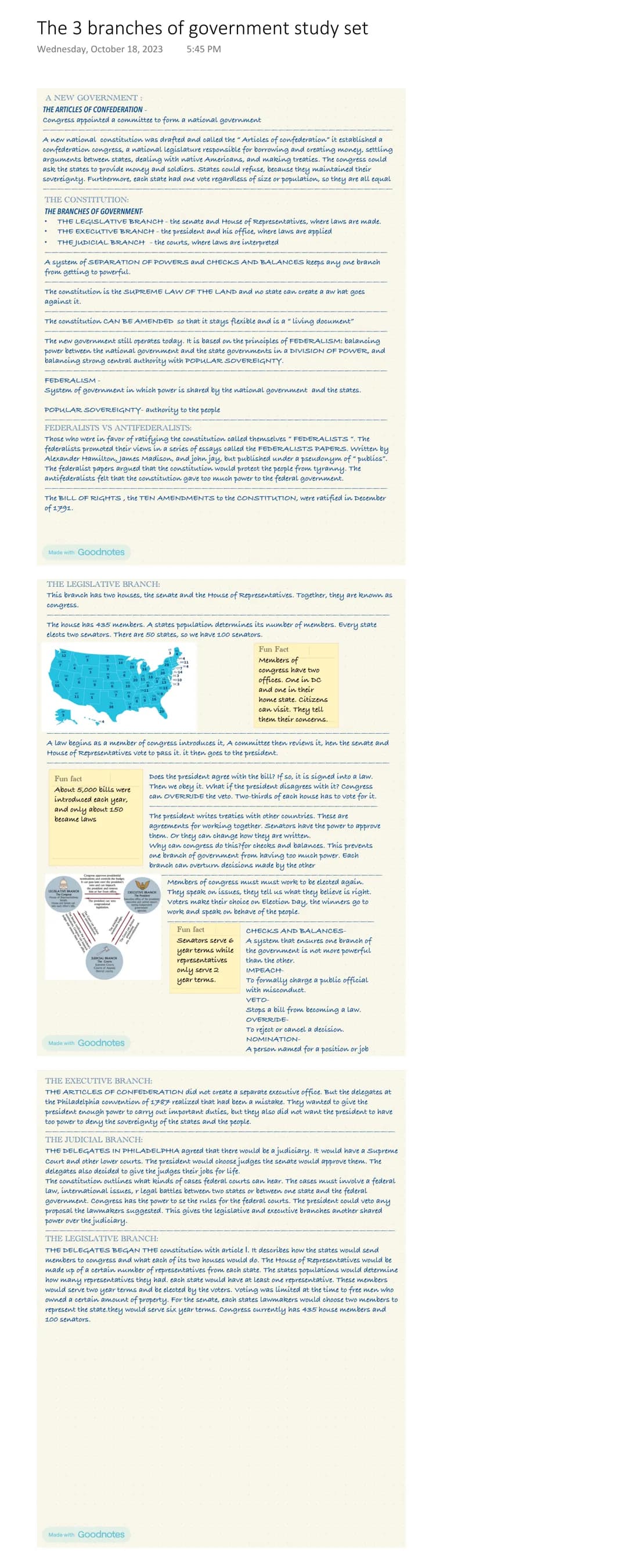
The Three Branches of Government
Ever wondered how our government prevents any single person or group from gaining too much power? The answer lies in our three-branch system. After the Revolutionary War, America first tried governing under the Articles of Confederation, which created a weak national legislature that couldn't even require states to provide money or soldiers. This system quickly proved inadequate.
The Constitution established our current government with three separate branches: the Legislative Branch (Congress, which makes laws), the Executive Branch (the President, who applies laws), and the Judicial Branch (courts, which interpret laws). This separation of powers works alongside a system of checks and balances that allows each branch to limit the others.
Our government operates on the principle of federalism, which balances power between national and state governments. When the Constitution was first proposed, Federalists supported it while Anti-Federalists worried it gave too much power to the central government. This debate led to the Bill of Rights—the first ten amendments to the Constitution—which protected individual liberties.
Did you know? While about 5,000 bills are introduced in Congress each year, only about 150 actually become laws. The process deliberately makes lawmaking difficult to ensure careful consideration!
The Legislative Branch
The Legislative Branch (Congress) consists of two houses: the Senate (with 100 members, two from each state) and the House of Representatives (with 435 members distributed based on state population). Together, they create and pass laws before sending them to the President.
When a bill reaches the President, they can either sign it into law or veto it. If vetoed, Congress can still override the decision with a two-thirds majority vote in each house—a perfect example of checks and balances in action. Congress also approves treaties and nominations made by the President.
Members of Congress serve different terms—Representatives for two years and Senators for six years—and must regularly campaign for reelection. This ensures they remain accountable to voters and represent their constituents' interests.
The Judicial Branch
The Supreme Court sits at the top of the Judicial Branch, which interprets and applies the law. Federal judges are nominated by the President and confirmed by the Senate, and they serve lifetime appointments to ensure their independence from political pressure.
Federal courts handle cases involving federal laws, international issues, or disputes between states. The system of checks and balances extends here too—Congress sets rules for the courts, while the President can veto these proposals, giving both branches influence over the judiciary without controlling it.
We thought you’d never ask...
What is the Knowunity AI companion?
Our AI companion is specifically built for the needs of students. Based on the millions of content pieces we have on the platform we can provide truly meaningful and relevant answers to students. But its not only about answers, the companion is even more about guiding students through their daily learning challenges, with personalised study plans, quizzes or content pieces in the chat and 100% personalisation based on the students skills and developments.
Where can I download the Knowunity app?
You can download the app in the Google Play Store and in the Apple App Store.
Is Knowunity really free of charge?
That's right! Enjoy free access to study content, connect with fellow students, and get instant help – all at your fingertips.
Similar Content
 Historia universal contemporánea
 Historia
 Sociales/Historia
Most popular content in US History
9S
US HistoryShort Quiz on US Government/Founding History
A 5-question quiz including questions about modern American government as well as the history of its’ founding.
9th4190
T
US HistoryThe Civil War
Explore the dangerous war of America with this quiz, practice yourself for a quiz or test you need, this will answer all your questions (for eighth grade or for people who just like to learn about it ahead of time)
8th4560
W
US HistoryWW2 refresher
Use this to refresh you memory about world War 2
7th2770
S
US HistoryShort Quiz on US Government/Founding History
A 5-question quiz including questions about modern American government as well as the history of its’ founding.
10th2660
C
US Historycivil rights movement quiz
Vocab
8th2220
U
US HistoryUnited States Review Quiz
This is a bunch of random questions based on US History.
9th2080
T
US HistoryThe Louisiana Purchase; EASY
Simple flashcards for US History
9th2710
B
US HistoryBasic Presidency and Stuff Review
Presidency, Bill of Rights, Constitution
6th2660
US HistoryHistory EOC EXAM REVIEW
HISTROY EOC EXAM REVIEW
50031
Most popular content
9O
AP US HistoryOrigins and Dynamics of the Columbian Exchange
Analyze the ecological and economic motivations behind the initial transfer of goods, people, and diseases between the Old and New Worlds.
9th3,1280
I
AP US HistoryIntroduction to Early Cultural Interactions
Analyze the initial social and religious encounters between Europeans, Africans, and Indigenous peoples in the colonial Americas.
9th2,7730
O
 AP World History
Origins of Ancient River Civilizations
Analyze the environmental factors and technological innovations that led to the rise of early states in Mesopotamia, Egypt, and the Indus Valley.
9th3,1870
M
AP US HistoryMotivations for European Exploration
Analyze the economic, religious, and political factors that drove European powers to the Americas during the 15th and 16th centuries.
9th1,7780
F
 AP Psychology
Foundations of Ethical Guidelines in Research
Practice the core principles of the APA ethical code including informed consent, debriefing, and the role of Institutional Review Boards.
9th1,3360
I
AP US HistoryIntroduction to Native American Societies
Examine the diverse social, political, and economic structures of North American indigenous groups prior to European contact.
9th1,1100
I
 AP Biology
Introduction to Biological Elements of Life
Practice identifying the essential elements including carbon, nitrogen, phosphorus, and sulfur that compose biological macromolecules.
9th1,7410
I
AP US HistoryIntroduction to the Spanish Encomienda System
Explore the fundamental economic and social structures of the Spanish colonial system, focusing on the encomienda and the casta social hierarchy.
9th8890
O
AP World HistoryOrigins and Continuity of the Byzantine Empire
Analyze the political and cultural transitions from the Roman Empire to the Byzantine Empire, focusing on the reign of Justinian I and his code.
9th1,6320
Can't find what you're looking for? Explore other subjects.
Students love us — and so will you.
4.6/5App Store
4.7/5Google Play
The app is very easy to use and well designed. I have found everything I was looking for so far and have been able to learn a lot from the presentations! I will definitely use the app for a class assignment! And of course it also helps a lot as an inspiration.
Stefan SiOS user
This app is really great. There are so many study notes and help [...]. My problem subject is French, for example, and the app has so many options for help. Thanks to this app, I have improved my French. I would recommend it to anyone.
Samantha KlichAndroid user
Wow, I am really amazed. I just tried the app because I've seen it advertised many times and was absolutely stunned. This app is THE HELP you want for school and above all, it offers so many things, such as workouts and fact sheets, which have been VERY helpful to me personally.
AnnaiOS user
US History59 views·Updated Jun 18, 2026·1 pageUnderstanding the Three Branches of Government
M
Mina Hanna@minahanna_defk
The United States government operates through three distinct branches, designed with a system of checks and balances to prevent any single branch from becoming too powerful. This structure, established by the Constitution after the Articles of Confederation proved inadequate, remains...
1
of 1
Sign up to see the content. It's free!
- Access to all documents
- Improve your grades
- Join milions of students
The Three Branches of Government
Ever wondered how our government prevents any single person or group from gaining too much power? The answer lies in our three-branch system. After the Revolutionary War, America first tried governing under the Articles of Confederation, which created a weak national legislature that couldn't even require states to provide money or soldiers. This system quickly proved inadequate.
The Constitution established our current government with three separate branches: the Legislative Branch (Congress, which makes laws), the Executive Branch (the President, who applies laws), and the Judicial Branch (courts, which interpret laws). This separation of powers works alongside a system of checks and balances that allows each branch to limit the others.
Our government operates on the principle of federalism, which balances power between national and state governments. When the Constitution was first proposed, Federalists supported it while Anti-Federalists worried it gave too much power to the central government. This debate led to the Bill of Rights—the first ten amendments to the Constitution—which protected individual liberties.
Did you know? While about 5,000 bills are introduced in Congress each year, only about 150 actually become laws. The process deliberately makes lawmaking difficult to ensure careful consideration!
The Legislative Branch
The Legislative Branch (Congress) consists of two houses: the Senate (with 100 members, two from each state) and the House of Representatives (with 435 members distributed based on state population). Together, they create and pass laws before sending them to the President.
When a bill reaches the President, they can either sign it into law or veto it. If vetoed, Congress can still override the decision with a two-thirds majority vote in each house—a perfect example of checks and balances in action. Congress also approves treaties and nominations made by the President.
Members of Congress serve different terms—Representatives for two years and Senators for six years—and must regularly campaign for reelection. This ensures they remain accountable to voters and represent their constituents' interests.
The Judicial Branch
The Supreme Court sits at the top of the Judicial Branch, which interprets and applies the law. Federal judges are nominated by the President and confirmed by the Senate, and they serve lifetime appointments to ensure their independence from political pressure.
Federal courts handle cases involving federal laws, international issues, or disputes between states. The system of checks and balances extends here too—Congress sets rules for the courts, while the President can veto these proposals, giving both branches influence over the judiciary without controlling it.
We thought you’d never ask...
What is the Knowunity AI companion?
Our AI companion is specifically built for the needs of students. Based on the millions of content pieces we have on the platform we can provide truly meaningful and relevant answers to students. But its not only about answers, the companion is even more about guiding students through their daily learning challenges, with personalised study plans, quizzes or content pieces in the chat and 100% personalisation based on the students skills and developments.
Where can I download the Knowunity app?
You can download the app in the Google Play Store and in the Apple App Store.
Is Knowunity really free of charge?
That's right! Enjoy free access to study content, connect with fellow students, and get instant help – all at your fingertips.
Similar Content
Most popular content in US History
9S
US HistoryShort Quiz on US Government/Founding History
A 5-question quiz including questions about modern American government as well as the history of its’ founding.
9th4190
T
US HistoryThe Civil War
Explore the dangerous war of America with this quiz, practice yourself for a quiz or test you need, this will answer all your questions (for eighth grade or for people who just like to learn about it ahead of time)
8th4560
W
US HistoryWW2 refresher
Use this to refresh you memory about world War 2
7th2770
S
US HistoryShort Quiz on US Government/Founding History
A 5-question quiz including questions about modern American government as well as the history of its’ founding.
10th2660
C
US Historycivil rights movement quiz
Vocab
8th2220
U
US HistoryUnited States Review Quiz
This is a bunch of random questions based on US History.
9th2080
T
US HistoryThe Louisiana Purchase; EASY
Simple flashcards for US History
9th2710
B
US HistoryBasic Presidency and Stuff Review
Presidency, Bill of Rights, Constitution
6th2660
US HistoryHistory EOC EXAM REVIEW
HISTROY EOC EXAM REVIEW
50031
Most popular content
9O
AP US HistoryOrigins and Dynamics of the Columbian Exchange
Analyze the ecological and economic motivations behind the initial transfer of goods, people, and diseases between the Old and New Worlds.
9th3,1280
I
AP US HistoryIntroduction to Early Cultural Interactions
Analyze the initial social and religious encounters between Europeans, Africans, and Indigenous peoples in the colonial Americas.
9th2,7730
O
AP World HistoryOrigins of Ancient River Civilizations
Analyze the environmental factors and technological innovations that led to the rise of early states in Mesopotamia, Egypt, and the Indus Valley.
9th3,1870
M
AP US HistoryMotivations for European Exploration
Analyze the economic, religious, and political factors that drove European powers to the Americas during the 15th and 16th centuries.
9th1,7780
F
AP PsychologyFoundations of Ethical Guidelines in Research
Practice the core principles of the APA ethical code including informed consent, debriefing, and the role of Institutional Review Boards.
9th1,3360
I
AP US HistoryIntroduction to Native American Societies
Examine the diverse social, political, and economic structures of North American indigenous groups prior to European contact.
9th1,1100
I
AP BiologyIntroduction to Biological Elements of Life
Practice identifying the essential elements including carbon, nitrogen, phosphorus, and sulfur that compose biological macromolecules.
9th1,7410
I
AP US HistoryIntroduction to the Spanish Encomienda System
Explore the fundamental economic and social structures of the Spanish colonial system, focusing on the encomienda and the casta social hierarchy.
9th8890
O
AP World HistoryOrigins and Continuity of the Byzantine Empire
Analyze the political and cultural transitions from the Roman Empire to the Byzantine Empire, focusing on the reign of Justinian I and his code.
9th1,6320
Can't find what you're looking for? Explore other subjects.
Students love us — and so will you.
4.6/5App Store
4.7/5Google Play
The app is very easy to use and well designed. I have found everything I was looking for so far and have been able to learn a lot from the presentations! I will definitely use the app for a class assignment! And of course it also helps a lot as an inspiration.
Stefan SiOS user
This app is really great. There are so many study notes and help [...]. My problem subject is French, for example, and the app has so many options for help. Thanks to this app, I have improved my French. I would recommend it to anyone.
Samantha KlichAndroid user
Wow, I am really amazed. I just tried the app because I've seen it advertised many times and was absolutely stunned. This app is THE HELP you want for school and above all, it offers so many things, such as workouts and fact sheets, which have been VERY helpful to me personally.
AnnaiOS user