
The 1950s Cold War cultural impacttransformed American society through...
 US History118 views·Updated Jun 17, 2026·17 pages
The 1950s: How the Cold War Changed Everything

Arshi M.@arshi_unicorn


1 / 10
1
of 10
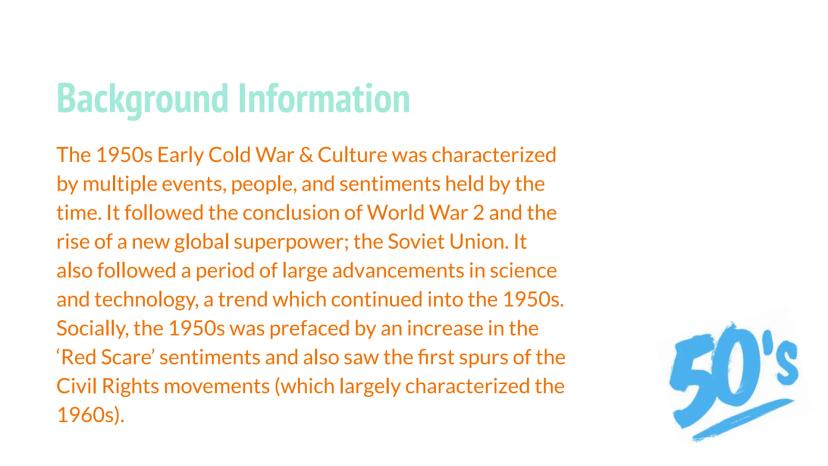
Understanding the Cultural and Political Landscape of the 1950s Cold War Era
The 1950s Cold War cultural impact transformed American society fundamentally after World War II's conclusion. This period marked unprecedented changes in geopolitics, technology, and social dynamics as the United States and Soviet Union emerged as global superpowers. The era witnessed remarkable scientific advancement while simultaneously dealing with domestic tensions and fears.
Definition: The Cold War was a period of geopolitical tension and rivalry between the United States and the Soviet Union that shaped global politics, military development, and cultural attitudes from the late 1940s through the 1980s.
The post-war period ushered in dramatic societal changes, with the rise of suburban living, increased consumer culture, and technological innovations becoming hallmarks of American life. The atomic bombs and Cold War arms race created an atmosphere of constant tension, leading to the construction of bomb shelters and regular nuclear attack drills in schools and communities.
These global tensions manifested in domestic policies and social movements. The period saw the early stirrings of the Civil Rights Movement, while simultaneously experiencing intense anti-communist sentiment known as the Red Scare. This paradoxical era combined prosperity and paranoia, progress and persecution.
2
of 10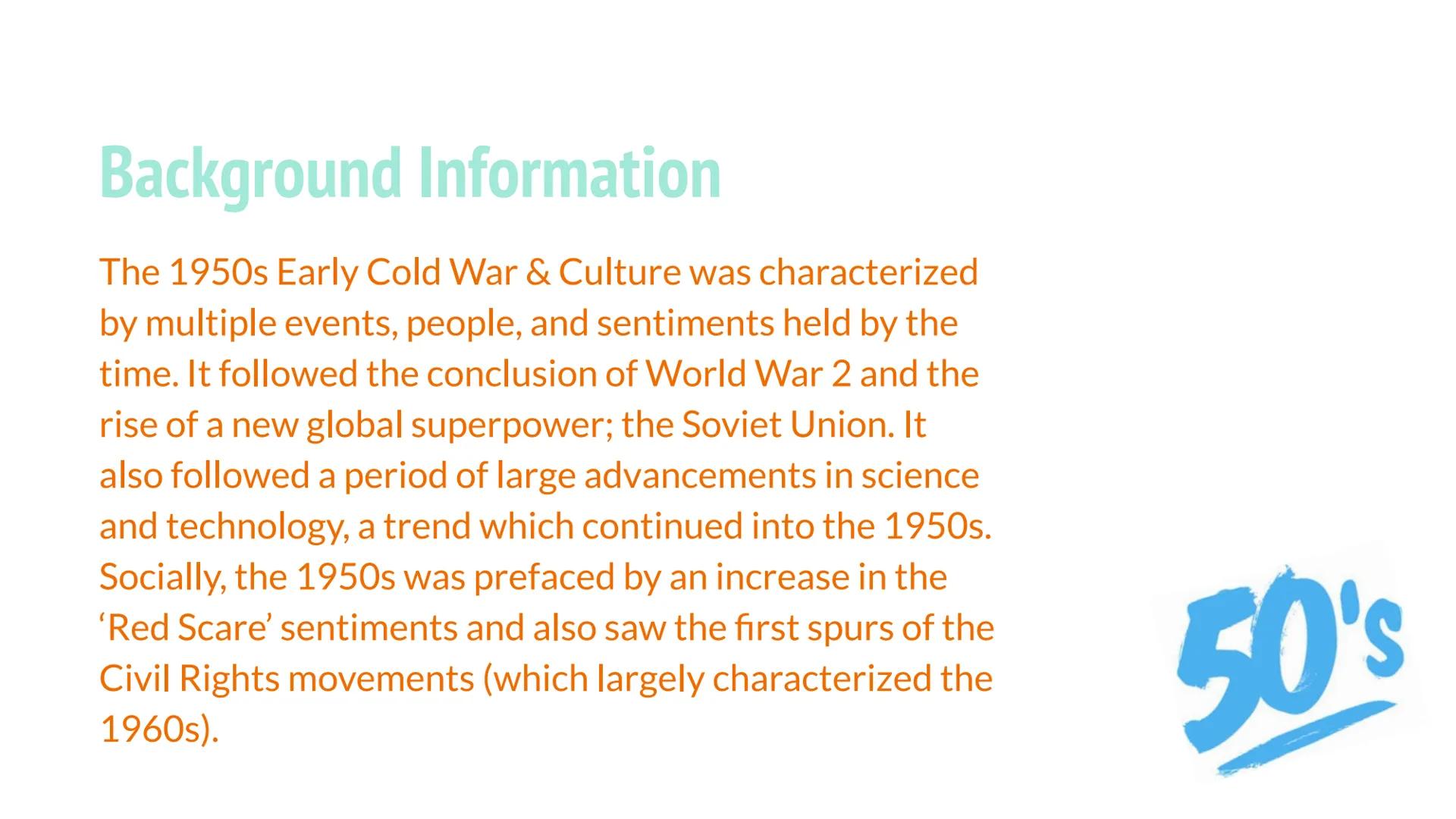
Key Figures and Leadership During the Early Cold War
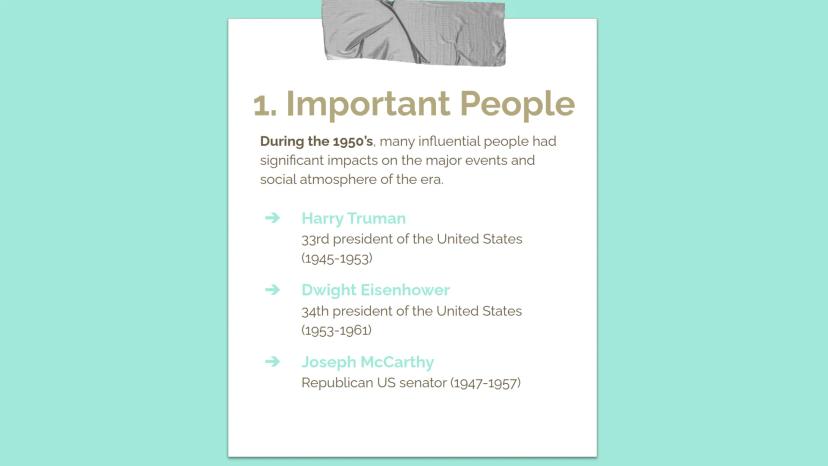
The early Cold War period was shaped by several influential leaders whose decisions and policies had lasting impacts. President Harry Truman (1945-1953) established the foundational Cold War policy of containment through the Truman Doctrine, while his successor Dwight Eisenhower (1953-1961) continued these policies while managing escalating tensions with the Soviet Union.
Highlight: Senator Joseph McCarthy became a controversial figure during this period, leading anti-communist investigations that would later be known as McCarthyism, significantly impacting American society and politics.
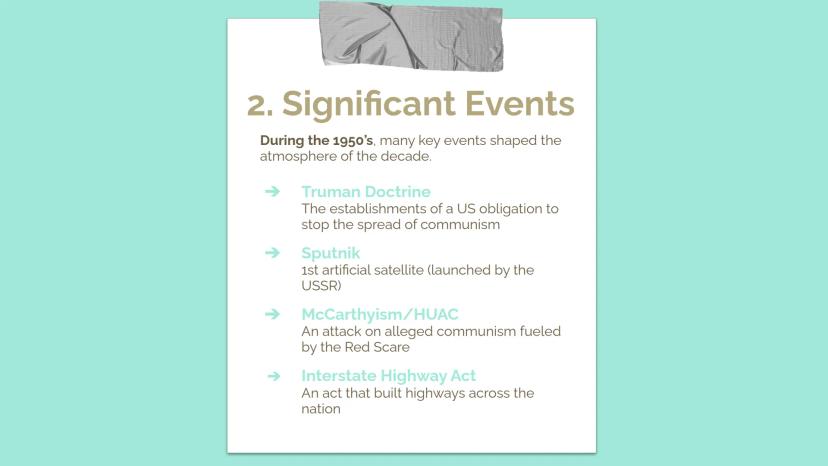
The significant 1950s events and influences were largely shaped by these leaders' responses to Soviet actions and domestic concerns. Their policies affected everything from international relations to domestic civil liberties, creating lasting impacts on American society.
3
of 10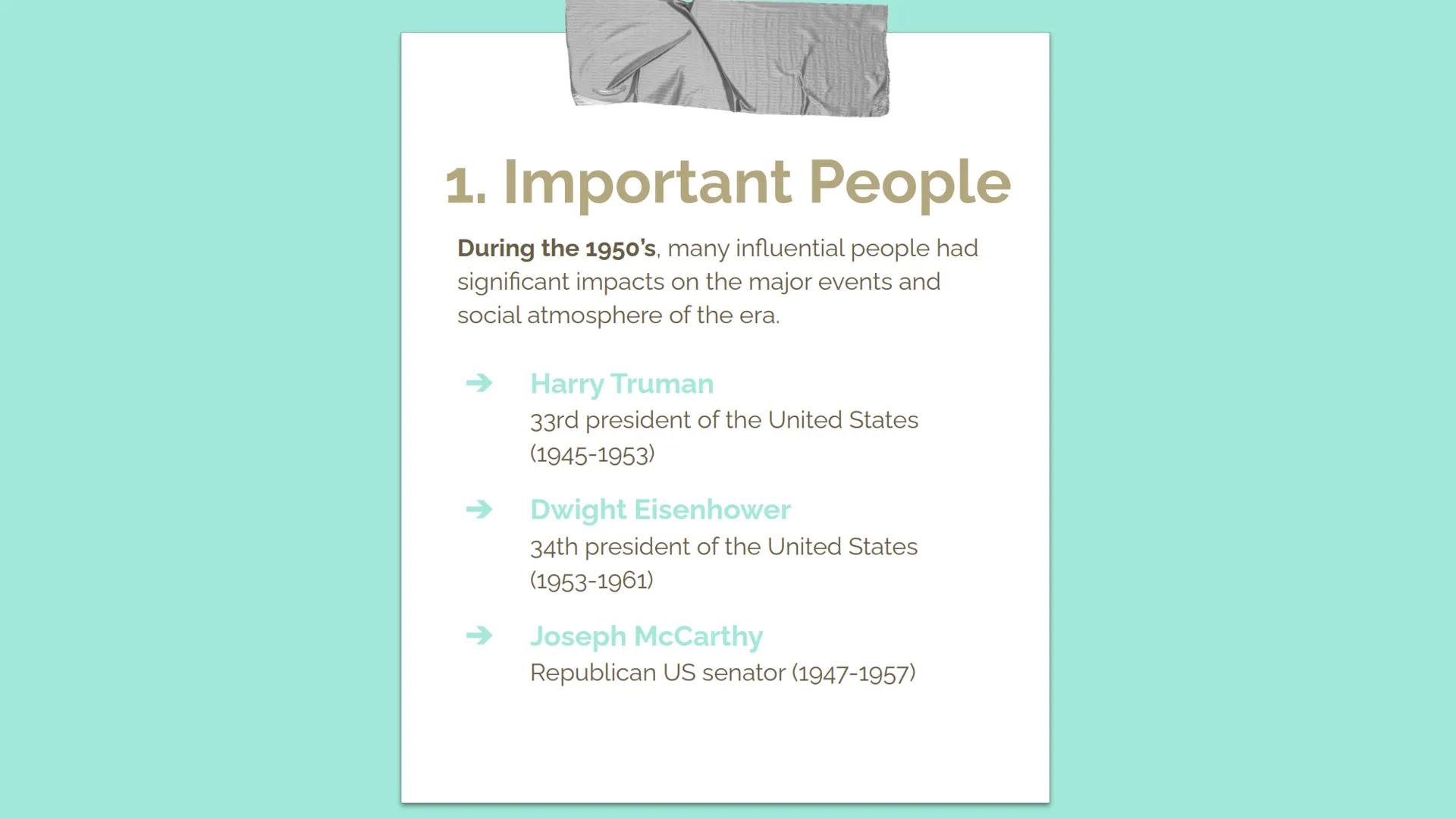
Social and Political Developments of the 1950s
The 1950s witnessed dramatic social and political transformations that would define American society for decades to come. The period was marked by increasing prosperity for many Americans, though this prosperity wasn't equally distributed across all segments of society.
Example: The Interstate Highway Act of 1956 revolutionized American transportation and culture, leading to increased mobility, suburban growth, and changes in how Americans lived and worked.
The launch of Sputnik by the USSR in 1957 sparked a new phase in the Space Race and led to increased emphasis on science and technology education in American schools. This event, combined with ongoing Cold War tensions, accelerated technological development and military spending.
4
of 10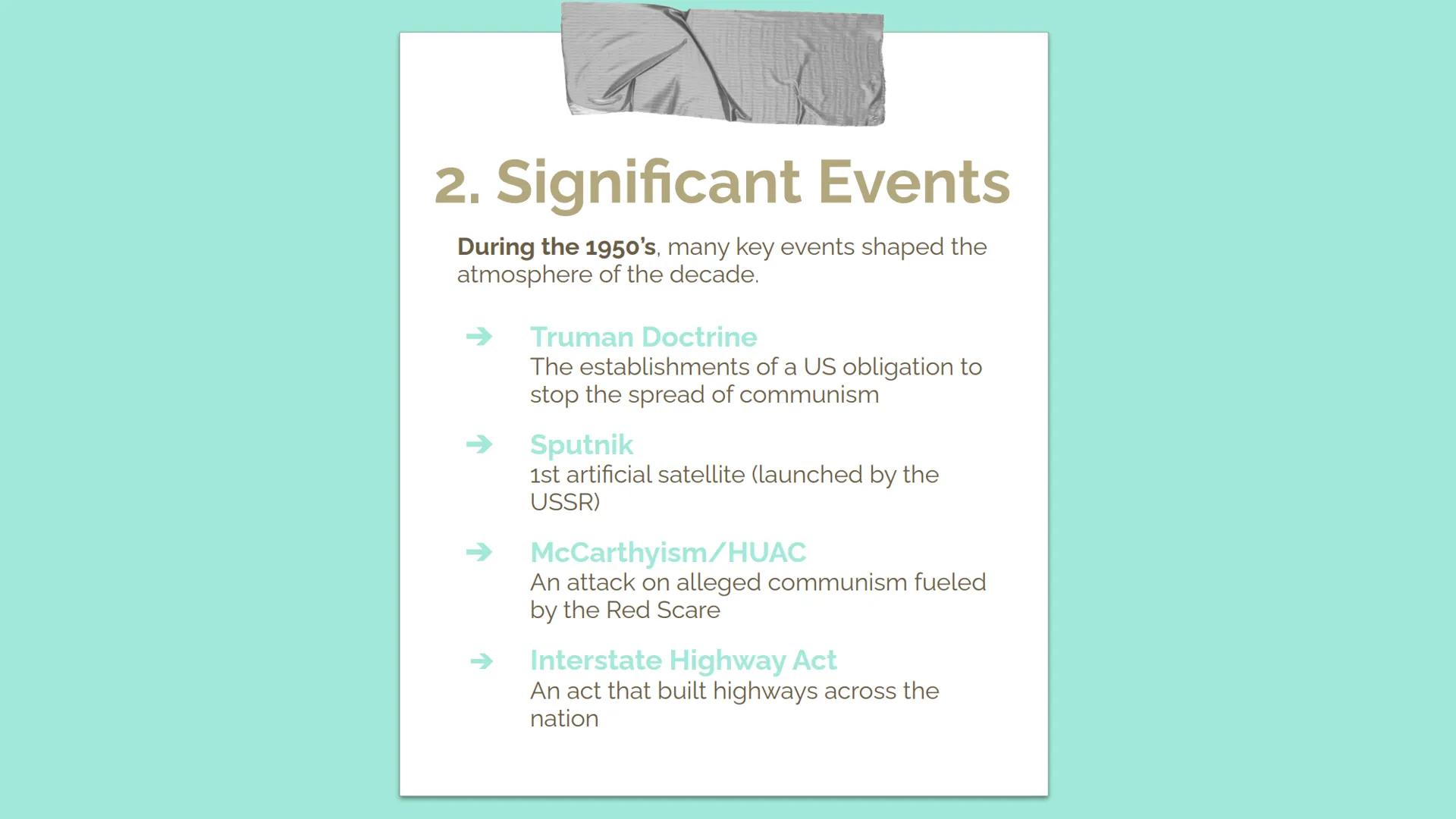
Cultural and Technological Advancements
The 1950s represented a unique convergence of cultural change and technological progress. The decade saw unprecedented advances in consumer technology, from television sets becoming household fixtures to the development of early computers.
Vocabulary: The "Red Scare" refers to a period of intense anti-communist suspicion and persecution in American society, leading to investigations, blacklists, and widespread fear of communist infiltration.
These technological advancements occurred against a backdrop of social conformity and political tension. The period's cultural landscape was shaped by both the optimism of post-war prosperity and the anxiety of potential nuclear conflict, creating a complex and often contradictory social environment.
5
of 10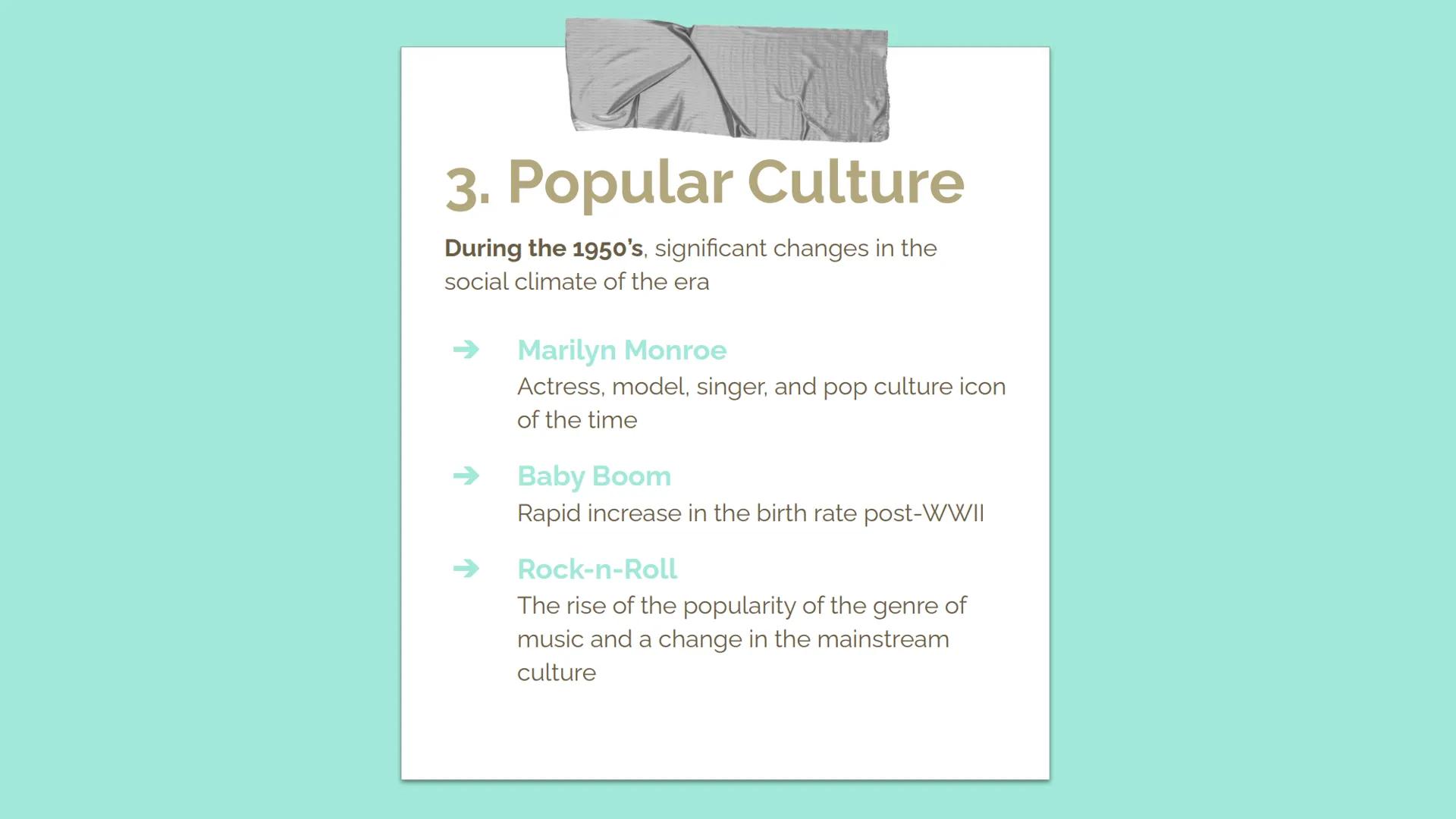
The Cultural and Political Transformation of 1950s America
The 1950s marked a pivotal era in American history, characterized by dramatic social changes, political tensions, and cultural innovations. The 1950s Cold War cultural impact reshaped American society in profound ways, from entertainment to family life.
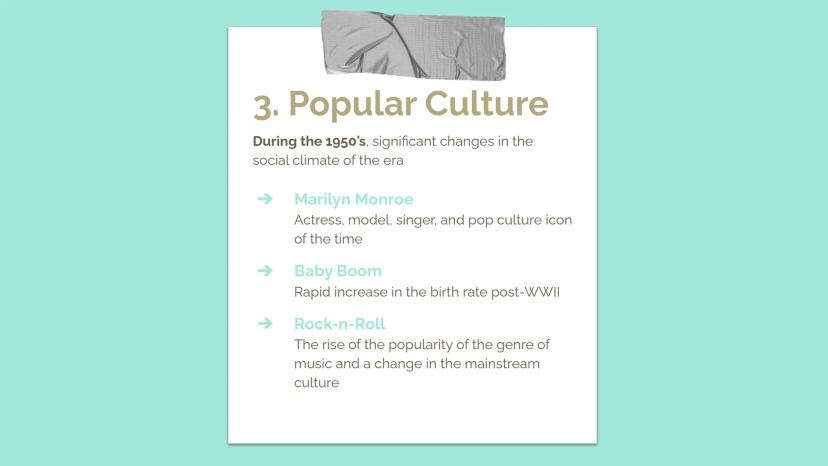
During this transformative period, popular culture underwent significant changes. Marilyn Monroe emerged as the decade's defining icon, embodying the changing attitudes toward celebrity, femininity, and entertainment. Her influence extended beyond acting into modeling and music, creating a new template for stardom that persists today.
The Baby Boom phenomenon fundamentally altered American society, as returning World War II veterans started families in unprecedented numbers. This population surge drove suburban expansion, educational reform, and consumer culture. Simultaneously, Rock-n-Roll music revolutionized popular entertainment, challenging traditional values and establishing youth culture as a powerful social force.
Definition: The Baby Boom refers to the dramatic increase in birth rates between 1946 and 1964, profoundly impacting American demographics, economy, and culture.
6
of 10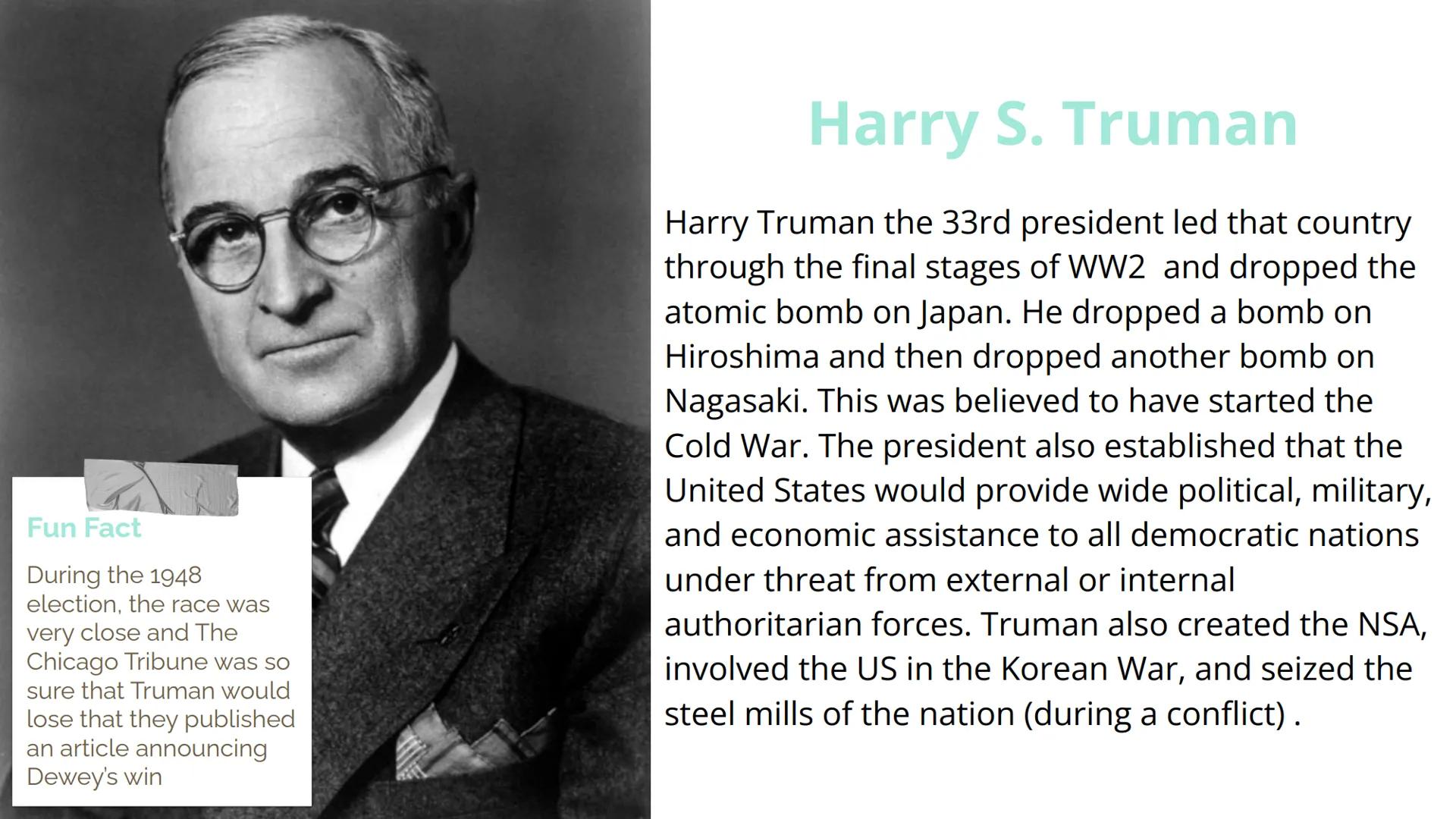
President Truman's Legacy and the Dawn of the Cold War
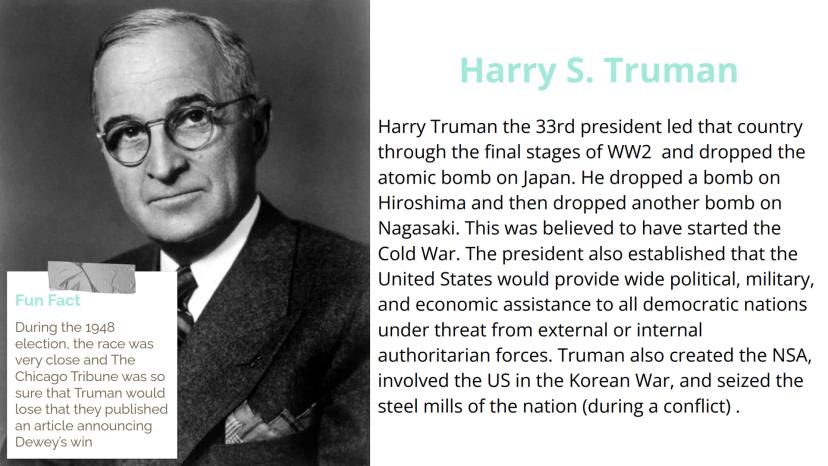
Harry S. Truman's presidency marked a crucial turning point in American history. As the 33rd president, his decisions shaped the post-World War II global order and initiated the Cold War era. His most consequential decision was authorizing the atomic bombings of Hiroshima and Nagasaki, forever changing international relations and military strategy.
The Truman Doctrine became a cornerstone of American foreign policy, establishing the United States as the primary defender of democratic nations against authoritarian threats. This policy led to extensive military, economic, and political assistance programs worldwide, fundamentally altering America's role in global affairs.
Highlight: The Chicago Tribune's premature "Dewey Defeats Truman" headline in 1948 became a symbol of journalistic hubris and one of the most famous mistakes in newspaper history.
7
of 10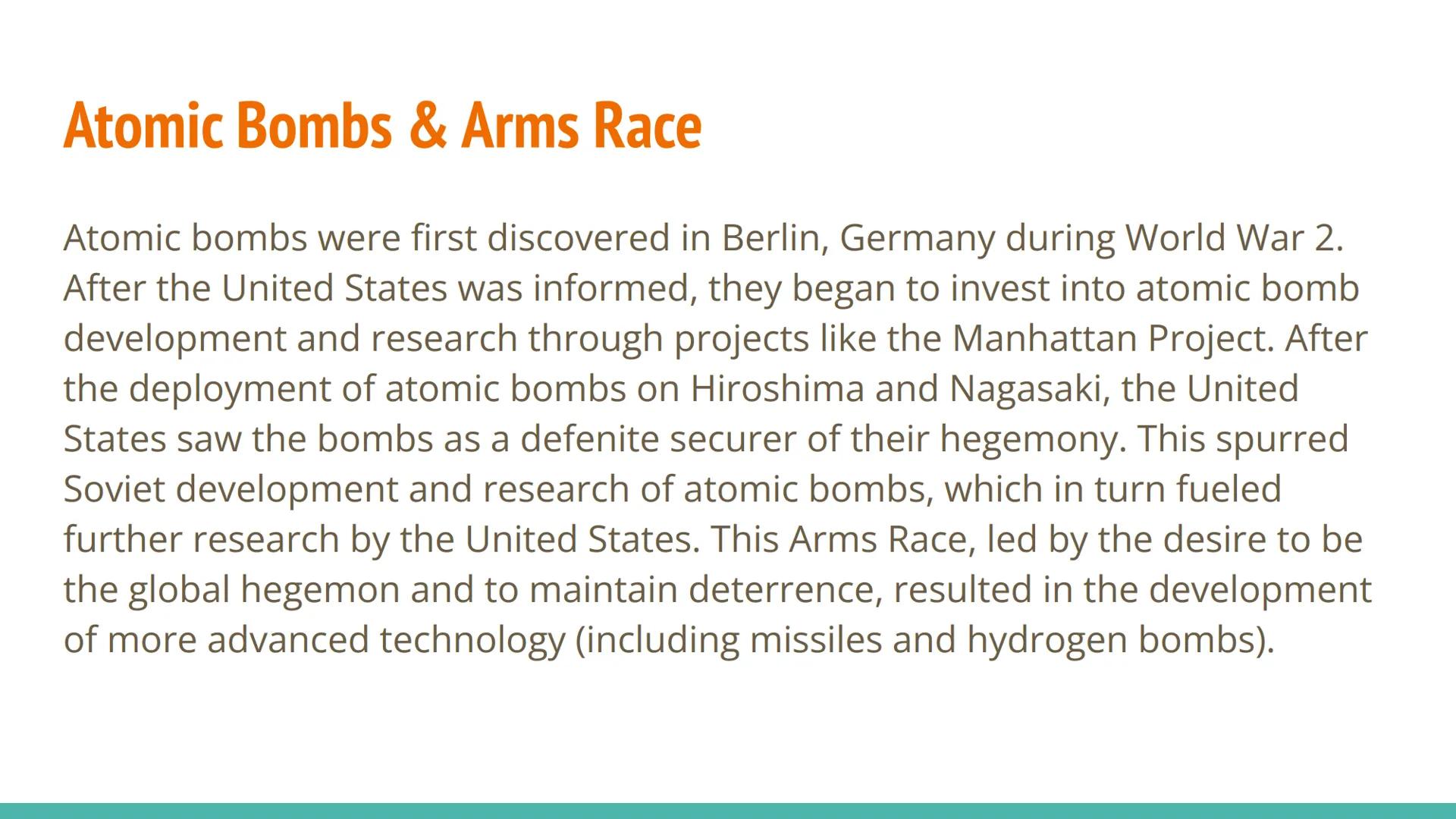
The Nuclear Age and Global Arms Race
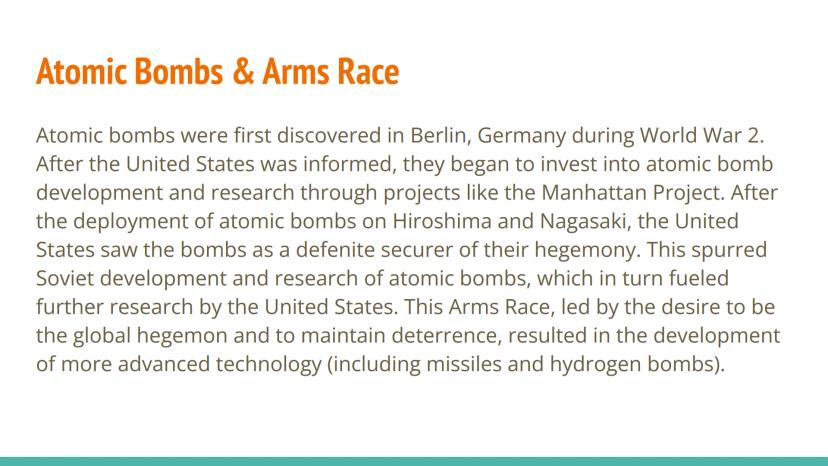
The discovery and development of atomic bombs and Cold War arms race transformed international relations and military strategy. Beginning with the Manhattan Project, atomic research rapidly accelerated, leading to increasingly powerful weapons and delivery systems.
The Soviet Union's successful development of nuclear weapons intensified the arms race, as both superpowers sought technological superiority. This competition spurred innovations in missile technology, leading to intercontinental ballistic missiles (ICBMs) and hydrogen bombs, dramatically raising the stakes of international conflicts.
Example: The hydrogen bomb, developed in the 1950s, represented a quantum leap in destructive power, being hundreds of times more powerful than the atomic bombs used in World War II.
8
of 10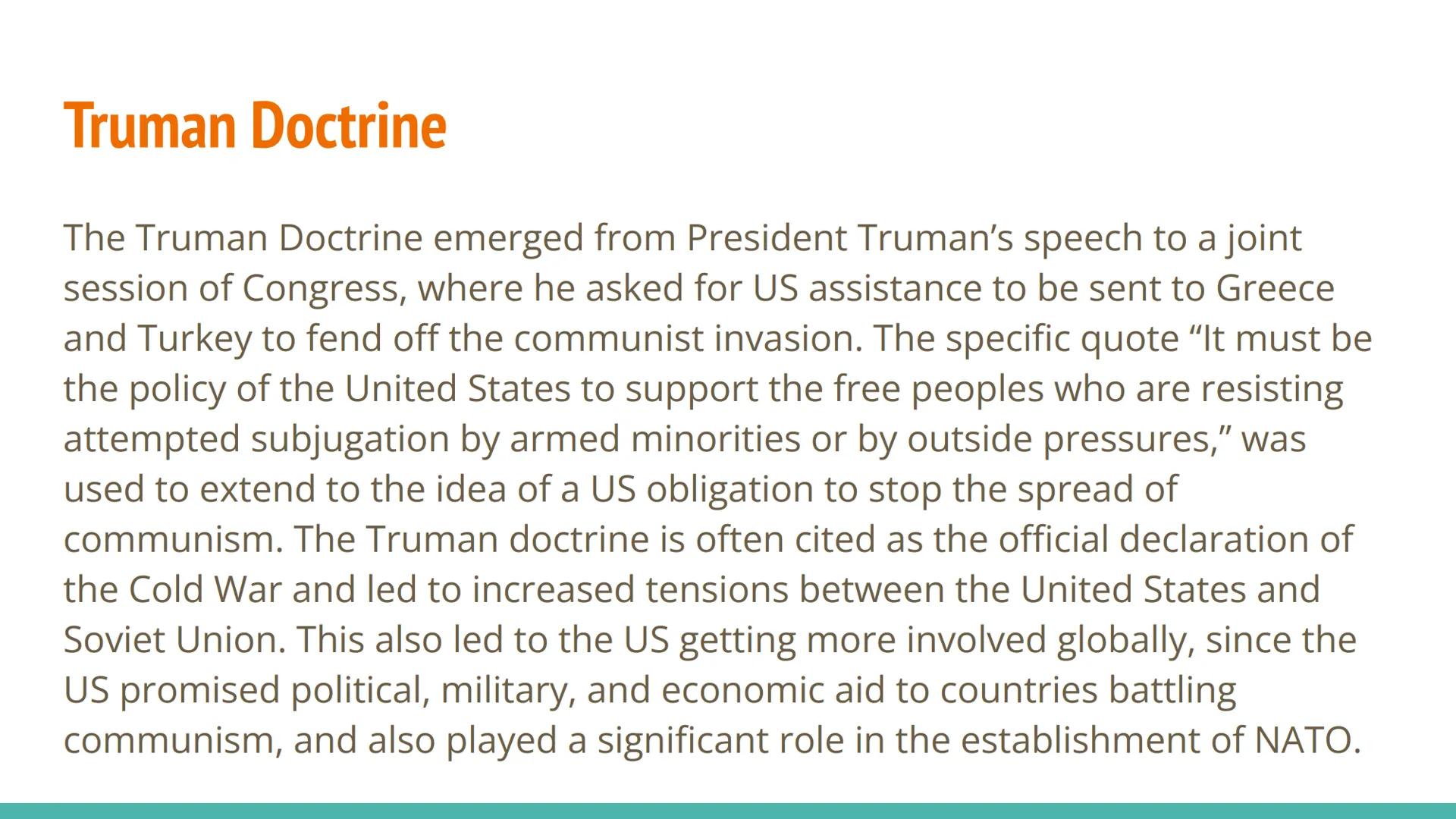
Eisenhower's America: Highways and Civil Rights
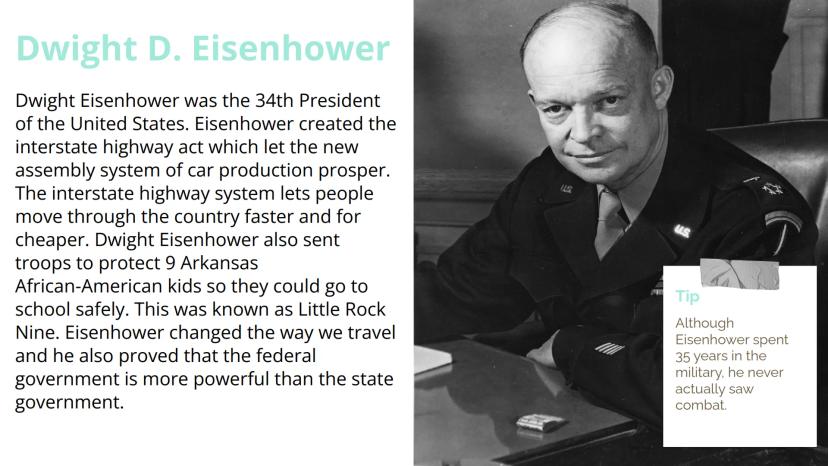
Dwight D. Eisenhower's presidency brought significant domestic changes to America. His Interstate Highway System revolutionized transportation, connecting cities and regions while boosting economic growth and mobility. This massive infrastructure project reflected the era's optimism and technological progress.
Eisenhower's decision to enforce desegregation during the Little Rock Crisis demonstrated federal authority over state governments in civil rights matters. By sending federal troops to protect the Little Rock Nine, he set a precedent for federal intervention in civil rights issues.
Quote: "There must be no second class citizens in this country." - President Eisenhower's commitment to civil rights enforcement.
9
of 10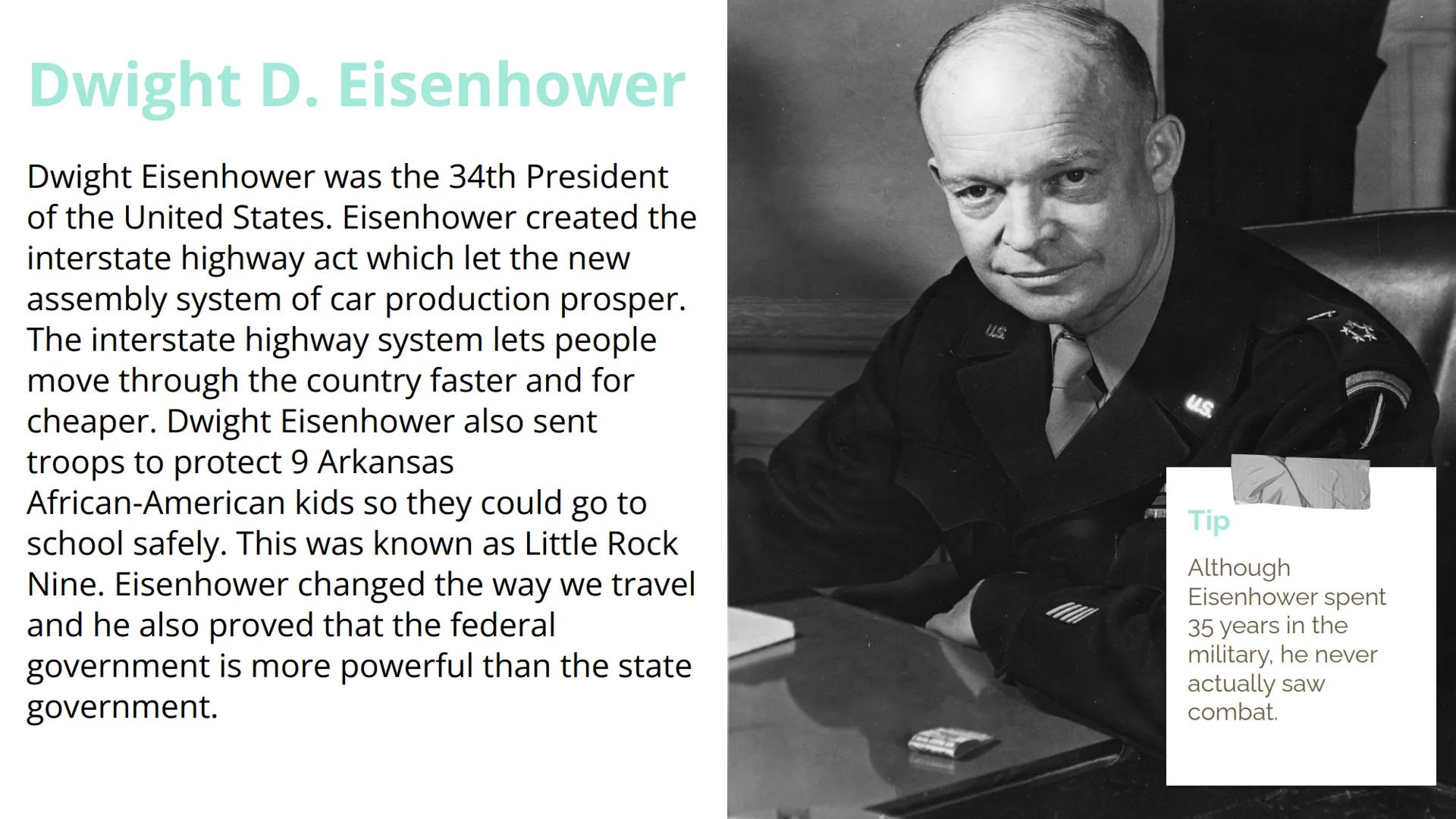
The Interstate Highway System: Transforming America's Transportation
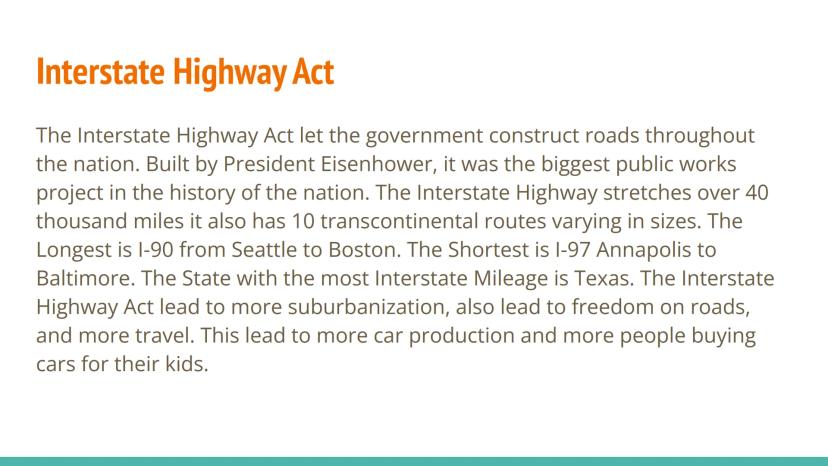
The Interstate Highway Act of 1956 marked a pivotal moment in American infrastructure and society, launching the most ambitious public works project in U.S. history under President Dwight D. Eisenhower's administration. This massive undertaking fundamentally changed how Americans lived, worked, and traveled, creating over 40,000 miles of interconnected highways that would reshape the nation's landscape.
Definition: The Interstate Highway System is a network of controlled-access highways that forms the backbone of America's transportation infrastructure, designed for high-speed vehicular traffic connecting major urban areas.
The system's scope was unprecedented, featuring ten transcontinental routes of varying lengths. The longest route, I-90, spans approximately 3,020 miles from Seattle to Boston, providing a vital east-west corridor across the northern United States. In contrast, I-97 running from Annapolis to Baltimore represents the shortest interstate at just over 17 miles. Texas, with its vast territory, contains the most extensive interstate mileage of any state, reflecting the system's adaptation to regional needs and geography.
This massive infrastructure project catalyzed significant social and economic changes across America. The new highways accelerated suburbanization as families could now live farther from city centers while maintaining easy access to urban employment. The improved connectivity sparked a boom in automobile production and ownership, with many families purchasing multiple vehicles. This transformation of American mobility created a new culture of road travel, family vacations, and interstate commerce that continues to influence society today.
10
of 10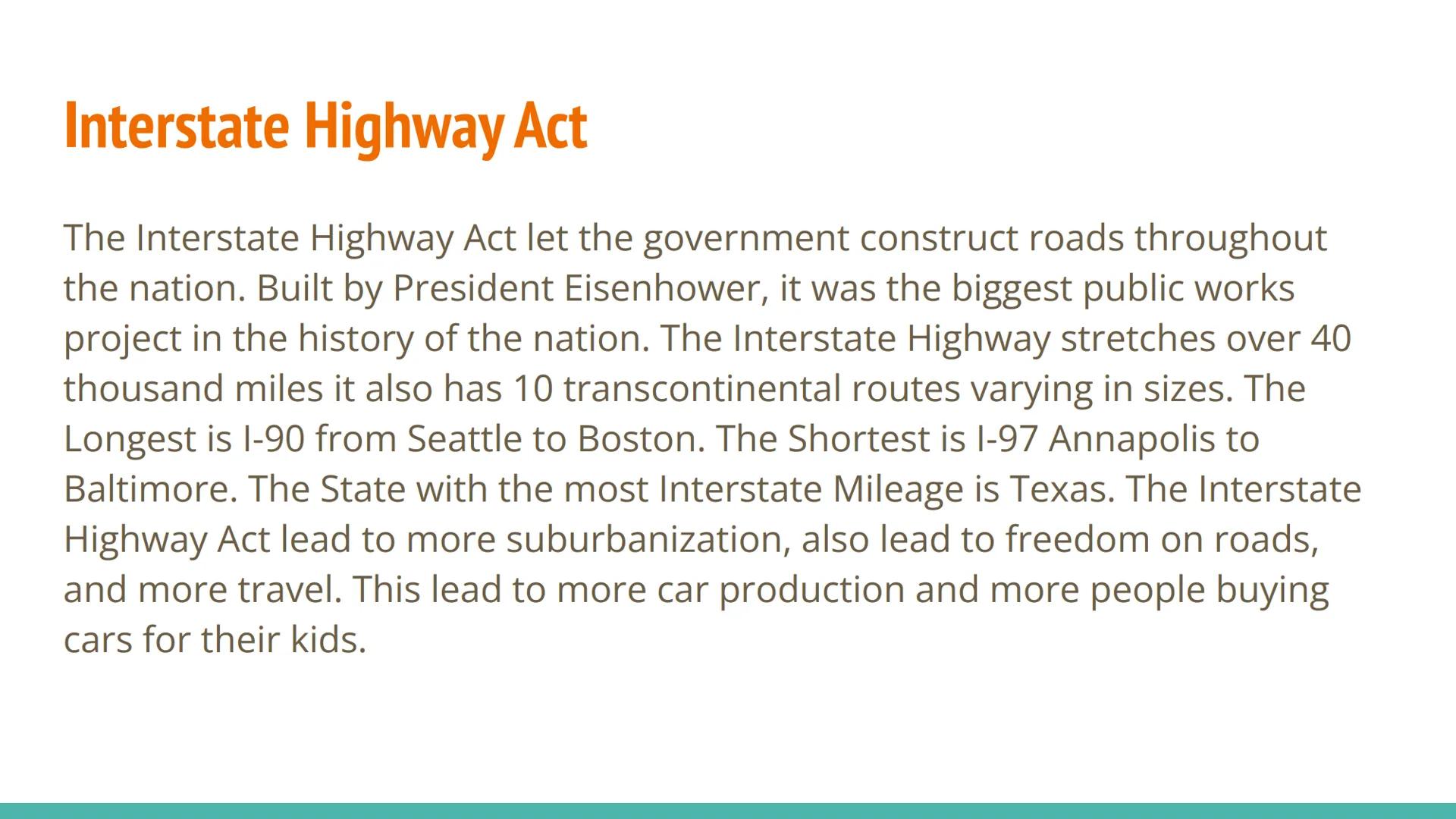
Social and Economic Impact of the Interstate System
The Interstate Highway System's influence extended far beyond transportation, fundamentally altering American society's fabric during the 1950s Cold War cultural impact period. The highways became crucial for national defense, allowing rapid military mobilization - a key consideration during the atomic bombs and Cold War arms race era. This dual-purpose infrastructure represented both domestic progress and strategic preparation.
Highlight: The Interstate Highway System revolutionized American commerce by enabling efficient long-distance trucking and creating new economic corridors along major routes.
The system's development coincided with several other significant 1950s events and influences, including the rise of suburban living and shopping centers. These highways facilitated the growth of regional shopping malls, drive-in restaurants, and motels, creating entirely new business models and consumer experiences. The increased mobility also contributed to cultural exchange between regions, as Americans could more easily travel across state lines for both business and pleasure.
The economic impact was equally transformative. Construction of the Interstate System created millions of jobs and stimulated industries ranging from construction to automotive manufacturing. It established new patterns of urban development, often leading to the decline of traditional downtown areas as commercial activity shifted to highway-accessible locations. This restructuring of American geography and commerce continues to shape development patterns and economic opportunities today.
We thought you’d never ask...
What is the Knowunity AI companion?
Our AI companion is specifically built for the needs of students. Based on the millions of content pieces we have on the platform we can provide truly meaningful and relevant answers to students. But its not only about answers, the companion is even more about guiding students through their daily learning challenges, with personalised study plans, quizzes or content pieces in the chat and 100% personalisation based on the students skills and developments.
Where can I download the Knowunity app?
You can download the app in the Google Play Store and in the Apple App Store.
Is Knowunity really free of charge?
That's right! Enjoy free access to study content, connect with fellow students, and get instant help – all at your fingertips.
Similar Content
Most popular content in US History
9T
US HistoryThe Civil War
Explore the dangerous war of America with this quiz, practice yourself for a quiz or test you need, this will answer all your questions (for eighth grade or for people who just like to learn about it ahead of time)
8th4550
S
US HistoryShort Quiz on US Government/Founding History
A 5-question quiz including questions about modern American government as well as the history of its’ founding.
9th4190
W
US HistoryWW2 refresher
Use this to refresh you memory about world War 2
7th2770
S
US HistoryShort Quiz on US Government/Founding History
A 5-question quiz including questions about modern American government as well as the history of its’ founding.
10th2650
C
US Historycivil rights movement quiz
Vocab
8th2220
T
US HistoryThe Louisiana Purchase; EASY
Simple flashcards for US History
9th2700
B
US HistoryBasic Presidency and Stuff Review
Presidency, Bill of Rights, Constitution
6th2650
U
US HistoryUnited States Review Quiz
This is a bunch of random questions based on US History.
9th2080
US HistoryHistory EOC EXAM REVIEW
HISTROY EOC EXAM REVIEW
50031
Most popular content
9O
AP US HistoryOrigins and Dynamics of the Columbian Exchange
Analyze the ecological and economic motivations behind the initial transfer of goods, people, and diseases between the Old and New Worlds.
9th3,1280
I
AP US HistoryIntroduction to Early Cultural Interactions
Analyze the initial social and religious encounters between Europeans, Africans, and Indigenous peoples in the colonial Americas.
9th2,7730
O
 AP World History
Origins of Ancient River Civilizations
Analyze the environmental factors and technological innovations that led to the rise of early states in Mesopotamia, Egypt, and the Indus Valley.
9th3,1870
M
AP US HistoryMotivations for European Exploration
Analyze the economic, religious, and political factors that drove European powers to the Americas during the 15th and 16th centuries.
9th1,7780
F
 AP Psychology
Foundations of Ethical Guidelines in Research
Practice the core principles of the APA ethical code including informed consent, debriefing, and the role of Institutional Review Boards.
9th1,3360
I
AP US HistoryIntroduction to Native American Societies
Examine the diverse social, political, and economic structures of North American indigenous groups prior to European contact.
9th1,1100
I
 AP Biology
Introduction to Biological Elements of Life
Practice identifying the essential elements including carbon, nitrogen, phosphorus, and sulfur that compose biological macromolecules.
9th1,7390
I
AP US HistoryIntroduction to the Spanish Encomienda System
Explore the fundamental economic and social structures of the Spanish colonial system, focusing on the encomienda and the casta social hierarchy.
9th8890
O
AP World HistoryOrigins and Continuity of the Byzantine Empire
Analyze the political and cultural transitions from the Roman Empire to the Byzantine Empire, focusing on the reign of Justinian I and his code.
9th1,6320
Can't find what you're looking for? Explore other subjects.
Students love us — and so will you.
4.6/5App Store
4.7/5Google Play
The app is very easy to use and well designed. I have found everything I was looking for so far and have been able to learn a lot from the presentations! I will definitely use the app for a class assignment! And of course it also helps a lot as an inspiration.
Stefan SiOS user
This app is really great. There are so many study notes and help [...]. My problem subject is French, for example, and the app has so many options for help. Thanks to this app, I have improved my French. I would recommend it to anyone.
Samantha KlichAndroid user
Wow, I am really amazed. I just tried the app because I've seen it advertised many times and was absolutely stunned. This app is THE HELP you want for school and above all, it offers so many things, such as workouts and fact sheets, which have been VERY helpful to me personally.
AnnaiOS user
US History118 views·Updated Jun 17, 2026·17 pagesThe 1950s: How the Cold War Changed Everything
Arshi M.@arshi_unicorn
The 1950s Cold War cultural impact transformed American society through fear, technological advancement, and social change.
During this pivotal decade, the atomic bombs and Cold War arms racecreated widespread anxiety among Americans. Families built backyard fallout shelters and children...
1
of 10
Sign up to see the content. It's free!
- Access to all documents
- Improve your grades
- Join milions of students
Understanding the Cultural and Political Landscape of the 1950s Cold War Era
The 1950s Cold War cultural impact transformed American society fundamentally after World War II's conclusion. This period marked unprecedented changes in geopolitics, technology, and social dynamics as the United States and Soviet Union emerged as global superpowers. The era witnessed remarkable scientific advancement while simultaneously dealing with domestic tensions and fears.
Definition: The Cold War was a period of geopolitical tension and rivalry between the United States and the Soviet Union that shaped global politics, military development, and cultural attitudes from the late 1940s through the 1980s.
The post-war period ushered in dramatic societal changes, with the rise of suburban living, increased consumer culture, and technological innovations becoming hallmarks of American life. The atomic bombs and Cold War arms race created an atmosphere of constant tension, leading to the construction of bomb shelters and regular nuclear attack drills in schools and communities.
These global tensions manifested in domestic policies and social movements. The period saw the early stirrings of the Civil Rights Movement, while simultaneously experiencing intense anti-communist sentiment known as the Red Scare. This paradoxical era combined prosperity and paranoia, progress and persecution.
2
of 10Sign up to see the content. It's free!
- Access to all documents
- Improve your grades
- Join milions of students
Key Figures and Leadership During the Early Cold War
The early Cold War period was shaped by several influential leaders whose decisions and policies had lasting impacts. President Harry Truman (1945-1953) established the foundational Cold War policy of containment through the Truman Doctrine, while his successor Dwight Eisenhower (1953-1961) continued these policies while managing escalating tensions with the Soviet Union.
Highlight: Senator Joseph McCarthy became a controversial figure during this period, leading anti-communist investigations that would later be known as McCarthyism, significantly impacting American society and politics.
The significant 1950s events and influences were largely shaped by these leaders' responses to Soviet actions and domestic concerns. Their policies affected everything from international relations to domestic civil liberties, creating lasting impacts on American society.
3
of 10Sign up to see the content. It's free!
- Access to all documents
- Improve your grades
- Join milions of students
Social and Political Developments of the 1950s
The 1950s witnessed dramatic social and political transformations that would define American society for decades to come. The period was marked by increasing prosperity for many Americans, though this prosperity wasn't equally distributed across all segments of society.
Example: The Interstate Highway Act of 1956 revolutionized American transportation and culture, leading to increased mobility, suburban growth, and changes in how Americans lived and worked.
The launch of Sputnik by the USSR in 1957 sparked a new phase in the Space Race and led to increased emphasis on science and technology education in American schools. This event, combined with ongoing Cold War tensions, accelerated technological development and military spending.
4
of 10Sign up to see the content. It's free!
- Access to all documents
- Improve your grades
- Join milions of students
Cultural and Technological Advancements
The 1950s represented a unique convergence of cultural change and technological progress. The decade saw unprecedented advances in consumer technology, from television sets becoming household fixtures to the development of early computers.
Vocabulary: The "Red Scare" refers to a period of intense anti-communist suspicion and persecution in American society, leading to investigations, blacklists, and widespread fear of communist infiltration.
These technological advancements occurred against a backdrop of social conformity and political tension. The period's cultural landscape was shaped by both the optimism of post-war prosperity and the anxiety of potential nuclear conflict, creating a complex and often contradictory social environment.
5
of 10Sign up to see the content. It's free!
- Access to all documents
- Improve your grades
- Join milions of students
The Cultural and Political Transformation of 1950s America
The 1950s marked a pivotal era in American history, characterized by dramatic social changes, political tensions, and cultural innovations. The 1950s Cold War cultural impact reshaped American society in profound ways, from entertainment to family life.
During this transformative period, popular culture underwent significant changes. Marilyn Monroe emerged as the decade's defining icon, embodying the changing attitudes toward celebrity, femininity, and entertainment. Her influence extended beyond acting into modeling and music, creating a new template for stardom that persists today.
The Baby Boom phenomenon fundamentally altered American society, as returning World War II veterans started families in unprecedented numbers. This population surge drove suburban expansion, educational reform, and consumer culture. Simultaneously, Rock-n-Roll music revolutionized popular entertainment, challenging traditional values and establishing youth culture as a powerful social force.
Definition: The Baby Boom refers to the dramatic increase in birth rates between 1946 and 1964, profoundly impacting American demographics, economy, and culture.
6
of 10Sign up to see the content. It's free!
- Access to all documents
- Improve your grades
- Join milions of students
President Truman's Legacy and the Dawn of the Cold War
Harry S. Truman's presidency marked a crucial turning point in American history. As the 33rd president, his decisions shaped the post-World War II global order and initiated the Cold War era. His most consequential decision was authorizing the atomic bombings of Hiroshima and Nagasaki, forever changing international relations and military strategy.
The Truman Doctrine became a cornerstone of American foreign policy, establishing the United States as the primary defender of democratic nations against authoritarian threats. This policy led to extensive military, economic, and political assistance programs worldwide, fundamentally altering America's role in global affairs.
Highlight: The Chicago Tribune's premature "Dewey Defeats Truman" headline in 1948 became a symbol of journalistic hubris and one of the most famous mistakes in newspaper history.
7
of 10Sign up to see the content. It's free!
- Access to all documents
- Improve your grades
- Join milions of students
The Nuclear Age and Global Arms Race
The discovery and development of atomic bombs and Cold War arms race transformed international relations and military strategy. Beginning with the Manhattan Project, atomic research rapidly accelerated, leading to increasingly powerful weapons and delivery systems.
The Soviet Union's successful development of nuclear weapons intensified the arms race, as both superpowers sought technological superiority. This competition spurred innovations in missile technology, leading to intercontinental ballistic missiles (ICBMs) and hydrogen bombs, dramatically raising the stakes of international conflicts.
Example: The hydrogen bomb, developed in the 1950s, represented a quantum leap in destructive power, being hundreds of times more powerful than the atomic bombs used in World War II.
8
of 10Sign up to see the content. It's free!
- Access to all documents
- Improve your grades
- Join milions of students
Eisenhower's America: Highways and Civil Rights
Dwight D. Eisenhower's presidency brought significant domestic changes to America. His Interstate Highway System revolutionized transportation, connecting cities and regions while boosting economic growth and mobility. This massive infrastructure project reflected the era's optimism and technological progress.
Eisenhower's decision to enforce desegregation during the Little Rock Crisis demonstrated federal authority over state governments in civil rights matters. By sending federal troops to protect the Little Rock Nine, he set a precedent for federal intervention in civil rights issues.
Quote: "There must be no second class citizens in this country." - President Eisenhower's commitment to civil rights enforcement.
9
of 10Sign up to see the content. It's free!
- Access to all documents
- Improve your grades
- Join milions of students
The Interstate Highway System: Transforming America's Transportation
The Interstate Highway Act of 1956 marked a pivotal moment in American infrastructure and society, launching the most ambitious public works project in U.S. history under President Dwight D. Eisenhower's administration. This massive undertaking fundamentally changed how Americans lived, worked, and traveled, creating over 40,000 miles of interconnected highways that would reshape the nation's landscape.
Definition: The Interstate Highway System is a network of controlled-access highways that forms the backbone of America's transportation infrastructure, designed for high-speed vehicular traffic connecting major urban areas.
The system's scope was unprecedented, featuring ten transcontinental routes of varying lengths. The longest route, I-90, spans approximately 3,020 miles from Seattle to Boston, providing a vital east-west corridor across the northern United States. In contrast, I-97 running from Annapolis to Baltimore represents the shortest interstate at just over 17 miles. Texas, with its vast territory, contains the most extensive interstate mileage of any state, reflecting the system's adaptation to regional needs and geography.
This massive infrastructure project catalyzed significant social and economic changes across America. The new highways accelerated suburbanization as families could now live farther from city centers while maintaining easy access to urban employment. The improved connectivity sparked a boom in automobile production and ownership, with many families purchasing multiple vehicles. This transformation of American mobility created a new culture of road travel, family vacations, and interstate commerce that continues to influence society today.
10
of 10Sign up to see the content. It's free!
- Access to all documents
- Improve your grades
- Join milions of students
Social and Economic Impact of the Interstate System
The Interstate Highway System's influence extended far beyond transportation, fundamentally altering American society's fabric during the 1950s Cold War cultural impact period. The highways became crucial for national defense, allowing rapid military mobilization - a key consideration during the atomic bombs and Cold War arms race era. This dual-purpose infrastructure represented both domestic progress and strategic preparation.
Highlight: The Interstate Highway System revolutionized American commerce by enabling efficient long-distance trucking and creating new economic corridors along major routes.
The system's development coincided with several other significant 1950s events and influences, including the rise of suburban living and shopping centers. These highways facilitated the growth of regional shopping malls, drive-in restaurants, and motels, creating entirely new business models and consumer experiences. The increased mobility also contributed to cultural exchange between regions, as Americans could more easily travel across state lines for both business and pleasure.
The economic impact was equally transformative. Construction of the Interstate System created millions of jobs and stimulated industries ranging from construction to automotive manufacturing. It established new patterns of urban development, often leading to the decline of traditional downtown areas as commercial activity shifted to highway-accessible locations. This restructuring of American geography and commerce continues to shape development patterns and economic opportunities today.
We thought you’d never ask...
What is the Knowunity AI companion?
Our AI companion is specifically built for the needs of students. Based on the millions of content pieces we have on the platform we can provide truly meaningful and relevant answers to students. But its not only about answers, the companion is even more about guiding students through their daily learning challenges, with personalised study plans, quizzes or content pieces in the chat and 100% personalisation based on the students skills and developments.
Where can I download the Knowunity app?
You can download the app in the Google Play Store and in the Apple App Store.
Is Knowunity really free of charge?
That's right! Enjoy free access to study content, connect with fellow students, and get instant help – all at your fingertips.
Similar Content
Most popular content in US History
9T
US HistoryThe Civil War
Explore the dangerous war of America with this quiz, practice yourself for a quiz or test you need, this will answer all your questions (for eighth grade or for people who just like to learn about it ahead of time)
8th4550
S
US HistoryShort Quiz on US Government/Founding History
A 5-question quiz including questions about modern American government as well as the history of its’ founding.
9th4190
W
US HistoryWW2 refresher
Use this to refresh you memory about world War 2
7th2770
S
US HistoryShort Quiz on US Government/Founding History
A 5-question quiz including questions about modern American government as well as the history of its’ founding.
10th2650
C
US Historycivil rights movement quiz
Vocab
8th2220
T
US HistoryThe Louisiana Purchase; EASY
Simple flashcards for US History
9th2700
B
US HistoryBasic Presidency and Stuff Review
Presidency, Bill of Rights, Constitution
6th2650
U
US HistoryUnited States Review Quiz
This is a bunch of random questions based on US History.
9th2080
US HistoryHistory EOC EXAM REVIEW
HISTROY EOC EXAM REVIEW
50031
Most popular content
9O
AP US HistoryOrigins and Dynamics of the Columbian Exchange
Analyze the ecological and economic motivations behind the initial transfer of goods, people, and diseases between the Old and New Worlds.
9th3,1280
I
AP US HistoryIntroduction to Early Cultural Interactions
Analyze the initial social and religious encounters between Europeans, Africans, and Indigenous peoples in the colonial Americas.
9th2,7730
O
AP World HistoryOrigins of Ancient River Civilizations
Analyze the environmental factors and technological innovations that led to the rise of early states in Mesopotamia, Egypt, and the Indus Valley.
9th3,1870
M
AP US HistoryMotivations for European Exploration
Analyze the economic, religious, and political factors that drove European powers to the Americas during the 15th and 16th centuries.
9th1,7780
F
AP PsychologyFoundations of Ethical Guidelines in Research
Practice the core principles of the APA ethical code including informed consent, debriefing, and the role of Institutional Review Boards.
9th1,3360
I
AP US HistoryIntroduction to Native American Societies
Examine the diverse social, political, and economic structures of North American indigenous groups prior to European contact.
9th1,1100
I
AP BiologyIntroduction to Biological Elements of Life
Practice identifying the essential elements including carbon, nitrogen, phosphorus, and sulfur that compose biological macromolecules.
9th1,7390
I
AP US HistoryIntroduction to the Spanish Encomienda System
Explore the fundamental economic and social structures of the Spanish colonial system, focusing on the encomienda and the casta social hierarchy.
9th8890
O
AP World HistoryOrigins and Continuity of the Byzantine Empire
Analyze the political and cultural transitions from the Roman Empire to the Byzantine Empire, focusing on the reign of Justinian I and his code.
9th1,6320
Can't find what you're looking for? Explore other subjects.
Students love us — and so will you.
4.6/5App Store
4.7/5Google Play
The app is very easy to use and well designed. I have found everything I was looking for so far and have been able to learn a lot from the presentations! I will definitely use the app for a class assignment! And of course it also helps a lot as an inspiration.
Stefan SiOS user
This app is really great. There are so many study notes and help [...]. My problem subject is French, for example, and the app has so many options for help. Thanks to this app, I have improved my French. I would recommend it to anyone.
Samantha KlichAndroid user
Wow, I am really amazed. I just tried the app because I've seen it advertised many times and was absolutely stunned. This app is THE HELP you want for school and above all, it offers so many things, such as workouts and fact sheets, which have been VERY helpful to me personally.
AnnaiOS user