

Radian and degree measure are essential concepts in precalculus that...
 Trigonometry130 views·Updated Jun 15, 2026·10 pages
Understanding Radian and Degree Measures: Key Concepts Explained



1 / 10
1
of 10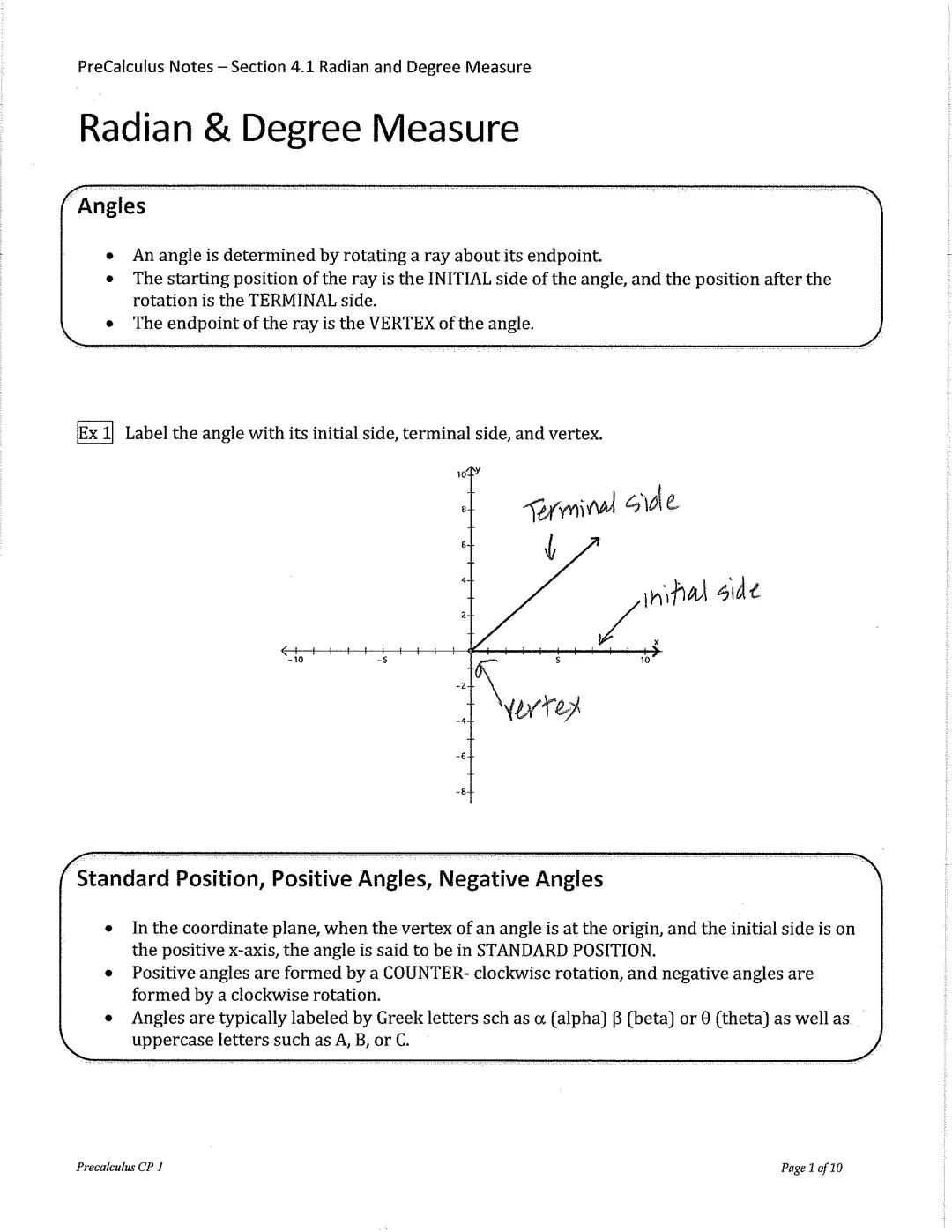
Understanding Angles
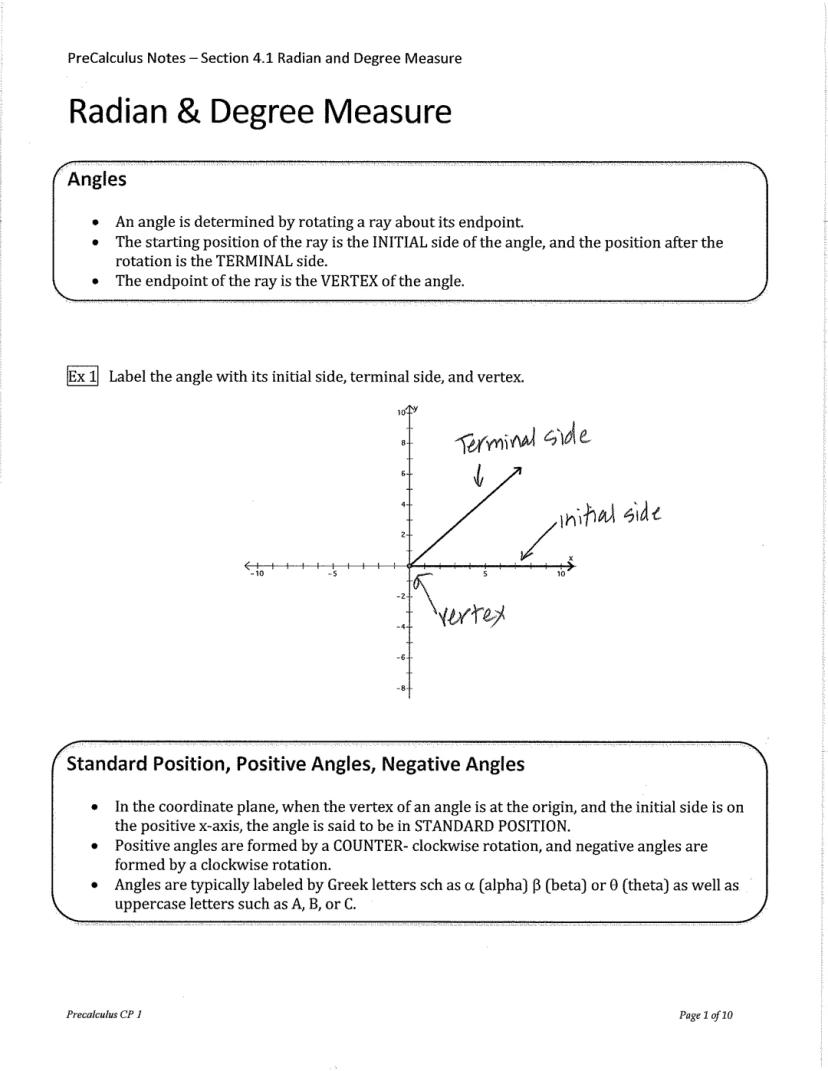
Angles are formed when a ray rotates around its endpoint. Every angle has three key parts: the initial side (starting position), the terminal side (position after rotation), and the vertex (the endpoint where rotation occurs).
When we place an angle in the coordinate system with its vertex at the origin and initial side along the positive x-axis, it's in standard position. This standard placement makes it easier to analyze angles consistently.
Remember that angles have direction! A positive angle forms through counterclockwise rotation, while a negative angle forms through clockwise rotation. Angles are typically labeled using Greek letters like θ (theta) or α (alpha).
Quick Tip: Think of angle measurement like turning a steering wheel - counterclockwise is positive, clockwise is negative!
2
of 10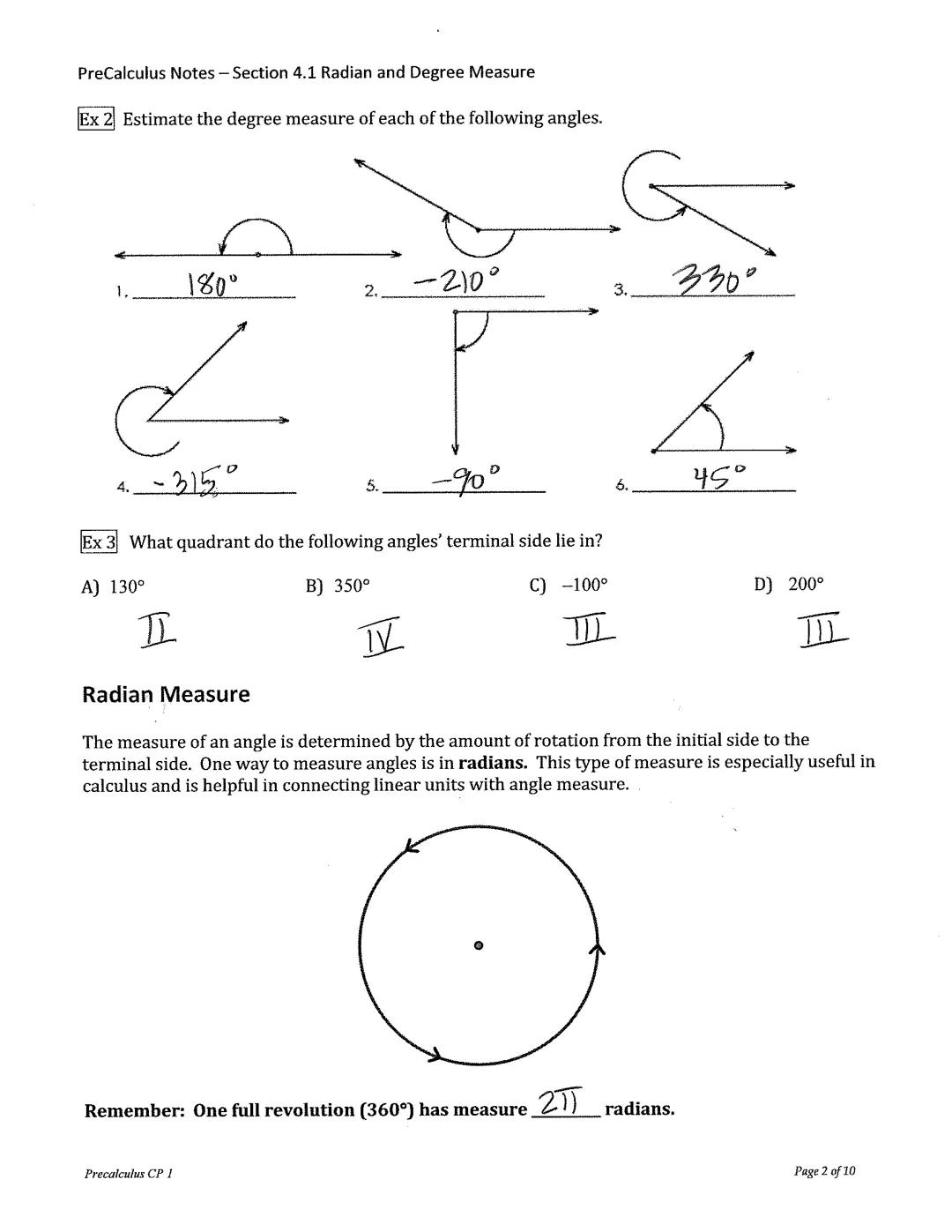
Radian Measure Basics
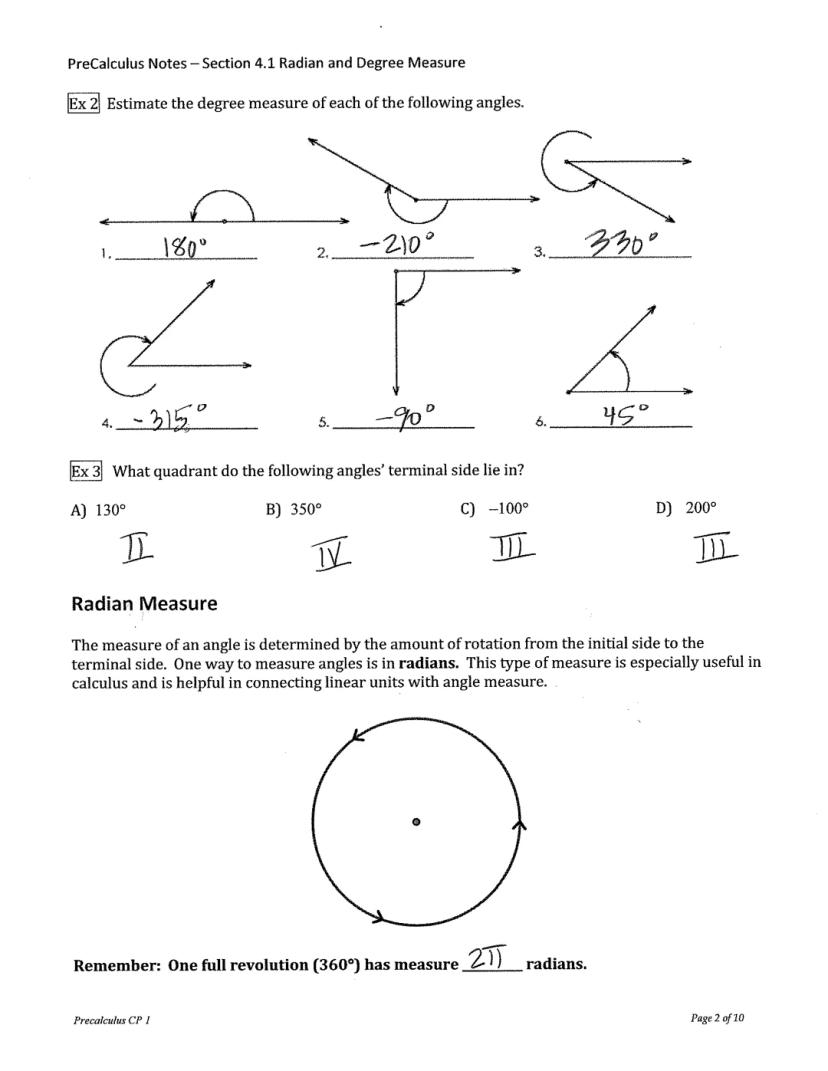
Radian measure connects angle size to the radius of a circle. While degrees might be more familiar, radians are especially important in calculus and higher math because they create a direct relationship between arc length and radius.
The key relationship to remember is that one complete circle (360°) equals 2π radians. This means that half a circle (180°) is π radians, and a quarter circle (90°) is π/2 radians.
When identifying where angles land, think about quadrants. For example, angles between 0° and 90° have their terminal side in Quadrant I, while angles between 90° and 180° end in Quadrant II.
Pro Tip: Quadrantal angles (those whose terminal sides fall directly on an axis) are especially important to memorize: 0, π/2, π, 3π/2, and 2π radians.
3
of 10
Comparing Degrees and Radians
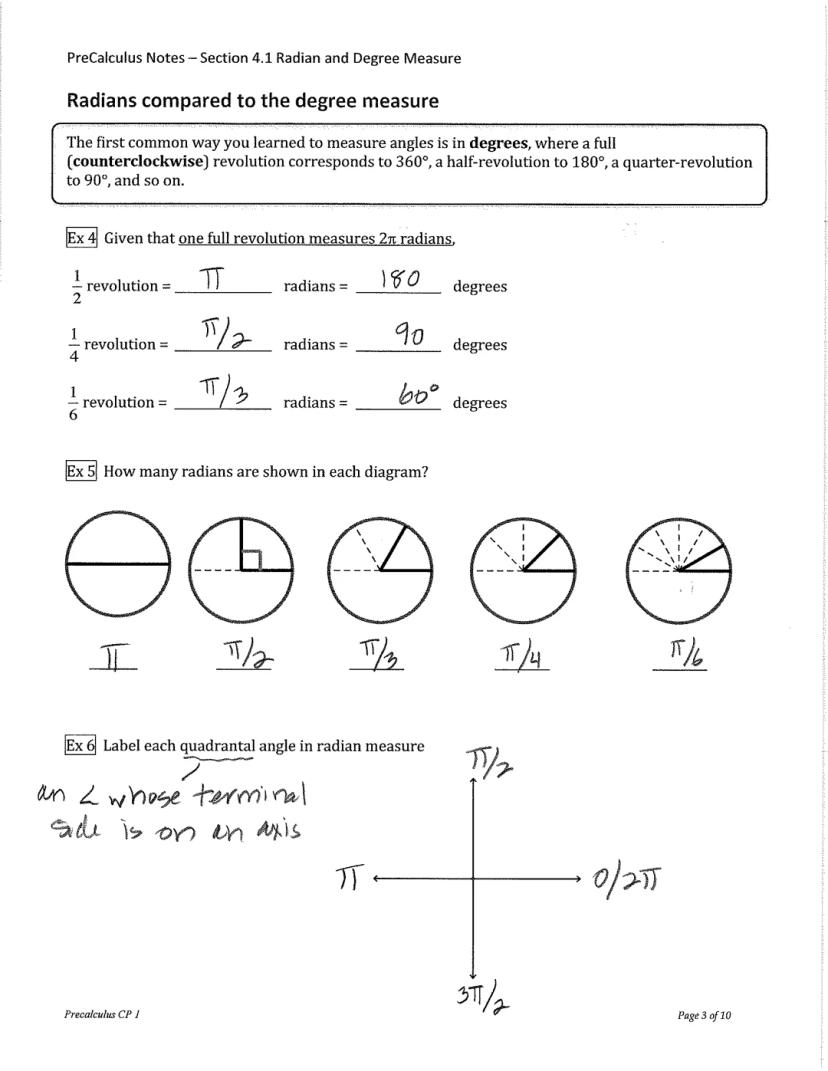
Radians help us connect circular motion with linear measurements. Instead of dividing a circle into 360 equal parts (degrees), radian measure relates directly to the circle's radius.
The most frequently used radian measures correspond to common angles:
- A quarter-revolution (90°) equals π/2 radians
- A half-revolution (180°) equals π radians
- A sixth of a revolution (60°) equals π/3 radians
Remember that quadrantal angles have their terminal side directly on an axis. In radians, these special angles are 0, π/2, π, 3π/2, and 2π. Being able to quickly identify these values will make trigonometry much easier!
Remember: When drawing angles in radian measure, visualize fractions of the circle. For example, π/4 is 1/8 of the full circle (which is 2π).
4
of 10
Converting Between Systems
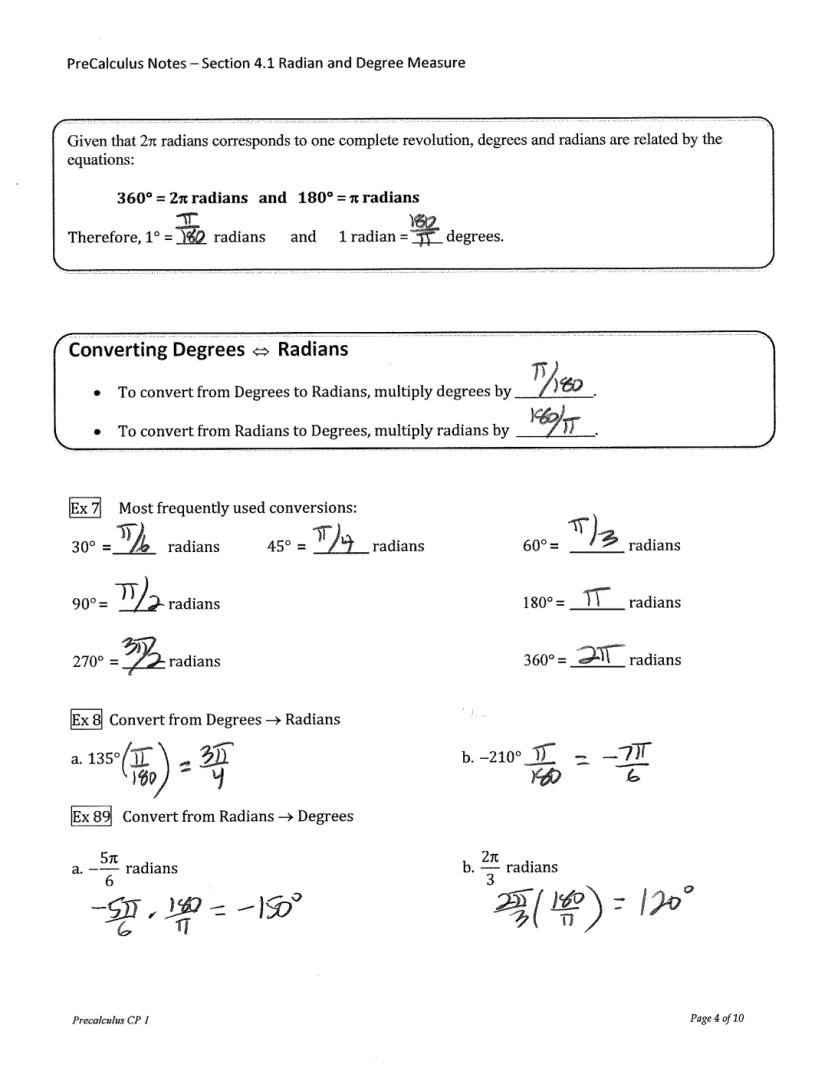
Converting between degrees and radians is straightforward once you know the key relationship: 180° = π radians.
To convert from degrees to radians:
- Multiply degrees by π/180
- Example: 135° × (π/180) = 3π/4 radians
To convert from radians to degrees:
- Multiply radians by 180/π
- Example: 5π/6 × (180/π) = 150°
The most common angle measures you should memorize are:
- 30° = π/6 radians
- 45° = π/4 radians
- 60° = π/3 radians
- 90° = π/2 radians
Conversion Shortcut: Think of π radians as 180° and divide both sides equally. For example, π/3 radians is 1/3 of 180°, which equals 60°.
5
of 10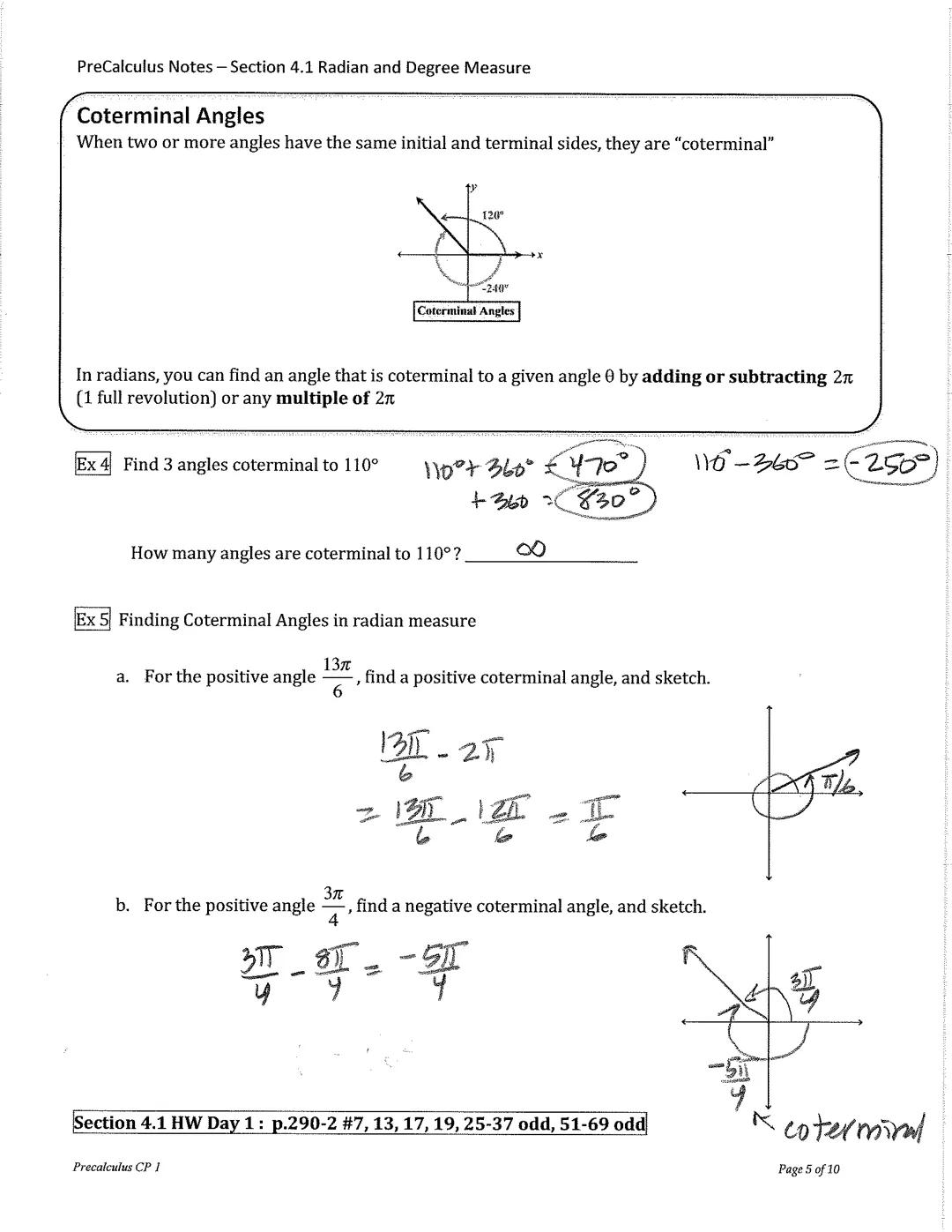
Coterminal Angles
Coterminal angles share the same initial and terminal sides, even though they have different measures. They're like different ways of describing the same final position!
To find coterminal angles:
- Add or subtract 360° (for degrees)
- Add or subtract 2π (for radians)
For example, 110° has coterminal angles at 470° (add 360°), -250° (subtract 360°), and many others. In fact, there are infinitely many coterminal angles for any given angle.
In radian measure, finding coterminal angles works the same way. For example, to find a positive angle coterminal with 13π/6:
- Calculate 13π/6 - 2π
- Simplify to 13π/6 - 12π/6 = π/6
Visualization Tip: Think of coterminal angles as "wrapping around" the circle multiple times but ending at the same spot. Like different paths that lead to the same destination!
6
of 10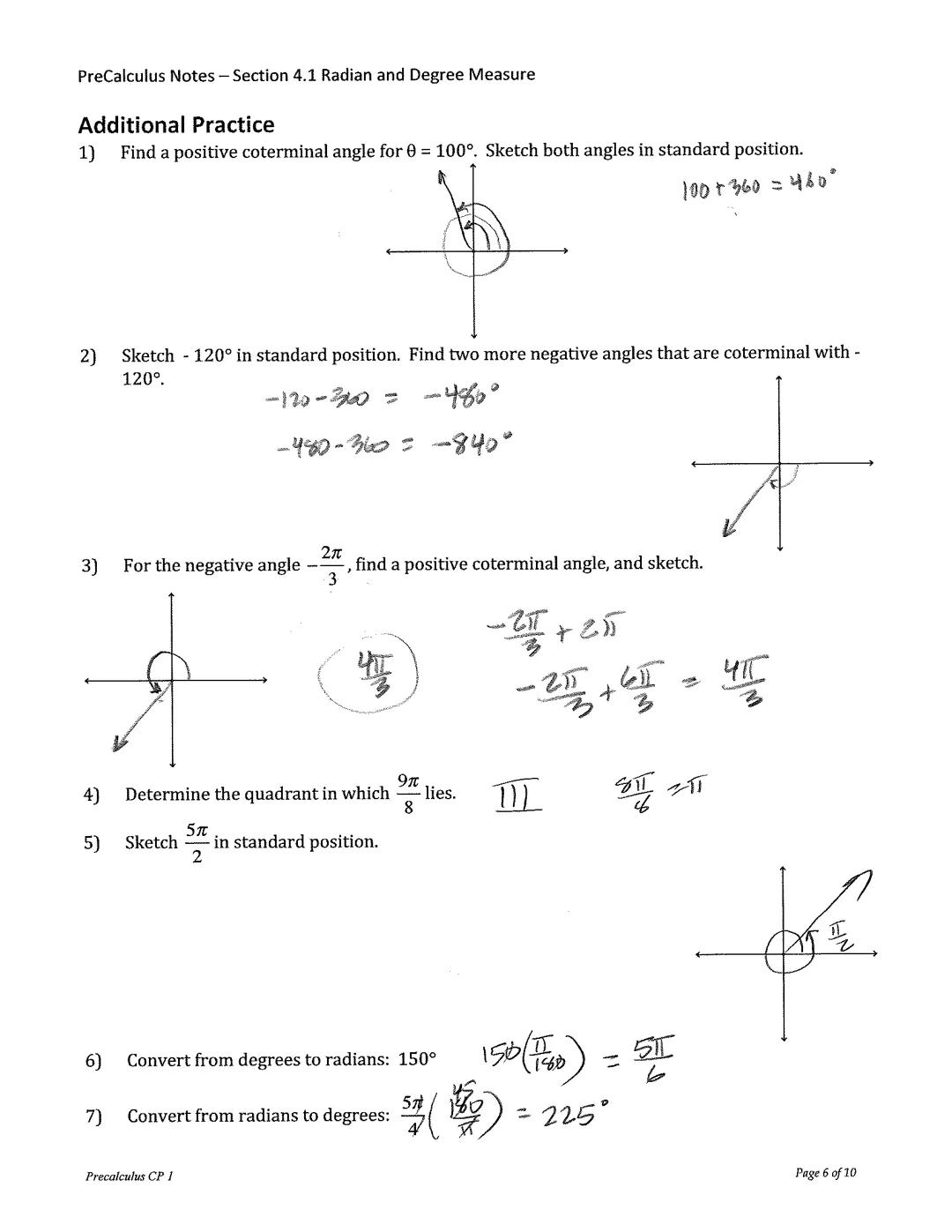
Working with Angles
When working with angles in standard position, you'll often need to:
- Find coterminal angles
- Determine which quadrant an angle lies in
- Convert between measurement systems
For example, to find a positive angle coterminal with -2π/3, add one full revolution (2π): -2π/3 + 2π = -2π/3 + 6π/3 = 4π/3
Identifying the quadrant of an angle helps with trigonometric calculations. For example, 9π/8 is between π (180°) and 3π/2 (270°), so it's in Quadrant III.
When converting measurements, always remember:
- For degrees to radians: multiply by π/180
- For radians to degrees: multiply by 180/π
Practice Strategy: Sketch angles in standard position to visualize them better. This helps you understand where they lie and makes finding coterminal angles much easier!
7
of 10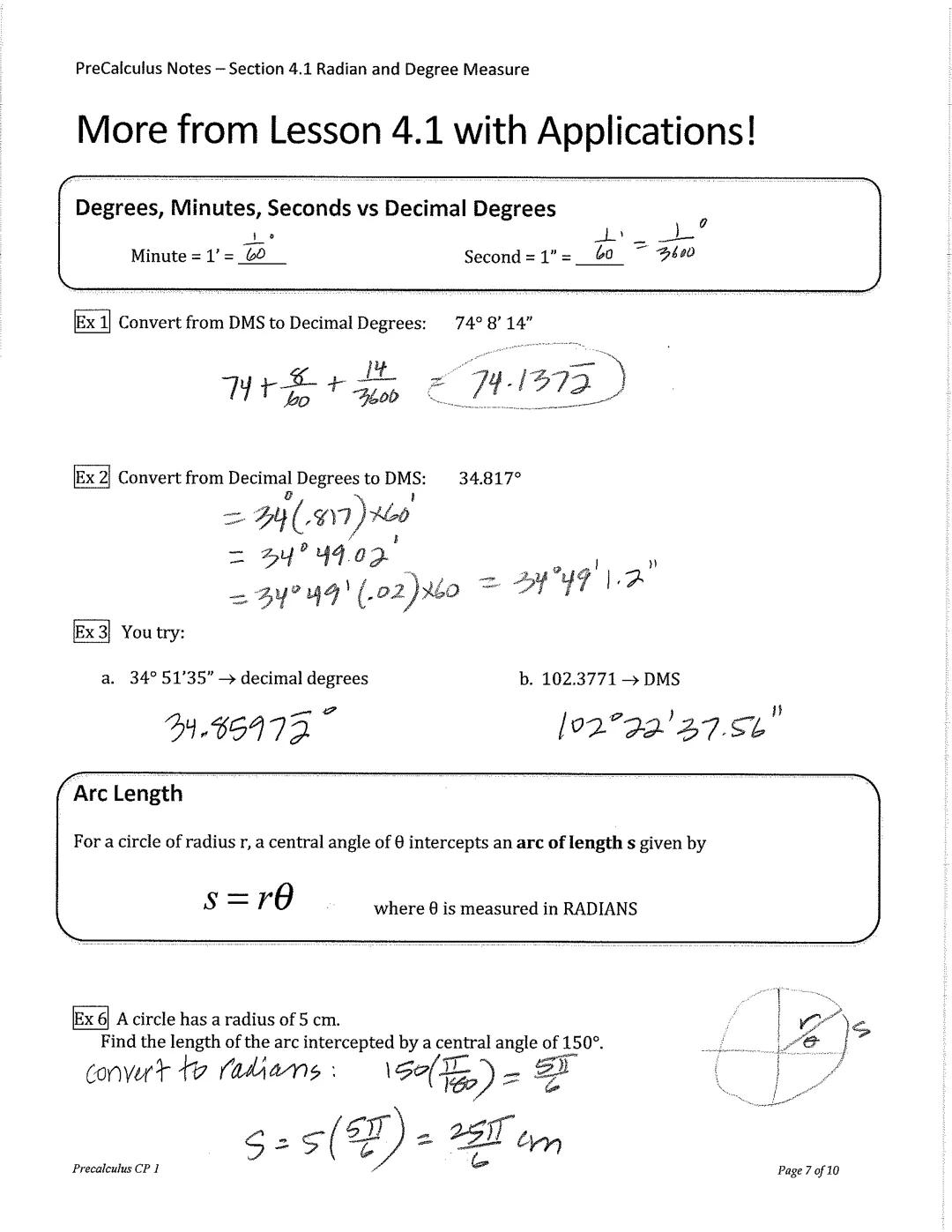
Advanced Angle Measurements
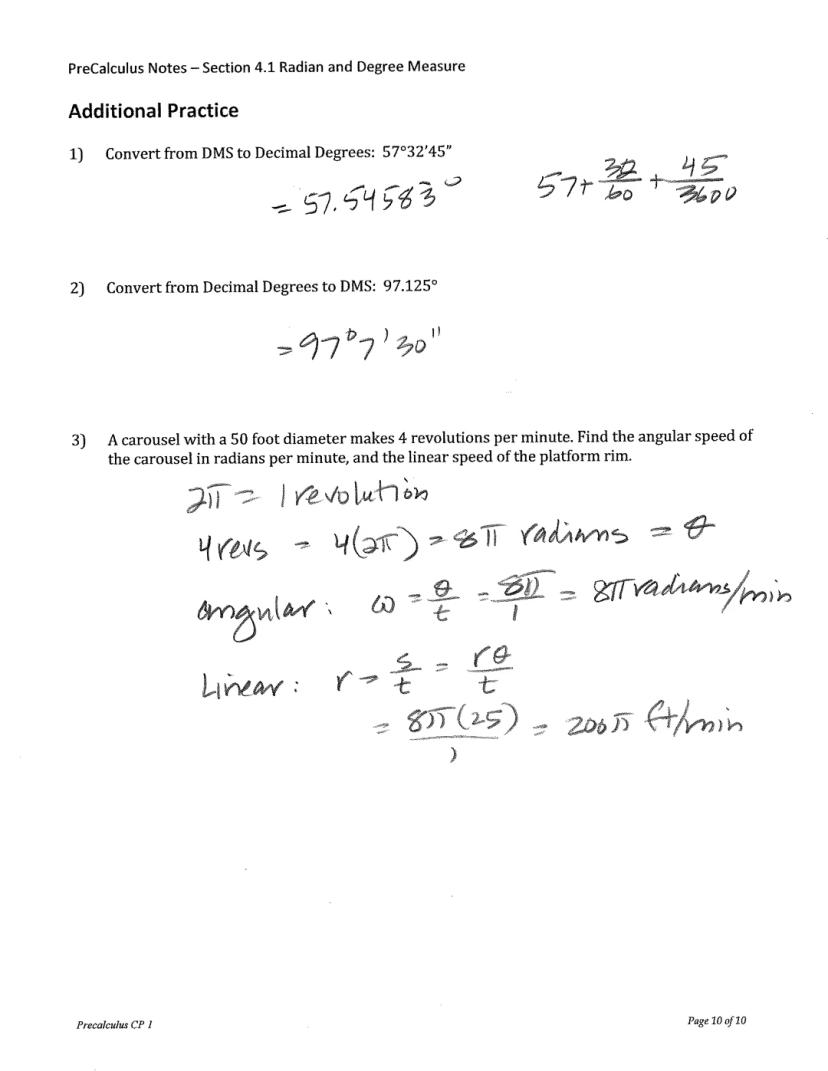
Beyond basic degrees and radians, you'll sometimes encounter degrees, minutes, and seconds (DMS) notation, where:
- 1 minute (1') = 1/60 of a degree
- 1 second (1") = 1/60 of a minute = 1/3600 of a degree
Converting from DMS to decimal degrees:
- Add the degrees, minutes/60, and seconds/3600
- Example: 34°51'35" = 34 + 51/60 + 35/3600 = 34.86°
Converting from decimal degrees to DMS:
- Keep the whole number as degrees
- Multiply the decimal by 60 to get minutes
- Multiply any remaining decimal by 60 to get seconds
Arc length connects angles to distance along a circle. For a circle with radius r and central angle θ (in radians), the arc length is s = rθ. This formula only works when θ is in radians!
Real-world Connection: Arc length is used in everything from designing Ferris wheels to calculating how far a planet travels in its orbit during a specific time period.
8
of 10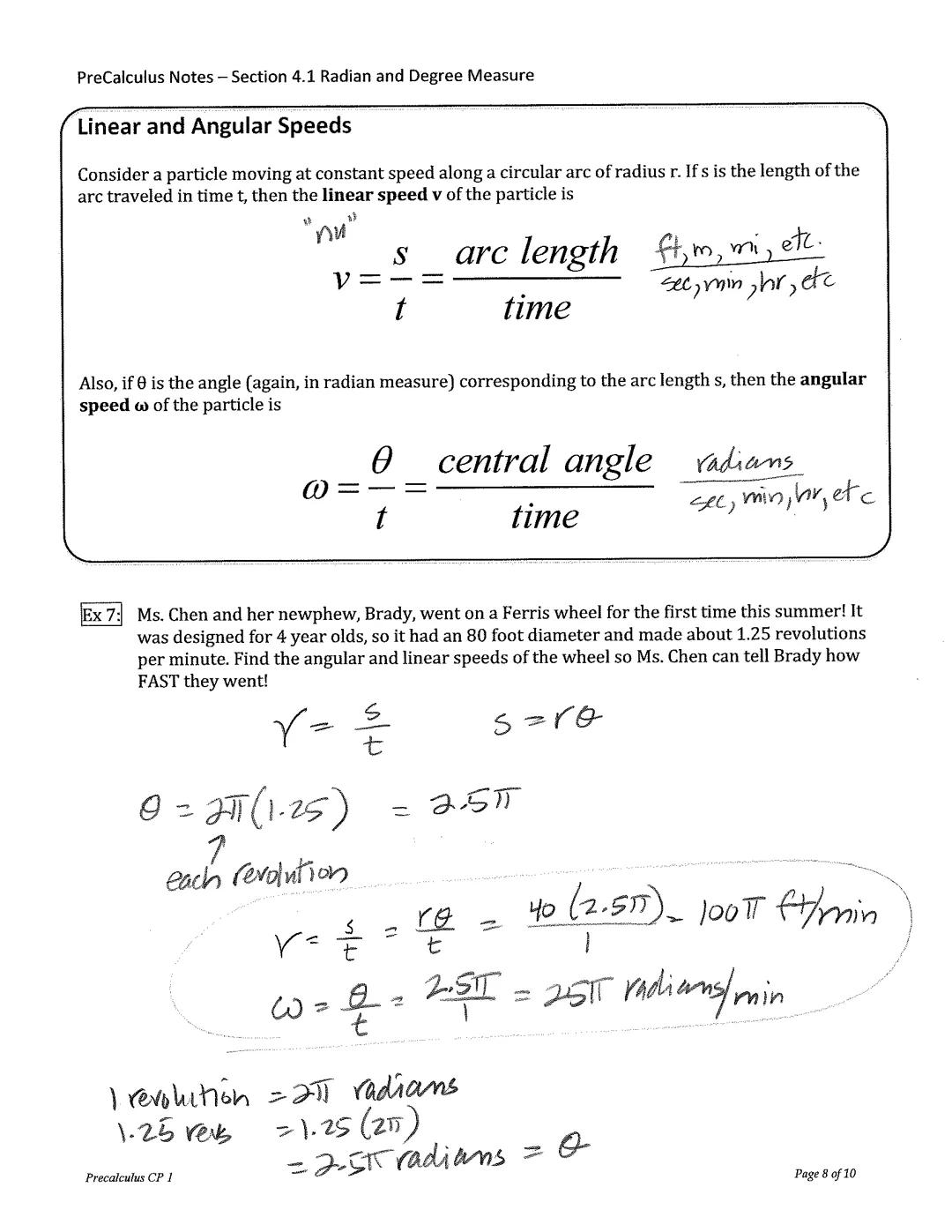
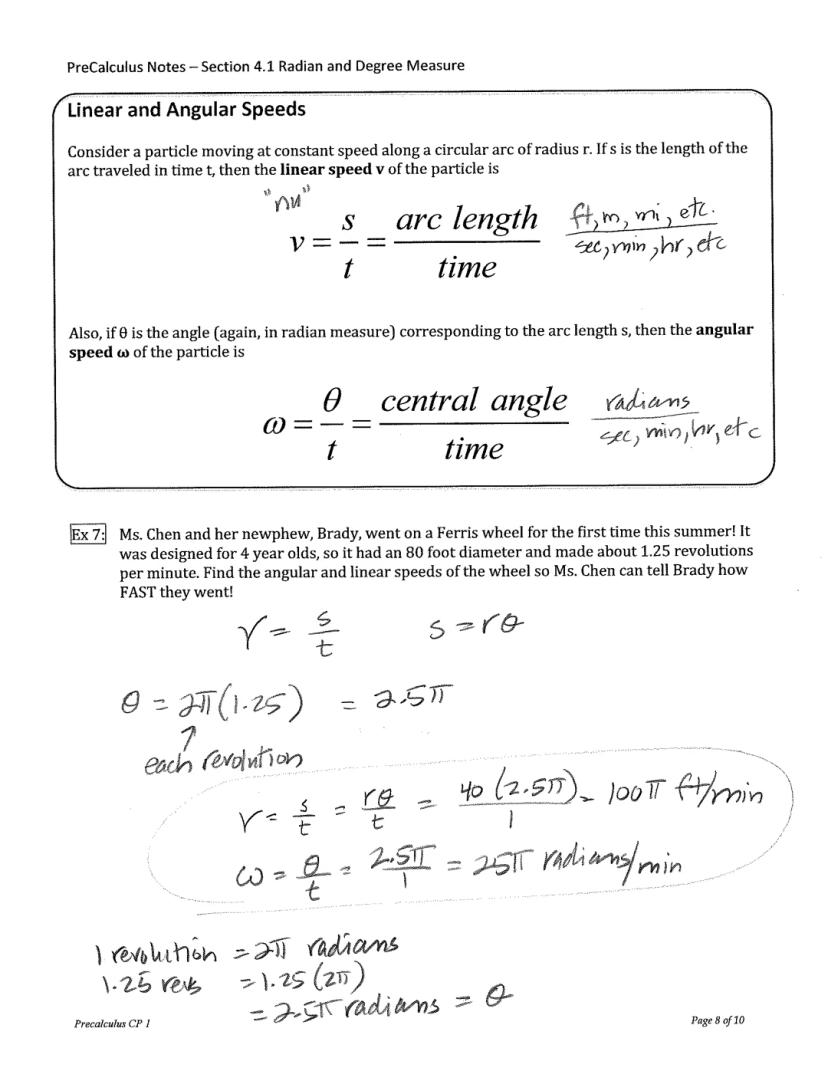
Linear and Angular Speed
When an object moves in a circular path, we can describe its motion in two ways:
- Linear speed (v): how fast it travels along the arc (distance per time)
- Angular speed (ω): how fast the angle changes (radians per time)
These two measures are related by the formula: v = rω where r is the radius.
For example, on a Ferris wheel with a 40-foot radius making 1.25 revolutions per minute:
- Angular speed: ω = 2.5π radians/minute
- Linear speed: v = 40 × 2.5π = 100π feet/minute
Understanding both types of speed helps you analyze circular motion in real situations, from carnival rides to engineering problems!
Think About It: On a spinning record, points farther from the center have the same angular speed but faster linear speed. That's why the outer edge of a record moves faster than points near the center!
9
of 10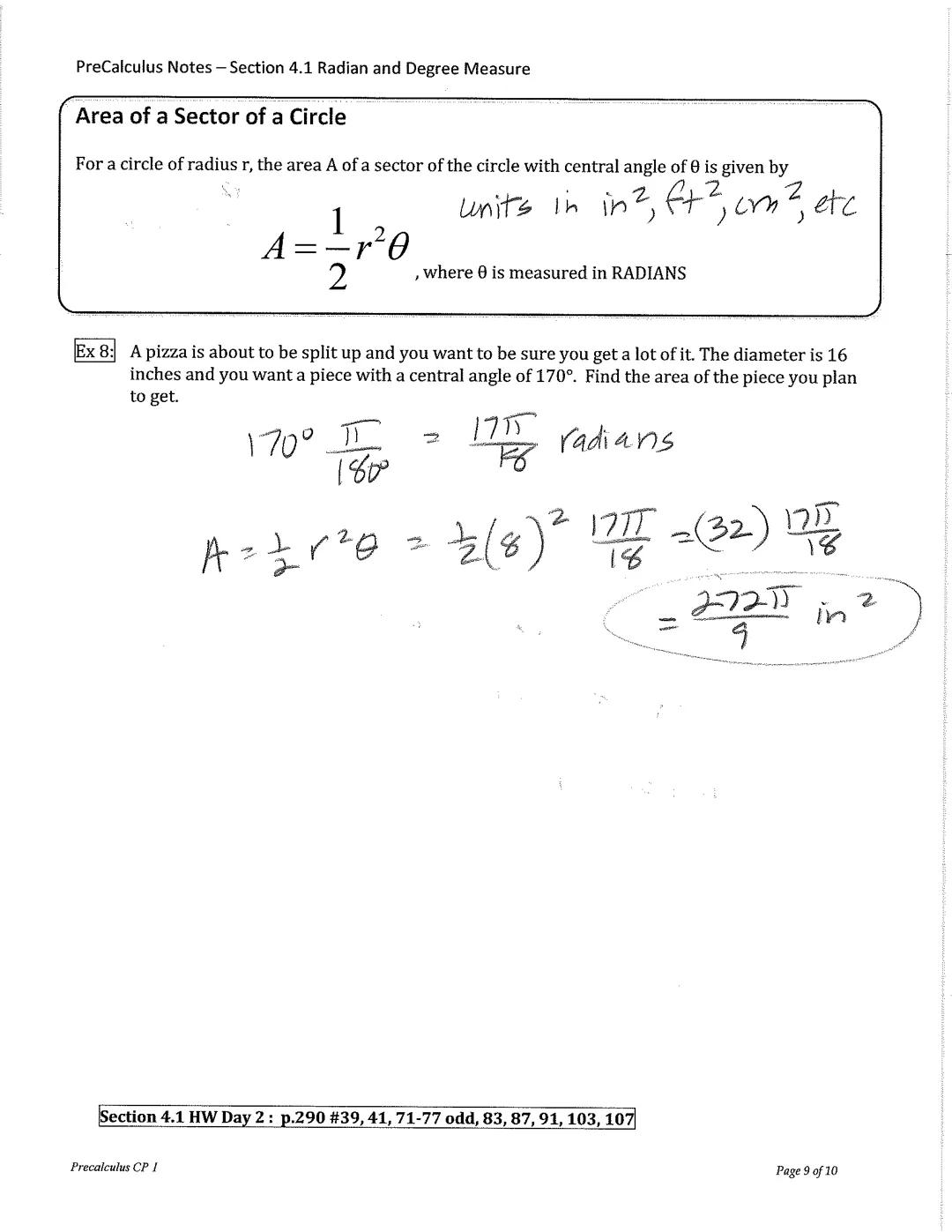
Area of a Sector
A sector is like a "pizza slice" of a circle. For a circle with radius r and central angle θ (in radians), the area of the sector is:
A = ½r²θ
Remember that θ must be in radians for this formula to work! If you're given an angle in degrees, convert it to radians first.
For example, to find the area of a pizza sector with radius 8 inches and central angle 170°:
- Convert to radians: 170° = 17π/18 radians
- Apply the formula: A = ½(8)²(17π/18) = 32(17π/18) = 272π/9 square inches
This formula has many real-world applications, from calculating land areas to determining material needed for circular sections.
Application Idea: The next time you share a pizza, you can calculate exactly how much pizza each person gets by finding the area of their slice!
10
of 10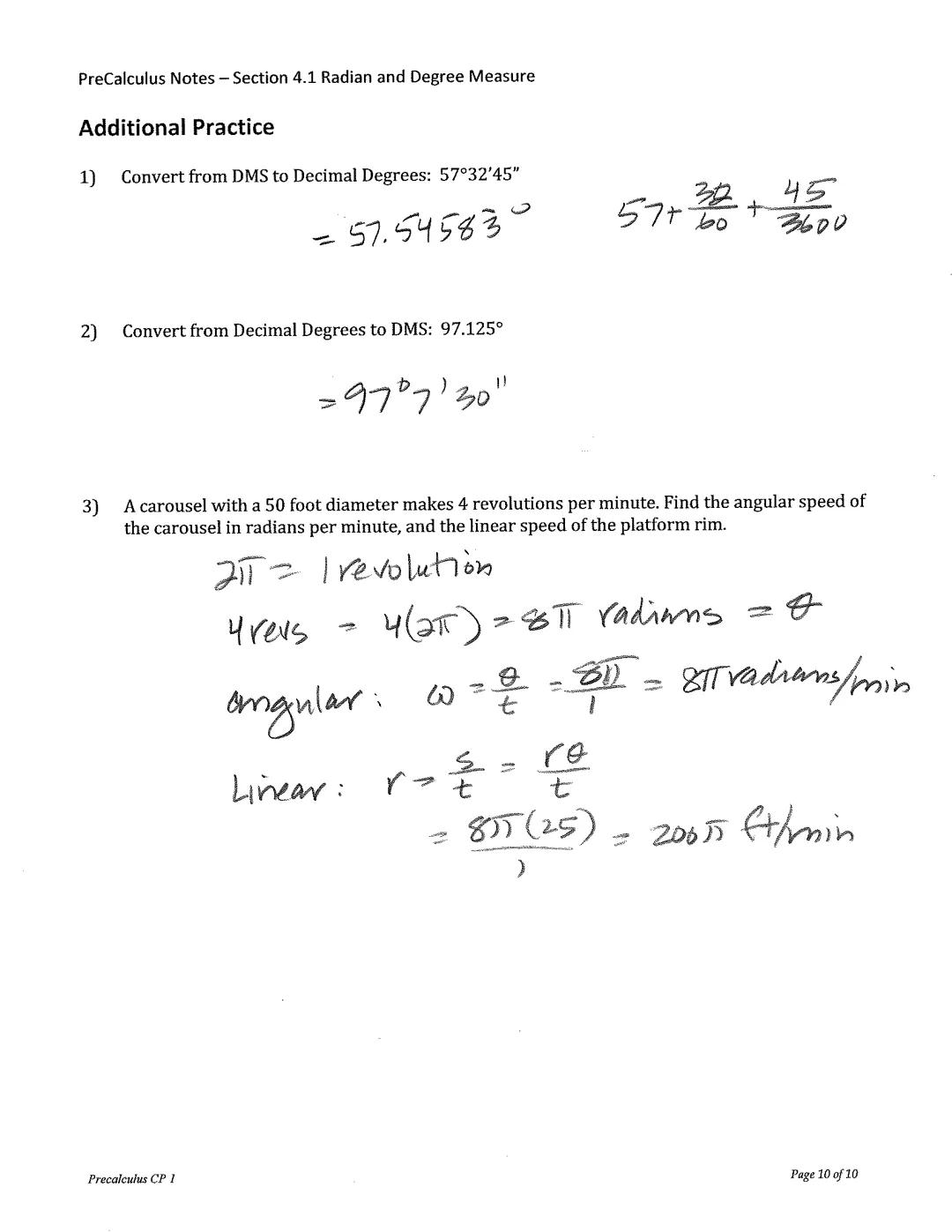
Applications and Practice
Converting between measurement systems is a skill you'll use throughout precalculus and calculus:
- 57°32'45" = 57 + 32/60 + 45/3600 = 57.546° (decimal degrees)
- 97.125° = 97° + 0.125(60)' = 97°7'30" (DMS)
Circular motion problems combine angular and linear concepts. For a carousel with a 50-foot diameter making 4 revolutions per minute:
- Radius = 25 feet
- Angular speed = 4 × 2π = 8π radians/minute
- Linear speed = r × ω = 25 × 8π = 200π feet/minute
These concepts apply to many real-world situations, from engineering (gears, wheels) to astronomy (planetary motion) and even to music (vinyl records).
Connecting Ideas: The relationship between linear and angular measurements is why radians are so useful in physics and engineering. When θ is in radians, the formula s = rθ directly connects the radius, angle, and arc length without needing any conversion factors!
We thought you’d never ask...
What is the Knowunity AI companion?
Our AI companion is specifically built for the needs of students. Based on the millions of content pieces we have on the platform we can provide truly meaningful and relevant answers to students. But its not only about answers, the companion is even more about guiding students through their daily learning challenges, with personalised study plans, quizzes or content pieces in the chat and 100% personalisation based on the students skills and developments.
Where can I download the Knowunity app?
You can download the app in the Google Play Store and in the Apple App Store.
Is Knowunity really free of charge?
That's right! Enjoy free access to study content, connect with fellow students, and get instant help – all at your fingertips.
Similar Content
Most popular content in Geometry
9GeometryCongruent Chords & Arcs
This is a finished and completed worksheet that applies very helpful information for the subject.
10th9012
Geometry10:4 Inscribed Angles
This is a finished and completed worksheet that applies very helpful information for the subject.
10th2,66127
 Calculus 1
Basic Formulas in Algebra, Geometry, Trigonometry and Calculus
This includes formulas for algebra, analytic geometry, soldi geometry, integral calculus, differential calculus and statistics and probability.
12th2,422118
GeometryQuiz 10-1: Intro to Circes, Central Angles, Arcs, and Chords
This is a finished and completed worksheet that applies very helpful information for the subject.
10th1,0879
GeometryUnit 7: Right Triangles & Trigonometry Homework 5: Trigonometry: Finding Sides And Angles
Geometry Homework, 100%
10th2,87317
GeometryUnit 7: Right Triangles & Trigonometry Homework 1: Pythagorean Theorem and its Converse
Geometry Homework, 100%
10th1,2893
GeometryCentral Angles & Arc Measures
This is a finished and completed worksheet that applies very helpful information for the subject.
10th3083
 Algebra 2
Special Right Triangles
Examples of two of the most common special right triangles.
11th2002
 Pre-Calculus
Trigonometry (Polygons)
This note is all about trigonometry, discussing the concept of polygons and how to solve problems involving polygons. It also includes formulas and sample problems.
660
Most popular content
9O
 AP US History
Origins and Dynamics of the Columbian Exchange
Analyze the ecological and economic motivations behind the initial transfer of goods, people, and diseases between the Old and New Worlds.
9th3,1280
I
AP US HistoryIntroduction to Early Cultural Interactions
Analyze the initial social and religious encounters between Europeans, Africans, and Indigenous peoples in the colonial Americas.
9th2,7730
O
 AP World History
Origins of Ancient River Civilizations
Analyze the environmental factors and technological innovations that led to the rise of early states in Mesopotamia, Egypt, and the Indus Valley.
9th3,1870
M
AP US HistoryMotivations for European Exploration
Analyze the economic, religious, and political factors that drove European powers to the Americas during the 15th and 16th centuries.
9th1,7780
F
 AP Psychology
Foundations of Ethical Guidelines in Research
Practice the core principles of the APA ethical code including informed consent, debriefing, and the role of Institutional Review Boards.
9th1,3360
I
AP US HistoryIntroduction to Native American Societies
Examine the diverse social, political, and economic structures of North American indigenous groups prior to European contact.
9th1,1100
I
 AP Biology
Introduction to Biological Elements of Life
Practice identifying the essential elements including carbon, nitrogen, phosphorus, and sulfur that compose biological macromolecules.
9th1,7390
I
AP US HistoryIntroduction to the Spanish Encomienda System
Explore the fundamental economic and social structures of the Spanish colonial system, focusing on the encomienda and the casta social hierarchy.
9th8890
O
AP World HistoryOrigins and Continuity of the Byzantine Empire
Analyze the political and cultural transitions from the Roman Empire to the Byzantine Empire, focusing on the reign of Justinian I and his code.
9th1,6320
Can't find what you're looking for? Explore other subjects.
Students love us — and so will you.
4.6/5App Store
4.7/5Google Play
The app is very easy to use and well designed. I have found everything I was looking for so far and have been able to learn a lot from the presentations! I will definitely use the app for a class assignment! And of course it also helps a lot as an inspiration.
Stefan SiOS user
This app is really great. There are so many study notes and help [...]. My problem subject is French, for example, and the app has so many options for help. Thanks to this app, I have improved my French. I would recommend it to anyone.
Samantha KlichAndroid user
Wow, I am really amazed. I just tried the app because I've seen it advertised many times and was absolutely stunned. This app is THE HELP you want for school and above all, it offers so many things, such as workouts and fact sheets, which have been VERY helpful to me personally.
AnnaiOS user
Trigonometry130 views·Updated Jun 15, 2026·10 pagesUnderstanding Radian and Degree Measures: Key Concepts Explained
Radian and degree measure are essential concepts in precalculus that help us understand angles in different ways. These measurements connect circular motion to linear distance and are fundamental for trigonometry and calculus applications. Understanding how to work with both systems...
1
of 10
Sign up to see the content. It's free!
- Access to all documents
- Improve your grades
- Join milions of students
Understanding Angles
Angles are formed when a ray rotates around its endpoint. Every angle has three key parts: the initial side (starting position), the terminal side (position after rotation), and the vertex (the endpoint where rotation occurs).
When we place an angle in the coordinate system with its vertex at the origin and initial side along the positive x-axis, it's in standard position. This standard placement makes it easier to analyze angles consistently.
Remember that angles have direction! A positive angle forms through counterclockwise rotation, while a negative angle forms through clockwise rotation. Angles are typically labeled using Greek letters like θ (theta) or α (alpha).
Quick Tip: Think of angle measurement like turning a steering wheel - counterclockwise is positive, clockwise is negative!
2
of 10Sign up to see the content. It's free!
- Access to all documents
- Improve your grades
- Join milions of students
Radian Measure Basics
Radian measure connects angle size to the radius of a circle. While degrees might be more familiar, radians are especially important in calculus and higher math because they create a direct relationship between arc length and radius.
The key relationship to remember is that one complete circle (360°) equals 2π radians. This means that half a circle (180°) is π radians, and a quarter circle (90°) is π/2 radians.
When identifying where angles land, think about quadrants. For example, angles between 0° and 90° have their terminal side in Quadrant I, while angles between 90° and 180° end in Quadrant II.
Pro Tip: Quadrantal angles (those whose terminal sides fall directly on an axis) are especially important to memorize: 0, π/2, π, 3π/2, and 2π radians.
3
of 10Sign up to see the content. It's free!
- Access to all documents
- Improve your grades
- Join milions of students
Comparing Degrees and Radians
Radians help us connect circular motion with linear measurements. Instead of dividing a circle into 360 equal parts (degrees), radian measure relates directly to the circle's radius.
The most frequently used radian measures correspond to common angles:
- A quarter-revolution (90°) equals π/2 radians
- A half-revolution (180°) equals π radians
- A sixth of a revolution (60°) equals π/3 radians
Remember that quadrantal angles have their terminal side directly on an axis. In radians, these special angles are 0, π/2, π, 3π/2, and 2π. Being able to quickly identify these values will make trigonometry much easier!
Remember: When drawing angles in radian measure, visualize fractions of the circle. For example, π/4 is 1/8 of the full circle (which is 2π).
4
of 10Sign up to see the content. It's free!
- Access to all documents
- Improve your grades
- Join milions of students
Converting Between Systems
Converting between degrees and radians is straightforward once you know the key relationship: 180° = π radians.
To convert from degrees to radians:
- Multiply degrees by π/180
- Example: 135° × (π/180) = 3π/4 radians
To convert from radians to degrees:
- Multiply radians by 180/π
- Example: 5π/6 × (180/π) = 150°
The most common angle measures you should memorize are:
- 30° = π/6 radians
- 45° = π/4 radians
- 60° = π/3 radians
- 90° = π/2 radians
Conversion Shortcut: Think of π radians as 180° and divide both sides equally. For example, π/3 radians is 1/3 of 180°, which equals 60°.
5
of 10Sign up to see the content. It's free!
- Access to all documents
- Improve your grades
- Join milions of students
Coterminal Angles
Coterminal angles share the same initial and terminal sides, even though they have different measures. They're like different ways of describing the same final position!
To find coterminal angles:
- Add or subtract 360° (for degrees)
- Add or subtract 2π (for radians)
For example, 110° has coterminal angles at 470° (add 360°), -250° (subtract 360°), and many others. In fact, there are infinitely many coterminal angles for any given angle.
In radian measure, finding coterminal angles works the same way. For example, to find a positive angle coterminal with 13π/6:
- Calculate 13π/6 - 2π
- Simplify to 13π/6 - 12π/6 = π/6
Visualization Tip: Think of coterminal angles as "wrapping around" the circle multiple times but ending at the same spot. Like different paths that lead to the same destination!
6
of 10Sign up to see the content. It's free!
- Access to all documents
- Improve your grades
- Join milions of students
Working with Angles
When working with angles in standard position, you'll often need to:
- Find coterminal angles
- Determine which quadrant an angle lies in
- Convert between measurement systems
For example, to find a positive angle coterminal with -2π/3, add one full revolution (2π): -2π/3 + 2π = -2π/3 + 6π/3 = 4π/3
Identifying the quadrant of an angle helps with trigonometric calculations. For example, 9π/8 is between π (180°) and 3π/2 (270°), so it's in Quadrant III.
When converting measurements, always remember:
- For degrees to radians: multiply by π/180
- For radians to degrees: multiply by 180/π
Practice Strategy: Sketch angles in standard position to visualize them better. This helps you understand where they lie and makes finding coterminal angles much easier!
7
of 10Sign up to see the content. It's free!
- Access to all documents
- Improve your grades
- Join milions of students
Advanced Angle Measurements
Beyond basic degrees and radians, you'll sometimes encounter degrees, minutes, and seconds (DMS) notation, where:
- 1 minute (1') = 1/60 of a degree
- 1 second (1") = 1/60 of a minute = 1/3600 of a degree
Converting from DMS to decimal degrees:
- Add the degrees, minutes/60, and seconds/3600
- Example: 34°51'35" = 34 + 51/60 + 35/3600 = 34.86°
Converting from decimal degrees to DMS:
- Keep the whole number as degrees
- Multiply the decimal by 60 to get minutes
- Multiply any remaining decimal by 60 to get seconds
Arc length connects angles to distance along a circle. For a circle with radius r and central angle θ (in radians), the arc length is s = rθ. This formula only works when θ is in radians!
Real-world Connection: Arc length is used in everything from designing Ferris wheels to calculating how far a planet travels in its orbit during a specific time period.
8
of 10Sign up to see the content. It's free!
- Access to all documents
- Improve your grades
- Join milions of students
Linear and Angular Speed
When an object moves in a circular path, we can describe its motion in two ways:
- Linear speed (v): how fast it travels along the arc (distance per time)
- Angular speed (ω): how fast the angle changes (radians per time)
These two measures are related by the formula: v = rω where r is the radius.
For example, on a Ferris wheel with a 40-foot radius making 1.25 revolutions per minute:
- Angular speed: ω = 2.5π radians/minute
- Linear speed: v = 40 × 2.5π = 100π feet/minute
Understanding both types of speed helps you analyze circular motion in real situations, from carnival rides to engineering problems!
Think About It: On a spinning record, points farther from the center have the same angular speed but faster linear speed. That's why the outer edge of a record moves faster than points near the center!
9
of 10Sign up to see the content. It's free!
- Access to all documents
- Improve your grades
- Join milions of students
Area of a Sector
A sector is like a "pizza slice" of a circle. For a circle with radius r and central angle θ (in radians), the area of the sector is:
A = ½r²θ
Remember that θ must be in radians for this formula to work! If you're given an angle in degrees, convert it to radians first.
For example, to find the area of a pizza sector with radius 8 inches and central angle 170°:
- Convert to radians: 170° = 17π/18 radians
- Apply the formula: A = ½(8)²(17π/18) = 32(17π/18) = 272π/9 square inches
This formula has many real-world applications, from calculating land areas to determining material needed for circular sections.
Application Idea: The next time you share a pizza, you can calculate exactly how much pizza each person gets by finding the area of their slice!
10
of 10Sign up to see the content. It's free!
- Access to all documents
- Improve your grades
- Join milions of students
Applications and Practice
Converting between measurement systems is a skill you'll use throughout precalculus and calculus:
- 57°32'45" = 57 + 32/60 + 45/3600 = 57.546° (decimal degrees)
- 97.125° = 97° + 0.125(60)' = 97°7'30" (DMS)
Circular motion problems combine angular and linear concepts. For a carousel with a 50-foot diameter making 4 revolutions per minute:
- Radius = 25 feet
- Angular speed = 4 × 2π = 8π radians/minute
- Linear speed = r × ω = 25 × 8π = 200π feet/minute
These concepts apply to many real-world situations, from engineering (gears, wheels) to astronomy (planetary motion) and even to music (vinyl records).
Connecting Ideas: The relationship between linear and angular measurements is why radians are so useful in physics and engineering. When θ is in radians, the formula s = rθ directly connects the radius, angle, and arc length without needing any conversion factors!
We thought you’d never ask...
What is the Knowunity AI companion?
Our AI companion is specifically built for the needs of students. Based on the millions of content pieces we have on the platform we can provide truly meaningful and relevant answers to students. But its not only about answers, the companion is even more about guiding students through their daily learning challenges, with personalised study plans, quizzes or content pieces in the chat and 100% personalisation based on the students skills and developments.
Where can I download the Knowunity app?
You can download the app in the Google Play Store and in the Apple App Store.
Is Knowunity really free of charge?
That's right! Enjoy free access to study content, connect with fellow students, and get instant help – all at your fingertips.
Similar Content
Most popular content in Geometry
9GeometryCongruent Chords & Arcs
This is a finished and completed worksheet that applies very helpful information for the subject.
10th9012
Geometry10:4 Inscribed Angles
This is a finished and completed worksheet that applies very helpful information for the subject.
10th2,66127
Calculus 1Basic Formulas in Algebra, Geometry, Trigonometry and Calculus
This includes formulas for algebra, analytic geometry, soldi geometry, integral calculus, differential calculus and statistics and probability.
12th2,422118
GeometryQuiz 10-1: Intro to Circes, Central Angles, Arcs, and Chords
This is a finished and completed worksheet that applies very helpful information for the subject.
10th1,0879
GeometryUnit 7: Right Triangles & Trigonometry Homework 5: Trigonometry: Finding Sides And Angles
Geometry Homework, 100%
10th2,87317
GeometryUnit 7: Right Triangles & Trigonometry Homework 1: Pythagorean Theorem and its Converse
Geometry Homework, 100%
10th1,2893
GeometryCentral Angles & Arc Measures
This is a finished and completed worksheet that applies very helpful information for the subject.
10th3083
Algebra 2Special Right Triangles
Examples of two of the most common special right triangles.
11th2002
Pre-CalculusTrigonometry (Polygons)
This note is all about trigonometry, discussing the concept of polygons and how to solve problems involving polygons. It also includes formulas and sample problems.
660
Most popular content
9O
AP US HistoryOrigins and Dynamics of the Columbian Exchange
Analyze the ecological and economic motivations behind the initial transfer of goods, people, and diseases between the Old and New Worlds.
9th3,1280
I
AP US HistoryIntroduction to Early Cultural Interactions
Analyze the initial social and religious encounters between Europeans, Africans, and Indigenous peoples in the colonial Americas.
9th2,7730
O
AP World HistoryOrigins of Ancient River Civilizations
Analyze the environmental factors and technological innovations that led to the rise of early states in Mesopotamia, Egypt, and the Indus Valley.
9th3,1870
M
AP US HistoryMotivations for European Exploration
Analyze the economic, religious, and political factors that drove European powers to the Americas during the 15th and 16th centuries.
9th1,7780
F
AP PsychologyFoundations of Ethical Guidelines in Research
Practice the core principles of the APA ethical code including informed consent, debriefing, and the role of Institutional Review Boards.
9th1,3360
I
AP US HistoryIntroduction to Native American Societies
Examine the diverse social, political, and economic structures of North American indigenous groups prior to European contact.
9th1,1100
I
AP BiologyIntroduction to Biological Elements of Life
Practice identifying the essential elements including carbon, nitrogen, phosphorus, and sulfur that compose biological macromolecules.
9th1,7390
I
AP US HistoryIntroduction to the Spanish Encomienda System
Explore the fundamental economic and social structures of the Spanish colonial system, focusing on the encomienda and the casta social hierarchy.
9th8890
O
AP World HistoryOrigins and Continuity of the Byzantine Empire
Analyze the political and cultural transitions from the Roman Empire to the Byzantine Empire, focusing on the reign of Justinian I and his code.
9th1,6320
Can't find what you're looking for? Explore other subjects.
Students love us — and so will you.
4.6/5App Store
4.7/5Google Play
The app is very easy to use and well designed. I have found everything I was looking for so far and have been able to learn a lot from the presentations! I will definitely use the app for a class assignment! And of course it also helps a lot as an inspiration.
Stefan SiOS user
This app is really great. There are so many study notes and help [...]. My problem subject is French, for example, and the app has so many options for help. Thanks to this app, I have improved my French. I would recommend it to anyone.
Samantha KlichAndroid user
Wow, I am really amazed. I just tried the app because I've seen it advertised many times and was absolutely stunned. This app is THE HELP you want for school and above all, it offers so many things, such as workouts and fact sheets, which have been VERY helpful to me personally.
AnnaiOS user