
I verbi modali tedeschi sono essenziali per esprimere desideri, capacità...
 Tedesco1,573 views·Updated Jun 14, 2026·3 pages
Guida ai Verbi Modali Tedeschi: Esempi e Regole
A
alessia@aalessia_


1 / 3
1
of 3
Esprimere Desideri: Möchten vs Wollen
Quando vuoi qualcosa in tedesco, hai due opzioni principali che cambiano completamente il tono del tuo messaggio. Möchten è la forma educata e cortese (equivale a "vorrei" o "mi piacerebbe"), mentre wollen è più diretta e decisa.
La coniugazione di möchten segue il pattern: ich möchte, du möchtest, er/sie/es möchte, wir möchten, ihr möchtet, sie/Sie möchten. Per wollen invece: ich will, du willst, er/sie/es will, wir wollen, ihr wollt, sie/Sie wollen.
💡 Ricorda: La prima e la terza persona singolare sono sempre uguali in tutti i verbi modali!
Esempi pratici: "Was möchtest du trinken?" (Che cosa vorresti bere?) suona molto più gentile di una richiesta con "wollen". Al contrario, "Ich will sofort nach Hause gehen" (Voglio andare a casa subito) esprime urgenza e determinazione.
2
of 3
Capacità e Permessi: Können e Dürfen
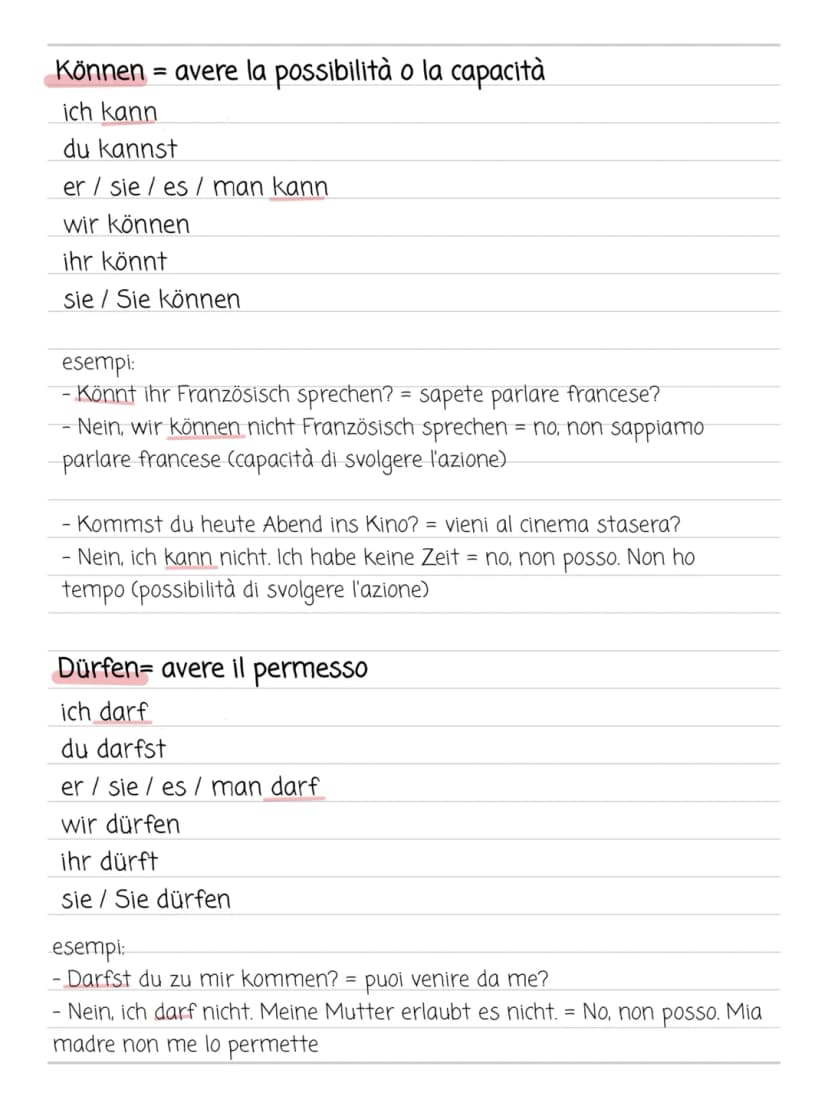
Können esprime sia la capacità che la possibilità di fare qualcosa, ed è uno dei verbi modali più utilizzati. Si coniuga: ich kann, du kannst, er/sie/es kann, wir können, ihr könnt, sie/Sie können.
Questo verbo copre due significati distinti. Quando chiedi "Könnt ihr Französisch sprechen?" stai chiedendo se hanno la capacità di parlare francese. Ma se dici "Ich kann nicht, ich habe keine Zeit", stai parlando di possibilità o disponibilità.
Dürfen invece riguarda esclusivamente i permessi e le autorizzazioni. La coniugazione è: ich darf, du darfst, er/sie/es darf, wir dürfen, ihr dürft, sie/Sie dürfen.
💡 Trucco: Se puoi sostituire il verbo con "avere il permesso", usa dürfen!
"Darfst du zu mir kommen?" chiede letteralmente se hai il permesso di venire, non se sei fisicamente in grado.
3
of 3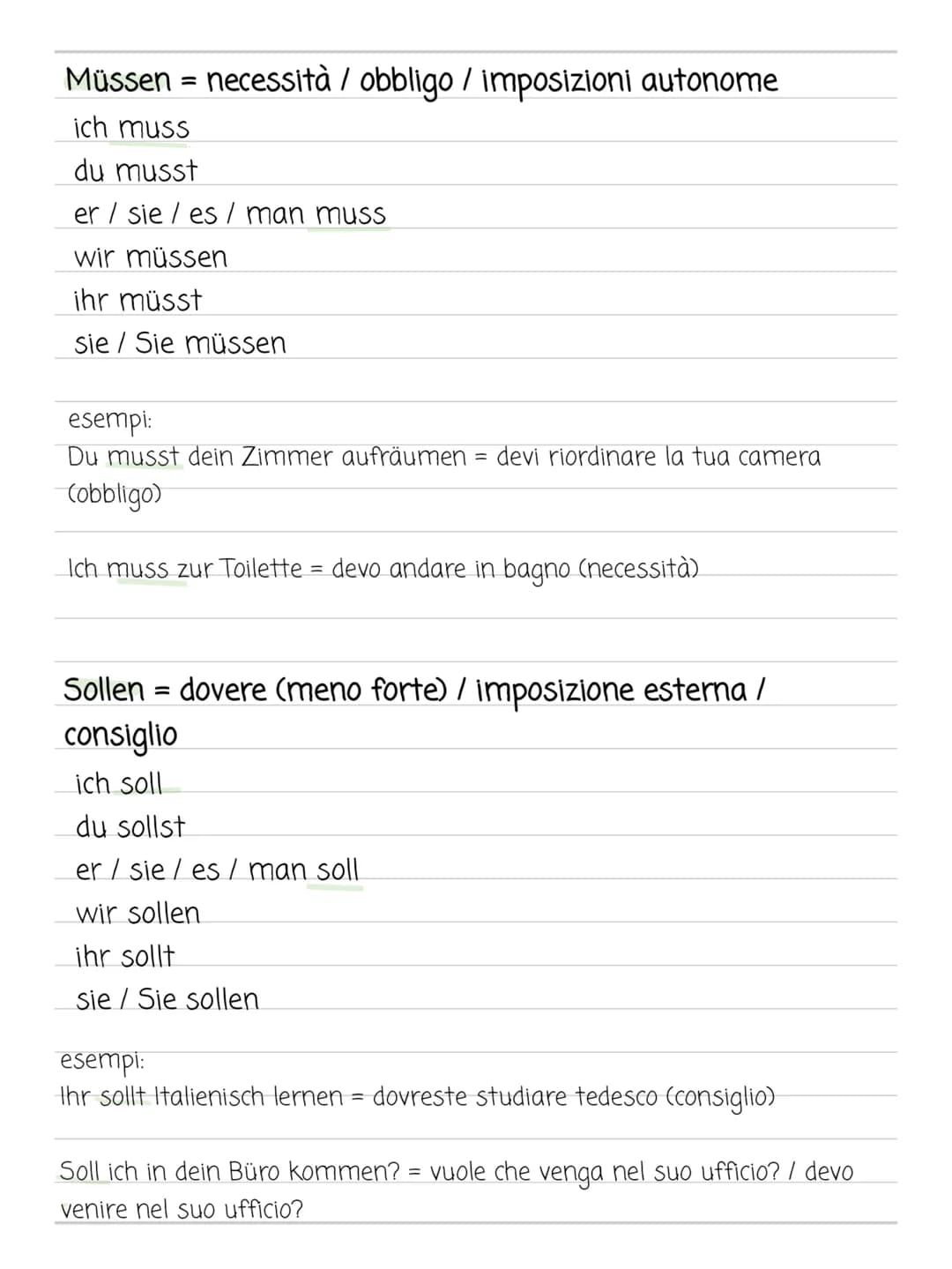
Obblighi e Consigli: Müssen e Sollen
Müssen indica necessità assolute e obblighi che senti personalmente. Si coniuga: ich muss, du musst, er/sie/es muss, wir müssen, ihr müsst, sie/Sie müssen. È il verbo dell'urgenza e delle imposizioni che accetti come necessarie.
"Du musst dein Zimmer aufräumen" è un obbligo chiaro, mentre "Ich muss zur Toilette" esprime una necessità fisica impellente. In entrambi i casi, non c'è molto spazio per la negoziazione.
Sollen è più morbido e diplomatico. La coniugazione è: ich soll, du sollst, er/sie/es soll, wir sollen, ihr sollt, sie/Sie sollen. Esprime consigli, raccomandazioni o obblighi esterni meno rigidi.
💡 Differenza chiave: Müssen = "devo assolutamente", sollen = "dovrei/si consiglia"
"Ihr sollt Italienisch lernen" è un consiglio gentile, non un ordine. "Soll ich in dein Büro kommen?" chiede cortesemente se è desiderabile che tu vada.
We thought you’d never ask...
What is the Knowunity AI companion?
Our AI companion is specifically built for the needs of students. Based on the millions of content pieces we have on the platform we can provide truly meaningful and relevant answers to students. But its not only about answers, the companion is even more about guiding students through their daily learning challenges, with personalised study plans, quizzes or content pieces in the chat and 100% personalisation based on the students skills and developments.
Where can I download the Knowunity app?
You can download the app in the Google Play Store and in the Apple App Store.
Is Knowunity really free of charge?
That's right! Enjoy free access to study content, connect with fellow students, and get instant help – all at your fingertips.
Similar Content
 Allemand
 Język niemiecki
Most popular content: Deutsche Verben
4TedescoRegole grammatica tedesca
Ovviamente non sono presenti tutte ma solo quelle di cui ho bisogno io, però è comunque una buona base per sapere qualcosa di grammatica tedesca
2ªl2,69658
Tedescogrammatica tedesca
articoli, pronomi, aggettivi, preposizioni (accusativo, dativo) verbi, ausiliari, modali, il verbo sapere, verbi separabili e non, verbi deboli, verbi forti, aggettivi, termini e frasi utili, avverbi, subordinate, tempo, complementi, congiunzioni
1ªl6,160171
TedescoPerfekt
Appunti di tedesco sul Perfekt e sull’uso di sein e haben
1ªl1,77133
TedescoLe preposizioni, i verbi modali, perfeckt prateritum e le frasi secondarie
Le preposizioni tedesche e il significato dei verbi modali + le frasi secondare
3ªl1,10727
Most popular content in Tedesco
9TedescoRipasso generale grammatica tedesca
Schemi di tutti gli argomenti di grammatica tedesca
2ªl95029
Tedescosintesi grammatica e lessico tedesco
le basi del tedesco seguitemi su instagram sxratonvn ciao
1ªl21,2181,386
TedescoVocabolario tedesco di base 🇩🇪
Vocabolario tedesco di base 🇩🇪
1ªm1,83471
D
Tedescodomande di tedesco sui numeri e la famiglia
spero vi aiuti a studiare
1ªm4971
TedescoRegole grammatica tedesca
Ovviamente non sono presenti tutte ma solo quelle di cui ho bisogno io, però è comunque una buona base per sapere qualcosa di grammatica tedesca
2ªl2,69658
Tedescogrammatica tedesca
articoli, pronomi, aggettivi, preposizioni (accusativo, dativo) verbi, ausiliari, modali, il verbo sapere, verbi separabili e non, verbi deboli, verbi forti, aggettivi, termini e frasi utili, avverbi, subordinate, tempo, complementi, congiunzioni
1ªl6,160171
V
Tedescoverbo essere in tedesco
verbo essere in tedesco esercizii di completamento
1ªl3453
TedescoAppunti base Tedesco
Insieme di appunti per il tedesco "basilare" (nominativo, accusativo, dativo e altri concetti di livello base/intermedio)
2ªl62717
Tedesconominativo, accusativo e dativo
spiegazione con esempi nel nominativo, accusativo e dativo tedesco (ci sono le tabelle)
1ªl3,390109
Most popular content
9 Italiano
Riassunto patente B
Riassunto patente B - appunti presi a lezione
5ªl29,228943
 Altro
AltroTeoria patente b
Tutti gli argomenti per la patente
1ªl21,114685
 Ed. civ.
Teoria patente di guida B: Segnali stradali
Segnali stradali di pericolo, luminosi, di prescrizione, di indicazione, temporanei, complementari, pannelli integrativi, segnaletica orizzontale, segnalazioni agenti del traffico, distanza di visibilità per l‘arresto, minima di sicurezza.
5ªl40,0421,645
 Filosofia
Aristotele
Aristotele: vita, metafisica, fisica, etica e politica, retorica e poetica
3ªl7,623216
ItalianoI promessi sposi
Riassunti completi di tutti i 38 capitoli dei Promessi sposi.
2ªl14,090314
AltroPATENTE
schemi per esame teorico della patente
Università22,067756
S
ItalianoSintesi finale di Analisi logica
Esercitazione completa di analisi logica su frasi articolate per consolidare la conoscenza di tutti i complementi.
3ªm5,5290
P
 Inglese
Present Simple vs Present Continuous
Develop the ability to choose correctly between the Present Simple for habits and the Present Continuous for ongoing actions.
3ªm4,2120
G
ItalianoGabriele D'Annunzio e l'Estetismo
Domande sull'ideale del superuomo, il panismo e la concezione dell'arte come valore assoluto in D'Annunzio.
4ªl2,6740
Can't find what you're looking for? Explore other subjects.
Students love us — and so will you.
4.6/5App Store
4.7/5Google Play
The app is very easy to use and well designed. I have found everything I was looking for so far and have been able to learn a lot from the presentations! I will definitely use the app for a class assignment! And of course it also helps a lot as an inspiration.
Stefan SiOS user
This app is really great. There are so many study notes and help [...]. My problem subject is French, for example, and the app has so many options for help. Thanks to this app, I have improved my French. I would recommend it to anyone.
Samantha KlichAndroid user
Wow, I am really amazed. I just tried the app because I've seen it advertised many times and was absolutely stunned. This app is THE HELP you want for school and above all, it offers so many things, such as workouts and fact sheets, which have been VERY helpful to me personally.
AnnaiOS user
Tedesco1,573 views·Updated Jun 14, 2026·3 pagesGuida ai Verbi Modali Tedeschi: Esempi e Regole
A
alessia@aalessia_
I verbi modali tedeschi sono essenziali per esprimere desideri, capacità e obblighi nella vita quotidiana. Comprendere le differenze tra möchten, wollen, können, dürfen, müssen e sollen ti permetterà di comunicare con maggiore precisione e cortesia.
1
of 3
Sign up to see the content. It's free!
- Access to all documents
- Improve your grades
- Join milions of students
Esprimere Desideri: Möchten vs Wollen
Quando vuoi qualcosa in tedesco, hai due opzioni principali che cambiano completamente il tono del tuo messaggio. Möchten è la forma educata e cortese (equivale a "vorrei" o "mi piacerebbe"), mentre wollen è più diretta e decisa.
La coniugazione di möchten segue il pattern: ich möchte, du möchtest, er/sie/es möchte, wir möchten, ihr möchtet, sie/Sie möchten. Per wollen invece: ich will, du willst, er/sie/es will, wir wollen, ihr wollt, sie/Sie wollen.
💡 Ricorda: La prima e la terza persona singolare sono sempre uguali in tutti i verbi modali!
Esempi pratici: "Was möchtest du trinken?" (Che cosa vorresti bere?) suona molto più gentile di una richiesta con "wollen". Al contrario, "Ich will sofort nach Hause gehen" (Voglio andare a casa subito) esprime urgenza e determinazione.
2
of 3Sign up to see the content. It's free!
- Access to all documents
- Improve your grades
- Join milions of students
Capacità e Permessi: Können e Dürfen
Können esprime sia la capacità che la possibilità di fare qualcosa, ed è uno dei verbi modali più utilizzati. Si coniuga: ich kann, du kannst, er/sie/es kann, wir können, ihr könnt, sie/Sie können.
Questo verbo copre due significati distinti. Quando chiedi "Könnt ihr Französisch sprechen?" stai chiedendo se hanno la capacità di parlare francese. Ma se dici "Ich kann nicht, ich habe keine Zeit", stai parlando di possibilità o disponibilità.
Dürfen invece riguarda esclusivamente i permessi e le autorizzazioni. La coniugazione è: ich darf, du darfst, er/sie/es darf, wir dürfen, ihr dürft, sie/Sie dürfen.
💡 Trucco: Se puoi sostituire il verbo con "avere il permesso", usa dürfen!
"Darfst du zu mir kommen?" chiede letteralmente se hai il permesso di venire, non se sei fisicamente in grado.
3
of 3Sign up to see the content. It's free!
- Access to all documents
- Improve your grades
- Join milions of students
Obblighi e Consigli: Müssen e Sollen
Müssen indica necessità assolute e obblighi che senti personalmente. Si coniuga: ich muss, du musst, er/sie/es muss, wir müssen, ihr müsst, sie/Sie müssen. È il verbo dell'urgenza e delle imposizioni che accetti come necessarie.
"Du musst dein Zimmer aufräumen" è un obbligo chiaro, mentre "Ich muss zur Toilette" esprime una necessità fisica impellente. In entrambi i casi, non c'è molto spazio per la negoziazione.
Sollen è più morbido e diplomatico. La coniugazione è: ich soll, du sollst, er/sie/es soll, wir sollen, ihr sollt, sie/Sie sollen. Esprime consigli, raccomandazioni o obblighi esterni meno rigidi.
💡 Differenza chiave: Müssen = "devo assolutamente", sollen = "dovrei/si consiglia"
"Ihr sollt Italienisch lernen" è un consiglio gentile, non un ordine. "Soll ich in dein Büro kommen?" chiede cortesemente se è desiderabile che tu vada.
We thought you’d never ask...
What is the Knowunity AI companion?
Our AI companion is specifically built for the needs of students. Based on the millions of content pieces we have on the platform we can provide truly meaningful and relevant answers to students. But its not only about answers, the companion is even more about guiding students through their daily learning challenges, with personalised study plans, quizzes or content pieces in the chat and 100% personalisation based on the students skills and developments.
Where can I download the Knowunity app?
You can download the app in the Google Play Store and in the Apple App Store.
Is Knowunity really free of charge?
That's right! Enjoy free access to study content, connect with fellow students, and get instant help – all at your fingertips.
Similar Content
Most popular content: Deutsche Verben
4TedescoRegole grammatica tedesca
Ovviamente non sono presenti tutte ma solo quelle di cui ho bisogno io, però è comunque una buona base per sapere qualcosa di grammatica tedesca
2ªl2,69658
Tedescogrammatica tedesca
articoli, pronomi, aggettivi, preposizioni (accusativo, dativo) verbi, ausiliari, modali, il verbo sapere, verbi separabili e non, verbi deboli, verbi forti, aggettivi, termini e frasi utili, avverbi, subordinate, tempo, complementi, congiunzioni
1ªl6,160171
TedescoPerfekt
Appunti di tedesco sul Perfekt e sull’uso di sein e haben
1ªl1,77133
TedescoLe preposizioni, i verbi modali, perfeckt prateritum e le frasi secondarie
Le preposizioni tedesche e il significato dei verbi modali + le frasi secondare
3ªl1,10727
Most popular content in Tedesco
9TedescoRipasso generale grammatica tedesca
Schemi di tutti gli argomenti di grammatica tedesca
2ªl95029
Tedescosintesi grammatica e lessico tedesco
le basi del tedesco seguitemi su instagram sxratonvn ciao
1ªl21,2181,386
TedescoVocabolario tedesco di base 🇩🇪
Vocabolario tedesco di base 🇩🇪
1ªm1,83471
D
Tedescodomande di tedesco sui numeri e la famiglia
spero vi aiuti a studiare
1ªm4971
TedescoRegole grammatica tedesca
Ovviamente non sono presenti tutte ma solo quelle di cui ho bisogno io, però è comunque una buona base per sapere qualcosa di grammatica tedesca
2ªl2,69658
Tedescogrammatica tedesca
articoli, pronomi, aggettivi, preposizioni (accusativo, dativo) verbi, ausiliari, modali, il verbo sapere, verbi separabili e non, verbi deboli, verbi forti, aggettivi, termini e frasi utili, avverbi, subordinate, tempo, complementi, congiunzioni
1ªl6,160171
V
Tedescoverbo essere in tedesco
verbo essere in tedesco esercizii di completamento
1ªl3453
TedescoAppunti base Tedesco
Insieme di appunti per il tedesco "basilare" (nominativo, accusativo, dativo e altri concetti di livello base/intermedio)
2ªl62717
Tedesconominativo, accusativo e dativo
spiegazione con esempi nel nominativo, accusativo e dativo tedesco (ci sono le tabelle)
1ªl3,390109
Most popular content
9ItalianoRiassunto patente B
Riassunto patente B - appunti presi a lezione
5ªl29,228943
AltroTeoria patente b
Tutti gli argomenti per la patente
1ªl21,114685
Ed. civ.Teoria patente di guida B: Segnali stradali
Segnali stradali di pericolo, luminosi, di prescrizione, di indicazione, temporanei, complementari, pannelli integrativi, segnaletica orizzontale, segnalazioni agenti del traffico, distanza di visibilità per l‘arresto, minima di sicurezza.
5ªl40,0421,645
FilosofiaAristotele
Aristotele: vita, metafisica, fisica, etica e politica, retorica e poetica
3ªl7,623216
ItalianoI promessi sposi
Riassunti completi di tutti i 38 capitoli dei Promessi sposi.
2ªl14,090314
AltroPATENTE
schemi per esame teorico della patente
Università22,067756
S
ItalianoSintesi finale di Analisi logica
Esercitazione completa di analisi logica su frasi articolate per consolidare la conoscenza di tutti i complementi.
3ªm5,5290
P
InglesePresent Simple vs Present Continuous
Develop the ability to choose correctly between the Present Simple for habits and the Present Continuous for ongoing actions.
3ªm4,2120
G
ItalianoGabriele D'Annunzio e l'Estetismo
Domande sull'ideale del superuomo, il panismo e la concezione dell'arte come valore assoluto in D'Annunzio.
4ªl2,6740
Can't find what you're looking for? Explore other subjects.
Students love us — and so will you.
4.6/5App Store
4.7/5Google Play
The app is very easy to use and well designed. I have found everything I was looking for so far and have been able to learn a lot from the presentations! I will definitely use the app for a class assignment! And of course it also helps a lot as an inspiration.
Stefan SiOS user
This app is really great. There are so many study notes and help [...]. My problem subject is French, for example, and the app has so many options for help. Thanks to this app, I have improved my French. I would recommend it to anyone.
Samantha KlichAndroid user
Wow, I am really amazed. I just tried the app because I've seen it advertised many times and was absolutely stunned. This app is THE HELP you want for school and above all, it offers so many things, such as workouts and fact sheets, which have been VERY helpful to me personally.
AnnaiOS user