
Right, this is your ultimate revision guide for AQA A...
 Sociology509 views·Updated Jun 14, 2026·9 pages
Comprehensive AQA A-Level Sociological Theory Essay Plans
R
Rhianna Willory@rhiannawillory_zqjk



1 / 9
1
of 9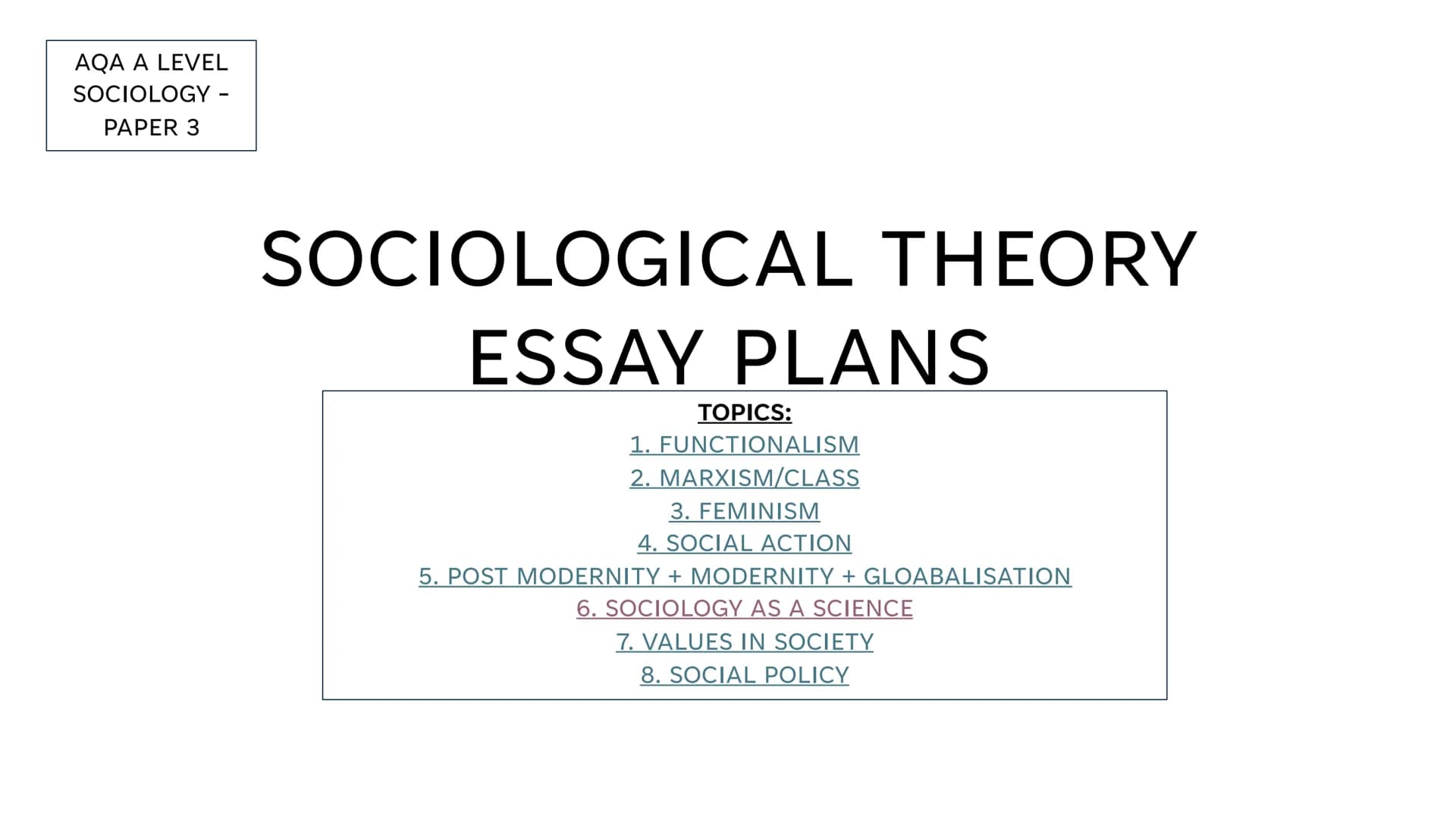
AQA A Level Sociology Paper 3 Overview
Paper 3 focuses on sociological theory - basically all the major ways sociologists try to explain how society works. You'll need to understand eight key areas that form the backbone of sociological thinking.
The topics split into three main categories: structural theories (functionalism and Marxism), action theories (social action and interactionism), and contemporary debates (feminism, postmodernity, science, values, and policy). Each perspective offers a different lens for understanding society.
Think of these theories as competing explanations for the same phenomena - like different people describing the same elephant whilst blindfolded. Your job is to evaluate their strengths, weaknesses, and how they apply to modern Britain.
Top Tip: Don't just memorise these theories - understand how they debate with each other. Marxists critique functionalists, feminists challenge both, and postmodernists question everyone!
2
of 9
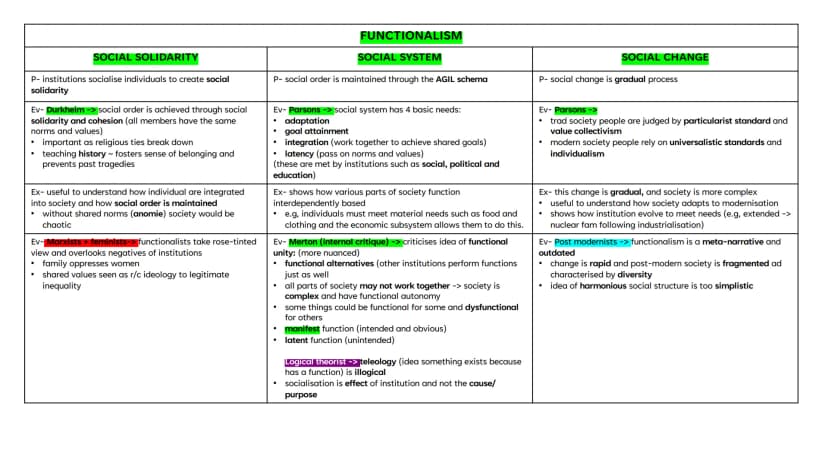
Functionalism: Society as a System
Functionalism sees society like a human body - all parts working together to keep the whole system healthy. This perspective dominated sociology for decades and still influences policy today.
Social solidarity is functionalism's big idea. Durkheim argued that shared norms and values hold society together, especially as traditional religious bonds weaken. Think about how teaching British history in schools creates national identity and prevents social chaos.
Parsons developed the AGIL schema - four basic needs every society must meet: adaptation (economic system), goal attainment (political system), integration (working together), and latency (passing on culture). Each institution has a specific job, like organs in a body.
Social change happens gradually according to functionalists. Parsons described the shift from traditional communities (where who your family is matters most) to modern societies (where individual achievement counts). This explains changes like nuclear families replacing extended ones after industrialisation.
Remember: Critics slam functionalism for being too rosy-eyed about society, ignoring conflict and oppression that Marxists and feminists highlight.
3
of 9
Marxism: Class Conflict and Revolution
Capitalism creates two main classes - the bourgeoisie (owners) and proletariat (workers) - locked in eternal conflict. Marx believed this would eventually lead to revolution and a classless society.
Traditional Marxism focuses on economic forces driving history. Workers become alienated from their labour, turned into "mindless drones" producing profits for others. Marx predicted growing class consciousness would spark revolution, replacing profit-driven production with meeting human needs.
Neo-Marxists updated these ideas for modern times. Gramsci introduced hegemony - how the ruling class maintains power through ideas and culture, not just force. This explains why workers accept capitalism despite exploitation (think about how media promotes consumer culture).
Althusser took a more structural approach, arguing that ideological state apparatus (schools, media) and repressive state apparatus (police, military) work together to maintain capitalism. Unlike Marx's simple base-superstructure model, he saw economic, political and ideological systems as separate but connected.
Key Debate: Humanistic Marxists (like Gramsci) emphasise human agency and resistance, while structural Marxists (like Althusser) see people as shaped by social forces.
4
of 9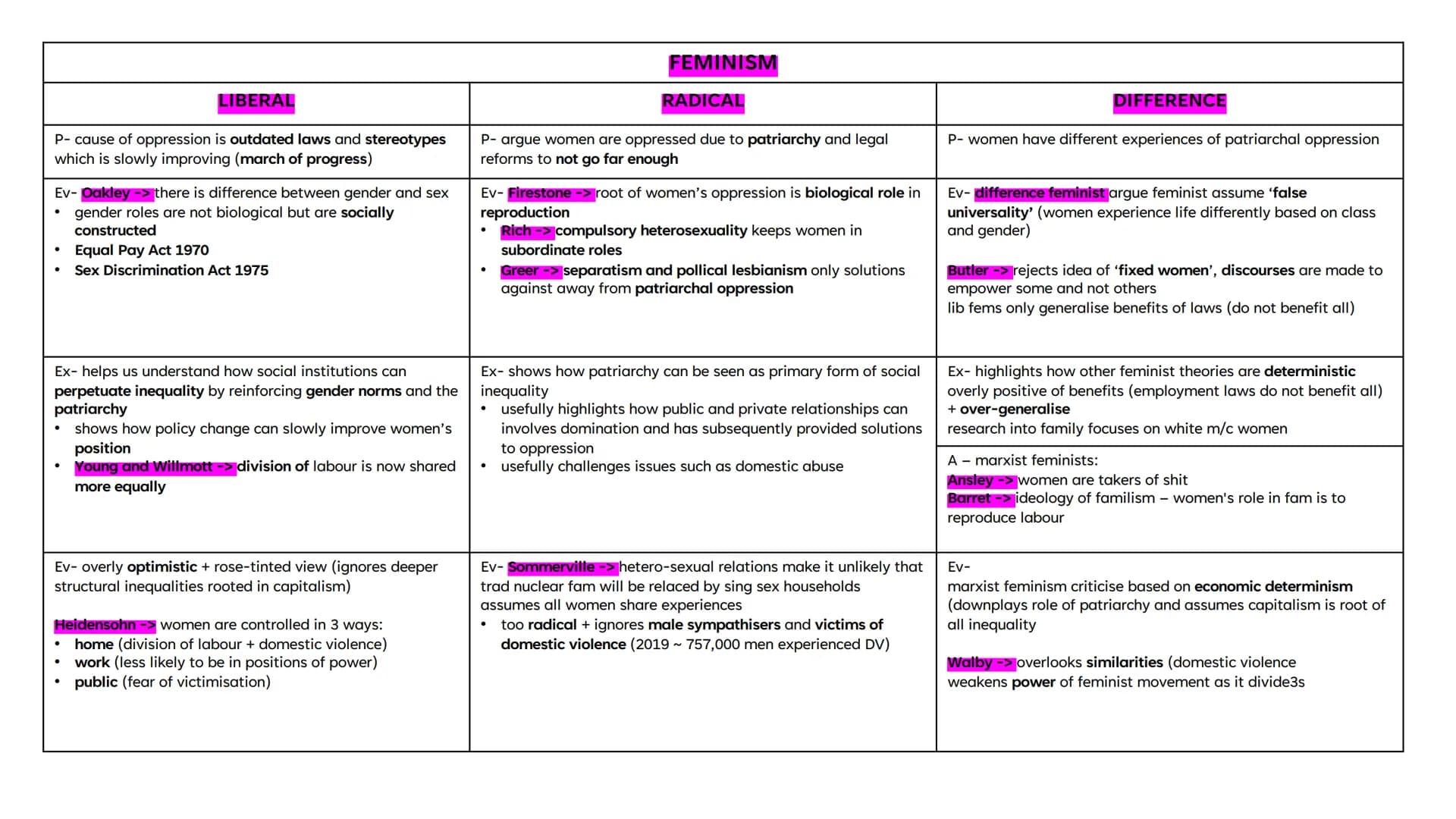
Feminism: Gender and Patriarchy
Feminism isn't one theory - it's several approaches united by concern for women's oppression. Each wave offers different explanations and solutions for gender inequality.
Liberal feminists see gradual progress through legal reforms. Oakley's distinction between sex (biological) and gender (social) was revolutionary, showing that gender roles aren't natural. Laws like the Equal Pay Act 1970 demonstrate slow but steady improvement in women's position.
Radical feminists argue that patriarchy - male dominance - is society's fundamental division. Firestone blamed women's biological role in reproduction, while others promoted separatism as the only escape from male oppression. They focus on areas like domestic violence that other theories ignore.
Difference feminists challenge the idea that all women share the same experiences. Butler argues there's no "fixed" female identity - experiences vary dramatically by class, race, and sexuality. This explains why employment laws might help middle-class women but not working-class or ethnic minority women.
Watch Out: Don't forget Marxist feminists like Ansley, who see women as "takers of shit" - absorbing men's frustration with capitalism to prevent revolution.
5
of 9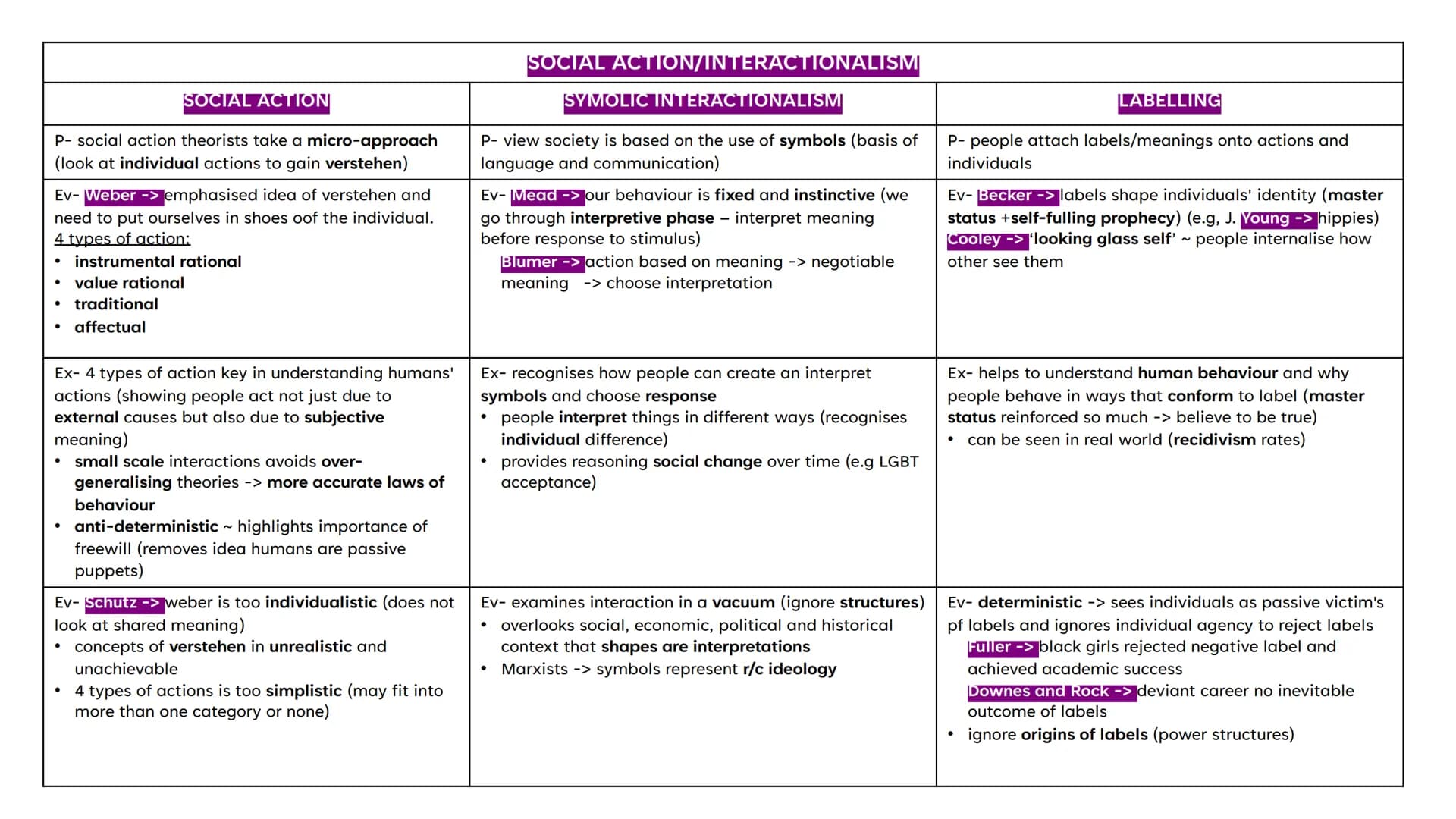
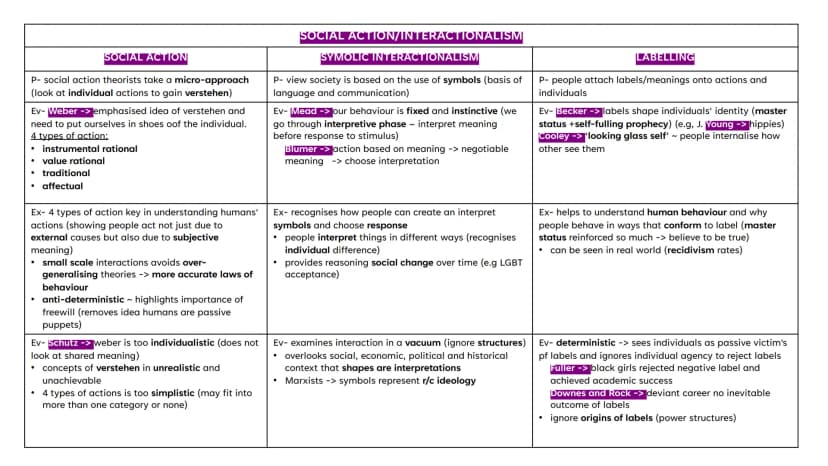
Social Action Theory: Understanding Individual Behaviour
Social action theorists flip sociology upside down - instead of looking at big structures, they examine individual actions and meanings. This micro-approach gives us verstehen (understanding from the actor's perspective).
Weber identified four types of action: instrumental rational , value rational (doing what's right), traditional (following custom), and affectual (emotional response). This shows people aren't just products of social forces - they make conscious choices based on personal meanings.
Symbolic interactionists focus on how we use symbols to communicate and create meaning. Mead argued humans interpret situations before responding, unlike animals with fixed instincts. Blumer emphasised that meanings are negotiable - they can change through interaction.
Labelling theory examines how society attaches meanings to people and actions. Becker showed how labels become "master status" - defining someone's entire identity. The "looking glass self" concept explains how we see ourselves through others' eyes, sometimes creating self-fulfilling prophecies.
Critical Point: Action theories excel at explaining individual behaviour but struggle with bigger questions about power and social structure that macro theories address.
6
of 9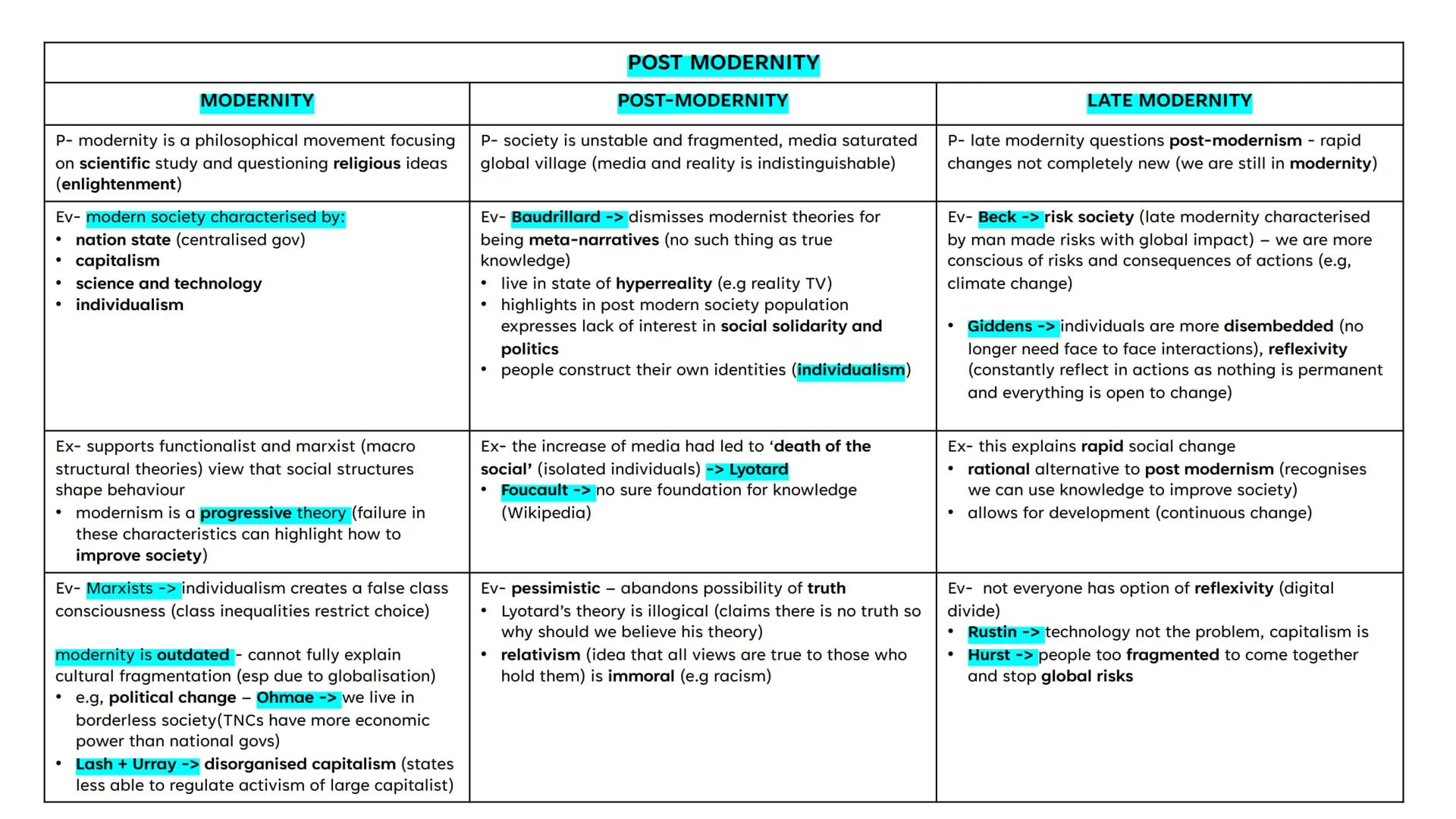
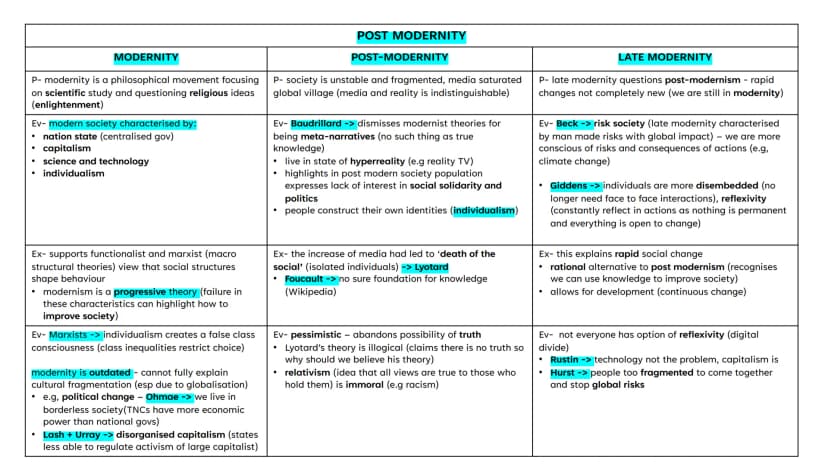
Modernity, Postmodernity and Social Change
Modernity emerged from the Enlightenment - emphasising science, reason, and progress over religious tradition. Modern societies feature nation states, capitalism, scientific thinking, and individualism.
This modernist worldview supports macro theories like functionalism and Marxism. Both assume we can scientifically study society and use knowledge to improve it. Modernity celebrates progress and believes rational solutions exist for social problems.
Postmodernists reject these "grand narratives" as outdated. Baudrillard argues we live in hyperreality where media and reality blur together (think reality TV or social media). Society has become fragmented, individualised, and media-saturated - a "global village" where old certainties have collapsed.
Late modern theorists like Giddens and Beck offer a middle path. Beck's risk society highlights man-made global risks like climate change that define contemporary life. Giddens emphasises reflexivity - constantly questioning and adapting our beliefs as knowledge evolves.
Think About It: Do we live in a postmodern world of choice and fragmentation, or are we still dealing with modern problems like class inequality and capitalism?
7
of 9
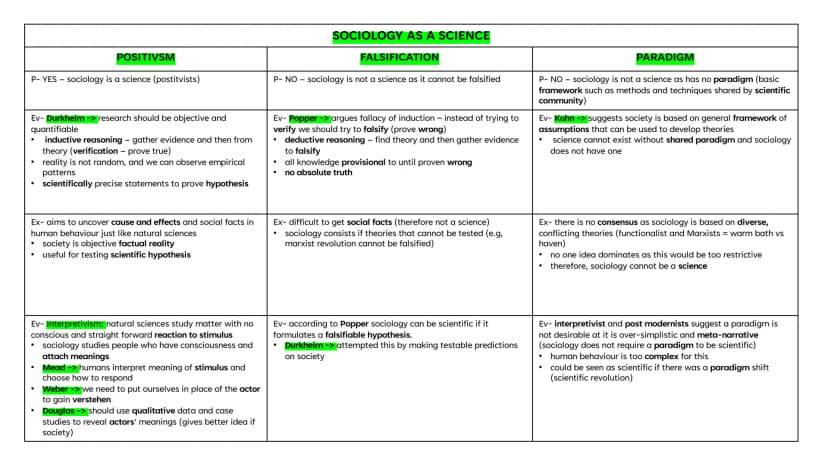
Sociology as a Science
Can sociology be scientific like physics or chemistry? This debate splits sociologists into camps with very different ideas about knowledge and research methods.
Positivists say yes - sociology should copy natural sciences. Durkheim pioneered this approach, using statistics to study suicide and arguing for objective, quantifiable research. Positivists use inductive reasoning - gather evidence first, then build theories.
Popper disagreed - science isn't about proving theories true but trying to falsify them. Real science uses deductive reasoning (theory first, then test) and accepts that all knowledge is provisional. Many sociological theories can't be falsified, so they're not scientific.
Kuhn argued science needs a paradigm - shared assumptions and methods that unite researchers. Sociology lacks this consensus - functionalists and Marxists use completely different approaches, so sociology can't be truly scientific.
Interpretivists reject the whole debate - humans aren't like rocks or chemicals. We have consciousness, interpret meanings, and choose responses. Weber's verstehen and qualitative methods suit social research better than scientific approaches.
Essay Gold: Link this to your other theories - positivism suits functionalism and Marxism, while interpretivism matches social action approaches.
8
of 9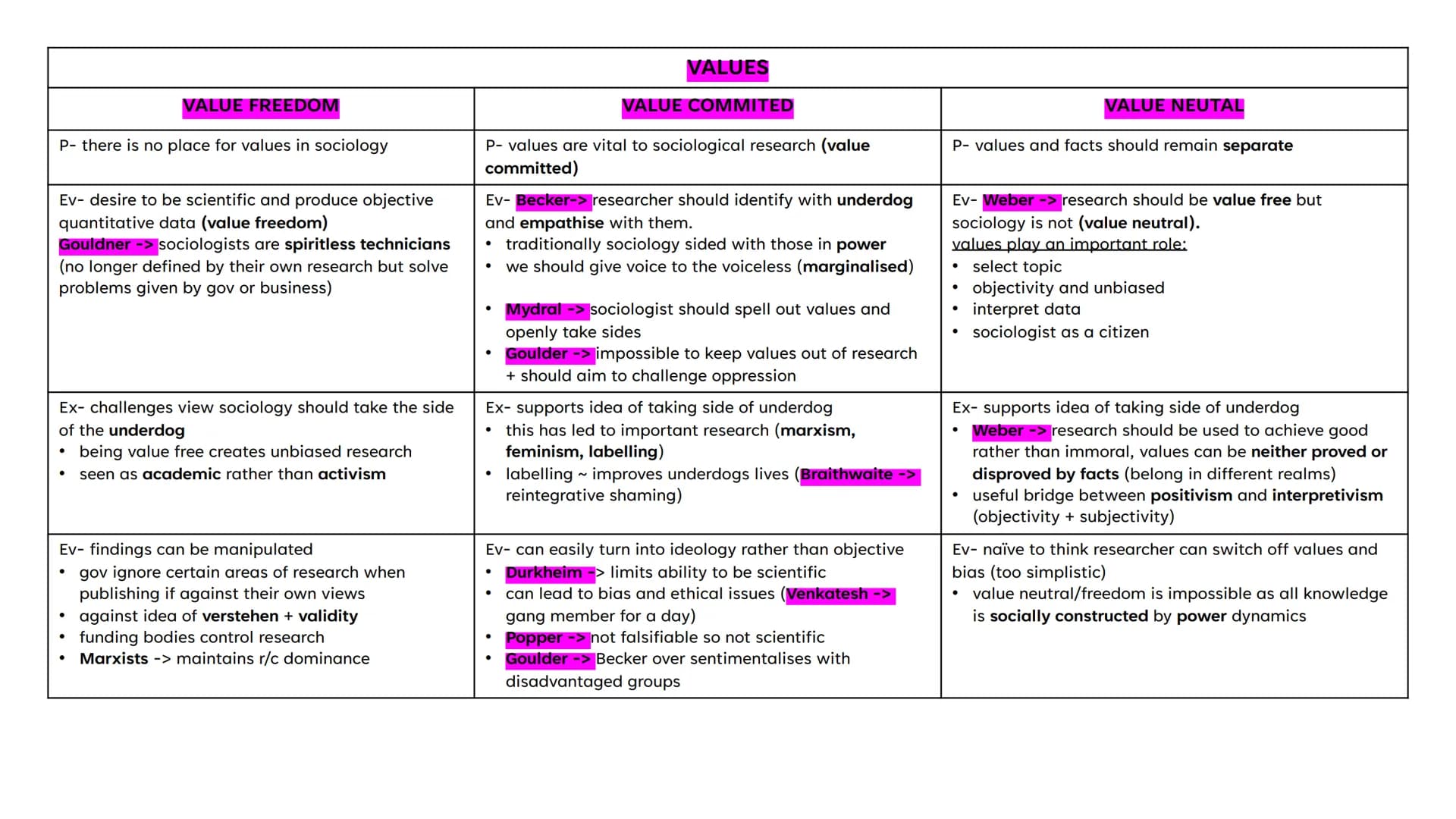
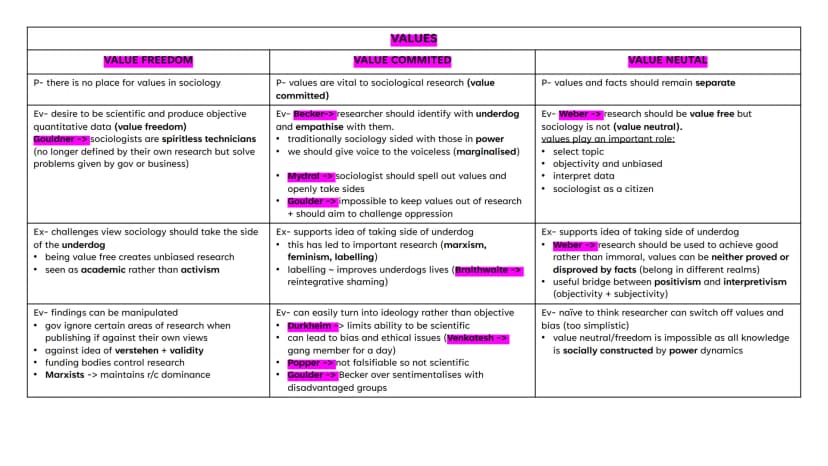
Values in Sociological Research
Should sociologists' personal values influence their research? This classic debate affects everything from topic choice to policy recommendations.
Value freedom advocates want sociology to be scientific and objective. Gouldner criticised sociologists as "spiritless technicians" solving problems for governments and businesses rather than pursuing independent research. This approach prioritises quantitative data and unbiased findings.
Value committed sociologists argue neutrality is impossible and undesirable. Becker famously argued researchers should "take the side of the underdog" - giving voice to marginalised groups traditionally ignored by sociology. This approach has produced vital research on labelling, feminism, and social inequality.
Weber proposed a middle way - being value neutral. Values inevitably influence topic selection and interpretation, but research methods should remain objective. Sociologists can pursue moral goals while maintaining scientific standards.
The debate connects to power and funding - who controls research agendas? Marxists argue value freedom serves ruling class interests by avoiding challenging questions about inequality and exploitation.
Real World: Consider how government funding shapes research priorities - studies supporting policy get money while critical research gets ignored.
9
of 9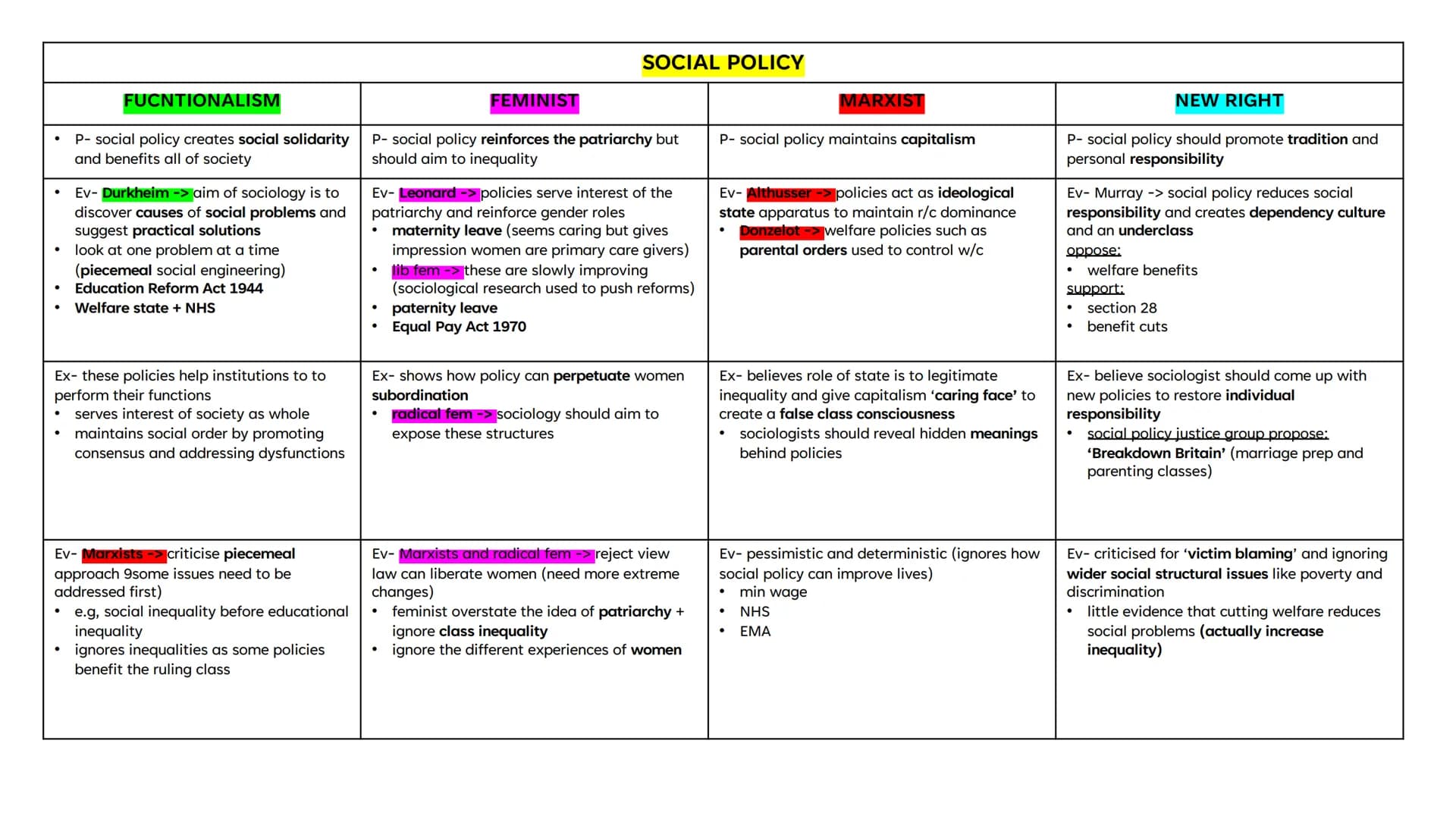
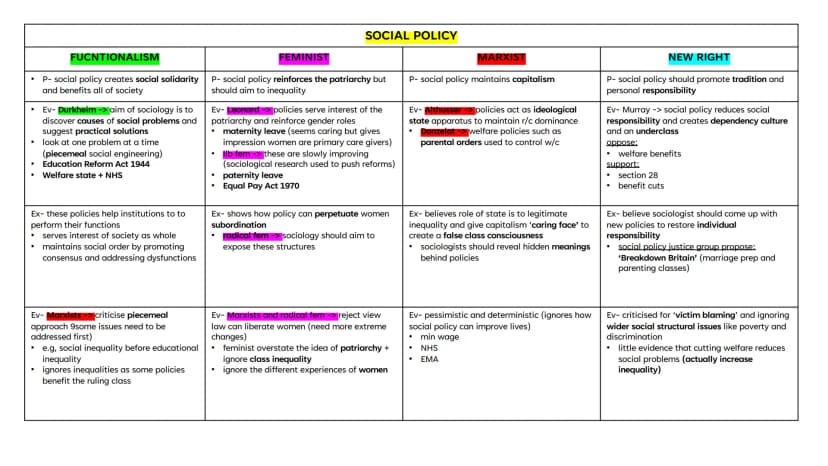
Social Policy and Sociological Perspectives
Every sociological theory has different ideas about social policy - what governments should do and why they do it. Understanding these connections helps you evaluate both theory and policy.
Functionalists support gradual reform through "piecemeal social engineering" - tackle one problem at a time. Policies like the 1944 Education Act and NHS creation help institutions perform their functions better, benefiting everyone and maintaining social solidarity.
Marxists see policy as social control - Althusser's ideological state apparatus keeps capitalism running smoothly. Welfare benefits give capitalism a "caring face" while maintaining inequality. True change requires revolution, not reform.
Feminists split on policy effectiveness. Liberal feminists celebrate gradual progress through laws like equal pay legislation. Radical feminists argue policies often reinforce patriarchy (maternity leave assumes women are primary carers) and demand more fundamental changes.
New Right theorists want minimal state intervention - Murray's "underclass" theory blames welfare for creating dependency culture. They support traditional values and individual responsibility over state solutions to social problems.
Evaluation Skill: Always ask "who benefits?" from any policy - different theories will give you different answers based on their core assumptions about power and social change.
We thought you’d never ask...
What is the Knowunity AI companion?
Our AI companion is specifically built for the needs of students. Based on the millions of content pieces we have on the platform we can provide truly meaningful and relevant answers to students. But its not only about answers, the companion is even more about guiding students through their daily learning challenges, with personalised study plans, quizzes or content pieces in the chat and 100% personalisation based on the students skills and developments.
Where can I download the Knowunity app?
You can download the app in the Google Play Store and in the Apple App Store.
Is Knowunity really free of charge?
That's right! Enjoy free access to study content, connect with fellow students, and get instant help – all at your fingertips.
Similar Content
 Ethik
Ethik Philosophie
Most popular content: Free Will Vs Determinism
9CriminologyCriminology WJEC unit 2
Unit 2 notes for criminology certificate WJEC
121,41328
 Psychology
Issues and Debates
AQA paper 3 alevel psychology topic 9 - issues and debates - full active recall questions - notion.
121,07326
SociologyAQA A Level Sociology Crime and Deviance Mindmaps
Includes all topics form Crime and Deviance
121,95047
PsychologyKey Psychological Approaches
Explore essential concepts in A-Level AQA Psychology, including the Biological, Behavioural, Cognitive, Humanistic, and Psychodynamic approaches. This comprehensive summary covers key theories, evaluations, and applications, providing a solid foundation for understanding psychological principles. Ideal for exam preparation and revision.
127778
PsychologyKey Psychological Debates
Explore essential concepts in AQA A Level Psychology, including cultural bias, gender bias, nature vs. nurture, and ethical issues. This summary covers critical evaluations of determinism, free will, and the idiographic vs. nomothetic approaches, providing a comprehensive overview for students preparing for exams.
125,617186
SociologyFAMILIES & HOUSEHOLDS - key perspective summaries
Key points, sociologists, examples and evaluation points for the main theories of the family topic AQA
121695
PsychologyPsychological Approaches Overview
Explore the key psychological approaches including behaviorism, psychodynamics, humanism, and cognitive theories. This summary highlights the debates of free will vs determinism, idiographic vs nomothetic methods, and the scientific credibility of each approach. Ideal for A-Level Psychology students seeking a comprehensive understanding of the subject.
122597
SociologyAQA A Level Sociology: Theories Paper 1 & 3
Notes for Q6 on Paper 1, and Q5 on Paper 2. I used Google Slides to condense the notes and used this as a basis for blurting & memorising!
122573
PsychologyFree Will & Determinism in Psychology - Issues and Debates
• revision notes for free will & determinism in psychology (issues and debates)
121835
Most popular content in Sociology
9SociologySociology of Education Overview
Explore comprehensive A-Level Sociology notes on the education system, covering key theories, policies, and sociological perspectives. This resource includes insights on marketisation, gender roles, cultural deprivation, and educational inequalities, providing a thorough understanding of how education shapes social stratification and individual achievement. Ideal for exam preparation and in-depth study.
12102,8693,040
SociologySociology of Families: Comprehensive Revision
Dive into an extensive overview of family dynamics, perspectives, and patterns in sociology. This resource covers key concepts such as family diversity, gender roles, marriage, and the impact of social policies on family structures. Perfect for A-Level Sociology students preparing for Paper 2.
1273,6612,307
SociologyComprehensive Crime & Deviance Overview
Explore an extensive revision of crime and deviance topics, including theories, types of crime, and the impact of media. This resource covers key concepts such as Marxism, functionalism, gender and crime, and the influence of globalization on criminal behavior. Ideal for students seeking a thorough understanding of criminology and its various theories. Type: Full Topic Revision.
1251,6541,399
SociologySociological Theories Overview
Comprehensive revision of key sociological theories including Functionalism, Marxism, Feminism, and Interpretivism. Explore concepts like value freedom, identity formation, and the critique of social control. Ideal for AQA A-Level Sociology students preparing for exams. This summary covers essential theories and their implications in sociology, providing a clear understanding of each perspective.
1231,442846
SociologySociology Research Methods Overview
Explore the essential research methods in A-Level Sociology, including structured, unstructured, and semi-structured interviews, official statistics, questionnaires, and observational techniques. This comprehensive guide covers practical and theoretical issues, advantages and disadvantages of each method, and their relevance in sociological research. Ideal for students preparing for exams or seeking to deepen their understanding of sociological research methodologies.
1228,944918
SociologyMedia Studies: Key Concepts & Theories
Dive into the essential concepts and theories of media studies for AQA A-level Sociology. This comprehensive revision guide covers topics such as media influence, representations, globalization, and sociological perspectives, ensuring you grasp the critical elements needed for your exams. Perfect for students seeking to enhance their understanding of media's role in society.
1222,717512
SociologyEducation-AQA A-level Sociology
Overview of the topic of education in alevel sociology, source:the sociology teacher
124,096118
SociologySociology Research Methods in Education
Explore key sociological research methods used in educational contexts, including ethical considerations, power dynamics, and various interview techniques. This summary provides essential insights for tackling 20-mark exam questions on methods in context, focusing on the role of education, labelling theory, and the impact of social factors on educational outcomes.
1222,113639
SociologyTheories of Religion Explained
Explore key sociological theories of religion, including functionalism, Marxism, and feminism. This summary covers definitions, the role of religion in society, and its impact on social change. Ideal for A-Level AQA Sociology students seeking to understand the complexities of belief systems and their societal implications.
128,462160
Most popular content
9SociologySociology of Education Overview
Explore comprehensive A-Level Sociology notes on the education system, covering key theories, policies, and sociological perspectives. This resource includes insights on marketisation, gender roles, cultural deprivation, and educational inequalities, providing a thorough understanding of how education shapes social stratification and individual achievement. Ideal for exam preparation and in-depth study.
12102,8693,040
SociologySociology of Families: Comprehensive Revision
Dive into an extensive overview of family dynamics, perspectives, and patterns in sociology. This resource covers key concepts such as family diversity, gender roles, marriage, and the impact of social policies on family structures. Perfect for A-Level Sociology students preparing for Paper 2.
1273,6612,307
CriminologyCriminology: Crime & Punishment Overview
Comprehensive mindmaps covering key concepts in the Crime and Punishment topic for WJEC Criminology Unit 4. This resource includes detailed insights into the Criminal Justice System, crime prevention strategies, sentencing models, and the roles of various agencies. Ideal for A-Level revision, ensuring you grasp essential theories and legislative processes to excel in your exams.
1254,8691,059
SociologyComprehensive Crime & Deviance Overview
Explore an extensive revision of crime and deviance topics, including theories, types of crime, and the impact of media. This resource covers key concepts such as Marxism, functionalism, gender and crime, and the influence of globalization on criminal behavior. Ideal for students seeking a thorough understanding of criminology and its various theories. Type: Full Topic Revision.
1251,6541,399
C
 Biology
Cell Biology and Cell structure
cell structures
93,2490
 English Literature
An Inspector Calls: Character Insights
Explore in-depth analysis and key quotes for characters in J.B. Priestley's 'An Inspector Calls'. This resource covers Gerald Croft, Inspector Goole, Sheila Birling, Mrs. Birling, Eric Birling, and Eva Smith, focusing on themes of class, gender roles, and social responsibility. Ideal for students aiming for Grade 8 and above.
1025,429907
CriminologyWJEC Unit 4 Criminology
Criminology unit 4 detailed revision note
127,151125
CriminologyCriminology Theories Overview
Explore key criminology theories and their implications on crime and deviance. This comprehensive summary covers biological, psychological, and sociological perspectives, including labelling theory, right realism, and the impact of social campaigns on policy development. Ideal for A-Level criminology students seeking to understand the complexities of criminal behaviour and the factors influencing crime prevention strategies.
129,760210
English LiteratureRomeo and Juliet: Key themes
Key Romeo and Juliet themes and analysed quotes
106,708198
Can't find what you're looking for? Explore other subjects.
Students love us — and so will you.
4.6/5App Store
4.7/5Google Play
The app is very easy to use and well designed. I have found everything I was looking for so far and have been able to learn a lot from the presentations! I will definitely use the app for a class assignment! And of course it also helps a lot as an inspiration.
Stefan SiOS user
This app is really great. There are so many study notes and help [...]. My problem subject is French, for example, and the app has so many options for help. Thanks to this app, I have improved my French. I would recommend it to anyone.
Samantha KlichAndroid user
Wow, I am really amazed. I just tried the app because I've seen it advertised many times and was absolutely stunned. This app is THE HELP you want for school and above all, it offers so many things, such as workouts and fact sheets, which have been VERY helpful to me personally.
AnnaiOS user
Sociology509 views·Updated Jun 14, 2026·9 pagesComprehensive AQA A-Level Sociological Theory Essay Plans
R
Rhianna Willory@rhiannawillory_zqjk
Right, this is your ultimate revision guide for AQA A Level Sociology Paper 3 - the theory paper that brings together all the big sociological perspectives you need to know. We're covering eight major topics from functionalism to social policy,...
1
of 9
Sign up to see the content. It's free!
- Access to all documents
- Improve your grades
- Join milions of students
AQA A Level Sociology Paper 3 Overview
Paper 3 focuses on sociological theory - basically all the major ways sociologists try to explain how society works. You'll need to understand eight key areas that form the backbone of sociological thinking.
The topics split into three main categories: structural theories (functionalism and Marxism), action theories (social action and interactionism), and contemporary debates (feminism, postmodernity, science, values, and policy). Each perspective offers a different lens for understanding society.
Think of these theories as competing explanations for the same phenomena - like different people describing the same elephant whilst blindfolded. Your job is to evaluate their strengths, weaknesses, and how they apply to modern Britain.
Top Tip: Don't just memorise these theories - understand how they debate with each other. Marxists critique functionalists, feminists challenge both, and postmodernists question everyone!
2
of 9Sign up to see the content. It's free!
- Access to all documents
- Improve your grades
- Join milions of students
Functionalism: Society as a System
Functionalism sees society like a human body - all parts working together to keep the whole system healthy. This perspective dominated sociology for decades and still influences policy today.
Social solidarity is functionalism's big idea. Durkheim argued that shared norms and values hold society together, especially as traditional religious bonds weaken. Think about how teaching British history in schools creates national identity and prevents social chaos.
Parsons developed the AGIL schema - four basic needs every society must meet: adaptation (economic system), goal attainment (political system), integration (working together), and latency (passing on culture). Each institution has a specific job, like organs in a body.
Social change happens gradually according to functionalists. Parsons described the shift from traditional communities (where who your family is matters most) to modern societies (where individual achievement counts). This explains changes like nuclear families replacing extended ones after industrialisation.
Remember: Critics slam functionalism for being too rosy-eyed about society, ignoring conflict and oppression that Marxists and feminists highlight.
3
of 9Sign up to see the content. It's free!
- Access to all documents
- Improve your grades
- Join milions of students
Marxism: Class Conflict and Revolution
Capitalism creates two main classes - the bourgeoisie (owners) and proletariat (workers) - locked in eternal conflict. Marx believed this would eventually lead to revolution and a classless society.
Traditional Marxism focuses on economic forces driving history. Workers become alienated from their labour, turned into "mindless drones" producing profits for others. Marx predicted growing class consciousness would spark revolution, replacing profit-driven production with meeting human needs.
Neo-Marxists updated these ideas for modern times. Gramsci introduced hegemony - how the ruling class maintains power through ideas and culture, not just force. This explains why workers accept capitalism despite exploitation (think about how media promotes consumer culture).
Althusser took a more structural approach, arguing that ideological state apparatus (schools, media) and repressive state apparatus (police, military) work together to maintain capitalism. Unlike Marx's simple base-superstructure model, he saw economic, political and ideological systems as separate but connected.
Key Debate: Humanistic Marxists (like Gramsci) emphasise human agency and resistance, while structural Marxists (like Althusser) see people as shaped by social forces.
4
of 9Sign up to see the content. It's free!
- Access to all documents
- Improve your grades
- Join milions of students
Feminism: Gender and Patriarchy
Feminism isn't one theory - it's several approaches united by concern for women's oppression. Each wave offers different explanations and solutions for gender inequality.
Liberal feminists see gradual progress through legal reforms. Oakley's distinction between sex (biological) and gender (social) was revolutionary, showing that gender roles aren't natural. Laws like the Equal Pay Act 1970 demonstrate slow but steady improvement in women's position.
Radical feminists argue that patriarchy - male dominance - is society's fundamental division. Firestone blamed women's biological role in reproduction, while others promoted separatism as the only escape from male oppression. They focus on areas like domestic violence that other theories ignore.
Difference feminists challenge the idea that all women share the same experiences. Butler argues there's no "fixed" female identity - experiences vary dramatically by class, race, and sexuality. This explains why employment laws might help middle-class women but not working-class or ethnic minority women.
Watch Out: Don't forget Marxist feminists like Ansley, who see women as "takers of shit" - absorbing men's frustration with capitalism to prevent revolution.
5
of 9Sign up to see the content. It's free!
- Access to all documents
- Improve your grades
- Join milions of students
Social Action Theory: Understanding Individual Behaviour
Social action theorists flip sociology upside down - instead of looking at big structures, they examine individual actions and meanings. This micro-approach gives us verstehen (understanding from the actor's perspective).
Weber identified four types of action: instrumental rational , value rational (doing what's right), traditional (following custom), and affectual (emotional response). This shows people aren't just products of social forces - they make conscious choices based on personal meanings.
Symbolic interactionists focus on how we use symbols to communicate and create meaning. Mead argued humans interpret situations before responding, unlike animals with fixed instincts. Blumer emphasised that meanings are negotiable - they can change through interaction.
Labelling theory examines how society attaches meanings to people and actions. Becker showed how labels become "master status" - defining someone's entire identity. The "looking glass self" concept explains how we see ourselves through others' eyes, sometimes creating self-fulfilling prophecies.
Critical Point: Action theories excel at explaining individual behaviour but struggle with bigger questions about power and social structure that macro theories address.
6
of 9Sign up to see the content. It's free!
- Access to all documents
- Improve your grades
- Join milions of students
Modernity, Postmodernity and Social Change
Modernity emerged from the Enlightenment - emphasising science, reason, and progress over religious tradition. Modern societies feature nation states, capitalism, scientific thinking, and individualism.
This modernist worldview supports macro theories like functionalism and Marxism. Both assume we can scientifically study society and use knowledge to improve it. Modernity celebrates progress and believes rational solutions exist for social problems.
Postmodernists reject these "grand narratives" as outdated. Baudrillard argues we live in hyperreality where media and reality blur together (think reality TV or social media). Society has become fragmented, individualised, and media-saturated - a "global village" where old certainties have collapsed.
Late modern theorists like Giddens and Beck offer a middle path. Beck's risk society highlights man-made global risks like climate change that define contemporary life. Giddens emphasises reflexivity - constantly questioning and adapting our beliefs as knowledge evolves.
Think About It: Do we live in a postmodern world of choice and fragmentation, or are we still dealing with modern problems like class inequality and capitalism?
7
of 9Sign up to see the content. It's free!
- Access to all documents
- Improve your grades
- Join milions of students
Sociology as a Science
Can sociology be scientific like physics or chemistry? This debate splits sociologists into camps with very different ideas about knowledge and research methods.
Positivists say yes - sociology should copy natural sciences. Durkheim pioneered this approach, using statistics to study suicide and arguing for objective, quantifiable research. Positivists use inductive reasoning - gather evidence first, then build theories.
Popper disagreed - science isn't about proving theories true but trying to falsify them. Real science uses deductive reasoning (theory first, then test) and accepts that all knowledge is provisional. Many sociological theories can't be falsified, so they're not scientific.
Kuhn argued science needs a paradigm - shared assumptions and methods that unite researchers. Sociology lacks this consensus - functionalists and Marxists use completely different approaches, so sociology can't be truly scientific.
Interpretivists reject the whole debate - humans aren't like rocks or chemicals. We have consciousness, interpret meanings, and choose responses. Weber's verstehen and qualitative methods suit social research better than scientific approaches.
Essay Gold: Link this to your other theories - positivism suits functionalism and Marxism, while interpretivism matches social action approaches.
8
of 9Sign up to see the content. It's free!
- Access to all documents
- Improve your grades
- Join milions of students
Values in Sociological Research
Should sociologists' personal values influence their research? This classic debate affects everything from topic choice to policy recommendations.
Value freedom advocates want sociology to be scientific and objective. Gouldner criticised sociologists as "spiritless technicians" solving problems for governments and businesses rather than pursuing independent research. This approach prioritises quantitative data and unbiased findings.
Value committed sociologists argue neutrality is impossible and undesirable. Becker famously argued researchers should "take the side of the underdog" - giving voice to marginalised groups traditionally ignored by sociology. This approach has produced vital research on labelling, feminism, and social inequality.
Weber proposed a middle way - being value neutral. Values inevitably influence topic selection and interpretation, but research methods should remain objective. Sociologists can pursue moral goals while maintaining scientific standards.
The debate connects to power and funding - who controls research agendas? Marxists argue value freedom serves ruling class interests by avoiding challenging questions about inequality and exploitation.
Real World: Consider how government funding shapes research priorities - studies supporting policy get money while critical research gets ignored.
9
of 9Sign up to see the content. It's free!
- Access to all documents
- Improve your grades
- Join milions of students
Social Policy and Sociological Perspectives
Every sociological theory has different ideas about social policy - what governments should do and why they do it. Understanding these connections helps you evaluate both theory and policy.
Functionalists support gradual reform through "piecemeal social engineering" - tackle one problem at a time. Policies like the 1944 Education Act and NHS creation help institutions perform their functions better, benefiting everyone and maintaining social solidarity.
Marxists see policy as social control - Althusser's ideological state apparatus keeps capitalism running smoothly. Welfare benefits give capitalism a "caring face" while maintaining inequality. True change requires revolution, not reform.
Feminists split on policy effectiveness. Liberal feminists celebrate gradual progress through laws like equal pay legislation. Radical feminists argue policies often reinforce patriarchy (maternity leave assumes women are primary carers) and demand more fundamental changes.
New Right theorists want minimal state intervention - Murray's "underclass" theory blames welfare for creating dependency culture. They support traditional values and individual responsibility over state solutions to social problems.
Evaluation Skill: Always ask "who benefits?" from any policy - different theories will give you different answers based on their core assumptions about power and social change.
We thought you’d never ask...
What is the Knowunity AI companion?
Our AI companion is specifically built for the needs of students. Based on the millions of content pieces we have on the platform we can provide truly meaningful and relevant answers to students. But its not only about answers, the companion is even more about guiding students through their daily learning challenges, with personalised study plans, quizzes or content pieces in the chat and 100% personalisation based on the students skills and developments.
Where can I download the Knowunity app?
You can download the app in the Google Play Store and in the Apple App Store.
Is Knowunity really free of charge?
That's right! Enjoy free access to study content, connect with fellow students, and get instant help – all at your fingertips.
Similar Content
Most popular content: Free Will Vs Determinism
9CriminologyCriminology WJEC unit 2
Unit 2 notes for criminology certificate WJEC
121,41328
PsychologyIssues and Debates
AQA paper 3 alevel psychology topic 9 - issues and debates - full active recall questions - notion.
121,07326
SociologyAQA A Level Sociology Crime and Deviance Mindmaps
Includes all topics form Crime and Deviance
121,95047
PsychologyKey Psychological Approaches
Explore essential concepts in A-Level AQA Psychology, including the Biological, Behavioural, Cognitive, Humanistic, and Psychodynamic approaches. This comprehensive summary covers key theories, evaluations, and applications, providing a solid foundation for understanding psychological principles. Ideal for exam preparation and revision.
127778
PsychologyKey Psychological Debates
Explore essential concepts in AQA A Level Psychology, including cultural bias, gender bias, nature vs. nurture, and ethical issues. This summary covers critical evaluations of determinism, free will, and the idiographic vs. nomothetic approaches, providing a comprehensive overview for students preparing for exams.
125,617186
SociologyFAMILIES & HOUSEHOLDS - key perspective summaries
Key points, sociologists, examples and evaluation points for the main theories of the family topic AQA
121695
PsychologyPsychological Approaches Overview
Explore the key psychological approaches including behaviorism, psychodynamics, humanism, and cognitive theories. This summary highlights the debates of free will vs determinism, idiographic vs nomothetic methods, and the scientific credibility of each approach. Ideal for A-Level Psychology students seeking a comprehensive understanding of the subject.
122597
SociologyAQA A Level Sociology: Theories Paper 1 & 3
Notes for Q6 on Paper 1, and Q5 on Paper 2. I used Google Slides to condense the notes and used this as a basis for blurting & memorising!
122573
PsychologyFree Will & Determinism in Psychology - Issues and Debates
• revision notes for free will & determinism in psychology (issues and debates)
121835
Most popular content in Sociology
9SociologySociology of Education Overview
Explore comprehensive A-Level Sociology notes on the education system, covering key theories, policies, and sociological perspectives. This resource includes insights on marketisation, gender roles, cultural deprivation, and educational inequalities, providing a thorough understanding of how education shapes social stratification and individual achievement. Ideal for exam preparation and in-depth study.
12102,8693,040
SociologySociology of Families: Comprehensive Revision
Dive into an extensive overview of family dynamics, perspectives, and patterns in sociology. This resource covers key concepts such as family diversity, gender roles, marriage, and the impact of social policies on family structures. Perfect for A-Level Sociology students preparing for Paper 2.
1273,6612,307
SociologyComprehensive Crime & Deviance Overview
Explore an extensive revision of crime and deviance topics, including theories, types of crime, and the impact of media. This resource covers key concepts such as Marxism, functionalism, gender and crime, and the influence of globalization on criminal behavior. Ideal for students seeking a thorough understanding of criminology and its various theories. Type: Full Topic Revision.
1251,6541,399
SociologySociological Theories Overview
Comprehensive revision of key sociological theories including Functionalism, Marxism, Feminism, and Interpretivism. Explore concepts like value freedom, identity formation, and the critique of social control. Ideal for AQA A-Level Sociology students preparing for exams. This summary covers essential theories and their implications in sociology, providing a clear understanding of each perspective.
1231,442846
SociologySociology Research Methods Overview
Explore the essential research methods in A-Level Sociology, including structured, unstructured, and semi-structured interviews, official statistics, questionnaires, and observational techniques. This comprehensive guide covers practical and theoretical issues, advantages and disadvantages of each method, and their relevance in sociological research. Ideal for students preparing for exams or seeking to deepen their understanding of sociological research methodologies.
1228,944918
SociologyMedia Studies: Key Concepts & Theories
Dive into the essential concepts and theories of media studies for AQA A-level Sociology. This comprehensive revision guide covers topics such as media influence, representations, globalization, and sociological perspectives, ensuring you grasp the critical elements needed for your exams. Perfect for students seeking to enhance their understanding of media's role in society.
1222,717512
SociologyEducation-AQA A-level Sociology
Overview of the topic of education in alevel sociology, source:the sociology teacher
124,096118
SociologySociology Research Methods in Education
Explore key sociological research methods used in educational contexts, including ethical considerations, power dynamics, and various interview techniques. This summary provides essential insights for tackling 20-mark exam questions on methods in context, focusing on the role of education, labelling theory, and the impact of social factors on educational outcomes.
1222,113639
SociologyTheories of Religion Explained
Explore key sociological theories of religion, including functionalism, Marxism, and feminism. This summary covers definitions, the role of religion in society, and its impact on social change. Ideal for A-Level AQA Sociology students seeking to understand the complexities of belief systems and their societal implications.
128,462160
Most popular content
9SociologySociology of Education Overview
Explore comprehensive A-Level Sociology notes on the education system, covering key theories, policies, and sociological perspectives. This resource includes insights on marketisation, gender roles, cultural deprivation, and educational inequalities, providing a thorough understanding of how education shapes social stratification and individual achievement. Ideal for exam preparation and in-depth study.
12102,8693,040
SociologySociology of Families: Comprehensive Revision
Dive into an extensive overview of family dynamics, perspectives, and patterns in sociology. This resource covers key concepts such as family diversity, gender roles, marriage, and the impact of social policies on family structures. Perfect for A-Level Sociology students preparing for Paper 2.
1273,6612,307
CriminologyCriminology: Crime & Punishment Overview
Comprehensive mindmaps covering key concepts in the Crime and Punishment topic for WJEC Criminology Unit 4. This resource includes detailed insights into the Criminal Justice System, crime prevention strategies, sentencing models, and the roles of various agencies. Ideal for A-Level revision, ensuring you grasp essential theories and legislative processes to excel in your exams.
1254,8691,059
SociologyComprehensive Crime & Deviance Overview
Explore an extensive revision of crime and deviance topics, including theories, types of crime, and the impact of media. This resource covers key concepts such as Marxism, functionalism, gender and crime, and the influence of globalization on criminal behavior. Ideal for students seeking a thorough understanding of criminology and its various theories. Type: Full Topic Revision.
1251,6541,399
C
BiologyCell Biology and Cell structure
cell structures
93,2490
English LiteratureAn Inspector Calls: Character Insights
Explore in-depth analysis and key quotes for characters in J.B. Priestley's 'An Inspector Calls'. This resource covers Gerald Croft, Inspector Goole, Sheila Birling, Mrs. Birling, Eric Birling, and Eva Smith, focusing on themes of class, gender roles, and social responsibility. Ideal for students aiming for Grade 8 and above.
1025,429907
CriminologyWJEC Unit 4 Criminology
Criminology unit 4 detailed revision note
127,151125
CriminologyCriminology Theories Overview
Explore key criminology theories and their implications on crime and deviance. This comprehensive summary covers biological, psychological, and sociological perspectives, including labelling theory, right realism, and the impact of social campaigns on policy development. Ideal for A-Level criminology students seeking to understand the complexities of criminal behaviour and the factors influencing crime prevention strategies.
129,760210
English LiteratureRomeo and Juliet: Key themes
Key Romeo and Juliet themes and analysed quotes
106,708198
Can't find what you're looking for? Explore other subjects.
Students love us — and so will you.
4.6/5App Store
4.7/5Google Play
The app is very easy to use and well designed. I have found everything I was looking for so far and have been able to learn a lot from the presentations! I will definitely use the app for a class assignment! And of course it also helps a lot as an inspiration.
Stefan SiOS user
This app is really great. There are so many study notes and help [...]. My problem subject is French, for example, and the app has so many options for help. Thanks to this app, I have improved my French. I would recommend it to anyone.
Samantha KlichAndroid user
Wow, I am really amazed. I just tried the app because I've seen it advertised many times and was absolutely stunned. This app is THE HELP you want for school and above all, it offers so many things, such as workouts and fact sheets, which have been VERY helpful to me personally.
AnnaiOS user