
Ever wondered why sociologists have such different views on what...
 Sociology169 views·Updated Jun 17, 2026·7 pages
Families and Households: Key Perspective Overview
S
Sophie@sophiexox


1 / 7
1
of 7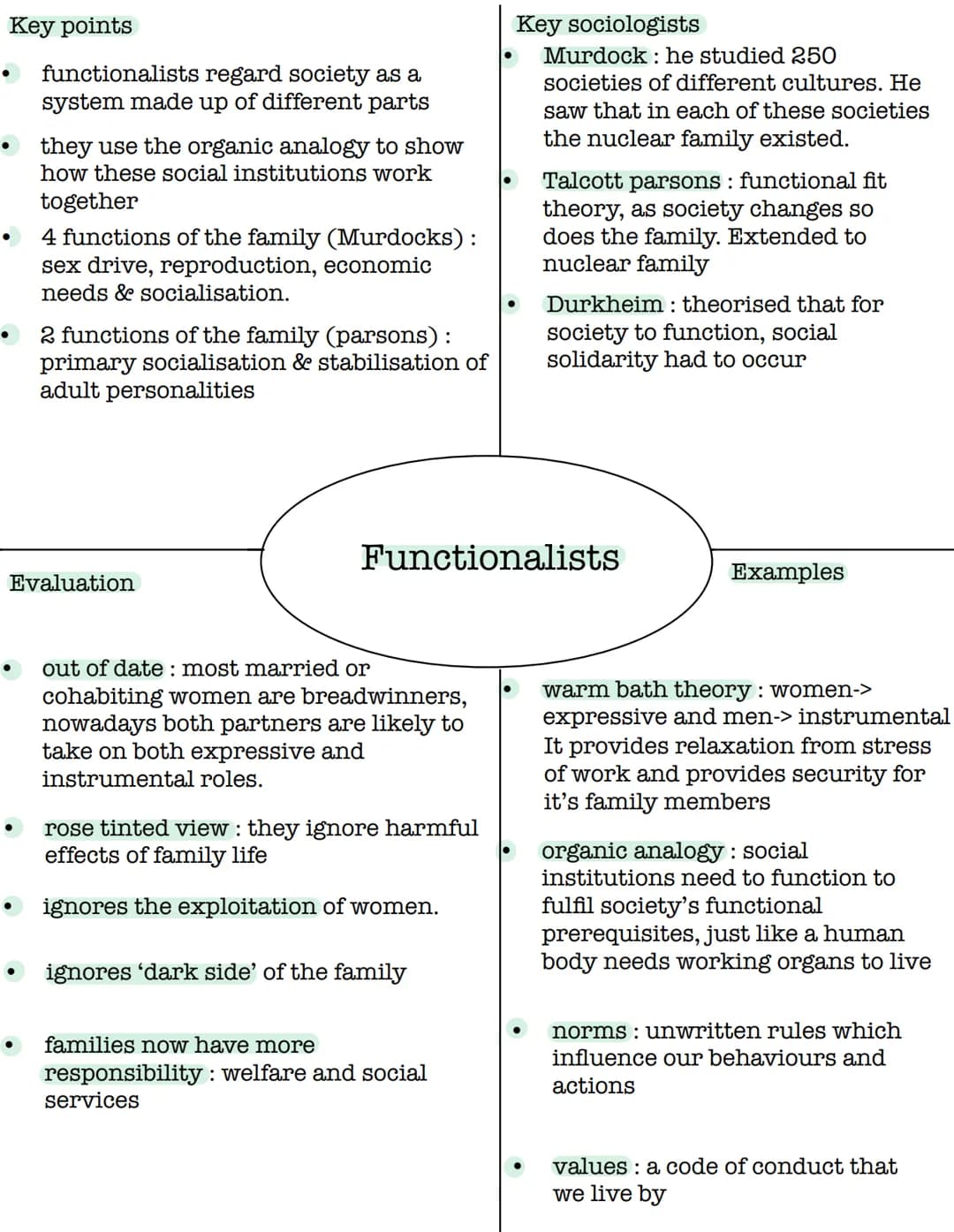
Functionalism and the Family
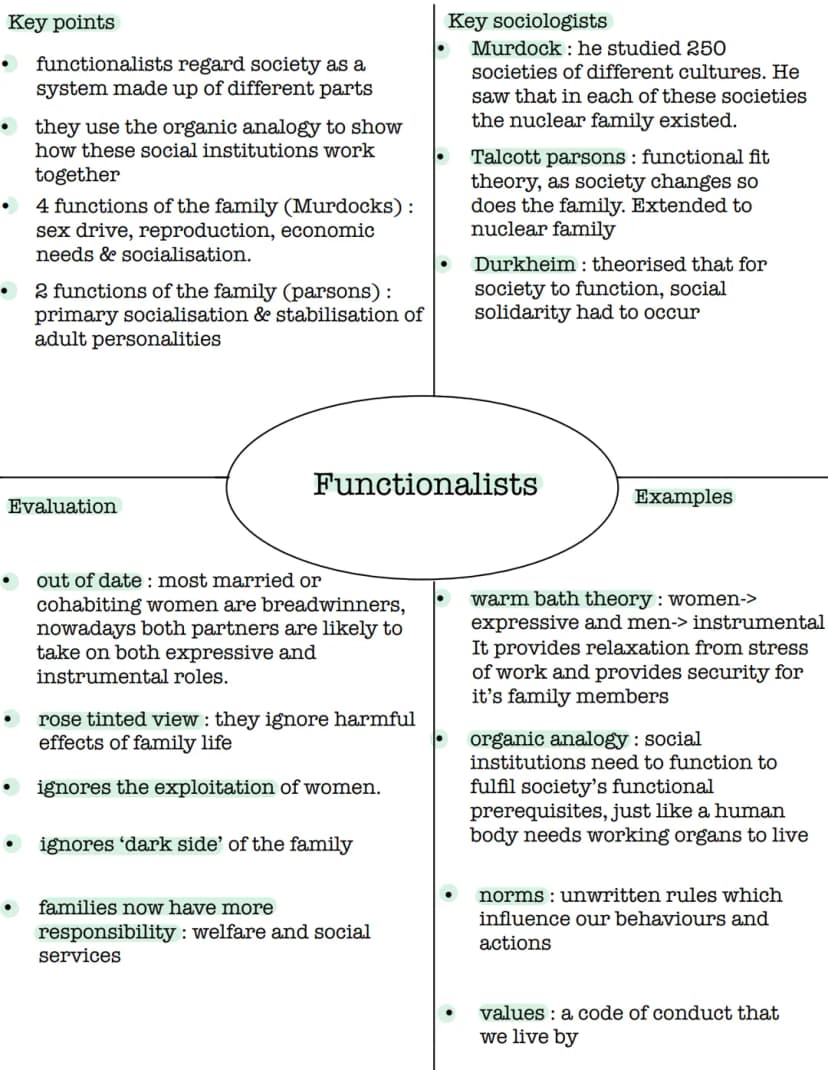
Think of society like a human body - every part needs to work together to keep the whole thing alive. That's exactly how functionalists see families, using what they call the organic analogy to explain how social institutions support each other.
Murdock studied 250 different societies and found nuclear families everywhere, leading him to identify four key functions: managing the sex drive, reproduction, meeting economic needs, and socialisation. Meanwhile, Parsons focused on just two crucial roles: primary socialisation (teaching kids society's rules) and stabilising adult personalities through his famous warm bath theory.
This warm bath theory suggests that women naturally take expressive roles (emotional support) whilst men handle instrumental roles (breadwinning). The family becomes a safe haven where stressed workers can recharge and feel secure.
Quick Check: Durkheim argued that social solidarity (people sticking together) was essential for society to function properly.
However, this rosy picture ignores some harsh realities. Many couples now share both breadwinning and emotional responsibilities, and functionalists completely overlook family problems like domestic violence and women's exploitation. Their theories feel quite outdated when most women are now breadwinners themselves.
2
of 7
Marxism and Family Structure
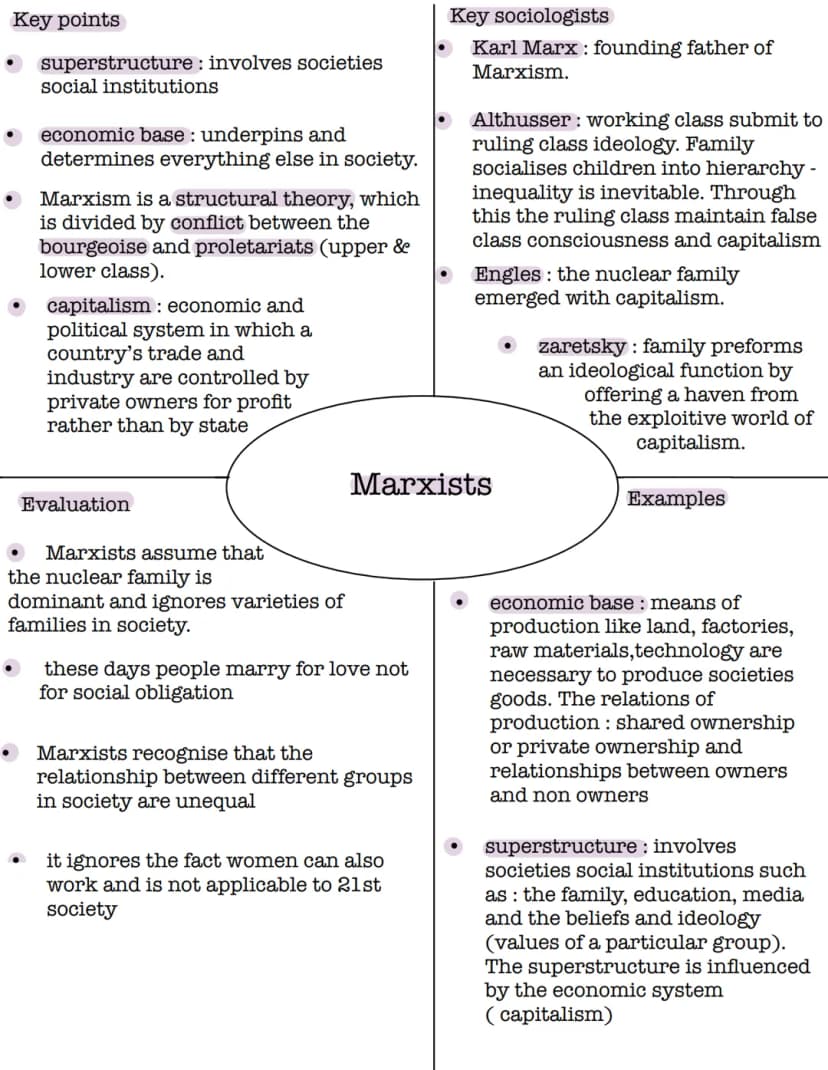
Here's where things get political - Marxists see families as part of capitalism's grand plan to keep the rich in power. They divide society into two parts: the economic base (who owns the factories, land, and means of production) and the superstructure (institutions like family, education, and media).
Karl Marx founded this theory, but Althusser and Engels developed the family angle. They argue that families brainwash children into accepting inequality as normal - this false class consciousness stops workers from rebelling against their exploitation. The nuclear family only emerged because capitalism needed it.
Zaretsky claimed families offer an illusion of escape from capitalist exploitation, like a fake holiday from reality. Meanwhile, the bourgeoisie (ruling class) use families to control the proletariat (working class) by making them think hierarchy is inevitable.
Reality Check: Engels believed people only started forming nuclear families when private property became important under capitalism.
Critics argue that Marxists ignore family diversity and the fact that people often marry for love, not economic reasons. Their focus on class conflict also overlooks how women's roles have dramatically changed in the 21st century.
3
of 7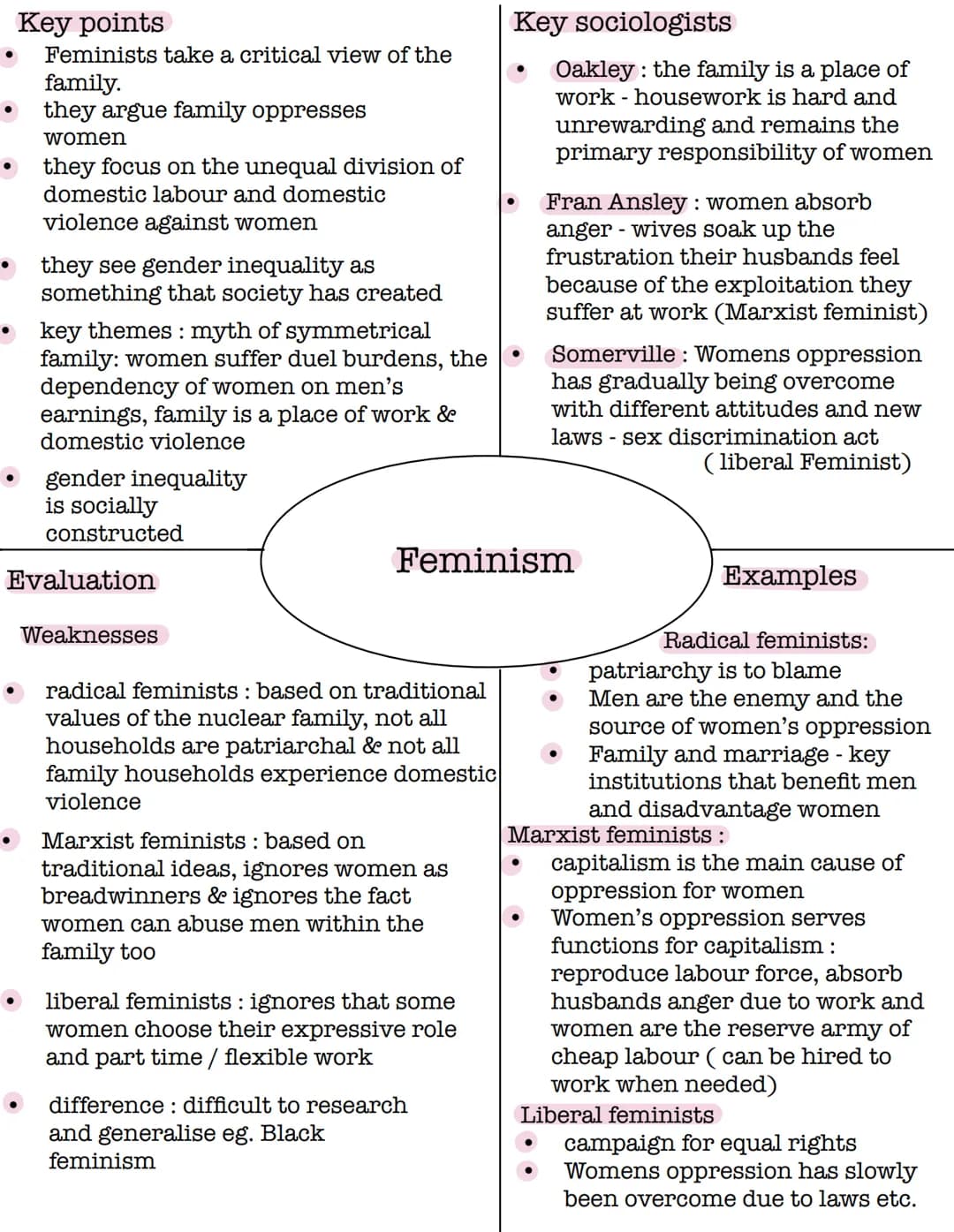
Feminist Perspectives on Family
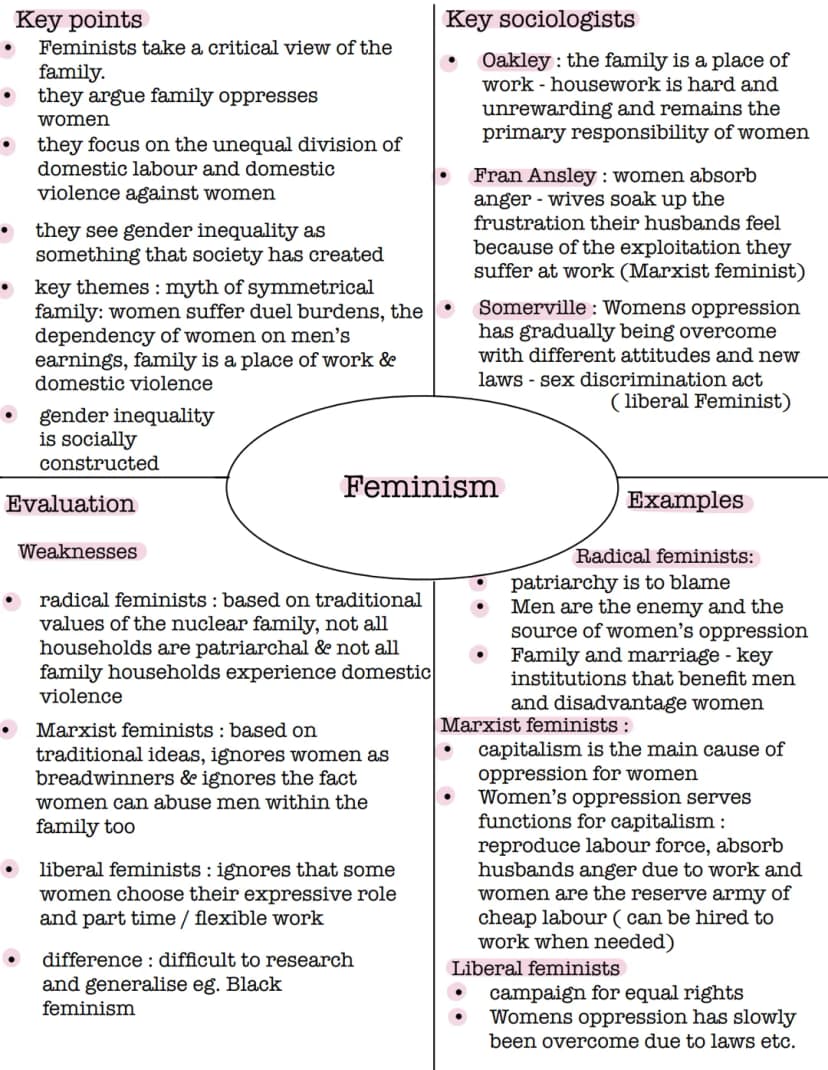
Feminists aren't having any of the "happy family" narrative - they see families as places where gender inequality thrives and women get a raw deal. Unlike other theories, feminism comes in different flavours, each with its own take on what's wrong.
Radical feminists blame patriarchy entirely, seeing men as the enemy and family as an institution designed to benefit men. Marxist feminists point fingers at capitalism, arguing that women serve as a "reserve army of cheap labour" whilst absorbing their husbands' work frustrations. Liberal feminists like Somerville are more optimistic, believing laws like the Sex Discrimination Act are gradually improving things.
Oakley famously argued that housework is real work - it's just unpaid, undervalued, and overwhelmingly done by women. Fran Ansley developed the idea that wives "soak up" their husbands' anger from workplace exploitation, essentially becoming emotional punch bags.
Food for Thought: The "myth of symmetrical family" suggests that despite claims of equality, women still carry a dual burden of work and domestic responsibilities.
Critics argue that feminists focus too much on traditional nuclear families and ignore that some women choose expressive roles or that domestic violence isn't universal. They also overlook situations where women abuse men or serve as primary breadwinners.
4
of 7
Personal Life Perspective
Forget blood relations and marriage certificates - the Personal Life Perspective (PLP) says families are whatever people decide they are. This approach celebrates free will and argues that you can't understand relationships without knowing what they mean to the people involved.
The PLP absolutely slates structural theories like functionalism, Marxism, and feminism for being obsessed with traditional nuclear families. Instead, they focus on how families change throughout someone's life course and recognise the choices people make in creating their own definitions of family.
This perspective highlights both the positive and negative sides of intimate relationships. Yes, families provide belonging and relatedness, but they also acknowledge that biological families can involve abuse and unhappiness - relatedness isn't always sunshine and rainbows.
Modern Example: Nordqvist and Smart's 2014 study found that parents of donor-conceived children valued social bonds over genetic ones when forming family relationships.
The strength of this approach lies in understanding how people actually construct their family relationships rather than imposing outdated sociological definitions. It's refreshingly honest about the complexity of modern relationships and doesn't try to force everyone into the same box.
5
of 7
Postmodernism and Family Choice
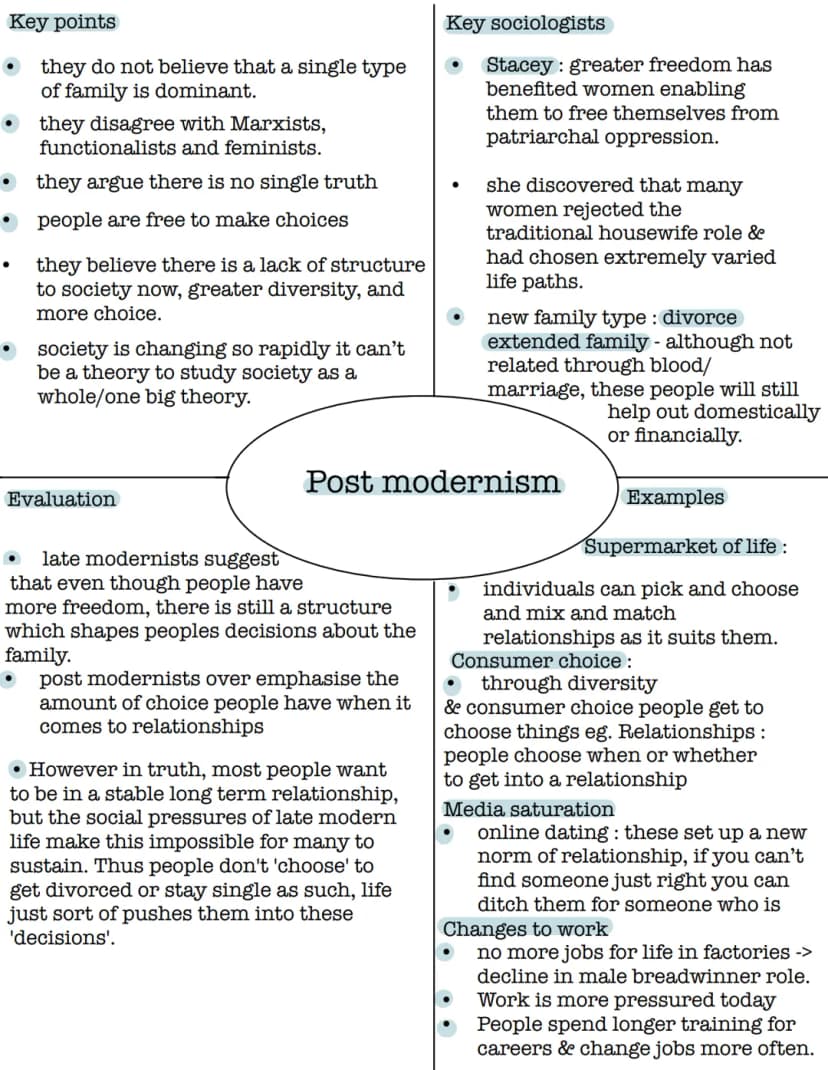
Welcome to the "supermarket of life" - postmodernists believe you can pick and mix relationships like choosing breakfast cereal. They reject the idea that any single family type dominates and argue that rapid social change makes grand theories pointless.
Stacey discovered that greater freedom has liberated many women from patriarchal oppression, leading to incredibly varied life paths and new family forms like "divorce extended families" (people who help each other despite not being related by blood or marriage). The key themes are diversity, consumer choice, and freedom from traditional structures.
Media saturation and online dating have created new relationship norms - if someone doesn't meet your exact requirements, you can simply move on to someone who does. Meanwhile, changes to work patterns have destroyed the traditional male breadwinner role, with people spending longer training for careers and changing jobs frequently.
Reality Check: Late modernists argue that whilst people have more freedom, social structures still heavily influence family decisions.
Critics suggest postmodernists overestimate how much choice people actually have. Most people still want stable, long-term relationships, but the pressures of modern life make this difficult to achieve. People don't necessarily "choose" divorce or singleness - life circumstances often push them into these situations.
6
of 7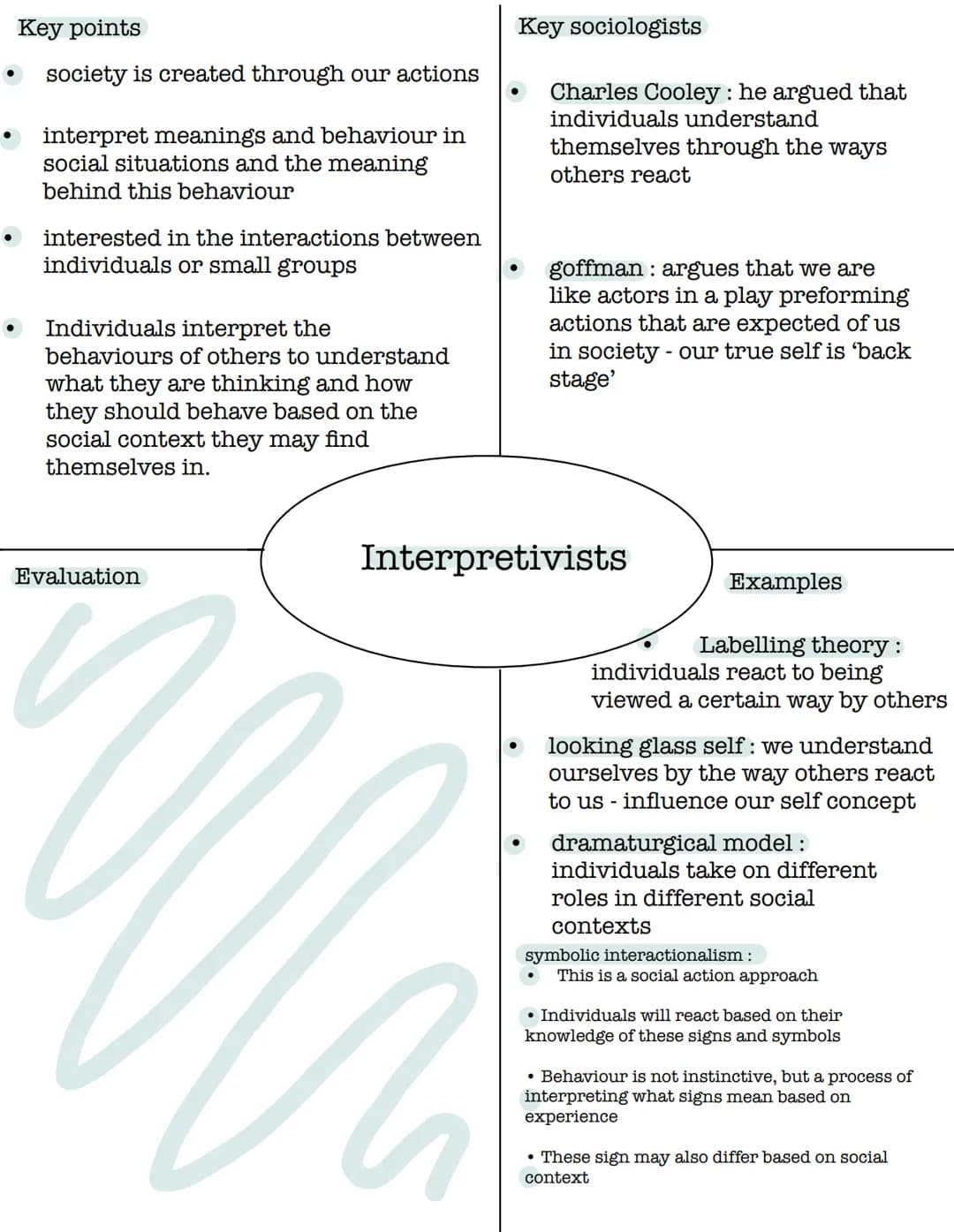
Interpretivist Approaches
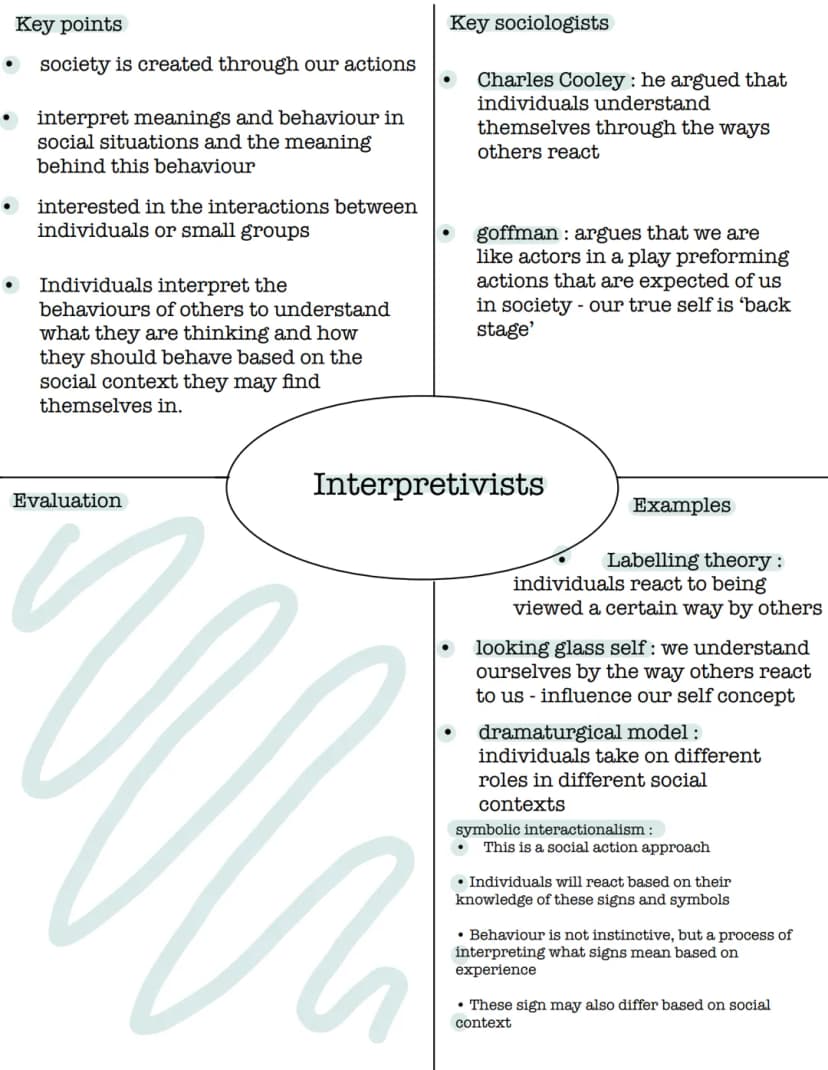
Interpretivists take a completely different angle - they're not interested in big theories about society, but in understanding how individuals make sense of their social world through interactions and meanings. Think small-scale, personal encounters rather than grand social structures.
Charles Cooley developed the "looking glass self" concept, arguing that we understand ourselves through how others react to us - basically, we see ourselves reflected in other people's responses. Goffman took this further with his dramaturgical model, suggesting we're all actors performing different roles depending on our social context, keeping our "true self" backstage.
Symbolic interactionism focuses on how people interpret signs and symbols in social situations. Our behaviour isn't instinctive - it's a process of reading social cues based on experience, and these interpretations can vary dramatically depending on the context.
Key Insight: Labelling theory suggests that individuals often react to being viewed a certain way by others, which can actually influence their behaviour and self-concept.
The strength of interpretivism lies in its focus on individual agency and meaning-making. However, critics argue it ignores broader social structures and power inequalities that shape people's choices and interactions in the first place.
7
of 7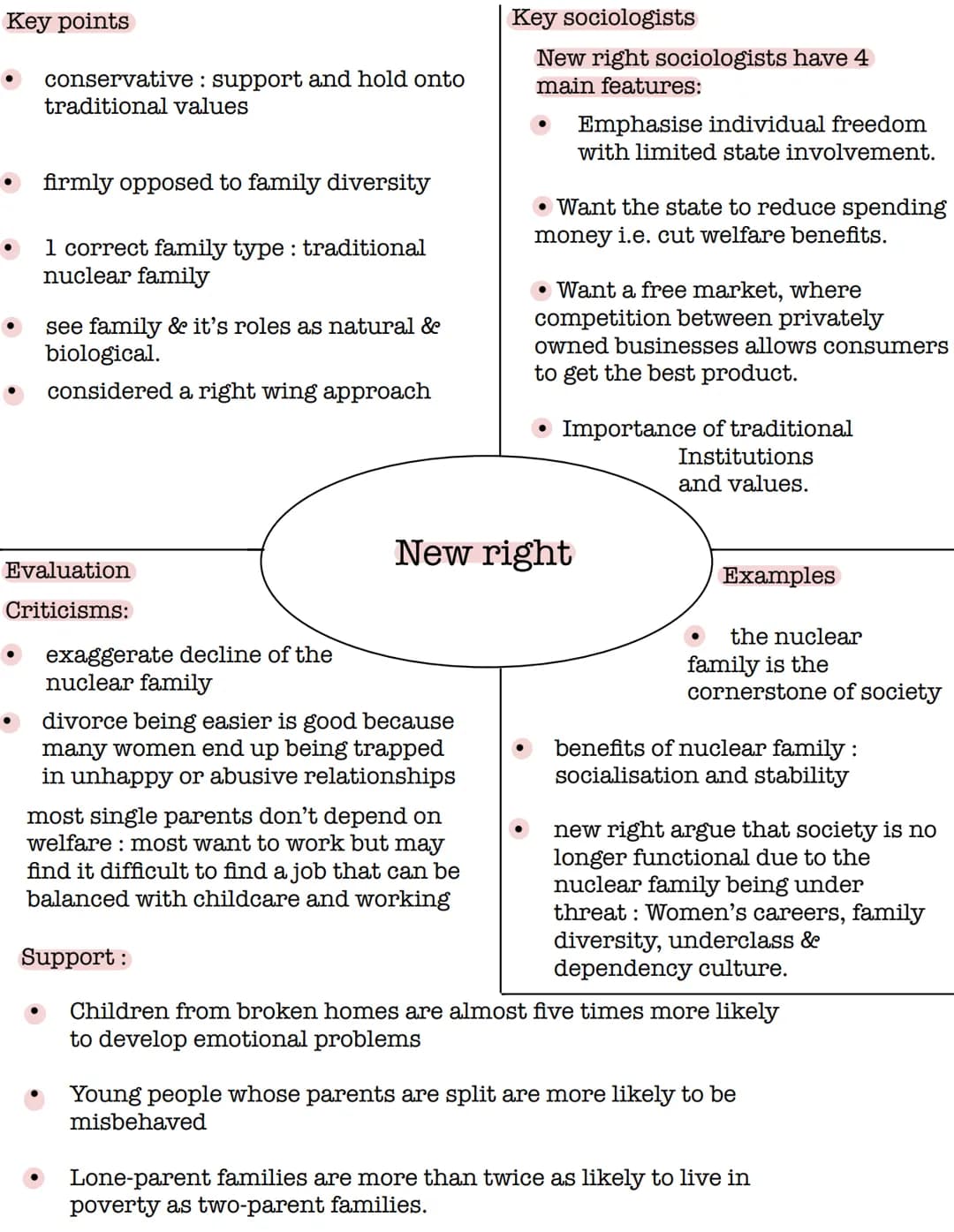
New Right Perspectives
The New Right are the traditionalists of sociology - they firmly believe there's only one "correct" family type: the traditional nuclear family. They see family roles as natural and biological rather than socially constructed, making them a distinctly conservative, right-wing approach to family sociology.
New Right thinkers emphasise four main principles: individual freedom with minimal state involvement, reduced welfare spending, free market competition, and the importance of traditional institutions and values. They argue that the nuclear family is society's "cornerstone" and that family diversity threatens social stability.
Their concerns focus on women's careers disrupting traditional roles, the rise of single-parent families creating an underclass, and what they call "dependency culture" where people rely too heavily on welfare benefits instead of traditional family support.
Supporting Evidence: They point out that children from broken homes are five times more likely to develop emotional problems, and lone-parent families are twice as likely to live in poverty.
Critics argue the New Right exaggerates the decline of nuclear families and ignores that easier divorce actually helps women escape unhappy or abusive relationships. They also overlook that most single parents want to work but struggle with childcare and job flexibility, rather than deliberately depending on welfare.
We thought you’d never ask...
What is the Knowunity AI companion?
Our AI companion is specifically built for the needs of students. Based on the millions of content pieces we have on the platform we can provide truly meaningful and relevant answers to students. But its not only about answers, the companion is even more about guiding students through their daily learning challenges, with personalised study plans, quizzes or content pieces in the chat and 100% personalisation based on the students skills and developments.
Where can I download the Knowunity app?
You can download the app in the Google Play Store and in the Apple App Store.
Is Knowunity really free of charge?
That's right! Enjoy free access to study content, connect with fellow students, and get instant help – all at your fingertips.
Similar Content
 Ethik
Ethik Philosophie
Most popular content: Free Will Vs Determinism
9CriminologyCriminology WJEC unit 2
Unit 2 notes for criminology certificate WJEC
121,41328
 Psychology
Issues and Debates
AQA paper 3 alevel psychology topic 9 - issues and debates - full active recall questions - notion.
121,07326
SociologyAQA A Level Sociology Crime and Deviance Mindmaps
Includes all topics form Crime and Deviance
121,95047
PsychologyKey Psychological Approaches
Explore essential concepts in A-Level AQA Psychology, including the Biological, Behavioural, Cognitive, Humanistic, and Psychodynamic approaches. This comprehensive summary covers key theories, evaluations, and applications, providing a solid foundation for understanding psychological principles. Ideal for exam preparation and revision.
127778
SociologySociological Theory Essay Plans
Aqa A Level Sociological Theory Essay Plans on every topic
125099
PsychologyKey Psychological Debates
Explore essential concepts in AQA A Level Psychology, including cultural bias, gender bias, nature vs. nurture, and ethical issues. This summary covers critical evaluations of determinism, free will, and the idiographic vs. nomothetic approaches, providing a comprehensive overview for students preparing for exams.
125,617186
PsychologyPsychological Approaches Overview
Explore the key psychological approaches including behaviorism, psychodynamics, humanism, and cognitive theories. This summary highlights the debates of free will vs determinism, idiographic vs nomothetic methods, and the scientific credibility of each approach. Ideal for A-Level Psychology students seeking a comprehensive understanding of the subject.
122597
SociologyAQA A Level Sociology: Theories Paper 1 & 3
Notes for Q6 on Paper 1, and Q5 on Paper 2. I used Google Slides to condense the notes and used this as a basis for blurting & memorising!
122573
PsychologyFree Will & Determinism in Psychology - Issues and Debates
• revision notes for free will & determinism in psychology (issues and debates)
121835
Most popular content in Sociology
9SociologySociology of Education Overview
Explore comprehensive A-Level Sociology notes on the education system, covering key theories, policies, and sociological perspectives. This resource includes insights on marketisation, gender roles, cultural deprivation, and educational inequalities, providing a thorough understanding of how education shapes social stratification and individual achievement. Ideal for exam preparation and in-depth study.
12102,8693,040
SociologySociology of Families: Comprehensive Revision
Dive into an extensive overview of family dynamics, perspectives, and patterns in sociology. This resource covers key concepts such as family diversity, gender roles, marriage, and the impact of social policies on family structures. Perfect for A-Level Sociology students preparing for Paper 2.
1273,6612,307
SociologyComprehensive Crime & Deviance Overview
Explore an extensive revision of crime and deviance topics, including theories, types of crime, and the impact of media. This resource covers key concepts such as Marxism, functionalism, gender and crime, and the influence of globalization on criminal behavior. Ideal for students seeking a thorough understanding of criminology and its various theories. Type: Full Topic Revision.
1251,6541,399
SociologySociological Theories Overview
Comprehensive revision of key sociological theories including Functionalism, Marxism, Feminism, and Interpretivism. Explore concepts like value freedom, identity formation, and the critique of social control. Ideal for AQA A-Level Sociology students preparing for exams. This summary covers essential theories and their implications in sociology, providing a clear understanding of each perspective.
1231,442846
SociologySociology Research Methods Overview
Explore the essential research methods in A-Level Sociology, including structured, unstructured, and semi-structured interviews, official statistics, questionnaires, and observational techniques. This comprehensive guide covers practical and theoretical issues, advantages and disadvantages of each method, and their relevance in sociological research. Ideal for students preparing for exams or seeking to deepen their understanding of sociological research methodologies.
1228,944918
SociologyMedia Studies: Key Concepts & Theories
Dive into the essential concepts and theories of media studies for AQA A-level Sociology. This comprehensive revision guide covers topics such as media influence, representations, globalization, and sociological perspectives, ensuring you grasp the critical elements needed for your exams. Perfect for students seeking to enhance their understanding of media's role in society.
1222,717512
SociologyEducation-AQA A-level Sociology
Overview of the topic of education in alevel sociology, source:the sociology teacher
124,096118
SociologySociology Research Methods in Education
Explore key sociological research methods used in educational contexts, including ethical considerations, power dynamics, and various interview techniques. This summary provides essential insights for tackling 20-mark exam questions on methods in context, focusing on the role of education, labelling theory, and the impact of social factors on educational outcomes.
1222,113639
SociologyTheories of Religion Explained
Explore key sociological theories of religion, including functionalism, Marxism, and feminism. This summary covers definitions, the role of religion in society, and its impact on social change. Ideal for A-Level AQA Sociology students seeking to understand the complexities of belief systems and their societal implications.
128,462160
Most popular content
9SociologySociology of Education Overview
Explore comprehensive A-Level Sociology notes on the education system, covering key theories, policies, and sociological perspectives. This resource includes insights on marketisation, gender roles, cultural deprivation, and educational inequalities, providing a thorough understanding of how education shapes social stratification and individual achievement. Ideal for exam preparation and in-depth study.
12102,8693,040
SociologySociology of Families: Comprehensive Revision
Dive into an extensive overview of family dynamics, perspectives, and patterns in sociology. This resource covers key concepts such as family diversity, gender roles, marriage, and the impact of social policies on family structures. Perfect for A-Level Sociology students preparing for Paper 2.
1273,6612,307
CriminologyCriminology: Crime & Punishment Overview
Comprehensive mindmaps covering key concepts in the Crime and Punishment topic for WJEC Criminology Unit 4. This resource includes detailed insights into the Criminal Justice System, crime prevention strategies, sentencing models, and the roles of various agencies. Ideal for A-Level revision, ensuring you grasp essential theories and legislative processes to excel in your exams.
1254,8691,059
SociologyComprehensive Crime & Deviance Overview
Explore an extensive revision of crime and deviance topics, including theories, types of crime, and the impact of media. This resource covers key concepts such as Marxism, functionalism, gender and crime, and the influence of globalization on criminal behavior. Ideal for students seeking a thorough understanding of criminology and its various theories. Type: Full Topic Revision.
1251,6541,399
C
 Biology
Cell Biology and Cell structure
cell structures
93,2470
 English Literature
An Inspector Calls: Character Insights
Explore in-depth analysis and key quotes for characters in J.B. Priestley's 'An Inspector Calls'. This resource covers Gerald Croft, Inspector Goole, Sheila Birling, Mrs. Birling, Eric Birling, and Eva Smith, focusing on themes of class, gender roles, and social responsibility. Ideal for students aiming for Grade 8 and above.
1025,429907
CriminologyWJEC Unit 4 Criminology
Criminology unit 4 detailed revision note
127,151125
CriminologyCriminology Theories Overview
Explore key criminology theories and their implications on crime and deviance. This comprehensive summary covers biological, psychological, and sociological perspectives, including labelling theory, right realism, and the impact of social campaigns on policy development. Ideal for A-Level criminology students seeking to understand the complexities of criminal behaviour and the factors influencing crime prevention strategies.
129,760210
English LiteratureRomeo and Juliet: Key themes
Key Romeo and Juliet themes and analysed quotes
106,708198
Can't find what you're looking for? Explore other subjects.
Students love us — and so will you.
4.6/5App Store
4.7/5Google Play
The app is very easy to use and well designed. I have found everything I was looking for so far and have been able to learn a lot from the presentations! I will definitely use the app for a class assignment! And of course it also helps a lot as an inspiration.
Stefan SiOS user
This app is really great. There are so many study notes and help [...]. My problem subject is French, for example, and the app has so many options for help. Thanks to this app, I have improved my French. I would recommend it to anyone.
Samantha KlichAndroid user
Wow, I am really amazed. I just tried the app because I've seen it advertised many times and was absolutely stunned. This app is THE HELP you want for school and above all, it offers so many things, such as workouts and fact sheets, which have been VERY helpful to me personally.
AnnaiOS user
Sociology169 views·Updated Jun 17, 2026·7 pagesFamilies and Households: Key Perspective Overview
S
Sophie@sophiexox
Ever wondered why sociologists have such different views on what families are supposed to do? From traditional nuclear families to modern blended households, sociologists can't agree on what's best - and their debates reveal a lot about how society really...
1
of 7
Sign up to see the content. It's free!
- Access to all documents
- Improve your grades
- Join milions of students
Functionalism and the Family
Think of society like a human body - every part needs to work together to keep the whole thing alive. That's exactly how functionalists see families, using what they call the organic analogy to explain how social institutions support each other.
Murdock studied 250 different societies and found nuclear families everywhere, leading him to identify four key functions: managing the sex drive, reproduction, meeting economic needs, and socialisation. Meanwhile, Parsons focused on just two crucial roles: primary socialisation (teaching kids society's rules) and stabilising adult personalities through his famous warm bath theory.
This warm bath theory suggests that women naturally take expressive roles (emotional support) whilst men handle instrumental roles (breadwinning). The family becomes a safe haven where stressed workers can recharge and feel secure.
Quick Check: Durkheim argued that social solidarity (people sticking together) was essential for society to function properly.
However, this rosy picture ignores some harsh realities. Many couples now share both breadwinning and emotional responsibilities, and functionalists completely overlook family problems like domestic violence and women's exploitation. Their theories feel quite outdated when most women are now breadwinners themselves.
2
of 7Sign up to see the content. It's free!
- Access to all documents
- Improve your grades
- Join milions of students
Marxism and Family Structure
Here's where things get political - Marxists see families as part of capitalism's grand plan to keep the rich in power. They divide society into two parts: the economic base (who owns the factories, land, and means of production) and the superstructure (institutions like family, education, and media).
Karl Marx founded this theory, but Althusser and Engels developed the family angle. They argue that families brainwash children into accepting inequality as normal - this false class consciousness stops workers from rebelling against their exploitation. The nuclear family only emerged because capitalism needed it.
Zaretsky claimed families offer an illusion of escape from capitalist exploitation, like a fake holiday from reality. Meanwhile, the bourgeoisie (ruling class) use families to control the proletariat (working class) by making them think hierarchy is inevitable.
Reality Check: Engels believed people only started forming nuclear families when private property became important under capitalism.
Critics argue that Marxists ignore family diversity and the fact that people often marry for love, not economic reasons. Their focus on class conflict also overlooks how women's roles have dramatically changed in the 21st century.
3
of 7Sign up to see the content. It's free!
- Access to all documents
- Improve your grades
- Join milions of students
Feminist Perspectives on Family
Feminists aren't having any of the "happy family" narrative - they see families as places where gender inequality thrives and women get a raw deal. Unlike other theories, feminism comes in different flavours, each with its own take on what's wrong.
Radical feminists blame patriarchy entirely, seeing men as the enemy and family as an institution designed to benefit men. Marxist feminists point fingers at capitalism, arguing that women serve as a "reserve army of cheap labour" whilst absorbing their husbands' work frustrations. Liberal feminists like Somerville are more optimistic, believing laws like the Sex Discrimination Act are gradually improving things.
Oakley famously argued that housework is real work - it's just unpaid, undervalued, and overwhelmingly done by women. Fran Ansley developed the idea that wives "soak up" their husbands' anger from workplace exploitation, essentially becoming emotional punch bags.
Food for Thought: The "myth of symmetrical family" suggests that despite claims of equality, women still carry a dual burden of work and domestic responsibilities.
Critics argue that feminists focus too much on traditional nuclear families and ignore that some women choose expressive roles or that domestic violence isn't universal. They also overlook situations where women abuse men or serve as primary breadwinners.
4
of 7Sign up to see the content. It's free!
- Access to all documents
- Improve your grades
- Join milions of students
Personal Life Perspective
Forget blood relations and marriage certificates - the Personal Life Perspective (PLP) says families are whatever people decide they are. This approach celebrates free will and argues that you can't understand relationships without knowing what they mean to the people involved.
The PLP absolutely slates structural theories like functionalism, Marxism, and feminism for being obsessed with traditional nuclear families. Instead, they focus on how families change throughout someone's life course and recognise the choices people make in creating their own definitions of family.
This perspective highlights both the positive and negative sides of intimate relationships. Yes, families provide belonging and relatedness, but they also acknowledge that biological families can involve abuse and unhappiness - relatedness isn't always sunshine and rainbows.
Modern Example: Nordqvist and Smart's 2014 study found that parents of donor-conceived children valued social bonds over genetic ones when forming family relationships.
The strength of this approach lies in understanding how people actually construct their family relationships rather than imposing outdated sociological definitions. It's refreshingly honest about the complexity of modern relationships and doesn't try to force everyone into the same box.
5
of 7Sign up to see the content. It's free!
- Access to all documents
- Improve your grades
- Join milions of students
Postmodernism and Family Choice
Welcome to the "supermarket of life" - postmodernists believe you can pick and mix relationships like choosing breakfast cereal. They reject the idea that any single family type dominates and argue that rapid social change makes grand theories pointless.
Stacey discovered that greater freedom has liberated many women from patriarchal oppression, leading to incredibly varied life paths and new family forms like "divorce extended families" (people who help each other despite not being related by blood or marriage). The key themes are diversity, consumer choice, and freedom from traditional structures.
Media saturation and online dating have created new relationship norms - if someone doesn't meet your exact requirements, you can simply move on to someone who does. Meanwhile, changes to work patterns have destroyed the traditional male breadwinner role, with people spending longer training for careers and changing jobs frequently.
Reality Check: Late modernists argue that whilst people have more freedom, social structures still heavily influence family decisions.
Critics suggest postmodernists overestimate how much choice people actually have. Most people still want stable, long-term relationships, but the pressures of modern life make this difficult to achieve. People don't necessarily "choose" divorce or singleness - life circumstances often push them into these situations.
6
of 7Sign up to see the content. It's free!
- Access to all documents
- Improve your grades
- Join milions of students
Interpretivist Approaches
Interpretivists take a completely different angle - they're not interested in big theories about society, but in understanding how individuals make sense of their social world through interactions and meanings. Think small-scale, personal encounters rather than grand social structures.
Charles Cooley developed the "looking glass self" concept, arguing that we understand ourselves through how others react to us - basically, we see ourselves reflected in other people's responses. Goffman took this further with his dramaturgical model, suggesting we're all actors performing different roles depending on our social context, keeping our "true self" backstage.
Symbolic interactionism focuses on how people interpret signs and symbols in social situations. Our behaviour isn't instinctive - it's a process of reading social cues based on experience, and these interpretations can vary dramatically depending on the context.
Key Insight: Labelling theory suggests that individuals often react to being viewed a certain way by others, which can actually influence their behaviour and self-concept.
The strength of interpretivism lies in its focus on individual agency and meaning-making. However, critics argue it ignores broader social structures and power inequalities that shape people's choices and interactions in the first place.
7
of 7Sign up to see the content. It's free!
- Access to all documents
- Improve your grades
- Join milions of students
New Right Perspectives
The New Right are the traditionalists of sociology - they firmly believe there's only one "correct" family type: the traditional nuclear family. They see family roles as natural and biological rather than socially constructed, making them a distinctly conservative, right-wing approach to family sociology.
New Right thinkers emphasise four main principles: individual freedom with minimal state involvement, reduced welfare spending, free market competition, and the importance of traditional institutions and values. They argue that the nuclear family is society's "cornerstone" and that family diversity threatens social stability.
Their concerns focus on women's careers disrupting traditional roles, the rise of single-parent families creating an underclass, and what they call "dependency culture" where people rely too heavily on welfare benefits instead of traditional family support.
Supporting Evidence: They point out that children from broken homes are five times more likely to develop emotional problems, and lone-parent families are twice as likely to live in poverty.
Critics argue the New Right exaggerates the decline of nuclear families and ignores that easier divorce actually helps women escape unhappy or abusive relationships. They also overlook that most single parents want to work but struggle with childcare and job flexibility, rather than deliberately depending on welfare.
We thought you’d never ask...
What is the Knowunity AI companion?
Our AI companion is specifically built for the needs of students. Based on the millions of content pieces we have on the platform we can provide truly meaningful and relevant answers to students. But its not only about answers, the companion is even more about guiding students through their daily learning challenges, with personalised study plans, quizzes or content pieces in the chat and 100% personalisation based on the students skills and developments.
Where can I download the Knowunity app?
You can download the app in the Google Play Store and in the Apple App Store.
Is Knowunity really free of charge?
That's right! Enjoy free access to study content, connect with fellow students, and get instant help – all at your fingertips.
Similar Content
Most popular content: Free Will Vs Determinism
9CriminologyCriminology WJEC unit 2
Unit 2 notes for criminology certificate WJEC
121,41328
PsychologyIssues and Debates
AQA paper 3 alevel psychology topic 9 - issues and debates - full active recall questions - notion.
121,07326
SociologyAQA A Level Sociology Crime and Deviance Mindmaps
Includes all topics form Crime and Deviance
121,95047
PsychologyKey Psychological Approaches
Explore essential concepts in A-Level AQA Psychology, including the Biological, Behavioural, Cognitive, Humanistic, and Psychodynamic approaches. This comprehensive summary covers key theories, evaluations, and applications, providing a solid foundation for understanding psychological principles. Ideal for exam preparation and revision.
127778
SociologySociological Theory Essay Plans
Aqa A Level Sociological Theory Essay Plans on every topic
125099
PsychologyKey Psychological Debates
Explore essential concepts in AQA A Level Psychology, including cultural bias, gender bias, nature vs. nurture, and ethical issues. This summary covers critical evaluations of determinism, free will, and the idiographic vs. nomothetic approaches, providing a comprehensive overview for students preparing for exams.
125,617186
PsychologyPsychological Approaches Overview
Explore the key psychological approaches including behaviorism, psychodynamics, humanism, and cognitive theories. This summary highlights the debates of free will vs determinism, idiographic vs nomothetic methods, and the scientific credibility of each approach. Ideal for A-Level Psychology students seeking a comprehensive understanding of the subject.
122597
SociologyAQA A Level Sociology: Theories Paper 1 & 3
Notes for Q6 on Paper 1, and Q5 on Paper 2. I used Google Slides to condense the notes and used this as a basis for blurting & memorising!
122573
PsychologyFree Will & Determinism in Psychology - Issues and Debates
• revision notes for free will & determinism in psychology (issues and debates)
121835
Most popular content in Sociology
9SociologySociology of Education Overview
Explore comprehensive A-Level Sociology notes on the education system, covering key theories, policies, and sociological perspectives. This resource includes insights on marketisation, gender roles, cultural deprivation, and educational inequalities, providing a thorough understanding of how education shapes social stratification and individual achievement. Ideal for exam preparation and in-depth study.
12102,8693,040
SociologySociology of Families: Comprehensive Revision
Dive into an extensive overview of family dynamics, perspectives, and patterns in sociology. This resource covers key concepts such as family diversity, gender roles, marriage, and the impact of social policies on family structures. Perfect for A-Level Sociology students preparing for Paper 2.
1273,6612,307
SociologyComprehensive Crime & Deviance Overview
Explore an extensive revision of crime and deviance topics, including theories, types of crime, and the impact of media. This resource covers key concepts such as Marxism, functionalism, gender and crime, and the influence of globalization on criminal behavior. Ideal for students seeking a thorough understanding of criminology and its various theories. Type: Full Topic Revision.
1251,6541,399
SociologySociological Theories Overview
Comprehensive revision of key sociological theories including Functionalism, Marxism, Feminism, and Interpretivism. Explore concepts like value freedom, identity formation, and the critique of social control. Ideal for AQA A-Level Sociology students preparing for exams. This summary covers essential theories and their implications in sociology, providing a clear understanding of each perspective.
1231,442846
SociologySociology Research Methods Overview
Explore the essential research methods in A-Level Sociology, including structured, unstructured, and semi-structured interviews, official statistics, questionnaires, and observational techniques. This comprehensive guide covers practical and theoretical issues, advantages and disadvantages of each method, and their relevance in sociological research. Ideal for students preparing for exams or seeking to deepen their understanding of sociological research methodologies.
1228,944918
SociologyMedia Studies: Key Concepts & Theories
Dive into the essential concepts and theories of media studies for AQA A-level Sociology. This comprehensive revision guide covers topics such as media influence, representations, globalization, and sociological perspectives, ensuring you grasp the critical elements needed for your exams. Perfect for students seeking to enhance their understanding of media's role in society.
1222,717512
SociologyEducation-AQA A-level Sociology
Overview of the topic of education in alevel sociology, source:the sociology teacher
124,096118
SociologySociology Research Methods in Education
Explore key sociological research methods used in educational contexts, including ethical considerations, power dynamics, and various interview techniques. This summary provides essential insights for tackling 20-mark exam questions on methods in context, focusing on the role of education, labelling theory, and the impact of social factors on educational outcomes.
1222,113639
SociologyTheories of Religion Explained
Explore key sociological theories of religion, including functionalism, Marxism, and feminism. This summary covers definitions, the role of religion in society, and its impact on social change. Ideal for A-Level AQA Sociology students seeking to understand the complexities of belief systems and their societal implications.
128,462160
Most popular content
9SociologySociology of Education Overview
Explore comprehensive A-Level Sociology notes on the education system, covering key theories, policies, and sociological perspectives. This resource includes insights on marketisation, gender roles, cultural deprivation, and educational inequalities, providing a thorough understanding of how education shapes social stratification and individual achievement. Ideal for exam preparation and in-depth study.
12102,8693,040
SociologySociology of Families: Comprehensive Revision
Dive into an extensive overview of family dynamics, perspectives, and patterns in sociology. This resource covers key concepts such as family diversity, gender roles, marriage, and the impact of social policies on family structures. Perfect for A-Level Sociology students preparing for Paper 2.
1273,6612,307
CriminologyCriminology: Crime & Punishment Overview
Comprehensive mindmaps covering key concepts in the Crime and Punishment topic for WJEC Criminology Unit 4. This resource includes detailed insights into the Criminal Justice System, crime prevention strategies, sentencing models, and the roles of various agencies. Ideal for A-Level revision, ensuring you grasp essential theories and legislative processes to excel in your exams.
1254,8691,059
SociologyComprehensive Crime & Deviance Overview
Explore an extensive revision of crime and deviance topics, including theories, types of crime, and the impact of media. This resource covers key concepts such as Marxism, functionalism, gender and crime, and the influence of globalization on criminal behavior. Ideal for students seeking a thorough understanding of criminology and its various theories. Type: Full Topic Revision.
1251,6541,399
C
BiologyCell Biology and Cell structure
cell structures
93,2470
English LiteratureAn Inspector Calls: Character Insights
Explore in-depth analysis and key quotes for characters in J.B. Priestley's 'An Inspector Calls'. This resource covers Gerald Croft, Inspector Goole, Sheila Birling, Mrs. Birling, Eric Birling, and Eva Smith, focusing on themes of class, gender roles, and social responsibility. Ideal for students aiming for Grade 8 and above.
1025,429907
CriminologyWJEC Unit 4 Criminology
Criminology unit 4 detailed revision note
127,151125
CriminologyCriminology Theories Overview
Explore key criminology theories and their implications on crime and deviance. This comprehensive summary covers biological, psychological, and sociological perspectives, including labelling theory, right realism, and the impact of social campaigns on policy development. Ideal for A-Level criminology students seeking to understand the complexities of criminal behaviour and the factors influencing crime prevention strategies.
129,760210
English LiteratureRomeo and Juliet: Key themes
Key Romeo and Juliet themes and analysed quotes
106,708198
Can't find what you're looking for? Explore other subjects.
Students love us — and so will you.
4.6/5App Store
4.7/5Google Play
The app is very easy to use and well designed. I have found everything I was looking for so far and have been able to learn a lot from the presentations! I will definitely use the app for a class assignment! And of course it also helps a lot as an inspiration.
Stefan SiOS user
This app is really great. There are so many study notes and help [...]. My problem subject is French, for example, and the app has so many options for help. Thanks to this app, I have improved my French. I would recommend it to anyone.
Samantha KlichAndroid user
Wow, I am really amazed. I just tried the app because I've seen it advertised many times and was absolutely stunned. This app is THE HELP you want for school and above all, it offers so many things, such as workouts and fact sheets, which have been VERY helpful to me personally.
AnnaiOS user