

Crime and deviance sociologyexplores how societies understand and respond...
 Sociology51,654 views·Updated Jun 15, 2026·38 pages
Fun and Easy Sociology Notes on Crime and Deviance Revision PDF


1 / 10
1
of 10
Understanding Crime and Deviance in Sociology
Crime and deviance sociology topics form a crucial area of study that examines how societies define and respond to rule-breaking behaviors. This comprehensive overview explores key theoretical frameworks and their practical applications in understanding criminal behavior and social responses.
Definition: Crime refers to actions that violate formal laws, while deviance encompasses any behavior that breaks social norms, whether legally prohibited or not.
Crime and deviance sociology a level notes typically begin with foundational concepts that help students grasp the complex relationship between individual behavior and societal structures. Understanding these concepts is essential for analyzing patterns of criminal behavior and social control mechanisms.
The study of crime and deviance reveals how societies maintain order while simultaneously adapting to change. This dynamic process involves various social institutions, cultural values, and power structures that influence both conformity and rule-breaking behaviors.
Highlight: Crime and deviance serve multiple functions in society, including reinforcing social bonds, facilitating necessary changes, and highlighting areas requiring reform.
2
of 10
Functionalist Perspectives on Crime and Society
Functionalist strain and subcultural theories pdf materials explore how social structures influence criminal behavior. These theories examine how society's organization can create pressures that lead some individuals toward deviant behavior.
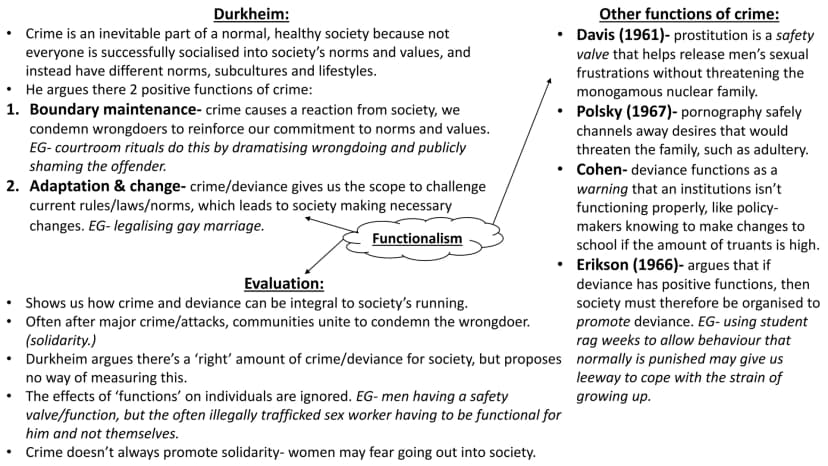
Emile Durkheim theory presents crime as an inevitable and necessary part of society. Durkheim argued that crime serves several essential functions:
Example: Boundary maintenance crime example includes public court proceedings that reinforce social values by publicly condemning wrongdoers.
The concept of why is crime necessary to the functioning of society relates to several key aspects:
- It reinforces social norms through collective responses
- It allows for social adaptation and change
- It serves as a safety valve for social tensions
3
of 10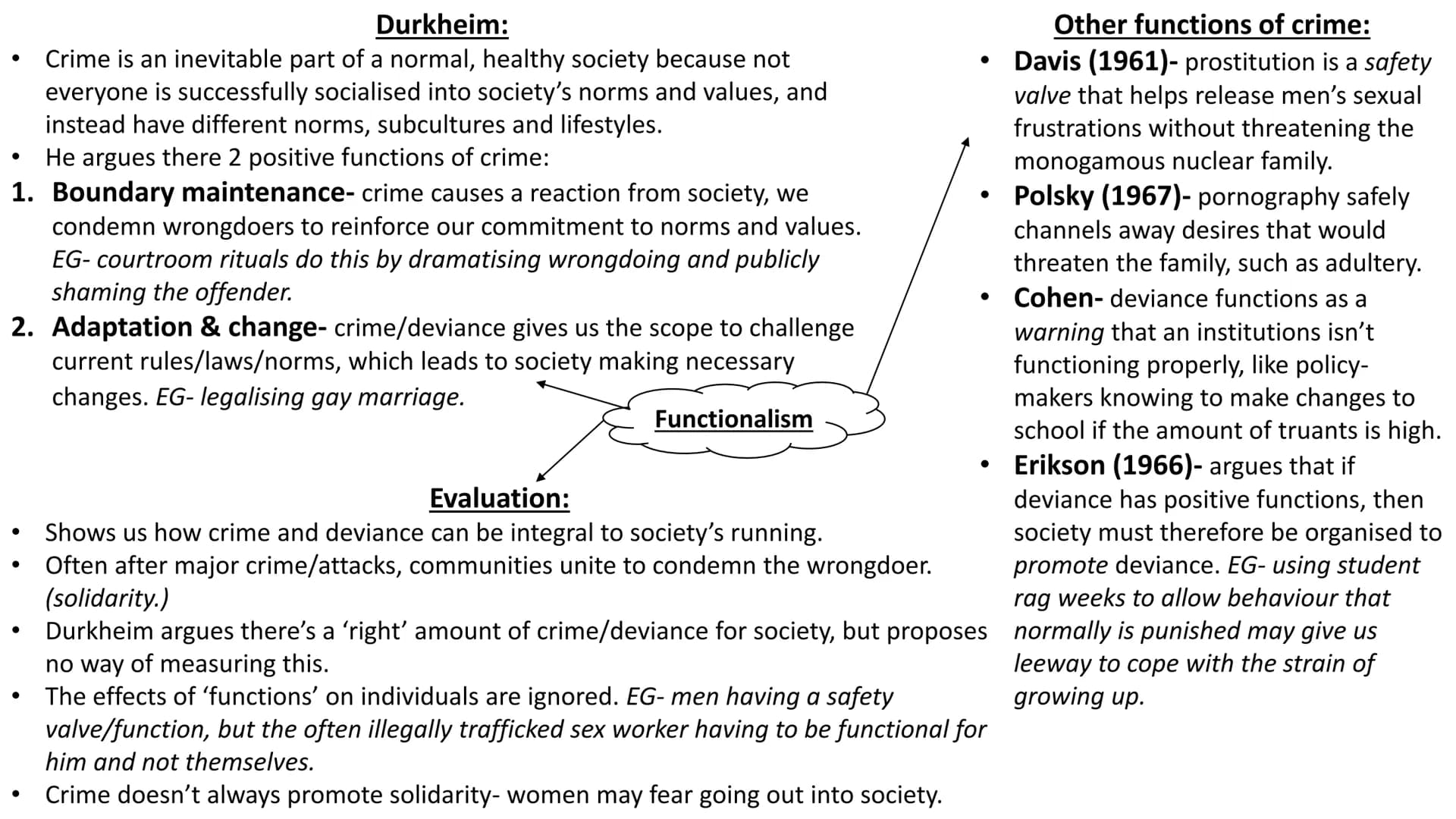
Functions of Crime in Society
The 4 functions of crime identified by sociologists demonstrate how deviant behavior contributes to social stability and change:
- Boundary Maintenance
- Social Unity
- Social Change
- Safety Valve Function
Quote: "Crime is normal because a society exempt from it would be utterly impossible" - Emile Durkheim
Functions of crime sociology studies reveal how deviant behavior can paradoxically strengthen social bonds. When communities unite against wrongdoing, they reinforce shared values and collective identity.
Why is crime inevitable becomes clear when examining how societies evolve and adapt. Crime often highlights areas where social institutions need reform or where cultural values are in transition.
4
of 10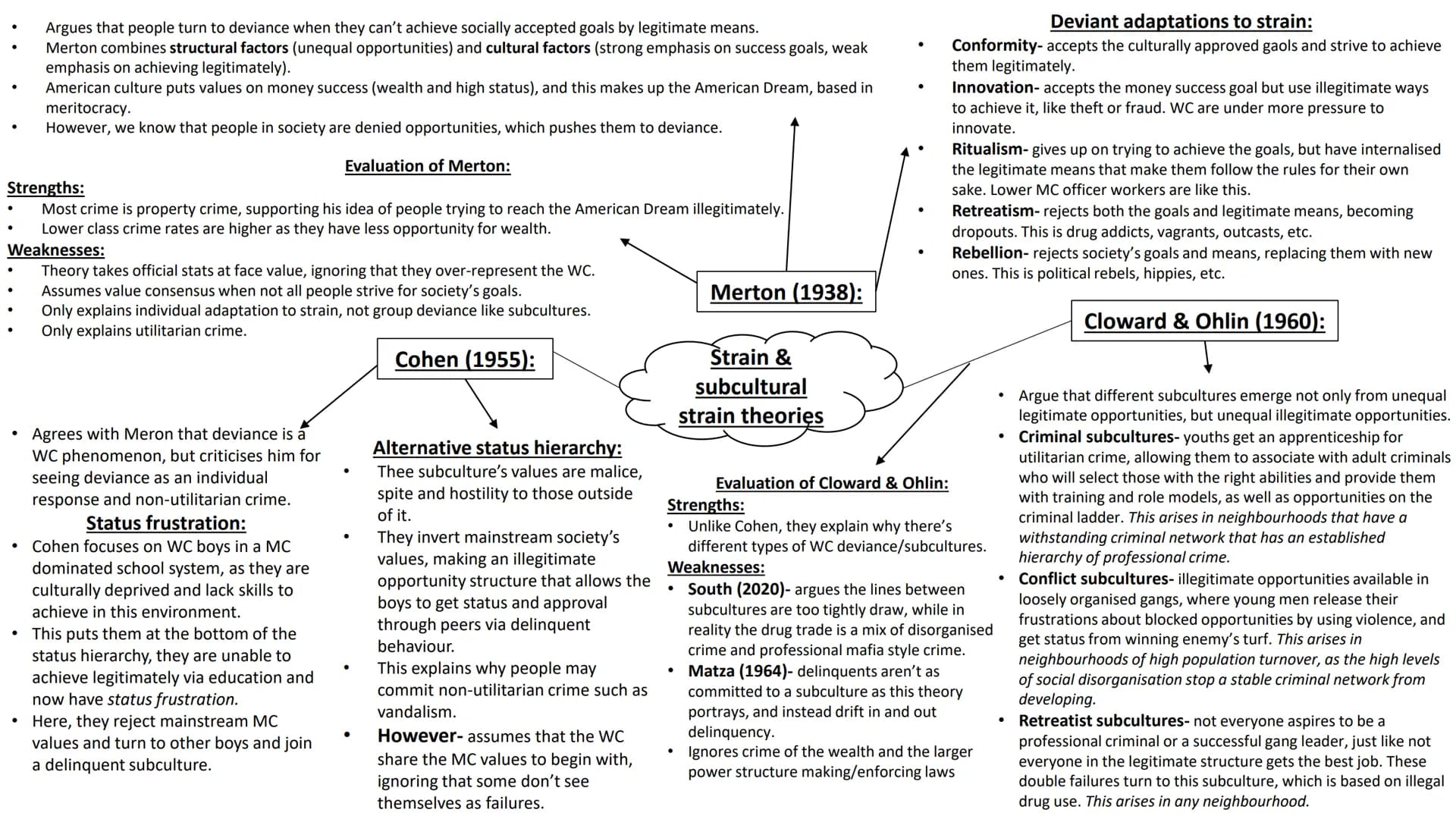
Strain Theory and Social Adaptation
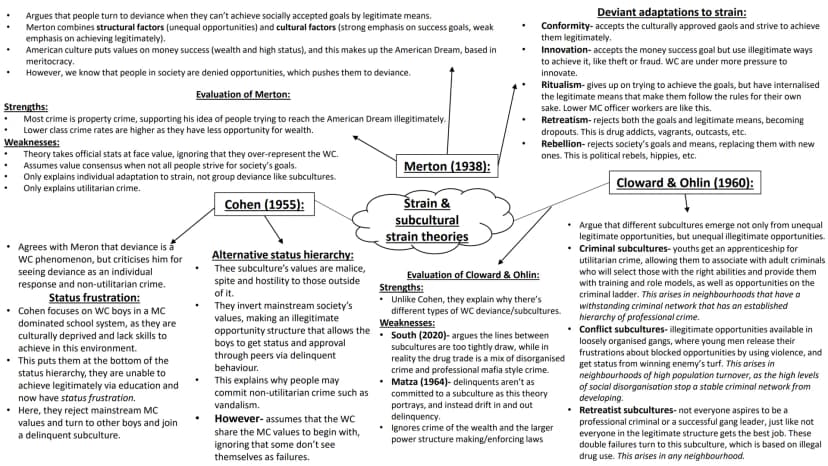
Strain theory explains how social pressures can lead to deviant behavior. When examining legitimate and illegitimate opportunities definition sociology, we see how blocked access to conventional success can push individuals toward alternative paths.
Retreatist subculture definition sociology describes groups that reject both conventional goals and means of achievement. These groups often form when individuals face:
- Limited legitimate opportunities
- Restricted access to illegitimate opportunities
- Social alienation
Vocabulary: Are Cloward and Ohlin functionalists - While they build on functionalist ideas, they focus more specifically on how different types of criminal opportunities lead to distinct forms of deviance.
The strengths and weaknesses of functionalist theory of crime reveal both its explanatory power and limitations. While it effectively explains some aspects of crime's social role, it may overlook individual experiences and varying cultural contexts.
5
of 10
Understanding Interactionism and Labelling Theory in Crime and Deviance
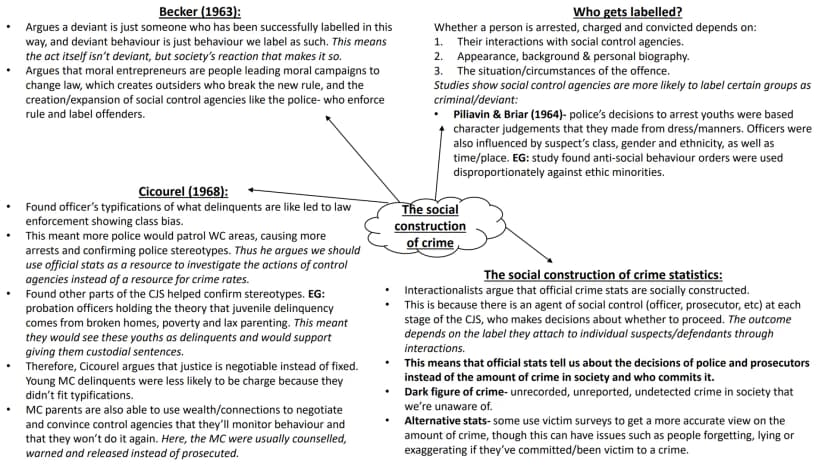
Labelling theory fundamentally reshapes our understanding of crime and deviance by examining how society's reactions create and perpetuate criminal behavior. Howard Becker's groundbreaking 1963 work established that deviance isn't inherent in any action - rather, it emerges from society successfully labeling certain behaviors as deviant. This process involves moral entrepreneurs who campaign for new laws, creating "outsiders" who violate these rules and expanding social control agencies that enforce them.
The social construction of crime statistics reveals crucial insights about how criminal justice operates. Cicourel's research demonstrated how law enforcement officers' preconceptions about what makes someone "criminal" led to class-based bias in policing. This resulted in increased patrol presence in working-class areas, creating a self-fulfilling prophecy of higher arrest rates that seemed to validate initial stereotypes.
Definition: The dark figure of crime refers to unrecorded, unreported, and undetected criminal activity that official statistics fail to capture.
The criminal justice system's negotiable nature becomes evident through differential treatment based on social class. Middle-class delinquents often avoid charges by not fitting officer typifications, while their parents can leverage wealth and connections to negotiate alternatives to prosecution. This systematic bias demonstrates how labeling theory intersects with broader social inequalities.
6
of 10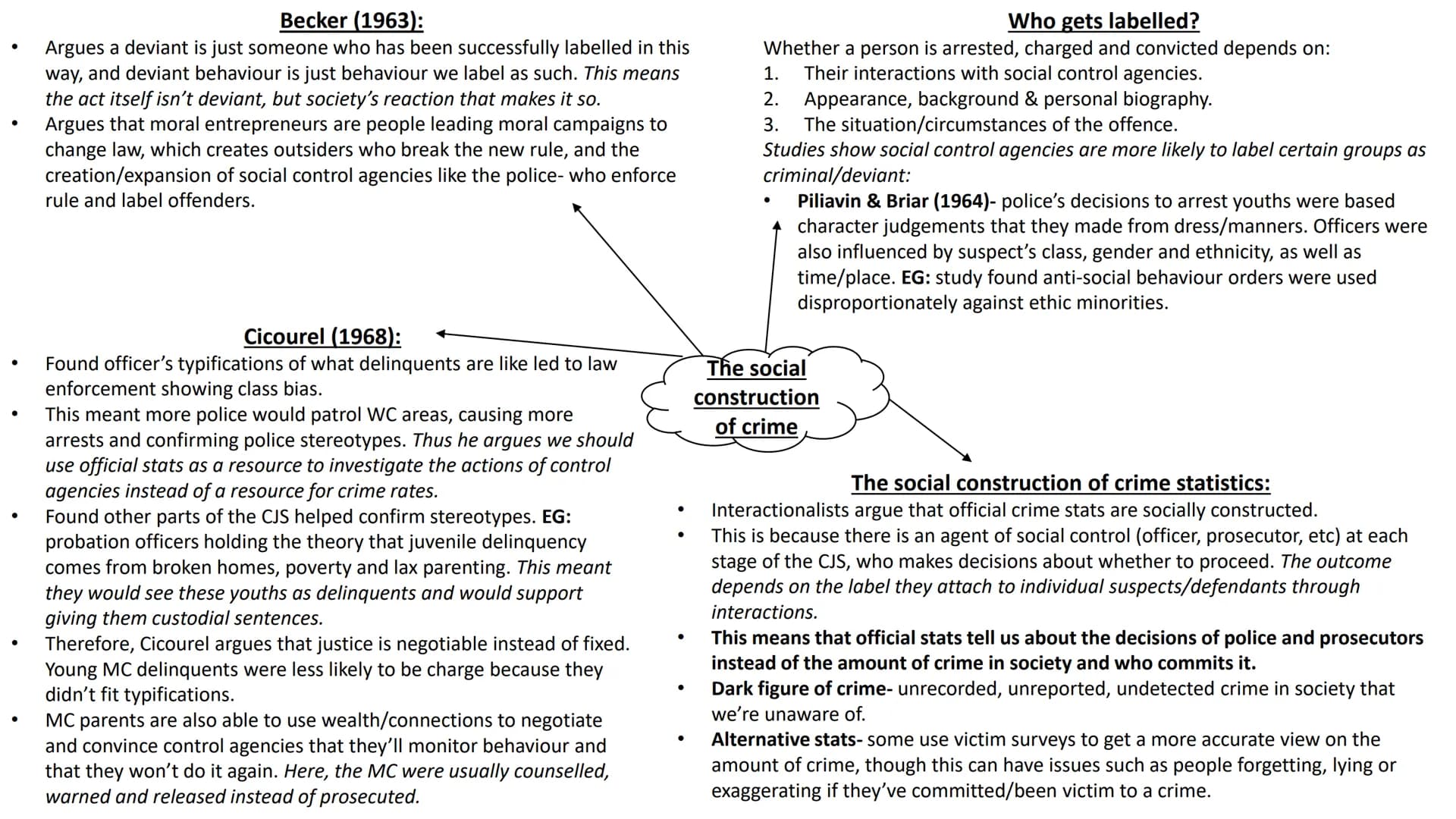
The Effects of Criminal Labeling and Deviance Amplification
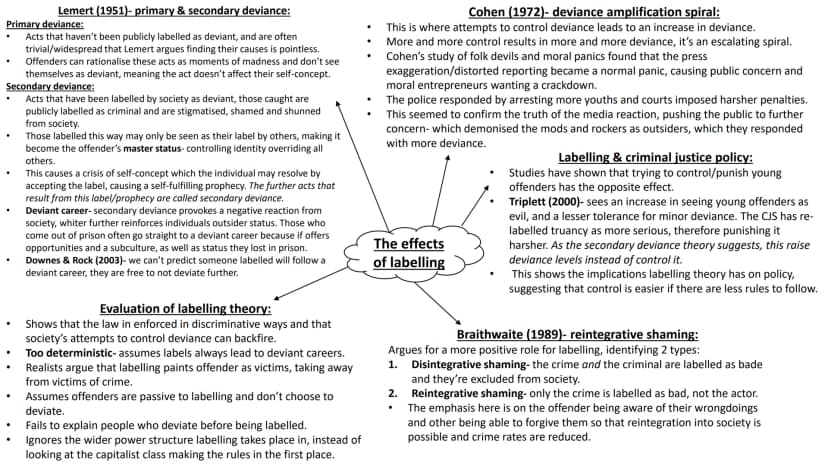
Lemert's distinction between primary and secondary deviance provides crucial insight into how labeling shapes criminal careers. Primary deviance encompasses minor infractions that don't fundamentally alter someone's self-concept. However, secondary deviance emerges after public labeling, when stigmatization forces individuals to potentially accept and internalize their criminal identity.
Highlight: The concept of the "master status" shows how a criminal label can override all other aspects of someone's identity, potentially leading to a self-fulfilling prophecy of continued deviance.
Cohen's deviance amplification spiral demonstrates how attempts to control crime can paradoxically increase it. Media exaggeration creates moral panics, leading to increased enforcement and harsher penalties. This apparent confirmation of public fears creates a cycle of escalating response and rebellion.
Example: The mods and rockers panic of the 1960s shows how media coverage and police response created a spiral of increasing deviance, as youth responded to demonization with further rebellion.
7
of 10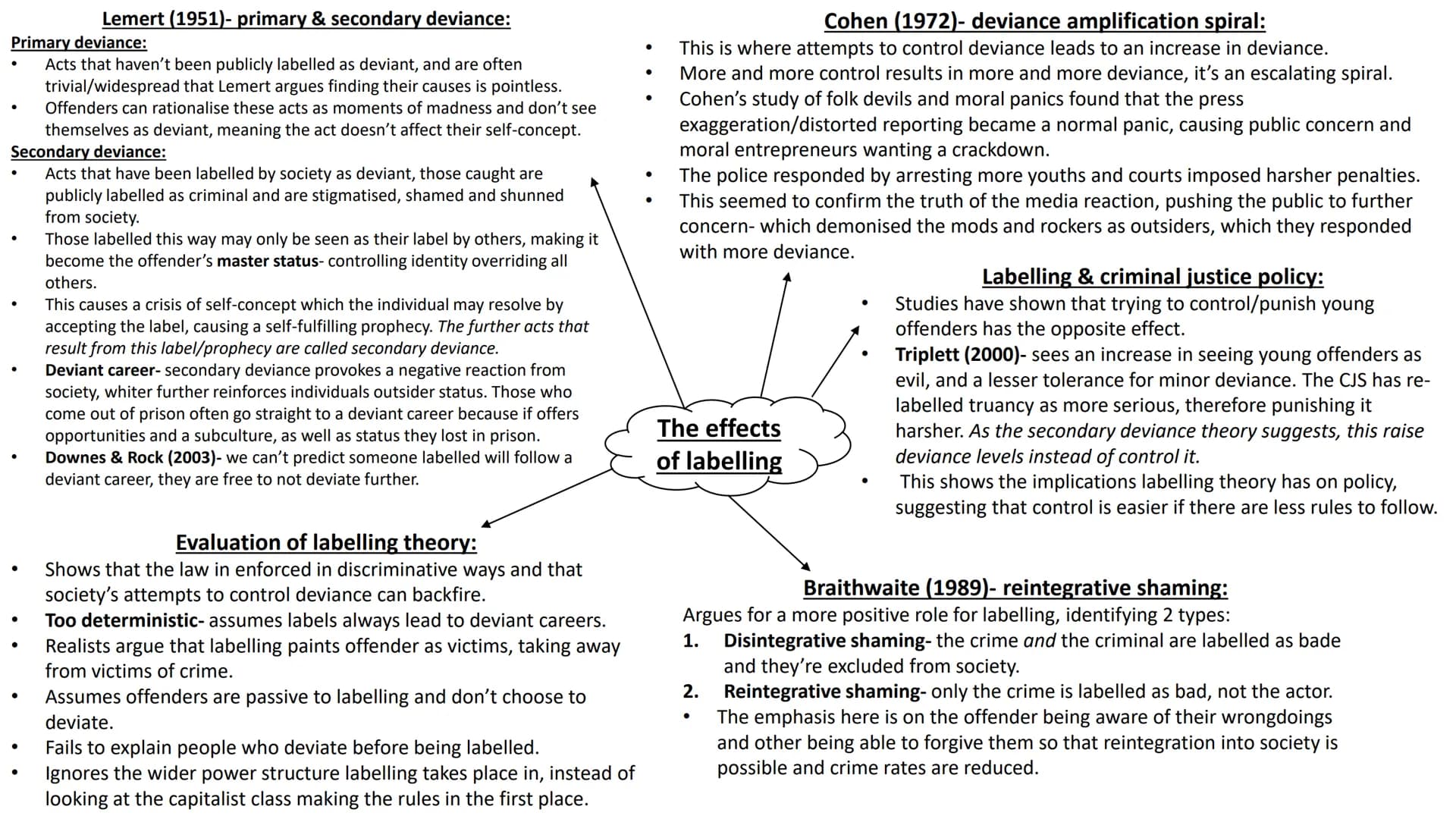
Class and Power Dynamics in Criminal Behavior
The relationship between capitalism and crime reveals deep structural connections. The criminogenic nature of capitalist society means crime becomes inevitable across all social classes, though for different reasons. Working-class crime may emerge from poverty or alienation, while corporate crime stems from competitive pressure and profit maximization.
Vocabulary: Criminogenic capitalism refers to how capitalist social structures inherently generate conditions that promote criminal behavior across all social classes.
The ideological functions of crime and law serve to maintain capitalist power structures. While some laws appear to protect workers, their selective enforcement often reinforces class divisions. Health and safety regulations illustrate this dynamic - they provide capitalism with a caring facade while remaining loosely enforced.
Quote: "Crime is a rational response to the capitalist system" - Gordon (1976)
8
of 10
Marxist Perspectives on Crime and Law Enforcement
Marxist criminology emphasizes how law-making and enforcement serve ruling class interests. Chambliss's historical analysis shows how property laws were deliberately crafted to support colonial economic exploitation, while Snider demonstrates continuing state reluctance to regulate business activities that threaten profitability.
The selective enforcement of laws reveals systematic bias in the criminal justice system. While working-class and minority offenders face aggressive prosecution, crimes of the powerful often go unpunished or receive lenient treatment. This pattern supports Marxist arguments about law enforcement's class-based nature.
Highlight: Marxist theory completes labelling theory by placing selective enforcement within broader structural power dynamics, though it may overlook other forms of inequality.
The strengths of Marxist approaches include explaining relationships between crime, capitalism, and class interests. However, critics note deterministic tendencies and insufficient attention to intra-class crime where both perpetrator and victim are working class.
9
of 10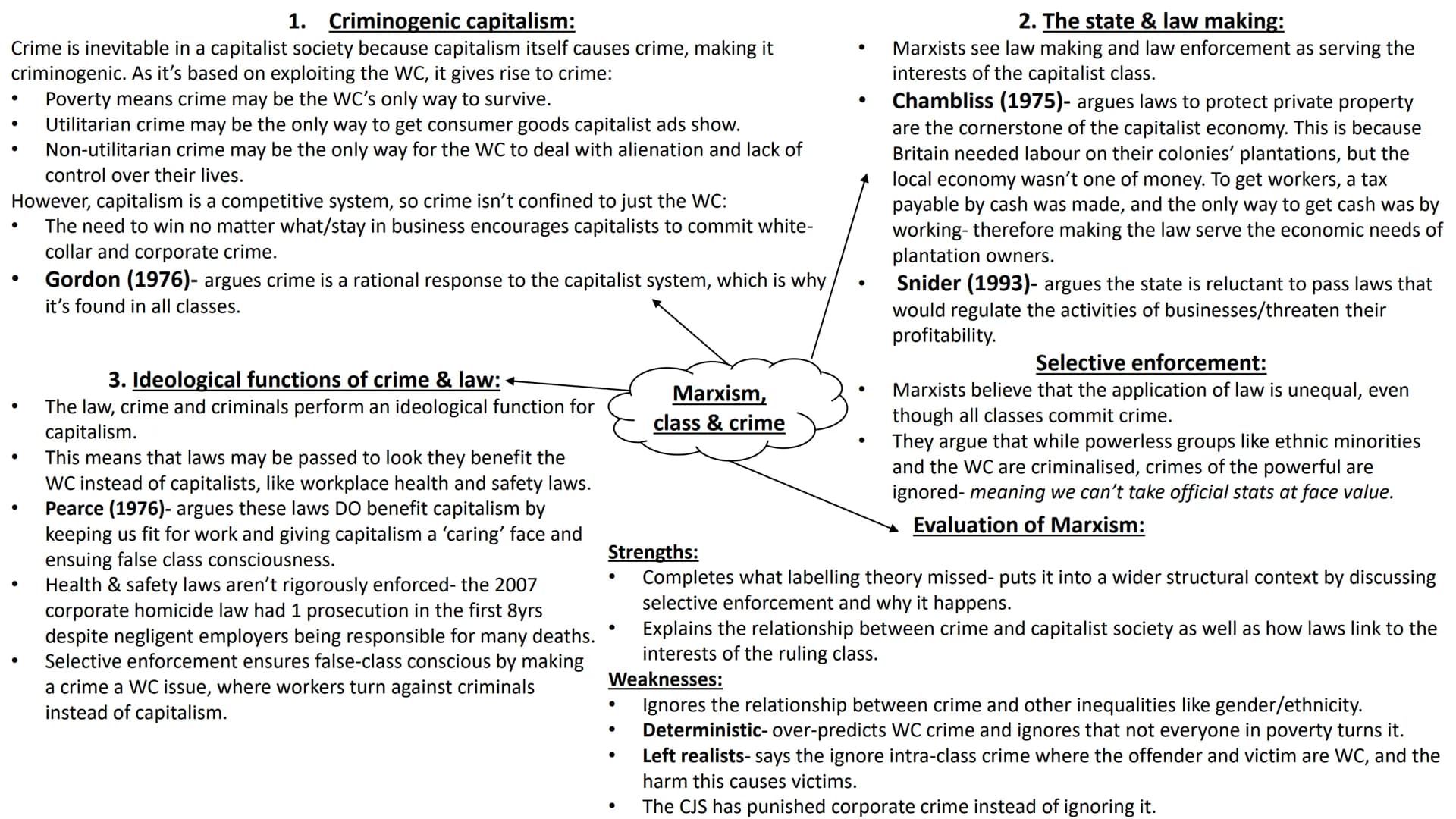
Understanding Neo-Marxist Perspectives on Crime and Society
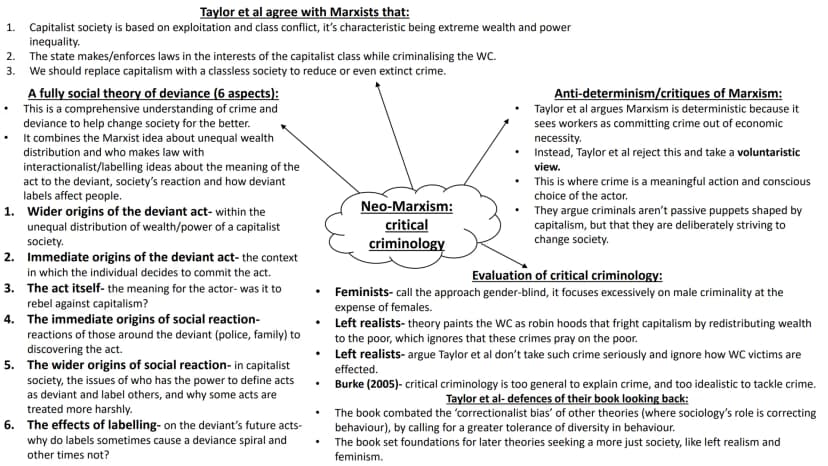
Neo-Marxist criminology, particularly through the lens of critical criminology, offers a comprehensive analysis of how capitalism influences criminal behavior and social control. This perspective examines the complex relationship between economic systems, power structures, and deviant behavior, providing crucial insights for crime and deviance sociology topics.
The Neo-Marxist approach introduces a "fully social theory of deviance" which consists of six interconnected aspects that help explain criminal behavior in capitalist societies. This framework combines traditional Marxist analysis of wealth distribution with interactionist perspectives on labeling and social reactions, creating a more nuanced understanding of crime and deviance sociology.
Definition: A fully social theory of deviance examines both the structural causes of crime and the interpretive aspects of deviant behavior, including social reactions and labeling effects.
The theory emphasizes how the wider origins of deviant acts stem from capitalism's unequal distribution of wealth and power. It then examines the immediate context of criminal decisions, the meaning of the act to the perpetrator, and society's responses at both micro and macro levels. This comprehensive approach helps explain why some individuals engage in criminal behavior while others don't, even under similar economic conditions.
Neo-Marxist criminologists, particularly Taylor and colleagues, challenge deterministic interpretations of criminal behavior. They argue that criminals aren't simply passive victims of economic circumstances but active agents making conscious choices. This voluntaristic view suggests that some criminal acts represent deliberate attempts to challenge and change the existing social order.
10
of 10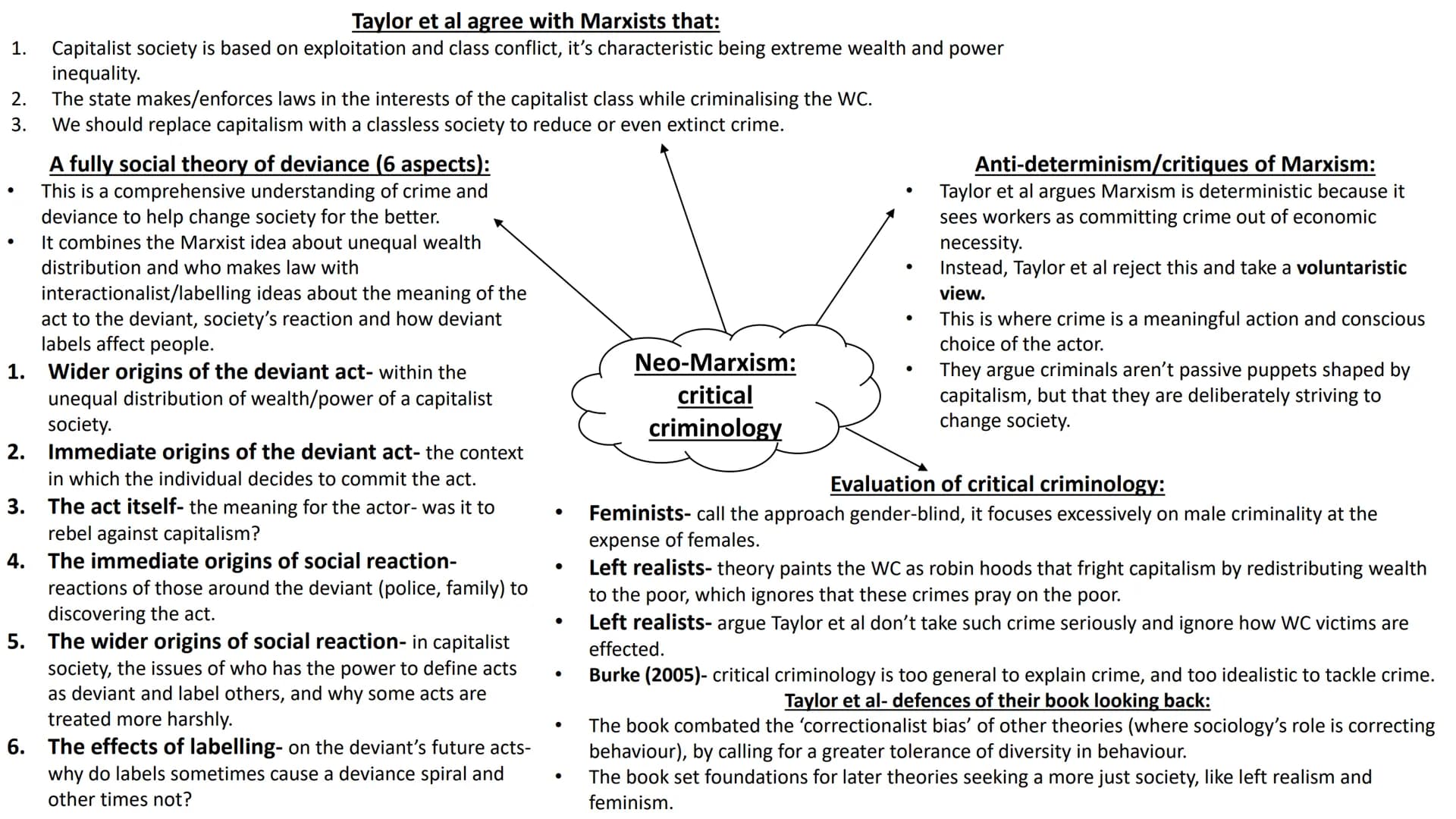
Critical Evaluation of Neo-Marxist Criminology
The Neo-Marxist approach to criminology, while innovative, faces several significant criticisms from different theoretical perspectives. These critiques help illuminate both the strengths and limitations of this approach to understanding crime and deviance sociology a level notes.
Feminist scholars have pointed out that critical criminology tends to be gender-blind, focusing predominantly on male criminality while overlooking female experiences with crime. This criticism highlights the need for a more inclusive approach to understanding criminal behavior across all demographic groups.
Highlight: Left realist critics argue that Neo-Marxist theory romantically portrays working-class criminals as modern-day Robin Hoods while ignoring how their actions often victimize other working-class individuals.
The theory's practical applications have also been questioned. Burke (2005) argues that critical criminology's broad theoretical framework, while intellectually compelling, proves too general for explaining specific instances of crime and too idealistic for developing practical crime prevention strategies. However, defenders of the approach emphasize its important contribution to challenging correctionalist biases in criminology and establishing foundations for more progressive approaches to criminal justice.
Despite these criticisms, the Neo-Marxist perspective has significantly influenced modern crime and deviance sociology revision, particularly in understanding how economic systems and power structures shape both criminal behavior and societal responses to crime. Its emphasis on examining both structural factors and individual agency continues to inform contemporary criminological theory and research.
We thought you’d never ask...
What is the Knowunity AI companion?
Our AI companion is specifically built for the needs of students. Based on the millions of content pieces we have on the platform we can provide truly meaningful and relevant answers to students. But its not only about answers, the companion is even more about guiding students through their daily learning challenges, with personalised study plans, quizzes or content pieces in the chat and 100% personalisation based on the students skills and developments.
Where can I download the Knowunity app?
You can download the app in the Google Play Store and in the Apple App Store.
Is Knowunity really free of charge?
That's right! Enjoy free access to study content, connect with fellow students, and get instant help – all at your fingertips.
Similar Content
 Diritto
Most popular content: Deviance and Social Control
9CriminologyCriminology Unit 4 Revision Cards
These were the revision cards I used for my Criminology Unit 4 exam. Feel free to print these out and use them as an exam resource, they have been colour coded for each AC. Good luck!
125,55090
SociologySociology of Crime
Comprehensive AQA A-Level sociology revision notes on crime and deviance. Explore key theories including Marxism, Right Realism, and Labelling Theory, alongside discussions on gender, ethnicity, and the impact of globalization on crime. Ideal for students preparing for exams, this resource covers crime prevention strategies, types of crime, and the role of media in shaping perceptions of criminality.
124,01277
CriminologyCrime & Punishment Overview
Explore a comprehensive summary of key concepts in crime and punishment, including the criminal justice system, prison dynamics, crime prevention strategies, and the roles of various agencies. This resource covers essential theories, the parliamentary law-making process, and the limitations of social control, tailored for WJEC Level 3 students. Ideal for exam preparation and understanding the complexities of crime and justice.
131,57518
SociologyCrime and deviance basics
Basics
132624
SociologyAQA Crime & Deviance Overview
Explore key concepts in AQA Crime and Deviance, including labelling theory, gender and crime, media influences, and sociological perspectives. This comprehensive summary covers essential theories such as Marxism, Functionalism, and Subcultural Theory, along with the role of social control agencies and the types of crime. Ideal for students preparing for exams or seeking a deeper understanding of criminology.
1193027
CriminologyUnderstanding Social Control
Explore the mechanisms of social control, including the role of the superego, cultural influences, and the criminal justice system. This summary delves into theories of crime, the impact of socialisation, and the importance of community bonds in preventing deviance. Ideal for criminology students seeking to grasp the complexities of social control and its implications on behavior.
131,35448
SociologySociology of Crime Insights
Explore key concepts in the sociology of crime, including gender roles, deviant behavior, and the impact of social inequality. This comprehensive study note covers various sociological theories such as functionalism, Marxism, and feminist perspectives, providing a critical analysis of crime statistics and unreported crime. Ideal for GCSE AQA Sociology students aiming for top grades.
101,69126
CriminologyAgencies in Social Control
Explore the role of various agencies in achieving social control within criminology. This study note covers key concepts such as environmental design, behavioral tactics, institutional strategies, and the limitations of state provisions. Understand how these elements contribute to crime prevention and the effectiveness of different approaches in the justice system.
132,00144
SociologyCrime and Deviance Theories
Explore key sociological perspectives on crime and deviance, including Functionalism, Marxism, Neo-Marxism, Interactionism, and Realism. This summary covers the causes of crime, the role of social control, and the impact of societal reactions. Ideal for students studying criminology and sociology.
133,245117
Most popular content in Sociology
9SociologySociology of Education Overview
Explore comprehensive A-Level Sociology notes on the education system, covering key theories, policies, and sociological perspectives. This resource includes insights on marketisation, gender roles, cultural deprivation, and educational inequalities, providing a thorough understanding of how education shapes social stratification and individual achievement. Ideal for exam preparation and in-depth study.
12102,8523,040
SociologySociology of Families: Comprehensive Revision
Dive into an extensive overview of family dynamics, perspectives, and patterns in sociology. This resource covers key concepts such as family diversity, gender roles, marriage, and the impact of social policies on family structures. Perfect for A-Level Sociology students preparing for Paper 2.
1273,6612,307
SociologySociological Theories Overview
Comprehensive revision of key sociological theories including Functionalism, Marxism, Feminism, and Interpretivism. Explore concepts like value freedom, identity formation, and the critique of social control. Ideal for AQA A-Level Sociology students preparing for exams. This summary covers essential theories and their implications in sociology, providing a clear understanding of each perspective.
1231,442846
SociologySociology Research Methods Overview
Explore the essential research methods in A-Level Sociology, including structured, unstructured, and semi-structured interviews, official statistics, questionnaires, and observational techniques. This comprehensive guide covers practical and theoretical issues, advantages and disadvantages of each method, and their relevance in sociological research. Ideal for students preparing for exams or seeking to deepen their understanding of sociological research methodologies.
1228,944918
SociologyMedia Studies: Key Concepts & Theories
Dive into the essential concepts and theories of media studies for AQA A-level Sociology. This comprehensive revision guide covers topics such as media influence, representations, globalization, and sociological perspectives, ensuring you grasp the critical elements needed for your exams. Perfect for students seeking to enhance their understanding of media's role in society.
1222,716512
SociologyEducation-AQA A-level Sociology
Overview of the topic of education in alevel sociology, source:the sociology teacher
124,096118
SociologySociology Research Methods in Education
Explore key sociological research methods used in educational contexts, including ethical considerations, power dynamics, and various interview techniques. This summary provides essential insights for tackling 20-mark exam questions on methods in context, focusing on the role of education, labelling theory, and the impact of social factors on educational outcomes.
1222,112639
SociologyTheories of Religion Explained
Explore key sociological theories of religion, including functionalism, Marxism, and feminism. This summary covers definitions, the role of religion in society, and its impact on social change. Ideal for A-Level AQA Sociology students seeking to understand the complexities of belief systems and their societal implications.
128,462160
SociologyTheory and Methods-AQA A-level Sociology
AQA alevel topic keynotes
121,53434
Most popular content
9SociologySociology of Education Overview
Explore comprehensive A-Level Sociology notes on the education system, covering key theories, policies, and sociological perspectives. This resource includes insights on marketisation, gender roles, cultural deprivation, and educational inequalities, providing a thorough understanding of how education shapes social stratification and individual achievement. Ideal for exam preparation and in-depth study.
12102,8523,040
SociologySociology of Families: Comprehensive Revision
Dive into an extensive overview of family dynamics, perspectives, and patterns in sociology. This resource covers key concepts such as family diversity, gender roles, marriage, and the impact of social policies on family structures. Perfect for A-Level Sociology students preparing for Paper 2.
1273,6612,307
CriminologyCriminology: Crime & Punishment Overview
Comprehensive mindmaps covering key concepts in the Crime and Punishment topic for WJEC Criminology Unit 4. This resource includes detailed insights into the Criminal Justice System, crime prevention strategies, sentencing models, and the roles of various agencies. Ideal for A-Level revision, ensuring you grasp essential theories and legislative processes to excel in your exams.
1254,8691,059
C
 Biology
Cell Biology and Cell structure
cell structures
93,2470
 English Literature
An Inspector Calls: Character Insights
Explore in-depth analysis and key quotes for characters in J.B. Priestley's 'An Inspector Calls'. This resource covers Gerald Croft, Inspector Goole, Sheila Birling, Mrs. Birling, Eric Birling, and Eva Smith, focusing on themes of class, gender roles, and social responsibility. Ideal for students aiming for Grade 8 and above.
1025,429907
CriminologyWJEC Unit 4 Criminology
Criminology unit 4 detailed revision note
127,151125
CriminologyCriminology Theories Overview
Explore key criminology theories and their implications on crime and deviance. This comprehensive summary covers biological, psychological, and sociological perspectives, including labelling theory, right realism, and the impact of social campaigns on policy development. Ideal for A-Level criminology students seeking to understand the complexities of criminal behaviour and the factors influencing crime prevention strategies.
129,760210
English LiteratureRomeo and Juliet: Key themes
Key Romeo and Juliet themes and analysed quotes
106,708198
English LiteratureMacbeth: Guilt and Ambition
Explore the complex themes of guilt and ambition in Shakespeare's 'Macbeth'. This analysis covers key characters, including Macbeth and Lady Macbeth, their moral dilemmas, and the tragic consequences of their ambition. Ideal for students studying character motivations, thematic elements, and the psychological impact of power. Includes insights on the natural order, manipulation, and the descent into madness.
919,093397
Can't find what you're looking for? Explore other subjects.
Students love us — and so will you.
4.6/5App Store
4.7/5Google Play
The app is very easy to use and well designed. I have found everything I was looking for so far and have been able to learn a lot from the presentations! I will definitely use the app for a class assignment! And of course it also helps a lot as an inspiration.
Stefan SiOS user
This app is really great. There are so many study notes and help [...]. My problem subject is French, for example, and the app has so many options for help. Thanks to this app, I have improved my French. I would recommend it to anyone.
Samantha KlichAndroid user
Wow, I am really amazed. I just tried the app because I've seen it advertised many times and was absolutely stunned. This app is THE HELP you want for school and above all, it offers so many things, such as workouts and fact sheets, which have been VERY helpful to me personally.
AnnaiOS user
Sociology51,654 views·Updated Jun 15, 2026·38 pagesFun and Easy Sociology Notes on Crime and Deviance Revision PDF
Crime and deviance sociology explores how societies understand and respond to criminal behavior through various theoretical perspectives.
Functionalist strain theory and subcultural theories are key frameworks for understanding criminal behavior. According to strain theory, developed by Robert Merton, crime...
1
of 10
Sign up to see the content. It's free!
- Access to all documents
- Improve your grades
- Join milions of students
Understanding Crime and Deviance in Sociology
Crime and deviance sociology topics form a crucial area of study that examines how societies define and respond to rule-breaking behaviors. This comprehensive overview explores key theoretical frameworks and their practical applications in understanding criminal behavior and social responses.
Definition: Crime refers to actions that violate formal laws, while deviance encompasses any behavior that breaks social norms, whether legally prohibited or not.
Crime and deviance sociology a level notes typically begin with foundational concepts that help students grasp the complex relationship between individual behavior and societal structures. Understanding these concepts is essential for analyzing patterns of criminal behavior and social control mechanisms.
The study of crime and deviance reveals how societies maintain order while simultaneously adapting to change. This dynamic process involves various social institutions, cultural values, and power structures that influence both conformity and rule-breaking behaviors.
Highlight: Crime and deviance serve multiple functions in society, including reinforcing social bonds, facilitating necessary changes, and highlighting areas requiring reform.
2
of 10Sign up to see the content. It's free!
- Access to all documents
- Improve your grades
- Join milions of students
Functionalist Perspectives on Crime and Society
Functionalist strain and subcultural theories pdf materials explore how social structures influence criminal behavior. These theories examine how society's organization can create pressures that lead some individuals toward deviant behavior.
Emile Durkheim theory presents crime as an inevitable and necessary part of society. Durkheim argued that crime serves several essential functions:
Example: Boundary maintenance crime example includes public court proceedings that reinforce social values by publicly condemning wrongdoers.
The concept of why is crime necessary to the functioning of society relates to several key aspects:
- It reinforces social norms through collective responses
- It allows for social adaptation and change
- It serves as a safety valve for social tensions
3
of 10Sign up to see the content. It's free!
- Access to all documents
- Improve your grades
- Join milions of students
Functions of Crime in Society
The 4 functions of crime identified by sociologists demonstrate how deviant behavior contributes to social stability and change:
- Boundary Maintenance
- Social Unity
- Social Change
- Safety Valve Function
Quote: "Crime is normal because a society exempt from it would be utterly impossible" - Emile Durkheim
Functions of crime sociology studies reveal how deviant behavior can paradoxically strengthen social bonds. When communities unite against wrongdoing, they reinforce shared values and collective identity.
Why is crime inevitable becomes clear when examining how societies evolve and adapt. Crime often highlights areas where social institutions need reform or where cultural values are in transition.
4
of 10Sign up to see the content. It's free!
- Access to all documents
- Improve your grades
- Join milions of students
Strain Theory and Social Adaptation
Strain theory explains how social pressures can lead to deviant behavior. When examining legitimate and illegitimate opportunities definition sociology, we see how blocked access to conventional success can push individuals toward alternative paths.
Retreatist subculture definition sociology describes groups that reject both conventional goals and means of achievement. These groups often form when individuals face:
- Limited legitimate opportunities
- Restricted access to illegitimate opportunities
- Social alienation
Vocabulary: Are Cloward and Ohlin functionalists - While they build on functionalist ideas, they focus more specifically on how different types of criminal opportunities lead to distinct forms of deviance.
The strengths and weaknesses of functionalist theory of crime reveal both its explanatory power and limitations. While it effectively explains some aspects of crime's social role, it may overlook individual experiences and varying cultural contexts.
5
of 10Sign up to see the content. It's free!
- Access to all documents
- Improve your grades
- Join milions of students
Understanding Interactionism and Labelling Theory in Crime and Deviance
Labelling theory fundamentally reshapes our understanding of crime and deviance by examining how society's reactions create and perpetuate criminal behavior. Howard Becker's groundbreaking 1963 work established that deviance isn't inherent in any action - rather, it emerges from society successfully labeling certain behaviors as deviant. This process involves moral entrepreneurs who campaign for new laws, creating "outsiders" who violate these rules and expanding social control agencies that enforce them.
The social construction of crime statistics reveals crucial insights about how criminal justice operates. Cicourel's research demonstrated how law enforcement officers' preconceptions about what makes someone "criminal" led to class-based bias in policing. This resulted in increased patrol presence in working-class areas, creating a self-fulfilling prophecy of higher arrest rates that seemed to validate initial stereotypes.
Definition: The dark figure of crime refers to unrecorded, unreported, and undetected criminal activity that official statistics fail to capture.
The criminal justice system's negotiable nature becomes evident through differential treatment based on social class. Middle-class delinquents often avoid charges by not fitting officer typifications, while their parents can leverage wealth and connections to negotiate alternatives to prosecution. This systematic bias demonstrates how labeling theory intersects with broader social inequalities.
6
of 10Sign up to see the content. It's free!
- Access to all documents
- Improve your grades
- Join milions of students
The Effects of Criminal Labeling and Deviance Amplification
Lemert's distinction between primary and secondary deviance provides crucial insight into how labeling shapes criminal careers. Primary deviance encompasses minor infractions that don't fundamentally alter someone's self-concept. However, secondary deviance emerges after public labeling, when stigmatization forces individuals to potentially accept and internalize their criminal identity.
Highlight: The concept of the "master status" shows how a criminal label can override all other aspects of someone's identity, potentially leading to a self-fulfilling prophecy of continued deviance.
Cohen's deviance amplification spiral demonstrates how attempts to control crime can paradoxically increase it. Media exaggeration creates moral panics, leading to increased enforcement and harsher penalties. This apparent confirmation of public fears creates a cycle of escalating response and rebellion.
Example: The mods and rockers panic of the 1960s shows how media coverage and police response created a spiral of increasing deviance, as youth responded to demonization with further rebellion.
7
of 10Sign up to see the content. It's free!
- Access to all documents
- Improve your grades
- Join milions of students
Class and Power Dynamics in Criminal Behavior
The relationship between capitalism and crime reveals deep structural connections. The criminogenic nature of capitalist society means crime becomes inevitable across all social classes, though for different reasons. Working-class crime may emerge from poverty or alienation, while corporate crime stems from competitive pressure and profit maximization.
Vocabulary: Criminogenic capitalism refers to how capitalist social structures inherently generate conditions that promote criminal behavior across all social classes.
The ideological functions of crime and law serve to maintain capitalist power structures. While some laws appear to protect workers, their selective enforcement often reinforces class divisions. Health and safety regulations illustrate this dynamic - they provide capitalism with a caring facade while remaining loosely enforced.
Quote: "Crime is a rational response to the capitalist system" - Gordon (1976)
8
of 10Sign up to see the content. It's free!
- Access to all documents
- Improve your grades
- Join milions of students
Marxist Perspectives on Crime and Law Enforcement
Marxist criminology emphasizes how law-making and enforcement serve ruling class interests. Chambliss's historical analysis shows how property laws were deliberately crafted to support colonial economic exploitation, while Snider demonstrates continuing state reluctance to regulate business activities that threaten profitability.
The selective enforcement of laws reveals systematic bias in the criminal justice system. While working-class and minority offenders face aggressive prosecution, crimes of the powerful often go unpunished or receive lenient treatment. This pattern supports Marxist arguments about law enforcement's class-based nature.
Highlight: Marxist theory completes labelling theory by placing selective enforcement within broader structural power dynamics, though it may overlook other forms of inequality.
The strengths of Marxist approaches include explaining relationships between crime, capitalism, and class interests. However, critics note deterministic tendencies and insufficient attention to intra-class crime where both perpetrator and victim are working class.
9
of 10Sign up to see the content. It's free!
- Access to all documents
- Improve your grades
- Join milions of students
Understanding Neo-Marxist Perspectives on Crime and Society
Neo-Marxist criminology, particularly through the lens of critical criminology, offers a comprehensive analysis of how capitalism influences criminal behavior and social control. This perspective examines the complex relationship between economic systems, power structures, and deviant behavior, providing crucial insights for crime and deviance sociology topics.
The Neo-Marxist approach introduces a "fully social theory of deviance" which consists of six interconnected aspects that help explain criminal behavior in capitalist societies. This framework combines traditional Marxist analysis of wealth distribution with interactionist perspectives on labeling and social reactions, creating a more nuanced understanding of crime and deviance sociology.
Definition: A fully social theory of deviance examines both the structural causes of crime and the interpretive aspects of deviant behavior, including social reactions and labeling effects.
The theory emphasizes how the wider origins of deviant acts stem from capitalism's unequal distribution of wealth and power. It then examines the immediate context of criminal decisions, the meaning of the act to the perpetrator, and society's responses at both micro and macro levels. This comprehensive approach helps explain why some individuals engage in criminal behavior while others don't, even under similar economic conditions.
Neo-Marxist criminologists, particularly Taylor and colleagues, challenge deterministic interpretations of criminal behavior. They argue that criminals aren't simply passive victims of economic circumstances but active agents making conscious choices. This voluntaristic view suggests that some criminal acts represent deliberate attempts to challenge and change the existing social order.
10
of 10Sign up to see the content. It's free!
- Access to all documents
- Improve your grades
- Join milions of students
Critical Evaluation of Neo-Marxist Criminology
The Neo-Marxist approach to criminology, while innovative, faces several significant criticisms from different theoretical perspectives. These critiques help illuminate both the strengths and limitations of this approach to understanding crime and deviance sociology a level notes.
Feminist scholars have pointed out that critical criminology tends to be gender-blind, focusing predominantly on male criminality while overlooking female experiences with crime. This criticism highlights the need for a more inclusive approach to understanding criminal behavior across all demographic groups.
Highlight: Left realist critics argue that Neo-Marxist theory romantically portrays working-class criminals as modern-day Robin Hoods while ignoring how their actions often victimize other working-class individuals.
The theory's practical applications have also been questioned. Burke (2005) argues that critical criminology's broad theoretical framework, while intellectually compelling, proves too general for explaining specific instances of crime and too idealistic for developing practical crime prevention strategies. However, defenders of the approach emphasize its important contribution to challenging correctionalist biases in criminology and establishing foundations for more progressive approaches to criminal justice.
Despite these criticisms, the Neo-Marxist perspective has significantly influenced modern crime and deviance sociology revision, particularly in understanding how economic systems and power structures shape both criminal behavior and societal responses to crime. Its emphasis on examining both structural factors and individual agency continues to inform contemporary criminological theory and research.
We thought you’d never ask...
What is the Knowunity AI companion?
Our AI companion is specifically built for the needs of students. Based on the millions of content pieces we have on the platform we can provide truly meaningful and relevant answers to students. But its not only about answers, the companion is even more about guiding students through their daily learning challenges, with personalised study plans, quizzes or content pieces in the chat and 100% personalisation based on the students skills and developments.
Where can I download the Knowunity app?
You can download the app in the Google Play Store and in the Apple App Store.
Is Knowunity really free of charge?
That's right! Enjoy free access to study content, connect with fellow students, and get instant help – all at your fingertips.
Similar Content
Most popular content: Deviance and Social Control
9CriminologyCriminology Unit 4 Revision Cards
These were the revision cards I used for my Criminology Unit 4 exam. Feel free to print these out and use them as an exam resource, they have been colour coded for each AC. Good luck!
125,55090
SociologySociology of Crime
Comprehensive AQA A-Level sociology revision notes on crime and deviance. Explore key theories including Marxism, Right Realism, and Labelling Theory, alongside discussions on gender, ethnicity, and the impact of globalization on crime. Ideal for students preparing for exams, this resource covers crime prevention strategies, types of crime, and the role of media in shaping perceptions of criminality.
124,01277
CriminologyCrime & Punishment Overview
Explore a comprehensive summary of key concepts in crime and punishment, including the criminal justice system, prison dynamics, crime prevention strategies, and the roles of various agencies. This resource covers essential theories, the parliamentary law-making process, and the limitations of social control, tailored for WJEC Level 3 students. Ideal for exam preparation and understanding the complexities of crime and justice.
131,57518
SociologyCrime and deviance basics
Basics
132624
SociologyAQA Crime & Deviance Overview
Explore key concepts in AQA Crime and Deviance, including labelling theory, gender and crime, media influences, and sociological perspectives. This comprehensive summary covers essential theories such as Marxism, Functionalism, and Subcultural Theory, along with the role of social control agencies and the types of crime. Ideal for students preparing for exams or seeking a deeper understanding of criminology.
1193027
CriminologyUnderstanding Social Control
Explore the mechanisms of social control, including the role of the superego, cultural influences, and the criminal justice system. This summary delves into theories of crime, the impact of socialisation, and the importance of community bonds in preventing deviance. Ideal for criminology students seeking to grasp the complexities of social control and its implications on behavior.
131,35448
SociologySociology of Crime Insights
Explore key concepts in the sociology of crime, including gender roles, deviant behavior, and the impact of social inequality. This comprehensive study note covers various sociological theories such as functionalism, Marxism, and feminist perspectives, providing a critical analysis of crime statistics and unreported crime. Ideal for GCSE AQA Sociology students aiming for top grades.
101,69126
CriminologyAgencies in Social Control
Explore the role of various agencies in achieving social control within criminology. This study note covers key concepts such as environmental design, behavioral tactics, institutional strategies, and the limitations of state provisions. Understand how these elements contribute to crime prevention and the effectiveness of different approaches in the justice system.
132,00144
SociologyCrime and Deviance Theories
Explore key sociological perspectives on crime and deviance, including Functionalism, Marxism, Neo-Marxism, Interactionism, and Realism. This summary covers the causes of crime, the role of social control, and the impact of societal reactions. Ideal for students studying criminology and sociology.
133,245117
Most popular content in Sociology
9SociologySociology of Education Overview
Explore comprehensive A-Level Sociology notes on the education system, covering key theories, policies, and sociological perspectives. This resource includes insights on marketisation, gender roles, cultural deprivation, and educational inequalities, providing a thorough understanding of how education shapes social stratification and individual achievement. Ideal for exam preparation and in-depth study.
12102,8523,040
SociologySociology of Families: Comprehensive Revision
Dive into an extensive overview of family dynamics, perspectives, and patterns in sociology. This resource covers key concepts such as family diversity, gender roles, marriage, and the impact of social policies on family structures. Perfect for A-Level Sociology students preparing for Paper 2.
1273,6612,307
SociologySociological Theories Overview
Comprehensive revision of key sociological theories including Functionalism, Marxism, Feminism, and Interpretivism. Explore concepts like value freedom, identity formation, and the critique of social control. Ideal for AQA A-Level Sociology students preparing for exams. This summary covers essential theories and their implications in sociology, providing a clear understanding of each perspective.
1231,442846
SociologySociology Research Methods Overview
Explore the essential research methods in A-Level Sociology, including structured, unstructured, and semi-structured interviews, official statistics, questionnaires, and observational techniques. This comprehensive guide covers practical and theoretical issues, advantages and disadvantages of each method, and their relevance in sociological research. Ideal for students preparing for exams or seeking to deepen their understanding of sociological research methodologies.
1228,944918
SociologyMedia Studies: Key Concepts & Theories
Dive into the essential concepts and theories of media studies for AQA A-level Sociology. This comprehensive revision guide covers topics such as media influence, representations, globalization, and sociological perspectives, ensuring you grasp the critical elements needed for your exams. Perfect for students seeking to enhance their understanding of media's role in society.
1222,716512
SociologyEducation-AQA A-level Sociology
Overview of the topic of education in alevel sociology, source:the sociology teacher
124,096118
SociologySociology Research Methods in Education
Explore key sociological research methods used in educational contexts, including ethical considerations, power dynamics, and various interview techniques. This summary provides essential insights for tackling 20-mark exam questions on methods in context, focusing on the role of education, labelling theory, and the impact of social factors on educational outcomes.
1222,112639
SociologyTheories of Religion Explained
Explore key sociological theories of religion, including functionalism, Marxism, and feminism. This summary covers definitions, the role of religion in society, and its impact on social change. Ideal for A-Level AQA Sociology students seeking to understand the complexities of belief systems and their societal implications.
128,462160
SociologyTheory and Methods-AQA A-level Sociology
AQA alevel topic keynotes
121,53434
Most popular content
9SociologySociology of Education Overview
Explore comprehensive A-Level Sociology notes on the education system, covering key theories, policies, and sociological perspectives. This resource includes insights on marketisation, gender roles, cultural deprivation, and educational inequalities, providing a thorough understanding of how education shapes social stratification and individual achievement. Ideal for exam preparation and in-depth study.
12102,8523,040
SociologySociology of Families: Comprehensive Revision
Dive into an extensive overview of family dynamics, perspectives, and patterns in sociology. This resource covers key concepts such as family diversity, gender roles, marriage, and the impact of social policies on family structures. Perfect for A-Level Sociology students preparing for Paper 2.
1273,6612,307
CriminologyCriminology: Crime & Punishment Overview
Comprehensive mindmaps covering key concepts in the Crime and Punishment topic for WJEC Criminology Unit 4. This resource includes detailed insights into the Criminal Justice System, crime prevention strategies, sentencing models, and the roles of various agencies. Ideal for A-Level revision, ensuring you grasp essential theories and legislative processes to excel in your exams.
1254,8691,059
C
BiologyCell Biology and Cell structure
cell structures
93,2470
English LiteratureAn Inspector Calls: Character Insights
Explore in-depth analysis and key quotes for characters in J.B. Priestley's 'An Inspector Calls'. This resource covers Gerald Croft, Inspector Goole, Sheila Birling, Mrs. Birling, Eric Birling, and Eva Smith, focusing on themes of class, gender roles, and social responsibility. Ideal for students aiming for Grade 8 and above.
1025,429907
CriminologyWJEC Unit 4 Criminology
Criminology unit 4 detailed revision note
127,151125
CriminologyCriminology Theories Overview
Explore key criminology theories and their implications on crime and deviance. This comprehensive summary covers biological, psychological, and sociological perspectives, including labelling theory, right realism, and the impact of social campaigns on policy development. Ideal for A-Level criminology students seeking to understand the complexities of criminal behaviour and the factors influencing crime prevention strategies.
129,760210
English LiteratureRomeo and Juliet: Key themes
Key Romeo and Juliet themes and analysed quotes
106,708198
English LiteratureMacbeth: Guilt and Ambition
Explore the complex themes of guilt and ambition in Shakespeare's 'Macbeth'. This analysis covers key characters, including Macbeth and Lady Macbeth, their moral dilemmas, and the tragic consequences of their ambition. Ideal for students studying character motivations, thematic elements, and the psychological impact of power. Includes insights on the natural order, manipulation, and the descent into madness.
919,093397
Can't find what you're looking for? Explore other subjects.
Students love us — and so will you.
4.6/5App Store
4.7/5Google Play
The app is very easy to use and well designed. I have found everything I was looking for so far and have been able to learn a lot from the presentations! I will definitely use the app for a class assignment! And of course it also helps a lot as an inspiration.
Stefan SiOS user
This app is really great. There are so many study notes and help [...]. My problem subject is French, for example, and the app has so many options for help. Thanks to this app, I have improved my French. I would recommend it to anyone.
Samantha KlichAndroid user
Wow, I am really amazed. I just tried the app because I've seen it advertised many times and was absolutely stunned. This app is THE HELP you want for school and above all, it offers so many things, such as workouts and fact sheets, which have been VERY helpful to me personally.
AnnaiOS user