
Ready to explore the fascinating world of beliefs in society?...
 Sociology8,462 views·Updated Jun 22, 2026·8 pages
Understanding Beliefs in Society: A Sociology Guide

learningaboutpeople@learningaboutpeople2




1 / 8
1
of 8
Introduction to Beliefs in Society
Ever wondered how religion shapes our society? This topic explores the powerful role beliefs play in our social world. You'll learn about different perspectives on religion - from functionalists who see it as society's glue to critics who view it as a tool for control.
The course covers how religion influences social change, why some societies are becoming more secular, and how religious movements adapt in our modern, globalised world. You'll also explore the relationship between religion and science, and how ideologies function in society.
Whether you're interested in how religion shapes politics, why new religious movements form, or how science challenges traditional beliefs, these notes will help you develop critical thinking about some of society's most fundamental questions.
Remember: Understanding theories of religion helps you analyse not just religious institutions but all belief systems that shape our social world!
2
of 8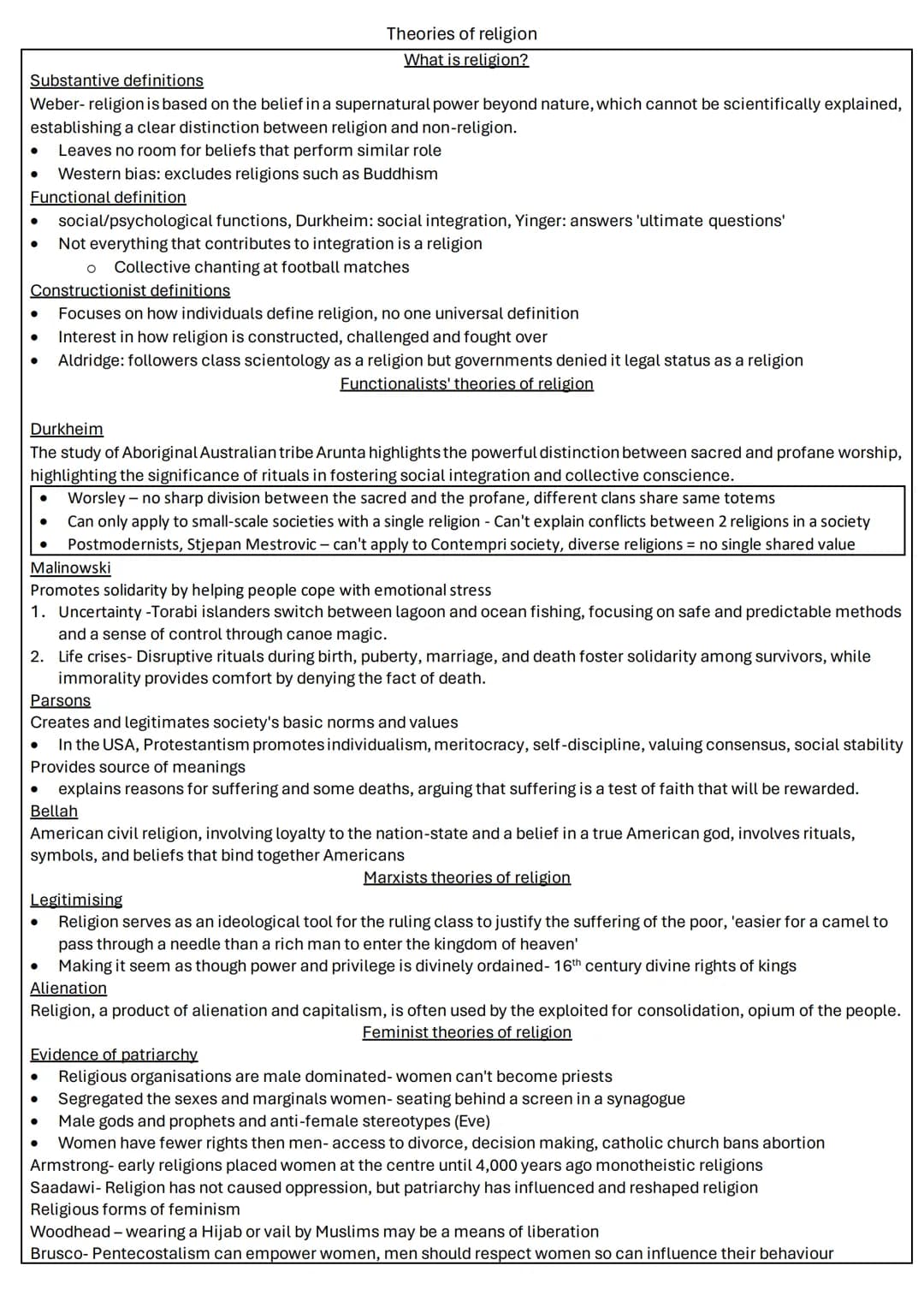
Theories of Religion
How do sociologists actually define religion? It's trickier than you might think! Substantive definitions focus on belief in supernatural powers, but this can exclude religions like Buddhism. Functional definitions look at what religion does for society, while constructionist approaches examine how people themselves define religion.
Functionalist theories see religion as serving society's needs. Durkheim studied Aboriginal Australians to show how religion creates social solidarity through shared sacred rituals. Malinowski focused on how religion helps people cope with stress and uncertainty, while Parsons argued it legitimates society's basic values. However, these views struggle to explain religious conflict and diversity in modern societies.
Marxist theories take a more critical approach, viewing religion as a tool of the ruling class. Religion legitimises inequality by making it seem divinely ordained and provides comfort ("opium of the people") that prevents revolution. The exploited often turn to religion for consolation rather than challenging the system.
Feminist theories highlight how religions often reinforce patriarchy through male-dominated institutions, segregation of women, and fewer rights for women. Feminists like Armstrong argue early religions were more female-centred until monotheistic religions emerged. However, some feminists see religious practices like wearing the hijab as potentially empowering rather than simply oppressive.
Think deeper: Next time you encounter a religious practice or belief, consider which sociological perspective best explains it. Is it functioning to integrate society, maintain inequality, or reinforce gender roles?
3
of 8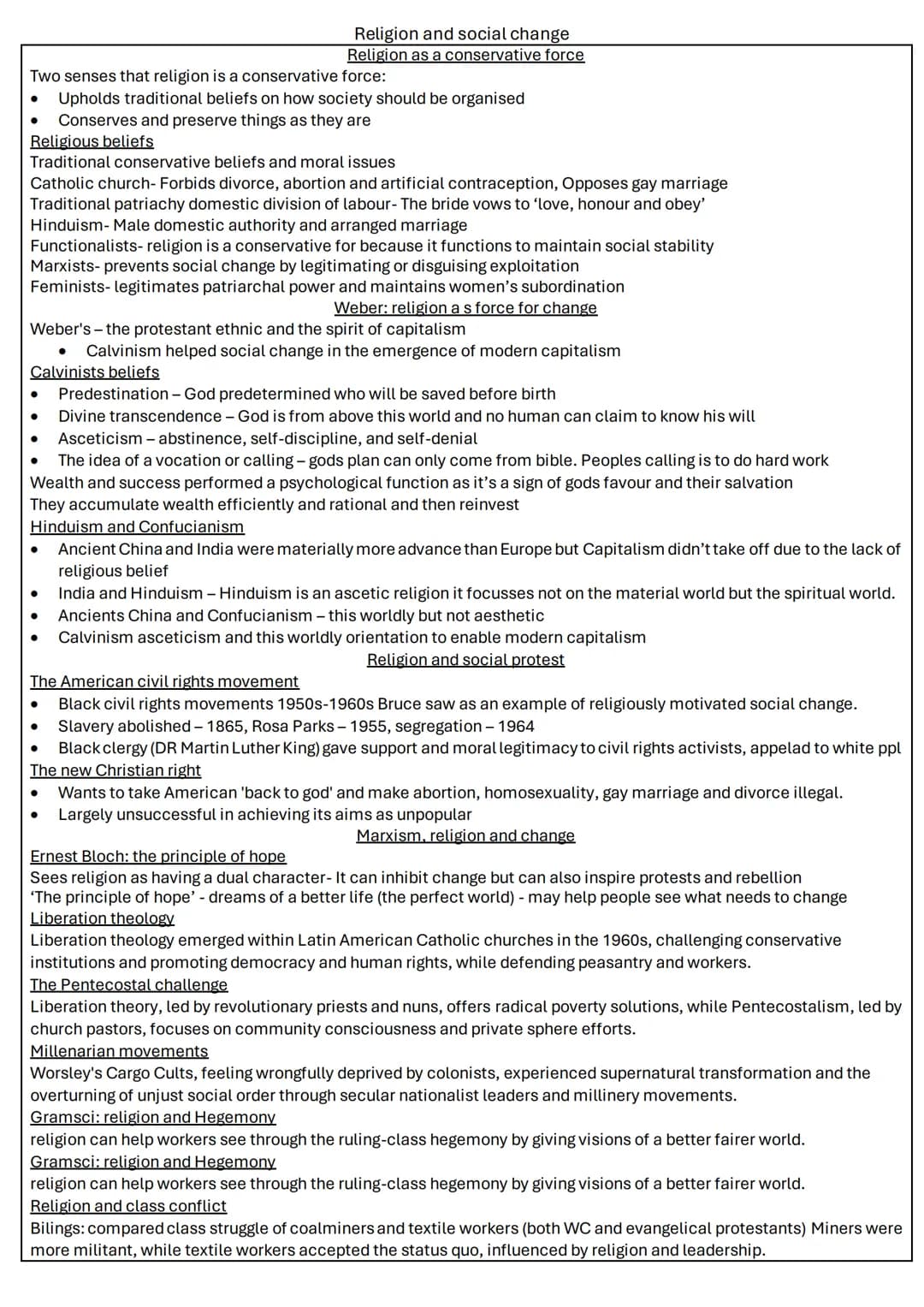
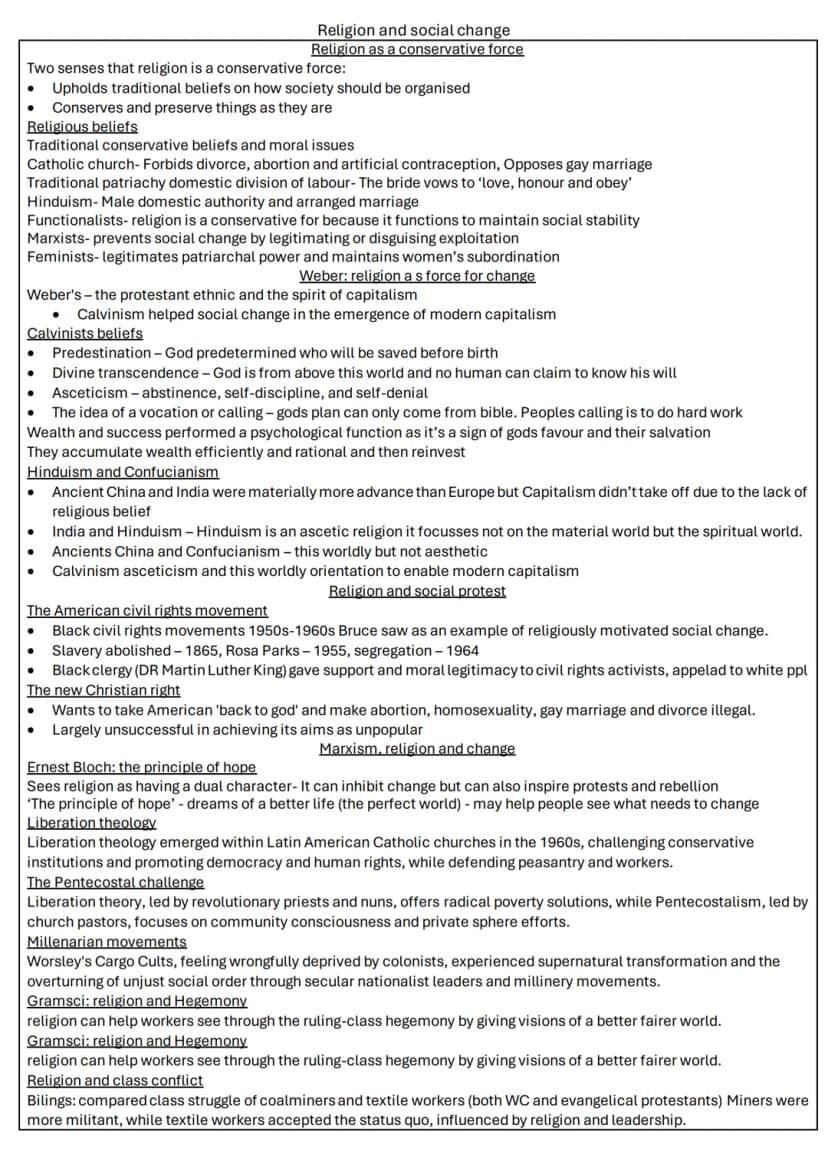
Religion and Social Change
Is religion a force for stability or change? Religion can be conservative in two ways: preserving traditional beliefs and maintaining the social status quo. Religious institutions often uphold traditional views on marriage, gender roles, and moral issues. Functionalists see this conservatism as valuable for social stability, while critics view it as preventing necessary change.
Yet religion can also drive radical social transformation. Weber's study of Protestantism shows how Calvinist beliefs about predestination and the value of hard work helped create modern capitalism. Their belief that success might indicate God's favour led to disciplined wealth creation and investment – key elements of capitalism.
Religious movements have powered significant social protest. The American civil rights movement drew strength from black churches, with leaders like Dr. Martin Luther King using religious language to mobilize supporters. In Latin America, liberation theology emerged in the 1960s, challenging conservative Catholic institutions and fighting for the rights of the poor.
Even Marxist thinkers like Ernst Bloch and Antonio Gramsci recognised religion's revolutionary potential. Bloch's "principle of hope" suggests religious visions of a better world can inspire people to fight for change. Religion's impact depends greatly on social context – in some cases reinforcing class divisions, in others fueling resistance to oppression.
Historical insight: Religion's role in social change is rarely simple. The same religion that justified slavery in America also inspired abolitionists to fight against it.
4
of 8
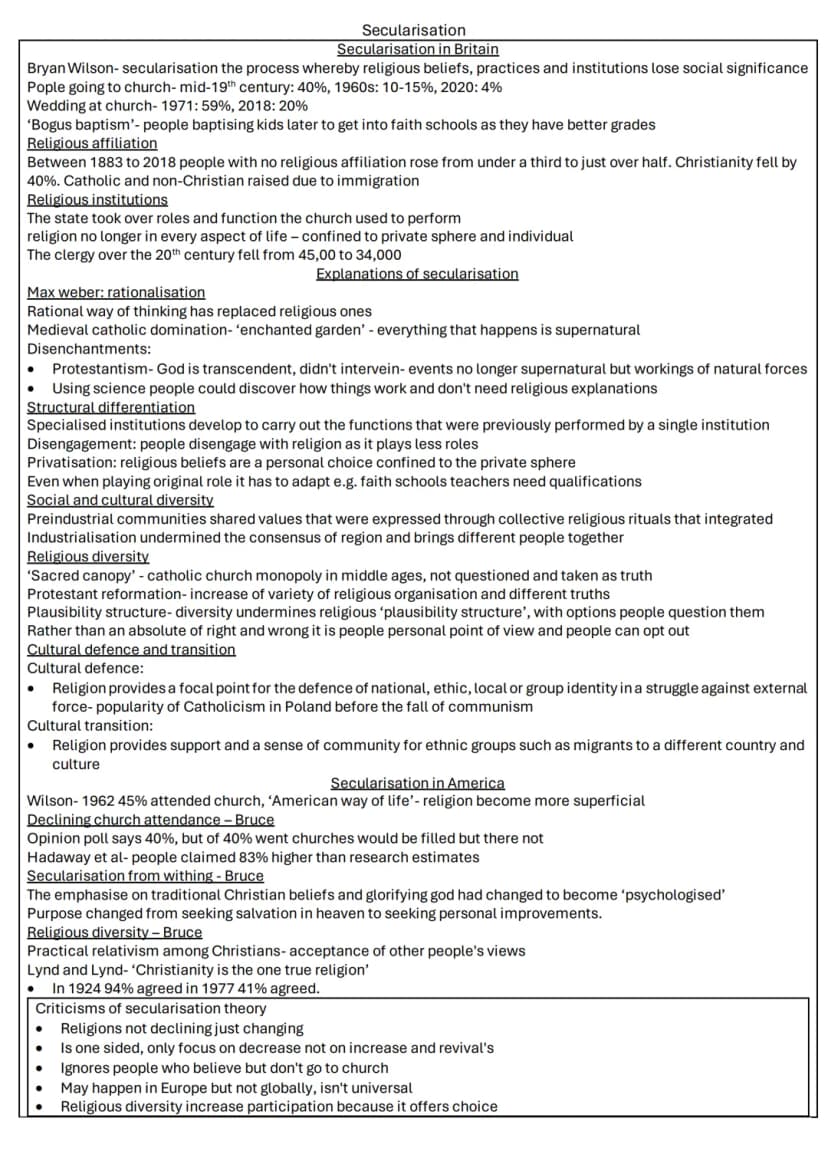
Secularisation
Ever noticed fewer people attending church these days? Secularisation refers to the process whereby religious beliefs, practices, and institutions lose social significance. The evidence in Britain is striking – church attendance dropped from 40% in the mid-19th century to just 4% by 2020, while religious weddings declined from 59% to 20% between 1971 and 2018.
Why is this happening? Max Weber pointed to rationalisation – the rise of scientific, rational thinking that replaces religious explanations. The medieval world was an "enchanted garden" where supernatural forces explained everything. Gradually, science offered alternative explanations for natural phenomena.
Structural differentiation also drives secularisation. Specialised institutions now perform functions once handled by the church – education, healthcare, welfare. This leads to disengagement from religion and its privatisation as a personal choice rather than a public obligation.
Social diversity undermines religion's power too. In pre-industrial communities, shared religious rituals integrated society. Industrialisation brought different people together, challenging religious consensus. The "sacred canopy" of a single religious truth fractured into multiple competing viewpoints, making any one religion less plausible.
Not everyone agrees secularisation is universal, however. Religion remains strong where it serves as cultural defence (protecting national identity against external threats) or assists with cultural transition (helping migrants maintain identity in a new country).
Modern perspective: Think about your own experience – has religion become more of a personal choice rather than a social obligation in your community?
5
of 8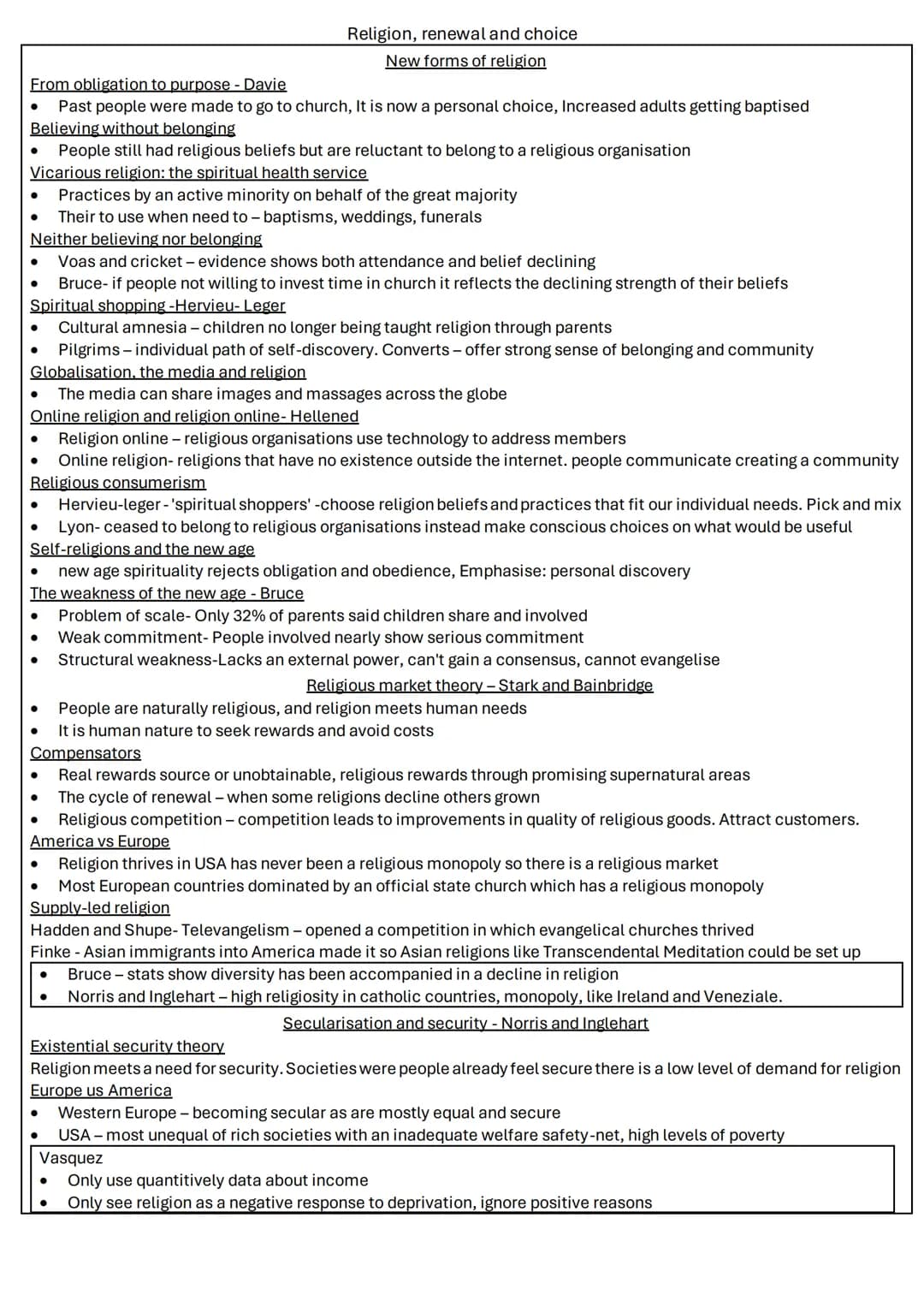
Religion, Renewal and Choice
Religion isn't simply disappearing – it's transforming. Grace Davie describes a shift "from obligation to purpose," where people actively choose religion rather than inheriting it. Many may be "believing without belonging" – maintaining spiritual beliefs without formal religious practice.
The concept of "vicarious religion" suggests a minority actively practices religion on behalf of the majority, who use religious services mainly for key life events like weddings and funerals. Others argue both belief and practice are declining, reflecting diminishing religious commitment altogether.
Globalisation and media have revolutionised how we experience religion. Online platforms create new religious communities and enable "spiritual shopping" – picking and choosing beliefs that suit individual needs. New Age spirituality emphasises personal discovery rather than institutional obligation, though critics like Bruce question its lasting impact due to weak commitment and structural limitations.
Some sociologists propose religious market theory to explain why religion thrives in some contexts. Stark and Bainbridge suggest competition between religions improves the "quality" of religious options. This might explain why America, with its religious marketplace, maintains higher religiosity than Europe with its traditional religious monopolies.
Norris and Inglehart offer an alternative explanation based on existential security. They argue people turn to religion when feeling insecure – explaining why unequal societies with weak social safety nets (like America) remain more religious than more secure European welfare states.
Food for thought: In today's world, is religion becoming more of a consumer product we shop for rather than a tradition we inherit?
6
of 8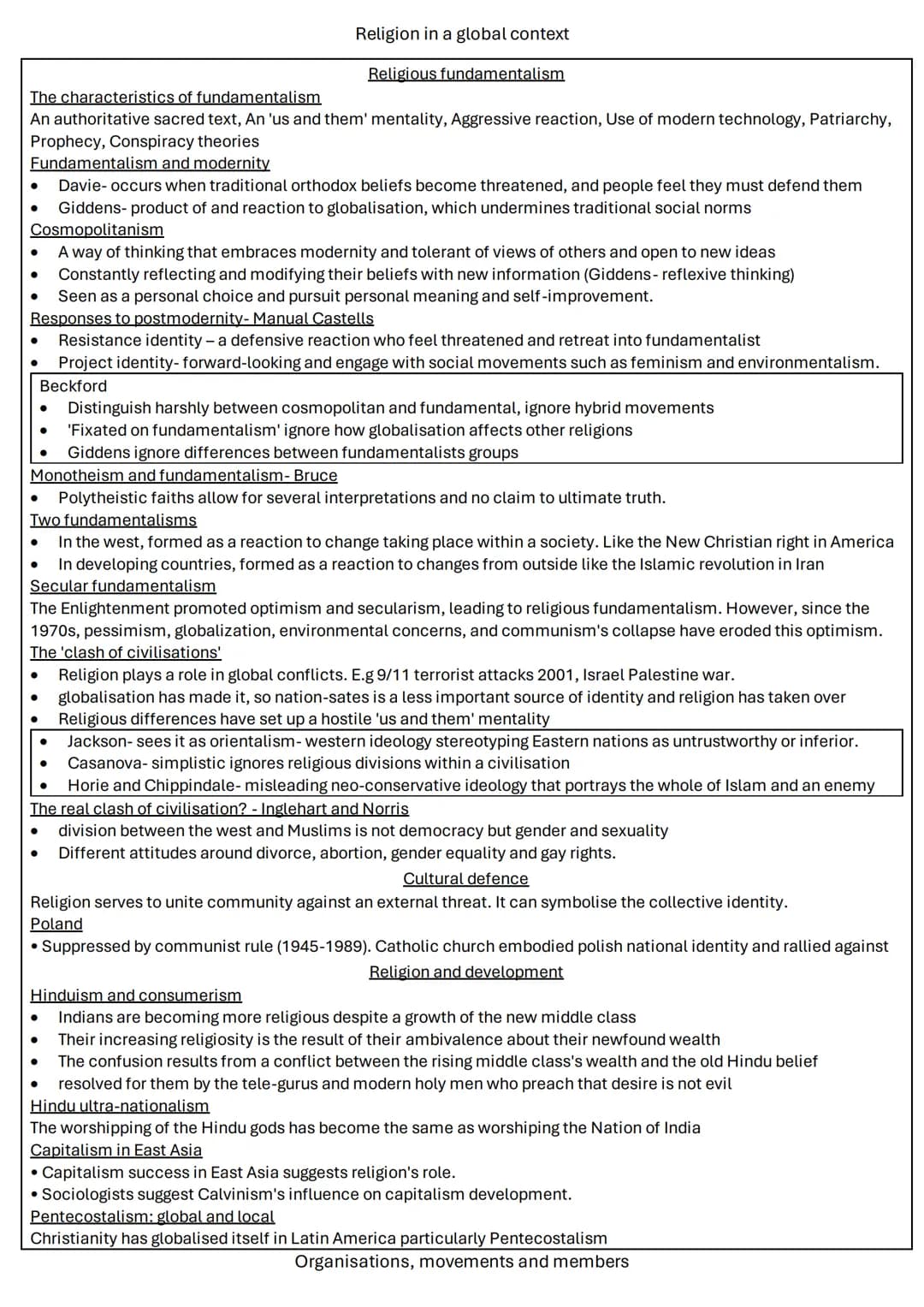
Religion in a Global Context
Religious fundamentalism has become a powerful global force, characterised by belief in an authoritative sacred text, an "us versus them" mentality, and often aggressive reactions to perceived threats. But why is it rising now? Sociologists suggest fundamentalism emerges as a reaction to the uncertainties of globalisation and modernity.
Anthony Giddens contrasts fundamentalism with cosmopolitanism – an open, reflective approach embracing diverse viewpoints. Manuel Castells identifies two responses to globalisation: resistance identity (defensive retreat into fundamentalism) and project identity (engaging with progressive social movements).
Steve Bruce argues monotheistic faiths are more prone to fundamentalism than polytheistic ones, as they claim exclusive truth. He distinguishes between Western fundamentalism (responding to internal social changes) and developing world fundamentalism (reacting to external influences).
The idea of a global "clash of civilisations" between religious worldviews gained prominence after events like 9/11. However, critics call this oversimplified and potentially dangerous. Inglehart and Norris suggest the real clash is over values like gender equality and sexual liberation rather than democracy.
Religion can serve as cultural defence against external threats, as seen in Catholic Poland under communism. In India, religion is evolving alongside economic development, with new "tele-gurus" helping the middle class reconcile traditional Hindu values with newfound wealth. Meanwhile, Pentecostalism has become one of the world's fastest-growing religious movements, adapting to both global and local contexts.
Global perspective: Next time you hear about religious conflict, consider whether it's really about religion itself or about broader cultural, economic, or political tensions expressed through religious language.
7
of 8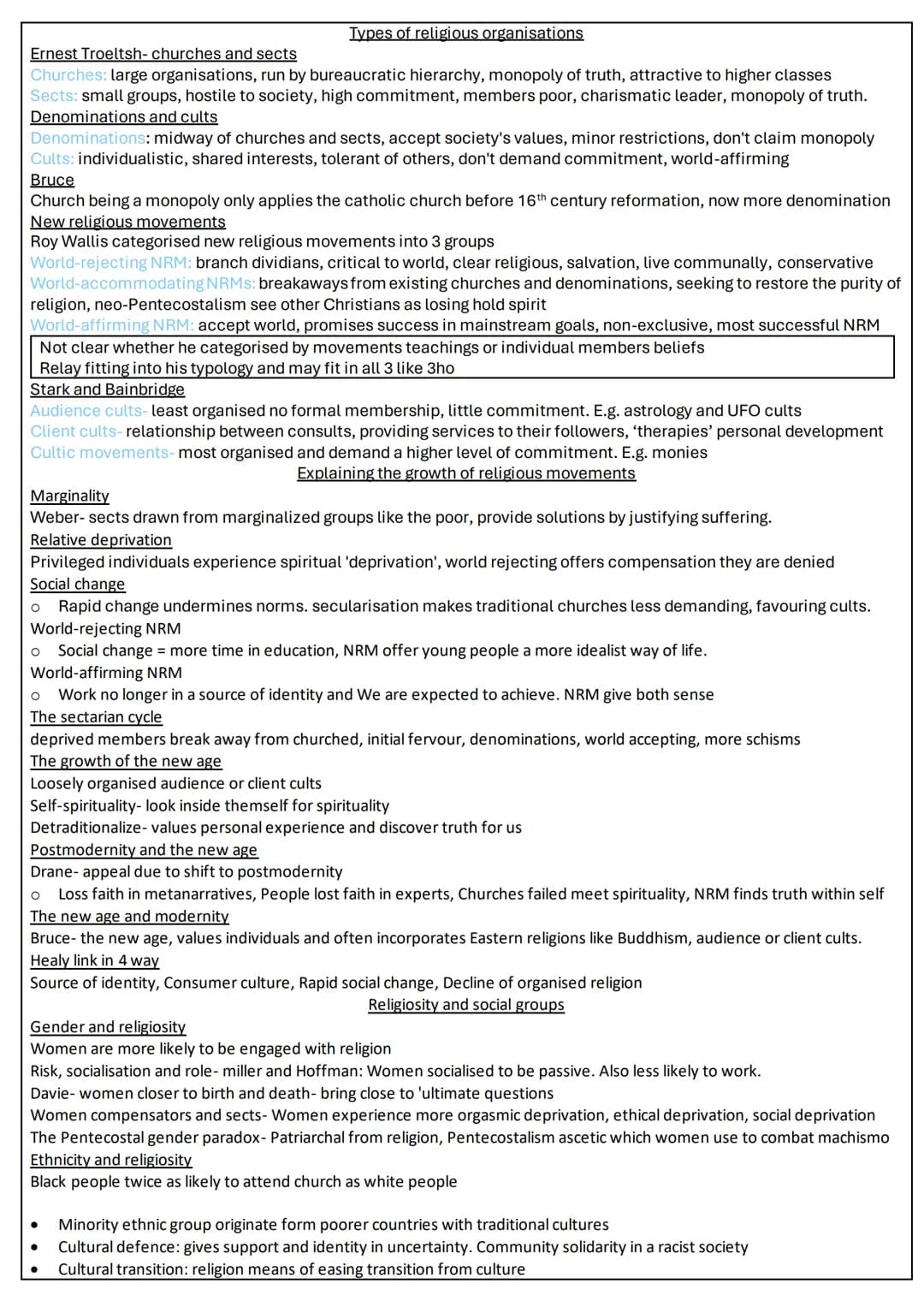
Organisation, Movements and Members
Religious organisations come in diverse forms. Churches are large, established institutions with professional clergy and broad appeal. Sects are smaller, more demanding groups often led by charismatic figures and attracting marginalised people. Denominations fall between these, while cults tend to be individualistic with less formal commitment.
New Religious Movements (NRMs) can be categorised in several ways. Roy Wallis divided them into world-rejecting (critical of mainstream society), world-accommodating (seeking to restore religious purity), and world-affirming (accepting society while promising personal success). Stark and Bainbridge identified audience cults (least organised), client cults (providing services), and cultic movements (most organised).
Why do people join religious movements? Marginality theory suggests they appeal to disadvantaged groups seeking solutions to suffering. Relative deprivation explains how even privileged individuals might feel spiritually deprived. Social change creates uncertainty that religious movements address, while the sectarian cycle shows how movements evolve over time from fervent sects to established denominations.
The growth of New Age spirituality, with its emphasis on self-discovery and personal experience, reflects broader shifts toward postmodernity. These loosely organised movements offer sources of identity in a rapidly changing world where organised religion is declining.
Religious involvement varies significantly across social groups. Women typically show higher religiosity than men, possibly due to socialisation, closer experience with birth and death, or as compensation for social disadvantages. Ethnic minorities often maintain stronger religious ties, using religion for cultural defence and to ease transition between cultures.
Social pattern: Consider why certain demographics might be more drawn to specific types of religious organisations – what needs are being met that mainstream society fails to address?
8
of 8
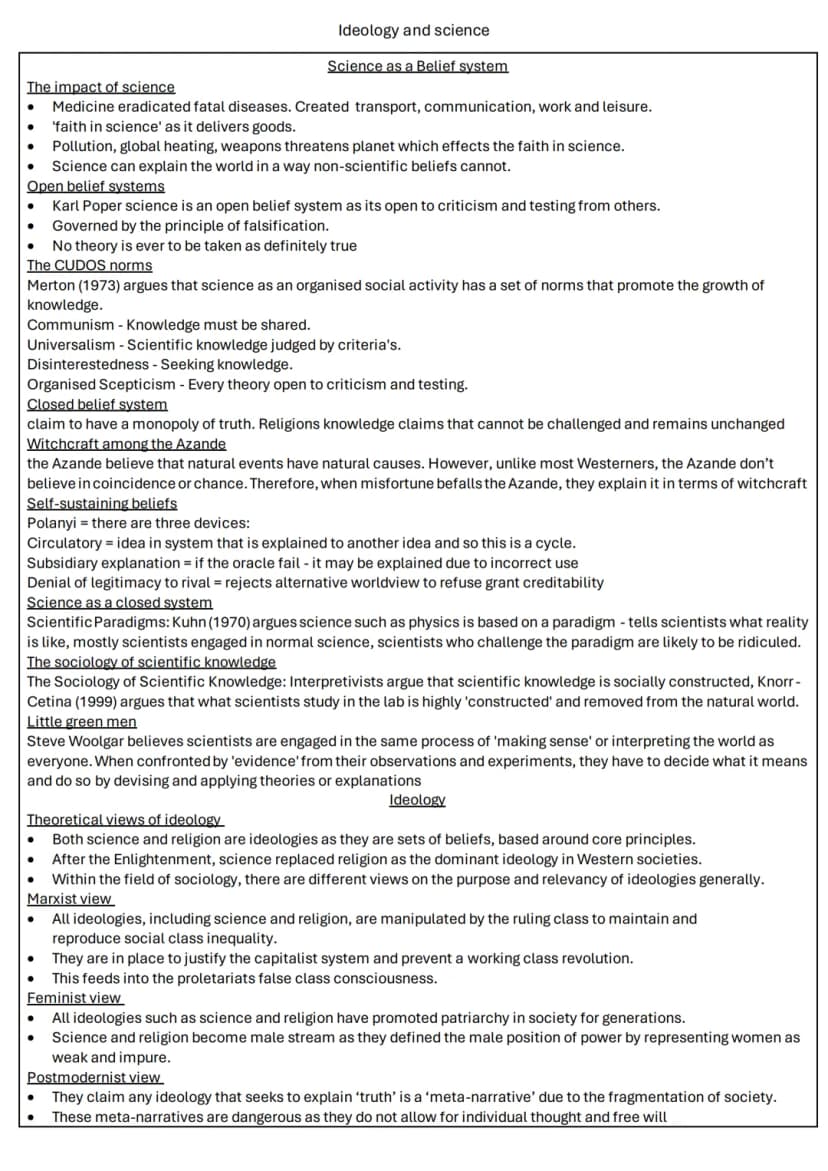
Ideology and Science
Is science just another belief system? It certainly transforms our world through medicine, transport, and communication, inspiring widespread faith in its powers. However, problems like pollution and weapons development have shaken this confidence.
Karl Popper argued science is an open belief system governed by falsification – theories must be open to testing and criticism. Robert Merton identified the CUDOS norms of science: Communism (shared knowledge), Universalism (objective criteria), Disinterestedness (seeking truth), and Organised Skepticism (critical testing).
This contrasts with closed belief systems like religion that claim unchangeable truths. Evans-Pritchard's study of Azande witchcraft showed how such belief systems become self-sustaining through circular reasoning and rejecting alternatives. However, Thomas Kuhn challenged the view of science as purely open, arguing it operates through paradigms that resist fundamental challenges.
The Sociology of Scientific Knowledge goes further, suggesting scientific "facts" are socially constructed through interpretation. Steve Woolgar showed how scientists "make sense" of observations by applying theories, much like anyone else interpreting the world.
Both science and religion can function as ideologies – sets of beliefs based on core principles. Marxists view them as tools of the ruling class to maintain inequality and prevent revolution. Feminists argue they promote patriarchy by representing women as weak or impure. Postmodernists reject all "meta-narratives" claiming universal truth as dangerous to individual freedom.
Critical thinking: Next time you hear someone invoke "scientific fact," ask yourself what social factors might have shaped how those facts were discovered, interpreted, and presented.
We thought you’d never ask...
What is the Knowunity AI companion?
Our AI companion is specifically built for the needs of students. Based on the millions of content pieces we have on the platform we can provide truly meaningful and relevant answers to students. But its not only about answers, the companion is even more about guiding students through their daily learning challenges, with personalised study plans, quizzes or content pieces in the chat and 100% personalisation based on the students skills and developments.
Where can I download the Knowunity app?
You can download the app in the Google Play Store and in the Apple App Store.
Is Knowunity really free of charge?
That's right! Enjoy free access to study content, connect with fellow students, and get instant help – all at your fingertips.
Similar Content
 Ciencias Sociales
 Religión
 Social Studies
Most popular content: Social Institutions
9SociologySociology of Religion Overview
Explore 9 concise summary sheets covering key concepts in the sociology of religion, including influential sociologists, critical evaluations, and contemporary examples. This resource is designed for A Level students aiming for top grades, featuring insights into modernization theory, functionalism, gender socialization, and the interplay between religion and social change. Perfect for exam preparation and understanding complex sociological theories.
127,404304
SociologySocial Policy & Family Dynamics
Explore how social policies shape family structures and relationships through various sociological perspectives. This comprehensive revision covers the impact of policies like the one-child policy, welfare benefits, and the New Right's influence on family dynamics. Ideal for A-Level Sociology students seeking to understand the intersection of family and social policy.
124,696126
SociologySecularisation Trends in Society
Explore the dynamics of secularisation in the UK and USA, including key definitions, issues, and sociological theories. This study note features a 10-mark practice question structured with PEECE, designed to help you achieve top marks in your AQA Sociology A Level exam.
122,50952
SociologyPost-2010 Education Policies
Explore the evolution of educational policies in the UK from 2010 onwards, focusing on the shift towards neo-liberalism, the introduction of academies and free schools, and the impact of funding cuts. This summary highlights key concepts such as social inequality and the comprehensive education system, providing insights into the implications for students and schools. Type: Summary.
135305
SociologyAQA Sociology Past Papers
Explore AQA Sociology past paper questions from 2017-2023, covering key topics such as family patterns, crime theories, and research methods. This resource is designed to aid your exam preparation and enhance your understanding of sociological concepts. Ideal for students revising for A Level Sociology exams.
129255
SociologyReligion and Globalisation Insights
Explore the intricate relationship between religion and globalisation, focusing on Hinduism's role in India's economic growth, the rise of ultra-nationalism, and the impact of cultural changes. This summary includes key sociological theories, such as Weber's views on religion and economic development, and offers two 10-mark exam questions for practice.
122,95754
SociologyReligious Market Dynamics
Explore the complexities of religious beliefs, renewal, and consumerism in modern society. This summary delves into key theories such as Stark and Bainbridge's religious market theory, the cycle of religious decline and revival, and the impact of globalization on spirituality. Ideal for sociology students studying the intersection of religion and social change.
121,28938
SociologyTypes of Religious Organizations
Explore the various types of religious organizations, including churches, sects, and cults. This summary covers key concepts such as the characteristics of each type, their societal roles, and the impact of social change on their growth. Understand the distinctions between world-affirming and world-rejecting movements, and the implications of modernization on religious beliefs. Ideal for sociology students studying religion and social change.
122010
CriminologyLaw-Making Processes Explained
Explore the intricate processes of law-making in the UK, covering both government and judicial frameworks. This summary details the roles of Parliament, the court hierarchy, judicial precedent, and statutory interpretation, providing essential insights for understanding legislative procedures. Ideal for students studying UK law and political systems.
131,78247
Most popular content in Sociology
9SociologySociology of Education Overview
Explore comprehensive A-Level Sociology notes on the education system, covering key theories, policies, and sociological perspectives. This resource includes insights on marketisation, gender roles, cultural deprivation, and educational inequalities, providing a thorough understanding of how education shapes social stratification and individual achievement. Ideal for exam preparation and in-depth study.
12102,8523,040
SociologySociology of Families: Comprehensive Revision
Dive into an extensive overview of family dynamics, perspectives, and patterns in sociology. This resource covers key concepts such as family diversity, gender roles, marriage, and the impact of social policies on family structures. Perfect for A-Level Sociology students preparing for Paper 2.
1273,6612,307
SociologyComprehensive Crime & Deviance Overview
Explore an extensive revision of crime and deviance topics, including theories, types of crime, and the impact of media. This resource covers key concepts such as Marxism, functionalism, gender and crime, and the influence of globalization on criminal behavior. Ideal for students seeking a thorough understanding of criminology and its various theories. Type: Full Topic Revision.
1251,6541,399
SociologySociological Theories Overview
Comprehensive revision of key sociological theories including Functionalism, Marxism, Feminism, and Interpretivism. Explore concepts like value freedom, identity formation, and the critique of social control. Ideal for AQA A-Level Sociology students preparing for exams. This summary covers essential theories and their implications in sociology, providing a clear understanding of each perspective.
1231,442846
SociologySociology Research Methods Overview
Explore the essential research methods in A-Level Sociology, including structured, unstructured, and semi-structured interviews, official statistics, questionnaires, and observational techniques. This comprehensive guide covers practical and theoretical issues, advantages and disadvantages of each method, and their relevance in sociological research. Ideal for students preparing for exams or seeking to deepen their understanding of sociological research methodologies.
1228,944918
SociologyMedia Studies: Key Concepts & Theories
Dive into the essential concepts and theories of media studies for AQA A-level Sociology. This comprehensive revision guide covers topics such as media influence, representations, globalization, and sociological perspectives, ensuring you grasp the critical elements needed for your exams. Perfect for students seeking to enhance their understanding of media's role in society.
1222,716512
SociologyEducation-AQA A-level Sociology
Overview of the topic of education in alevel sociology, source:the sociology teacher
124,096118
SociologySociology Research Methods in Education
Explore key sociological research methods used in educational contexts, including ethical considerations, power dynamics, and various interview techniques. This summary provides essential insights for tackling 20-mark exam questions on methods in context, focusing on the role of education, labelling theory, and the impact of social factors on educational outcomes.
1222,113639
SociologyTheory and Methods-AQA A-level Sociology
AQA alevel topic keynotes
121,53434
Most popular content
9SociologySociology of Education Overview
Explore comprehensive A-Level Sociology notes on the education system, covering key theories, policies, and sociological perspectives. This resource includes insights on marketisation, gender roles, cultural deprivation, and educational inequalities, providing a thorough understanding of how education shapes social stratification and individual achievement. Ideal for exam preparation and in-depth study.
12102,8523,040
SociologySociology of Families: Comprehensive Revision
Dive into an extensive overview of family dynamics, perspectives, and patterns in sociology. This resource covers key concepts such as family diversity, gender roles, marriage, and the impact of social policies on family structures. Perfect for A-Level Sociology students preparing for Paper 2.
1273,6612,307
CriminologyCriminology: Crime & Punishment Overview
Comprehensive mindmaps covering key concepts in the Crime and Punishment topic for WJEC Criminology Unit 4. This resource includes detailed insights into the Criminal Justice System, crime prevention strategies, sentencing models, and the roles of various agencies. Ideal for A-Level revision, ensuring you grasp essential theories and legislative processes to excel in your exams.
1254,8691,059
SociologyComprehensive Crime & Deviance Overview
Explore an extensive revision of crime and deviance topics, including theories, types of crime, and the impact of media. This resource covers key concepts such as Marxism, functionalism, gender and crime, and the influence of globalization on criminal behavior. Ideal for students seeking a thorough understanding of criminology and its various theories. Type: Full Topic Revision.
1251,6541,399
C
 Biology
Cell Biology and Cell structure
cell structures
93,2470
 English Literature
An Inspector Calls: Character Insights
Explore in-depth analysis and key quotes for characters in J.B. Priestley's 'An Inspector Calls'. This resource covers Gerald Croft, Inspector Goole, Sheila Birling, Mrs. Birling, Eric Birling, and Eva Smith, focusing on themes of class, gender roles, and social responsibility. Ideal for students aiming for Grade 8 and above.
1025,429907
CriminologyWJEC Unit 4 Criminology
Criminology unit 4 detailed revision note
127,151125
CriminologyCriminology Theories Overview
Explore key criminology theories and their implications on crime and deviance. This comprehensive summary covers biological, psychological, and sociological perspectives, including labelling theory, right realism, and the impact of social campaigns on policy development. Ideal for A-Level criminology students seeking to understand the complexities of criminal behaviour and the factors influencing crime prevention strategies.
129,760210
English LiteratureRomeo and Juliet: Key themes
Key Romeo and Juliet themes and analysed quotes
106,708198
Can't find what you're looking for? Explore other subjects.
Students love us — and so will you.
4.6/5App Store
4.7/5Google Play
The app is very easy to use and well designed. I have found everything I was looking for so far and have been able to learn a lot from the presentations! I will definitely use the app for a class assignment! And of course it also helps a lot as an inspiration.
Stefan SiOS user
This app is really great. There are so many study notes and help [...]. My problem subject is French, for example, and the app has so many options for help. Thanks to this app, I have improved my French. I would recommend it to anyone.
Samantha KlichAndroid user
Wow, I am really amazed. I just tried the app because I've seen it advertised many times and was absolutely stunned. This app is THE HELP you want for school and above all, it offers so many things, such as workouts and fact sheets, which have been VERY helpful to me personally.
AnnaiOS user
Sociology8,462 views·Updated Jun 22, 2026·8 pagesUnderstanding Beliefs in Society: A Sociology Guide
learningaboutpeople@learningaboutpeople2
Ready to explore the fascinating world of beliefs in society? These notes dive deep into how religion, science, and ideology shape our world. From classic theories of religion to modern secularisation trends, you'll discover how beliefs both maintain social order...
1
of 8
Sign up to see the content. It's free!
- Access to all documents
- Improve your grades
- Join milions of students
Introduction to Beliefs in Society
Ever wondered how religion shapes our society? This topic explores the powerful role beliefs play in our social world. You'll learn about different perspectives on religion - from functionalists who see it as society's glue to critics who view it as a tool for control.
The course covers how religion influences social change, why some societies are becoming more secular, and how religious movements adapt in our modern, globalised world. You'll also explore the relationship between religion and science, and how ideologies function in society.
Whether you're interested in how religion shapes politics, why new religious movements form, or how science challenges traditional beliefs, these notes will help you develop critical thinking about some of society's most fundamental questions.
Remember: Understanding theories of religion helps you analyse not just religious institutions but all belief systems that shape our social world!
2
of 8Sign up to see the content. It's free!
- Access to all documents
- Improve your grades
- Join milions of students
Theories of Religion
How do sociologists actually define religion? It's trickier than you might think! Substantive definitions focus on belief in supernatural powers, but this can exclude religions like Buddhism. Functional definitions look at what religion does for society, while constructionist approaches examine how people themselves define religion.
Functionalist theories see religion as serving society's needs. Durkheim studied Aboriginal Australians to show how religion creates social solidarity through shared sacred rituals. Malinowski focused on how religion helps people cope with stress and uncertainty, while Parsons argued it legitimates society's basic values. However, these views struggle to explain religious conflict and diversity in modern societies.
Marxist theories take a more critical approach, viewing religion as a tool of the ruling class. Religion legitimises inequality by making it seem divinely ordained and provides comfort ("opium of the people") that prevents revolution. The exploited often turn to religion for consolation rather than challenging the system.
Feminist theories highlight how religions often reinforce patriarchy through male-dominated institutions, segregation of women, and fewer rights for women. Feminists like Armstrong argue early religions were more female-centred until monotheistic religions emerged. However, some feminists see religious practices like wearing the hijab as potentially empowering rather than simply oppressive.
Think deeper: Next time you encounter a religious practice or belief, consider which sociological perspective best explains it. Is it functioning to integrate society, maintain inequality, or reinforce gender roles?
3
of 8Sign up to see the content. It's free!
- Access to all documents
- Improve your grades
- Join milions of students
Religion and Social Change
Is religion a force for stability or change? Religion can be conservative in two ways: preserving traditional beliefs and maintaining the social status quo. Religious institutions often uphold traditional views on marriage, gender roles, and moral issues. Functionalists see this conservatism as valuable for social stability, while critics view it as preventing necessary change.
Yet religion can also drive radical social transformation. Weber's study of Protestantism shows how Calvinist beliefs about predestination and the value of hard work helped create modern capitalism. Their belief that success might indicate God's favour led to disciplined wealth creation and investment – key elements of capitalism.
Religious movements have powered significant social protest. The American civil rights movement drew strength from black churches, with leaders like Dr. Martin Luther King using religious language to mobilize supporters. In Latin America, liberation theology emerged in the 1960s, challenging conservative Catholic institutions and fighting for the rights of the poor.
Even Marxist thinkers like Ernst Bloch and Antonio Gramsci recognised religion's revolutionary potential. Bloch's "principle of hope" suggests religious visions of a better world can inspire people to fight for change. Religion's impact depends greatly on social context – in some cases reinforcing class divisions, in others fueling resistance to oppression.
Historical insight: Religion's role in social change is rarely simple. The same religion that justified slavery in America also inspired abolitionists to fight against it.
4
of 8Sign up to see the content. It's free!
- Access to all documents
- Improve your grades
- Join milions of students
Secularisation
Ever noticed fewer people attending church these days? Secularisation refers to the process whereby religious beliefs, practices, and institutions lose social significance. The evidence in Britain is striking – church attendance dropped from 40% in the mid-19th century to just 4% by 2020, while religious weddings declined from 59% to 20% between 1971 and 2018.
Why is this happening? Max Weber pointed to rationalisation – the rise of scientific, rational thinking that replaces religious explanations. The medieval world was an "enchanted garden" where supernatural forces explained everything. Gradually, science offered alternative explanations for natural phenomena.
Structural differentiation also drives secularisation. Specialised institutions now perform functions once handled by the church – education, healthcare, welfare. This leads to disengagement from religion and its privatisation as a personal choice rather than a public obligation.
Social diversity undermines religion's power too. In pre-industrial communities, shared religious rituals integrated society. Industrialisation brought different people together, challenging religious consensus. The "sacred canopy" of a single religious truth fractured into multiple competing viewpoints, making any one religion less plausible.
Not everyone agrees secularisation is universal, however. Religion remains strong where it serves as cultural defence (protecting national identity against external threats) or assists with cultural transition (helping migrants maintain identity in a new country).
Modern perspective: Think about your own experience – has religion become more of a personal choice rather than a social obligation in your community?
5
of 8Sign up to see the content. It's free!
- Access to all documents
- Improve your grades
- Join milions of students
Religion, Renewal and Choice
Religion isn't simply disappearing – it's transforming. Grace Davie describes a shift "from obligation to purpose," where people actively choose religion rather than inheriting it. Many may be "believing without belonging" – maintaining spiritual beliefs without formal religious practice.
The concept of "vicarious religion" suggests a minority actively practices religion on behalf of the majority, who use religious services mainly for key life events like weddings and funerals. Others argue both belief and practice are declining, reflecting diminishing religious commitment altogether.
Globalisation and media have revolutionised how we experience religion. Online platforms create new religious communities and enable "spiritual shopping" – picking and choosing beliefs that suit individual needs. New Age spirituality emphasises personal discovery rather than institutional obligation, though critics like Bruce question its lasting impact due to weak commitment and structural limitations.
Some sociologists propose religious market theory to explain why religion thrives in some contexts. Stark and Bainbridge suggest competition between religions improves the "quality" of religious options. This might explain why America, with its religious marketplace, maintains higher religiosity than Europe with its traditional religious monopolies.
Norris and Inglehart offer an alternative explanation based on existential security. They argue people turn to religion when feeling insecure – explaining why unequal societies with weak social safety nets (like America) remain more religious than more secure European welfare states.
Food for thought: In today's world, is religion becoming more of a consumer product we shop for rather than a tradition we inherit?
6
of 8Sign up to see the content. It's free!
- Access to all documents
- Improve your grades
- Join milions of students
Religion in a Global Context
Religious fundamentalism has become a powerful global force, characterised by belief in an authoritative sacred text, an "us versus them" mentality, and often aggressive reactions to perceived threats. But why is it rising now? Sociologists suggest fundamentalism emerges as a reaction to the uncertainties of globalisation and modernity.
Anthony Giddens contrasts fundamentalism with cosmopolitanism – an open, reflective approach embracing diverse viewpoints. Manuel Castells identifies two responses to globalisation: resistance identity (defensive retreat into fundamentalism) and project identity (engaging with progressive social movements).
Steve Bruce argues monotheistic faiths are more prone to fundamentalism than polytheistic ones, as they claim exclusive truth. He distinguishes between Western fundamentalism (responding to internal social changes) and developing world fundamentalism (reacting to external influences).
The idea of a global "clash of civilisations" between religious worldviews gained prominence after events like 9/11. However, critics call this oversimplified and potentially dangerous. Inglehart and Norris suggest the real clash is over values like gender equality and sexual liberation rather than democracy.
Religion can serve as cultural defence against external threats, as seen in Catholic Poland under communism. In India, religion is evolving alongside economic development, with new "tele-gurus" helping the middle class reconcile traditional Hindu values with newfound wealth. Meanwhile, Pentecostalism has become one of the world's fastest-growing religious movements, adapting to both global and local contexts.
Global perspective: Next time you hear about religious conflict, consider whether it's really about religion itself or about broader cultural, economic, or political tensions expressed through religious language.
7
of 8Sign up to see the content. It's free!
- Access to all documents
- Improve your grades
- Join milions of students
Organisation, Movements and Members
Religious organisations come in diverse forms. Churches are large, established institutions with professional clergy and broad appeal. Sects are smaller, more demanding groups often led by charismatic figures and attracting marginalised people. Denominations fall between these, while cults tend to be individualistic with less formal commitment.
New Religious Movements (NRMs) can be categorised in several ways. Roy Wallis divided them into world-rejecting (critical of mainstream society), world-accommodating (seeking to restore religious purity), and world-affirming (accepting society while promising personal success). Stark and Bainbridge identified audience cults (least organised), client cults (providing services), and cultic movements (most organised).
Why do people join religious movements? Marginality theory suggests they appeal to disadvantaged groups seeking solutions to suffering. Relative deprivation explains how even privileged individuals might feel spiritually deprived. Social change creates uncertainty that religious movements address, while the sectarian cycle shows how movements evolve over time from fervent sects to established denominations.
The growth of New Age spirituality, with its emphasis on self-discovery and personal experience, reflects broader shifts toward postmodernity. These loosely organised movements offer sources of identity in a rapidly changing world where organised religion is declining.
Religious involvement varies significantly across social groups. Women typically show higher religiosity than men, possibly due to socialisation, closer experience with birth and death, or as compensation for social disadvantages. Ethnic minorities often maintain stronger religious ties, using religion for cultural defence and to ease transition between cultures.
Social pattern: Consider why certain demographics might be more drawn to specific types of religious organisations – what needs are being met that mainstream society fails to address?
8
of 8Sign up to see the content. It's free!
- Access to all documents
- Improve your grades
- Join milions of students
Ideology and Science
Is science just another belief system? It certainly transforms our world through medicine, transport, and communication, inspiring widespread faith in its powers. However, problems like pollution and weapons development have shaken this confidence.
Karl Popper argued science is an open belief system governed by falsification – theories must be open to testing and criticism. Robert Merton identified the CUDOS norms of science: Communism (shared knowledge), Universalism (objective criteria), Disinterestedness (seeking truth), and Organised Skepticism (critical testing).
This contrasts with closed belief systems like religion that claim unchangeable truths. Evans-Pritchard's study of Azande witchcraft showed how such belief systems become self-sustaining through circular reasoning and rejecting alternatives. However, Thomas Kuhn challenged the view of science as purely open, arguing it operates through paradigms that resist fundamental challenges.
The Sociology of Scientific Knowledge goes further, suggesting scientific "facts" are socially constructed through interpretation. Steve Woolgar showed how scientists "make sense" of observations by applying theories, much like anyone else interpreting the world.
Both science and religion can function as ideologies – sets of beliefs based on core principles. Marxists view them as tools of the ruling class to maintain inequality and prevent revolution. Feminists argue they promote patriarchy by representing women as weak or impure. Postmodernists reject all "meta-narratives" claiming universal truth as dangerous to individual freedom.
Critical thinking: Next time you hear someone invoke "scientific fact," ask yourself what social factors might have shaped how those facts were discovered, interpreted, and presented.
We thought you’d never ask...
What is the Knowunity AI companion?
Our AI companion is specifically built for the needs of students. Based on the millions of content pieces we have on the platform we can provide truly meaningful and relevant answers to students. But its not only about answers, the companion is even more about guiding students through their daily learning challenges, with personalised study plans, quizzes or content pieces in the chat and 100% personalisation based on the students skills and developments.
Where can I download the Knowunity app?
You can download the app in the Google Play Store and in the Apple App Store.
Is Knowunity really free of charge?
That's right! Enjoy free access to study content, connect with fellow students, and get instant help – all at your fingertips.
Similar Content
Most popular content: Social Institutions
9SociologySociology of Religion Overview
Explore 9 concise summary sheets covering key concepts in the sociology of religion, including influential sociologists, critical evaluations, and contemporary examples. This resource is designed for A Level students aiming for top grades, featuring insights into modernization theory, functionalism, gender socialization, and the interplay between religion and social change. Perfect for exam preparation and understanding complex sociological theories.
127,404304
SociologySocial Policy & Family Dynamics
Explore how social policies shape family structures and relationships through various sociological perspectives. This comprehensive revision covers the impact of policies like the one-child policy, welfare benefits, and the New Right's influence on family dynamics. Ideal for A-Level Sociology students seeking to understand the intersection of family and social policy.
124,696126
SociologySecularisation Trends in Society
Explore the dynamics of secularisation in the UK and USA, including key definitions, issues, and sociological theories. This study note features a 10-mark practice question structured with PEECE, designed to help you achieve top marks in your AQA Sociology A Level exam.
122,50952
SociologyPost-2010 Education Policies
Explore the evolution of educational policies in the UK from 2010 onwards, focusing on the shift towards neo-liberalism, the introduction of academies and free schools, and the impact of funding cuts. This summary highlights key concepts such as social inequality and the comprehensive education system, providing insights into the implications for students and schools. Type: Summary.
135305
SociologyAQA Sociology Past Papers
Explore AQA Sociology past paper questions from 2017-2023, covering key topics such as family patterns, crime theories, and research methods. This resource is designed to aid your exam preparation and enhance your understanding of sociological concepts. Ideal for students revising for A Level Sociology exams.
129255
SociologyReligion and Globalisation Insights
Explore the intricate relationship between religion and globalisation, focusing on Hinduism's role in India's economic growth, the rise of ultra-nationalism, and the impact of cultural changes. This summary includes key sociological theories, such as Weber's views on religion and economic development, and offers two 10-mark exam questions for practice.
122,95754
SociologyReligious Market Dynamics
Explore the complexities of religious beliefs, renewal, and consumerism in modern society. This summary delves into key theories such as Stark and Bainbridge's religious market theory, the cycle of religious decline and revival, and the impact of globalization on spirituality. Ideal for sociology students studying the intersection of religion and social change.
121,28938
SociologyTypes of Religious Organizations
Explore the various types of religious organizations, including churches, sects, and cults. This summary covers key concepts such as the characteristics of each type, their societal roles, and the impact of social change on their growth. Understand the distinctions between world-affirming and world-rejecting movements, and the implications of modernization on religious beliefs. Ideal for sociology students studying religion and social change.
122010
CriminologyLaw-Making Processes Explained
Explore the intricate processes of law-making in the UK, covering both government and judicial frameworks. This summary details the roles of Parliament, the court hierarchy, judicial precedent, and statutory interpretation, providing essential insights for understanding legislative procedures. Ideal for students studying UK law and political systems.
131,78247
Most popular content in Sociology
9SociologySociology of Education Overview
Explore comprehensive A-Level Sociology notes on the education system, covering key theories, policies, and sociological perspectives. This resource includes insights on marketisation, gender roles, cultural deprivation, and educational inequalities, providing a thorough understanding of how education shapes social stratification and individual achievement. Ideal for exam preparation and in-depth study.
12102,8523,040
SociologySociology of Families: Comprehensive Revision
Dive into an extensive overview of family dynamics, perspectives, and patterns in sociology. This resource covers key concepts such as family diversity, gender roles, marriage, and the impact of social policies on family structures. Perfect for A-Level Sociology students preparing for Paper 2.
1273,6612,307
SociologyComprehensive Crime & Deviance Overview
Explore an extensive revision of crime and deviance topics, including theories, types of crime, and the impact of media. This resource covers key concepts such as Marxism, functionalism, gender and crime, and the influence of globalization on criminal behavior. Ideal for students seeking a thorough understanding of criminology and its various theories. Type: Full Topic Revision.
1251,6541,399
SociologySociological Theories Overview
Comprehensive revision of key sociological theories including Functionalism, Marxism, Feminism, and Interpretivism. Explore concepts like value freedom, identity formation, and the critique of social control. Ideal for AQA A-Level Sociology students preparing for exams. This summary covers essential theories and their implications in sociology, providing a clear understanding of each perspective.
1231,442846
SociologySociology Research Methods Overview
Explore the essential research methods in A-Level Sociology, including structured, unstructured, and semi-structured interviews, official statistics, questionnaires, and observational techniques. This comprehensive guide covers practical and theoretical issues, advantages and disadvantages of each method, and their relevance in sociological research. Ideal for students preparing for exams or seeking to deepen their understanding of sociological research methodologies.
1228,944918
SociologyMedia Studies: Key Concepts & Theories
Dive into the essential concepts and theories of media studies for AQA A-level Sociology. This comprehensive revision guide covers topics such as media influence, representations, globalization, and sociological perspectives, ensuring you grasp the critical elements needed for your exams. Perfect for students seeking to enhance their understanding of media's role in society.
1222,716512
SociologyEducation-AQA A-level Sociology
Overview of the topic of education in alevel sociology, source:the sociology teacher
124,096118
SociologySociology Research Methods in Education
Explore key sociological research methods used in educational contexts, including ethical considerations, power dynamics, and various interview techniques. This summary provides essential insights for tackling 20-mark exam questions on methods in context, focusing on the role of education, labelling theory, and the impact of social factors on educational outcomes.
1222,113639
SociologyTheory and Methods-AQA A-level Sociology
AQA alevel topic keynotes
121,53434
Most popular content
9SociologySociology of Education Overview
Explore comprehensive A-Level Sociology notes on the education system, covering key theories, policies, and sociological perspectives. This resource includes insights on marketisation, gender roles, cultural deprivation, and educational inequalities, providing a thorough understanding of how education shapes social stratification and individual achievement. Ideal for exam preparation and in-depth study.
12102,8523,040
SociologySociology of Families: Comprehensive Revision
Dive into an extensive overview of family dynamics, perspectives, and patterns in sociology. This resource covers key concepts such as family diversity, gender roles, marriage, and the impact of social policies on family structures. Perfect for A-Level Sociology students preparing for Paper 2.
1273,6612,307
CriminologyCriminology: Crime & Punishment Overview
Comprehensive mindmaps covering key concepts in the Crime and Punishment topic for WJEC Criminology Unit 4. This resource includes detailed insights into the Criminal Justice System, crime prevention strategies, sentencing models, and the roles of various agencies. Ideal for A-Level revision, ensuring you grasp essential theories and legislative processes to excel in your exams.
1254,8691,059
SociologyComprehensive Crime & Deviance Overview
Explore an extensive revision of crime and deviance topics, including theories, types of crime, and the impact of media. This resource covers key concepts such as Marxism, functionalism, gender and crime, and the influence of globalization on criminal behavior. Ideal for students seeking a thorough understanding of criminology and its various theories. Type: Full Topic Revision.
1251,6541,399
C
BiologyCell Biology and Cell structure
cell structures
93,2470
English LiteratureAn Inspector Calls: Character Insights
Explore in-depth analysis and key quotes for characters in J.B. Priestley's 'An Inspector Calls'. This resource covers Gerald Croft, Inspector Goole, Sheila Birling, Mrs. Birling, Eric Birling, and Eva Smith, focusing on themes of class, gender roles, and social responsibility. Ideal for students aiming for Grade 8 and above.
1025,429907
CriminologyWJEC Unit 4 Criminology
Criminology unit 4 detailed revision note
127,151125
CriminologyCriminology Theories Overview
Explore key criminology theories and their implications on crime and deviance. This comprehensive summary covers biological, psychological, and sociological perspectives, including labelling theory, right realism, and the impact of social campaigns on policy development. Ideal for A-Level criminology students seeking to understand the complexities of criminal behaviour and the factors influencing crime prevention strategies.
129,760210
English LiteratureRomeo and Juliet: Key themes
Key Romeo and Juliet themes and analysed quotes
106,708198
Can't find what you're looking for? Explore other subjects.
Students love us — and so will you.
4.6/5App Store
4.7/5Google Play
The app is very easy to use and well designed. I have found everything I was looking for so far and have been able to learn a lot from the presentations! I will definitely use the app for a class assignment! And of course it also helps a lot as an inspiration.
Stefan SiOS user
This app is really great. There are so many study notes and help [...]. My problem subject is French, for example, and the app has so many options for help. Thanks to this app, I have improved my French. I would recommend it to anyone.
Samantha KlichAndroid user
Wow, I am really amazed. I just tried the app because I've seen it advertised many times and was absolutely stunned. This app is THE HELP you want for school and above all, it offers so many things, such as workouts and fact sheets, which have been VERY helpful to me personally.
AnnaiOS user