

Vertebrates are animals with backbones! This guide covers the main...
 Social Studies11 views·Updated Jun 6, 2026·2 pages
Comprehensive Vertebrae Study Guide
1
of 2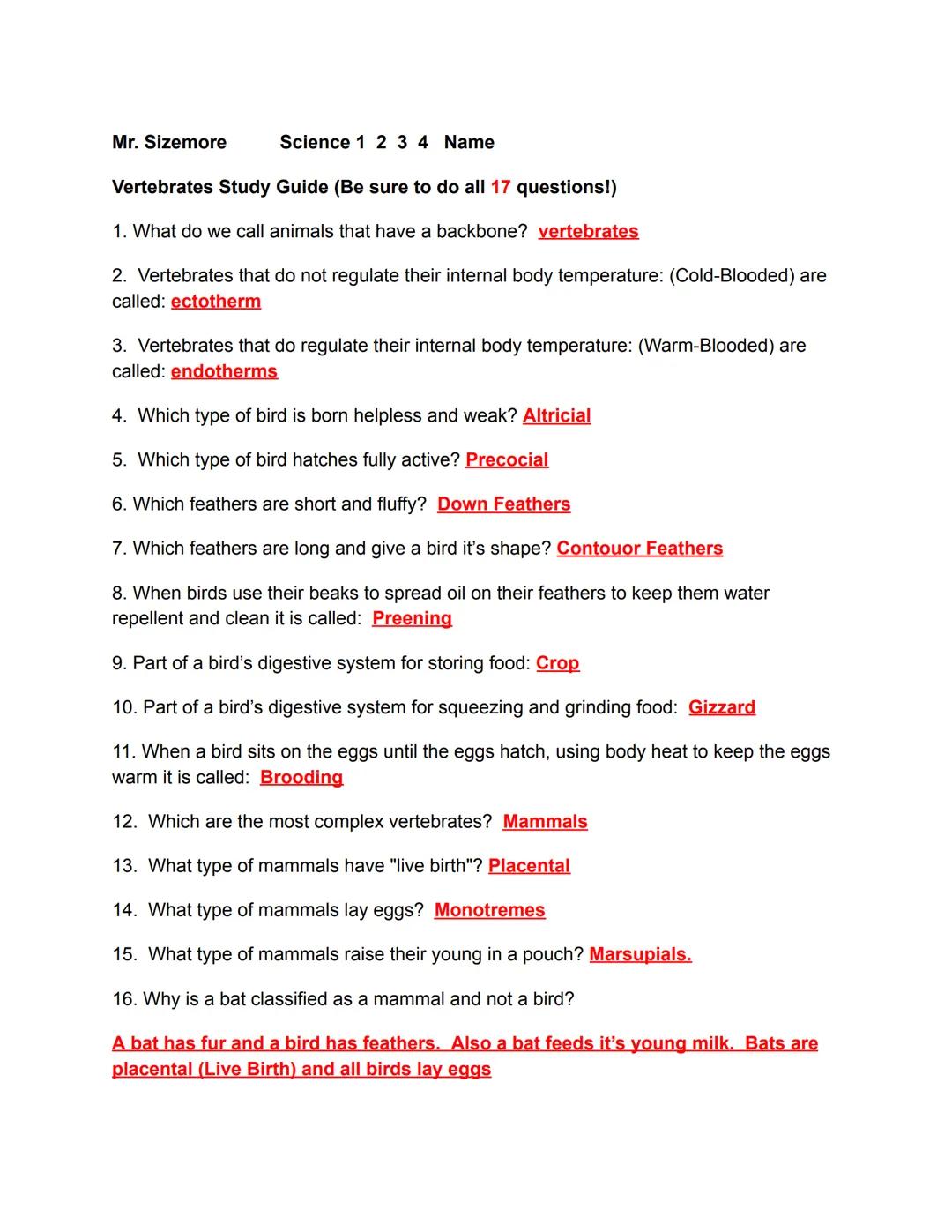
Vertebrate Basics and Classification
Vertebrates are animals that have a backbone. They can be divided into two main groups based on body temperature. Ectotherms don't regulate their internal temperature, while endotherms can control their body heat.
Birds have special features that make them unique vertebrates. Some baby birds are altricial, meaning they're born helpless and weak, while others are precocial and hatch fully active and ready to go! Birds have two main types of feathers: soft, fluffy down feathers and longer contour feathers that give birds their shape.
Birds take care of their feathers through preening, using their beaks to spread oil and keep feathers clean and waterproof. Their digestive system includes a crop for storing food and a gizzard for grinding food since birds don't have teeth. When birds sit on eggs to keep them warm until they hatch, this is called brooding.
Fun Fact: Even though bats can fly like birds, they're actually mammals because they have fur instead of feathers and feed their babies milk!
2
of 2
Mammal Types and Animal Classification
Mammals are considered the most complex vertebrates. There are three main types based on how they reproduce. Placental mammals give birth to live babies, monotremes (like platypuses) lay eggs, and marsupials (like kangaroos) carry and raise their babies in pouches.
Scientists classify animals by looking at their body features. For example, bats are mammals, not birds, because they have fur instead of feathers, feed their babies milk, and give live birth rather than laying eggs.
Similarly, penguins are birds, not fish, despite being excellent swimmers. Penguins have feathers (not scales), lungs (not gills), and a four-chambered heart (fish have two chambers). These differences help scientists place animals in the correct groups.
Remember This: Classification helps us understand how animals are related and how they evolved over time. The features you can't always see (like heart chambers) can be just as important as obvious ones (like feathers or fur)!
We thought you’d never ask...
What is the Knowunity AI companion?
Our AI companion is specifically built for the needs of students. Based on the millions of content pieces we have on the platform we can provide truly meaningful and relevant answers to students. But its not only about answers, the companion is even more about guiding students through their daily learning challenges, with personalised study plans, quizzes or content pieces in the chat and 100% personalisation based on the students skills and developments.
Where can I download the Knowunity app?
You can download the app in the Google Play Store and in the Apple App Store.
Is Knowunity really free of charge?
That's right! Enjoy free access to study content, connect with fellow students, and get instant help – all at your fingertips.
Most popular content in US History
9C
 US History
civil rights movement quiz
Vocab
8th2220
Social StudiesThe Neolithic Revolution: From Hunter-Gatherers to Farming
Summarizes the key aspects of the Neolithic Revolution, detailing how humans moved from hunter-gatherer groups to settled agricultural societies.
6th2882
T
Social StudiesThe Revolutionary War Pt.1
Questions about the revolutionary war
9th840
Social StudiesMotives for European Exploration: Gold, God, and Glory
Learn about the key factors driving European exploration of the New World. This resource explains the "3 G's" motive: the pursuit of Gold, the spread of God, and the desire for Glory.
6th1821
 AP Human Geography
AP Human Geography Notes and Exam Prep Unit 1
A document covering Unit 1 of AP Human Geography from my 9th grade class 2021-2022
1,34776
AP Human GeographyAP Human Geography Notes and Exam Prep Unit 6
A document covering Unit 6 of AP Human Geography from my 9th grade class 2021-2022
1,29765
AP Human GeographyAP Human Geography Notes and Exam Prep Unit 5
A document covering Unit 5 of AP Human Geography from my 9th grade class 2021-2022
1,14943
W
 Earth and Space Science
World Oceans - Sixth Grade
Can you guess all the oceans? This will test your knowledge on the location of each ocean, describing bordering countries, seas, lands, and other oceans.
6th1390
AP Human GeographyAP Human Geography Notes and Exam Prep Unit 4
A document covering Unit 4 of AP Human Geography from my 9th grade class 2021-2022
98653
Most popular content
9O
AP US HistoryOrigins and Dynamics of the Columbian Exchange
Analyze the ecological and economic motivations behind the initial transfer of goods, people, and diseases between the Old and New Worlds.
9th3,1280
I
AP US HistoryIntroduction to Early Cultural Interactions
Analyze the initial social and religious encounters between Europeans, Africans, and Indigenous peoples in the colonial Americas.
9th2,7730
O
AP World HistoryOrigins of Ancient River Civilizations
Analyze the environmental factors and technological innovations that led to the rise of early states in Mesopotamia, Egypt, and the Indus Valley.
9th3,1870
M
AP US HistoryMotivations for European Exploration
Analyze the economic, religious, and political factors that drove European powers to the Americas during the 15th and 16th centuries.
9th1,7780
F
AP PsychologyFoundations of Ethical Guidelines in Research
Practice the core principles of the APA ethical code including informed consent, debriefing, and the role of Institutional Review Boards.
9th1,3360
I
AP US HistoryIntroduction to Native American Societies
Examine the diverse social, political, and economic structures of North American indigenous groups prior to European contact.
9th1,1100
I
 AP Biology
Introduction to Biological Elements of Life
Practice identifying the essential elements including carbon, nitrogen, phosphorus, and sulfur that compose biological macromolecules.
9th1,7390
I
AP US HistoryIntroduction to the Spanish Encomienda System
Explore the fundamental economic and social structures of the Spanish colonial system, focusing on the encomienda and the casta social hierarchy.
9th8890
O
AP World HistoryOrigins and Continuity of the Byzantine Empire
Analyze the political and cultural transitions from the Roman Empire to the Byzantine Empire, focusing on the reign of Justinian I and his code.
9th1,6320
Can't find what you're looking for? Explore other subjects.
Students love us — and so will you.
4.6/5App Store
4.7/5Google Play
The app is very easy to use and well designed. I have found everything I was looking for so far and have been able to learn a lot from the presentations! I will definitely use the app for a class assignment! And of course it also helps a lot as an inspiration.
Stefan SiOS user
This app is really great. There are so many study notes and help [...]. My problem subject is French, for example, and the app has so many options for help. Thanks to this app, I have improved my French. I would recommend it to anyone.
Samantha KlichAndroid user
Wow, I am really amazed. I just tried the app because I've seen it advertised many times and was absolutely stunned. This app is THE HELP you want for school and above all, it offers so many things, such as workouts and fact sheets, which have been VERY helpful to me personally.
AnnaiOS user
Social Studies11 views·Updated Jun 6, 2026·2 pagesComprehensive Vertebrae Study Guide
Vertebrates are animals with backbones! This guide covers the main types of vertebrates, focusing on birds and mammals, and explores how scientists classify these animals based on their unique characteristics.
1
of 2
Sign up to see the content. It's free!
- Access to all documents
- Improve your grades
- Join milions of students
Vertebrate Basics and Classification
Vertebrates are animals that have a backbone. They can be divided into two main groups based on body temperature. Ectotherms don't regulate their internal temperature, while endotherms can control their body heat.
Birds have special features that make them unique vertebrates. Some baby birds are altricial, meaning they're born helpless and weak, while others are precocial and hatch fully active and ready to go! Birds have two main types of feathers: soft, fluffy down feathers and longer contour feathers that give birds their shape.
Birds take care of their feathers through preening, using their beaks to spread oil and keep feathers clean and waterproof. Their digestive system includes a crop for storing food and a gizzard for grinding food since birds don't have teeth. When birds sit on eggs to keep them warm until they hatch, this is called brooding.
Fun Fact: Even though bats can fly like birds, they're actually mammals because they have fur instead of feathers and feed their babies milk!
2
of 2Sign up to see the content. It's free!
- Access to all documents
- Improve your grades
- Join milions of students
Mammal Types and Animal Classification
Mammals are considered the most complex vertebrates. There are three main types based on how they reproduce. Placental mammals give birth to live babies, monotremes (like platypuses) lay eggs, and marsupials (like kangaroos) carry and raise their babies in pouches.
Scientists classify animals by looking at their body features. For example, bats are mammals, not birds, because they have fur instead of feathers, feed their babies milk, and give live birth rather than laying eggs.
Similarly, penguins are birds, not fish, despite being excellent swimmers. Penguins have feathers (not scales), lungs (not gills), and a four-chambered heart (fish have two chambers). These differences help scientists place animals in the correct groups.
Remember This: Classification helps us understand how animals are related and how they evolved over time. The features you can't always see (like heart chambers) can be just as important as obvious ones (like feathers or fur)!
We thought you’d never ask...
What is the Knowunity AI companion?
Our AI companion is specifically built for the needs of students. Based on the millions of content pieces we have on the platform we can provide truly meaningful and relevant answers to students. But its not only about answers, the companion is even more about guiding students through their daily learning challenges, with personalised study plans, quizzes or content pieces in the chat and 100% personalisation based on the students skills and developments.
Where can I download the Knowunity app?
You can download the app in the Google Play Store and in the Apple App Store.
Is Knowunity really free of charge?
That's right! Enjoy free access to study content, connect with fellow students, and get instant help – all at your fingertips.
Most popular content in US History
9C
US Historycivil rights movement quiz
Vocab
8th2220
Social StudiesThe Neolithic Revolution: From Hunter-Gatherers to Farming
Summarizes the key aspects of the Neolithic Revolution, detailing how humans moved from hunter-gatherer groups to settled agricultural societies.
6th2882
T
Social StudiesThe Revolutionary War Pt.1
Questions about the revolutionary war
9th840
Social StudiesMotives for European Exploration: Gold, God, and Glory
Learn about the key factors driving European exploration of the New World. This resource explains the "3 G's" motive: the pursuit of Gold, the spread of God, and the desire for Glory.
6th1821
AP Human GeographyAP Human Geography Notes and Exam Prep Unit 1
A document covering Unit 1 of AP Human Geography from my 9th grade class 2021-2022
1,34776
AP Human GeographyAP Human Geography Notes and Exam Prep Unit 6
A document covering Unit 6 of AP Human Geography from my 9th grade class 2021-2022
1,29765
AP Human GeographyAP Human Geography Notes and Exam Prep Unit 5
A document covering Unit 5 of AP Human Geography from my 9th grade class 2021-2022
1,14943
W
Earth and Space ScienceWorld Oceans - Sixth Grade
Can you guess all the oceans? This will test your knowledge on the location of each ocean, describing bordering countries, seas, lands, and other oceans.
6th1390
AP Human GeographyAP Human Geography Notes and Exam Prep Unit 4
A document covering Unit 4 of AP Human Geography from my 9th grade class 2021-2022
98653
Most popular content
9O
AP US HistoryOrigins and Dynamics of the Columbian Exchange
Analyze the ecological and economic motivations behind the initial transfer of goods, people, and diseases between the Old and New Worlds.
9th3,1280
I
AP US HistoryIntroduction to Early Cultural Interactions
Analyze the initial social and religious encounters between Europeans, Africans, and Indigenous peoples in the colonial Americas.
9th2,7730
O
AP World HistoryOrigins of Ancient River Civilizations
Analyze the environmental factors and technological innovations that led to the rise of early states in Mesopotamia, Egypt, and the Indus Valley.
9th3,1870
M
AP US HistoryMotivations for European Exploration
Analyze the economic, religious, and political factors that drove European powers to the Americas during the 15th and 16th centuries.
9th1,7780
F
AP PsychologyFoundations of Ethical Guidelines in Research
Practice the core principles of the APA ethical code including informed consent, debriefing, and the role of Institutional Review Boards.
9th1,3360
I
AP US HistoryIntroduction to Native American Societies
Examine the diverse social, political, and economic structures of North American indigenous groups prior to European contact.
9th1,1100
I
AP BiologyIntroduction to Biological Elements of Life
Practice identifying the essential elements including carbon, nitrogen, phosphorus, and sulfur that compose biological macromolecules.
9th1,7390
I
AP US HistoryIntroduction to the Spanish Encomienda System
Explore the fundamental economic and social structures of the Spanish colonial system, focusing on the encomienda and the casta social hierarchy.
9th8890
O
AP World HistoryOrigins and Continuity of the Byzantine Empire
Analyze the political and cultural transitions from the Roman Empire to the Byzantine Empire, focusing on the reign of Justinian I and his code.
9th1,6320
Can't find what you're looking for? Explore other subjects.
Students love us — and so will you.
4.6/5App Store
4.7/5Google Play
The app is very easy to use and well designed. I have found everything I was looking for so far and have been able to learn a lot from the presentations! I will definitely use the app for a class assignment! And of course it also helps a lot as an inspiration.
Stefan SiOS user
This app is really great. There are so many study notes and help [...]. My problem subject is French, for example, and the app has so many options for help. Thanks to this app, I have improved my French. I would recommend it to anyone.
Samantha KlichAndroid user
Wow, I am really amazed. I just tried the app because I've seen it advertised many times and was absolutely stunned. This app is THE HELP you want for school and above all, it offers so many things, such as workouts and fact sheets, which have been VERY helpful to me personally.
AnnaiOS user