
The Renaissance was a period of "rebirth" that swept through...
 Social Studies21 views·Updated Jun 13, 2026·2 pages
The Renaissance: A Transformative Era in History
Aubrey@myusernameis
1
of 2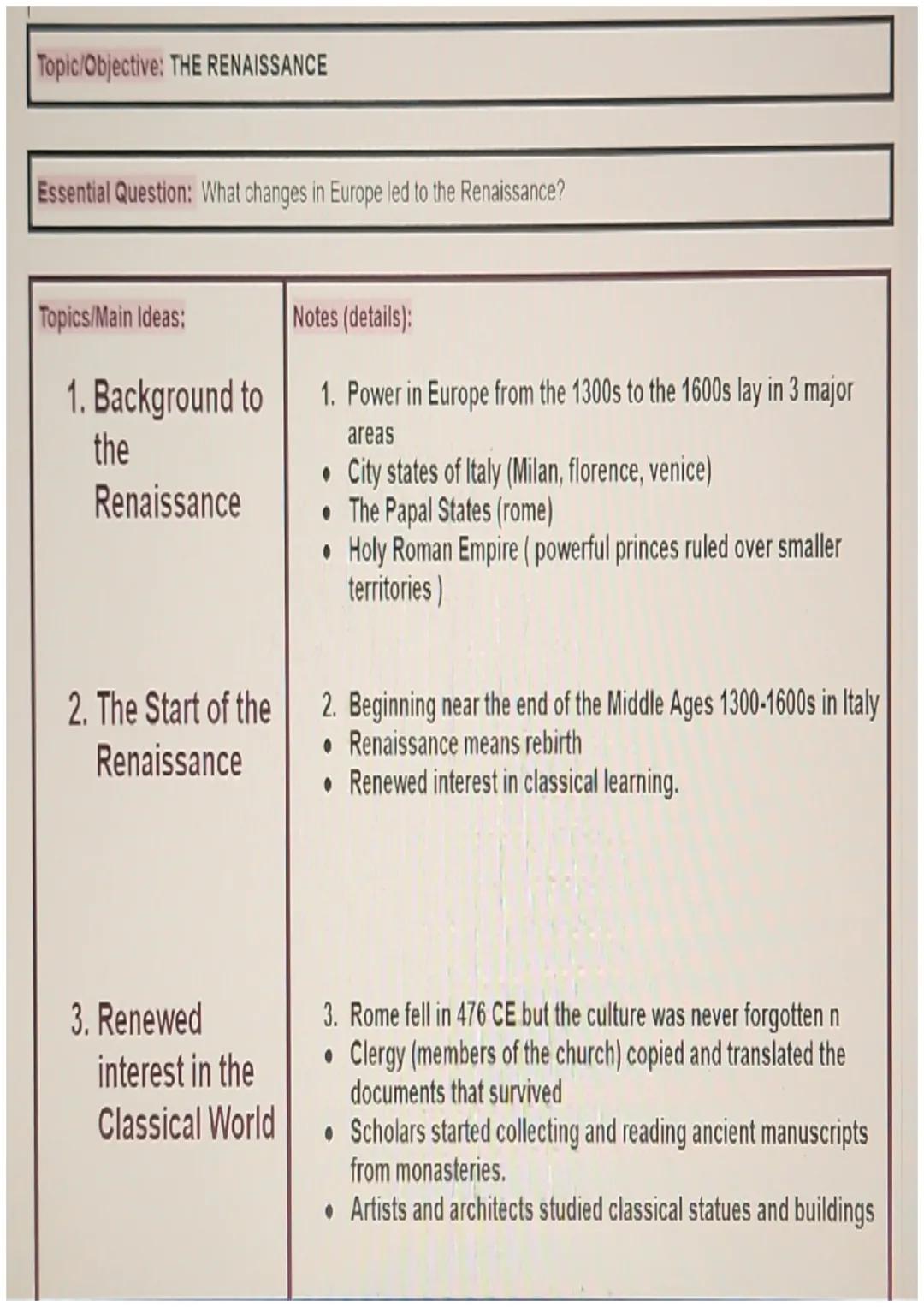
Renaissance Beginnings
Ever wonder why we call this period the "Renaissance"? The word means "rebirth" in French, and that's exactly what was happening - a rebirth of interest in ancient learning. This period started around the late 1300s in Italy and continued until the 1600s.
Power in Europe during this time was divided among three main areas: the city-states of Italy (like Milan, Florence, and Venice), the Papal States centered in Rome, and the Holy Roman Empire with its many territories ruled by princes.
When Rome fell in 476 CE, its culture wasn't completely lost. Church clergy preserved knowledge by copying ancient manuscripts, and Renaissance scholars eagerly sought these texts in monasteries. Artists and architects studied classical statues and buildings to learn from their techniques.
Did you know? While we think of the Renaissance as a sudden change, it actually developed gradually over centuries as scholars and artists rediscovered ancient knowledge.
2
of 2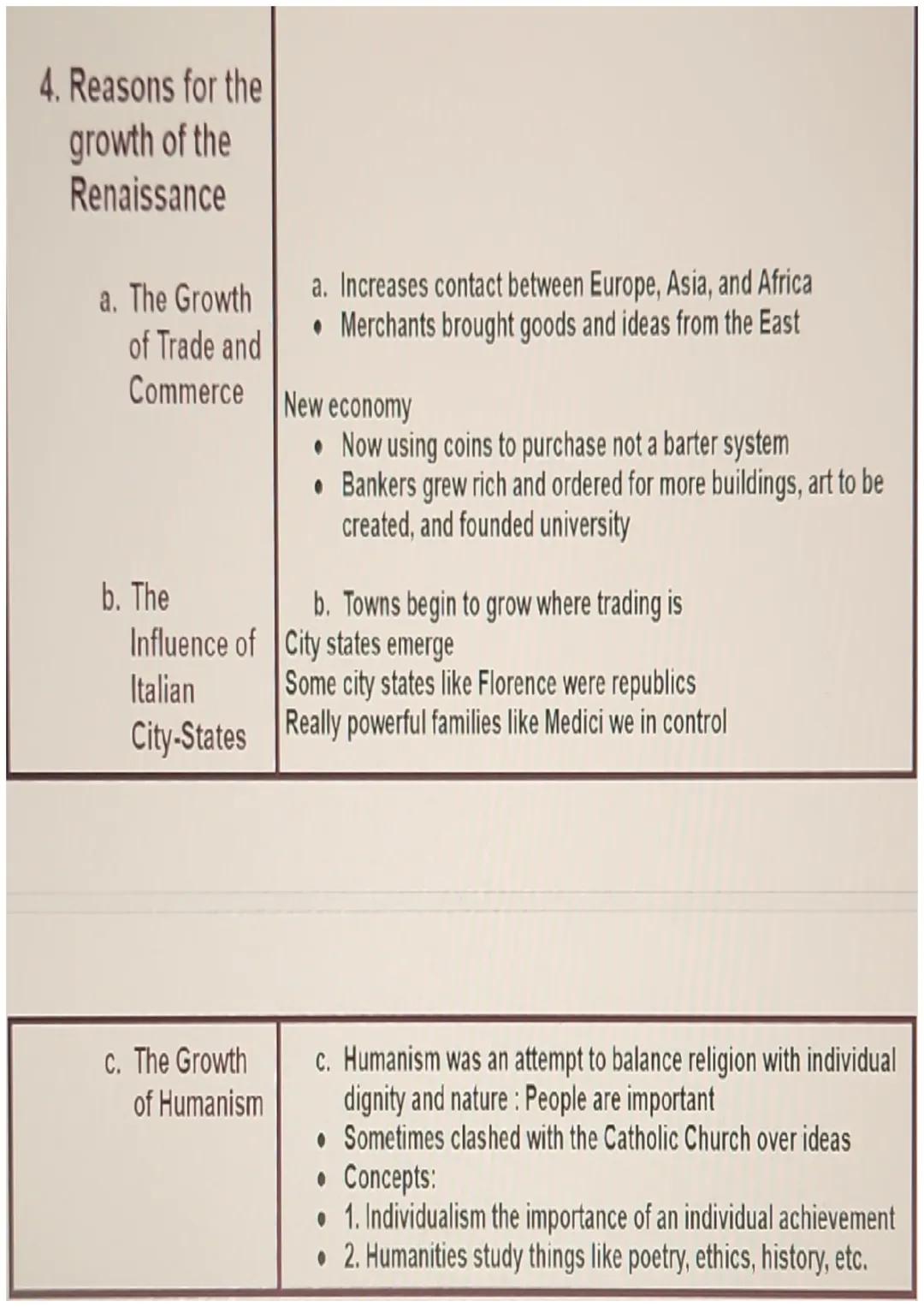
What Made the Renaissance Grow?
Trade routes connecting Europe, Asia, and Africa became superhighways for more than just goods - they transported ideas too! Merchants returning from the East brought back not just silks and spices, but also new ways of thinking that helped fuel Renaissance creativity.
A major economic shift happened during this time. Instead of simply trading one item for another (bartering), people began using coins. Wealthy bankers emerged who used their money to commission beautiful buildings, sponsor artists, and even fund universities.
Italian city-states became powerful centers of Renaissance culture. Some, like Florence, were republics, though powerful families (like the Medici) often controlled things behind the scenes. These wealthy families competed to sponsor the greatest artists and thinkers.
Humanism became a central Renaissance idea that changed how people saw themselves. This philosophy emphasized the importance of individual achievement and the study of subjects like poetry, ethics, and history. Humanists believed people had dignity and value - a view that sometimes put them at odds with Church authorities.
Think about it: How might your life be different if you lived during a time when individual achievement was just beginning to be celebrated?
We thought you’d never ask...
What is the Knowunity AI companion?
Our AI companion is specifically built for the needs of students. Based on the millions of content pieces we have on the platform we can provide truly meaningful and relevant answers to students. But its not only about answers, the companion is even more about guiding students through their daily learning challenges, with personalised study plans, quizzes or content pieces in the chat and 100% personalisation based on the students skills and developments.
Where can I download the Knowunity app?
You can download the app in the Google Play Store and in the Apple App Store.
Is Knowunity really free of charge?
That's right! Enjoy free access to study content, connect with fellow students, and get instant help – all at your fingertips.
Similar Content
Most popular content in US History
9C
 US History
civil rights movement quiz
Vocab
8th2220
Social StudiesThe Neolithic Revolution: From Hunter-Gatherers to Farming
Summarizes the key aspects of the Neolithic Revolution, detailing how humans moved from hunter-gatherer groups to settled agricultural societies.
6th2882
T
Social StudiesThe Revolutionary War Pt.1
Questions about the revolutionary war
9th840
Social StudiesMotives for European Exploration: Gold, God, and Glory
Learn about the key factors driving European exploration of the New World. This resource explains the "3 G's" motive: the pursuit of Gold, the spread of God, and the desire for Glory.
6th1821
 AP Human Geography
AP Human Geography Notes and Exam Prep Unit 1
A document covering Unit 1 of AP Human Geography from my 9th grade class 2021-2022
1,34776
AP Human GeographyAP Human Geography Notes and Exam Prep Unit 6
A document covering Unit 6 of AP Human Geography from my 9th grade class 2021-2022
1,29765
AP Human GeographyAP Human Geography Notes and Exam Prep Unit 5
A document covering Unit 5 of AP Human Geography from my 9th grade class 2021-2022
1,14943
W
 Earth and Space Science
World Oceans - Sixth Grade
Can you guess all the oceans? This will test your knowledge on the location of each ocean, describing bordering countries, seas, lands, and other oceans.
6th1390
AP Human GeographyAP Human Geography Notes and Exam Prep Unit 4
A document covering Unit 4 of AP Human Geography from my 9th grade class 2021-2022
98653
Most popular content
9O
AP US HistoryOrigins and Dynamics of the Columbian Exchange
Analyze the ecological and economic motivations behind the initial transfer of goods, people, and diseases between the Old and New Worlds.
9th3,1280
I
AP US HistoryIntroduction to Early Cultural Interactions
Analyze the initial social and religious encounters between Europeans, Africans, and Indigenous peoples in the colonial Americas.
9th2,7730
O
AP World HistoryOrigins of Ancient River Civilizations
Analyze the environmental factors and technological innovations that led to the rise of early states in Mesopotamia, Egypt, and the Indus Valley.
9th3,1870
M
AP US HistoryMotivations for European Exploration
Analyze the economic, religious, and political factors that drove European powers to the Americas during the 15th and 16th centuries.
9th1,7780
F
AP PsychologyFoundations of Ethical Guidelines in Research
Practice the core principles of the APA ethical code including informed consent, debriefing, and the role of Institutional Review Boards.
9th1,3360
I
AP US HistoryIntroduction to Native American Societies
Examine the diverse social, political, and economic structures of North American indigenous groups prior to European contact.
9th1,1100
I
 AP Biology
Introduction to Biological Elements of Life
Practice identifying the essential elements including carbon, nitrogen, phosphorus, and sulfur that compose biological macromolecules.
9th1,7390
I
AP US HistoryIntroduction to the Spanish Encomienda System
Explore the fundamental economic and social structures of the Spanish colonial system, focusing on the encomienda and the casta social hierarchy.
9th8890
O
AP World HistoryOrigins and Continuity of the Byzantine Empire
Analyze the political and cultural transitions from the Roman Empire to the Byzantine Empire, focusing on the reign of Justinian I and his code.
9th1,6320
Can't find what you're looking for? Explore other subjects.
Students love us — and so will you.
4.6/5App Store
4.7/5Google Play
The app is very easy to use and well designed. I have found everything I was looking for so far and have been able to learn a lot from the presentations! I will definitely use the app for a class assignment! And of course it also helps a lot as an inspiration.
Stefan SiOS user
This app is really great. There are so many study notes and help [...]. My problem subject is French, for example, and the app has so many options for help. Thanks to this app, I have improved my French. I would recommend it to anyone.
Samantha KlichAndroid user
Wow, I am really amazed. I just tried the app because I've seen it advertised many times and was absolutely stunned. This app is THE HELP you want for school and above all, it offers so many things, such as workouts and fact sheets, which have been VERY helpful to me personally.
AnnaiOS user
Social Studies21 views·Updated Jun 13, 2026·2 pagesThe Renaissance: A Transformative Era in History
Aubrey@myusernameis
The Renaissance was a period of "rebirth" that swept through Europe from the 1300s to 1600s, beginning in Italy. During this time, people rediscovered classical Greek and Roman knowledge, leading to major changes in art, thinking, and society.
1
of 2
Sign up to see the content. It's free!
- Access to all documents
- Improve your grades
- Join milions of students
Renaissance Beginnings
Ever wonder why we call this period the "Renaissance"? The word means "rebirth" in French, and that's exactly what was happening - a rebirth of interest in ancient learning. This period started around the late 1300s in Italy and continued until the 1600s.
Power in Europe during this time was divided among three main areas: the city-states of Italy (like Milan, Florence, and Venice), the Papal States centered in Rome, and the Holy Roman Empire with its many territories ruled by princes.
When Rome fell in 476 CE, its culture wasn't completely lost. Church clergy preserved knowledge by copying ancient manuscripts, and Renaissance scholars eagerly sought these texts in monasteries. Artists and architects studied classical statues and buildings to learn from their techniques.
Did you know? While we think of the Renaissance as a sudden change, it actually developed gradually over centuries as scholars and artists rediscovered ancient knowledge.
2
of 2Sign up to see the content. It's free!
- Access to all documents
- Improve your grades
- Join milions of students
What Made the Renaissance Grow?
Trade routes connecting Europe, Asia, and Africa became superhighways for more than just goods - they transported ideas too! Merchants returning from the East brought back not just silks and spices, but also new ways of thinking that helped fuel Renaissance creativity.
A major economic shift happened during this time. Instead of simply trading one item for another (bartering), people began using coins. Wealthy bankers emerged who used their money to commission beautiful buildings, sponsor artists, and even fund universities.
Italian city-states became powerful centers of Renaissance culture. Some, like Florence, were republics, though powerful families (like the Medici) often controlled things behind the scenes. These wealthy families competed to sponsor the greatest artists and thinkers.
Humanism became a central Renaissance idea that changed how people saw themselves. This philosophy emphasized the importance of individual achievement and the study of subjects like poetry, ethics, and history. Humanists believed people had dignity and value - a view that sometimes put them at odds with Church authorities.
Think about it: How might your life be different if you lived during a time when individual achievement was just beginning to be celebrated?
We thought you’d never ask...
What is the Knowunity AI companion?
Our AI companion is specifically built for the needs of students. Based on the millions of content pieces we have on the platform we can provide truly meaningful and relevant answers to students. But its not only about answers, the companion is even more about guiding students through their daily learning challenges, with personalised study plans, quizzes or content pieces in the chat and 100% personalisation based on the students skills and developments.
Where can I download the Knowunity app?
You can download the app in the Google Play Store and in the Apple App Store.
Is Knowunity really free of charge?
That's right! Enjoy free access to study content, connect with fellow students, and get instant help – all at your fingertips.
Similar Content
Most popular content in US History
9C
US Historycivil rights movement quiz
Vocab
8th2220
Social StudiesThe Neolithic Revolution: From Hunter-Gatherers to Farming
Summarizes the key aspects of the Neolithic Revolution, detailing how humans moved from hunter-gatherer groups to settled agricultural societies.
6th2882
T
Social StudiesThe Revolutionary War Pt.1
Questions about the revolutionary war
9th840
Social StudiesMotives for European Exploration: Gold, God, and Glory
Learn about the key factors driving European exploration of the New World. This resource explains the "3 G's" motive: the pursuit of Gold, the spread of God, and the desire for Glory.
6th1821
AP Human GeographyAP Human Geography Notes and Exam Prep Unit 1
A document covering Unit 1 of AP Human Geography from my 9th grade class 2021-2022
1,34776
AP Human GeographyAP Human Geography Notes and Exam Prep Unit 6
A document covering Unit 6 of AP Human Geography from my 9th grade class 2021-2022
1,29765
AP Human GeographyAP Human Geography Notes and Exam Prep Unit 5
A document covering Unit 5 of AP Human Geography from my 9th grade class 2021-2022
1,14943
W
Earth and Space ScienceWorld Oceans - Sixth Grade
Can you guess all the oceans? This will test your knowledge on the location of each ocean, describing bordering countries, seas, lands, and other oceans.
6th1390
AP Human GeographyAP Human Geography Notes and Exam Prep Unit 4
A document covering Unit 4 of AP Human Geography from my 9th grade class 2021-2022
98653
Most popular content
9O
AP US HistoryOrigins and Dynamics of the Columbian Exchange
Analyze the ecological and economic motivations behind the initial transfer of goods, people, and diseases between the Old and New Worlds.
9th3,1280
I
AP US HistoryIntroduction to Early Cultural Interactions
Analyze the initial social and religious encounters between Europeans, Africans, and Indigenous peoples in the colonial Americas.
9th2,7730
O
AP World HistoryOrigins of Ancient River Civilizations
Analyze the environmental factors and technological innovations that led to the rise of early states in Mesopotamia, Egypt, and the Indus Valley.
9th3,1870
M
AP US HistoryMotivations for European Exploration
Analyze the economic, religious, and political factors that drove European powers to the Americas during the 15th and 16th centuries.
9th1,7780
F
AP PsychologyFoundations of Ethical Guidelines in Research
Practice the core principles of the APA ethical code including informed consent, debriefing, and the role of Institutional Review Boards.
9th1,3360
I
AP US HistoryIntroduction to Native American Societies
Examine the diverse social, political, and economic structures of North American indigenous groups prior to European contact.
9th1,1100
I
AP BiologyIntroduction to Biological Elements of Life
Practice identifying the essential elements including carbon, nitrogen, phosphorus, and sulfur that compose biological macromolecules.
9th1,7390
I
AP US HistoryIntroduction to the Spanish Encomienda System
Explore the fundamental economic and social structures of the Spanish colonial system, focusing on the encomienda and the casta social hierarchy.
9th8890
O
AP World HistoryOrigins and Continuity of the Byzantine Empire
Analyze the political and cultural transitions from the Roman Empire to the Byzantine Empire, focusing on the reign of Justinian I and his code.
9th1,6320
Can't find what you're looking for? Explore other subjects.
Students love us — and so will you.
4.6/5App Store
4.7/5Google Play
The app is very easy to use and well designed. I have found everything I was looking for so far and have been able to learn a lot from the presentations! I will definitely use the app for a class assignment! And of course it also helps a lot as an inspiration.
Stefan SiOS user
This app is really great. There are so many study notes and help [...]. My problem subject is French, for example, and the app has so many options for help. Thanks to this app, I have improved my French. I would recommend it to anyone.
Samantha KlichAndroid user
Wow, I am really amazed. I just tried the app because I've seen it advertised many times and was absolutely stunned. This app is THE HELP you want for school and above all, it offers so many things, such as workouts and fact sheets, which have been VERY helpful to me personally.
AnnaiOS user