
Welcome to the essential vocabulary guide for understanding the U.S....
 US History88 views·Updated Jun 5, 2026·5 pages
Comprehensive AP US Gov Legislative Branch Vocabulary Guide

Adeline Tse@aliwormie

1 / 5
1
of 5
Legislative Branch Vocabulary: Core Concepts
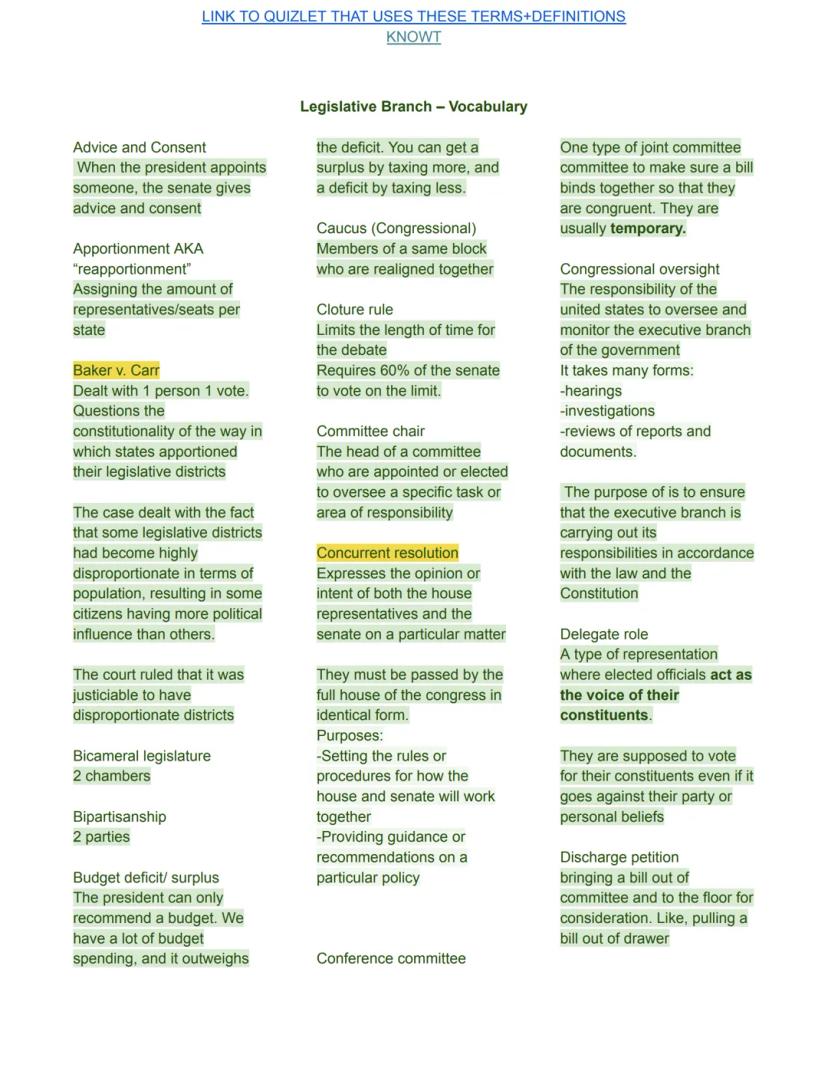
Ever wonder how Congress actually works? Let's start with some fundamental concepts. The U.S. has a bicameral legislature with two chambers (House and Senate), and both play different roles in governing.
When the President appoints officials, the Senate provides advice and consent by reviewing and voting on these nominations. States receive representatives through apportionment, which assigns congressional seats based on population. The landmark case Baker v. Carr established the "one person, one vote" principle, ruling that disproportionate legislative districts were justiciable issues.
Congressional groups often work together in a caucus, uniting members with similar interests. Committee decisions are guided by a committee chair who oversees specific areas of responsibility. When bills need reconciliation between House and Senate versions, a temporary conference committee forms to resolve differences.
Thinking Deeper: Understanding how representatives view their role is key! A delegate role means officials vote according to constituents' wishes, even if it contradicts their personal beliefs. This directly affects how your voice is represented in government.
2
of 5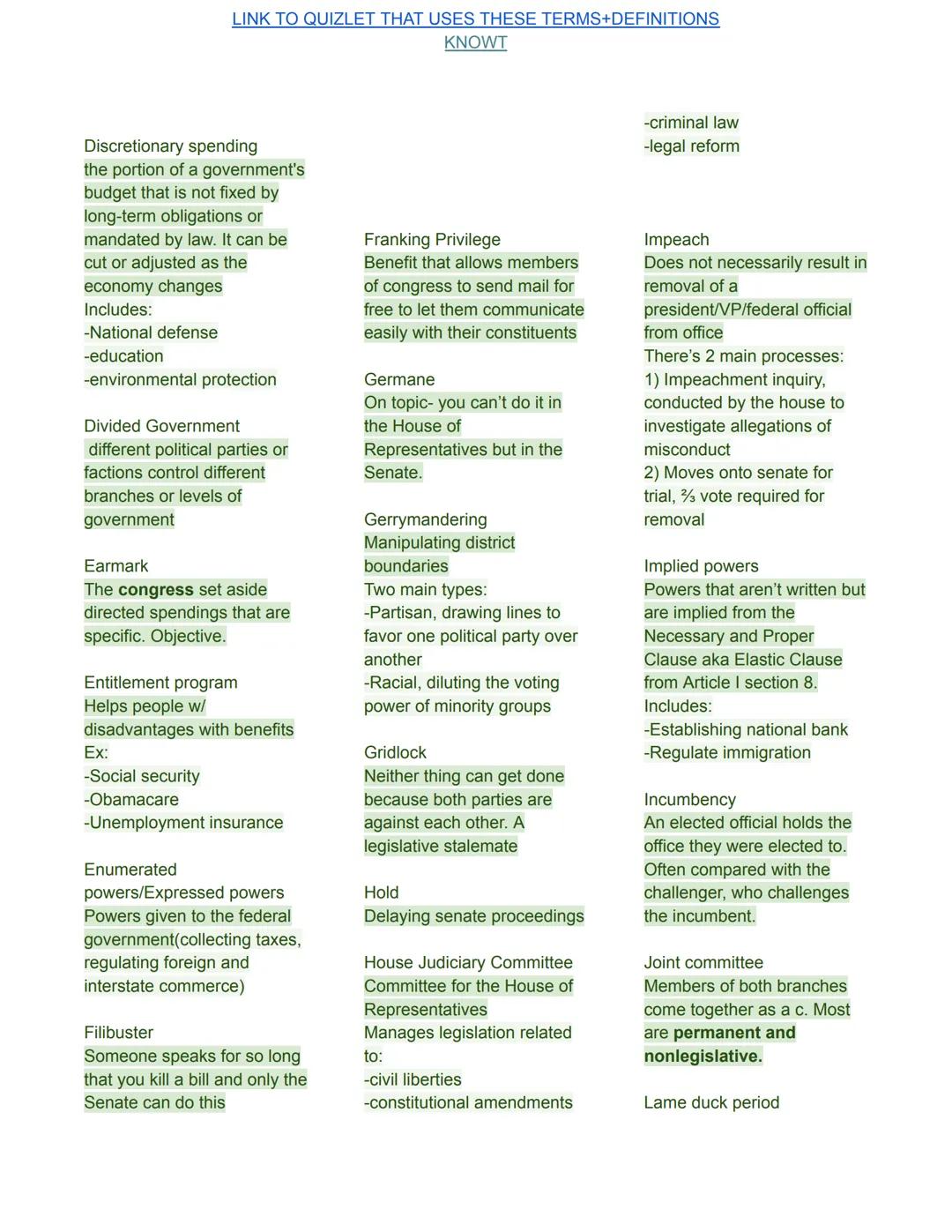
Budget Powers and Government Structure
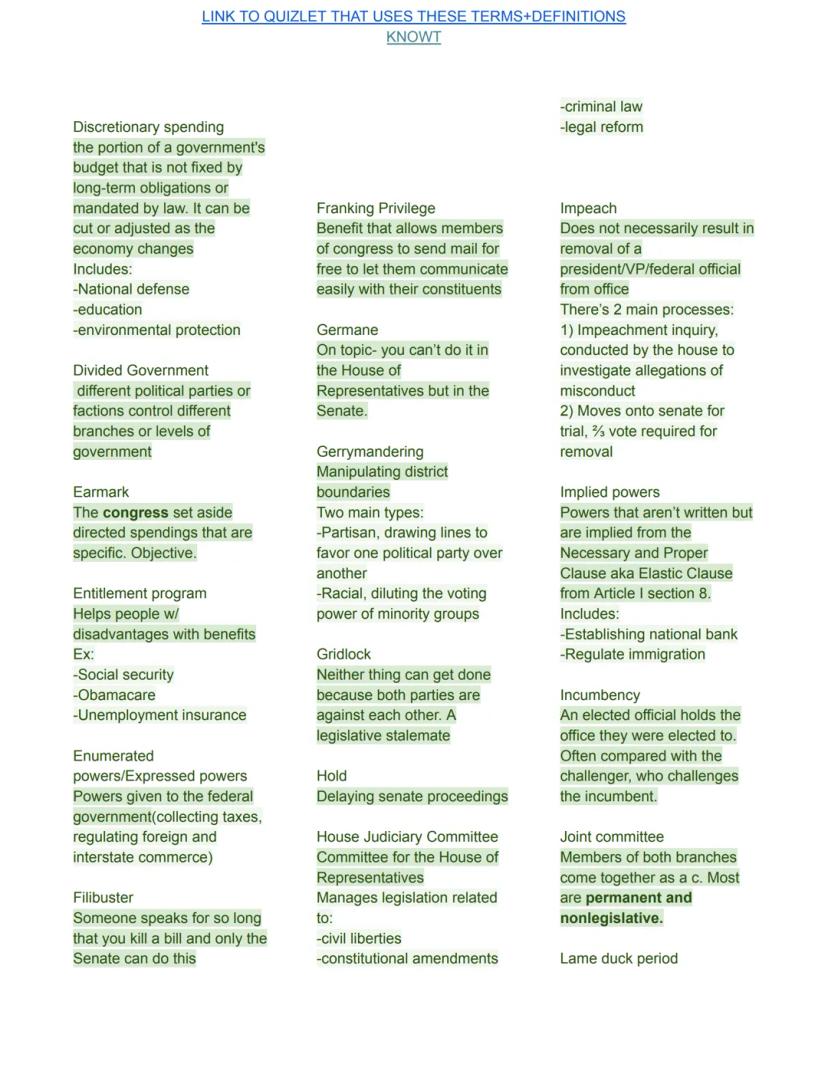
Money matters in government! The federal budget includes discretionary spending (adjustable expenses like defense and education) and mandatory spending (required programs like Social Security). When spending exceeds revenue, we have a budget deficit; when revenue exceeds spending, we have a surplus.
A divided government occurs when different parties control different branches, often leading to gridlock where legislation stalls due to partisan disagreement. By contrast, unified government happens when one party controls both executive and legislative branches, typically enabling more efficient policymaking.
Entitlement programs provide benefits to eligible groups (like Social Security or unemployment insurance), while earmarks direct spending to specific projects. Congress has oversight responsibility to monitor the executive branch through hearings and investigations.
Real Impact: Notice how gerrymandering (manipulating district boundaries) affects election outcomes! This practice can create "safe seats" for incumbents and dilute voting power of certain groups. This directly impacts who represents you and your community.
3
of 5
Legislative Powers and Procedures
Congress has both enumerated powers (explicitly stated in the Constitution) and implied powers (derived from the Necessary and Proper Clause). These powers form the foundation of congressional authority.
The Senate has unique procedures like the filibuster, where a senator speaks continuously to delay or prevent voting on legislation. To end a filibuster, the Senate needs 60 votes through a cloture rule. Senators can also place a hold to temporarily block consideration of nominations or legislation.
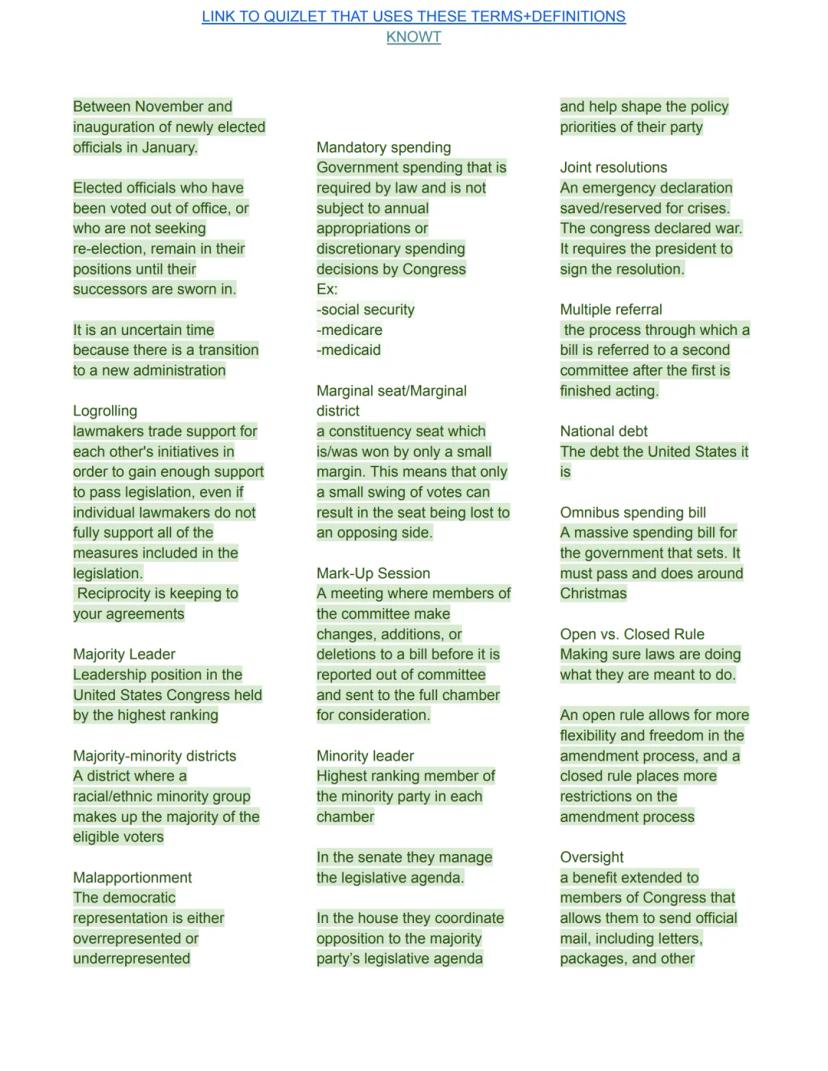
Representatives enjoy certain privileges, including the franking privilege which allows them to send mail to constituents for free. The lame duck period (between November elections and January inaugurations) is when outgoing officials still hold office but have reduced political influence.
Practical Politics: Logrolling is when lawmakers trade votes ("I'll support your bill if you support mine"). This practice shows that politics often involves compromise and negotiation rather than purely ideological decisions. This helps explain why some seemingly unrelated issues get bundled together!
4
of 5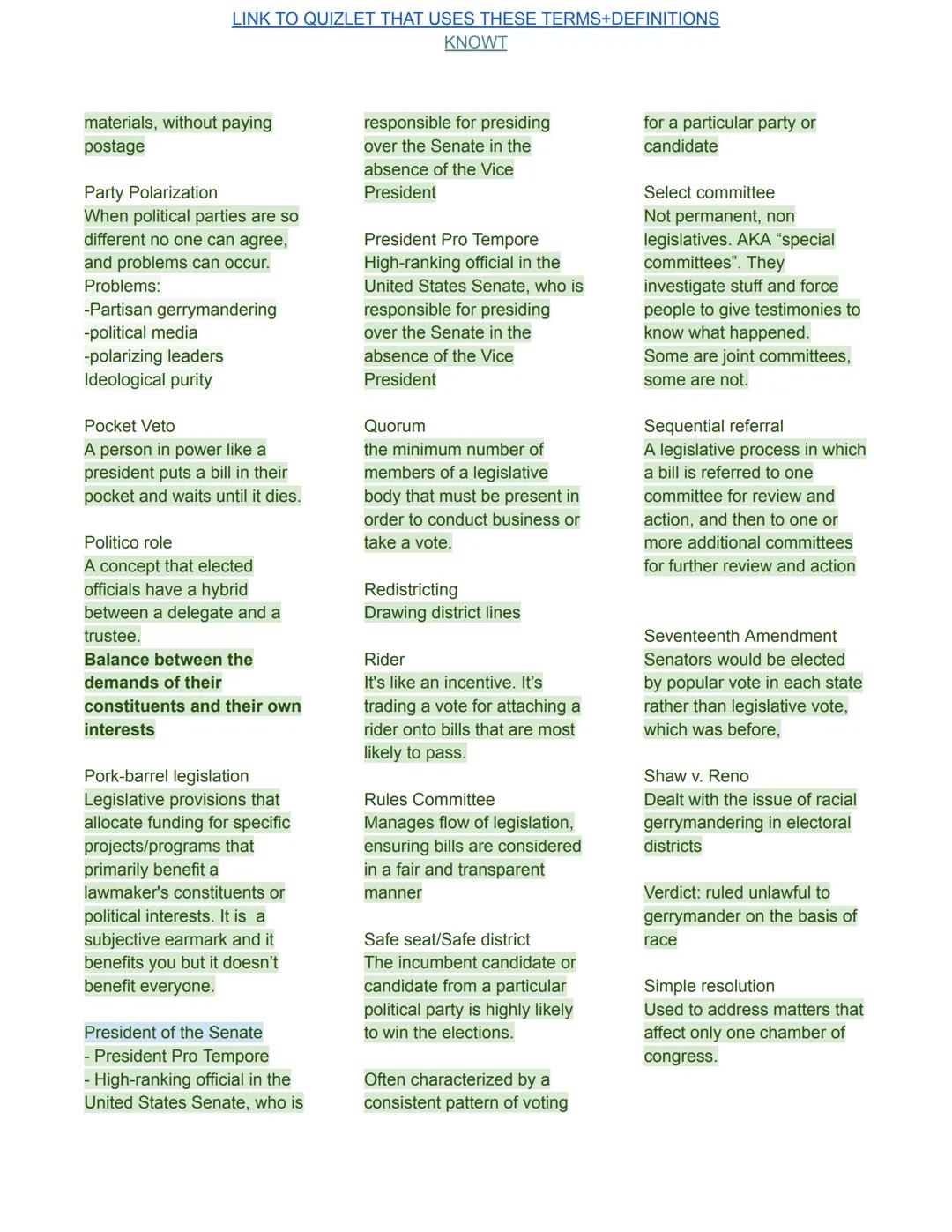
Leadership, Representation, and Legislative Process
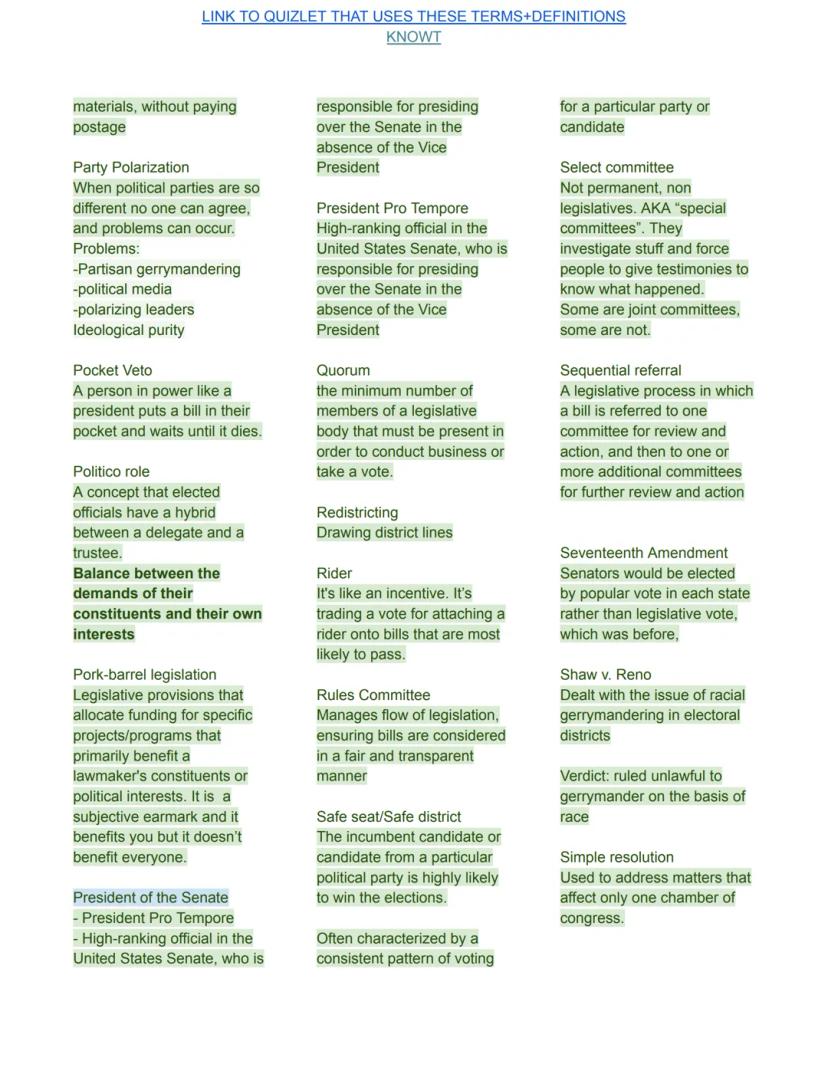
Leadership positions are crucial in Congress. The Speaker of the House leads the House of Representatives, while the President Pro Tempore presides over the Senate when the Vice President is absent. Each party has a Majority Leader and Minority Leader who coordinate their party's legislative agenda.
A bill's sponsor introduces legislation, which may go to standing committees (permanent groups organized by policy area) or select committees (temporary groups formed for specific investigations). During a mark-up session, committee members revise the bill before sending it to the full chamber.
Representation can vary significantly between districts. Majority-minority districts have racial/ethnic minority groups as the voting majority. Safe districts consistently vote for one party, while swing districts (or battleground districts) are competitive between parties.
Democracy Check: For Congress to conduct official business, a quorum (minimum number of members) must be present. This ensures decisions represent adequate participation, though sometimes strategic absences can be used to block action on controversial issues.
5
of 5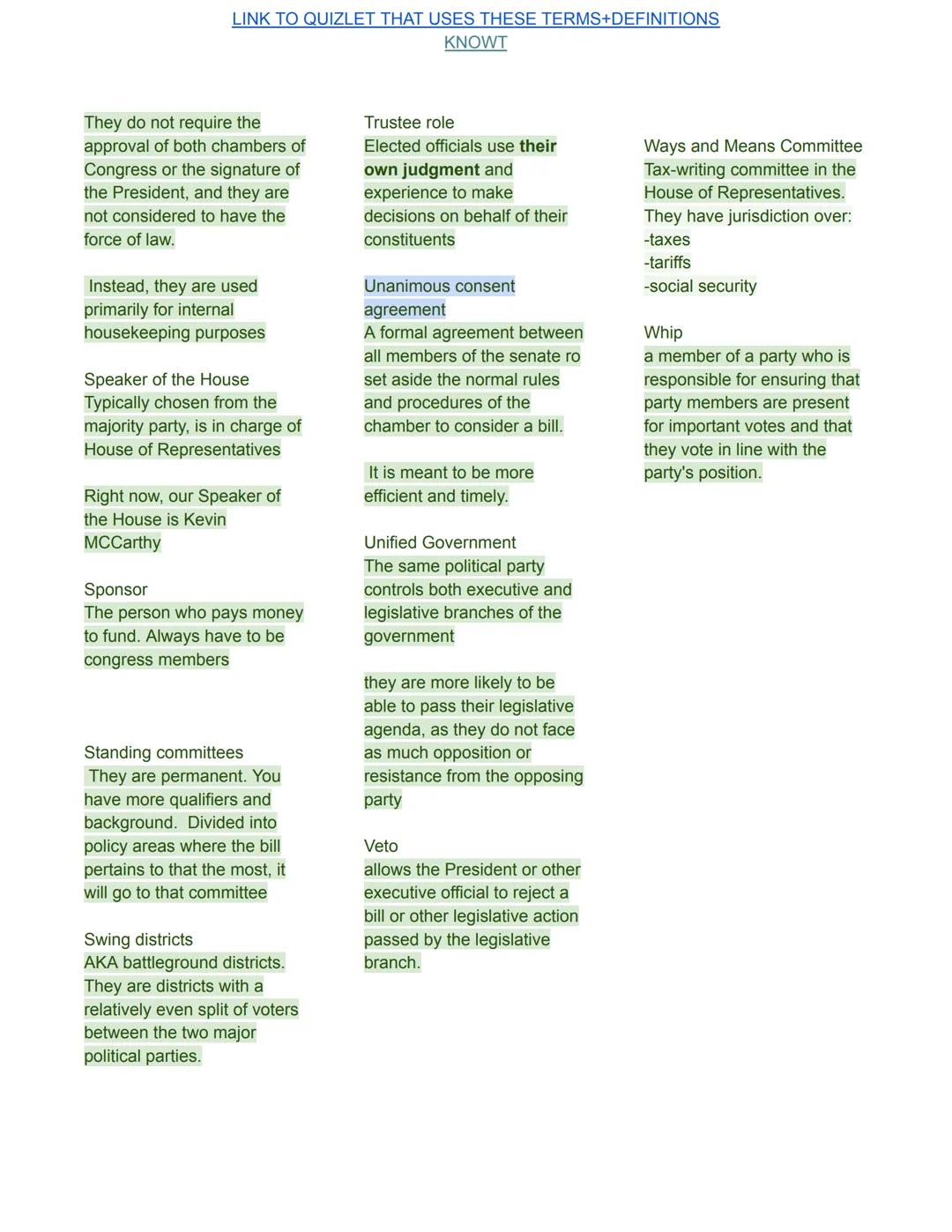
Amendments, Resolutions, and Political Roles
The Seventeenth Amendment changed how senators are elected—from state legislature appointment to direct popular vote. Another important court case, Shaw v. Reno, ruled against racial gerrymandering in electoral districts.
Congress uses various types of resolutions: concurrent resolutions express opinions of both chambers; joint resolutions function like bills and require presidential approval; and simple resolutions address matters affecting only one chamber.
Representatives adopt different approaches to their role: the trustee role means using personal judgment regardless of public opinion, while the politico role balances constituent demands with personal judgment. Party discipline is enforced by the whip, who ensures members vote with their party on important legislation.
Power Centers: The Ways and Means Committee is one of the most powerful committees in Congress, handling taxes, tariffs, and Social Security. Getting on this committee gives representatives significant influence over national economic policy.
We thought you’d never ask...
What is the Knowunity AI companion?
Our AI companion is specifically built for the needs of students. Based on the millions of content pieces we have on the platform we can provide truly meaningful and relevant answers to students. But its not only about answers, the companion is even more about guiding students through their daily learning challenges, with personalised study plans, quizzes or content pieces in the chat and 100% personalisation based on the students skills and developments.
Where can I download the Knowunity app?
You can download the app in the Google Play Store and in the Apple App Store.
Is Knowunity really free of charge?
That's right! Enjoy free access to study content, connect with fellow students, and get instant help – all at your fingertips.
Similar Content
 Social Studies
Most popular content in US History
9T
US HistoryThe Civil War
Explore the dangerous war of America with this quiz, practice yourself for a quiz or test you need, this will answer all your questions (for eighth grade or for people who just like to learn about it ahead of time)
8th4550
S
US HistoryShort Quiz on US Government/Founding History
A 5-question quiz including questions about modern American government as well as the history of its’ founding.
9th4190
W
US HistoryWW2 refresher
Use this to refresh you memory about world War 2
7th2770
S
US HistoryShort Quiz on US Government/Founding History
A 5-question quiz including questions about modern American government as well as the history of its’ founding.
10th2650
C
US Historycivil rights movement quiz
Vocab
8th2220
T
US HistoryThe Louisiana Purchase; EASY
Simple flashcards for US History
9th2700
B
US HistoryBasic Presidency and Stuff Review
Presidency, Bill of Rights, Constitution
6th2650
U
US HistoryUnited States Review Quiz
This is a bunch of random questions based on US History.
9th2080
US HistoryHistory EOC EXAM REVIEW
HISTROY EOC EXAM REVIEW
50031
Most popular content
9O
AP US HistoryOrigins and Dynamics of the Columbian Exchange
Analyze the ecological and economic motivations behind the initial transfer of goods, people, and diseases between the Old and New Worlds.
9th3,1280
I
AP US HistoryIntroduction to Early Cultural Interactions
Analyze the initial social and religious encounters between Europeans, Africans, and Indigenous peoples in the colonial Americas.
9th2,7730
O
 AP World History
Origins of Ancient River Civilizations
Analyze the environmental factors and technological innovations that led to the rise of early states in Mesopotamia, Egypt, and the Indus Valley.
9th3,1870
M
AP US HistoryMotivations for European Exploration
Analyze the economic, religious, and political factors that drove European powers to the Americas during the 15th and 16th centuries.
9th1,7780
F
 AP Psychology
Foundations of Ethical Guidelines in Research
Practice the core principles of the APA ethical code including informed consent, debriefing, and the role of Institutional Review Boards.
9th1,3360
I
AP US HistoryIntroduction to Native American Societies
Examine the diverse social, political, and economic structures of North American indigenous groups prior to European contact.
9th1,1100
I
 AP Biology
Introduction to Biological Elements of Life
Practice identifying the essential elements including carbon, nitrogen, phosphorus, and sulfur that compose biological macromolecules.
9th1,7390
I
AP US HistoryIntroduction to the Spanish Encomienda System
Explore the fundamental economic and social structures of the Spanish colonial system, focusing on the encomienda and the casta social hierarchy.
9th8890
O
AP World HistoryOrigins and Continuity of the Byzantine Empire
Analyze the political and cultural transitions from the Roman Empire to the Byzantine Empire, focusing on the reign of Justinian I and his code.
9th1,6320
Can't find what you're looking for? Explore other subjects.
Students love us — and so will you.
4.6/5App Store
4.7/5Google Play
The app is very easy to use and well designed. I have found everything I was looking for so far and have been able to learn a lot from the presentations! I will definitely use the app for a class assignment! And of course it also helps a lot as an inspiration.
Stefan SiOS user
This app is really great. There are so many study notes and help [...]. My problem subject is French, for example, and the app has so many options for help. Thanks to this app, I have improved my French. I would recommend it to anyone.
Samantha KlichAndroid user
Wow, I am really amazed. I just tried the app because I've seen it advertised many times and was absolutely stunned. This app is THE HELP you want for school and above all, it offers so many things, such as workouts and fact sheets, which have been VERY helpful to me personally.
AnnaiOS user
US History88 views·Updated Jun 5, 2026·5 pagesComprehensive AP US Gov Legislative Branch Vocabulary Guide
Adeline Tse@aliwormie
Welcome to the essential vocabulary guide for understanding the U.S. Legislative Branch! These terms are crucial for making sense of how Congress works, from the creation of laws to the structure of government power. Knowing these concepts will help you...
1
of 5
Sign up to see the content. It's free!
- Access to all documents
- Improve your grades
- Join milions of students
Legislative Branch Vocabulary: Core Concepts
Ever wonder how Congress actually works? Let's start with some fundamental concepts. The U.S. has a bicameral legislature with two chambers (House and Senate), and both play different roles in governing.
When the President appoints officials, the Senate provides advice and consent by reviewing and voting on these nominations. States receive representatives through apportionment, which assigns congressional seats based on population. The landmark case Baker v. Carr established the "one person, one vote" principle, ruling that disproportionate legislative districts were justiciable issues.
Congressional groups often work together in a caucus, uniting members with similar interests. Committee decisions are guided by a committee chair who oversees specific areas of responsibility. When bills need reconciliation between House and Senate versions, a temporary conference committee forms to resolve differences.
Thinking Deeper: Understanding how representatives view their role is key! A delegate role means officials vote according to constituents' wishes, even if it contradicts their personal beliefs. This directly affects how your voice is represented in government.
2
of 5Sign up to see the content. It's free!
- Access to all documents
- Improve your grades
- Join milions of students
Budget Powers and Government Structure
Money matters in government! The federal budget includes discretionary spending (adjustable expenses like defense and education) and mandatory spending (required programs like Social Security). When spending exceeds revenue, we have a budget deficit; when revenue exceeds spending, we have a surplus.
A divided government occurs when different parties control different branches, often leading to gridlock where legislation stalls due to partisan disagreement. By contrast, unified government happens when one party controls both executive and legislative branches, typically enabling more efficient policymaking.
Entitlement programs provide benefits to eligible groups (like Social Security or unemployment insurance), while earmarks direct spending to specific projects. Congress has oversight responsibility to monitor the executive branch through hearings and investigations.
Real Impact: Notice how gerrymandering (manipulating district boundaries) affects election outcomes! This practice can create "safe seats" for incumbents and dilute voting power of certain groups. This directly impacts who represents you and your community.
3
of 5Sign up to see the content. It's free!
- Access to all documents
- Improve your grades
- Join milions of students
Legislative Powers and Procedures
Congress has both enumerated powers (explicitly stated in the Constitution) and implied powers (derived from the Necessary and Proper Clause). These powers form the foundation of congressional authority.
The Senate has unique procedures like the filibuster, where a senator speaks continuously to delay or prevent voting on legislation. To end a filibuster, the Senate needs 60 votes through a cloture rule. Senators can also place a hold to temporarily block consideration of nominations or legislation.
Representatives enjoy certain privileges, including the franking privilege which allows them to send mail to constituents for free. The lame duck period (between November elections and January inaugurations) is when outgoing officials still hold office but have reduced political influence.
Practical Politics: Logrolling is when lawmakers trade votes ("I'll support your bill if you support mine"). This practice shows that politics often involves compromise and negotiation rather than purely ideological decisions. This helps explain why some seemingly unrelated issues get bundled together!
4
of 5Sign up to see the content. It's free!
- Access to all documents
- Improve your grades
- Join milions of students
Leadership, Representation, and Legislative Process
Leadership positions are crucial in Congress. The Speaker of the House leads the House of Representatives, while the President Pro Tempore presides over the Senate when the Vice President is absent. Each party has a Majority Leader and Minority Leader who coordinate their party's legislative agenda.
A bill's sponsor introduces legislation, which may go to standing committees (permanent groups organized by policy area) or select committees (temporary groups formed for specific investigations). During a mark-up session, committee members revise the bill before sending it to the full chamber.
Representation can vary significantly between districts. Majority-minority districts have racial/ethnic minority groups as the voting majority. Safe districts consistently vote for one party, while swing districts (or battleground districts) are competitive between parties.
Democracy Check: For Congress to conduct official business, a quorum (minimum number of members) must be present. This ensures decisions represent adequate participation, though sometimes strategic absences can be used to block action on controversial issues.
5
of 5Sign up to see the content. It's free!
- Access to all documents
- Improve your grades
- Join milions of students
Amendments, Resolutions, and Political Roles
The Seventeenth Amendment changed how senators are elected—from state legislature appointment to direct popular vote. Another important court case, Shaw v. Reno, ruled against racial gerrymandering in electoral districts.
Congress uses various types of resolutions: concurrent resolutions express opinions of both chambers; joint resolutions function like bills and require presidential approval; and simple resolutions address matters affecting only one chamber.
Representatives adopt different approaches to their role: the trustee role means using personal judgment regardless of public opinion, while the politico role balances constituent demands with personal judgment. Party discipline is enforced by the whip, who ensures members vote with their party on important legislation.
Power Centers: The Ways and Means Committee is one of the most powerful committees in Congress, handling taxes, tariffs, and Social Security. Getting on this committee gives representatives significant influence over national economic policy.
We thought you’d never ask...
What is the Knowunity AI companion?
Our AI companion is specifically built for the needs of students. Based on the millions of content pieces we have on the platform we can provide truly meaningful and relevant answers to students. But its not only about answers, the companion is even more about guiding students through their daily learning challenges, with personalised study plans, quizzes or content pieces in the chat and 100% personalisation based on the students skills and developments.
Where can I download the Knowunity app?
You can download the app in the Google Play Store and in the Apple App Store.
Is Knowunity really free of charge?
That's right! Enjoy free access to study content, connect with fellow students, and get instant help – all at your fingertips.
Similar Content
Most popular content in US History
9T
US HistoryThe Civil War
Explore the dangerous war of America with this quiz, practice yourself for a quiz or test you need, this will answer all your questions (for eighth grade or for people who just like to learn about it ahead of time)
8th4550
S
US HistoryShort Quiz on US Government/Founding History
A 5-question quiz including questions about modern American government as well as the history of its’ founding.
9th4190
W
US HistoryWW2 refresher
Use this to refresh you memory about world War 2
7th2770
S
US HistoryShort Quiz on US Government/Founding History
A 5-question quiz including questions about modern American government as well as the history of its’ founding.
10th2650
C
US Historycivil rights movement quiz
Vocab
8th2220
T
US HistoryThe Louisiana Purchase; EASY
Simple flashcards for US History
9th2700
B
US HistoryBasic Presidency and Stuff Review
Presidency, Bill of Rights, Constitution
6th2650
U
US HistoryUnited States Review Quiz
This is a bunch of random questions based on US History.
9th2080
US HistoryHistory EOC EXAM REVIEW
HISTROY EOC EXAM REVIEW
50031
Most popular content
9O
AP US HistoryOrigins and Dynamics of the Columbian Exchange
Analyze the ecological and economic motivations behind the initial transfer of goods, people, and diseases between the Old and New Worlds.
9th3,1280
I
AP US HistoryIntroduction to Early Cultural Interactions
Analyze the initial social and religious encounters between Europeans, Africans, and Indigenous peoples in the colonial Americas.
9th2,7730
O
AP World HistoryOrigins of Ancient River Civilizations
Analyze the environmental factors and technological innovations that led to the rise of early states in Mesopotamia, Egypt, and the Indus Valley.
9th3,1870
M
AP US HistoryMotivations for European Exploration
Analyze the economic, religious, and political factors that drove European powers to the Americas during the 15th and 16th centuries.
9th1,7780
F
AP PsychologyFoundations of Ethical Guidelines in Research
Practice the core principles of the APA ethical code including informed consent, debriefing, and the role of Institutional Review Boards.
9th1,3360
I
AP US HistoryIntroduction to Native American Societies
Examine the diverse social, political, and economic structures of North American indigenous groups prior to European contact.
9th1,1100
I
AP BiologyIntroduction to Biological Elements of Life
Practice identifying the essential elements including carbon, nitrogen, phosphorus, and sulfur that compose biological macromolecules.
9th1,7390
I
AP US HistoryIntroduction to the Spanish Encomienda System
Explore the fundamental economic and social structures of the Spanish colonial system, focusing on the encomienda and the casta social hierarchy.
9th8890
O
AP World HistoryOrigins and Continuity of the Byzantine Empire
Analyze the political and cultural transitions from the Roman Empire to the Byzantine Empire, focusing on the reign of Justinian I and his code.
9th1,6320
Can't find what you're looking for? Explore other subjects.
Students love us — and so will you.
4.6/5App Store
4.7/5Google Play
The app is very easy to use and well designed. I have found everything I was looking for so far and have been able to learn a lot from the presentations! I will definitely use the app for a class assignment! And of course it also helps a lot as an inspiration.
Stefan SiOS user
This app is really great. There are so many study notes and help [...]. My problem subject is French, for example, and the app has so many options for help. Thanks to this app, I have improved my French. I would recommend it to anyone.
Samantha KlichAndroid user
Wow, I am really amazed. I just tried the app because I've seen it advertised many times and was absolutely stunned. This app is THE HELP you want for school and above all, it offers so many things, such as workouts and fact sheets, which have been VERY helpful to me personally.
AnnaiOS user