
Geography is the study of Earth and its diverse characteristics....
 Social Studies96 views·Updated Jun 11, 2026·16 pages
Understanding the 5 Themes of Geography

Ⓓⓘⓐⓝⓐ@diana_o_07
1 / 10
1
of 10
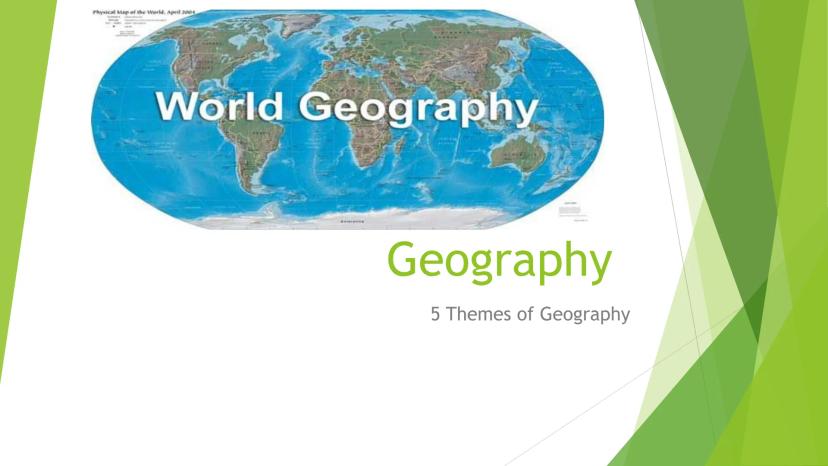
World Geography
Geography helps us understand our planet and everything on it. This fascinating subject explores various aspects of Earth including climate patterns, political boundaries, population distribution, landscapes, and more.
The 5 themes of geography provide a framework that makes it easier to study and organize what we know about different places around the world. These themes help us ask the right questions about locations and understand their significance.
2
of 10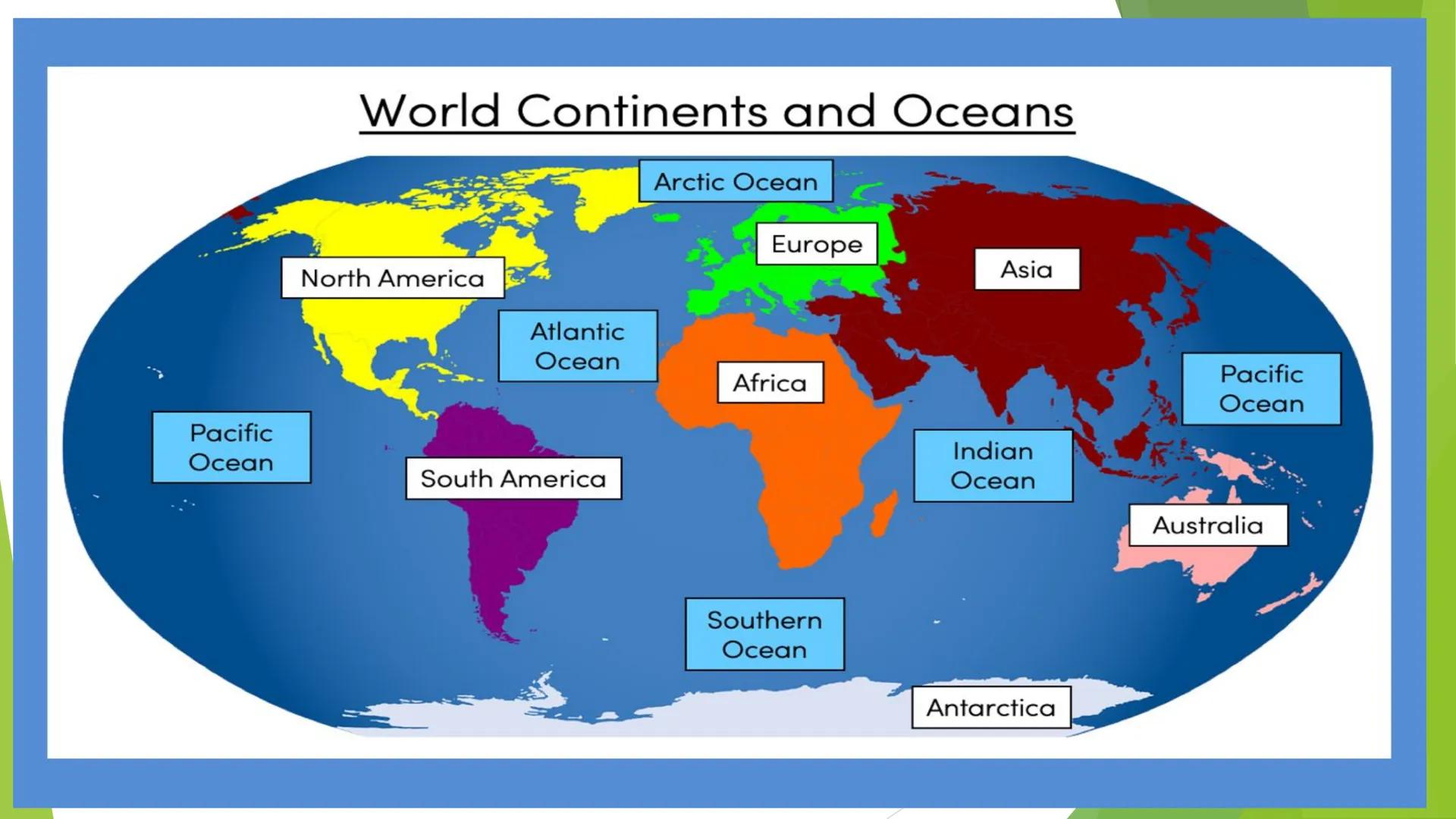
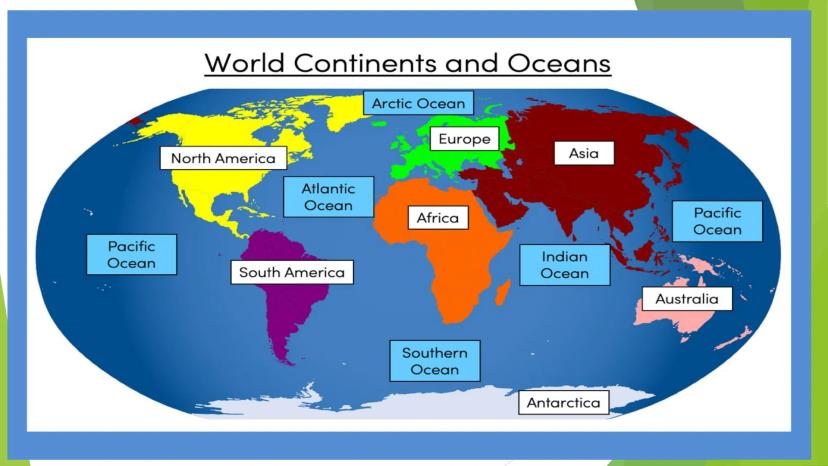
World Continents and Oceans
Our planet is divided into seven continents: North America, South America, Europe, Africa, Asia, Australia, and Antarctica. Each continent has unique physical features, climates, and cultures.
Earth's surface is mostly water, with five major oceans: Pacific (the largest), Atlantic, Indian, Arctic (the smallest), and Southern. These oceans connect our continents and influence weather patterns worldwide.
Did you know? The Pacific Ocean covers about one-third of Earth's surface - that's more area than all the land on the planet combined!
3
of 10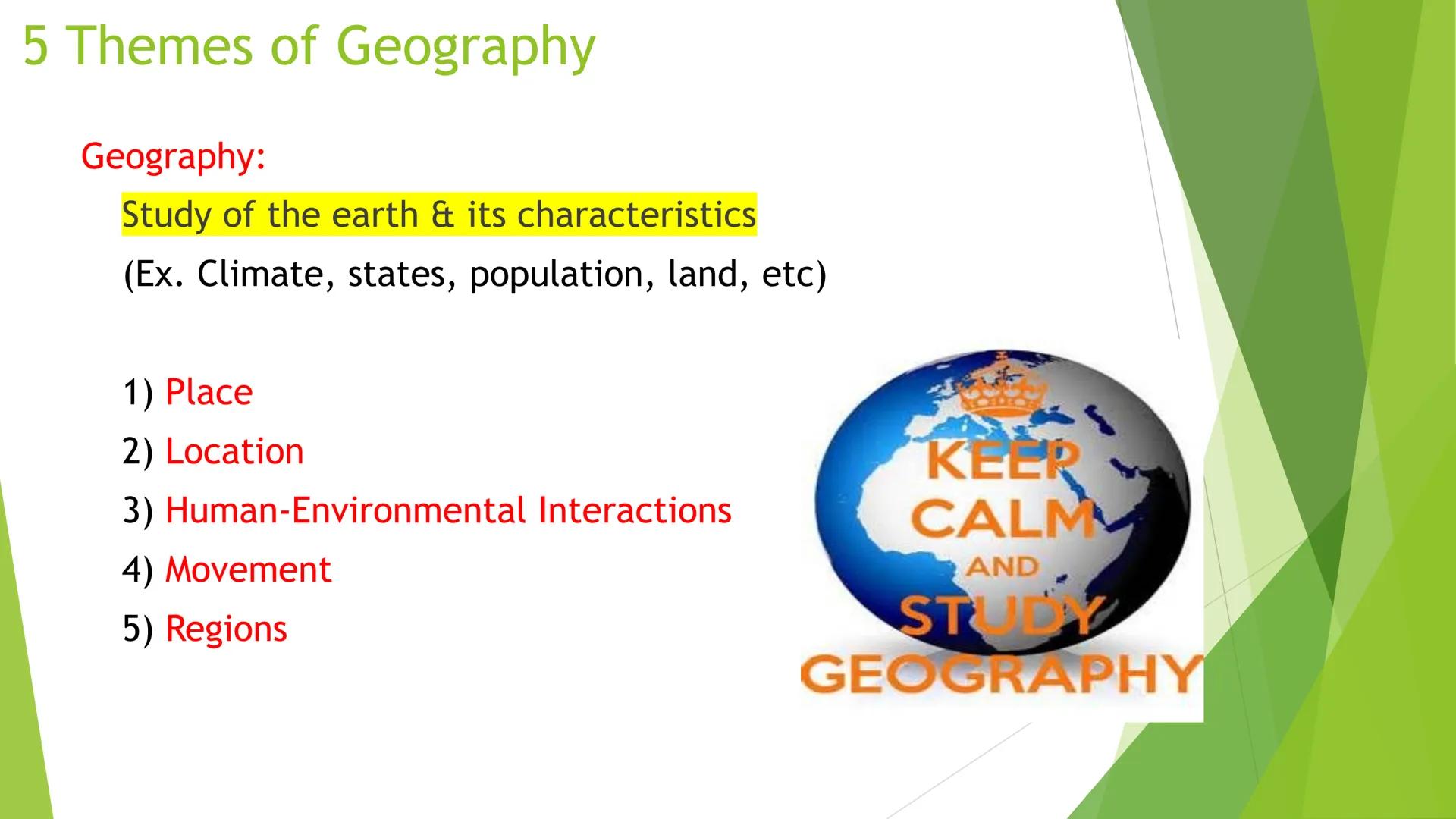
5 Themes of Geography
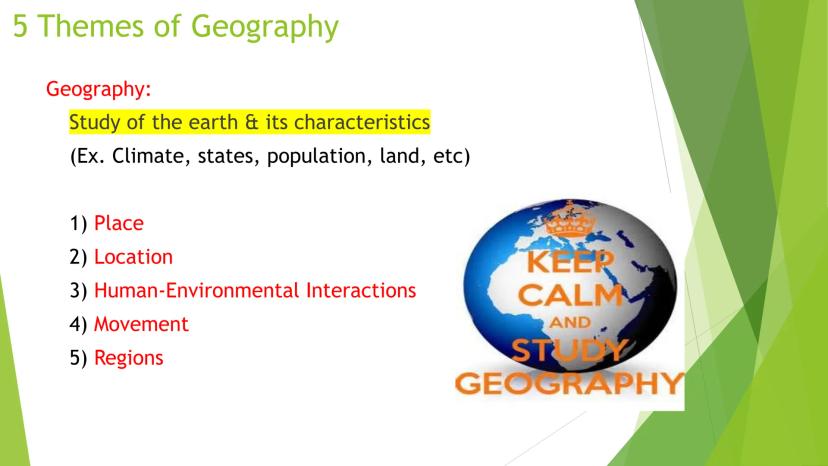
Geography is the study of Earth and its characteristics including climate, states, population, and landforms. Geographers use five main themes to organize their understanding of the world.
These five themes are: Place, Location, Human-Environmental Interactions, Movement, and Regions. You can remember them using the first letters to spell PLHMR.
Each theme offers a different lens for examining any location on Earth. Together, they help us fully understand why places are unique and how they connect to each other.
Remember this: Keep CALM and Study Geography!
4
of 10
Place
Place describes what somewhere is like through both its physical and human characteristics. This theme answers the question: "What makes this location unique?"
Physical characteristics include natural features like mountains, plains, rivers, climate, and other aspects of the natural environment. For example, Arizona has the Grand Canyon, Sonoran Desert, and a hot, dry climate.
Human characteristics focus on what people have created, including buildings, cities, culture, language, and religion. These are the man-made elements that give places their cultural identity and appearance.
5
of 10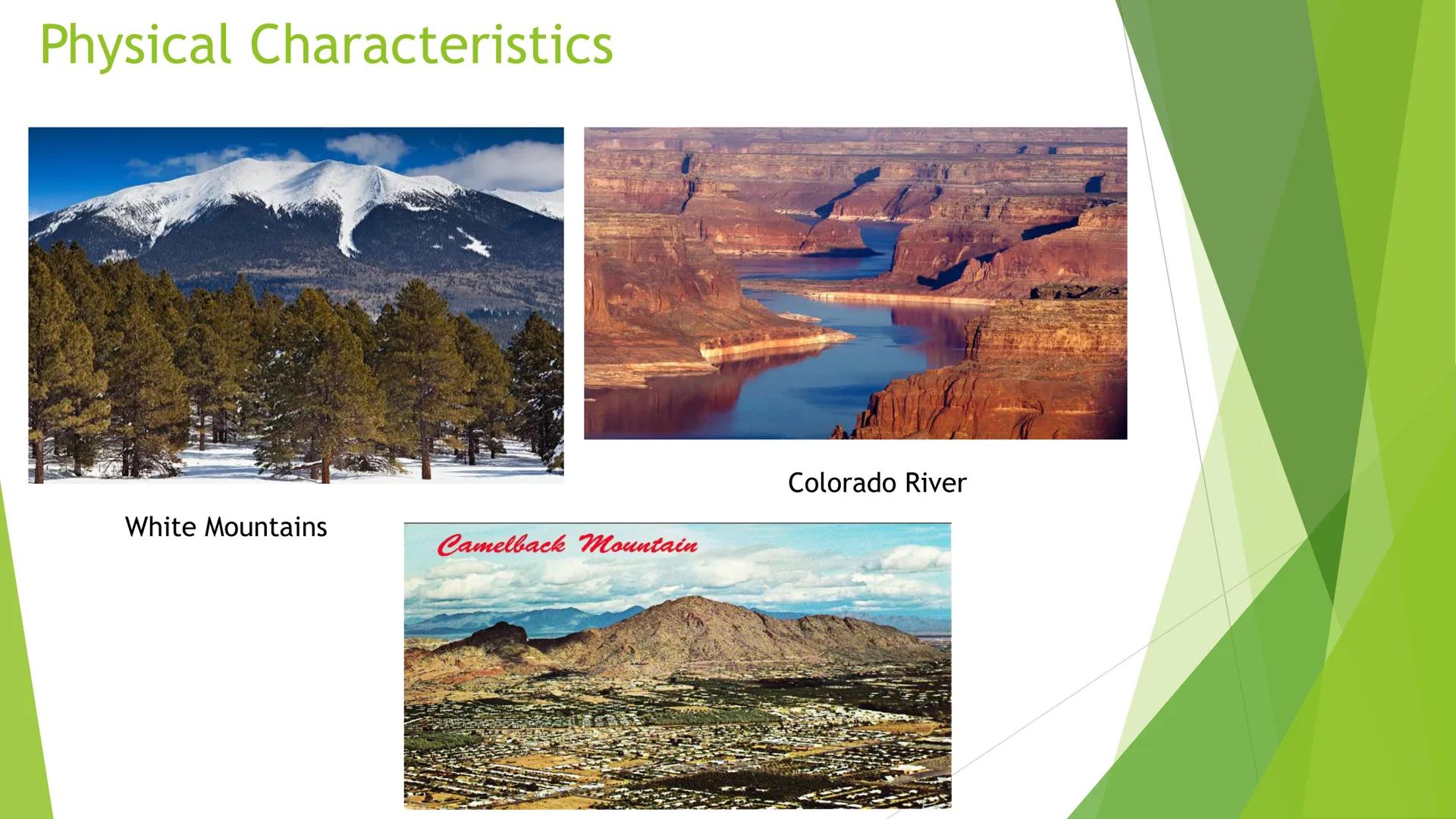
Physical Characteristics
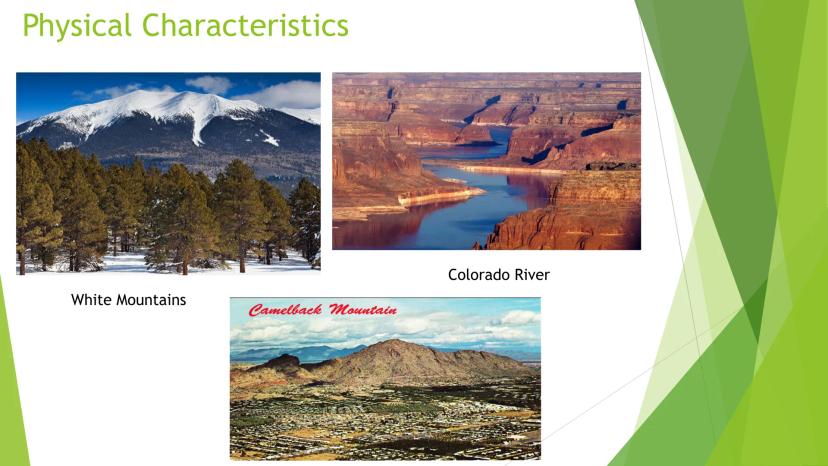
Physical characteristics are the natural features that make a place unique. These include landforms, bodies of water, climate, vegetation, and wildlife.
In the American Southwest, striking physical features include the White Mountains with their forests and alpine meadows. The Colorado River carves through the landscape, creating spectacular canyons and providing vital water to the region.
Camelback Mountain in Phoenix is another distinctive physical feature that resembles a kneeling camel. These natural landmarks give areas their unique character and influence how people live in these environments.
Think about it: What are the main physical characteristics of where you live? How do these features affect daily life in your community?
6
of 10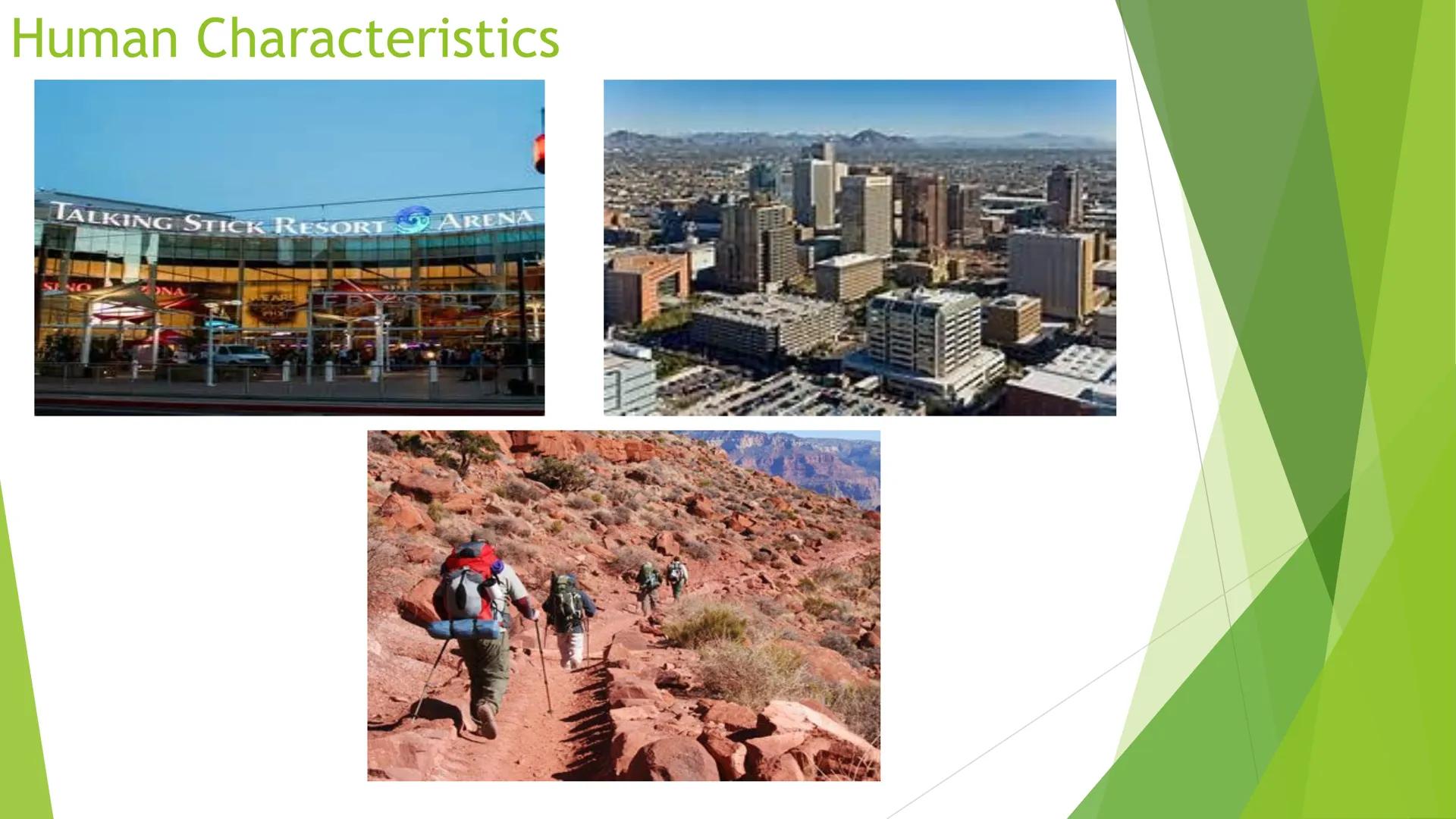
Human Characteristics
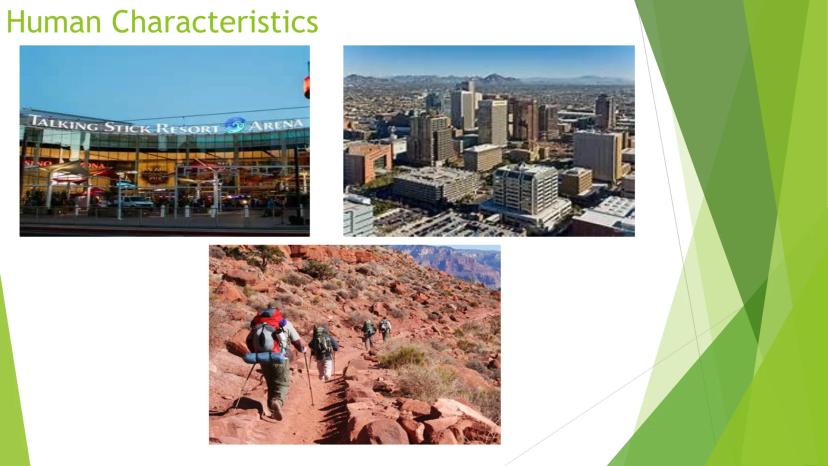
Human characteristics are the features created by people that make a place distinct. These include buildings, transportation systems, language, food, and traditions.
The Talking Stick Resort Arena in Phoenix is an example of a human characteristic. This modern structure serves as a cultural and entertainment hub where thousands gather for sports events and concerts.
Human characteristics reflect how people have adapted to their environment and built communities. These features tell us about a society's values, technology level, and cultural identity.
7
of 10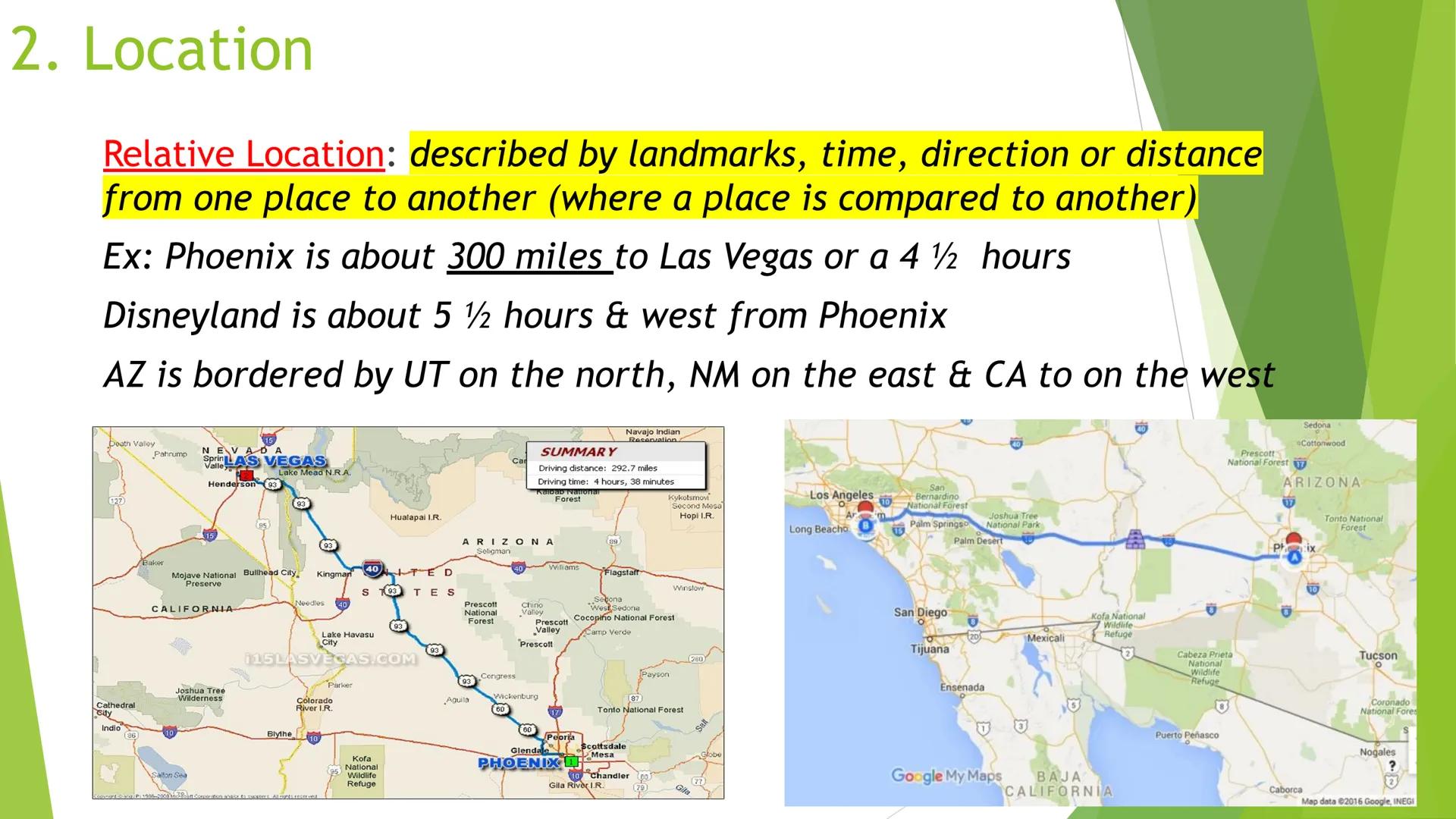
Location
Location refers to where a place is found on Earth. There are two main ways to describe location: relative and absolute.
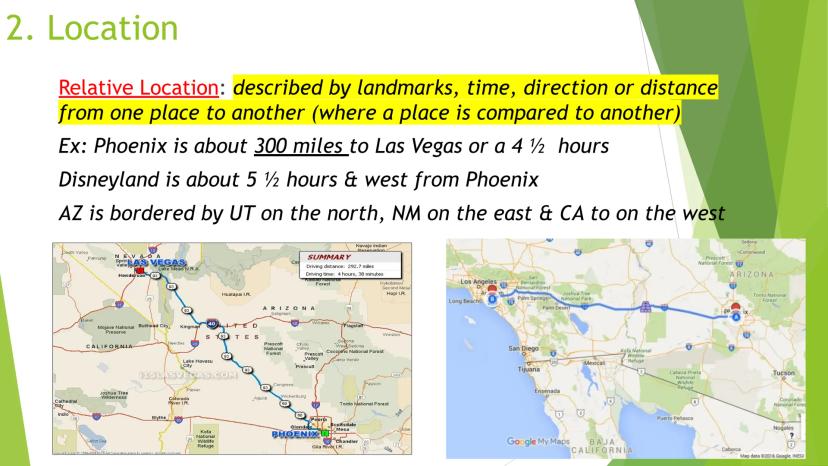
Relative location describes where a place is in relation to other places. For example, Phoenix is about 300 miles from Las Vegas (about a 4½ hour drive) and is bordered by Utah to the north, New Mexico to the east, and California to the west.
Maps showing relative location help us understand the relationships between places. They can show travel routes, distances, and directional relationships that help us navigate from one place to another.
Travel tip: When planning a road trip, understanding relative location helps you estimate travel time and plan your route more effectively!
8
of 10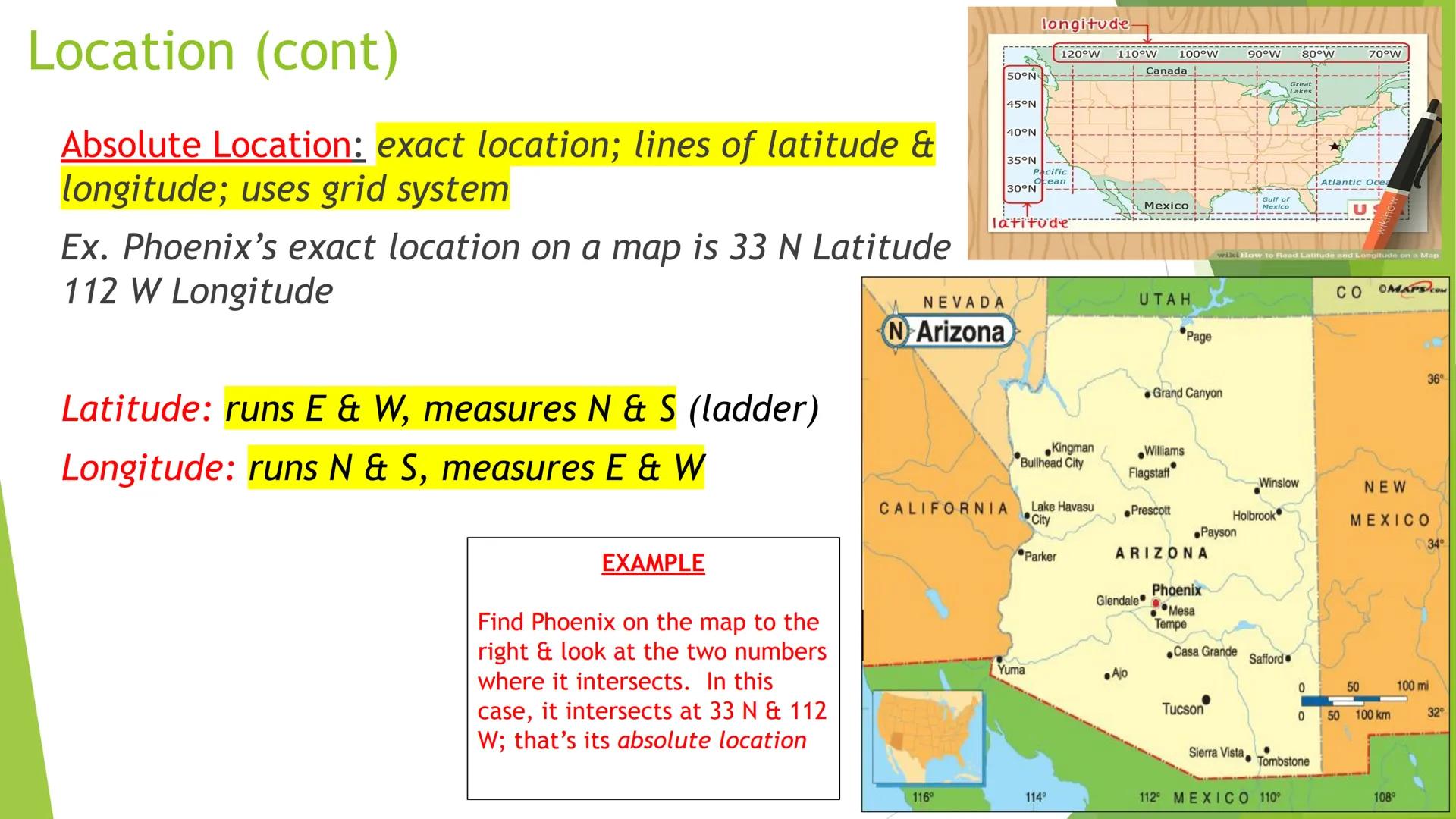
Location (continued)
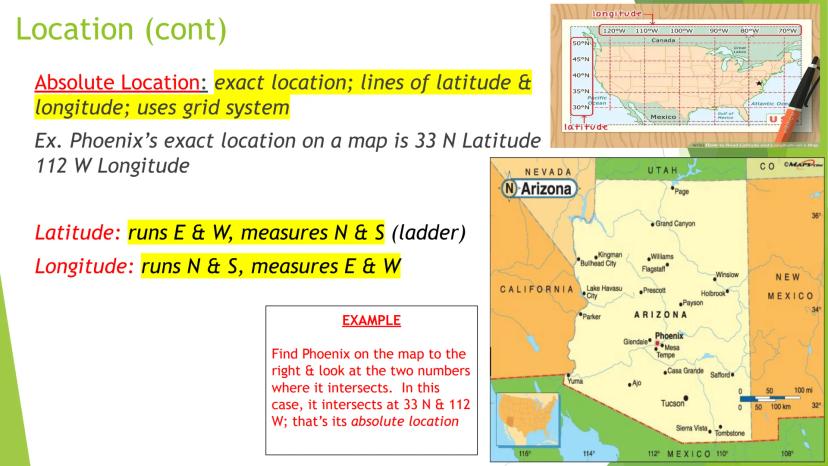
Absolute location gives the exact position of a place using coordinates on Earth's grid system. This system uses lines of latitude and longitude to pinpoint any location precisely.
Latitude lines run east to west around the Earth and measure distance north or south of the Equator. Longitude lines run north to south and measure distance east or west of the Prime Meridian.
Phoenix's absolute location is 33°N latitude and 112°W longitude. Think of latitude as the rungs on a ladder (they run horizontally) and longitude as the vertical poles of the ladder.
Pro tip: When reading coordinates, always give latitude first, then longitude - just like in the phrase "climb up, then across" to remember the order!
9
of 10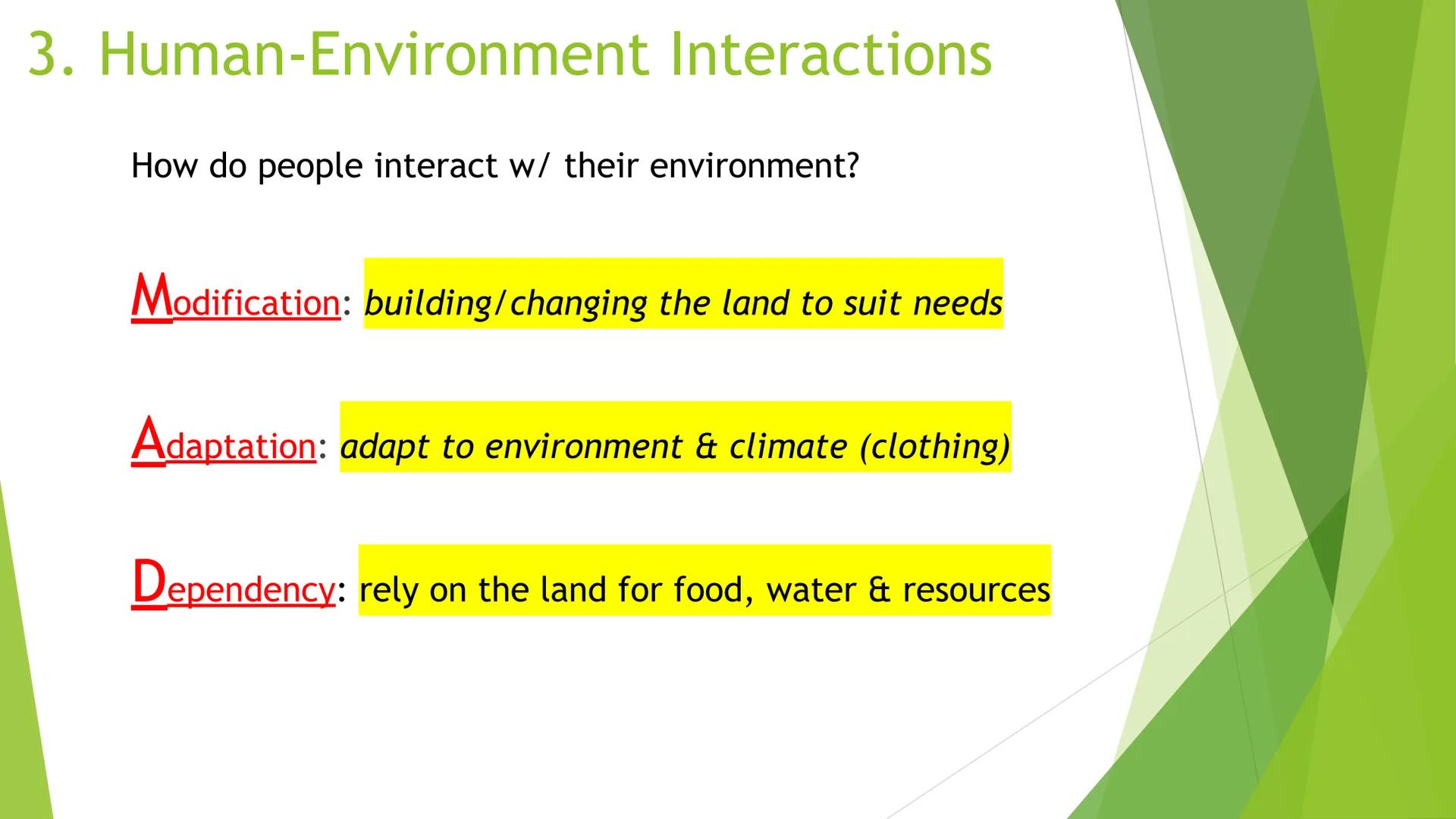
Human-Environment Interactions
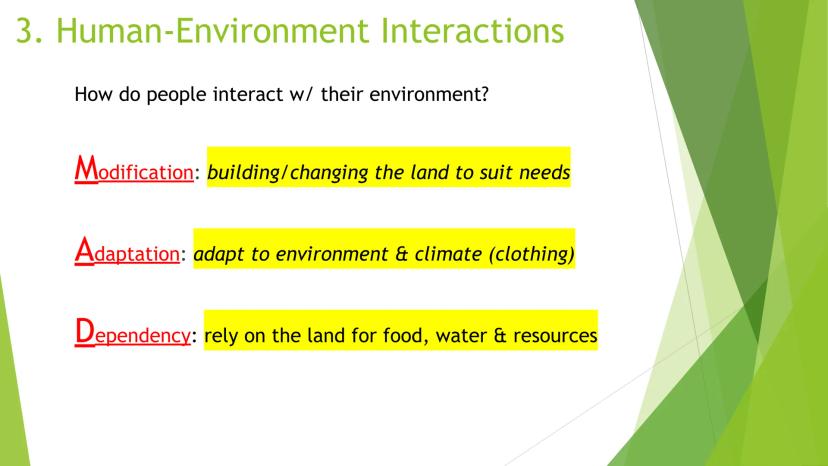
Human-environment interactions examine how people relate to their surroundings. This theme explores the relationship between humans and the natural world around them.
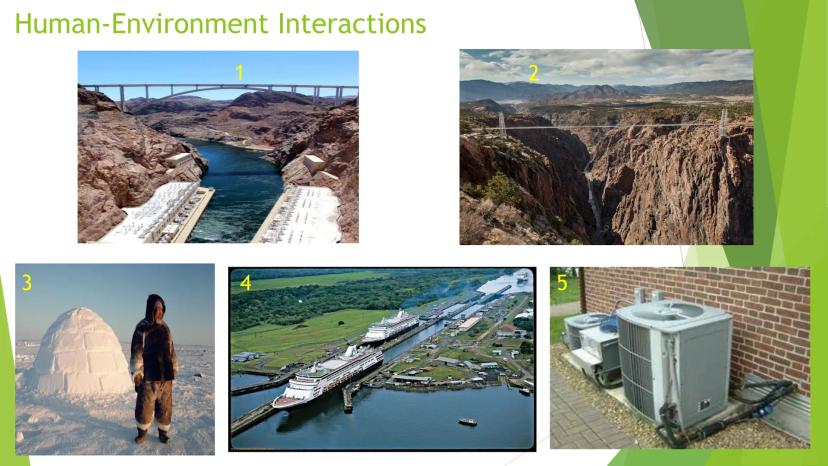
There are three main types of interactions. Modification is when people build or change the land to meet their needs, like constructing dams or clearing forests for farming. Adaptation happens when people adjust to their environment, such as wearing different clothing for different climates.
Dependency occurs when people rely on the land for resources like food, water, and materials. All societies depend on their environment, but how they use these resources varies greatly around the world.
10
of 10
Human-Environment Interactions Examples
Human-environment interactions happen everywhere in different ways. In deserts, people build irrigation systems to grow crops where it's naturally too dry. In cold regions, homes are built with thick insulation to retain heat.
Cities often show dramatic examples of modification, with natural landscapes transformed into urban environments with buildings, roads, and parks. Coastal communities might build seawalls to protect against flooding or erosion.
Sometimes these interactions have negative consequences, like pollution or resource depletion. Other times they can be beneficial, like sustainable farming or renewable energy production.
Challenge question: Look around your neighborhood. Can you identify three ways humans have modified the natural environment?
We thought you’d never ask...
What is the Knowunity AI companion?
Our AI companion is specifically built for the needs of students. Based on the millions of content pieces we have on the platform we can provide truly meaningful and relevant answers to students. But its not only about answers, the companion is even more about guiding students through their daily learning challenges, with personalised study plans, quizzes or content pieces in the chat and 100% personalisation based on the students skills and developments.
Where can I download the Knowunity app?
You can download the app in the Google Play Store and in the Apple App Store.
Is Knowunity really free of charge?
That's right! Enjoy free access to study content, connect with fellow students, and get instant help – all at your fingertips.
Similar Content
Most popular content in US History
9C
 US History
civil rights movement quiz
Vocab
8th2220
Social StudiesThe Neolithic Revolution: From Hunter-Gatherers to Farming
Summarizes the key aspects of the Neolithic Revolution, detailing how humans moved from hunter-gatherer groups to settled agricultural societies.
6th2882
T
Social StudiesThe Revolutionary War Pt.1
Questions about the revolutionary war
9th840
Social StudiesMotives for European Exploration: Gold, God, and Glory
Learn about the key factors driving European exploration of the New World. This resource explains the "3 G's" motive: the pursuit of Gold, the spread of God, and the desire for Glory.
6th1821
 AP Human Geography
AP Human Geography Notes and Exam Prep Unit 1
A document covering Unit 1 of AP Human Geography from my 9th grade class 2021-2022
1,34776
AP Human GeographyAP Human Geography Notes and Exam Prep Unit 6
A document covering Unit 6 of AP Human Geography from my 9th grade class 2021-2022
1,29765
AP Human GeographyAP Human Geography Notes and Exam Prep Unit 5
A document covering Unit 5 of AP Human Geography from my 9th grade class 2021-2022
1,14943
W
 Earth and Space Science
World Oceans - Sixth Grade
Can you guess all the oceans? This will test your knowledge on the location of each ocean, describing bordering countries, seas, lands, and other oceans.
6th1390
AP Human GeographyAP Human Geography Notes and Exam Prep Unit 4
A document covering Unit 4 of AP Human Geography from my 9th grade class 2021-2022
98653
Most popular content
9O
AP US HistoryOrigins and Dynamics of the Columbian Exchange
Analyze the ecological and economic motivations behind the initial transfer of goods, people, and diseases between the Old and New Worlds.
9th3,1280
I
AP US HistoryIntroduction to Early Cultural Interactions
Analyze the initial social and religious encounters between Europeans, Africans, and Indigenous peoples in the colonial Americas.
9th2,7730
O
AP World HistoryOrigins of Ancient River Civilizations
Analyze the environmental factors and technological innovations that led to the rise of early states in Mesopotamia, Egypt, and the Indus Valley.
9th3,1870
M
AP US HistoryMotivations for European Exploration
Analyze the economic, religious, and political factors that drove European powers to the Americas during the 15th and 16th centuries.
9th1,7780
F
AP PsychologyFoundations of Ethical Guidelines in Research
Practice the core principles of the APA ethical code including informed consent, debriefing, and the role of Institutional Review Boards.
9th1,3360
I
AP US HistoryIntroduction to Native American Societies
Examine the diverse social, political, and economic structures of North American indigenous groups prior to European contact.
9th1,1100
I
 AP Biology
Introduction to Biological Elements of Life
Practice identifying the essential elements including carbon, nitrogen, phosphorus, and sulfur that compose biological macromolecules.
9th1,7390
I
AP US HistoryIntroduction to the Spanish Encomienda System
Explore the fundamental economic and social structures of the Spanish colonial system, focusing on the encomienda and the casta social hierarchy.
9th8890
O
AP World HistoryOrigins and Continuity of the Byzantine Empire
Analyze the political and cultural transitions from the Roman Empire to the Byzantine Empire, focusing on the reign of Justinian I and his code.
9th1,6320
Can't find what you're looking for? Explore other subjects.
Students love us — and so will you.
4.6/5App Store
4.7/5Google Play
The app is very easy to use and well designed. I have found everything I was looking for so far and have been able to learn a lot from the presentations! I will definitely use the app for a class assignment! And of course it also helps a lot as an inspiration.
Stefan SiOS user
This app is really great. There are so many study notes and help [...]. My problem subject is French, for example, and the app has so many options for help. Thanks to this app, I have improved my French. I would recommend it to anyone.
Samantha KlichAndroid user
Wow, I am really amazed. I just tried the app because I've seen it advertised many times and was absolutely stunned. This app is THE HELP you want for school and above all, it offers so many things, such as workouts and fact sheets, which have been VERY helpful to me personally.
AnnaiOS user
Social Studies96 views·Updated Jun 11, 2026·16 pagesUnderstanding the 5 Themes of Geography
Ⓓⓘⓐⓝⓐ@diana_o_07
Geography is the study of Earth and its diverse characteristics. Understanding the 5 themes of geography helps us make sense of our world - from knowing where places are located to understanding how humans interact with their environment.
1
of 10
Sign up to see the content. It's free!
- Access to all documents
- Improve your grades
- Join milions of students
World Geography
Geography helps us understand our planet and everything on it. This fascinating subject explores various aspects of Earth including climate patterns, political boundaries, population distribution, landscapes, and more.
The 5 themes of geography provide a framework that makes it easier to study and organize what we know about different places around the world. These themes help us ask the right questions about locations and understand their significance.
2
of 10Sign up to see the content. It's free!
- Access to all documents
- Improve your grades
- Join milions of students
World Continents and Oceans
Our planet is divided into seven continents: North America, South America, Europe, Africa, Asia, Australia, and Antarctica. Each continent has unique physical features, climates, and cultures.
Earth's surface is mostly water, with five major oceans: Pacific (the largest), Atlantic, Indian, Arctic (the smallest), and Southern. These oceans connect our continents and influence weather patterns worldwide.
Did you know? The Pacific Ocean covers about one-third of Earth's surface - that's more area than all the land on the planet combined!
3
of 10Sign up to see the content. It's free!
- Access to all documents
- Improve your grades
- Join milions of students
5 Themes of Geography
Geography is the study of Earth and its characteristics including climate, states, population, and landforms. Geographers use five main themes to organize their understanding of the world.
These five themes are: Place, Location, Human-Environmental Interactions, Movement, and Regions. You can remember them using the first letters to spell PLHMR.
Each theme offers a different lens for examining any location on Earth. Together, they help us fully understand why places are unique and how they connect to each other.
Remember this: Keep CALM and Study Geography!
4
of 10Sign up to see the content. It's free!
- Access to all documents
- Improve your grades
- Join milions of students
Place
Place describes what somewhere is like through both its physical and human characteristics. This theme answers the question: "What makes this location unique?"
Physical characteristics include natural features like mountains, plains, rivers, climate, and other aspects of the natural environment. For example, Arizona has the Grand Canyon, Sonoran Desert, and a hot, dry climate.
Human characteristics focus on what people have created, including buildings, cities, culture, language, and religion. These are the man-made elements that give places their cultural identity and appearance.
5
of 10Sign up to see the content. It's free!
- Access to all documents
- Improve your grades
- Join milions of students
Physical Characteristics
Physical characteristics are the natural features that make a place unique. These include landforms, bodies of water, climate, vegetation, and wildlife.
In the American Southwest, striking physical features include the White Mountains with their forests and alpine meadows. The Colorado River carves through the landscape, creating spectacular canyons and providing vital water to the region.
Camelback Mountain in Phoenix is another distinctive physical feature that resembles a kneeling camel. These natural landmarks give areas their unique character and influence how people live in these environments.
Think about it: What are the main physical characteristics of where you live? How do these features affect daily life in your community?
6
of 10Sign up to see the content. It's free!
- Access to all documents
- Improve your grades
- Join milions of students
Human Characteristics
Human characteristics are the features created by people that make a place distinct. These include buildings, transportation systems, language, food, and traditions.
The Talking Stick Resort Arena in Phoenix is an example of a human characteristic. This modern structure serves as a cultural and entertainment hub where thousands gather for sports events and concerts.
Human characteristics reflect how people have adapted to their environment and built communities. These features tell us about a society's values, technology level, and cultural identity.
7
of 10Sign up to see the content. It's free!
- Access to all documents
- Improve your grades
- Join milions of students
Location
Location refers to where a place is found on Earth. There are two main ways to describe location: relative and absolute.
Relative location describes where a place is in relation to other places. For example, Phoenix is about 300 miles from Las Vegas (about a 4½ hour drive) and is bordered by Utah to the north, New Mexico to the east, and California to the west.
Maps showing relative location help us understand the relationships between places. They can show travel routes, distances, and directional relationships that help us navigate from one place to another.
Travel tip: When planning a road trip, understanding relative location helps you estimate travel time and plan your route more effectively!
8
of 10Sign up to see the content. It's free!
- Access to all documents
- Improve your grades
- Join milions of students
Location (continued)
Absolute location gives the exact position of a place using coordinates on Earth's grid system. This system uses lines of latitude and longitude to pinpoint any location precisely.
Latitude lines run east to west around the Earth and measure distance north or south of the Equator. Longitude lines run north to south and measure distance east or west of the Prime Meridian.
Phoenix's absolute location is 33°N latitude and 112°W longitude. Think of latitude as the rungs on a ladder (they run horizontally) and longitude as the vertical poles of the ladder.
Pro tip: When reading coordinates, always give latitude first, then longitude - just like in the phrase "climb up, then across" to remember the order!
9
of 10Sign up to see the content. It's free!
- Access to all documents
- Improve your grades
- Join milions of students
Human-Environment Interactions
Human-environment interactions examine how people relate to their surroundings. This theme explores the relationship between humans and the natural world around them.
There are three main types of interactions. Modification is when people build or change the land to meet their needs, like constructing dams or clearing forests for farming. Adaptation happens when people adjust to their environment, such as wearing different clothing for different climates.
Dependency occurs when people rely on the land for resources like food, water, and materials. All societies depend on their environment, but how they use these resources varies greatly around the world.
10
of 10Sign up to see the content. It's free!
- Access to all documents
- Improve your grades
- Join milions of students
Human-Environment Interactions Examples
Human-environment interactions happen everywhere in different ways. In deserts, people build irrigation systems to grow crops where it's naturally too dry. In cold regions, homes are built with thick insulation to retain heat.
Cities often show dramatic examples of modification, with natural landscapes transformed into urban environments with buildings, roads, and parks. Coastal communities might build seawalls to protect against flooding or erosion.
Sometimes these interactions have negative consequences, like pollution or resource depletion. Other times they can be beneficial, like sustainable farming or renewable energy production.
Challenge question: Look around your neighborhood. Can you identify three ways humans have modified the natural environment?
We thought you’d never ask...
What is the Knowunity AI companion?
Our AI companion is specifically built for the needs of students. Based on the millions of content pieces we have on the platform we can provide truly meaningful and relevant answers to students. But its not only about answers, the companion is even more about guiding students through their daily learning challenges, with personalised study plans, quizzes or content pieces in the chat and 100% personalisation based on the students skills and developments.
Where can I download the Knowunity app?
You can download the app in the Google Play Store and in the Apple App Store.
Is Knowunity really free of charge?
That's right! Enjoy free access to study content, connect with fellow students, and get instant help – all at your fingertips.
Similar Content
Most popular content in US History
9C
US Historycivil rights movement quiz
Vocab
8th2220
Social StudiesThe Neolithic Revolution: From Hunter-Gatherers to Farming
Summarizes the key aspects of the Neolithic Revolution, detailing how humans moved from hunter-gatherer groups to settled agricultural societies.
6th2882
T
Social StudiesThe Revolutionary War Pt.1
Questions about the revolutionary war
9th840
Social StudiesMotives for European Exploration: Gold, God, and Glory
Learn about the key factors driving European exploration of the New World. This resource explains the "3 G's" motive: the pursuit of Gold, the spread of God, and the desire for Glory.
6th1821
AP Human GeographyAP Human Geography Notes and Exam Prep Unit 1
A document covering Unit 1 of AP Human Geography from my 9th grade class 2021-2022
1,34776
AP Human GeographyAP Human Geography Notes and Exam Prep Unit 6
A document covering Unit 6 of AP Human Geography from my 9th grade class 2021-2022
1,29765
AP Human GeographyAP Human Geography Notes and Exam Prep Unit 5
A document covering Unit 5 of AP Human Geography from my 9th grade class 2021-2022
1,14943
W
Earth and Space ScienceWorld Oceans - Sixth Grade
Can you guess all the oceans? This will test your knowledge on the location of each ocean, describing bordering countries, seas, lands, and other oceans.
6th1390
AP Human GeographyAP Human Geography Notes and Exam Prep Unit 4
A document covering Unit 4 of AP Human Geography from my 9th grade class 2021-2022
98653
Most popular content
9O
AP US HistoryOrigins and Dynamics of the Columbian Exchange
Analyze the ecological and economic motivations behind the initial transfer of goods, people, and diseases between the Old and New Worlds.
9th3,1280
I
AP US HistoryIntroduction to Early Cultural Interactions
Analyze the initial social and religious encounters between Europeans, Africans, and Indigenous peoples in the colonial Americas.
9th2,7730
O
AP World HistoryOrigins of Ancient River Civilizations
Analyze the environmental factors and technological innovations that led to the rise of early states in Mesopotamia, Egypt, and the Indus Valley.
9th3,1870
M
AP US HistoryMotivations for European Exploration
Analyze the economic, religious, and political factors that drove European powers to the Americas during the 15th and 16th centuries.
9th1,7780
F
AP PsychologyFoundations of Ethical Guidelines in Research
Practice the core principles of the APA ethical code including informed consent, debriefing, and the role of Institutional Review Boards.
9th1,3360
I
AP US HistoryIntroduction to Native American Societies
Examine the diverse social, political, and economic structures of North American indigenous groups prior to European contact.
9th1,1100
I
AP BiologyIntroduction to Biological Elements of Life
Practice identifying the essential elements including carbon, nitrogen, phosphorus, and sulfur that compose biological macromolecules.
9th1,7390
I
AP US HistoryIntroduction to the Spanish Encomienda System
Explore the fundamental economic and social structures of the Spanish colonial system, focusing on the encomienda and the casta social hierarchy.
9th8890
O
AP World HistoryOrigins and Continuity of the Byzantine Empire
Analyze the political and cultural transitions from the Roman Empire to the Byzantine Empire, focusing on the reign of Justinian I and his code.
9th1,6320
Can't find what you're looking for? Explore other subjects.
Students love us — and so will you.
4.6/5App Store
4.7/5Google Play
The app is very easy to use and well designed. I have found everything I was looking for so far and have been able to learn a lot from the presentations! I will definitely use the app for a class assignment! And of course it also helps a lot as an inspiration.
Stefan SiOS user
This app is really great. There are so many study notes and help [...]. My problem subject is French, for example, and the app has so many options for help. Thanks to this app, I have improved my French. I would recommend it to anyone.
Samantha KlichAndroid user
Wow, I am really amazed. I just tried the app because I've seen it advertised many times and was absolutely stunned. This app is THE HELP you want for school and above all, it offers so many things, such as workouts and fact sheets, which have been VERY helpful to me personally.
AnnaiOS user