

The 13 Colonies Map Activity helps you explore how early...
 Social Studies46 views·Updated Jun 8, 2026·3 pages
Explore the 13 Colonies with This Map Activity
1 / 3
1
of 3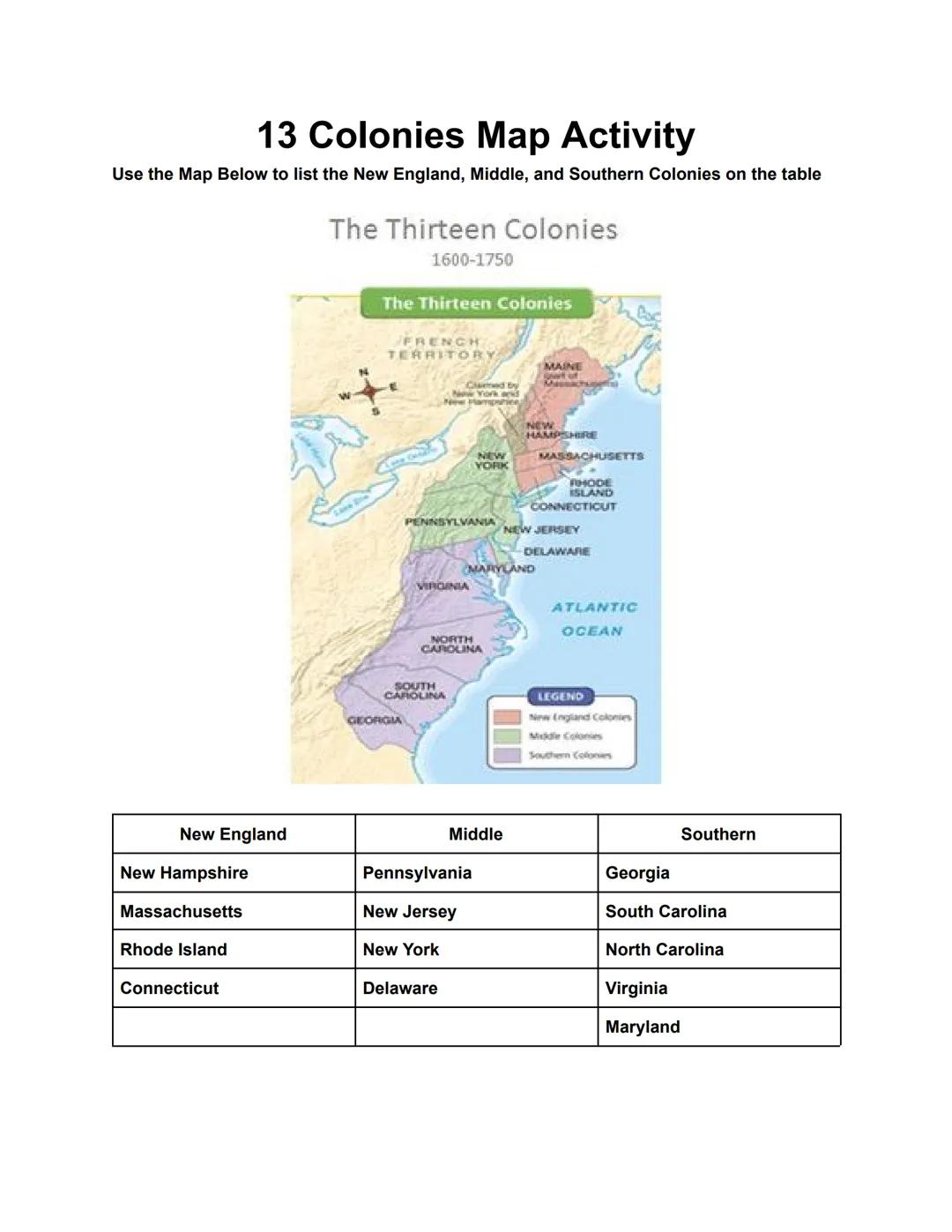
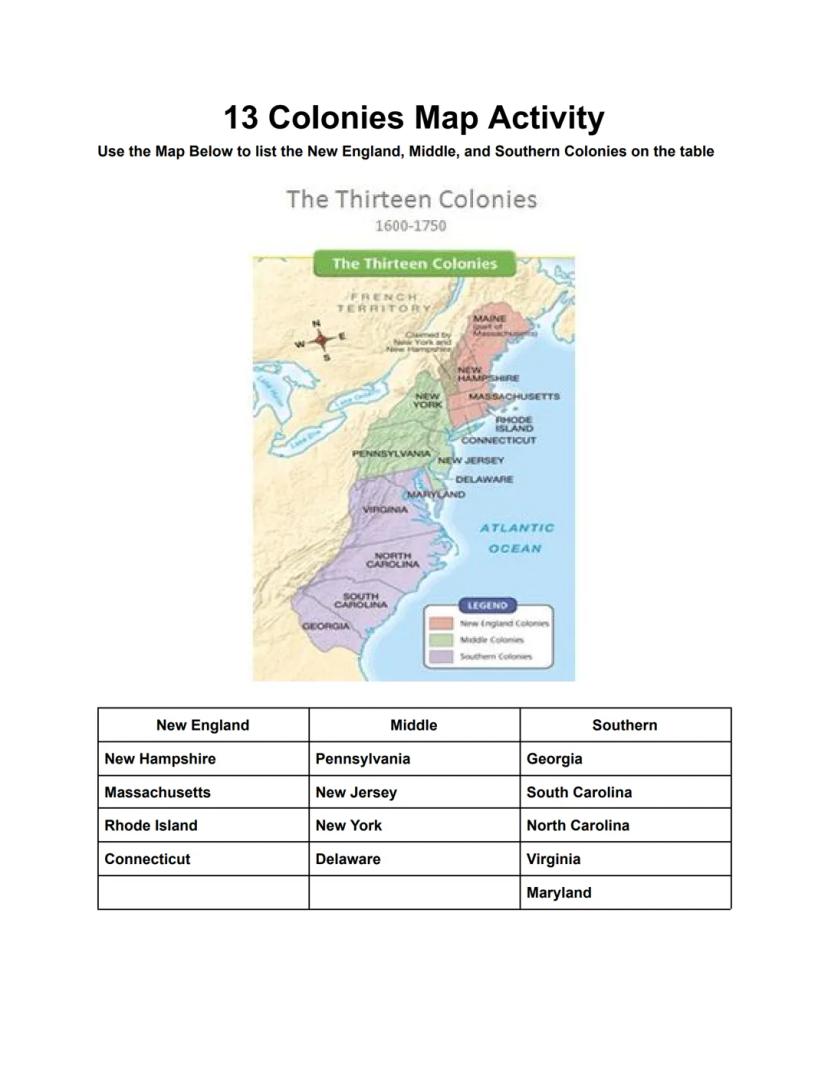
The Thirteen Colonies (1600-1750)
The thirteen original colonies were divided into three main regions, each with distinct characteristics. Looking at the Atlantic coast, you can see how these colonies were organized from north to south.
The New England Colonies included New Hampshire, Massachusetts, Rhode Island, and Connecticut. These northern colonies had rockier soil and harsher winters than their southern neighbors.
The Middle Colonies consisted of New York, New Jersey, Pennsylvania, and Delaware. These colonies often served as a transition zone between the northern and southern regions.
The Southern Colonies included Maryland, Virginia, North Carolina, South Carolina, and Georgia. These colonies generally had warmer climates that supported different types of agriculture than the northern regions.
Did you know? Maine was actually claimed by both New York and Massachusetts during colonial times and wasn't its own colony!
2
of 3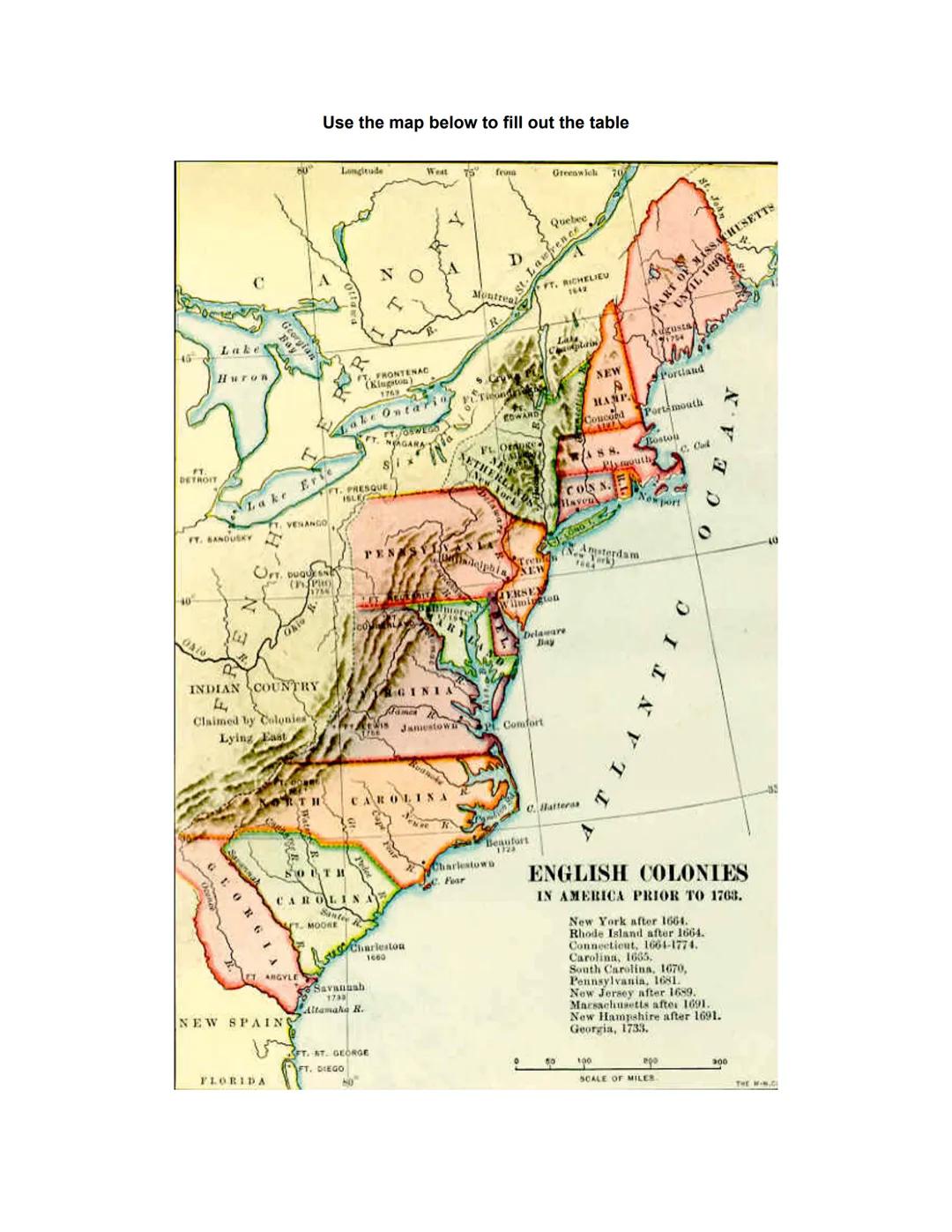
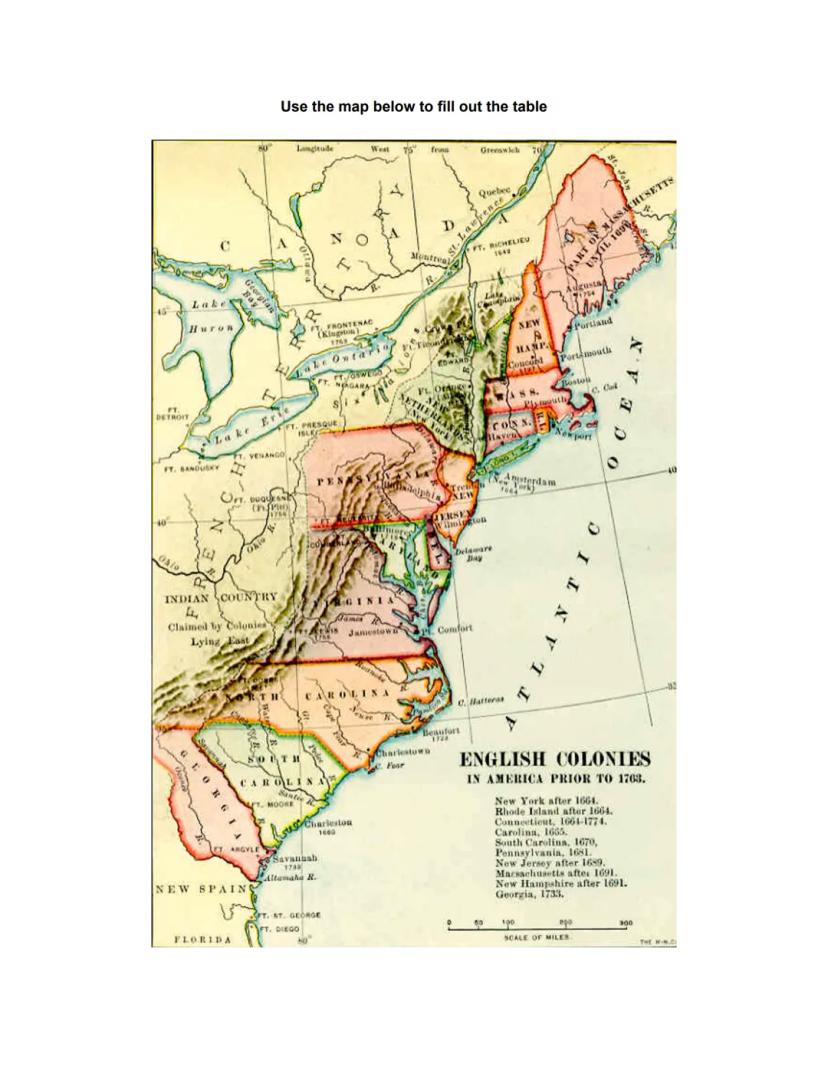
Colonial America Before 1763
The map of colonial America shows more than just political boundaries—it reveals how geography influenced settlement patterns. The colonies were sandwiched between the Appalachian Mountains to the west and the Atlantic Ocean to the east.
Major waterways like the Hudson River, Delaware River, and Chesapeake Bay provided crucial transportation routes. These natural highways allowed colonists to travel, trade goods, and communicate with other settlements.
Colonial cities typically developed along these waterways. Places like Boston, New York (previously New Amsterdam), Philadelphia, and Charleston became important centers of commerce and culture.
Notice how the map shows territories beyond the thirteen colonies too! French territory to the north, Indian Country to the west, and Spanish Florida to the south all influenced colonial development and led to future conflicts.
Map Skill Tip: When looking at historical maps, pay attention to how natural features like mountains and rivers often served as boundaries between territories.
3
of 3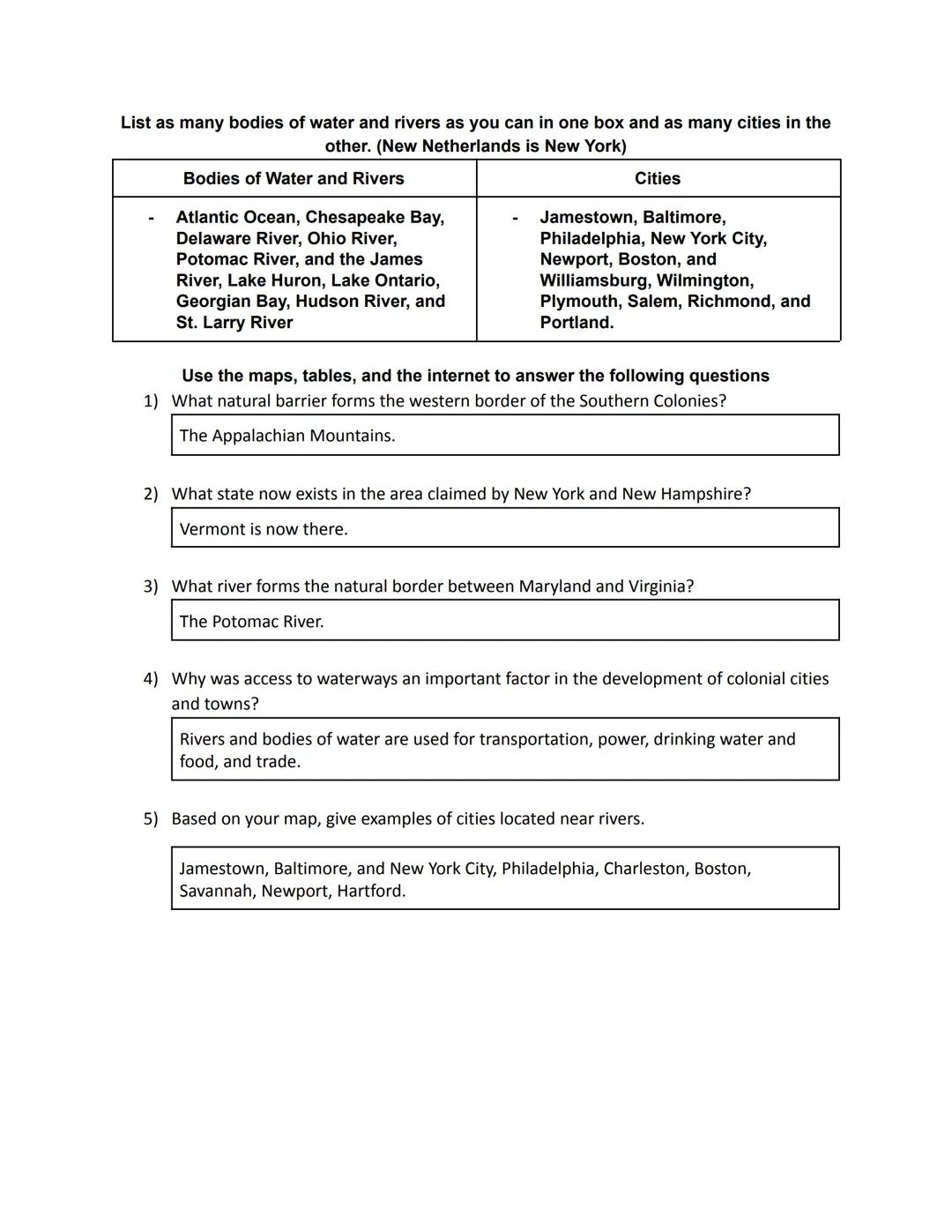
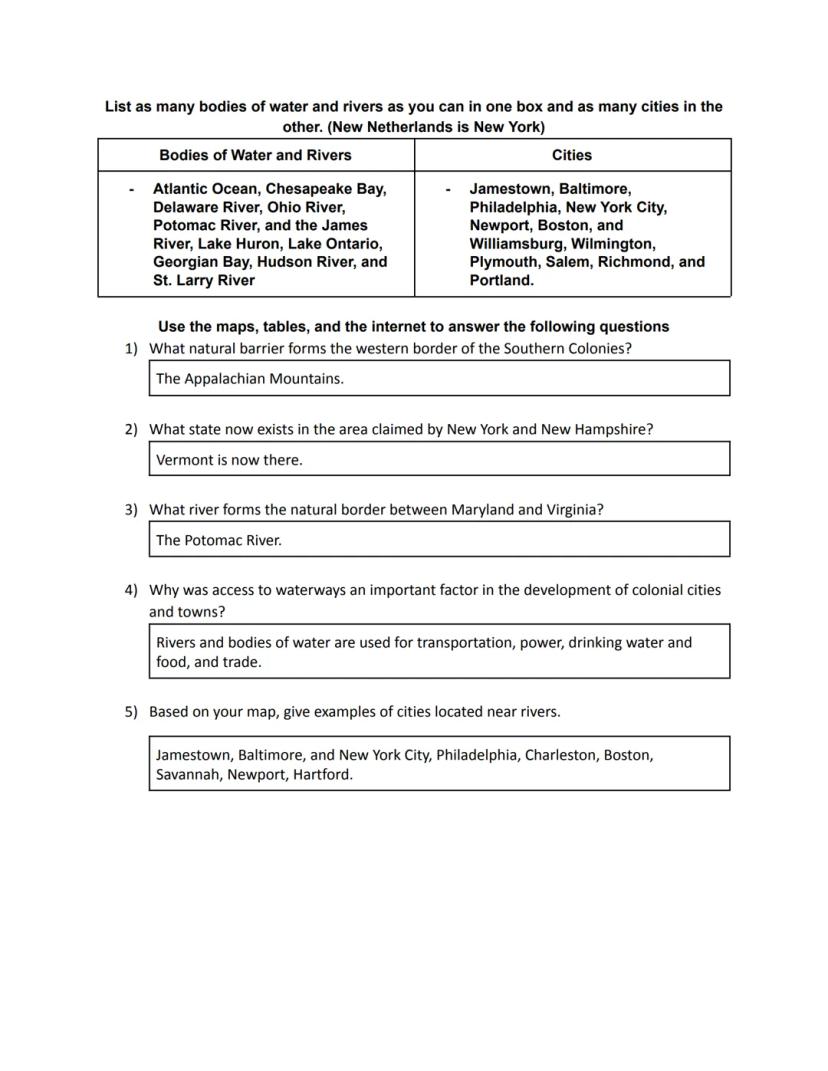
Analyzing Colonial Geography
Colonial America was defined by its waterways. The Atlantic Ocean provided the connection to Europe, while rivers like the Delaware, Potomac, Ohio, and James served as transportation highways. Lakes Huron and Ontario in the north were also important for trade and movement.
Colonial cities developed strategically near water. Jamestown, Baltimore, Philadelphia, New York City, Boston, and Charleston all grew along rivers or harbors that provided access to resources and trading opportunities.
The Appalachian Mountains formed a natural western barrier for the Southern Colonies, limiting initial expansion westward. This mountain range influenced settlement patterns and later became significant during western expansion.
Rivers often created natural borders between colonies, like the Potomac River separating Maryland and Virginia. Access to waterways was crucial for colonial development because they provided transportation routes, power for mills, drinking water, food sources, and trading opportunities.
Connect the Dots: Next time you look at a map of the eastern United States, notice how many major cities are still located on the same rivers and harbors where colonial settlements began!
We thought you’d never ask...
What is the Knowunity AI companion?
Our AI companion is specifically built for the needs of students. Based on the millions of content pieces we have on the platform we can provide truly meaningful and relevant answers to students. But its not only about answers, the companion is even more about guiding students through their daily learning challenges, with personalised study plans, quizzes or content pieces in the chat and 100% personalisation based on the students skills and developments.
Where can I download the Knowunity app?
You can download the app in the Google Play Store and in the Apple App Store.
Is Knowunity really free of charge?
That's right! Enjoy free access to study content, connect with fellow students, and get instant help – all at your fingertips.
Similar Content
Most popular content in US History
9C
 US History
civil rights movement quiz
Vocab
8th2220
Social StudiesThe Neolithic Revolution: From Hunter-Gatherers to Farming
Summarizes the key aspects of the Neolithic Revolution, detailing how humans moved from hunter-gatherer groups to settled agricultural societies.
6th2882
T
Social StudiesThe Revolutionary War Pt.1
Questions about the revolutionary war
9th840
Social StudiesMotives for European Exploration: Gold, God, and Glory
Learn about the key factors driving European exploration of the New World. This resource explains the "3 G's" motive: the pursuit of Gold, the spread of God, and the desire for Glory.
6th1821
 AP Human Geography
AP Human Geography Notes and Exam Prep Unit 1
A document covering Unit 1 of AP Human Geography from my 9th grade class 2021-2022
1,34776
AP Human GeographyAP Human Geography Notes and Exam Prep Unit 6
A document covering Unit 6 of AP Human Geography from my 9th grade class 2021-2022
1,29765
AP Human GeographyAP Human Geography Notes and Exam Prep Unit 5
A document covering Unit 5 of AP Human Geography from my 9th grade class 2021-2022
1,14943
W
 Earth and Space Science
World Oceans - Sixth Grade
Can you guess all the oceans? This will test your knowledge on the location of each ocean, describing bordering countries, seas, lands, and other oceans.
6th1390
AP Human GeographyAP Human Geography Notes and Exam Prep Unit 4
A document covering Unit 4 of AP Human Geography from my 9th grade class 2021-2022
98653
Most popular content
9O
AP US HistoryOrigins and Dynamics of the Columbian Exchange
Analyze the ecological and economic motivations behind the initial transfer of goods, people, and diseases between the Old and New Worlds.
9th3,1280
I
AP US HistoryIntroduction to Early Cultural Interactions
Analyze the initial social and religious encounters between Europeans, Africans, and Indigenous peoples in the colonial Americas.
9th2,7730
O
AP World HistoryOrigins of Ancient River Civilizations
Analyze the environmental factors and technological innovations that led to the rise of early states in Mesopotamia, Egypt, and the Indus Valley.
9th3,1870
M
AP US HistoryMotivations for European Exploration
Analyze the economic, religious, and political factors that drove European powers to the Americas during the 15th and 16th centuries.
9th1,7780
F
AP PsychologyFoundations of Ethical Guidelines in Research
Practice the core principles of the APA ethical code including informed consent, debriefing, and the role of Institutional Review Boards.
9th1,3360
I
AP US HistoryIntroduction to Native American Societies
Examine the diverse social, political, and economic structures of North American indigenous groups prior to European contact.
9th1,1100
I
 AP Biology
Introduction to Biological Elements of Life
Practice identifying the essential elements including carbon, nitrogen, phosphorus, and sulfur that compose biological macromolecules.
9th1,7390
I
AP US HistoryIntroduction to the Spanish Encomienda System
Explore the fundamental economic and social structures of the Spanish colonial system, focusing on the encomienda and the casta social hierarchy.
9th8890
O
AP World HistoryOrigins and Continuity of the Byzantine Empire
Analyze the political and cultural transitions from the Roman Empire to the Byzantine Empire, focusing on the reign of Justinian I and his code.
9th1,6320
Can't find what you're looking for? Explore other subjects.
Students love us — and so will you.
4.6/5App Store
4.7/5Google Play
The app is very easy to use and well designed. I have found everything I was looking for so far and have been able to learn a lot from the presentations! I will definitely use the app for a class assignment! And of course it also helps a lot as an inspiration.
Stefan SiOS user
This app is really great. There are so many study notes and help [...]. My problem subject is French, for example, and the app has so many options for help. Thanks to this app, I have improved my French. I would recommend it to anyone.
Samantha KlichAndroid user
Wow, I am really amazed. I just tried the app because I've seen it advertised many times and was absolutely stunned. This app is THE HELP you want for school and above all, it offers so many things, such as workouts and fact sheets, which have been VERY helpful to me personally.
AnnaiOS user
Social Studies46 views·Updated Jun 8, 2026·3 pagesExplore the 13 Colonies with This Map Activity
The 13 Colonies Map Activity helps you explore how early America was organized into three distinct regions: New England, Middle, and Southern colonies. By examining historical maps, you'll learn about colonial boundaries, important cities, and geographical features that shaped early...
1
of 3
Sign up to see the content. It's free!
- Access to all documents
- Improve your grades
- Join milions of students
The Thirteen Colonies (1600-1750)
The thirteen original colonies were divided into three main regions, each with distinct characteristics. Looking at the Atlantic coast, you can see how these colonies were organized from north to south.
The New England Colonies included New Hampshire, Massachusetts, Rhode Island, and Connecticut. These northern colonies had rockier soil and harsher winters than their southern neighbors.
The Middle Colonies consisted of New York, New Jersey, Pennsylvania, and Delaware. These colonies often served as a transition zone between the northern and southern regions.
The Southern Colonies included Maryland, Virginia, North Carolina, South Carolina, and Georgia. These colonies generally had warmer climates that supported different types of agriculture than the northern regions.
Did you know? Maine was actually claimed by both New York and Massachusetts during colonial times and wasn't its own colony!
2
of 3Sign up to see the content. It's free!
- Access to all documents
- Improve your grades
- Join milions of students
Colonial America Before 1763
The map of colonial America shows more than just political boundaries—it reveals how geography influenced settlement patterns. The colonies were sandwiched between the Appalachian Mountains to the west and the Atlantic Ocean to the east.
Major waterways like the Hudson River, Delaware River, and Chesapeake Bay provided crucial transportation routes. These natural highways allowed colonists to travel, trade goods, and communicate with other settlements.
Colonial cities typically developed along these waterways. Places like Boston, New York (previously New Amsterdam), Philadelphia, and Charleston became important centers of commerce and culture.
Notice how the map shows territories beyond the thirteen colonies too! French territory to the north, Indian Country to the west, and Spanish Florida to the south all influenced colonial development and led to future conflicts.
Map Skill Tip: When looking at historical maps, pay attention to how natural features like mountains and rivers often served as boundaries between territories.
3
of 3Sign up to see the content. It's free!
- Access to all documents
- Improve your grades
- Join milions of students
Analyzing Colonial Geography
Colonial America was defined by its waterways. The Atlantic Ocean provided the connection to Europe, while rivers like the Delaware, Potomac, Ohio, and James served as transportation highways. Lakes Huron and Ontario in the north were also important for trade and movement.
Colonial cities developed strategically near water. Jamestown, Baltimore, Philadelphia, New York City, Boston, and Charleston all grew along rivers or harbors that provided access to resources and trading opportunities.
The Appalachian Mountains formed a natural western barrier for the Southern Colonies, limiting initial expansion westward. This mountain range influenced settlement patterns and later became significant during western expansion.
Rivers often created natural borders between colonies, like the Potomac River separating Maryland and Virginia. Access to waterways was crucial for colonial development because they provided transportation routes, power for mills, drinking water, food sources, and trading opportunities.
Connect the Dots: Next time you look at a map of the eastern United States, notice how many major cities are still located on the same rivers and harbors where colonial settlements began!
We thought you’d never ask...
What is the Knowunity AI companion?
Our AI companion is specifically built for the needs of students. Based on the millions of content pieces we have on the platform we can provide truly meaningful and relevant answers to students. But its not only about answers, the companion is even more about guiding students through their daily learning challenges, with personalised study plans, quizzes or content pieces in the chat and 100% personalisation based on the students skills and developments.
Where can I download the Knowunity app?
You can download the app in the Google Play Store and in the Apple App Store.
Is Knowunity really free of charge?
That's right! Enjoy free access to study content, connect with fellow students, and get instant help – all at your fingertips.
Similar Content
Most popular content in US History
9C
US Historycivil rights movement quiz
Vocab
8th2220
Social StudiesThe Neolithic Revolution: From Hunter-Gatherers to Farming
Summarizes the key aspects of the Neolithic Revolution, detailing how humans moved from hunter-gatherer groups to settled agricultural societies.
6th2882
T
Social StudiesThe Revolutionary War Pt.1
Questions about the revolutionary war
9th840
Social StudiesMotives for European Exploration: Gold, God, and Glory
Learn about the key factors driving European exploration of the New World. This resource explains the "3 G's" motive: the pursuit of Gold, the spread of God, and the desire for Glory.
6th1821
AP Human GeographyAP Human Geography Notes and Exam Prep Unit 1
A document covering Unit 1 of AP Human Geography from my 9th grade class 2021-2022
1,34776
AP Human GeographyAP Human Geography Notes and Exam Prep Unit 6
A document covering Unit 6 of AP Human Geography from my 9th grade class 2021-2022
1,29765
AP Human GeographyAP Human Geography Notes and Exam Prep Unit 5
A document covering Unit 5 of AP Human Geography from my 9th grade class 2021-2022
1,14943
W
Earth and Space ScienceWorld Oceans - Sixth Grade
Can you guess all the oceans? This will test your knowledge on the location of each ocean, describing bordering countries, seas, lands, and other oceans.
6th1390
AP Human GeographyAP Human Geography Notes and Exam Prep Unit 4
A document covering Unit 4 of AP Human Geography from my 9th grade class 2021-2022
98653
Most popular content
9O
AP US HistoryOrigins and Dynamics of the Columbian Exchange
Analyze the ecological and economic motivations behind the initial transfer of goods, people, and diseases between the Old and New Worlds.
9th3,1280
I
AP US HistoryIntroduction to Early Cultural Interactions
Analyze the initial social and religious encounters between Europeans, Africans, and Indigenous peoples in the colonial Americas.
9th2,7730
O
AP World HistoryOrigins of Ancient River Civilizations
Analyze the environmental factors and technological innovations that led to the rise of early states in Mesopotamia, Egypt, and the Indus Valley.
9th3,1870
M
AP US HistoryMotivations for European Exploration
Analyze the economic, religious, and political factors that drove European powers to the Americas during the 15th and 16th centuries.
9th1,7780
F
AP PsychologyFoundations of Ethical Guidelines in Research
Practice the core principles of the APA ethical code including informed consent, debriefing, and the role of Institutional Review Boards.
9th1,3360
I
AP US HistoryIntroduction to Native American Societies
Examine the diverse social, political, and economic structures of North American indigenous groups prior to European contact.
9th1,1100
I
AP BiologyIntroduction to Biological Elements of Life
Practice identifying the essential elements including carbon, nitrogen, phosphorus, and sulfur that compose biological macromolecules.
9th1,7390
I
AP US HistoryIntroduction to the Spanish Encomienda System
Explore the fundamental economic and social structures of the Spanish colonial system, focusing on the encomienda and the casta social hierarchy.
9th8890
O
AP World HistoryOrigins and Continuity of the Byzantine Empire
Analyze the political and cultural transitions from the Roman Empire to the Byzantine Empire, focusing on the reign of Justinian I and his code.
9th1,6320
Can't find what you're looking for? Explore other subjects.
Students love us — and so will you.
4.6/5App Store
4.7/5Google Play
The app is very easy to use and well designed. I have found everything I was looking for so far and have been able to learn a lot from the presentations! I will definitely use the app for a class assignment! And of course it also helps a lot as an inspiration.
Stefan SiOS user
This app is really great. There are so many study notes and help [...]. My problem subject is French, for example, and the app has so many options for help. Thanks to this app, I have improved my French. I would recommend it to anyone.
Samantha KlichAndroid user
Wow, I am really amazed. I just tried the app because I've seen it advertised many times and was absolutely stunned. This app is THE HELP you want for school and above all, it offers so many things, such as workouts and fact sheets, which have been VERY helpful to me personally.
AnnaiOS user