
Gli atomi non vivono da soli! In natura tendono sempre...
 Scienze1,619 views·Updated Jun 15, 2026·2 pages
Comprendere i Legami Chimici

rox@grxthy
1
of 2
Legami Chimici e Legami Ionici
Perché gli atomi si legano? La risposta è semplice: per stare meglio! Quando gli atomi si uniscono, raggiungono un livello di energia più basso e diventano più stabili. Inoltre, cercano di completare il loro ottetto di elettroni - come se volessero avere sempre 8 elettroni nel loro guscio esterno.
I legami ionici nascono dall'attrazione tra ioni di carica opposta. I metalli (come sodio e calcio) perdono facilmente elettroni e diventano ioni positivi, mentre i non metalli (come cloro e ossigeno) li acquistano diventando ioni negativi. È come quando due magneti si attraggono!
Un esempio perfetto è il sale da cucina (NaCl): il sodio cede un elettrone al cloro, creando due ioni che si attraggono fortemente. Questi composti formano dei reticoli cristallini molto ordinati e conducono elettricità solo quando sono fusi.
💡 Ricorda: I legami ionici avvengono sempre tra metalli e non metalli!
I legami metallici funzionano diversamente: gli atomi metallici condividono i loro elettroni in una "nuvola" che si muove liberamente. Questo spiega perché i metalli conducono elettricità e sono malleabili - gli elettroni possono scorrere facilmente!
2
of 2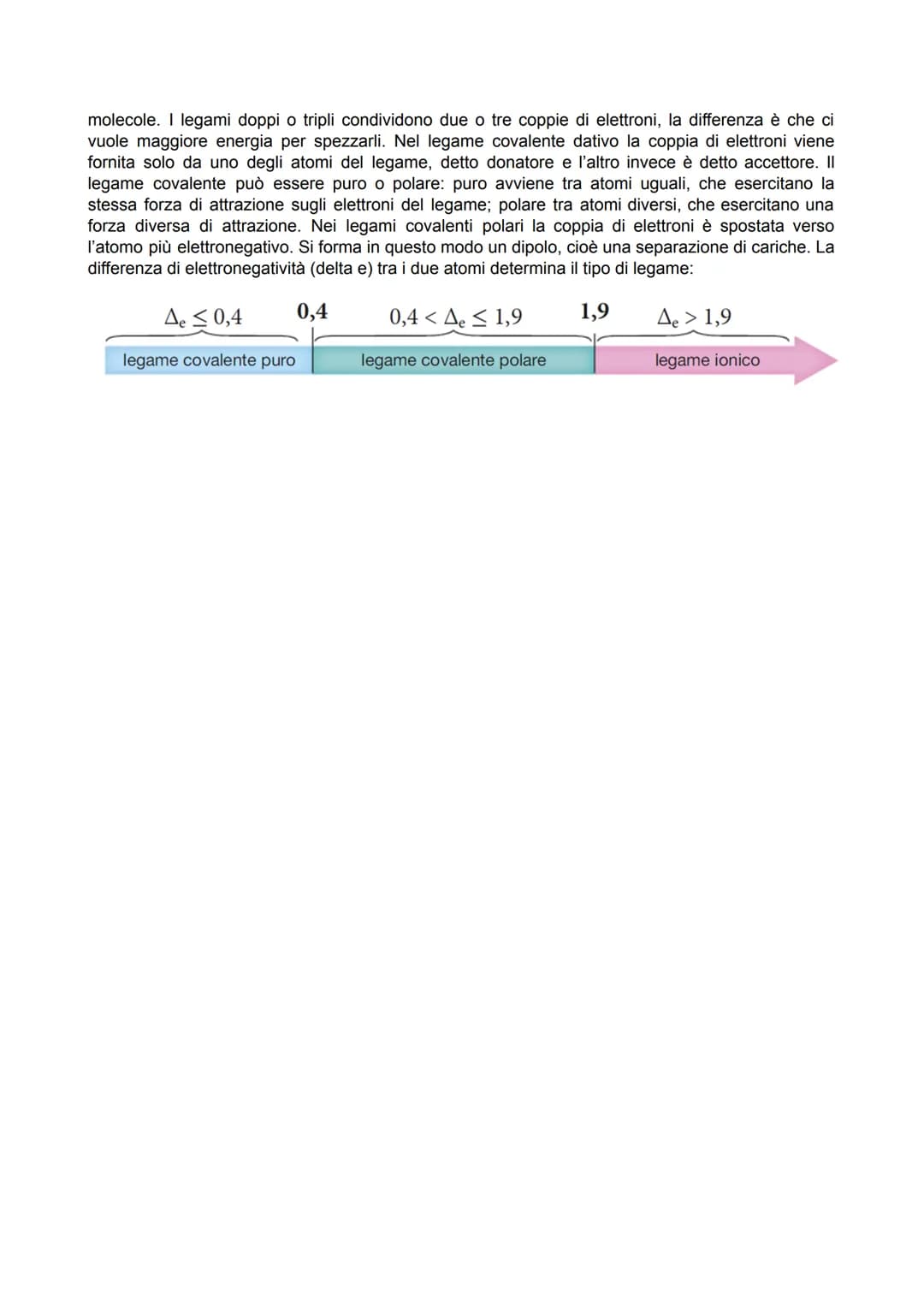
Legami Covalenti
I legami covalenti sono il regno dei non metalli! Qui gli atomi non si rubano elettroni, ma li condividono come buoni amici. Questa condivisione può coinvolgere una, due o tre coppie di elettroni (legami singoli, doppi o tripli).
Esistono due tipi principali di legami covalenti. Il legame covalente puro avviene tra atomi identici che tirano gli elettroni con la stessa forza. Il legame covalente polare invece si forma tra atomi diversi: quello più elettronegativo attira di più gli elettroni, creando un dipolo.
Come fai a sapere che tipo di legame si forma? Tutto dipende dalla differenza di elettronegatività (Δε):
- Δε ≤ 0,4: legame covalente puro
- 0,4 < Δε ≤ 1,9: legame covalente polare
- Δε > 1,9: legame ionico
💡 Trucco: Più grande è la differenza di elettronegatività, più il legame diventa "estremo"!
Nel legame covalente dativo, un solo atomo fornisce entrambi gli elettroni della coppia - è come prestare qualcosa senza chiedere nulla in cambio!
We thought you’d never ask...
What is the Knowunity AI companion?
Our AI companion is specifically built for the needs of students. Based on the millions of content pieces we have on the platform we can provide truly meaningful and relevant answers to students. But its not only about answers, the companion is even more about guiding students through their daily learning challenges, with personalised study plans, quizzes or content pieces in the chat and 100% personalisation based on the students skills and developments.
Where can I download the Knowunity app?
You can download the app in the Google Play Store and in the Apple App Store.
Is Knowunity really free of charge?
That's right! Enjoy free access to study content, connect with fellow students, and get instant help – all at your fingertips.
Similar Content
 Ens. Scient.
Most popular content: Minerale
9ScienzeLE ROCCE E I MINERALI
ROCCE MAGMATICHE, ROCCE SEDIMENTARIE, ROCCE METAMORFICHE, FORMAZIONE DEI MINERALI, OSSIDI, SILICATI, CARBONATI, ELEMENTI NATIVI, SOLFURI, SOLFATI, ALOGENURI
1ªl4,70690
ScienzeI minerali. Le rocce.
Minerali, tipi di minerali, rocce.
4ªl3,80693
ScienzeMinerali e Rocce
I Minerali con approfondimento sui Silicati, le tipologie di Rocce
4ªl1,63126
Scienzeminerali e rocce
appunti di scienze della terra
3ªl7,644178
ScienzeRocce e minerali
Minerali e rocce
3ªm95415
Scienzei minerali
cosa sono, come nascono, classificazione, i silicati
1ªl1,34329
Scienzela tavola periodica
descrizione (appunti) della tavola periodica
1ªl2,86055
Scienzeistologia
corso istologia e citologia al corso di laurea di biologia
5ªl84027
ScienzeLa struttura della Terra
Presentazione su "La struttura della Terra", spiegata in modo semplice ed efficace.
1ªm1,25819
Most popular content in Scienze
9S
ScienzeStruttura della Cellula Eucariote
Ripasso delle componenti principali come nucleo, membrana e citoplasma per comprendere l'organizzazione di base della cellula.
1ªl2,1880
F
ScienzeFondamenti dell'Apparato Circolatorio
Identifica gli organi principali dell'apparato circolatorio e le loro funzioni primarie nel corpo umano.
2ªm2,9080
°
Scienze°• LA CELLULA •°
le cellule eucariote e procariote. Le cellule vegetali e animali
1ªm3,7335
A
ScienzeApparato respiratorio
fai un quiz
2ªm1,4930
A
ScienzeAnatomia dell'Apparato Digerente
Identifica i principali organi e le loro funzioni primarie all'interno del sistema digerente umano.
2ªm3,7160
ScienzeLA CELLULA EUCARIOTE
spiegazione della cellula eucariote, membrana cellulare e le due cellule ecucariotica vegetale ed animale
2ªl23,838787
R
Scienzeripassa l'apparato digerente con queste sfide difficili!
10/10 prova questo quiz per ripassare l apparato digerente
2ªm7,3085
C
ScienzeConfronto tra Mitosi, Meiosi e Gameti
Analisi delle differenze tra mitosi e meiosi e studio del processo di formazione dei gameti umani.
2ªl1,2500
F
ScienzeFunzioni degli Organelli Eucarioti
Esercizi per identificare il ruolo di mitocondri, ribosomi e apparato di Golgi nel mantenimento delle funzioni cellulari.
1ªl9140
Most popular content
9 Italiano
Riassunto patente B
Riassunto patente B - appunti presi a lezione
5ªl29,228943
 Altro
AltroTeoria patente b
Tutti gli argomenti per la patente
1ªl21,114685
 Ed. civ.
Teoria patente di guida B: Segnali stradali
Segnali stradali di pericolo, luminosi, di prescrizione, di indicazione, temporanei, complementari, pannelli integrativi, segnaletica orizzontale, segnalazioni agenti del traffico, distanza di visibilità per l‘arresto, minima di sicurezza.
5ªl40,0421,645
 Filosofia
Aristotele
Aristotele: vita, metafisica, fisica, etica e politica, retorica e poetica
3ªl7,623216
ItalianoI promessi sposi
Riassunti completi di tutti i 38 capitoli dei Promessi sposi.
2ªl14,090314
AltroPATENTE
schemi per esame teorico della patente
Università22,067756
S
ItalianoSintesi finale di Analisi logica
Esercitazione completa di analisi logica su frasi articolate per consolidare la conoscenza di tutti i complementi.
3ªm5,5290
P
 Inglese
Present Simple vs Present Continuous
Develop the ability to choose correctly between the Present Simple for habits and the Present Continuous for ongoing actions.
3ªm4,2120
G
ItalianoGabriele D'Annunzio e l'Estetismo
Domande sull'ideale del superuomo, il panismo e la concezione dell'arte come valore assoluto in D'Annunzio.
4ªl2,6740
Can't find what you're looking for? Explore other subjects.
Students love us — and so will you.
4.6/5App Store
4.7/5Google Play
The app is very easy to use and well designed. I have found everything I was looking for so far and have been able to learn a lot from the presentations! I will definitely use the app for a class assignment! And of course it also helps a lot as an inspiration.
Stefan SiOS user
This app is really great. There are so many study notes and help [...]. My problem subject is French, for example, and the app has so many options for help. Thanks to this app, I have improved my French. I would recommend it to anyone.
Samantha KlichAndroid user
Wow, I am really amazed. I just tried the app because I've seen it advertised many times and was absolutely stunned. This app is THE HELP you want for school and above all, it offers so many things, such as workouts and fact sheets, which have been VERY helpful to me personally.
AnnaiOS user
Scienze1,619 views·Updated Jun 15, 2026·2 pagesComprendere i Legami Chimici
rox@grxthy
Gli atomi non vivono da soli! In natura tendono sempre a legarsi tra loro per diventare più stabili e raggiungere quello che chiamiamo "ottetto completo". Esistono diversi tipi di legami chimici, ognuno con le sue caratteristiche uniche.
1
of 2
Sign up to see the content. It's free!
- Access to all documents
- Improve your grades
- Join milions of students
Legami Chimici e Legami Ionici
Perché gli atomi si legano? La risposta è semplice: per stare meglio! Quando gli atomi si uniscono, raggiungono un livello di energia più basso e diventano più stabili. Inoltre, cercano di completare il loro ottetto di elettroni - come se volessero avere sempre 8 elettroni nel loro guscio esterno.
I legami ionici nascono dall'attrazione tra ioni di carica opposta. I metalli (come sodio e calcio) perdono facilmente elettroni e diventano ioni positivi, mentre i non metalli (come cloro e ossigeno) li acquistano diventando ioni negativi. È come quando due magneti si attraggono!
Un esempio perfetto è il sale da cucina (NaCl): il sodio cede un elettrone al cloro, creando due ioni che si attraggono fortemente. Questi composti formano dei reticoli cristallini molto ordinati e conducono elettricità solo quando sono fusi.
💡 Ricorda: I legami ionici avvengono sempre tra metalli e non metalli!
I legami metallici funzionano diversamente: gli atomi metallici condividono i loro elettroni in una "nuvola" che si muove liberamente. Questo spiega perché i metalli conducono elettricità e sono malleabili - gli elettroni possono scorrere facilmente!
2
of 2Sign up to see the content. It's free!
- Access to all documents
- Improve your grades
- Join milions of students
Legami Covalenti
I legami covalenti sono il regno dei non metalli! Qui gli atomi non si rubano elettroni, ma li condividono come buoni amici. Questa condivisione può coinvolgere una, due o tre coppie di elettroni (legami singoli, doppi o tripli).
Esistono due tipi principali di legami covalenti. Il legame covalente puro avviene tra atomi identici che tirano gli elettroni con la stessa forza. Il legame covalente polare invece si forma tra atomi diversi: quello più elettronegativo attira di più gli elettroni, creando un dipolo.
Come fai a sapere che tipo di legame si forma? Tutto dipende dalla differenza di elettronegatività (Δε):
- Δε ≤ 0,4: legame covalente puro
- 0,4 < Δε ≤ 1,9: legame covalente polare
- Δε > 1,9: legame ionico
💡 Trucco: Più grande è la differenza di elettronegatività, più il legame diventa "estremo"!
Nel legame covalente dativo, un solo atomo fornisce entrambi gli elettroni della coppia - è come prestare qualcosa senza chiedere nulla in cambio!
We thought you’d never ask...
What is the Knowunity AI companion?
Our AI companion is specifically built for the needs of students. Based on the millions of content pieces we have on the platform we can provide truly meaningful and relevant answers to students. But its not only about answers, the companion is even more about guiding students through their daily learning challenges, with personalised study plans, quizzes or content pieces in the chat and 100% personalisation based on the students skills and developments.
Where can I download the Knowunity app?
You can download the app in the Google Play Store and in the Apple App Store.
Is Knowunity really free of charge?
That's right! Enjoy free access to study content, connect with fellow students, and get instant help – all at your fingertips.
Similar Content
Most popular content: Minerale
9ScienzeLE ROCCE E I MINERALI
ROCCE MAGMATICHE, ROCCE SEDIMENTARIE, ROCCE METAMORFICHE, FORMAZIONE DEI MINERALI, OSSIDI, SILICATI, CARBONATI, ELEMENTI NATIVI, SOLFURI, SOLFATI, ALOGENURI
1ªl4,70690
ScienzeI minerali. Le rocce.
Minerali, tipi di minerali, rocce.
4ªl3,80693
ScienzeMinerali e Rocce
I Minerali con approfondimento sui Silicati, le tipologie di Rocce
4ªl1,63126
Scienzeminerali e rocce
appunti di scienze della terra
3ªl7,644178
ScienzeRocce e minerali
Minerali e rocce
3ªm95415
Scienzei minerali
cosa sono, come nascono, classificazione, i silicati
1ªl1,34329
Scienzela tavola periodica
descrizione (appunti) della tavola periodica
1ªl2,86055
Scienzeistologia
corso istologia e citologia al corso di laurea di biologia
5ªl84027
ScienzeLa struttura della Terra
Presentazione su "La struttura della Terra", spiegata in modo semplice ed efficace.
1ªm1,25819
Most popular content in Scienze
9S
ScienzeStruttura della Cellula Eucariote
Ripasso delle componenti principali come nucleo, membrana e citoplasma per comprendere l'organizzazione di base della cellula.
1ªl2,1880
F
ScienzeFondamenti dell'Apparato Circolatorio
Identifica gli organi principali dell'apparato circolatorio e le loro funzioni primarie nel corpo umano.
2ªm2,9080
°
Scienze°• LA CELLULA •°
le cellule eucariote e procariote. Le cellule vegetali e animali
1ªm3,7335
A
ScienzeApparato respiratorio
fai un quiz
2ªm1,4930
A
ScienzeAnatomia dell'Apparato Digerente
Identifica i principali organi e le loro funzioni primarie all'interno del sistema digerente umano.
2ªm3,7160
ScienzeLA CELLULA EUCARIOTE
spiegazione della cellula eucariote, membrana cellulare e le due cellule ecucariotica vegetale ed animale
2ªl23,838787
R
Scienzeripassa l'apparato digerente con queste sfide difficili!
10/10 prova questo quiz per ripassare l apparato digerente
2ªm7,3085
C
ScienzeConfronto tra Mitosi, Meiosi e Gameti
Analisi delle differenze tra mitosi e meiosi e studio del processo di formazione dei gameti umani.
2ªl1,2500
F
ScienzeFunzioni degli Organelli Eucarioti
Esercizi per identificare il ruolo di mitocondri, ribosomi e apparato di Golgi nel mantenimento delle funzioni cellulari.
1ªl9140
Most popular content
9ItalianoRiassunto patente B
Riassunto patente B - appunti presi a lezione
5ªl29,228943
AltroTeoria patente b
Tutti gli argomenti per la patente
1ªl21,114685
Ed. civ.Teoria patente di guida B: Segnali stradali
Segnali stradali di pericolo, luminosi, di prescrizione, di indicazione, temporanei, complementari, pannelli integrativi, segnaletica orizzontale, segnalazioni agenti del traffico, distanza di visibilità per l‘arresto, minima di sicurezza.
5ªl40,0421,645
FilosofiaAristotele
Aristotele: vita, metafisica, fisica, etica e politica, retorica e poetica
3ªl7,623216
ItalianoI promessi sposi
Riassunti completi di tutti i 38 capitoli dei Promessi sposi.
2ªl14,090314
AltroPATENTE
schemi per esame teorico della patente
Università22,067756
S
ItalianoSintesi finale di Analisi logica
Esercitazione completa di analisi logica su frasi articolate per consolidare la conoscenza di tutti i complementi.
3ªm5,5290
P
InglesePresent Simple vs Present Continuous
Develop the ability to choose correctly between the Present Simple for habits and the Present Continuous for ongoing actions.
3ªm4,2120
G
ItalianoGabriele D'Annunzio e l'Estetismo
Domande sull'ideale del superuomo, il panismo e la concezione dell'arte come valore assoluto in D'Annunzio.
4ªl2,6740
Can't find what you're looking for? Explore other subjects.
Students love us — and so will you.
4.6/5App Store
4.7/5Google Play
The app is very easy to use and well designed. I have found everything I was looking for so far and have been able to learn a lot from the presentations! I will definitely use the app for a class assignment! And of course it also helps a lot as an inspiration.
Stefan SiOS user
This app is really great. There are so many study notes and help [...]. My problem subject is French, for example, and the app has so many options for help. Thanks to this app, I have improved my French. I would recommend it to anyone.
Samantha KlichAndroid user
Wow, I am really amazed. I just tried the app because I've seen it advertised many times and was absolutely stunned. This app is THE HELP you want for school and above all, it offers so many things, such as workouts and fact sheets, which have been VERY helpful to me personally.
AnnaiOS user