
Ready to dive into the essential physics concepts that'll show...
 Science3,200 views·Updated Jun 24, 2026·15 pages
Complete General Physics 1 Notes
S
sam ⋆𐙚₊˚⊹♡@samantha.badiola_





1 / 10
1
of 10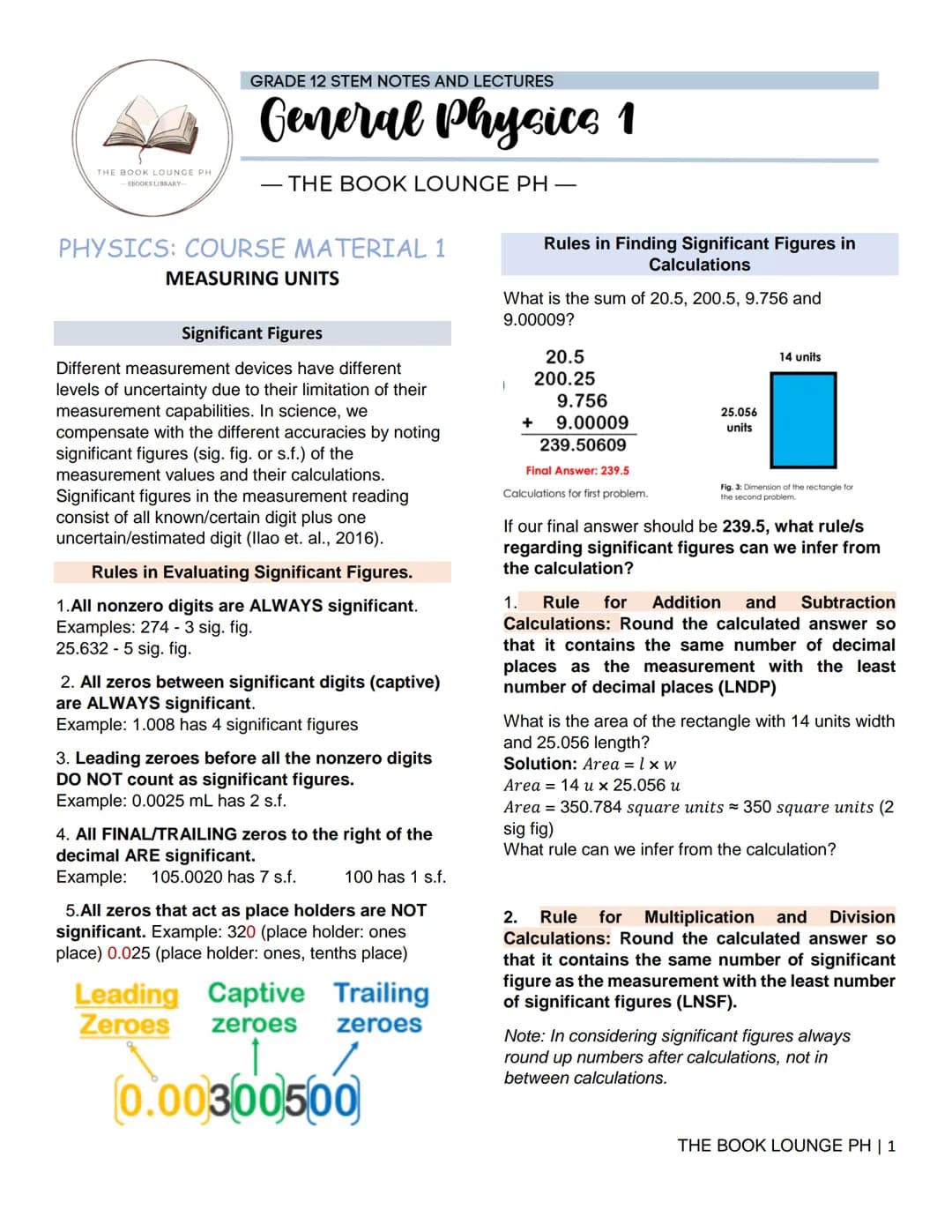
Measuring Units and Significant Figures
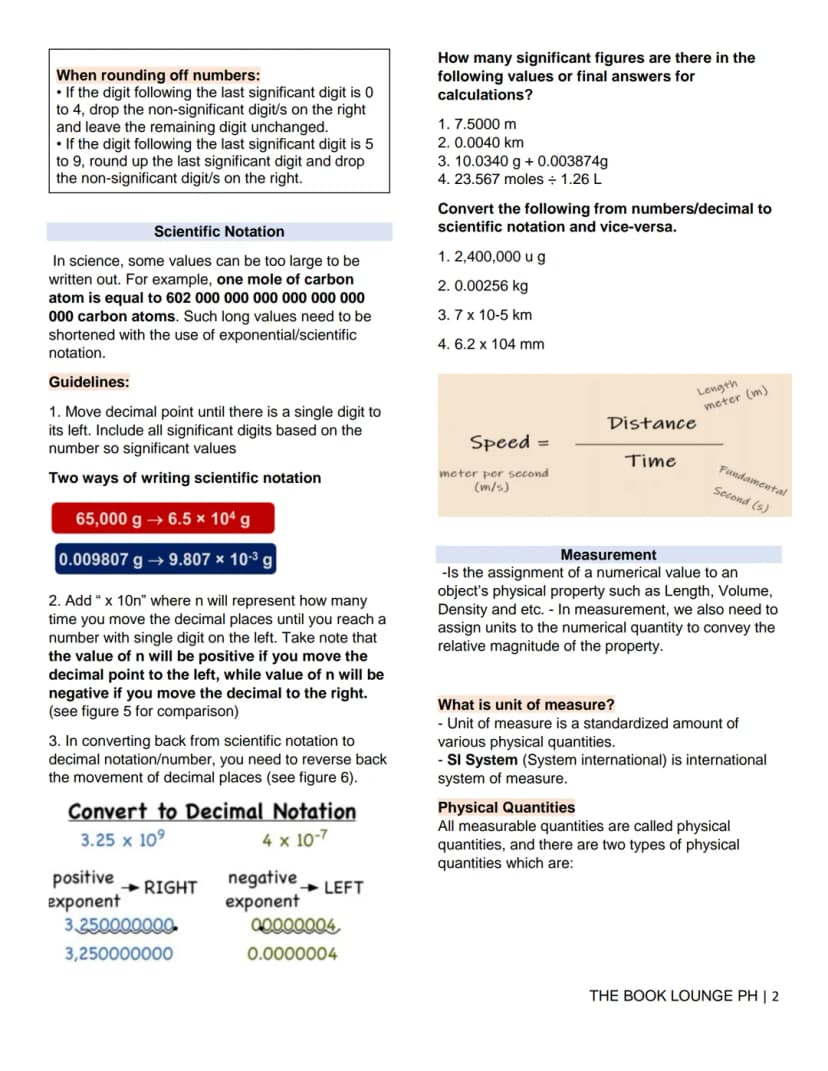
Ever wondered why your calculator shows way more decimal places than you should actually write down? That's where significant figures come to save you from looking like you measured something with impossible precision.
Significant figures tell us how precise our measurements really are. They include all the digits we're sure about, plus one estimated digit. Think of it this way - if your ruler only shows millimeters, you can't claim to know something down to the micrometer!
Here are the key rules you need to memorize: All non-zero digits always count (274 has 3 sig figs). Zeros between other digits count too (1,008 has 4 sig figs). But leading zeros before the first non-zero digit? They don't count at all (0.0025 only has 2 sig figs).
Quick Tip: When doing calculations, addition/subtraction follows decimal places, while multiplication/division follows the number with the least significant figures.
2
of 10
Scientific Notation and Physical Quantities
Nobody wants to write out 602,000,000,000,000,000,000,000 every time they talk about atoms! Scientific notation saves your hand from cramping by expressing huge or tiny numbers as powers of 10.
The trick is moving that decimal point until you have just one digit to the left of it. Move left for big numbers (positive exponent), move right for tiny numbers (negative exponent). So 65,000 becomes 6.5 × 10⁴, and 0.009807 becomes 9.807 × 10⁻³.
Physics deals with two types of quantities: fundamental and derived. Fundamental quantities like length (meters), mass (kilograms), and time (seconds) are the building blocks. Derived quantities like speed are combinations of the fundamentals.
Real Talk: Scientific notation isn't just for show - it's essential for keeping track of significant figures in massive or microscopic measurements.
3
of 10
Measurement Systems: Metric vs English
The metric system is basically physics on easy mode. Everything works in factors of 10, so converting is just about moving decimal points. Remember "King Henry Doesn't Usually Drink Chocolate Milk" for kilo-hecto-deca-UNIT-deci-centi-milli.
Converting 2.5 kilometers to meters? Count three places right from kilo to the base unit, so move that decimal three places: 2,500 meters. Converting 15 centigrams to decagrams? Count three places left from centi to deca, so you get 0.015 decagrams.
The English system is where things get messy. You need conversion ratios instead of simple decimal moves. Remember that 1 foot = 12 inches, 1 mile = 5,280 feet, and 1 ton = 2,000 pounds. These ratios always equal 1, which is why the math works.
Study Hack: Master the metric prefixes first - they'll save you tons of time on calculations and reduce silly mistakes.
4
of 10
Unit Conversions and Vector Introduction
Converting between systems gets tricky but follows a pattern. Always set up your conversion ratios so unwanted units cancel out. Converting 25 m/s to inches per minute? Chain your conversions: meters to centimeters to inches, and seconds to minutes.
Now let's talk vectors - these are quantities that need both magnitude and direction to make sense. Scalar quantities like speed, distance, and temperature only need a number. But vector quantities like velocity, displacement, and force need direction too.
Think about it: "I'm going 60 kph" (scalar speed) versus "I'm going 60 kph north" (vector velocity). The direction completely changes what's happening! Same with saying "I moved 5 meters" (scalar distance) versus "I moved 5 meters southeast" (vector displacement).
Memory Trick: If you can add "in what direction?" to a quantity and it makes sense, it's probably a vector.
5
of 10
Representing and Adding Vectors
Drawing vectors is like creating a map - the arrow's length shows magnitude, and where it points shows direction. Always use compass directions (north, south, east, west) instead of relative terms like "up" or "left" because those change depending on your perspective.
When measuring angles, start from east or west and go toward north or south. So "45° south of east" means you start pointing east, then rotate 45° toward south. This keeps all angles between 0° and 90°, making calculations cleaner.
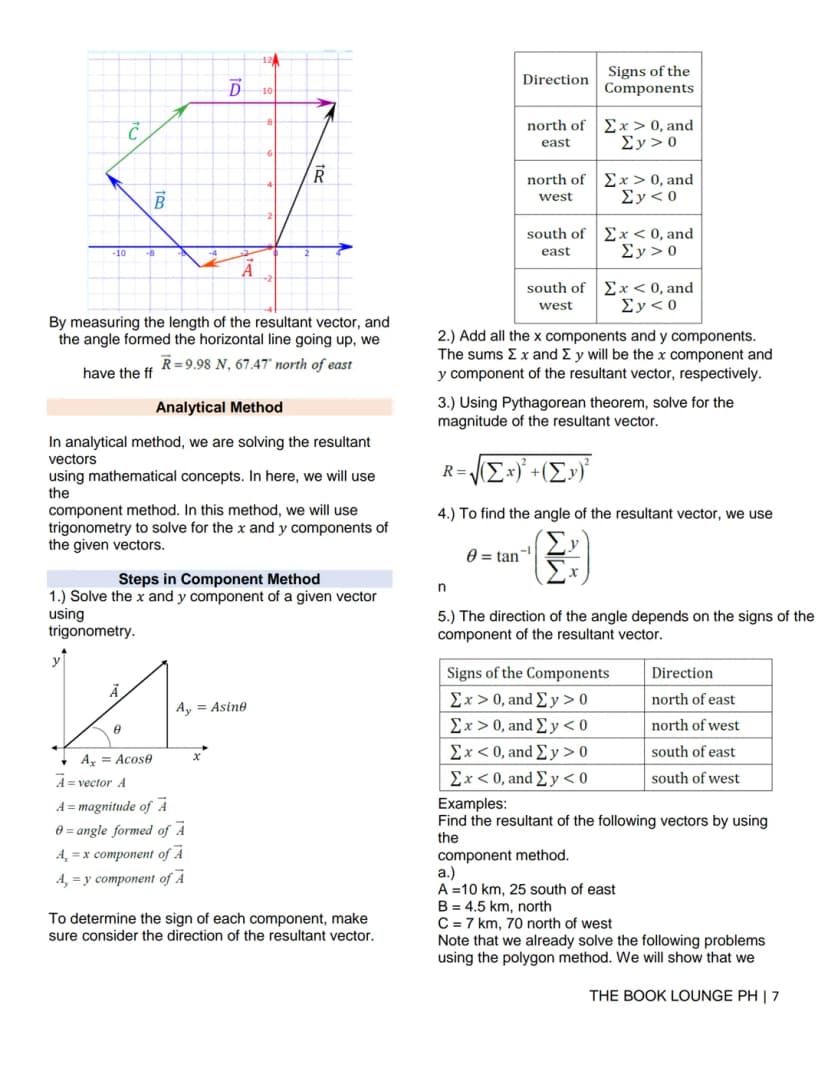
Vector addition using the polygon method connects vectors head-to-tail, like following a treasure map. Draw the first vector from the origin, then start the second vector from where the first one ends. The resultant vector connects the starting point to the final endpoint.
Pro Tip: The polygon method gives you a visual understanding of what's really happening when forces or motions combine.
6
of 10
Analytical Vector Methods
The component method uses trigonometry to break vectors into x and y parts. For any vector, the x-component equals magnitude × cos(θ), and the y-component equals magnitude × sin(θ). Think of it as finding the shadow the vector casts on each axis.
Pay attention to signs! Vectors pointing east or north give positive components, while vectors pointing west or south give negative components. This is crucial for getting the right direction in your final answer.
To find the resultant, add all x-components together and all y-components together. Then use the Pythagorean theorem: R = √. The angle comes from tan⁻¹.
Key Insight: The analytical method gives exact answers, while the graphical method helps you visualize what's happening - use both for complete understanding!
7
of 10
Vector Calculations and Problem Solving
When solving vector problems analytically, organize everything in a table with columns for magnitude, angle, x-component, and y-component. This prevents mistakes and makes checking your work easier.
Remember the quadrant rules for determining direction: positive x and y means "north of east," positive x and negative y means "south of east," and so on. The signs of your final components tell you which quadrant your resultant vector points toward.
Vector subtraction just means adding the negative of a vector. To get the negative, flip the direction 180°. So if vector A points "30° north of east," then -A points "30° south of west."
Test Strategy: Always double-check your angle calculations - wrong signs on components are the most common mistake in vector problems.
8
of 10
Advanced Vector Operations
For complex vector problems, break everything down step by step. When you see something like D = A - B - C, rewrite it as D = A + + . Then find the components of -B and -C by flipping their directions.
The component method works the same way regardless of how many vectors you're combining. Just make sure to get the signs right for each component based on the vector's actual direction after considering any negative signs.
Both graphical and analytical methods should give you similar answers. Small differences come from measurement errors or rounding, but if your answers are way off, check for sign errors or calculation mistakes.
Reality Check: Vector problems model real situations like forces on bridges or airplane navigation - getting the direction wrong could be catastrophic!
9
of 10
Introduction to Motion: Distance vs Displacement
Kinematics studies how things move without worrying about what causes the motion. It's like being a motion detective - you observe and measure, but don't ask "why" yet.
Distance is the total path traveled (scalar), while displacement is the straight-line distance from start to finish (vector). Think of distance as your car's odometer reading, and displacement as "how far you are from home as the crow flies."
If you walk 15 miles east then 5 miles west, your total distance is 20 miles, but your displacement is only 10 miles east. Distance can never be negative and never decreases, but displacement can be positive, negative, or zero.
Real Example: GPS navigation shows you the shortest route (displacement thinking) but also tracks total miles driven (distance thinking) - both matter for different reasons!
10
of 10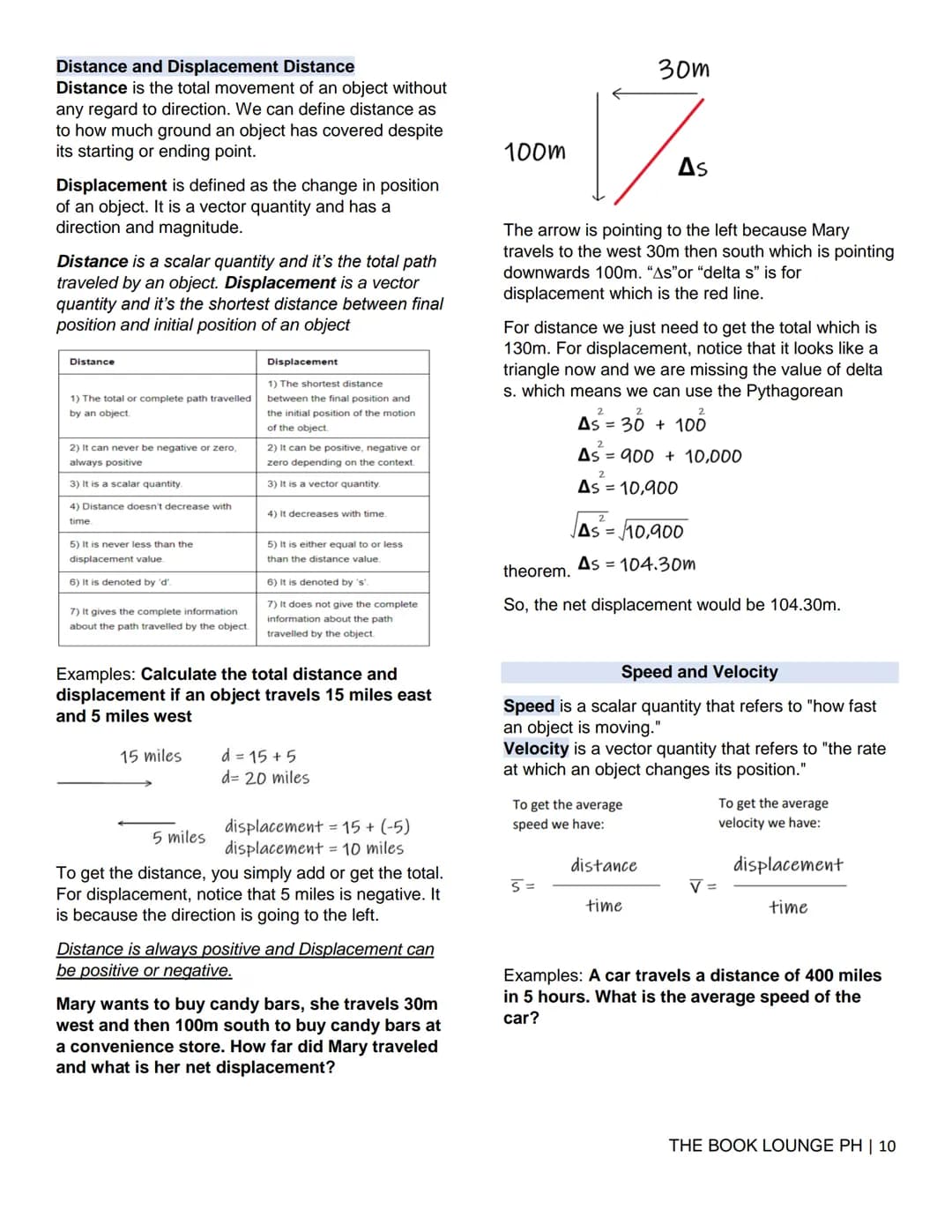
Speed, Velocity, and Motion Analysis
Speed tells you how fast you're moving (scalar), while velocity tells you how fast AND in what direction (vector). Average speed = total distance ÷ time, while average velocity = displacement ÷ time.
Here's the key difference: if you drive around the block and end up back home, your average velocity for the trip is zero (no displacement), but your average speed definitely wasn't zero (you covered distance).
For problems involving right triangles, use the Pythagorean theorem to find displacement. If Mary walks 30m west then 100m south, her displacement is √(30² + 100²) = 104.30m at an angle you can find using trigonometry.
Connect the Dots: These motion concepts build toward understanding acceleration and forces - master distance/displacement and speed/velocity now to make future topics easier.
We thought you’d never ask...
What is the Knowunity AI companion?
Our AI companion is specifically built for the needs of students. Based on the millions of content pieces we have on the platform we can provide truly meaningful and relevant answers to students. But its not only about answers, the companion is even more about guiding students through their daily learning challenges, with personalised study plans, quizzes or content pieces in the chat and 100% personalisation based on the students skills and developments.
Where can I download the Knowunity app?
You can download the app in the Google Play Store and in the Apple App Store.
Is Knowunity really free of charge?
That's right! Enjoy free access to study content, connect with fellow students, and get instant help – all at your fingertips.
Most popular content in Science
9ScienceScience 9 Quarter 1 Lesson 1
Topics: The Respiratory System and The Circulatory System
G911,069383
ScienceSCIENCE Grade 9 Quarter 3 Reviewer
All about the lessons in Grade 9 Quarter 3 SCIENCE, all complete, highlighted, printable, and has extra informations.
G914,629303
ScienceThe Human Digestive System
Science Grade 8 1st Quarter Lesson
G84,78386
ScienceScience G10 1ST QUARTER Reviewer
Science G10 1ST QUARTER Reviewer all about Plate Tectonics
G1012,527455
ScienceSCIENCE Grade 9 Quarter 2 Reviewer
All about the lessons in Grade 9 Quarter 2 SCIENCE, all complete, highlighted, printable, and has extra informations.
G98,051235
ScienceGrade 8 Science Reviewer – Volcanoes, Earthquakes, and Plate Tectonics (Quarter 3)
This detailed 3-page reviewer covers essential Grade 8 Science Quarter 3 topics including the structure and types of volcanoes, causes and measurement of earthquakes, and the theory of plate tectonics with real-world examples and illustrations.
G84,66479
ScienceScience notes about Physics (Force, Motion, Energy)
Physics (Force, Motion, Energy)
G81,46628
ScienceParts of a microscope grade 7 quarter 2 science
This is all about parts of a microscope
G71,55724
ScienceGen Chem 2 Notes
This offers students complete notes of General Chemistry 2. Easy to read and good for reviewing.
G121,58843
Most popular content
9 Math
MathMathematics Grade 10 Quarter 1
Grade 10 Math topics
G1010,218250
 Iba pa
El Filibusterismo (FILIPINO 10)
Kilalanin ang mga karakter at alamin ang mga pangyayari mula Kabanata 1 hanggang 39.
G1011,183240
ScienceScience 9 Quarter 1 Lesson 1
Topics: The Respiratory System and The Circulatory System
G911,069383
 Gen Physics
General Physics 1, First Sem
Units of Measurement, Vectors, and Kinematics. All with formulas
G116,247168
 Filipino
Filipino 8 Reviewer
Filipino Reviewer for 4th Quarter for Grade 8 students
G88,088127
ScienceSCIENCE Grade 9 Quarter 3 Reviewer
All about the lessons in Grade 9 Quarter 3 SCIENCE, all complete, highlighted, printable, and has extra informations.
G914,629303
 Pre-Cal
UPCAT Reviewer: Mathematics
general coverage of the mathematics section for UPCAT
G127,072397
OtherIntroduction to Philosophy - 1st Semester, Grade 12
A summarized notes for Grade 12 students. Easier learning for the 1st semester’s Philosophy subject.
G123,93956
ScienceThe Human Digestive System
Science Grade 8 1st Quarter Lesson
G84,78386
Can't find what you're looking for? Explore other subjects.
Students love us — and so will you.
4.6/5App Store
4.7/5Google Play
The app is very easy to use and well designed. I have found everything I was looking for so far and have been able to learn a lot from the presentations! I will definitely use the app for a class assignment! And of course it also helps a lot as an inspiration.
Stefan SiOS user
This app is really great. There are so many study notes and help [...]. My problem subject is French, for example, and the app has so many options for help. Thanks to this app, I have improved my French. I would recommend it to anyone.
Samantha KlichAndroid user
Wow, I am really amazed. I just tried the app because I've seen it advertised many times and was absolutely stunned. This app is THE HELP you want for school and above all, it offers so many things, such as workouts and fact sheets, which have been VERY helpful to me personally.
AnnaiOS user
Science3,200 views·Updated Jun 24, 2026·15 pagesComplete General Physics 1 Notes
S
sam ⋆𐙚₊˚⊹♡@samantha.badiola_
Ready to dive into the essential physics concepts that'll show up on your tests? This covers everything from measuring with precision using significant figures to understanding how forces work as vectors in the real world.
1
of 10
Sign up to see the content. It's free!
- Access to all documents
- Improve your grades
- Join milions of students
Measuring Units and Significant Figures
Ever wondered why your calculator shows way more decimal places than you should actually write down? That's where significant figures come to save you from looking like you measured something with impossible precision.
Significant figures tell us how precise our measurements really are. They include all the digits we're sure about, plus one estimated digit. Think of it this way - if your ruler only shows millimeters, you can't claim to know something down to the micrometer!
Here are the key rules you need to memorize: All non-zero digits always count (274 has 3 sig figs). Zeros between other digits count too (1,008 has 4 sig figs). But leading zeros before the first non-zero digit? They don't count at all (0.0025 only has 2 sig figs).
Quick Tip: When doing calculations, addition/subtraction follows decimal places, while multiplication/division follows the number with the least significant figures.
2
of 10Sign up to see the content. It's free!
- Access to all documents
- Improve your grades
- Join milions of students
Scientific Notation and Physical Quantities
Nobody wants to write out 602,000,000,000,000,000,000,000 every time they talk about atoms! Scientific notation saves your hand from cramping by expressing huge or tiny numbers as powers of 10.
The trick is moving that decimal point until you have just one digit to the left of it. Move left for big numbers (positive exponent), move right for tiny numbers (negative exponent). So 65,000 becomes 6.5 × 10⁴, and 0.009807 becomes 9.807 × 10⁻³.
Physics deals with two types of quantities: fundamental and derived. Fundamental quantities like length (meters), mass (kilograms), and time (seconds) are the building blocks. Derived quantities like speed are combinations of the fundamentals.
Real Talk: Scientific notation isn't just for show - it's essential for keeping track of significant figures in massive or microscopic measurements.
3
of 10Sign up to see the content. It's free!
- Access to all documents
- Improve your grades
- Join milions of students
Measurement Systems: Metric vs English
The metric system is basically physics on easy mode. Everything works in factors of 10, so converting is just about moving decimal points. Remember "King Henry Doesn't Usually Drink Chocolate Milk" for kilo-hecto-deca-UNIT-deci-centi-milli.
Converting 2.5 kilometers to meters? Count three places right from kilo to the base unit, so move that decimal three places: 2,500 meters. Converting 15 centigrams to decagrams? Count three places left from centi to deca, so you get 0.015 decagrams.
The English system is where things get messy. You need conversion ratios instead of simple decimal moves. Remember that 1 foot = 12 inches, 1 mile = 5,280 feet, and 1 ton = 2,000 pounds. These ratios always equal 1, which is why the math works.
Study Hack: Master the metric prefixes first - they'll save you tons of time on calculations and reduce silly mistakes.
4
of 10Sign up to see the content. It's free!
- Access to all documents
- Improve your grades
- Join milions of students
Unit Conversions and Vector Introduction
Converting between systems gets tricky but follows a pattern. Always set up your conversion ratios so unwanted units cancel out. Converting 25 m/s to inches per minute? Chain your conversions: meters to centimeters to inches, and seconds to minutes.
Now let's talk vectors - these are quantities that need both magnitude and direction to make sense. Scalar quantities like speed, distance, and temperature only need a number. But vector quantities like velocity, displacement, and force need direction too.
Think about it: "I'm going 60 kph" (scalar speed) versus "I'm going 60 kph north" (vector velocity). The direction completely changes what's happening! Same with saying "I moved 5 meters" (scalar distance) versus "I moved 5 meters southeast" (vector displacement).
Memory Trick: If you can add "in what direction?" to a quantity and it makes sense, it's probably a vector.
5
of 10Sign up to see the content. It's free!
- Access to all documents
- Improve your grades
- Join milions of students
Representing and Adding Vectors
Drawing vectors is like creating a map - the arrow's length shows magnitude, and where it points shows direction. Always use compass directions (north, south, east, west) instead of relative terms like "up" or "left" because those change depending on your perspective.
When measuring angles, start from east or west and go toward north or south. So "45° south of east" means you start pointing east, then rotate 45° toward south. This keeps all angles between 0° and 90°, making calculations cleaner.
Vector addition using the polygon method connects vectors head-to-tail, like following a treasure map. Draw the first vector from the origin, then start the second vector from where the first one ends. The resultant vector connects the starting point to the final endpoint.
Pro Tip: The polygon method gives you a visual understanding of what's really happening when forces or motions combine.
6
of 10Sign up to see the content. It's free!
- Access to all documents
- Improve your grades
- Join milions of students
Analytical Vector Methods
The component method uses trigonometry to break vectors into x and y parts. For any vector, the x-component equals magnitude × cos(θ), and the y-component equals magnitude × sin(θ). Think of it as finding the shadow the vector casts on each axis.
Pay attention to signs! Vectors pointing east or north give positive components, while vectors pointing west or south give negative components. This is crucial for getting the right direction in your final answer.
To find the resultant, add all x-components together and all y-components together. Then use the Pythagorean theorem: R = √. The angle comes from tan⁻¹.
Key Insight: The analytical method gives exact answers, while the graphical method helps you visualize what's happening - use both for complete understanding!
7
of 10Sign up to see the content. It's free!
- Access to all documents
- Improve your grades
- Join milions of students
Vector Calculations and Problem Solving
When solving vector problems analytically, organize everything in a table with columns for magnitude, angle, x-component, and y-component. This prevents mistakes and makes checking your work easier.
Remember the quadrant rules for determining direction: positive x and y means "north of east," positive x and negative y means "south of east," and so on. The signs of your final components tell you which quadrant your resultant vector points toward.
Vector subtraction just means adding the negative of a vector. To get the negative, flip the direction 180°. So if vector A points "30° north of east," then -A points "30° south of west."
Test Strategy: Always double-check your angle calculations - wrong signs on components are the most common mistake in vector problems.
8
of 10Sign up to see the content. It's free!
- Access to all documents
- Improve your grades
- Join milions of students
Advanced Vector Operations
For complex vector problems, break everything down step by step. When you see something like D = A - B - C, rewrite it as D = A + + . Then find the components of -B and -C by flipping their directions.
The component method works the same way regardless of how many vectors you're combining. Just make sure to get the signs right for each component based on the vector's actual direction after considering any negative signs.
Both graphical and analytical methods should give you similar answers. Small differences come from measurement errors or rounding, but if your answers are way off, check for sign errors or calculation mistakes.
Reality Check: Vector problems model real situations like forces on bridges or airplane navigation - getting the direction wrong could be catastrophic!
9
of 10Sign up to see the content. It's free!
- Access to all documents
- Improve your grades
- Join milions of students
Introduction to Motion: Distance vs Displacement
Kinematics studies how things move without worrying about what causes the motion. It's like being a motion detective - you observe and measure, but don't ask "why" yet.
Distance is the total path traveled (scalar), while displacement is the straight-line distance from start to finish (vector). Think of distance as your car's odometer reading, and displacement as "how far you are from home as the crow flies."
If you walk 15 miles east then 5 miles west, your total distance is 20 miles, but your displacement is only 10 miles east. Distance can never be negative and never decreases, but displacement can be positive, negative, or zero.
Real Example: GPS navigation shows you the shortest route (displacement thinking) but also tracks total miles driven (distance thinking) - both matter for different reasons!
10
of 10Sign up to see the content. It's free!
- Access to all documents
- Improve your grades
- Join milions of students
Speed, Velocity, and Motion Analysis
Speed tells you how fast you're moving (scalar), while velocity tells you how fast AND in what direction (vector). Average speed = total distance ÷ time, while average velocity = displacement ÷ time.
Here's the key difference: if you drive around the block and end up back home, your average velocity for the trip is zero (no displacement), but your average speed definitely wasn't zero (you covered distance).
For problems involving right triangles, use the Pythagorean theorem to find displacement. If Mary walks 30m west then 100m south, her displacement is √(30² + 100²) = 104.30m at an angle you can find using trigonometry.
Connect the Dots: These motion concepts build toward understanding acceleration and forces - master distance/displacement and speed/velocity now to make future topics easier.
We thought you’d never ask...
What is the Knowunity AI companion?
Our AI companion is specifically built for the needs of students. Based on the millions of content pieces we have on the platform we can provide truly meaningful and relevant answers to students. But its not only about answers, the companion is even more about guiding students through their daily learning challenges, with personalised study plans, quizzes or content pieces in the chat and 100% personalisation based on the students skills and developments.
Where can I download the Knowunity app?
You can download the app in the Google Play Store and in the Apple App Store.
Is Knowunity really free of charge?
That's right! Enjoy free access to study content, connect with fellow students, and get instant help – all at your fingertips.
Most popular content in Science
9ScienceScience 9 Quarter 1 Lesson 1
Topics: The Respiratory System and The Circulatory System
G911,069383
ScienceSCIENCE Grade 9 Quarter 3 Reviewer
All about the lessons in Grade 9 Quarter 3 SCIENCE, all complete, highlighted, printable, and has extra informations.
G914,629303
ScienceThe Human Digestive System
Science Grade 8 1st Quarter Lesson
G84,78386
ScienceScience G10 1ST QUARTER Reviewer
Science G10 1ST QUARTER Reviewer all about Plate Tectonics
G1012,527455
ScienceSCIENCE Grade 9 Quarter 2 Reviewer
All about the lessons in Grade 9 Quarter 2 SCIENCE, all complete, highlighted, printable, and has extra informations.
G98,051235
ScienceGrade 8 Science Reviewer – Volcanoes, Earthquakes, and Plate Tectonics (Quarter 3)
This detailed 3-page reviewer covers essential Grade 8 Science Quarter 3 topics including the structure and types of volcanoes, causes and measurement of earthquakes, and the theory of plate tectonics with real-world examples and illustrations.
G84,66479
ScienceScience notes about Physics (Force, Motion, Energy)
Physics (Force, Motion, Energy)
G81,46628
ScienceParts of a microscope grade 7 quarter 2 science
This is all about parts of a microscope
G71,55724
ScienceGen Chem 2 Notes
This offers students complete notes of General Chemistry 2. Easy to read and good for reviewing.
G121,58843
Most popular content
9MathMathematics Grade 10 Quarter 1
Grade 10 Math topics
G1010,218250
Iba paEl Filibusterismo (FILIPINO 10)
Kilalanin ang mga karakter at alamin ang mga pangyayari mula Kabanata 1 hanggang 39.
G1011,183240
ScienceScience 9 Quarter 1 Lesson 1
Topics: The Respiratory System and The Circulatory System
G911,069383
Gen PhysicsGeneral Physics 1, First Sem
Units of Measurement, Vectors, and Kinematics. All with formulas
G116,247168
FilipinoFilipino 8 Reviewer
Filipino Reviewer for 4th Quarter for Grade 8 students
G88,088127
ScienceSCIENCE Grade 9 Quarter 3 Reviewer
All about the lessons in Grade 9 Quarter 3 SCIENCE, all complete, highlighted, printable, and has extra informations.
G914,629303
Pre-CalUPCAT Reviewer: Mathematics
general coverage of the mathematics section for UPCAT
G127,072397
OtherIntroduction to Philosophy - 1st Semester, Grade 12
A summarized notes for Grade 12 students. Easier learning for the 1st semester’s Philosophy subject.
G123,93956
ScienceThe Human Digestive System
Science Grade 8 1st Quarter Lesson
G84,78386
Can't find what you're looking for? Explore other subjects.
Students love us — and so will you.
4.6/5App Store
4.7/5Google Play
The app is very easy to use and well designed. I have found everything I was looking for so far and have been able to learn a lot from the presentations! I will definitely use the app for a class assignment! And of course it also helps a lot as an inspiration.
Stefan SiOS user
This app is really great. There are so many study notes and help [...]. My problem subject is French, for example, and the app has so many options for help. Thanks to this app, I have improved my French. I would recommend it to anyone.
Samantha KlichAndroid user
Wow, I am really amazed. I just tried the app because I've seen it advertised many times and was absolutely stunned. This app is THE HELP you want for school and above all, it offers so many things, such as workouts and fact sheets, which have been VERY helpful to me personally.
AnnaiOS user