
Utilitarianismand ethical philosophy have evolved significantly through key thinkers...
 Religious Studies1,307 views·Updated Jun 16, 2026·12 pages
Understanding Consequentialism and Utilitarianism in A Level Philosophy
O
Oliver Grimes@olivergrimes_isnl



1 / 10
1
of 10
Understanding Utilitarianism and Consequentialist Ethics
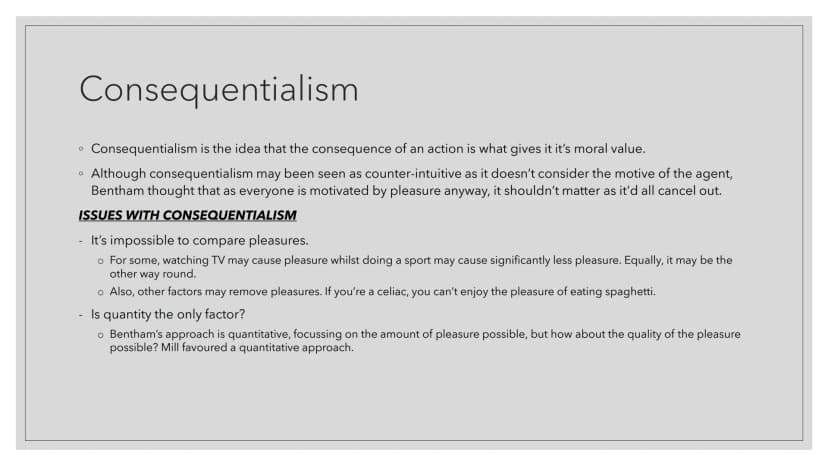
Consequentialism in moral philosophy forms the foundation of utilitarian ethical theory. This approach evaluates the morality of actions based solely on their outcomes rather than intentions or rules. In utilitarian thinking, the right action is the one that produces the greatest good for the greatest number of people.
Definition: Consequentialism in moral philosophy judges the rightness or wrongness of actions purely by their consequences, not by the motives or character of those performing them.
The concept that "philosophers agree on what constitutes right and wrong" is challenged by utilitarian theory, which offers a systematic approach to ethical decision-making based on measurable outcomes. This makes it particularly relevant for A level philosophy applied ethics studies.
Jeremy Bentham, a key figure in utilitarian thought, argued that since humans naturally seek pleasure and avoid pain, these sensations could serve as objective measures of moral value. This forms the basis of Quantitative hedonistic Utilitarianism, which attempts to calculate the numerical value of pleasure and pain resulting from actions.
2
of 10
Quantitative vs. Qualitative Approaches in Utilitarianism
Quantitative utilitarianism examples demonstrate how Bentham's approach measures pleasure purely by quantity. His famous utility calculus considers seven factors: intensity, duration, certainty, proximity, productivity, purity, and extent.
Example: When deciding whether to build a new park or shopping center, quantitative utilitarianism would calculate factors like:
- Number of people benefiting
- Duration of benefits
- Certainty of positive outcomes
- Potential negative impacts
However, John Stuart Mill theory of utilitarianism introduced a qualitative dimension. Mill argued that some pleasures are inherently more valuable than others, regardless of quantity. This led to his distinction between higher and lower pleasures.
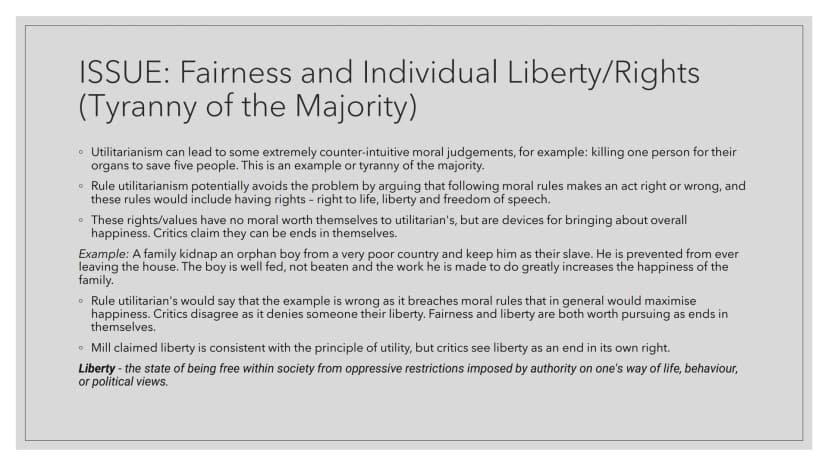
Highlight: Mill's harm principle states that the only justification for interfering with individual liberty is to prevent harm to others, showing how utilitarian thinking can protect individual rights while promoting collective good.
3
of 10
The Evolution of Utilitarian Thought
John Stuart Mill's greatest happiness principle refined Bentham's ideas by introducing quality distinctions in pleasure assessment. This development addressed key criticisms of purely quantitative approaches.
Quote: "It is better to be a human being dissatisfied than a pig satisfied; better to be Socrates dissatisfied than a fool satisfied" - John Stuart Mill
This perspective on Qualitative hedonistic Utilitarianism acknowledges that intellectual and moral pleasures have greater value than purely physical ones. Mill's approach provides a more nuanced framework for ethical decision-making in modern contexts.
The distinction between quantitative utilitarianism vs. qualitative utilitarianism remains crucial for understanding contemporary ethical debates and applying utilitarian principles to complex moral problems.
4
of 10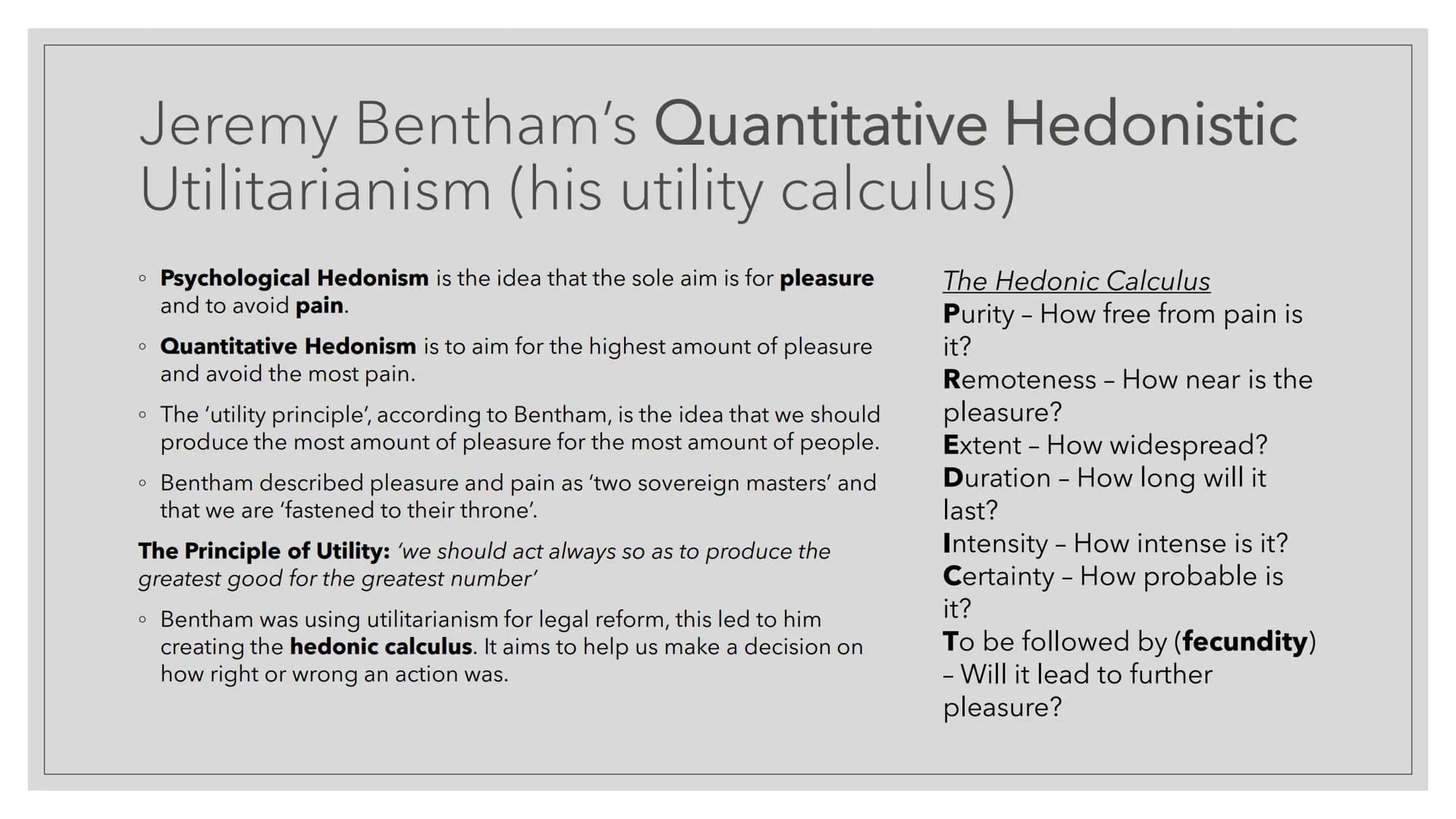
Practical Applications of Utilitarian Ethics
Act utilitarianism focuses on evaluating individual actions based on their specific consequences, making it particularly relevant for real-world ethical decision-making. This approach differs from rule utilitarianism, which considers the utility of following general principles.
Vocabulary: Non hedonistic utilitarianism moves beyond pleasure-based calculations to consider other forms of good, such as preference satisfaction or well-being.
Modern applications of utilitarian theory appear in various fields:
- Public policy decisions
- Healthcare resource allocation
- Environmental ethics
- Business ethics
These practical applications demonstrate how utilitarian thinking continues to influence contemporary ethical discussions and decision-making processes, making it a crucial component of Philosophy and Ethics A Level studies.
5
of 10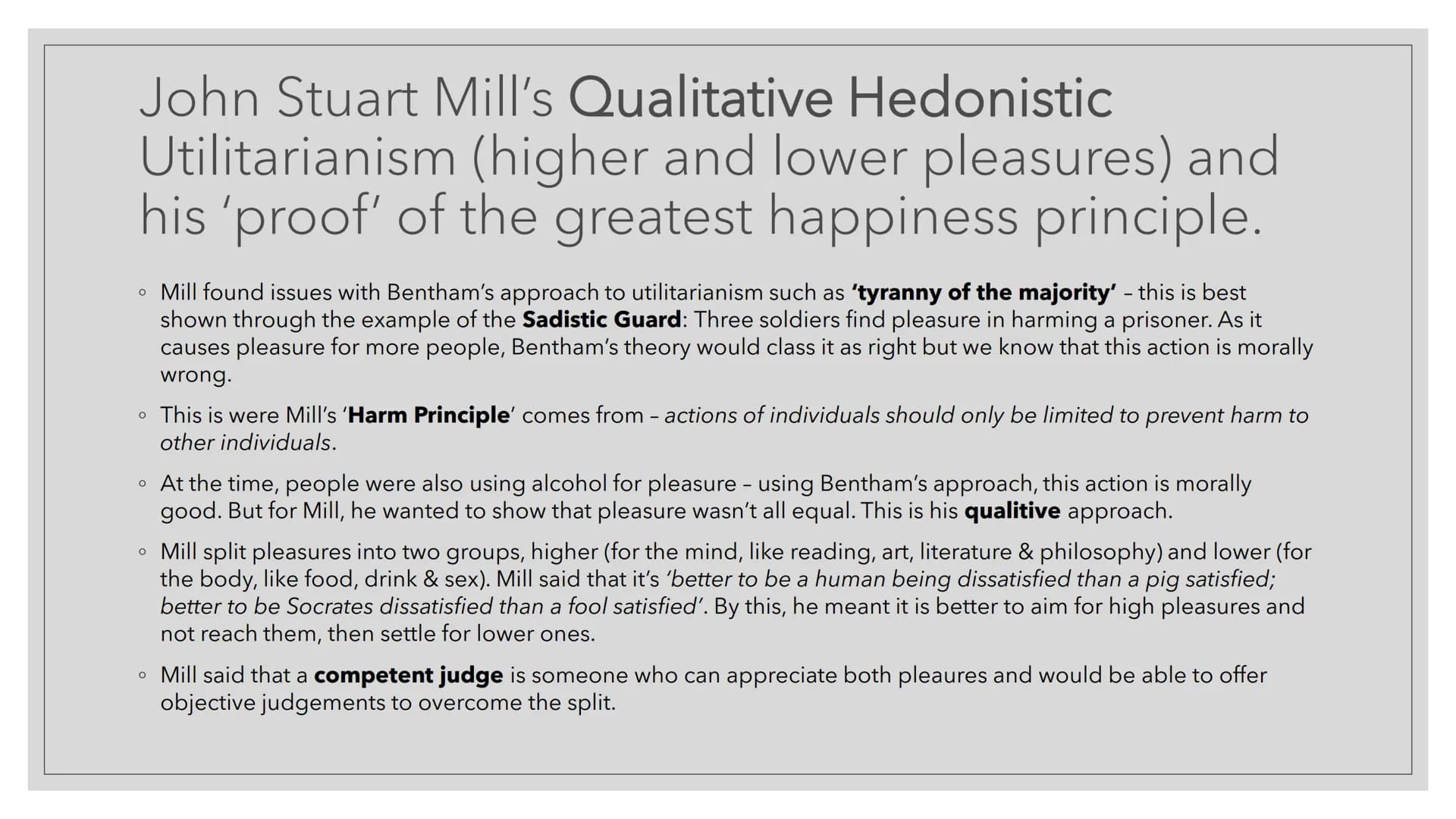
Understanding John Stuart Mill's Qualitative Hedonistic Utilitarianism
John Stuart Mill's approach to utilitarianism addressed critical limitations in Bentham's quantitative theory. Mill introduced the crucial distinction between higher and lower pleasures, fundamentally reshaping utilitarian thought. His qualitative utilitarianism recognized that not all pleasures hold equal moral worth.
The concept of higher and lower pleasures forms the cornerstone of Mill's theory. Higher pleasures engage the intellect through activities like philosophy, art, and literature, while lower pleasures satisfy bodily desires like food and drink. Mill famously declared it "better to be Socrates dissatisfied than a fool satisfied," emphasizing the superior value of intellectual pursuits over mere physical gratification.
To address the practical challenge of evaluating pleasures, Mill introduced the concept of the competent judge - someone experienced in both higher and lower pleasures who could make informed assessments of their relative worth. This framework helped overcome the "tyranny of the majority" problem that plagued Bentham's approach.
Quote: "It is better to be a human being dissatisfied than a pig satisfied; better to be Socrates dissatisfied than a fool satisfied." - John Stuart Mill
6
of 10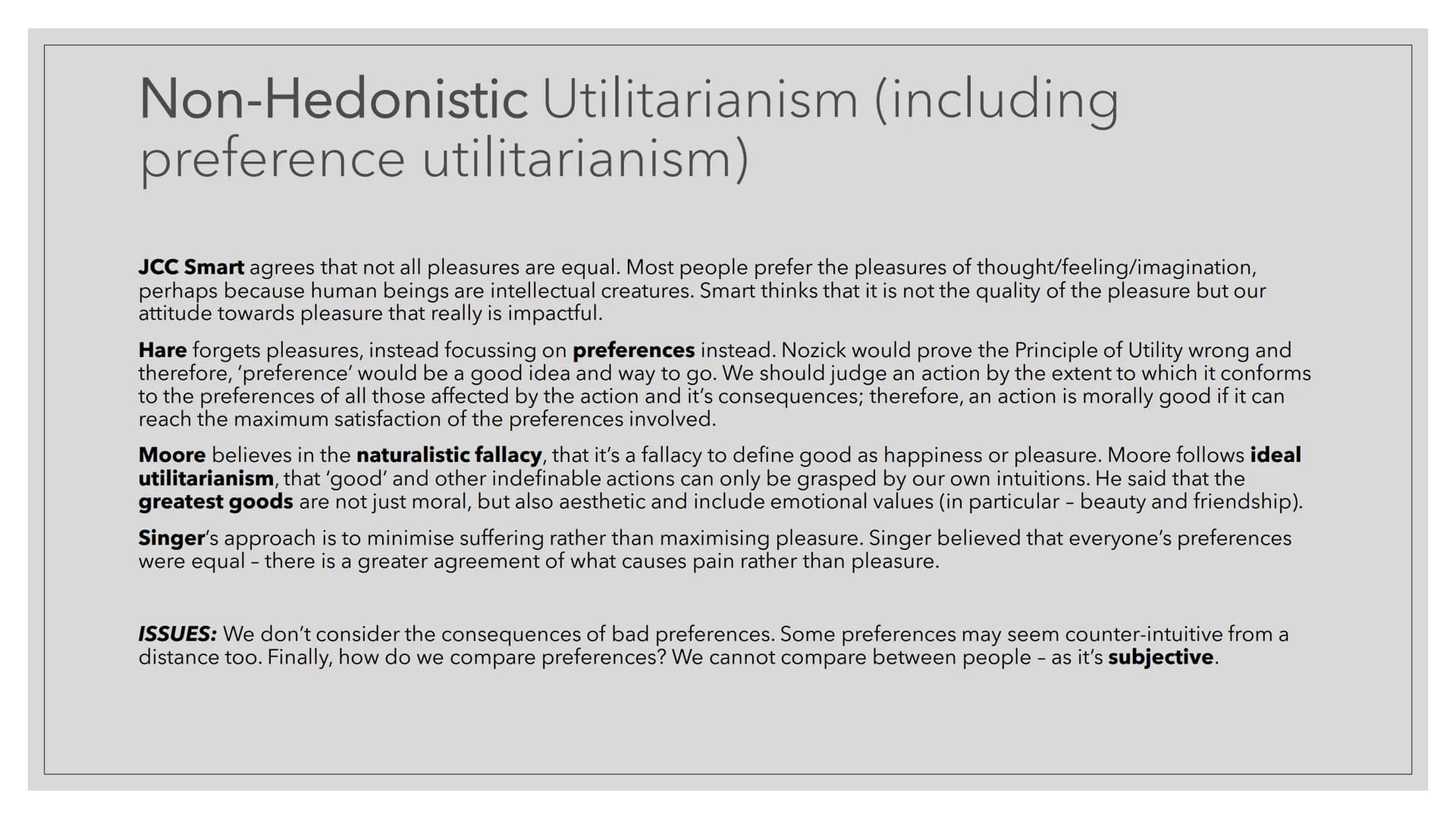
Exploring Non-Hedonistic Utilitarianism and Preference Theory
Modern utilitarian thinkers have moved beyond pleasure-based theories to develop more nuanced approaches to determining moral good. Preference utilitarianism, championed by R.M. Hare, shifts focus from pleasure to the satisfaction of preferences as the key metric for moral evaluation.
Peter Singer's influential perspective emphasizes minimizing suffering rather than maximizing pleasure. This approach acknowledges that there tends to be greater agreement about what constitutes harm than what brings pleasure. Singer argues for equal consideration of all beings' preferences, extending moral consideration beyond human pleasure.
G.E. Moore's ideal utilitarianism introduces the concept of the naturalistic fallacy, arguing that "good" cannot be reduced to natural properties like pleasure or happiness. Instead, Moore suggests that moral truths must be grasped through intuition, with aesthetic and emotional values playing crucial roles.
Definition: Preference utilitarianism evaluates actions based on how well they satisfy the preferences of all affected parties, rather than focusing solely on pleasure or pain.
7
of 10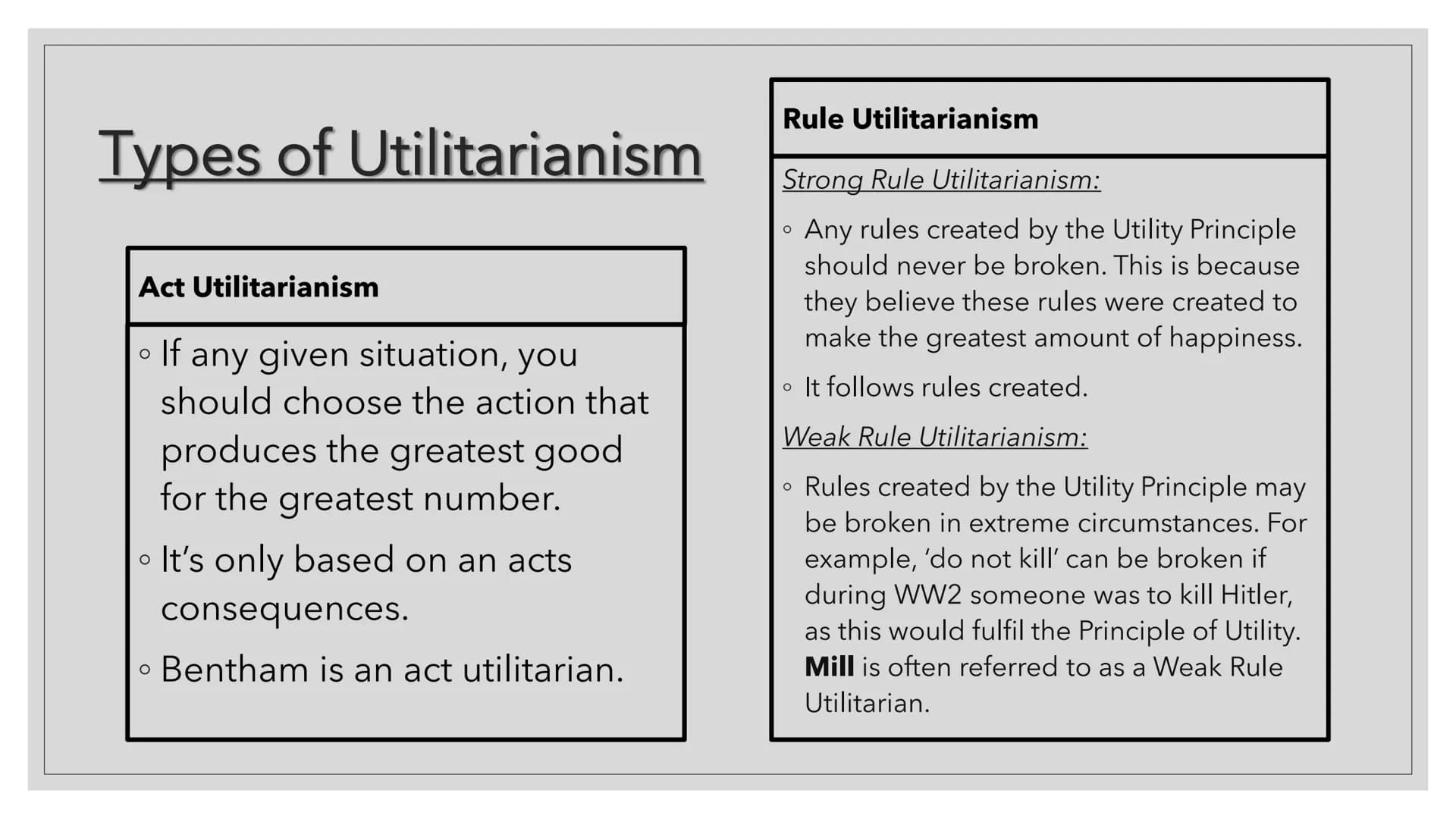
Comparing Act and Rule Utilitarianism
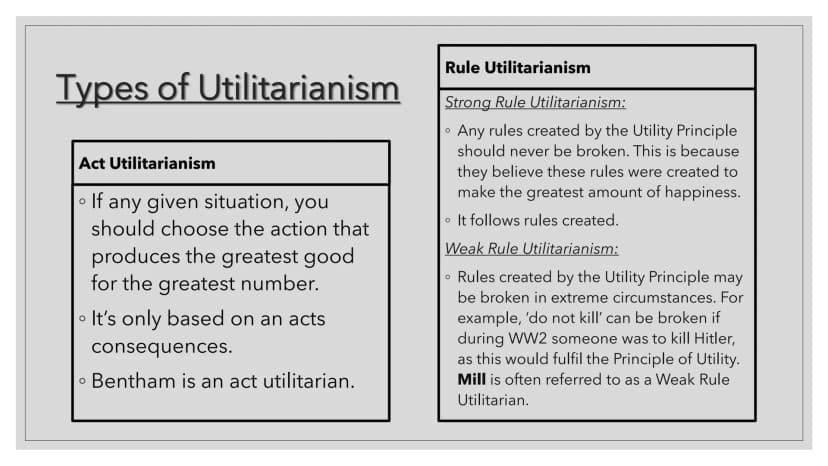
Act utilitarianism evaluates each action individually based on its consequences, seeking to maximize good outcomes in every specific situation. This approach, exemplified by Bentham, offers flexibility but can lead to counterintuitive moral conclusions.
Rule utilitarianism develops moral guidelines based on which rules would produce the greatest good if universally followed. Strong rule utilitarianism maintains these rules should never be broken, while weak rule utilitarianism allows exceptions in extreme circumstances where breaking the rule would clearly produce better outcomes.
The distinction between act and rule utilitarianism addresses practical challenges in applying utilitarian principles to real-world ethical decisions. Rule utilitarianism helps avoid some common criticisms of act utilitarianism while maintaining utilitarian foundations.
Example: Under weak rule utilitarianism, the general rule against killing might be suspended in extreme cases like stopping a mass murderer, where breaking the rule would prevent greater harm.
8
of 10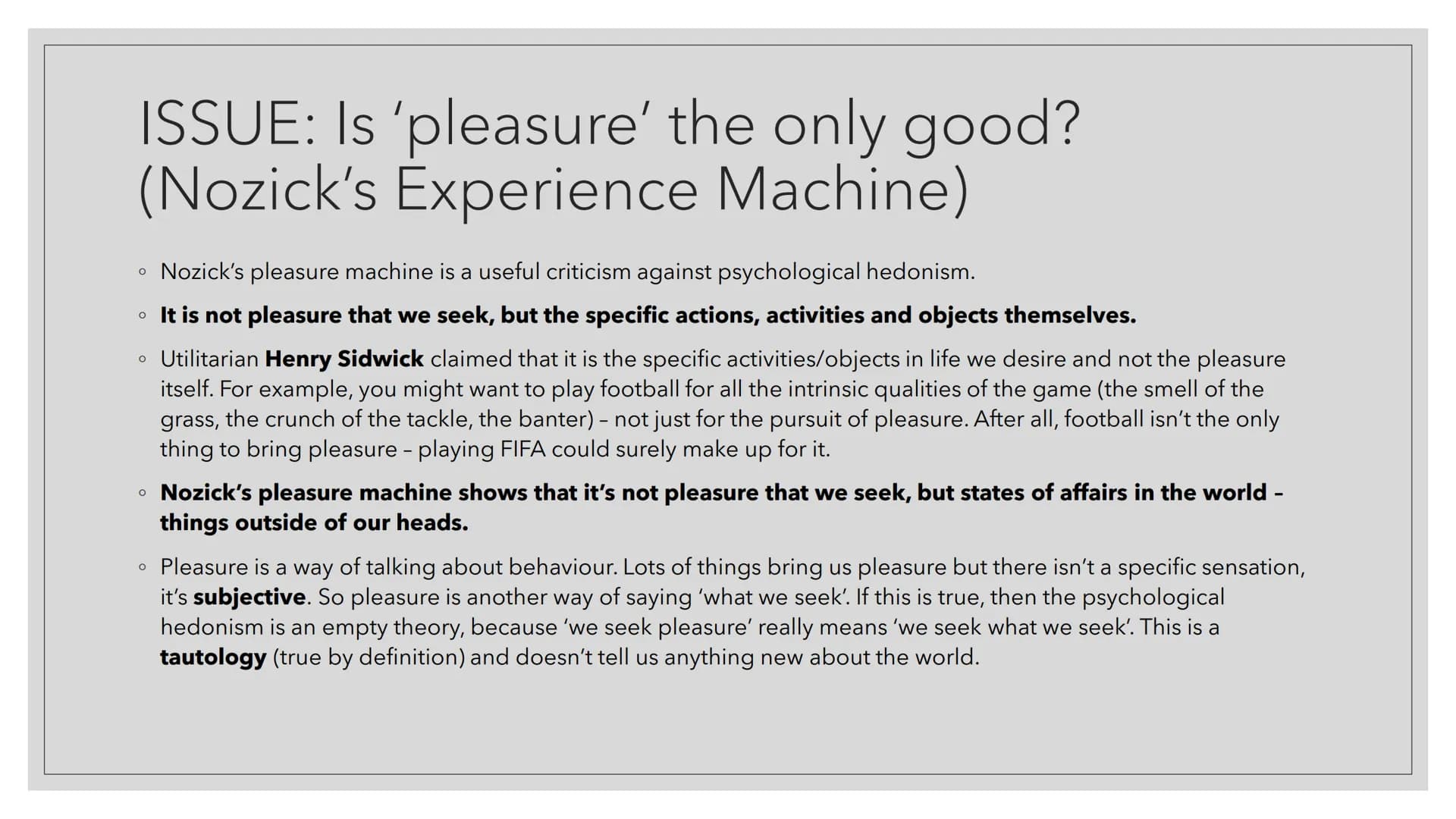
Examining Criticisms of Pleasure-Based Ethics
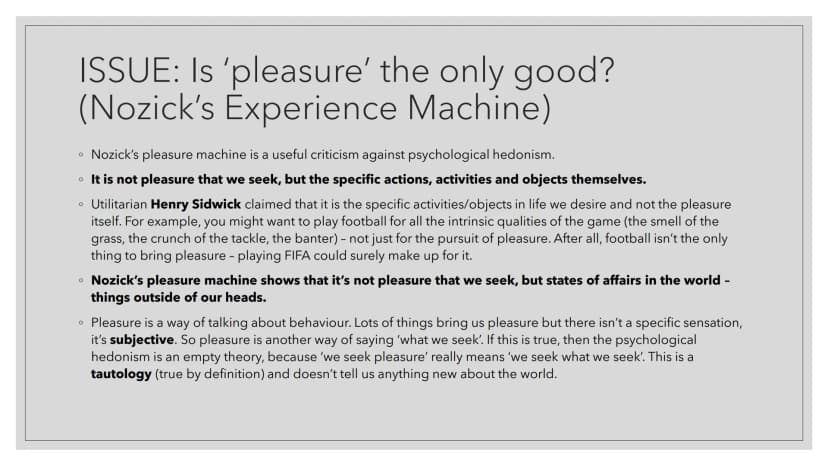
Robert Nozick's experience machine thought experiment presents a powerful challenge to hedonistic utilitarianism. The thought experiment asks whether we would choose to live in a simulated reality that guaranteed pleasure over real experiences that might include pain.
The experience machine reveals that humans value more than just pleasure - we seek authentic experiences, genuine achievements, and real connections. This suggests that a purely pleasure-based ethical framework may miss crucial aspects of what makes life meaningful and worthwhile.
Henry Sidgwick's analysis further demonstrates that we often desire specific activities and experiences for their intrinsic qualities rather than purely for the pleasure they bring. This insight challenges the fundamental assumptions of psychological hedonism and suggests the need for more nuanced approaches to understanding human motivation and moral value.
Highlight: Nozick's experience machine demonstrates that humans value authenticity and real experiences over pure pleasure, challenging core assumptions of hedonistic utilitarianism.
9
of 10
Challenges in Utilitarian Calculations and Moral Philosophy
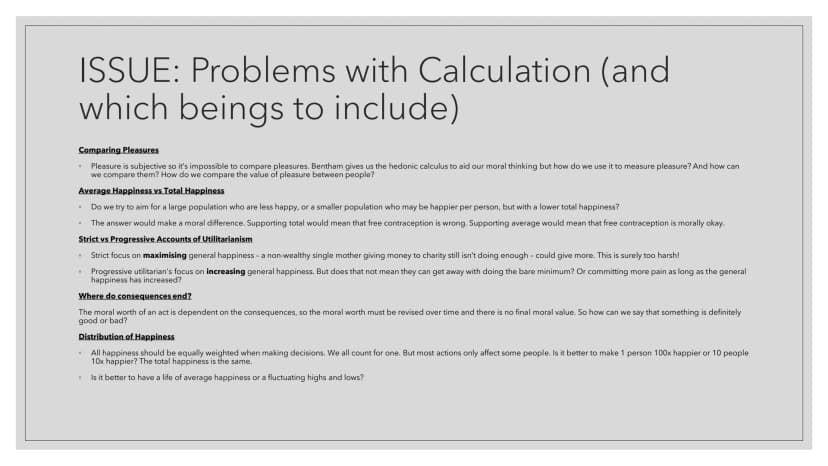
Understanding the complexities of measuring and comparing pleasure presents significant challenges in Quantitative and Qualitative Utilitarianism. These fundamental issues shape how we approach moral decision-making and ethical frameworks in philosophy.
The subjective nature of pleasure creates a significant hurdle in utilitarian calculations. While Jeremy Bentham's theory of utilitarianism provides the hedonic calculus as a tool for moral reasoning, the practical application raises questions about measurement and comparison. How do we effectively quantify and compare pleasures between different individuals? This challenge becomes particularly relevant when examining Quantitative hedonism and its real-world applications.
The debate between maximizing average happiness versus total happiness presents another crucial consideration in utilitarian ethics. This dilemma has practical implications for policy decisions and moral choices. For instance, when considering population ethics, supporting total happiness might suggest that limiting population growth through contraception is morally wrong, while focusing on average happiness could justify such measures.
Definition: The hedonic calculus is a method proposed by Bentham to measure pleasure and pain based on intensity, duration, certainty, proximity, fecundity, purity, and extent.
10
of 10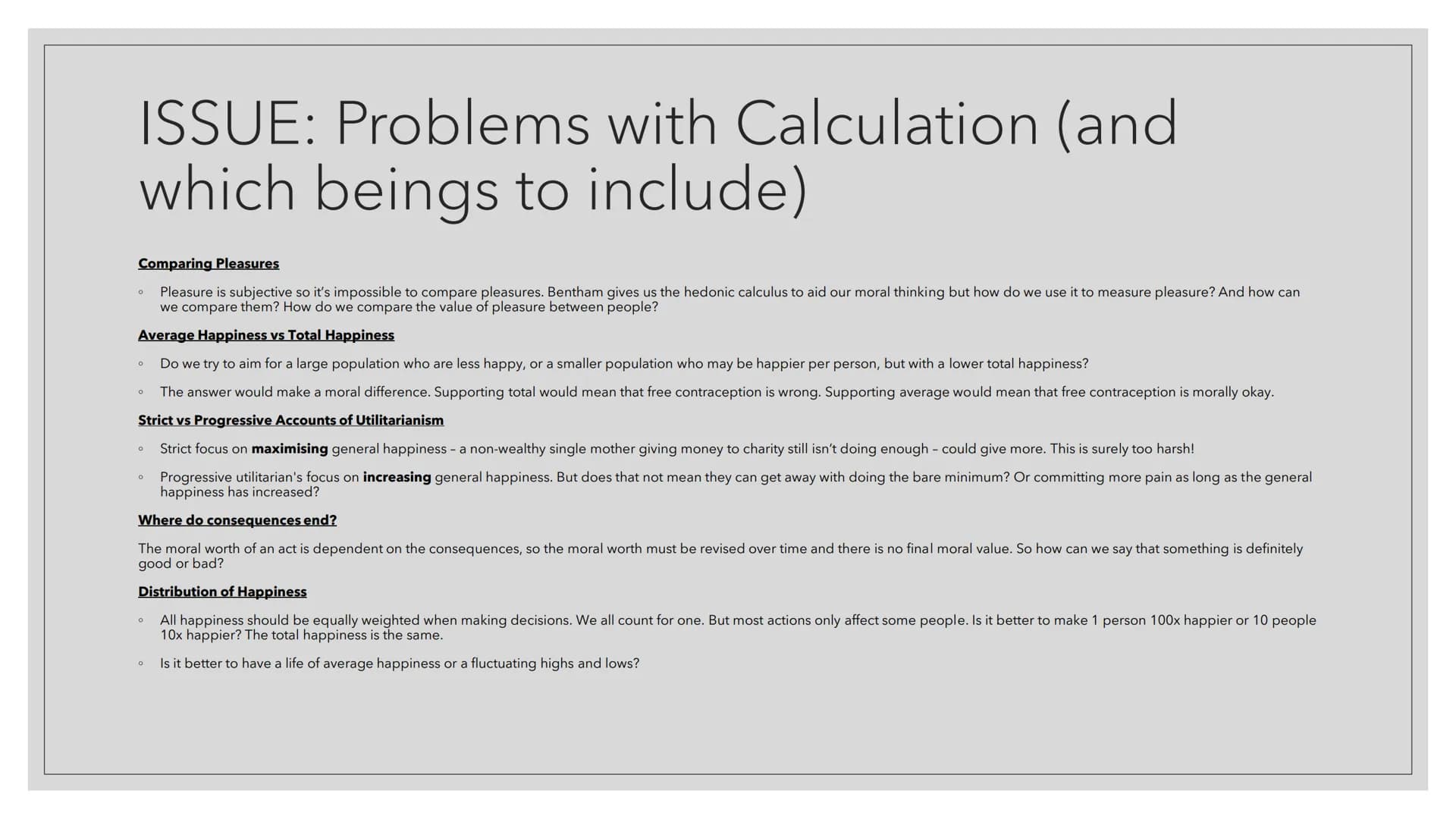
Advanced Considerations in Utilitarian Ethics
The tension between strict and progressive interpretations of utilitarianism reveals important philosophical distinctions. Strict utilitarianism, focusing solely on maximizing general happiness, can lead to seemingly harsh conclusions. For example, it might suggest that even significant charitable giving from someone with limited means is insufficient if they could theoretically give more.
John Stuart Mill's theory of utilitarianism offers a more nuanced approach through his concept of higher and lower pleasures. This qualitative distinction helps address some of the challenges in pleasure comparison, though questions about measurement and comparison persist. Mill's harm principle and his emphasis on individual liberty provide important constraints on utilitarian calculations.
The temporal aspect of consequentialist ethics raises additional complications. Since the moral worth of actions depends on their consequences, which can unfold indefinitely, determining definitive moral judgments becomes problematic. This connects to broader questions in A level philosophy applied ethics about how we evaluate long-term impacts of moral decisions.
Highlight: The distribution of happiness raises important questions about equality and fairness in utilitarian calculations. Should we prioritize making one person extremely happy or creating moderate happiness for many?
We thought you’d never ask...
What is the Knowunity AI companion?
Our AI companion is specifically built for the needs of students. Based on the millions of content pieces we have on the platform we can provide truly meaningful and relevant answers to students. But its not only about answers, the companion is even more about guiding students through their daily learning challenges, with personalised study plans, quizzes or content pieces in the chat and 100% personalisation based on the students skills and developments.
Where can I download the Knowunity app?
You can download the app in the Google Play Store and in the Apple App Store.
Is Knowunity really free of charge?
That's right! Enjoy free access to study content, connect with fellow students, and get instant help – all at your fingertips.
Similar Content
 Ethik
EthikMost popular content: Utilitarianism
5Religious StudiesUtilitarianism: Mill vs. Bentham
Explore the key differences between Act and Rule Utilitarianism as proposed by Bentham and Mill. This summary highlights the strengths and weaknesses of each theory, the concept of hedonism, and the qualitative aspects of pleasure. Ideal for A-Level ethics students seeking to understand utilitarian ethics and its implications.
1246410
Religious StudiesUtilitarianism vs. Kantian Ethics
Explore the key concepts of Utilitarianism and Kantian Ethics, focusing on the principles of Act and Rule Utilitarianism as proposed by Bentham and Mill, and the Categorical Imperative by Kant. This summary highlights the strengths and weaknesses of each ethical theory, their implications for moral decision-making, and the significance of pleasure and duty in ethical considerations. Ideal for OCR Philosophy and Ethics students.
122503
Religious StudiesUtilitarianism: A Critical Analysis
Explore a comprehensive A-level essay on utilitarianism, examining both act and rule utilitarianism, their strengths and weaknesses, and their implications for moral decision-making. This analysis includes critiques from philosophers like Bentham and Williams, and discusses the relevance of utilitarianism in contemporary ethical discussions. Ideal for students studying ethical theories and seeking to understand the complexities of utilitarian thought.
122986
Religious StudiesBusiness Ethics Overview
Explore key concepts in business ethics, including utilitarianism, Kantian ethics, and Christian ethics. This summary covers the implications of ethical decision-making in business practices, stakeholder relationships, and the balance between profit and sustainability. Ideal for A-Level Religious Studies students seeking to understand moral philosophy in a business context.
133819
Religious StudiesUnderstanding Utilitarianism
Explore the key concepts of utilitarianism, including act and rule utilitarianism, hedonism, and the ethical implications of consequentialism. This summary provides insights into how actions are evaluated based on their outcomes and the pursuit of happiness for the greatest number. Ideal for students studying moral philosophy and ethical theories.
S41582
Most popular content in Religious Studies
9C
Religious StudiesChristianity keywords
Help, remember these keywords with this quiz
95411
I
Religious Studiesislam
you need to do this test supper easy and fun
73500
 Humanities
Religious Studies Quote Bank
Christianity and Islam Paper 1 and Paper 2 Quotes.
1076413
Religious StudiesChristianity: Core Beliefs
Explore essential Christian beliefs including the Nature of God, the Trinity, Creation, Incarnation, Crucifixion, Resurrection, and concepts of Heaven, Hell, and Salvation. This comprehensive summary provides key quotes and insights for AQA GCSE revision.
95,345184
J
Religious StudiesJudaism ✡️
Key concepts in Judaism including the Covenant, Shekhinah, Messiah, and Torah for GCSE Religious Studies.
102410
R
Religious StudiesR.E Judaism questions quiz
Quiz on random Judaism R.E questions
92624
E
Religious StudiesExploring World Religions: A Comprehensive Study Guide
Master the diverse beliefs, practices, and traditions of major world religions with this in-depth study guide for religious studies.
111930
Religious StudiesCatholic Theology: Good & Evil
Explore key concepts in Catholic theology regarding good and evil, including the role of free will, the problem of evil, and the significance of Jesus' crucifixion. This summary provides essential revision notes, quotations, and sources to enhance your understanding of Christian ethics and salvation. Ideal for WJEC Foundation students studying Catholic Christianity.
1046610
C
Religious StudiesChristianity comp 2
Core Christian concepts including evangelism, sacraments, and the resurrection of Jesus.
111370
Most popular content
9 Sociology
Sociology of Education Overview
Explore comprehensive A-Level Sociology notes on the education system, covering key theories, policies, and sociological perspectives. This resource includes insights on marketisation, gender roles, cultural deprivation, and educational inequalities, providing a thorough understanding of how education shapes social stratification and individual achievement. Ideal for exam preparation and in-depth study.
12102,8693,040
SociologySociology of Families: Comprehensive Revision
Dive into an extensive overview of family dynamics, perspectives, and patterns in sociology. This resource covers key concepts such as family diversity, gender roles, marriage, and the impact of social policies on family structures. Perfect for A-Level Sociology students preparing for Paper 2.
1273,6662,307
CriminologyCriminology: Crime & Punishment Overview
Comprehensive mindmaps covering key concepts in the Crime and Punishment topic for WJEC Criminology Unit 4. This resource includes detailed insights into the Criminal Justice System, crime prevention strategies, sentencing models, and the roles of various agencies. Ideal for A-Level revision, ensuring you grasp essential theories and legislative processes to excel in your exams.
1254,8721,059
SociologyComprehensive Crime & Deviance Overview
Explore an extensive revision of crime and deviance topics, including theories, types of crime, and the impact of media. This resource covers key concepts such as Marxism, functionalism, gender and crime, and the influence of globalization on criminal behavior. Ideal for students seeking a thorough understanding of criminology and its various theories. Type: Full Topic Revision.
1251,6541,399
C
 Biology
Cell Biology and Cell structure
cell structures
93,2490
 English Literature
An Inspector Calls: Character Insights
Explore in-depth analysis and key quotes for characters in J.B. Priestley's 'An Inspector Calls'. This resource covers Gerald Croft, Inspector Goole, Sheila Birling, Mrs. Birling, Eric Birling, and Eva Smith, focusing on themes of class, gender roles, and social responsibility. Ideal for students aiming for Grade 8 and above.
1025,429907
CriminologyWJEC Unit 4 Criminology
Criminology unit 4 detailed revision note
127,151125
CriminologyCriminology Theories Overview
Explore key criminology theories and their implications on crime and deviance. This comprehensive summary covers biological, psychological, and sociological perspectives, including labelling theory, right realism, and the impact of social campaigns on policy development. Ideal for A-Level criminology students seeking to understand the complexities of criminal behaviour and the factors influencing crime prevention strategies.
129,760210
English LiteratureRomeo and Juliet: Key themes
Key Romeo and Juliet themes and analysed quotes
106,708198
Can't find what you're looking for? Explore other subjects.
Students love us — and so will you.
4.6/5App Store
4.7/5Google Play
The app is very easy to use and well designed. I have found everything I was looking for so far and have been able to learn a lot from the presentations! I will definitely use the app for a class assignment! And of course it also helps a lot as an inspiration.
Stefan SiOS user
This app is really great. There are so many study notes and help [...]. My problem subject is French, for example, and the app has so many options for help. Thanks to this app, I have improved my French. I would recommend it to anyone.
Samantha KlichAndroid user
Wow, I am really amazed. I just tried the app because I've seen it advertised many times and was absolutely stunned. This app is THE HELP you want for school and above all, it offers so many things, such as workouts and fact sheets, which have been VERY helpful to me personally.
AnnaiOS user
Religious Studies1,307 views·Updated Jun 16, 2026·12 pagesUnderstanding Consequentialism and Utilitarianism in A Level Philosophy
O
Oliver Grimes@olivergrimes_isnl
Utilitarianism and ethical philosophy have evolved significantly through key thinkers and their theories about morality and happiness.
Jeremy Bentham developed Quantitative hedonistic Utilitarianism, which measures happiness purely by quantity using factors like intensity, duration, certainty, and extent. His approach...
1
of 10
Sign up to see the content. It's free!
- Access to all documents
- Improve your grades
- Join milions of students
Understanding Utilitarianism and Consequentialist Ethics
Consequentialism in moral philosophy forms the foundation of utilitarian ethical theory. This approach evaluates the morality of actions based solely on their outcomes rather than intentions or rules. In utilitarian thinking, the right action is the one that produces the greatest good for the greatest number of people.
Definition: Consequentialism in moral philosophy judges the rightness or wrongness of actions purely by their consequences, not by the motives or character of those performing them.
The concept that "philosophers agree on what constitutes right and wrong" is challenged by utilitarian theory, which offers a systematic approach to ethical decision-making based on measurable outcomes. This makes it particularly relevant for A level philosophy applied ethics studies.
Jeremy Bentham, a key figure in utilitarian thought, argued that since humans naturally seek pleasure and avoid pain, these sensations could serve as objective measures of moral value. This forms the basis of Quantitative hedonistic Utilitarianism, which attempts to calculate the numerical value of pleasure and pain resulting from actions.
2
of 10Sign up to see the content. It's free!
- Access to all documents
- Improve your grades
- Join milions of students
Quantitative vs. Qualitative Approaches in Utilitarianism
Quantitative utilitarianism examples demonstrate how Bentham's approach measures pleasure purely by quantity. His famous utility calculus considers seven factors: intensity, duration, certainty, proximity, productivity, purity, and extent.
Example: When deciding whether to build a new park or shopping center, quantitative utilitarianism would calculate factors like:
- Number of people benefiting
- Duration of benefits
- Certainty of positive outcomes
- Potential negative impacts
However, John Stuart Mill theory of utilitarianism introduced a qualitative dimension. Mill argued that some pleasures are inherently more valuable than others, regardless of quantity. This led to his distinction between higher and lower pleasures.
Highlight: Mill's harm principle states that the only justification for interfering with individual liberty is to prevent harm to others, showing how utilitarian thinking can protect individual rights while promoting collective good.
3
of 10Sign up to see the content. It's free!
- Access to all documents
- Improve your grades
- Join milions of students
The Evolution of Utilitarian Thought
John Stuart Mill's greatest happiness principle refined Bentham's ideas by introducing quality distinctions in pleasure assessment. This development addressed key criticisms of purely quantitative approaches.
Quote: "It is better to be a human being dissatisfied than a pig satisfied; better to be Socrates dissatisfied than a fool satisfied" - John Stuart Mill
This perspective on Qualitative hedonistic Utilitarianism acknowledges that intellectual and moral pleasures have greater value than purely physical ones. Mill's approach provides a more nuanced framework for ethical decision-making in modern contexts.
The distinction between quantitative utilitarianism vs. qualitative utilitarianism remains crucial for understanding contemporary ethical debates and applying utilitarian principles to complex moral problems.
4
of 10Sign up to see the content. It's free!
- Access to all documents
- Improve your grades
- Join milions of students
Practical Applications of Utilitarian Ethics
Act utilitarianism focuses on evaluating individual actions based on their specific consequences, making it particularly relevant for real-world ethical decision-making. This approach differs from rule utilitarianism, which considers the utility of following general principles.
Vocabulary: Non hedonistic utilitarianism moves beyond pleasure-based calculations to consider other forms of good, such as preference satisfaction or well-being.
Modern applications of utilitarian theory appear in various fields:
- Public policy decisions
- Healthcare resource allocation
- Environmental ethics
- Business ethics
These practical applications demonstrate how utilitarian thinking continues to influence contemporary ethical discussions and decision-making processes, making it a crucial component of Philosophy and Ethics A Level studies.
5
of 10Sign up to see the content. It's free!
- Access to all documents
- Improve your grades
- Join milions of students
Understanding John Stuart Mill's Qualitative Hedonistic Utilitarianism
John Stuart Mill's approach to utilitarianism addressed critical limitations in Bentham's quantitative theory. Mill introduced the crucial distinction between higher and lower pleasures, fundamentally reshaping utilitarian thought. His qualitative utilitarianism recognized that not all pleasures hold equal moral worth.
The concept of higher and lower pleasures forms the cornerstone of Mill's theory. Higher pleasures engage the intellect through activities like philosophy, art, and literature, while lower pleasures satisfy bodily desires like food and drink. Mill famously declared it "better to be Socrates dissatisfied than a fool satisfied," emphasizing the superior value of intellectual pursuits over mere physical gratification.
To address the practical challenge of evaluating pleasures, Mill introduced the concept of the competent judge - someone experienced in both higher and lower pleasures who could make informed assessments of their relative worth. This framework helped overcome the "tyranny of the majority" problem that plagued Bentham's approach.
Quote: "It is better to be a human being dissatisfied than a pig satisfied; better to be Socrates dissatisfied than a fool satisfied." - John Stuart Mill
6
of 10Sign up to see the content. It's free!
- Access to all documents
- Improve your grades
- Join milions of students
Exploring Non-Hedonistic Utilitarianism and Preference Theory
Modern utilitarian thinkers have moved beyond pleasure-based theories to develop more nuanced approaches to determining moral good. Preference utilitarianism, championed by R.M. Hare, shifts focus from pleasure to the satisfaction of preferences as the key metric for moral evaluation.
Peter Singer's influential perspective emphasizes minimizing suffering rather than maximizing pleasure. This approach acknowledges that there tends to be greater agreement about what constitutes harm than what brings pleasure. Singer argues for equal consideration of all beings' preferences, extending moral consideration beyond human pleasure.
G.E. Moore's ideal utilitarianism introduces the concept of the naturalistic fallacy, arguing that "good" cannot be reduced to natural properties like pleasure or happiness. Instead, Moore suggests that moral truths must be grasped through intuition, with aesthetic and emotional values playing crucial roles.
Definition: Preference utilitarianism evaluates actions based on how well they satisfy the preferences of all affected parties, rather than focusing solely on pleasure or pain.
7
of 10Sign up to see the content. It's free!
- Access to all documents
- Improve your grades
- Join milions of students
Comparing Act and Rule Utilitarianism
Act utilitarianism evaluates each action individually based on its consequences, seeking to maximize good outcomes in every specific situation. This approach, exemplified by Bentham, offers flexibility but can lead to counterintuitive moral conclusions.
Rule utilitarianism develops moral guidelines based on which rules would produce the greatest good if universally followed. Strong rule utilitarianism maintains these rules should never be broken, while weak rule utilitarianism allows exceptions in extreme circumstances where breaking the rule would clearly produce better outcomes.
The distinction between act and rule utilitarianism addresses practical challenges in applying utilitarian principles to real-world ethical decisions. Rule utilitarianism helps avoid some common criticisms of act utilitarianism while maintaining utilitarian foundations.
Example: Under weak rule utilitarianism, the general rule against killing might be suspended in extreme cases like stopping a mass murderer, where breaking the rule would prevent greater harm.
8
of 10Sign up to see the content. It's free!
- Access to all documents
- Improve your grades
- Join milions of students
Examining Criticisms of Pleasure-Based Ethics
Robert Nozick's experience machine thought experiment presents a powerful challenge to hedonistic utilitarianism. The thought experiment asks whether we would choose to live in a simulated reality that guaranteed pleasure over real experiences that might include pain.
The experience machine reveals that humans value more than just pleasure - we seek authentic experiences, genuine achievements, and real connections. This suggests that a purely pleasure-based ethical framework may miss crucial aspects of what makes life meaningful and worthwhile.
Henry Sidgwick's analysis further demonstrates that we often desire specific activities and experiences for their intrinsic qualities rather than purely for the pleasure they bring. This insight challenges the fundamental assumptions of psychological hedonism and suggests the need for more nuanced approaches to understanding human motivation and moral value.
Highlight: Nozick's experience machine demonstrates that humans value authenticity and real experiences over pure pleasure, challenging core assumptions of hedonistic utilitarianism.
9
of 10Sign up to see the content. It's free!
- Access to all documents
- Improve your grades
- Join milions of students
Challenges in Utilitarian Calculations and Moral Philosophy
Understanding the complexities of measuring and comparing pleasure presents significant challenges in Quantitative and Qualitative Utilitarianism. These fundamental issues shape how we approach moral decision-making and ethical frameworks in philosophy.
The subjective nature of pleasure creates a significant hurdle in utilitarian calculations. While Jeremy Bentham's theory of utilitarianism provides the hedonic calculus as a tool for moral reasoning, the practical application raises questions about measurement and comparison. How do we effectively quantify and compare pleasures between different individuals? This challenge becomes particularly relevant when examining Quantitative hedonism and its real-world applications.
The debate between maximizing average happiness versus total happiness presents another crucial consideration in utilitarian ethics. This dilemma has practical implications for policy decisions and moral choices. For instance, when considering population ethics, supporting total happiness might suggest that limiting population growth through contraception is morally wrong, while focusing on average happiness could justify such measures.
Definition: The hedonic calculus is a method proposed by Bentham to measure pleasure and pain based on intensity, duration, certainty, proximity, fecundity, purity, and extent.
10
of 10Sign up to see the content. It's free!
- Access to all documents
- Improve your grades
- Join milions of students
Advanced Considerations in Utilitarian Ethics
The tension between strict and progressive interpretations of utilitarianism reveals important philosophical distinctions. Strict utilitarianism, focusing solely on maximizing general happiness, can lead to seemingly harsh conclusions. For example, it might suggest that even significant charitable giving from someone with limited means is insufficient if they could theoretically give more.
John Stuart Mill's theory of utilitarianism offers a more nuanced approach through his concept of higher and lower pleasures. This qualitative distinction helps address some of the challenges in pleasure comparison, though questions about measurement and comparison persist. Mill's harm principle and his emphasis on individual liberty provide important constraints on utilitarian calculations.
The temporal aspect of consequentialist ethics raises additional complications. Since the moral worth of actions depends on their consequences, which can unfold indefinitely, determining definitive moral judgments becomes problematic. This connects to broader questions in A level philosophy applied ethics about how we evaluate long-term impacts of moral decisions.
Highlight: The distribution of happiness raises important questions about equality and fairness in utilitarian calculations. Should we prioritize making one person extremely happy or creating moderate happiness for many?
We thought you’d never ask...
What is the Knowunity AI companion?
Our AI companion is specifically built for the needs of students. Based on the millions of content pieces we have on the platform we can provide truly meaningful and relevant answers to students. But its not only about answers, the companion is even more about guiding students through their daily learning challenges, with personalised study plans, quizzes or content pieces in the chat and 100% personalisation based on the students skills and developments.
Where can I download the Knowunity app?
You can download the app in the Google Play Store and in the Apple App Store.
Is Knowunity really free of charge?
That's right! Enjoy free access to study content, connect with fellow students, and get instant help – all at your fingertips.
Similar Content
Most popular content: Utilitarianism
5Religious StudiesUtilitarianism: Mill vs. Bentham
Explore the key differences between Act and Rule Utilitarianism as proposed by Bentham and Mill. This summary highlights the strengths and weaknesses of each theory, the concept of hedonism, and the qualitative aspects of pleasure. Ideal for A-Level ethics students seeking to understand utilitarian ethics and its implications.
1246410
Religious StudiesUtilitarianism vs. Kantian Ethics
Explore the key concepts of Utilitarianism and Kantian Ethics, focusing on the principles of Act and Rule Utilitarianism as proposed by Bentham and Mill, and the Categorical Imperative by Kant. This summary highlights the strengths and weaknesses of each ethical theory, their implications for moral decision-making, and the significance of pleasure and duty in ethical considerations. Ideal for OCR Philosophy and Ethics students.
122503
Religious StudiesUtilitarianism: A Critical Analysis
Explore a comprehensive A-level essay on utilitarianism, examining both act and rule utilitarianism, their strengths and weaknesses, and their implications for moral decision-making. This analysis includes critiques from philosophers like Bentham and Williams, and discusses the relevance of utilitarianism in contemporary ethical discussions. Ideal for students studying ethical theories and seeking to understand the complexities of utilitarian thought.
122986
Religious StudiesBusiness Ethics Overview
Explore key concepts in business ethics, including utilitarianism, Kantian ethics, and Christian ethics. This summary covers the implications of ethical decision-making in business practices, stakeholder relationships, and the balance between profit and sustainability. Ideal for A-Level Religious Studies students seeking to understand moral philosophy in a business context.
133819
Religious StudiesUnderstanding Utilitarianism
Explore the key concepts of utilitarianism, including act and rule utilitarianism, hedonism, and the ethical implications of consequentialism. This summary provides insights into how actions are evaluated based on their outcomes and the pursuit of happiness for the greatest number. Ideal for students studying moral philosophy and ethical theories.
S41582
Most popular content in Religious Studies
9C
Religious StudiesChristianity keywords
Help, remember these keywords with this quiz
95411
I
Religious Studiesislam
you need to do this test supper easy and fun
73500
HumanitiesReligious Studies Quote Bank
Christianity and Islam Paper 1 and Paper 2 Quotes.
1076413
Religious StudiesChristianity: Core Beliefs
Explore essential Christian beliefs including the Nature of God, the Trinity, Creation, Incarnation, Crucifixion, Resurrection, and concepts of Heaven, Hell, and Salvation. This comprehensive summary provides key quotes and insights for AQA GCSE revision.
95,345184
J
Religious StudiesJudaism ✡️
Key concepts in Judaism including the Covenant, Shekhinah, Messiah, and Torah for GCSE Religious Studies.
102410
R
Religious StudiesR.E Judaism questions quiz
Quiz on random Judaism R.E questions
92624
E
Religious StudiesExploring World Religions: A Comprehensive Study Guide
Master the diverse beliefs, practices, and traditions of major world religions with this in-depth study guide for religious studies.
111930
Religious StudiesCatholic Theology: Good & Evil
Explore key concepts in Catholic theology regarding good and evil, including the role of free will, the problem of evil, and the significance of Jesus' crucifixion. This summary provides essential revision notes, quotations, and sources to enhance your understanding of Christian ethics and salvation. Ideal for WJEC Foundation students studying Catholic Christianity.
1046610
C
Religious StudiesChristianity comp 2
Core Christian concepts including evangelism, sacraments, and the resurrection of Jesus.
111370
Most popular content
9SociologySociology of Education Overview
Explore comprehensive A-Level Sociology notes on the education system, covering key theories, policies, and sociological perspectives. This resource includes insights on marketisation, gender roles, cultural deprivation, and educational inequalities, providing a thorough understanding of how education shapes social stratification and individual achievement. Ideal for exam preparation and in-depth study.
12102,8693,040
SociologySociology of Families: Comprehensive Revision
Dive into an extensive overview of family dynamics, perspectives, and patterns in sociology. This resource covers key concepts such as family diversity, gender roles, marriage, and the impact of social policies on family structures. Perfect for A-Level Sociology students preparing for Paper 2.
1273,6662,307
CriminologyCriminology: Crime & Punishment Overview
Comprehensive mindmaps covering key concepts in the Crime and Punishment topic for WJEC Criminology Unit 4. This resource includes detailed insights into the Criminal Justice System, crime prevention strategies, sentencing models, and the roles of various agencies. Ideal for A-Level revision, ensuring you grasp essential theories and legislative processes to excel in your exams.
1254,8721,059
SociologyComprehensive Crime & Deviance Overview
Explore an extensive revision of crime and deviance topics, including theories, types of crime, and the impact of media. This resource covers key concepts such as Marxism, functionalism, gender and crime, and the influence of globalization on criminal behavior. Ideal for students seeking a thorough understanding of criminology and its various theories. Type: Full Topic Revision.
1251,6541,399
C
BiologyCell Biology and Cell structure
cell structures
93,2490
English LiteratureAn Inspector Calls: Character Insights
Explore in-depth analysis and key quotes for characters in J.B. Priestley's 'An Inspector Calls'. This resource covers Gerald Croft, Inspector Goole, Sheila Birling, Mrs. Birling, Eric Birling, and Eva Smith, focusing on themes of class, gender roles, and social responsibility. Ideal for students aiming for Grade 8 and above.
1025,429907
CriminologyWJEC Unit 4 Criminology
Criminology unit 4 detailed revision note
127,151125
CriminologyCriminology Theories Overview
Explore key criminology theories and their implications on crime and deviance. This comprehensive summary covers biological, psychological, and sociological perspectives, including labelling theory, right realism, and the impact of social campaigns on policy development. Ideal for A-Level criminology students seeking to understand the complexities of criminal behaviour and the factors influencing crime prevention strategies.
129,760210
English LiteratureRomeo and Juliet: Key themes
Key Romeo and Juliet themes and analysed quotes
106,708198
Can't find what you're looking for? Explore other subjects.
Students love us — and so will you.
4.6/5App Store
4.7/5Google Play
The app is very easy to use and well designed. I have found everything I was looking for so far and have been able to learn a lot from the presentations! I will definitely use the app for a class assignment! And of course it also helps a lot as an inspiration.
Stefan SiOS user
This app is really great. There are so many study notes and help [...]. My problem subject is French, for example, and the app has so many options for help. Thanks to this app, I have improved my French. I would recommend it to anyone.
Samantha KlichAndroid user
Wow, I am really amazed. I just tried the app because I've seen it advertised many times and was absolutely stunned. This app is THE HELP you want for school and above all, it offers so many things, such as workouts and fact sheets, which have been VERY helpful to me personally.
AnnaiOS user