
Thomas Aquinas developed Natural Moral Law (NML) by combining Aristotle's...
 Religious Studies106 views·Updated Jun 27, 2026·2 pages
Understanding Natural Moral Law: A Mindmap

maryam@maryammusa
1
of 2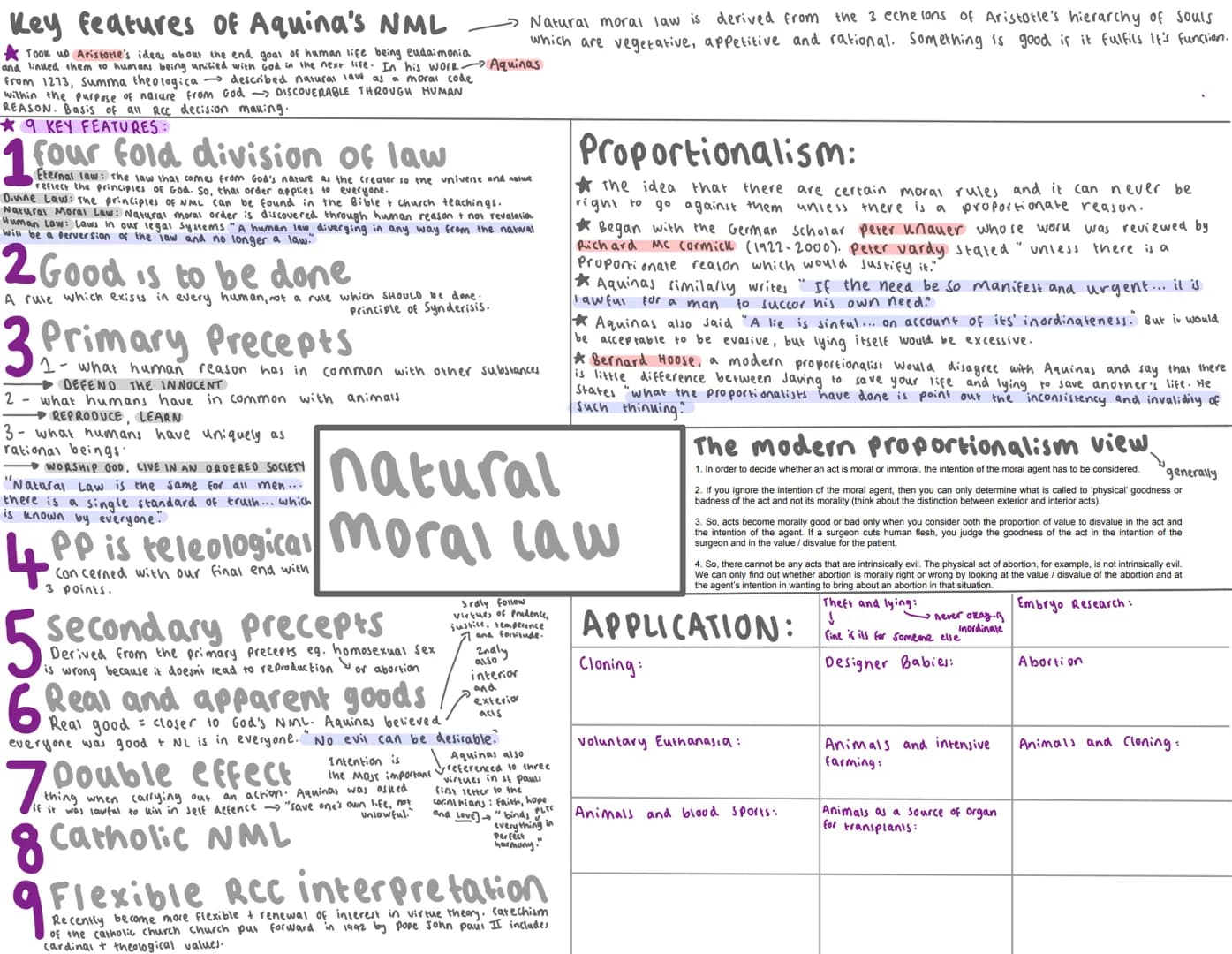
Aquinas's Natural Moral Law Framework
Ever wondered how we might know right from wrong without just following rules? Aquinas believed humans could discover moral truths through reason, building on Aristotle's idea that everything has a purpose and is "good" when it fulfils that purpose.
Aquinas structured law into four levels: Eternal law (God's plan for creation), Divine law (biblical teachings), Natural law (moral principles discoverable through reason), and Human law (legal systems). He argued that any human law contradicting natural law becomes invalid - a pretty radical idea for his time!
At the heart of his system lies the principle "good is to be done" - something he called synderesis. This isn't a command but rather a natural inclination that exists in every human being.
Key Point: Natural law isn't about following external rules - it's about using reason to discover the moral principles built into human nature itself.
From this foundation, Aquinas developed Primary Precepts - fundamental human purposes like preserving life, reproducing, learning, worshipping God, and living in ordered society. These aren't arbitrary commands but reflect what Aquinas saw as essential human functions shared across all cultures.
2
of 2
Modern Applications and Proportionalism
Whilst traditional Natural Moral Law seemed rigid, modern Catholic thinking has become more flexible. Proportionalism, developed by scholars like Peter Knauer and Richard McCormick, challenges the idea that certain acts are always wrong regardless of circumstances.
Proportionalists argue that moral decisions require weighing intentions against consequences. They distinguish between the physical action (like cutting flesh) and its moral significance (surgery vs. assault). This approach considers whether there's a "proportionate reason" that might justify an otherwise problematic action.
This creates interesting debates around contemporary issues. Traditional NML might condemn actions like abortion or euthanasia outright, whilst proportionalists would examine each situation's specific circumstances, intentions, and outcomes before making moral judgements.
Think About It: If lying is normally wrong, would you lie to protect innocent people from harm? Proportionalists would say context matters more than absolute rules.
The tension between absolute moral rules and situational ethics remains hotly debated. Understanding both approaches helps you tackle complex moral dilemmas that don't have simple black-and-white answers - exactly the kind of thinking you'll need for philosophy exams and real life.
We thought you’d never ask...
What is the Knowunity AI companion?
Our AI companion is specifically built for the needs of students. Based on the millions of content pieces we have on the platform we can provide truly meaningful and relevant answers to students. But its not only about answers, the companion is even more about guiding students through their daily learning challenges, with personalised study plans, quizzes or content pieces in the chat and 100% personalisation based on the students skills and developments.
Where can I download the Knowunity app?
You can download the app in the Google Play Store and in the Apple App Store.
Is Knowunity really free of charge?
That's right! Enjoy free access to study content, connect with fellow students, and get instant help – all at your fingertips.
Similar Content
 Religion
Most popular content: Teleological Argument
4Religious StudiesPaley's Teleological Argument
Explore William Paley's teleological argument for the existence of God, including key concepts such as complexity, regularity, and purpose (CRP). This presentation critically examines Paley's analogy of the watchmaker, objections from David Hume, and the implications for faith and reason. Ideal for AQA A-level Religious Studies students.
1263426
Religious StudiesGod's Existence: Key Arguments
Explore the three primary arguments for the existence of God: the Design Argument, the First Cause Argument, and the Moral Argument. This summary includes key concepts, philosophical insights, and comprehension questions to enhance your understanding of these foundational ideas in the philosophy of religion.
1164111
Religious StudiesRMPS Essay Insights
Explore key concepts in Higher RMPS, including Christianity, medical ethics, and the existence of God. This resource covers essential topics such as euthanasia, organ donation, and ethical theories, providing a comprehensive overview for effective revision.
S56087
Religious StudiesTeleological Argument Insights
Explore the strengths and weaknesses of the teleological argument for the existence of God. This summary covers key concepts such as inductive reasoning, the watchmaker analogy, fine-tuning, and critiques from philosophers like Hume and Darwin. Ideal for Higher RMPS students studying the Existence of God unit.
S52094
Most popular content in Religious Studies
9C
Religious StudiesChristianity keywords
Help, remember these keywords with this quiz
95411
I
Religious Studiesislam
you need to do this test supper easy and fun
73500
 Humanities
Religious Studies Quote Bank
Christianity and Islam Paper 1 and Paper 2 Quotes.
1076413
Religious StudiesChristianity: Core Beliefs
Explore essential Christian beliefs including the Nature of God, the Trinity, Creation, Incarnation, Crucifixion, Resurrection, and concepts of Heaven, Hell, and Salvation. This comprehensive summary provides key quotes and insights for AQA GCSE revision.
95,345184
J
Religious StudiesJudaism ✡️
Key concepts in Judaism including the Covenant, Shekhinah, Messiah, and Torah for GCSE Religious Studies.
102410
R
Religious StudiesR.E Judaism questions quiz
Quiz on random Judaism R.E questions
92624
E
Religious StudiesExploring World Religions: A Comprehensive Study Guide
Master the diverse beliefs, practices, and traditions of major world religions with this in-depth study guide for religious studies.
111930
Religious StudiesCatholic Theology: Good & Evil
Explore key concepts in Catholic theology regarding good and evil, including the role of free will, the problem of evil, and the significance of Jesus' crucifixion. This summary provides essential revision notes, quotations, and sources to enhance your understanding of Christian ethics and salvation. Ideal for WJEC Foundation students studying Catholic Christianity.
1046610
C
Religious StudiesChristianity comp 2
Core Christian concepts including evangelism, sacraments, and the resurrection of Jesus.
111370
Most popular content
9 Sociology
Sociology of Education Overview
Explore comprehensive A-Level Sociology notes on the education system, covering key theories, policies, and sociological perspectives. This resource includes insights on marketisation, gender roles, cultural deprivation, and educational inequalities, providing a thorough understanding of how education shapes social stratification and individual achievement. Ideal for exam preparation and in-depth study.
12102,8703,040
SociologySociology of Families: Comprehensive Revision
Dive into an extensive overview of family dynamics, perspectives, and patterns in sociology. This resource covers key concepts such as family diversity, gender roles, marriage, and the impact of social policies on family structures. Perfect for A-Level Sociology students preparing for Paper 2.
1273,6662,307
CriminologyCriminology: Crime & Punishment Overview
Comprehensive mindmaps covering key concepts in the Crime and Punishment topic for WJEC Criminology Unit 4. This resource includes detailed insights into the Criminal Justice System, crime prevention strategies, sentencing models, and the roles of various agencies. Ideal for A-Level revision, ensuring you grasp essential theories and legislative processes to excel in your exams.
1254,8721,059
SociologyComprehensive Crime & Deviance Overview
Explore an extensive revision of crime and deviance topics, including theories, types of crime, and the impact of media. This resource covers key concepts such as Marxism, functionalism, gender and crime, and the influence of globalization on criminal behavior. Ideal for students seeking a thorough understanding of criminology and its various theories. Type: Full Topic Revision.
1251,6541,399
C
 Biology
Cell Biology and Cell structure
cell structures
93,2490
 English Literature
An Inspector Calls: Character Insights
Explore in-depth analysis and key quotes for characters in J.B. Priestley's 'An Inspector Calls'. This resource covers Gerald Croft, Inspector Goole, Sheila Birling, Mrs. Birling, Eric Birling, and Eva Smith, focusing on themes of class, gender roles, and social responsibility. Ideal for students aiming for Grade 8 and above.
1025,429907
CriminologyWJEC Unit 4 Criminology
Criminology unit 4 detailed revision note
127,154125
CriminologyCriminology Theories Overview
Explore key criminology theories and their implications on crime and deviance. This comprehensive summary covers biological, psychological, and sociological perspectives, including labelling theory, right realism, and the impact of social campaigns on policy development. Ideal for A-Level criminology students seeking to understand the complexities of criminal behaviour and the factors influencing crime prevention strategies.
129,760210
English LiteratureRomeo and Juliet: Key themes
Key Romeo and Juliet themes and analysed quotes
106,708198
Can't find what you're looking for? Explore other subjects.
Students love us — and so will you.
4.6/5App Store
4.7/5Google Play
The app is very easy to use and well designed. I have found everything I was looking for so far and have been able to learn a lot from the presentations! I will definitely use the app for a class assignment! And of course it also helps a lot as an inspiration.
Stefan SiOS user
This app is really great. There are so many study notes and help [...]. My problem subject is French, for example, and the app has so many options for help. Thanks to this app, I have improved my French. I would recommend it to anyone.
Samantha KlichAndroid user
Wow, I am really amazed. I just tried the app because I've seen it advertised many times and was absolutely stunned. This app is THE HELP you want for school and above all, it offers so many things, such as workouts and fact sheets, which have been VERY helpful to me personally.
AnnaiOS user
Religious Studies106 views·Updated Jun 27, 2026·2 pagesUnderstanding Natural Moral Law: A Mindmap
maryam@maryammusa
Thomas Aquinas developed Natural Moral Law (NML) by combining Aristotle's philosophical ideas with Christian theology, creating a system that claims moral truths can be discovered through human reason. This ethical framework remains hugely influential today, especially within Catholic teaching, though...
1
of 2
Sign up to see the content. It's free!
- Access to all documents
- Improve your grades
- Join milions of students
Aquinas's Natural Moral Law Framework
Ever wondered how we might know right from wrong without just following rules? Aquinas believed humans could discover moral truths through reason, building on Aristotle's idea that everything has a purpose and is "good" when it fulfils that purpose.
Aquinas structured law into four levels: Eternal law (God's plan for creation), Divine law (biblical teachings), Natural law (moral principles discoverable through reason), and Human law (legal systems). He argued that any human law contradicting natural law becomes invalid - a pretty radical idea for his time!
At the heart of his system lies the principle "good is to be done" - something he called synderesis. This isn't a command but rather a natural inclination that exists in every human being.
Key Point: Natural law isn't about following external rules - it's about using reason to discover the moral principles built into human nature itself.
From this foundation, Aquinas developed Primary Precepts - fundamental human purposes like preserving life, reproducing, learning, worshipping God, and living in ordered society. These aren't arbitrary commands but reflect what Aquinas saw as essential human functions shared across all cultures.
2
of 2Sign up to see the content. It's free!
- Access to all documents
- Improve your grades
- Join milions of students
Modern Applications and Proportionalism
Whilst traditional Natural Moral Law seemed rigid, modern Catholic thinking has become more flexible. Proportionalism, developed by scholars like Peter Knauer and Richard McCormick, challenges the idea that certain acts are always wrong regardless of circumstances.
Proportionalists argue that moral decisions require weighing intentions against consequences. They distinguish between the physical action (like cutting flesh) and its moral significance (surgery vs. assault). This approach considers whether there's a "proportionate reason" that might justify an otherwise problematic action.
This creates interesting debates around contemporary issues. Traditional NML might condemn actions like abortion or euthanasia outright, whilst proportionalists would examine each situation's specific circumstances, intentions, and outcomes before making moral judgements.
Think About It: If lying is normally wrong, would you lie to protect innocent people from harm? Proportionalists would say context matters more than absolute rules.
The tension between absolute moral rules and situational ethics remains hotly debated. Understanding both approaches helps you tackle complex moral dilemmas that don't have simple black-and-white answers - exactly the kind of thinking you'll need for philosophy exams and real life.
We thought you’d never ask...
What is the Knowunity AI companion?
Our AI companion is specifically built for the needs of students. Based on the millions of content pieces we have on the platform we can provide truly meaningful and relevant answers to students. But its not only about answers, the companion is even more about guiding students through their daily learning challenges, with personalised study plans, quizzes or content pieces in the chat and 100% personalisation based on the students skills and developments.
Where can I download the Knowunity app?
You can download the app in the Google Play Store and in the Apple App Store.
Is Knowunity really free of charge?
That's right! Enjoy free access to study content, connect with fellow students, and get instant help – all at your fingertips.
Similar Content
Most popular content: Teleological Argument
4Religious StudiesPaley's Teleological Argument
Explore William Paley's teleological argument for the existence of God, including key concepts such as complexity, regularity, and purpose (CRP). This presentation critically examines Paley's analogy of the watchmaker, objections from David Hume, and the implications for faith and reason. Ideal for AQA A-level Religious Studies students.
1263426
Religious StudiesGod's Existence: Key Arguments
Explore the three primary arguments for the existence of God: the Design Argument, the First Cause Argument, and the Moral Argument. This summary includes key concepts, philosophical insights, and comprehension questions to enhance your understanding of these foundational ideas in the philosophy of religion.
1164111
Religious StudiesRMPS Essay Insights
Explore key concepts in Higher RMPS, including Christianity, medical ethics, and the existence of God. This resource covers essential topics such as euthanasia, organ donation, and ethical theories, providing a comprehensive overview for effective revision.
S56087
Religious StudiesTeleological Argument Insights
Explore the strengths and weaknesses of the teleological argument for the existence of God. This summary covers key concepts such as inductive reasoning, the watchmaker analogy, fine-tuning, and critiques from philosophers like Hume and Darwin. Ideal for Higher RMPS students studying the Existence of God unit.
S52094
Most popular content in Religious Studies
9C
Religious StudiesChristianity keywords
Help, remember these keywords with this quiz
95411
I
Religious Studiesislam
you need to do this test supper easy and fun
73500
HumanitiesReligious Studies Quote Bank
Christianity and Islam Paper 1 and Paper 2 Quotes.
1076413
Religious StudiesChristianity: Core Beliefs
Explore essential Christian beliefs including the Nature of God, the Trinity, Creation, Incarnation, Crucifixion, Resurrection, and concepts of Heaven, Hell, and Salvation. This comprehensive summary provides key quotes and insights for AQA GCSE revision.
95,345184
J
Religious StudiesJudaism ✡️
Key concepts in Judaism including the Covenant, Shekhinah, Messiah, and Torah for GCSE Religious Studies.
102410
R
Religious StudiesR.E Judaism questions quiz
Quiz on random Judaism R.E questions
92624
E
Religious StudiesExploring World Religions: A Comprehensive Study Guide
Master the diverse beliefs, practices, and traditions of major world religions with this in-depth study guide for religious studies.
111930
Religious StudiesCatholic Theology: Good & Evil
Explore key concepts in Catholic theology regarding good and evil, including the role of free will, the problem of evil, and the significance of Jesus' crucifixion. This summary provides essential revision notes, quotations, and sources to enhance your understanding of Christian ethics and salvation. Ideal for WJEC Foundation students studying Catholic Christianity.
1046610
C
Religious StudiesChristianity comp 2
Core Christian concepts including evangelism, sacraments, and the resurrection of Jesus.
111370
Most popular content
9SociologySociology of Education Overview
Explore comprehensive A-Level Sociology notes on the education system, covering key theories, policies, and sociological perspectives. This resource includes insights on marketisation, gender roles, cultural deprivation, and educational inequalities, providing a thorough understanding of how education shapes social stratification and individual achievement. Ideal for exam preparation and in-depth study.
12102,8703,040
SociologySociology of Families: Comprehensive Revision
Dive into an extensive overview of family dynamics, perspectives, and patterns in sociology. This resource covers key concepts such as family diversity, gender roles, marriage, and the impact of social policies on family structures. Perfect for A-Level Sociology students preparing for Paper 2.
1273,6662,307
CriminologyCriminology: Crime & Punishment Overview
Comprehensive mindmaps covering key concepts in the Crime and Punishment topic for WJEC Criminology Unit 4. This resource includes detailed insights into the Criminal Justice System, crime prevention strategies, sentencing models, and the roles of various agencies. Ideal for A-Level revision, ensuring you grasp essential theories and legislative processes to excel in your exams.
1254,8721,059
SociologyComprehensive Crime & Deviance Overview
Explore an extensive revision of crime and deviance topics, including theories, types of crime, and the impact of media. This resource covers key concepts such as Marxism, functionalism, gender and crime, and the influence of globalization on criminal behavior. Ideal for students seeking a thorough understanding of criminology and its various theories. Type: Full Topic Revision.
1251,6541,399
C
BiologyCell Biology and Cell structure
cell structures
93,2490
English LiteratureAn Inspector Calls: Character Insights
Explore in-depth analysis and key quotes for characters in J.B. Priestley's 'An Inspector Calls'. This resource covers Gerald Croft, Inspector Goole, Sheila Birling, Mrs. Birling, Eric Birling, and Eva Smith, focusing on themes of class, gender roles, and social responsibility. Ideal for students aiming for Grade 8 and above.
1025,429907
CriminologyWJEC Unit 4 Criminology
Criminology unit 4 detailed revision note
127,154125
CriminologyCriminology Theories Overview
Explore key criminology theories and their implications on crime and deviance. This comprehensive summary covers biological, psychological, and sociological perspectives, including labelling theory, right realism, and the impact of social campaigns on policy development. Ideal for A-Level criminology students seeking to understand the complexities of criminal behaviour and the factors influencing crime prevention strategies.
129,760210
English LiteratureRomeo and Juliet: Key themes
Key Romeo and Juliet themes and analysed quotes
106,708198
Can't find what you're looking for? Explore other subjects.
Students love us — and so will you.
4.6/5App Store
4.7/5Google Play
The app is very easy to use and well designed. I have found everything I was looking for so far and have been able to learn a lot from the presentations! I will definitely use the app for a class assignment! And of course it also helps a lot as an inspiration.
Stefan SiOS user
This app is really great. There are so many study notes and help [...]. My problem subject is French, for example, and the app has so many options for help. Thanks to this app, I have improved my French. I would recommend it to anyone.
Samantha KlichAndroid user
Wow, I am really amazed. I just tried the app because I've seen it advertised many times and was absolutely stunned. This app is THE HELP you want for school and above all, it offers so many things, such as workouts and fact sheets, which have been VERY helpful to me personally.
AnnaiOS user