
Ever wondered whether saying "murder is wrong" is actually stating...
 Religious Studies328 views·Updated Jun 19, 2026·7 pages
Understanding Meta-Ethics: Naturalism, Intuitionalism, and Emotivism

Zoe@zoe_b8
1 / 7
1
of 7
Understanding Meta Ethics and Its Core Divisions
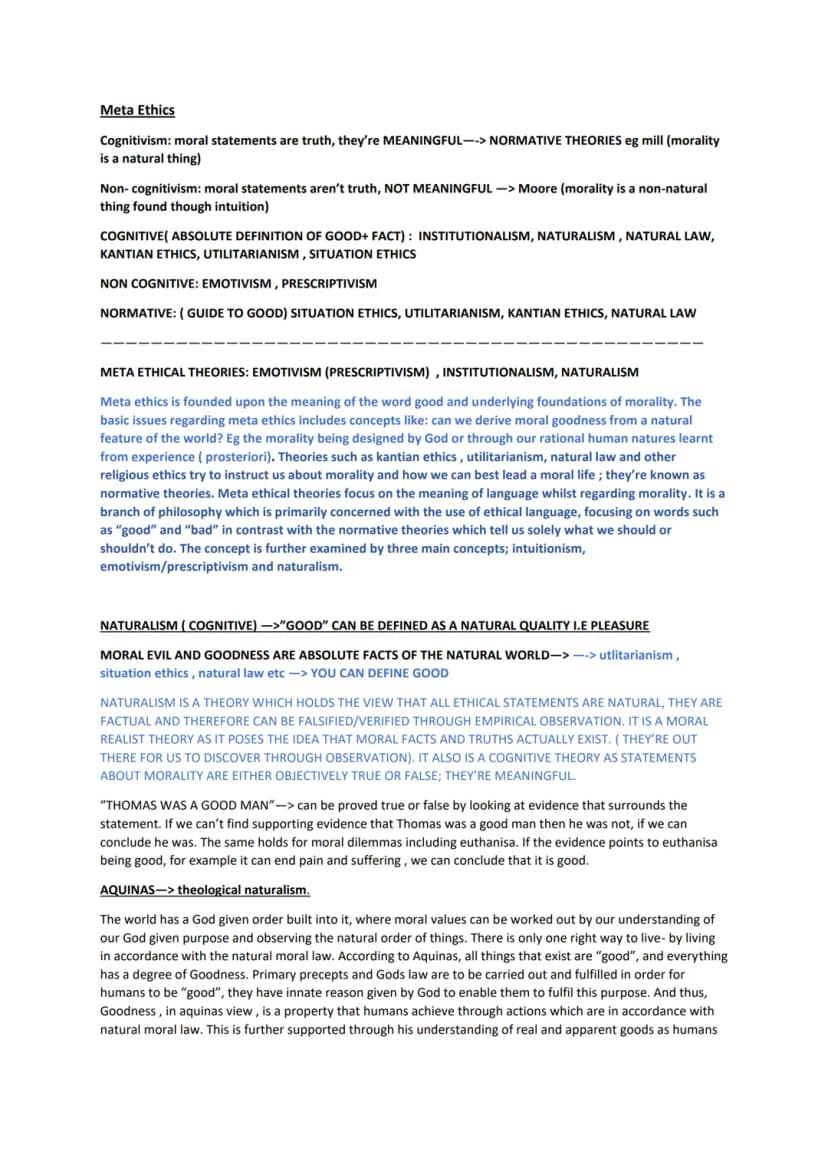
Meta ethics isn't about telling you what's right or wrong - that's the job of normative theories like utilitarianism or Kantian ethics. Instead, it examines what we actually mean when we use moral language and whether statements like "stealing is wrong" can be true or false.
The field splits into two major camps: cognitivists and non-cognitivists. Cognitivists believe moral statements are meaningful and can be either true or false - they're making factual claims about the world. Non-cognitivists argue the opposite: moral statements aren't factual at all, but express emotions or attitudes instead.
Naturalism represents one major cognitivist approach, arguing that moral properties like "goodness" can be defined through natural qualities we observe in the world. Think of how utilitarians define "good" as pleasure or how natural law theorists see goodness in fulfilling our natural purpose.
Quick Check: If someone says "helping others is good," naturalists would say this statement can be verified by looking at natural evidence - perhaps because helping creates happiness or fulfils our social nature.
2
of 7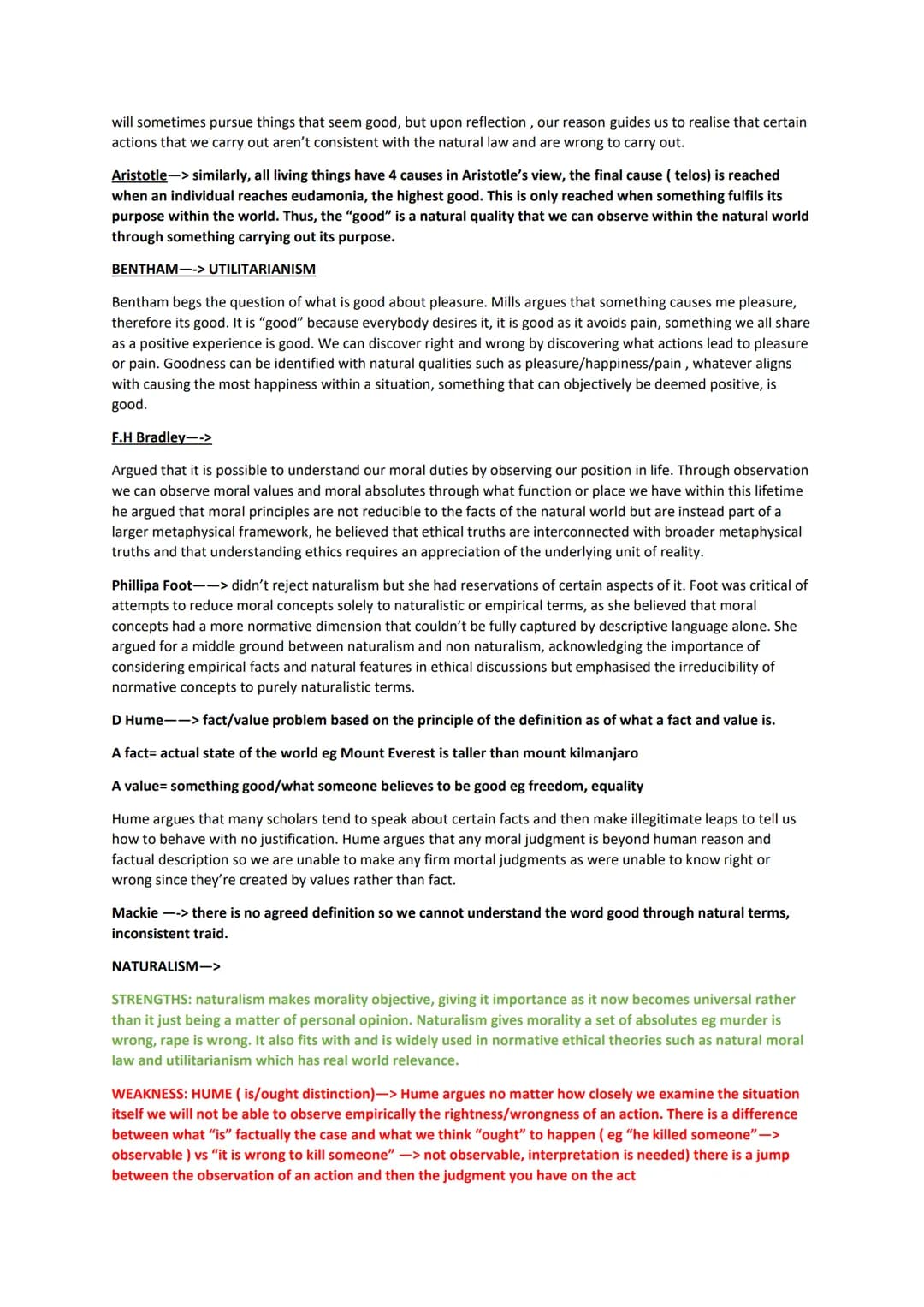
Naturalism: Finding Morality in the Natural World
Naturalism takes the bold stance that moral truths exist as absolute facts in the natural world, discoverable through empirical observation. When naturalists say "Thomas was a good man," they believe this can be proven true or false by examining real evidence about Thomas's actions and character.
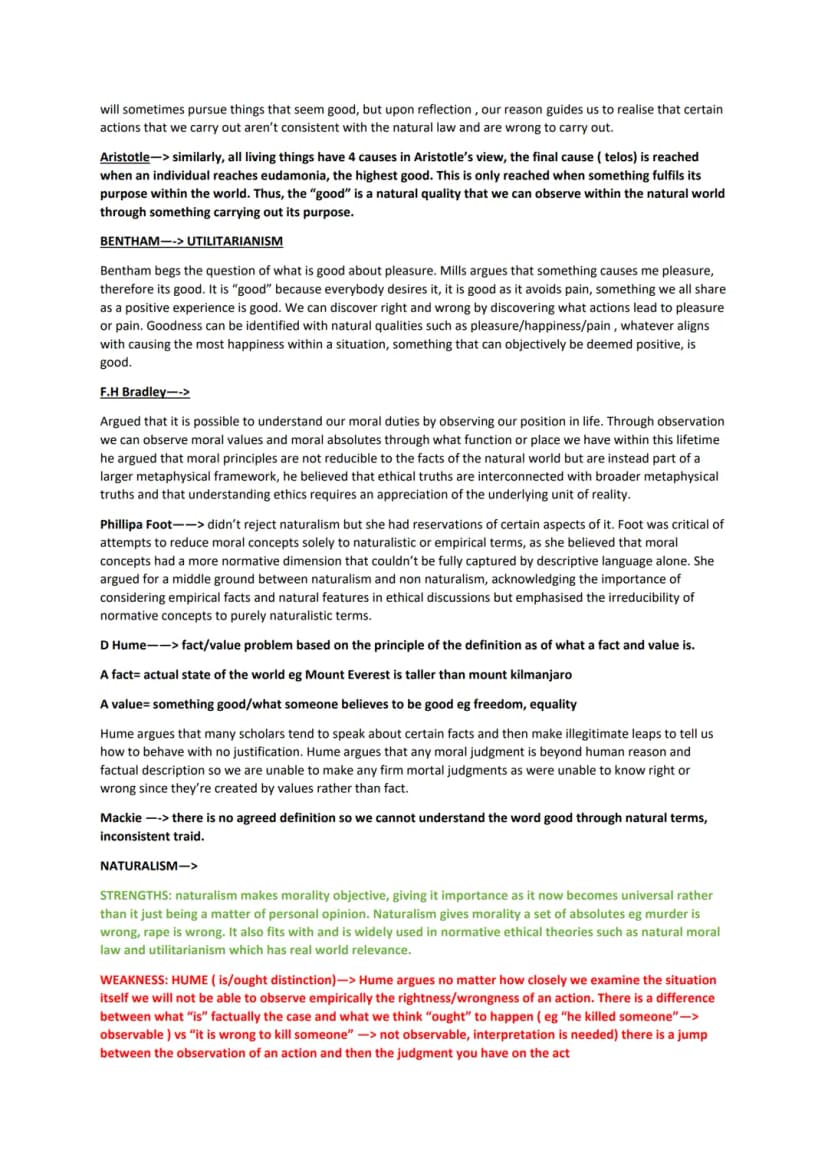
Several major philosophers support this view through different approaches. Aquinas argued that God built moral values into the natural order - we discover goodness by understanding our divine purpose and following natural moral law. Aristotle similarly believed all things have a telos (final cause), and something becomes "good" when it fulfils its natural purpose.
Bentham's utilitarianism offers another naturalistic approach, identifying "good" with natural qualities like pleasure and happiness. We can objectively measure what causes the most happiness in any situation, making moral decisions factual rather than subjective.
However, naturalism faces serious challenges. Hume's is/ought problem points out the logical gap between observing facts ("he killed someone") and making moral judgements ("killing is wrong"). Moore's naturalistic fallacy questions why we should assume natural things are automatically good - after all, disease and suffering are also natural.
Think About It: If naturalism is correct, then moral disagreements should be solvable through evidence and observation - just like scientific disputes.
3
of 7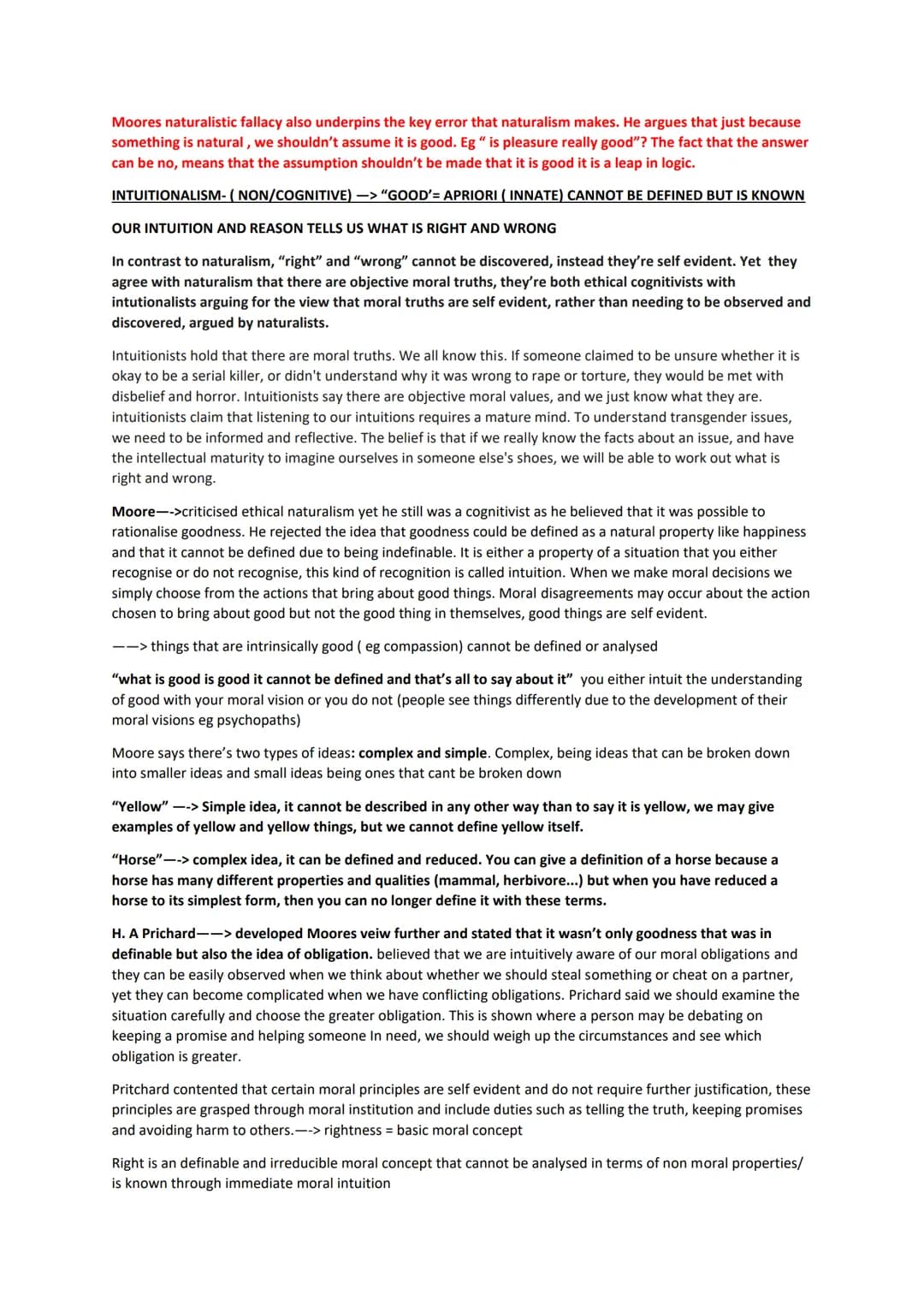
Intuitionism: Knowing Good Through Moral Vision
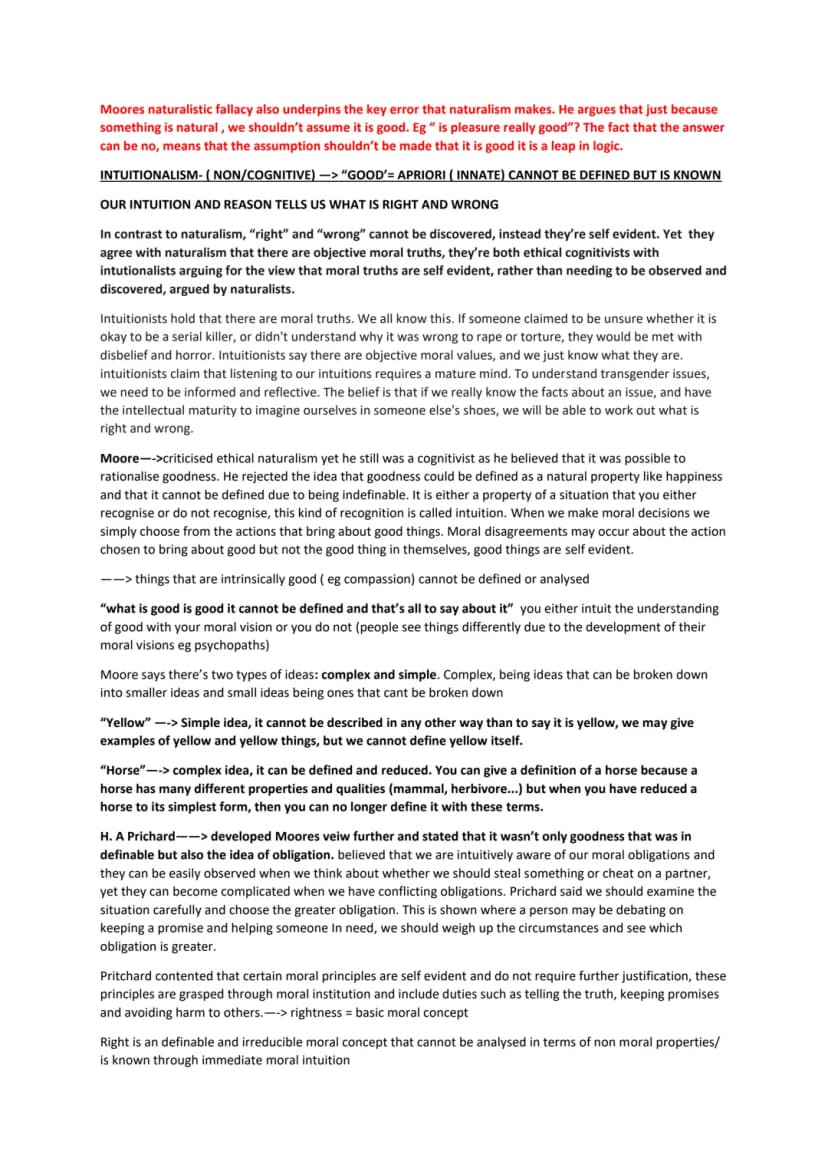
Intuitionism agrees with naturalism that objective moral truths exist, but argues we don't discover them through observation - we simply know them intuitively. According to intuitionists, moral truths are self-evident to anyone with a developed moral sense.
G.E. Moore pioneered this approach, arguing that "good" is like the colour yellow - it's a simple, indefinable concept that you either recognise or you don't. Just as you can't explain yellow to someone who's never seen it, you can't define goodness in terms of anything else. Moore believed people have a kind of "moral vision" that allows them to intuit what's right.
H.A. Prichard extended this theory to include our sense of obligation and duty. He argued we intuitively recognise moral duties like promise-keeping and honesty, though we might face conflicts when different obligations compete with each other.
W.D. Ross developed this further with his theory of prima facie duties - fundamental obligations like fidelity, gratitude, justice, and avoiding harm that we recognise as obviously right in most situations.
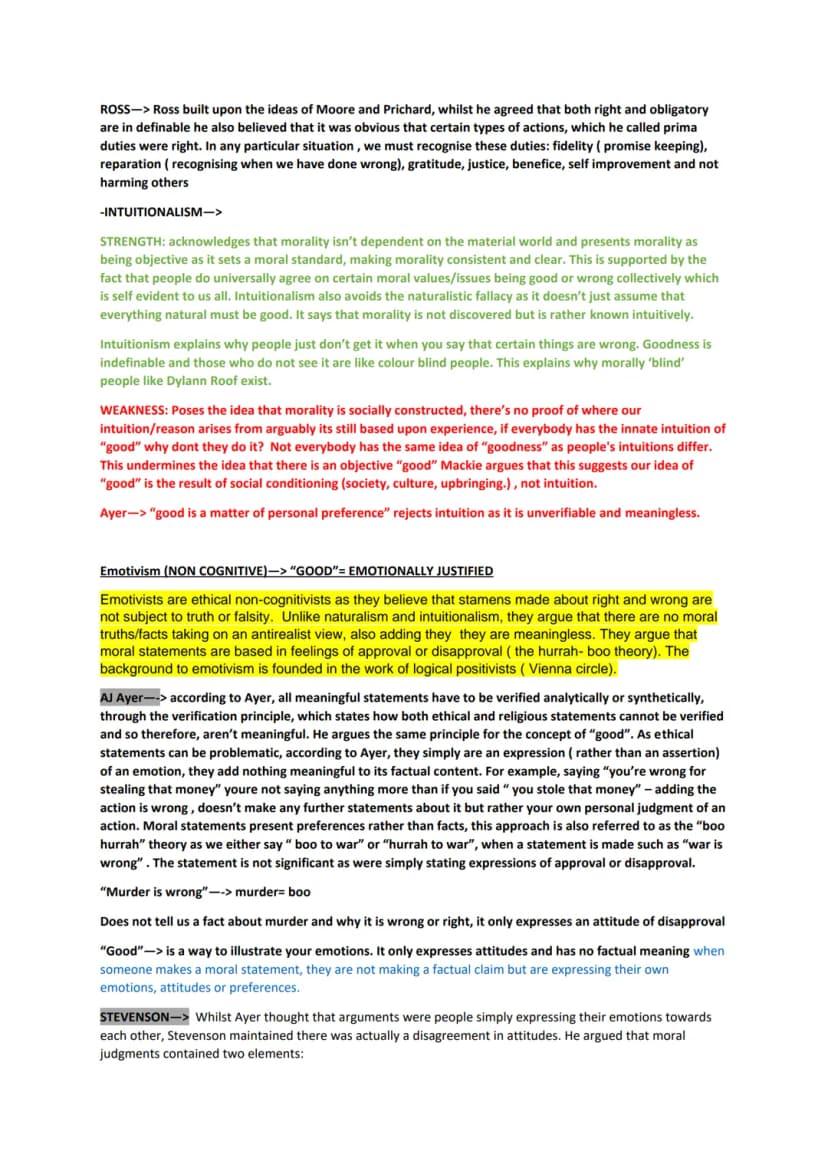
The strength of intuitionism is that it explains why certain moral truths seem universal and why some people appear "morally blind" to obvious wrongs. However, critics argue that if moral intuition were real, why do people's moral judgements differ so dramatically across cultures and individuals?
Real-World Connection: Intuitionists would say your immediate horror at hearing about child abuse isn't learned - it's an intuitive recognition of moral truth.
4
of 7
Emotivism: Morality as Personal Expression
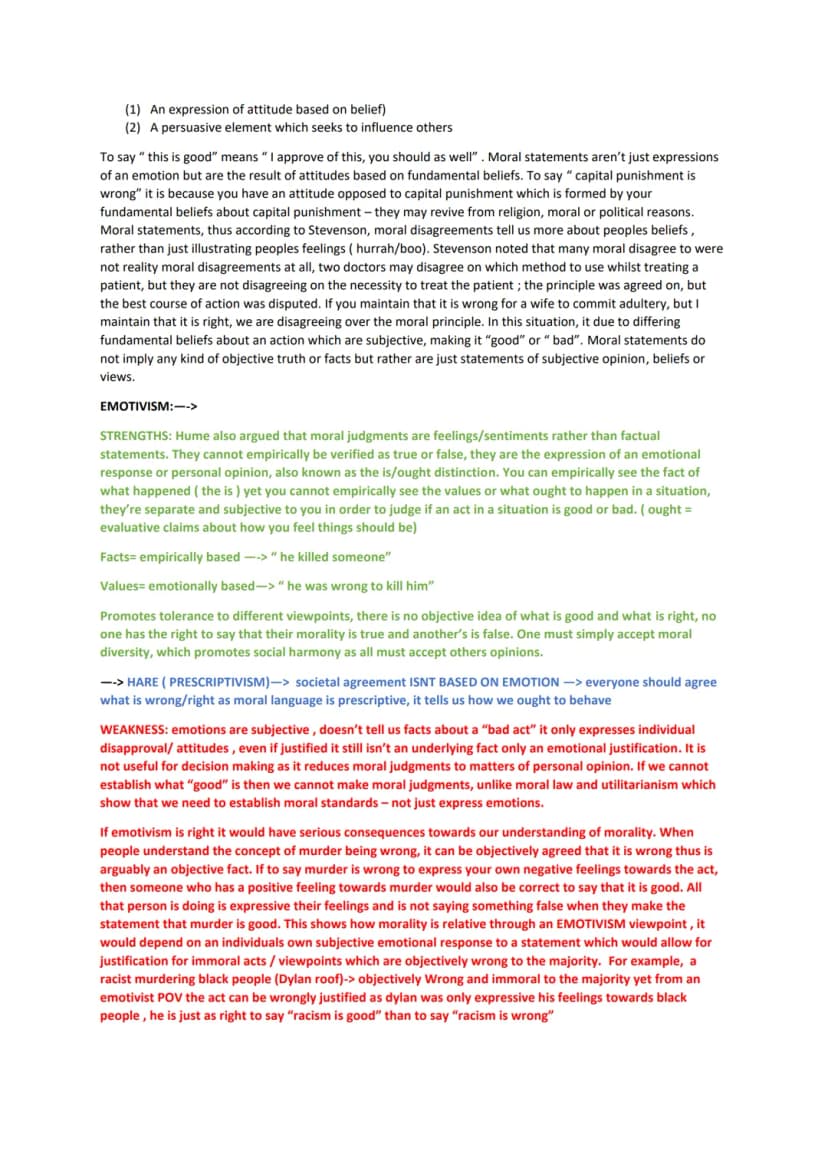
Emotivism completely rejects the idea that moral statements express facts or truths. Instead, when you say "murder is wrong," you're simply expressing your emotional disapproval - like saying "murder - boo!" It's not meaningful in any factual sense.
A.J. Ayer developed this theory using the verification principle, which states that meaningful statements must be verifiable through observation or logic. Since moral statements can't be verified scientifically, they're essentially meaningless expressions of personal emotion rather than factual claims.
Charles Stevenson refined emotivism by arguing that moral statements do more than just express feelings - they attempt to influence others' attitudes. When you say "stealing is wrong," you're really saying "I disapprove of stealing, and you should too." Moral disagreements aren't about facts, but about conflicting attitudes based on different fundamental beliefs.
This theory connects to Hume's is/ought distinction - the idea that you can't logically jump from factual observations ("he stole money") to value judgements ("stealing is wrong"). Facts and values occupy completely separate domains.
Emotivism promotes tolerance since no one can claim their moral views are objectively true. However, it struggles with the problem of moral relativism - if emotions determine morality, then a racist's approval of discrimination would be equally "valid" as your disapproval of it.
Consider This: If emotivism is correct, then moral education isn't about teaching truths, but about shaping emotional responses and attitudes.
5
of 7
The Realism Debate: Do Moral Facts Exist?
The ultimate question in meta ethics boils down to moral realism versus moral anti-realism. Do moral facts actually exist in the world, waiting to be discovered, or do we simply create moral rules through our attitudes and decisions?
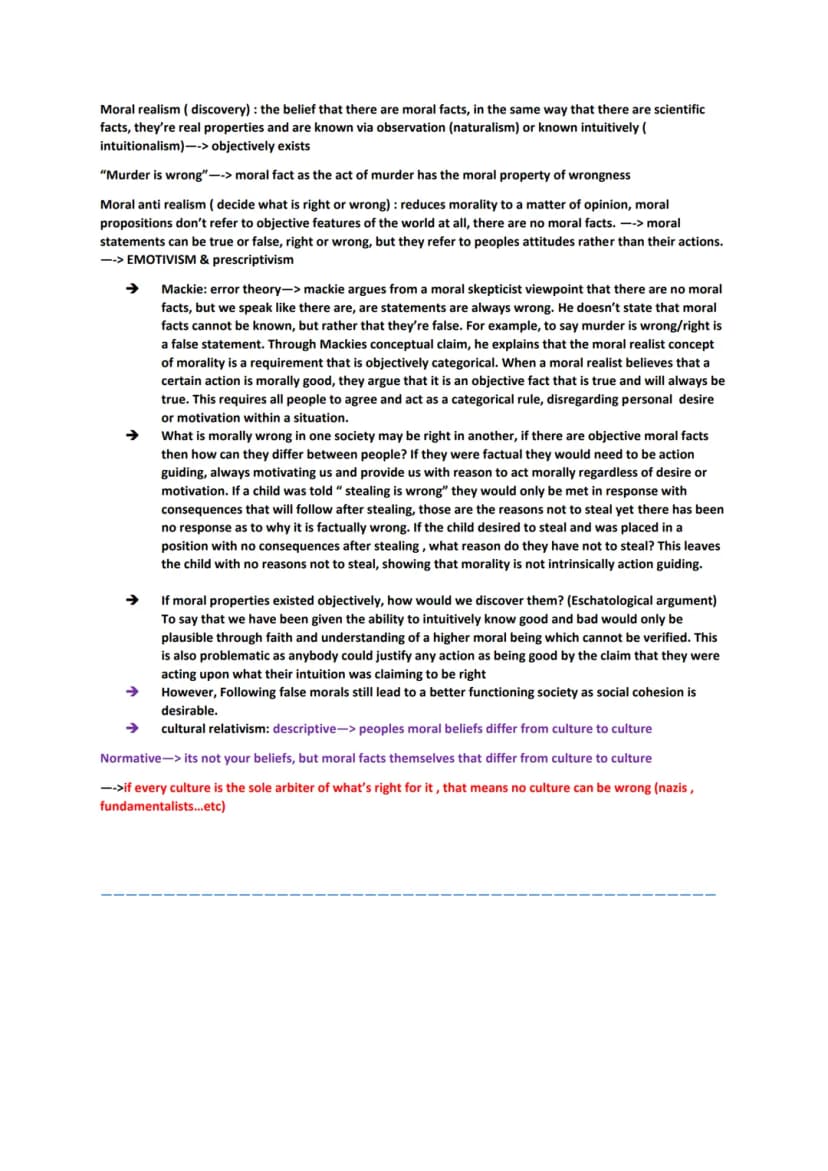
Moral realists (including naturalists and intuitionists) believe moral properties are real features of the world. When they say "murder is wrong," they're claiming that wrongness is an actual property of murder, just like redness is a property of roses.
Moral anti-realists (like emotivists) argue there are no moral facts at all. Moral statements might feel meaningful to us, but they don't refer to objective features of reality - they're expressions of our subjective attitudes and preferences.
J.L. Mackie's error theory presents a third option: moral statements try to describe objective facts, but they're always false because no moral facts exist. When people make moral claims, they're making a systematic error - speaking as if moral facts exist when they don't.
Mackie argues that if moral facts existed, they'd need to be intrinsically motivating and action-guiding for everyone. But moral rules often fail to motivate people who lack personal reasons to follow them, suggesting they're not objective features of reality.
The debate has practical implications: if moral realism is false, can we maintain social cooperation and justify moral criticism of practices like oppression or genocide?
Food for Thought: Your instinctive belief that some things are objectively wrong might be the strongest evidence for moral realism - or the greatest illusion.
6
of 7
Connecting Meta Ethics to Normative Theories
Understanding meta ethics helps you grasp the foundations of the normative theories you've studied. Each normative approach implicitly takes a position on whether moral facts exist and how we access them.
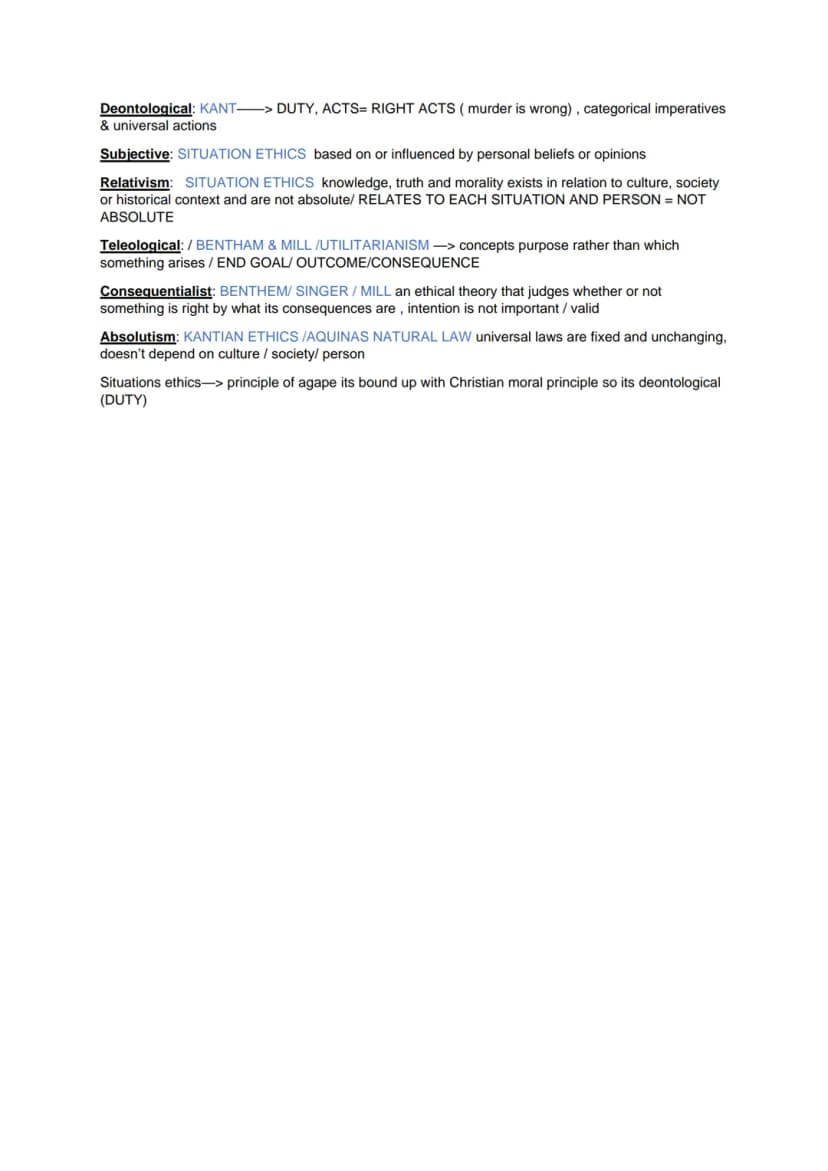
Kantian ethics operates from a cognitivist, realist position - Kant believed moral duties are objective facts discovered through reason. His categorical imperative assumes universal moral truths that apply to all rational beings regardless of personal desires or cultural differences.
Utilitarianism typically embraces naturalism, defining "good" in terms of observable consequences like happiness or pleasure. Mill and Bentham treated moral decisions as factual questions about which actions produce the best outcomes for the greatest number.
Situation ethics presents more complexity - while it emphasises the absolute principle of agape (love), it applies this relativistically to each situation. This creates tension between its deontological foundation and its consequentialist application .
The classification of these theories matters for understanding their strengths and weaknesses. Absolutist theories like natural law claim universal moral truths, while relativist approaches like situation ethics allow moral rules to vary by context.
Cultural relativism raises additional questions: if moral beliefs differ dramatically across societies, does this prove there are no universal moral facts, or simply that some cultures have better access to moral truth than others?
Exam Tip: Always consider the meta-ethical assumptions behind any normative theory you're evaluating - it often reveals the theory's deepest strengths and vulnerabilities.
7
of 7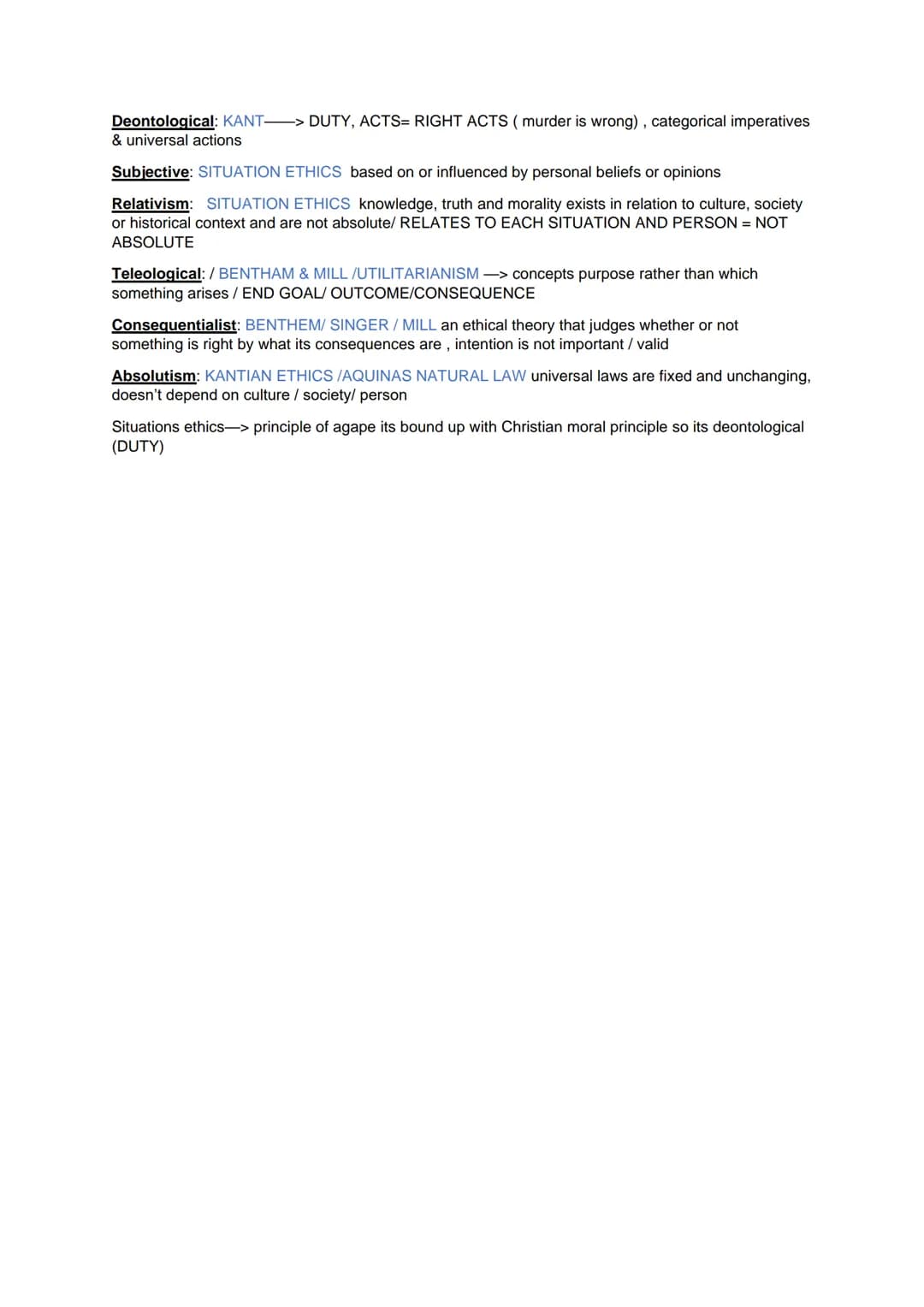
We thought you’d never ask...
What is the Knowunity AI companion?
Our AI companion is specifically built for the needs of students. Based on the millions of content pieces we have on the platform we can provide truly meaningful and relevant answers to students. But its not only about answers, the companion is even more about guiding students through their daily learning challenges, with personalised study plans, quizzes or content pieces in the chat and 100% personalisation based on the students skills and developments.
Where can I download the Knowunity app?
You can download the app in the Google Play Store and in the Apple App Store.
Is Knowunity really free of charge?
That's right! Enjoy free access to study content, connect with fellow students, and get instant help – all at your fingertips.
Similar Content
 Ethik
Ethik Felsefe
Most popular content: Ethics
6Religious StudiesEthical Theories Overview
Explore key ethical theories including Ethical Egoism, Divine Command Theory, Virtue Ethics, Naturalism, Intuitionism, and Emotivism. This summary provides insights into each theory's principles, implications, and critiques, making it essential for understanding moral philosophy. Ideal for WJEC ethics students preparing for exams.
123259
Religious StudiesMorality and Justice Insights
Explore the complex relationship between morality, crime, and punishment in this comprehensive overview. This study note covers key concepts such as good vs. evil, the role of free will, and differing religious perspectives on justice and forgiveness. Ideal for students studying ethics, religious studies, or philosophy. Key topics include the aims of punishment, the death penalty, and moral decision-making frameworks.
112749
Religious StudiesEthics of Good and Evil
Explore the complex concepts of good and evil, retributive justice, and human rights in this comprehensive study note. Delve into Christian and Islamic perspectives on morality, forgiveness, and the implications of poverty and wealth. Ideal for GCSE Religious Studies students seeking to understand ethical frameworks and their real-world applications.
113166
Religious StudiesVirtue Ethics Analysis
Explore the strengths and weaknesses of virtue ethics in moral philosophy. This summary delves into key arguments from philosophers like Philippa Foot and Robert Louden, discussing the implications of virtue in ethical dilemmas, the role of character, and the challenges of defining virtues. Ideal for students studying religious studies and ethical theories.
122648
Religious StudiesMeta Ethics Overview
Explore the key concepts of Meta Ethics in AQA A-Level Religious Studies. This summary covers essential theories including Divine Command Theory, Utilitarianism, and Ethical Naturalism, along with their strengths and weaknesses. Ideal for students seeking to understand moral philosophy and ethical frameworks. Includes critical quotes and insights for exam preparation.
1242812
Religious StudiesKantian Ethics Explained
Explore the core principles of Kantian ethics, including the Hypothetical and Categorical Imperatives, and Kant's views on morality, duty, and the highest good. This summary covers key concepts such as deontological ethics, moral law, and the implications of treating individuals as ends in themselves. Ideal for students seeking a clear understanding of Kant's ethical framework.
1248916
Most popular content in Religious Studies
9C
Religious StudiesChristianity keywords
Help, remember these keywords with this quiz
95411
I
Religious Studiesislam
you need to do this test supper easy and fun
73500
 Humanities
Religious Studies Quote Bank
Christianity and Islam Paper 1 and Paper 2 Quotes.
1076413
Religious StudiesChristianity: Core Beliefs
Explore essential Christian beliefs including the Nature of God, the Trinity, Creation, Incarnation, Crucifixion, Resurrection, and concepts of Heaven, Hell, and Salvation. This comprehensive summary provides key quotes and insights for AQA GCSE revision.
95,345184
J
Religious StudiesJudaism ✡️
Key concepts in Judaism including the Covenant, Shekhinah, Messiah, and Torah for GCSE Religious Studies.
102410
R
Religious StudiesR.E Judaism questions quiz
Quiz on random Judaism R.E questions
92624
E
Religious StudiesExploring World Religions: A Comprehensive Study Guide
Master the diverse beliefs, practices, and traditions of major world religions with this in-depth study guide for religious studies.
111930
Religious StudiesCatholic Theology: Good & Evil
Explore key concepts in Catholic theology regarding good and evil, including the role of free will, the problem of evil, and the significance of Jesus' crucifixion. This summary provides essential revision notes, quotations, and sources to enhance your understanding of Christian ethics and salvation. Ideal for WJEC Foundation students studying Catholic Christianity.
1046610
C
Religious StudiesChristianity comp 2
Core Christian concepts including evangelism, sacraments, and the resurrection of Jesus.
111370
Most popular content
9 Sociology
Sociology of Education Overview
Explore comprehensive A-Level Sociology notes on the education system, covering key theories, policies, and sociological perspectives. This resource includes insights on marketisation, gender roles, cultural deprivation, and educational inequalities, providing a thorough understanding of how education shapes social stratification and individual achievement. Ideal for exam preparation and in-depth study.
12102,8693,040
SociologySociology of Families: Comprehensive Revision
Dive into an extensive overview of family dynamics, perspectives, and patterns in sociology. This resource covers key concepts such as family diversity, gender roles, marriage, and the impact of social policies on family structures. Perfect for A-Level Sociology students preparing for Paper 2.
1273,6612,307
CriminologyCriminology: Crime & Punishment Overview
Comprehensive mindmaps covering key concepts in the Crime and Punishment topic for WJEC Criminology Unit 4. This resource includes detailed insights into the Criminal Justice System, crime prevention strategies, sentencing models, and the roles of various agencies. Ideal for A-Level revision, ensuring you grasp essential theories and legislative processes to excel in your exams.
1254,8691,059
SociologyComprehensive Crime & Deviance Overview
Explore an extensive revision of crime and deviance topics, including theories, types of crime, and the impact of media. This resource covers key concepts such as Marxism, functionalism, gender and crime, and the influence of globalization on criminal behavior. Ideal for students seeking a thorough understanding of criminology and its various theories. Type: Full Topic Revision.
1251,6541,399
C
 Biology
Cell Biology and Cell structure
cell structures
93,2470
 English Literature
An Inspector Calls: Character Insights
Explore in-depth analysis and key quotes for characters in J.B. Priestley's 'An Inspector Calls'. This resource covers Gerald Croft, Inspector Goole, Sheila Birling, Mrs. Birling, Eric Birling, and Eva Smith, focusing on themes of class, gender roles, and social responsibility. Ideal for students aiming for Grade 8 and above.
1025,429907
CriminologyWJEC Unit 4 Criminology
Criminology unit 4 detailed revision note
127,151125
CriminologyCriminology Theories Overview
Explore key criminology theories and their implications on crime and deviance. This comprehensive summary covers biological, psychological, and sociological perspectives, including labelling theory, right realism, and the impact of social campaigns on policy development. Ideal for A-Level criminology students seeking to understand the complexities of criminal behaviour and the factors influencing crime prevention strategies.
129,760210
English LiteratureRomeo and Juliet: Key themes
Key Romeo and Juliet themes and analysed quotes
106,708198
Can't find what you're looking for? Explore other subjects.
Students love us — and so will you.
4.6/5App Store
4.7/5Google Play
The app is very easy to use and well designed. I have found everything I was looking for so far and have been able to learn a lot from the presentations! I will definitely use the app for a class assignment! And of course it also helps a lot as an inspiration.
Stefan SiOS user
This app is really great. There are so many study notes and help [...]. My problem subject is French, for example, and the app has so many options for help. Thanks to this app, I have improved my French. I would recommend it to anyone.
Samantha KlichAndroid user
Wow, I am really amazed. I just tried the app because I've seen it advertised many times and was absolutely stunned. This app is THE HELP you want for school and above all, it offers so many things, such as workouts and fact sheets, which have been VERY helpful to me personally.
AnnaiOS user
Religious Studies328 views·Updated Jun 19, 2026·7 pagesUnderstanding Meta-Ethics: Naturalism, Intuitionalism, and Emotivism
Zoe@zoe_b8
Ever wondered whether saying "murder is wrong" is actually stating a fact or just expressing your feelings? Meta ethics explores the very meaning behind moral language and asks fundamental questions about how we define "good" and "bad". It's the philosophical...
1
of 7
Sign up to see the content. It's free!
- Access to all documents
- Improve your grades
- Join milions of students
Understanding Meta Ethics and Its Core Divisions
Meta ethics isn't about telling you what's right or wrong - that's the job of normative theories like utilitarianism or Kantian ethics. Instead, it examines what we actually mean when we use moral language and whether statements like "stealing is wrong" can be true or false.
The field splits into two major camps: cognitivists and non-cognitivists. Cognitivists believe moral statements are meaningful and can be either true or false - they're making factual claims about the world. Non-cognitivists argue the opposite: moral statements aren't factual at all, but express emotions or attitudes instead.
Naturalism represents one major cognitivist approach, arguing that moral properties like "goodness" can be defined through natural qualities we observe in the world. Think of how utilitarians define "good" as pleasure or how natural law theorists see goodness in fulfilling our natural purpose.
Quick Check: If someone says "helping others is good," naturalists would say this statement can be verified by looking at natural evidence - perhaps because helping creates happiness or fulfils our social nature.
2
of 7Sign up to see the content. It's free!
- Access to all documents
- Improve your grades
- Join milions of students
Naturalism: Finding Morality in the Natural World
Naturalism takes the bold stance that moral truths exist as absolute facts in the natural world, discoverable through empirical observation. When naturalists say "Thomas was a good man," they believe this can be proven true or false by examining real evidence about Thomas's actions and character.
Several major philosophers support this view through different approaches. Aquinas argued that God built moral values into the natural order - we discover goodness by understanding our divine purpose and following natural moral law. Aristotle similarly believed all things have a telos (final cause), and something becomes "good" when it fulfils its natural purpose.
Bentham's utilitarianism offers another naturalistic approach, identifying "good" with natural qualities like pleasure and happiness. We can objectively measure what causes the most happiness in any situation, making moral decisions factual rather than subjective.
However, naturalism faces serious challenges. Hume's is/ought problem points out the logical gap between observing facts ("he killed someone") and making moral judgements ("killing is wrong"). Moore's naturalistic fallacy questions why we should assume natural things are automatically good - after all, disease and suffering are also natural.
Think About It: If naturalism is correct, then moral disagreements should be solvable through evidence and observation - just like scientific disputes.
3
of 7Sign up to see the content. It's free!
- Access to all documents
- Improve your grades
- Join milions of students
Intuitionism: Knowing Good Through Moral Vision
Intuitionism agrees with naturalism that objective moral truths exist, but argues we don't discover them through observation - we simply know them intuitively. According to intuitionists, moral truths are self-evident to anyone with a developed moral sense.
G.E. Moore pioneered this approach, arguing that "good" is like the colour yellow - it's a simple, indefinable concept that you either recognise or you don't. Just as you can't explain yellow to someone who's never seen it, you can't define goodness in terms of anything else. Moore believed people have a kind of "moral vision" that allows them to intuit what's right.
H.A. Prichard extended this theory to include our sense of obligation and duty. He argued we intuitively recognise moral duties like promise-keeping and honesty, though we might face conflicts when different obligations compete with each other.
W.D. Ross developed this further with his theory of prima facie duties - fundamental obligations like fidelity, gratitude, justice, and avoiding harm that we recognise as obviously right in most situations.
The strength of intuitionism is that it explains why certain moral truths seem universal and why some people appear "morally blind" to obvious wrongs. However, critics argue that if moral intuition were real, why do people's moral judgements differ so dramatically across cultures and individuals?
Real-World Connection: Intuitionists would say your immediate horror at hearing about child abuse isn't learned - it's an intuitive recognition of moral truth.
4
of 7Sign up to see the content. It's free!
- Access to all documents
- Improve your grades
- Join milions of students
Emotivism: Morality as Personal Expression
Emotivism completely rejects the idea that moral statements express facts or truths. Instead, when you say "murder is wrong," you're simply expressing your emotional disapproval - like saying "murder - boo!" It's not meaningful in any factual sense.
A.J. Ayer developed this theory using the verification principle, which states that meaningful statements must be verifiable through observation or logic. Since moral statements can't be verified scientifically, they're essentially meaningless expressions of personal emotion rather than factual claims.
Charles Stevenson refined emotivism by arguing that moral statements do more than just express feelings - they attempt to influence others' attitudes. When you say "stealing is wrong," you're really saying "I disapprove of stealing, and you should too." Moral disagreements aren't about facts, but about conflicting attitudes based on different fundamental beliefs.
This theory connects to Hume's is/ought distinction - the idea that you can't logically jump from factual observations ("he stole money") to value judgements ("stealing is wrong"). Facts and values occupy completely separate domains.
Emotivism promotes tolerance since no one can claim their moral views are objectively true. However, it struggles with the problem of moral relativism - if emotions determine morality, then a racist's approval of discrimination would be equally "valid" as your disapproval of it.
Consider This: If emotivism is correct, then moral education isn't about teaching truths, but about shaping emotional responses and attitudes.
5
of 7Sign up to see the content. It's free!
- Access to all documents
- Improve your grades
- Join milions of students
The Realism Debate: Do Moral Facts Exist?
The ultimate question in meta ethics boils down to moral realism versus moral anti-realism. Do moral facts actually exist in the world, waiting to be discovered, or do we simply create moral rules through our attitudes and decisions?
Moral realists (including naturalists and intuitionists) believe moral properties are real features of the world. When they say "murder is wrong," they're claiming that wrongness is an actual property of murder, just like redness is a property of roses.
Moral anti-realists (like emotivists) argue there are no moral facts at all. Moral statements might feel meaningful to us, but they don't refer to objective features of reality - they're expressions of our subjective attitudes and preferences.
J.L. Mackie's error theory presents a third option: moral statements try to describe objective facts, but they're always false because no moral facts exist. When people make moral claims, they're making a systematic error - speaking as if moral facts exist when they don't.
Mackie argues that if moral facts existed, they'd need to be intrinsically motivating and action-guiding for everyone. But moral rules often fail to motivate people who lack personal reasons to follow them, suggesting they're not objective features of reality.
The debate has practical implications: if moral realism is false, can we maintain social cooperation and justify moral criticism of practices like oppression or genocide?
Food for Thought: Your instinctive belief that some things are objectively wrong might be the strongest evidence for moral realism - or the greatest illusion.
6
of 7Sign up to see the content. It's free!
- Access to all documents
- Improve your grades
- Join milions of students
Connecting Meta Ethics to Normative Theories
Understanding meta ethics helps you grasp the foundations of the normative theories you've studied. Each normative approach implicitly takes a position on whether moral facts exist and how we access them.
Kantian ethics operates from a cognitivist, realist position - Kant believed moral duties are objective facts discovered through reason. His categorical imperative assumes universal moral truths that apply to all rational beings regardless of personal desires or cultural differences.
Utilitarianism typically embraces naturalism, defining "good" in terms of observable consequences like happiness or pleasure. Mill and Bentham treated moral decisions as factual questions about which actions produce the best outcomes for the greatest number.
Situation ethics presents more complexity - while it emphasises the absolute principle of agape (love), it applies this relativistically to each situation. This creates tension between its deontological foundation and its consequentialist application .
The classification of these theories matters for understanding their strengths and weaknesses. Absolutist theories like natural law claim universal moral truths, while relativist approaches like situation ethics allow moral rules to vary by context.
Cultural relativism raises additional questions: if moral beliefs differ dramatically across societies, does this prove there are no universal moral facts, or simply that some cultures have better access to moral truth than others?
Exam Tip: Always consider the meta-ethical assumptions behind any normative theory you're evaluating - it often reveals the theory's deepest strengths and vulnerabilities.
7
of 7Sign up to see the content. It's free!
- Access to all documents
- Improve your grades
- Join milions of students
We thought you’d never ask...
What is the Knowunity AI companion?
Our AI companion is specifically built for the needs of students. Based on the millions of content pieces we have on the platform we can provide truly meaningful and relevant answers to students. But its not only about answers, the companion is even more about guiding students through their daily learning challenges, with personalised study plans, quizzes or content pieces in the chat and 100% personalisation based on the students skills and developments.
Where can I download the Knowunity app?
You can download the app in the Google Play Store and in the Apple App Store.
Is Knowunity really free of charge?
That's right! Enjoy free access to study content, connect with fellow students, and get instant help – all at your fingertips.
Similar Content
Most popular content: Ethics
6Religious StudiesEthical Theories Overview
Explore key ethical theories including Ethical Egoism, Divine Command Theory, Virtue Ethics, Naturalism, Intuitionism, and Emotivism. This summary provides insights into each theory's principles, implications, and critiques, making it essential for understanding moral philosophy. Ideal for WJEC ethics students preparing for exams.
123259
Religious StudiesMorality and Justice Insights
Explore the complex relationship between morality, crime, and punishment in this comprehensive overview. This study note covers key concepts such as good vs. evil, the role of free will, and differing religious perspectives on justice and forgiveness. Ideal for students studying ethics, religious studies, or philosophy. Key topics include the aims of punishment, the death penalty, and moral decision-making frameworks.
112749
Religious StudiesEthics of Good and Evil
Explore the complex concepts of good and evil, retributive justice, and human rights in this comprehensive study note. Delve into Christian and Islamic perspectives on morality, forgiveness, and the implications of poverty and wealth. Ideal for GCSE Religious Studies students seeking to understand ethical frameworks and their real-world applications.
113166
Religious StudiesVirtue Ethics Analysis
Explore the strengths and weaknesses of virtue ethics in moral philosophy. This summary delves into key arguments from philosophers like Philippa Foot and Robert Louden, discussing the implications of virtue in ethical dilemmas, the role of character, and the challenges of defining virtues. Ideal for students studying religious studies and ethical theories.
122648
Religious StudiesMeta Ethics Overview
Explore the key concepts of Meta Ethics in AQA A-Level Religious Studies. This summary covers essential theories including Divine Command Theory, Utilitarianism, and Ethical Naturalism, along with their strengths and weaknesses. Ideal for students seeking to understand moral philosophy and ethical frameworks. Includes critical quotes and insights for exam preparation.
1242812
Religious StudiesKantian Ethics Explained
Explore the core principles of Kantian ethics, including the Hypothetical and Categorical Imperatives, and Kant's views on morality, duty, and the highest good. This summary covers key concepts such as deontological ethics, moral law, and the implications of treating individuals as ends in themselves. Ideal for students seeking a clear understanding of Kant's ethical framework.
1248916
Most popular content in Religious Studies
9C
Religious StudiesChristianity keywords
Help, remember these keywords with this quiz
95411
I
Religious Studiesislam
you need to do this test supper easy and fun
73500
HumanitiesReligious Studies Quote Bank
Christianity and Islam Paper 1 and Paper 2 Quotes.
1076413
Religious StudiesChristianity: Core Beliefs
Explore essential Christian beliefs including the Nature of God, the Trinity, Creation, Incarnation, Crucifixion, Resurrection, and concepts of Heaven, Hell, and Salvation. This comprehensive summary provides key quotes and insights for AQA GCSE revision.
95,345184
J
Religious StudiesJudaism ✡️
Key concepts in Judaism including the Covenant, Shekhinah, Messiah, and Torah for GCSE Religious Studies.
102410
R
Religious StudiesR.E Judaism questions quiz
Quiz on random Judaism R.E questions
92624
E
Religious StudiesExploring World Religions: A Comprehensive Study Guide
Master the diverse beliefs, practices, and traditions of major world religions with this in-depth study guide for religious studies.
111930
Religious StudiesCatholic Theology: Good & Evil
Explore key concepts in Catholic theology regarding good and evil, including the role of free will, the problem of evil, and the significance of Jesus' crucifixion. This summary provides essential revision notes, quotations, and sources to enhance your understanding of Christian ethics and salvation. Ideal for WJEC Foundation students studying Catholic Christianity.
1046610
C
Religious StudiesChristianity comp 2
Core Christian concepts including evangelism, sacraments, and the resurrection of Jesus.
111370
Most popular content
9SociologySociology of Education Overview
Explore comprehensive A-Level Sociology notes on the education system, covering key theories, policies, and sociological perspectives. This resource includes insights on marketisation, gender roles, cultural deprivation, and educational inequalities, providing a thorough understanding of how education shapes social stratification and individual achievement. Ideal for exam preparation and in-depth study.
12102,8693,040
SociologySociology of Families: Comprehensive Revision
Dive into an extensive overview of family dynamics, perspectives, and patterns in sociology. This resource covers key concepts such as family diversity, gender roles, marriage, and the impact of social policies on family structures. Perfect for A-Level Sociology students preparing for Paper 2.
1273,6612,307
CriminologyCriminology: Crime & Punishment Overview
Comprehensive mindmaps covering key concepts in the Crime and Punishment topic for WJEC Criminology Unit 4. This resource includes detailed insights into the Criminal Justice System, crime prevention strategies, sentencing models, and the roles of various agencies. Ideal for A-Level revision, ensuring you grasp essential theories and legislative processes to excel in your exams.
1254,8691,059
SociologyComprehensive Crime & Deviance Overview
Explore an extensive revision of crime and deviance topics, including theories, types of crime, and the impact of media. This resource covers key concepts such as Marxism, functionalism, gender and crime, and the influence of globalization on criminal behavior. Ideal for students seeking a thorough understanding of criminology and its various theories. Type: Full Topic Revision.
1251,6541,399
C
BiologyCell Biology and Cell structure
cell structures
93,2470
English LiteratureAn Inspector Calls: Character Insights
Explore in-depth analysis and key quotes for characters in J.B. Priestley's 'An Inspector Calls'. This resource covers Gerald Croft, Inspector Goole, Sheila Birling, Mrs. Birling, Eric Birling, and Eva Smith, focusing on themes of class, gender roles, and social responsibility. Ideal for students aiming for Grade 8 and above.
1025,429907
CriminologyWJEC Unit 4 Criminology
Criminology unit 4 detailed revision note
127,151125
CriminologyCriminology Theories Overview
Explore key criminology theories and their implications on crime and deviance. This comprehensive summary covers biological, psychological, and sociological perspectives, including labelling theory, right realism, and the impact of social campaigns on policy development. Ideal for A-Level criminology students seeking to understand the complexities of criminal behaviour and the factors influencing crime prevention strategies.
129,760210
English LiteratureRomeo and Juliet: Key themes
Key Romeo and Juliet themes and analysed quotes
106,708198
Can't find what you're looking for? Explore other subjects.
Students love us — and so will you.
4.6/5App Store
4.7/5Google Play
The app is very easy to use and well designed. I have found everything I was looking for so far and have been able to learn a lot from the presentations! I will definitely use the app for a class assignment! And of course it also helps a lot as an inspiration.
Stefan SiOS user
This app is really great. There are so many study notes and help [...]. My problem subject is French, for example, and the app has so many options for help. Thanks to this app, I have improved my French. I would recommend it to anyone.
Samantha KlichAndroid user
Wow, I am really amazed. I just tried the app because I've seen it advertised many times and was absolutely stunned. This app is THE HELP you want for school and above all, it offers so many things, such as workouts and fact sheets, which have been VERY helpful to me personally.
AnnaiOS user