

The Nature of Allah and Islamic Beliefs- A comprehensive...
 Religious Studies383 views·Updated Jun 22, 2026·7 pages
Islam Notes: 5 Pillars, Angels, and More for Nat 5 RMPS



1 / 7
1
of 7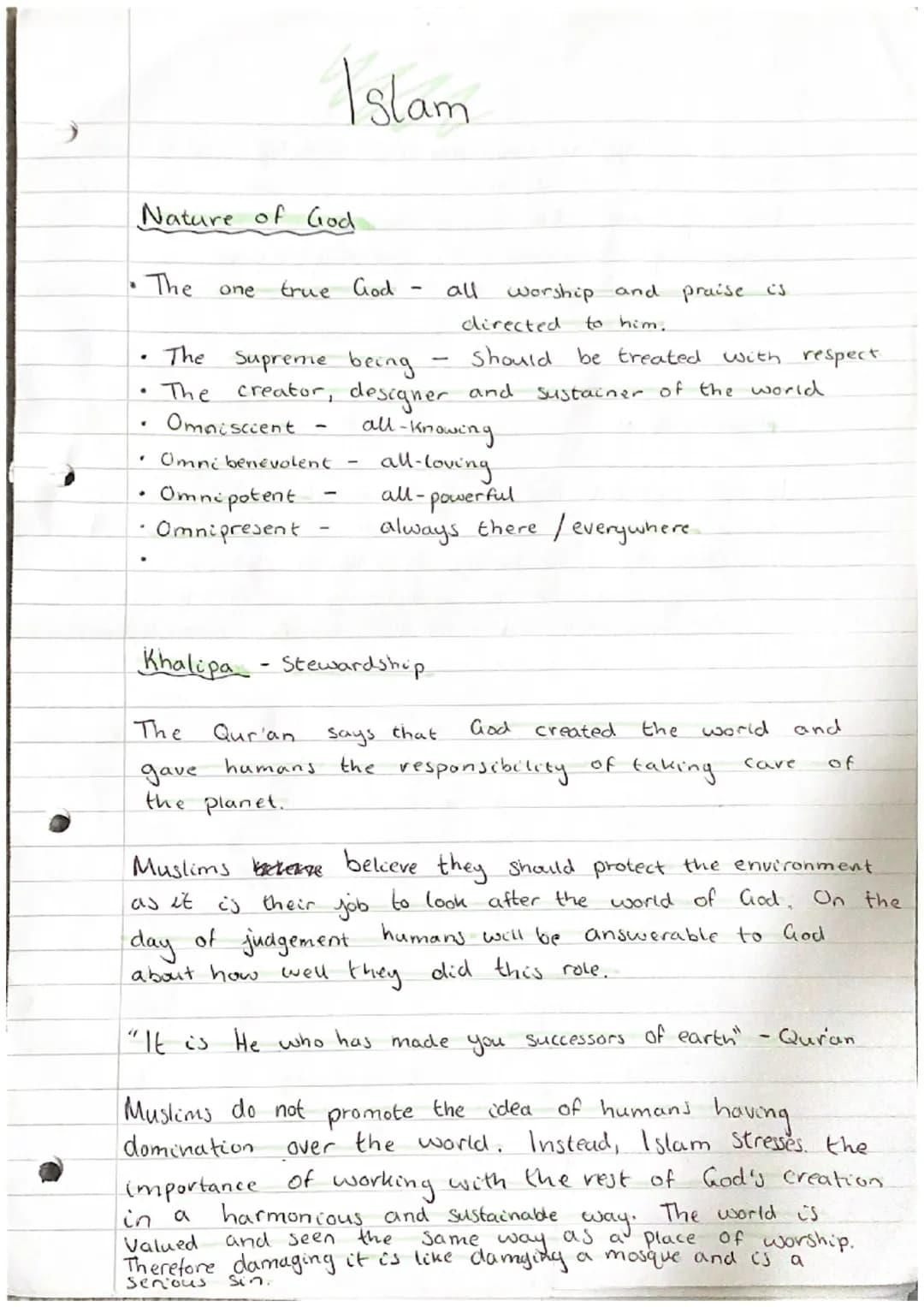
The Seal of the Prophets and Sin in Islam
Muhammad as the Final Prophet
Muhammad is regarded as the Seal of the Prophets in Islam, meaning he is considered the final messenger of Allah. This belief is central to Islamic theology.
Definition: Seal of the Prophets - The concept that Muhammad is the last in the line of prophets, completing and authenticating the prophetic traditions.
Understanding Sin in Islam
In Islamic teaching, sin is defined as an immoral act against God. Muslims believe that on the Day of Judgment, Allah will weigh an individual's good deeds against their sins.
Highlight: Those whose evil deeds outweigh their good deeds will face punishment.
Muhammad as a Role Model
Prophet Muhammad is viewed as the ideal role model for all Muslims. He is believed to have embodied the best human values and encouraged respect for all people, regardless of their background.
Quote: The Quran describes Muhammad as a "beautiful pattern" for believers to follow.
Muslims are instructed to emulate Muhammad's example as a way of submitting to Allah and living according to the Quran's teachings.
2
of 7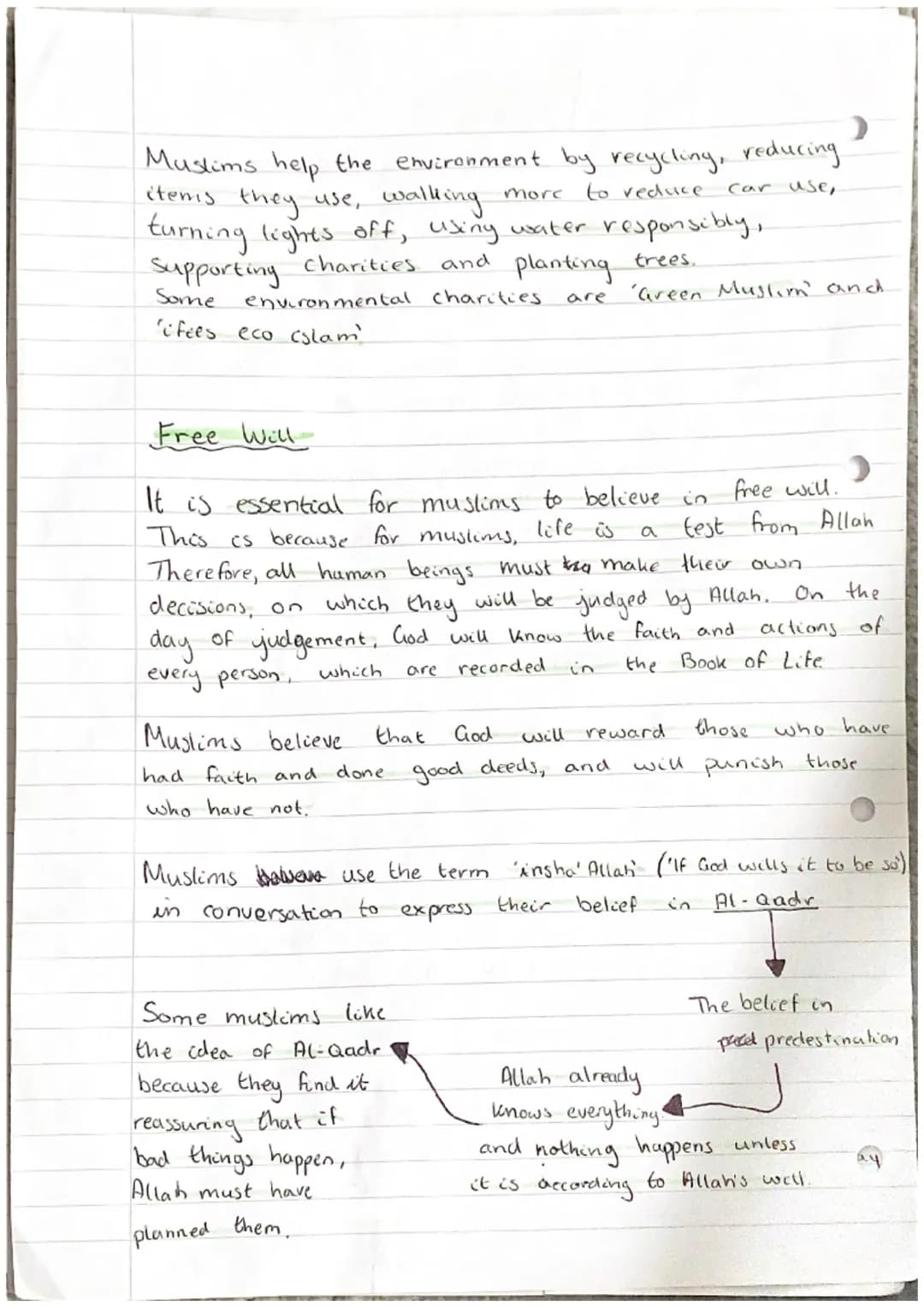
Revelation and Judgment in Islam
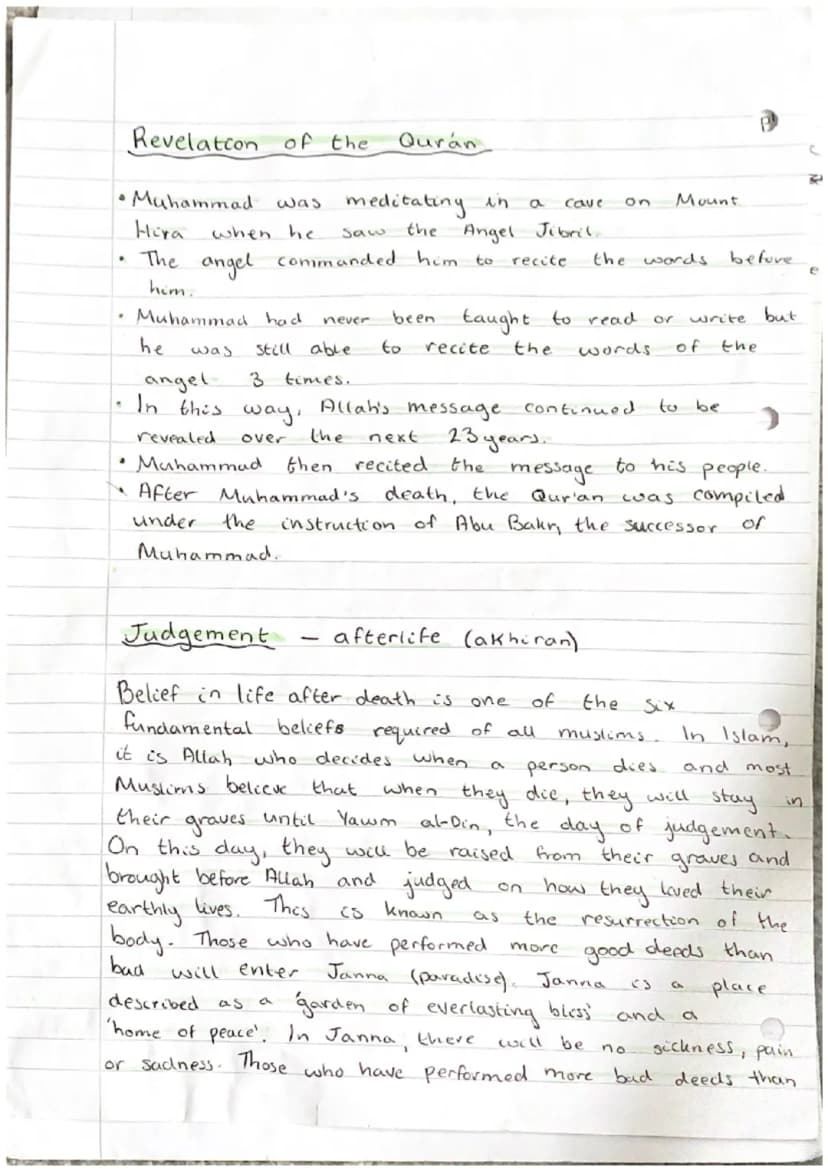
The Revelation of the Quran
The Islamic tradition teaches that the Quran was revealed to Muhammad over a period of 23 years. The process began when Muhammad was meditating in a cave on Mount Hira.
Example: According to Islamic belief, the Angel Jibril (Gabriel) appeared to Muhammad and commanded him to recite. Despite being unable to read, Muhammad was miraculously able to recite the words.
After Muhammad's death, the Quran was compiled under the instruction of Abu Bakr, Muhammad's successor.
Judgment in Islam
Belief in life after death is one of the most fundamental beliefs in Islam. Muslims believe that after death, individuals remain in their graves until the Day of Judgment .
Vocabulary: Akhirah - The Islamic concept of the afterlife
On the Day of Judgment, Muslims believe all people will be resurrected and brought before Allah to be judged based on their earthly lives.
Definition: Janna - The Islamic concept of paradise, described as a garden of everlasting bliss Definition: Jahannam - The Islamic concept of hell, a place of physical and spiritual suffering
Those who have performed more good deeds than bad will enter Janna, while those with more bad deeds will enter Jahannam. However, Muslims believe in Allah's mercy and forgiveness for those who have sincerely repented.
3
of 7
The Five Pillars of Islam
The Five Pillars of Islam are the fundamental practices that every Muslim is expected to fulfill. They are:
-
Shahadah: The declaration of faith and belief in one God (Allah)
-
Salat: Performing set prayers five times daily
-
Zakat: Giving a portion of one's wealth to charity
-
Sawm: Fasting during the month of Ramadan
-
Hajj: Pilgrimage to Mecca at least once in a lifetime, if physically and financially able
Highlight: These pillars form the core of Islamic practice and are considered essential for living a righteous life in accordance with Allah's will.
Each pillar serves a specific purpose in strengthening a Muslim's faith and connection to Allah, as well as fostering a sense of community and social responsibility within the Islamic faith.
Example: Zakat, for instance, not only purifies one's wealth but also helps to reduce economic inequality within society.
Understanding and practicing these pillars is crucial for Muslims seeking to fulfill their religious obligations and draw closer to Allah.
4
of 7
The Afterlife and Divine Judgment
This section explains Islamic beliefs about the afterlife and divine judgment.
Definition:
- Janna: Paradise, described as a garden of everlasting bliss
- Jahannam: Hell, a place of physical and spiritual suffering
Highlight: Allah is described as merciful and compassionate, willing to forgive those who genuinely repent.
The text emphasizes that judgment is based on the balance of good and bad deeds during earthly life.
5
of 7
The Five Pillars of Islam
This section begins to outline What are the 5 pillars of Islam?, though the content is incomplete in the transcript.
Definition:
- Shahadah: Declaration of faith in Allah
- Salat: Performing set prayers
- Zakat: Charitable giving
- Sawm: Fasting
The text introduces the fundamental practices that form the foundation of Islamic faith.
6
of 7
The Quran and Pilgrimage
This section details the significance of the Quran and the pilgrimage to Mecca.
Definition: Ayat refers to verses in the Quran, while Surahs are chapters.
Highlight: The Quran consists of 114 chapters revealed over 23 years.
Example: Hajj must be performed once in a lifetime by those who are physically and financially able.
7
of 7
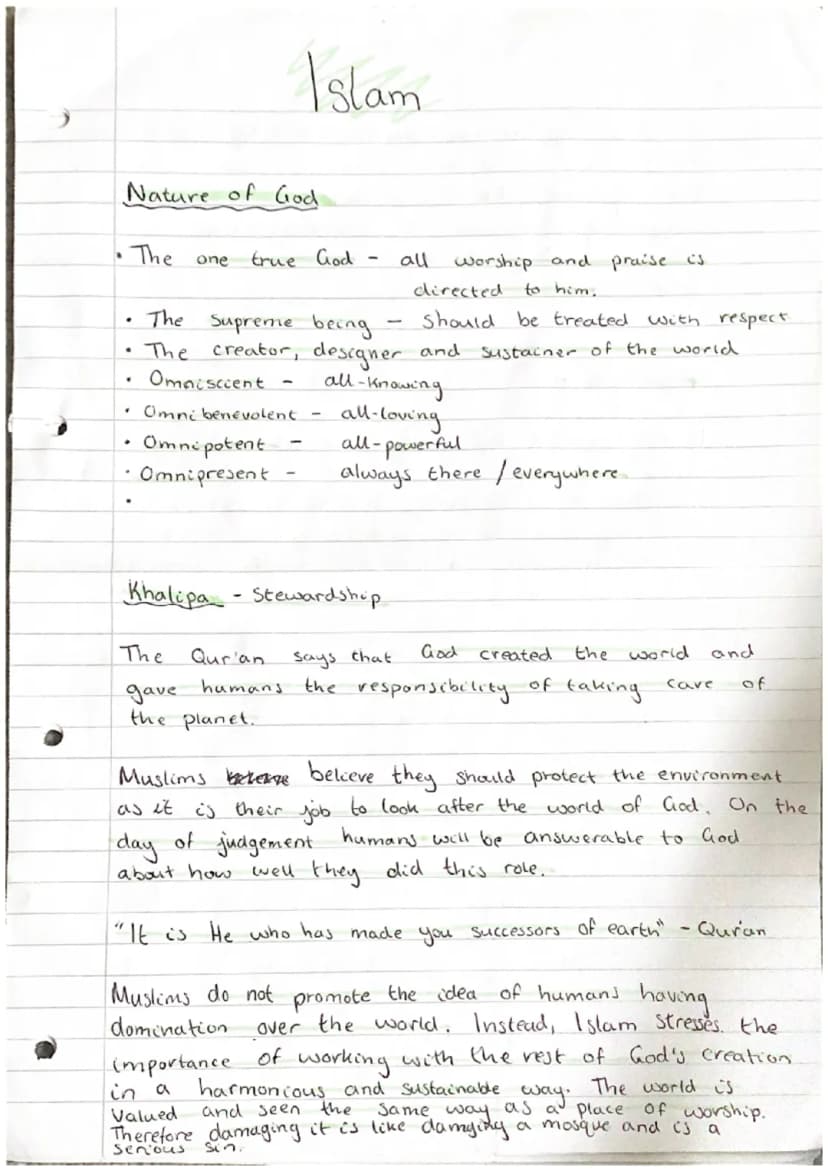
Nature of God in Islam
Islam teaches that Allah is the one true God, possessing supreme attributes:
- Omnipotent
- Omniscient
- Omnipresent (present everywhere)
- Omnibenevolent
As the creator and sustainer of the world, Allah gave humans the responsibility of stewardship (khalifa) over the planet.
Highlight: Muslims believe they must protect the environment as part of their duty to care for Allah's creation. They will be held accountable for this stewardship on Judgment Day.
Quote: "It is He who has made you successors of earth" - Quran
Islam promotes living harmoniously with nature rather than dominating it. The world is viewed as sacred, similar to a place of worship.
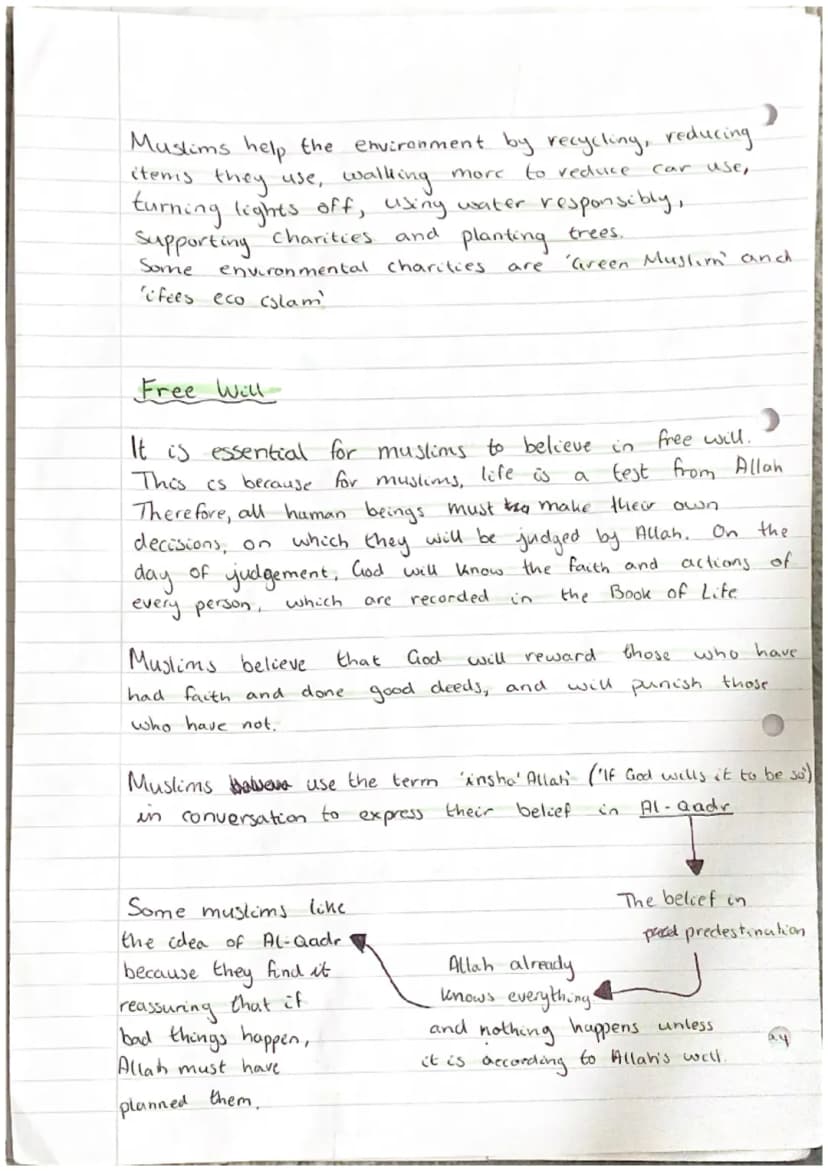
Example: Muslims may help the environment by recycling, reducing consumption, using sustainable transportation, conserving resources, and supporting environmental causes.
Free Will and Predestination in Islam
Free will is an essential Islamic belief, as life is seen as a test from Allah. Humans must make their own choices, which will be judged by Allah.
Vocabulary: Al-Qadr - The Islamic concept of divine destiny or predestination
Some Muslims find comfort in Al-Qadr, believing that even negative events are part of Allah's plan. However, this doesn't negate human responsibility.
Example: Muslims often use the phrase "insha'Allah" (if God wills it) to express their belief in divine predestination.
We thought you’d never ask...
What is the Knowunity AI companion?
Our AI companion is specifically built for the needs of students. Based on the millions of content pieces we have on the platform we can provide truly meaningful and relevant answers to students. But its not only about answers, the companion is even more about guiding students through their daily learning challenges, with personalised study plans, quizzes or content pieces in the chat and 100% personalisation based on the students skills and developments.
Where can I download the Knowunity app?
You can download the app in the Google Play Store and in the Apple App Store.
Is Knowunity really free of charge?
That's right! Enjoy free access to study content, connect with fellow students, and get instant help – all at your fingertips.
Similar Content
 Ethik
Ethik Sosyal Bilgiler
Most popular content: Islam
9Religious StudiesCore Islamic Practices
Explore the essential Islamic practices including the Five Pillars of Islam, the significance of Ramadan, Jihad, and the importance of Hajj. This summary provides insights into key beliefs, rituals, and festivals that shape the Muslim faith, tailored for AQA GCSE Religious Studies. Enhance your understanding of Islamic teachings and community values.
113,943144
Religious StudiesCore Beliefs: Christianity & Islam
Explore the foundational beliefs and practices of Christianity and Islam, including key concepts such as the nature of God, the significance of the Five Pillars of Islam, Christian sacraments, and the importance of festivals. This comprehensive study note includes essential quotes and definitions aligned with the AQA specification, making it an invaluable resource for students preparing for their exams.
114,161114
Religious StudiesCore Islamic Beliefs
Explore the essential beliefs of Islam, including the concepts of Tawhid, Imamate, and the Nature of God. Understand the roles of Angels, Predestination, and Life After Death (Akirah). Learn about Prophethood with key figures like Muhammad, Adam, and Ibrahim, along with insights into Islamic Holy Books. This summary is ideal for GCSE students seeking a comprehensive overview of Islamic teachings.
114299
Religious StudiesUnderstanding Islam: Key Concepts
Explore the essential beliefs and teachings of Islam in this comprehensive study resource. Covering topics such as Tawhid, Prophethood, the Qur'an, and the significance of the afterlife, this guide is designed for GCSE Religious Studies students. Gain insights into the differences between Sunni and Shia beliefs, the Five Pillars of Islam, and the role of prophets. Perfect for exam preparation and deepening your understanding of Islamic faith and practices.
111,00622
Religious StudiesGCSE Edexcel Islam
a summary of the course
123344
Religious StudiesKey Prophets in Islam
Explore the significance of key prophets in Islam, including Adam, Ibrahim, and Muhammad. This summary covers their roles, teachings, and the concept of prophethood (Risalah) in Islamic belief, essential for GCSE Religious Education. Understand the foundational stories and their impact on Islamic teachings and practices.
945810
Religious StudiesCore Islamic Teachings
Explore essential Islamic beliefs, including the roles of prophets, the significance of the Qur'an, and the concepts of predestination and the afterlife. This summary covers key topics such as the Five Pillars of Islam, Sunni and Shia differences, and the nature of God. Ideal for students preparing for exams or seeking a deeper understanding of Islamic faith.
114278
Religious StudiesIslamic Beliefs About Angels
Explore the essential beliefs regarding angels in Islam, including their roles, characteristics, and significance in the afterlife. This summary covers key concepts such as the nature of angels, their functions as messengers, and their involvement in the Day of Judgement. Ideal for GCSE Religious Studies students.
114145
Religious StudiesIslamic Beliefs & Practices
Explore key Islamic teachings, including the Five Pillars, concepts of prophethood, and life after death. This study resource features essential quotes for memorization and practice exam questions (2, 5, 8, and 15 marks) to enhance your understanding and preparation.
112,03543
Most popular content in Religious Studies
9C
Religious StudiesChristianity keywords
Help, remember these keywords with this quiz
95411
I
Religious Studiesislam
you need to do this test supper easy and fun
73500
 Humanities
Religious Studies Quote Bank
Christianity and Islam Paper 1 and Paper 2 Quotes.
1076413
Religious StudiesChristianity: Core Beliefs
Explore essential Christian beliefs including the Nature of God, the Trinity, Creation, Incarnation, Crucifixion, Resurrection, and concepts of Heaven, Hell, and Salvation. This comprehensive summary provides key quotes and insights for AQA GCSE revision.
95,345184
J
Religious StudiesJudaism ✡️
Key concepts in Judaism including the Covenant, Shekhinah, Messiah, and Torah for GCSE Religious Studies.
102410
R
Religious StudiesR.E Judaism questions quiz
Quiz on random Judaism R.E questions
92624
E
Religious StudiesExploring World Religions: A Comprehensive Study Guide
Master the diverse beliefs, practices, and traditions of major world religions with this in-depth study guide for religious studies.
111930
Religious StudiesCatholic Theology: Good & Evil
Explore key concepts in Catholic theology regarding good and evil, including the role of free will, the problem of evil, and the significance of Jesus' crucifixion. This summary provides essential revision notes, quotations, and sources to enhance your understanding of Christian ethics and salvation. Ideal for WJEC Foundation students studying Catholic Christianity.
1046610
C
Religious StudiesChristianity comp 2
Core Christian concepts including evangelism, sacraments, and the resurrection of Jesus.
111370
Most popular content
9 Sociology
Sociology of Education Overview
Explore comprehensive A-Level Sociology notes on the education system, covering key theories, policies, and sociological perspectives. This resource includes insights on marketisation, gender roles, cultural deprivation, and educational inequalities, providing a thorough understanding of how education shapes social stratification and individual achievement. Ideal for exam preparation and in-depth study.
12102,8693,040
SociologySociology of Families: Comprehensive Revision
Dive into an extensive overview of family dynamics, perspectives, and patterns in sociology. This resource covers key concepts such as family diversity, gender roles, marriage, and the impact of social policies on family structures. Perfect for A-Level Sociology students preparing for Paper 2.
1273,6612,307
CriminologyCriminology: Crime & Punishment Overview
Comprehensive mindmaps covering key concepts in the Crime and Punishment topic for WJEC Criminology Unit 4. This resource includes detailed insights into the Criminal Justice System, crime prevention strategies, sentencing models, and the roles of various agencies. Ideal for A-Level revision, ensuring you grasp essential theories and legislative processes to excel in your exams.
1254,8691,059
SociologyComprehensive Crime & Deviance Overview
Explore an extensive revision of crime and deviance topics, including theories, types of crime, and the impact of media. This resource covers key concepts such as Marxism, functionalism, gender and crime, and the influence of globalization on criminal behavior. Ideal for students seeking a thorough understanding of criminology and its various theories. Type: Full Topic Revision.
1251,6541,399
C
 Biology
Cell Biology and Cell structure
cell structures
93,2470
 English Literature
An Inspector Calls: Character Insights
Explore in-depth analysis and key quotes for characters in J.B. Priestley's 'An Inspector Calls'. This resource covers Gerald Croft, Inspector Goole, Sheila Birling, Mrs. Birling, Eric Birling, and Eva Smith, focusing on themes of class, gender roles, and social responsibility. Ideal for students aiming for Grade 8 and above.
1025,429907
CriminologyWJEC Unit 4 Criminology
Criminology unit 4 detailed revision note
127,151125
CriminologyCriminology Theories Overview
Explore key criminology theories and their implications on crime and deviance. This comprehensive summary covers biological, psychological, and sociological perspectives, including labelling theory, right realism, and the impact of social campaigns on policy development. Ideal for A-Level criminology students seeking to understand the complexities of criminal behaviour and the factors influencing crime prevention strategies.
129,760210
English LiteratureRomeo and Juliet: Key themes
Key Romeo and Juliet themes and analysed quotes
106,708198
Can't find what you're looking for? Explore other subjects.
Students love us — and so will you.
4.6/5App Store
4.7/5Google Play
The app is very easy to use and well designed. I have found everything I was looking for so far and have been able to learn a lot from the presentations! I will definitely use the app for a class assignment! And of course it also helps a lot as an inspiration.
Stefan SiOS user
This app is really great. There are so many study notes and help [...]. My problem subject is French, for example, and the app has so many options for help. Thanks to this app, I have improved my French. I would recommend it to anyone.
Samantha KlichAndroid user
Wow, I am really amazed. I just tried the app because I've seen it advertised many times and was absolutely stunned. This app is THE HELP you want for school and above all, it offers so many things, such as workouts and fact sheets, which have been VERY helpful to me personally.
AnnaiOS user
Religious Studies383 views·Updated Jun 22, 2026·7 pagesIslam Notes: 5 Pillars, Angels, and More for Nat 5 RMPS
The Nature of Allah and Islamic Beliefs - A comprehensive guide exploring fundamental Islamic concepts including the nature of Allah, the 5 pillars of Islam, and core religious practices.
• The document extensively covers What is Islam 5...
1
of 7
Sign up to see the content. It's free!
- Access to all documents
- Improve your grades
- Join milions of students
The Seal of the Prophets and Sin in Islam
Muhammad as the Final Prophet
Muhammad is regarded as the Seal of the Prophets in Islam, meaning he is considered the final messenger of Allah. This belief is central to Islamic theology.
Definition: Seal of the Prophets - The concept that Muhammad is the last in the line of prophets, completing and authenticating the prophetic traditions.
Understanding Sin in Islam
In Islamic teaching, sin is defined as an immoral act against God. Muslims believe that on the Day of Judgment, Allah will weigh an individual's good deeds against their sins.
Highlight: Those whose evil deeds outweigh their good deeds will face punishment.
Muhammad as a Role Model
Prophet Muhammad is viewed as the ideal role model for all Muslims. He is believed to have embodied the best human values and encouraged respect for all people, regardless of their background.
Quote: The Quran describes Muhammad as a "beautiful pattern" for believers to follow.
Muslims are instructed to emulate Muhammad's example as a way of submitting to Allah and living according to the Quran's teachings.
2
of 7Sign up to see the content. It's free!
- Access to all documents
- Improve your grades
- Join milions of students
Revelation and Judgment in Islam
The Revelation of the Quran
The Islamic tradition teaches that the Quran was revealed to Muhammad over a period of 23 years. The process began when Muhammad was meditating in a cave on Mount Hira.
Example: According to Islamic belief, the Angel Jibril (Gabriel) appeared to Muhammad and commanded him to recite. Despite being unable to read, Muhammad was miraculously able to recite the words.
After Muhammad's death, the Quran was compiled under the instruction of Abu Bakr, Muhammad's successor.
Judgment in Islam
Belief in life after death is one of the most fundamental beliefs in Islam. Muslims believe that after death, individuals remain in their graves until the Day of Judgment .
Vocabulary: Akhirah - The Islamic concept of the afterlife
On the Day of Judgment, Muslims believe all people will be resurrected and brought before Allah to be judged based on their earthly lives.
Definition: Janna - The Islamic concept of paradise, described as a garden of everlasting bliss Definition: Jahannam - The Islamic concept of hell, a place of physical and spiritual suffering
Those who have performed more good deeds than bad will enter Janna, while those with more bad deeds will enter Jahannam. However, Muslims believe in Allah's mercy and forgiveness for those who have sincerely repented.
3
of 7Sign up to see the content. It's free!
- Access to all documents
- Improve your grades
- Join milions of students
The Five Pillars of Islam
The Five Pillars of Islam are the fundamental practices that every Muslim is expected to fulfill. They are:
-
Shahadah: The declaration of faith and belief in one God (Allah)
-
Salat: Performing set prayers five times daily
-
Zakat: Giving a portion of one's wealth to charity
-
Sawm: Fasting during the month of Ramadan
-
Hajj: Pilgrimage to Mecca at least once in a lifetime, if physically and financially able
Highlight: These pillars form the core of Islamic practice and are considered essential for living a righteous life in accordance with Allah's will.
Each pillar serves a specific purpose in strengthening a Muslim's faith and connection to Allah, as well as fostering a sense of community and social responsibility within the Islamic faith.
Example: Zakat, for instance, not only purifies one's wealth but also helps to reduce economic inequality within society.
Understanding and practicing these pillars is crucial for Muslims seeking to fulfill their religious obligations and draw closer to Allah.
4
of 7Sign up to see the content. It's free!
- Access to all documents
- Improve your grades
- Join milions of students
The Afterlife and Divine Judgment
This section explains Islamic beliefs about the afterlife and divine judgment.
Definition:
- Janna: Paradise, described as a garden of everlasting bliss
- Jahannam: Hell, a place of physical and spiritual suffering
Highlight: Allah is described as merciful and compassionate, willing to forgive those who genuinely repent.
The text emphasizes that judgment is based on the balance of good and bad deeds during earthly life.
5
of 7Sign up to see the content. It's free!
- Access to all documents
- Improve your grades
- Join milions of students
The Five Pillars of Islam
This section begins to outline What are the 5 pillars of Islam?, though the content is incomplete in the transcript.
Definition:
- Shahadah: Declaration of faith in Allah
- Salat: Performing set prayers
- Zakat: Charitable giving
- Sawm: Fasting
The text introduces the fundamental practices that form the foundation of Islamic faith.
6
of 7Sign up to see the content. It's free!
- Access to all documents
- Improve your grades
- Join milions of students
The Quran and Pilgrimage
This section details the significance of the Quran and the pilgrimage to Mecca.
Definition: Ayat refers to verses in the Quran, while Surahs are chapters.
Highlight: The Quran consists of 114 chapters revealed over 23 years.
Example: Hajj must be performed once in a lifetime by those who are physically and financially able.
7
of 7Sign up to see the content. It's free!
- Access to all documents
- Improve your grades
- Join milions of students
Nature of God in Islam
Islam teaches that Allah is the one true God, possessing supreme attributes:
- Omnipotent
- Omniscient
- Omnipresent (present everywhere)
- Omnibenevolent
As the creator and sustainer of the world, Allah gave humans the responsibility of stewardship (khalifa) over the planet.
Highlight: Muslims believe they must protect the environment as part of their duty to care for Allah's creation. They will be held accountable for this stewardship on Judgment Day.
Quote: "It is He who has made you successors of earth" - Quran
Islam promotes living harmoniously with nature rather than dominating it. The world is viewed as sacred, similar to a place of worship.
Example: Muslims may help the environment by recycling, reducing consumption, using sustainable transportation, conserving resources, and supporting environmental causes.
Free Will and Predestination in Islam
Free will is an essential Islamic belief, as life is seen as a test from Allah. Humans must make their own choices, which will be judged by Allah.
Vocabulary: Al-Qadr - The Islamic concept of divine destiny or predestination
Some Muslims find comfort in Al-Qadr, believing that even negative events are part of Allah's plan. However, this doesn't negate human responsibility.
Example: Muslims often use the phrase "insha'Allah" (if God wills it) to express their belief in divine predestination.
We thought you’d never ask...
What is the Knowunity AI companion?
Our AI companion is specifically built for the needs of students. Based on the millions of content pieces we have on the platform we can provide truly meaningful and relevant answers to students. But its not only about answers, the companion is even more about guiding students through their daily learning challenges, with personalised study plans, quizzes or content pieces in the chat and 100% personalisation based on the students skills and developments.
Where can I download the Knowunity app?
You can download the app in the Google Play Store and in the Apple App Store.
Is Knowunity really free of charge?
That's right! Enjoy free access to study content, connect with fellow students, and get instant help – all at your fingertips.
Similar Content
Most popular content: Islam
9Religious StudiesCore Islamic Practices
Explore the essential Islamic practices including the Five Pillars of Islam, the significance of Ramadan, Jihad, and the importance of Hajj. This summary provides insights into key beliefs, rituals, and festivals that shape the Muslim faith, tailored for AQA GCSE Religious Studies. Enhance your understanding of Islamic teachings and community values.
113,943144
Religious StudiesCore Beliefs: Christianity & Islam
Explore the foundational beliefs and practices of Christianity and Islam, including key concepts such as the nature of God, the significance of the Five Pillars of Islam, Christian sacraments, and the importance of festivals. This comprehensive study note includes essential quotes and definitions aligned with the AQA specification, making it an invaluable resource for students preparing for their exams.
114,161114
Religious StudiesCore Islamic Beliefs
Explore the essential beliefs of Islam, including the concepts of Tawhid, Imamate, and the Nature of God. Understand the roles of Angels, Predestination, and Life After Death (Akirah). Learn about Prophethood with key figures like Muhammad, Adam, and Ibrahim, along with insights into Islamic Holy Books. This summary is ideal for GCSE students seeking a comprehensive overview of Islamic teachings.
114299
Religious StudiesUnderstanding Islam: Key Concepts
Explore the essential beliefs and teachings of Islam in this comprehensive study resource. Covering topics such as Tawhid, Prophethood, the Qur'an, and the significance of the afterlife, this guide is designed for GCSE Religious Studies students. Gain insights into the differences between Sunni and Shia beliefs, the Five Pillars of Islam, and the role of prophets. Perfect for exam preparation and deepening your understanding of Islamic faith and practices.
111,00622
Religious StudiesGCSE Edexcel Islam
a summary of the course
123344
Religious StudiesKey Prophets in Islam
Explore the significance of key prophets in Islam, including Adam, Ibrahim, and Muhammad. This summary covers their roles, teachings, and the concept of prophethood (Risalah) in Islamic belief, essential for GCSE Religious Education. Understand the foundational stories and their impact on Islamic teachings and practices.
945810
Religious StudiesCore Islamic Teachings
Explore essential Islamic beliefs, including the roles of prophets, the significance of the Qur'an, and the concepts of predestination and the afterlife. This summary covers key topics such as the Five Pillars of Islam, Sunni and Shia differences, and the nature of God. Ideal for students preparing for exams or seeking a deeper understanding of Islamic faith.
114278
Religious StudiesIslamic Beliefs About Angels
Explore the essential beliefs regarding angels in Islam, including their roles, characteristics, and significance in the afterlife. This summary covers key concepts such as the nature of angels, their functions as messengers, and their involvement in the Day of Judgement. Ideal for GCSE Religious Studies students.
114145
Religious StudiesIslamic Beliefs & Practices
Explore key Islamic teachings, including the Five Pillars, concepts of prophethood, and life after death. This study resource features essential quotes for memorization and practice exam questions (2, 5, 8, and 15 marks) to enhance your understanding and preparation.
112,03543
Most popular content in Religious Studies
9C
Religious StudiesChristianity keywords
Help, remember these keywords with this quiz
95411
I
Religious Studiesislam
you need to do this test supper easy and fun
73500
HumanitiesReligious Studies Quote Bank
Christianity and Islam Paper 1 and Paper 2 Quotes.
1076413
Religious StudiesChristianity: Core Beliefs
Explore essential Christian beliefs including the Nature of God, the Trinity, Creation, Incarnation, Crucifixion, Resurrection, and concepts of Heaven, Hell, and Salvation. This comprehensive summary provides key quotes and insights for AQA GCSE revision.
95,345184
J
Religious StudiesJudaism ✡️
Key concepts in Judaism including the Covenant, Shekhinah, Messiah, and Torah for GCSE Religious Studies.
102410
R
Religious StudiesR.E Judaism questions quiz
Quiz on random Judaism R.E questions
92624
E
Religious StudiesExploring World Religions: A Comprehensive Study Guide
Master the diverse beliefs, practices, and traditions of major world religions with this in-depth study guide for religious studies.
111930
Religious StudiesCatholic Theology: Good & Evil
Explore key concepts in Catholic theology regarding good and evil, including the role of free will, the problem of evil, and the significance of Jesus' crucifixion. This summary provides essential revision notes, quotations, and sources to enhance your understanding of Christian ethics and salvation. Ideal for WJEC Foundation students studying Catholic Christianity.
1046610
C
Religious StudiesChristianity comp 2
Core Christian concepts including evangelism, sacraments, and the resurrection of Jesus.
111370
Most popular content
9SociologySociology of Education Overview
Explore comprehensive A-Level Sociology notes on the education system, covering key theories, policies, and sociological perspectives. This resource includes insights on marketisation, gender roles, cultural deprivation, and educational inequalities, providing a thorough understanding of how education shapes social stratification and individual achievement. Ideal for exam preparation and in-depth study.
12102,8693,040
SociologySociology of Families: Comprehensive Revision
Dive into an extensive overview of family dynamics, perspectives, and patterns in sociology. This resource covers key concepts such as family diversity, gender roles, marriage, and the impact of social policies on family structures. Perfect for A-Level Sociology students preparing for Paper 2.
1273,6612,307
CriminologyCriminology: Crime & Punishment Overview
Comprehensive mindmaps covering key concepts in the Crime and Punishment topic for WJEC Criminology Unit 4. This resource includes detailed insights into the Criminal Justice System, crime prevention strategies, sentencing models, and the roles of various agencies. Ideal for A-Level revision, ensuring you grasp essential theories and legislative processes to excel in your exams.
1254,8691,059
SociologyComprehensive Crime & Deviance Overview
Explore an extensive revision of crime and deviance topics, including theories, types of crime, and the impact of media. This resource covers key concepts such as Marxism, functionalism, gender and crime, and the influence of globalization on criminal behavior. Ideal for students seeking a thorough understanding of criminology and its various theories. Type: Full Topic Revision.
1251,6541,399
C
BiologyCell Biology and Cell structure
cell structures
93,2470
English LiteratureAn Inspector Calls: Character Insights
Explore in-depth analysis and key quotes for characters in J.B. Priestley's 'An Inspector Calls'. This resource covers Gerald Croft, Inspector Goole, Sheila Birling, Mrs. Birling, Eric Birling, and Eva Smith, focusing on themes of class, gender roles, and social responsibility. Ideal for students aiming for Grade 8 and above.
1025,429907
CriminologyWJEC Unit 4 Criminology
Criminology unit 4 detailed revision note
127,151125
CriminologyCriminology Theories Overview
Explore key criminology theories and their implications on crime and deviance. This comprehensive summary covers biological, psychological, and sociological perspectives, including labelling theory, right realism, and the impact of social campaigns on policy development. Ideal for A-Level criminology students seeking to understand the complexities of criminal behaviour and the factors influencing crime prevention strategies.
129,760210
English LiteratureRomeo and Juliet: Key themes
Key Romeo and Juliet themes and analysed quotes
106,708198
Can't find what you're looking for? Explore other subjects.
Students love us — and so will you.
4.6/5App Store
4.7/5Google Play
The app is very easy to use and well designed. I have found everything I was looking for so far and have been able to learn a lot from the presentations! I will definitely use the app for a class assignment! And of course it also helps a lot as an inspiration.
Stefan SiOS user
This app is really great. There are so many study notes and help [...]. My problem subject is French, for example, and the app has so many options for help. Thanks to this app, I have improved my French. I would recommend it to anyone.
Samantha KlichAndroid user
Wow, I am really amazed. I just tried the app because I've seen it advertised many times and was absolutely stunned. This app is THE HELP you want for school and above all, it offers so many things, such as workouts and fact sheets, which have been VERY helpful to me personally.
AnnaiOS user