

Personality theories explain how our characteristics develop and influence our...
 Psychology17 views·Updated Jun 8, 2026·14 pages
Understanding Socio-Cognitive Theories
1 / 10
1
of 10
Theories of Personality: Socio-Cognitive Theories
Socio-cognitive theories explore how our personality develops through the interaction of social, cognitive, and behavioral learning variables. Unlike other approaches that might focus on just one aspect, these theories recognize that personality forms through a complex interplay of factors.
These theories help explain why your personality isn't fixed but can change based on your experiences and the environments you choose.
2
of 10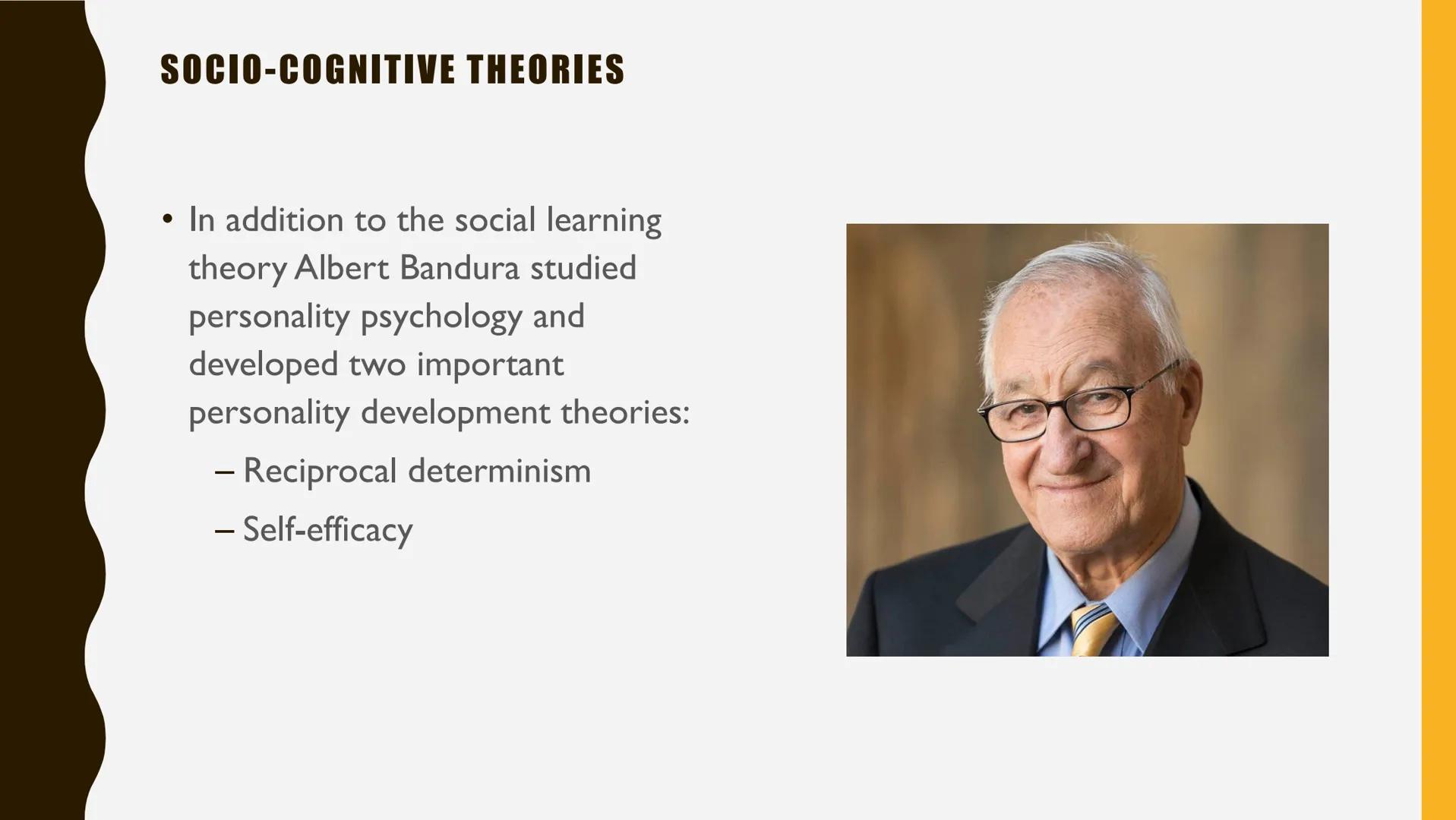
Socio-Cognitive Theories
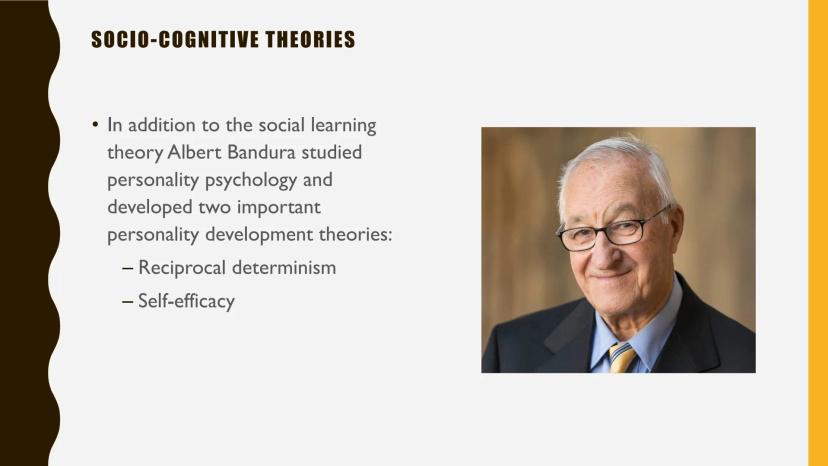
Albert Bandura made major contributions to our understanding of personality through two important theories: reciprocal determinism and self-efficacy. These concepts go beyond basic social learning to explain how we develop our unique traits.
Bandura's work shows that we're not just passive recipients of environmental influences. Instead, we actively participate in shaping our personality through our choices and beliefs.
Did you know? Bandura's theories challenged earlier views that personality is mostly fixed early in life, showing instead that we continue to develop throughout our lives.
3
of 10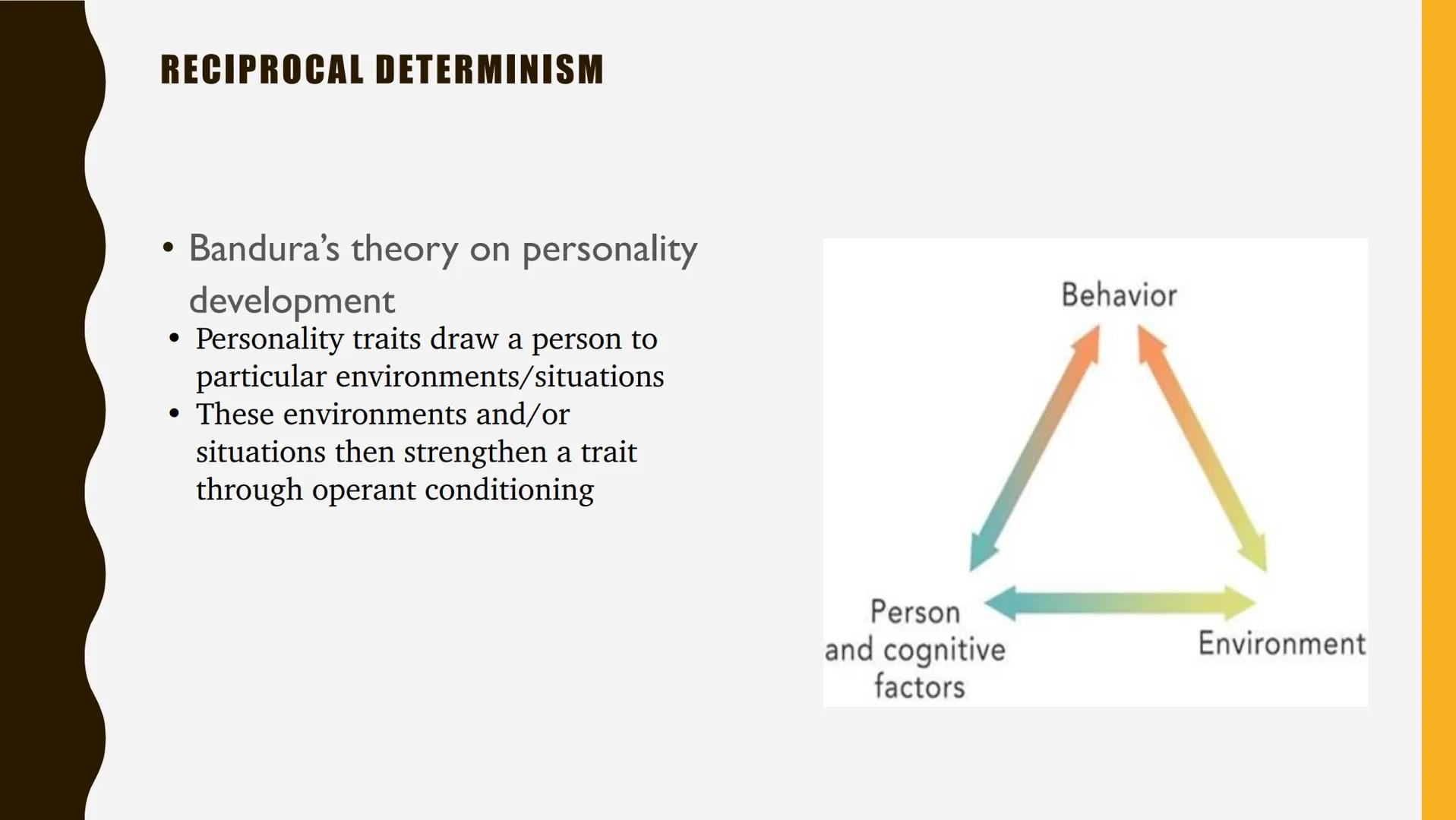
Reciprocal Determinism
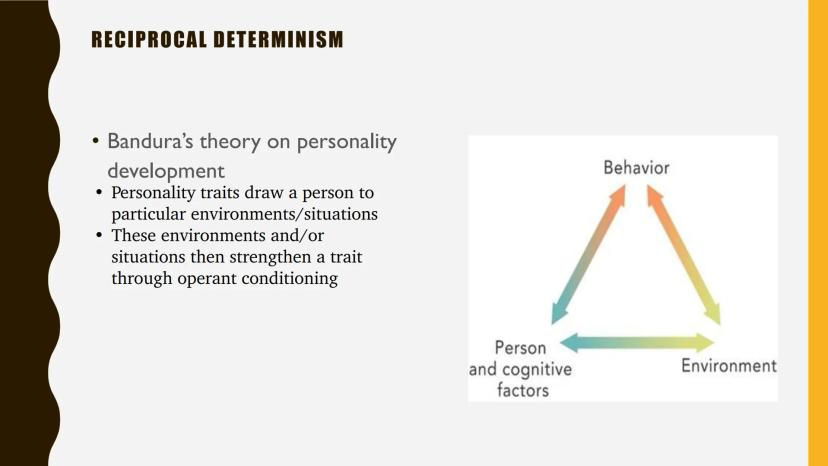
Reciprocal determinism is Bandura's theory explaining how personality develops through a three-way relationship. Your personality traits draw you toward certain environments, and those environments then strengthen those traits through reinforcement.
This creates a continuous cycle where your personal factors, behaviors, and environment all influence each other. For example, if you're naturally creative, you might join an art club, which then further develops your creativity.
The three components—person/cognitive factors, behavior, and environment—work together in a triangle of influence, constantly shaping and reshaping your personality.
4
of 10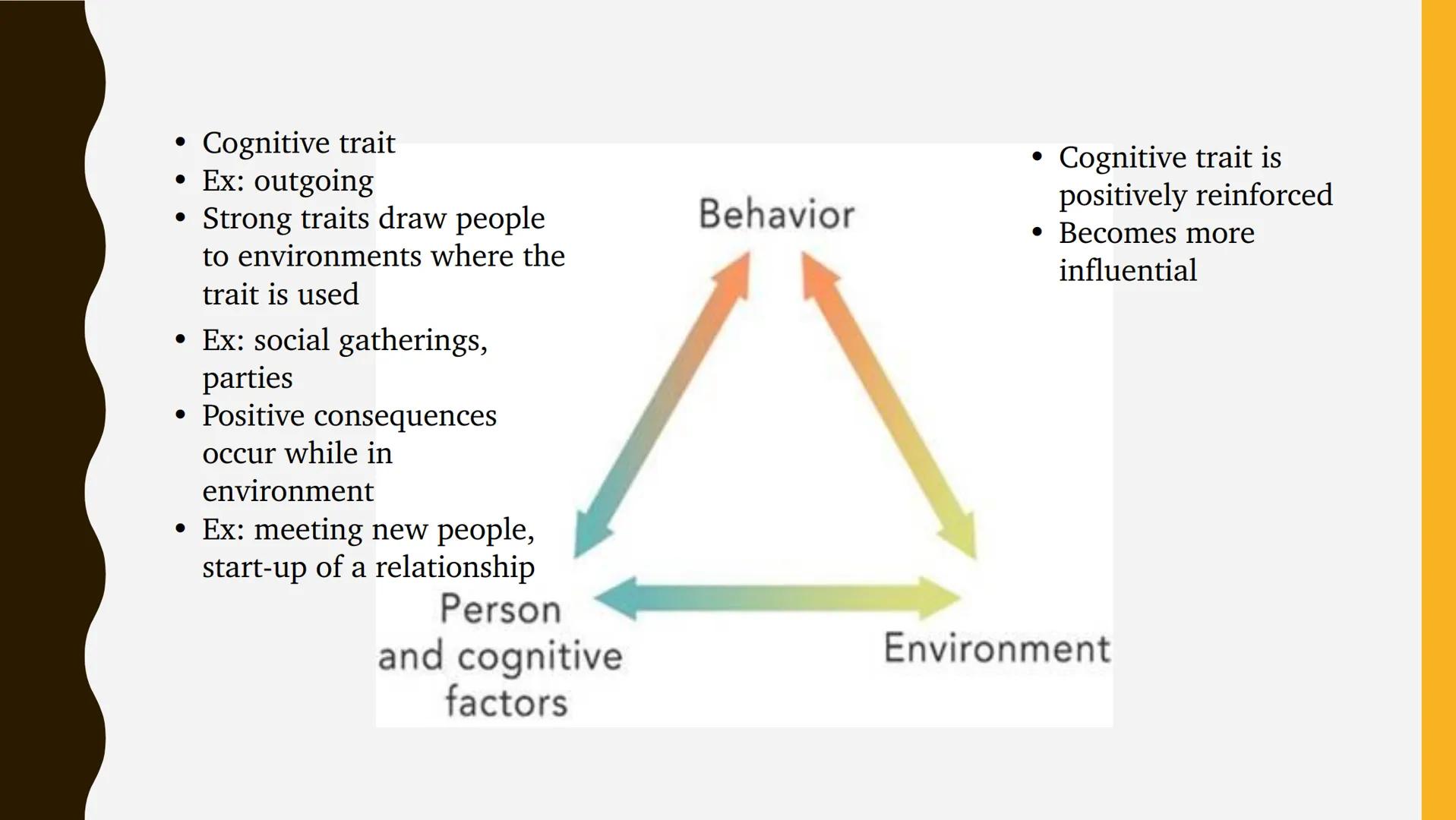
Reciprocal Determinism Example
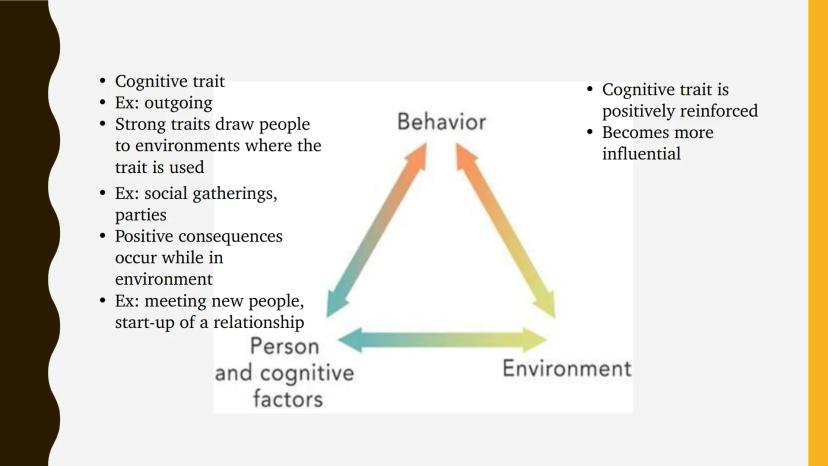
Here's how reciprocal determinism works in real life: If you have the cognitive trait of being outgoing, you'll likely be drawn to social environments like parties or gatherings. These are places where your outgoing nature can shine.
While in these social settings, you experience positive consequences—maybe you meet interesting people or start new relationships. These positive experiences serve as reinforcement for your outgoing behavior.
Over time, this positive reinforcement strengthens your outgoing trait, making it more influential in your personality. This creates a cycle where your trait leads to environments that further reinforce that trait.
Think about it: What personality trait do you have that leads you to certain environments, and how do those environments strengthen that trait?
5
of 10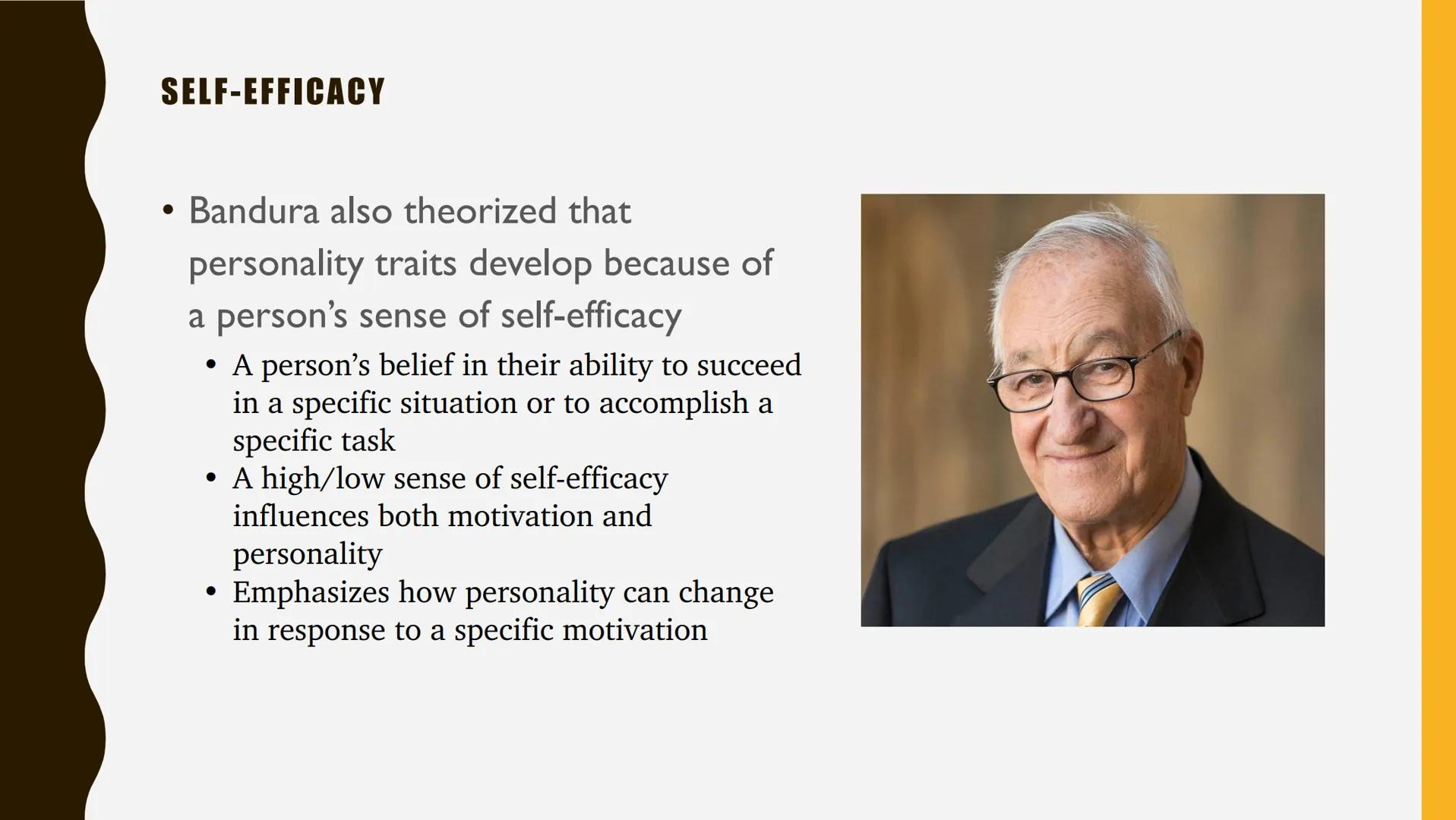
Self-Efficacy
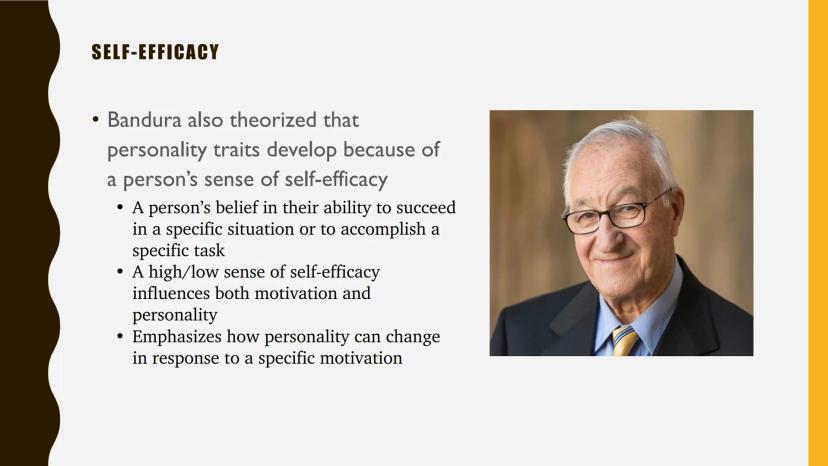
Self-efficacy is another key concept from Bandura, referring to your belief in your ability to succeed at specific tasks. This isn't about general confidence but rather your belief in your capabilities in particular situations.
Your sense of self-efficacy has a major impact on your motivation and personality development. Someone with high self-efficacy approaches challenges differently than someone with low self-efficacy.
What makes self-efficacy especially interesting is that it can vary across different areas of your life. You might have high self-efficacy for math but low self-efficacy for public speaking, showing how personality can be situation-specific.
6
of 10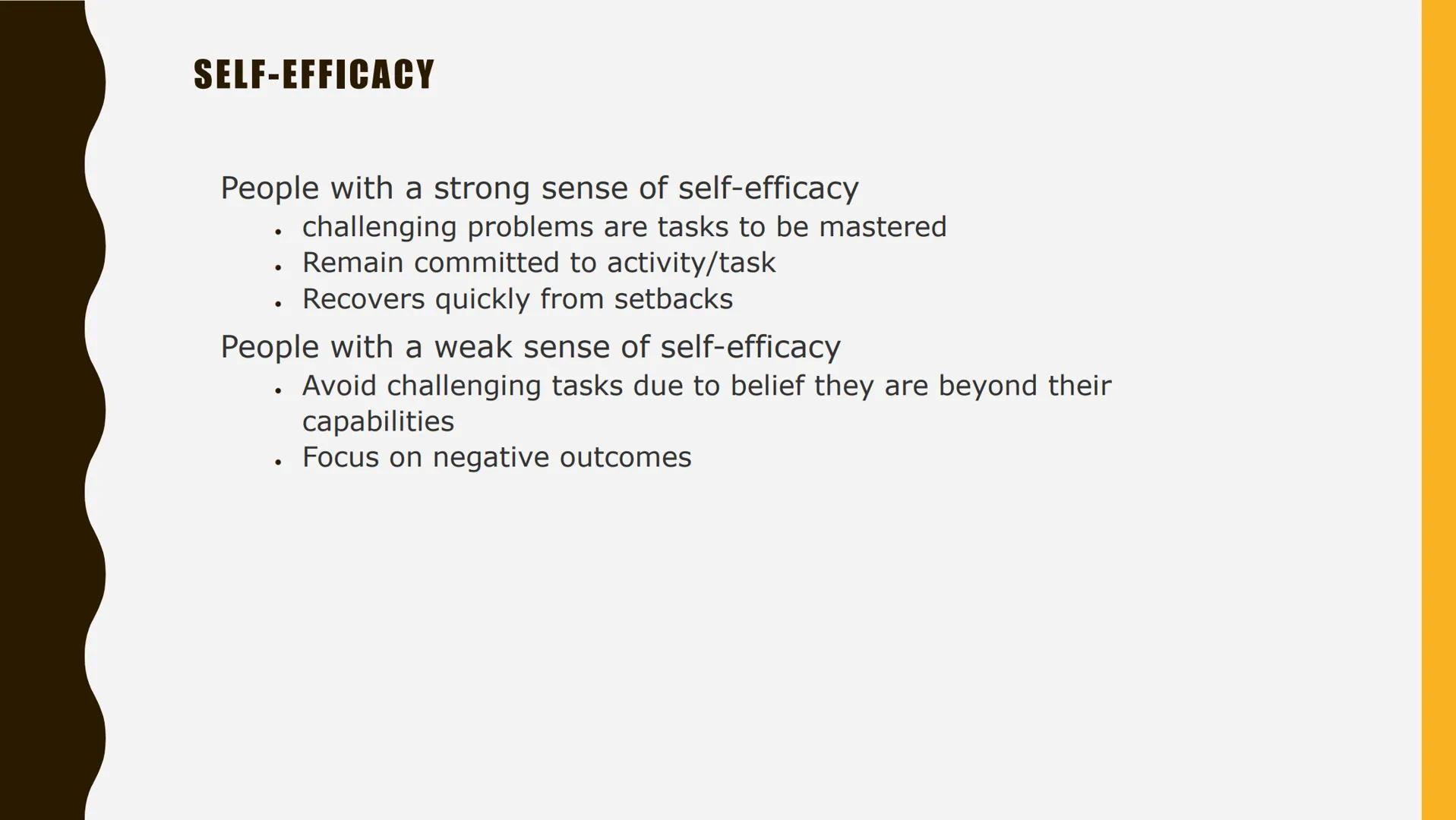
Self-Efficacy Differences
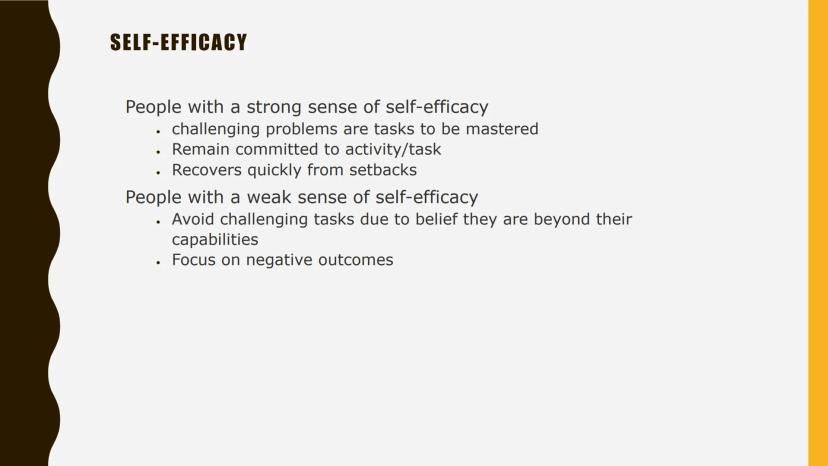
People with strong self-efficacy view challenging problems as opportunities to master new skills rather than threats to avoid. They stay committed to activities even when things get tough and bounce back quickly from setbacks.
In contrast, those with weak self-efficacy tend to avoid challenging tasks because they believe these tasks exceed their capabilities. They focus on potential negative outcomes rather than possibilities for success.
These differences in self-efficacy can dramatically affect life choices, from which classes you take to what career you pursue. Your belief in your abilities often becomes a self-fulfilling prophecy.
Boost your confidence: Self-efficacy can be strengthened! Try tackling small challenges successfully to build up your belief in your abilities.
7
of 10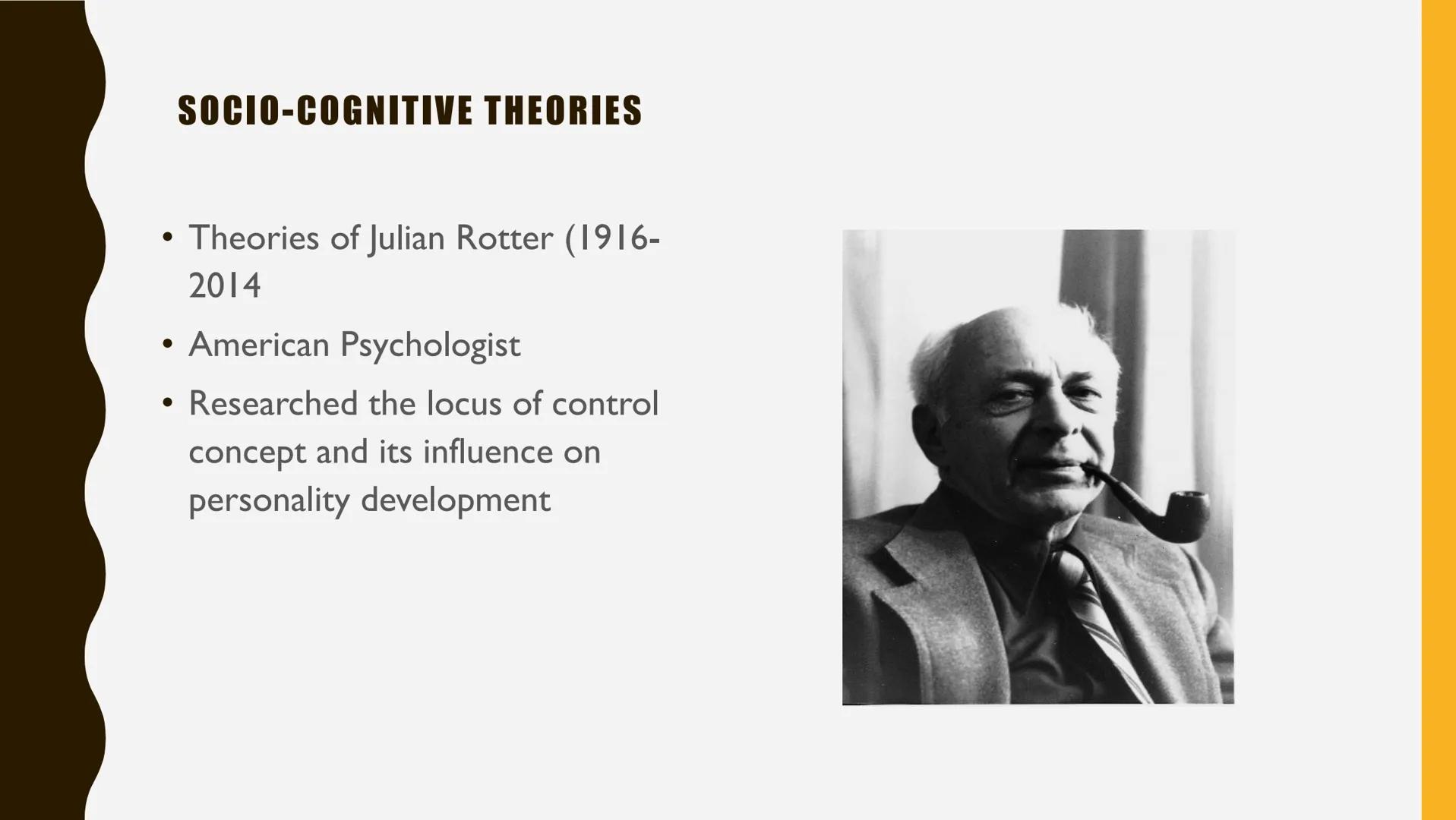
Socio-Cognitive Theories
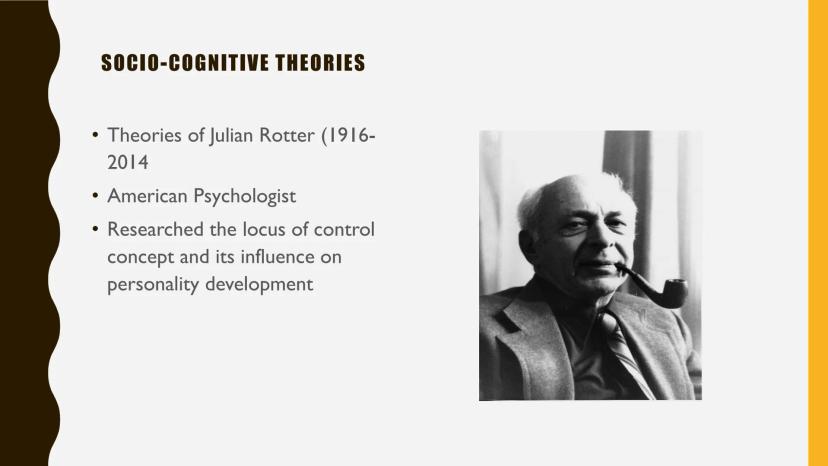
Julian Rotter (1916-2014), an American psychologist, made significant contributions to personality psychology through his research on locus of control. This concept helps explain why some people feel in charge of their lives while others feel like things just happen to them.
Rotter's work complements Bandura's theories by adding another dimension to how we understand personality development. While Bandura focused on self-belief and environmental interactions, Rotter examined how our beliefs about control influence our behavior.
8
of 10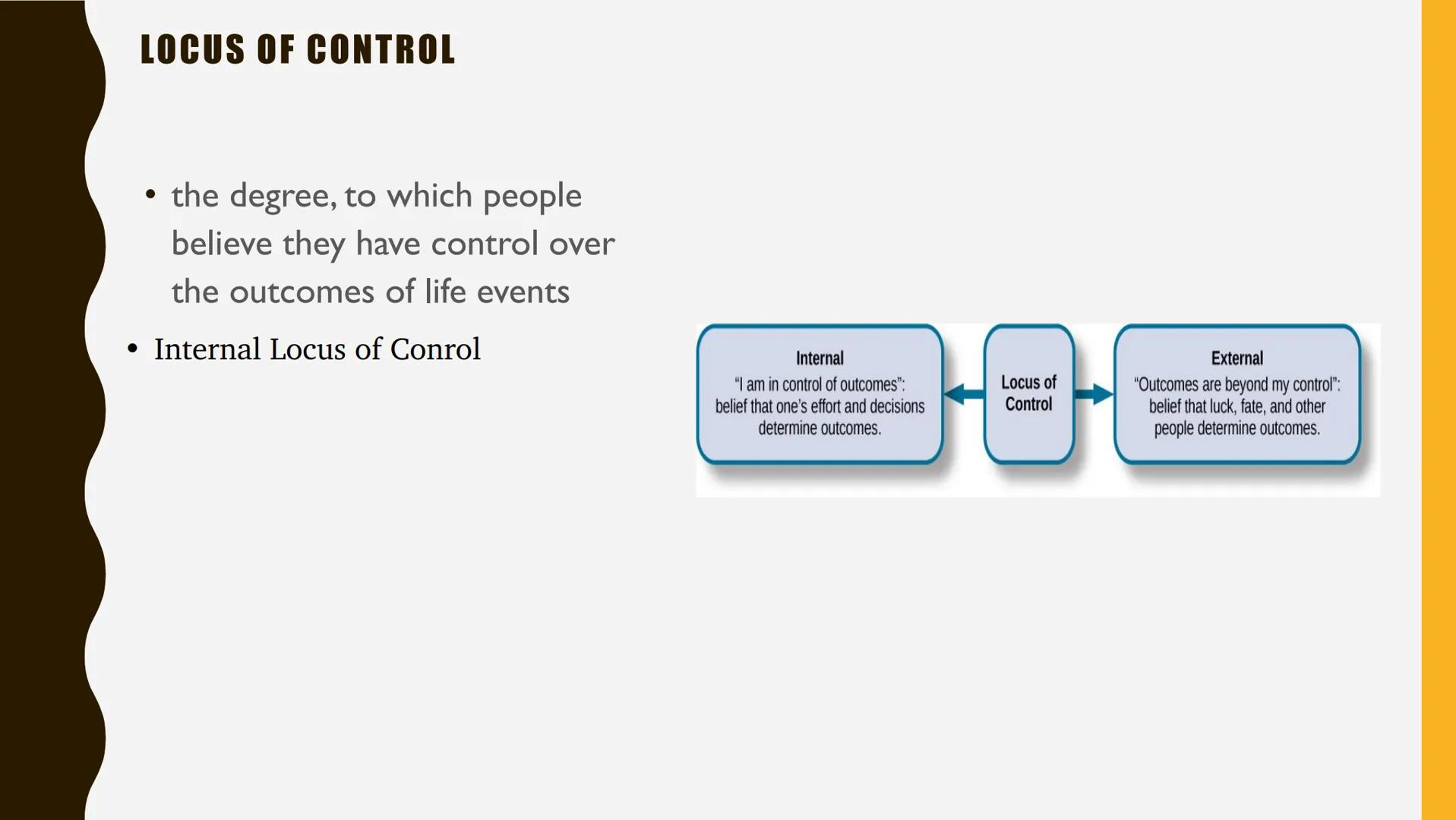
Locus of Control
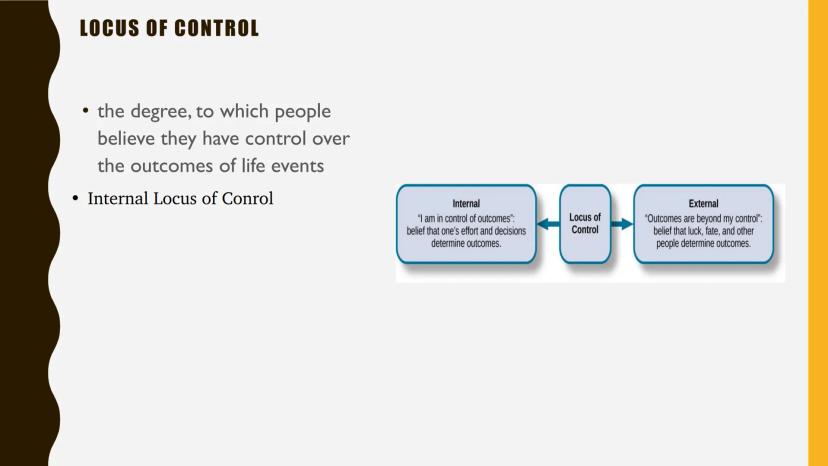
Locus of control refers to how much you believe you can control the outcomes in your life. It exists on a spectrum between internal and external orientation.
People with an internal locus of control believe "I am in control of outcomes" and see their own efforts and decisions as determining what happens to them. They tend to take more responsibility for their situations.
Those with an external locus of control believe "Outcomes are beyond my control" and attribute results to luck, fate, or other people's actions. They often feel less personal responsibility for what happens in their lives.
Reality check: Most people fall somewhere on the spectrum between completely internal or external, and your locus of control can vary in different areas of life.
9
of 10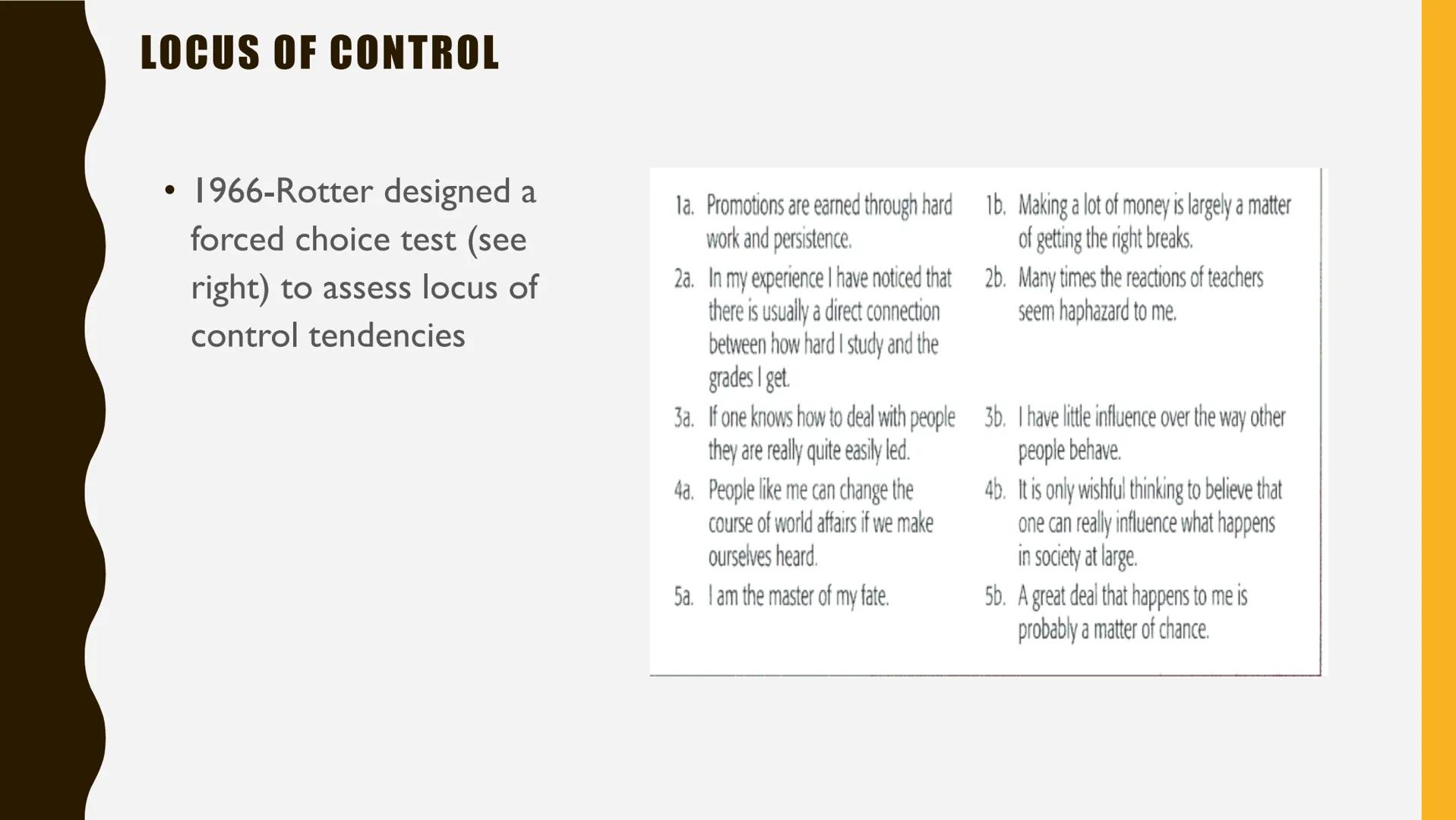
Locus of Control Assessment
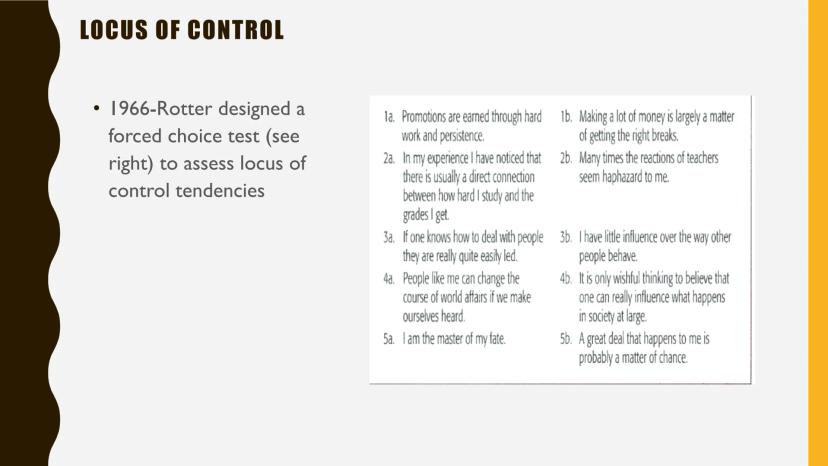
In 1966, Rotter developed a forced-choice test to measure where people fall on the locus of control spectrum. The test presents pairs of statements like "Promotions are earned through hard work" versus "Making money is largely about getting breaks."
Your pattern of responses reveals your tendency toward either an internal or external orientation. For example, agreeing more with statements like "I am the master of my fate" suggests an internal locus of control.
This assessment helps you understand how you interpret events in your life. Do you see yourself as actively creating outcomes, or do you view yourself as subject to external forces beyond your control?
10
of 10
Locus of Control Application
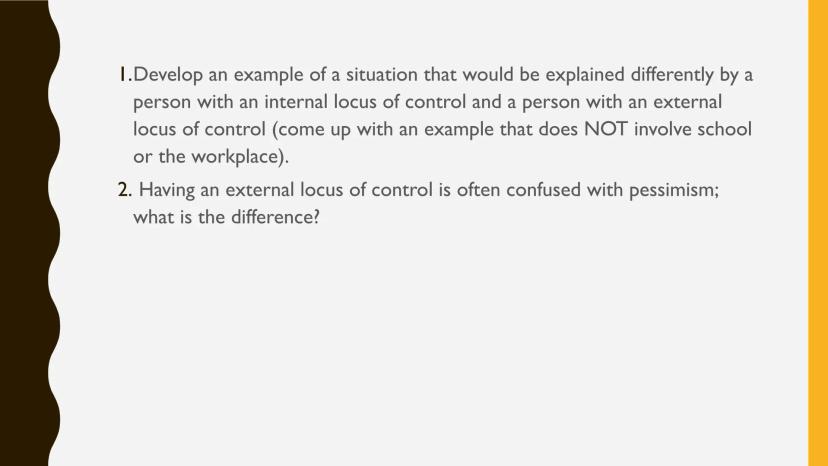
Consider how locus of control might explain different reactions to losing a sports game. Someone with an internal locus might think, "I need to practice more specific skills to improve," while someone with an external locus might say, "The referee made unfair calls."
It's important to note that having an external locus of control is not the same as pessimism. Pessimism is a negative outlook expecting bad outcomes, while an external locus simply attributes causes to outside forces—these could be positive (good luck) or negative (bad luck).
Understanding your own locus of control can help you recognize patterns in how you respond to successes and failures in your life.
We thought you’d never ask...
What is the Knowunity AI companion?
Our AI companion is specifically built for the needs of students. Based on the millions of content pieces we have on the platform we can provide truly meaningful and relevant answers to students. But its not only about answers, the companion is even more about guiding students through their daily learning challenges, with personalised study plans, quizzes or content pieces in the chat and 100% personalisation based on the students skills and developments.
Where can I download the Knowunity app?
You can download the app in the Google Play Store and in the Apple App Store.
Is Knowunity really free of charge?
That's right! Enjoy free access to study content, connect with fellow students, and get instant help – all at your fingertips.
Similar Content
 Psychology
Most popular content in Psychology
7PsychologyPsychology 101 Notes
Notes: Chapters 1, 2, 3, 5, 6, 7, 8, 9
2,441103
Psychologybipolar disorder psyc353
adult psychopathology lecture notes
875
PsychologyPsychology | Chapter 8: Lifespan Development
Study guide on chapter 8, theories on how people develop over a lifetime. Information was from the textbook Introduction to Psychology by Hawkes Learning and supplemented by my professor's resources.
895
PsychologyPsychology - Somatic Symptom and Related Disorders
a presentation deck on somatic symptom disorders, including illness anxiety disorder, conversion disorder and somatic symptom disorders. featuring visuals from osmosis, "crazyhead comics", verywell and even never have i ever lol
11th271
Psychologyeating disorders psyc353
adult psychopathology lecture notes
964
PsychologyAp Psychology Unit 1
Scientific foundations of Psychology
10th1,11753
PsychologySchizophrenia and Psychosis PSYC353
Adult psychopathology lecture notes
12310
Most popular content
9O
 AP US History
Origins and Dynamics of the Columbian Exchange
Analyze the ecological and economic motivations behind the initial transfer of goods, people, and diseases between the Old and New Worlds.
9th3,1280
I
AP US HistoryIntroduction to Early Cultural Interactions
Analyze the initial social and religious encounters between Europeans, Africans, and Indigenous peoples in the colonial Americas.
9th2,7730
O
 AP World History
Origins of Ancient River Civilizations
Analyze the environmental factors and technological innovations that led to the rise of early states in Mesopotamia, Egypt, and the Indus Valley.
9th3,1870
M
AP US HistoryMotivations for European Exploration
Analyze the economic, religious, and political factors that drove European powers to the Americas during the 15th and 16th centuries.
9th1,7780
F
 AP Psychology
Foundations of Ethical Guidelines in Research
Practice the core principles of the APA ethical code including informed consent, debriefing, and the role of Institutional Review Boards.
9th1,3360
I
AP US HistoryIntroduction to Native American Societies
Examine the diverse social, political, and economic structures of North American indigenous groups prior to European contact.
9th1,1100
I
 AP Biology
Introduction to Biological Elements of Life
Practice identifying the essential elements including carbon, nitrogen, phosphorus, and sulfur that compose biological macromolecules.
9th1,7390
I
AP US HistoryIntroduction to the Spanish Encomienda System
Explore the fundamental economic and social structures of the Spanish colonial system, focusing on the encomienda and the casta social hierarchy.
9th8890
O
AP World HistoryOrigins and Continuity of the Byzantine Empire
Analyze the political and cultural transitions from the Roman Empire to the Byzantine Empire, focusing on the reign of Justinian I and his code.
9th1,6320
Can't find what you're looking for? Explore other subjects.
Students love us — and so will you.
4.6/5App Store
4.7/5Google Play
The app is very easy to use and well designed. I have found everything I was looking for so far and have been able to learn a lot from the presentations! I will definitely use the app for a class assignment! And of course it also helps a lot as an inspiration.
Stefan SiOS user
This app is really great. There are so many study notes and help [...]. My problem subject is French, for example, and the app has so many options for help. Thanks to this app, I have improved my French. I would recommend it to anyone.
Samantha KlichAndroid user
Wow, I am really amazed. I just tried the app because I've seen it advertised many times and was absolutely stunned. This app is THE HELP you want for school and above all, it offers so many things, such as workouts and fact sheets, which have been VERY helpful to me personally.
AnnaiOS user
Psychology17 views·Updated Jun 8, 2026·14 pagesUnderstanding Socio-Cognitive Theories
Personality theories explain how our characteristics develop and influence our behavior. The socio-cognitive and trait theories focus on how our thoughts, environments, and behaviors interact to shape who we become. These theories help explain why people respond differently to the...
1
of 10
Sign up to see the content. It's free!
- Access to all documents
- Improve your grades
- Join milions of students
Theories of Personality: Socio-Cognitive Theories
Socio-cognitive theories explore how our personality develops through the interaction of social, cognitive, and behavioral learning variables. Unlike other approaches that might focus on just one aspect, these theories recognize that personality forms through a complex interplay of factors.
These theories help explain why your personality isn't fixed but can change based on your experiences and the environments you choose.
2
of 10Sign up to see the content. It's free!
- Access to all documents
- Improve your grades
- Join milions of students
Socio-Cognitive Theories
Albert Bandura made major contributions to our understanding of personality through two important theories: reciprocal determinism and self-efficacy. These concepts go beyond basic social learning to explain how we develop our unique traits.
Bandura's work shows that we're not just passive recipients of environmental influences. Instead, we actively participate in shaping our personality through our choices and beliefs.
Did you know? Bandura's theories challenged earlier views that personality is mostly fixed early in life, showing instead that we continue to develop throughout our lives.
3
of 10Sign up to see the content. It's free!
- Access to all documents
- Improve your grades
- Join milions of students
Reciprocal Determinism
Reciprocal determinism is Bandura's theory explaining how personality develops through a three-way relationship. Your personality traits draw you toward certain environments, and those environments then strengthen those traits through reinforcement.
This creates a continuous cycle where your personal factors, behaviors, and environment all influence each other. For example, if you're naturally creative, you might join an art club, which then further develops your creativity.
The three components—person/cognitive factors, behavior, and environment—work together in a triangle of influence, constantly shaping and reshaping your personality.
4
of 10Sign up to see the content. It's free!
- Access to all documents
- Improve your grades
- Join milions of students
Reciprocal Determinism Example
Here's how reciprocal determinism works in real life: If you have the cognitive trait of being outgoing, you'll likely be drawn to social environments like parties or gatherings. These are places where your outgoing nature can shine.
While in these social settings, you experience positive consequences—maybe you meet interesting people or start new relationships. These positive experiences serve as reinforcement for your outgoing behavior.
Over time, this positive reinforcement strengthens your outgoing trait, making it more influential in your personality. This creates a cycle where your trait leads to environments that further reinforce that trait.
Think about it: What personality trait do you have that leads you to certain environments, and how do those environments strengthen that trait?
5
of 10Sign up to see the content. It's free!
- Access to all documents
- Improve your grades
- Join milions of students
Self-Efficacy
Self-efficacy is another key concept from Bandura, referring to your belief in your ability to succeed at specific tasks. This isn't about general confidence but rather your belief in your capabilities in particular situations.
Your sense of self-efficacy has a major impact on your motivation and personality development. Someone with high self-efficacy approaches challenges differently than someone with low self-efficacy.
What makes self-efficacy especially interesting is that it can vary across different areas of your life. You might have high self-efficacy for math but low self-efficacy for public speaking, showing how personality can be situation-specific.
6
of 10Sign up to see the content. It's free!
- Access to all documents
- Improve your grades
- Join milions of students
Self-Efficacy Differences
People with strong self-efficacy view challenging problems as opportunities to master new skills rather than threats to avoid. They stay committed to activities even when things get tough and bounce back quickly from setbacks.
In contrast, those with weak self-efficacy tend to avoid challenging tasks because they believe these tasks exceed their capabilities. They focus on potential negative outcomes rather than possibilities for success.
These differences in self-efficacy can dramatically affect life choices, from which classes you take to what career you pursue. Your belief in your abilities often becomes a self-fulfilling prophecy.
Boost your confidence: Self-efficacy can be strengthened! Try tackling small challenges successfully to build up your belief in your abilities.
7
of 10Sign up to see the content. It's free!
- Access to all documents
- Improve your grades
- Join milions of students
Socio-Cognitive Theories
Julian Rotter (1916-2014), an American psychologist, made significant contributions to personality psychology through his research on locus of control. This concept helps explain why some people feel in charge of their lives while others feel like things just happen to them.
Rotter's work complements Bandura's theories by adding another dimension to how we understand personality development. While Bandura focused on self-belief and environmental interactions, Rotter examined how our beliefs about control influence our behavior.
8
of 10Sign up to see the content. It's free!
- Access to all documents
- Improve your grades
- Join milions of students
Locus of Control
Locus of control refers to how much you believe you can control the outcomes in your life. It exists on a spectrum between internal and external orientation.
People with an internal locus of control believe "I am in control of outcomes" and see their own efforts and decisions as determining what happens to them. They tend to take more responsibility for their situations.
Those with an external locus of control believe "Outcomes are beyond my control" and attribute results to luck, fate, or other people's actions. They often feel less personal responsibility for what happens in their lives.
Reality check: Most people fall somewhere on the spectrum between completely internal or external, and your locus of control can vary in different areas of life.
9
of 10Sign up to see the content. It's free!
- Access to all documents
- Improve your grades
- Join milions of students
Locus of Control Assessment
In 1966, Rotter developed a forced-choice test to measure where people fall on the locus of control spectrum. The test presents pairs of statements like "Promotions are earned through hard work" versus "Making money is largely about getting breaks."
Your pattern of responses reveals your tendency toward either an internal or external orientation. For example, agreeing more with statements like "I am the master of my fate" suggests an internal locus of control.
This assessment helps you understand how you interpret events in your life. Do you see yourself as actively creating outcomes, or do you view yourself as subject to external forces beyond your control?
10
of 10Sign up to see the content. It's free!
- Access to all documents
- Improve your grades
- Join milions of students
Locus of Control Application
Consider how locus of control might explain different reactions to losing a sports game. Someone with an internal locus might think, "I need to practice more specific skills to improve," while someone with an external locus might say, "The referee made unfair calls."
It's important to note that having an external locus of control is not the same as pessimism. Pessimism is a negative outlook expecting bad outcomes, while an external locus simply attributes causes to outside forces—these could be positive (good luck) or negative (bad luck).
Understanding your own locus of control can help you recognize patterns in how you respond to successes and failures in your life.
We thought you’d never ask...
What is the Knowunity AI companion?
Our AI companion is specifically built for the needs of students. Based on the millions of content pieces we have on the platform we can provide truly meaningful and relevant answers to students. But its not only about answers, the companion is even more about guiding students through their daily learning challenges, with personalised study plans, quizzes or content pieces in the chat and 100% personalisation based on the students skills and developments.
Where can I download the Knowunity app?
You can download the app in the Google Play Store and in the Apple App Store.
Is Knowunity really free of charge?
That's right! Enjoy free access to study content, connect with fellow students, and get instant help – all at your fingertips.
Similar Content
Most popular content in Psychology
7PsychologyPsychology 101 Notes
Notes: Chapters 1, 2, 3, 5, 6, 7, 8, 9
2,441103
Psychologybipolar disorder psyc353
adult psychopathology lecture notes
875
PsychologyPsychology | Chapter 8: Lifespan Development
Study guide on chapter 8, theories on how people develop over a lifetime. Information was from the textbook Introduction to Psychology by Hawkes Learning and supplemented by my professor's resources.
895
PsychologyPsychology - Somatic Symptom and Related Disorders
a presentation deck on somatic symptom disorders, including illness anxiety disorder, conversion disorder and somatic symptom disorders. featuring visuals from osmosis, "crazyhead comics", verywell and even never have i ever lol
11th271
Psychologyeating disorders psyc353
adult psychopathology lecture notes
964
PsychologyAp Psychology Unit 1
Scientific foundations of Psychology
10th1,11753
PsychologySchizophrenia and Psychosis PSYC353
Adult psychopathology lecture notes
12310
Most popular content
9O
AP US HistoryOrigins and Dynamics of the Columbian Exchange
Analyze the ecological and economic motivations behind the initial transfer of goods, people, and diseases between the Old and New Worlds.
9th3,1280
I
AP US HistoryIntroduction to Early Cultural Interactions
Analyze the initial social and religious encounters between Europeans, Africans, and Indigenous peoples in the colonial Americas.
9th2,7730
O
AP World HistoryOrigins of Ancient River Civilizations
Analyze the environmental factors and technological innovations that led to the rise of early states in Mesopotamia, Egypt, and the Indus Valley.
9th3,1870
M
AP US HistoryMotivations for European Exploration
Analyze the economic, religious, and political factors that drove European powers to the Americas during the 15th and 16th centuries.
9th1,7780
F
AP PsychologyFoundations of Ethical Guidelines in Research
Practice the core principles of the APA ethical code including informed consent, debriefing, and the role of Institutional Review Boards.
9th1,3360
I
AP US HistoryIntroduction to Native American Societies
Examine the diverse social, political, and economic structures of North American indigenous groups prior to European contact.
9th1,1100
I
AP BiologyIntroduction to Biological Elements of Life
Practice identifying the essential elements including carbon, nitrogen, phosphorus, and sulfur that compose biological macromolecules.
9th1,7390
I
AP US HistoryIntroduction to the Spanish Encomienda System
Explore the fundamental economic and social structures of the Spanish colonial system, focusing on the encomienda and the casta social hierarchy.
9th8890
O
AP World HistoryOrigins and Continuity of the Byzantine Empire
Analyze the political and cultural transitions from the Roman Empire to the Byzantine Empire, focusing on the reign of Justinian I and his code.
9th1,6320
Can't find what you're looking for? Explore other subjects.
Students love us — and so will you.
4.6/5App Store
4.7/5Google Play
The app is very easy to use and well designed. I have found everything I was looking for so far and have been able to learn a lot from the presentations! I will definitely use the app for a class assignment! And of course it also helps a lot as an inspiration.
Stefan SiOS user
This app is really great. There are so many study notes and help [...]. My problem subject is French, for example, and the app has so many options for help. Thanks to this app, I have improved my French. I would recommend it to anyone.
Samantha KlichAndroid user
Wow, I am really amazed. I just tried the app because I've seen it advertised many times and was absolutely stunned. This app is THE HELP you want for school and above all, it offers so many things, such as workouts and fact sheets, which have been VERY helpful to me personally.
AnnaiOS user