

Explore the influential theories that shape our understanding of human...
 Psychology51 views·Updated Jun 11, 2026·13 pages
Understanding Key Social Development Concepts - Unit 6 Review
1 / 10
1
of 10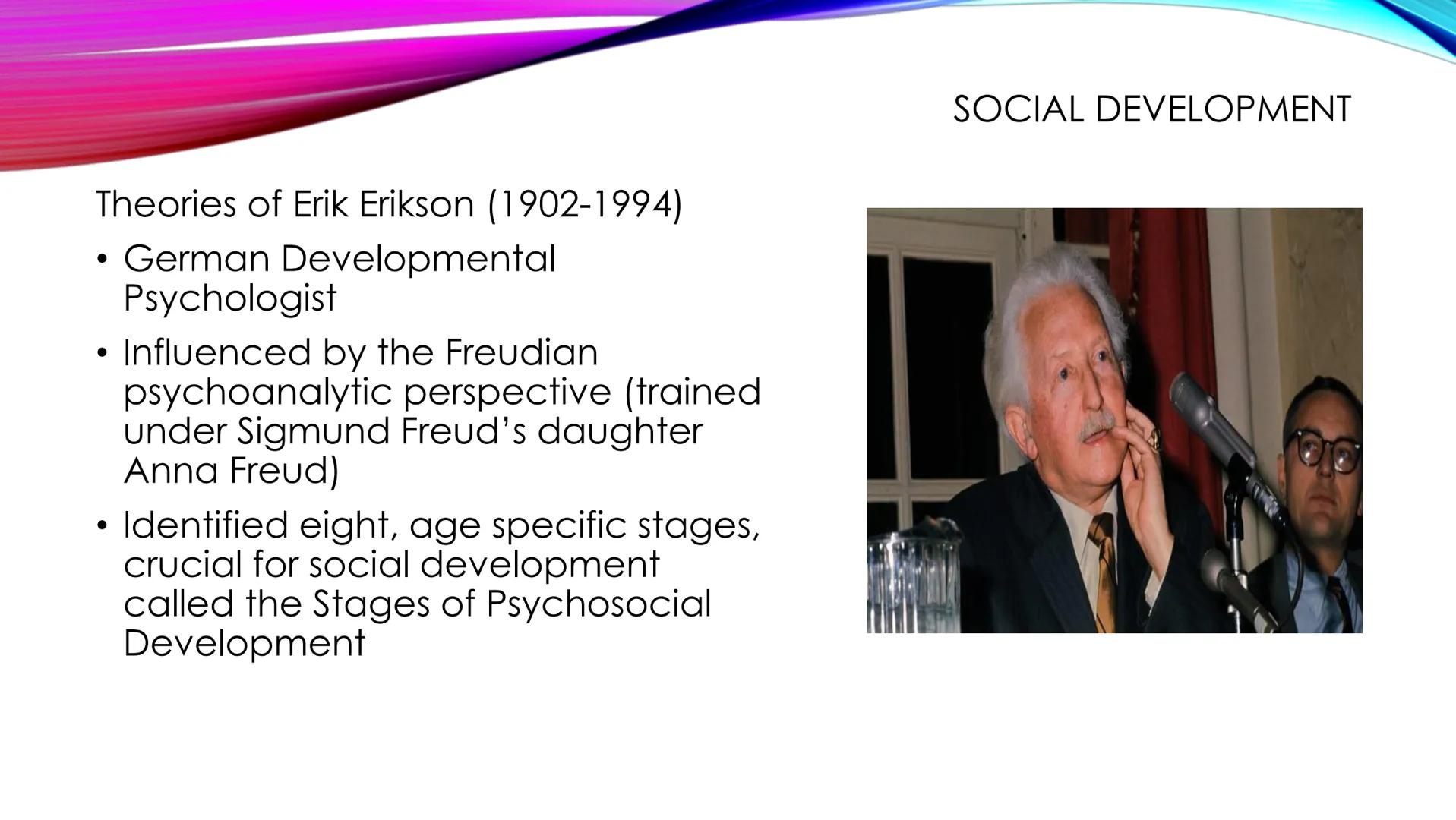
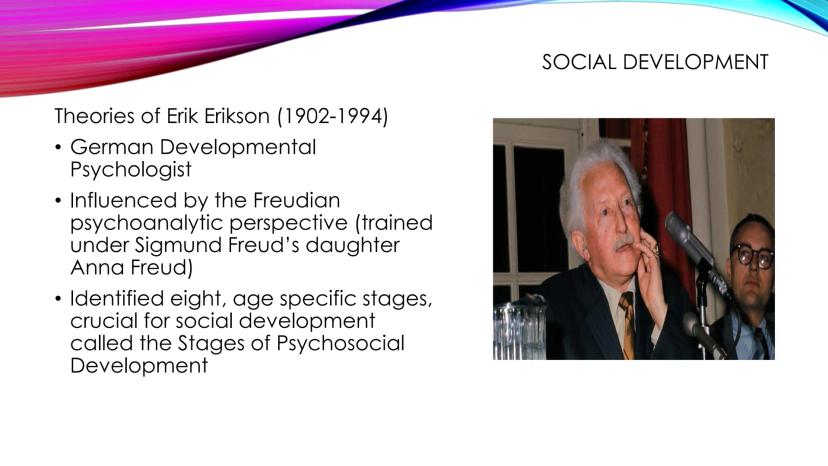
Theories of Erik Erikson (1902-1994)
Ever wonder how you develop as a person throughout your life? Erik Erikson has answers! This German psychologist studied how people grow socially from birth to death.
Erikson was trained by Anna Freud (Sigmund Freud's daughter) and was influenced by psychoanalytic perspectives. What makes his work special is that he identified eight age-specific stages that everyone goes through.
Each stage in his Stages of Psychosocial Development represents a crucial period for social development. How you handle each stage's challenges shapes who you become!
Quick Insight: Unlike many theorists who focused only on childhood, Erikson recognized that social development continues throughout our entire lives.
2
of 10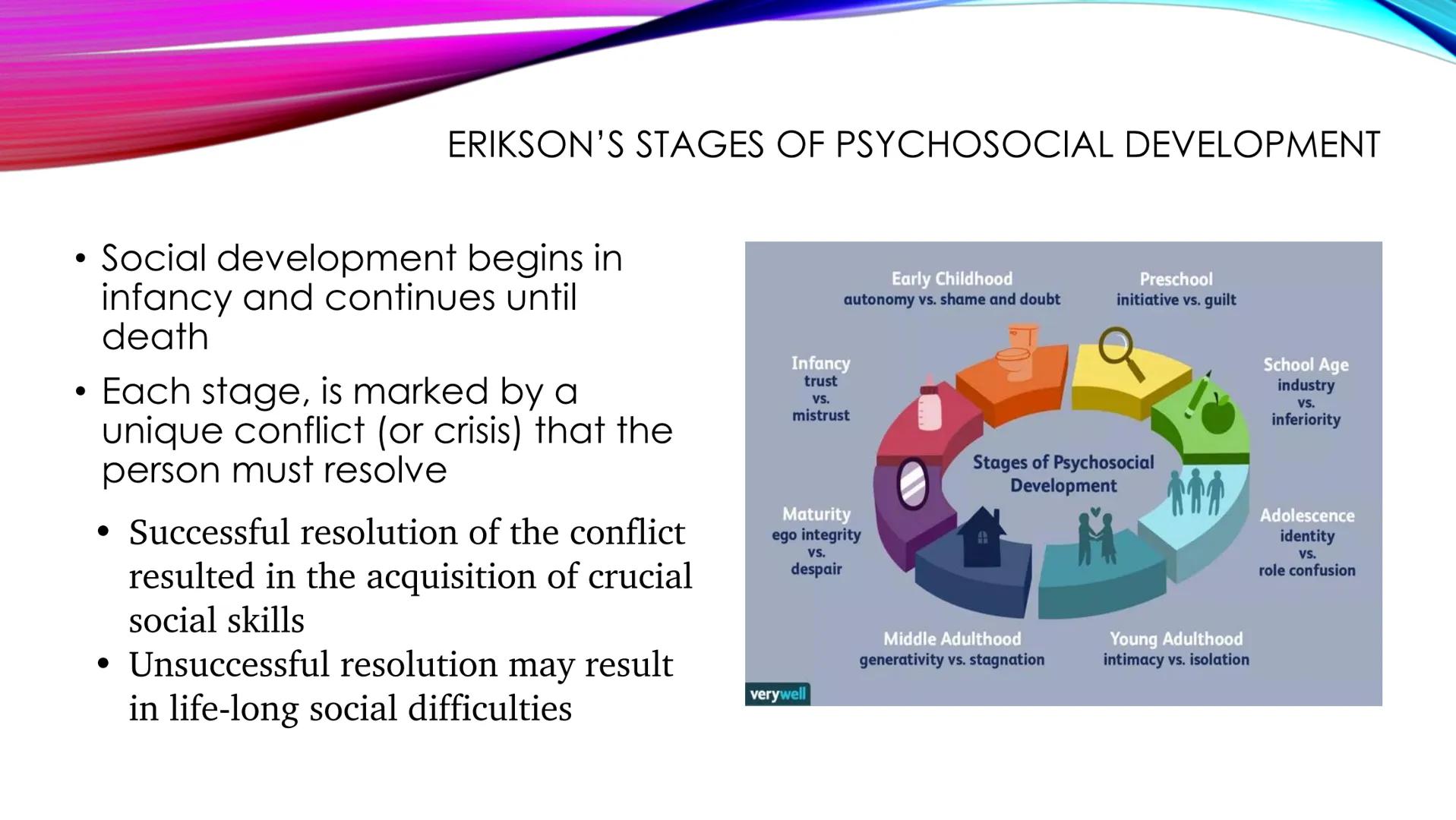
Erikson's Stages of Psychosocial Development
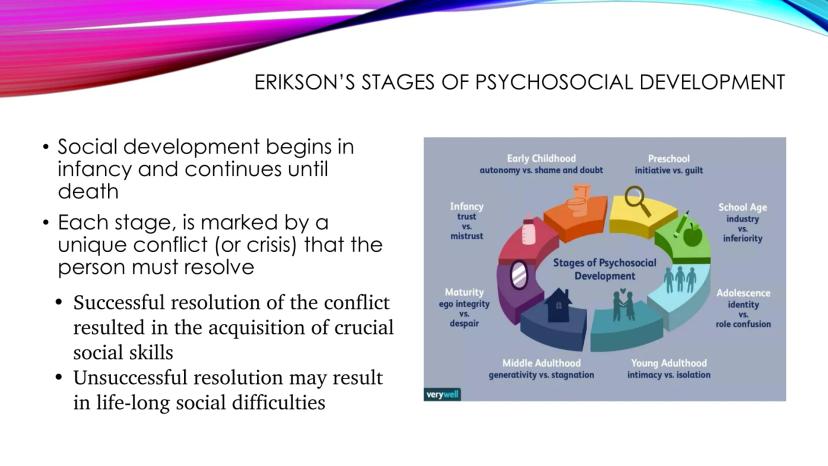
Think of life as a series of challenges you need to overcome! Erikson's theory suggests that at each stage of life, you face a specific psychosocial crisis that needs resolution.
Successfully resolving each crisis helps you gain important social skills that build your personality. If you struggle with resolution, it might cause ongoing social difficulties as you move forward.
The eight stages span your entire life: infancy (trust vs. mistrust), early childhood , preschool (initiative vs. guilt), school age (industry vs. inferiority), adolescence (identity vs. role confusion), young adulthood (intimacy vs. isolation), middle adulthood (generativity vs. stagnation), and maturity (integrity vs. despair).
Remember This: Each stage builds on the previous one—the better you resolve earlier crises, the more prepared you'll be for later challenges!
3
of 10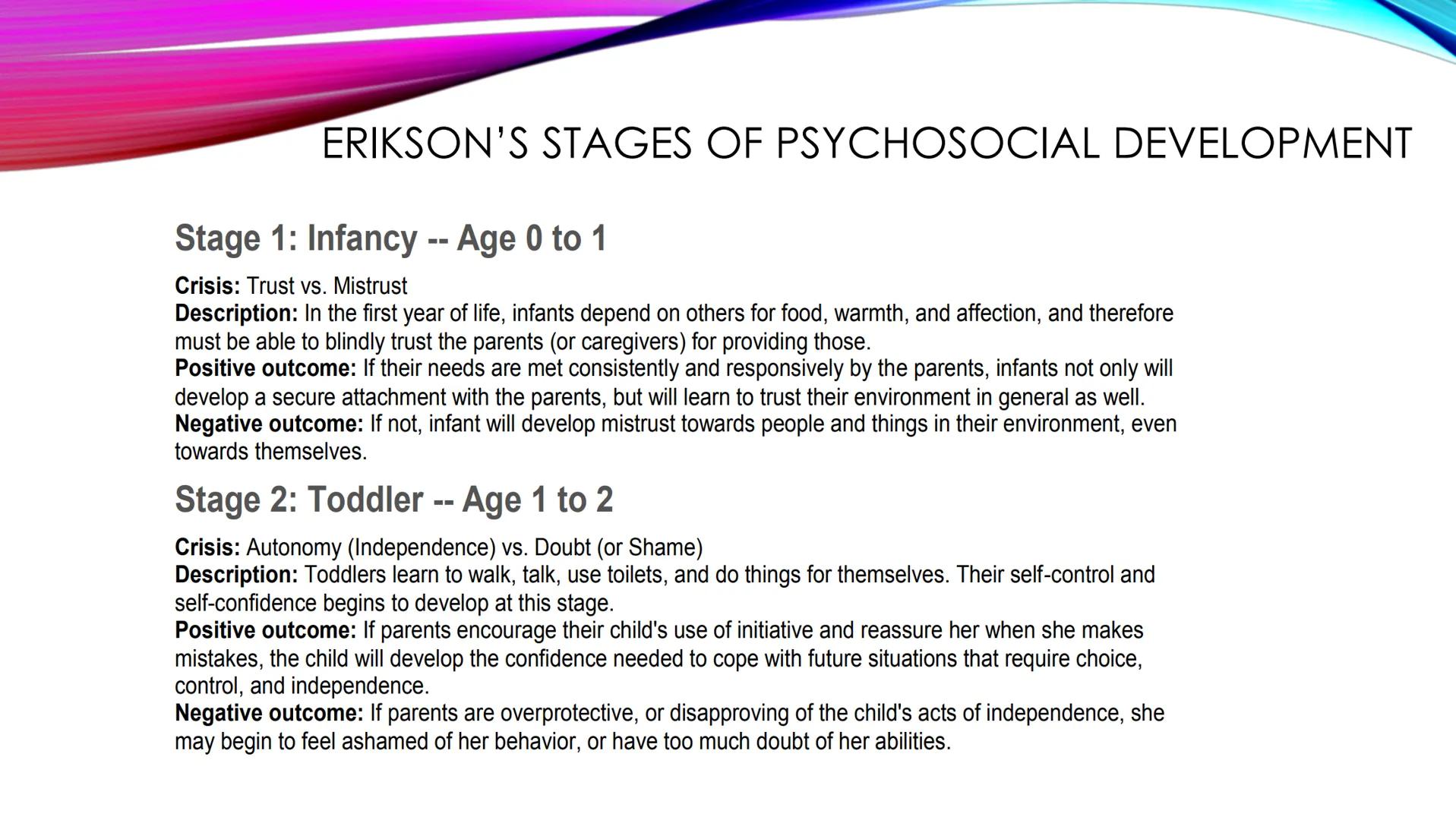
Early Stages of Psychosocial Development
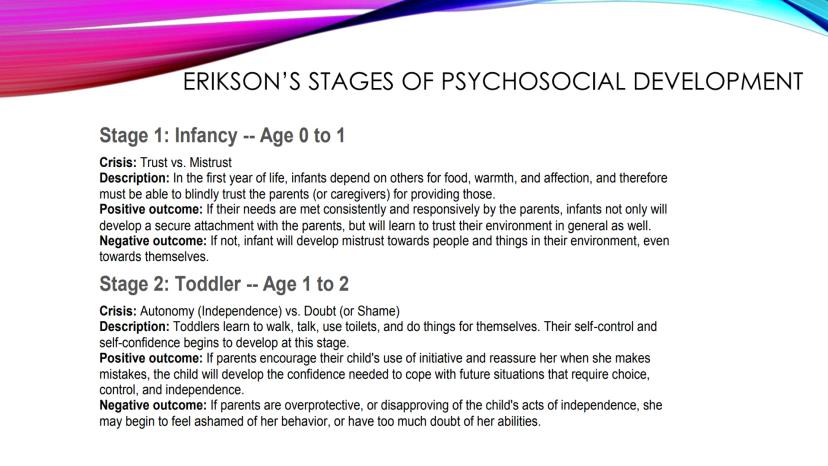
In your first year of life (Stage 1: Trust vs. Mistrust), you learn whether the world is a safe place. When caregivers consistently meet your needs, you develop trust in others and your environment. Without consistent care, you might develop mistrust that follows you through life.
During your toddler years (Stage 2: Autonomy vs. Doubt), ages 1-2, you start gaining independence. You learn to walk, talk, and do things yourself. Parents who encourage your independence help you build self-confidence. Overprotective parents might cause you to doubt your abilities.
Both stages create your foundation for future development. When parents respond to your needs and support your growing independence, you're set up for success in later stages.
Think About: How might your earliest experiences with caregivers still affect how you approach new relationships today?
4
of 10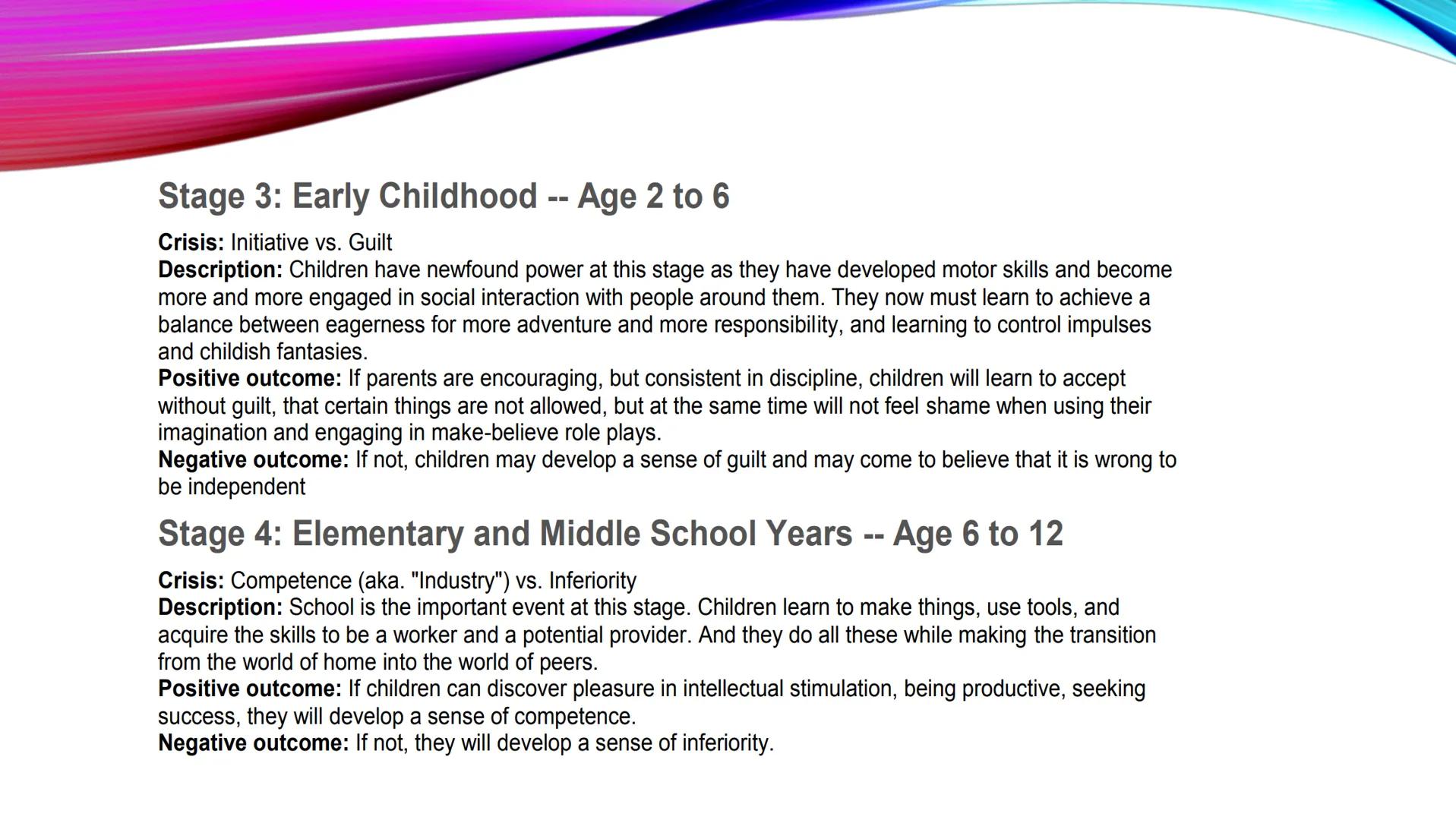
Middle Childhood Stages
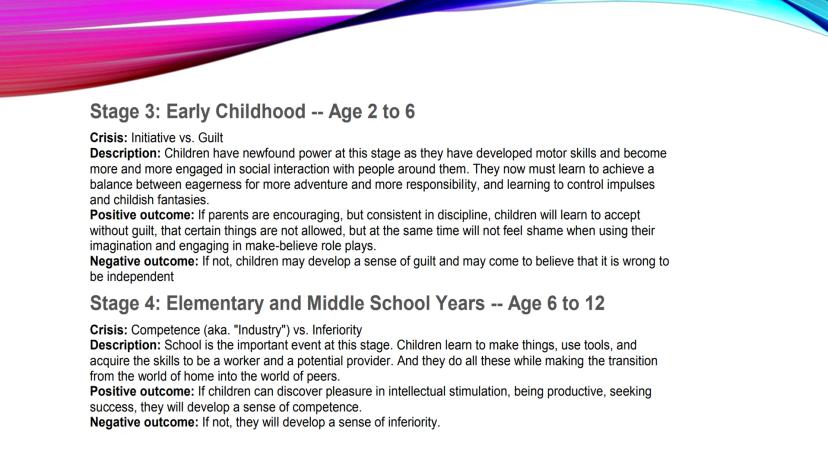
Ages 2-6 (Stage 3: Initiative vs. Guilt) bring exciting new abilities! You develop motor skills and social interactions become more complex. You need to balance your desire for adventure with learning appropriate behavior.
When parents provide encouragement with consistent boundaries, you learn to use your imagination freely while understanding limits. Without this balance, you might develop unnecessary guilt about your independence.
In elementary and middle school years (Stage 4: Competence vs. Inferiority), ages 6-12, school becomes central to your development. You learn practical skills and begin transitioning from family life to peer relationships.
Finding pleasure in learning and achieving success helps you develop a sense of competence. Without positive experiences during this time, feelings of inferiority might develop that affect your confidence.
Pro Tip: The skills and attitudes you develop during these school years impact how you approach challenges and learning for the rest of your life!
5
of 10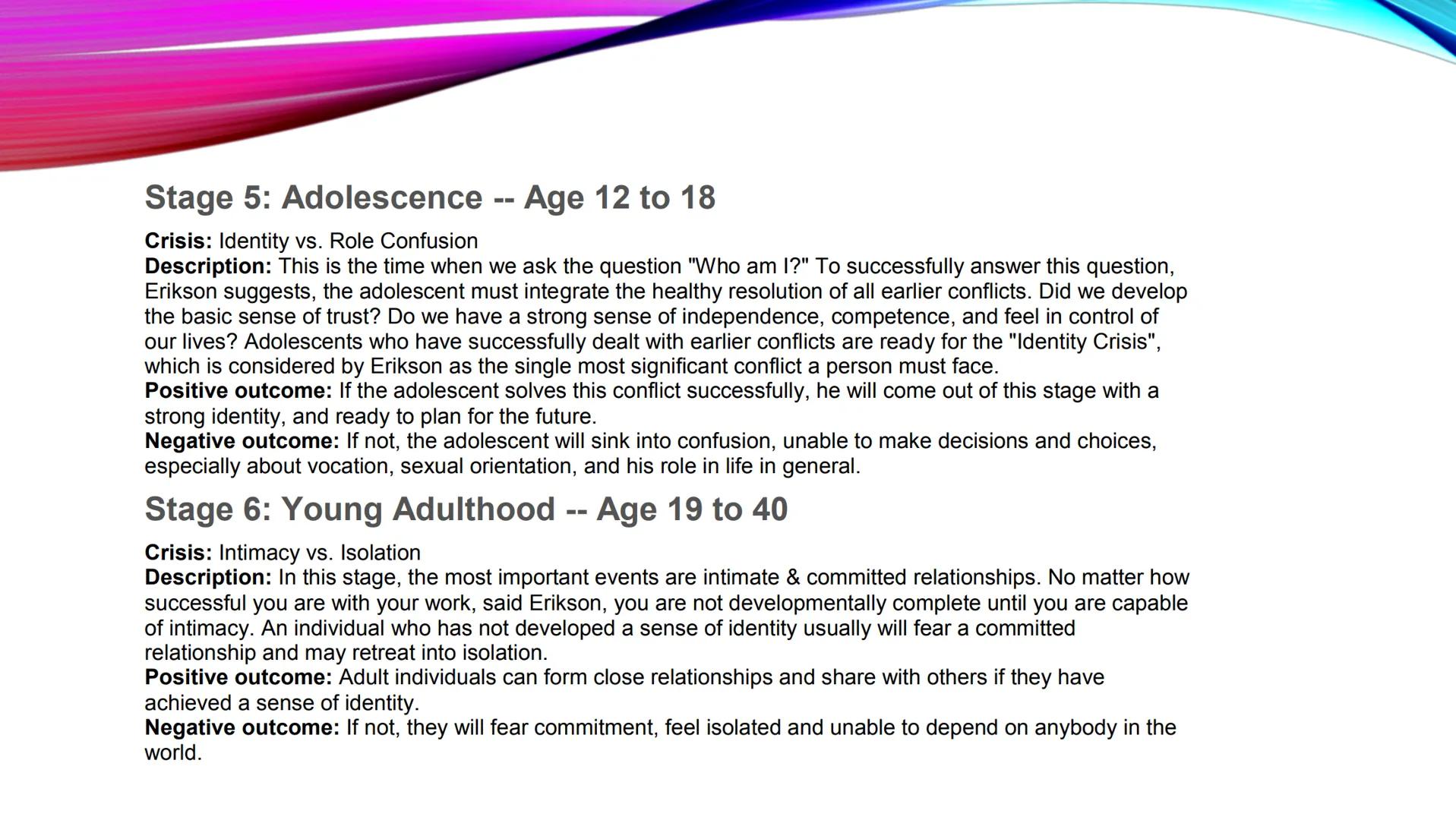
Adolescence and Young Adulthood
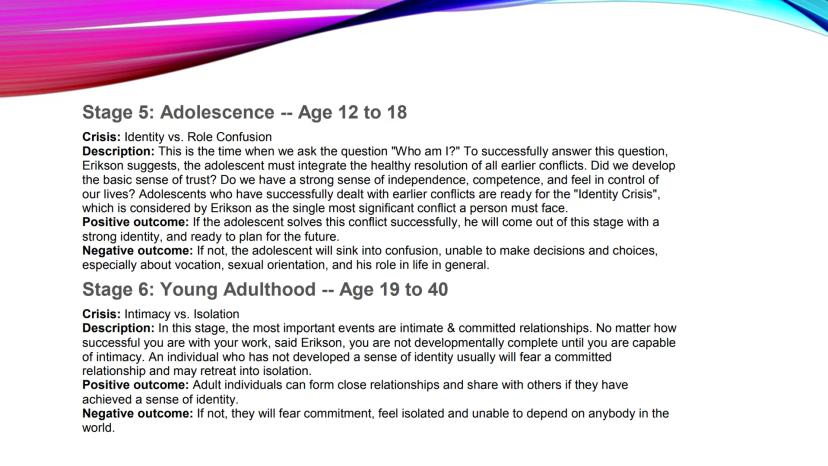
Adolescence (Stage 5: Identity vs. Role Confusion), ages 12-18, brings the famous question: "Who am I?" Erikson considered this the single most significant conflict you'll face in life.
Successfully navigating this stage means emerging with a strong identity and vision for your future. Those who struggle may feel confused about their role in the world and have trouble making important decisions about their future.
In young adulthood (Stage 6: Intimacy vs. Isolation), ages 19-40, forming meaningful relationships becomes crucial. Even if you're successful in your career, Erikson believed you're not developmentally complete until you can form deep connections.
Those who've developed a solid identity can form committed relationships and share with others. Without this foundation, you might fear commitment and feel isolated.
Reality Check: Many teens struggle with identity issues—it's completely normal and part of the development process!
6
of 10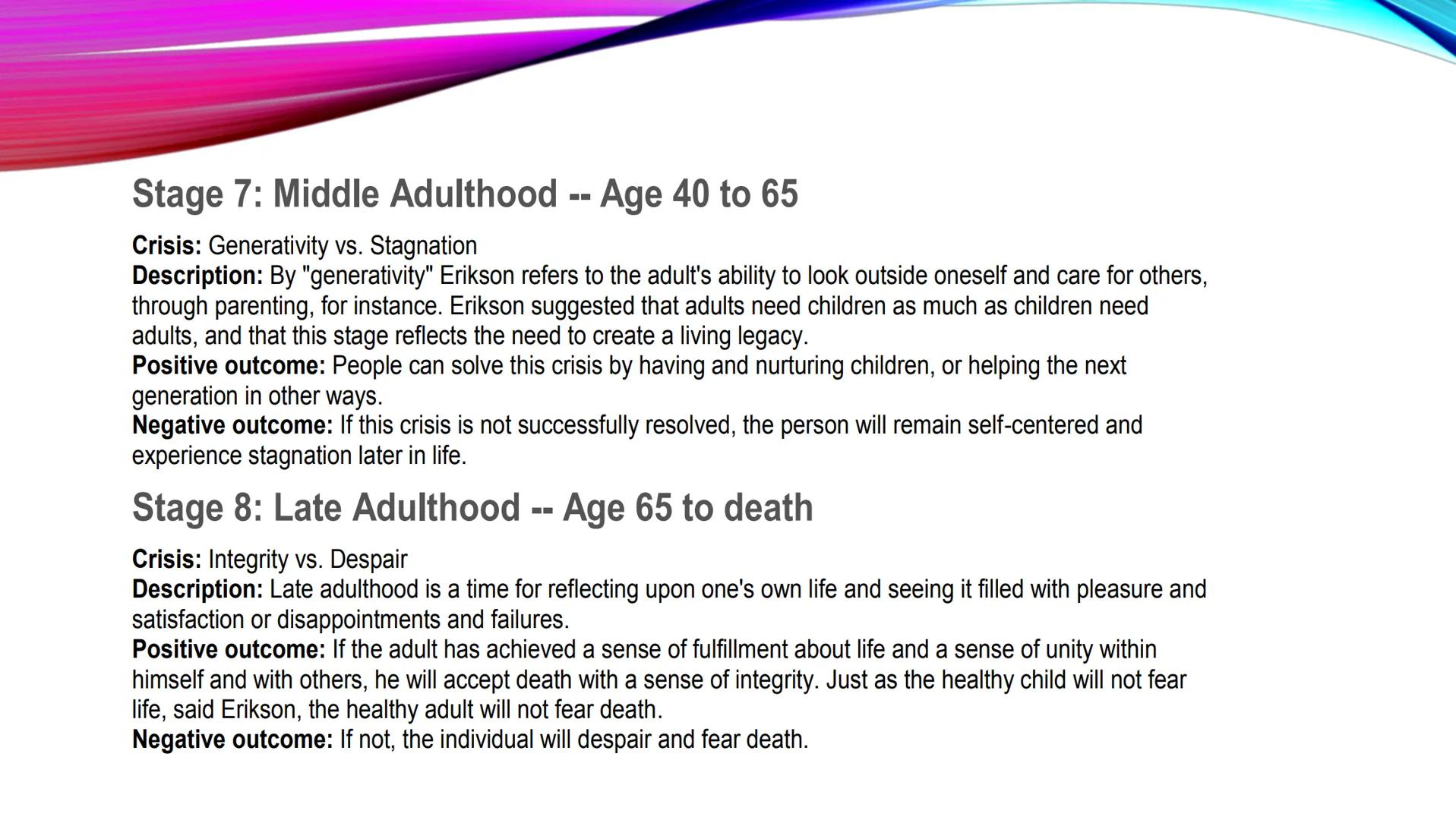
Middle and Late Adulthood
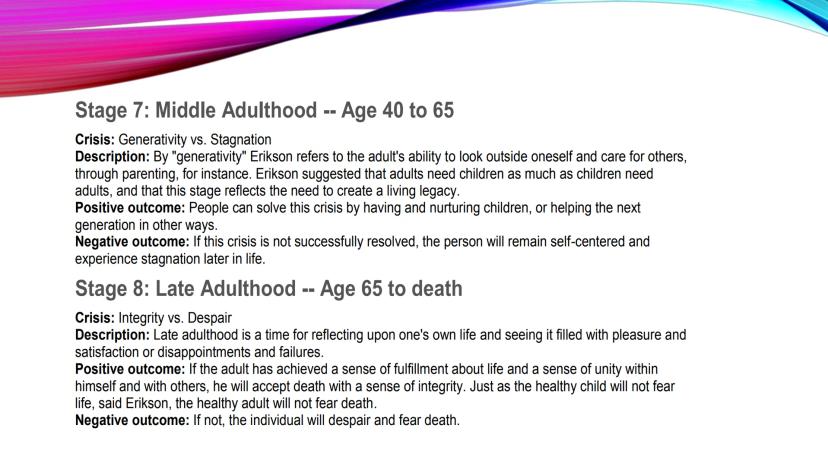
During middle adulthood (Stage 7: Generativity vs. Stagnation), ages 40-65, your focus shifts to caring for others and creating a legacy. Erikson believed adults need to contribute to future generations as much as children need adult guidance.
Successfully resolving this stage means finding ways to nurture the next generation—through parenting, mentoring, or creating something that improves society. Without this resolution, you might become self-centered and experience stagnation.
In late adulthood (Stage 8: Integrity vs. Despair), from 65 until death, you reflect on your life journey. Those who feel fulfilled and connected develop integrity, accepting death without fear. Those who see mainly disappointments may experience despair.
Erikson's powerful insight: just as a healthy child doesn't fear life, a healthy older adult doesn't fear death.
Life Perspective: These final stages remind us that development continues throughout our entire lives—we never stop growing and learning!
7
of 10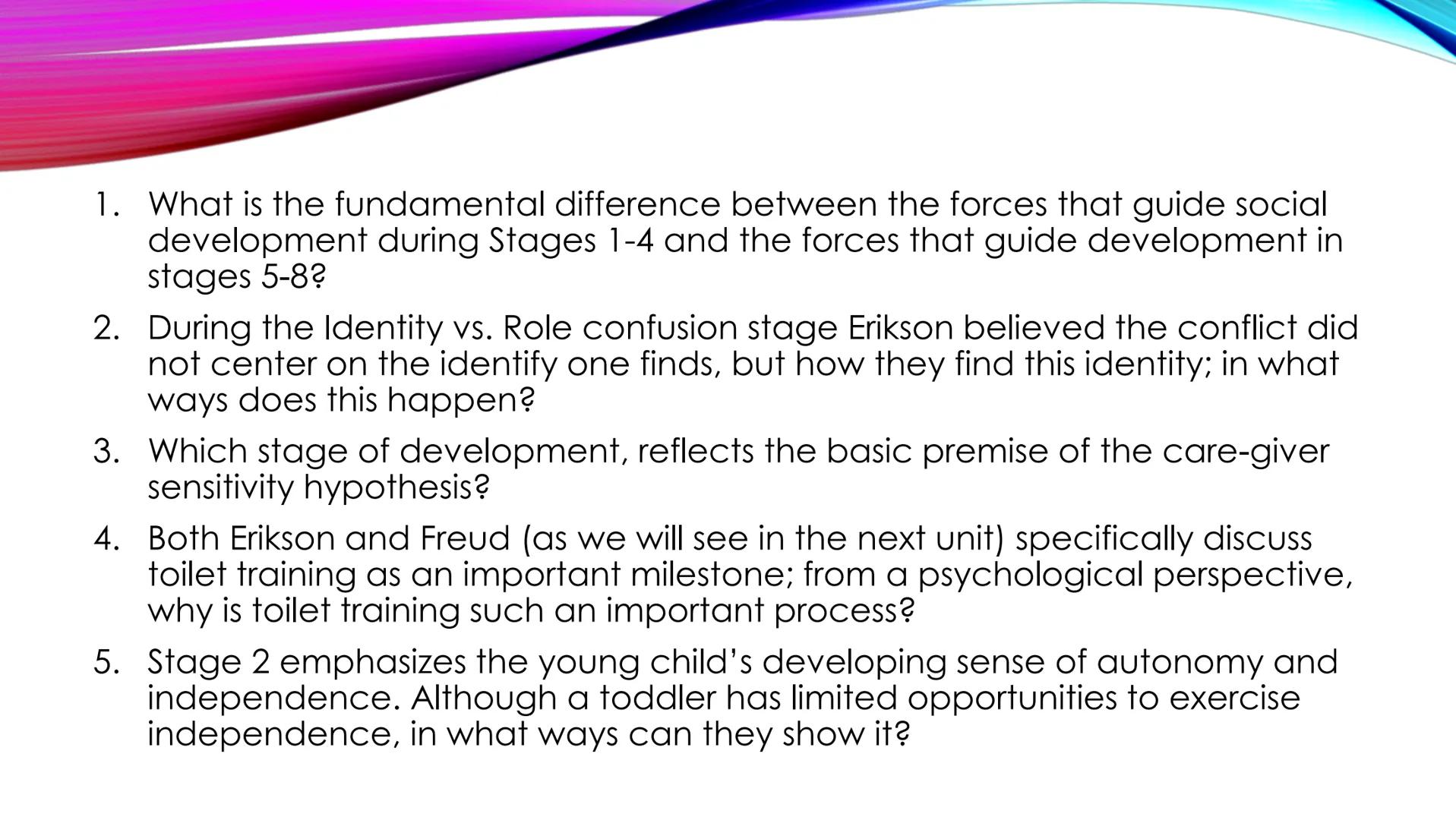
Exploring Erikson's Theory Further
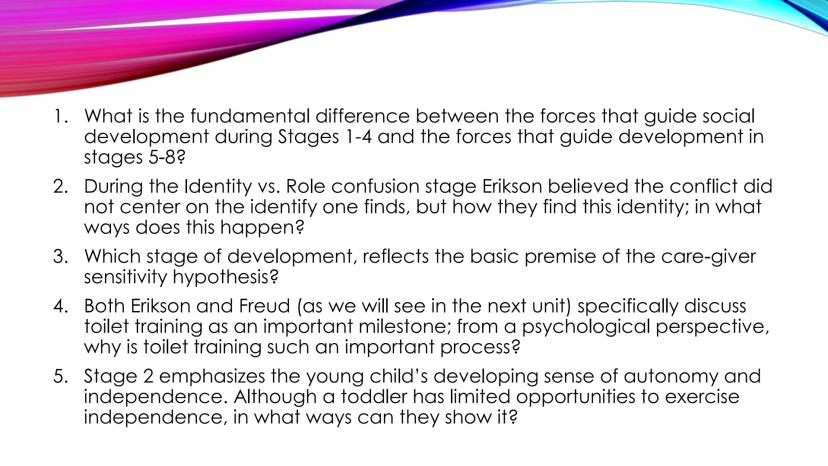
Erikson's theory becomes more fascinating when we examine it closely! The first four stages (1-4) focus primarily on how external forces like parents and teachers shape development. The later stages (5-8) shift toward internal forces and how you make personal choices.
During the Identity stage, it's not just about finding your identity but how you discover it. Are you actively exploring different options before committing? Or accepting others' expectations without question?
The Trust vs. Mistrust stage directly connects to the caregiver sensitivity hypothesis—the idea that responsive caregiving creates secure attachment patterns.
Even something seemingly simple like toilet training (Stage 2) has deep psychological significance. It represents your first major opportunity to control your body and exert independence while learning to conform to social expectations.
Consider This: What other ways do toddlers show independence? Through food choices, clothing preferences, saying "no," and testing boundaries!
8
of 10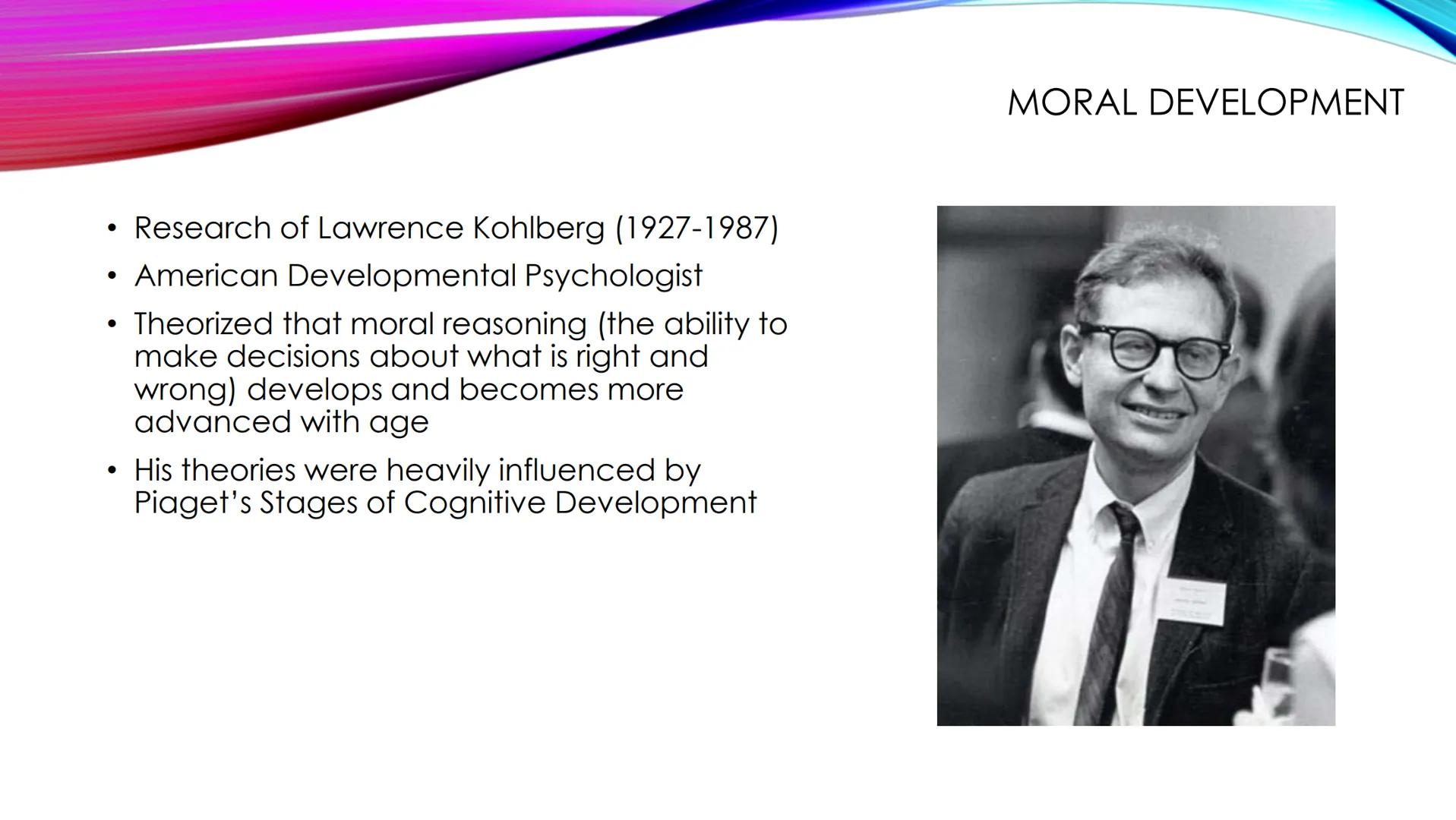
Moral Development
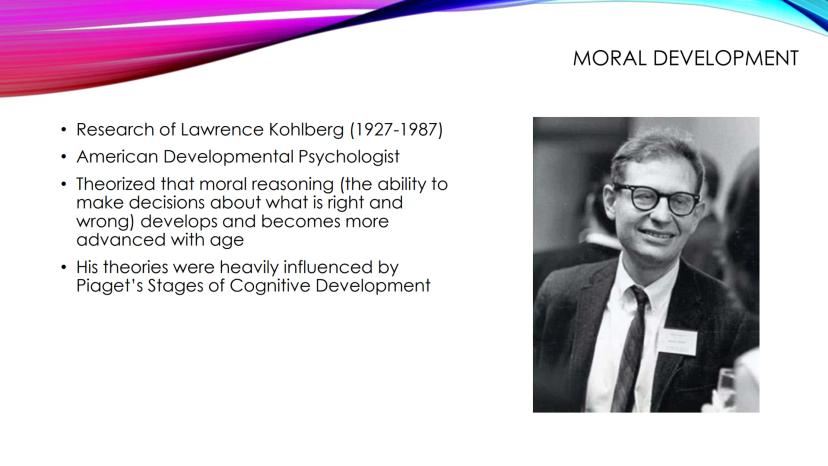
How do we learn right from wrong? Lawrence Kohlberg (1927-1987), an American developmental psychologist, created a framework to explain this process.
Kohlberg proposed that moral reasoning—our ability to make decisions about right and wrong—develops progressively as we grow older. Like developmental stages for other skills, our moral thinking becomes more advanced over time.
His work was heavily influenced by Piaget's cognitive development stages, suggesting that moral reasoning requires certain cognitive abilities that develop with age.
Rather than focusing just on behavior, Kohlberg was interested in the reasoning process behind moral decisions—why we believe something is right or wrong matters more than the choice itself.
Think Deeper: Have you noticed your own moral reasoning changing over time? Situations that once seemed black and white may now appear more complex.
9
of 10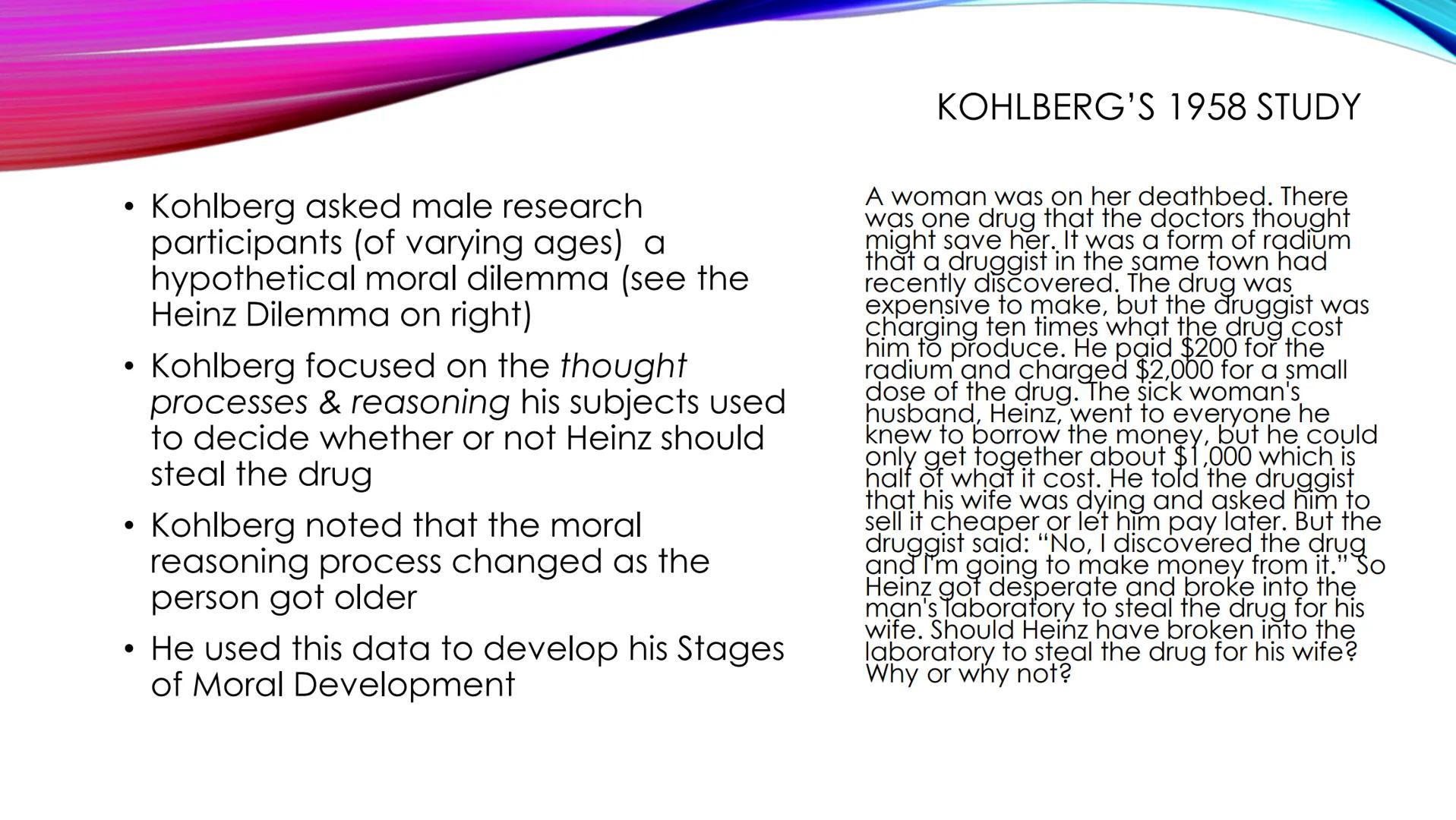
Kohlberg's 1958 Study
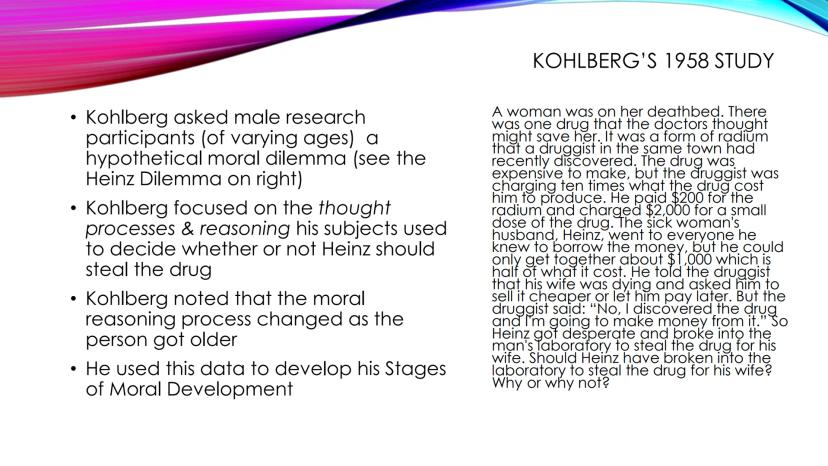
How would you solve a moral dilemma? Kohlberg presented research participants with the famous Heinz Dilemma: Should a man named Heinz steal an overpriced drug to save his dying wife?
In this scenario, a druggist discovered a drug that could save Heinz's dying wife but charged $2,000 when it only cost $200 to make. When Heinz could only raise $1,000 and the druggist refused to lower the price, Heinz broke into the laboratory to steal the medication.
What makes this study fascinating isn't whether people thought Heinz should steal the drug—it's their reasoning process behind the decision. Kohlberg noted that younger participants used simpler reasoning while older subjects considered more complex moral principles.
This study became the foundation for Kohlberg's Stages of Moral Development, showing how our moral thinking evolves as we mature.
Critical Thinking: When considering this dilemma yourself, what factors influence your decision? Is it laws, relationships, principles of justice, or something else?
10
of 10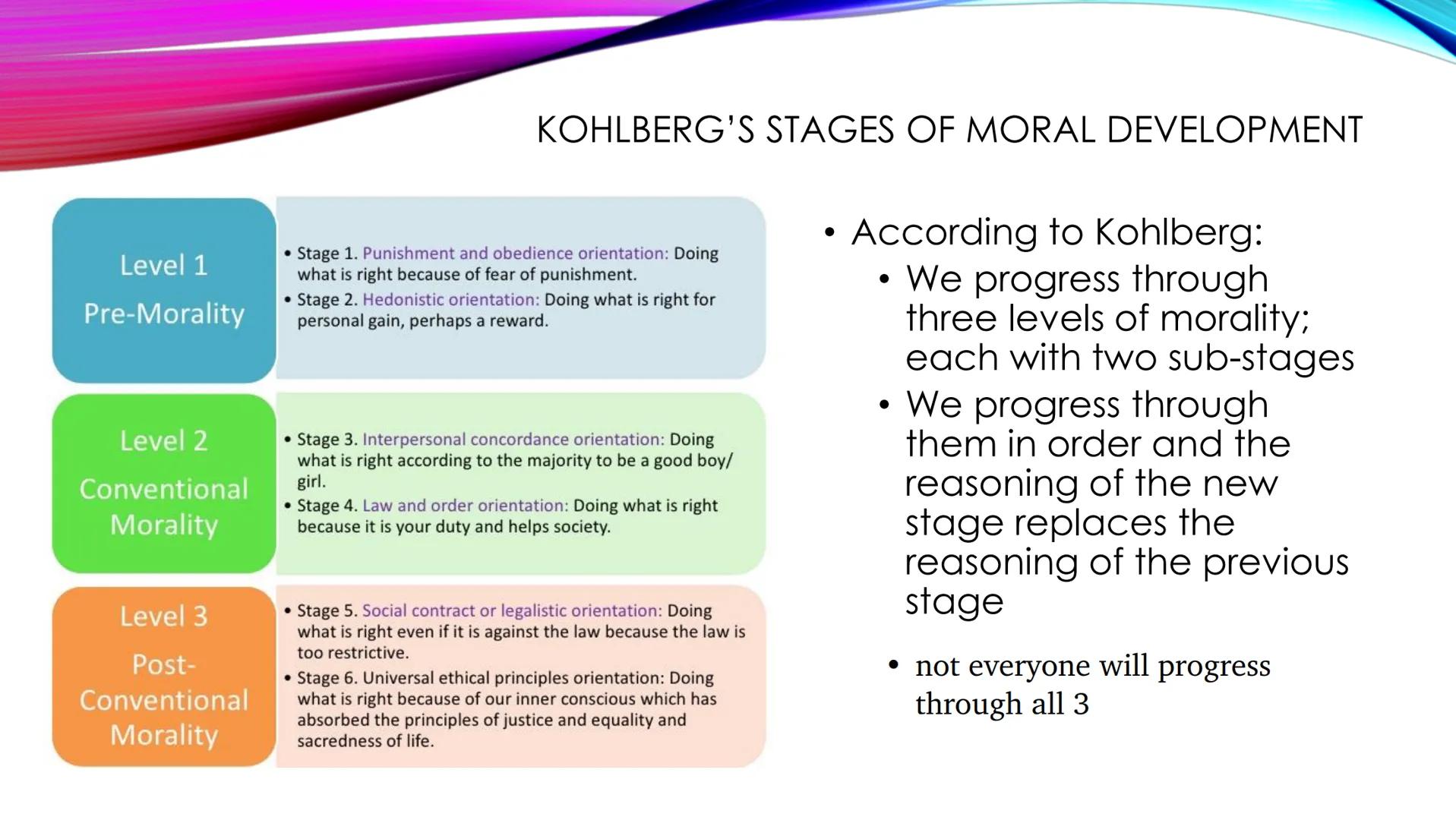
Kohlberg's Stages of Moral Development
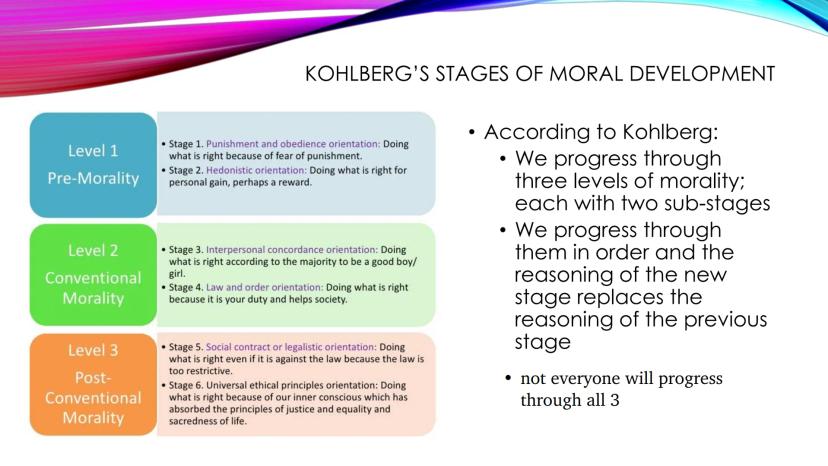
Kohlberg organized moral development into three main levels, each containing two stages—creating six stages total that we progress through in order.
At the Pre-Morality level , decisions are based on avoiding punishment or seeking rewards. "I won't cheat because I'll get in trouble" or "I'll help because I'll get something in return."
The Conventional Morality level focuses on social expectations and rules. "I'll follow rules to be a good person" or "Laws must be obeyed because they maintain social order."
Those reaching the Post-Conventional Morality level evaluate principles beyond society's rules. "Some laws may be unjust and should be changed" or "Universal principles of justice and human dignity matter most."
Kohlberg believed each new stage replaces previous reasoning, though not everyone reaches all stages—only about 10% of adults reach post-conventional thinking.
Reality Check: Most adults operate at the conventional morality level, focusing on society's expectations and rules rather than abstract universal principles.
We thought you’d never ask...
What is the Knowunity AI companion?
Our AI companion is specifically built for the needs of students. Based on the millions of content pieces we have on the platform we can provide truly meaningful and relevant answers to students. But its not only about answers, the companion is even more about guiding students through their daily learning challenges, with personalised study plans, quizzes or content pieces in the chat and 100% personalisation based on the students skills and developments.
Where can I download the Knowunity app?
You can download the app in the Google Play Store and in the Apple App Store.
Is Knowunity really free of charge?
That's right! Enjoy free access to study content, connect with fellow students, and get instant help – all at your fingertips.
Similar Content
 Psychology
Most popular content in Psychology
7PsychologyPsychology 101 Notes
Notes: Chapters 1, 2, 3, 5, 6, 7, 8, 9
2,441103
Psychologybipolar disorder psyc353
adult psychopathology lecture notes
875
PsychologyPsychology | Chapter 8: Lifespan Development
Study guide on chapter 8, theories on how people develop over a lifetime. Information was from the textbook Introduction to Psychology by Hawkes Learning and supplemented by my professor's resources.
895
PsychologyPsychology - Somatic Symptom and Related Disorders
a presentation deck on somatic symptom disorders, including illness anxiety disorder, conversion disorder and somatic symptom disorders. featuring visuals from osmosis, "crazyhead comics", verywell and even never have i ever lol
11th271
Psychologyeating disorders psyc353
adult psychopathology lecture notes
964
PsychologyAp Psychology Unit 1
Scientific foundations of Psychology
10th1,11753
PsychologySchizophrenia and Psychosis PSYC353
Adult psychopathology lecture notes
12310
Most popular content
9O
 AP US History
Origins and Dynamics of the Columbian Exchange
Analyze the ecological and economic motivations behind the initial transfer of goods, people, and diseases between the Old and New Worlds.
9th3,1280
I
AP US HistoryIntroduction to Early Cultural Interactions
Analyze the initial social and religious encounters between Europeans, Africans, and Indigenous peoples in the colonial Americas.
9th2,7730
O
 AP World History
Origins of Ancient River Civilizations
Analyze the environmental factors and technological innovations that led to the rise of early states in Mesopotamia, Egypt, and the Indus Valley.
9th3,1870
M
AP US HistoryMotivations for European Exploration
Analyze the economic, religious, and political factors that drove European powers to the Americas during the 15th and 16th centuries.
9th1,7780
F
 AP Psychology
Foundations of Ethical Guidelines in Research
Practice the core principles of the APA ethical code including informed consent, debriefing, and the role of Institutional Review Boards.
9th1,3360
I
AP US HistoryIntroduction to Native American Societies
Examine the diverse social, political, and economic structures of North American indigenous groups prior to European contact.
9th1,1100
I
 AP Biology
Introduction to Biological Elements of Life
Practice identifying the essential elements including carbon, nitrogen, phosphorus, and sulfur that compose biological macromolecules.
9th1,7390
I
AP US HistoryIntroduction to the Spanish Encomienda System
Explore the fundamental economic and social structures of the Spanish colonial system, focusing on the encomienda and the casta social hierarchy.
9th8890
O
AP World HistoryOrigins and Continuity of the Byzantine Empire
Analyze the political and cultural transitions from the Roman Empire to the Byzantine Empire, focusing on the reign of Justinian I and his code.
9th1,6320
Can't find what you're looking for? Explore other subjects.
Students love us — and so will you.
4.6/5App Store
4.7/5Google Play
The app is very easy to use and well designed. I have found everything I was looking for so far and have been able to learn a lot from the presentations! I will definitely use the app for a class assignment! And of course it also helps a lot as an inspiration.
Stefan SiOS user
This app is really great. There are so many study notes and help [...]. My problem subject is French, for example, and the app has so many options for help. Thanks to this app, I have improved my French. I would recommend it to anyone.
Samantha KlichAndroid user
Wow, I am really amazed. I just tried the app because I've seen it advertised many times and was absolutely stunned. This app is THE HELP you want for school and above all, it offers so many things, such as workouts and fact sheets, which have been VERY helpful to me personally.
AnnaiOS user
Psychology51 views·Updated Jun 11, 2026·13 pagesUnderstanding Key Social Development Concepts - Unit 6 Review
Explore the influential theories that shape our understanding of human development through the ages. Erik Erikson's psychosocial stages explain how we develop socially from infancy to old age, while Lawrence Kohlberg's framework reveals how our moral reasoning matures over time.
1
of 10
Sign up to see the content. It's free!
- Access to all documents
- Improve your grades
- Join milions of students
Theories of Erik Erikson (1902-1994)
Ever wonder how you develop as a person throughout your life? Erik Erikson has answers! This German psychologist studied how people grow socially from birth to death.
Erikson was trained by Anna Freud (Sigmund Freud's daughter) and was influenced by psychoanalytic perspectives. What makes his work special is that he identified eight age-specific stages that everyone goes through.
Each stage in his Stages of Psychosocial Development represents a crucial period for social development. How you handle each stage's challenges shapes who you become!
Quick Insight: Unlike many theorists who focused only on childhood, Erikson recognized that social development continues throughout our entire lives.
2
of 10Sign up to see the content. It's free!
- Access to all documents
- Improve your grades
- Join milions of students
Erikson's Stages of Psychosocial Development
Think of life as a series of challenges you need to overcome! Erikson's theory suggests that at each stage of life, you face a specific psychosocial crisis that needs resolution.
Successfully resolving each crisis helps you gain important social skills that build your personality. If you struggle with resolution, it might cause ongoing social difficulties as you move forward.
The eight stages span your entire life: infancy (trust vs. mistrust), early childhood , preschool (initiative vs. guilt), school age (industry vs. inferiority), adolescence (identity vs. role confusion), young adulthood (intimacy vs. isolation), middle adulthood (generativity vs. stagnation), and maturity (integrity vs. despair).
Remember This: Each stage builds on the previous one—the better you resolve earlier crises, the more prepared you'll be for later challenges!
3
of 10Sign up to see the content. It's free!
- Access to all documents
- Improve your grades
- Join milions of students
Early Stages of Psychosocial Development
In your first year of life (Stage 1: Trust vs. Mistrust), you learn whether the world is a safe place. When caregivers consistently meet your needs, you develop trust in others and your environment. Without consistent care, you might develop mistrust that follows you through life.
During your toddler years (Stage 2: Autonomy vs. Doubt), ages 1-2, you start gaining independence. You learn to walk, talk, and do things yourself. Parents who encourage your independence help you build self-confidence. Overprotective parents might cause you to doubt your abilities.
Both stages create your foundation for future development. When parents respond to your needs and support your growing independence, you're set up for success in later stages.
Think About: How might your earliest experiences with caregivers still affect how you approach new relationships today?
4
of 10Sign up to see the content. It's free!
- Access to all documents
- Improve your grades
- Join milions of students
Middle Childhood Stages
Ages 2-6 (Stage 3: Initiative vs. Guilt) bring exciting new abilities! You develop motor skills and social interactions become more complex. You need to balance your desire for adventure with learning appropriate behavior.
When parents provide encouragement with consistent boundaries, you learn to use your imagination freely while understanding limits. Without this balance, you might develop unnecessary guilt about your independence.
In elementary and middle school years (Stage 4: Competence vs. Inferiority), ages 6-12, school becomes central to your development. You learn practical skills and begin transitioning from family life to peer relationships.
Finding pleasure in learning and achieving success helps you develop a sense of competence. Without positive experiences during this time, feelings of inferiority might develop that affect your confidence.
Pro Tip: The skills and attitudes you develop during these school years impact how you approach challenges and learning for the rest of your life!
5
of 10Sign up to see the content. It's free!
- Access to all documents
- Improve your grades
- Join milions of students
Adolescence and Young Adulthood
Adolescence (Stage 5: Identity vs. Role Confusion), ages 12-18, brings the famous question: "Who am I?" Erikson considered this the single most significant conflict you'll face in life.
Successfully navigating this stage means emerging with a strong identity and vision for your future. Those who struggle may feel confused about their role in the world and have trouble making important decisions about their future.
In young adulthood (Stage 6: Intimacy vs. Isolation), ages 19-40, forming meaningful relationships becomes crucial. Even if you're successful in your career, Erikson believed you're not developmentally complete until you can form deep connections.
Those who've developed a solid identity can form committed relationships and share with others. Without this foundation, you might fear commitment and feel isolated.
Reality Check: Many teens struggle with identity issues—it's completely normal and part of the development process!
6
of 10Sign up to see the content. It's free!
- Access to all documents
- Improve your grades
- Join milions of students
Middle and Late Adulthood
During middle adulthood (Stage 7: Generativity vs. Stagnation), ages 40-65, your focus shifts to caring for others and creating a legacy. Erikson believed adults need to contribute to future generations as much as children need adult guidance.
Successfully resolving this stage means finding ways to nurture the next generation—through parenting, mentoring, or creating something that improves society. Without this resolution, you might become self-centered and experience stagnation.
In late adulthood (Stage 8: Integrity vs. Despair), from 65 until death, you reflect on your life journey. Those who feel fulfilled and connected develop integrity, accepting death without fear. Those who see mainly disappointments may experience despair.
Erikson's powerful insight: just as a healthy child doesn't fear life, a healthy older adult doesn't fear death.
Life Perspective: These final stages remind us that development continues throughout our entire lives—we never stop growing and learning!
7
of 10Sign up to see the content. It's free!
- Access to all documents
- Improve your grades
- Join milions of students
Exploring Erikson's Theory Further
Erikson's theory becomes more fascinating when we examine it closely! The first four stages (1-4) focus primarily on how external forces like parents and teachers shape development. The later stages (5-8) shift toward internal forces and how you make personal choices.
During the Identity stage, it's not just about finding your identity but how you discover it. Are you actively exploring different options before committing? Or accepting others' expectations without question?
The Trust vs. Mistrust stage directly connects to the caregiver sensitivity hypothesis—the idea that responsive caregiving creates secure attachment patterns.
Even something seemingly simple like toilet training (Stage 2) has deep psychological significance. It represents your first major opportunity to control your body and exert independence while learning to conform to social expectations.
Consider This: What other ways do toddlers show independence? Through food choices, clothing preferences, saying "no," and testing boundaries!
8
of 10Sign up to see the content. It's free!
- Access to all documents
- Improve your grades
- Join milions of students
Moral Development
How do we learn right from wrong? Lawrence Kohlberg (1927-1987), an American developmental psychologist, created a framework to explain this process.
Kohlberg proposed that moral reasoning—our ability to make decisions about right and wrong—develops progressively as we grow older. Like developmental stages for other skills, our moral thinking becomes more advanced over time.
His work was heavily influenced by Piaget's cognitive development stages, suggesting that moral reasoning requires certain cognitive abilities that develop with age.
Rather than focusing just on behavior, Kohlberg was interested in the reasoning process behind moral decisions—why we believe something is right or wrong matters more than the choice itself.
Think Deeper: Have you noticed your own moral reasoning changing over time? Situations that once seemed black and white may now appear more complex.
9
of 10Sign up to see the content. It's free!
- Access to all documents
- Improve your grades
- Join milions of students
Kohlberg's 1958 Study
How would you solve a moral dilemma? Kohlberg presented research participants with the famous Heinz Dilemma: Should a man named Heinz steal an overpriced drug to save his dying wife?
In this scenario, a druggist discovered a drug that could save Heinz's dying wife but charged $2,000 when it only cost $200 to make. When Heinz could only raise $1,000 and the druggist refused to lower the price, Heinz broke into the laboratory to steal the medication.
What makes this study fascinating isn't whether people thought Heinz should steal the drug—it's their reasoning process behind the decision. Kohlberg noted that younger participants used simpler reasoning while older subjects considered more complex moral principles.
This study became the foundation for Kohlberg's Stages of Moral Development, showing how our moral thinking evolves as we mature.
Critical Thinking: When considering this dilemma yourself, what factors influence your decision? Is it laws, relationships, principles of justice, or something else?
10
of 10Sign up to see the content. It's free!
- Access to all documents
- Improve your grades
- Join milions of students
Kohlberg's Stages of Moral Development
Kohlberg organized moral development into three main levels, each containing two stages—creating six stages total that we progress through in order.
At the Pre-Morality level , decisions are based on avoiding punishment or seeking rewards. "I won't cheat because I'll get in trouble" or "I'll help because I'll get something in return."
The Conventional Morality level focuses on social expectations and rules. "I'll follow rules to be a good person" or "Laws must be obeyed because they maintain social order."
Those reaching the Post-Conventional Morality level evaluate principles beyond society's rules. "Some laws may be unjust and should be changed" or "Universal principles of justice and human dignity matter most."
Kohlberg believed each new stage replaces previous reasoning, though not everyone reaches all stages—only about 10% of adults reach post-conventional thinking.
Reality Check: Most adults operate at the conventional morality level, focusing on society's expectations and rules rather than abstract universal principles.
We thought you’d never ask...
What is the Knowunity AI companion?
Our AI companion is specifically built for the needs of students. Based on the millions of content pieces we have on the platform we can provide truly meaningful and relevant answers to students. But its not only about answers, the companion is even more about guiding students through their daily learning challenges, with personalised study plans, quizzes or content pieces in the chat and 100% personalisation based on the students skills and developments.
Where can I download the Knowunity app?
You can download the app in the Google Play Store and in the Apple App Store.
Is Knowunity really free of charge?
That's right! Enjoy free access to study content, connect with fellow students, and get instant help – all at your fingertips.
Similar Content
Most popular content in Psychology
7PsychologyPsychology 101 Notes
Notes: Chapters 1, 2, 3, 5, 6, 7, 8, 9
2,441103
Psychologybipolar disorder psyc353
adult psychopathology lecture notes
875
PsychologyPsychology | Chapter 8: Lifespan Development
Study guide on chapter 8, theories on how people develop over a lifetime. Information was from the textbook Introduction to Psychology by Hawkes Learning and supplemented by my professor's resources.
895
PsychologyPsychology - Somatic Symptom and Related Disorders
a presentation deck on somatic symptom disorders, including illness anxiety disorder, conversion disorder and somatic symptom disorders. featuring visuals from osmosis, "crazyhead comics", verywell and even never have i ever lol
11th271
Psychologyeating disorders psyc353
adult psychopathology lecture notes
964
PsychologyAp Psychology Unit 1
Scientific foundations of Psychology
10th1,11753
PsychologySchizophrenia and Psychosis PSYC353
Adult psychopathology lecture notes
12310
Most popular content
9O
AP US HistoryOrigins and Dynamics of the Columbian Exchange
Analyze the ecological and economic motivations behind the initial transfer of goods, people, and diseases between the Old and New Worlds.
9th3,1280
I
AP US HistoryIntroduction to Early Cultural Interactions
Analyze the initial social and religious encounters between Europeans, Africans, and Indigenous peoples in the colonial Americas.
9th2,7730
O
AP World HistoryOrigins of Ancient River Civilizations
Analyze the environmental factors and technological innovations that led to the rise of early states in Mesopotamia, Egypt, and the Indus Valley.
9th3,1870
M
AP US HistoryMotivations for European Exploration
Analyze the economic, religious, and political factors that drove European powers to the Americas during the 15th and 16th centuries.
9th1,7780
F
AP PsychologyFoundations of Ethical Guidelines in Research
Practice the core principles of the APA ethical code including informed consent, debriefing, and the role of Institutional Review Boards.
9th1,3360
I
AP US HistoryIntroduction to Native American Societies
Examine the diverse social, political, and economic structures of North American indigenous groups prior to European contact.
9th1,1100
I
AP BiologyIntroduction to Biological Elements of Life
Practice identifying the essential elements including carbon, nitrogen, phosphorus, and sulfur that compose biological macromolecules.
9th1,7390
I
AP US HistoryIntroduction to the Spanish Encomienda System
Explore the fundamental economic and social structures of the Spanish colonial system, focusing on the encomienda and the casta social hierarchy.
9th8890
O
AP World HistoryOrigins and Continuity of the Byzantine Empire
Analyze the political and cultural transitions from the Roman Empire to the Byzantine Empire, focusing on the reign of Justinian I and his code.
9th1,6320
Can't find what you're looking for? Explore other subjects.
Students love us — and so will you.
4.6/5App Store
4.7/5Google Play
The app is very easy to use and well designed. I have found everything I was looking for so far and have been able to learn a lot from the presentations! I will definitely use the app for a class assignment! And of course it also helps a lot as an inspiration.
Stefan SiOS user
This app is really great. There are so many study notes and help [...]. My problem subject is French, for example, and the app has so many options for help. Thanks to this app, I have improved my French. I would recommend it to anyone.
Samantha KlichAndroid user
Wow, I am really amazed. I just tried the app because I've seen it advertised many times and was absolutely stunned. This app is THE HELP you want for school and above all, it offers so many things, such as workouts and fact sheets, which have been VERY helpful to me personally.
AnnaiOS user