

Dive into the fascinating world of human consciousness where we'll...
 Psychology48 views·Updated Jun 8, 2026·2 pages
Understanding Consciousness: Study Guide for Chapter 3 in Psychology
1
of 2
Sleep and Dreams: The Science Behind Your Nightly Rest
Ever wonder what happens when you fall asleep? Your body follows a circadian rhythm (your biological clock) through several sleep cycles each night. Each cycle lasts about 90 minutes and includes both REM (rapid eye movement) and NREM stages, following this pattern: NREM 1 → NREM 2 → NREM 3 → NREM 2 → NREM 1 → REM. The deepest sleep happens during NREM 3.
During REM sleep, your body experiences alpha motor neuron inhibition, basically sleep paralysis that prevents you from acting out your dreams. You might occasionally experience hypnagogic hallucinations or a myoclonic jerk .
Why do we sleep at all? Scientists have multiple theories. The Repair and Restoration Theory suggests sleep allows your body to heal and recharge. The Evolution Theory proposes sleep helps conserve energy. REM sleep specifically appears crucial for brain development and memory consolidation. If you're REM-deprived, you'll experience REM-rebound, spending about 50% more time in REM during your next sleep session.
Did you know? Dreams have fascinated scientists for centuries. Freud believed dreams had both manifest content (the actual storyline) and latent content (hidden symbolic meanings). Modern science suggests the Activation Synthesis Hypothesis - your brain activates during sleep, including emotion centers, and then creates a story to make sense of this activity.
2
of 2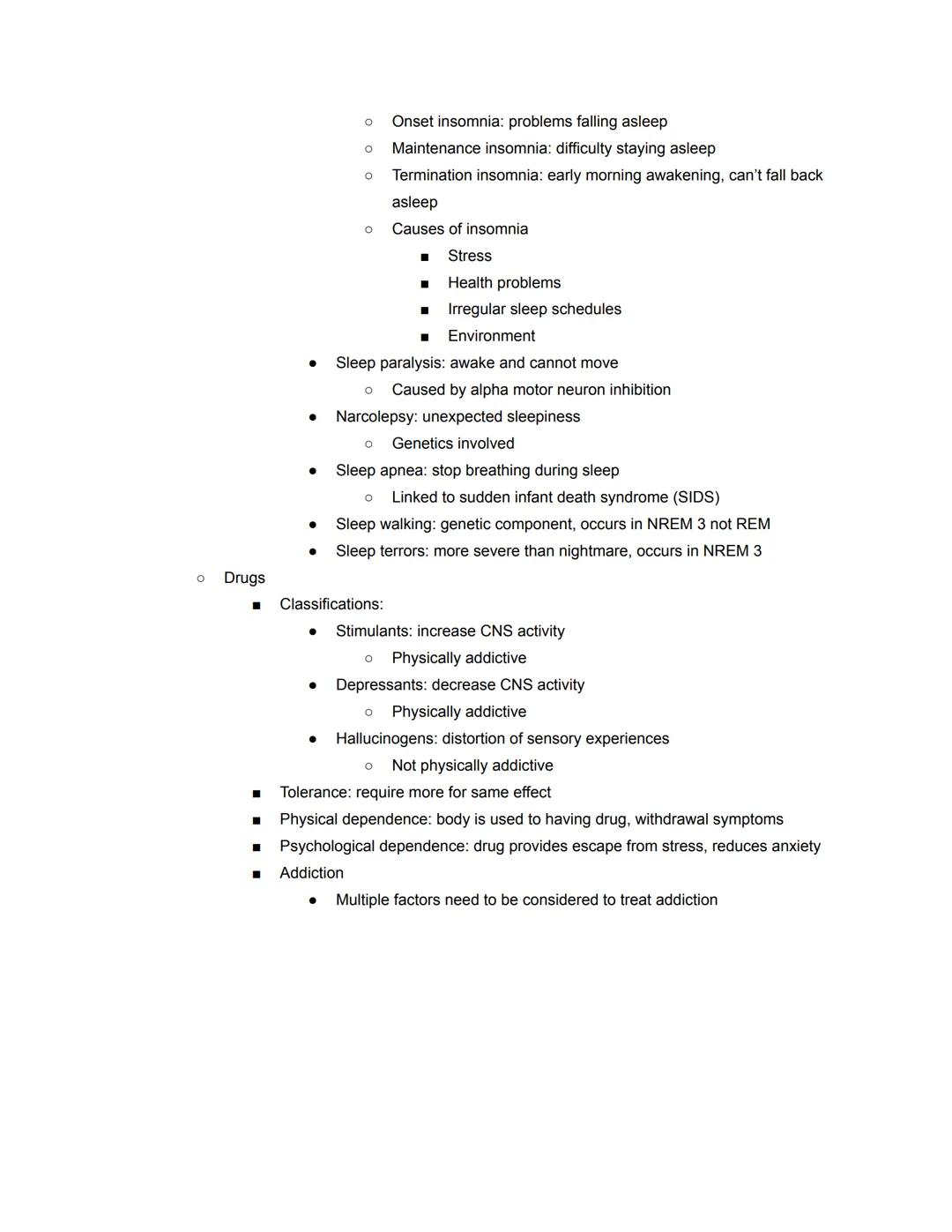
Sleep Disorders and Drugs: When Consciousness Goes Awry
Sleep disorders can seriously impact your daily life. Insomnia comes in three main forms: onset (trouble falling asleep), maintenance (difficulty staying asleep), and termination (waking too early). It's often triggered by stress, health problems, irregular sleep schedules, or environmental factors.
Other common sleep disorders include sleep paralysis (being awake but unable to move due to alpha motor neuron inhibition), narcolepsy (unexpected sleepiness with a genetic component), sleep apnea (breathing stops during sleep and is linked to SIDS in infants), sleepwalking (has genetic factors and occurs during deep NREM 3 sleep), and sleep terrors (more intense than nightmares, happening in NREM 3).
Drugs affect consciousness by altering brain activity. They fall into three main classifications: stimulants increase central nervous system activity, depressants decrease CNS activity (both are physically addictive), and hallucinogens distort sensory experiences (not physically addictive). With regular use, you can develop tolerance (needing more for the same effect), physical dependence (experiencing withdrawal when stopping), and psychological dependence (relying on drugs to escape stress).
Important note: Addiction is complex and requires consideration of multiple factors for effective treatment. It's not just about willpower—it involves biological, psychological, and social components that all need addressing.
We thought you’d never ask...
What is the Knowunity AI companion?
Our AI companion is specifically built for the needs of students. Based on the millions of content pieces we have on the platform we can provide truly meaningful and relevant answers to students. But its not only about answers, the companion is even more about guiding students through their daily learning challenges, with personalised study plans, quizzes or content pieces in the chat and 100% personalisation based on the students skills and developments.
Where can I download the Knowunity app?
You can download the app in the Google Play Store and in the Apple App Store.
Is Knowunity really free of charge?
That's right! Enjoy free access to study content, connect with fellow students, and get instant help – all at your fingertips.
Similar Content
 Psychology
Most popular content in Psychology
7PsychologyPsychology 101 Notes
Notes: Chapters 1, 2, 3, 5, 6, 7, 8, 9
2,441103
Psychologybipolar disorder psyc353
adult psychopathology lecture notes
875
PsychologyPsychology - Somatic Symptom and Related Disorders
a presentation deck on somatic symptom disorders, including illness anxiety disorder, conversion disorder and somatic symptom disorders. featuring visuals from osmosis, "crazyhead comics", verywell and even never have i ever lol
11th271
PsychologyPsychology | Chapter 8: Lifespan Development
Study guide on chapter 8, theories on how people develop over a lifetime. Information was from the textbook Introduction to Psychology by Hawkes Learning and supplemented by my professor's resources.
895
PsychologyThe Endocrine System and Nervous System
Unit 2 review
2827
PsychologySchizophrenia and Psychosis PSYC353
Adult psychopathology lecture notes
12310
 AP Psychology
Jean Piaget & Cognitive Development
This know covers everything you may need to know about Jean Piaget & his theory of Cognitive development, as well as explanations of each step of cognitive development
10th1273
Most popular content
9O
 AP US History
Origins and Dynamics of the Columbian Exchange
Analyze the ecological and economic motivations behind the initial transfer of goods, people, and diseases between the Old and New Worlds.
9th3,1280
I
AP US HistoryIntroduction to Early Cultural Interactions
Analyze the initial social and religious encounters between Europeans, Africans, and Indigenous peoples in the colonial Americas.
9th2,7730
O
 AP World History
Origins of Ancient River Civilizations
Analyze the environmental factors and technological innovations that led to the rise of early states in Mesopotamia, Egypt, and the Indus Valley.
9th3,1870
M
AP US HistoryMotivations for European Exploration
Analyze the economic, religious, and political factors that drove European powers to the Americas during the 15th and 16th centuries.
9th1,7780
F
AP PsychologyFoundations of Ethical Guidelines in Research
Practice the core principles of the APA ethical code including informed consent, debriefing, and the role of Institutional Review Boards.
9th1,3360
I
AP US HistoryIntroduction to Native American Societies
Examine the diverse social, political, and economic structures of North American indigenous groups prior to European contact.
9th1,1100
I
 AP Biology
Introduction to Biological Elements of Life
Practice identifying the essential elements including carbon, nitrogen, phosphorus, and sulfur that compose biological macromolecules.
9th1,7390
I
AP US HistoryIntroduction to the Spanish Encomienda System
Explore the fundamental economic and social structures of the Spanish colonial system, focusing on the encomienda and the casta social hierarchy.
9th8890
O
AP World HistoryOrigins and Continuity of the Byzantine Empire
Analyze the political and cultural transitions from the Roman Empire to the Byzantine Empire, focusing on the reign of Justinian I and his code.
9th1,6320
Can't find what you're looking for? Explore other subjects.
Students love us — and so will you.
4.6/5App Store
4.7/5Google Play
The app is very easy to use and well designed. I have found everything I was looking for so far and have been able to learn a lot from the presentations! I will definitely use the app for a class assignment! And of course it also helps a lot as an inspiration.
Stefan SiOS user
This app is really great. There are so many study notes and help [...]. My problem subject is French, for example, and the app has so many options for help. Thanks to this app, I have improved my French. I would recommend it to anyone.
Samantha KlichAndroid user
Wow, I am really amazed. I just tried the app because I've seen it advertised many times and was absolutely stunned. This app is THE HELP you want for school and above all, it offers so many things, such as workouts and fact sheets, which have been VERY helpful to me personally.
AnnaiOS user
Psychology48 views·Updated Jun 8, 2026·2 pagesUnderstanding Consciousness: Study Guide for Chapter 3 in Psychology
Dive into the fascinating world of human consciousness where we'll explore sleep cycles, dream theories, sleep disorders, and the impact of drugs on the brain. These concepts help us understand why we spend nearly a third of our lives sleeping...
1
of 2
Sign up to see the content. It's free!
- Access to all documents
- Improve your grades
- Join milions of students
Sleep and Dreams: The Science Behind Your Nightly Rest
Ever wonder what happens when you fall asleep? Your body follows a circadian rhythm (your biological clock) through several sleep cycles each night. Each cycle lasts about 90 minutes and includes both REM (rapid eye movement) and NREM stages, following this pattern: NREM 1 → NREM 2 → NREM 3 → NREM 2 → NREM 1 → REM. The deepest sleep happens during NREM 3.
During REM sleep, your body experiences alpha motor neuron inhibition, basically sleep paralysis that prevents you from acting out your dreams. You might occasionally experience hypnagogic hallucinations or a myoclonic jerk .
Why do we sleep at all? Scientists have multiple theories. The Repair and Restoration Theory suggests sleep allows your body to heal and recharge. The Evolution Theory proposes sleep helps conserve energy. REM sleep specifically appears crucial for brain development and memory consolidation. If you're REM-deprived, you'll experience REM-rebound, spending about 50% more time in REM during your next sleep session.
Did you know? Dreams have fascinated scientists for centuries. Freud believed dreams had both manifest content (the actual storyline) and latent content (hidden symbolic meanings). Modern science suggests the Activation Synthesis Hypothesis - your brain activates during sleep, including emotion centers, and then creates a story to make sense of this activity.
2
of 2Sign up to see the content. It's free!
- Access to all documents
- Improve your grades
- Join milions of students
Sleep Disorders and Drugs: When Consciousness Goes Awry
Sleep disorders can seriously impact your daily life. Insomnia comes in three main forms: onset (trouble falling asleep), maintenance (difficulty staying asleep), and termination (waking too early). It's often triggered by stress, health problems, irregular sleep schedules, or environmental factors.
Other common sleep disorders include sleep paralysis (being awake but unable to move due to alpha motor neuron inhibition), narcolepsy (unexpected sleepiness with a genetic component), sleep apnea (breathing stops during sleep and is linked to SIDS in infants), sleepwalking (has genetic factors and occurs during deep NREM 3 sleep), and sleep terrors (more intense than nightmares, happening in NREM 3).
Drugs affect consciousness by altering brain activity. They fall into three main classifications: stimulants increase central nervous system activity, depressants decrease CNS activity (both are physically addictive), and hallucinogens distort sensory experiences (not physically addictive). With regular use, you can develop tolerance (needing more for the same effect), physical dependence (experiencing withdrawal when stopping), and psychological dependence (relying on drugs to escape stress).
Important note: Addiction is complex and requires consideration of multiple factors for effective treatment. It's not just about willpower—it involves biological, psychological, and social components that all need addressing.
We thought you’d never ask...
What is the Knowunity AI companion?
Our AI companion is specifically built for the needs of students. Based on the millions of content pieces we have on the platform we can provide truly meaningful and relevant answers to students. But its not only about answers, the companion is even more about guiding students through their daily learning challenges, with personalised study plans, quizzes or content pieces in the chat and 100% personalisation based on the students skills and developments.
Where can I download the Knowunity app?
You can download the app in the Google Play Store and in the Apple App Store.
Is Knowunity really free of charge?
That's right! Enjoy free access to study content, connect with fellow students, and get instant help – all at your fingertips.
Similar Content
Most popular content in Psychology
7PsychologyPsychology 101 Notes
Notes: Chapters 1, 2, 3, 5, 6, 7, 8, 9
2,441103
Psychologybipolar disorder psyc353
adult psychopathology lecture notes
875
PsychologyPsychology - Somatic Symptom and Related Disorders
a presentation deck on somatic symptom disorders, including illness anxiety disorder, conversion disorder and somatic symptom disorders. featuring visuals from osmosis, "crazyhead comics", verywell and even never have i ever lol
11th271
PsychologyPsychology | Chapter 8: Lifespan Development
Study guide on chapter 8, theories on how people develop over a lifetime. Information was from the textbook Introduction to Psychology by Hawkes Learning and supplemented by my professor's resources.
895
PsychologyThe Endocrine System and Nervous System
Unit 2 review
2827
PsychologySchizophrenia and Psychosis PSYC353
Adult psychopathology lecture notes
12310
AP PsychologyJean Piaget & Cognitive Development
This know covers everything you may need to know about Jean Piaget & his theory of Cognitive development, as well as explanations of each step of cognitive development
10th1273
Most popular content
9O
AP US HistoryOrigins and Dynamics of the Columbian Exchange
Analyze the ecological and economic motivations behind the initial transfer of goods, people, and diseases between the Old and New Worlds.
9th3,1280
I
AP US HistoryIntroduction to Early Cultural Interactions
Analyze the initial social and religious encounters between Europeans, Africans, and Indigenous peoples in the colonial Americas.
9th2,7730
O
AP World HistoryOrigins of Ancient River Civilizations
Analyze the environmental factors and technological innovations that led to the rise of early states in Mesopotamia, Egypt, and the Indus Valley.
9th3,1870
M
AP US HistoryMotivations for European Exploration
Analyze the economic, religious, and political factors that drove European powers to the Americas during the 15th and 16th centuries.
9th1,7780
F
AP PsychologyFoundations of Ethical Guidelines in Research
Practice the core principles of the APA ethical code including informed consent, debriefing, and the role of Institutional Review Boards.
9th1,3360
I
AP US HistoryIntroduction to Native American Societies
Examine the diverse social, political, and economic structures of North American indigenous groups prior to European contact.
9th1,1100
I
AP BiologyIntroduction to Biological Elements of Life
Practice identifying the essential elements including carbon, nitrogen, phosphorus, and sulfur that compose biological macromolecules.
9th1,7390
I
AP US HistoryIntroduction to the Spanish Encomienda System
Explore the fundamental economic and social structures of the Spanish colonial system, focusing on the encomienda and the casta social hierarchy.
9th8890
O
AP World HistoryOrigins and Continuity of the Byzantine Empire
Analyze the political and cultural transitions from the Roman Empire to the Byzantine Empire, focusing on the reign of Justinian I and his code.
9th1,6320
Can't find what you're looking for? Explore other subjects.
Students love us — and so will you.
4.6/5App Store
4.7/5Google Play
The app is very easy to use and well designed. I have found everything I was looking for so far and have been able to learn a lot from the presentations! I will definitely use the app for a class assignment! And of course it also helps a lot as an inspiration.
Stefan SiOS user
This app is really great. There are so many study notes and help [...]. My problem subject is French, for example, and the app has so many options for help. Thanks to this app, I have improved my French. I would recommend it to anyone.
Samantha KlichAndroid user
Wow, I am really amazed. I just tried the app because I've seen it advertised many times and was absolutely stunned. This app is THE HELP you want for school and above all, it offers so many things, such as workouts and fact sheets, which have been VERY helpful to me personally.
AnnaiOS user