

Motivation drives our actions and behaviors. This unit explores what...
 Psychology30 views·Updated Jun 13, 2026·7 pages
Boost Your Motivation: Unit 7 Comprehensive Guide

1 / 7
1
of 7
Motivation, Emotion & Personality
This unit explores the psychological forces that drive our behaviors and decisions. You'll learn about different types of motivation, what happens when rewards backfire, and theories that explain why we act the way we do.
Understanding motivation helps explain everything from why you study for a test to why you pursue hobbies even when they're challenging. The concepts in this unit connect directly to your daily choices and long-term goals.
2
of 7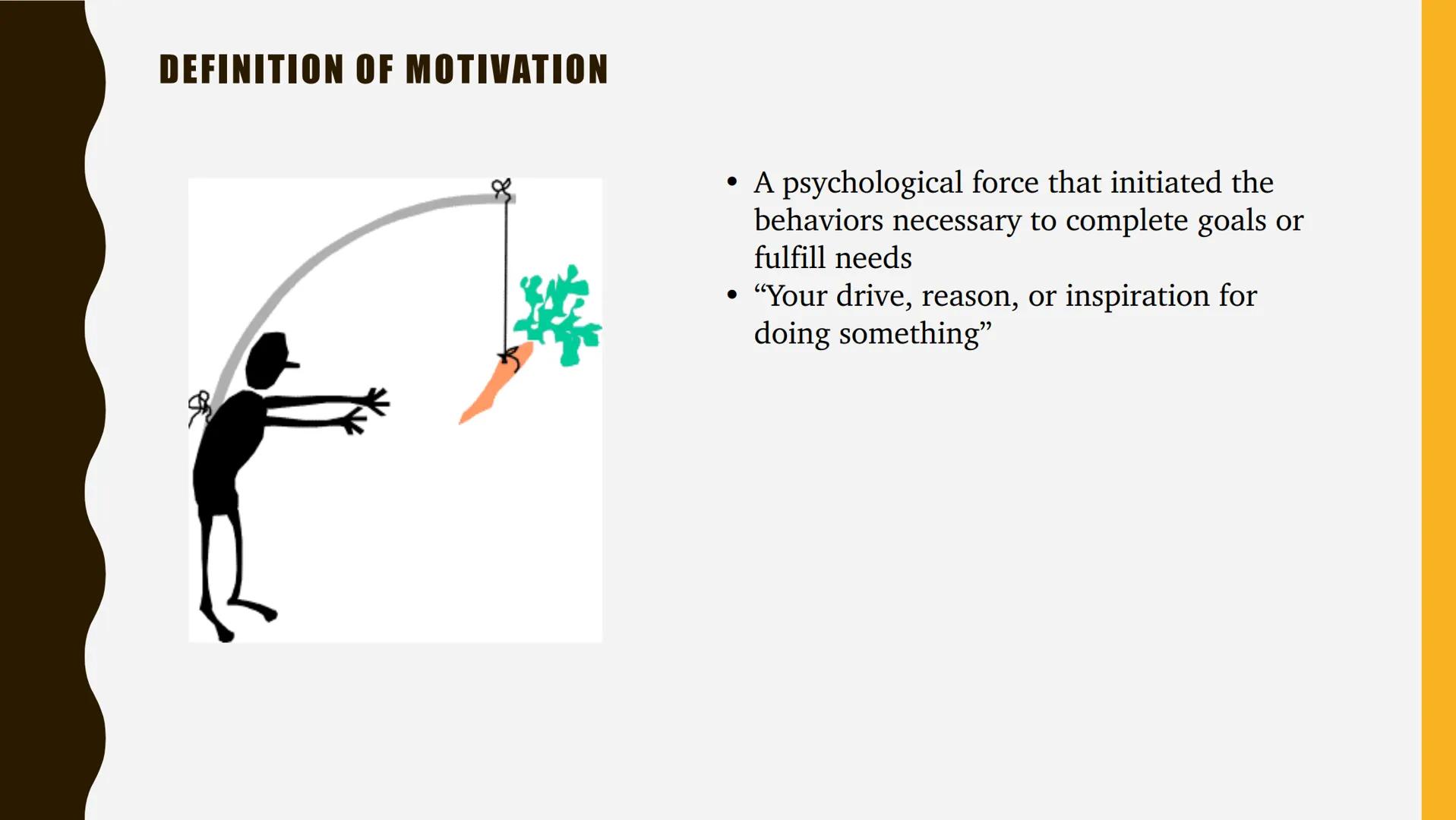
Definition of Motivation
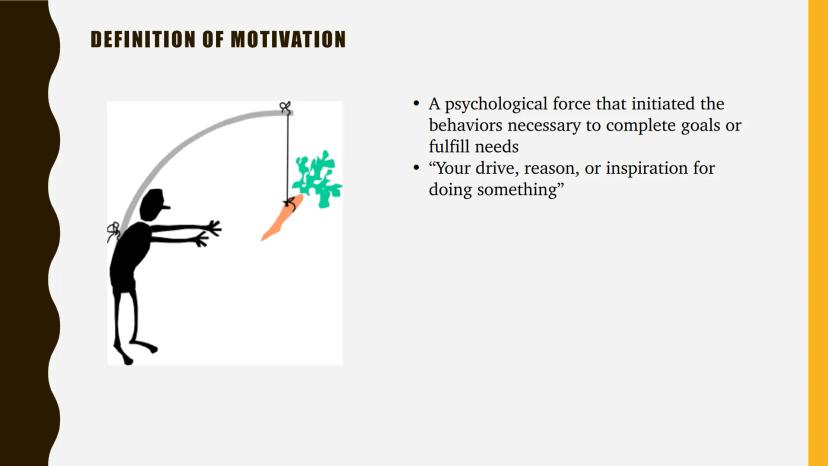
Motivation is a psychological force that pushes you to take action toward completing goals or fulfilling needs. Think of it as your internal engine that powers you through tasks and challenges.
It's essentially your drive, reason, or inspiration for doing something. When you feel motivated, you have energy and direction that helps you accomplish what you set out to do.
💡 Every action you take, from studying for a test to playing video games, is driven by some form of motivation. Recognizing what motivates you can help you become more successful!
3
of 7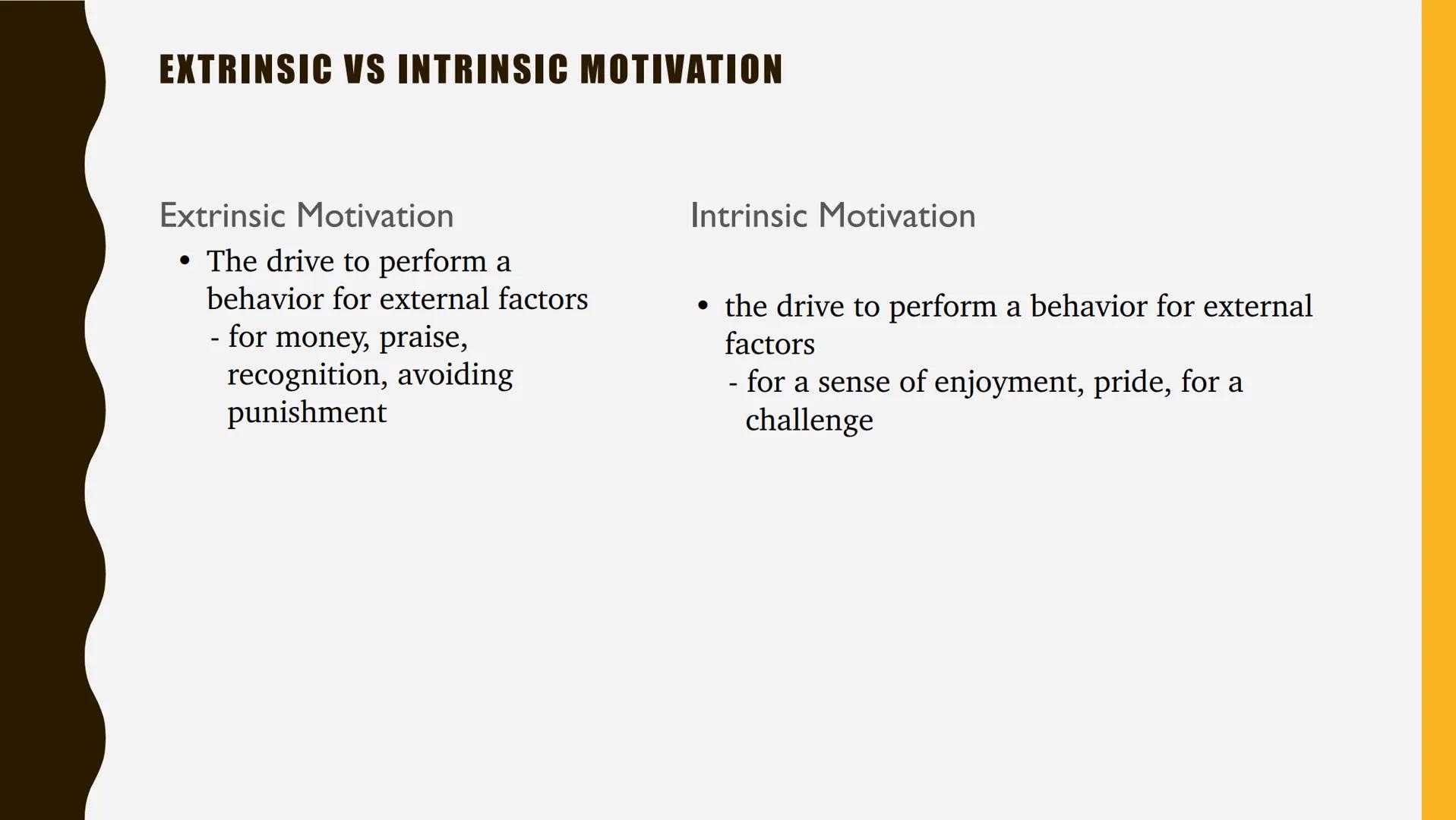
Extrinsic vs Intrinsic Motivation
Extrinsic motivation comes from outside yourself. You perform behaviors to gain rewards or avoid negative consequences. Examples include studying to get good grades, working for money, or behaving well to earn praise from others.
Intrinsic motivation comes from within. You do things because they're personally rewarding, enjoyable, or provide a sense of accomplishment. Playing an instrument because you love music or solving puzzles for the challenge are intrinsically motivated behaviors.
Most of our activities involve a mix of both types of motivation, though one type might be stronger than the other in different situations.
4
of 7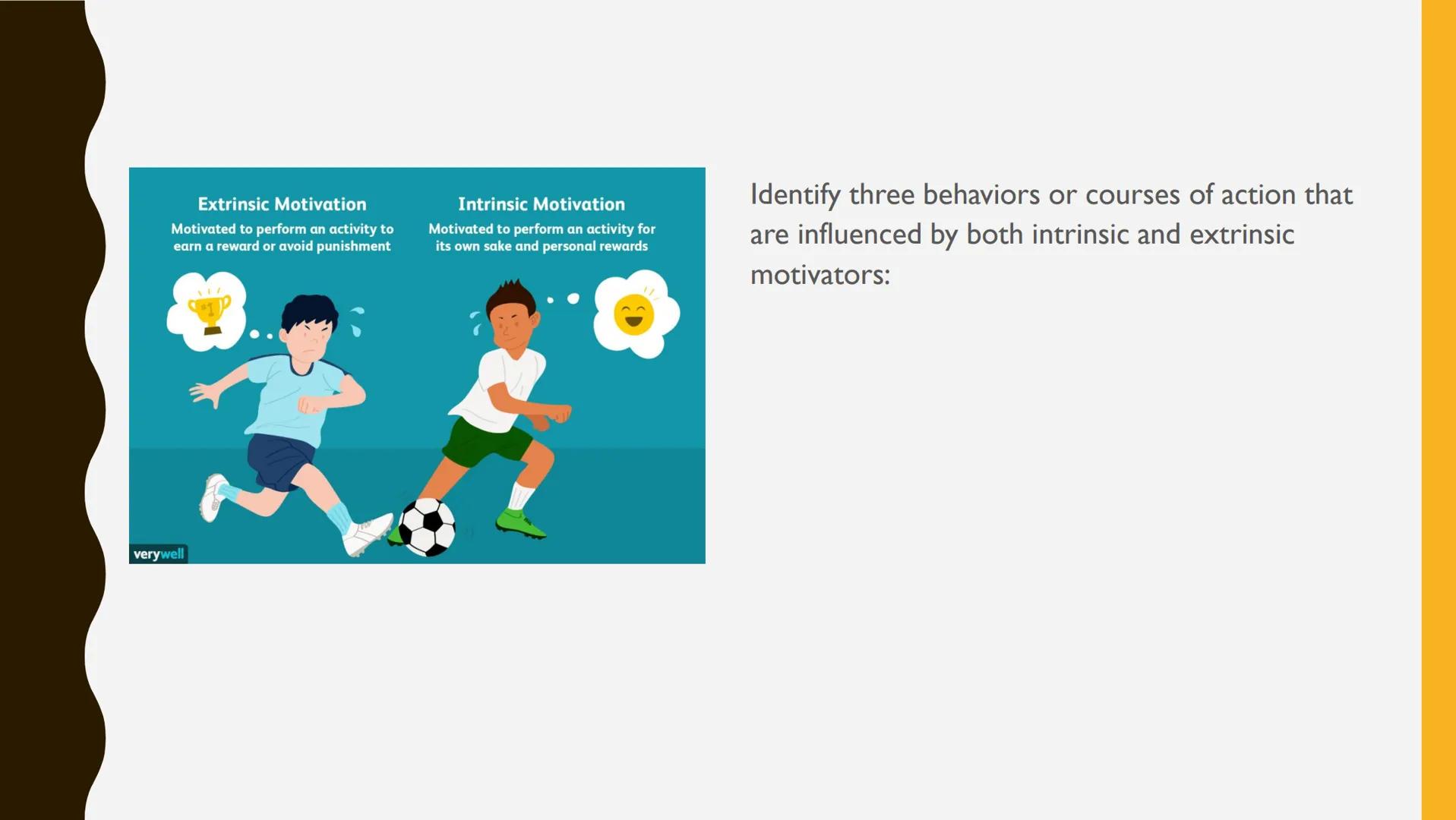
Understanding Motivation Types
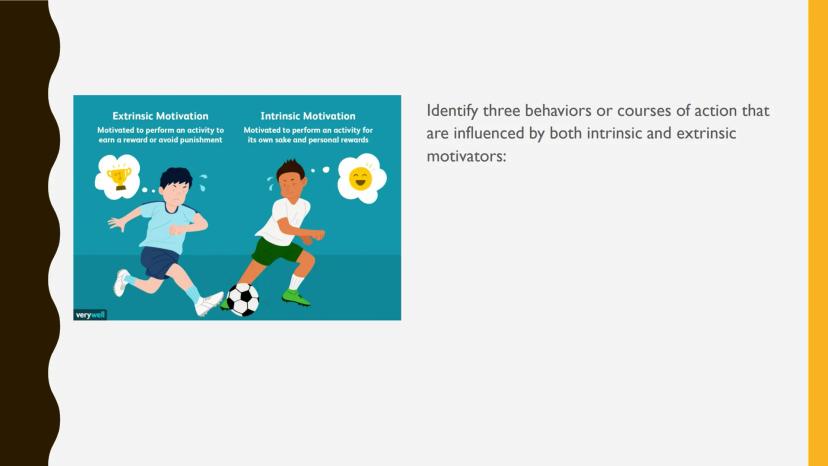
Extrinsic motivation pushes you to act based on external factors. When you complete homework to avoid punishment or participate in a competition to win a prize, you're extrinsically motivated.
Intrinsic motivation, by contrast, drives you to engage in activities for personal satisfaction. Reading a book because you enjoy the story or practicing basketball because you love improving your skills shows intrinsic motivation.
Many activities in your life involve both types. For example, you might join a school club partially because it looks good on college applications (extrinsic) but also because you genuinely enjoy the activities (intrinsic).
🔍 Think about your favorite class or hobby - what mix of intrinsic and extrinsic factors motivate you to pursue it?
5
of 7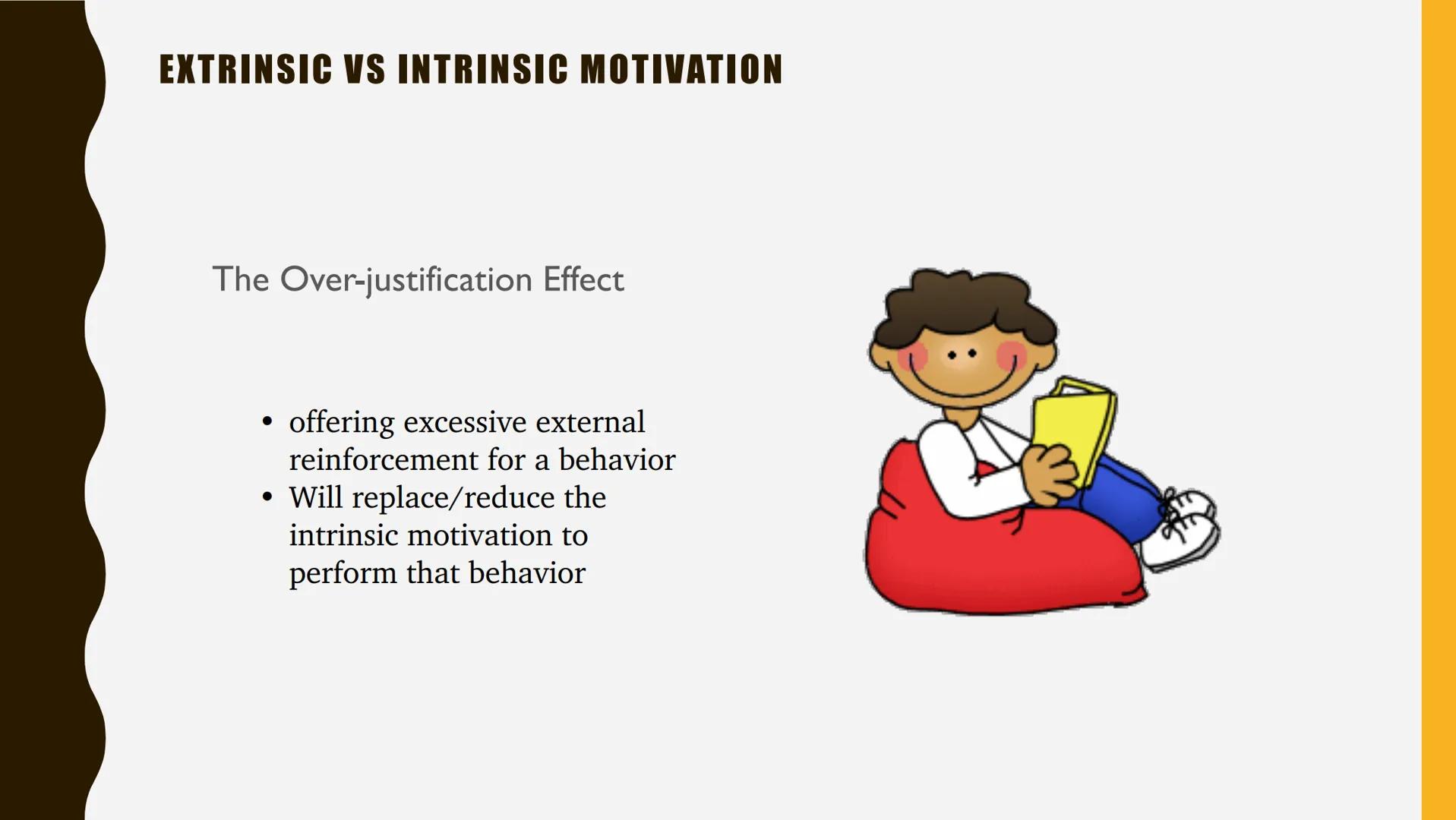
The Over-justification Effect
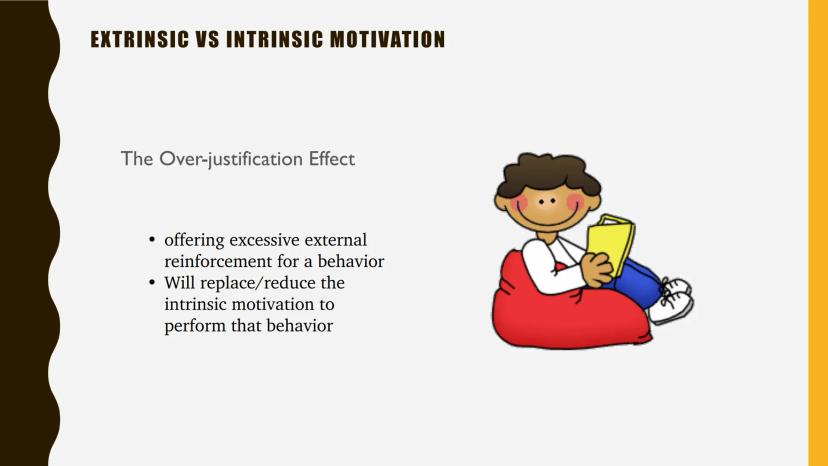
Sometimes too much of a good thing can backfire! The over-justification effect happens when excessive external rewards actually decrease your intrinsic motivation for an activity you previously enjoyed.
For example, if you love drawing and then start getting paid for every picture you create, you might eventually feel less joy in drawing just for fun. The external reward (money) replaces the internal satisfaction that originally motivated you.
This psychological phenomenon explains why activities that become obligations or jobs sometimes lose their appeal. It's why many teachers and parents try to balance rewards with encouraging genuine interest in learning.
6
of 7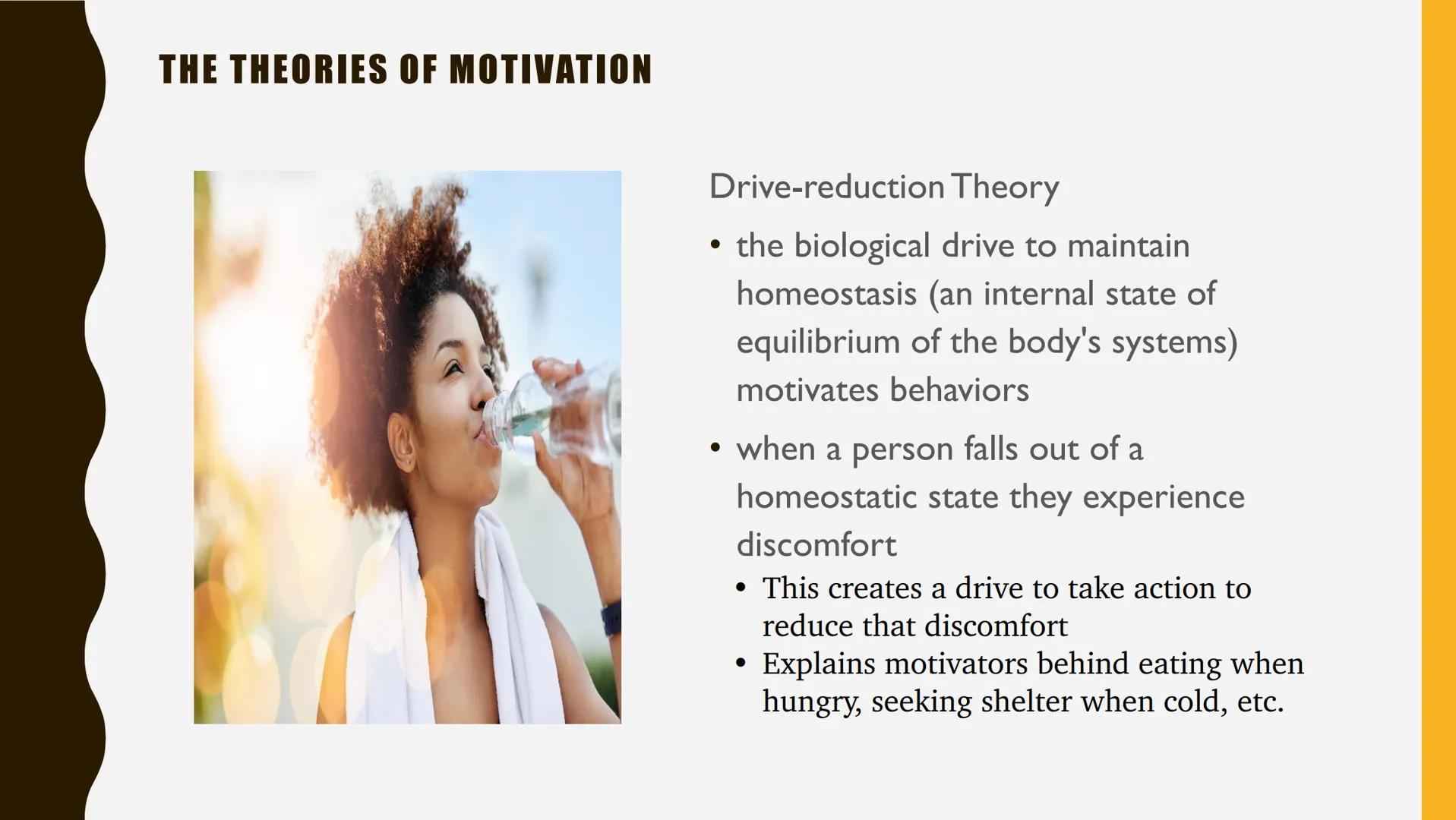
Drive-Reduction Theory
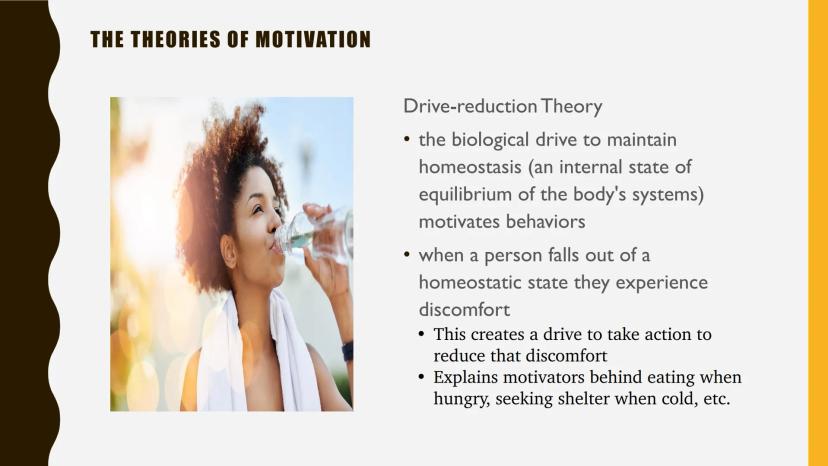
The drive-reduction theory explains motivation as our biological need to maintain homeostasis - a balanced internal state in our body systems. When this balance is disrupted, we feel uncomfortable and are motivated to restore it.
For example, when you haven't eaten for hours, your blood sugar drops and you feel hungry. This uncomfortable feeling creates a drive to find food, which reduces the discomfort and returns your body to homeostasis.
This theory effectively explains basic motivations like eating when hungry, drinking when thirsty, or putting on a sweater when cold. These behaviors are directly tied to physical needs and the discomfort that comes from not meeting them.
⚡ Your body is constantly working to maintain balance, and those uncomfortable feelings like hunger and thirst are actually helpful signals that motivate you to take care of yourself!
7
of 7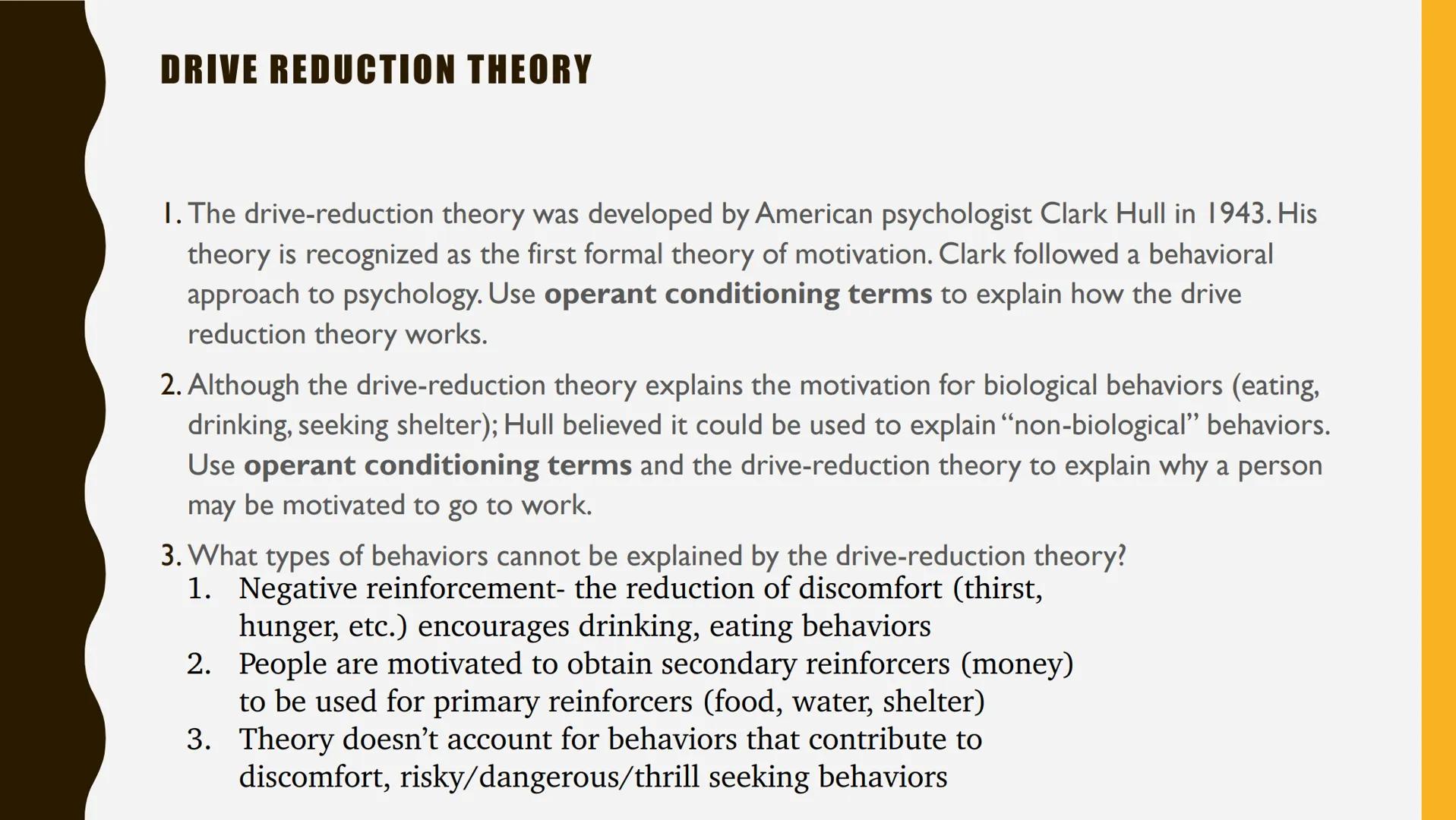
Applications of Drive-Reduction Theory
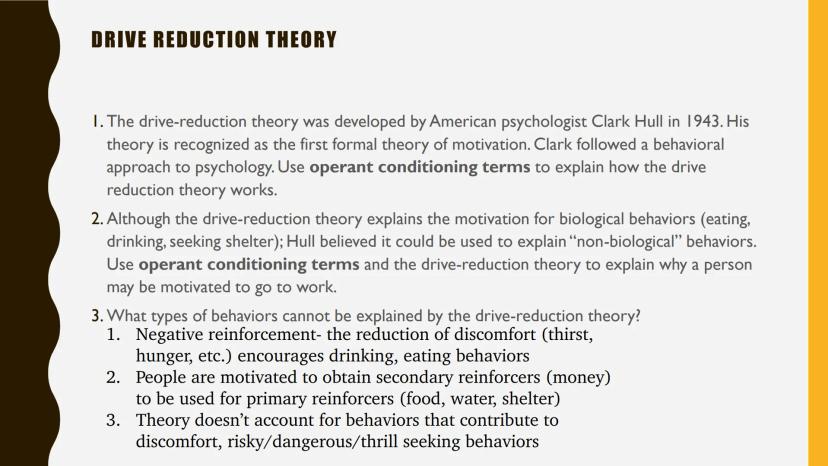
Drive-reduction theory, developed by psychologist Clark Hull in 1943, explains motivation through operant conditioning principles. When you're hungry and eat food, the discomfort reduction acts as negative reinforcement, making you more likely to eat when hungry in the future.
The theory can extend beyond biological needs to explain other behaviors. People work jobs not just for money itself, but because money serves as a secondary reinforcer that helps obtain primary needs like food and shelter. The reduction of financial insecurity drives the motivation to work.
However, drive-reduction theory has limitations. It can't explain why people engage in behaviors that increase discomfort, like thrill-seeking activities, dangerous sports, or challenges that don't restore homeostasis. These actions actually disrupt balance yet people are still motivated to do them.
🧠 Not all of your motivations are about reducing discomfort! Sometimes you're drawn to experiences precisely because they're challenging or thrilling.
We thought you’d never ask...
What is the Knowunity AI companion?
Our AI companion is specifically built for the needs of students. Based on the millions of content pieces we have on the platform we can provide truly meaningful and relevant answers to students. But its not only about answers, the companion is even more about guiding students through their daily learning challenges, with personalised study plans, quizzes or content pieces in the chat and 100% personalisation based on the students skills and developments.
Where can I download the Knowunity app?
You can download the app in the Google Play Store and in the Apple App Store.
Is Knowunity really free of charge?
That's right! Enjoy free access to study content, connect with fellow students, and get instant help – all at your fingertips.
Similar Content
Most popular content in Psychology
7PsychologyPsychology 101 Notes
Notes: Chapters 1, 2, 3, 5, 6, 7, 8, 9
2,441103
Psychologybipolar disorder psyc353
adult psychopathology lecture notes
875
PsychologyPsychology | Chapter 8: Lifespan Development
Study guide on chapter 8, theories on how people develop over a lifetime. Information was from the textbook Introduction to Psychology by Hawkes Learning and supplemented by my professor's resources.
895
PsychologyPsychology - Somatic Symptom and Related Disorders
a presentation deck on somatic symptom disorders, including illness anxiety disorder, conversion disorder and somatic symptom disorders. featuring visuals from osmosis, "crazyhead comics", verywell and even never have i ever lol
11th271
Psychologyeating disorders psyc353
adult psychopathology lecture notes
964
PsychologyAp Psychology Unit 1
Scientific foundations of Psychology
10th1,11753
PsychologySchizophrenia and Psychosis PSYC353
Adult psychopathology lecture notes
12310
Most popular content
9O
 AP US History
Origins and Dynamics of the Columbian Exchange
Analyze the ecological and economic motivations behind the initial transfer of goods, people, and diseases between the Old and New Worlds.
9th3,1280
I
AP US HistoryIntroduction to Early Cultural Interactions
Analyze the initial social and religious encounters between Europeans, Africans, and Indigenous peoples in the colonial Americas.
9th2,7730
O
 AP World History
Origins of Ancient River Civilizations
Analyze the environmental factors and technological innovations that led to the rise of early states in Mesopotamia, Egypt, and the Indus Valley.
9th3,1870
M
AP US HistoryMotivations for European Exploration
Analyze the economic, religious, and political factors that drove European powers to the Americas during the 15th and 16th centuries.
9th1,7780
F
 AP Psychology
Foundations of Ethical Guidelines in Research
Practice the core principles of the APA ethical code including informed consent, debriefing, and the role of Institutional Review Boards.
9th1,3360
I
AP US HistoryIntroduction to Native American Societies
Examine the diverse social, political, and economic structures of North American indigenous groups prior to European contact.
9th1,1100
I
 AP Biology
Introduction to Biological Elements of Life
Practice identifying the essential elements including carbon, nitrogen, phosphorus, and sulfur that compose biological macromolecules.
9th1,7390
I
AP US HistoryIntroduction to the Spanish Encomienda System
Explore the fundamental economic and social structures of the Spanish colonial system, focusing on the encomienda and the casta social hierarchy.
9th8890
O
AP World HistoryOrigins and Continuity of the Byzantine Empire
Analyze the political and cultural transitions from the Roman Empire to the Byzantine Empire, focusing on the reign of Justinian I and his code.
9th1,6320
Can't find what you're looking for? Explore other subjects.
Students love us — and so will you.
4.6/5App Store
4.7/5Google Play
The app is very easy to use and well designed. I have found everything I was looking for so far and have been able to learn a lot from the presentations! I will definitely use the app for a class assignment! And of course it also helps a lot as an inspiration.
Stefan SiOS user
This app is really great. There are so many study notes and help [...]. My problem subject is French, for example, and the app has so many options for help. Thanks to this app, I have improved my French. I would recommend it to anyone.
Samantha KlichAndroid user
Wow, I am really amazed. I just tried the app because I've seen it advertised many times and was absolutely stunned. This app is THE HELP you want for school and above all, it offers so many things, such as workouts and fact sheets, which have been VERY helpful to me personally.
AnnaiOS user
Psychology30 views·Updated Jun 13, 2026·7 pagesBoost Your Motivation: Unit 7 Comprehensive Guide
Motivation drives our actions and behaviors. This unit explores what motivates us, the differences between intrinsic and extrinsic motivation, and theories that explain why we do what we do.
1
of 7
Sign up to see the content. It's free!
- Access to all documents
- Improve your grades
- Join milions of students
Motivation, Emotion & Personality
This unit explores the psychological forces that drive our behaviors and decisions. You'll learn about different types of motivation, what happens when rewards backfire, and theories that explain why we act the way we do.
Understanding motivation helps explain everything from why you study for a test to why you pursue hobbies even when they're challenging. The concepts in this unit connect directly to your daily choices and long-term goals.
2
of 7Sign up to see the content. It's free!
- Access to all documents
- Improve your grades
- Join milions of students
Definition of Motivation
Motivation is a psychological force that pushes you to take action toward completing goals or fulfilling needs. Think of it as your internal engine that powers you through tasks and challenges.
It's essentially your drive, reason, or inspiration for doing something. When you feel motivated, you have energy and direction that helps you accomplish what you set out to do.
💡 Every action you take, from studying for a test to playing video games, is driven by some form of motivation. Recognizing what motivates you can help you become more successful!
3
of 7Sign up to see the content. It's free!
- Access to all documents
- Improve your grades
- Join milions of students
Extrinsic vs Intrinsic Motivation
Extrinsic motivation comes from outside yourself. You perform behaviors to gain rewards or avoid negative consequences. Examples include studying to get good grades, working for money, or behaving well to earn praise from others.
Intrinsic motivation comes from within. You do things because they're personally rewarding, enjoyable, or provide a sense of accomplishment. Playing an instrument because you love music or solving puzzles for the challenge are intrinsically motivated behaviors.
Most of our activities involve a mix of both types of motivation, though one type might be stronger than the other in different situations.
4
of 7Sign up to see the content. It's free!
- Access to all documents
- Improve your grades
- Join milions of students
Understanding Motivation Types
Extrinsic motivation pushes you to act based on external factors. When you complete homework to avoid punishment or participate in a competition to win a prize, you're extrinsically motivated.
Intrinsic motivation, by contrast, drives you to engage in activities for personal satisfaction. Reading a book because you enjoy the story or practicing basketball because you love improving your skills shows intrinsic motivation.
Many activities in your life involve both types. For example, you might join a school club partially because it looks good on college applications (extrinsic) but also because you genuinely enjoy the activities (intrinsic).
🔍 Think about your favorite class or hobby - what mix of intrinsic and extrinsic factors motivate you to pursue it?
5
of 7Sign up to see the content. It's free!
- Access to all documents
- Improve your grades
- Join milions of students
The Over-justification Effect
Sometimes too much of a good thing can backfire! The over-justification effect happens when excessive external rewards actually decrease your intrinsic motivation for an activity you previously enjoyed.
For example, if you love drawing and then start getting paid for every picture you create, you might eventually feel less joy in drawing just for fun. The external reward (money) replaces the internal satisfaction that originally motivated you.
This psychological phenomenon explains why activities that become obligations or jobs sometimes lose their appeal. It's why many teachers and parents try to balance rewards with encouraging genuine interest in learning.
6
of 7Sign up to see the content. It's free!
- Access to all documents
- Improve your grades
- Join milions of students
Drive-Reduction Theory
The drive-reduction theory explains motivation as our biological need to maintain homeostasis - a balanced internal state in our body systems. When this balance is disrupted, we feel uncomfortable and are motivated to restore it.
For example, when you haven't eaten for hours, your blood sugar drops and you feel hungry. This uncomfortable feeling creates a drive to find food, which reduces the discomfort and returns your body to homeostasis.
This theory effectively explains basic motivations like eating when hungry, drinking when thirsty, or putting on a sweater when cold. These behaviors are directly tied to physical needs and the discomfort that comes from not meeting them.
⚡ Your body is constantly working to maintain balance, and those uncomfortable feelings like hunger and thirst are actually helpful signals that motivate you to take care of yourself!
7
of 7Sign up to see the content. It's free!
- Access to all documents
- Improve your grades
- Join milions of students
Applications of Drive-Reduction Theory
Drive-reduction theory, developed by psychologist Clark Hull in 1943, explains motivation through operant conditioning principles. When you're hungry and eat food, the discomfort reduction acts as negative reinforcement, making you more likely to eat when hungry in the future.
The theory can extend beyond biological needs to explain other behaviors. People work jobs not just for money itself, but because money serves as a secondary reinforcer that helps obtain primary needs like food and shelter. The reduction of financial insecurity drives the motivation to work.
However, drive-reduction theory has limitations. It can't explain why people engage in behaviors that increase discomfort, like thrill-seeking activities, dangerous sports, or challenges that don't restore homeostasis. These actions actually disrupt balance yet people are still motivated to do them.
🧠 Not all of your motivations are about reducing discomfort! Sometimes you're drawn to experiences precisely because they're challenging or thrilling.
We thought you’d never ask...
What is the Knowunity AI companion?
Our AI companion is specifically built for the needs of students. Based on the millions of content pieces we have on the platform we can provide truly meaningful and relevant answers to students. But its not only about answers, the companion is even more about guiding students through their daily learning challenges, with personalised study plans, quizzes or content pieces in the chat and 100% personalisation based on the students skills and developments.
Where can I download the Knowunity app?
You can download the app in the Google Play Store and in the Apple App Store.
Is Knowunity really free of charge?
That's right! Enjoy free access to study content, connect with fellow students, and get instant help – all at your fingertips.
Similar Content
Most popular content in Psychology
7PsychologyPsychology 101 Notes
Notes: Chapters 1, 2, 3, 5, 6, 7, 8, 9
2,441103
Psychologybipolar disorder psyc353
adult psychopathology lecture notes
875
PsychologyPsychology | Chapter 8: Lifespan Development
Study guide on chapter 8, theories on how people develop over a lifetime. Information was from the textbook Introduction to Psychology by Hawkes Learning and supplemented by my professor's resources.
895
PsychologyPsychology - Somatic Symptom and Related Disorders
a presentation deck on somatic symptom disorders, including illness anxiety disorder, conversion disorder and somatic symptom disorders. featuring visuals from osmosis, "crazyhead comics", verywell and even never have i ever lol
11th271
Psychologyeating disorders psyc353
adult psychopathology lecture notes
964
PsychologyAp Psychology Unit 1
Scientific foundations of Psychology
10th1,11753
PsychologySchizophrenia and Psychosis PSYC353
Adult psychopathology lecture notes
12310
Most popular content
9O
AP US HistoryOrigins and Dynamics of the Columbian Exchange
Analyze the ecological and economic motivations behind the initial transfer of goods, people, and diseases between the Old and New Worlds.
9th3,1280
I
AP US HistoryIntroduction to Early Cultural Interactions
Analyze the initial social and religious encounters between Europeans, Africans, and Indigenous peoples in the colonial Americas.
9th2,7730
O
AP World HistoryOrigins of Ancient River Civilizations
Analyze the environmental factors and technological innovations that led to the rise of early states in Mesopotamia, Egypt, and the Indus Valley.
9th3,1870
M
AP US HistoryMotivations for European Exploration
Analyze the economic, religious, and political factors that drove European powers to the Americas during the 15th and 16th centuries.
9th1,7780
F
AP PsychologyFoundations of Ethical Guidelines in Research
Practice the core principles of the APA ethical code including informed consent, debriefing, and the role of Institutional Review Boards.
9th1,3360
I
AP US HistoryIntroduction to Native American Societies
Examine the diverse social, political, and economic structures of North American indigenous groups prior to European contact.
9th1,1100
I
AP BiologyIntroduction to Biological Elements of Life
Practice identifying the essential elements including carbon, nitrogen, phosphorus, and sulfur that compose biological macromolecules.
9th1,7390
I
AP US HistoryIntroduction to the Spanish Encomienda System
Explore the fundamental economic and social structures of the Spanish colonial system, focusing on the encomienda and the casta social hierarchy.
9th8890
O
AP World HistoryOrigins and Continuity of the Byzantine Empire
Analyze the political and cultural transitions from the Roman Empire to the Byzantine Empire, focusing on the reign of Justinian I and his code.
9th1,6320
Can't find what you're looking for? Explore other subjects.
Students love us — and so will you.
4.6/5App Store
4.7/5Google Play
The app is very easy to use and well designed. I have found everything I was looking for so far and have been able to learn a lot from the presentations! I will definitely use the app for a class assignment! And of course it also helps a lot as an inspiration.
Stefan SiOS user
This app is really great. There are so many study notes and help [...]. My problem subject is French, for example, and the app has so many options for help. Thanks to this app, I have improved my French. I would recommend it to anyone.
Samantha KlichAndroid user
Wow, I am really amazed. I just tried the app because I've seen it advertised many times and was absolutely stunned. This app is THE HELP you want for school and above all, it offers so many things, such as workouts and fact sheets, which have been VERY helpful to me personally.
AnnaiOS user