
Ever wondered why psychology research sometimes gets it wrong about...
 Psychology1,073 views·Updated Jun 20, 2026·28 pages
AQA A-Level Psychology Topic 9: Issues and Debates Explained

Zainab@zainab_02839





1 / 10
1
of 10
Gender Bias Basics
Psychology aims for universality - research that applies to everyone regardless of gender. But here's the problem: researchers' own assumptions and stereotypes often sneak into their work, making findings less reliable than they should be.
Alpha bias happens when studies exaggerate differences between males and females. Think of it as making mountains out of molehills - researchers assume there are huge, unchangeable differences between the sexes.
Freud's theory perfectly shows alpha bias in action. He claimed girls develop weaker moral reasoning because they can't identify with their fathers as strongly as boys do. On the flip side, Chodorow argued women are naturally better at forming emotional bonds - still alpha bias, just favouring women instead.
Quick Check: Alpha bias = exaggerating gender differences (usually making women look worse)
2
of 10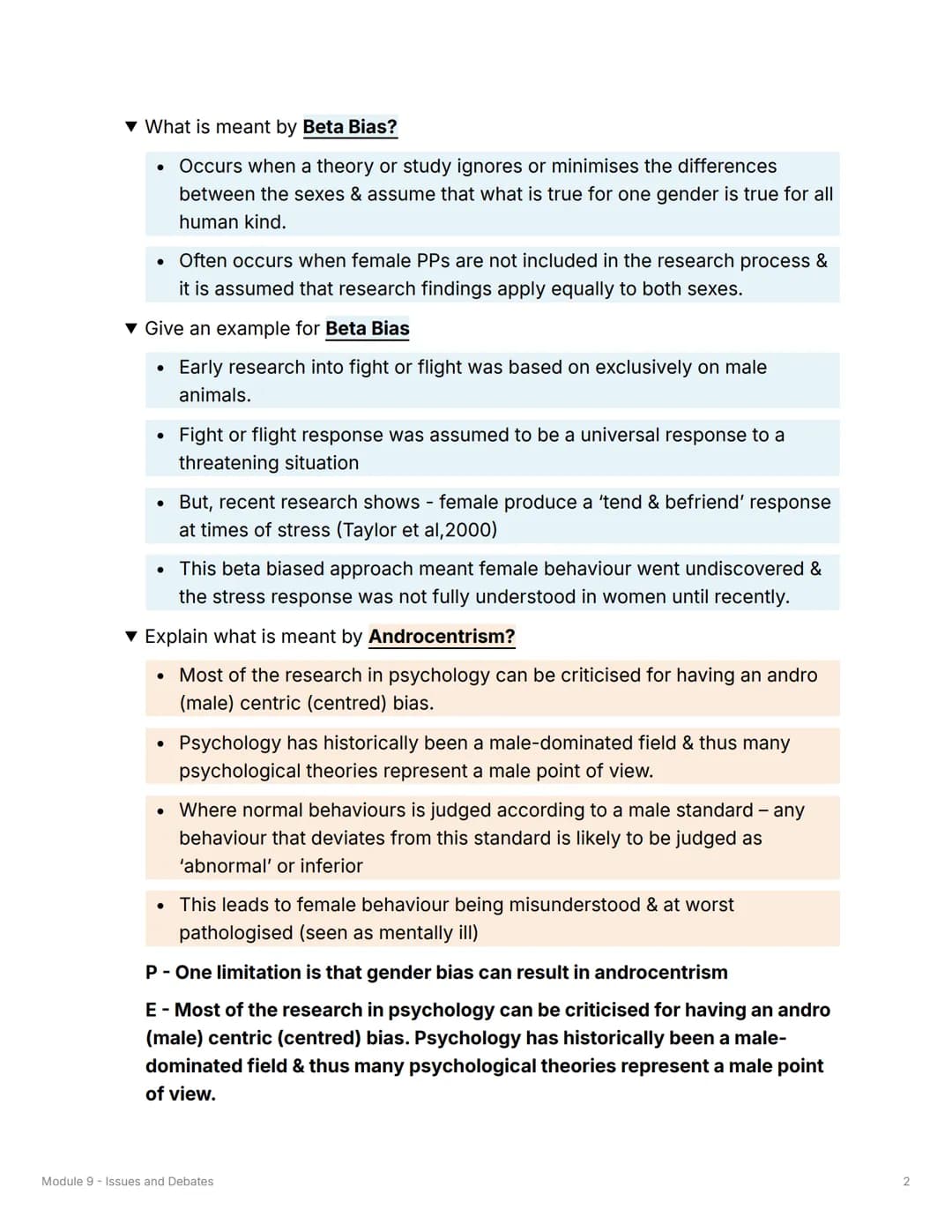
Beta Bias and Androcentrism
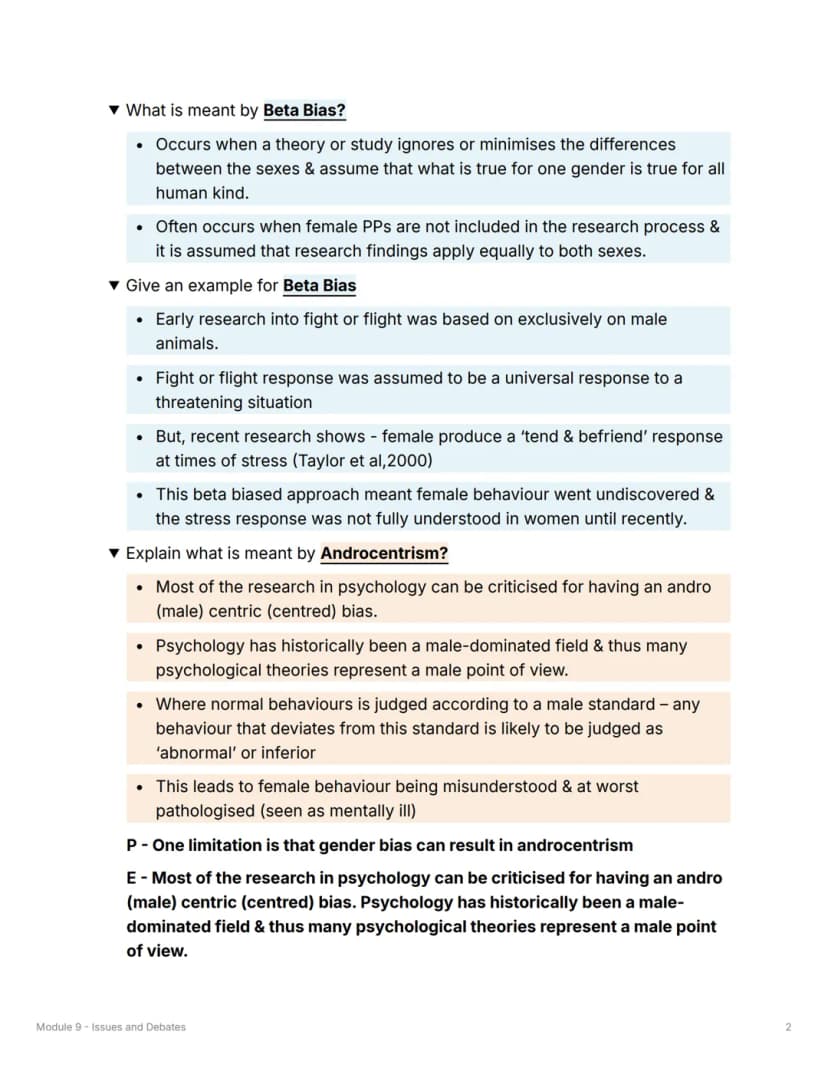
Beta bias does the opposite - it ignores gender differences entirely. Researchers often study only men but then apply their findings to everyone, assuming what's true for blokes is true for everyone.
The classic example is fight or flight research. For years, scientists only studied male animals and concluded this was the universal stress response. Then Taylor discovered women often show a 'tend and befriend' response instead - caring for others rather than fighting or running away.
Androcentrism is psychology's biggest gender problem. Since the field has been dominated by men, male behaviour becomes the 'normal' standard. Anything women do differently gets labelled as abnormal or inferior.
Reality Check: Most psychological theories were created by men, studying men, for men - then applied to everyone
This male-centred approach means female behaviour gets misunderstood or even pathologised (treated as mental illness). Not exactly fair, is it?
3
of 10
Tackling Gender Bias
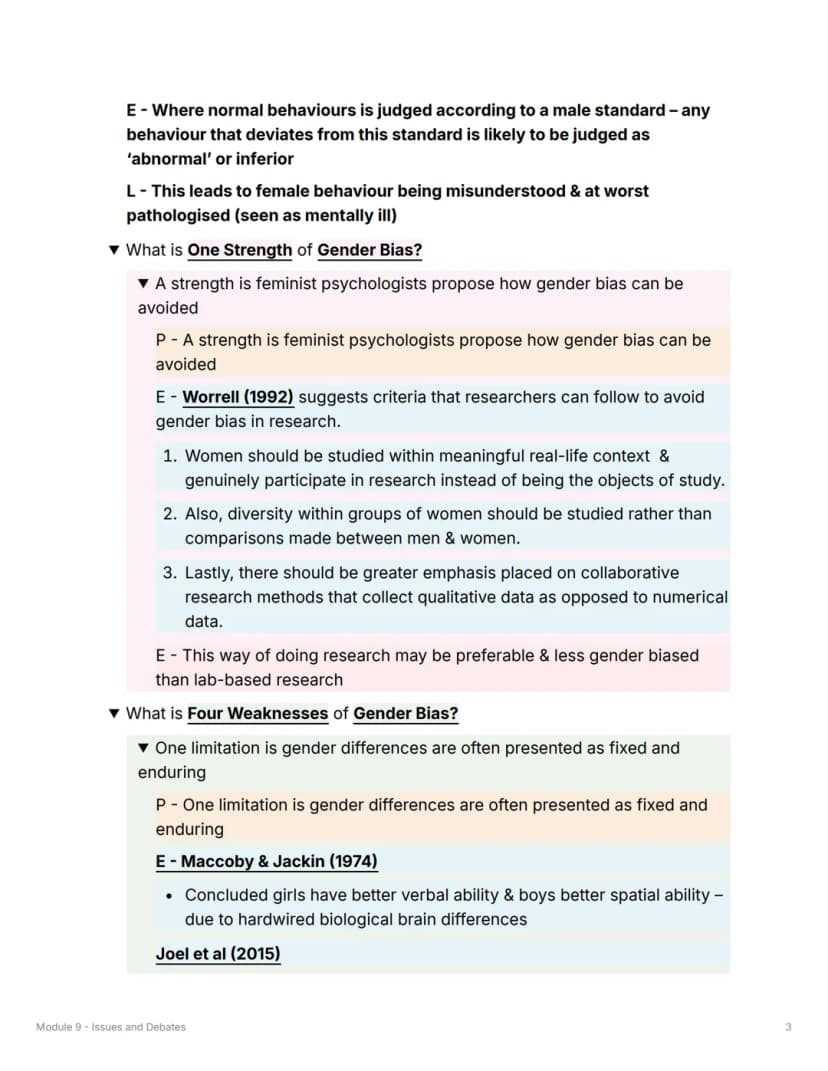
The good news? Feminist psychologists like Worrell have figured out how to make research less biased. Their approach is brilliant: study women in real-life situations where they actually participate rather than just being observed like lab rats.
Instead of constantly comparing men and women, researchers should explore the diversity within groups of women. Plus, collaborative research using qualitative data tends to be way more meaningful than sterile lab experiments.
Maccoby and Jacklin once claimed girls were naturally better at verbal tasks whilst boys excelled at spatial ones - all down to brain differences. But Joel's brain scanning research found no such differences in brain structure.
Think About It: Many 'biological facts' about gender might actually just be social stereotypes in disguise
However, Ingalhalikar's research suggests women might genuinely be better at multitasking due to better connections between brain hemispheres. The key is not exaggerating what these differences actually mean for behaviour.
4
of 10
Problems with Gender Bias
Gender bias creates real problems beyond just dodgy research. Sexism in academia means fewer women in senior positions, especially in science departments. Even though most psychology undergraduates are female, the lecturers are predominantly male.
This matters because male researchers might unconsciously expect women to be irrational or unable to handle complex tasks. These expectations can actually make female participants underperform - a self-fulfilling prophecy.
The consequences extend far beyond universities. Gender-biased research creates misleading assumptions about women, reinforces negative stereotypes, and can justify discrimination in workplaces and society.
Real Impact: Biased research isn't just a methodological problem - it affects real women's lives and opportunities
Think about it: if 'scientific' research suggests women are naturally inferior at certain tasks, this could be used to deny them job opportunities or equal treatment. That's why getting gender bias right matters so much.
5
of 10
Cultural Bias and WEIRD Samples
Cultural bias means judging everyone through the lens of your own culture, which seriously distorts research findings. Henrich's research revealed a shocking truth: 68% of psychology participants come from the US, and 96% from industrialised nations.
Most participants are WEIRD - Western, Educated, Industrialised, Rich, and Democratic. If these people set the 'normal' standard, then everyone else gets labelled as abnormal, inferior, or just plain weird.
Ethnocentrism is the belief that your cultural group is somehow superior. In psychology, this shows up when any behaviour that doesn't match European or American standards gets seen as deficient or underdeveloped.
Eye-Opener: 80% of research participants are psychology undergraduates - hardly representative of the whole world!
Ainsworth's attachment research shows ethnocentrism perfectly. She defined secure attachment based on US cultural norms, then judged other cultures by this standard. Japanese babies, rarely left alone, were wrongly labelled as insecurely attached simply because they showed distress when separated.
6
of 10
Emic vs Etic Approaches
Cultural relativism argues that behaviour only makes sense within its cultural context. You can't understand what people do without knowing their cultural background and values.
Berry distinguished between two research approaches. Etic approaches look at behaviour from outside a culture, searching for universal patterns. Emic approaches work from inside a culture, focusing on what's specific to that group.
The problem? Psychology often uses an imposed etic approach - claiming theories are universal whilst only studying specific cultures. It's like studying only British teenagers then claiming your findings apply to elderly people in rural China.
Key Insight: What we think is 'universal' human behaviour might just be Western behaviour in disguise
Cultural psychology offers a better solution. This emerging field takes an emic approach, working with local researchers and using culturally appropriate methods. It's research done from the inside rather than imposed from outside.
7
of 10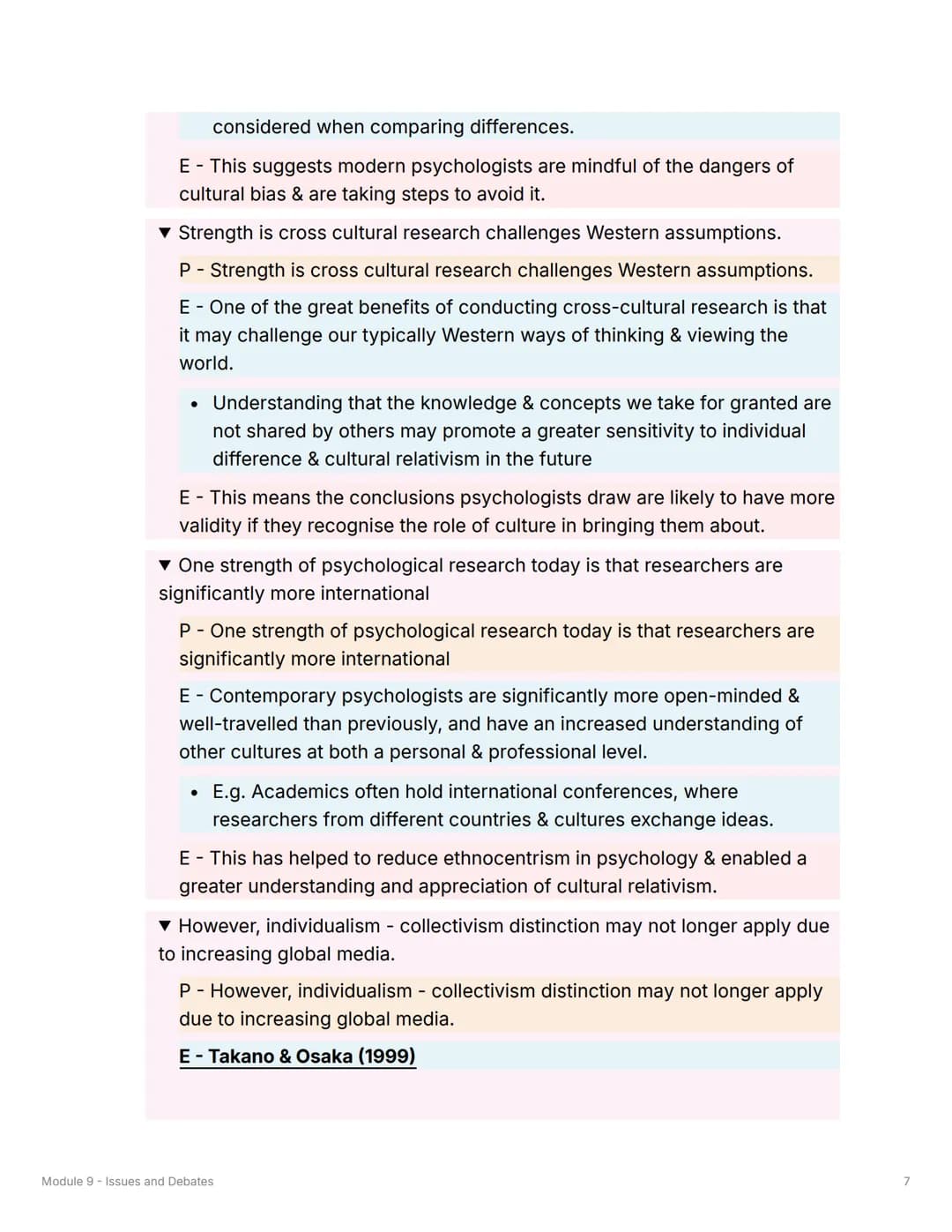
Benefits of Cultural Research
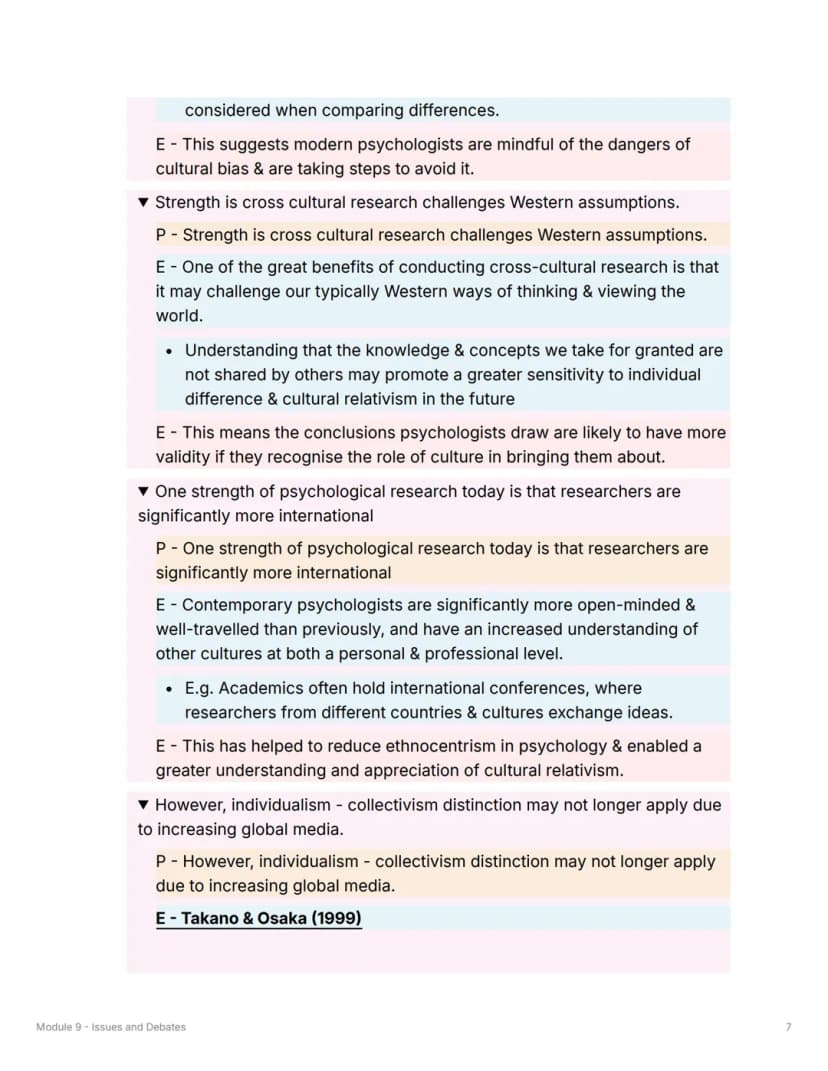
Cross-cultural research challenges our Western assumptions and opens our minds to different ways of thinking. When we realise our 'obvious' truths aren't shared by others, it promotes sensitivity to individual differences and cultural relativism.
Modern psychologists are becoming more internationally minded. They travel more, attend international conferences, and collaborate across cultures. This helps reduce ethnocentrism and builds genuine appreciation for cultural differences.
Takano and Osaka found that the famous individualism vs collectivism distinction might be outdated. In 14 out of 15 studies comparing the US and Japan, they found no evidence of these supposed cultural differences.
Modern Reality: Global media and communication might be reducing cultural differences in psychological research
This suggests cultural bias might be becoming less of an issue as the world becomes more connected. However, we still need to remain vigilant about cultural assumptions in research.
8
of 10
Problems with Cultural Bias
Many classic psychology studies are seriously culturally biased. Both Asch's conformity and Milgram's obedience studies used only white, middle-class American participants. When researchers replicated these studies elsewhere, they got completely different results.
Asch-type experiments in collectivist cultures found much higher conformity rates than the original US studies. This means our understanding of social influence might only apply to individualist cultures - hardly universal human behaviour.
Cultural bias has led to serious prejudice. Gould explained how early IQ tests resulted in eugenic social policies in America. During WWI, psychologists tested 1.75 million army recruits using culturally biased questions.
Historical Warning: Biased research has been used to justify discrimination and even genocide
Recruits from southeastern Europe and African-Americans scored lowest because the tests included ethnocentric items like naming US presidents. They were then deemed 'genetically inferior' - showing how cultural bias can justify horrific discrimination.
9
of 10
Free Will vs Determinism
Do you actually choose your behaviour, or is everything you do predetermined? Free will suggests humans are self-determining and can make genuine choices, even when facing biological and environmental pressures.
Determinism argues the opposite - all human behaviour results from internal or external causes beyond our conscious control. It's a fundamental debate that affects how we understand responsibility, treatment, and human nature itself.
Hard determinism believes every action has an identifiable cause and we have no real control. This fits with scientific aims of prediction and control. Soft determinism offers a middle ground - we have causes for our behaviour but still have some freedom to choose within limits.
Big Question: If everything you do is determined, are you responsible for your actions?
Biological determinism blames genetics, hormones, brain chemistry, and neural structure. Environmental determinism, championed by behaviourists like Skinner, sees conditioning as controlling everything. Psychic determinism from Freud points to unconscious drives and childhood experiences.
10
of 10
Free Will Benefits and Determinism's Scientific Value
Free will has practical benefits even if it's not real. Roberts found that adolescents who believed in fatalism (that their lives were decided by external forces) had higher depression rates. People with an internal locus of control tend to be more optimistic and mentally healthy.
This suggests that believing in free will, regardless of whether it actually exists, has positive effects on our minds and behaviour. It's a bit like a helpful illusion that makes life better.
Determinism aligns perfectly with scientific goals. Science aims to predict and control behaviour, which requires finding reliable causes and effects. If behaviour is truly random or free, then scientific psychology becomes impossible.
Practical Point: Believing in free will might make you happier, even if determinism is scientifically more useful
The tension between these approaches reflects psychology's struggle to be both scientific and humanistic. We want to understand human behaviour scientifically whilst still treating people as responsible agents who can make meaningful choices.
We thought you’d never ask...
What is the Knowunity AI companion?
Our AI companion is specifically built for the needs of students. Based on the millions of content pieces we have on the platform we can provide truly meaningful and relevant answers to students. But its not only about answers, the companion is even more about guiding students through their daily learning challenges, with personalised study plans, quizzes or content pieces in the chat and 100% personalisation based on the students skills and developments.
Where can I download the Knowunity app?
You can download the app in the Google Play Store and in the Apple App Store.
Is Knowunity really free of charge?
That's right! Enjoy free access to study content, connect with fellow students, and get instant help – all at your fingertips.
Similar Content
 Ethik
Ethik Philosophie
Most popular content: Free Will Vs Determinism
9 Criminology
Criminology WJEC unit 2
Unit 2 notes for criminology certificate WJEC
121,41328
SociologyAQA A Level Sociology Crime and Deviance Mindmaps
Includes all topics form Crime and Deviance
121,95047
PsychologyKey Psychological Approaches
Explore essential concepts in A-Level AQA Psychology, including the Biological, Behavioural, Cognitive, Humanistic, and Psychodynamic approaches. This comprehensive summary covers key theories, evaluations, and applications, providing a solid foundation for understanding psychological principles. Ideal for exam preparation and revision.
127778
SociologySociological Theory Essay Plans
Aqa A Level Sociological Theory Essay Plans on every topic
125099
PsychologyKey Psychological Debates
Explore essential concepts in AQA A Level Psychology, including cultural bias, gender bias, nature vs. nurture, and ethical issues. This summary covers critical evaluations of determinism, free will, and the idiographic vs. nomothetic approaches, providing a comprehensive overview for students preparing for exams.
125,617186
SociologyFAMILIES & HOUSEHOLDS - key perspective summaries
Key points, sociologists, examples and evaluation points for the main theories of the family topic AQA
121695
PsychologyPsychological Approaches Overview
Explore the key psychological approaches including behaviorism, psychodynamics, humanism, and cognitive theories. This summary highlights the debates of free will vs determinism, idiographic vs nomothetic methods, and the scientific credibility of each approach. Ideal for A-Level Psychology students seeking a comprehensive understanding of the subject.
122597
SociologyAQA A Level Sociology: Theories Paper 1 & 3
Notes for Q6 on Paper 1, and Q5 on Paper 2. I used Google Slides to condense the notes and used this as a basis for blurting & memorising!
122573
PsychologyFree Will & Determinism in Psychology - Issues and Debates
• revision notes for free will & determinism in psychology (issues and debates)
121835
Most popular content in Psychology
9PsychologySocial Influence Overview
Explore key concepts in social influence, including conformity, obedience, and minority influence. This comprehensive summary covers essential studies such as Milgram's experiment, Asch's conformity tests, and the Stanford prison experiment, providing insights into the psychological mechanisms behind social behavior. Ideal for A-Level revision.
127,472320
PsychologyComprehensive Research Methods
Explore essential research methods in psychology, including experimental designs, types of experiments, observations, interviews, and ethical considerations. This summary covers key concepts such as independent and dependent variables, validity, reliability, and statistical significance, tailored for A Level AQA Psychology students.
1214,429719
PsychologyAQA A Level Sociology Research Methods
Includes all research methods
122,14468
PsychologyAttachment Theory Overview
Explore key concepts of attachment theory, including Bowlby's Theory, the Strange Situation, and the role of fathers in attachment. This comprehensive summary covers maternal deprivation, secure and insecure attachments, and insights from animal studies. Ideal for AQA A-Level Psychology students seeking to understand childhood attachment dynamics.
122,87256
PsychologyBiopsychology Key Concepts
Explore essential biopsychology concepts including circadian rhythms, brain structure, and neurobiology. This comprehensive summary covers the nervous system, hormonal coordination, and the impact of brain plasticity on behavior. Ideal for AQA A Level Psychology revision.
1212,968612
PsychologyAttachment- essay plans
All the content needed to answer 16 markers in psych- attachment
1275213
PsychologyTheories of Romantic Relationships
Explore key theories and concepts in romantic relationships, including Social Exchange Theory, Equity Theory, and Duck's Phase Model. Understand factors affecting attraction such as self-disclosure, physical attractiveness, and the dynamics of virtual and parasocial relationships. This comprehensive summary is essential for AQA A Level Psychology students.
124,759163
PsychologyA Level AQA Biopsychology Content Mindmap
Biopsychology Content Mind Maps, DOES NOT CONTAIN RESEARCH OR EVALUATION
122,07246
PsychologyForensic Psychology Overview
Comprehensive revision notes covering key concepts in forensic psychology for AQA A Level Psychology. Explore topics such as offender profiling, criminal personality, behavioral approaches, and the impact of socialization on criminal behavior. Ideal for students preparing for exams and seeking a deeper understanding of the psychological aspects of crime and punishment.
126,941282
Most popular content
9SociologySociology of Education Overview
Explore comprehensive A-Level Sociology notes on the education system, covering key theories, policies, and sociological perspectives. This resource includes insights on marketisation, gender roles, cultural deprivation, and educational inequalities, providing a thorough understanding of how education shapes social stratification and individual achievement. Ideal for exam preparation and in-depth study.
12102,8693,040
SociologySociology of Families: Comprehensive Revision
Dive into an extensive overview of family dynamics, perspectives, and patterns in sociology. This resource covers key concepts such as family diversity, gender roles, marriage, and the impact of social policies on family structures. Perfect for A-Level Sociology students preparing for Paper 2.
1273,6612,307
CriminologyCriminology: Crime & Punishment Overview
Comprehensive mindmaps covering key concepts in the Crime and Punishment topic for WJEC Criminology Unit 4. This resource includes detailed insights into the Criminal Justice System, crime prevention strategies, sentencing models, and the roles of various agencies. Ideal for A-Level revision, ensuring you grasp essential theories and legislative processes to excel in your exams.
1254,8691,059
SociologyComprehensive Crime & Deviance Overview
Explore an extensive revision of crime and deviance topics, including theories, types of crime, and the impact of media. This resource covers key concepts such as Marxism, functionalism, gender and crime, and the influence of globalization on criminal behavior. Ideal for students seeking a thorough understanding of criminology and its various theories. Type: Full Topic Revision.
1251,6541,399
C
 Biology
Cell Biology and Cell structure
cell structures
93,2470
 English Literature
An Inspector Calls: Character Insights
Explore in-depth analysis and key quotes for characters in J.B. Priestley's 'An Inspector Calls'. This resource covers Gerald Croft, Inspector Goole, Sheila Birling, Mrs. Birling, Eric Birling, and Eva Smith, focusing on themes of class, gender roles, and social responsibility. Ideal for students aiming for Grade 8 and above.
1025,429907
CriminologyWJEC Unit 4 Criminology
Criminology unit 4 detailed revision note
127,151125
CriminologyCriminology Theories Overview
Explore key criminology theories and their implications on crime and deviance. This comprehensive summary covers biological, psychological, and sociological perspectives, including labelling theory, right realism, and the impact of social campaigns on policy development. Ideal for A-Level criminology students seeking to understand the complexities of criminal behaviour and the factors influencing crime prevention strategies.
129,760210
English LiteratureRomeo and Juliet: Key themes
Key Romeo and Juliet themes and analysed quotes
106,708198
Can't find what you're looking for? Explore other subjects.
Students love us — and so will you.
4.6/5App Store
4.7/5Google Play
The app is very easy to use and well designed. I have found everything I was looking for so far and have been able to learn a lot from the presentations! I will definitely use the app for a class assignment! And of course it also helps a lot as an inspiration.
Stefan SiOS user
This app is really great. There are so many study notes and help [...]. My problem subject is French, for example, and the app has so many options for help. Thanks to this app, I have improved my French. I would recommend it to anyone.
Samantha KlichAndroid user
Wow, I am really amazed. I just tried the app because I've seen it advertised many times and was absolutely stunned. This app is THE HELP you want for school and above all, it offers so many things, such as workouts and fact sheets, which have been VERY helpful to me personally.
AnnaiOS user
Psychology1,073 views·Updated Jun 20, 2026·28 pagesAQA A-Level Psychology Topic 9: Issues and Debates Explained
Zainab@zainab_02839
Ever wondered why psychology research sometimes gets it wrong about gender and culture? This module explores how bias creeps into psychological studies and the big debate about whether we actually have free will or if everything we do is determined...
1
of 10
Sign up to see the content. It's free!
- Access to all documents
- Improve your grades
- Join milions of students
Gender Bias Basics
Psychology aims for universality - research that applies to everyone regardless of gender. But here's the problem: researchers' own assumptions and stereotypes often sneak into their work, making findings less reliable than they should be.
Alpha bias happens when studies exaggerate differences between males and females. Think of it as making mountains out of molehills - researchers assume there are huge, unchangeable differences between the sexes.
Freud's theory perfectly shows alpha bias in action. He claimed girls develop weaker moral reasoning because they can't identify with their fathers as strongly as boys do. On the flip side, Chodorow argued women are naturally better at forming emotional bonds - still alpha bias, just favouring women instead.
Quick Check: Alpha bias = exaggerating gender differences (usually making women look worse)
2
of 10Sign up to see the content. It's free!
- Access to all documents
- Improve your grades
- Join milions of students
Beta Bias and Androcentrism
Beta bias does the opposite - it ignores gender differences entirely. Researchers often study only men but then apply their findings to everyone, assuming what's true for blokes is true for everyone.
The classic example is fight or flight research. For years, scientists only studied male animals and concluded this was the universal stress response. Then Taylor discovered women often show a 'tend and befriend' response instead - caring for others rather than fighting or running away.
Androcentrism is psychology's biggest gender problem. Since the field has been dominated by men, male behaviour becomes the 'normal' standard. Anything women do differently gets labelled as abnormal or inferior.
Reality Check: Most psychological theories were created by men, studying men, for men - then applied to everyone
This male-centred approach means female behaviour gets misunderstood or even pathologised (treated as mental illness). Not exactly fair, is it?
3
of 10Sign up to see the content. It's free!
- Access to all documents
- Improve your grades
- Join milions of students
Tackling Gender Bias
The good news? Feminist psychologists like Worrell have figured out how to make research less biased. Their approach is brilliant: study women in real-life situations where they actually participate rather than just being observed like lab rats.
Instead of constantly comparing men and women, researchers should explore the diversity within groups of women. Plus, collaborative research using qualitative data tends to be way more meaningful than sterile lab experiments.
Maccoby and Jacklin once claimed girls were naturally better at verbal tasks whilst boys excelled at spatial ones - all down to brain differences. But Joel's brain scanning research found no such differences in brain structure.
Think About It: Many 'biological facts' about gender might actually just be social stereotypes in disguise
However, Ingalhalikar's research suggests women might genuinely be better at multitasking due to better connections between brain hemispheres. The key is not exaggerating what these differences actually mean for behaviour.
4
of 10Sign up to see the content. It's free!
- Access to all documents
- Improve your grades
- Join milions of students
Problems with Gender Bias
Gender bias creates real problems beyond just dodgy research. Sexism in academia means fewer women in senior positions, especially in science departments. Even though most psychology undergraduates are female, the lecturers are predominantly male.
This matters because male researchers might unconsciously expect women to be irrational or unable to handle complex tasks. These expectations can actually make female participants underperform - a self-fulfilling prophecy.
The consequences extend far beyond universities. Gender-biased research creates misleading assumptions about women, reinforces negative stereotypes, and can justify discrimination in workplaces and society.
Real Impact: Biased research isn't just a methodological problem - it affects real women's lives and opportunities
Think about it: if 'scientific' research suggests women are naturally inferior at certain tasks, this could be used to deny them job opportunities or equal treatment. That's why getting gender bias right matters so much.
5
of 10Sign up to see the content. It's free!
- Access to all documents
- Improve your grades
- Join milions of students
Cultural Bias and WEIRD Samples
Cultural bias means judging everyone through the lens of your own culture, which seriously distorts research findings. Henrich's research revealed a shocking truth: 68% of psychology participants come from the US, and 96% from industrialised nations.
Most participants are WEIRD - Western, Educated, Industrialised, Rich, and Democratic. If these people set the 'normal' standard, then everyone else gets labelled as abnormal, inferior, or just plain weird.
Ethnocentrism is the belief that your cultural group is somehow superior. In psychology, this shows up when any behaviour that doesn't match European or American standards gets seen as deficient or underdeveloped.
Eye-Opener: 80% of research participants are psychology undergraduates - hardly representative of the whole world!
Ainsworth's attachment research shows ethnocentrism perfectly. She defined secure attachment based on US cultural norms, then judged other cultures by this standard. Japanese babies, rarely left alone, were wrongly labelled as insecurely attached simply because they showed distress when separated.
6
of 10Sign up to see the content. It's free!
- Access to all documents
- Improve your grades
- Join milions of students
Emic vs Etic Approaches
Cultural relativism argues that behaviour only makes sense within its cultural context. You can't understand what people do without knowing their cultural background and values.
Berry distinguished between two research approaches. Etic approaches look at behaviour from outside a culture, searching for universal patterns. Emic approaches work from inside a culture, focusing on what's specific to that group.
The problem? Psychology often uses an imposed etic approach - claiming theories are universal whilst only studying specific cultures. It's like studying only British teenagers then claiming your findings apply to elderly people in rural China.
Key Insight: What we think is 'universal' human behaviour might just be Western behaviour in disguise
Cultural psychology offers a better solution. This emerging field takes an emic approach, working with local researchers and using culturally appropriate methods. It's research done from the inside rather than imposed from outside.
7
of 10Sign up to see the content. It's free!
- Access to all documents
- Improve your grades
- Join milions of students
Benefits of Cultural Research
Cross-cultural research challenges our Western assumptions and opens our minds to different ways of thinking. When we realise our 'obvious' truths aren't shared by others, it promotes sensitivity to individual differences and cultural relativism.
Modern psychologists are becoming more internationally minded. They travel more, attend international conferences, and collaborate across cultures. This helps reduce ethnocentrism and builds genuine appreciation for cultural differences.
Takano and Osaka found that the famous individualism vs collectivism distinction might be outdated. In 14 out of 15 studies comparing the US and Japan, they found no evidence of these supposed cultural differences.
Modern Reality: Global media and communication might be reducing cultural differences in psychological research
This suggests cultural bias might be becoming less of an issue as the world becomes more connected. However, we still need to remain vigilant about cultural assumptions in research.
8
of 10Sign up to see the content. It's free!
- Access to all documents
- Improve your grades
- Join milions of students
Problems with Cultural Bias
Many classic psychology studies are seriously culturally biased. Both Asch's conformity and Milgram's obedience studies used only white, middle-class American participants. When researchers replicated these studies elsewhere, they got completely different results.
Asch-type experiments in collectivist cultures found much higher conformity rates than the original US studies. This means our understanding of social influence might only apply to individualist cultures - hardly universal human behaviour.
Cultural bias has led to serious prejudice. Gould explained how early IQ tests resulted in eugenic social policies in America. During WWI, psychologists tested 1.75 million army recruits using culturally biased questions.
Historical Warning: Biased research has been used to justify discrimination and even genocide
Recruits from southeastern Europe and African-Americans scored lowest because the tests included ethnocentric items like naming US presidents. They were then deemed 'genetically inferior' - showing how cultural bias can justify horrific discrimination.
9
of 10Sign up to see the content. It's free!
- Access to all documents
- Improve your grades
- Join milions of students
Free Will vs Determinism
Do you actually choose your behaviour, or is everything you do predetermined? Free will suggests humans are self-determining and can make genuine choices, even when facing biological and environmental pressures.
Determinism argues the opposite - all human behaviour results from internal or external causes beyond our conscious control. It's a fundamental debate that affects how we understand responsibility, treatment, and human nature itself.
Hard determinism believes every action has an identifiable cause and we have no real control. This fits with scientific aims of prediction and control. Soft determinism offers a middle ground - we have causes for our behaviour but still have some freedom to choose within limits.
Big Question: If everything you do is determined, are you responsible for your actions?
Biological determinism blames genetics, hormones, brain chemistry, and neural structure. Environmental determinism, championed by behaviourists like Skinner, sees conditioning as controlling everything. Psychic determinism from Freud points to unconscious drives and childhood experiences.
10
of 10Sign up to see the content. It's free!
- Access to all documents
- Improve your grades
- Join milions of students
Free Will Benefits and Determinism's Scientific Value
Free will has practical benefits even if it's not real. Roberts found that adolescents who believed in fatalism (that their lives were decided by external forces) had higher depression rates. People with an internal locus of control tend to be more optimistic and mentally healthy.
This suggests that believing in free will, regardless of whether it actually exists, has positive effects on our minds and behaviour. It's a bit like a helpful illusion that makes life better.
Determinism aligns perfectly with scientific goals. Science aims to predict and control behaviour, which requires finding reliable causes and effects. If behaviour is truly random or free, then scientific psychology becomes impossible.
Practical Point: Believing in free will might make you happier, even if determinism is scientifically more useful
The tension between these approaches reflects psychology's struggle to be both scientific and humanistic. We want to understand human behaviour scientifically whilst still treating people as responsible agents who can make meaningful choices.
We thought you’d never ask...
What is the Knowunity AI companion?
Our AI companion is specifically built for the needs of students. Based on the millions of content pieces we have on the platform we can provide truly meaningful and relevant answers to students. But its not only about answers, the companion is even more about guiding students through their daily learning challenges, with personalised study plans, quizzes or content pieces in the chat and 100% personalisation based on the students skills and developments.
Where can I download the Knowunity app?
You can download the app in the Google Play Store and in the Apple App Store.
Is Knowunity really free of charge?
That's right! Enjoy free access to study content, connect with fellow students, and get instant help – all at your fingertips.
Similar Content
Most popular content: Free Will Vs Determinism
9CriminologyCriminology WJEC unit 2
Unit 2 notes for criminology certificate WJEC
121,41328
SociologyAQA A Level Sociology Crime and Deviance Mindmaps
Includes all topics form Crime and Deviance
121,95047
PsychologyKey Psychological Approaches
Explore essential concepts in A-Level AQA Psychology, including the Biological, Behavioural, Cognitive, Humanistic, and Psychodynamic approaches. This comprehensive summary covers key theories, evaluations, and applications, providing a solid foundation for understanding psychological principles. Ideal for exam preparation and revision.
127778
SociologySociological Theory Essay Plans
Aqa A Level Sociological Theory Essay Plans on every topic
125099
PsychologyKey Psychological Debates
Explore essential concepts in AQA A Level Psychology, including cultural bias, gender bias, nature vs. nurture, and ethical issues. This summary covers critical evaluations of determinism, free will, and the idiographic vs. nomothetic approaches, providing a comprehensive overview for students preparing for exams.
125,617186
SociologyFAMILIES & HOUSEHOLDS - key perspective summaries
Key points, sociologists, examples and evaluation points for the main theories of the family topic AQA
121695
PsychologyPsychological Approaches Overview
Explore the key psychological approaches including behaviorism, psychodynamics, humanism, and cognitive theories. This summary highlights the debates of free will vs determinism, idiographic vs nomothetic methods, and the scientific credibility of each approach. Ideal for A-Level Psychology students seeking a comprehensive understanding of the subject.
122597
SociologyAQA A Level Sociology: Theories Paper 1 & 3
Notes for Q6 on Paper 1, and Q5 on Paper 2. I used Google Slides to condense the notes and used this as a basis for blurting & memorising!
122573
PsychologyFree Will & Determinism in Psychology - Issues and Debates
• revision notes for free will & determinism in psychology (issues and debates)
121835
Most popular content in Psychology
9PsychologySocial Influence Overview
Explore key concepts in social influence, including conformity, obedience, and minority influence. This comprehensive summary covers essential studies such as Milgram's experiment, Asch's conformity tests, and the Stanford prison experiment, providing insights into the psychological mechanisms behind social behavior. Ideal for A-Level revision.
127,472320
PsychologyComprehensive Research Methods
Explore essential research methods in psychology, including experimental designs, types of experiments, observations, interviews, and ethical considerations. This summary covers key concepts such as independent and dependent variables, validity, reliability, and statistical significance, tailored for A Level AQA Psychology students.
1214,429719
PsychologyAQA A Level Sociology Research Methods
Includes all research methods
122,14468
PsychologyAttachment Theory Overview
Explore key concepts of attachment theory, including Bowlby's Theory, the Strange Situation, and the role of fathers in attachment. This comprehensive summary covers maternal deprivation, secure and insecure attachments, and insights from animal studies. Ideal for AQA A-Level Psychology students seeking to understand childhood attachment dynamics.
122,87256
PsychologyBiopsychology Key Concepts
Explore essential biopsychology concepts including circadian rhythms, brain structure, and neurobiology. This comprehensive summary covers the nervous system, hormonal coordination, and the impact of brain plasticity on behavior. Ideal for AQA A Level Psychology revision.
1212,968612
PsychologyAttachment- essay plans
All the content needed to answer 16 markers in psych- attachment
1275213
PsychologyTheories of Romantic Relationships
Explore key theories and concepts in romantic relationships, including Social Exchange Theory, Equity Theory, and Duck's Phase Model. Understand factors affecting attraction such as self-disclosure, physical attractiveness, and the dynamics of virtual and parasocial relationships. This comprehensive summary is essential for AQA A Level Psychology students.
124,759163
PsychologyA Level AQA Biopsychology Content Mindmap
Biopsychology Content Mind Maps, DOES NOT CONTAIN RESEARCH OR EVALUATION
122,07246
PsychologyForensic Psychology Overview
Comprehensive revision notes covering key concepts in forensic psychology for AQA A Level Psychology. Explore topics such as offender profiling, criminal personality, behavioral approaches, and the impact of socialization on criminal behavior. Ideal for students preparing for exams and seeking a deeper understanding of the psychological aspects of crime and punishment.
126,941282
Most popular content
9SociologySociology of Education Overview
Explore comprehensive A-Level Sociology notes on the education system, covering key theories, policies, and sociological perspectives. This resource includes insights on marketisation, gender roles, cultural deprivation, and educational inequalities, providing a thorough understanding of how education shapes social stratification and individual achievement. Ideal for exam preparation and in-depth study.
12102,8693,040
SociologySociology of Families: Comprehensive Revision
Dive into an extensive overview of family dynamics, perspectives, and patterns in sociology. This resource covers key concepts such as family diversity, gender roles, marriage, and the impact of social policies on family structures. Perfect for A-Level Sociology students preparing for Paper 2.
1273,6612,307
CriminologyCriminology: Crime & Punishment Overview
Comprehensive mindmaps covering key concepts in the Crime and Punishment topic for WJEC Criminology Unit 4. This resource includes detailed insights into the Criminal Justice System, crime prevention strategies, sentencing models, and the roles of various agencies. Ideal for A-Level revision, ensuring you grasp essential theories and legislative processes to excel in your exams.
1254,8691,059
SociologyComprehensive Crime & Deviance Overview
Explore an extensive revision of crime and deviance topics, including theories, types of crime, and the impact of media. This resource covers key concepts such as Marxism, functionalism, gender and crime, and the influence of globalization on criminal behavior. Ideal for students seeking a thorough understanding of criminology and its various theories. Type: Full Topic Revision.
1251,6541,399
C
BiologyCell Biology and Cell structure
cell structures
93,2470
English LiteratureAn Inspector Calls: Character Insights
Explore in-depth analysis and key quotes for characters in J.B. Priestley's 'An Inspector Calls'. This resource covers Gerald Croft, Inspector Goole, Sheila Birling, Mrs. Birling, Eric Birling, and Eva Smith, focusing on themes of class, gender roles, and social responsibility. Ideal for students aiming for Grade 8 and above.
1025,429907
CriminologyWJEC Unit 4 Criminology
Criminology unit 4 detailed revision note
127,151125
CriminologyCriminology Theories Overview
Explore key criminology theories and their implications on crime and deviance. This comprehensive summary covers biological, psychological, and sociological perspectives, including labelling theory, right realism, and the impact of social campaigns on policy development. Ideal for A-Level criminology students seeking to understand the complexities of criminal behaviour and the factors influencing crime prevention strategies.
129,760210
English LiteratureRomeo and Juliet: Key themes
Key Romeo and Juliet themes and analysed quotes
106,708198
Can't find what you're looking for? Explore other subjects.
Students love us — and so will you.
4.6/5App Store
4.7/5Google Play
The app is very easy to use and well designed. I have found everything I was looking for so far and have been able to learn a lot from the presentations! I will definitely use the app for a class assignment! And of course it also helps a lot as an inspiration.
Stefan SiOS user
This app is really great. There are so many study notes and help [...]. My problem subject is French, for example, and the app has so many options for help. Thanks to this app, I have improved my French. I would recommend it to anyone.
Samantha KlichAndroid user
Wow, I am really amazed. I just tried the app because I've seen it advertised many times and was absolutely stunned. This app is THE HELP you want for school and above all, it offers so many things, such as workouts and fact sheets, which have been VERY helpful to me personally.
AnnaiOS user