
Ever wondered why some people form close relationships easily whilst...
 Psychology606 views·Updated Jun 19, 2026·8 pages
Comprehensive Notes on Attachment for AQA A-Level Psychology

Kayleigh Jones@kayleighjones_phvq








1 / 8
1
of 8
Early Infant Interactions and Attachment Formation
Your first relationships begin way earlier than you might think - attachment is a two-way emotional bond that starts forming within months of birth. Maccoby identified key characteristics like seeking proximity (wanting to be close), separation anxiety, and pleasure when reunited with caregivers.
Reciprocity describes the two-way interactions between caregiver and child, whilst interactional synchrony involves simultaneous, coordinated movements and communications. Think of it like an emotional dance where both partners mirror each other's expressions and responses.
Babies use natural abilities like mimicking facial expressions and responding to motherese to form these crucial early bonds. These interactions aren't just cute - they're building the foundation for all future relationships.
Key Point: Filmed observations show that babies actively participate in attachment formation through social behaviours, proving it's not just about feeding but emotional connection.
2
of 8
Schaffer and Emerson's Stages of Attachment
Attachment doesn't happen overnight - it develops through four distinct stages. Pre-attachment sees similar responses to objects and people, followed by indiscriminate attachment where babies prefer humans but aren't fussy about who.
The crucial specific attachment stage is when babies show clear preference for one caregiver and display separation anxiety. Finally, multiple attachments develop as babies form bonds with several people.
Research shows 75% of babies are attached to their father by 18 months, though there's ongoing debate about the father's role. Some studies suggest fathers are more like playmates, whilst others show they can be primary attachment figures when circumstances require it.
Key Point: These stages were identified through studying 1960s Glasgow families, so results might not apply universally across different cultures and time periods.
3
of 8
Animal Studies: Lorenz and Harlow
Lorenz's geese study revealed imprinting - a critical period where young animals form attachments to moving objects. Goslings who hatched in incubators followed Lorenz around instead of their mothers, showing attachment isn't just about survival needs.
Harlow's monkey experiments challenged the idea that attachment is simply about food. Baby monkeys spent most time with soft cloth surrogate mothers rather than wire ones that provided food, only visiting the wire mother when hungry.
These studies revolutionised our understanding of attachment, showing that comfort and emotional security matter more than just meeting physical needs. However, the monkeys who grew up with surrogates struggled as parents themselves, highlighting the importance of proper early care.
Key Point: Whilst animal studies provide valuable insights, human attachment is far more complex, so we must be cautious about directly applying these findings to people.
4
of 8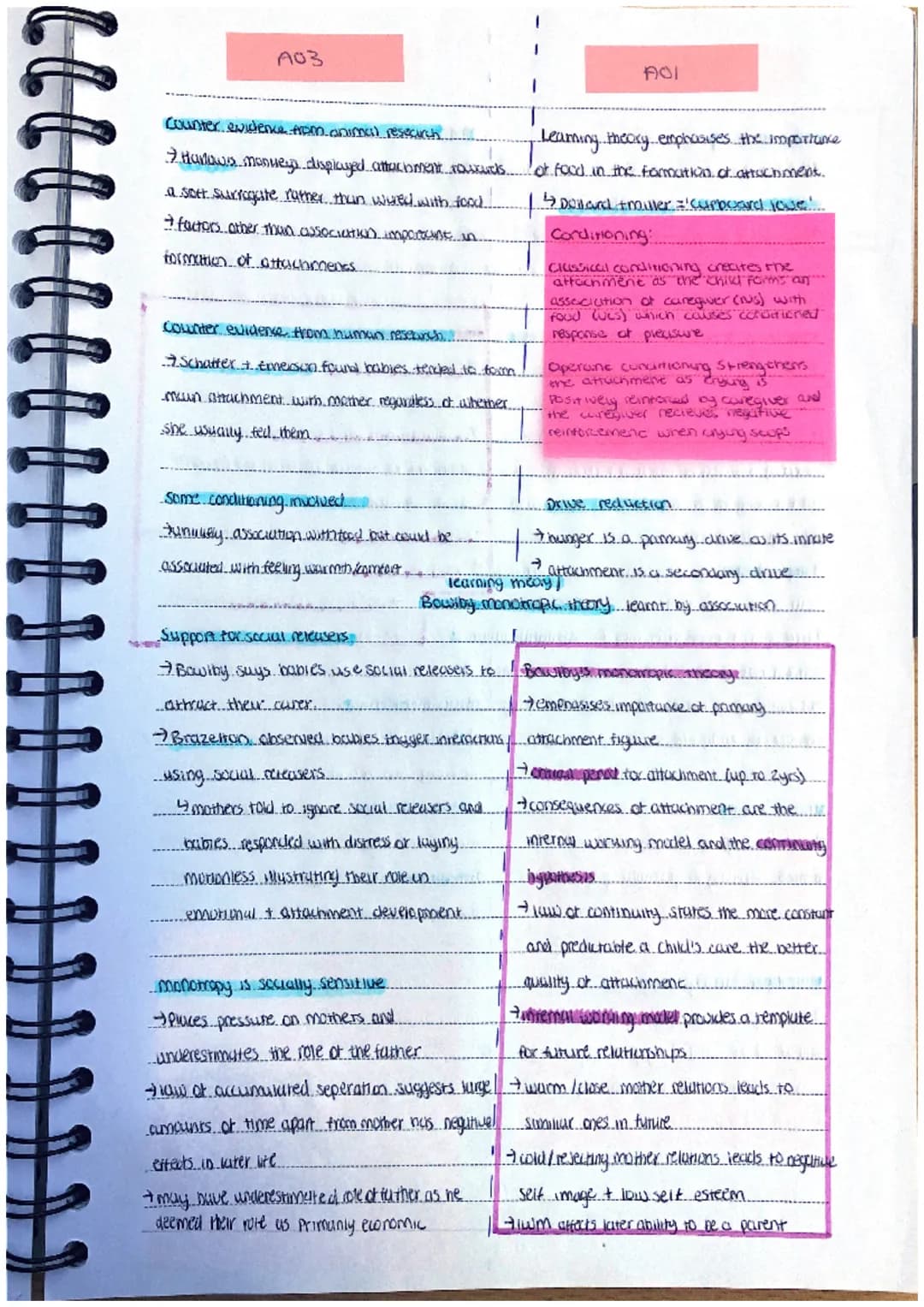
Learning Theory vs Bowlby's Monotropic Theory
Learning theory suggests attachment develops through association - babies learn to associate caregivers with food and comfort through classical and operant conditioning. This "cupboard love" theory emphasises feeding as the foundation of attachment.
Bowlby's monotropic theory argues for something deeper - babies are biologically programmed to form one primary attachment using social releasers (crying, smiling, cooing) to attract care. This creates an internal working model that templates all future relationships.
The critical period (up to 2.5 years) and continuity hypothesis suggest that consistent, predictable care leads to secure attachments and better later relationships. However, this theory places enormous pressure on mothers and may underestimate fathers' roles.
Key Point: Evidence from Schaffer and Emerson shows babies often attach to non-feeding caregivers, supporting Bowlby over learning theory explanations.
5
of 8
The Strange Situation and Attachment Types
Ainsworth's Strange Situation uses standardised observations to measure attachment quality through babies' responses to separation and reunion with caregivers. This controlled environment reveals three main attachment types.
Secure attachment (about 66% of babies) shows moderate distress when separated but accepts comfort on reunion. Insecure-avoidant children show little separation anxiety and avoid contact when reunited. Insecure-resistant babies display high anxiety and resist comfort despite seeking it.
Cross-cultural research found secure attachment is most common globally, though proportions vary. Japan showed high insecure-resistant rates (possibly because separation is unusual there), whilst Germany had high insecure-avoidant rates.
Key Point: The Strange Situation might be culturally biased since it was developed using American samples and assumes separation scenarios are universally meaningful.
6
of 8
Maternal Deprivation Theory
Bowlby's maternal deprivation theory argues that continuous relationships with mothers are essential for healthy psychological development. He distinguished between deprivation (losing an existing attachment) and privation (never forming one), with privation having more severe effects.
His 44 thieves study found links between early maternal separation and later emotional problems, including affectionless psychopathy - the inability to feel guilt or form meaningful relationships. However, this research relied on potentially unreliable retrospective accounts.
The theory transformed childcare practices, particularly in hospitals where parent visits were previously discouraged. The critical period concept suggests that prolonged separations in the first 2.5 years can cause lasting emotional, social, and intellectual difficulties.
Key Point: Modern research suggests the quality of substitute care matters more than separation itself - high-quality alternative caregiving can prevent many negative outcomes.
7
of 8
Institutionalisation and Romanian Orphan Studies
Institutionalisation research, particularly Rutter's studies of Romanian orphans, reveals the severe effects of early privation. Children adopted from Romanian institutions showed intellectual disabilities, delayed language development, and disinhibited attachment - being overly friendly with strangers.
The timing of adoption proved crucial - children adopted before 6 months had average IQs of 102, whilst those adopted after 2 years averaged just 77. Many continued showing signs of disinhibited attachment even at age 11.
Effects include quasi-dwarfism, impaired peer relationships, and loss of personal identity. However, longitudinal studies show that with quality care and time, some effects can be reversed, particularly if intervention occurs early.
Key Point: Romanian orphanages had extremely poor conditions including malnutrition and lack of stimulation, so results might not generalise to all institutional care settings.
8
of 8
The Influence of Early Attachment on Later Relationships
Your early attachment experiences create an internal working model that serves as a template for all future relationships. Research shows securely attached children form better quality friendships and have healthier romantic relationships in adulthood.
In childhood, securely attached kids balance closeness with independence, whilst insecurely attached children either become overly clingy or excessively independent. Studies found insecure-avoidant children are more likely to be bullied, whilst insecure-resistant children often become bullies themselves.
Adult research reveals that parenting styles pass across generations - securely attached mothers tend to raise securely attached children. However, the temperament hypothesis suggests innate personality might influence attachment quality, making it difficult to establish clear cause and effect.
Key Point: Recovery is possible even after severe early deprivation, as shown by the Czech twins who overcame horrific early experiences to lead normal adult lives with proper intervention.
We thought you’d never ask...
What is the Knowunity AI companion?
Our AI companion is specifically built for the needs of students. Based on the millions of content pieces we have on the platform we can provide truly meaningful and relevant answers to students. But its not only about answers, the companion is even more about guiding students through their daily learning challenges, with personalised study plans, quizzes or content pieces in the chat and 100% personalisation based on the students skills and developments.
Where can I download the Knowunity app?
You can download the app in the Google Play Store and in the Apple App Store.
Is Knowunity really free of charge?
That's right! Enjoy free access to study content, connect with fellow students, and get instant help – all at your fingertips.
Similar Content
 Pädagogik
Most popular content: Attachment
9PsychologyAttachment Theory Overview
Explore key concepts of attachment theory, including Bowlby's Theory, the Strange Situation, and the role of fathers in attachment. This comprehensive summary covers maternal deprivation, secure and insecure attachments, and insights from animal studies. Ideal for AQA A-Level Psychology students seeking to understand childhood attachment dynamics.
122,87256
PsychologyUnderstanding Attachment Theory
Explore the key concepts of attachment theory, including types of attachment, the role of caregivers, and the impact of early relationships on later development. This comprehensive summary covers Bowlby's theory, Ainsworth's Strange Situation, and the effects of maternal deprivation, making it essential for A-level psychology students. Ideal for exam preparation and deepening your understanding of attachment in both humans and animals.
1210,387505
PsychologyUnderstanding Attachment Theory
Explore key concepts of attachment theory in psychology, including Bowlby's monotropic theory, the role of caregivers, and the impact of early attachments on later relationships. This comprehensive summary covers maternal deprivation, institutionalization effects, and the strange situation, making it essential for A-level psychology students. Ideal for exam preparation and deepening your understanding of attachment.
127,398318
PsychologyAttachment Theory Insights
Explore key studies and evaluations on attachment theory, including Rutter's Romanian orphan research, Ainsworth's Strange Situation, and Bowlby's maternal deprivation theory. Understand the implications of attachment styles on childhood and adult relationships, the role of fathers, and cross-cultural variations in attachment. This comprehensive summary is essential for AQA Psychology students.
124,144127
PsychologyImpact of Romanian Orphanage Care
Explore the effects of institutionalisation on child development through key studies, including Rutter's ERA and the Bucharest Early Intervention Project. This summary highlights findings on attachment styles, cognitive development, and the implications for orphan care practices. Ideal for psychology students studying attachment theory and its real-life applications.
121,01820
PsychologyUnderstanding Attachment Theory
Explore the key concepts of attachment theory, including Bowlby's monotropic theory, the role of the father, and the implications of maternal deprivation. This comprehensive overview covers the stages of attachment, the strange situation, and the impact of early attachment on later relationships. Ideal for students studying developmental psychology, this resource provides insights into both human and animal studies of attachment, including the effects of institutionalization and neuroplasticity. Enhance your understanding of secure and insecure attachment styles and their significance in psychological development.
122,10384
PsychologyFather's Role in Attachment
Explore the complexities of the father's role in childhood attachment through this detailed 16-mark essay model. This resource covers key concepts such as attachment theory, secure and insecure attachments, and the implications of father figures in child development. Ideal for A-level psychology students preparing for exams, this essay provides insights into research findings and their real-world applications, helping to clarify the significance of fathers in attachment relationships.
126736
PsychologyBowlby's Attachment Theory Explained
Explore Bowlby's Monotropic Theory of Attachment, focusing on key concepts such as the critical period, social releasers, and the internal working model. This summary highlights the evolutionary basis of attachment, critiques of the theory, and implications for future relationships. Ideal for AQA Psychology A Level students preparing for exams.
124741
PsychologyUnderstanding Attachment Types
Explore comprehensive insights into attachment psychology, covering key concepts such as maternal deprivation, Bowlby's theory, and the roles of caregivers. This detailed summary includes findings from Ainsworth's Strange Situation, cultural variations in attachment, and the impact of early relationships on adult behavior. Ideal for AQA Psychology A-Level students seeking to deepen their understanding of attachment theory.
122,55762
Most popular content in Psychology
9PsychologySocial Influence Overview
Explore key concepts in social influence, including conformity, obedience, and minority influence. This comprehensive summary covers essential studies such as Milgram's experiment, Asch's conformity tests, and the Stanford prison experiment, providing insights into the psychological mechanisms behind social behavior. Ideal for A-Level revision.
127,472320
PsychologyComprehensive Research Methods
Explore essential research methods in psychology, including experimental designs, types of experiments, observations, interviews, and ethical considerations. This summary covers key concepts such as independent and dependent variables, validity, reliability, and statistical significance, tailored for A Level AQA Psychology students.
1214,429719
PsychologyAQA A Level Sociology Research Methods
Includes all research methods
122,14468
PsychologyIssues and Debates
AQA paper 3 alevel psychology topic 9 - issues and debates - full active recall questions - notion.
121,07326
PsychologyAttachment Theory Overview
Explore key concepts of attachment theory, including Bowlby's Theory, the Strange Situation, and the role of fathers in attachment. This comprehensive summary covers maternal deprivation, secure and insecure attachments, and insights from animal studies. Ideal for AQA A-Level Psychology students seeking to understand childhood attachment dynamics.
122,87256
PsychologyBiopsychology Key Concepts
Explore essential biopsychology concepts including circadian rhythms, brain structure, and neurobiology. This comprehensive summary covers the nervous system, hormonal coordination, and the impact of brain plasticity on behavior. Ideal for AQA A Level Psychology revision.
1212,968612
PsychologyAttachment- essay plans
All the content needed to answer 16 markers in psych- attachment
1275213
PsychologyTheories of Romantic Relationships
Explore key theories and concepts in romantic relationships, including Social Exchange Theory, Equity Theory, and Duck's Phase Model. Understand factors affecting attraction such as self-disclosure, physical attractiveness, and the dynamics of virtual and parasocial relationships. This comprehensive summary is essential for AQA A Level Psychology students.
124,759163
PsychologyA Level AQA Biopsychology Content Mindmap
Biopsychology Content Mind Maps, DOES NOT CONTAIN RESEARCH OR EVALUATION
122,07246
Most popular content
9 Sociology
Sociology of Education Overview
Explore comprehensive A-Level Sociology notes on the education system, covering key theories, policies, and sociological perspectives. This resource includes insights on marketisation, gender roles, cultural deprivation, and educational inequalities, providing a thorough understanding of how education shapes social stratification and individual achievement. Ideal for exam preparation and in-depth study.
12102,8693,040
SociologySociology of Families: Comprehensive Revision
Dive into an extensive overview of family dynamics, perspectives, and patterns in sociology. This resource covers key concepts such as family diversity, gender roles, marriage, and the impact of social policies on family structures. Perfect for A-Level Sociology students preparing for Paper 2.
1273,6612,307
CriminologyCriminology: Crime & Punishment Overview
Comprehensive mindmaps covering key concepts in the Crime and Punishment topic for WJEC Criminology Unit 4. This resource includes detailed insights into the Criminal Justice System, crime prevention strategies, sentencing models, and the roles of various agencies. Ideal for A-Level revision, ensuring you grasp essential theories and legislative processes to excel in your exams.
1254,8691,059
SociologyComprehensive Crime & Deviance Overview
Explore an extensive revision of crime and deviance topics, including theories, types of crime, and the impact of media. This resource covers key concepts such as Marxism, functionalism, gender and crime, and the influence of globalization on criminal behavior. Ideal for students seeking a thorough understanding of criminology and its various theories. Type: Full Topic Revision.
1251,6541,399
C
 Biology
Cell Biology and Cell structure
cell structures
93,2470
 English Literature
An Inspector Calls: Character Insights
Explore in-depth analysis and key quotes for characters in J.B. Priestley's 'An Inspector Calls'. This resource covers Gerald Croft, Inspector Goole, Sheila Birling, Mrs. Birling, Eric Birling, and Eva Smith, focusing on themes of class, gender roles, and social responsibility. Ideal for students aiming for Grade 8 and above.
1025,429907
CriminologyWJEC Unit 4 Criminology
Criminology unit 4 detailed revision note
127,151125
CriminologyCriminology Theories Overview
Explore key criminology theories and their implications on crime and deviance. This comprehensive summary covers biological, psychological, and sociological perspectives, including labelling theory, right realism, and the impact of social campaigns on policy development. Ideal for A-Level criminology students seeking to understand the complexities of criminal behaviour and the factors influencing crime prevention strategies.
129,760210
English LiteratureRomeo and Juliet: Key themes
Key Romeo and Juliet themes and analysed quotes
106,708198
Can't find what you're looking for? Explore other subjects.
Students love us — and so will you.
4.6/5App Store
4.7/5Google Play
The app is very easy to use and well designed. I have found everything I was looking for so far and have been able to learn a lot from the presentations! I will definitely use the app for a class assignment! And of course it also helps a lot as an inspiration.
Stefan SiOS user
This app is really great. There are so many study notes and help [...]. My problem subject is French, for example, and the app has so many options for help. Thanks to this app, I have improved my French. I would recommend it to anyone.
Samantha KlichAndroid user
Wow, I am really amazed. I just tried the app because I've seen it advertised many times and was absolutely stunned. This app is THE HELP you want for school and above all, it offers so many things, such as workouts and fact sheets, which have been VERY helpful to me personally.
AnnaiOS user
Psychology606 views·Updated Jun 19, 2026·8 pagesComprehensive Notes on Attachment for AQA A-Level Psychology
Kayleigh Jones@kayleighjones_phvq
Ever wondered why some people form close relationships easily whilst others struggle with intimacy? Attachment theory explains how our earliest bonds with caregivers shape our entire approach to relationships throughout life.
1
of 8
Sign up to see the content. It's free!
- Access to all documents
- Improve your grades
- Join milions of students
Early Infant Interactions and Attachment Formation
Your first relationships begin way earlier than you might think - attachment is a two-way emotional bond that starts forming within months of birth. Maccoby identified key characteristics like seeking proximity (wanting to be close), separation anxiety, and pleasure when reunited with caregivers.
Reciprocity describes the two-way interactions between caregiver and child, whilst interactional synchrony involves simultaneous, coordinated movements and communications. Think of it like an emotional dance where both partners mirror each other's expressions and responses.
Babies use natural abilities like mimicking facial expressions and responding to motherese to form these crucial early bonds. These interactions aren't just cute - they're building the foundation for all future relationships.
Key Point: Filmed observations show that babies actively participate in attachment formation through social behaviours, proving it's not just about feeding but emotional connection.
2
of 8Sign up to see the content. It's free!
- Access to all documents
- Improve your grades
- Join milions of students
Schaffer and Emerson's Stages of Attachment
Attachment doesn't happen overnight - it develops through four distinct stages. Pre-attachment sees similar responses to objects and people, followed by indiscriminate attachment where babies prefer humans but aren't fussy about who.
The crucial specific attachment stage is when babies show clear preference for one caregiver and display separation anxiety. Finally, multiple attachments develop as babies form bonds with several people.
Research shows 75% of babies are attached to their father by 18 months, though there's ongoing debate about the father's role. Some studies suggest fathers are more like playmates, whilst others show they can be primary attachment figures when circumstances require it.
Key Point: These stages were identified through studying 1960s Glasgow families, so results might not apply universally across different cultures and time periods.
3
of 8Sign up to see the content. It's free!
- Access to all documents
- Improve your grades
- Join milions of students
Animal Studies: Lorenz and Harlow
Lorenz's geese study revealed imprinting - a critical period where young animals form attachments to moving objects. Goslings who hatched in incubators followed Lorenz around instead of their mothers, showing attachment isn't just about survival needs.
Harlow's monkey experiments challenged the idea that attachment is simply about food. Baby monkeys spent most time with soft cloth surrogate mothers rather than wire ones that provided food, only visiting the wire mother when hungry.
These studies revolutionised our understanding of attachment, showing that comfort and emotional security matter more than just meeting physical needs. However, the monkeys who grew up with surrogates struggled as parents themselves, highlighting the importance of proper early care.
Key Point: Whilst animal studies provide valuable insights, human attachment is far more complex, so we must be cautious about directly applying these findings to people.
4
of 8Sign up to see the content. It's free!
- Access to all documents
- Improve your grades
- Join milions of students
Learning Theory vs Bowlby's Monotropic Theory
Learning theory suggests attachment develops through association - babies learn to associate caregivers with food and comfort through classical and operant conditioning. This "cupboard love" theory emphasises feeding as the foundation of attachment.
Bowlby's monotropic theory argues for something deeper - babies are biologically programmed to form one primary attachment using social releasers (crying, smiling, cooing) to attract care. This creates an internal working model that templates all future relationships.
The critical period (up to 2.5 years) and continuity hypothesis suggest that consistent, predictable care leads to secure attachments and better later relationships. However, this theory places enormous pressure on mothers and may underestimate fathers' roles.
Key Point: Evidence from Schaffer and Emerson shows babies often attach to non-feeding caregivers, supporting Bowlby over learning theory explanations.
5
of 8Sign up to see the content. It's free!
- Access to all documents
- Improve your grades
- Join milions of students
The Strange Situation and Attachment Types
Ainsworth's Strange Situation uses standardised observations to measure attachment quality through babies' responses to separation and reunion with caregivers. This controlled environment reveals three main attachment types.
Secure attachment (about 66% of babies) shows moderate distress when separated but accepts comfort on reunion. Insecure-avoidant children show little separation anxiety and avoid contact when reunited. Insecure-resistant babies display high anxiety and resist comfort despite seeking it.
Cross-cultural research found secure attachment is most common globally, though proportions vary. Japan showed high insecure-resistant rates (possibly because separation is unusual there), whilst Germany had high insecure-avoidant rates.
Key Point: The Strange Situation might be culturally biased since it was developed using American samples and assumes separation scenarios are universally meaningful.
6
of 8Sign up to see the content. It's free!
- Access to all documents
- Improve your grades
- Join milions of students
Maternal Deprivation Theory
Bowlby's maternal deprivation theory argues that continuous relationships with mothers are essential for healthy psychological development. He distinguished between deprivation (losing an existing attachment) and privation (never forming one), with privation having more severe effects.
His 44 thieves study found links between early maternal separation and later emotional problems, including affectionless psychopathy - the inability to feel guilt or form meaningful relationships. However, this research relied on potentially unreliable retrospective accounts.
The theory transformed childcare practices, particularly in hospitals where parent visits were previously discouraged. The critical period concept suggests that prolonged separations in the first 2.5 years can cause lasting emotional, social, and intellectual difficulties.
Key Point: Modern research suggests the quality of substitute care matters more than separation itself - high-quality alternative caregiving can prevent many negative outcomes.
7
of 8Sign up to see the content. It's free!
- Access to all documents
- Improve your grades
- Join milions of students
Institutionalisation and Romanian Orphan Studies
Institutionalisation research, particularly Rutter's studies of Romanian orphans, reveals the severe effects of early privation. Children adopted from Romanian institutions showed intellectual disabilities, delayed language development, and disinhibited attachment - being overly friendly with strangers.
The timing of adoption proved crucial - children adopted before 6 months had average IQs of 102, whilst those adopted after 2 years averaged just 77. Many continued showing signs of disinhibited attachment even at age 11.
Effects include quasi-dwarfism, impaired peer relationships, and loss of personal identity. However, longitudinal studies show that with quality care and time, some effects can be reversed, particularly if intervention occurs early.
Key Point: Romanian orphanages had extremely poor conditions including malnutrition and lack of stimulation, so results might not generalise to all institutional care settings.
8
of 8Sign up to see the content. It's free!
- Access to all documents
- Improve your grades
- Join milions of students
The Influence of Early Attachment on Later Relationships
Your early attachment experiences create an internal working model that serves as a template for all future relationships. Research shows securely attached children form better quality friendships and have healthier romantic relationships in adulthood.
In childhood, securely attached kids balance closeness with independence, whilst insecurely attached children either become overly clingy or excessively independent. Studies found insecure-avoidant children are more likely to be bullied, whilst insecure-resistant children often become bullies themselves.
Adult research reveals that parenting styles pass across generations - securely attached mothers tend to raise securely attached children. However, the temperament hypothesis suggests innate personality might influence attachment quality, making it difficult to establish clear cause and effect.
Key Point: Recovery is possible even after severe early deprivation, as shown by the Czech twins who overcame horrific early experiences to lead normal adult lives with proper intervention.
We thought you’d never ask...
What is the Knowunity AI companion?
Our AI companion is specifically built for the needs of students. Based on the millions of content pieces we have on the platform we can provide truly meaningful and relevant answers to students. But its not only about answers, the companion is even more about guiding students through their daily learning challenges, with personalised study plans, quizzes or content pieces in the chat and 100% personalisation based on the students skills and developments.
Where can I download the Knowunity app?
You can download the app in the Google Play Store and in the Apple App Store.
Is Knowunity really free of charge?
That's right! Enjoy free access to study content, connect with fellow students, and get instant help – all at your fingertips.
Similar Content
Most popular content: Attachment
9PsychologyAttachment Theory Overview
Explore key concepts of attachment theory, including Bowlby's Theory, the Strange Situation, and the role of fathers in attachment. This comprehensive summary covers maternal deprivation, secure and insecure attachments, and insights from animal studies. Ideal for AQA A-Level Psychology students seeking to understand childhood attachment dynamics.
122,87256
PsychologyUnderstanding Attachment Theory
Explore the key concepts of attachment theory, including types of attachment, the role of caregivers, and the impact of early relationships on later development. This comprehensive summary covers Bowlby's theory, Ainsworth's Strange Situation, and the effects of maternal deprivation, making it essential for A-level psychology students. Ideal for exam preparation and deepening your understanding of attachment in both humans and animals.
1210,387505
PsychologyUnderstanding Attachment Theory
Explore key concepts of attachment theory in psychology, including Bowlby's monotropic theory, the role of caregivers, and the impact of early attachments on later relationships. This comprehensive summary covers maternal deprivation, institutionalization effects, and the strange situation, making it essential for A-level psychology students. Ideal for exam preparation and deepening your understanding of attachment.
127,398318
PsychologyAttachment Theory Insights
Explore key studies and evaluations on attachment theory, including Rutter's Romanian orphan research, Ainsworth's Strange Situation, and Bowlby's maternal deprivation theory. Understand the implications of attachment styles on childhood and adult relationships, the role of fathers, and cross-cultural variations in attachment. This comprehensive summary is essential for AQA Psychology students.
124,144127
PsychologyImpact of Romanian Orphanage Care
Explore the effects of institutionalisation on child development through key studies, including Rutter's ERA and the Bucharest Early Intervention Project. This summary highlights findings on attachment styles, cognitive development, and the implications for orphan care practices. Ideal for psychology students studying attachment theory and its real-life applications.
121,01820
PsychologyUnderstanding Attachment Theory
Explore the key concepts of attachment theory, including Bowlby's monotropic theory, the role of the father, and the implications of maternal deprivation. This comprehensive overview covers the stages of attachment, the strange situation, and the impact of early attachment on later relationships. Ideal for students studying developmental psychology, this resource provides insights into both human and animal studies of attachment, including the effects of institutionalization and neuroplasticity. Enhance your understanding of secure and insecure attachment styles and their significance in psychological development.
122,10384
PsychologyFather's Role in Attachment
Explore the complexities of the father's role in childhood attachment through this detailed 16-mark essay model. This resource covers key concepts such as attachment theory, secure and insecure attachments, and the implications of father figures in child development. Ideal for A-level psychology students preparing for exams, this essay provides insights into research findings and their real-world applications, helping to clarify the significance of fathers in attachment relationships.
126736
PsychologyBowlby's Attachment Theory Explained
Explore Bowlby's Monotropic Theory of Attachment, focusing on key concepts such as the critical period, social releasers, and the internal working model. This summary highlights the evolutionary basis of attachment, critiques of the theory, and implications for future relationships. Ideal for AQA Psychology A Level students preparing for exams.
124741
PsychologyUnderstanding Attachment Types
Explore comprehensive insights into attachment psychology, covering key concepts such as maternal deprivation, Bowlby's theory, and the roles of caregivers. This detailed summary includes findings from Ainsworth's Strange Situation, cultural variations in attachment, and the impact of early relationships on adult behavior. Ideal for AQA Psychology A-Level students seeking to deepen their understanding of attachment theory.
122,55762
Most popular content in Psychology
9PsychologySocial Influence Overview
Explore key concepts in social influence, including conformity, obedience, and minority influence. This comprehensive summary covers essential studies such as Milgram's experiment, Asch's conformity tests, and the Stanford prison experiment, providing insights into the psychological mechanisms behind social behavior. Ideal for A-Level revision.
127,472320
PsychologyComprehensive Research Methods
Explore essential research methods in psychology, including experimental designs, types of experiments, observations, interviews, and ethical considerations. This summary covers key concepts such as independent and dependent variables, validity, reliability, and statistical significance, tailored for A Level AQA Psychology students.
1214,429719
PsychologyAQA A Level Sociology Research Methods
Includes all research methods
122,14468
PsychologyIssues and Debates
AQA paper 3 alevel psychology topic 9 - issues and debates - full active recall questions - notion.
121,07326
PsychologyAttachment Theory Overview
Explore key concepts of attachment theory, including Bowlby's Theory, the Strange Situation, and the role of fathers in attachment. This comprehensive summary covers maternal deprivation, secure and insecure attachments, and insights from animal studies. Ideal for AQA A-Level Psychology students seeking to understand childhood attachment dynamics.
122,87256
PsychologyBiopsychology Key Concepts
Explore essential biopsychology concepts including circadian rhythms, brain structure, and neurobiology. This comprehensive summary covers the nervous system, hormonal coordination, and the impact of brain plasticity on behavior. Ideal for AQA A Level Psychology revision.
1212,968612
PsychologyAttachment- essay plans
All the content needed to answer 16 markers in psych- attachment
1275213
PsychologyTheories of Romantic Relationships
Explore key theories and concepts in romantic relationships, including Social Exchange Theory, Equity Theory, and Duck's Phase Model. Understand factors affecting attraction such as self-disclosure, physical attractiveness, and the dynamics of virtual and parasocial relationships. This comprehensive summary is essential for AQA A Level Psychology students.
124,759163
PsychologyA Level AQA Biopsychology Content Mindmap
Biopsychology Content Mind Maps, DOES NOT CONTAIN RESEARCH OR EVALUATION
122,07246
Most popular content
9SociologySociology of Education Overview
Explore comprehensive A-Level Sociology notes on the education system, covering key theories, policies, and sociological perspectives. This resource includes insights on marketisation, gender roles, cultural deprivation, and educational inequalities, providing a thorough understanding of how education shapes social stratification and individual achievement. Ideal for exam preparation and in-depth study.
12102,8693,040
SociologySociology of Families: Comprehensive Revision
Dive into an extensive overview of family dynamics, perspectives, and patterns in sociology. This resource covers key concepts such as family diversity, gender roles, marriage, and the impact of social policies on family structures. Perfect for A-Level Sociology students preparing for Paper 2.
1273,6612,307
CriminologyCriminology: Crime & Punishment Overview
Comprehensive mindmaps covering key concepts in the Crime and Punishment topic for WJEC Criminology Unit 4. This resource includes detailed insights into the Criminal Justice System, crime prevention strategies, sentencing models, and the roles of various agencies. Ideal for A-Level revision, ensuring you grasp essential theories and legislative processes to excel in your exams.
1254,8691,059
SociologyComprehensive Crime & Deviance Overview
Explore an extensive revision of crime and deviance topics, including theories, types of crime, and the impact of media. This resource covers key concepts such as Marxism, functionalism, gender and crime, and the influence of globalization on criminal behavior. Ideal for students seeking a thorough understanding of criminology and its various theories. Type: Full Topic Revision.
1251,6541,399
C
BiologyCell Biology and Cell structure
cell structures
93,2470
English LiteratureAn Inspector Calls: Character Insights
Explore in-depth analysis and key quotes for characters in J.B. Priestley's 'An Inspector Calls'. This resource covers Gerald Croft, Inspector Goole, Sheila Birling, Mrs. Birling, Eric Birling, and Eva Smith, focusing on themes of class, gender roles, and social responsibility. Ideal for students aiming for Grade 8 and above.
1025,429907
CriminologyWJEC Unit 4 Criminology
Criminology unit 4 detailed revision note
127,151125
CriminologyCriminology Theories Overview
Explore key criminology theories and their implications on crime and deviance. This comprehensive summary covers biological, psychological, and sociological perspectives, including labelling theory, right realism, and the impact of social campaigns on policy development. Ideal for A-Level criminology students seeking to understand the complexities of criminal behaviour and the factors influencing crime prevention strategies.
129,760210
English LiteratureRomeo and Juliet: Key themes
Key Romeo and Juliet themes and analysed quotes
106,708198
Can't find what you're looking for? Explore other subjects.
Students love us — and so will you.
4.6/5App Store
4.7/5Google Play
The app is very easy to use and well designed. I have found everything I was looking for so far and have been able to learn a lot from the presentations! I will definitely use the app for a class assignment! And of course it also helps a lot as an inspiration.
Stefan SiOS user
This app is really great. There are so many study notes and help [...]. My problem subject is French, for example, and the app has so many options for help. Thanks to this app, I have improved my French. I would recommend it to anyone.
Samantha KlichAndroid user
Wow, I am really amazed. I just tried the app because I've seen it advertised many times and was absolutely stunned. This app is THE HELP you want for school and above all, it offers so many things, such as workouts and fact sheets, which have been VERY helpful to me personally.
AnnaiOS user