

Dive into the world of polynomials, rational functions, and variations...
 Pre-Calculus285 views·Updated Jun 9, 2026·11 pages
Understanding Polynomial and Rational Functions in Pre-Calc


1 / 10
1
of 10
Polynomial Division & Theorems
When working with polynomials, long division helps us break down complex expressions into simpler parts. Just like regular division, we divide term by term and subtract to find quotients and remainders.
The Factor Theorem tells us that if P(c) = 0, then is a factor of polynomial P(x). For example, in the polynomial x⁴-x³+2x-12, we can check if x-2 is a factor by evaluating P(2). Since P(2) = 0, x-2 is indeed a factor!
The Remainder Theorem states that when dividing P(x) by , the remainder equals P(c). This gives us a shortcut for finding remainders without doing full polynomial division.
💡 When you're checking if is a factor of a polynomial, just substitute x=c into the polynomial. If you get zero, it's a factor!
2
of 10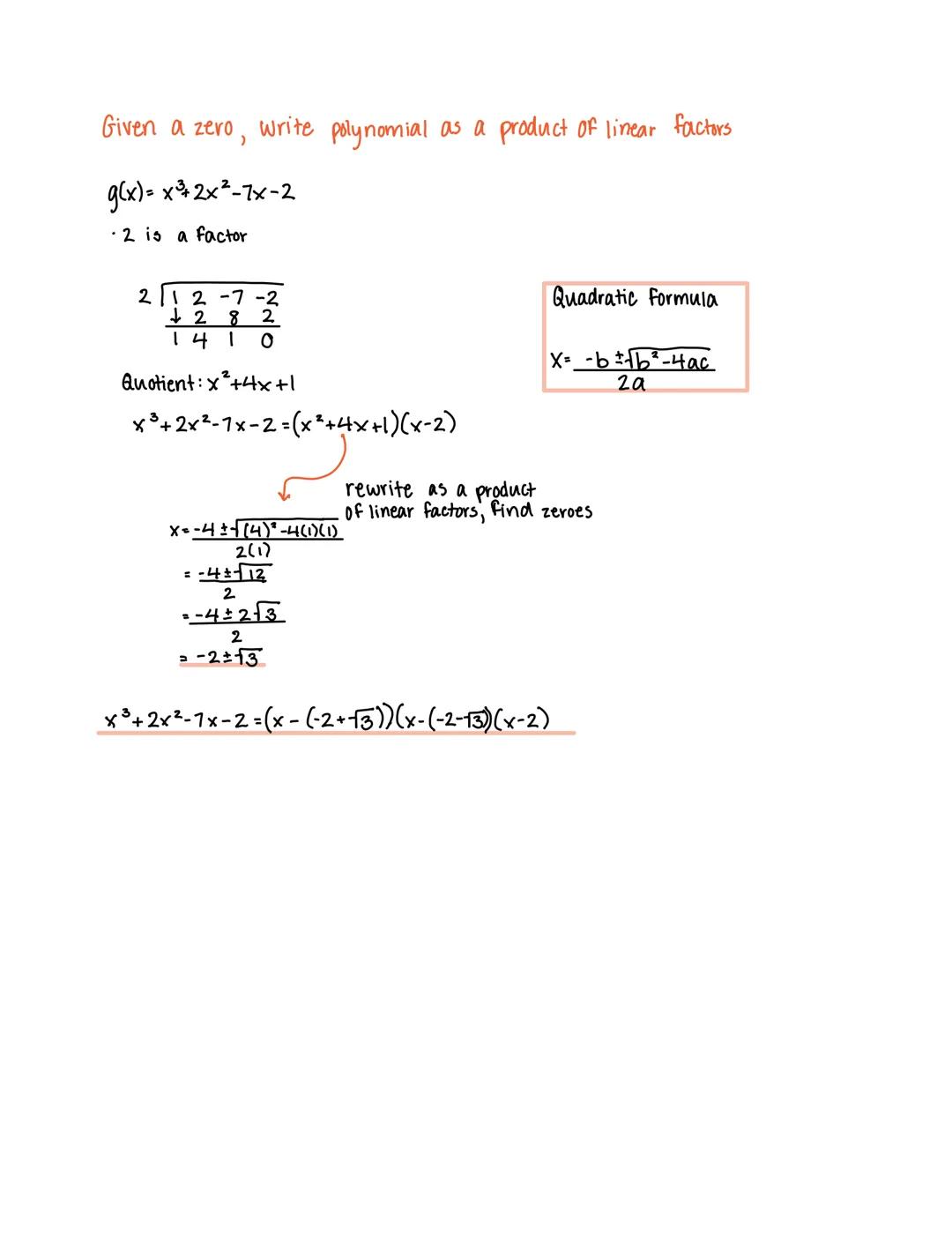
Writing Polynomials as Products
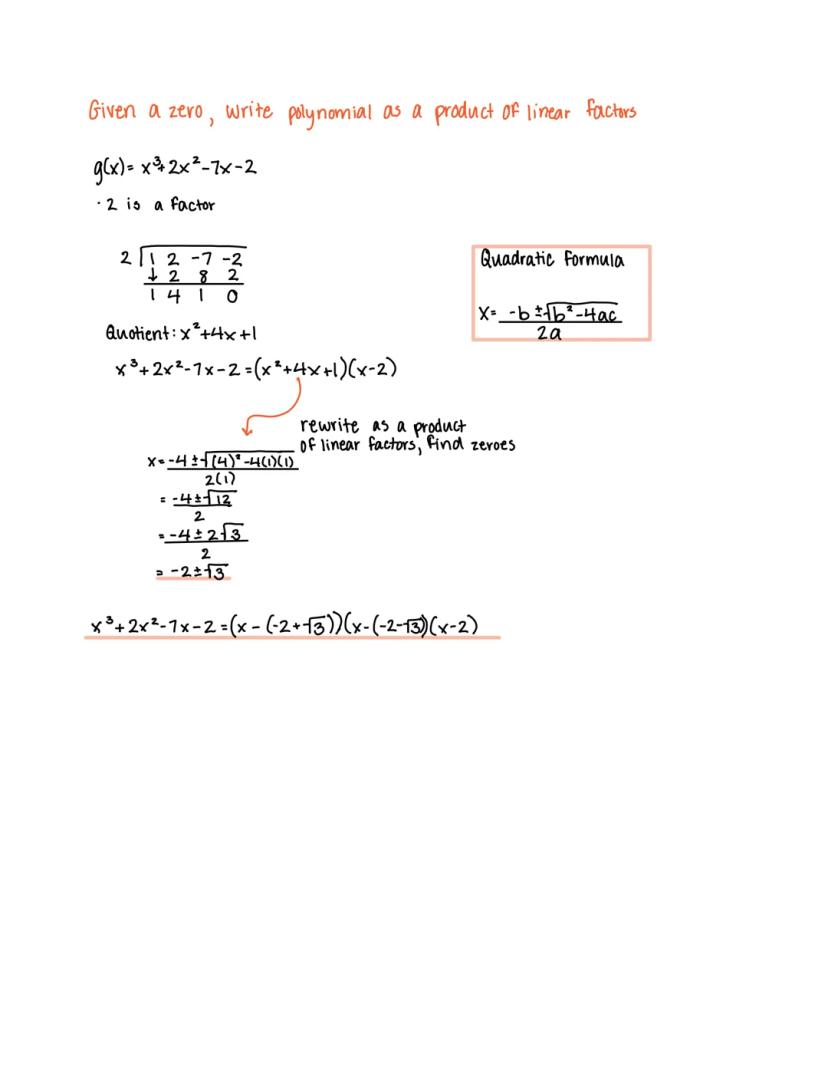
When you know a zero of a polynomial, you can use it to write the polynomial as a product of factors. This makes finding all zeros much easier!
For example, if g(x) = x³+2x²-7x-2 and you know 2 is a zero, you can use polynomial division to factor it as: g(x) =
To find the remaining zeros, use the quadratic formula on the quadratic factor. For the example above, the quadratic formula gives us x = -2±√3, meaning the polynomial can be written as: g(x) =
This technique helps you break down higher-degree polynomials into manageable pieces, making them easier to solve and understand.
3
of 10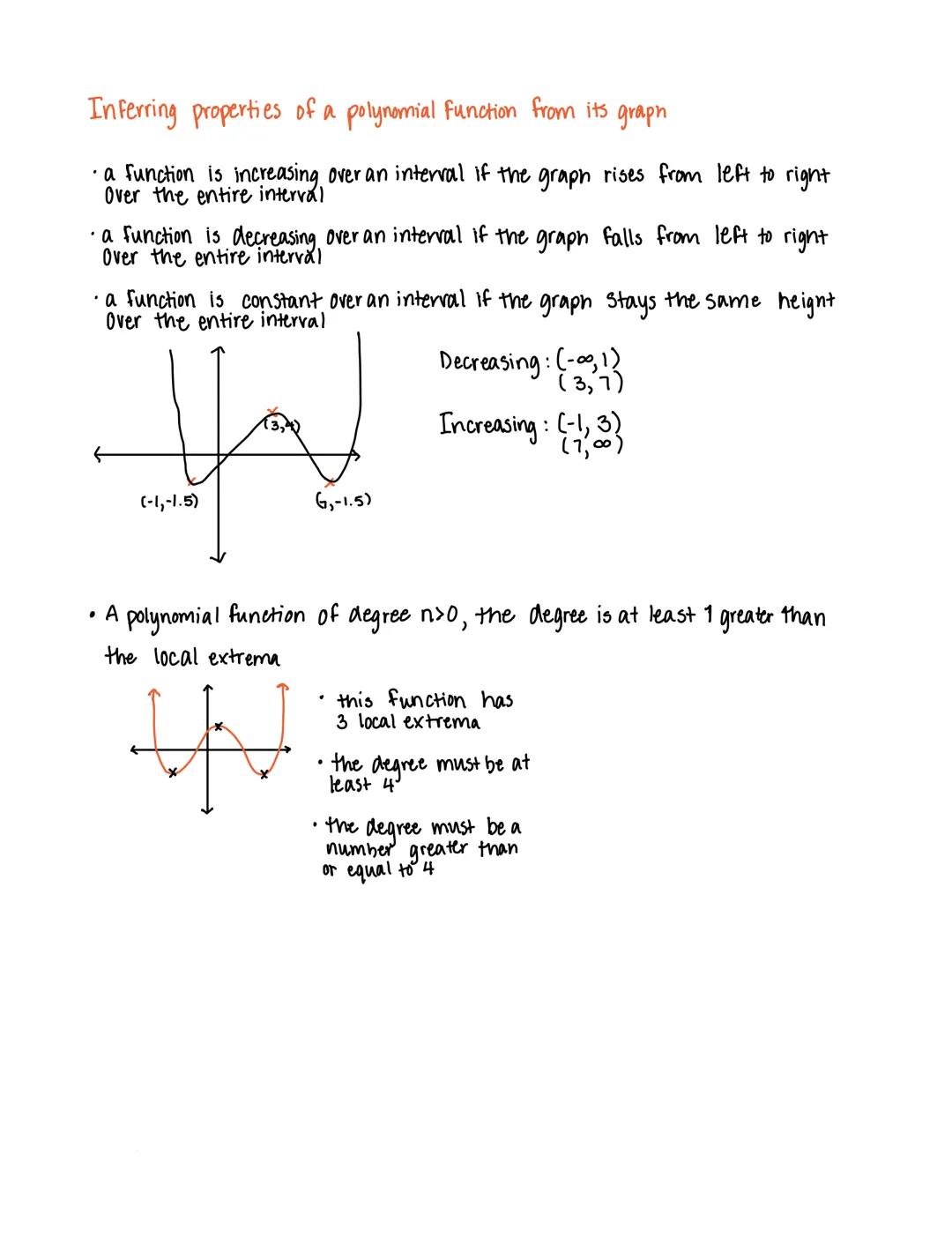
Analyzing Polynomial Graphs
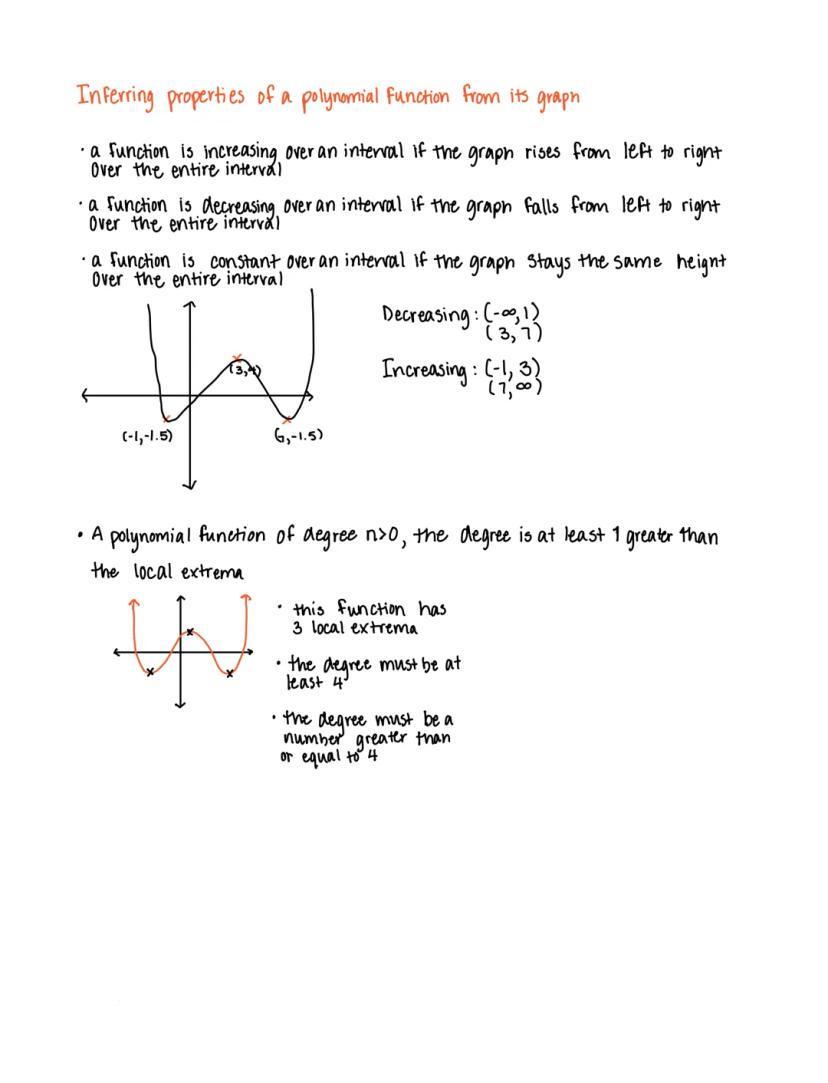
The shape of a polynomial graph tells you a lot about its behavior. A function is increasing when its graph rises from left to right and decreasing when it falls.
You can identify intervals where the function behaves differently. For example, a function might be decreasing on (-∞,1) and (3,7), while increasing on (-1,3) and (7,∞).
An important relationship exists between a polynomial's degree and its local extrema (peaks and valleys). For a polynomial function of degree n>0, the degree is at least 1 more than the number of local extrema. So if a graph shows 3 local extrema, the polynomial must have a degree of at least 4.
🔍 Count the number of "hills" and "valleys" in a polynomial graph, add 1, and you'll know the minimum possible degree of the polynomial!
4
of 10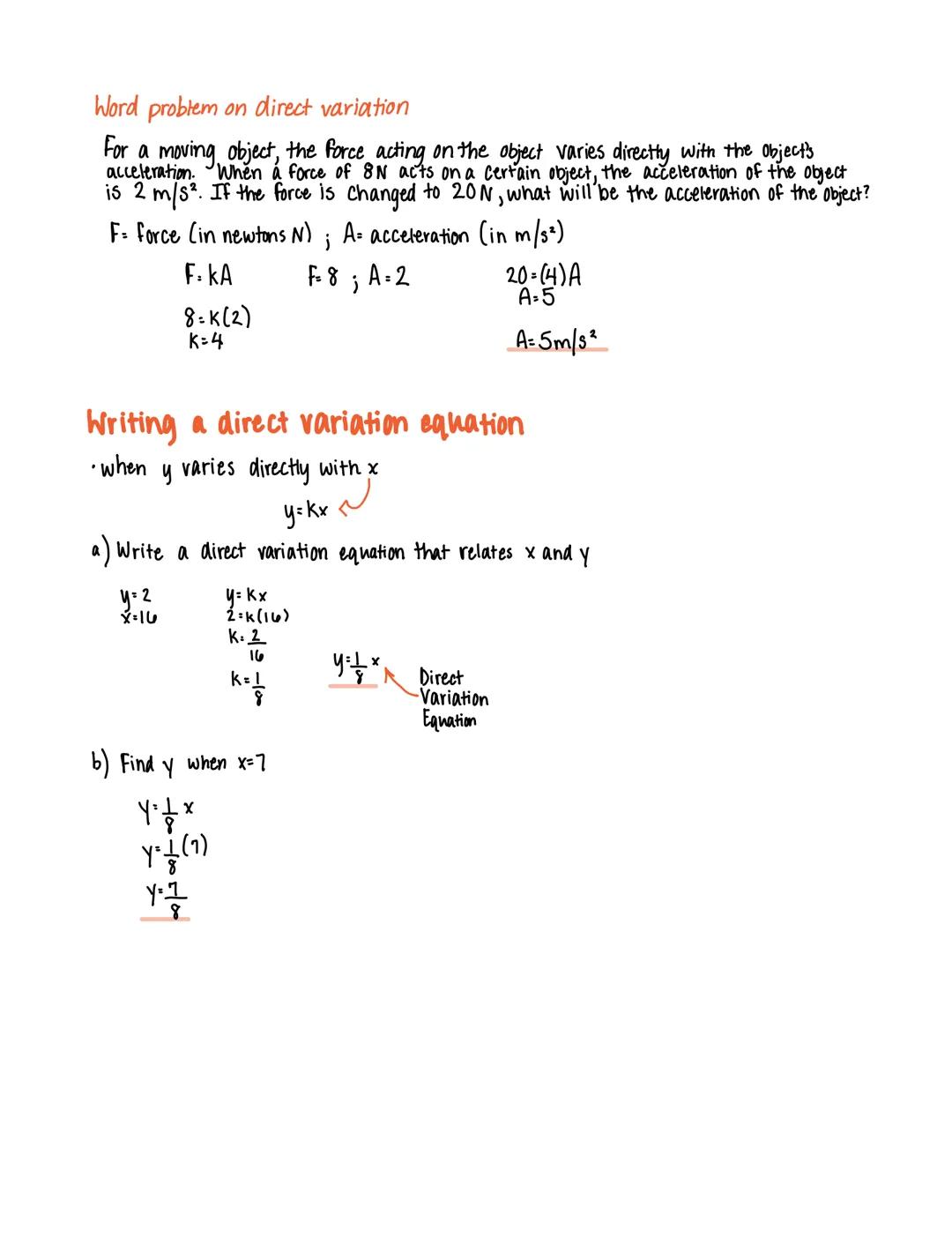
Direct Variation
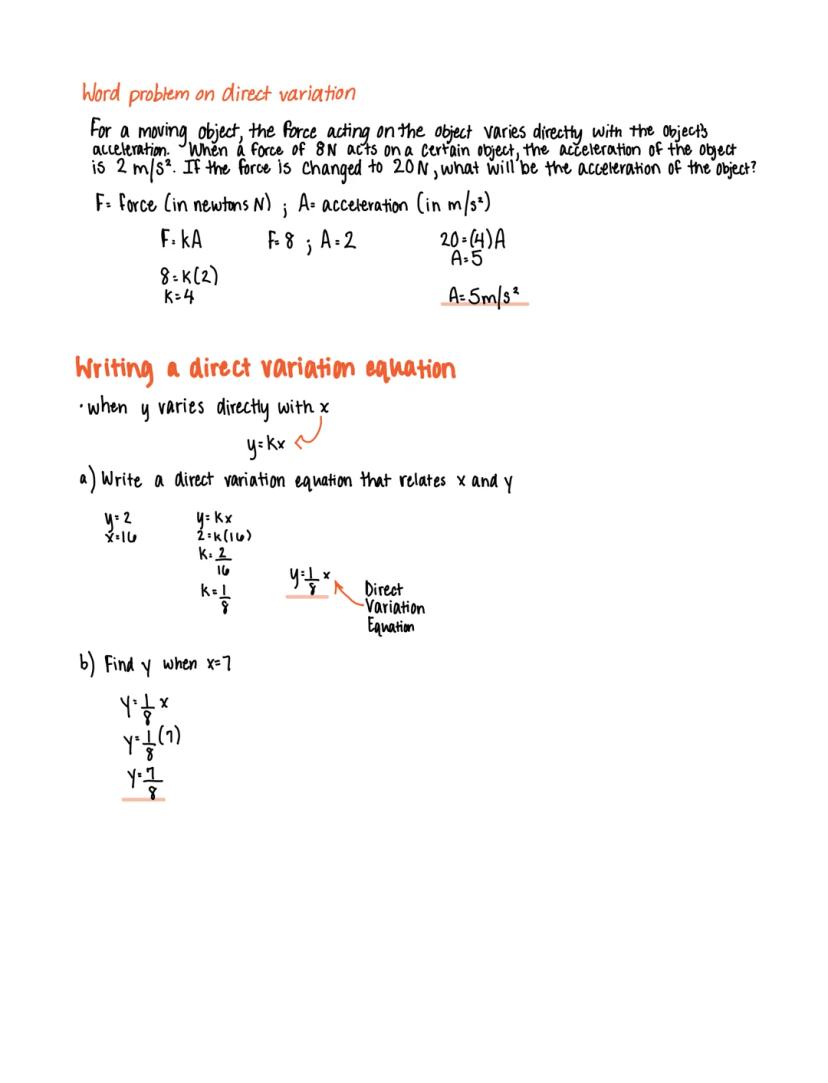
Direct variation is when two quantities change proportionally - as one increases, the other increases at the same rate. The equation for direct variation is y = kx, where k is the constant of variation.
In real-world applications, direct variation appears frequently. For instance, when a force acts on an object, the force varies directly with the object's acceleration . If 8 Newtons of force causes 2 m/s² acceleration, then 20 Newtons will cause 5 m/s² acceleration.
To create a direct variation equation from a single point, find the constant k first. If y = 2 when x = 10, then k = 2/10 = 1/5, giving the equation y = (1/5)x. You can then use this equation to find y for any value of x.
🚀 Direct variation is like a see-saw that stays balanced - when one value doubles, the other doubles too!
5
of 10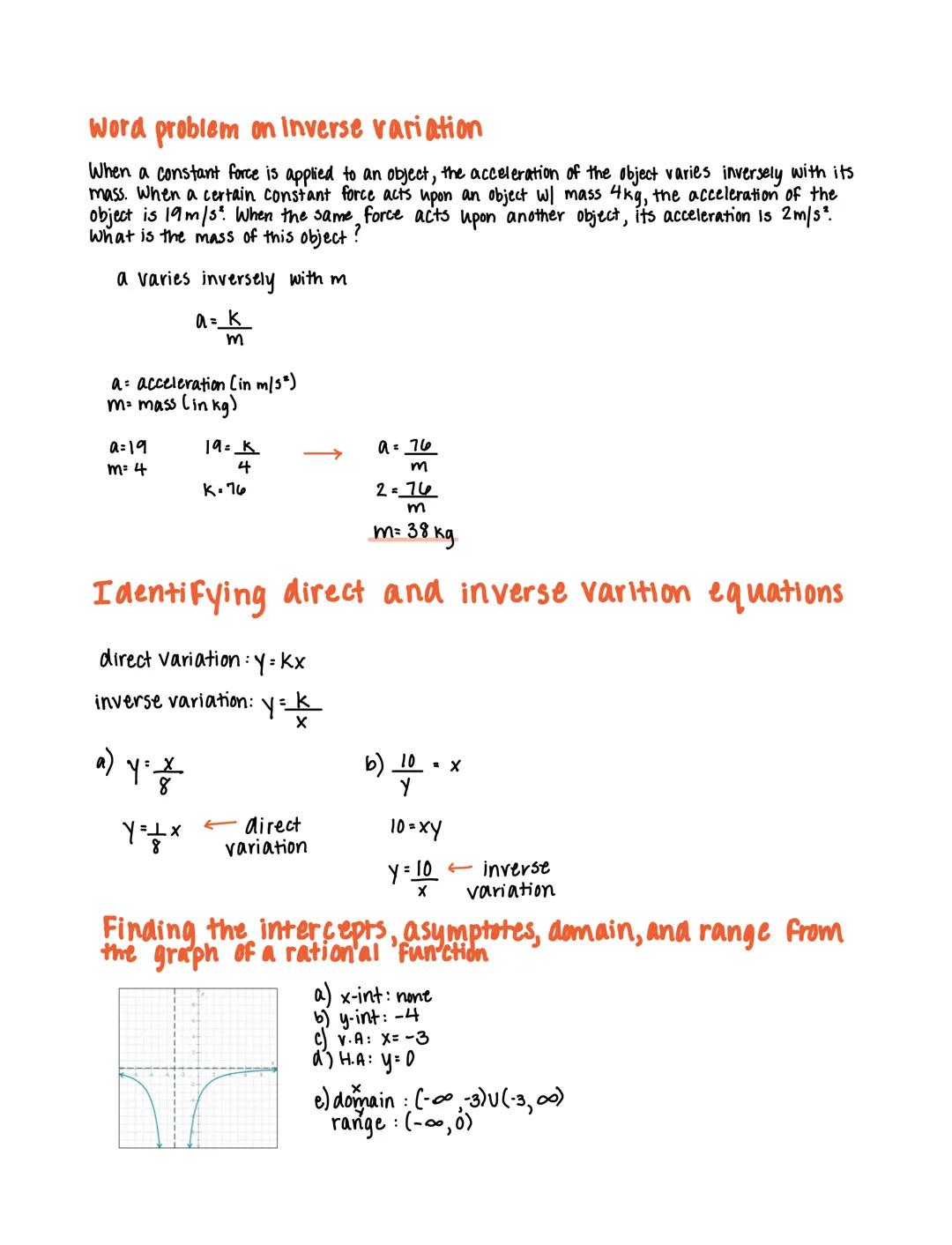
Inverse Variation
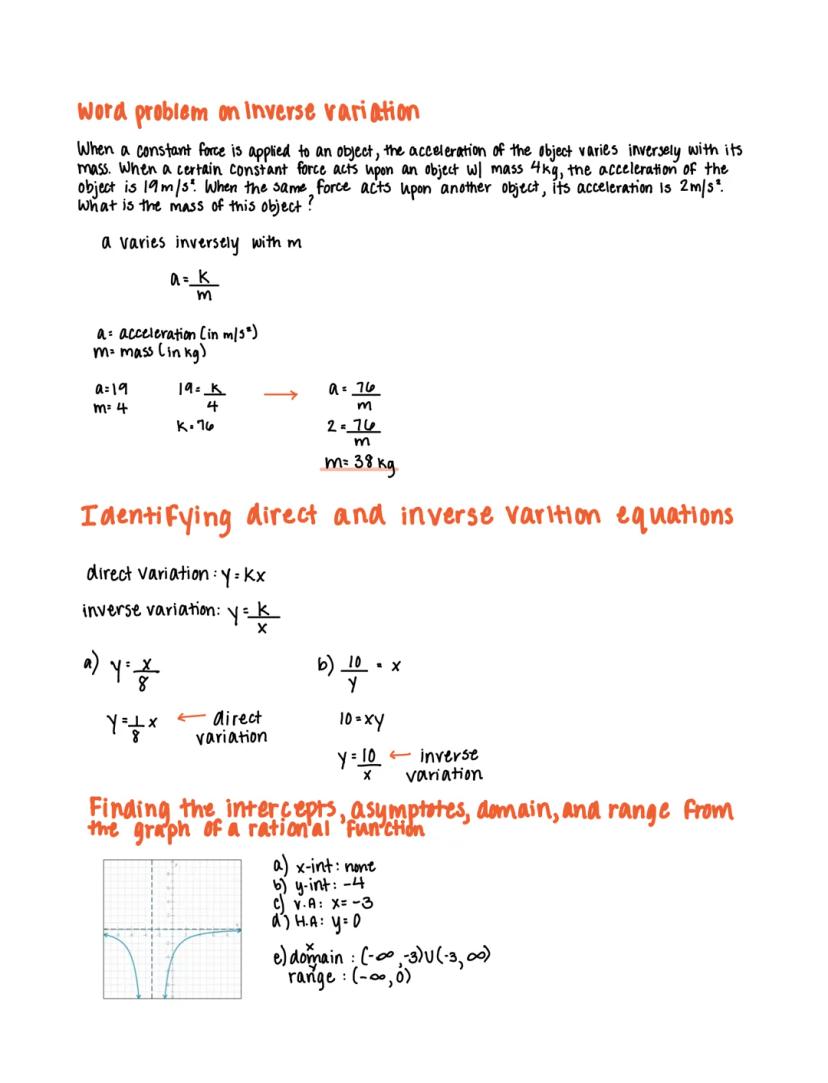
In inverse variation, as one quantity increases, the other decreases proportionally. The equation is y = k/x, where k is the constant of variation.
This relationship appears in many physical situations. For example, when a constant force acts on objects of different masses, the acceleration varies inversely with mass. If an object with 4kg mass accelerates at 19 m/s², we can find that another object with 38kg mass will accelerate at only 2 m/s².
Rational functions often model inverse relationships. When graphing rational functions, identify key features including:
- x-intercepts
- y-intercepts
- vertical asymptotes (where the denominator equals zero)
- horizontal asymptotes (the value the function approaches as x gets very large)
⚖️ Think of inverse variation as a seesaw effect: as one value gets 10 times bigger, the other gets 10 times smaller!
6
of 10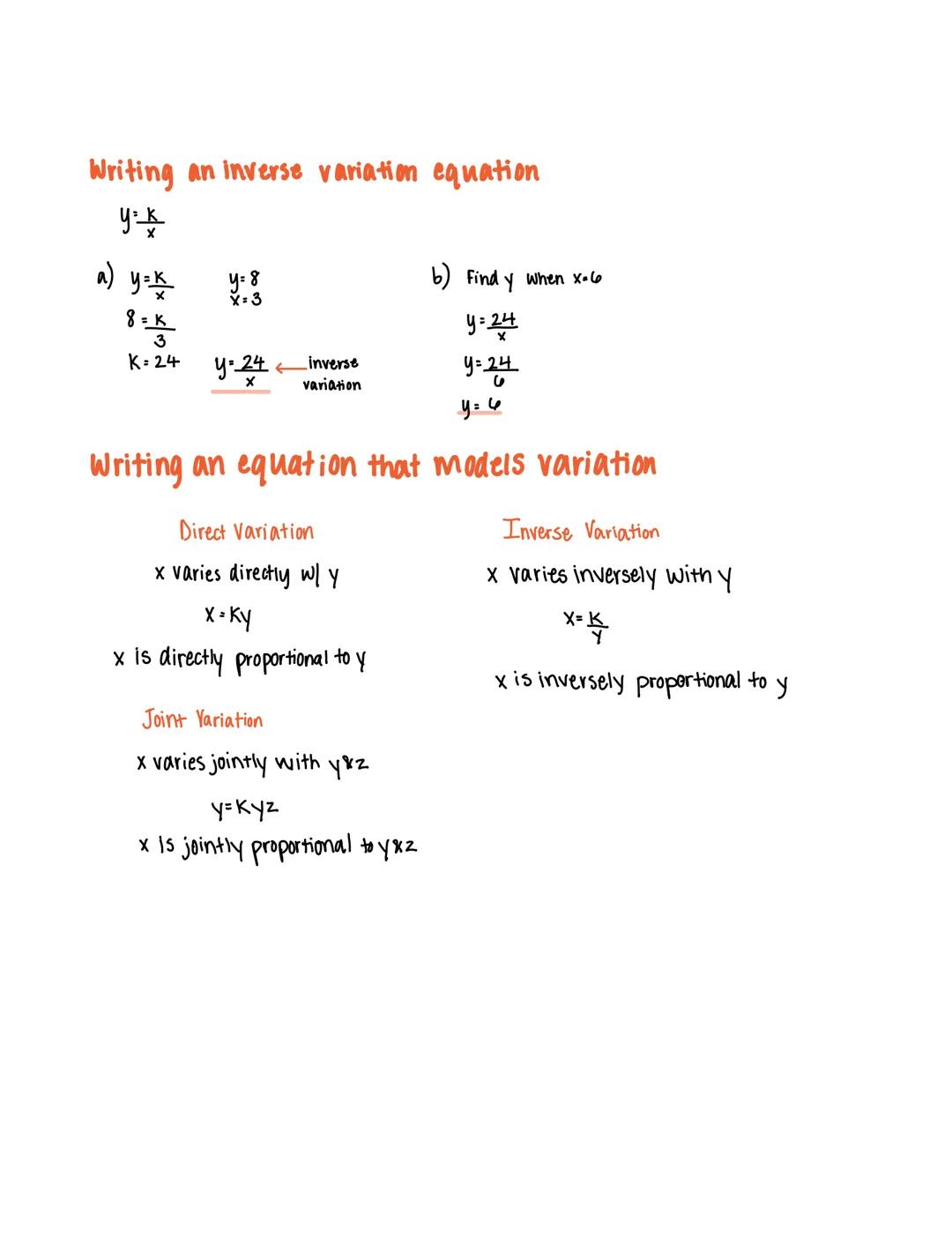
Writing Variation Equations
Variation equations describe how quantities relate to each other mathematically. Knowing how to write these equations helps you model real-world relationships.
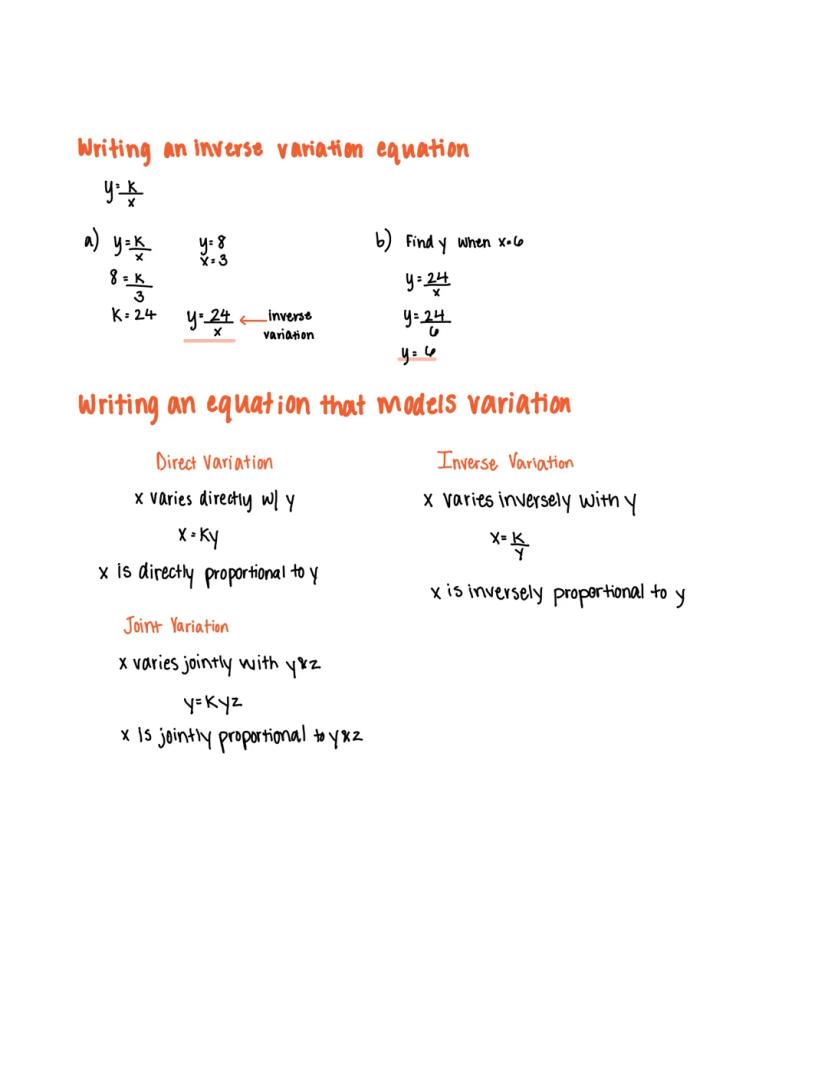
For inverse variation , find the constant k using a known point. If y = 8 when x = 3, then 8 = k/3, so k = 24, giving the equation y = 24/x. You can then use this to find y for any x value.
There are three main types of variation equations:
- Direct Variation: x = Ky (x is directly proportional to y)
- Inverse Variation: x = k/y (x is inversely proportional to y)
- Joint Variation: x = Kyz (x varies jointly with y and z)
Understanding these patterns helps you recognize and model relationships in science, economics, and everyday life situations.
7
of 10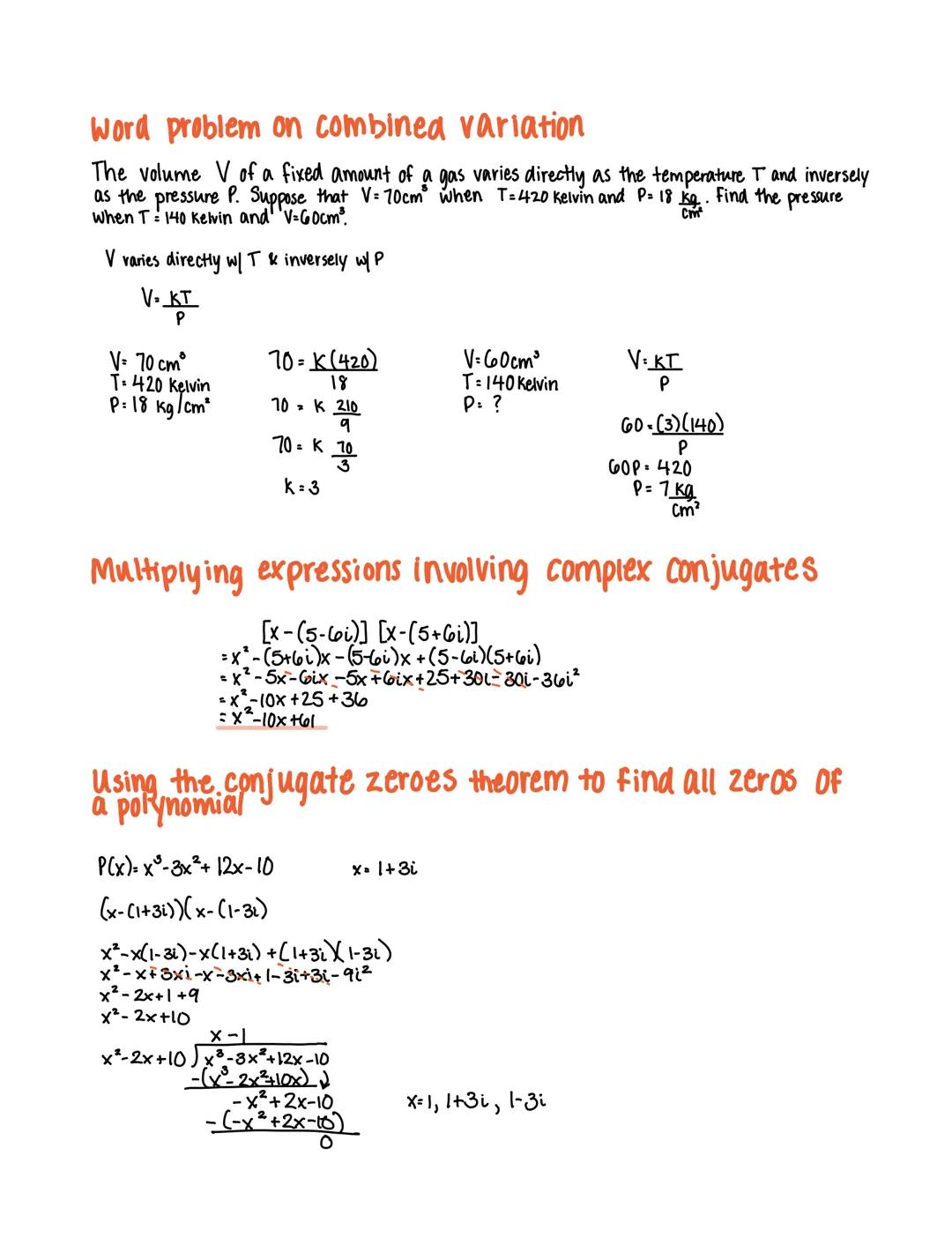
Combined Variation & Complex Zeros
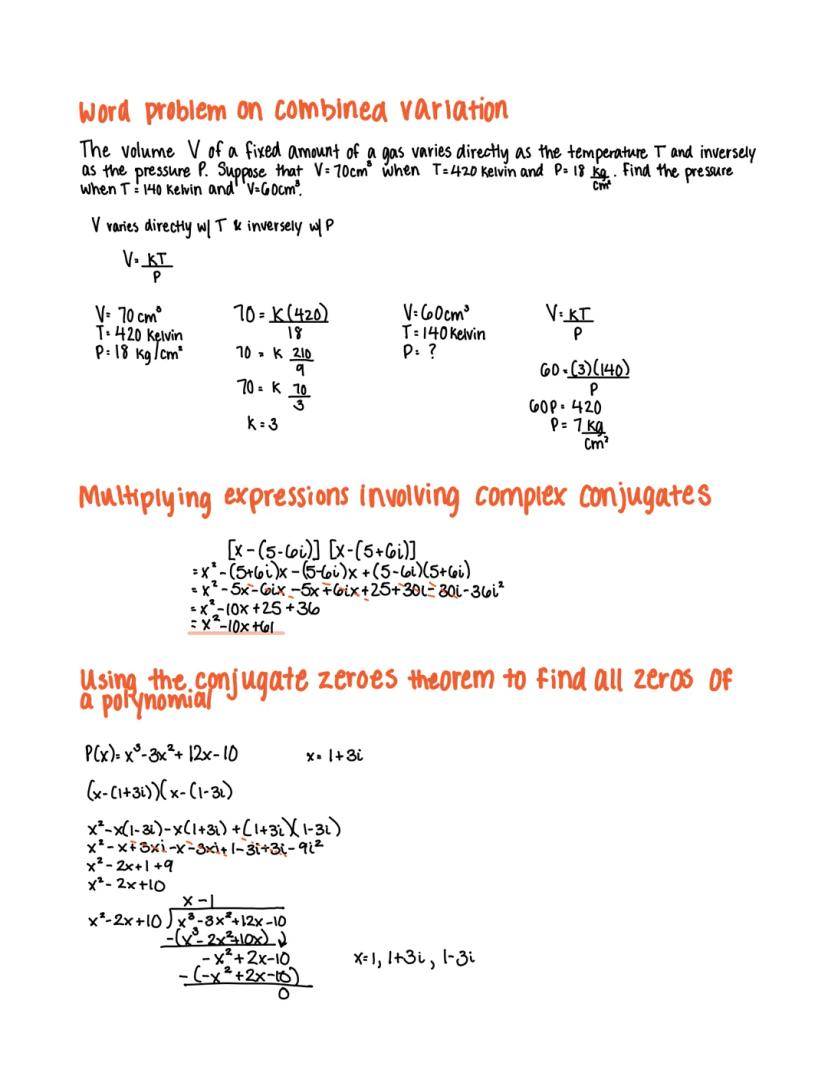
Combined variation involves both direct and inverse relationships. For example, the volume (V) of a gas varies directly with temperature (T) and inversely with pressure (P), giving V = KT/P.
To solve problems with combined variation:
- Write the equation with the constant K
- Substitute known values to find K
- Use the complete equation to find unknown values
When working with complex zeros of polynomials, remember that complex zeros always come in conjugate pairs . Multiplying complex conjugate expressions like simplifies to x²-10x+61.
The conjugate zeros theorem helps find all zeros of a polynomial. If you know one complex zero , you know its conjugate is also a zero. You can then use polynomial division to find remaining zeros.
🧩 When a polynomial has real coefficients, complex zeros always come in pairs. If a+bi is a zero, then a-bi must also be a zero!
8
of 10
Polynomial Inequalities & Rational Function Asymptotes
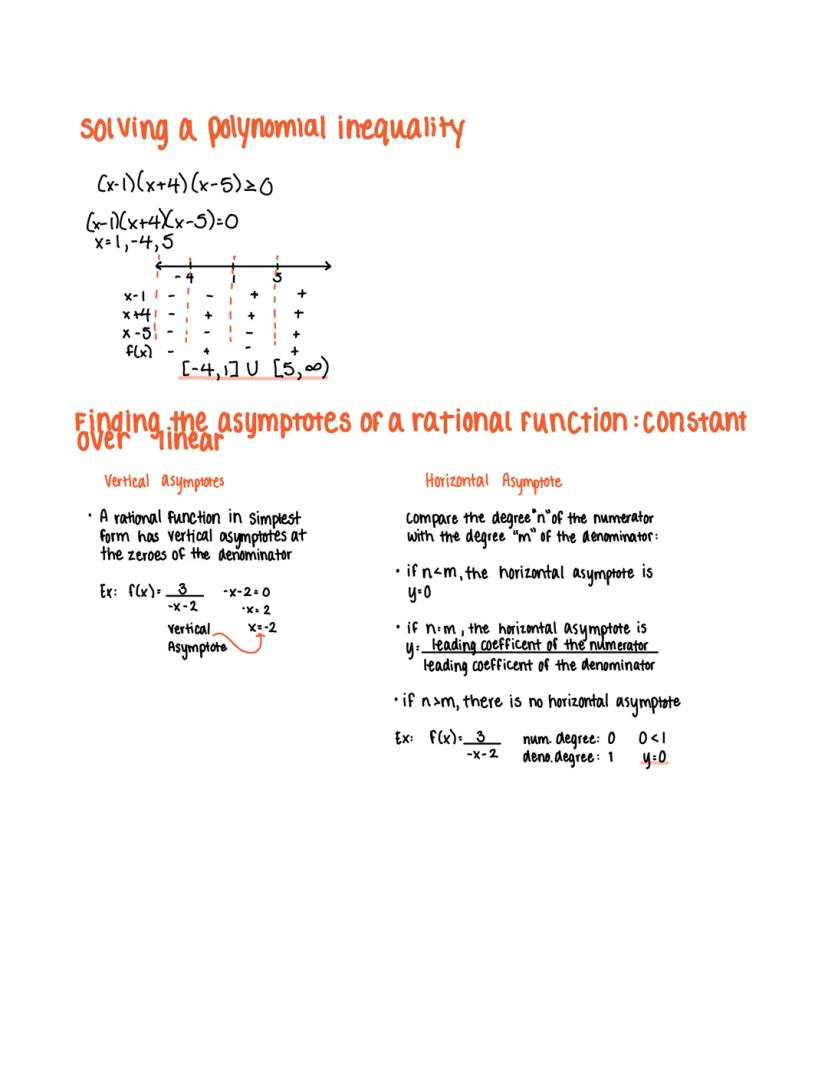
Solving polynomial inequalities involves finding where expressions like ≥ 0 are true. To solve:
- Find where the expression equals zero
- These points divide the number line into regions
- Test each region to determine where the inequality is satisfied
For this example, the solution is [-4,1] ∪ [5,∞).
Rational functions have important asymptotic behavior:
- Vertical asymptotes occur at zeros of the denominator
- Horizontal asymptotes depend on comparing degrees:
- If degree of numerator < degree of denominator: y = 0
- If degrees are equal: y = ratio of leading coefficients
- If degree of numerator > degree of denominator: no horizontal asymptote
📊 Think of asymptotes as "boundary lines" that the graph approaches but never crosses. They help you quickly sketch the overall shape of rational functions!
9
of 10
Advanced Asymptotes in Rational Functions
Rational functions can have different types of asymptotes depending on the degrees of their numerator and denominator.
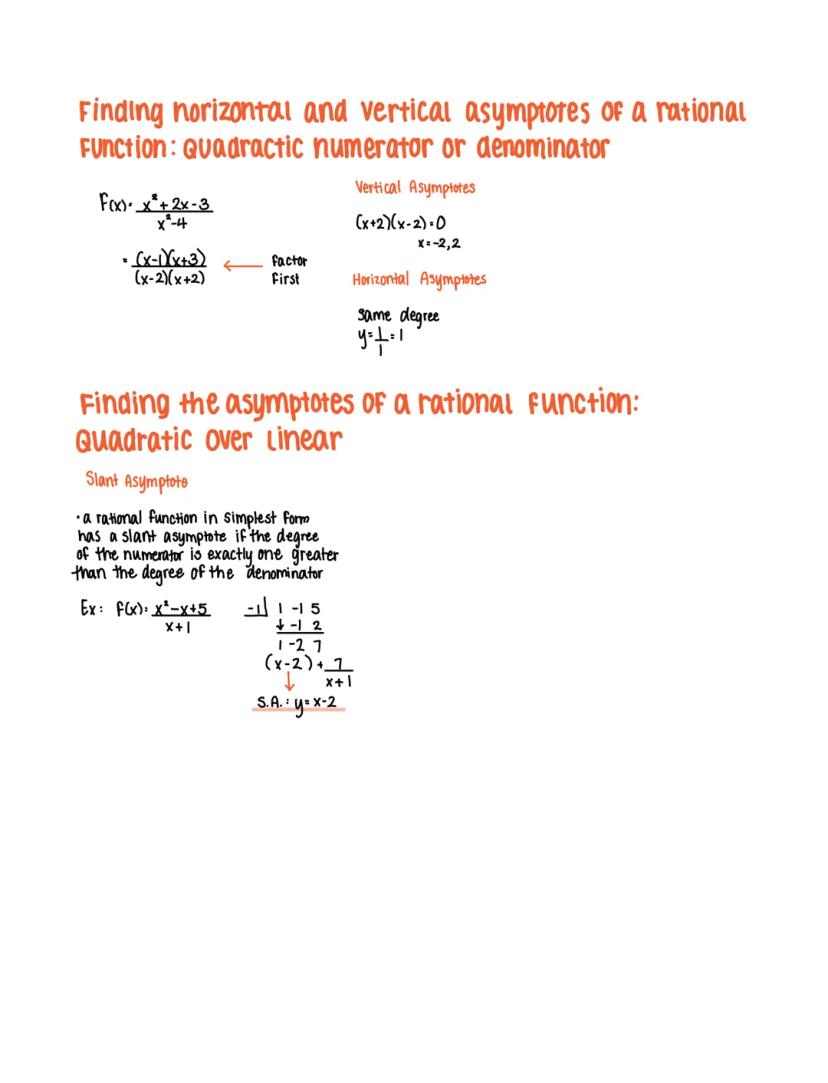
For a rational function like f(x) = /, start by finding the vertical asymptotes where the denominator equals zero. After factoring, we get vertical asymptotes at x = -2 and x = 2.
To find the horizontal asymptote, compare the degrees. When the numerator and denominator have the same degree (like x² in this example), the horizontal asymptote is y = ratio of leading coefficients = 1/1 = 1.
A slant asymptote occurs when the degree of the numerator is exactly one more than the denominator. For f(x) = /, divide to get f(x) = +7/, giving a slant asymptote of y = x-2.
🔍 When graphing rational functions, identifying the asymptotes first gives you the "skeleton" of the graph, making it much easier to sketch accurately!
10
of 10
Rational Functions with Holes & Descartes' Rule
Rational functions can have holes in their graphs when a factor cancels out. For example, in f(x) = -2x/, the factor cancels, creating a hole at x = 3.
To find holes:
- Factor completely
- Identify common factors in numerator and denominator
- Calculate the y-value at this x-value after simplifying
For our example, after simplification, f(x) = -2x/, so the hole appears at (3, -3).
Descartes' Rule of Signs helps count possible real zeros of polynomials:
- The number of positive real zeros equals the number of sign variations in P(x) or less by an even number
- The number of negative real zeros equals the sign variations in P or less by an even number
For f(x) = -x⁴+3x³-9x²+4x+9, with 3 sign variations, we'll have either 3 or 1 positive real zeros.
🧮 Descartes' Rule won't tell you exactly how many real zeros a polynomial has, but it narrows down the possibilities significantly!
We thought you’d never ask...
What is the Knowunity AI companion?
Our AI companion is specifically built for the needs of students. Based on the millions of content pieces we have on the platform we can provide truly meaningful and relevant answers to students. But its not only about answers, the companion is even more about guiding students through their daily learning challenges, with personalised study plans, quizzes or content pieces in the chat and 100% personalisation based on the students skills and developments.
Where can I download the Knowunity app?
You can download the app in the Google Play Store and in the Apple App Store.
Is Knowunity really free of charge?
That's right! Enjoy free access to study content, connect with fellow students, and get instant help – all at your fingertips.
Similar Content
Most popular content in Pre-Calculus
9Pre-CalculusSolutions of Oblique Triangles
This is a note about solutions of oblique triangles with examples.
682
 Calculus 1
Derivation
Calculus
954
Pre-CalculusAP Precalculus Notes: Unit 1 CRAM
I used a couple abbreviations in these notes, so I'll quickly define them! VA: Vertical Asymptote, HA: Horizontal Asymptote, UND: Undefined, LC: Leading Coefficient, ROC: Rate of change. Good luck! :)
10th1643
Pre-CalculusThe remainder theorem and factor theorem
Notes about the topic
591
Pre-CalculusTrigonometry (Polygons)
This note is all about trigonometry, discussing the concept of polygons and how to solve problems involving polygons. It also includes formulas and sample problems.
660
Pre-CalculusDerivative of Inverse Trigonometric Functions
This is about getting the derivative of inverse trigonometric functions.
290
Pre-CalculusDerivative of Trigonometric Functions
This is about getting the derivative of trigonometric functions.
241
Pre-CalculusMathematics (Solid Mensuration)
This note is all about solid mensuration, angles, and polygons. It includes formulas and sample problems with solution.
3053
Pre-CalculusReference Angle
How to find the references angle of an angle in any quadrant
652
Most popular content
9O
 AP US History
Origins and Dynamics of the Columbian Exchange
Analyze the ecological and economic motivations behind the initial transfer of goods, people, and diseases between the Old and New Worlds.
9th3,1280
I
AP US HistoryIntroduction to Early Cultural Interactions
Analyze the initial social and religious encounters between Europeans, Africans, and Indigenous peoples in the colonial Americas.
9th2,7730
O
 AP World History
Origins of Ancient River Civilizations
Analyze the environmental factors and technological innovations that led to the rise of early states in Mesopotamia, Egypt, and the Indus Valley.
9th3,1870
M
AP US HistoryMotivations for European Exploration
Analyze the economic, religious, and political factors that drove European powers to the Americas during the 15th and 16th centuries.
9th1,7780
F
 AP Psychology
Foundations of Ethical Guidelines in Research
Practice the core principles of the APA ethical code including informed consent, debriefing, and the role of Institutional Review Boards.
9th1,3360
I
AP US HistoryIntroduction to Native American Societies
Examine the diverse social, political, and economic structures of North American indigenous groups prior to European contact.
9th1,1100
I
 AP Biology
Introduction to Biological Elements of Life
Practice identifying the essential elements including carbon, nitrogen, phosphorus, and sulfur that compose biological macromolecules.
9th1,7390
I
AP US HistoryIntroduction to the Spanish Encomienda System
Explore the fundamental economic and social structures of the Spanish colonial system, focusing on the encomienda and the casta social hierarchy.
9th8890
O
AP World HistoryOrigins and Continuity of the Byzantine Empire
Analyze the political and cultural transitions from the Roman Empire to the Byzantine Empire, focusing on the reign of Justinian I and his code.
9th1,6320
Can't find what you're looking for? Explore other subjects.
Students love us — and so will you.
4.6/5App Store
4.7/5Google Play
The app is very easy to use and well designed. I have found everything I was looking for so far and have been able to learn a lot from the presentations! I will definitely use the app for a class assignment! And of course it also helps a lot as an inspiration.
Stefan SiOS user
This app is really great. There are so many study notes and help [...]. My problem subject is French, for example, and the app has so many options for help. Thanks to this app, I have improved my French. I would recommend it to anyone.
Samantha KlichAndroid user
Wow, I am really amazed. I just tried the app because I've seen it advertised many times and was absolutely stunned. This app is THE HELP you want for school and above all, it offers so many things, such as workouts and fact sheets, which have been VERY helpful to me personally.
AnnaiOS user
Pre-Calculus285 views·Updated Jun 9, 2026·11 pagesUnderstanding Polynomial and Rational Functions in Pre-Calc
Dive into the world of polynomials, rational functions, and variations where math becomes both powerful and practical. These concepts help us model real-world relationships and solve complex problems through algebraic techniques.
1
of 10
Sign up to see the content. It's free!
- Access to all documents
- Improve your grades
- Join milions of students
Polynomial Division & Theorems
When working with polynomials, long division helps us break down complex expressions into simpler parts. Just like regular division, we divide term by term and subtract to find quotients and remainders.
The Factor Theorem tells us that if P(c) = 0, then is a factor of polynomial P(x). For example, in the polynomial x⁴-x³+2x-12, we can check if x-2 is a factor by evaluating P(2). Since P(2) = 0, x-2 is indeed a factor!
The Remainder Theorem states that when dividing P(x) by , the remainder equals P(c). This gives us a shortcut for finding remainders without doing full polynomial division.
💡 When you're checking if is a factor of a polynomial, just substitute x=c into the polynomial. If you get zero, it's a factor!
2
of 10Sign up to see the content. It's free!
- Access to all documents
- Improve your grades
- Join milions of students
Writing Polynomials as Products
When you know a zero of a polynomial, you can use it to write the polynomial as a product of factors. This makes finding all zeros much easier!
For example, if g(x) = x³+2x²-7x-2 and you know 2 is a zero, you can use polynomial division to factor it as: g(x) =
To find the remaining zeros, use the quadratic formula on the quadratic factor. For the example above, the quadratic formula gives us x = -2±√3, meaning the polynomial can be written as: g(x) =
This technique helps you break down higher-degree polynomials into manageable pieces, making them easier to solve and understand.
3
of 10Sign up to see the content. It's free!
- Access to all documents
- Improve your grades
- Join milions of students
Analyzing Polynomial Graphs
The shape of a polynomial graph tells you a lot about its behavior. A function is increasing when its graph rises from left to right and decreasing when it falls.
You can identify intervals where the function behaves differently. For example, a function might be decreasing on (-∞,1) and (3,7), while increasing on (-1,3) and (7,∞).
An important relationship exists between a polynomial's degree and its local extrema (peaks and valleys). For a polynomial function of degree n>0, the degree is at least 1 more than the number of local extrema. So if a graph shows 3 local extrema, the polynomial must have a degree of at least 4.
🔍 Count the number of "hills" and "valleys" in a polynomial graph, add 1, and you'll know the minimum possible degree of the polynomial!
4
of 10Sign up to see the content. It's free!
- Access to all documents
- Improve your grades
- Join milions of students
Direct Variation
Direct variation is when two quantities change proportionally - as one increases, the other increases at the same rate. The equation for direct variation is y = kx, where k is the constant of variation.
In real-world applications, direct variation appears frequently. For instance, when a force acts on an object, the force varies directly with the object's acceleration . If 8 Newtons of force causes 2 m/s² acceleration, then 20 Newtons will cause 5 m/s² acceleration.
To create a direct variation equation from a single point, find the constant k first. If y = 2 when x = 10, then k = 2/10 = 1/5, giving the equation y = (1/5)x. You can then use this equation to find y for any value of x.
🚀 Direct variation is like a see-saw that stays balanced - when one value doubles, the other doubles too!
5
of 10Sign up to see the content. It's free!
- Access to all documents
- Improve your grades
- Join milions of students
Inverse Variation
In inverse variation, as one quantity increases, the other decreases proportionally. The equation is y = k/x, where k is the constant of variation.
This relationship appears in many physical situations. For example, when a constant force acts on objects of different masses, the acceleration varies inversely with mass. If an object with 4kg mass accelerates at 19 m/s², we can find that another object with 38kg mass will accelerate at only 2 m/s².
Rational functions often model inverse relationships. When graphing rational functions, identify key features including:
- x-intercepts
- y-intercepts
- vertical asymptotes (where the denominator equals zero)
- horizontal asymptotes (the value the function approaches as x gets very large)
⚖️ Think of inverse variation as a seesaw effect: as one value gets 10 times bigger, the other gets 10 times smaller!
6
of 10Sign up to see the content. It's free!
- Access to all documents
- Improve your grades
- Join milions of students
Writing Variation Equations
Variation equations describe how quantities relate to each other mathematically. Knowing how to write these equations helps you model real-world relationships.
For inverse variation , find the constant k using a known point. If y = 8 when x = 3, then 8 = k/3, so k = 24, giving the equation y = 24/x. You can then use this to find y for any x value.
There are three main types of variation equations:
- Direct Variation: x = Ky (x is directly proportional to y)
- Inverse Variation: x = k/y (x is inversely proportional to y)
- Joint Variation: x = Kyz (x varies jointly with y and z)
Understanding these patterns helps you recognize and model relationships in science, economics, and everyday life situations.
7
of 10Sign up to see the content. It's free!
- Access to all documents
- Improve your grades
- Join milions of students
Combined Variation & Complex Zeros
Combined variation involves both direct and inverse relationships. For example, the volume (V) of a gas varies directly with temperature (T) and inversely with pressure (P), giving V = KT/P.
To solve problems with combined variation:
- Write the equation with the constant K
- Substitute known values to find K
- Use the complete equation to find unknown values
When working with complex zeros of polynomials, remember that complex zeros always come in conjugate pairs . Multiplying complex conjugate expressions like simplifies to x²-10x+61.
The conjugate zeros theorem helps find all zeros of a polynomial. If you know one complex zero , you know its conjugate is also a zero. You can then use polynomial division to find remaining zeros.
🧩 When a polynomial has real coefficients, complex zeros always come in pairs. If a+bi is a zero, then a-bi must also be a zero!
8
of 10Sign up to see the content. It's free!
- Access to all documents
- Improve your grades
- Join milions of students
Polynomial Inequalities & Rational Function Asymptotes
Solving polynomial inequalities involves finding where expressions like ≥ 0 are true. To solve:
- Find where the expression equals zero
- These points divide the number line into regions
- Test each region to determine where the inequality is satisfied
For this example, the solution is [-4,1] ∪ [5,∞).
Rational functions have important asymptotic behavior:
- Vertical asymptotes occur at zeros of the denominator
- Horizontal asymptotes depend on comparing degrees:
- If degree of numerator < degree of denominator: y = 0
- If degrees are equal: y = ratio of leading coefficients
- If degree of numerator > degree of denominator: no horizontal asymptote
📊 Think of asymptotes as "boundary lines" that the graph approaches but never crosses. They help you quickly sketch the overall shape of rational functions!
9
of 10Sign up to see the content. It's free!
- Access to all documents
- Improve your grades
- Join milions of students
Advanced Asymptotes in Rational Functions
Rational functions can have different types of asymptotes depending on the degrees of their numerator and denominator.
For a rational function like f(x) = /, start by finding the vertical asymptotes where the denominator equals zero. After factoring, we get vertical asymptotes at x = -2 and x = 2.
To find the horizontal asymptote, compare the degrees. When the numerator and denominator have the same degree (like x² in this example), the horizontal asymptote is y = ratio of leading coefficients = 1/1 = 1.
A slant asymptote occurs when the degree of the numerator is exactly one more than the denominator. For f(x) = /, divide to get f(x) = +7/, giving a slant asymptote of y = x-2.
🔍 When graphing rational functions, identifying the asymptotes first gives you the "skeleton" of the graph, making it much easier to sketch accurately!
10
of 10Sign up to see the content. It's free!
- Access to all documents
- Improve your grades
- Join milions of students
Rational Functions with Holes & Descartes' Rule
Rational functions can have holes in their graphs when a factor cancels out. For example, in f(x) = -2x/, the factor cancels, creating a hole at x = 3.
To find holes:
- Factor completely
- Identify common factors in numerator and denominator
- Calculate the y-value at this x-value after simplifying
For our example, after simplification, f(x) = -2x/, so the hole appears at (3, -3).
Descartes' Rule of Signs helps count possible real zeros of polynomials:
- The number of positive real zeros equals the number of sign variations in P(x) or less by an even number
- The number of negative real zeros equals the sign variations in P or less by an even number
For f(x) = -x⁴+3x³-9x²+4x+9, with 3 sign variations, we'll have either 3 or 1 positive real zeros.
🧮 Descartes' Rule won't tell you exactly how many real zeros a polynomial has, but it narrows down the possibilities significantly!
We thought you’d never ask...
What is the Knowunity AI companion?
Our AI companion is specifically built for the needs of students. Based on the millions of content pieces we have on the platform we can provide truly meaningful and relevant answers to students. But its not only about answers, the companion is even more about guiding students through their daily learning challenges, with personalised study plans, quizzes or content pieces in the chat and 100% personalisation based on the students skills and developments.
Where can I download the Knowunity app?
You can download the app in the Google Play Store and in the Apple App Store.
Is Knowunity really free of charge?
That's right! Enjoy free access to study content, connect with fellow students, and get instant help – all at your fingertips.
Similar Content
Most popular content in Pre-Calculus
9Pre-CalculusSolutions of Oblique Triangles
This is a note about solutions of oblique triangles with examples.
682
Calculus 1Derivation
Calculus
954
Pre-CalculusAP Precalculus Notes: Unit 1 CRAM
I used a couple abbreviations in these notes, so I'll quickly define them! VA: Vertical Asymptote, HA: Horizontal Asymptote, UND: Undefined, LC: Leading Coefficient, ROC: Rate of change. Good luck! :)
10th1643
Pre-CalculusThe remainder theorem and factor theorem
Notes about the topic
591
Pre-CalculusTrigonometry (Polygons)
This note is all about trigonometry, discussing the concept of polygons and how to solve problems involving polygons. It also includes formulas and sample problems.
660
Pre-CalculusDerivative of Inverse Trigonometric Functions
This is about getting the derivative of inverse trigonometric functions.
290
Pre-CalculusDerivative of Trigonometric Functions
This is about getting the derivative of trigonometric functions.
241
Pre-CalculusMathematics (Solid Mensuration)
This note is all about solid mensuration, angles, and polygons. It includes formulas and sample problems with solution.
3053
Pre-CalculusReference Angle
How to find the references angle of an angle in any quadrant
652
Most popular content
9O
AP US HistoryOrigins and Dynamics of the Columbian Exchange
Analyze the ecological and economic motivations behind the initial transfer of goods, people, and diseases between the Old and New Worlds.
9th3,1280
I
AP US HistoryIntroduction to Early Cultural Interactions
Analyze the initial social and religious encounters between Europeans, Africans, and Indigenous peoples in the colonial Americas.
9th2,7730
O
AP World HistoryOrigins of Ancient River Civilizations
Analyze the environmental factors and technological innovations that led to the rise of early states in Mesopotamia, Egypt, and the Indus Valley.
9th3,1870
M
AP US HistoryMotivations for European Exploration
Analyze the economic, religious, and political factors that drove European powers to the Americas during the 15th and 16th centuries.
9th1,7780
F
AP PsychologyFoundations of Ethical Guidelines in Research
Practice the core principles of the APA ethical code including informed consent, debriefing, and the role of Institutional Review Boards.
9th1,3360
I
AP US HistoryIntroduction to Native American Societies
Examine the diverse social, political, and economic structures of North American indigenous groups prior to European contact.
9th1,1100
I
AP BiologyIntroduction to Biological Elements of Life
Practice identifying the essential elements including carbon, nitrogen, phosphorus, and sulfur that compose biological macromolecules.
9th1,7390
I
AP US HistoryIntroduction to the Spanish Encomienda System
Explore the fundamental economic and social structures of the Spanish colonial system, focusing on the encomienda and the casta social hierarchy.
9th8890
O
AP World HistoryOrigins and Continuity of the Byzantine Empire
Analyze the political and cultural transitions from the Roman Empire to the Byzantine Empire, focusing on the reign of Justinian I and his code.
9th1,6320
Can't find what you're looking for? Explore other subjects.
Students love us — and so will you.
4.6/5App Store
4.7/5Google Play
The app is very easy to use and well designed. I have found everything I was looking for so far and have been able to learn a lot from the presentations! I will definitely use the app for a class assignment! And of course it also helps a lot as an inspiration.
Stefan SiOS user
This app is really great. There are so many study notes and help [...]. My problem subject is French, for example, and the app has so many options for help. Thanks to this app, I have improved my French. I would recommend it to anyone.
Samantha KlichAndroid user
Wow, I am really amazed. I just tried the app because I've seen it advertised many times and was absolutely stunned. This app is THE HELP you want for school and above all, it offers so many things, such as workouts and fact sheets, which have been VERY helpful to me personally.
AnnaiOS user