
Let's dive into quantitative research - the systematic way of...
 Practical Research474 views·Updated Jun 27, 2026·7 pages
Comprehensive Practical Research 2 Notes
S
sam ⋆𐙚₊˚⊹♡@samantha.badiola_



1 / 7
1
of 7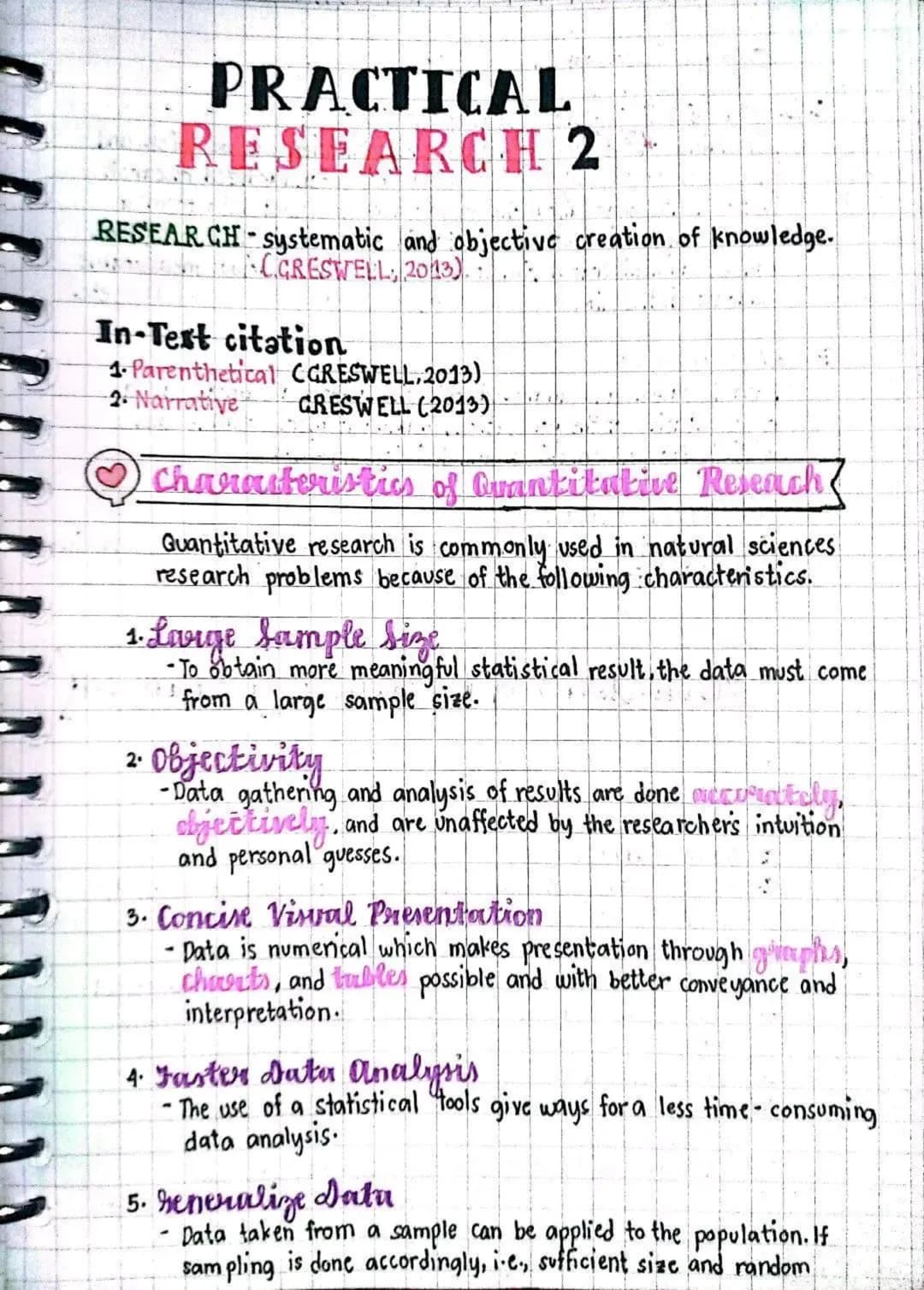
What is Quantitative Research?
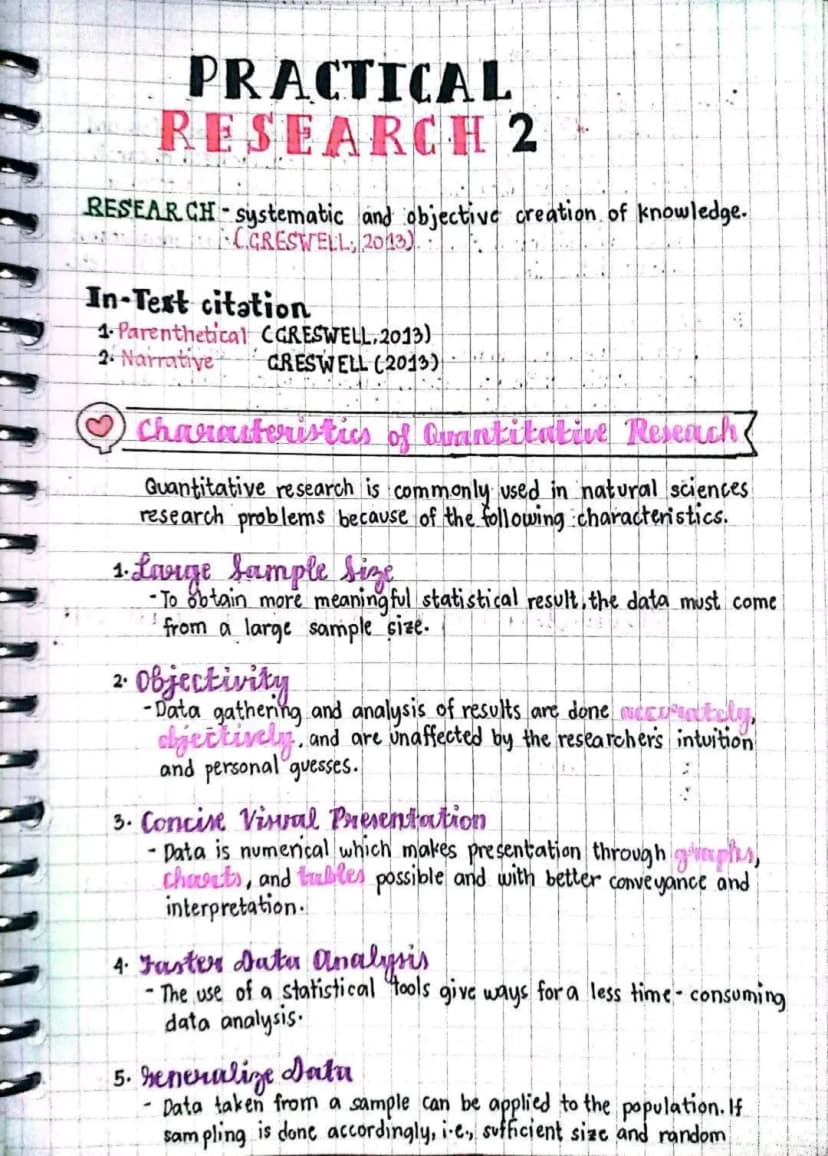
Ever wondered how researchers prove their theories with solid evidence? Quantitative research is your answer - it's all about systematic and objective creation of knowledge using numerical data.
When you see research citations like (Creswell, 2013), that's called in-text citation. You can write it two ways: parenthetical (author in parentheses) or narrative (author as part of the sentence). This is crucial for your research papers!
Quantitative research shines in natural sciences because of its unique characteristics. It uses large sample sizes to get meaningful statistical results - think surveying 1,000 students instead of just 10. The beauty lies in its objectivity - data gathering happens without the researcher's personal feelings interfering.
Quick Tip: Remember that bigger sample sizes generally lead to more reliable results that you can trust for decision-making!
2
of 7
Key Features and Advantages
What makes quantitative research so powerful? First, it offers concise visual presentation through graphs and charts that make complex data easy to understand. Plus, faster data analysis using statistical tools saves tons of time compared to other methods.
The real magic happens with generalizable data - results from your sample can represent the entire population if done correctly. Fast and easy data collection using standardized surveys means you can gather information from hundreds of people simultaneously.
Reliable data makes this research method perfect for policymaking and important decisions. The high replicability means other researchers can repeat your study to verify findings, making results more trustworthy.
The advantages are impressive: you get objective results, can predict outcomes, establish cause-and-effect relationships, and analyze data quickly using software. Your findings apply to larger populations, making your research truly impactful.
Remember: Quantitative research's strength lies in its ability to provide concrete, numerical evidence that policymakers and decision-makers can rely on!
3
of 7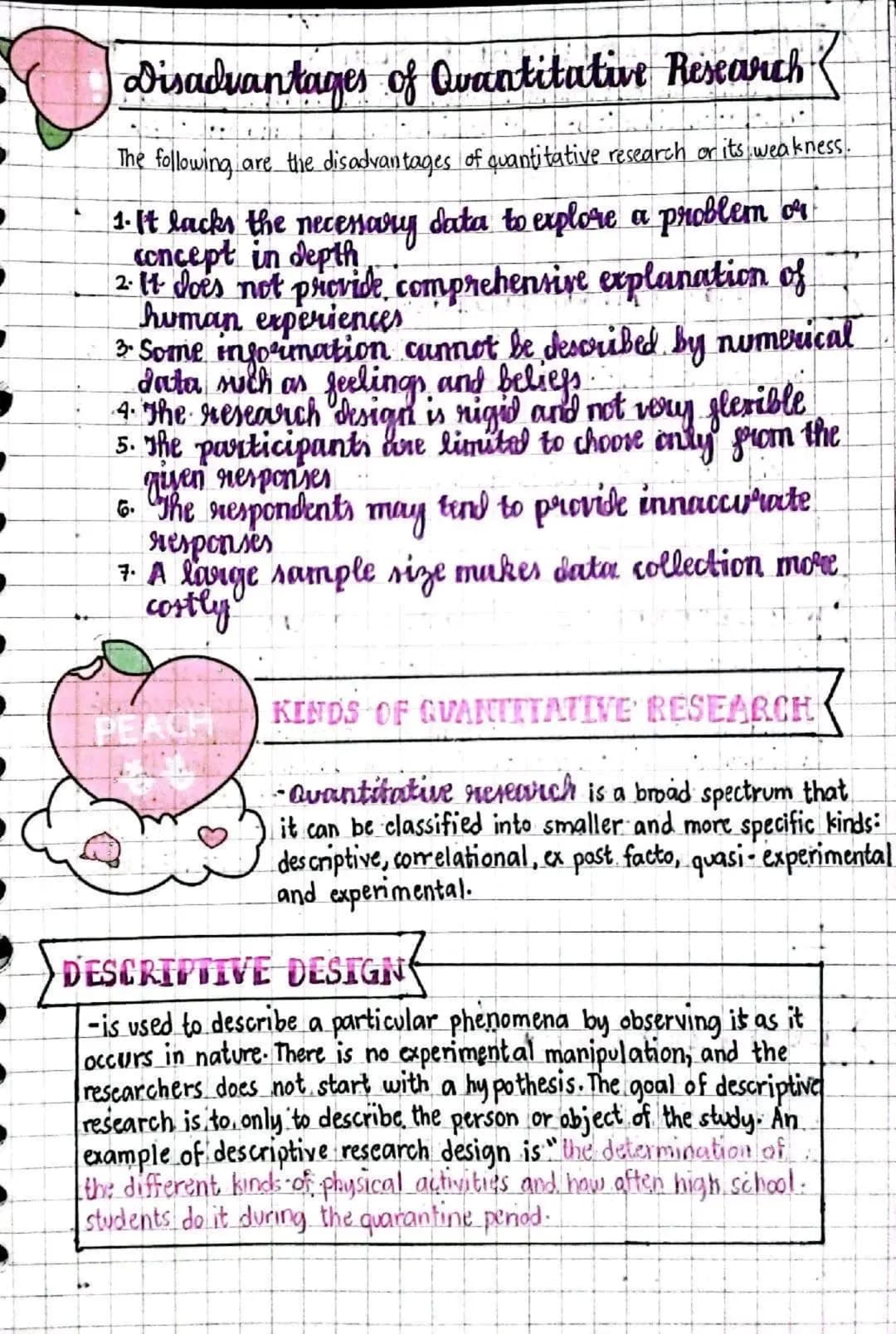
Limitations and Types of Quantitative Research
Like any method, quantitative research has its weaknesses. It lacks depth for exploring complex problems and doesn't provide comprehensive explanations of human experiences. Some things like feelings and beliefs simply can't be captured through numbers.
The research design is rigid and not very flexible once you start. Participants must choose from given responses, which might not capture their true thoughts. Sometimes respondents provide inaccurate answers, and large sample sizes make data collection more expensive.
Quantitative research comes in several types, each serving different purposes. Descriptive design simply describes phenomena as they naturally occur - like studying what physical activities students do during quarantine, without trying to change anything.
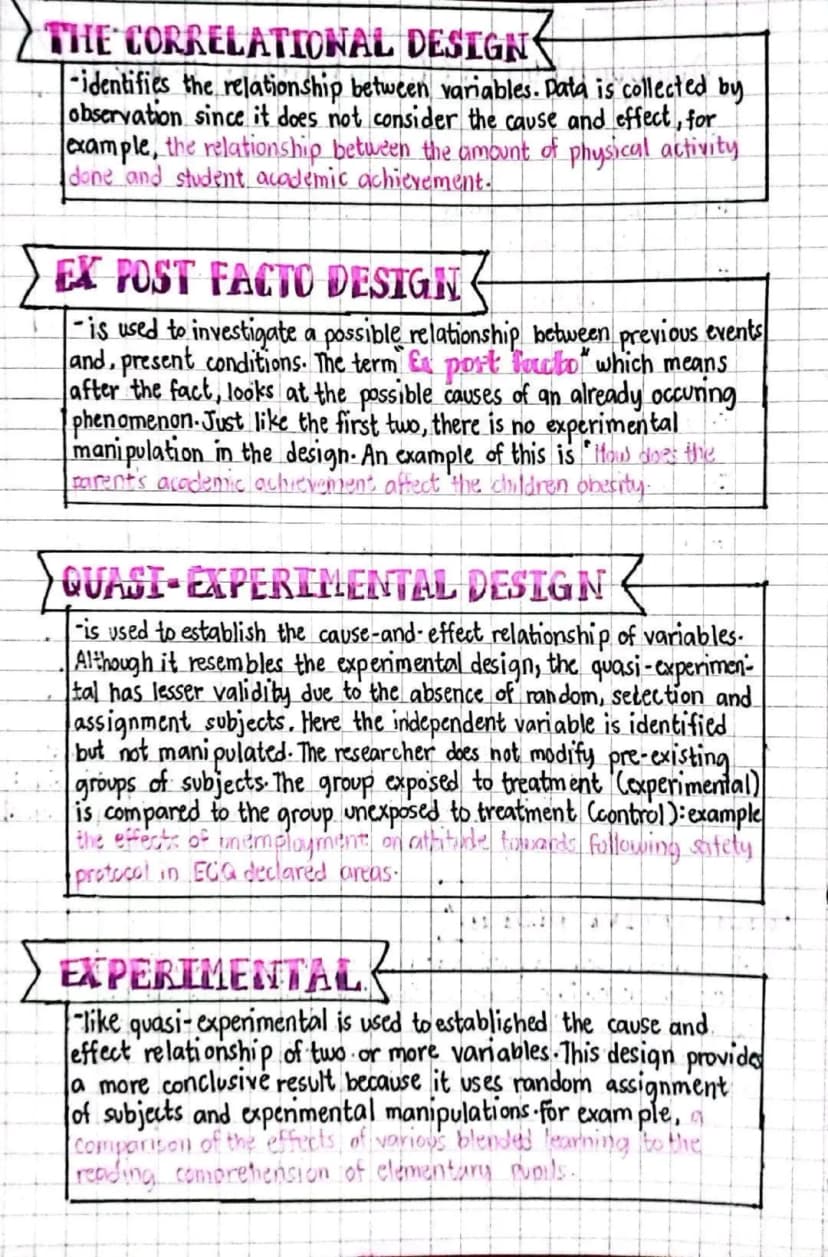
Correlational design identifies relationships between variables through observation. For example, you might study the relationship between physical activity and academic achievement without determining which causes which.
Study Smart: Understanding these limitations helps you choose the right research method for your project and interpret results more accurately!
4
of 7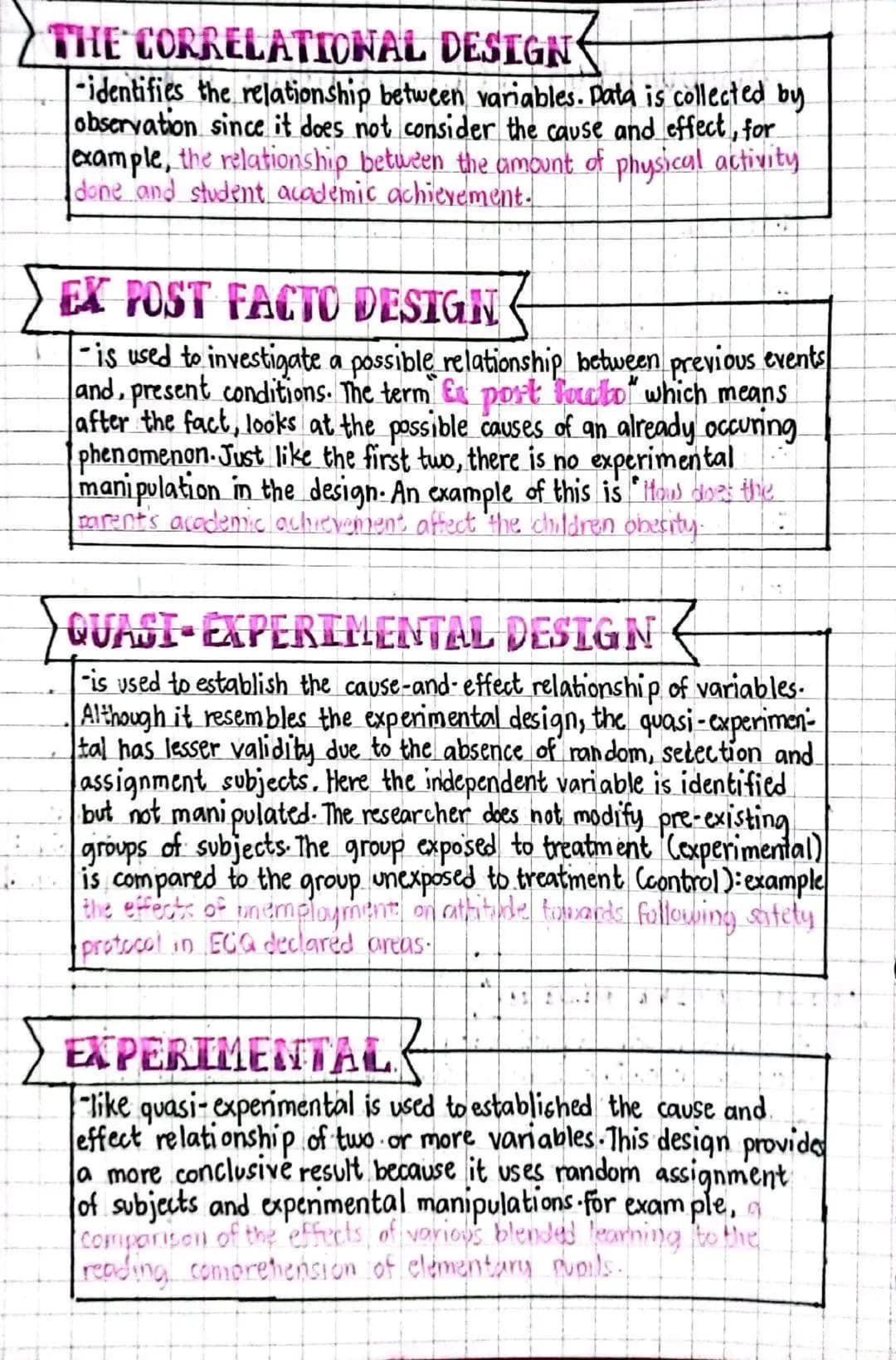
Advanced Research Designs
Ready to explore more complex research types? Ex post facto design investigates relationships between past events and current conditions. The term means "after the fact" - like studying how parents' academic achievements affect children's obesity rates.
Quasi-experimental design establishes cause-and-effect relationships but with less control than true experiments. You can't randomly assign subjects to groups, so you work with existing groups. Think studying unemployment effects on safety protocol attitudes in ECQ areas.
Experimental design provides the most conclusive results because it uses random assignment and experimental manipulation. This gold standard lets researchers directly compare treatment effects - like testing different blended learning methods on elementary pupils' reading comprehension.
Each design serves specific research goals. Descriptive tells you "what," correlational shows "what's related," ex post facto explores "what happened," while quasi-experimental and experimental designs reveal "what causes what."
Pro Tip: Choose your research design based on your research question - the more control you need over variables, the more experimental your approach should be!
5
of 7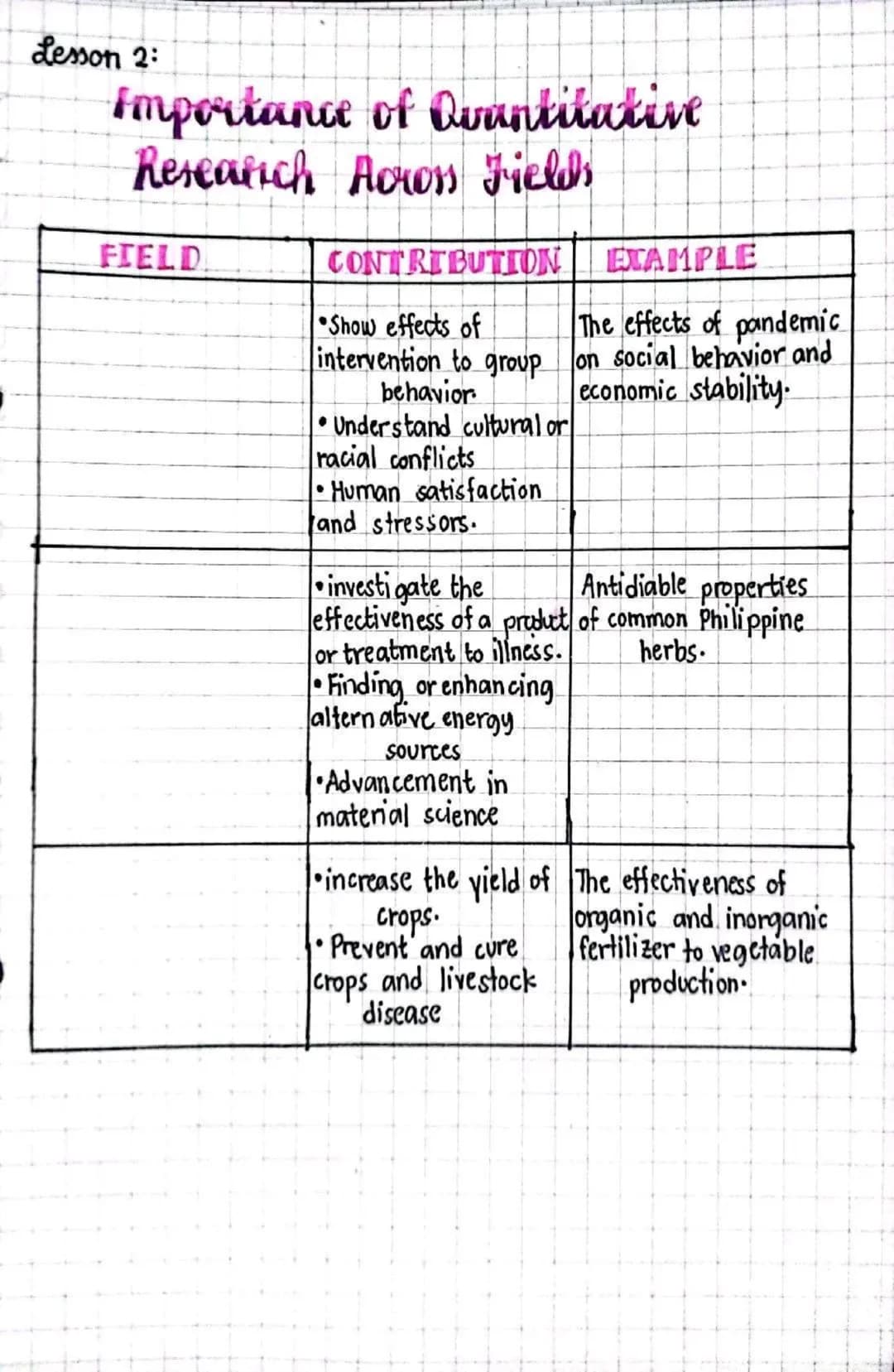
Real-World Applications and Historical Tools
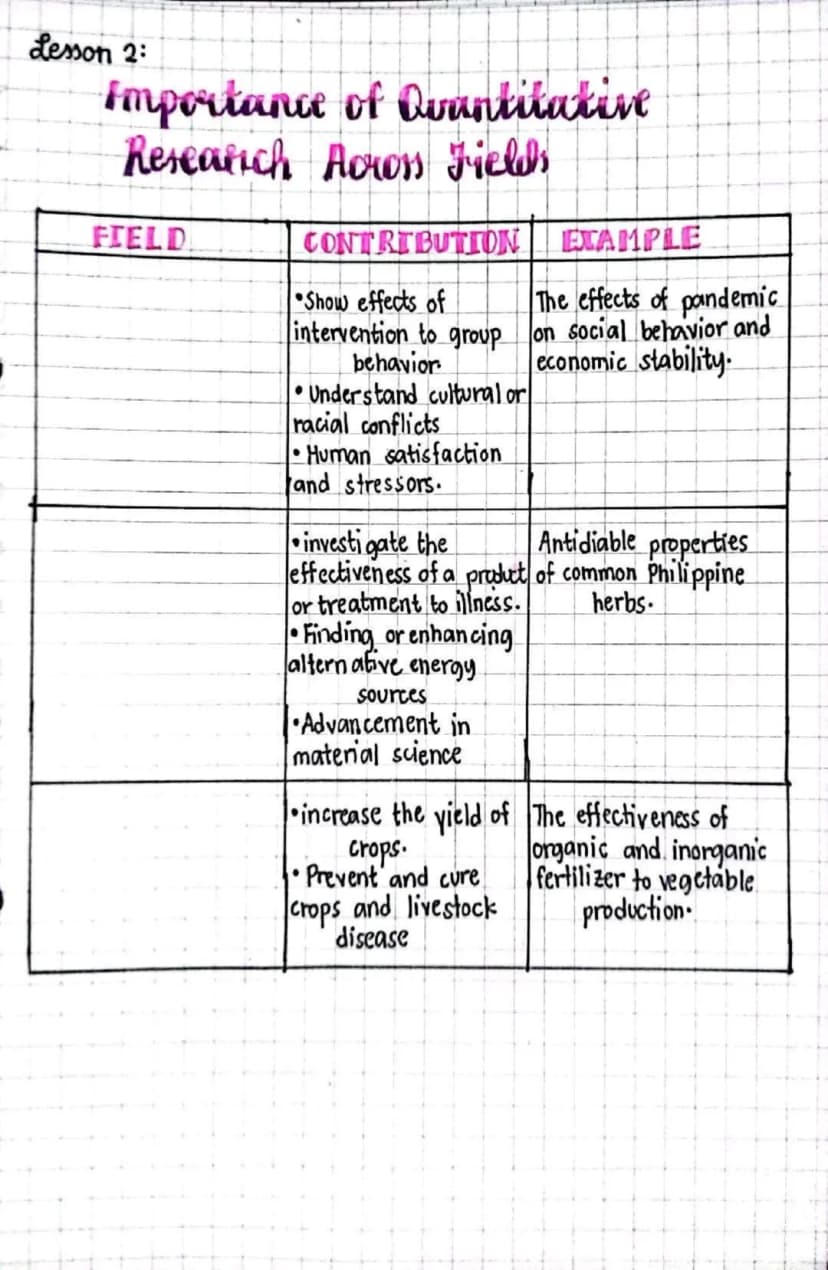
Quantitative research transforms every field you can imagine! In social sciences, it shows intervention effects on group behavior and helps us understand cultural conflicts - like studying pandemic effects on social behavior and economic stability.
Healthcare relies heavily on this research to investigate treatment effectiveness and find new medicines. Scientists test antidiabetic properties of Philippine herbs or develop better treatments for diseases. Environmental science uses it for alternative energy sources and advanced materials.
Agriculture benefits through crop yield studies and livestock disease prevention. Researchers compare organic versus inorganic fertilizer effectiveness on vegetable production, directly impacting food security.
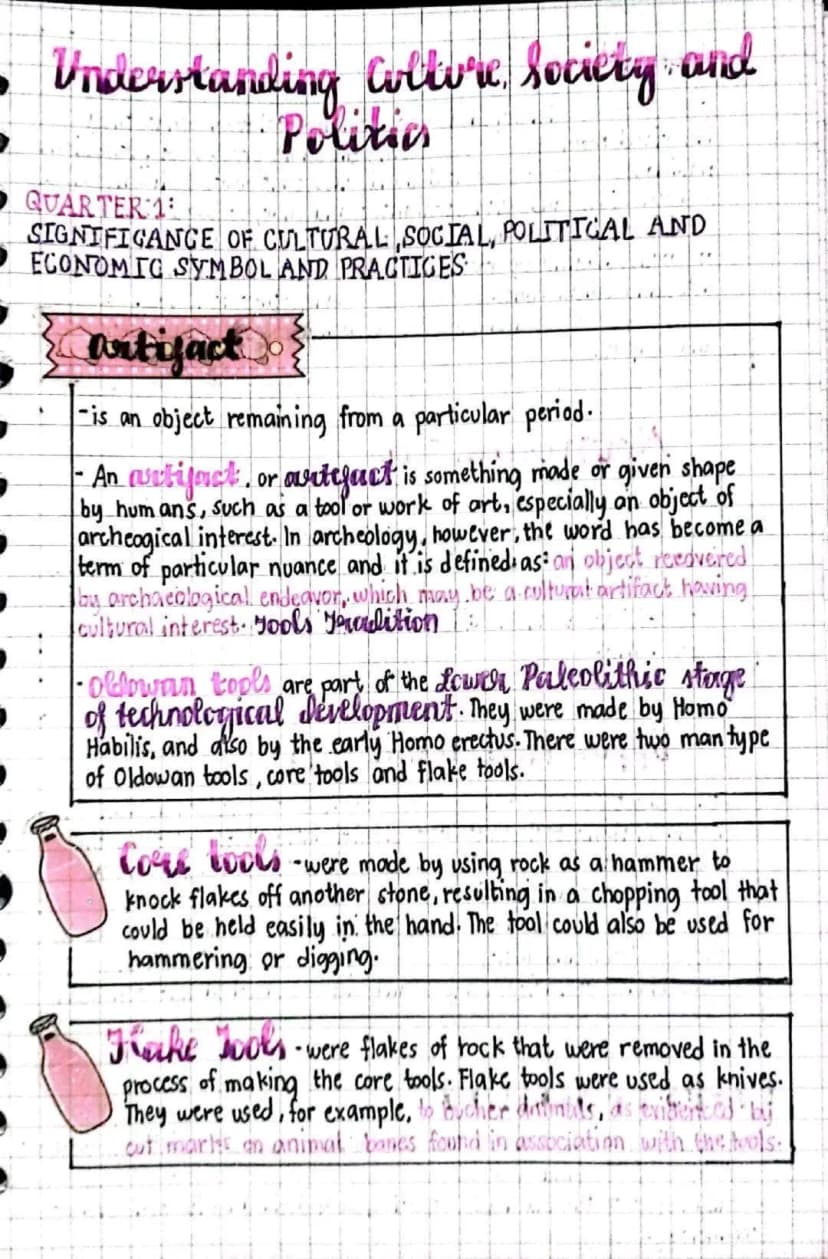
Moving beyond modern applications, let's explore human tool development. Artifacts - objects from particular periods - tell fascinating stories. Oldowan tools from the Lower Paleolithic period were humanity's first systematic toolmaking attempt by Homo habilis and early Homo erectus.
Connection Point: Just like ancient humans systematically developed better tools, modern quantitative research systematically develops better knowledge across all fields!
6
of 7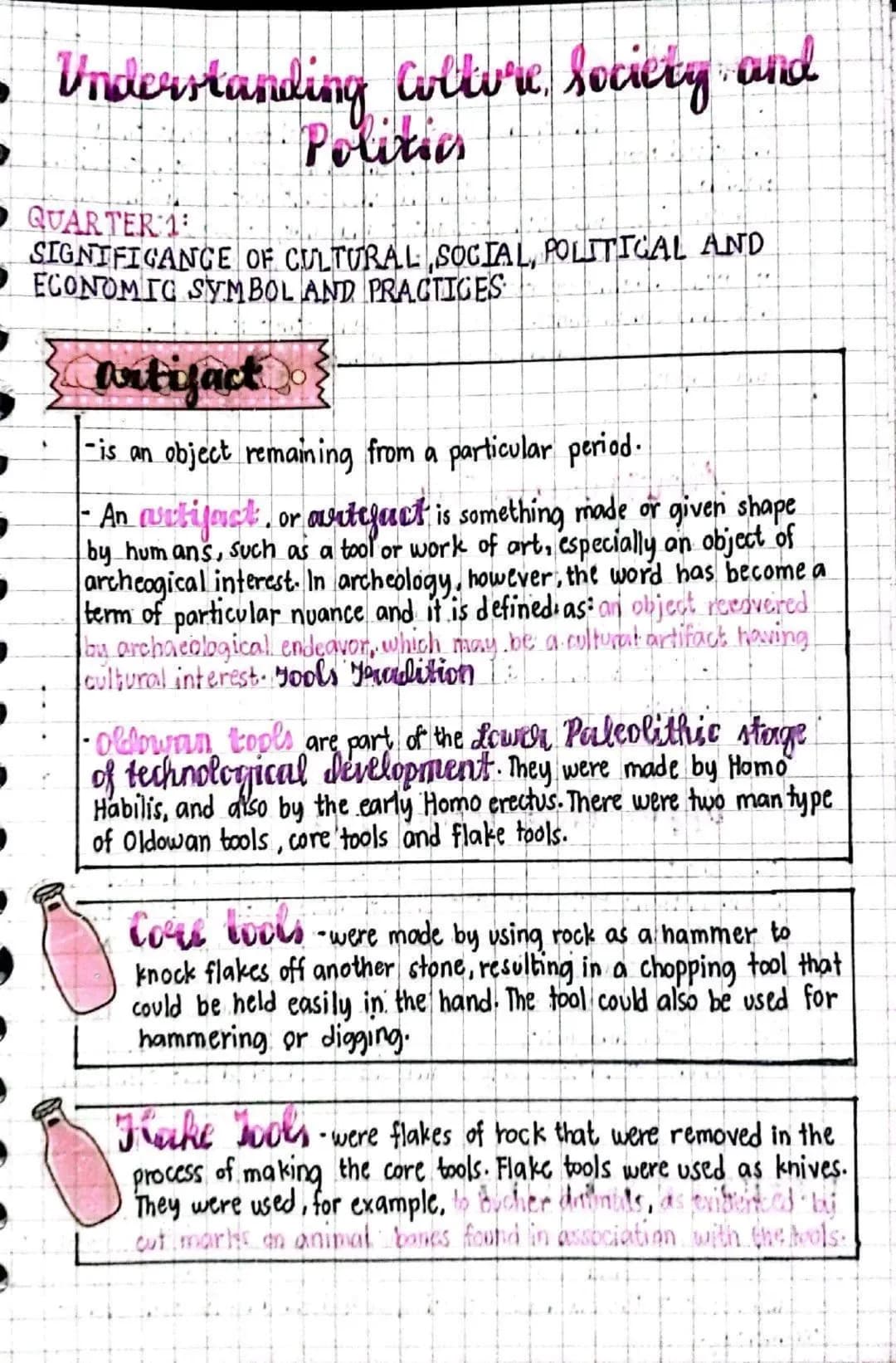
Evolution of Human Technology and Society
Our ancestors created two main Oldowan tool types: core tools and flake tools. Core tools were choppers made by knocking flakes off stones using rocks as hammers - perfect for hammering and digging. Flake tools were the removed pieces used as knives for butchering animals.
Homo erectus revolutionized toolmaking with Acheulian tools - more complex, bifacial hand axes shaped on both sides with straighter, sharper edges. These versatile tools handled multiple tasks: chopping wood, digging roots, butchering animals, and cracking nuts.
Mousterian tools, developed by Neanderthals, combined earlier techniques with new innovations. They created efficient flake tools with sharpened edges on all sides, making them more handy and effective than previous versions.
Upper Paleolithic tools emerged around 75,000 years ago when early modern humans created significantly different tools. These included various blade shapes and barbed harpoon heads found across Europe and eventually the New World.
Historical Insight: Tool evolution mirrors research evolution - both show humans constantly improving their methods to better understand and interact with their world!
7
of 7
Types of Human Societies
Throughout history, humans established many types of societies, but sociologists and anthropologists identify six basic ones, each defined by their technology level. This classification helps us understand how technological advancement shapes social organization.
These societies evolved alongside tool development, showing how quantitative research principles apply even to historical analysis. Just as researchers today use systematic methods to study societies, anthropologists use measurable criteria to categorize different social organizations.
The connection between technology and society demonstrates why quantitative research remains so valuable. Whether studying ancient tool traditions or modern social behaviors, systematic data collection and analysis reveal patterns that help us understand human development.
Understanding these societal types provides context for how research methods themselves evolved. From simple observation of tool use to complex statistical analysis of social patterns, humans have always sought systematic ways to understand their world.
Big Picture: The same systematic thinking that drove tool evolution now drives quantitative research - both represent humanity's quest to understand and improve our world through measurable progress!
We thought you’d never ask...
What is the Knowunity AI companion?
Our AI companion is specifically built for the needs of students. Based on the millions of content pieces we have on the platform we can provide truly meaningful and relevant answers to students. But its not only about answers, the companion is even more about guiding students through their daily learning challenges, with personalised study plans, quizzes or content pieces in the chat and 100% personalisation based on the students skills and developments.
Where can I download the Knowunity app?
You can download the app in the Google Play Store and in the Apple App Store.
Is Knowunity really free of charge?
That's right! Enjoy free access to study content, connect with fellow students, and get instant help – all at your fingertips.
Similar Content
 Inne
Inne Otros
Otros Science (ACT®)
Most popular content: Variable
5 Iba pa
Mathematics in the Modern World
It explores mathematics as the study of relationships among numbers, quantities, and shapes. It covers math anxiety, patterns in nature (spirals, symmetries, mosaics), and problem-solving strategies like guessing, acting it out, drawing, and listing.
G126,761187
Practical ResearchPractical Research 2
Practical Research 2 focuses on conducting quantitative research. Students learn how to write a research title, formulate questions or hypotheses, gather and analyze numerical data, and present findings.
G123,85874
Otherpractical research ii second quarter
a lecture/reviewer that can help you understand practical research ii
G111,27623
OtherMath ( 2nd Quarter)
Math 2nd quarter notes
G103,71464
Practical ResearchPRACTICAL RESEARCH 1
This document provides an overview about research from the PRACTICAL RESEARCH 1 course
G113,32257
Most popular content in Practical Research
6Practical ResearchPractical Research 2
Practical Research 2 focuses on conducting quantitative research. Students learn how to write a research title, formulate questions or hypotheses, gather and analyze numerical data, and present findings.
G123,85874
Practical ResearchPractical Research 1
Practical Research 1 Grade11
G113,78655
Practical ResearchPRACTICAL RESEARCH 1 (STEM 11)
PRACTICAL RESEARCH 1 FOR STEM 11
G111,94320
Practical ResearchPractical Research 1
Practical Research 1
G113,50644
Practical ResearchPractical Research 1
Practical Research 1 Notes
G113,79549
Practical ResearchPRACTICAL RESEARCH 1
This document provides an overview about research from the PRACTICAL RESEARCH 1 course
G113,32257
Most popular content
9 Math
MathMathematics Grade 10 Quarter 1
Grade 10 Math topics
G1010,223250
Iba paEl Filibusterismo (FILIPINO 10)
Kilalanin ang mga karakter at alamin ang mga pangyayari mula Kabanata 1 hanggang 39.
G1011,183240
 Science
Science 9 Quarter 1 Lesson 1
Topics: The Respiratory System and The Circulatory System
G911,075383
 Gen Physics
General Physics 1, First Sem
Units of Measurement, Vectors, and Kinematics. All with formulas
G116,247168
 Filipino
Filipino 8 Reviewer
Filipino Reviewer for 4th Quarter for Grade 8 students
G88,088127
ScienceSCIENCE Grade 9 Quarter 3 Reviewer
All about the lessons in Grade 9 Quarter 3 SCIENCE, all complete, highlighted, printable, and has extra informations.
G914,629303
 Pre-Cal
UPCAT Reviewer: Mathematics
general coverage of the mathematics section for UPCAT
G127,085397
OtherIntroduction to Philosophy - 1st Semester, Grade 12
A summarized notes for Grade 12 students. Easier learning for the 1st semester’s Philosophy subject.
G123,96856
ScienceThe Human Digestive System
Science Grade 8 1st Quarter Lesson
G84,78386
Can't find what you're looking for? Explore other subjects.
Students love us — and so will you.
4.6/5App Store
4.7/5Google Play
The app is very easy to use and well designed. I have found everything I was looking for so far and have been able to learn a lot from the presentations! I will definitely use the app for a class assignment! And of course it also helps a lot as an inspiration.
Stefan SiOS user
This app is really great. There are so many study notes and help [...]. My problem subject is French, for example, and the app has so many options for help. Thanks to this app, I have improved my French. I would recommend it to anyone.
Samantha KlichAndroid user
Wow, I am really amazed. I just tried the app because I've seen it advertised many times and was absolutely stunned. This app is THE HELP you want for school and above all, it offers so many things, such as workouts and fact sheets, which have been VERY helpful to me personally.
AnnaiOS user
Practical Research474 views·Updated Jun 27, 2026·7 pagesComprehensive Practical Research 2 Notes
S
sam ⋆𐙚₊˚⊹♡@samantha.badiola_
Let's dive into quantitative research - the systematic way of creating knowledge through numbers and data! This powerful research method helps us understand everything from social behaviors to scientific discoveries by collecting and analyzing measurable information objectively.
1
of 7
Sign up to see the content. It's free!
- Access to all documents
- Improve your grades
- Join milions of students
What is Quantitative Research?
Ever wondered how researchers prove their theories with solid evidence? Quantitative research is your answer - it's all about systematic and objective creation of knowledge using numerical data.
When you see research citations like (Creswell, 2013), that's called in-text citation. You can write it two ways: parenthetical (author in parentheses) or narrative (author as part of the sentence). This is crucial for your research papers!
Quantitative research shines in natural sciences because of its unique characteristics. It uses large sample sizes to get meaningful statistical results - think surveying 1,000 students instead of just 10. The beauty lies in its objectivity - data gathering happens without the researcher's personal feelings interfering.
Quick Tip: Remember that bigger sample sizes generally lead to more reliable results that you can trust for decision-making!
2
of 7Sign up to see the content. It's free!
- Access to all documents
- Improve your grades
- Join milions of students
Key Features and Advantages
What makes quantitative research so powerful? First, it offers concise visual presentation through graphs and charts that make complex data easy to understand. Plus, faster data analysis using statistical tools saves tons of time compared to other methods.
The real magic happens with generalizable data - results from your sample can represent the entire population if done correctly. Fast and easy data collection using standardized surveys means you can gather information from hundreds of people simultaneously.
Reliable data makes this research method perfect for policymaking and important decisions. The high replicability means other researchers can repeat your study to verify findings, making results more trustworthy.
The advantages are impressive: you get objective results, can predict outcomes, establish cause-and-effect relationships, and analyze data quickly using software. Your findings apply to larger populations, making your research truly impactful.
Remember: Quantitative research's strength lies in its ability to provide concrete, numerical evidence that policymakers and decision-makers can rely on!
3
of 7Sign up to see the content. It's free!
- Access to all documents
- Improve your grades
- Join milions of students
Limitations and Types of Quantitative Research
Like any method, quantitative research has its weaknesses. It lacks depth for exploring complex problems and doesn't provide comprehensive explanations of human experiences. Some things like feelings and beliefs simply can't be captured through numbers.
The research design is rigid and not very flexible once you start. Participants must choose from given responses, which might not capture their true thoughts. Sometimes respondents provide inaccurate answers, and large sample sizes make data collection more expensive.
Quantitative research comes in several types, each serving different purposes. Descriptive design simply describes phenomena as they naturally occur - like studying what physical activities students do during quarantine, without trying to change anything.
Correlational design identifies relationships between variables through observation. For example, you might study the relationship between physical activity and academic achievement without determining which causes which.
Study Smart: Understanding these limitations helps you choose the right research method for your project and interpret results more accurately!
4
of 7Sign up to see the content. It's free!
- Access to all documents
- Improve your grades
- Join milions of students
Advanced Research Designs
Ready to explore more complex research types? Ex post facto design investigates relationships between past events and current conditions. The term means "after the fact" - like studying how parents' academic achievements affect children's obesity rates.
Quasi-experimental design establishes cause-and-effect relationships but with less control than true experiments. You can't randomly assign subjects to groups, so you work with existing groups. Think studying unemployment effects on safety protocol attitudes in ECQ areas.
Experimental design provides the most conclusive results because it uses random assignment and experimental manipulation. This gold standard lets researchers directly compare treatment effects - like testing different blended learning methods on elementary pupils' reading comprehension.
Each design serves specific research goals. Descriptive tells you "what," correlational shows "what's related," ex post facto explores "what happened," while quasi-experimental and experimental designs reveal "what causes what."
Pro Tip: Choose your research design based on your research question - the more control you need over variables, the more experimental your approach should be!
5
of 7Sign up to see the content. It's free!
- Access to all documents
- Improve your grades
- Join milions of students
Real-World Applications and Historical Tools
Quantitative research transforms every field you can imagine! In social sciences, it shows intervention effects on group behavior and helps us understand cultural conflicts - like studying pandemic effects on social behavior and economic stability.
Healthcare relies heavily on this research to investigate treatment effectiveness and find new medicines. Scientists test antidiabetic properties of Philippine herbs or develop better treatments for diseases. Environmental science uses it for alternative energy sources and advanced materials.
Agriculture benefits through crop yield studies and livestock disease prevention. Researchers compare organic versus inorganic fertilizer effectiveness on vegetable production, directly impacting food security.
Moving beyond modern applications, let's explore human tool development. Artifacts - objects from particular periods - tell fascinating stories. Oldowan tools from the Lower Paleolithic period were humanity's first systematic toolmaking attempt by Homo habilis and early Homo erectus.
Connection Point: Just like ancient humans systematically developed better tools, modern quantitative research systematically develops better knowledge across all fields!
6
of 7Sign up to see the content. It's free!
- Access to all documents
- Improve your grades
- Join milions of students
Evolution of Human Technology and Society
Our ancestors created two main Oldowan tool types: core tools and flake tools. Core tools were choppers made by knocking flakes off stones using rocks as hammers - perfect for hammering and digging. Flake tools were the removed pieces used as knives for butchering animals.
Homo erectus revolutionized toolmaking with Acheulian tools - more complex, bifacial hand axes shaped on both sides with straighter, sharper edges. These versatile tools handled multiple tasks: chopping wood, digging roots, butchering animals, and cracking nuts.
Mousterian tools, developed by Neanderthals, combined earlier techniques with new innovations. They created efficient flake tools with sharpened edges on all sides, making them more handy and effective than previous versions.
Upper Paleolithic tools emerged around 75,000 years ago when early modern humans created significantly different tools. These included various blade shapes and barbed harpoon heads found across Europe and eventually the New World.
Historical Insight: Tool evolution mirrors research evolution - both show humans constantly improving their methods to better understand and interact with their world!
7
of 7Sign up to see the content. It's free!
- Access to all documents
- Improve your grades
- Join milions of students
Types of Human Societies
Throughout history, humans established many types of societies, but sociologists and anthropologists identify six basic ones, each defined by their technology level. This classification helps us understand how technological advancement shapes social organization.
These societies evolved alongside tool development, showing how quantitative research principles apply even to historical analysis. Just as researchers today use systematic methods to study societies, anthropologists use measurable criteria to categorize different social organizations.
The connection between technology and society demonstrates why quantitative research remains so valuable. Whether studying ancient tool traditions or modern social behaviors, systematic data collection and analysis reveal patterns that help us understand human development.
Understanding these societal types provides context for how research methods themselves evolved. From simple observation of tool use to complex statistical analysis of social patterns, humans have always sought systematic ways to understand their world.
Big Picture: The same systematic thinking that drove tool evolution now drives quantitative research - both represent humanity's quest to understand and improve our world through measurable progress!
We thought you’d never ask...
What is the Knowunity AI companion?
Our AI companion is specifically built for the needs of students. Based on the millions of content pieces we have on the platform we can provide truly meaningful and relevant answers to students. But its not only about answers, the companion is even more about guiding students through their daily learning challenges, with personalised study plans, quizzes or content pieces in the chat and 100% personalisation based on the students skills and developments.
Where can I download the Knowunity app?
You can download the app in the Google Play Store and in the Apple App Store.
Is Knowunity really free of charge?
That's right! Enjoy free access to study content, connect with fellow students, and get instant help – all at your fingertips.
Similar Content
Most popular content: Variable
5Iba paMathematics in the Modern World
It explores mathematics as the study of relationships among numbers, quantities, and shapes. It covers math anxiety, patterns in nature (spirals, symmetries, mosaics), and problem-solving strategies like guessing, acting it out, drawing, and listing.
G126,761187
Practical ResearchPractical Research 2
Practical Research 2 focuses on conducting quantitative research. Students learn how to write a research title, formulate questions or hypotheses, gather and analyze numerical data, and present findings.
G123,85874
Otherpractical research ii second quarter
a lecture/reviewer that can help you understand practical research ii
G111,27623
OtherMath ( 2nd Quarter)
Math 2nd quarter notes
G103,71464
Practical ResearchPRACTICAL RESEARCH 1
This document provides an overview about research from the PRACTICAL RESEARCH 1 course
G113,32257
Most popular content in Practical Research
6Practical ResearchPractical Research 2
Practical Research 2 focuses on conducting quantitative research. Students learn how to write a research title, formulate questions or hypotheses, gather and analyze numerical data, and present findings.
G123,85874
Practical ResearchPractical Research 1
Practical Research 1 Grade11
G113,78655
Practical ResearchPRACTICAL RESEARCH 1 (STEM 11)
PRACTICAL RESEARCH 1 FOR STEM 11
G111,94320
Practical ResearchPractical Research 1
Practical Research 1
G113,50644
Practical ResearchPractical Research 1
Practical Research 1 Notes
G113,79549
Practical ResearchPRACTICAL RESEARCH 1
This document provides an overview about research from the PRACTICAL RESEARCH 1 course
G113,32257
Most popular content
9MathMathematics Grade 10 Quarter 1
Grade 10 Math topics
G1010,223250
Iba paEl Filibusterismo (FILIPINO 10)
Kilalanin ang mga karakter at alamin ang mga pangyayari mula Kabanata 1 hanggang 39.
G1011,183240
ScienceScience 9 Quarter 1 Lesson 1
Topics: The Respiratory System and The Circulatory System
G911,075383
Gen PhysicsGeneral Physics 1, First Sem
Units of Measurement, Vectors, and Kinematics. All with formulas
G116,247168
FilipinoFilipino 8 Reviewer
Filipino Reviewer for 4th Quarter for Grade 8 students
G88,088127
ScienceSCIENCE Grade 9 Quarter 3 Reviewer
All about the lessons in Grade 9 Quarter 3 SCIENCE, all complete, highlighted, printable, and has extra informations.
G914,629303
Pre-CalUPCAT Reviewer: Mathematics
general coverage of the mathematics section for UPCAT
G127,085397
OtherIntroduction to Philosophy - 1st Semester, Grade 12
A summarized notes for Grade 12 students. Easier learning for the 1st semester’s Philosophy subject.
G123,96856
ScienceThe Human Digestive System
Science Grade 8 1st Quarter Lesson
G84,78386
Can't find what you're looking for? Explore other subjects.
Students love us — and so will you.
4.6/5App Store
4.7/5Google Play
The app is very easy to use and well designed. I have found everything I was looking for so far and have been able to learn a lot from the presentations! I will definitely use the app for a class assignment! And of course it also helps a lot as an inspiration.
Stefan SiOS user
This app is really great. There are so many study notes and help [...]. My problem subject is French, for example, and the app has so many options for help. Thanks to this app, I have improved my French. I would recommend it to anyone.
Samantha KlichAndroid user
Wow, I am really amazed. I just tried the app because I've seen it advertised many times and was absolutely stunned. This app is THE HELP you want for school and above all, it offers so many things, such as workouts and fact sheets, which have been VERY helpful to me personally.
AnnaiOS user