
Ever wonder how scientists actually find answers to complex questions?...
 Practical Research3,322 views·Updated Jun 22, 2026·24 pages
Mastering Research Basics - Practical Research 1 Guide

Karen Gella@cayennexxx




1 / 10
1
of 10
Understanding Scientific Knowledge and Research
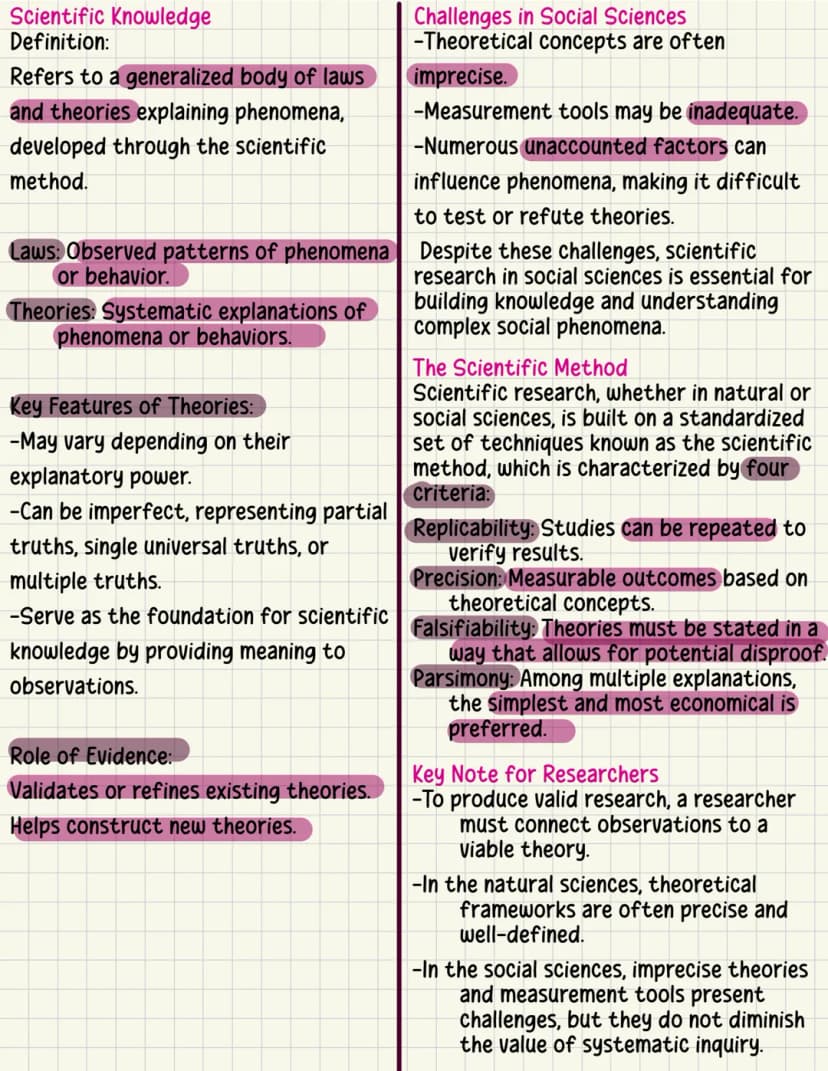
Think about how you naturally observe things around you - that curiosity is actually the starting point of all scientific discovery! Scientific knowledge goes beyond casual observation by using rigorous, systematic methods to find answers.
Research means any systematic investigation that contributes to our general understanding of the world. It's not just collecting information - you need to analyze and interpret data in structured ways. Without proper procedures, what you're doing isn't really considered scientific research.
The scientific method gives researchers a standardized toolkit for building reliable knowledge. This includes making valid observations, interpreting results properly, and drawing conclusions that others can understand and verify. When research follows these methods and adds to scientific knowledge, it becomes truly scientific.
Quick Tip: Remember that good research always follows two key rules - it must contribute to scientific knowledge AND follow proper scientific methods.
2
of 10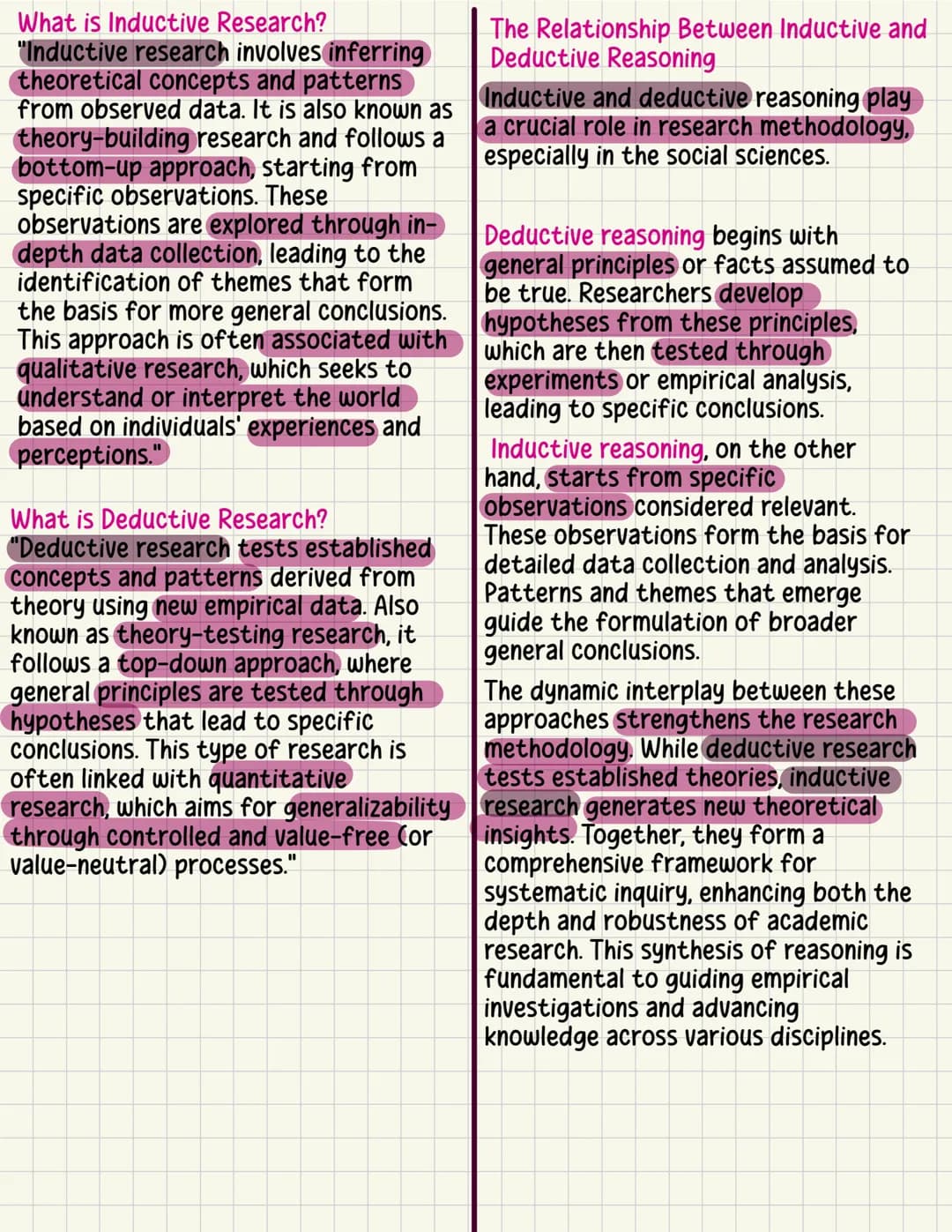
Inductive vs Deductive Research Approaches
You'll encounter two main ways researchers tackle problems, and understanding these will make academic papers much clearer to read. Inductive research works like detective work - you start with specific observations and build up to bigger theories. This "bottom-up" approach is perfect when you're exploring something new or trying to understand people's experiences.
Deductive research flips this around by starting with existing theories and testing them with new data. It's a "top-down" approach where you make predictions (hypotheses) and then check if they're correct through experiments or surveys.
Here's the cool part - these approaches actually work together to strengthen research. While deductive studies test what we think we know, inductive studies help discover completely new insights. Most successful research projects use elements of both approaches.
Real-world connection: When you form a theory about why your friends act a certain way based on observations, you're using inductive reasoning. When you test that theory by making predictions, you're being deductive!
3
of 10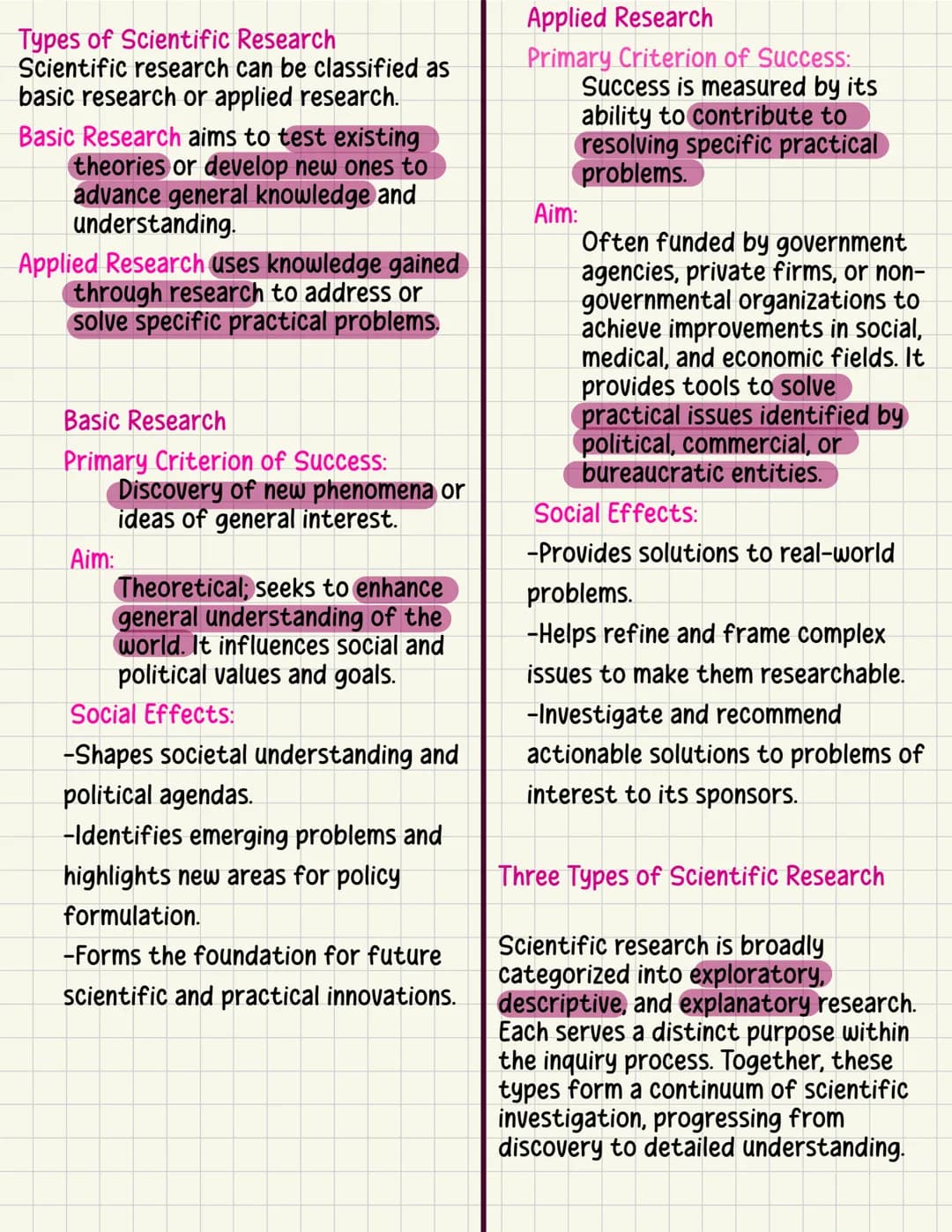
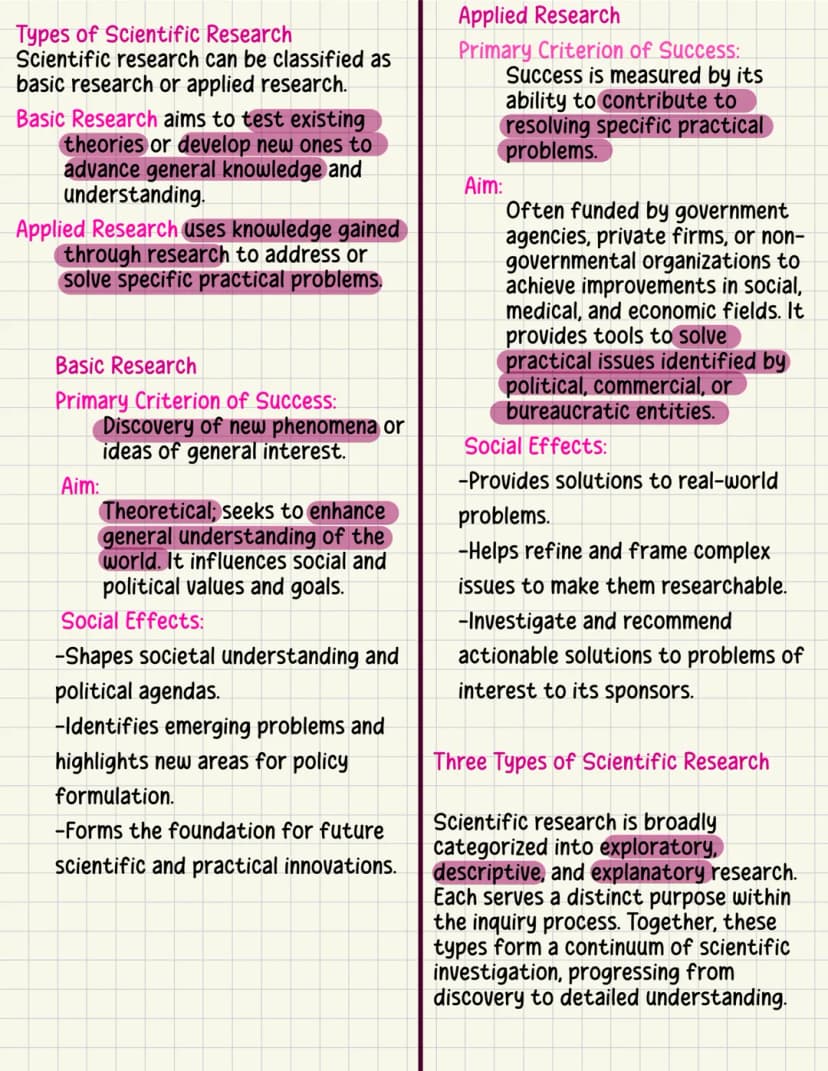
Types of Research: Basic vs Applied and Three Key Categories
Research serves different purposes depending on what you're trying to accomplish. Basic research focuses on expanding general knowledge and understanding - think of scientists studying black holes just to learn more about the universe. Applied research tackles specific real-world problems, like developing better vaccines or improving education systems.
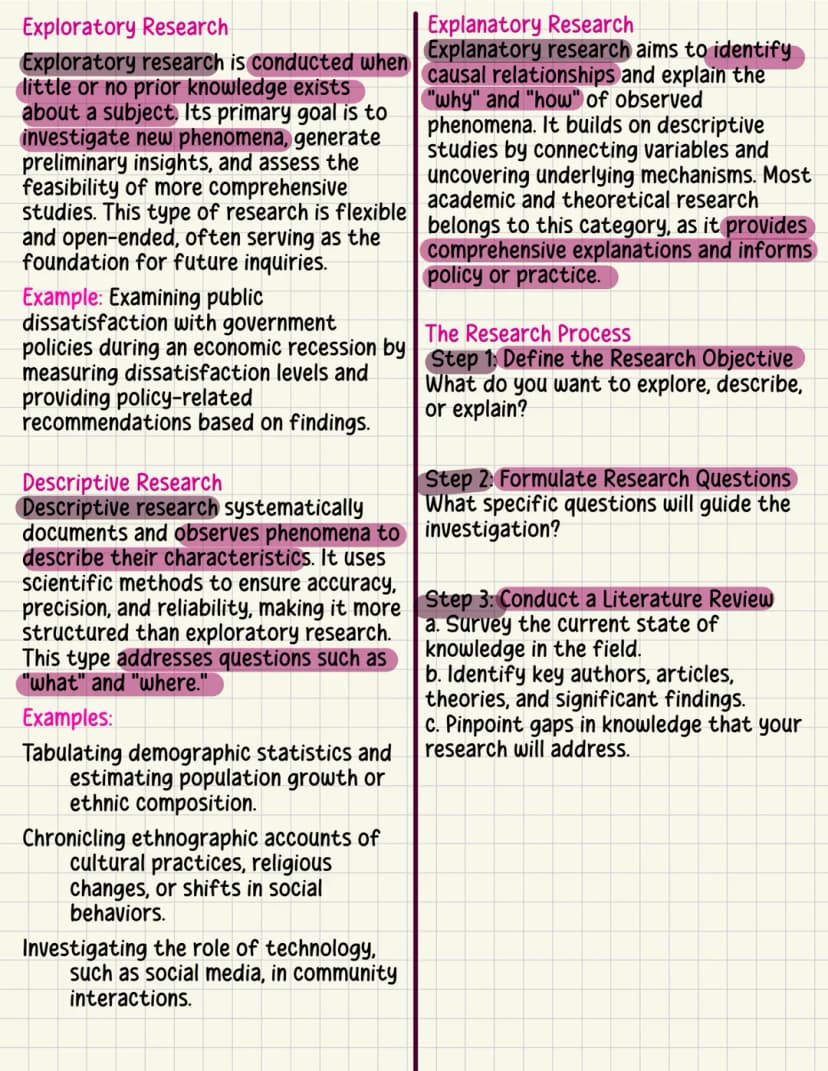
Scientific research also falls into three main categories that build on each other. Exploratory research happens when you're investigating something completely new with little prior knowledge. Descriptive research systematically documents what's happening - like surveying demographic trends or cultural practices.
Explanatory research goes the deepest by trying to understand why things happen and how different factors connect. This type answers the "why" and "how" questions that most academic research focuses on.
Study smart: When reading research papers, identifying which type you're dealing with helps you understand the author's goals and how to interpret their findings.
4
of 10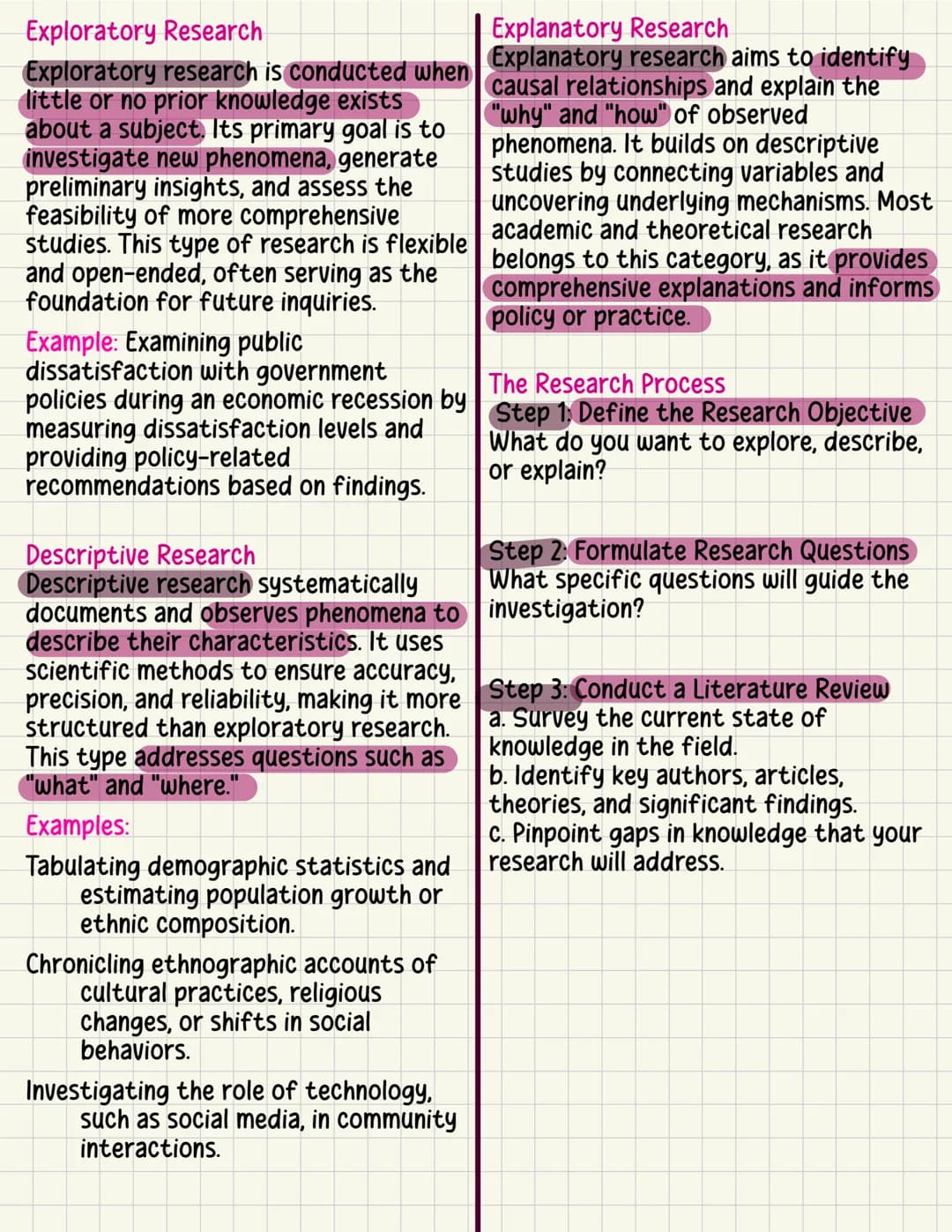
The Research Process: From Questions to Answers
Starting a research project can feel overwhelming, but following a clear process makes it manageable. You begin by defining your research objective - what exactly do you want to explore, describe, or explain? Then formulate specific research questions that will guide your investigation.
The literature review is crucial because it shows you what others have already discovered and helps identify gaps your research can fill. This step prevents you from repeating work that's already been done and builds on existing knowledge.
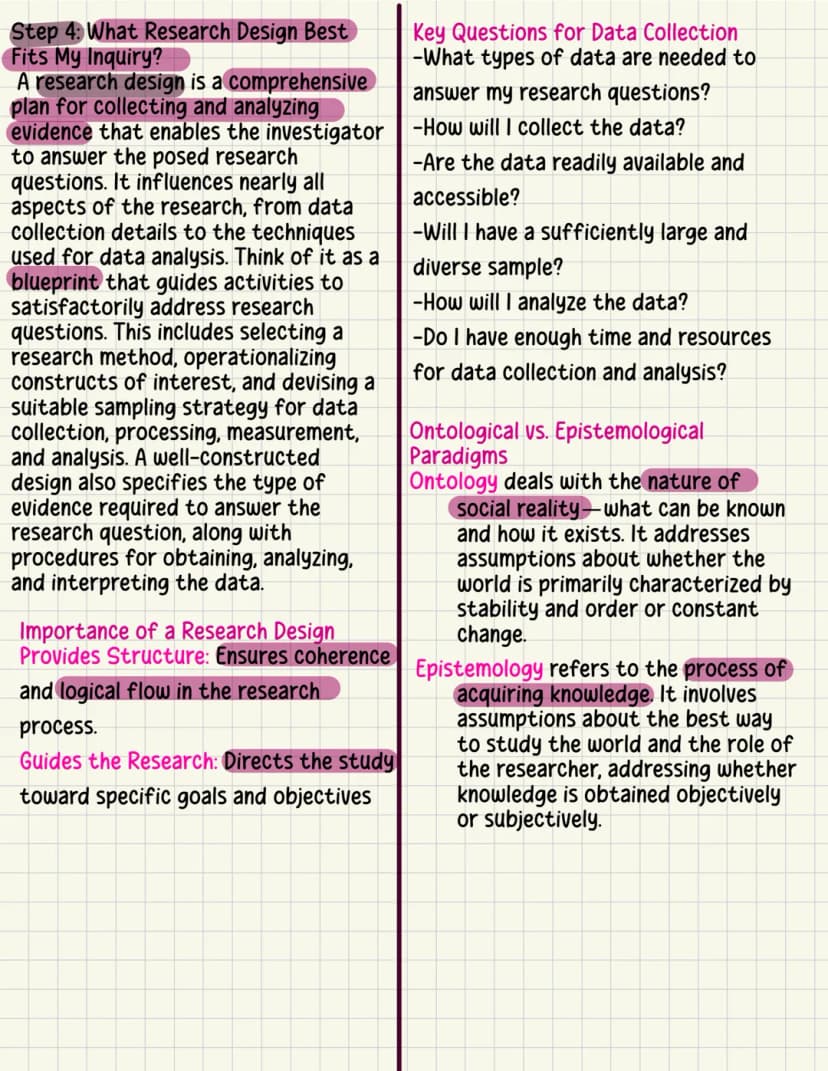
Your research design acts like a blueprint for everything that follows. It determines how you'll collect data, what type of evidence you need, and how you'll analyze everything. Good research design also considers practical questions like whether you have enough time, resources, and access to participants.
Pro tip: Spending extra time on your research design at the beginning saves you from major problems later in the process.
5
of 10
Research Philosophy and Data Collection Methods
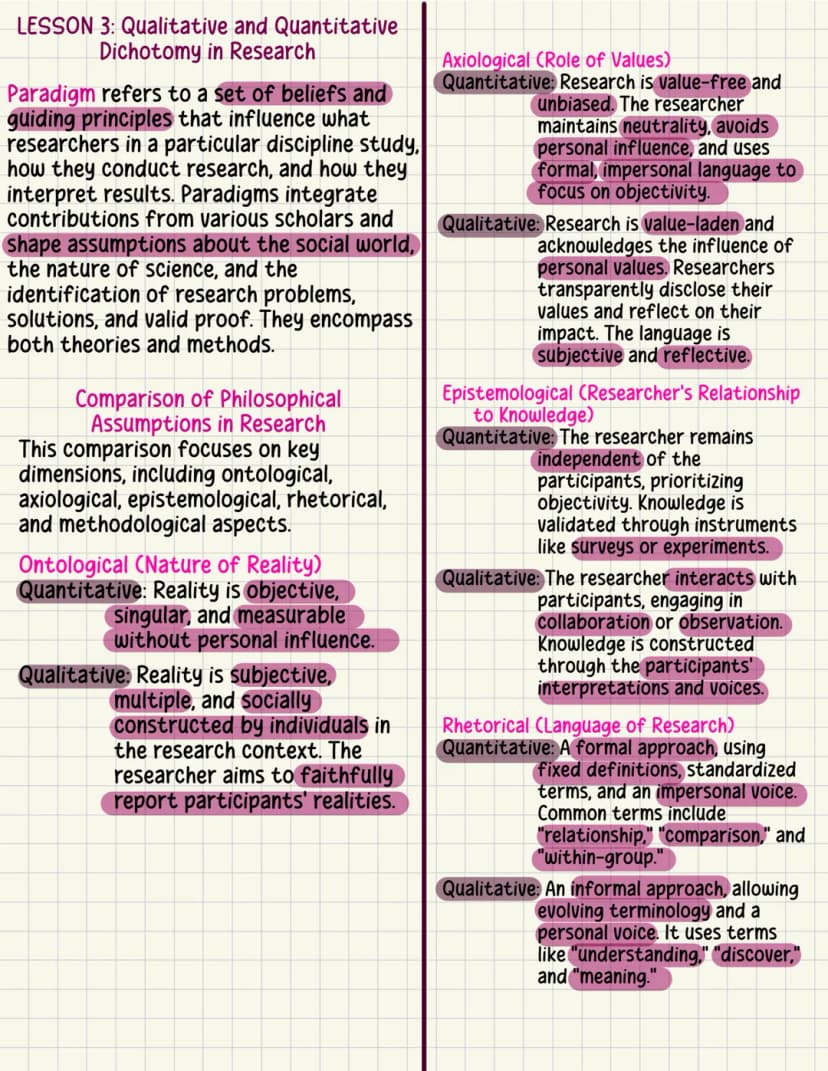
Before jumping into data collection, researchers need to consider deeper philosophical questions that shape their entire approach. Ontology deals with what reality actually is - do you believe there's one objective truth that can be measured, or that reality is subjective and interpreted differently by different people?
Epistemology focuses on how we gain knowledge. Should researchers stay completely objective and distant from their subjects, or is it better to interact closely with participants to understand their perspectives?
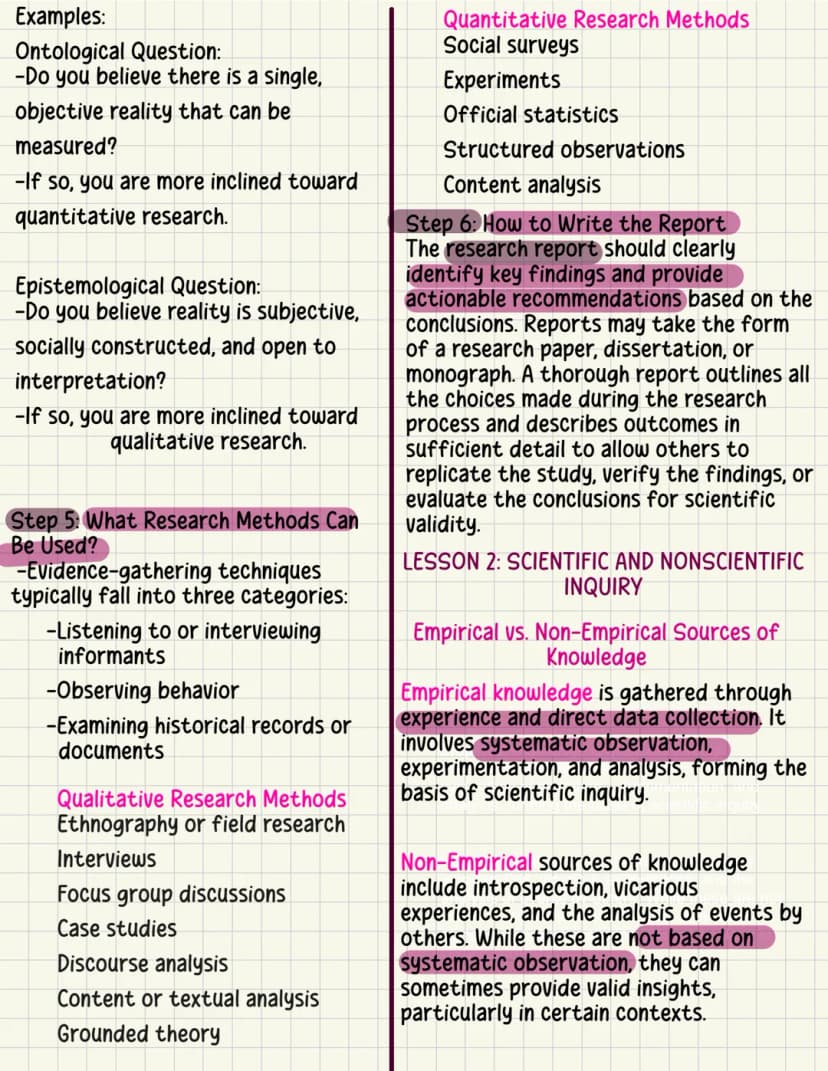
These philosophical positions lead to different research methods. You can gather evidence by interviewing people, observing behavior, or examining documents and records. Qualitative methods like ethnography and focus groups work well for understanding experiences and meanings. Quantitative methods like surveys and experiments are better for measuring relationships and testing theories.
Remember: There's no "right" or "wrong" philosophy - different research questions call for different approaches, and the best researchers understand when to use each one.
6
of 10
Scientific vs Non-Scientific Knowledge Sources
Understanding the difference between scientific inquiry and other ways of knowing helps you evaluate information more critically. Scientific knowledge comes from systematic observation and empirical data - evidence you can measure and verify. Non-empirical sources include things like authority figures, cultural knowledge, logical reasoning, and personal inspiration.
Scientific observation differs from everyday observation because it's purposeful and structured. When you casually notice something, that's common sense. When scientists observe with specific goals and methods, they're building reliable knowledge that others can test and verify.
Science branches into natural sciences (studying physical phenomena like biology and physics) and social sciences (studying people and societies). Both follow the scientific method but face different challenges - social sciences deal with more complex, unpredictable human behavior.
Critical thinking boost: Always ask whether information comes from systematic research or other sources - both can be valuable, but they serve different purposes.
7
of 10
The Scientific Method and Its Key Features
The scientific method provides four essential criteria that make research reliable and trustworthy. Replicability means other researchers should be able to repeat your study and get similar results. Precision requires that your measurements clearly connect to your theoretical concepts.
Falsifiability might sound negative, but it's actually crucial - your theories must be stated in ways that could potentially be proven wrong. If something can never be disproven, it's not really scientific. Parsimony means choosing the simplest explanation when multiple theories could explain the same phenomenon.
Scientific knowledge consists of laws (observed patterns) and theories (systematic explanations). Theories aren't just guesses - they're well-supported explanations that help us understand and predict phenomena. Even imperfect theories contribute valuable insights to our understanding.
Key insight: Social sciences face extra challenges because human behavior is complex and hard to measure precisely, but systematic inquiry still produces valuable knowledge about society.
8
of 10
Research Quality and Theoretical Frameworks
Building valid research requires connecting your observations to solid theoretical frameworks. In natural sciences, these theories are often precise and well-established. Social sciences work with more complex, sometimes imprecise theories, but this doesn't make the research less valuable.
Laws in science describe observed patterns, while theories provide systematic explanations for why these patterns occur. The quality of theories can vary - some offer partial truths, others claim universal validity, and some acknowledge multiple valid perspectives.
Evidence plays a crucial role in either supporting existing theories or helping construct new ones. Strong research demonstrates clear connections between theoretical concepts and actual observations, even when dealing with complex social phenomena.
Research reality check: Perfect theories don't exist - even well-established scientific theories continue evolving as new evidence emerges, and that's exactly how science should work.
9
of 10
Quantitative vs Qualitative Research Paradigms
Research paradigms are like different lenses for viewing the world - they shape what researchers study and how they interpret results. Understanding these differences helps you make sense of various research approaches you'll encounter.
Quantitative research treats reality as objective and measurable. Researchers maintain distance from participants, use formal language, and focus on relationships between variables. The goal is producing generalizable findings that can predict and explain phenomena across different contexts.
Qualitative research views reality as subjective and socially constructed. Researchers interact closely with participants, use informal language, and focus on understanding meaning and experience. The goal is developing rich, detailed insights about specific contexts and situations.
Important note: Neither approach is superior - they serve different purposes and answer different types of research questions. The best researchers know when to use each approach.
10
of 10
Research Ethics and Participant Protection
Ethics in research isn't just about following rules - it's about respecting the dignity and rights of everyone involved in your study. Ethical research protects participants while maintaining the integrity of the scientific process.
Voluntary participation means people must freely choose to be in your study after understanding what's involved. You can't trick, force, or pressure anyone into participating. Confidentiality protects participants by keeping their personal information and responses private.
The relationship between researchers and participants involves real responsibility. Ethical guidelines help ensure this relationship is based on mutual trust and respect. Participants should never be harmed by research, and they should benefit from contributing to scientific knowledge.
Ethical foundation: Remember that research participants are real people, not just data sources - treating them with respect and protecting their welfare should always be your top priority.
We thought you’d never ask...
What is the Knowunity AI companion?
Our AI companion is specifically built for the needs of students. Based on the millions of content pieces we have on the platform we can provide truly meaningful and relevant answers to students. But its not only about answers, the companion is even more about guiding students through their daily learning challenges, with personalised study plans, quizzes or content pieces in the chat and 100% personalisation based on the students skills and developments.
Where can I download the Knowunity app?
You can download the app in the Google Play Store and in the Apple App Store.
Is Knowunity really free of charge?
That's right! Enjoy free access to study content, connect with fellow students, and get instant help – all at your fingertips.
Similar Content
 Inne
Inne Otros
Otros Science (ACT®)
Most popular content: Variable
5 Iba pa
Mathematics in the Modern World
It explores mathematics as the study of relationships among numbers, quantities, and shapes. It covers math anxiety, patterns in nature (spirals, symmetries, mosaics), and problem-solving strategies like guessing, acting it out, drawing, and listing.
G126,761187
Practical ResearchPractical Research 2
Practical Research 2 focuses on conducting quantitative research. Students learn how to write a research title, formulate questions or hypotheses, gather and analyze numerical data, and present findings.
G123,85874
Otherpractical research ii second quarter
a lecture/reviewer that can help you understand practical research ii
G111,27623
OtherMath ( 2nd Quarter)
Math 2nd quarter notes
G103,71464
Practical ResearchPractical Research 2 - Handwritten Notes
This provides students complete notes on the mentioned subject.
G114746
Most popular content in Practical Research
6Practical ResearchPractical Research 2
Practical Research 2 focuses on conducting quantitative research. Students learn how to write a research title, formulate questions or hypotheses, gather and analyze numerical data, and present findings.
G123,85874
Practical ResearchPractical Research 1
Practical Research 1 Grade11
G113,78655
Practical ResearchPRACTICAL RESEARCH 1 (STEM 11)
PRACTICAL RESEARCH 1 FOR STEM 11
G111,94320
Practical ResearchPractical Research 1
Practical Research 1
G113,50644
Practical ResearchPractical Research 1
Practical Research 1 Notes
G113,79549
Practical ResearchPractical Research 2 - Handwritten Notes
This provides students complete notes on the mentioned subject.
G114746
Most popular content
9 Math
MathMathematics Grade 10 Quarter 1
Grade 10 Math topics
G1010,223250
Iba paEl Filibusterismo (FILIPINO 10)
Kilalanin ang mga karakter at alamin ang mga pangyayari mula Kabanata 1 hanggang 39.
G1011,183240
 Science
Science 9 Quarter 1 Lesson 1
Topics: The Respiratory System and The Circulatory System
G911,075383
 Gen Physics
General Physics 1, First Sem
Units of Measurement, Vectors, and Kinematics. All with formulas
G116,247168
 Filipino
Filipino 8 Reviewer
Filipino Reviewer for 4th Quarter for Grade 8 students
G88,088127
ScienceSCIENCE Grade 9 Quarter 3 Reviewer
All about the lessons in Grade 9 Quarter 3 SCIENCE, all complete, highlighted, printable, and has extra informations.
G914,629303
 Pre-Cal
UPCAT Reviewer: Mathematics
general coverage of the mathematics section for UPCAT
G127,085397
OtherIntroduction to Philosophy - 1st Semester, Grade 12
A summarized notes for Grade 12 students. Easier learning for the 1st semester’s Philosophy subject.
G123,96856
ScienceThe Human Digestive System
Science Grade 8 1st Quarter Lesson
G84,78386
Can't find what you're looking for? Explore other subjects.
Students love us — and so will you.
4.6/5App Store
4.7/5Google Play
The app is very easy to use and well designed. I have found everything I was looking for so far and have been able to learn a lot from the presentations! I will definitely use the app for a class assignment! And of course it also helps a lot as an inspiration.
Stefan SiOS user
This app is really great. There are so many study notes and help [...]. My problem subject is French, for example, and the app has so many options for help. Thanks to this app, I have improved my French. I would recommend it to anyone.
Samantha KlichAndroid user
Wow, I am really amazed. I just tried the app because I've seen it advertised many times and was absolutely stunned. This app is THE HELP you want for school and above all, it offers so many things, such as workouts and fact sheets, which have been VERY helpful to me personally.
AnnaiOS user
Practical Research3,322 views·Updated Jun 22, 2026·24 pagesMastering Research Basics - Practical Research 1 Guide
Karen Gella@cayennexxx
Ever wonder how scientists actually find answers to complex questions? Scientific research isn't just random observations - it's a systematic way of exploring the world around us that follows specific methods and ethical guidelines. Understanding these research fundamentals will help...
1
of 10
Sign up to see the content. It's free!
- Access to all documents
- Improve your grades
- Join milions of students
Understanding Scientific Knowledge and Research
Think about how you naturally observe things around you - that curiosity is actually the starting point of all scientific discovery! Scientific knowledge goes beyond casual observation by using rigorous, systematic methods to find answers.
Research means any systematic investigation that contributes to our general understanding of the world. It's not just collecting information - you need to analyze and interpret data in structured ways. Without proper procedures, what you're doing isn't really considered scientific research.
The scientific method gives researchers a standardized toolkit for building reliable knowledge. This includes making valid observations, interpreting results properly, and drawing conclusions that others can understand and verify. When research follows these methods and adds to scientific knowledge, it becomes truly scientific.
Quick Tip: Remember that good research always follows two key rules - it must contribute to scientific knowledge AND follow proper scientific methods.
2
of 10Sign up to see the content. It's free!
- Access to all documents
- Improve your grades
- Join milions of students
Inductive vs Deductive Research Approaches
You'll encounter two main ways researchers tackle problems, and understanding these will make academic papers much clearer to read. Inductive research works like detective work - you start with specific observations and build up to bigger theories. This "bottom-up" approach is perfect when you're exploring something new or trying to understand people's experiences.
Deductive research flips this around by starting with existing theories and testing them with new data. It's a "top-down" approach where you make predictions (hypotheses) and then check if they're correct through experiments or surveys.
Here's the cool part - these approaches actually work together to strengthen research. While deductive studies test what we think we know, inductive studies help discover completely new insights. Most successful research projects use elements of both approaches.
Real-world connection: When you form a theory about why your friends act a certain way based on observations, you're using inductive reasoning. When you test that theory by making predictions, you're being deductive!
3
of 10Sign up to see the content. It's free!
- Access to all documents
- Improve your grades
- Join milions of students
Types of Research: Basic vs Applied and Three Key Categories
Research serves different purposes depending on what you're trying to accomplish. Basic research focuses on expanding general knowledge and understanding - think of scientists studying black holes just to learn more about the universe. Applied research tackles specific real-world problems, like developing better vaccines or improving education systems.
Scientific research also falls into three main categories that build on each other. Exploratory research happens when you're investigating something completely new with little prior knowledge. Descriptive research systematically documents what's happening - like surveying demographic trends or cultural practices.
Explanatory research goes the deepest by trying to understand why things happen and how different factors connect. This type answers the "why" and "how" questions that most academic research focuses on.
Study smart: When reading research papers, identifying which type you're dealing with helps you understand the author's goals and how to interpret their findings.
4
of 10Sign up to see the content. It's free!
- Access to all documents
- Improve your grades
- Join milions of students
The Research Process: From Questions to Answers
Starting a research project can feel overwhelming, but following a clear process makes it manageable. You begin by defining your research objective - what exactly do you want to explore, describe, or explain? Then formulate specific research questions that will guide your investigation.
The literature review is crucial because it shows you what others have already discovered and helps identify gaps your research can fill. This step prevents you from repeating work that's already been done and builds on existing knowledge.
Your research design acts like a blueprint for everything that follows. It determines how you'll collect data, what type of evidence you need, and how you'll analyze everything. Good research design also considers practical questions like whether you have enough time, resources, and access to participants.
Pro tip: Spending extra time on your research design at the beginning saves you from major problems later in the process.
5
of 10Sign up to see the content. It's free!
- Access to all documents
- Improve your grades
- Join milions of students
Research Philosophy and Data Collection Methods
Before jumping into data collection, researchers need to consider deeper philosophical questions that shape their entire approach. Ontology deals with what reality actually is - do you believe there's one objective truth that can be measured, or that reality is subjective and interpreted differently by different people?
Epistemology focuses on how we gain knowledge. Should researchers stay completely objective and distant from their subjects, or is it better to interact closely with participants to understand their perspectives?
These philosophical positions lead to different research methods. You can gather evidence by interviewing people, observing behavior, or examining documents and records. Qualitative methods like ethnography and focus groups work well for understanding experiences and meanings. Quantitative methods like surveys and experiments are better for measuring relationships and testing theories.
Remember: There's no "right" or "wrong" philosophy - different research questions call for different approaches, and the best researchers understand when to use each one.
6
of 10Sign up to see the content. It's free!
- Access to all documents
- Improve your grades
- Join milions of students
Scientific vs Non-Scientific Knowledge Sources
Understanding the difference between scientific inquiry and other ways of knowing helps you evaluate information more critically. Scientific knowledge comes from systematic observation and empirical data - evidence you can measure and verify. Non-empirical sources include things like authority figures, cultural knowledge, logical reasoning, and personal inspiration.
Scientific observation differs from everyday observation because it's purposeful and structured. When you casually notice something, that's common sense. When scientists observe with specific goals and methods, they're building reliable knowledge that others can test and verify.
Science branches into natural sciences (studying physical phenomena like biology and physics) and social sciences (studying people and societies). Both follow the scientific method but face different challenges - social sciences deal with more complex, unpredictable human behavior.
Critical thinking boost: Always ask whether information comes from systematic research or other sources - both can be valuable, but they serve different purposes.
7
of 10Sign up to see the content. It's free!
- Access to all documents
- Improve your grades
- Join milions of students
The Scientific Method and Its Key Features
The scientific method provides four essential criteria that make research reliable and trustworthy. Replicability means other researchers should be able to repeat your study and get similar results. Precision requires that your measurements clearly connect to your theoretical concepts.
Falsifiability might sound negative, but it's actually crucial - your theories must be stated in ways that could potentially be proven wrong. If something can never be disproven, it's not really scientific. Parsimony means choosing the simplest explanation when multiple theories could explain the same phenomenon.
Scientific knowledge consists of laws (observed patterns) and theories (systematic explanations). Theories aren't just guesses - they're well-supported explanations that help us understand and predict phenomena. Even imperfect theories contribute valuable insights to our understanding.
Key insight: Social sciences face extra challenges because human behavior is complex and hard to measure precisely, but systematic inquiry still produces valuable knowledge about society.
8
of 10Sign up to see the content. It's free!
- Access to all documents
- Improve your grades
- Join milions of students
Research Quality and Theoretical Frameworks
Building valid research requires connecting your observations to solid theoretical frameworks. In natural sciences, these theories are often precise and well-established. Social sciences work with more complex, sometimes imprecise theories, but this doesn't make the research less valuable.
Laws in science describe observed patterns, while theories provide systematic explanations for why these patterns occur. The quality of theories can vary - some offer partial truths, others claim universal validity, and some acknowledge multiple valid perspectives.
Evidence plays a crucial role in either supporting existing theories or helping construct new ones. Strong research demonstrates clear connections between theoretical concepts and actual observations, even when dealing with complex social phenomena.
Research reality check: Perfect theories don't exist - even well-established scientific theories continue evolving as new evidence emerges, and that's exactly how science should work.
9
of 10Sign up to see the content. It's free!
- Access to all documents
- Improve your grades
- Join milions of students
Quantitative vs Qualitative Research Paradigms
Research paradigms are like different lenses for viewing the world - they shape what researchers study and how they interpret results. Understanding these differences helps you make sense of various research approaches you'll encounter.
Quantitative research treats reality as objective and measurable. Researchers maintain distance from participants, use formal language, and focus on relationships between variables. The goal is producing generalizable findings that can predict and explain phenomena across different contexts.
Qualitative research views reality as subjective and socially constructed. Researchers interact closely with participants, use informal language, and focus on understanding meaning and experience. The goal is developing rich, detailed insights about specific contexts and situations.
Important note: Neither approach is superior - they serve different purposes and answer different types of research questions. The best researchers know when to use each approach.
10
of 10Sign up to see the content. It's free!
- Access to all documents
- Improve your grades
- Join milions of students
Research Ethics and Participant Protection
Ethics in research isn't just about following rules - it's about respecting the dignity and rights of everyone involved in your study. Ethical research protects participants while maintaining the integrity of the scientific process.
Voluntary participation means people must freely choose to be in your study after understanding what's involved. You can't trick, force, or pressure anyone into participating. Confidentiality protects participants by keeping their personal information and responses private.
The relationship between researchers and participants involves real responsibility. Ethical guidelines help ensure this relationship is based on mutual trust and respect. Participants should never be harmed by research, and they should benefit from contributing to scientific knowledge.
Ethical foundation: Remember that research participants are real people, not just data sources - treating them with respect and protecting their welfare should always be your top priority.
We thought you’d never ask...
What is the Knowunity AI companion?
Our AI companion is specifically built for the needs of students. Based on the millions of content pieces we have on the platform we can provide truly meaningful and relevant answers to students. But its not only about answers, the companion is even more about guiding students through their daily learning challenges, with personalised study plans, quizzes or content pieces in the chat and 100% personalisation based on the students skills and developments.
Where can I download the Knowunity app?
You can download the app in the Google Play Store and in the Apple App Store.
Is Knowunity really free of charge?
That's right! Enjoy free access to study content, connect with fellow students, and get instant help – all at your fingertips.
Similar Content
Most popular content: Variable
5Iba paMathematics in the Modern World
It explores mathematics as the study of relationships among numbers, quantities, and shapes. It covers math anxiety, patterns in nature (spirals, symmetries, mosaics), and problem-solving strategies like guessing, acting it out, drawing, and listing.
G126,761187
Practical ResearchPractical Research 2
Practical Research 2 focuses on conducting quantitative research. Students learn how to write a research title, formulate questions or hypotheses, gather and analyze numerical data, and present findings.
G123,85874
Otherpractical research ii second quarter
a lecture/reviewer that can help you understand practical research ii
G111,27623
OtherMath ( 2nd Quarter)
Math 2nd quarter notes
G103,71464
Practical ResearchPractical Research 2 - Handwritten Notes
This provides students complete notes on the mentioned subject.
G114746
Most popular content in Practical Research
6Practical ResearchPractical Research 2
Practical Research 2 focuses on conducting quantitative research. Students learn how to write a research title, formulate questions or hypotheses, gather and analyze numerical data, and present findings.
G123,85874
Practical ResearchPractical Research 1
Practical Research 1 Grade11
G113,78655
Practical ResearchPRACTICAL RESEARCH 1 (STEM 11)
PRACTICAL RESEARCH 1 FOR STEM 11
G111,94320
Practical ResearchPractical Research 1
Practical Research 1
G113,50644
Practical ResearchPractical Research 1
Practical Research 1 Notes
G113,79549
Practical ResearchPractical Research 2 - Handwritten Notes
This provides students complete notes on the mentioned subject.
G114746
Most popular content
9MathMathematics Grade 10 Quarter 1
Grade 10 Math topics
G1010,223250
Iba paEl Filibusterismo (FILIPINO 10)
Kilalanin ang mga karakter at alamin ang mga pangyayari mula Kabanata 1 hanggang 39.
G1011,183240
ScienceScience 9 Quarter 1 Lesson 1
Topics: The Respiratory System and The Circulatory System
G911,075383
Gen PhysicsGeneral Physics 1, First Sem
Units of Measurement, Vectors, and Kinematics. All with formulas
G116,247168
FilipinoFilipino 8 Reviewer
Filipino Reviewer for 4th Quarter for Grade 8 students
G88,088127
ScienceSCIENCE Grade 9 Quarter 3 Reviewer
All about the lessons in Grade 9 Quarter 3 SCIENCE, all complete, highlighted, printable, and has extra informations.
G914,629303
Pre-CalUPCAT Reviewer: Mathematics
general coverage of the mathematics section for UPCAT
G127,085397
OtherIntroduction to Philosophy - 1st Semester, Grade 12
A summarized notes for Grade 12 students. Easier learning for the 1st semester’s Philosophy subject.
G123,96856
ScienceThe Human Digestive System
Science Grade 8 1st Quarter Lesson
G84,78386
Can't find what you're looking for? Explore other subjects.
Students love us — and so will you.
4.6/5App Store
4.7/5Google Play
The app is very easy to use and well designed. I have found everything I was looking for so far and have been able to learn a lot from the presentations! I will definitely use the app for a class assignment! And of course it also helps a lot as an inspiration.
Stefan SiOS user
This app is really great. There are so many study notes and help [...]. My problem subject is French, for example, and the app has so many options for help. Thanks to this app, I have improved my French. I would recommend it to anyone.
Samantha KlichAndroid user
Wow, I am really amazed. I just tried the app because I've seen it advertised many times and was absolutely stunned. This app is THE HELP you want for school and above all, it offers so many things, such as workouts and fact sheets, which have been VERY helpful to me personally.
AnnaiOS user