
Work and energy are powerful concepts that describe how forces...
 Physics116 views·Updated Jun 11, 2026·3 pages
Understanding Work and Energy: Unit Overview
K
kylie@kylie_ywwr
1 / 3
1
of 3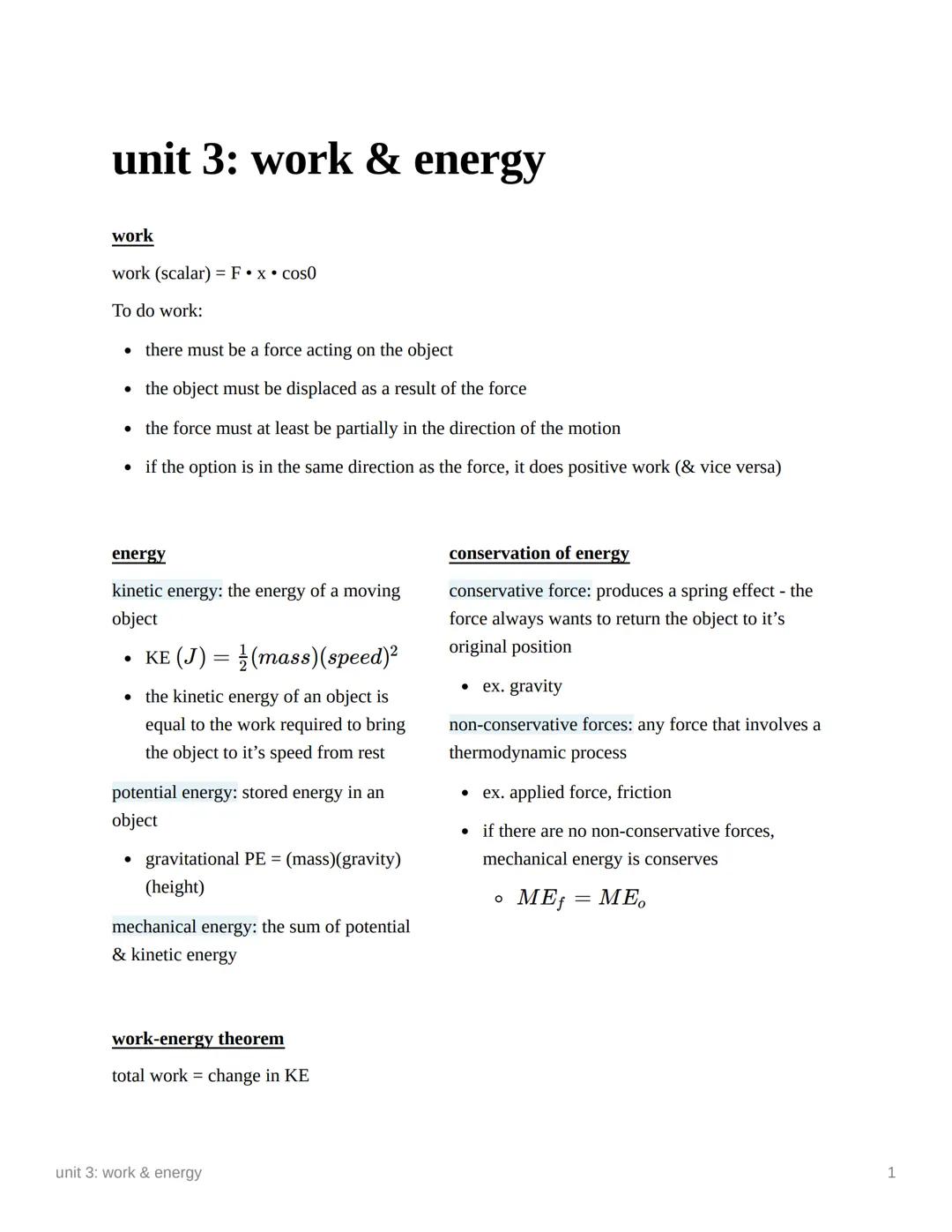
Work & Energy Fundamentals
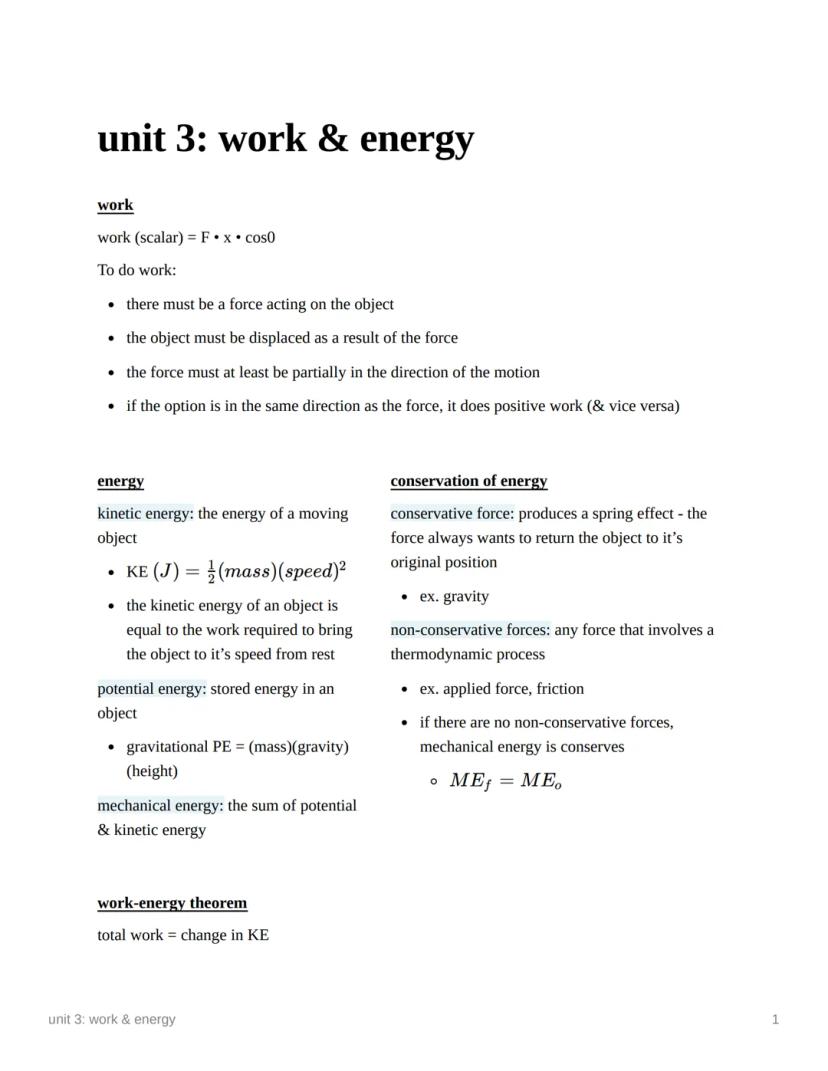
Work happens when a force causes an object to move in the direction of the force. The formula for work is work = force × displacement × cosθ. Remember, work only occurs when the force causes displacement, and the force must have at least some component in the direction of motion.
Energy comes in different forms. Kinetic energy is the energy of motion, calculated as KE = ½mv². This equals the work needed to accelerate an object from rest to its current speed. Potential energy is stored energy, with gravitational PE = mgh. Together, kinetic and potential energy make up mechanical energy.
Forces can be either conservative (like gravity, which tends to restore objects to their original position) or non-conservative (like friction, which involves thermodynamic processes). When only conservative forces act, mechanical energy is conserved, meaning ME₁ = ME₂.
⚡ Energy Insight: The work-energy theorem states that total work equals the change in kinetic energy. If total work is positive, an object speeds up; if negative, it slows down; if zero, its speed doesn't change.
2
of 3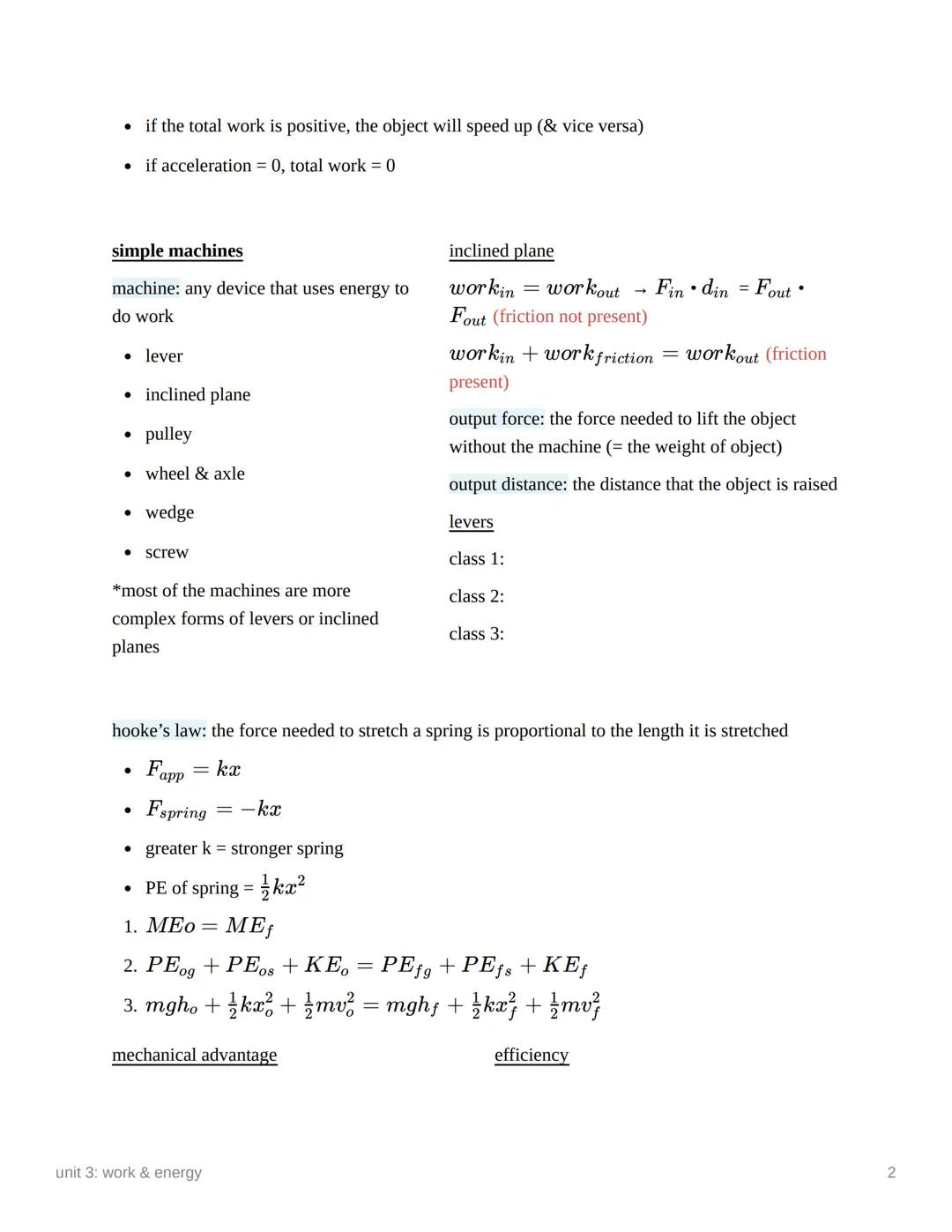
Simple Machines & Springs
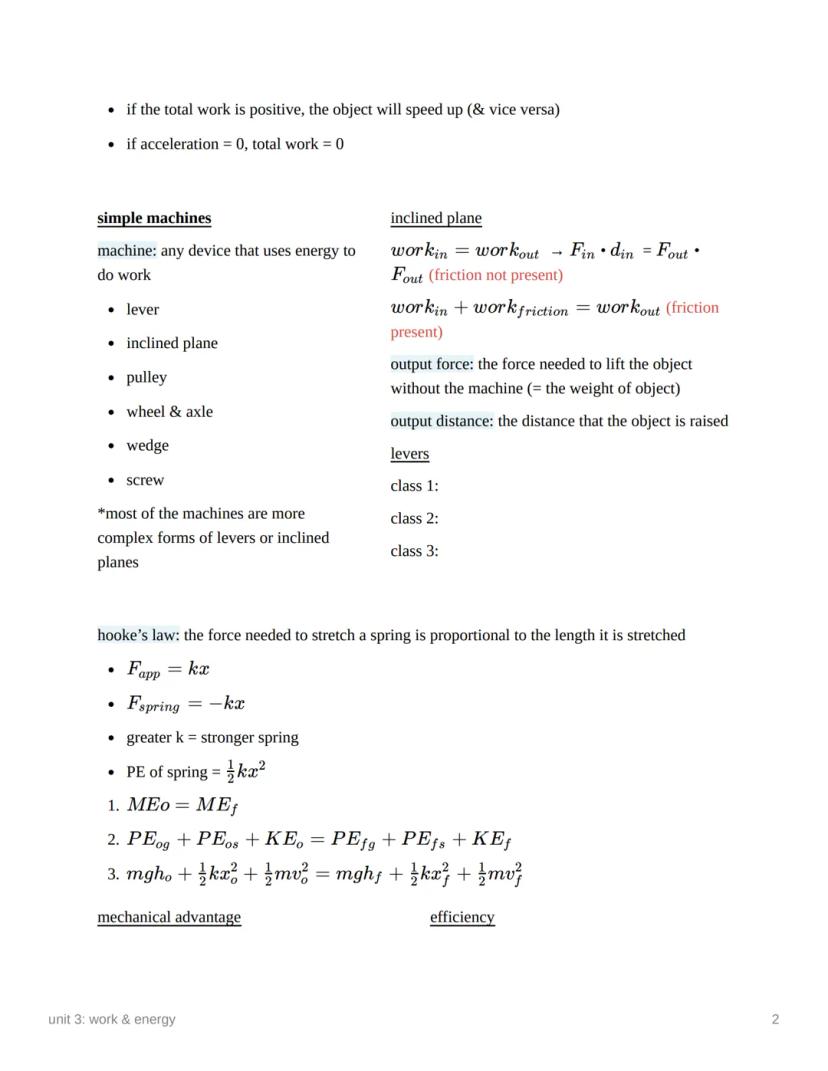
Simple machines help us do work more easily by trading force for distance. The six basic machines are levers, inclined planes, pulleys, wheel and axles, wedges, and screws. Most complex machines are variations of levers or inclined planes.
For any machine, input work equals output work when no friction exists . When friction is present, input work plus work done by friction equals output work. The output force is usually the weight of an object, and output distance is how far it's raised.
Springs follow Hooke's Law, which states that the force needed to stretch a spring is proportional to the distance stretched: F = kx, where k is the spring constant. A larger k means a stronger spring. The potential energy stored in a spring is PE = ½kx².
🔄 Balancing Act: When solving spring-mass problems, remember this equation: mghₒ + ½kxₒ² + ½mvₒ² = mghₑ + ½kxₑ² + ½mvₑ². This shows how energy transforms between gravitational potential, spring potential, and kinetic energy.
3
of 3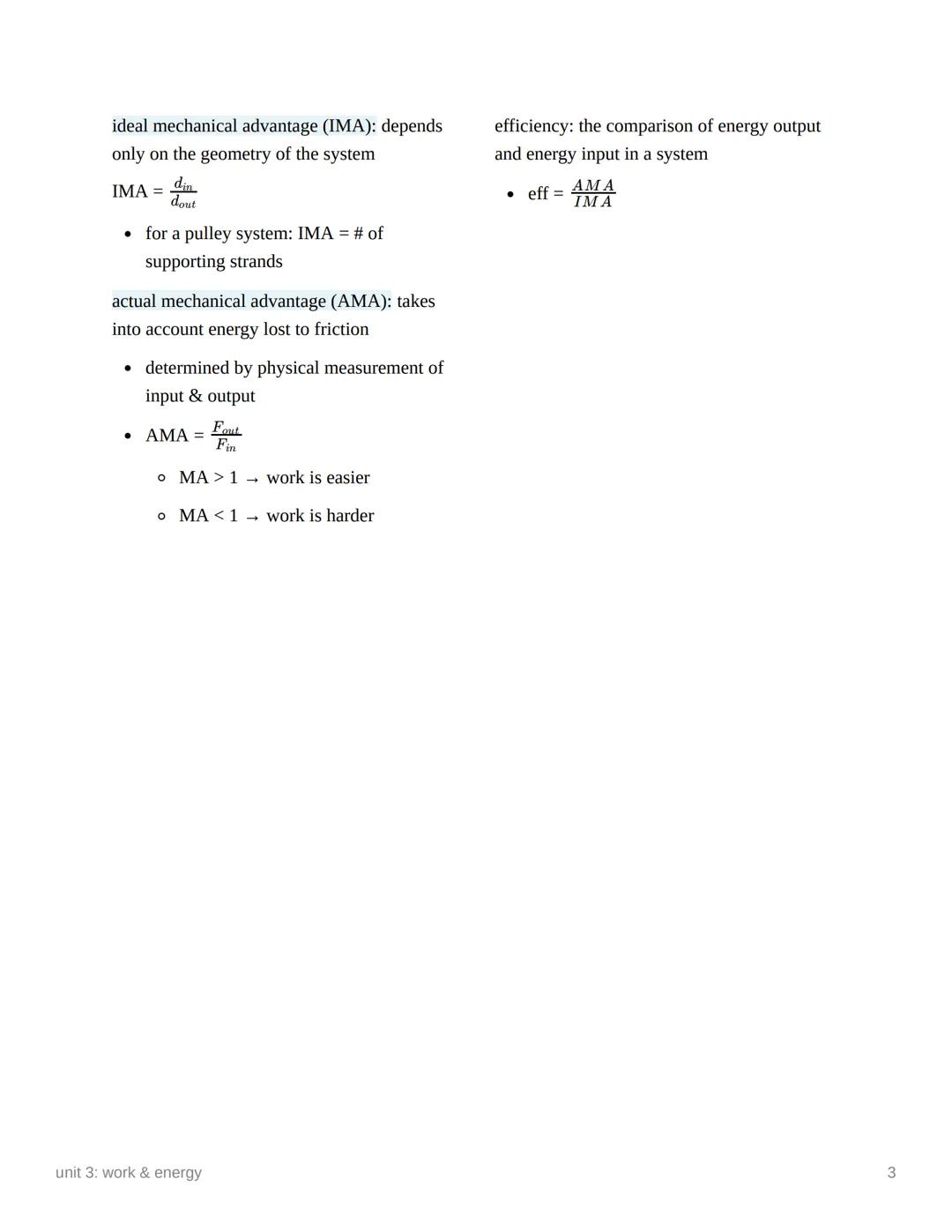
Mechanical Advantage & Efficiency
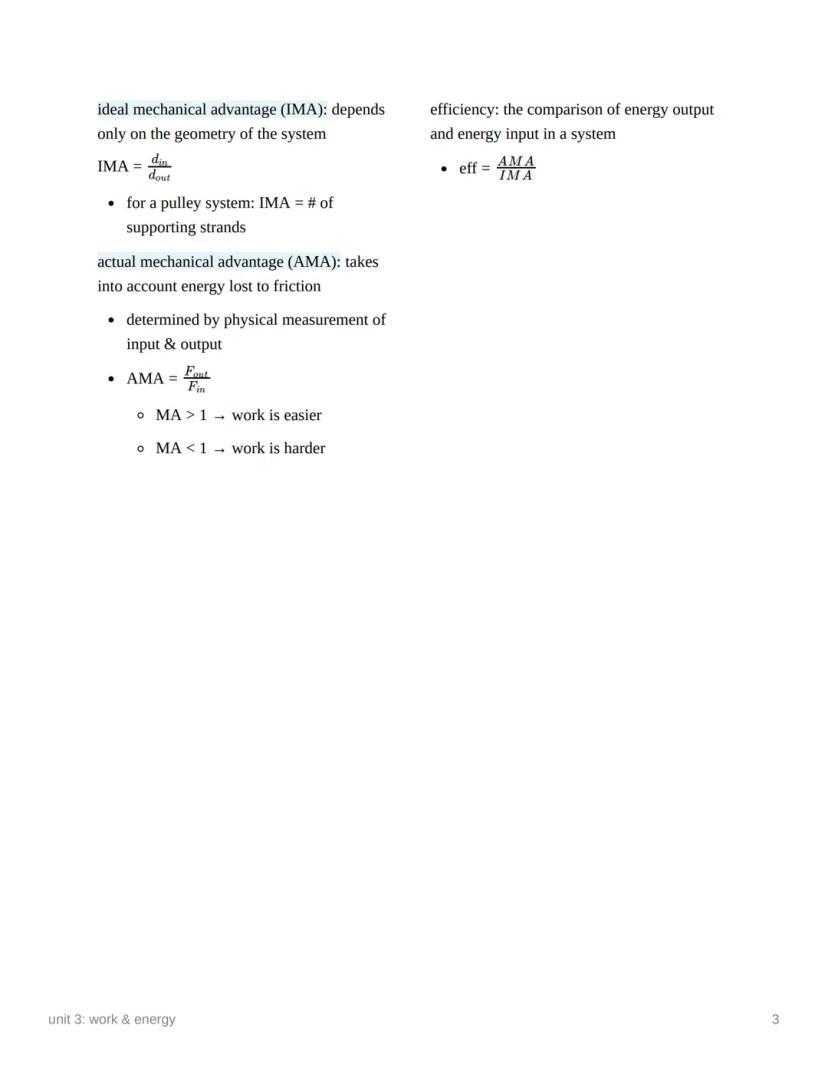
Ideal Mechanical Advantage (IMA) depends only on a machine's geometry and equals the ratio of input distance to output distance: IMA = dᵢₙ/dₒᵤₜ. For pulley systems, IMA equals the number of supporting strands.
Actual Mechanical Advantage (AMA) accounts for energy lost to friction and is found by measuring the ratio of output force to input force: AMA = Fₒᵤₜ/Fᵢₙ. If MA > 1, the machine makes work easier; if MA < 1, it makes work harder.
Efficiency compares energy output to energy input in a system: efficiency = AMA/IMA. This ratio helps us understand how much energy is lost in the process of using a machine.
🔧 Real-World Application: No machine is 100% efficient due to friction and other energy losses. When designing or choosing a machine, consider the trade-off between mechanical advantage and efficiency based on your needs.
We thought you’d never ask...
What is the Knowunity AI companion?
Our AI companion is specifically built for the needs of students. Based on the millions of content pieces we have on the platform we can provide truly meaningful and relevant answers to students. But its not only about answers, the companion is even more about guiding students through their daily learning challenges, with personalised study plans, quizzes or content pieces in the chat and 100% personalisation based on the students skills and developments.
Where can I download the Knowunity app?
You can download the app in the Google Play Store and in the Apple App Store.
Is Knowunity really free of charge?
That's right! Enjoy free access to study content, connect with fellow students, and get instant help – all at your fingertips.
Similar Content
Most popular content: Work
1Most popular content in Physics
9P
Physicsphysical science 8th grade
test your abilities
8th1380
AP Physics 1Newton's Second Law of Motion
A detailed explanation of Concept of Newton's Second Law of Motion, Examples, Formulas, and Sample Problems with solution.
36613
Physicsmomentum and impulse
momentum, impulse, conservation of momentum
98427
PhysicsPhysics Reviewer
This is an extensive physics reviewer.
College1,49334
PhysicsSimple Machines PowerPoint
This presentation offers an explanation of simple machines and how to solve for mechanical advantage, ideal mechanical advantage, and efficiency of each machine. It also provides definitions and examples.
9th29113
F
PhysicsForce and Motion
a study set for chapter 1 of Physical Science
1875
PhysicsHonors Physics Semester Two Review Sheet
This note sheet can be used for high school students taking physics classes to study for finals, unit tests, and review.
9th29313
PhysicsContact and Non-Contact Forces
Ppt on contact and Non-Contact Forces
7th781
AP Physics 1Types of Collisions
Understanding perfectly inelastic, perfectly elastic, and other types of collisions and the conservation of momentum.
10th713
Most popular content
9O
 AP US History
Origins and Dynamics of the Columbian Exchange
Analyze the ecological and economic motivations behind the initial transfer of goods, people, and diseases between the Old and New Worlds.
9th3,1280
I
AP US HistoryIntroduction to Early Cultural Interactions
Analyze the initial social and religious encounters between Europeans, Africans, and Indigenous peoples in the colonial Americas.
9th2,7730
O
 AP World History
Origins of Ancient River Civilizations
Analyze the environmental factors and technological innovations that led to the rise of early states in Mesopotamia, Egypt, and the Indus Valley.
9th3,1870
M
AP US HistoryMotivations for European Exploration
Analyze the economic, religious, and political factors that drove European powers to the Americas during the 15th and 16th centuries.
9th1,7780
F
 AP Psychology
Foundations of Ethical Guidelines in Research
Practice the core principles of the APA ethical code including informed consent, debriefing, and the role of Institutional Review Boards.
9th1,3360
I
AP US HistoryIntroduction to Native American Societies
Examine the diverse social, political, and economic structures of North American indigenous groups prior to European contact.
9th1,1100
I
 AP Biology
Introduction to Biological Elements of Life
Practice identifying the essential elements including carbon, nitrogen, phosphorus, and sulfur that compose biological macromolecules.
9th1,7390
I
AP US HistoryIntroduction to the Spanish Encomienda System
Explore the fundamental economic and social structures of the Spanish colonial system, focusing on the encomienda and the casta social hierarchy.
9th8890
O
AP World HistoryOrigins and Continuity of the Byzantine Empire
Analyze the political and cultural transitions from the Roman Empire to the Byzantine Empire, focusing on the reign of Justinian I and his code.
9th1,6320
Can't find what you're looking for? Explore other subjects.
Students love us — and so will you.
4.6/5App Store
4.7/5Google Play
The app is very easy to use and well designed. I have found everything I was looking for so far and have been able to learn a lot from the presentations! I will definitely use the app for a class assignment! And of course it also helps a lot as an inspiration.
Stefan SiOS user
This app is really great. There are so many study notes and help [...]. My problem subject is French, for example, and the app has so many options for help. Thanks to this app, I have improved my French. I would recommend it to anyone.
Samantha KlichAndroid user
Wow, I am really amazed. I just tried the app because I've seen it advertised many times and was absolutely stunned. This app is THE HELP you want for school and above all, it offers so many things, such as workouts and fact sheets, which have been VERY helpful to me personally.
AnnaiOS user
Physics116 views·Updated Jun 11, 2026·3 pagesUnderstanding Work and Energy: Unit Overview
K
kylie@kylie_ywwr
Work and energy are powerful concepts that describe how forces change the motion and position of objects. Understanding these principles helps explain everything from how machines make tasks easier to why a roller coaster can complete its track without a...
1
of 3
Sign up to see the content. It's free!
- Access to all documents
- Improve your grades
- Join milions of students
Work & Energy Fundamentals
Work happens when a force causes an object to move in the direction of the force. The formula for work is work = force × displacement × cosθ. Remember, work only occurs when the force causes displacement, and the force must have at least some component in the direction of motion.
Energy comes in different forms. Kinetic energy is the energy of motion, calculated as KE = ½mv². This equals the work needed to accelerate an object from rest to its current speed. Potential energy is stored energy, with gravitational PE = mgh. Together, kinetic and potential energy make up mechanical energy.
Forces can be either conservative (like gravity, which tends to restore objects to their original position) or non-conservative (like friction, which involves thermodynamic processes). When only conservative forces act, mechanical energy is conserved, meaning ME₁ = ME₂.
⚡ Energy Insight: The work-energy theorem states that total work equals the change in kinetic energy. If total work is positive, an object speeds up; if negative, it slows down; if zero, its speed doesn't change.
2
of 3Sign up to see the content. It's free!
- Access to all documents
- Improve your grades
- Join milions of students
Simple Machines & Springs
Simple machines help us do work more easily by trading force for distance. The six basic machines are levers, inclined planes, pulleys, wheel and axles, wedges, and screws. Most complex machines are variations of levers or inclined planes.
For any machine, input work equals output work when no friction exists . When friction is present, input work plus work done by friction equals output work. The output force is usually the weight of an object, and output distance is how far it's raised.
Springs follow Hooke's Law, which states that the force needed to stretch a spring is proportional to the distance stretched: F = kx, where k is the spring constant. A larger k means a stronger spring. The potential energy stored in a spring is PE = ½kx².
🔄 Balancing Act: When solving spring-mass problems, remember this equation: mghₒ + ½kxₒ² + ½mvₒ² = mghₑ + ½kxₑ² + ½mvₑ². This shows how energy transforms between gravitational potential, spring potential, and kinetic energy.
3
of 3Sign up to see the content. It's free!
- Access to all documents
- Improve your grades
- Join milions of students
Mechanical Advantage & Efficiency
Ideal Mechanical Advantage (IMA) depends only on a machine's geometry and equals the ratio of input distance to output distance: IMA = dᵢₙ/dₒᵤₜ. For pulley systems, IMA equals the number of supporting strands.
Actual Mechanical Advantage (AMA) accounts for energy lost to friction and is found by measuring the ratio of output force to input force: AMA = Fₒᵤₜ/Fᵢₙ. If MA > 1, the machine makes work easier; if MA < 1, it makes work harder.
Efficiency compares energy output to energy input in a system: efficiency = AMA/IMA. This ratio helps us understand how much energy is lost in the process of using a machine.
🔧 Real-World Application: No machine is 100% efficient due to friction and other energy losses. When designing or choosing a machine, consider the trade-off between mechanical advantage and efficiency based on your needs.
We thought you’d never ask...
What is the Knowunity AI companion?
Our AI companion is specifically built for the needs of students. Based on the millions of content pieces we have on the platform we can provide truly meaningful and relevant answers to students. But its not only about answers, the companion is even more about guiding students through their daily learning challenges, with personalised study plans, quizzes or content pieces in the chat and 100% personalisation based on the students skills and developments.
Where can I download the Knowunity app?
You can download the app in the Google Play Store and in the Apple App Store.
Is Knowunity really free of charge?
That's right! Enjoy free access to study content, connect with fellow students, and get instant help – all at your fingertips.
Similar Content
Most popular content: Work
1Most popular content in Physics
9P
Physicsphysical science 8th grade
test your abilities
8th1380
AP Physics 1Newton's Second Law of Motion
A detailed explanation of Concept of Newton's Second Law of Motion, Examples, Formulas, and Sample Problems with solution.
36613
Physicsmomentum and impulse
momentum, impulse, conservation of momentum
98427
PhysicsPhysics Reviewer
This is an extensive physics reviewer.
College1,49334
PhysicsSimple Machines PowerPoint
This presentation offers an explanation of simple machines and how to solve for mechanical advantage, ideal mechanical advantage, and efficiency of each machine. It also provides definitions and examples.
9th29113
F
PhysicsForce and Motion
a study set for chapter 1 of Physical Science
1875
PhysicsHonors Physics Semester Two Review Sheet
This note sheet can be used for high school students taking physics classes to study for finals, unit tests, and review.
9th29313
PhysicsContact and Non-Contact Forces
Ppt on contact and Non-Contact Forces
7th781
AP Physics 1Types of Collisions
Understanding perfectly inelastic, perfectly elastic, and other types of collisions and the conservation of momentum.
10th713
Most popular content
9O
AP US HistoryOrigins and Dynamics of the Columbian Exchange
Analyze the ecological and economic motivations behind the initial transfer of goods, people, and diseases between the Old and New Worlds.
9th3,1280
I
AP US HistoryIntroduction to Early Cultural Interactions
Analyze the initial social and religious encounters between Europeans, Africans, and Indigenous peoples in the colonial Americas.
9th2,7730
O
AP World HistoryOrigins of Ancient River Civilizations
Analyze the environmental factors and technological innovations that led to the rise of early states in Mesopotamia, Egypt, and the Indus Valley.
9th3,1870
M
AP US HistoryMotivations for European Exploration
Analyze the economic, religious, and political factors that drove European powers to the Americas during the 15th and 16th centuries.
9th1,7780
F
AP PsychologyFoundations of Ethical Guidelines in Research
Practice the core principles of the APA ethical code including informed consent, debriefing, and the role of Institutional Review Boards.
9th1,3360
I
AP US HistoryIntroduction to Native American Societies
Examine the diverse social, political, and economic structures of North American indigenous groups prior to European contact.
9th1,1100
I
AP BiologyIntroduction to Biological Elements of Life
Practice identifying the essential elements including carbon, nitrogen, phosphorus, and sulfur that compose biological macromolecules.
9th1,7390
I
AP US HistoryIntroduction to the Spanish Encomienda System
Explore the fundamental economic and social structures of the Spanish colonial system, focusing on the encomienda and the casta social hierarchy.
9th8890
O
AP World HistoryOrigins and Continuity of the Byzantine Empire
Analyze the political and cultural transitions from the Roman Empire to the Byzantine Empire, focusing on the reign of Justinian I and his code.
9th1,6320
Can't find what you're looking for? Explore other subjects.
Students love us — and so will you.
4.6/5App Store
4.7/5Google Play
The app is very easy to use and well designed. I have found everything I was looking for so far and have been able to learn a lot from the presentations! I will definitely use the app for a class assignment! And of course it also helps a lot as an inspiration.
Stefan SiOS user
This app is really great. There are so many study notes and help [...]. My problem subject is French, for example, and the app has so many options for help. Thanks to this app, I have improved my French. I would recommend it to anyone.
Samantha KlichAndroid user
Wow, I am really amazed. I just tried the app because I've seen it advertised many times and was absolutely stunned. This app is THE HELP you want for school and above all, it offers so many things, such as workouts and fact sheets, which have been VERY helpful to me personally.
AnnaiOS user