
Friction is a force that can either help or hinder...
 Physics74 views·Updated Jun 12, 2026·8 pages
Understanding Different Types of Friction in Physics

Laura Tillman@lauratillman
1 / 8
1
of 8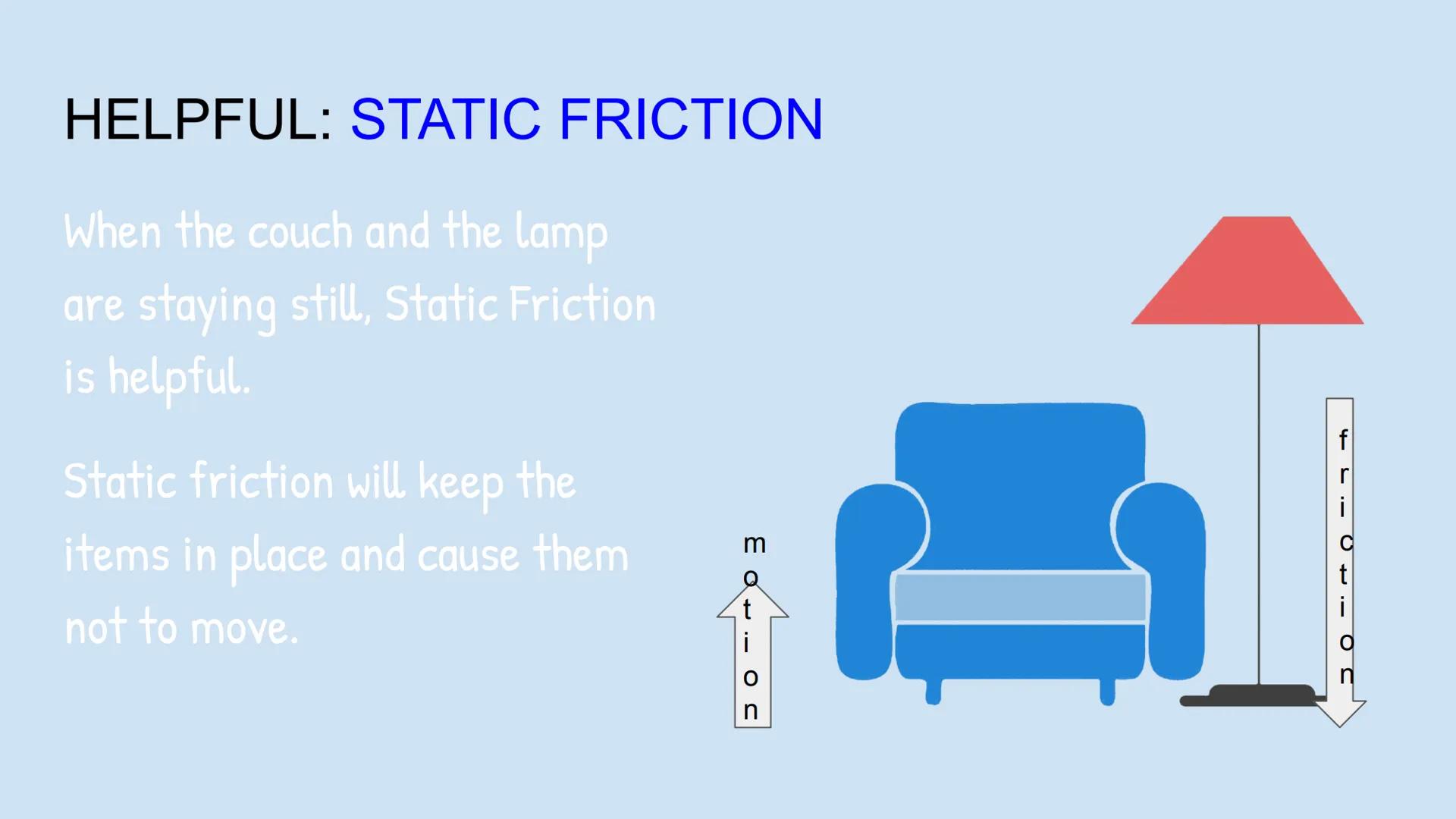
Helpful Static Friction
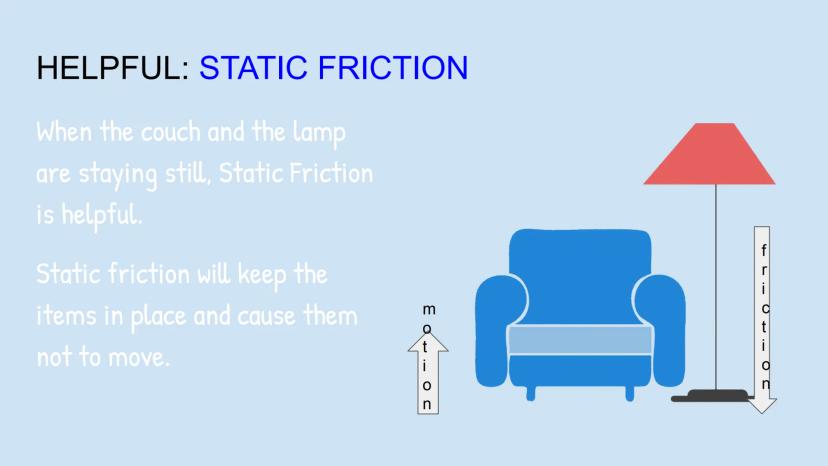
Static friction keeps objects from moving when they're at rest. Imagine your couch and lamp sitting perfectly still in your room—they stay put thanks to static friction!
This force acts between surfaces that aren't moving relative to each other. Without it, everything in your room would slide around like you're living on an ice rink.
Static friction creates stability in our world, preventing objects from sliding when we don't want them to move.
Try This: Place a book on a slightly tilted surface. The book stays in place until the angle becomes steep enough to overcome static friction!
2
of 8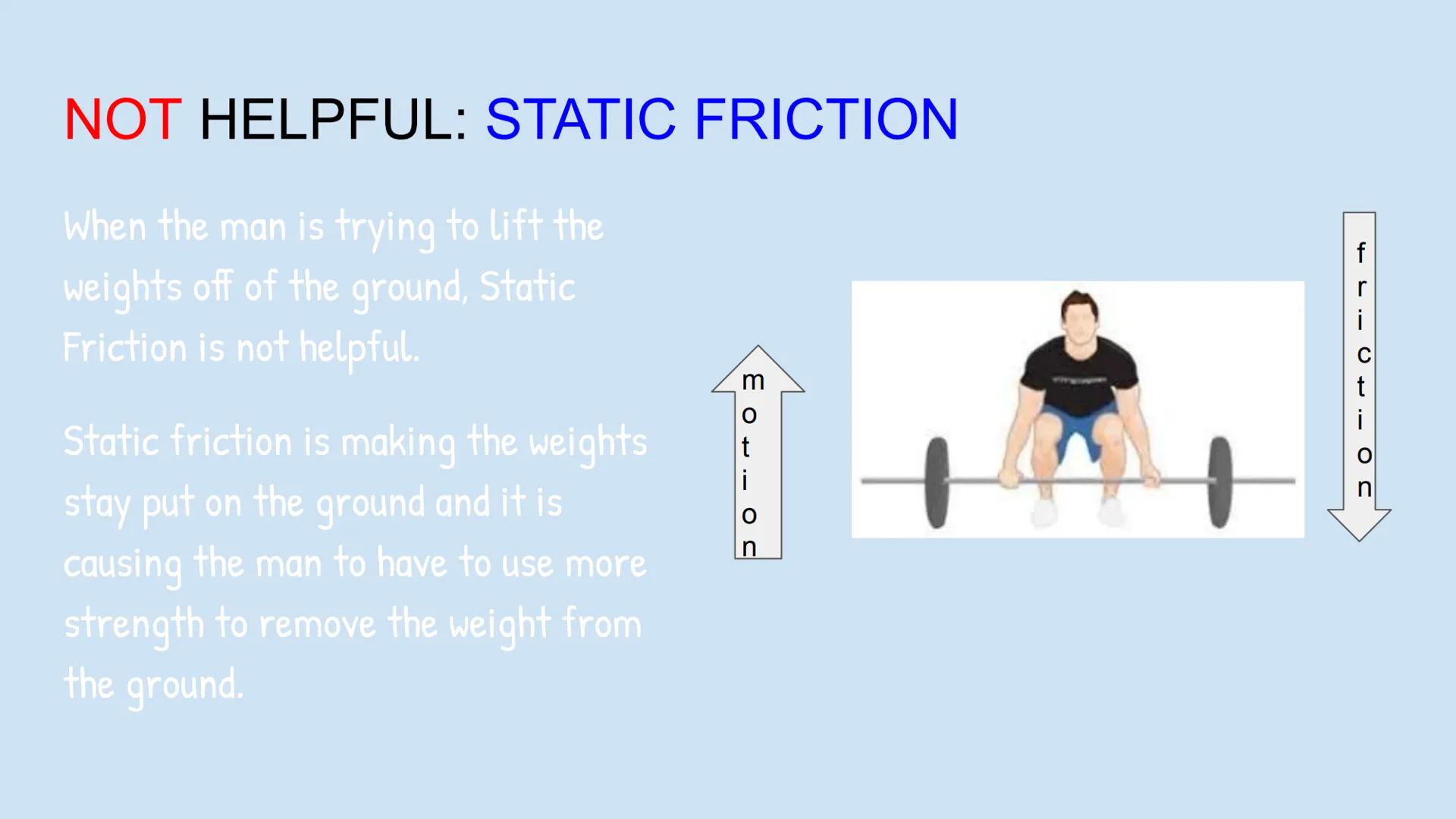
Unhelpful Static Friction
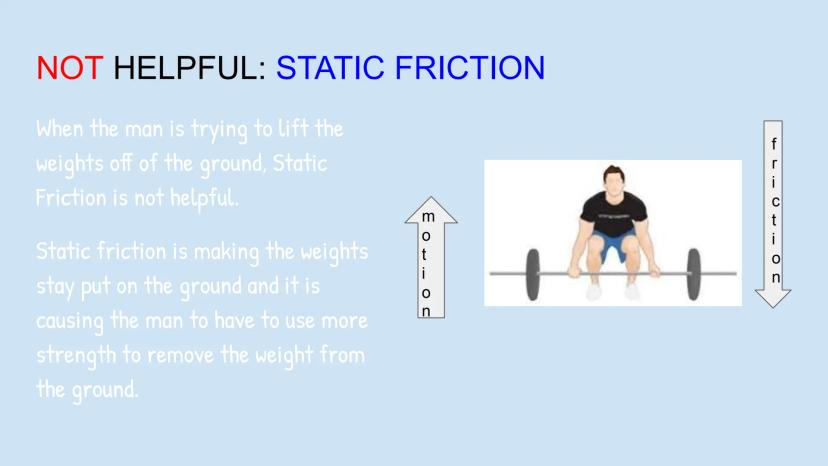
Sometimes static friction works against us. When you try to lift weights off the ground, static friction makes the job harder by resisting the initial movement.
The weights want to stay put on the ground due to static friction. This means you need to apply extra strength to overcome this resistance and get the weights moving.
While static friction is great for keeping things stable, it can make starting movement more challenging when that's your goal.
Remember: Static friction only exists until movement begins—then it changes to sliding friction!
3
of 8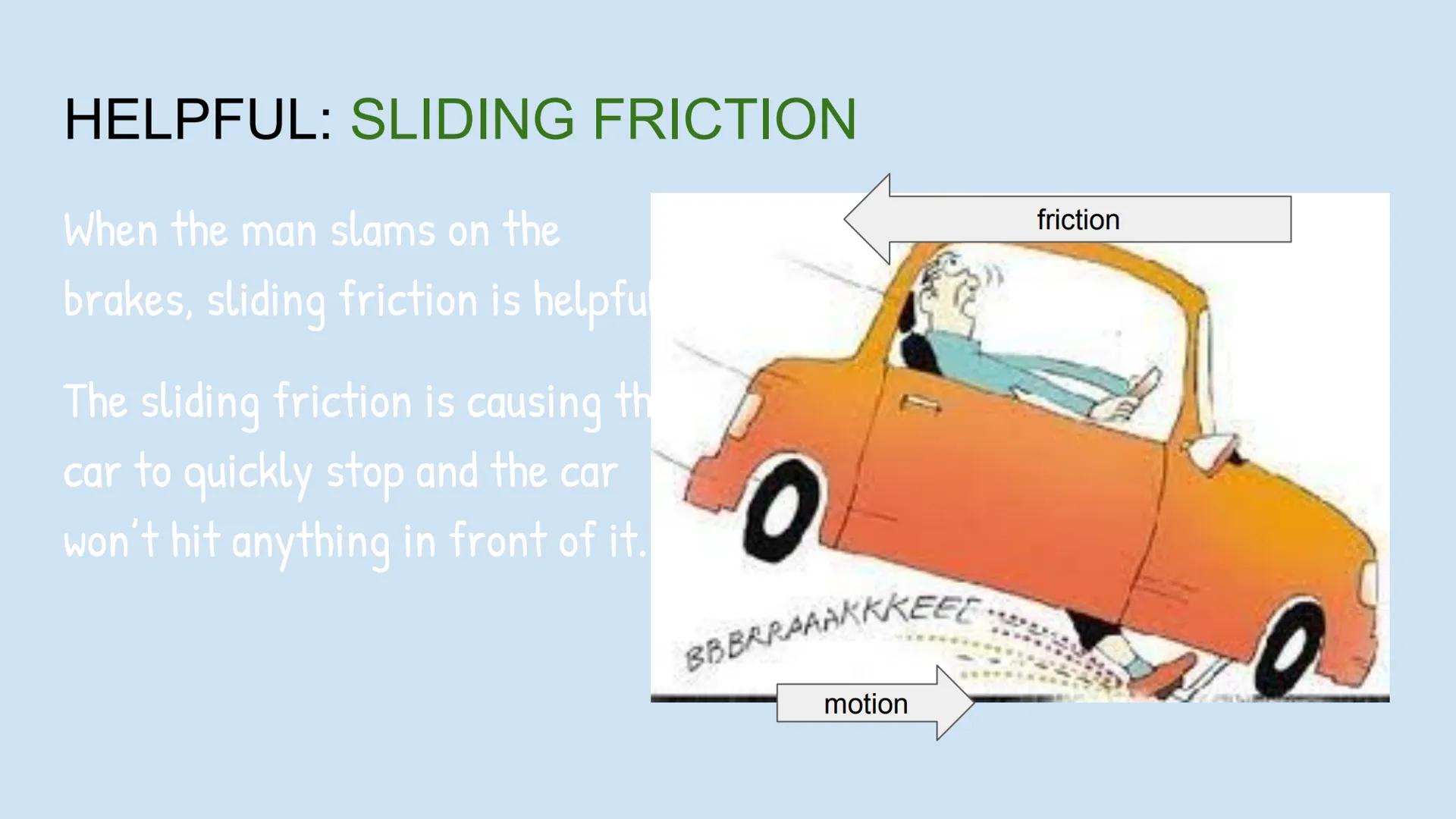
Helpful Sliding Friction
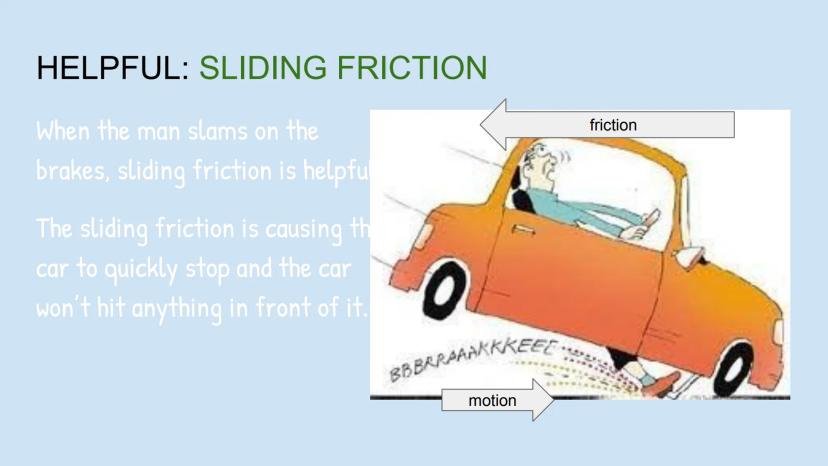
Slamming on the brakes shows sliding friction at its most helpful. When you hit the brakes hard, your tires slide against the road, creating friction that helps stop your car quickly.
This type of friction occurs when two surfaces slide past each other. The rougher the surfaces, the greater the sliding friction and stopping power.
Sliding friction prevents accidents by allowing objects in motion to slow down and stop when needed.
Real-World Example: Without sliding friction between your shoes and the floor, you couldn't stop running quickly or make sudden turns in a basketball game!
4
of 8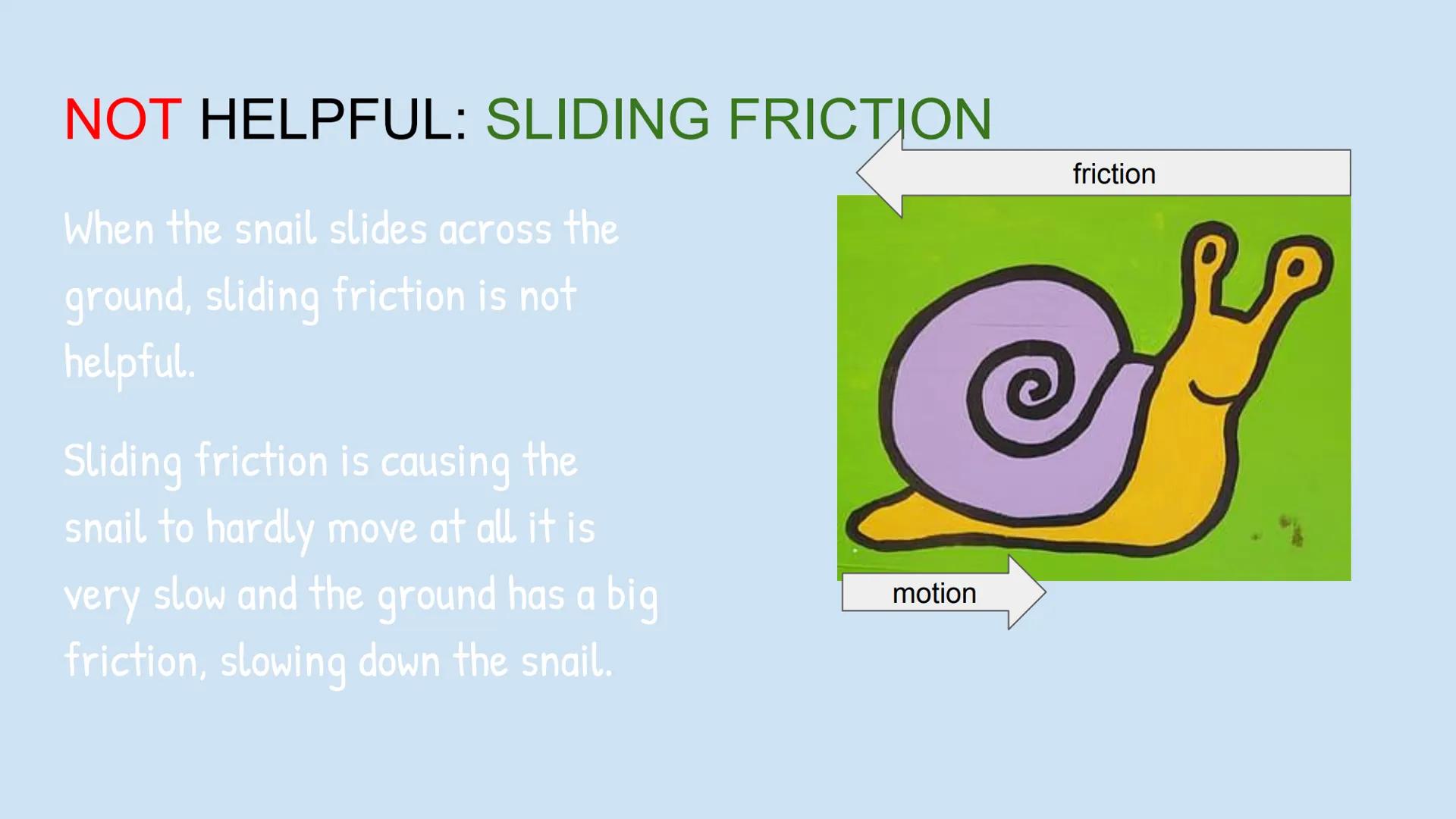
Unhelpful Sliding Friction
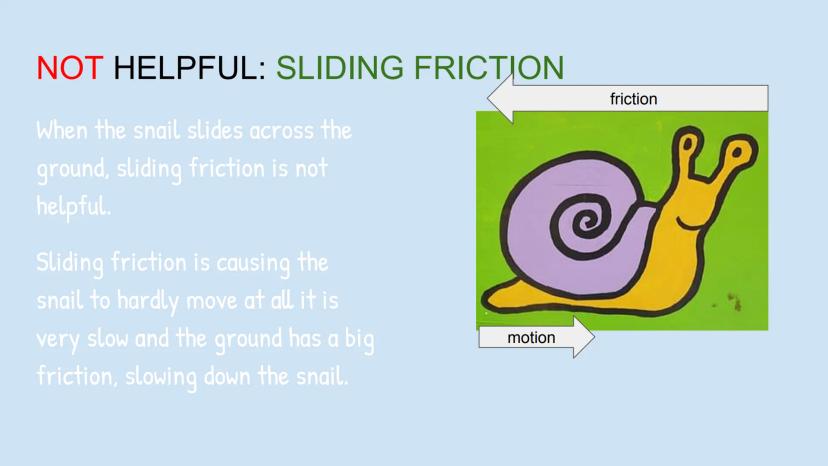
A snail trying to move across the ground faces the challenge of sliding friction working against it. The friction between the snail and the ground makes movement difficult and slow.
As the snail tries to slide forward, friction continuously opposes its motion. This resistance explains why snails move so slowly despite their efforts.
In this case, sliding friction is an obstacle to efficient movement, making the snail's journey much more difficult.
Think About It: Can you think of other situations where sliding friction makes movement harder? Ice skaters actually try to minimize this type of friction!
5
of 8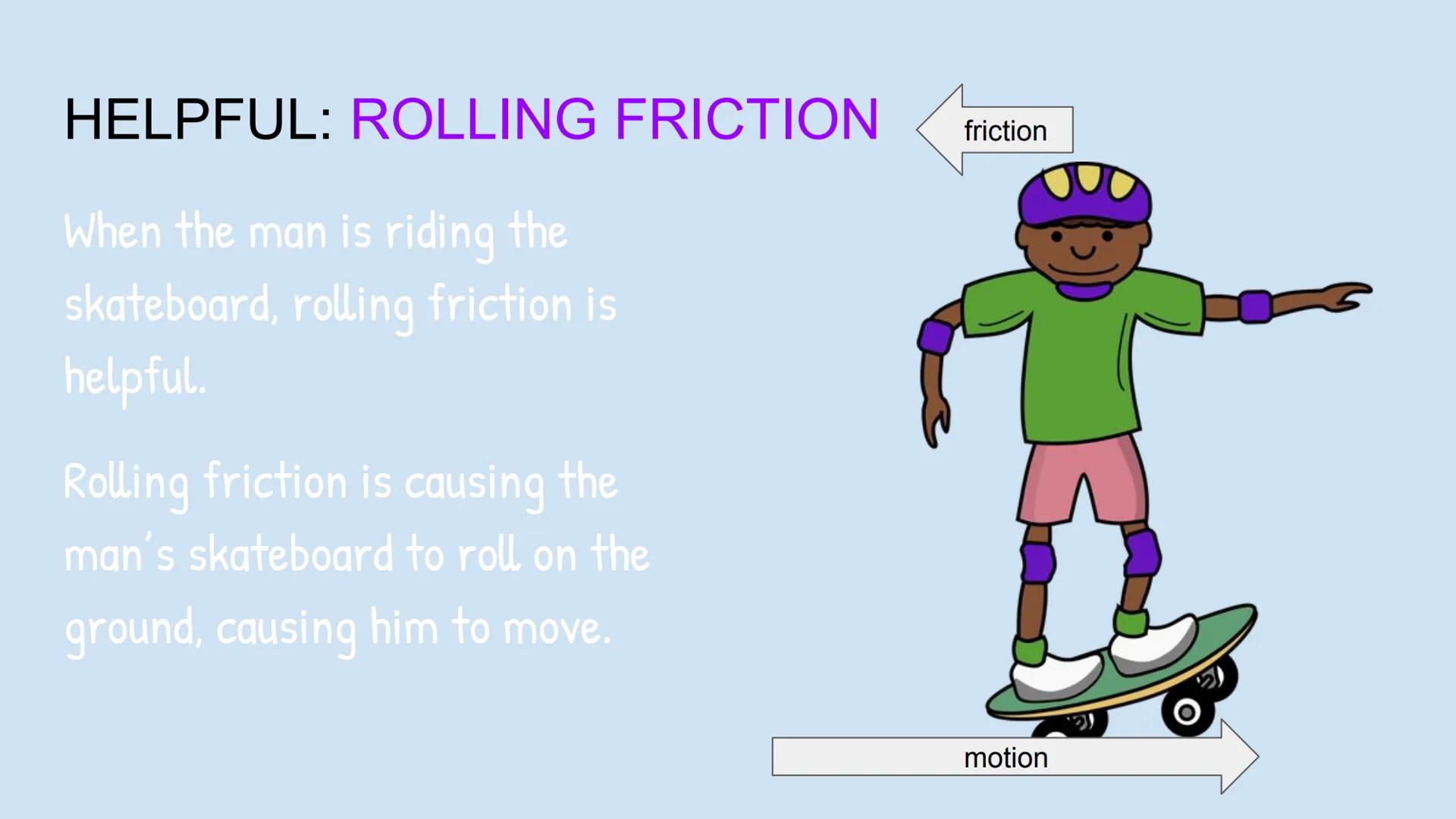
Helpful Rolling Friction
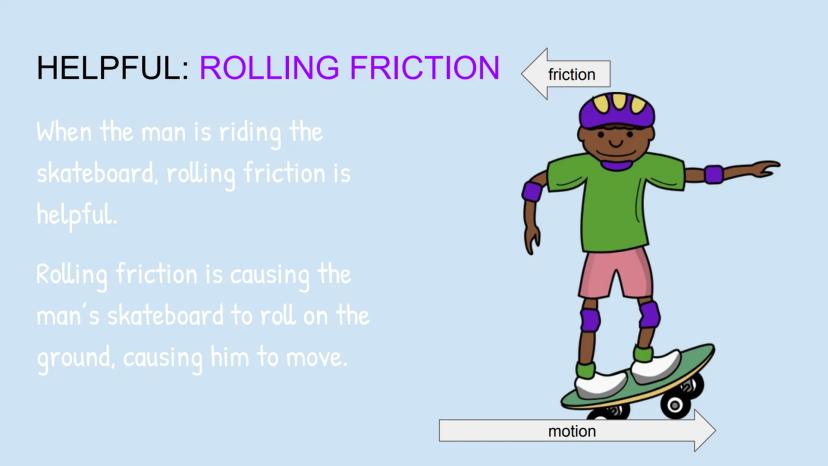
Skateboarding is possible thanks to rolling friction! When wheels roll against the ground, they experience much less resistance than if they were sliding.
Rolling friction occurs when an object rolls over a surface instead of sliding. This type of friction allows for smooth movement while still providing enough grip for control.
The wheels on a skateboard convert what would be sliding friction into rolling friction, making it much easier to move quickly and efficiently.
Fun Fact: Rolling friction is about 100 times less than sliding friction, which is why we put wheels on suitcases, cars, and skateboards!
6
of 8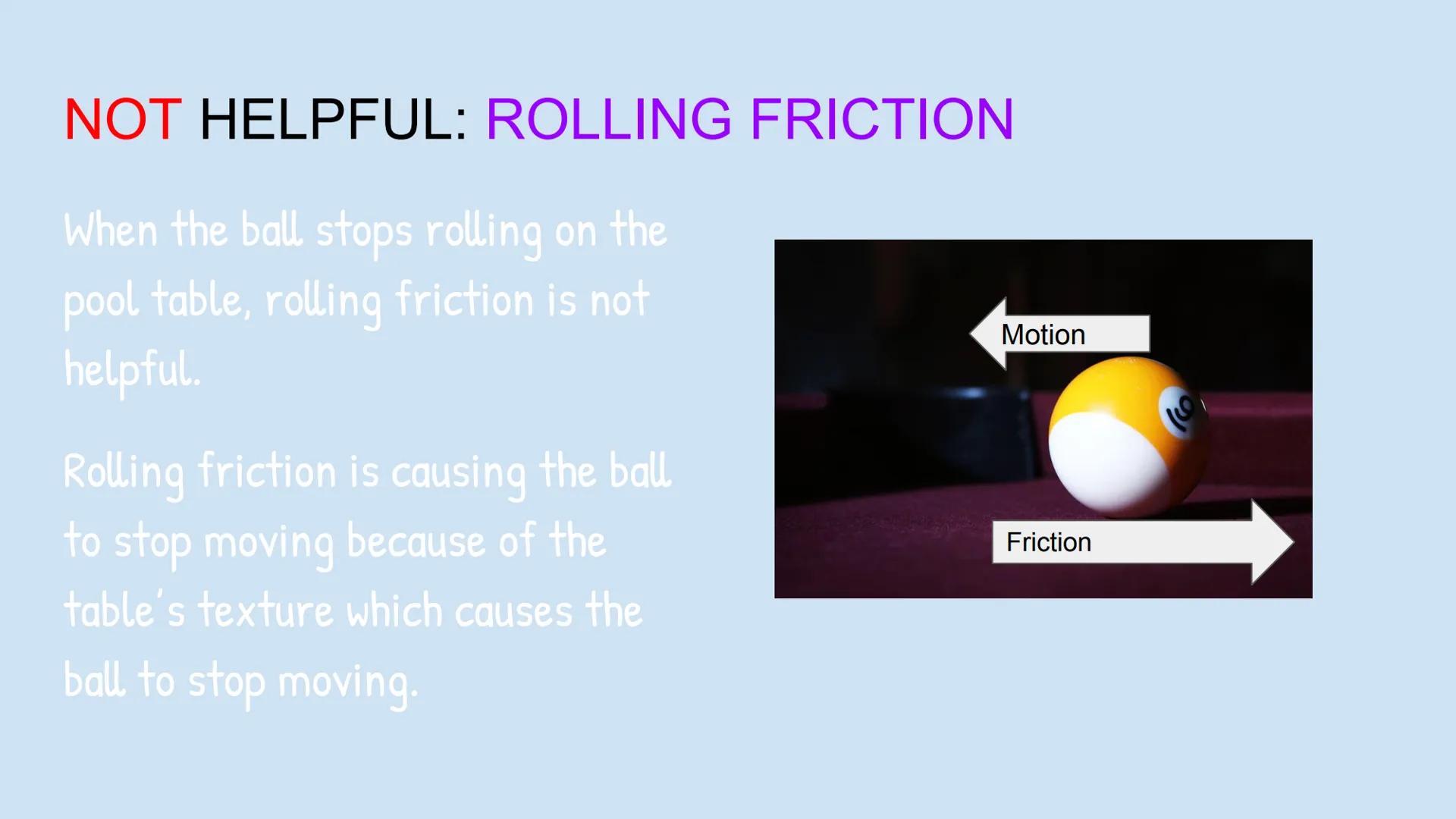
Unhelpful Rolling Friction
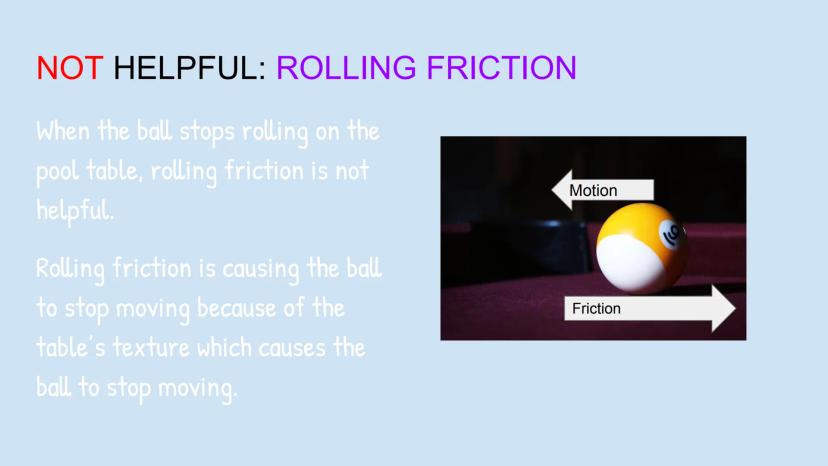
When a pool ball gradually slows down and stops rolling, that's rolling friction at work. The slight texture of the pool table creates resistance against the ball's motion.
Even though rolling friction is less than sliding friction, it still exists. Over time, this friction converts the ball's energy of motion into heat until the ball stops completely.
Without perfect conditions, rolling friction will eventually slow down any rolling object—which isn't helpful when you want something to keep moving.
Challenge Question: Why do you think pool tables are covered in felt rather than a rougher material?
7
of 8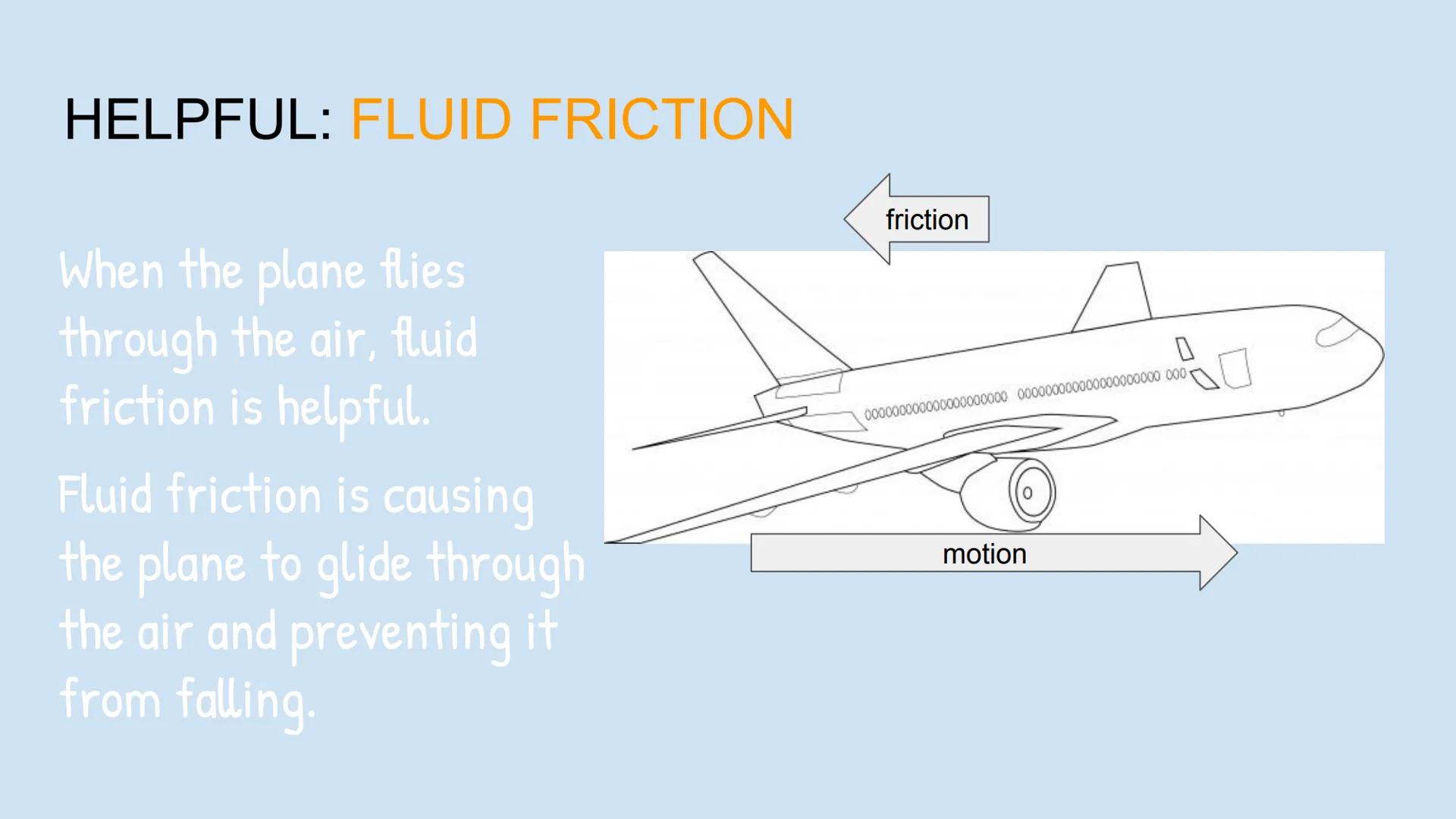
Helpful Fluid Friction
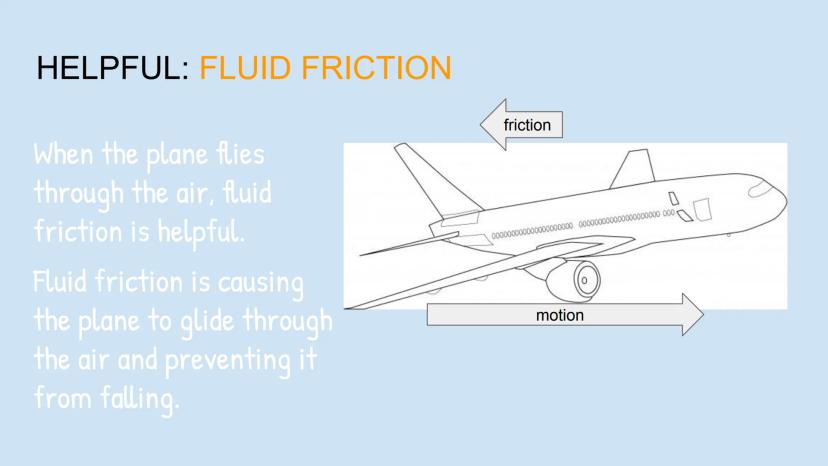
Airplanes rely on fluid friction to fly! As a plane moves through the air, fluid friction (also called drag) helps create lift that keeps the plane from falling.
Fluid friction occurs when objects move through liquids or gases. The shape of an airplane's wings uses this friction to generate upward force while minimizing resistance.
Without this type of friction, flight as we know it wouldn't be possible. The interaction between the plane and the air keeps it safely aloft.
Science Connection: Birds have evolved wing shapes that perfectly balance fluid friction forces—engineers designed airplane wings based on this natural example!
8
of 8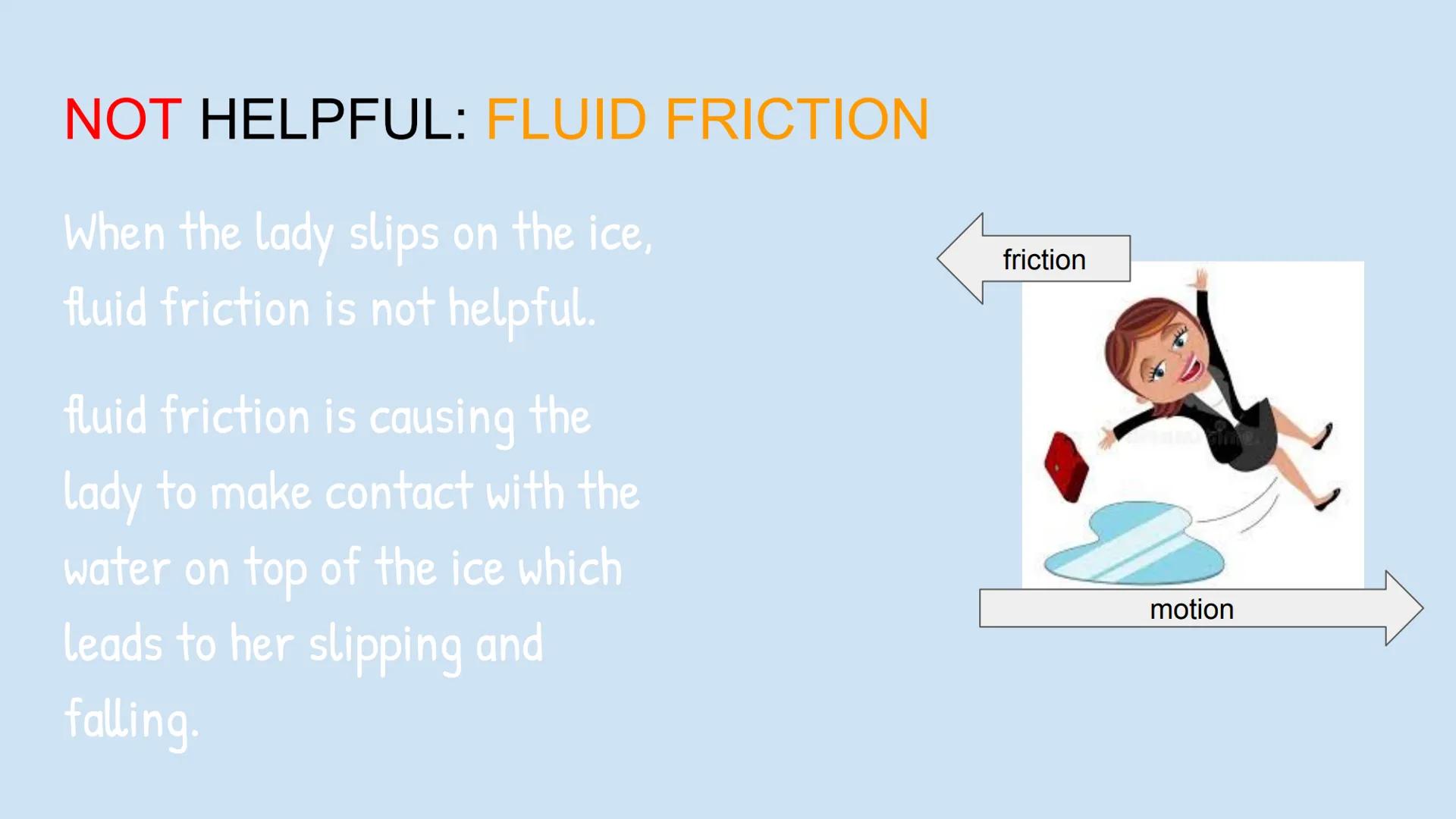
Unhelpful Fluid Friction
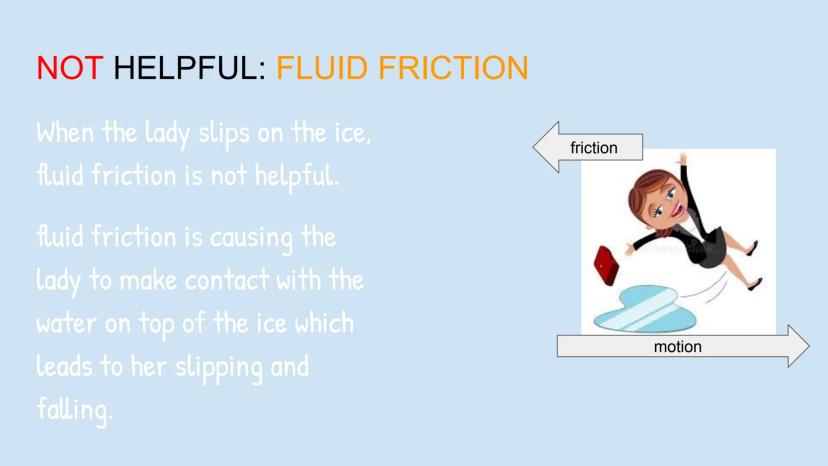
Slipping on ice happens because fluid friction can be treacherous. When someone slips, it's often because a thin layer of water on top of the ice creates very little friction.
The water acts as a fluid between the person's shoes and the ice, dramatically reducing grip. With almost no friction to provide stability, even a small force can cause a fall.
This demonstrates how reduced fluid friction can create dangerous situations when we need friction for stability and control.
Safety Tip: This is why we use salt on icy sidewalks—it melts the ice and creates a rough, slushy surface with more friction to prevent slipping!
We thought you’d never ask...
What is the Knowunity AI companion?
Our AI companion is specifically built for the needs of students. Based on the millions of content pieces we have on the platform we can provide truly meaningful and relevant answers to students. But its not only about answers, the companion is even more about guiding students through their daily learning challenges, with personalised study plans, quizzes or content pieces in the chat and 100% personalisation based on the students skills and developments.
Where can I download the Knowunity app?
You can download the app in the Google Play Store and in the Apple App Store.
Is Knowunity really free of charge?
That's right! Enjoy free access to study content, connect with fellow students, and get instant help – all at your fingertips.
Most popular content: Friction
1Most popular content in Physics
9P
Physicsphysical science 8th grade
test your abilities
8th1380
AP Physics 1Newton's Second Law of Motion
A detailed explanation of Concept of Newton's Second Law of Motion, Examples, Formulas, and Sample Problems with solution.
36613
Physicsmomentum and impulse
momentum, impulse, conservation of momentum
98427
PhysicsPhysics Reviewer
This is an extensive physics reviewer.
College1,49334
PhysicsSimple Machines PowerPoint
This presentation offers an explanation of simple machines and how to solve for mechanical advantage, ideal mechanical advantage, and efficiency of each machine. It also provides definitions and examples.
9th29113
F
PhysicsForce and Motion
a study set for chapter 1 of Physical Science
1875
PhysicsHonors Physics Semester Two Review Sheet
This note sheet can be used for high school students taking physics classes to study for finals, unit tests, and review.
9th29313
PhysicsContact and Non-Contact Forces
Ppt on contact and Non-Contact Forces
7th781
AP Physics 1Types of Collisions
Understanding perfectly inelastic, perfectly elastic, and other types of collisions and the conservation of momentum.
10th713
Most popular content
9O
 AP US History
Origins and Dynamics of the Columbian Exchange
Analyze the ecological and economic motivations behind the initial transfer of goods, people, and diseases between the Old and New Worlds.
9th3,1280
I
AP US HistoryIntroduction to Early Cultural Interactions
Analyze the initial social and religious encounters between Europeans, Africans, and Indigenous peoples in the colonial Americas.
9th2,7730
O
 AP World History
Origins of Ancient River Civilizations
Analyze the environmental factors and technological innovations that led to the rise of early states in Mesopotamia, Egypt, and the Indus Valley.
9th3,1870
M
AP US HistoryMotivations for European Exploration
Analyze the economic, religious, and political factors that drove European powers to the Americas during the 15th and 16th centuries.
9th1,7780
F
 AP Psychology
Foundations of Ethical Guidelines in Research
Practice the core principles of the APA ethical code including informed consent, debriefing, and the role of Institutional Review Boards.
9th1,3360
I
AP US HistoryIntroduction to Native American Societies
Examine the diverse social, political, and economic structures of North American indigenous groups prior to European contact.
9th1,1100
I
 AP Biology
Introduction to Biological Elements of Life
Practice identifying the essential elements including carbon, nitrogen, phosphorus, and sulfur that compose biological macromolecules.
9th1,7390
I
AP US HistoryIntroduction to the Spanish Encomienda System
Explore the fundamental economic and social structures of the Spanish colonial system, focusing on the encomienda and the casta social hierarchy.
9th8890
O
AP World HistoryOrigins and Continuity of the Byzantine Empire
Analyze the political and cultural transitions from the Roman Empire to the Byzantine Empire, focusing on the reign of Justinian I and his code.
9th1,6320
Can't find what you're looking for? Explore other subjects.
Students love us — and so will you.
4.6/5App Store
4.7/5Google Play
The app is very easy to use and well designed. I have found everything I was looking for so far and have been able to learn a lot from the presentations! I will definitely use the app for a class assignment! And of course it also helps a lot as an inspiration.
Stefan SiOS user
This app is really great. There are so many study notes and help [...]. My problem subject is French, for example, and the app has so many options for help. Thanks to this app, I have improved my French. I would recommend it to anyone.
Samantha KlichAndroid user
Wow, I am really amazed. I just tried the app because I've seen it advertised many times and was absolutely stunned. This app is THE HELP you want for school and above all, it offers so many things, such as workouts and fact sheets, which have been VERY helpful to me personally.
AnnaiOS user
Physics74 views·Updated Jun 12, 2026·8 pagesUnderstanding Different Types of Friction in Physics
Laura Tillman@lauratillman
Friction is a force that can either help or hinder movement in our everyday lives. This summary explores the different types of friction—static, sliding, rolling, and fluid—and shows when each type can be helpful or not helpful in real-world situations.
1
of 8
Sign up to see the content. It's free!
- Access to all documents
- Improve your grades
- Join milions of students
Helpful Static Friction
Static friction keeps objects from moving when they're at rest. Imagine your couch and lamp sitting perfectly still in your room—they stay put thanks to static friction!
This force acts between surfaces that aren't moving relative to each other. Without it, everything in your room would slide around like you're living on an ice rink.
Static friction creates stability in our world, preventing objects from sliding when we don't want them to move.
Try This: Place a book on a slightly tilted surface. The book stays in place until the angle becomes steep enough to overcome static friction!
2
of 8Sign up to see the content. It's free!
- Access to all documents
- Improve your grades
- Join milions of students
Unhelpful Static Friction
Sometimes static friction works against us. When you try to lift weights off the ground, static friction makes the job harder by resisting the initial movement.
The weights want to stay put on the ground due to static friction. This means you need to apply extra strength to overcome this resistance and get the weights moving.
While static friction is great for keeping things stable, it can make starting movement more challenging when that's your goal.
Remember: Static friction only exists until movement begins—then it changes to sliding friction!
3
of 8Sign up to see the content. It's free!
- Access to all documents
- Improve your grades
- Join milions of students
Helpful Sliding Friction
Slamming on the brakes shows sliding friction at its most helpful. When you hit the brakes hard, your tires slide against the road, creating friction that helps stop your car quickly.
This type of friction occurs when two surfaces slide past each other. The rougher the surfaces, the greater the sliding friction and stopping power.
Sliding friction prevents accidents by allowing objects in motion to slow down and stop when needed.
Real-World Example: Without sliding friction between your shoes and the floor, you couldn't stop running quickly or make sudden turns in a basketball game!
4
of 8Sign up to see the content. It's free!
- Access to all documents
- Improve your grades
- Join milions of students
Unhelpful Sliding Friction
A snail trying to move across the ground faces the challenge of sliding friction working against it. The friction between the snail and the ground makes movement difficult and slow.
As the snail tries to slide forward, friction continuously opposes its motion. This resistance explains why snails move so slowly despite their efforts.
In this case, sliding friction is an obstacle to efficient movement, making the snail's journey much more difficult.
Think About It: Can you think of other situations where sliding friction makes movement harder? Ice skaters actually try to minimize this type of friction!
5
of 8Sign up to see the content. It's free!
- Access to all documents
- Improve your grades
- Join milions of students
Helpful Rolling Friction
Skateboarding is possible thanks to rolling friction! When wheels roll against the ground, they experience much less resistance than if they were sliding.
Rolling friction occurs when an object rolls over a surface instead of sliding. This type of friction allows for smooth movement while still providing enough grip for control.
The wheels on a skateboard convert what would be sliding friction into rolling friction, making it much easier to move quickly and efficiently.
Fun Fact: Rolling friction is about 100 times less than sliding friction, which is why we put wheels on suitcases, cars, and skateboards!
6
of 8Sign up to see the content. It's free!
- Access to all documents
- Improve your grades
- Join milions of students
Unhelpful Rolling Friction
When a pool ball gradually slows down and stops rolling, that's rolling friction at work. The slight texture of the pool table creates resistance against the ball's motion.
Even though rolling friction is less than sliding friction, it still exists. Over time, this friction converts the ball's energy of motion into heat until the ball stops completely.
Without perfect conditions, rolling friction will eventually slow down any rolling object—which isn't helpful when you want something to keep moving.
Challenge Question: Why do you think pool tables are covered in felt rather than a rougher material?
7
of 8Sign up to see the content. It's free!
- Access to all documents
- Improve your grades
- Join milions of students
Helpful Fluid Friction
Airplanes rely on fluid friction to fly! As a plane moves through the air, fluid friction (also called drag) helps create lift that keeps the plane from falling.
Fluid friction occurs when objects move through liquids or gases. The shape of an airplane's wings uses this friction to generate upward force while minimizing resistance.
Without this type of friction, flight as we know it wouldn't be possible. The interaction between the plane and the air keeps it safely aloft.
Science Connection: Birds have evolved wing shapes that perfectly balance fluid friction forces—engineers designed airplane wings based on this natural example!
8
of 8Sign up to see the content. It's free!
- Access to all documents
- Improve your grades
- Join milions of students
Unhelpful Fluid Friction
Slipping on ice happens because fluid friction can be treacherous. When someone slips, it's often because a thin layer of water on top of the ice creates very little friction.
The water acts as a fluid between the person's shoes and the ice, dramatically reducing grip. With almost no friction to provide stability, even a small force can cause a fall.
This demonstrates how reduced fluid friction can create dangerous situations when we need friction for stability and control.
Safety Tip: This is why we use salt on icy sidewalks—it melts the ice and creates a rough, slushy surface with more friction to prevent slipping!
We thought you’d never ask...
What is the Knowunity AI companion?
Our AI companion is specifically built for the needs of students. Based on the millions of content pieces we have on the platform we can provide truly meaningful and relevant answers to students. But its not only about answers, the companion is even more about guiding students through their daily learning challenges, with personalised study plans, quizzes or content pieces in the chat and 100% personalisation based on the students skills and developments.
Where can I download the Knowunity app?
You can download the app in the Google Play Store and in the Apple App Store.
Is Knowunity really free of charge?
That's right! Enjoy free access to study content, connect with fellow students, and get instant help – all at your fingertips.
Most popular content: Friction
1Most popular content in Physics
9P
Physicsphysical science 8th grade
test your abilities
8th1380
AP Physics 1Newton's Second Law of Motion
A detailed explanation of Concept of Newton's Second Law of Motion, Examples, Formulas, and Sample Problems with solution.
36613
Physicsmomentum and impulse
momentum, impulse, conservation of momentum
98427
PhysicsPhysics Reviewer
This is an extensive physics reviewer.
College1,49334
PhysicsSimple Machines PowerPoint
This presentation offers an explanation of simple machines and how to solve for mechanical advantage, ideal mechanical advantage, and efficiency of each machine. It also provides definitions and examples.
9th29113
F
PhysicsForce and Motion
a study set for chapter 1 of Physical Science
1875
PhysicsHonors Physics Semester Two Review Sheet
This note sheet can be used for high school students taking physics classes to study for finals, unit tests, and review.
9th29313
PhysicsContact and Non-Contact Forces
Ppt on contact and Non-Contact Forces
7th781
AP Physics 1Types of Collisions
Understanding perfectly inelastic, perfectly elastic, and other types of collisions and the conservation of momentum.
10th713
Most popular content
9O
AP US HistoryOrigins and Dynamics of the Columbian Exchange
Analyze the ecological and economic motivations behind the initial transfer of goods, people, and diseases between the Old and New Worlds.
9th3,1280
I
AP US HistoryIntroduction to Early Cultural Interactions
Analyze the initial social and religious encounters between Europeans, Africans, and Indigenous peoples in the colonial Americas.
9th2,7730
O
AP World HistoryOrigins of Ancient River Civilizations
Analyze the environmental factors and technological innovations that led to the rise of early states in Mesopotamia, Egypt, and the Indus Valley.
9th3,1870
M
AP US HistoryMotivations for European Exploration
Analyze the economic, religious, and political factors that drove European powers to the Americas during the 15th and 16th centuries.
9th1,7780
F
AP PsychologyFoundations of Ethical Guidelines in Research
Practice the core principles of the APA ethical code including informed consent, debriefing, and the role of Institutional Review Boards.
9th1,3360
I
AP US HistoryIntroduction to Native American Societies
Examine the diverse social, political, and economic structures of North American indigenous groups prior to European contact.
9th1,1100
I
AP BiologyIntroduction to Biological Elements of Life
Practice identifying the essential elements including carbon, nitrogen, phosphorus, and sulfur that compose biological macromolecules.
9th1,7390
I
AP US HistoryIntroduction to the Spanish Encomienda System
Explore the fundamental economic and social structures of the Spanish colonial system, focusing on the encomienda and the casta social hierarchy.
9th8890
O
AP World HistoryOrigins and Continuity of the Byzantine Empire
Analyze the political and cultural transitions from the Roman Empire to the Byzantine Empire, focusing on the reign of Justinian I and his code.
9th1,6320
Can't find what you're looking for? Explore other subjects.
Students love us — and so will you.
4.6/5App Store
4.7/5Google Play
The app is very easy to use and well designed. I have found everything I was looking for so far and have been able to learn a lot from the presentations! I will definitely use the app for a class assignment! And of course it also helps a lot as an inspiration.
Stefan SiOS user
This app is really great. There are so many study notes and help [...]. My problem subject is French, for example, and the app has so many options for help. Thanks to this app, I have improved my French. I would recommend it to anyone.
Samantha KlichAndroid user
Wow, I am really amazed. I just tried the app because I've seen it advertised many times and was absolutely stunned. This app is THE HELP you want for school and above all, it offers so many things, such as workouts and fact sheets, which have been VERY helpful to me personally.
AnnaiOS user