

Ever wondered why some wires heat up more than others,...
 Physics117 views·Updated Jun 24, 2026·5 pages
Resistance of a Wire: GCSE Study Guide


1 / 5
1
of 5
Finding Resistance Using Ohm's Law
Working out a wire's resistance is actually dead simple once you know the formula. You just need to rearrange Ohm's law to get R = V/I, where V is potential difference (in volts) and I is current (in amps).
Setting up the experiment requires a basic circuit with your unknown resistor, plus a variable resistor to give you multiple readings. The variable resistor is brilliant because it lets you change the current and get loads of different measurements.
Your hypothesis should predict that longer wires have higher resistance. Remember to identify your variables clearly: length is your independent variable, resistance is dependent, and you must keep temperature, material, and wire thickness constant.
Safety Alert: High current can cause burns! Always use low voltage or add extra resistance to keep current manageable.
2
of 5
Analysing Your Results
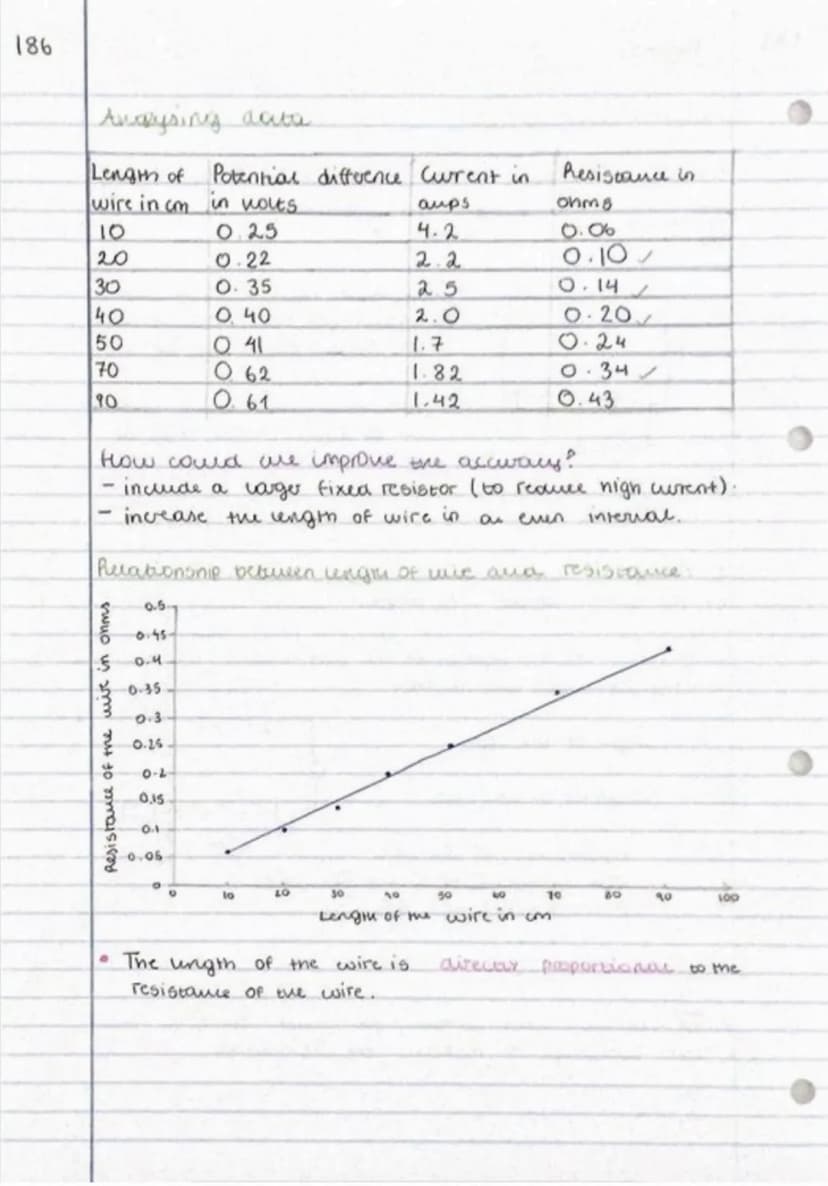
The data table shows exactly what you'd expect - as wire length increases, so does resistance. Notice how the 10cm reading looks dodgy compared to the others? That's why you need multiple measurements to spot anomalies.
The graph reveals a directly proportional relationship between length and resistance. This means if you double the length, you double the resistance - dead useful for predictions!
To improve accuracy, chuck in a fixed resistor to reduce current, and use consistent length intervals (like 10cm steps). This gives cleaner data and safer working conditions.
Top Tip: Always plot your results on a graph - it makes patterns obvious and helps you spot rogue readings instantly.
3
of 5
Designing Better Experiments
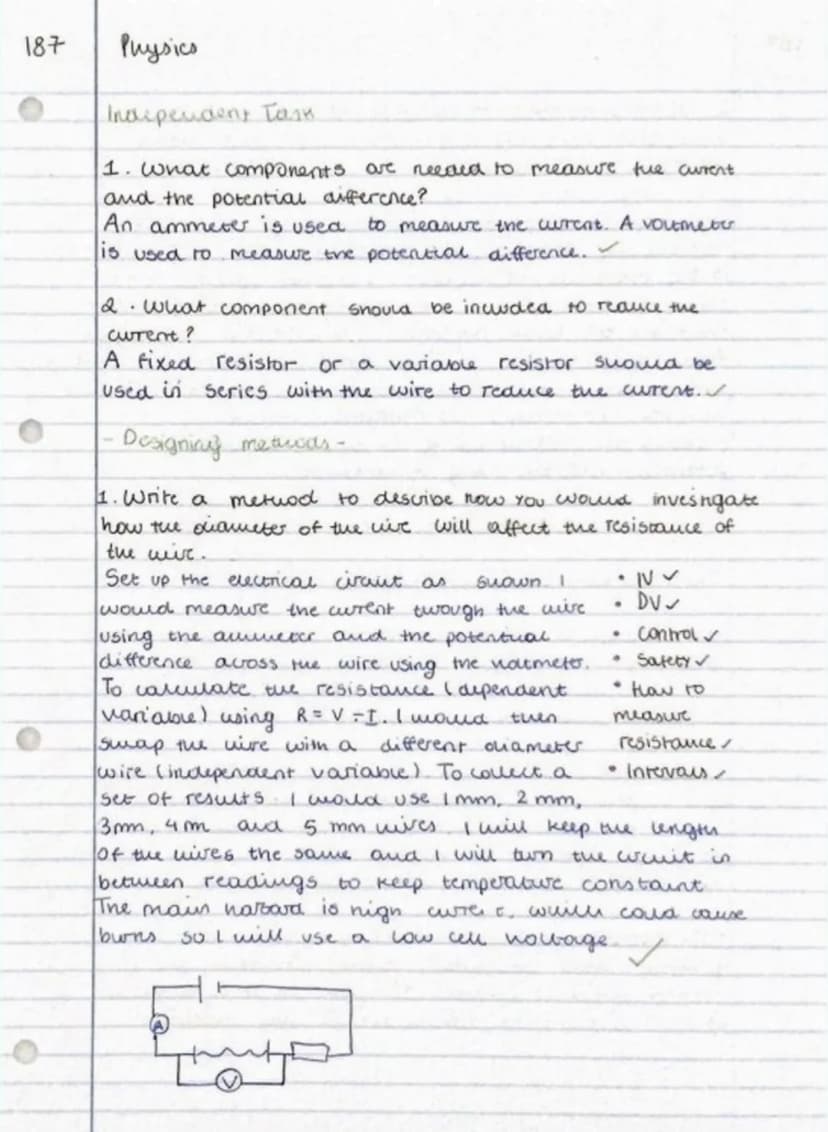
When investigating wire diameter, your method needs to be systematic. Use the same circuit setup, but swap wires of different thicknesses (1mm, 2mm, 3mm, etc.) while keeping length constant.
Circuit components are straightforward: an ammeter measures current, a voltmeter measures potential difference, and a variable resistor controls current flow. Turn the circuit off between readings to prevent heating.
Safety remains crucial - high current causes burns and can melt thin wires. Always use low voltage and consider adding protective resistors to your circuit.
Pro Method: Write down your control variables first - it'll stop you forgetting important factors like wire material and temperature.
4
of 5
What Actually Affects Resistance
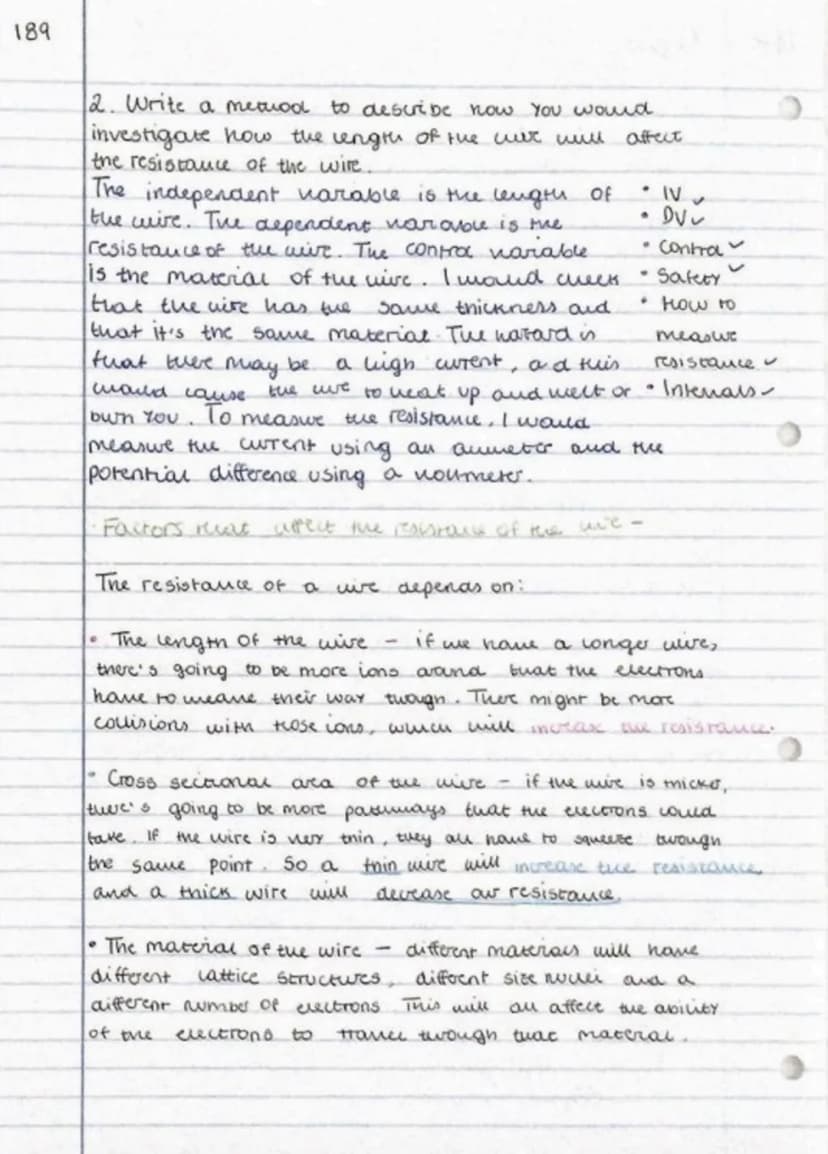
Wire length matters because electrons have to weave through more ions in longer wires, causing more collisions and higher resistance. It's like trying to run through a longer crowd - more obstacles mean slower progress.
Cross-sectional area works oppositely - thicker wires give electrons more pathways, reducing resistance. Think of it as multiple lanes on a motorway versus a single country road.
Material type affects resistance because different metals have varying lattice structures and electron availability. Temperature increases ion vibration, making it harder for electrons to pass through and boosting resistance.
Memory Trick: Remember "LTMT" - Length and Temperature increase resistance, while Material and Thickness depend on the specific situation.
5
of 5
Fuses: Safety in Action
Fuses are basically controlled weak points in circuits - they're designed to fail first when current gets dangerously high. Inside each fuse is a thin wire that melts at a specific current, instantly breaking the circuit.
This protection mechanism saves expensive appliances and prevents fires. When the fuse wire melts, electricity stops flowing completely, keeping you and your devices safe.
Fuses come in different ratings for different applications - a 3A fuse protects smaller devices, while 13A fuses handle higher-power appliances like kettles and heaters.
Real-world Connection: Every plug in your house has a fuse - next time one "blows," you'll know it's actually doing its job protecting you!
We thought you’d never ask...
What is the Knowunity AI companion?
Our AI companion is specifically built for the needs of students. Based on the millions of content pieces we have on the platform we can provide truly meaningful and relevant answers to students. But its not only about answers, the companion is even more about guiding students through their daily learning challenges, with personalised study plans, quizzes or content pieces in the chat and 100% personalisation based on the students skills and developments.
Where can I download the Knowunity app?
You can download the app in the Google Play Store and in the Apple App Store.
Is Knowunity really free of charge?
That's right! Enjoy free access to study content, connect with fellow students, and get instant help – all at your fingertips.
Similar Content
Most popular content: Resistance
9PhysicsElectricity Fundamentals
Comprehensive GCSE AQA Physics notes covering key concepts of electricity, including series and parallel circuits, power calculations, resistance, electrostatics, and the National Grid. Ideal for students preparing for exams, this resource provides clear explanations and essential formulas.
116,066567
PhysicsElectricity & Energy Concepts
Explore key concepts in electricity and energy, including resistance, Ohm's Law, energy resources, and the principles of circuits. This summary covers essential topics for GCSE combined science AQA Trilogy, providing a clear understanding of how electrical systems operate and the conservation of energy. Ideal for exam preparation and revision.
93,22348
PhysicsElectricity Concepts Overview
Explore key concepts in electricity with this comprehensive summary, covering circuit analysis, resistance, series and parallel circuits, and essential equations. Ideal for GCSE AQA Physics students preparing for exams. Understand the principles of electric current, potential difference, and the National Grid.
92,11745
PhysicsWire Resistance Experiment
Explore the relationship between wire length and resistance in this practical physics experiment. Learn how to set up the circuit, measure current and voltage, and calculate resistance using Ohm's Law. This summary covers key variables affecting resistance, including temperature, thickness, and material. Ideal for students preparing for practical assessments.
102551
PhysicsUnderstanding Resistance in Circuits
Explore the concept of resistance in electrical circuits, including Ohm's Law, series circuits, and practical measurement techniques. This summary provides essential insights for Edexcel Physics IGCSE 9-1 students, focusing on calculating resistance and its impact on current flow.
943611
PhysicsPhysics Practical Experiments
Explore essential physics practicals including specific heat capacity, energy transfers, and resistance measurements. This resource covers detailed methods for conducting experiments, analyzing current-voltage characteristics, and calculating specific heat capacity. Ideal for students preparing for exams or seeking to understand core physics concepts.
92248
PhysicsElectricity Concepts Overview
Comprehensive revision notes covering key concepts in electricity for AQA GCSE Physics, including series and parallel circuits, Ohm's Law, resistance, and circuit symbols. Ideal for higher tier students preparing for Paper 1. Understand the behavior of components like filament lamps, LDRs, and diodes, and master the principles of electric current and resistance.
111285
PhysicsElectric Circuits Overview
Explore the fundamentals of electric circuits, including Ohmic and non-Ohmic behavior, resistance, and Ohm's Law. This summary covers key concepts such as potential difference, current flow, and practical equations for circuit analysis. Ideal for AQA Combined Science students preparing for exams.
114117
PhysicsFundamentals of Electricity
Explore key concepts in electricity, including current, resistance, voltage, and circuit types. This summary covers essential formulas, circuit symbols, and the differences between series and parallel circuits, making it ideal for AQA Triple Physics students preparing for exams.
113,249140
Most popular content in Physics
9PhysicsForces and Motion Overview
Explore key concepts in Forces and Motion, including Hooke's Law, velocity, acceleration, and the principles of moments. This summary covers essential topics such as the relationship between force and extension, terminal velocity, and the impact of safety devices in physics. Ideal for AQA Physics Unit 5 revision.
109,190872
G
PhysicsGCSE Physics - Energy stores and Systems
Pl-Energy topic to revise for GCSE
101,3742
C
PhysicsConservation of energy- energy types and stores
Build a strong foundation in physics with these easy flashcards covering key concepts and principles.
96391
PhysicsPhysics Paper 2 Essentials
Master key concepts for AQA Combined Physics Paper 2, including electromagnetic waves, mechanics, forces, and motion. This comprehensive summary covers essential topics like wave properties, Newton's laws, and the motor effect, ensuring you're well-prepared for your exam.
1116,072940
PhysicsGCSE Physics Practical Experiments
Explore essential GCSE Physics practicals for AQA, covering key concepts such as Hooke's Law, wave properties, thermal insulation, and electrical circuits. This comprehensive guide includes step-by-step procedures, variables, and safety considerations for each experiment, ensuring a thorough understanding of practical applications in physics.
1011,409477
P
PhysicsPhysics Made Easy: Essential Concepts for Grade 10 Students
Master the fundamentals of physics with this comprehensive flashcard set designed specifically for grade 10 students. Learn key concepts and principles in an easy and engaging way!
104531
Physicsphysics paper 2 foundation notes
aqa combined science physics paper 2 foundation notes
101,32938
PhysicsPhysics paper 2 notes
physics aqa gcse paper 2 combined higher notes
101,23911
P
PhysicsPhysics Quiz - Current, Charge and Power
AQA physics quiz.
111,0252
Most popular content
9 Sociology
Sociology of Education Overview
Explore comprehensive A-Level Sociology notes on the education system, covering key theories, policies, and sociological perspectives. This resource includes insights on marketisation, gender roles, cultural deprivation, and educational inequalities, providing a thorough understanding of how education shapes social stratification and individual achievement. Ideal for exam preparation and in-depth study.
12102,8693,040
SociologySociology of Families: Comprehensive Revision
Dive into an extensive overview of family dynamics, perspectives, and patterns in sociology. This resource covers key concepts such as family diversity, gender roles, marriage, and the impact of social policies on family structures. Perfect for A-Level Sociology students preparing for Paper 2.
1273,6612,307
CriminologyCriminology: Crime & Punishment Overview
Comprehensive mindmaps covering key concepts in the Crime and Punishment topic for WJEC Criminology Unit 4. This resource includes detailed insights into the Criminal Justice System, crime prevention strategies, sentencing models, and the roles of various agencies. Ideal for A-Level revision, ensuring you grasp essential theories and legislative processes to excel in your exams.
1254,8691,059
SociologyComprehensive Crime & Deviance Overview
Explore an extensive revision of crime and deviance topics, including theories, types of crime, and the impact of media. This resource covers key concepts such as Marxism, functionalism, gender and crime, and the influence of globalization on criminal behavior. Ideal for students seeking a thorough understanding of criminology and its various theories. Type: Full Topic Revision.
1251,6541,399
C
 Biology
Cell Biology and Cell structure
cell structures
93,2470
 English Literature
An Inspector Calls: Character Insights
Explore in-depth analysis and key quotes for characters in J.B. Priestley's 'An Inspector Calls'. This resource covers Gerald Croft, Inspector Goole, Sheila Birling, Mrs. Birling, Eric Birling, and Eva Smith, focusing on themes of class, gender roles, and social responsibility. Ideal for students aiming for Grade 8 and above.
1025,429907
CriminologyWJEC Unit 4 Criminology
Criminology unit 4 detailed revision note
127,151125
CriminologyCriminology Theories Overview
Explore key criminology theories and their implications on crime and deviance. This comprehensive summary covers biological, psychological, and sociological perspectives, including labelling theory, right realism, and the impact of social campaigns on policy development. Ideal for A-Level criminology students seeking to understand the complexities of criminal behaviour and the factors influencing crime prevention strategies.
129,760210
English LiteratureRomeo and Juliet: Key themes
Key Romeo and Juliet themes and analysed quotes
106,708198
Can't find what you're looking for? Explore other subjects.
Students love us — and so will you.
4.6/5App Store
4.7/5Google Play
The app is very easy to use and well designed. I have found everything I was looking for so far and have been able to learn a lot from the presentations! I will definitely use the app for a class assignment! And of course it also helps a lot as an inspiration.
Stefan SiOS user
This app is really great. There are so many study notes and help [...]. My problem subject is French, for example, and the app has so many options for help. Thanks to this app, I have improved my French. I would recommend it to anyone.
Samantha KlichAndroid user
Wow, I am really amazed. I just tried the app because I've seen it advertised many times and was absolutely stunned. This app is THE HELP you want for school and above all, it offers so many things, such as workouts and fact sheets, which have been VERY helpful to me personally.
AnnaiOS user
Physics117 views·Updated Jun 24, 2026·5 pagesResistance of a Wire: GCSE Study Guide
Ever wondered why some wires heat up more than others, or how your phone charger doesn't explode when there's a power surge? Understanding resistance in wires is crucial for electrical safety and explains how electricity behaves in different materials.
1
of 5
Sign up to see the content. It's free!
- Access to all documents
- Improve your grades
- Join milions of students
Finding Resistance Using Ohm's Law
Working out a wire's resistance is actually dead simple once you know the formula. You just need to rearrange Ohm's law to get R = V/I, where V is potential difference (in volts) and I is current (in amps).
Setting up the experiment requires a basic circuit with your unknown resistor, plus a variable resistor to give you multiple readings. The variable resistor is brilliant because it lets you change the current and get loads of different measurements.
Your hypothesis should predict that longer wires have higher resistance. Remember to identify your variables clearly: length is your independent variable, resistance is dependent, and you must keep temperature, material, and wire thickness constant.
Safety Alert: High current can cause burns! Always use low voltage or add extra resistance to keep current manageable.
2
of 5Sign up to see the content. It's free!
- Access to all documents
- Improve your grades
- Join milions of students
Analysing Your Results
The data table shows exactly what you'd expect - as wire length increases, so does resistance. Notice how the 10cm reading looks dodgy compared to the others? That's why you need multiple measurements to spot anomalies.
The graph reveals a directly proportional relationship between length and resistance. This means if you double the length, you double the resistance - dead useful for predictions!
To improve accuracy, chuck in a fixed resistor to reduce current, and use consistent length intervals (like 10cm steps). This gives cleaner data and safer working conditions.
Top Tip: Always plot your results on a graph - it makes patterns obvious and helps you spot rogue readings instantly.
3
of 5Sign up to see the content. It's free!
- Access to all documents
- Improve your grades
- Join milions of students
Designing Better Experiments
When investigating wire diameter, your method needs to be systematic. Use the same circuit setup, but swap wires of different thicknesses (1mm, 2mm, 3mm, etc.) while keeping length constant.
Circuit components are straightforward: an ammeter measures current, a voltmeter measures potential difference, and a variable resistor controls current flow. Turn the circuit off between readings to prevent heating.
Safety remains crucial - high current causes burns and can melt thin wires. Always use low voltage and consider adding protective resistors to your circuit.
Pro Method: Write down your control variables first - it'll stop you forgetting important factors like wire material and temperature.
4
of 5Sign up to see the content. It's free!
- Access to all documents
- Improve your grades
- Join milions of students
What Actually Affects Resistance
Wire length matters because electrons have to weave through more ions in longer wires, causing more collisions and higher resistance. It's like trying to run through a longer crowd - more obstacles mean slower progress.
Cross-sectional area works oppositely - thicker wires give electrons more pathways, reducing resistance. Think of it as multiple lanes on a motorway versus a single country road.
Material type affects resistance because different metals have varying lattice structures and electron availability. Temperature increases ion vibration, making it harder for electrons to pass through and boosting resistance.
Memory Trick: Remember "LTMT" - Length and Temperature increase resistance, while Material and Thickness depend on the specific situation.
5
of 5Sign up to see the content. It's free!
- Access to all documents
- Improve your grades
- Join milions of students
Fuses: Safety in Action
Fuses are basically controlled weak points in circuits - they're designed to fail first when current gets dangerously high. Inside each fuse is a thin wire that melts at a specific current, instantly breaking the circuit.
This protection mechanism saves expensive appliances and prevents fires. When the fuse wire melts, electricity stops flowing completely, keeping you and your devices safe.
Fuses come in different ratings for different applications - a 3A fuse protects smaller devices, while 13A fuses handle higher-power appliances like kettles and heaters.
Real-world Connection: Every plug in your house has a fuse - next time one "blows," you'll know it's actually doing its job protecting you!
We thought you’d never ask...
What is the Knowunity AI companion?
Our AI companion is specifically built for the needs of students. Based on the millions of content pieces we have on the platform we can provide truly meaningful and relevant answers to students. But its not only about answers, the companion is even more about guiding students through their daily learning challenges, with personalised study plans, quizzes or content pieces in the chat and 100% personalisation based on the students skills and developments.
Where can I download the Knowunity app?
You can download the app in the Google Play Store and in the Apple App Store.
Is Knowunity really free of charge?
That's right! Enjoy free access to study content, connect with fellow students, and get instant help – all at your fingertips.
Similar Content
Most popular content: Resistance
9PhysicsElectricity Fundamentals
Comprehensive GCSE AQA Physics notes covering key concepts of electricity, including series and parallel circuits, power calculations, resistance, electrostatics, and the National Grid. Ideal for students preparing for exams, this resource provides clear explanations and essential formulas.
116,066567
PhysicsElectricity & Energy Concepts
Explore key concepts in electricity and energy, including resistance, Ohm's Law, energy resources, and the principles of circuits. This summary covers essential topics for GCSE combined science AQA Trilogy, providing a clear understanding of how electrical systems operate and the conservation of energy. Ideal for exam preparation and revision.
93,22348
PhysicsElectricity Concepts Overview
Explore key concepts in electricity with this comprehensive summary, covering circuit analysis, resistance, series and parallel circuits, and essential equations. Ideal for GCSE AQA Physics students preparing for exams. Understand the principles of electric current, potential difference, and the National Grid.
92,11745
PhysicsWire Resistance Experiment
Explore the relationship between wire length and resistance in this practical physics experiment. Learn how to set up the circuit, measure current and voltage, and calculate resistance using Ohm's Law. This summary covers key variables affecting resistance, including temperature, thickness, and material. Ideal for students preparing for practical assessments.
102551
PhysicsUnderstanding Resistance in Circuits
Explore the concept of resistance in electrical circuits, including Ohm's Law, series circuits, and practical measurement techniques. This summary provides essential insights for Edexcel Physics IGCSE 9-1 students, focusing on calculating resistance and its impact on current flow.
943611
PhysicsPhysics Practical Experiments
Explore essential physics practicals including specific heat capacity, energy transfers, and resistance measurements. This resource covers detailed methods for conducting experiments, analyzing current-voltage characteristics, and calculating specific heat capacity. Ideal for students preparing for exams or seeking to understand core physics concepts.
92248
PhysicsElectricity Concepts Overview
Comprehensive revision notes covering key concepts in electricity for AQA GCSE Physics, including series and parallel circuits, Ohm's Law, resistance, and circuit symbols. Ideal for higher tier students preparing for Paper 1. Understand the behavior of components like filament lamps, LDRs, and diodes, and master the principles of electric current and resistance.
111285
PhysicsElectric Circuits Overview
Explore the fundamentals of electric circuits, including Ohmic and non-Ohmic behavior, resistance, and Ohm's Law. This summary covers key concepts such as potential difference, current flow, and practical equations for circuit analysis. Ideal for AQA Combined Science students preparing for exams.
114117
PhysicsFundamentals of Electricity
Explore key concepts in electricity, including current, resistance, voltage, and circuit types. This summary covers essential formulas, circuit symbols, and the differences between series and parallel circuits, making it ideal for AQA Triple Physics students preparing for exams.
113,249140
Most popular content in Physics
9PhysicsForces and Motion Overview
Explore key concepts in Forces and Motion, including Hooke's Law, velocity, acceleration, and the principles of moments. This summary covers essential topics such as the relationship between force and extension, terminal velocity, and the impact of safety devices in physics. Ideal for AQA Physics Unit 5 revision.
109,190872
G
PhysicsGCSE Physics - Energy stores and Systems
Pl-Energy topic to revise for GCSE
101,3742
C
PhysicsConservation of energy- energy types and stores
Build a strong foundation in physics with these easy flashcards covering key concepts and principles.
96391
PhysicsPhysics Paper 2 Essentials
Master key concepts for AQA Combined Physics Paper 2, including electromagnetic waves, mechanics, forces, and motion. This comprehensive summary covers essential topics like wave properties, Newton's laws, and the motor effect, ensuring you're well-prepared for your exam.
1116,072940
PhysicsGCSE Physics Practical Experiments
Explore essential GCSE Physics practicals for AQA, covering key concepts such as Hooke's Law, wave properties, thermal insulation, and electrical circuits. This comprehensive guide includes step-by-step procedures, variables, and safety considerations for each experiment, ensuring a thorough understanding of practical applications in physics.
1011,409477
P
PhysicsPhysics Made Easy: Essential Concepts for Grade 10 Students
Master the fundamentals of physics with this comprehensive flashcard set designed specifically for grade 10 students. Learn key concepts and principles in an easy and engaging way!
104531
Physicsphysics paper 2 foundation notes
aqa combined science physics paper 2 foundation notes
101,32938
PhysicsPhysics paper 2 notes
physics aqa gcse paper 2 combined higher notes
101,23911
P
PhysicsPhysics Quiz - Current, Charge and Power
AQA physics quiz.
111,0252
Most popular content
9SociologySociology of Education Overview
Explore comprehensive A-Level Sociology notes on the education system, covering key theories, policies, and sociological perspectives. This resource includes insights on marketisation, gender roles, cultural deprivation, and educational inequalities, providing a thorough understanding of how education shapes social stratification and individual achievement. Ideal for exam preparation and in-depth study.
12102,8693,040
SociologySociology of Families: Comprehensive Revision
Dive into an extensive overview of family dynamics, perspectives, and patterns in sociology. This resource covers key concepts such as family diversity, gender roles, marriage, and the impact of social policies on family structures. Perfect for A-Level Sociology students preparing for Paper 2.
1273,6612,307
CriminologyCriminology: Crime & Punishment Overview
Comprehensive mindmaps covering key concepts in the Crime and Punishment topic for WJEC Criminology Unit 4. This resource includes detailed insights into the Criminal Justice System, crime prevention strategies, sentencing models, and the roles of various agencies. Ideal for A-Level revision, ensuring you grasp essential theories and legislative processes to excel in your exams.
1254,8691,059
SociologyComprehensive Crime & Deviance Overview
Explore an extensive revision of crime and deviance topics, including theories, types of crime, and the impact of media. This resource covers key concepts such as Marxism, functionalism, gender and crime, and the influence of globalization on criminal behavior. Ideal for students seeking a thorough understanding of criminology and its various theories. Type: Full Topic Revision.
1251,6541,399
C
BiologyCell Biology and Cell structure
cell structures
93,2470
English LiteratureAn Inspector Calls: Character Insights
Explore in-depth analysis and key quotes for characters in J.B. Priestley's 'An Inspector Calls'. This resource covers Gerald Croft, Inspector Goole, Sheila Birling, Mrs. Birling, Eric Birling, and Eva Smith, focusing on themes of class, gender roles, and social responsibility. Ideal for students aiming for Grade 8 and above.
1025,429907
CriminologyWJEC Unit 4 Criminology
Criminology unit 4 detailed revision note
127,151125
CriminologyCriminology Theories Overview
Explore key criminology theories and their implications on crime and deviance. This comprehensive summary covers biological, psychological, and sociological perspectives, including labelling theory, right realism, and the impact of social campaigns on policy development. Ideal for A-Level criminology students seeking to understand the complexities of criminal behaviour and the factors influencing crime prevention strategies.
129,760210
English LiteratureRomeo and Juliet: Key themes
Key Romeo and Juliet themes and analysed quotes
106,708198
Can't find what you're looking for? Explore other subjects.
Students love us — and so will you.
4.6/5App Store
4.7/5Google Play
The app is very easy to use and well designed. I have found everything I was looking for so far and have been able to learn a lot from the presentations! I will definitely use the app for a class assignment! And of course it also helps a lot as an inspiration.
Stefan SiOS user
This app is really great. There are so many study notes and help [...]. My problem subject is French, for example, and the app has so many options for help. Thanks to this app, I have improved my French. I would recommend it to anyone.
Samantha KlichAndroid user
Wow, I am really amazed. I just tried the app because I've seen it advertised many times and was absolutely stunned. This app is THE HELP you want for school and above all, it offers so many things, such as workouts and fact sheets, which have been VERY helpful to me personally.
AnnaiOS user