
Electromagnetic waves form the foundation of our technological world and...
 Physics62 views·Updated Jun 18, 2026·2 pages
Understanding Light and Electromagnetic Waves

Sarah @sarahlovestostudy
1
of 2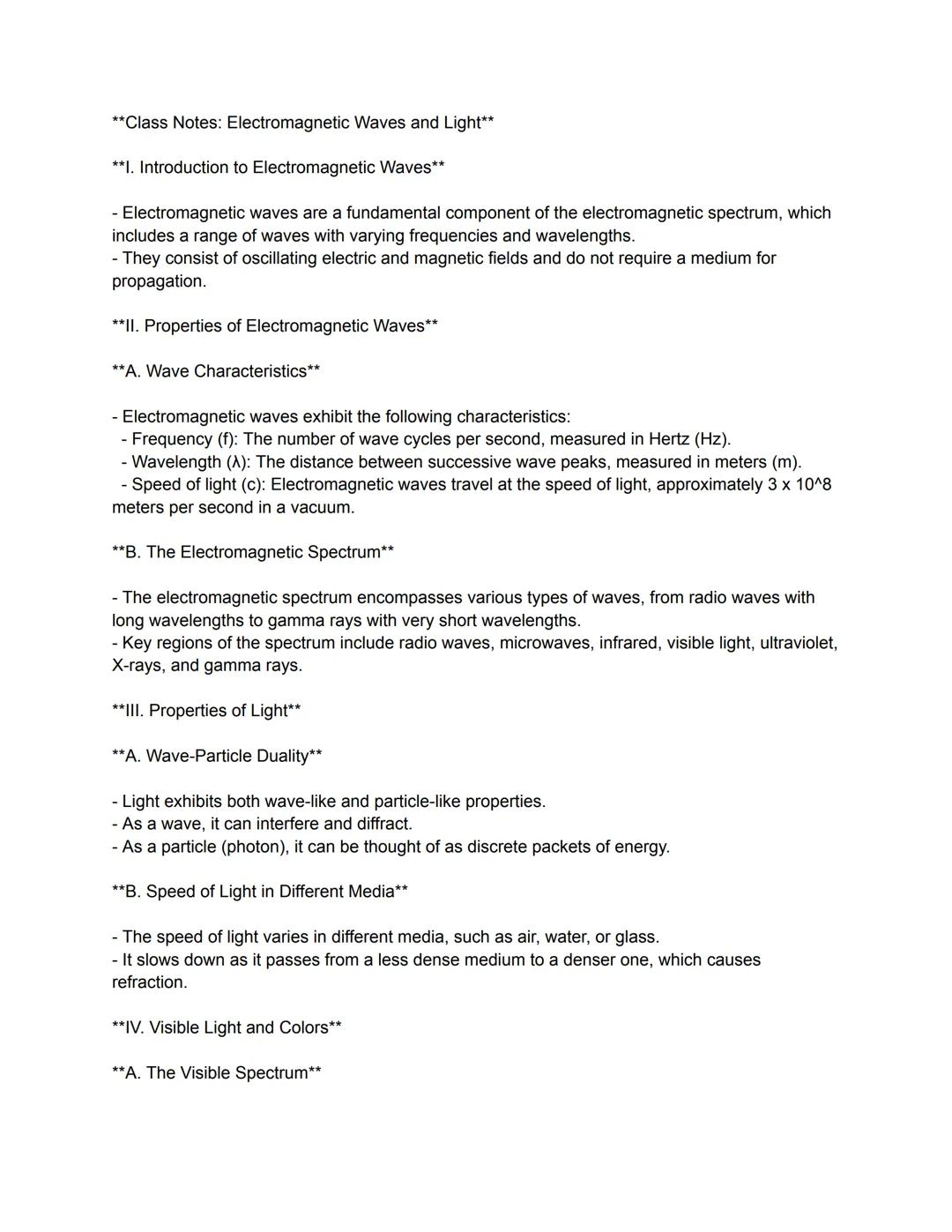
Electromagnetic Waves Fundamentals
Electromagnetic waves are fascinating energy forms that don't need a medium to travel—they can move through the vacuum of space at the incredible speed of 3 × 10^8 meters per second. Each wave has two key characteristics: frequency (measured in Hertz), which is how many wave cycles pass per second, and wavelength (measured in meters), the distance between successive wave peaks.
The electromagnetic spectrum organizes these waves from longest to shortest wavelength: radio waves, microwaves, infrared, visible light, ultraviolet, X-rays, and gamma rays. Though they all travel at the same speed in a vacuum, their effects and uses vary dramatically based on their energy levels.
Light itself exhibits a fascinating wave-particle duality—behaving as both a wave that can interfere and diffract, and as discrete particles called photons. When light travels between different materials like air to water, it slows down and bends, which is called refraction.
Did you know? The speed of light in a vacuum is the universe's speed limit! Nothing with mass can travel faster than light, making those 300,000 kilometers per second the cosmic speed limit for everything in our universe.
2
of 2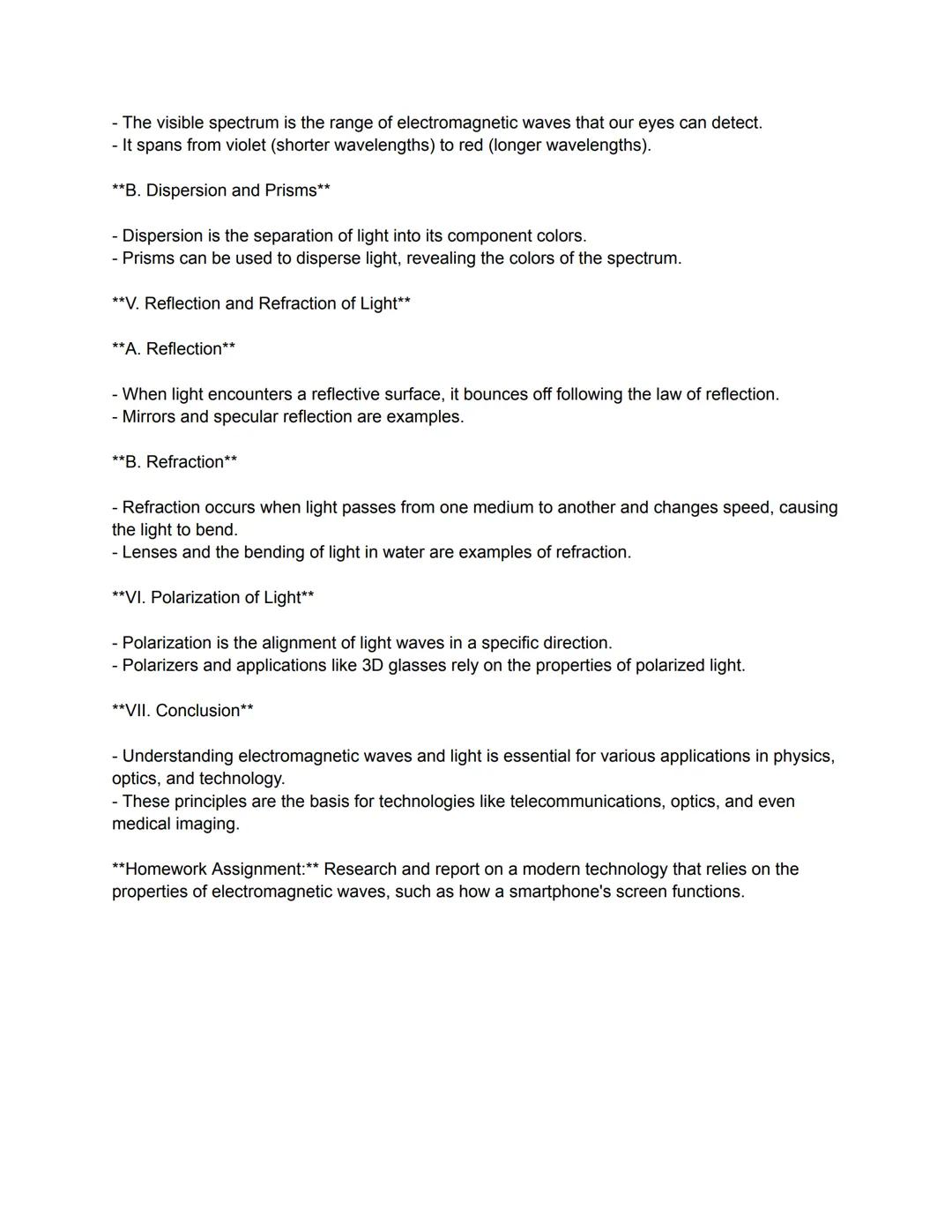
Light, Color, and Optical Phenomena
The visible spectrum represents just a tiny slice of the electromagnetic spectrum—the wavelengths our eyes can detect. This range spans from violet (shorter wavelengths around 380 nm) to red (longer wavelengths around 750 nm), with all the colors of the rainbow in between.
When white light passes through a prism, it undergoes dispersion, separating into its component colors. This happens because different wavelengths bend at slightly different angles when they refract through materials like glass, creating the familiar rainbow effect.
Light interacts with materials through reflection and refraction. Reflection occurs when light bounces off surfaces according to the principle that the angle of incidence equals the angle of reflection. Refraction happens when light changes speed as it passes between media, causing it to bend—this is why a straw appears bent in a glass of water.
Polarization refers to the alignment of light waves in specific directions. While natural light vibrates in all directions perpendicular to its path, polarized light vibrates in just one plane. This property is used in technologies like LCD screens, polarized sunglasses, and 3D movie glasses.
Try this! Look at a digital screen through polarized sunglasses, then rotate the glasses. You'll notice the screen appears to darken or brighten as you turn the glasses, demonstrating how polarized light works!
We thought you’d never ask...
What is the Knowunity AI companion?
Our AI companion is specifically built for the needs of students. Based on the millions of content pieces we have on the platform we can provide truly meaningful and relevant answers to students. But its not only about answers, the companion is even more about guiding students through their daily learning challenges, with personalised study plans, quizzes or content pieces in the chat and 100% personalisation based on the students skills and developments.
Where can I download the Knowunity app?
You can download the app in the Google Play Store and in the Apple App Store.
Is Knowunity really free of charge?
That's right! Enjoy free access to study content, connect with fellow students, and get instant help – all at your fingertips.
Similar Content
Most popular content in Physics
9P
Physicsphysical science 8th grade
test your abilities
8th1380
AP Physics 1Newton's Second Law of Motion
A detailed explanation of Concept of Newton's Second Law of Motion, Examples, Formulas, and Sample Problems with solution.
36613
Physicsmomentum and impulse
momentum, impulse, conservation of momentum
98427
PhysicsPhysics Reviewer
This is an extensive physics reviewer.
College1,49334
PhysicsSimple Machines PowerPoint
This presentation offers an explanation of simple machines and how to solve for mechanical advantage, ideal mechanical advantage, and efficiency of each machine. It also provides definitions and examples.
9th29113
F
PhysicsForce and Motion
a study set for chapter 1 of Physical Science
1875
PhysicsHonors Physics Semester Two Review Sheet
This note sheet can be used for high school students taking physics classes to study for finals, unit tests, and review.
9th29313
PhysicsContact and Non-Contact Forces
Ppt on contact and Non-Contact Forces
7th781
AP Physics 1Types of Collisions
Understanding perfectly inelastic, perfectly elastic, and other types of collisions and the conservation of momentum.
10th713
Most popular content
9O
 AP US History
Origins and Dynamics of the Columbian Exchange
Analyze the ecological and economic motivations behind the initial transfer of goods, people, and diseases between the Old and New Worlds.
9th3,1280
I
AP US HistoryIntroduction to Early Cultural Interactions
Analyze the initial social and religious encounters between Europeans, Africans, and Indigenous peoples in the colonial Americas.
9th2,7730
O
 AP World History
Origins of Ancient River Civilizations
Analyze the environmental factors and technological innovations that led to the rise of early states in Mesopotamia, Egypt, and the Indus Valley.
9th3,1870
M
AP US HistoryMotivations for European Exploration
Analyze the economic, religious, and political factors that drove European powers to the Americas during the 15th and 16th centuries.
9th1,7780
F
 AP Psychology
Foundations of Ethical Guidelines in Research
Practice the core principles of the APA ethical code including informed consent, debriefing, and the role of Institutional Review Boards.
9th1,3360
I
AP US HistoryIntroduction to Native American Societies
Examine the diverse social, political, and economic structures of North American indigenous groups prior to European contact.
9th1,1100
I
 AP Biology
Introduction to Biological Elements of Life
Practice identifying the essential elements including carbon, nitrogen, phosphorus, and sulfur that compose biological macromolecules.
9th1,7390
I
AP US HistoryIntroduction to the Spanish Encomienda System
Explore the fundamental economic and social structures of the Spanish colonial system, focusing on the encomienda and the casta social hierarchy.
9th8890
O
AP World HistoryOrigins and Continuity of the Byzantine Empire
Analyze the political and cultural transitions from the Roman Empire to the Byzantine Empire, focusing on the reign of Justinian I and his code.
9th1,6320
Can't find what you're looking for? Explore other subjects.
Students love us — and so will you.
4.6/5App Store
4.7/5Google Play
The app is very easy to use and well designed. I have found everything I was looking for so far and have been able to learn a lot from the presentations! I will definitely use the app for a class assignment! And of course it also helps a lot as an inspiration.
Stefan SiOS user
This app is really great. There are so many study notes and help [...]. My problem subject is French, for example, and the app has so many options for help. Thanks to this app, I have improved my French. I would recommend it to anyone.
Samantha KlichAndroid user
Wow, I am really amazed. I just tried the app because I've seen it advertised many times and was absolutely stunned. This app is THE HELP you want for school and above all, it offers so many things, such as workouts and fact sheets, which have been VERY helpful to me personally.
AnnaiOS user
Physics62 views·Updated Jun 18, 2026·2 pagesUnderstanding Light and Electromagnetic Waves
Sarah @sarahlovestostudy
Electromagnetic waves form the foundation of our technological world and natural environment. These waves, which include visible light, radio waves, and X-rays, travel through space as oscillating electric and magnetic fields. Understanding their properties helps explain everything from how we...
1
of 2
Sign up to see the content. It's free!
- Access to all documents
- Improve your grades
- Join milions of students
Electromagnetic Waves Fundamentals
Electromagnetic waves are fascinating energy forms that don't need a medium to travel—they can move through the vacuum of space at the incredible speed of 3 × 10^8 meters per second. Each wave has two key characteristics: frequency (measured in Hertz), which is how many wave cycles pass per second, and wavelength (measured in meters), the distance between successive wave peaks.
The electromagnetic spectrum organizes these waves from longest to shortest wavelength: radio waves, microwaves, infrared, visible light, ultraviolet, X-rays, and gamma rays. Though they all travel at the same speed in a vacuum, their effects and uses vary dramatically based on their energy levels.
Light itself exhibits a fascinating wave-particle duality—behaving as both a wave that can interfere and diffract, and as discrete particles called photons. When light travels between different materials like air to water, it slows down and bends, which is called refraction.
Did you know? The speed of light in a vacuum is the universe's speed limit! Nothing with mass can travel faster than light, making those 300,000 kilometers per second the cosmic speed limit for everything in our universe.
2
of 2Sign up to see the content. It's free!
- Access to all documents
- Improve your grades
- Join milions of students
Light, Color, and Optical Phenomena
The visible spectrum represents just a tiny slice of the electromagnetic spectrum—the wavelengths our eyes can detect. This range spans from violet (shorter wavelengths around 380 nm) to red (longer wavelengths around 750 nm), with all the colors of the rainbow in between.
When white light passes through a prism, it undergoes dispersion, separating into its component colors. This happens because different wavelengths bend at slightly different angles when they refract through materials like glass, creating the familiar rainbow effect.
Light interacts with materials through reflection and refraction. Reflection occurs when light bounces off surfaces according to the principle that the angle of incidence equals the angle of reflection. Refraction happens when light changes speed as it passes between media, causing it to bend—this is why a straw appears bent in a glass of water.
Polarization refers to the alignment of light waves in specific directions. While natural light vibrates in all directions perpendicular to its path, polarized light vibrates in just one plane. This property is used in technologies like LCD screens, polarized sunglasses, and 3D movie glasses.
Try this! Look at a digital screen through polarized sunglasses, then rotate the glasses. You'll notice the screen appears to darken or brighten as you turn the glasses, demonstrating how polarized light works!
We thought you’d never ask...
What is the Knowunity AI companion?
Our AI companion is specifically built for the needs of students. Based on the millions of content pieces we have on the platform we can provide truly meaningful and relevant answers to students. But its not only about answers, the companion is even more about guiding students through their daily learning challenges, with personalised study plans, quizzes or content pieces in the chat and 100% personalisation based on the students skills and developments.
Where can I download the Knowunity app?
You can download the app in the Google Play Store and in the Apple App Store.
Is Knowunity really free of charge?
That's right! Enjoy free access to study content, connect with fellow students, and get instant help – all at your fingertips.
Similar Content
Most popular content in Physics
9P
Physicsphysical science 8th grade
test your abilities
8th1380
AP Physics 1Newton's Second Law of Motion
A detailed explanation of Concept of Newton's Second Law of Motion, Examples, Formulas, and Sample Problems with solution.
36613
Physicsmomentum and impulse
momentum, impulse, conservation of momentum
98427
PhysicsPhysics Reviewer
This is an extensive physics reviewer.
College1,49334
PhysicsSimple Machines PowerPoint
This presentation offers an explanation of simple machines and how to solve for mechanical advantage, ideal mechanical advantage, and efficiency of each machine. It also provides definitions and examples.
9th29113
F
PhysicsForce and Motion
a study set for chapter 1 of Physical Science
1875
PhysicsHonors Physics Semester Two Review Sheet
This note sheet can be used for high school students taking physics classes to study for finals, unit tests, and review.
9th29313
PhysicsContact and Non-Contact Forces
Ppt on contact and Non-Contact Forces
7th781
AP Physics 1Types of Collisions
Understanding perfectly inelastic, perfectly elastic, and other types of collisions and the conservation of momentum.
10th713
Most popular content
9O
AP US HistoryOrigins and Dynamics of the Columbian Exchange
Analyze the ecological and economic motivations behind the initial transfer of goods, people, and diseases between the Old and New Worlds.
9th3,1280
I
AP US HistoryIntroduction to Early Cultural Interactions
Analyze the initial social and religious encounters between Europeans, Africans, and Indigenous peoples in the colonial Americas.
9th2,7730
O
AP World HistoryOrigins of Ancient River Civilizations
Analyze the environmental factors and technological innovations that led to the rise of early states in Mesopotamia, Egypt, and the Indus Valley.
9th3,1870
M
AP US HistoryMotivations for European Exploration
Analyze the economic, religious, and political factors that drove European powers to the Americas during the 15th and 16th centuries.
9th1,7780
F
AP PsychologyFoundations of Ethical Guidelines in Research
Practice the core principles of the APA ethical code including informed consent, debriefing, and the role of Institutional Review Boards.
9th1,3360
I
AP US HistoryIntroduction to Native American Societies
Examine the diverse social, political, and economic structures of North American indigenous groups prior to European contact.
9th1,1100
I
AP BiologyIntroduction to Biological Elements of Life
Practice identifying the essential elements including carbon, nitrogen, phosphorus, and sulfur that compose biological macromolecules.
9th1,7390
I
AP US HistoryIntroduction to the Spanish Encomienda System
Explore the fundamental economic and social structures of the Spanish colonial system, focusing on the encomienda and the casta social hierarchy.
9th8890
O
AP World HistoryOrigins and Continuity of the Byzantine Empire
Analyze the political and cultural transitions from the Roman Empire to the Byzantine Empire, focusing on the reign of Justinian I and his code.
9th1,6320
Can't find what you're looking for? Explore other subjects.
Students love us — and so will you.
4.6/5App Store
4.7/5Google Play
The app is very easy to use and well designed. I have found everything I was looking for so far and have been able to learn a lot from the presentations! I will definitely use the app for a class assignment! And of course it also helps a lot as an inspiration.
Stefan SiOS user
This app is really great. There are so many study notes and help [...]. My problem subject is French, for example, and the app has so many options for help. Thanks to this app, I have improved my French. I would recommend it to anyone.
Samantha KlichAndroid user
Wow, I am really amazed. I just tried the app because I've seen it advertised many times and was absolutely stunned. This app is THE HELP you want for school and above all, it offers so many things, such as workouts and fact sheets, which have been VERY helpful to me personally.
AnnaiOS user