
Physics experiments help us understand important scientific principles through hands-on...
 Physics754 views·Updated Jun 27, 2026·12 pages
Cool GCSE Physics Experiments: Measuring Average Speed, Hooke's Law, and Moments!
A
Aidan Devine@aidandevine_toov



1 / 10
1
of 10
Understanding GCSE Physics Practical Experiments: Core Investigations
The study of physics requires hands-on experimentation to truly grasp fundamental concepts. These prescribed practicals form an essential component of understanding physical phenomena and scientific methodology.
Definition: Prescribed practicals are standardized experiments that demonstrate key physics principles and develop crucial investigative skills.
These investigations include measuring average speed on slopes, exploring Hooke's law with springs, and investigating moments. Each practical requires careful attention to safety protocols and precise measurement techniques.
When conducting any physics practical, accuracy and reliability are paramount. This means taking multiple readings, controlling variables effectively, and understanding potential sources of error in measurements.
2
of 10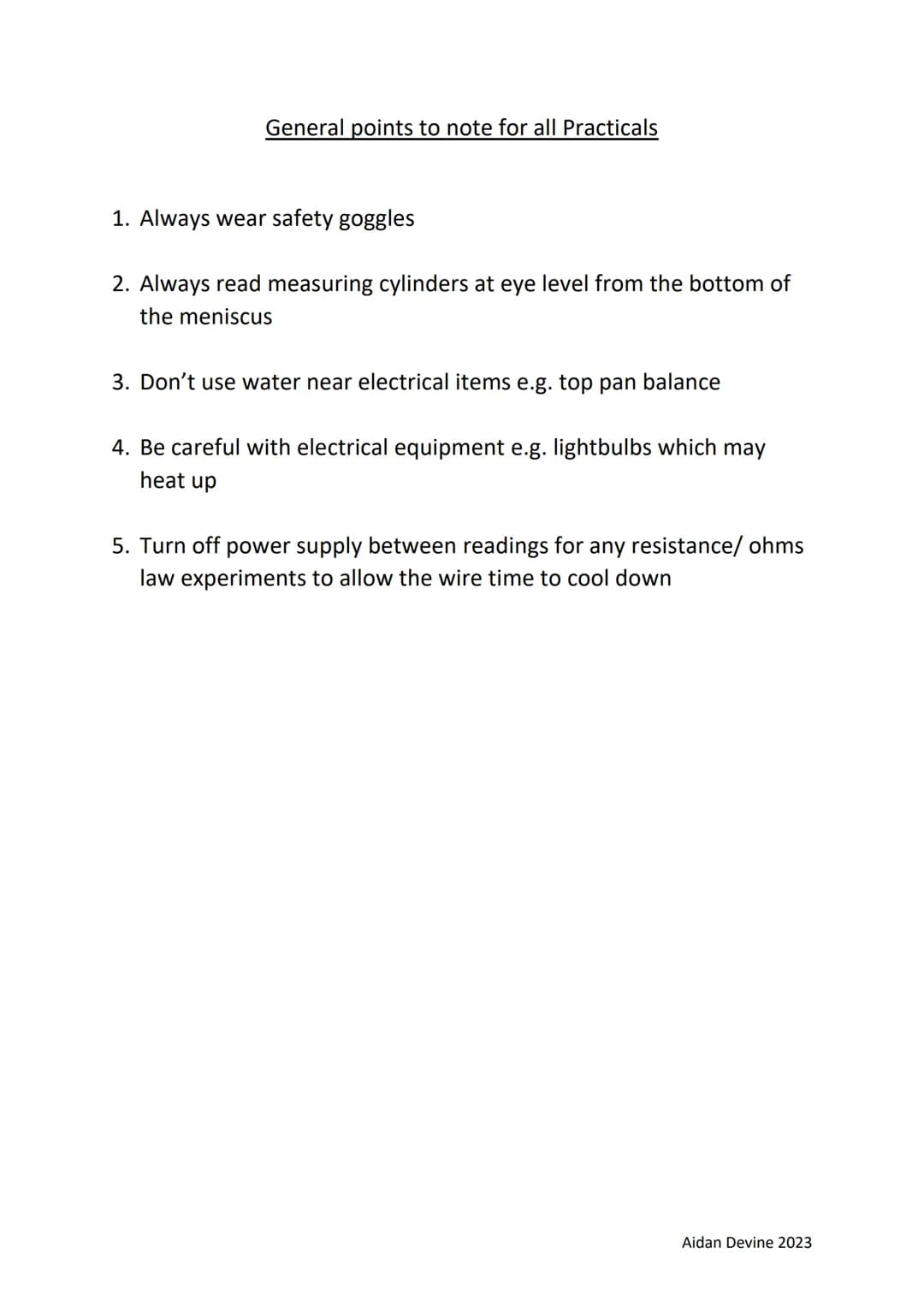
Safety and Measurement Protocols in Physics Experiments
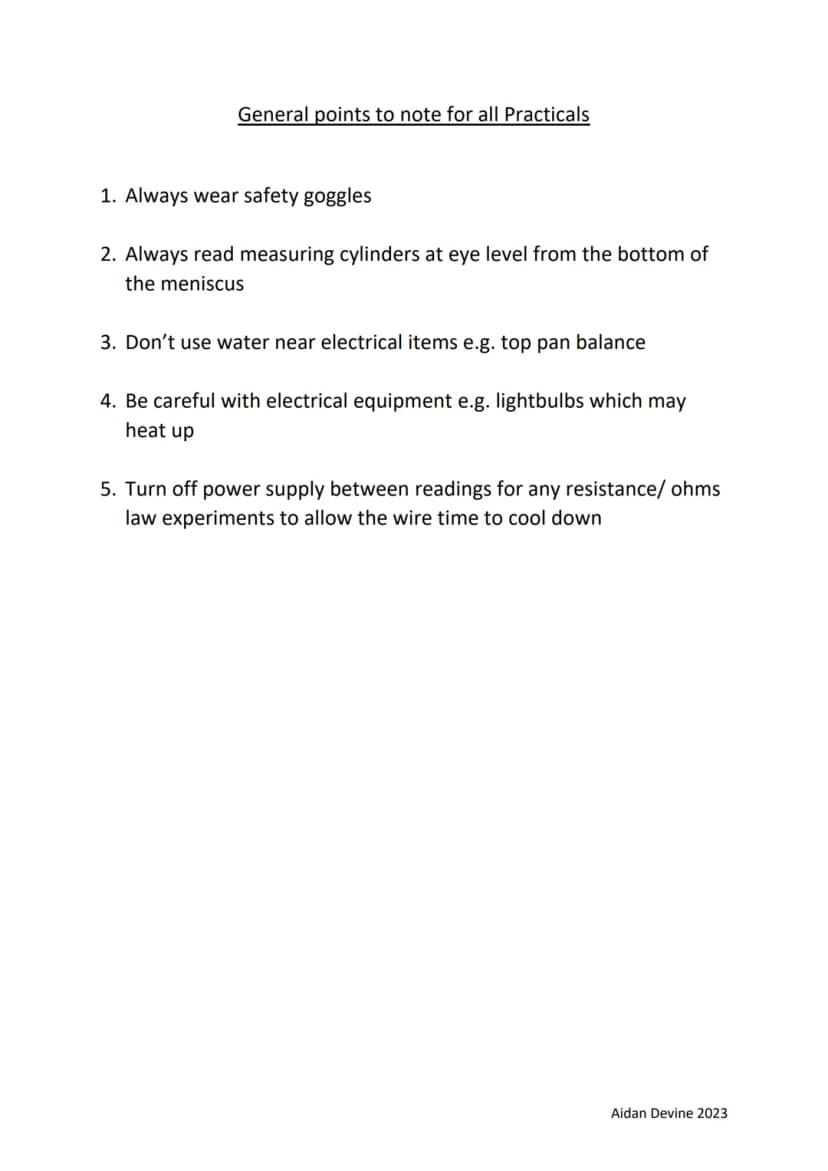
Laboratory safety forms the foundation of successful physics experiments. Proper protective equipment and careful handling of apparatus ensure both accurate results and student safety.
Highlight: Always wear safety goggles during experiments and read measuring cylinders at eye level from the bottom of the meniscus for accurate measurements.
When working with electrical equipment, special precautions must be taken. This includes keeping water away from electrical components and allowing sufficient cooling time between readings for resistance experiments.
Careful observation of measurement techniques ensures reliable data collection. This includes proper use of measuring cylinders, careful timing, and appropriate handling of sensitive equipment.
3
of 10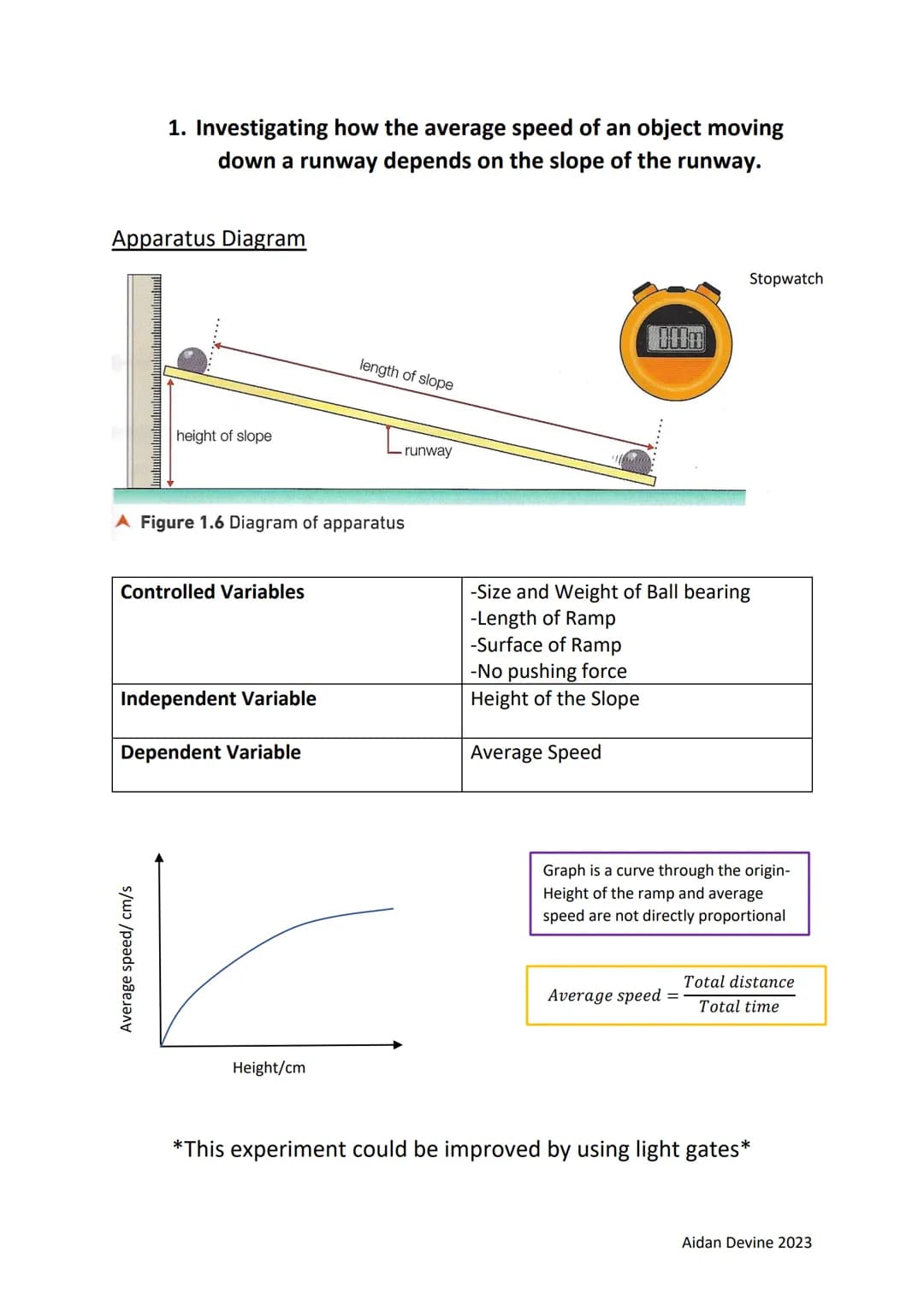
GCSE physics experiments for measuring average speed on slopes
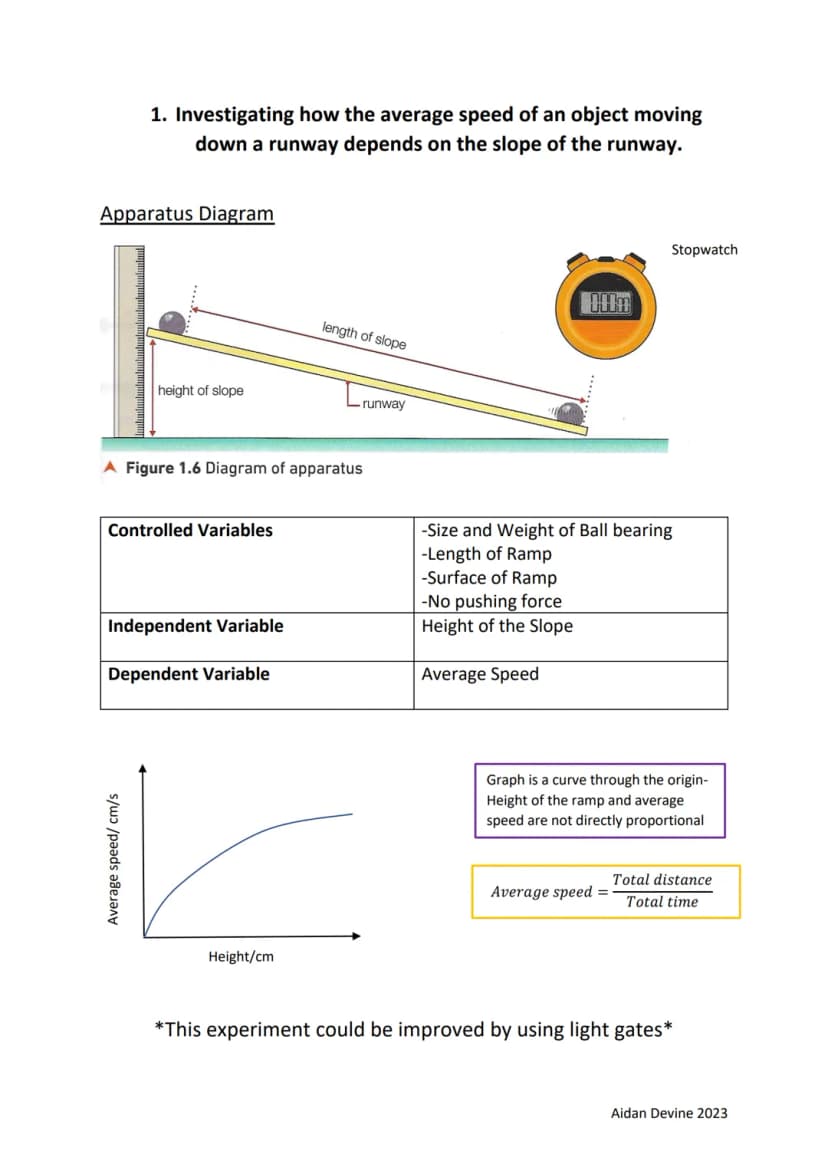
This fundamental investigation explores the relationship between slope height and average speed of a rolling object. The experiment requires precise control of variables and accurate timing.
Example: A ball bearing rolling down a runway demonstrates how gravitational potential energy converts to kinetic energy, affecting average speed.
Key controlled variables include the ball bearing's size and weight, runway length, and surface conditions. The independent variable is the slope height, while the dependent variable is the average speed.
The relationship between height and speed produces a curved graph through the origin, indicating that the variables are not directly proportional. Light gates can improve measurement accuracy compared to manual timing.
4
of 10
Helical spring Hooke's law experiment steps
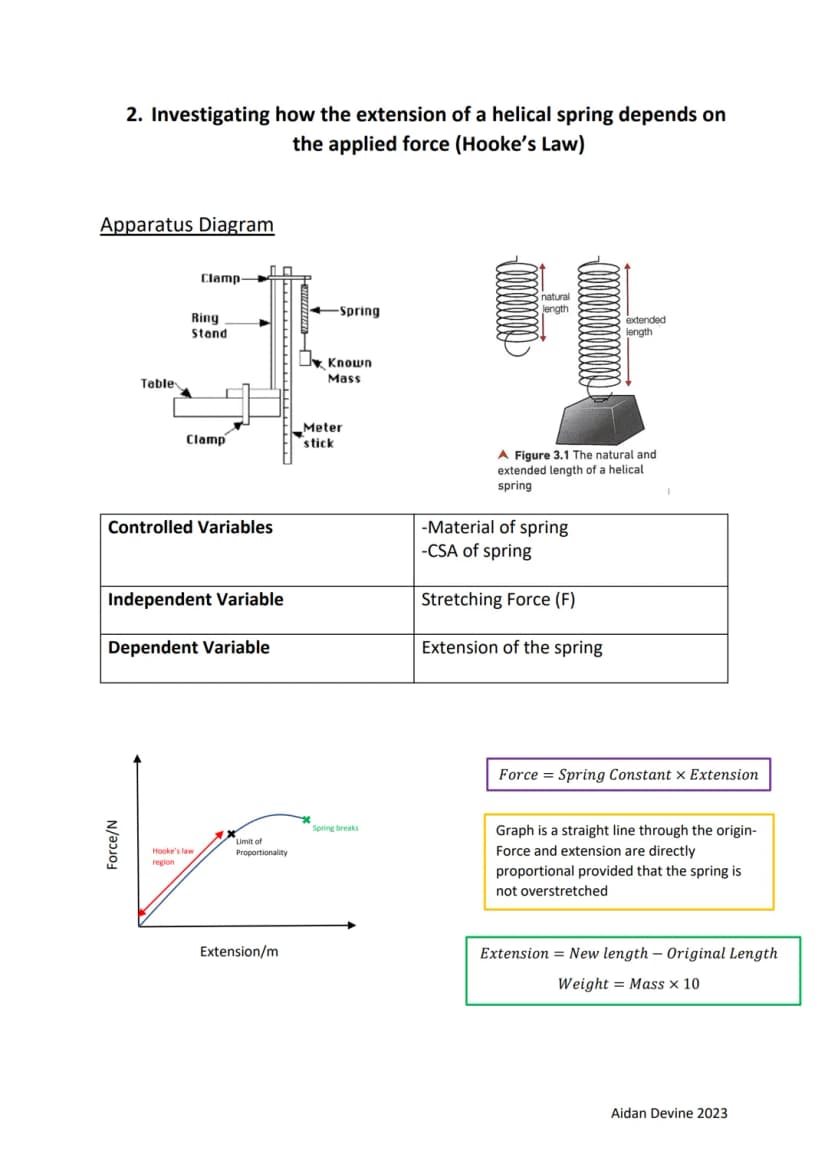
This investigation demonstrates the relationship between force and extension in elastic materials. The experiment explores fundamental principles of elasticity and material behavior.
Vocabulary: Hooke's Law states that the extension of a spring is directly proportional to the applied force, within the elastic limit.
The experimental setup requires careful measurement of both force and extension. Essential equipment includes a spring, known masses, meter stick, and appropriate support structure.
The relationship between force and extension produces a linear graph through the origin, demonstrating direct proportionality within the elastic limit. Beyond this point, the spring's behavior becomes non-linear and eventually leads to permanent deformation.
5
of 10
Investigating the Principle of Moments in Physics
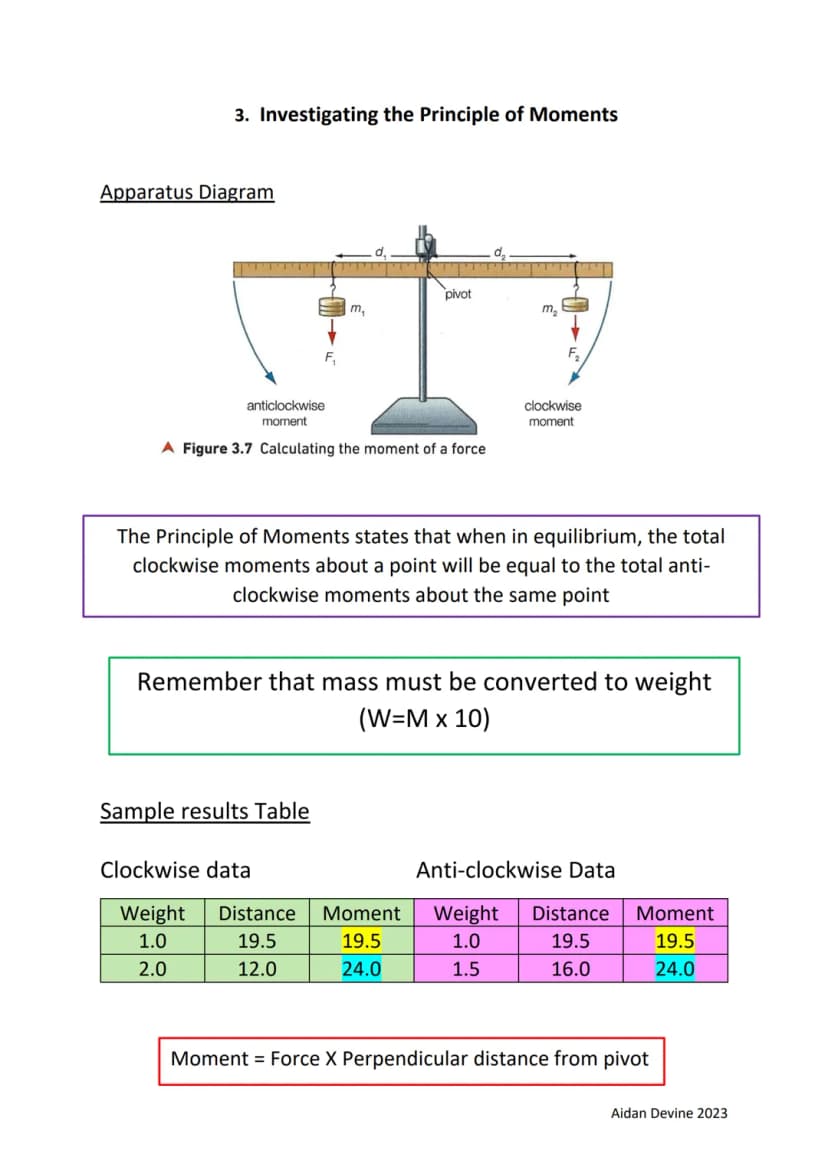
The principle of moments practical investigation is a fundamental physics experiment that demonstrates how forces balance around a pivot point. When an object is in equilibrium, the total clockwise moments exactly equal the total anticlockwise moments about the same point. This principle is crucial for understanding rotational forces and balance in mechanical systems.
To conduct this investigation, you'll need a meter rule balanced on a pivot point, various masses, and a way to measure distances. The experimental setup involves placing different masses at varying distances from the pivot point on both sides of the ruler. By calculating moments (force × perpendicular distance from pivot), you can verify if the system is in equilibrium.
When collecting data, it's essential to record both clockwise and anticlockwise measurements carefully. For each mass placed on the ruler, multiply its weight by its distance from the pivot point. This calculation gives you the moment for that particular force. The investigation demonstrates that when the sum of clockwise moments equals the sum of anticlockwise moments, the ruler remains balanced.
Definition: A moment is the turning effect of a force, calculated by multiplying the force by the perpendicular distance from the pivot point.
6
of 10
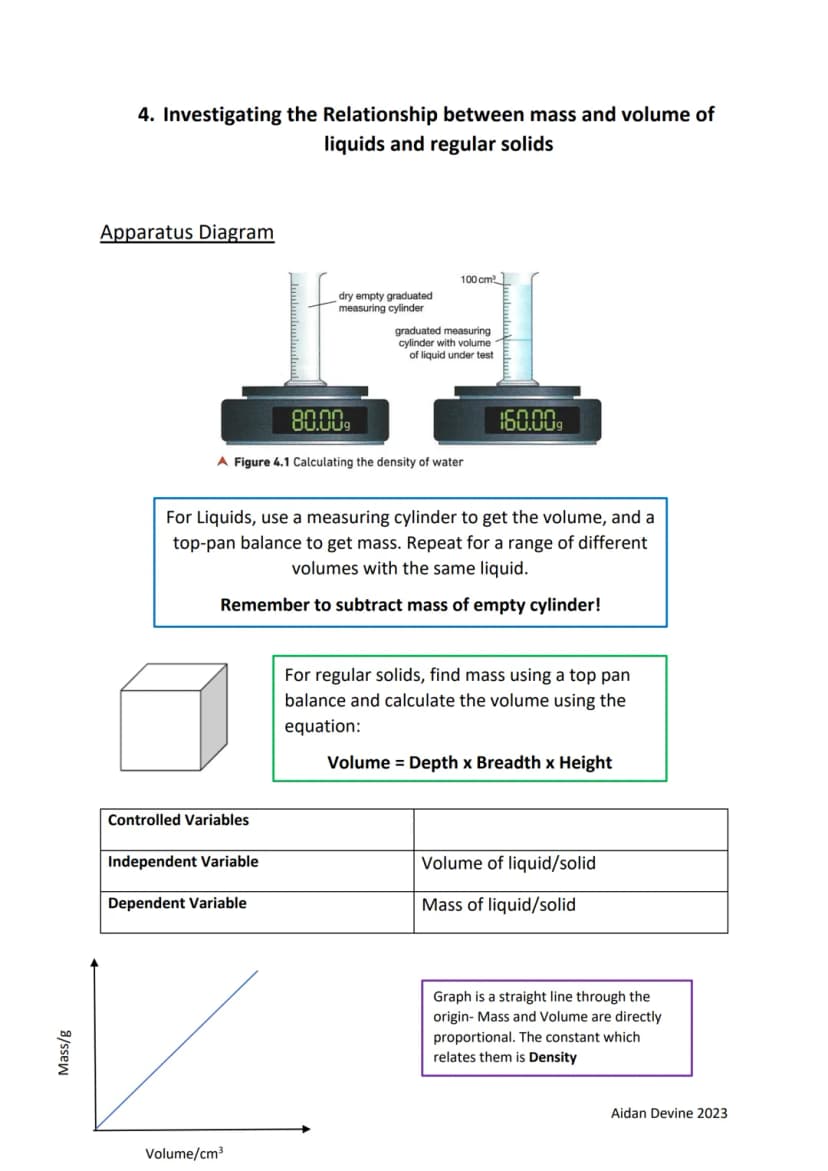
Investigating Density Through Mass and Volume Relationships
Understanding the relationship between mass and volume is crucial for determining density in both liquids and regular solids. This investigation demonstrates how these properties are connected and helps establish the concept of density as a material property.
For liquids, the process involves using a graduated measuring cylinder and a top-pan balance. By measuring different volumes of the same liquid and their corresponding masses, you can establish a direct relationship. Remember to account for the cylinder's mass by subtracting it from your measurements to get accurate results.
For regular solids, the investigation takes a slightly different approach. While mass is still measured using a top-pan balance, volume is calculated using dimensional measurements (length × width × height). The relationship between mass and volume creates a straight-line graph through the origin, indicating direct proportionality.
Highlight: The gradient of the mass-volume graph represents the density of the material being tested.
7
of 10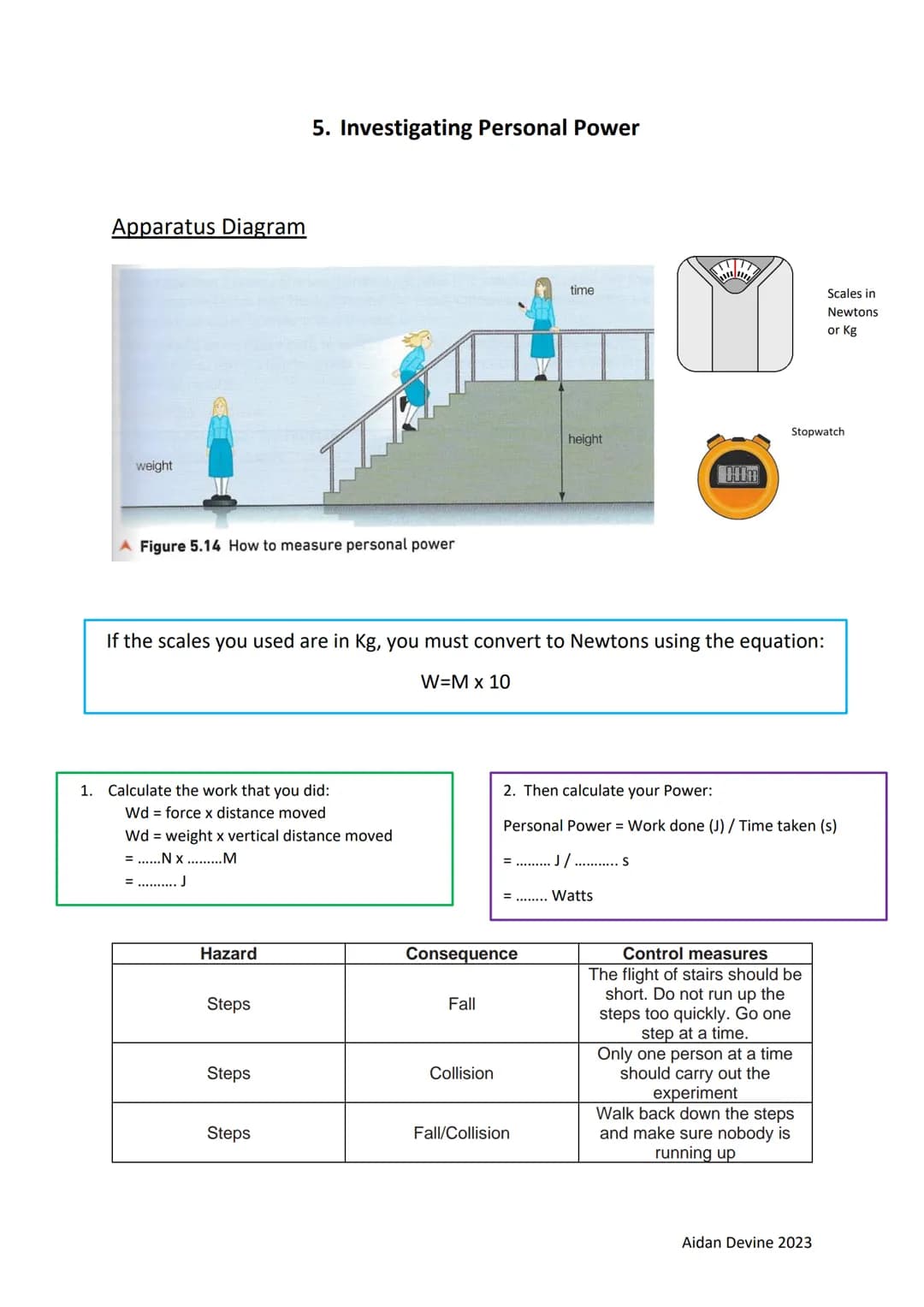
Investigating Personal Power Output
This practical investigation measures human power output by calculating work done against gravity when climbing stairs. The experiment combines concepts of force, distance, and time to determine personal power generation.
The setup requires a flight of stairs, weighing scales, and a stopwatch. Students must first calculate their weight in Newtons and measure the vertical height of the stairs. Work done is calculated by multiplying weight by vertical distance climbed. Power is then determined by dividing the work done by the time taken.
Safety is paramount in this investigation. Students should climb at a steady pace, one step at a time, and ensure proper coordination between timing and movement. The experiment provides real-world context for understanding power calculations and energy transfer.
Example: If a 50 kg student climbs 2 meters in 3 seconds, their power output would be: (50 × 10 × 2) ÷ 3 = 333.3 watts
8
of 10
Investigating Light Refraction Between Air and Glass
This investigation explores how light behaves when passing from air into glass, demonstrating the relationship between angles of incidence and refraction. The experiment uses a ray box, glass block, and protractor to measure how light changes direction at the boundary between materials.
The setup involves directing a light ray at different angles onto a glass block and measuring both the angle of incidence (i) and angle of refraction (r). Key controlled variables include the material and shape of the block, and the color of light used. The relationship between these angles reveals important principles about light behavior and material properties.
Results typically show a curved relationship between angles of incidence and refraction, indicating they're not directly proportional but have a positive correlation. This investigation helps understand how light changes speed when entering different mediums and the principles behind optical devices.
Vocabulary: Refraction is the bending of light as it passes from one medium to another due to a change in speed.
9
of 10
Understanding Resistance and Wire Length in Electrical Circuits
The relationship between electrical resistance and wire length forms a fundamental concept in physics, particularly when studying electrical conductors. When examining how resistance changes with wire length, several key factors must be carefully controlled to ensure accurate results.
In a typical experimental setup, we use a metal wire connected to a variable resistor, ammeter, and voltmeter. The wire's length is measured using a metre ruler, while maintaining constant cross-sectional area (CSA) and temperature throughout the investigation. The independent variable is the length of the wire, while the dependent variable is its electrical resistance, measured in ohms (Ω).
Definition: Electrical resistance is the opposition that a material offers to the flow of electric current, measured in ohms (Ω). The resistance of a wire increases proportionally with its length when other factors remain constant.
To maintain experimental accuracy, it's crucial to keep the current low and switch off the power supply between readings. This practice prevents the wire from heating up, which would affect its resistance and compromise the results. The relationship between resistance and length follows a direct proportional pattern, demonstrated by a straight-line graph passing through the origin.
Example: If 1 meter of wire has a resistance of 15Ω, then 2.5 meters of the same wire will have a resistance of 37.5Ω. This calculation demonstrates the direct proportional relationship between length and resistance.
10
of 10
Practical Applications of Ohm's Law in Wire Resistance
Understanding how wire resistance changes with length has significant practical applications in electrical engineering and circuit design. Metal wires consistently follow Ohm's law, which states that the current flowing through a conductor is directly proportional to the potential difference across it, provided physical conditions remain constant.
When conducting resistance experiments, several controlled variables must be maintained: the wire material, its cross-sectional area, and temperature. These factors significantly influence the wire's resistance characteristics and must remain constant to isolate the effect of length on resistance.
Highlight: The linear relationship between resistance and length only holds true when temperature remains constant. Any temperature change will affect the wire's resistance and deviate from the expected proportional relationship.
Scientists and engineers use this understanding to design electrical systems, calculate power transmission losses, and select appropriate wire lengths for specific applications. The direct proportional relationship between resistance and length helps in predicting how different wire lengths will affect circuit performance, making it an essential concept in electrical design and implementation.
We thought you’d never ask...
What is the Knowunity AI companion?
Our AI companion is specifically built for the needs of students. Based on the millions of content pieces we have on the platform we can provide truly meaningful and relevant answers to students. But its not only about answers, the companion is even more about guiding students through their daily learning challenges, with personalised study plans, quizzes or content pieces in the chat and 100% personalisation based on the students skills and developments.
Where can I download the Knowunity app?
You can download the app in the Google Play Store and in the Apple App Store.
Is Knowunity really free of charge?
That's right! Enjoy free access to study content, connect with fellow students, and get instant help – all at your fingertips.
Similar Content
Most popular content: Ohm's Law
3PhysicsUnderstanding Ohm's Law
Dive into the fundamentals of Ohm's Law, which defines the relationship between voltage, current, and resistance in electrical circuits. This summary covers key concepts, mathematical expressions, applications in circuit analysis, power calculations, and limitations of Ohm's Law. Ideal for students studying electronics and electrical engineering.
122723
PhysicsPhysics Energy & Circuits
Explore key concepts in physics including energy transfer, electric current, and circuit behavior. This summary covers density, power, efficiency, specific heat capacity, and Ohm's Law, providing essential insights for understanding thermal energy and electrical systems. Ideal for students preparing for exams in combined science.
103698
PhysicsPhysics paper 1 notes
Here are some notes for aqa physics combined paper 1*This is not all the content you need to know, just the ones I revised for my gcses-The writing highlighted in green is the things that actually came up!*
10801
Most popular content in Physics
9PhysicsForces and Motion Overview
Explore key concepts in Forces and Motion, including Hooke's Law, velocity, acceleration, and the principles of moments. This summary covers essential topics such as the relationship between force and extension, terminal velocity, and the impact of safety devices in physics. Ideal for AQA Physics Unit 5 revision.
109,190872
G
PhysicsGCSE Physics - Energy stores and Systems
Pl-Energy topic to revise for GCSE
101,3742
C
PhysicsConservation of energy- energy types and stores
Build a strong foundation in physics with these easy flashcards covering key concepts and principles.
96391
PhysicsPhysics Paper 2 Essentials
Master key concepts for AQA Combined Physics Paper 2, including electromagnetic waves, mechanics, forces, and motion. This comprehensive summary covers essential topics like wave properties, Newton's laws, and the motor effect, ensuring you're well-prepared for your exam.
1116,072940
PhysicsGCSE Physics Practical Experiments
Explore essential GCSE Physics practicals for AQA, covering key concepts such as Hooke's Law, wave properties, thermal insulation, and electrical circuits. This comprehensive guide includes step-by-step procedures, variables, and safety considerations for each experiment, ensuring a thorough understanding of practical applications in physics.
1011,409477
P
PhysicsPhysics Made Easy: Essential Concepts for Grade 10 Students
Master the fundamentals of physics with this comprehensive flashcard set designed specifically for grade 10 students. Learn key concepts and principles in an easy and engaging way!
104531
Physicsphysics paper 2 foundation notes
aqa combined science physics paper 2 foundation notes
101,32938
PhysicsPhysics paper 2 notes
physics aqa gcse paper 2 combined higher notes
101,23911
P
PhysicsPhysics Quiz - Current, Charge and Power
AQA physics quiz.
111,0252
Most popular content
9 Sociology
Sociology of Education Overview
Explore comprehensive A-Level Sociology notes on the education system, covering key theories, policies, and sociological perspectives. This resource includes insights on marketisation, gender roles, cultural deprivation, and educational inequalities, providing a thorough understanding of how education shapes social stratification and individual achievement. Ideal for exam preparation and in-depth study.
12102,8693,040
SociologySociology of Families: Comprehensive Revision
Dive into an extensive overview of family dynamics, perspectives, and patterns in sociology. This resource covers key concepts such as family diversity, gender roles, marriage, and the impact of social policies on family structures. Perfect for A-Level Sociology students preparing for Paper 2.
1273,6662,307
CriminologyCriminology: Crime & Punishment Overview
Comprehensive mindmaps covering key concepts in the Crime and Punishment topic for WJEC Criminology Unit 4. This resource includes detailed insights into the Criminal Justice System, crime prevention strategies, sentencing models, and the roles of various agencies. Ideal for A-Level revision, ensuring you grasp essential theories and legislative processes to excel in your exams.
1254,8721,059
SociologyComprehensive Crime & Deviance Overview
Explore an extensive revision of crime and deviance topics, including theories, types of crime, and the impact of media. This resource covers key concepts such as Marxism, functionalism, gender and crime, and the influence of globalization on criminal behavior. Ideal for students seeking a thorough understanding of criminology and its various theories. Type: Full Topic Revision.
1251,6541,399
C
 Biology
Cell Biology and Cell structure
cell structures
93,2490
 English Literature
An Inspector Calls: Character Insights
Explore in-depth analysis and key quotes for characters in J.B. Priestley's 'An Inspector Calls'. This resource covers Gerald Croft, Inspector Goole, Sheila Birling, Mrs. Birling, Eric Birling, and Eva Smith, focusing on themes of class, gender roles, and social responsibility. Ideal for students aiming for Grade 8 and above.
1025,429907
CriminologyWJEC Unit 4 Criminology
Criminology unit 4 detailed revision note
127,151125
CriminologyCriminology Theories Overview
Explore key criminology theories and their implications on crime and deviance. This comprehensive summary covers biological, psychological, and sociological perspectives, including labelling theory, right realism, and the impact of social campaigns on policy development. Ideal for A-Level criminology students seeking to understand the complexities of criminal behaviour and the factors influencing crime prevention strategies.
129,760210
English LiteratureRomeo and Juliet: Key themes
Key Romeo and Juliet themes and analysed quotes
106,708198
Can't find what you're looking for? Explore other subjects.
Students love us — and so will you.
4.6/5App Store
4.7/5Google Play
The app is very easy to use and well designed. I have found everything I was looking for so far and have been able to learn a lot from the presentations! I will definitely use the app for a class assignment! And of course it also helps a lot as an inspiration.
Stefan SiOS user
This app is really great. There are so many study notes and help [...]. My problem subject is French, for example, and the app has so many options for help. Thanks to this app, I have improved my French. I would recommend it to anyone.
Samantha KlichAndroid user
Wow, I am really amazed. I just tried the app because I've seen it advertised many times and was absolutely stunned. This app is THE HELP you want for school and above all, it offers so many things, such as workouts and fact sheets, which have been VERY helpful to me personally.
AnnaiOS user
Physics754 views·Updated Jun 27, 2026·12 pagesCool GCSE Physics Experiments: Measuring Average Speed, Hooke's Law, and Moments!
A
Aidan Devine@aidandevine_toov
Physics experiments help us understand important scientific principles through hands-on investigation and careful measurement.
The GCSE physics experiments for measuring average speed on slopesdemonstrate how objects accelerate under gravity. Students typically use a ball or trolley rolling down a...
1
of 10
Sign up to see the content. It's free!
- Access to all documents
- Improve your grades
- Join milions of students
Understanding GCSE Physics Practical Experiments: Core Investigations
The study of physics requires hands-on experimentation to truly grasp fundamental concepts. These prescribed practicals form an essential component of understanding physical phenomena and scientific methodology.
Definition: Prescribed practicals are standardized experiments that demonstrate key physics principles and develop crucial investigative skills.
These investigations include measuring average speed on slopes, exploring Hooke's law with springs, and investigating moments. Each practical requires careful attention to safety protocols and precise measurement techniques.
When conducting any physics practical, accuracy and reliability are paramount. This means taking multiple readings, controlling variables effectively, and understanding potential sources of error in measurements.
2
of 10Sign up to see the content. It's free!
- Access to all documents
- Improve your grades
- Join milions of students
Safety and Measurement Protocols in Physics Experiments
Laboratory safety forms the foundation of successful physics experiments. Proper protective equipment and careful handling of apparatus ensure both accurate results and student safety.
Highlight: Always wear safety goggles during experiments and read measuring cylinders at eye level from the bottom of the meniscus for accurate measurements.
When working with electrical equipment, special precautions must be taken. This includes keeping water away from electrical components and allowing sufficient cooling time between readings for resistance experiments.
Careful observation of measurement techniques ensures reliable data collection. This includes proper use of measuring cylinders, careful timing, and appropriate handling of sensitive equipment.
3
of 10Sign up to see the content. It's free!
- Access to all documents
- Improve your grades
- Join milions of students
GCSE physics experiments for measuring average speed on slopes
This fundamental investigation explores the relationship between slope height and average speed of a rolling object. The experiment requires precise control of variables and accurate timing.
Example: A ball bearing rolling down a runway demonstrates how gravitational potential energy converts to kinetic energy, affecting average speed.
Key controlled variables include the ball bearing's size and weight, runway length, and surface conditions. The independent variable is the slope height, while the dependent variable is the average speed.
The relationship between height and speed produces a curved graph through the origin, indicating that the variables are not directly proportional. Light gates can improve measurement accuracy compared to manual timing.
4
of 10Sign up to see the content. It's free!
- Access to all documents
- Improve your grades
- Join milions of students
Helical spring Hooke's law experiment steps
This investigation demonstrates the relationship between force and extension in elastic materials. The experiment explores fundamental principles of elasticity and material behavior.
Vocabulary: Hooke's Law states that the extension of a spring is directly proportional to the applied force, within the elastic limit.
The experimental setup requires careful measurement of both force and extension. Essential equipment includes a spring, known masses, meter stick, and appropriate support structure.
The relationship between force and extension produces a linear graph through the origin, demonstrating direct proportionality within the elastic limit. Beyond this point, the spring's behavior becomes non-linear and eventually leads to permanent deformation.
5
of 10Sign up to see the content. It's free!
- Access to all documents
- Improve your grades
- Join milions of students
Investigating the Principle of Moments in Physics
The principle of moments practical investigation is a fundamental physics experiment that demonstrates how forces balance around a pivot point. When an object is in equilibrium, the total clockwise moments exactly equal the total anticlockwise moments about the same point. This principle is crucial for understanding rotational forces and balance in mechanical systems.
To conduct this investigation, you'll need a meter rule balanced on a pivot point, various masses, and a way to measure distances. The experimental setup involves placing different masses at varying distances from the pivot point on both sides of the ruler. By calculating moments (force × perpendicular distance from pivot), you can verify if the system is in equilibrium.
When collecting data, it's essential to record both clockwise and anticlockwise measurements carefully. For each mass placed on the ruler, multiply its weight by its distance from the pivot point. This calculation gives you the moment for that particular force. The investigation demonstrates that when the sum of clockwise moments equals the sum of anticlockwise moments, the ruler remains balanced.
Definition: A moment is the turning effect of a force, calculated by multiplying the force by the perpendicular distance from the pivot point.
6
of 10Sign up to see the content. It's free!
- Access to all documents
- Improve your grades
- Join milions of students
Investigating Density Through Mass and Volume Relationships
Understanding the relationship between mass and volume is crucial for determining density in both liquids and regular solids. This investigation demonstrates how these properties are connected and helps establish the concept of density as a material property.
For liquids, the process involves using a graduated measuring cylinder and a top-pan balance. By measuring different volumes of the same liquid and their corresponding masses, you can establish a direct relationship. Remember to account for the cylinder's mass by subtracting it from your measurements to get accurate results.
For regular solids, the investigation takes a slightly different approach. While mass is still measured using a top-pan balance, volume is calculated using dimensional measurements (length × width × height). The relationship between mass and volume creates a straight-line graph through the origin, indicating direct proportionality.
Highlight: The gradient of the mass-volume graph represents the density of the material being tested.
7
of 10Sign up to see the content. It's free!
- Access to all documents
- Improve your grades
- Join milions of students
Investigating Personal Power Output
This practical investigation measures human power output by calculating work done against gravity when climbing stairs. The experiment combines concepts of force, distance, and time to determine personal power generation.
The setup requires a flight of stairs, weighing scales, and a stopwatch. Students must first calculate their weight in Newtons and measure the vertical height of the stairs. Work done is calculated by multiplying weight by vertical distance climbed. Power is then determined by dividing the work done by the time taken.
Safety is paramount in this investigation. Students should climb at a steady pace, one step at a time, and ensure proper coordination between timing and movement. The experiment provides real-world context for understanding power calculations and energy transfer.
Example: If a 50 kg student climbs 2 meters in 3 seconds, their power output would be: (50 × 10 × 2) ÷ 3 = 333.3 watts
8
of 10Sign up to see the content. It's free!
- Access to all documents
- Improve your grades
- Join milions of students
Investigating Light Refraction Between Air and Glass
This investigation explores how light behaves when passing from air into glass, demonstrating the relationship between angles of incidence and refraction. The experiment uses a ray box, glass block, and protractor to measure how light changes direction at the boundary between materials.
The setup involves directing a light ray at different angles onto a glass block and measuring both the angle of incidence (i) and angle of refraction (r). Key controlled variables include the material and shape of the block, and the color of light used. The relationship between these angles reveals important principles about light behavior and material properties.
Results typically show a curved relationship between angles of incidence and refraction, indicating they're not directly proportional but have a positive correlation. This investigation helps understand how light changes speed when entering different mediums and the principles behind optical devices.
Vocabulary: Refraction is the bending of light as it passes from one medium to another due to a change in speed.
9
of 10Sign up to see the content. It's free!
- Access to all documents
- Improve your grades
- Join milions of students
Understanding Resistance and Wire Length in Electrical Circuits
The relationship between electrical resistance and wire length forms a fundamental concept in physics, particularly when studying electrical conductors. When examining how resistance changes with wire length, several key factors must be carefully controlled to ensure accurate results.
In a typical experimental setup, we use a metal wire connected to a variable resistor, ammeter, and voltmeter. The wire's length is measured using a metre ruler, while maintaining constant cross-sectional area (CSA) and temperature throughout the investigation. The independent variable is the length of the wire, while the dependent variable is its electrical resistance, measured in ohms (Ω).
Definition: Electrical resistance is the opposition that a material offers to the flow of electric current, measured in ohms (Ω). The resistance of a wire increases proportionally with its length when other factors remain constant.
To maintain experimental accuracy, it's crucial to keep the current low and switch off the power supply between readings. This practice prevents the wire from heating up, which would affect its resistance and compromise the results. The relationship between resistance and length follows a direct proportional pattern, demonstrated by a straight-line graph passing through the origin.
Example: If 1 meter of wire has a resistance of 15Ω, then 2.5 meters of the same wire will have a resistance of 37.5Ω. This calculation demonstrates the direct proportional relationship between length and resistance.
10
of 10Sign up to see the content. It's free!
- Access to all documents
- Improve your grades
- Join milions of students
Practical Applications of Ohm's Law in Wire Resistance
Understanding how wire resistance changes with length has significant practical applications in electrical engineering and circuit design. Metal wires consistently follow Ohm's law, which states that the current flowing through a conductor is directly proportional to the potential difference across it, provided physical conditions remain constant.
When conducting resistance experiments, several controlled variables must be maintained: the wire material, its cross-sectional area, and temperature. These factors significantly influence the wire's resistance characteristics and must remain constant to isolate the effect of length on resistance.
Highlight: The linear relationship between resistance and length only holds true when temperature remains constant. Any temperature change will affect the wire's resistance and deviate from the expected proportional relationship.
Scientists and engineers use this understanding to design electrical systems, calculate power transmission losses, and select appropriate wire lengths for specific applications. The direct proportional relationship between resistance and length helps in predicting how different wire lengths will affect circuit performance, making it an essential concept in electrical design and implementation.
We thought you’d never ask...
What is the Knowunity AI companion?
Our AI companion is specifically built for the needs of students. Based on the millions of content pieces we have on the platform we can provide truly meaningful and relevant answers to students. But its not only about answers, the companion is even more about guiding students through their daily learning challenges, with personalised study plans, quizzes or content pieces in the chat and 100% personalisation based on the students skills and developments.
Where can I download the Knowunity app?
You can download the app in the Google Play Store and in the Apple App Store.
Is Knowunity really free of charge?
That's right! Enjoy free access to study content, connect with fellow students, and get instant help – all at your fingertips.
Similar Content
Most popular content: Ohm's Law
3PhysicsUnderstanding Ohm's Law
Dive into the fundamentals of Ohm's Law, which defines the relationship between voltage, current, and resistance in electrical circuits. This summary covers key concepts, mathematical expressions, applications in circuit analysis, power calculations, and limitations of Ohm's Law. Ideal for students studying electronics and electrical engineering.
122723
PhysicsPhysics Energy & Circuits
Explore key concepts in physics including energy transfer, electric current, and circuit behavior. This summary covers density, power, efficiency, specific heat capacity, and Ohm's Law, providing essential insights for understanding thermal energy and electrical systems. Ideal for students preparing for exams in combined science.
103698
PhysicsPhysics paper 1 notes
Here are some notes for aqa physics combined paper 1*This is not all the content you need to know, just the ones I revised for my gcses-The writing highlighted in green is the things that actually came up!*
10801
Most popular content in Physics
9PhysicsForces and Motion Overview
Explore key concepts in Forces and Motion, including Hooke's Law, velocity, acceleration, and the principles of moments. This summary covers essential topics such as the relationship between force and extension, terminal velocity, and the impact of safety devices in physics. Ideal for AQA Physics Unit 5 revision.
109,190872
G
PhysicsGCSE Physics - Energy stores and Systems
Pl-Energy topic to revise for GCSE
101,3742
C
PhysicsConservation of energy- energy types and stores
Build a strong foundation in physics with these easy flashcards covering key concepts and principles.
96391
PhysicsPhysics Paper 2 Essentials
Master key concepts for AQA Combined Physics Paper 2, including electromagnetic waves, mechanics, forces, and motion. This comprehensive summary covers essential topics like wave properties, Newton's laws, and the motor effect, ensuring you're well-prepared for your exam.
1116,072940
PhysicsGCSE Physics Practical Experiments
Explore essential GCSE Physics practicals for AQA, covering key concepts such as Hooke's Law, wave properties, thermal insulation, and electrical circuits. This comprehensive guide includes step-by-step procedures, variables, and safety considerations for each experiment, ensuring a thorough understanding of practical applications in physics.
1011,409477
P
PhysicsPhysics Made Easy: Essential Concepts for Grade 10 Students
Master the fundamentals of physics with this comprehensive flashcard set designed specifically for grade 10 students. Learn key concepts and principles in an easy and engaging way!
104531
Physicsphysics paper 2 foundation notes
aqa combined science physics paper 2 foundation notes
101,32938
PhysicsPhysics paper 2 notes
physics aqa gcse paper 2 combined higher notes
101,23911
P
PhysicsPhysics Quiz - Current, Charge and Power
AQA physics quiz.
111,0252
Most popular content
9SociologySociology of Education Overview
Explore comprehensive A-Level Sociology notes on the education system, covering key theories, policies, and sociological perspectives. This resource includes insights on marketisation, gender roles, cultural deprivation, and educational inequalities, providing a thorough understanding of how education shapes social stratification and individual achievement. Ideal for exam preparation and in-depth study.
12102,8693,040
SociologySociology of Families: Comprehensive Revision
Dive into an extensive overview of family dynamics, perspectives, and patterns in sociology. This resource covers key concepts such as family diversity, gender roles, marriage, and the impact of social policies on family structures. Perfect for A-Level Sociology students preparing for Paper 2.
1273,6662,307
CriminologyCriminology: Crime & Punishment Overview
Comprehensive mindmaps covering key concepts in the Crime and Punishment topic for WJEC Criminology Unit 4. This resource includes detailed insights into the Criminal Justice System, crime prevention strategies, sentencing models, and the roles of various agencies. Ideal for A-Level revision, ensuring you grasp essential theories and legislative processes to excel in your exams.
1254,8721,059
SociologyComprehensive Crime & Deviance Overview
Explore an extensive revision of crime and deviance topics, including theories, types of crime, and the impact of media. This resource covers key concepts such as Marxism, functionalism, gender and crime, and the influence of globalization on criminal behavior. Ideal for students seeking a thorough understanding of criminology and its various theories. Type: Full Topic Revision.
1251,6541,399
C
BiologyCell Biology and Cell structure
cell structures
93,2490
English LiteratureAn Inspector Calls: Character Insights
Explore in-depth analysis and key quotes for characters in J.B. Priestley's 'An Inspector Calls'. This resource covers Gerald Croft, Inspector Goole, Sheila Birling, Mrs. Birling, Eric Birling, and Eva Smith, focusing on themes of class, gender roles, and social responsibility. Ideal for students aiming for Grade 8 and above.
1025,429907
CriminologyWJEC Unit 4 Criminology
Criminology unit 4 detailed revision note
127,151125
CriminologyCriminology Theories Overview
Explore key criminology theories and their implications on crime and deviance. This comprehensive summary covers biological, psychological, and sociological perspectives, including labelling theory, right realism, and the impact of social campaigns on policy development. Ideal for A-Level criminology students seeking to understand the complexities of criminal behaviour and the factors influencing crime prevention strategies.
129,760210
English LiteratureRomeo and Juliet: Key themes
Key Romeo and Juliet themes and analysed quotes
106,708198
Can't find what you're looking for? Explore other subjects.
Students love us — and so will you.
4.6/5App Store
4.7/5Google Play
The app is very easy to use and well designed. I have found everything I was looking for so far and have been able to learn a lot from the presentations! I will definitely use the app for a class assignment! And of course it also helps a lot as an inspiration.
Stefan SiOS user
This app is really great. There are so many study notes and help [...]. My problem subject is French, for example, and the app has so many options for help. Thanks to this app, I have improved my French. I would recommend it to anyone.
Samantha KlichAndroid user
Wow, I am really amazed. I just tried the app because I've seen it advertised many times and was absolutely stunned. This app is THE HELP you want for school and above all, it offers so many things, such as workouts and fact sheets, which have been VERY helpful to me personally.
AnnaiOS user