

Electricity in the Home - A comprehensive guide covering GCSE...
 Physics512 views·Updated Jun 18, 2026·5 pages
GCSE P5 Electricity Notes and Questions - Easy PDF



1 / 5
1
of 5
Electrical Safety and Components
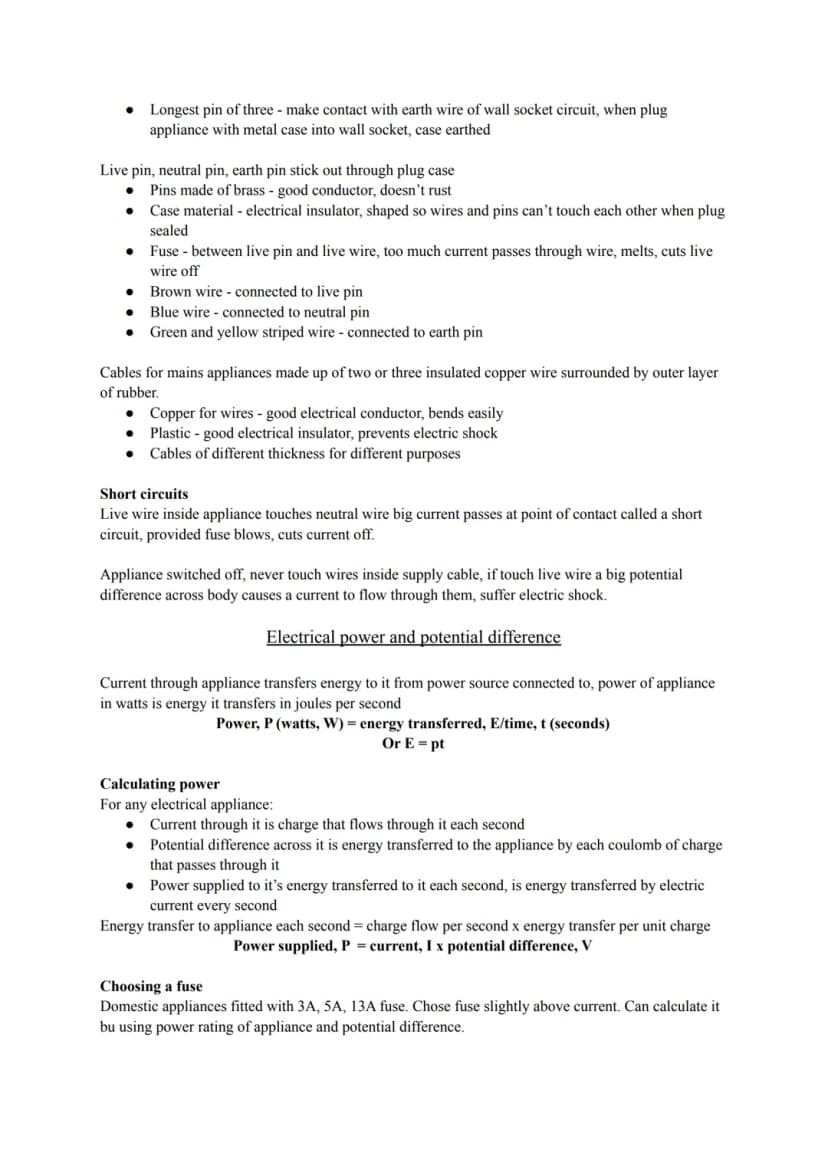
This section focuses on the safety features and components of electrical systems, particularly in domestic settings.
The importance of proper insulation in cables, plugs, and sockets is emphasized, explaining how these components contribute to electrical safety.
Highlight: The outer casings of plugs, sockets, and cables in mains circuits are made of hard-wearing electrical insulators to prevent accidental contact with live wires.
The structure and function of a three-pin plug are detailed, including the purpose of each pin and wire color coding.
Vocabulary: Double-insulated appliances have no earth wire connection due to their plastic casing, which provides additional protection against electric shock.
The concept of short circuits is introduced, explaining how they occur and the role of fuses in preventing electrical hazards.
Definition: A short circuit occurs when the live wire inside an appliance touches the neutral wire, causing a large current to flow at the point of contact.
The section concludes with advice on electrical safety, stressing the importance of proper handling of electrical devices and the dangers of electric shock.
2
of 5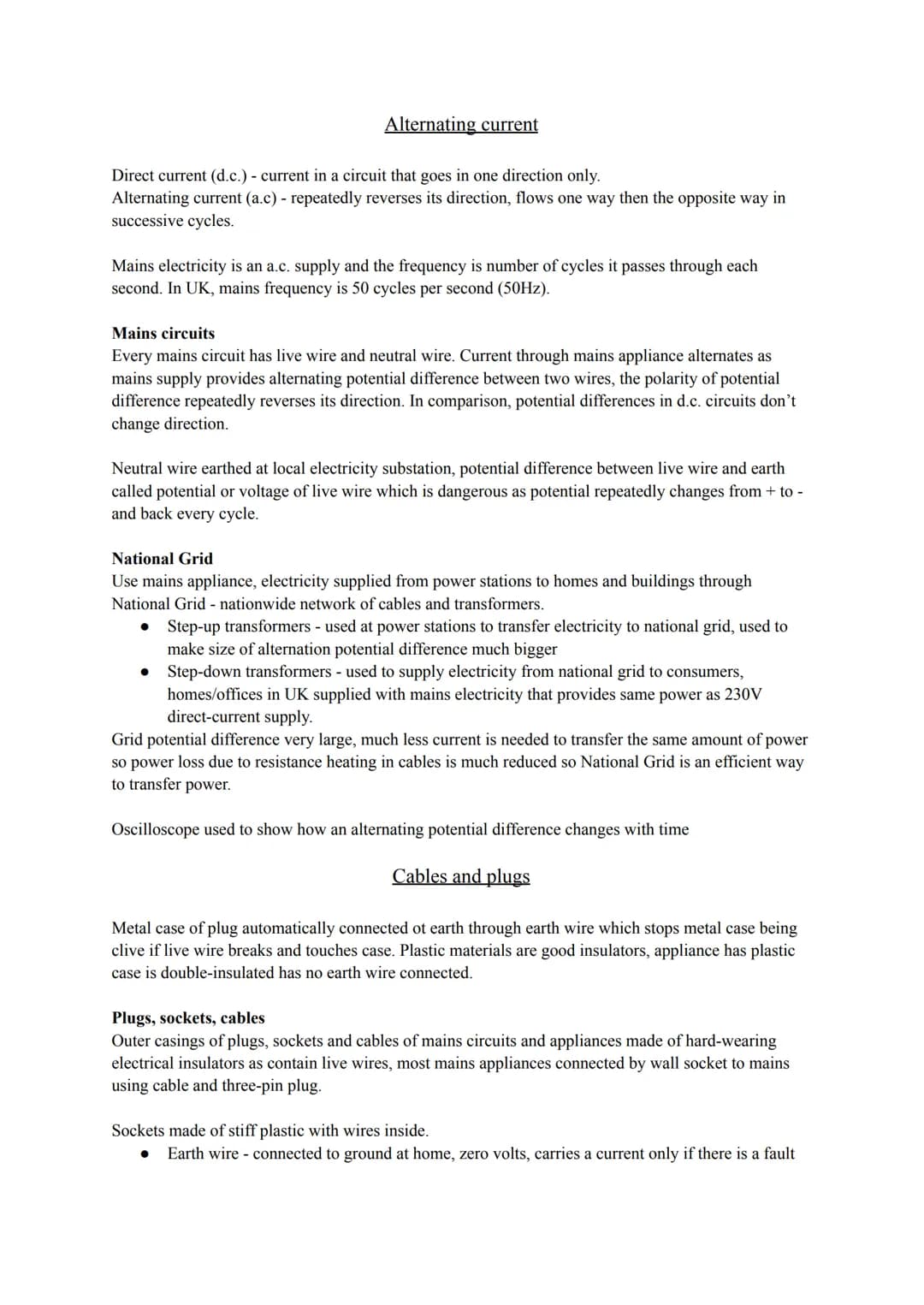
Electrical Power and Calculations
This section delves into the mathematical aspects of electricity, focusing on power calculations and their applications in electrical systems.
The relationship between electrical power, energy transfer, and time is explained, introducing the fundamental equation for power calculation.
Definition: Electrical power (P) is the rate at which energy (E) is transferred in an electrical system, measured in watts (W).
The section provides formulas for calculating power in electrical circuits, emphasizing the relationship between current, voltage, and power.
Example: To calculate the power of an appliance, multiply the current (I) flowing through it by the potential difference (V) across it: P = I × V.
Guidance on choosing appropriate fuses for domestic appliances is provided, linking power ratings to fuse selection.
Highlight: When selecting a fuse for an appliance, choose one with a rating slightly above the calculated current to ensure safe operation.
The concept of resistance heating is introduced, explaining how electrical energy is converted to heat in resistors.
Vocabulary: Resistance heating refers to the process by which an electric current passing through a resistor generates heat, which is then dissipated to the surroundings.
The section concludes with an introduction to more advanced power calculations, including the relationship between power, current, and resistance.
3
of 5
Advanced Electrical Concepts
This final section touches on more complex aspects of electrical systems, building on the foundational knowledge presented earlier.
The relationship between electrical currents and energy transfer is briefly introduced, setting the stage for more advanced study in GCSE Physics Electricity.
Highlight: Understanding the connection between electrical currents and energy transfer is crucial for analyzing the efficiency of electrical systems and solving complex GCSE electricity questions and answers.
While the content in this section is limited, it suggests that further exploration of these topics would be beneficial for students preparing for advanced GCSE Physics electricity exam questions.
Example: Advanced topics might include detailed analysis of power transmission in the National Grid, efficiency calculations for transformers, and in-depth study of alternating current characteristics.
This section serves as a bridge to more advanced electrical concepts, encouraging students to expand their knowledge beyond the basics covered in the previous sections.
4
of 5
Page 4: Resistance Heating and Energy Transfer
This page examines the relationship between electrical current, resistance, and energy transfer in electrical systems.
Definition: Power (P) equals current squared (I²) multiplied by resistance (R).
Vocabulary: Coulomb - the unit of electrical charge.
Example: When electrons flow through a resistor, they collide with metal ions, transferring energy as heat.
5
of 5
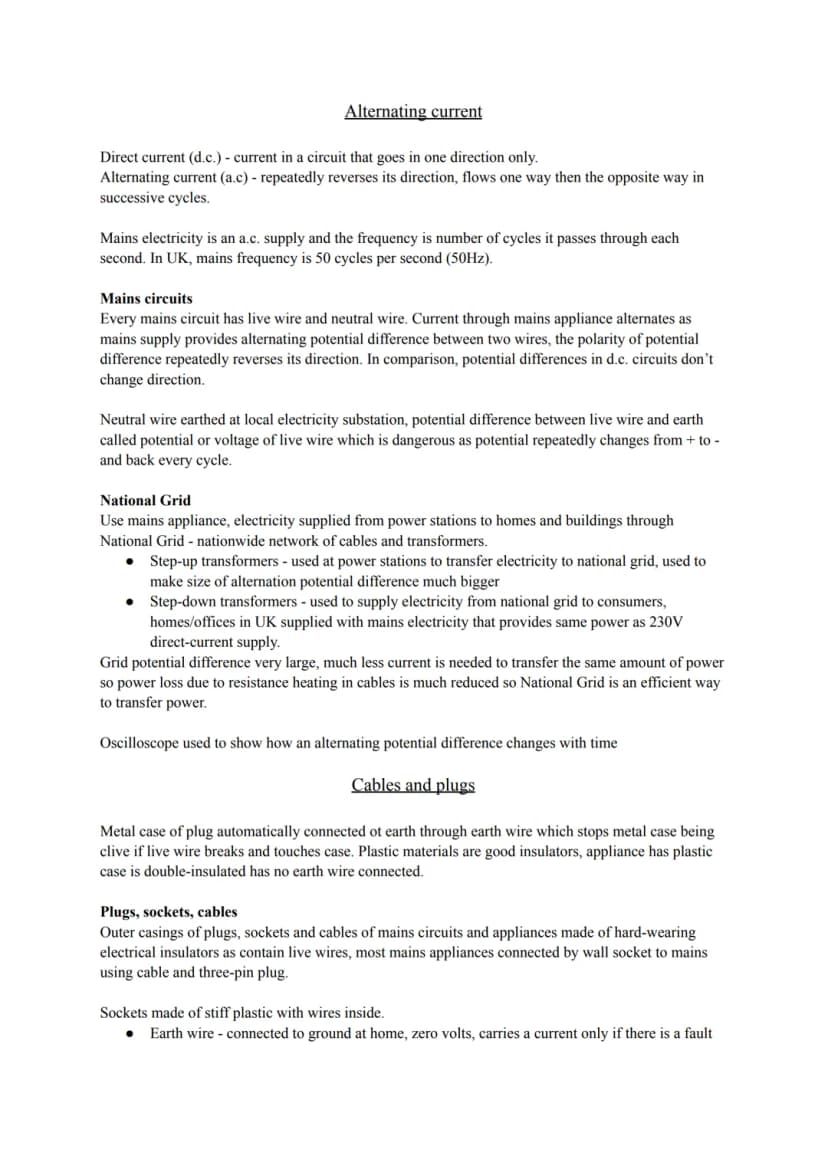
Alternating Current and Mains Electricity
This section introduces the fundamental concepts of alternating current (AC) and direct current (DC), with a focus on mains electricity in the UK.
Definition: Alternating current (AC) is an electric current that repeatedly reverses its direction, flowing one way and then the opposite way in successive cycles.
The frequency of mains electricity in the UK is explained, highlighting its importance in domestic power supply.
Highlight: In the UK, the mains electricity frequency is 50 cycles per second (50Hz).
The structure of mains circuits is described, emphasizing the role of live and neutral wires. The section also introduces the concept of earthing and its significance in electrical safety.
Vocabulary: Earthing refers to the practice of connecting electrical systems to the ground, providing a safe path for excess current and reducing the risk of electric shock.
The National Grid is introduced as the nationwide network for electricity distribution, explaining the use of transformers to efficiently transmit power over long distances.
Example: Step-up transformers at power stations increase the voltage for long-distance transmission, while step-down transformers reduce the voltage for safe use in homes and offices.
The use of oscilloscopes to visualize alternating potential difference is briefly mentioned, providing a practical application of the concepts discussed.
We thought you’d never ask...
What is the Knowunity AI companion?
Our AI companion is specifically built for the needs of students. Based on the millions of content pieces we have on the platform we can provide truly meaningful and relevant answers to students. But its not only about answers, the companion is even more about guiding students through their daily learning challenges, with personalised study plans, quizzes or content pieces in the chat and 100% personalisation based on the students skills and developments.
Where can I download the Knowunity app?
You can download the app in the Google Play Store and in the Apple App Store.
Is Knowunity really free of charge?
That's right! Enjoy free access to study content, connect with fellow students, and get instant help – all at your fingertips.
Similar Content
 Ens. Scient.
Most popular content: Power
1Most popular content in Physics
9PhysicsForces and Motion Overview
Explore key concepts in Forces and Motion, including Hooke's Law, velocity, acceleration, and the principles of moments. This summary covers essential topics such as the relationship between force and extension, terminal velocity, and the impact of safety devices in physics. Ideal for AQA Physics Unit 5 revision.
109,190872
G
PhysicsGCSE Physics - Energy stores and Systems
Pl-Energy topic to revise for GCSE
101,3742
C
PhysicsConservation of energy- energy types and stores
Build a strong foundation in physics with these easy flashcards covering key concepts and principles.
96391
PhysicsPhysics Paper 2 Essentials
Master key concepts for AQA Combined Physics Paper 2, including electromagnetic waves, mechanics, forces, and motion. This comprehensive summary covers essential topics like wave properties, Newton's laws, and the motor effect, ensuring you're well-prepared for your exam.
1116,072940
PhysicsGCSE Physics Practical Experiments
Explore essential GCSE Physics practicals for AQA, covering key concepts such as Hooke's Law, wave properties, thermal insulation, and electrical circuits. This comprehensive guide includes step-by-step procedures, variables, and safety considerations for each experiment, ensuring a thorough understanding of practical applications in physics.
1011,409477
P
PhysicsPhysics Made Easy: Essential Concepts for Grade 10 Students
Master the fundamentals of physics with this comprehensive flashcard set designed specifically for grade 10 students. Learn key concepts and principles in an easy and engaging way!
104531
Physicsphysics paper 2 foundation notes
aqa combined science physics paper 2 foundation notes
101,32938
PhysicsPhysics paper 2 notes
physics aqa gcse paper 2 combined higher notes
101,23911
P
PhysicsPhysics Quiz - Current, Charge and Power
AQA physics quiz.
111,0252
Most popular content
9 Sociology
Sociology of Education Overview
Explore comprehensive A-Level Sociology notes on the education system, covering key theories, policies, and sociological perspectives. This resource includes insights on marketisation, gender roles, cultural deprivation, and educational inequalities, providing a thorough understanding of how education shapes social stratification and individual achievement. Ideal for exam preparation and in-depth study.
12102,8693,040
SociologySociology of Families: Comprehensive Revision
Dive into an extensive overview of family dynamics, perspectives, and patterns in sociology. This resource covers key concepts such as family diversity, gender roles, marriage, and the impact of social policies on family structures. Perfect for A-Level Sociology students preparing for Paper 2.
1273,6612,307
CriminologyCriminology: Crime & Punishment Overview
Comprehensive mindmaps covering key concepts in the Crime and Punishment topic for WJEC Criminology Unit 4. This resource includes detailed insights into the Criminal Justice System, crime prevention strategies, sentencing models, and the roles of various agencies. Ideal for A-Level revision, ensuring you grasp essential theories and legislative processes to excel in your exams.
1254,8721,059
SociologyComprehensive Crime & Deviance Overview
Explore an extensive revision of crime and deviance topics, including theories, types of crime, and the impact of media. This resource covers key concepts such as Marxism, functionalism, gender and crime, and the influence of globalization on criminal behavior. Ideal for students seeking a thorough understanding of criminology and its various theories. Type: Full Topic Revision.
1251,6541,399
C
 Biology
Cell Biology and Cell structure
cell structures
93,2490
 English Literature
An Inspector Calls: Character Insights
Explore in-depth analysis and key quotes for characters in J.B. Priestley's 'An Inspector Calls'. This resource covers Gerald Croft, Inspector Goole, Sheila Birling, Mrs. Birling, Eric Birling, and Eva Smith, focusing on themes of class, gender roles, and social responsibility. Ideal for students aiming for Grade 8 and above.
1025,429907
CriminologyWJEC Unit 4 Criminology
Criminology unit 4 detailed revision note
127,151125
CriminologyCriminology Theories Overview
Explore key criminology theories and their implications on crime and deviance. This comprehensive summary covers biological, psychological, and sociological perspectives, including labelling theory, right realism, and the impact of social campaigns on policy development. Ideal for A-Level criminology students seeking to understand the complexities of criminal behaviour and the factors influencing crime prevention strategies.
129,760210
English LiteratureRomeo and Juliet: Key themes
Key Romeo and Juliet themes and analysed quotes
106,708198
Can't find what you're looking for? Explore other subjects.
Students love us — and so will you.
4.6/5App Store
4.7/5Google Play
The app is very easy to use and well designed. I have found everything I was looking for so far and have been able to learn a lot from the presentations! I will definitely use the app for a class assignment! And of course it also helps a lot as an inspiration.
Stefan SiOS user
This app is really great. There are so many study notes and help [...]. My problem subject is French, for example, and the app has so many options for help. Thanks to this app, I have improved my French. I would recommend it to anyone.
Samantha KlichAndroid user
Wow, I am really amazed. I just tried the app because I've seen it advertised many times and was absolutely stunned. This app is THE HELP you want for school and above all, it offers so many things, such as workouts and fact sheets, which have been VERY helpful to me personally.
AnnaiOS user
Physics512 views·Updated Jun 18, 2026·5 pagesGCSE P5 Electricity Notes and Questions - Easy PDF
Electricity in the Home - A comprehensive guide covering GCSE Physics electricity fundamentals including alternating current, mains electricity, and the National Grid. This essential resource explains key concepts of domestic electrical systems, safety features, and energy calculations.
• Detailed exploration...
1
of 5
Sign up to see the content. It's free!
- Access to all documents
- Improve your grades
- Join milions of students
Electrical Safety and Components
This section focuses on the safety features and components of electrical systems, particularly in domestic settings.
The importance of proper insulation in cables, plugs, and sockets is emphasized, explaining how these components contribute to electrical safety.
Highlight: The outer casings of plugs, sockets, and cables in mains circuits are made of hard-wearing electrical insulators to prevent accidental contact with live wires.
The structure and function of a three-pin plug are detailed, including the purpose of each pin and wire color coding.
Vocabulary: Double-insulated appliances have no earth wire connection due to their plastic casing, which provides additional protection against electric shock.
The concept of short circuits is introduced, explaining how they occur and the role of fuses in preventing electrical hazards.
Definition: A short circuit occurs when the live wire inside an appliance touches the neutral wire, causing a large current to flow at the point of contact.
The section concludes with advice on electrical safety, stressing the importance of proper handling of electrical devices and the dangers of electric shock.
2
of 5Sign up to see the content. It's free!
- Access to all documents
- Improve your grades
- Join milions of students
Electrical Power and Calculations
This section delves into the mathematical aspects of electricity, focusing on power calculations and their applications in electrical systems.
The relationship between electrical power, energy transfer, and time is explained, introducing the fundamental equation for power calculation.
Definition: Electrical power (P) is the rate at which energy (E) is transferred in an electrical system, measured in watts (W).
The section provides formulas for calculating power in electrical circuits, emphasizing the relationship between current, voltage, and power.
Example: To calculate the power of an appliance, multiply the current (I) flowing through it by the potential difference (V) across it: P = I × V.
Guidance on choosing appropriate fuses for domestic appliances is provided, linking power ratings to fuse selection.
Highlight: When selecting a fuse for an appliance, choose one with a rating slightly above the calculated current to ensure safe operation.
The concept of resistance heating is introduced, explaining how electrical energy is converted to heat in resistors.
Vocabulary: Resistance heating refers to the process by which an electric current passing through a resistor generates heat, which is then dissipated to the surroundings.
The section concludes with an introduction to more advanced power calculations, including the relationship between power, current, and resistance.
3
of 5Sign up to see the content. It's free!
- Access to all documents
- Improve your grades
- Join milions of students
Advanced Electrical Concepts
This final section touches on more complex aspects of electrical systems, building on the foundational knowledge presented earlier.
The relationship between electrical currents and energy transfer is briefly introduced, setting the stage for more advanced study in GCSE Physics Electricity.
Highlight: Understanding the connection between electrical currents and energy transfer is crucial for analyzing the efficiency of electrical systems and solving complex GCSE electricity questions and answers.
While the content in this section is limited, it suggests that further exploration of these topics would be beneficial for students preparing for advanced GCSE Physics electricity exam questions.
Example: Advanced topics might include detailed analysis of power transmission in the National Grid, efficiency calculations for transformers, and in-depth study of alternating current characteristics.
This section serves as a bridge to more advanced electrical concepts, encouraging students to expand their knowledge beyond the basics covered in the previous sections.
4
of 5Sign up to see the content. It's free!
- Access to all documents
- Improve your grades
- Join milions of students
Page 4: Resistance Heating and Energy Transfer
This page examines the relationship between electrical current, resistance, and energy transfer in electrical systems.
Definition: Power (P) equals current squared (I²) multiplied by resistance (R).
Vocabulary: Coulomb - the unit of electrical charge.
Example: When electrons flow through a resistor, they collide with metal ions, transferring energy as heat.
5
of 5Sign up to see the content. It's free!
- Access to all documents
- Improve your grades
- Join milions of students
Alternating Current and Mains Electricity
This section introduces the fundamental concepts of alternating current (AC) and direct current (DC), with a focus on mains electricity in the UK.
Definition: Alternating current (AC) is an electric current that repeatedly reverses its direction, flowing one way and then the opposite way in successive cycles.
The frequency of mains electricity in the UK is explained, highlighting its importance in domestic power supply.
Highlight: In the UK, the mains electricity frequency is 50 cycles per second (50Hz).
The structure of mains circuits is described, emphasizing the role of live and neutral wires. The section also introduces the concept of earthing and its significance in electrical safety.
Vocabulary: Earthing refers to the practice of connecting electrical systems to the ground, providing a safe path for excess current and reducing the risk of electric shock.
The National Grid is introduced as the nationwide network for electricity distribution, explaining the use of transformers to efficiently transmit power over long distances.
Example: Step-up transformers at power stations increase the voltage for long-distance transmission, while step-down transformers reduce the voltage for safe use in homes and offices.
The use of oscilloscopes to visualize alternating potential difference is briefly mentioned, providing a practical application of the concepts discussed.
We thought you’d never ask...
What is the Knowunity AI companion?
Our AI companion is specifically built for the needs of students. Based on the millions of content pieces we have on the platform we can provide truly meaningful and relevant answers to students. But its not only about answers, the companion is even more about guiding students through their daily learning challenges, with personalised study plans, quizzes or content pieces in the chat and 100% personalisation based on the students skills and developments.
Where can I download the Knowunity app?
You can download the app in the Google Play Store and in the Apple App Store.
Is Knowunity really free of charge?
That's right! Enjoy free access to study content, connect with fellow students, and get instant help – all at your fingertips.
Similar Content
Most popular content: Power
1Most popular content in Physics
9PhysicsForces and Motion Overview
Explore key concepts in Forces and Motion, including Hooke's Law, velocity, acceleration, and the principles of moments. This summary covers essential topics such as the relationship between force and extension, terminal velocity, and the impact of safety devices in physics. Ideal for AQA Physics Unit 5 revision.
109,190872
G
PhysicsGCSE Physics - Energy stores and Systems
Pl-Energy topic to revise for GCSE
101,3742
C
PhysicsConservation of energy- energy types and stores
Build a strong foundation in physics with these easy flashcards covering key concepts and principles.
96391
PhysicsPhysics Paper 2 Essentials
Master key concepts for AQA Combined Physics Paper 2, including electromagnetic waves, mechanics, forces, and motion. This comprehensive summary covers essential topics like wave properties, Newton's laws, and the motor effect, ensuring you're well-prepared for your exam.
1116,072940
PhysicsGCSE Physics Practical Experiments
Explore essential GCSE Physics practicals for AQA, covering key concepts such as Hooke's Law, wave properties, thermal insulation, and electrical circuits. This comprehensive guide includes step-by-step procedures, variables, and safety considerations for each experiment, ensuring a thorough understanding of practical applications in physics.
1011,409477
P
PhysicsPhysics Made Easy: Essential Concepts for Grade 10 Students
Master the fundamentals of physics with this comprehensive flashcard set designed specifically for grade 10 students. Learn key concepts and principles in an easy and engaging way!
104531
Physicsphysics paper 2 foundation notes
aqa combined science physics paper 2 foundation notes
101,32938
PhysicsPhysics paper 2 notes
physics aqa gcse paper 2 combined higher notes
101,23911
P
PhysicsPhysics Quiz - Current, Charge and Power
AQA physics quiz.
111,0252
Most popular content
9SociologySociology of Education Overview
Explore comprehensive A-Level Sociology notes on the education system, covering key theories, policies, and sociological perspectives. This resource includes insights on marketisation, gender roles, cultural deprivation, and educational inequalities, providing a thorough understanding of how education shapes social stratification and individual achievement. Ideal for exam preparation and in-depth study.
12102,8693,040
SociologySociology of Families: Comprehensive Revision
Dive into an extensive overview of family dynamics, perspectives, and patterns in sociology. This resource covers key concepts such as family diversity, gender roles, marriage, and the impact of social policies on family structures. Perfect for A-Level Sociology students preparing for Paper 2.
1273,6612,307
CriminologyCriminology: Crime & Punishment Overview
Comprehensive mindmaps covering key concepts in the Crime and Punishment topic for WJEC Criminology Unit 4. This resource includes detailed insights into the Criminal Justice System, crime prevention strategies, sentencing models, and the roles of various agencies. Ideal for A-Level revision, ensuring you grasp essential theories and legislative processes to excel in your exams.
1254,8721,059
SociologyComprehensive Crime & Deviance Overview
Explore an extensive revision of crime and deviance topics, including theories, types of crime, and the impact of media. This resource covers key concepts such as Marxism, functionalism, gender and crime, and the influence of globalization on criminal behavior. Ideal for students seeking a thorough understanding of criminology and its various theories. Type: Full Topic Revision.
1251,6541,399
C
BiologyCell Biology and Cell structure
cell structures
93,2490
English LiteratureAn Inspector Calls: Character Insights
Explore in-depth analysis and key quotes for characters in J.B. Priestley's 'An Inspector Calls'. This resource covers Gerald Croft, Inspector Goole, Sheila Birling, Mrs. Birling, Eric Birling, and Eva Smith, focusing on themes of class, gender roles, and social responsibility. Ideal for students aiming for Grade 8 and above.
1025,429907
CriminologyWJEC Unit 4 Criminology
Criminology unit 4 detailed revision note
127,151125
CriminologyCriminology Theories Overview
Explore key criminology theories and their implications on crime and deviance. This comprehensive summary covers biological, psychological, and sociological perspectives, including labelling theory, right realism, and the impact of social campaigns on policy development. Ideal for A-Level criminology students seeking to understand the complexities of criminal behaviour and the factors influencing crime prevention strategies.
129,760210
English LiteratureRomeo and Juliet: Key themes
Key Romeo and Juliet themes and analysed quotes
106,708198
Can't find what you're looking for? Explore other subjects.
Students love us — and so will you.
4.6/5App Store
4.7/5Google Play
The app is very easy to use and well designed. I have found everything I was looking for so far and have been able to learn a lot from the presentations! I will definitely use the app for a class assignment! And of course it also helps a lot as an inspiration.
Stefan SiOS user
This app is really great. There are so many study notes and help [...]. My problem subject is French, for example, and the app has so many options for help. Thanks to this app, I have improved my French. I would recommend it to anyone.
Samantha KlichAndroid user
Wow, I am really amazed. I just tried the app because I've seen it advertised many times and was absolutely stunned. This app is THE HELP you want for school and above all, it offers so many things, such as workouts and fact sheets, which have been VERY helpful to me personally.
AnnaiOS user