
Ever wondered how researchers actually plan and structure their studies?...
 Other195 views·Updated Jun 20, 2026·3 pages
Understanding PR 2: A Comprehensive Guide

aya@ayash
1 / 3
1
of 3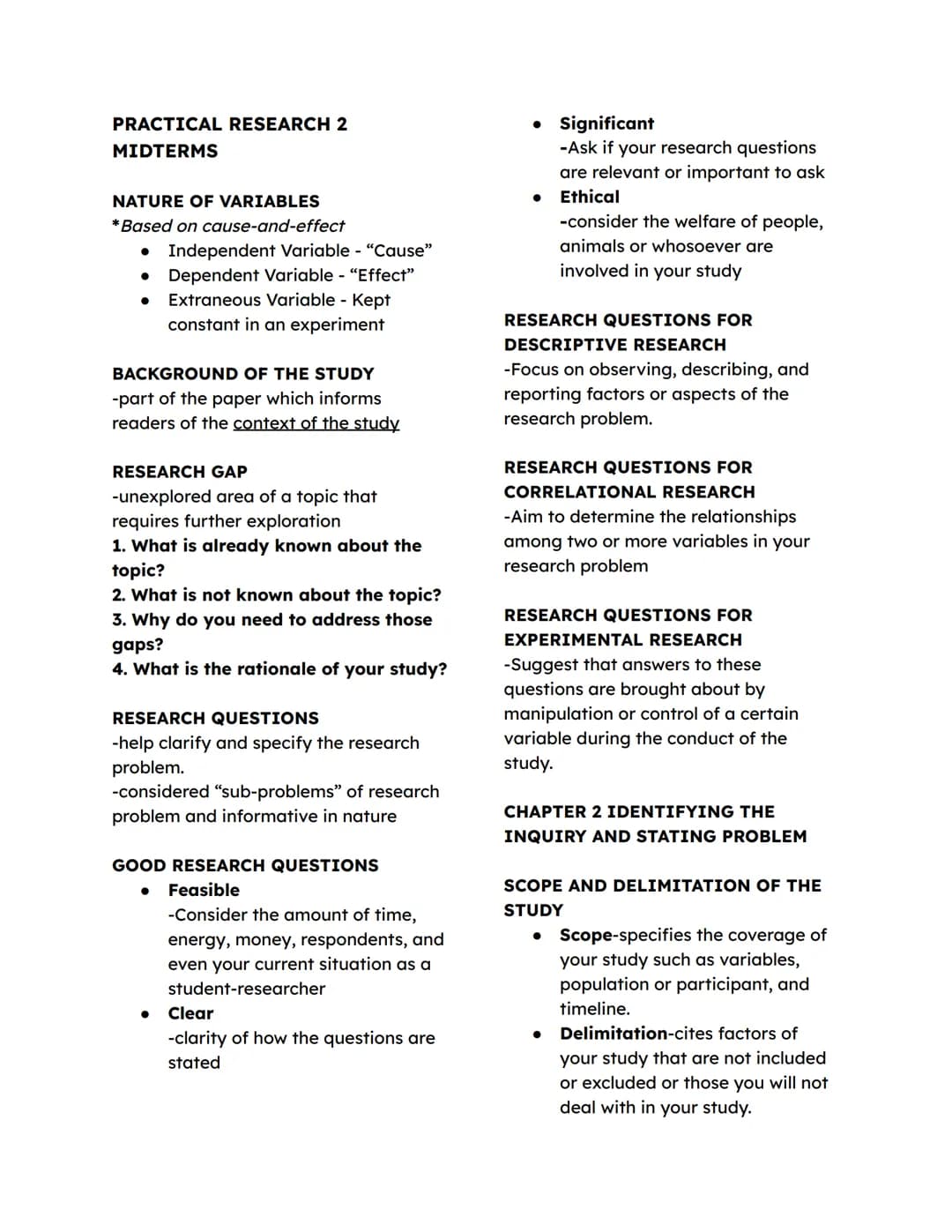
Understanding Research Variables and Problem Identification
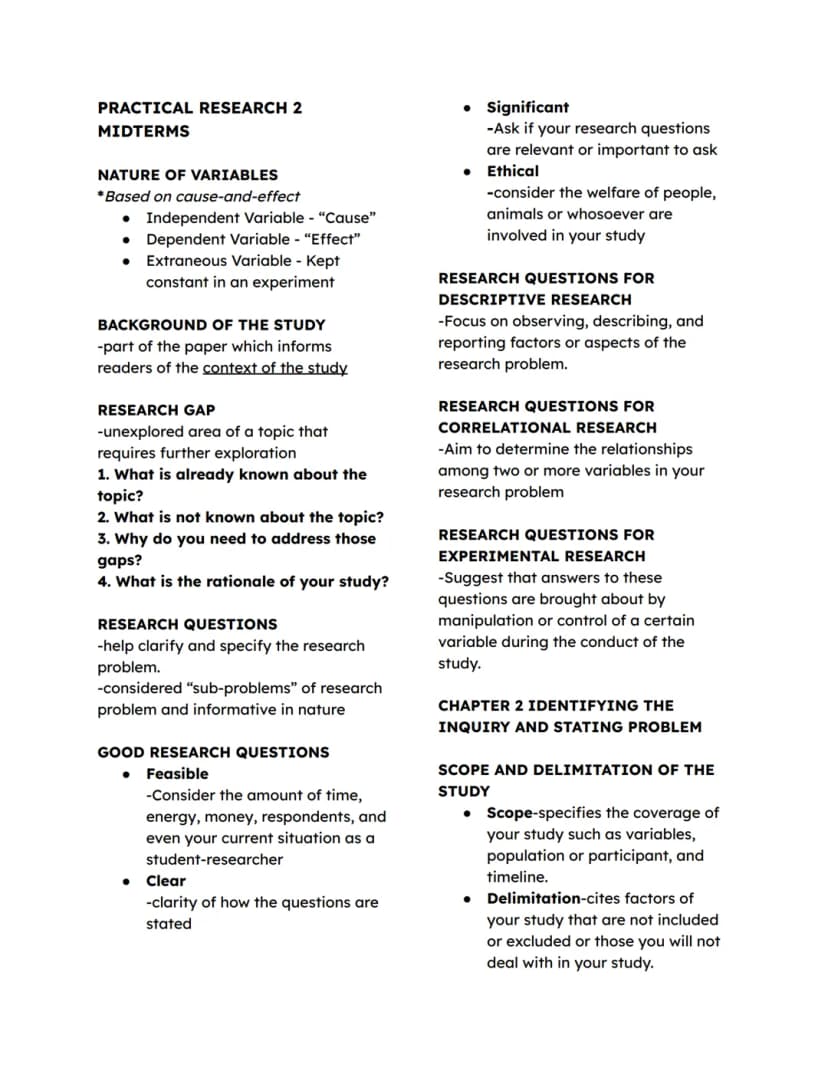
Think of research variables like characters in a story - each one plays a specific role! The independent variable is your "cause" (like hours of studying), while the dependent variable is your "effect" (like test scores). Don't forget about extraneous variables - these are the sneaky factors you need to keep constant so they don't mess up your results.
Your background of the study is like setting the stage for your audience. It gives readers the context they need to understand why your research matters. This is where you identify the research gap - basically, what's missing from current knowledge that your study will fill.
To find your research gap, ask yourself: What do we already know? What's still a mystery? Why does closing this gap matter? These questions help you build a strong foundation for your entire study.
Good research questions need to tick four boxes: they should be feasible (doable with your resources), clear (no confusing language), significant (actually important), and ethical (won't harm anyone). Remember, your research questions are like sub-problems that break down your main research problem into manageable pieces.
Pro Tip: Different research types need different question styles - descriptive research observes and describes, correlational research looks for relationships, and experimental research involves manipulating variables!
2
of 3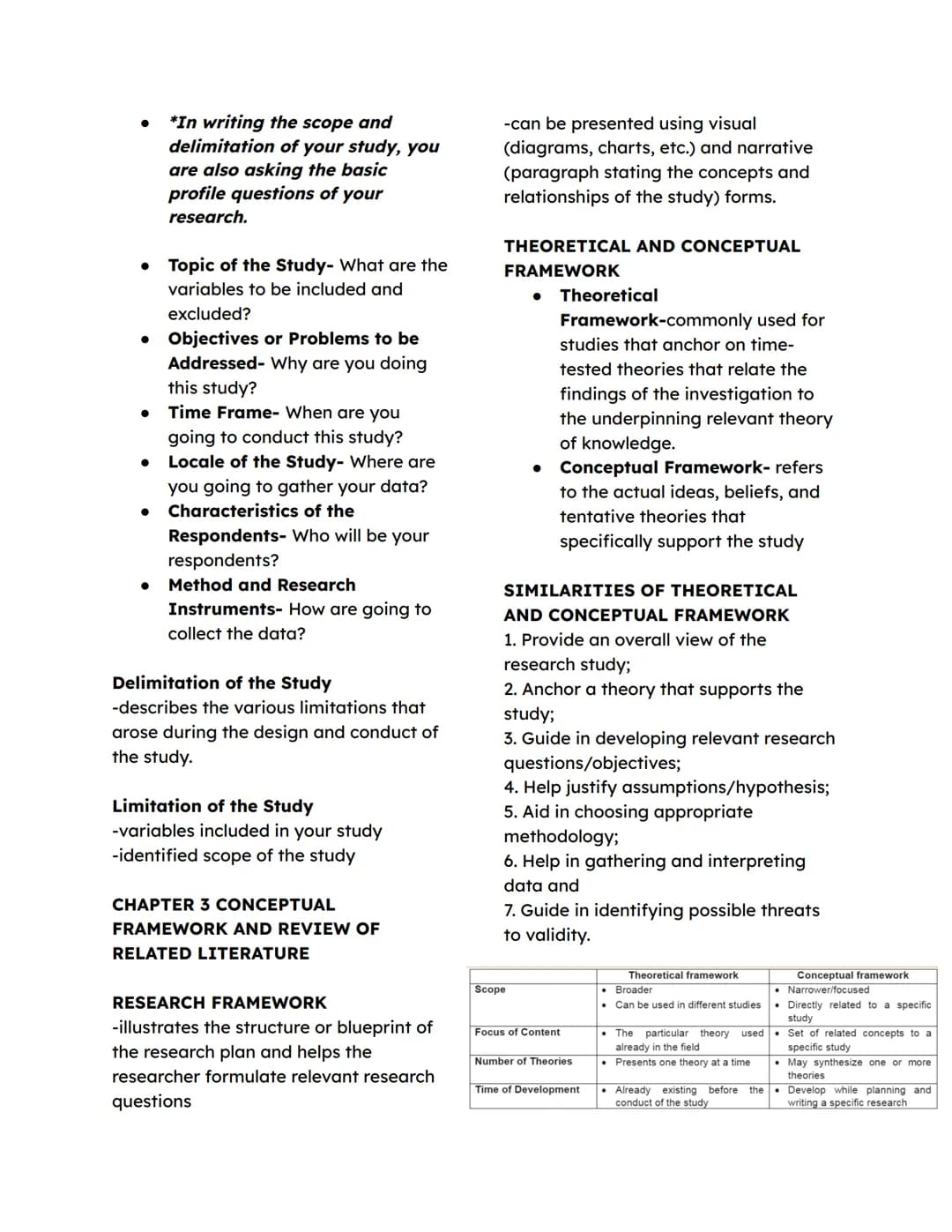
Defining Your Research Boundaries and Scope
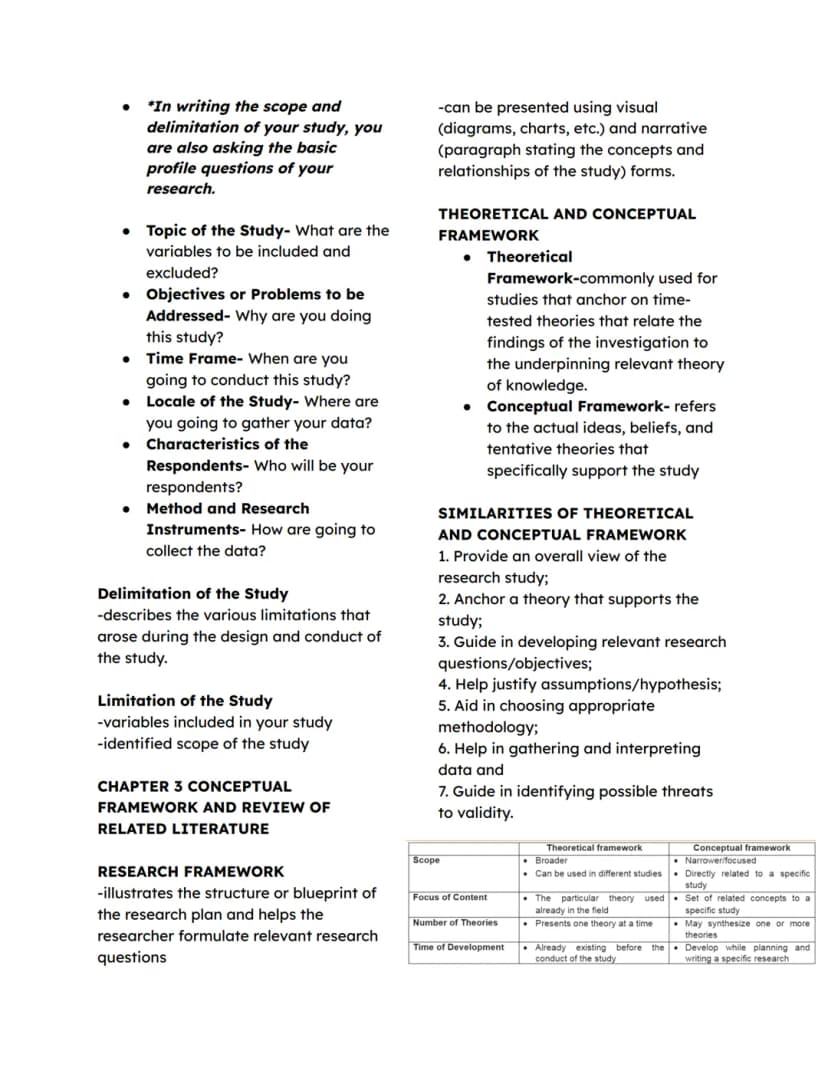
Setting boundaries isn't limiting your research - it's making it focused and doable! Your scope defines what you're covering (variables, participants, timeline), while your delimitation clearly states what you're NOT including. Think of it as drawing a clear map of your research territory.
When writing your scope and delimitation, you're basically answering the journalist's questions: What variables will you study? Why are you doing this research? When will you conduct it? Where will you gather data? Who are your participants? How will you collect information?
Here's something students often mix up: delimitation describes what you chose to exclude from your study design, while limitation refers to weaknesses or restrictions that came up during your actual research process. Delimitation is planned; limitation just happens.
Your research framework is like your study's blueprint - it shows the structure and helps you ask the right questions. You can present this visually (with diagrams or charts) or in narrative form (written explanations of how concepts connect).
Remember: Being specific about your boundaries actually makes your research stronger, not weaker - it shows you know exactly what you're investigating!
3
of 3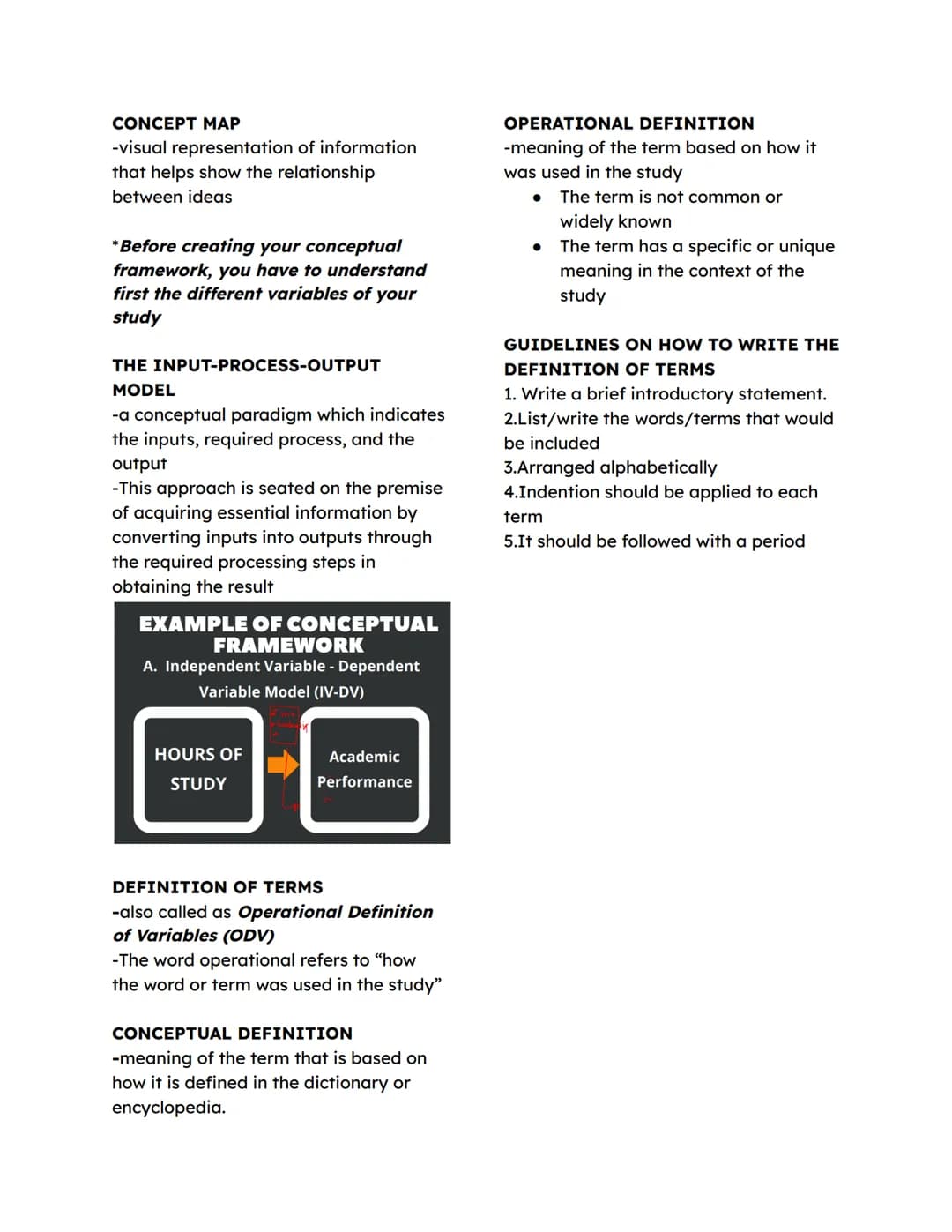
Building Strong Conceptual Frameworks
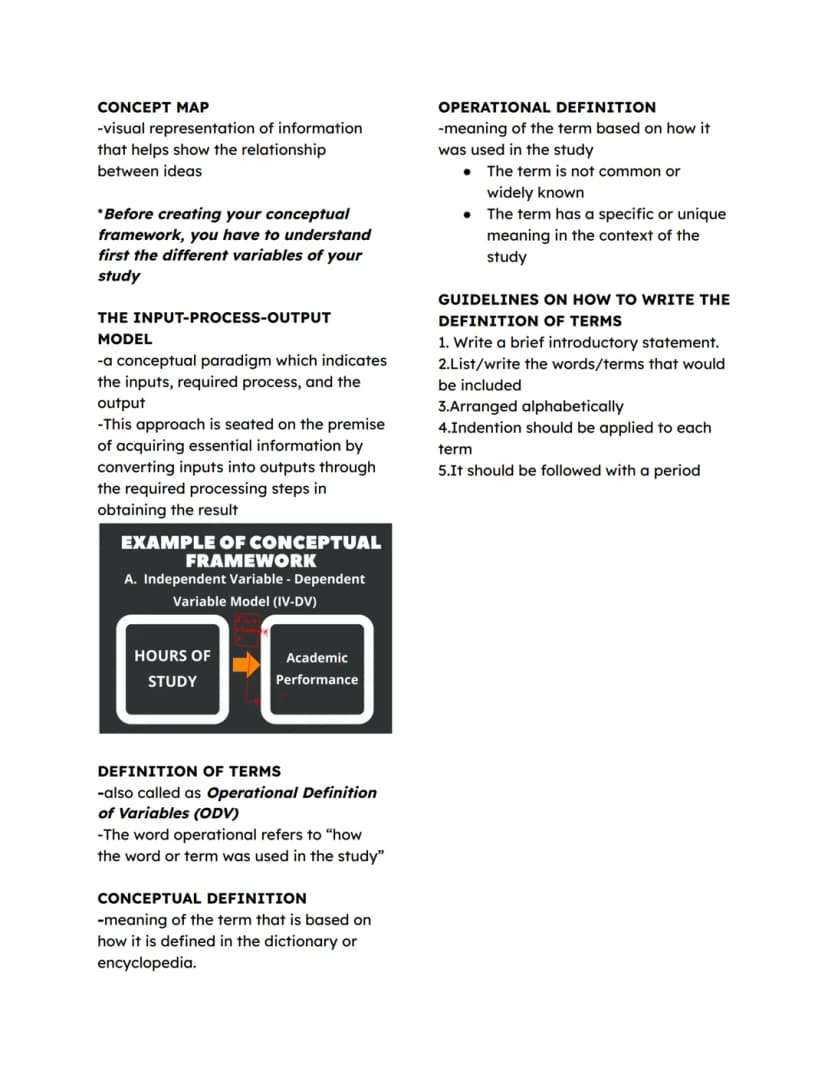
Here's where things get exciting - creating the visual backbone of your research! A theoretical framework uses established, time-tested theories, while a conceptual framework focuses on your specific ideas and beliefs that support your particular study. Both serve as your research roadmap.
The Input-Process-Output (IPO) model is super popular because it's straightforward: you have inputs (what goes in), process (what happens), and output (what comes out). It's like a research recipe that shows how you'll transform your data into meaningful results.
Concept maps are your best friend for visualizing relationships between ideas. They help you see connections you might have missed and make your framework crystal clear to readers. The most common model you'll use is the Independent Variable-Dependent Variable setup.
Don't forget your operational definitions - these explain exactly how you're using specific terms in your study. Include them when terms aren't widely known or when you're using them in a unique way. List them alphabetically with proper indentation, and always include a brief intro statement.
Quick Tip: Your conceptual framework develops as you plan your research, while theoretical frameworks already exist - think of one as custom-made and the other as off-the-shelf!
We thought you’d never ask...
What is the Knowunity AI companion?
Our AI companion is specifically built for the needs of students. Based on the millions of content pieces we have on the platform we can provide truly meaningful and relevant answers to students. But its not only about answers, the companion is even more about guiding students through their daily learning challenges, with personalised study plans, quizzes or content pieces in the chat and 100% personalisation based on the students skills and developments.
Where can I download the Knowunity app?
You can download the app in the Google Play Store and in the Apple App Store.
Is Knowunity really free of charge?
That's right! Enjoy free access to study content, connect with fellow students, and get instant help – all at your fingertips.
Similar Content
 Otros
Otros Other
Other Lectura, expresión oral y escrita
 Science (ACT®)
Most popular content in Pre-Cal
9 Pre-Cal
UPCAT Reviewer: Mathematics
general coverage of the mathematics section for UPCAT
G127,072397
OtherIntroduction to Philosophy - 1st Semester, Grade 12
A summarized notes for Grade 12 students. Easier learning for the 1st semester’s Philosophy subject.
G123,93956
OtherCreative Writing - 1st Sem
Complete 1st Semester Notes of Creative Writing for HUMSS Students.
G123,12580
OtherContemporary Philippine Arts from the Regions
Contemporary Philippine Arts from the Regions (CPAR) Focuses on modern art forms and local artists from different regions in the Philippines.
G122,02831
Other21st Century Literature from the Philippines and the World
Importance of Literature, Philippine Literary Periods and Literary Genres
G112,52426
OtherContemporary Arts 1, 1st Sem
Topics: Arts in the Philippines, Contemporary Art Forms from Regions, Elements of Arts, National Artists, Gawad Sa Manlilikha ng Bayan
G123,14655
 GenBio
UNDERSTANDING THE SELF LESSON 1
understanding the self lesson one
College3,27880
OtherNOTES f o r G r a d e 12STUDENTSContemporary Philippine Artsfrom the Region
NOTES f o r G r a d e 12 STUDENTS Contemporary Philippine Arts from the Region
G122,09324
OtherThe Reproductive System (SCIENCE 10)
Know more about the reproductive system!
G102,18844
Most popular content
9 Math
MathMathematics Grade 10 Quarter 1
Grade 10 Math topics
G1010,218250
Iba paEl Filibusterismo (FILIPINO 10)
Kilalanin ang mga karakter at alamin ang mga pangyayari mula Kabanata 1 hanggang 39.
G1011,183240
ScienceScience 9 Quarter 1 Lesson 1
Topics: The Respiratory System and The Circulatory System
G911,069383
 Gen Physics
General Physics 1, First Sem
Units of Measurement, Vectors, and Kinematics. All with formulas
G116,247168
 Filipino
Filipino 8 Reviewer
Filipino Reviewer for 4th Quarter for Grade 8 students
G88,088127
ScienceSCIENCE Grade 9 Quarter 3 Reviewer
All about the lessons in Grade 9 Quarter 3 SCIENCE, all complete, highlighted, printable, and has extra informations.
G914,629303
Pre-CalUPCAT Reviewer: Mathematics
general coverage of the mathematics section for UPCAT
G127,072397
OtherIntroduction to Philosophy - 1st Semester, Grade 12
A summarized notes for Grade 12 students. Easier learning for the 1st semester’s Philosophy subject.
G123,93956
ScienceThe Human Digestive System
Science Grade 8 1st Quarter Lesson
G84,78386
Can't find what you're looking for? Explore other subjects.
Students love us — and so will you.
4.6/5App Store
4.7/5Google Play
The app is very easy to use and well designed. I have found everything I was looking for so far and have been able to learn a lot from the presentations! I will definitely use the app for a class assignment! And of course it also helps a lot as an inspiration.
Stefan SiOS user
This app is really great. There are so many study notes and help [...]. My problem subject is French, for example, and the app has so many options for help. Thanks to this app, I have improved my French. I would recommend it to anyone.
Samantha KlichAndroid user
Wow, I am really amazed. I just tried the app because I've seen it advertised many times and was absolutely stunned. This app is THE HELP you want for school and above all, it offers so many things, such as workouts and fact sheets, which have been VERY helpful to me personally.
AnnaiOS user
Other195 views·Updated Jun 20, 2026·3 pagesUnderstanding PR 2: A Comprehensive Guide
aya@ayash
Ever wondered how researchers actually plan and structure their studies? This guide breaks down the essential building blocks of research - from identifying variables to creating frameworks that make your research rock-solid and meaningful.
1
of 3
Sign up to see the content. It's free!
- Access to all documents
- Improve your grades
- Join milions of students
Understanding Research Variables and Problem Identification
Think of research variables like characters in a story - each one plays a specific role! The independent variable is your "cause" (like hours of studying), while the dependent variable is your "effect" (like test scores). Don't forget about extraneous variables - these are the sneaky factors you need to keep constant so they don't mess up your results.
Your background of the study is like setting the stage for your audience. It gives readers the context they need to understand why your research matters. This is where you identify the research gap - basically, what's missing from current knowledge that your study will fill.
To find your research gap, ask yourself: What do we already know? What's still a mystery? Why does closing this gap matter? These questions help you build a strong foundation for your entire study.
Good research questions need to tick four boxes: they should be feasible (doable with your resources), clear (no confusing language), significant (actually important), and ethical (won't harm anyone). Remember, your research questions are like sub-problems that break down your main research problem into manageable pieces.
Pro Tip: Different research types need different question styles - descriptive research observes and describes, correlational research looks for relationships, and experimental research involves manipulating variables!
2
of 3Sign up to see the content. It's free!
- Access to all documents
- Improve your grades
- Join milions of students
Defining Your Research Boundaries and Scope
Setting boundaries isn't limiting your research - it's making it focused and doable! Your scope defines what you're covering (variables, participants, timeline), while your delimitation clearly states what you're NOT including. Think of it as drawing a clear map of your research territory.
When writing your scope and delimitation, you're basically answering the journalist's questions: What variables will you study? Why are you doing this research? When will you conduct it? Where will you gather data? Who are your participants? How will you collect information?
Here's something students often mix up: delimitation describes what you chose to exclude from your study design, while limitation refers to weaknesses or restrictions that came up during your actual research process. Delimitation is planned; limitation just happens.
Your research framework is like your study's blueprint - it shows the structure and helps you ask the right questions. You can present this visually (with diagrams or charts) or in narrative form (written explanations of how concepts connect).
Remember: Being specific about your boundaries actually makes your research stronger, not weaker - it shows you know exactly what you're investigating!
3
of 3Sign up to see the content. It's free!
- Access to all documents
- Improve your grades
- Join milions of students
Building Strong Conceptual Frameworks
Here's where things get exciting - creating the visual backbone of your research! A theoretical framework uses established, time-tested theories, while a conceptual framework focuses on your specific ideas and beliefs that support your particular study. Both serve as your research roadmap.
The Input-Process-Output (IPO) model is super popular because it's straightforward: you have inputs (what goes in), process (what happens), and output (what comes out). It's like a research recipe that shows how you'll transform your data into meaningful results.
Concept maps are your best friend for visualizing relationships between ideas. They help you see connections you might have missed and make your framework crystal clear to readers. The most common model you'll use is the Independent Variable-Dependent Variable setup.
Don't forget your operational definitions - these explain exactly how you're using specific terms in your study. Include them when terms aren't widely known or when you're using them in a unique way. List them alphabetically with proper indentation, and always include a brief intro statement.
Quick Tip: Your conceptual framework develops as you plan your research, while theoretical frameworks already exist - think of one as custom-made and the other as off-the-shelf!
We thought you’d never ask...
What is the Knowunity AI companion?
Our AI companion is specifically built for the needs of students. Based on the millions of content pieces we have on the platform we can provide truly meaningful and relevant answers to students. But its not only about answers, the companion is even more about guiding students through their daily learning challenges, with personalised study plans, quizzes or content pieces in the chat and 100% personalisation based on the students skills and developments.
Where can I download the Knowunity app?
You can download the app in the Google Play Store and in the Apple App Store.
Is Knowunity really free of charge?
That's right! Enjoy free access to study content, connect with fellow students, and get instant help – all at your fingertips.
Similar Content
Most popular content in Pre-Cal
9Pre-CalUPCAT Reviewer: Mathematics
general coverage of the mathematics section for UPCAT
G127,072397
OtherIntroduction to Philosophy - 1st Semester, Grade 12
A summarized notes for Grade 12 students. Easier learning for the 1st semester’s Philosophy subject.
G123,93956
OtherCreative Writing - 1st Sem
Complete 1st Semester Notes of Creative Writing for HUMSS Students.
G123,12580
OtherContemporary Philippine Arts from the Regions
Contemporary Philippine Arts from the Regions (CPAR) Focuses on modern art forms and local artists from different regions in the Philippines.
G122,02831
Other21st Century Literature from the Philippines and the World
Importance of Literature, Philippine Literary Periods and Literary Genres
G112,52426
OtherContemporary Arts 1, 1st Sem
Topics: Arts in the Philippines, Contemporary Art Forms from Regions, Elements of Arts, National Artists, Gawad Sa Manlilikha ng Bayan
G123,14655
GenBioUNDERSTANDING THE SELF LESSON 1
understanding the self lesson one
College3,27880
OtherNOTES f o r G r a d e 12STUDENTSContemporary Philippine Artsfrom the Region
NOTES f o r G r a d e 12 STUDENTS Contemporary Philippine Arts from the Region
G122,09324
OtherThe Reproductive System (SCIENCE 10)
Know more about the reproductive system!
G102,18844
Most popular content
9MathMathematics Grade 10 Quarter 1
Grade 10 Math topics
G1010,218250
Iba paEl Filibusterismo (FILIPINO 10)
Kilalanin ang mga karakter at alamin ang mga pangyayari mula Kabanata 1 hanggang 39.
G1011,183240
ScienceScience 9 Quarter 1 Lesson 1
Topics: The Respiratory System and The Circulatory System
G911,069383
Gen PhysicsGeneral Physics 1, First Sem
Units of Measurement, Vectors, and Kinematics. All with formulas
G116,247168
FilipinoFilipino 8 Reviewer
Filipino Reviewer for 4th Quarter for Grade 8 students
G88,088127
ScienceSCIENCE Grade 9 Quarter 3 Reviewer
All about the lessons in Grade 9 Quarter 3 SCIENCE, all complete, highlighted, printable, and has extra informations.
G914,629303
Pre-CalUPCAT Reviewer: Mathematics
general coverage of the mathematics section for UPCAT
G127,072397
OtherIntroduction to Philosophy - 1st Semester, Grade 12
A summarized notes for Grade 12 students. Easier learning for the 1st semester’s Philosophy subject.
G123,93956
ScienceThe Human Digestive System
Science Grade 8 1st Quarter Lesson
G84,78386
Can't find what you're looking for? Explore other subjects.
Students love us — and so will you.
4.6/5App Store
4.7/5Google Play
The app is very easy to use and well designed. I have found everything I was looking for so far and have been able to learn a lot from the presentations! I will definitely use the app for a class assignment! And of course it also helps a lot as an inspiration.
Stefan SiOS user
This app is really great. There are so many study notes and help [...]. My problem subject is French, for example, and the app has so many options for help. Thanks to this app, I have improved my French. I would recommend it to anyone.
Samantha KlichAndroid user
Wow, I am really amazed. I just tried the app because I've seen it advertised many times and was absolutely stunned. This app is THE HELP you want for school and above all, it offers so many things, such as workouts and fact sheets, which have been VERY helpful to me personally.
AnnaiOS user