
Japanese has some phrases that sound similar to English but...
 Other Languages67 views·Updated Jun 20, 2026·2 pages
Japanese Phrases with Double Meanings

Kate @kate_sbdx
1
of 2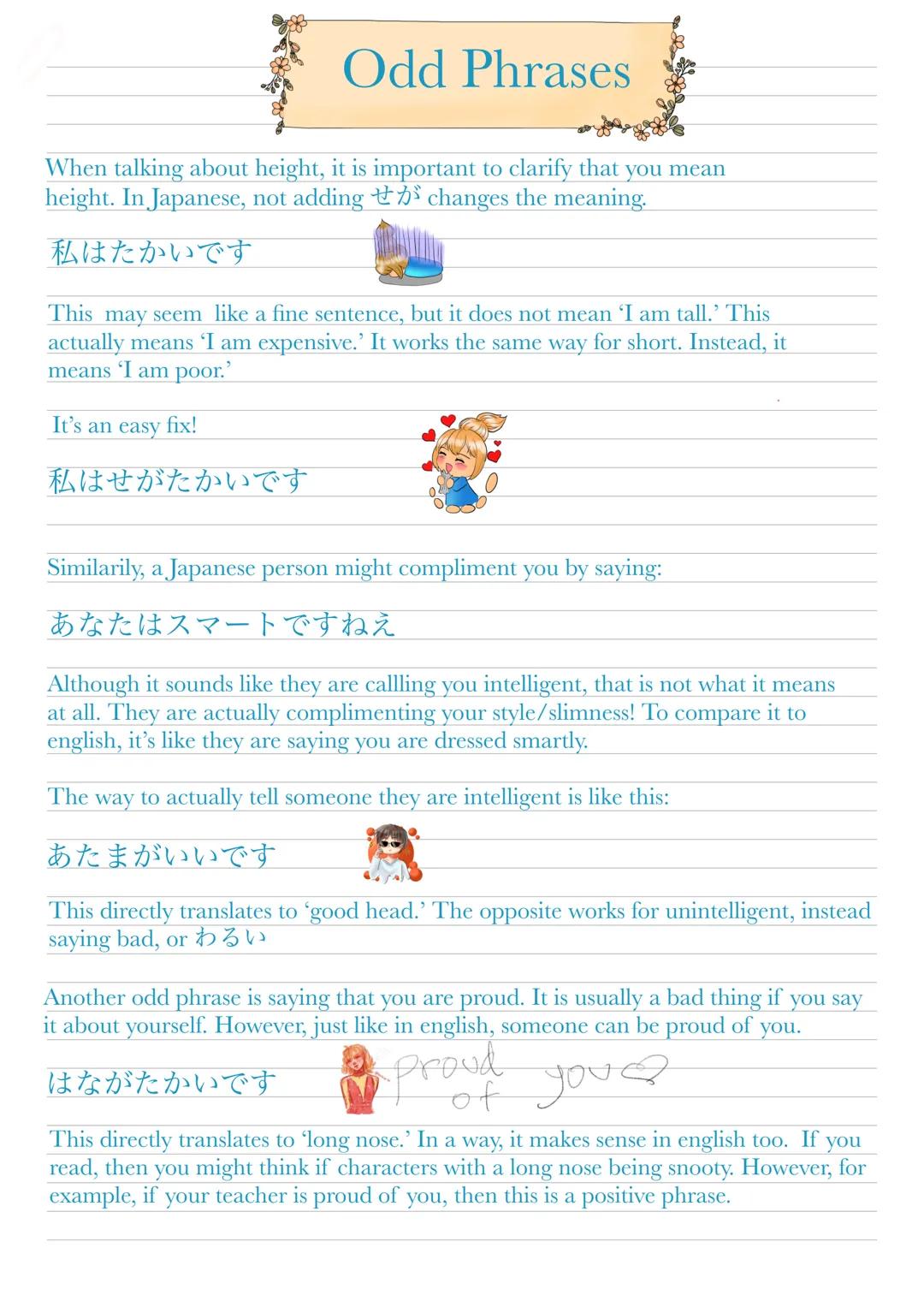
Surprising Japanese Phrases
When talking about height in Japanese, you need to be specific or you might say something totally different! For example, "私はたかいです" (Watashi wa takai desu) doesn't mean "I am tall" - it actually means "I am expensive." Similarly, saying you're short without the right word could mean you're poor!
The fix is simple: add "せが" (se ga) when talking about height. So "私はせがたかいです" (Watashi wa se ga takai desu) correctly says "I am tall." This small addition makes all the difference!
Another confusing phrase is when a Japanese person says "あなたはスマートですねえ" (Anata wa sumaato desu nee). While it sounds like they're calling you smart or intelligent, they're actually complimenting your style or slimness! To actually say someone is intelligent, use "あたまがいいです" (Atama ga ii desu) which literally means "good head."
Remember this! The phrase "はながたかいです" (Hana ga takai desu) literally means "long nose" but actually means "proud" - and it's usually negative when talking about yourself, but positive when someone else is proud of you!
2
of 2
More Curious Expressions
Japanese has many expressions that sound strange when translated literally but have specific cultural meanings. For example, "みみがはやいです" (Mimi ga hayai desu) literally means "fast ears" but actually refers to someone who picks up on gossip quickly!
Another surprising phrase is "くびにります" (Kubi ni niru), which literally translates to "cut off your neck" but is used to mean "fired" from a job. This shows how Japanese expressions can be quite dramatic when translated directly.
The phrase "かおがひろいです" (Kao ga hiroi desu) translates to "wide face" but actually means someone is well-known or has many connections. These expressions show how language and culture are deeply connected in Japanese.
Fun fact: Many Japanese expressions use body parts to describe personality traits or situations, which makes them memorable once you understand the cultural context behind them!
We thought you’d never ask...
What is the Knowunity AI companion?
Our AI companion is specifically built for the needs of students. Based on the millions of content pieces we have on the platform we can provide truly meaningful and relevant answers to students. But its not only about answers, the companion is even more about guiding students through their daily learning challenges, with personalised study plans, quizzes or content pieces in the chat and 100% personalisation based on the students skills and developments.
Where can I download the Knowunity app?
You can download the app in the Google Play Store and in the Apple App Store.
Is Knowunity really free of charge?
That's right! Enjoy free access to study content, connect with fellow students, and get instant help – all at your fingertips.
Similar Content
Most popular content in Other Languages
5A
Other LanguagesAlgebraic Expression Components
Learn to distinguish between variables, coefficients, constants, and exponents within algebraic expressions.
6th1270
Other LanguagesReading Hangul but the Easy not Complicated Way
this is literally like the easiest way to read hangul like yeah.
9th1205
 English
Korean
Korean language
7th942
Other LanguagesKorean Alphabet Consonants and Vowels
Learn the Korean alphabet including sound pronunciatio. This is not a super in depth grammar alphabet lesson, I’m just going over the basic characters and pronunciation :> Part 1/?
9th655
 Fun Stuff
Culture in Japan
A summary of Japan's etiquette, values, education, cuisine, holidays, religion, language, and attitude towards foreigners.
11th604
Most popular content
9O
 AP US History
Origins and Dynamics of the Columbian Exchange
Analyze the ecological and economic motivations behind the initial transfer of goods, people, and diseases between the Old and New Worlds.
9th3,1280
I
AP US HistoryIntroduction to Early Cultural Interactions
Analyze the initial social and religious encounters between Europeans, Africans, and Indigenous peoples in the colonial Americas.
9th2,7730
O
 AP World History
Origins of Ancient River Civilizations
Analyze the environmental factors and technological innovations that led to the rise of early states in Mesopotamia, Egypt, and the Indus Valley.
9th3,1870
M
AP US HistoryMotivations for European Exploration
Analyze the economic, religious, and political factors that drove European powers to the Americas during the 15th and 16th centuries.
9th1,7780
F
 AP Psychology
Foundations of Ethical Guidelines in Research
Practice the core principles of the APA ethical code including informed consent, debriefing, and the role of Institutional Review Boards.
9th1,3360
I
AP US HistoryIntroduction to Native American Societies
Examine the diverse social, political, and economic structures of North American indigenous groups prior to European contact.
9th1,1100
I
 AP Biology
Introduction to Biological Elements of Life
Practice identifying the essential elements including carbon, nitrogen, phosphorus, and sulfur that compose biological macromolecules.
9th1,7390
I
AP US HistoryIntroduction to the Spanish Encomienda System
Explore the fundamental economic and social structures of the Spanish colonial system, focusing on the encomienda and the casta social hierarchy.
9th8890
O
AP World HistoryOrigins and Continuity of the Byzantine Empire
Analyze the political and cultural transitions from the Roman Empire to the Byzantine Empire, focusing on the reign of Justinian I and his code.
9th1,6320
Can't find what you're looking for? Explore other subjects.
Students love us — and so will you.
4.6/5App Store
4.7/5Google Play
The app is very easy to use and well designed. I have found everything I was looking for so far and have been able to learn a lot from the presentations! I will definitely use the app for a class assignment! And of course it also helps a lot as an inspiration.
Stefan SiOS user
This app is really great. There are so many study notes and help [...]. My problem subject is French, for example, and the app has so many options for help. Thanks to this app, I have improved my French. I would recommend it to anyone.
Samantha KlichAndroid user
Wow, I am really amazed. I just tried the app because I've seen it advertised many times and was absolutely stunned. This app is THE HELP you want for school and above all, it offers so many things, such as workouts and fact sheets, which have been VERY helpful to me personally.
AnnaiOS user
Other Languages67 views·Updated Jun 20, 2026·2 pagesJapanese Phrases with Double Meanings
Kate @kate_sbdx
Japanese has some phrases that sound similar to English but mean something completely different! Understanding these odd phrases will help you avoid confusion and communicate more accurately when speaking Japanese.
1
of 2
Sign up to see the content. It's free!
- Access to all documents
- Improve your grades
- Join milions of students
Surprising Japanese Phrases
When talking about height in Japanese, you need to be specific or you might say something totally different! For example, "私はたかいです" (Watashi wa takai desu) doesn't mean "I am tall" - it actually means "I am expensive." Similarly, saying you're short without the right word could mean you're poor!
The fix is simple: add "せが" (se ga) when talking about height. So "私はせがたかいです" (Watashi wa se ga takai desu) correctly says "I am tall." This small addition makes all the difference!
Another confusing phrase is when a Japanese person says "あなたはスマートですねえ" (Anata wa sumaato desu nee). While it sounds like they're calling you smart or intelligent, they're actually complimenting your style or slimness! To actually say someone is intelligent, use "あたまがいいです" (Atama ga ii desu) which literally means "good head."
Remember this! The phrase "はながたかいです" (Hana ga takai desu) literally means "long nose" but actually means "proud" - and it's usually negative when talking about yourself, but positive when someone else is proud of you!
2
of 2Sign up to see the content. It's free!
- Access to all documents
- Improve your grades
- Join milions of students
More Curious Expressions
Japanese has many expressions that sound strange when translated literally but have specific cultural meanings. For example, "みみがはやいです" (Mimi ga hayai desu) literally means "fast ears" but actually refers to someone who picks up on gossip quickly!
Another surprising phrase is "くびにります" (Kubi ni niru), which literally translates to "cut off your neck" but is used to mean "fired" from a job. This shows how Japanese expressions can be quite dramatic when translated directly.
The phrase "かおがひろいです" (Kao ga hiroi desu) translates to "wide face" but actually means someone is well-known or has many connections. These expressions show how language and culture are deeply connected in Japanese.
Fun fact: Many Japanese expressions use body parts to describe personality traits or situations, which makes them memorable once you understand the cultural context behind them!
We thought you’d never ask...
What is the Knowunity AI companion?
Our AI companion is specifically built for the needs of students. Based on the millions of content pieces we have on the platform we can provide truly meaningful and relevant answers to students. But its not only about answers, the companion is even more about guiding students through their daily learning challenges, with personalised study plans, quizzes or content pieces in the chat and 100% personalisation based on the students skills and developments.
Where can I download the Knowunity app?
You can download the app in the Google Play Store and in the Apple App Store.
Is Knowunity really free of charge?
That's right! Enjoy free access to study content, connect with fellow students, and get instant help – all at your fingertips.
Similar Content
Most popular content in Other Languages
5A
Other LanguagesAlgebraic Expression Components
Learn to distinguish between variables, coefficients, constants, and exponents within algebraic expressions.
6th1270
Other LanguagesReading Hangul but the Easy not Complicated Way
this is literally like the easiest way to read hangul like yeah.
9th1205
EnglishKorean
Korean language
7th942
Other LanguagesKorean Alphabet Consonants and Vowels
Learn the Korean alphabet including sound pronunciatio. This is not a super in depth grammar alphabet lesson, I’m just going over the basic characters and pronunciation :> Part 1/?
9th655
Fun StuffCulture in Japan
A summary of Japan's etiquette, values, education, cuisine, holidays, religion, language, and attitude towards foreigners.
11th604
Most popular content
9O
AP US HistoryOrigins and Dynamics of the Columbian Exchange
Analyze the ecological and economic motivations behind the initial transfer of goods, people, and diseases between the Old and New Worlds.
9th3,1280
I
AP US HistoryIntroduction to Early Cultural Interactions
Analyze the initial social and religious encounters between Europeans, Africans, and Indigenous peoples in the colonial Americas.
9th2,7730
O
AP World HistoryOrigins of Ancient River Civilizations
Analyze the environmental factors and technological innovations that led to the rise of early states in Mesopotamia, Egypt, and the Indus Valley.
9th3,1870
M
AP US HistoryMotivations for European Exploration
Analyze the economic, religious, and political factors that drove European powers to the Americas during the 15th and 16th centuries.
9th1,7780
F
AP PsychologyFoundations of Ethical Guidelines in Research
Practice the core principles of the APA ethical code including informed consent, debriefing, and the role of Institutional Review Boards.
9th1,3360
I
AP US HistoryIntroduction to Native American Societies
Examine the diverse social, political, and economic structures of North American indigenous groups prior to European contact.
9th1,1100
I
AP BiologyIntroduction to Biological Elements of Life
Practice identifying the essential elements including carbon, nitrogen, phosphorus, and sulfur that compose biological macromolecules.
9th1,7390
I
AP US HistoryIntroduction to the Spanish Encomienda System
Explore the fundamental economic and social structures of the Spanish colonial system, focusing on the encomienda and the casta social hierarchy.
9th8890
O
AP World HistoryOrigins and Continuity of the Byzantine Empire
Analyze the political and cultural transitions from the Roman Empire to the Byzantine Empire, focusing on the reign of Justinian I and his code.
9th1,6320
Can't find what you're looking for? Explore other subjects.
Students love us — and so will you.
4.6/5App Store
4.7/5Google Play
The app is very easy to use and well designed. I have found everything I was looking for so far and have been able to learn a lot from the presentations! I will definitely use the app for a class assignment! And of course it also helps a lot as an inspiration.
Stefan SiOS user
This app is really great. There are so many study notes and help [...]. My problem subject is French, for example, and the app has so many options for help. Thanks to this app, I have improved my French. I would recommend it to anyone.
Samantha KlichAndroid user
Wow, I am really amazed. I just tried the app because I've seen it advertised many times and was absolutely stunned. This app is THE HELP you want for school and above all, it offers so many things, such as workouts and fact sheets, which have been VERY helpful to me personally.
AnnaiOS user