
Philosophy might sound intimidating, but it's actually about asking the...
 Other3,939 views·Updated Jun 27, 2026·5 pages
Grade 12 Philosophy Notes - 1st Semester Made Easy
A
Anne@anne6


1 / 5
1
of 5
Understanding Philosophy and Its Branches
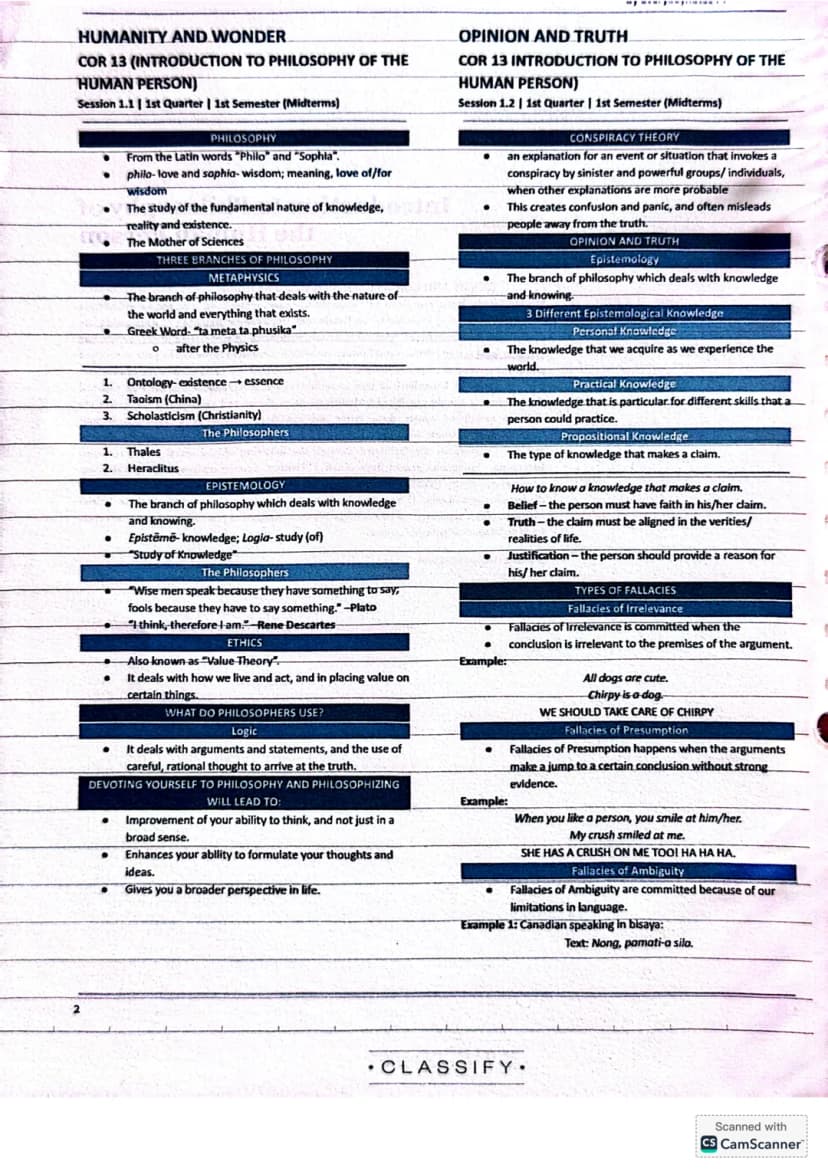
Ever wondered why people have different opinions about literally everything? Philosophy helps you figure out the difference between what's true and what's just someone's opinion. Philosophy comes from Greek words meaning "love of wisdom" - it's basically humanity's attempt to understand reality, knowledge, and existence.
The three main branches are metaphysics (what exists), epistemology (how we know things), and ethics (how we should live). Think of philosophers like Plato and Descartes as the original critical thinkers who weren't satisfied with simple answers.
Logic is the philosopher's main tool - it's about using careful reasoning to separate facts from opinions. When you study philosophy, you're training your brain to think more clearly, express ideas better, and see life from multiple perspectives.
Pro tip: Philosophy won't give you all the answers, but it'll teach you to ask better questions and spot when someone's trying to mislead you with conspiracy theories or logical fallacies.
2
of 5
Facts vs. Opinions and Critical Thinking
Your social media feed is probably full of people presenting their opinions as facts - philosophy teaches you the difference. Facts are things that can be proven true through evidence and research, while opinions are personal judgments that might be biased or one-sided.
Critical thinking is your superpower for analyzing information before accepting it. It improves your communication skills, helps you catch errors, and boosts your creativity. The goal isn't to become a know-it-all, but to become someone who thinks before believing.
Watch out for fallacies - these are common mistakes in reasoning. For example, thinking your crush likes you back just because they smiled at you (that's jumping to conclusions without evidence).
Remember: Wisdom comes from thinking critically about everything - even your own beliefs. As the saying goes, "The truth will set you free," but first you need to figure out what's actually true.
3
of 5
The Human Person and Finding Your Purpose
What makes you uniquely human? Philosophers debate whether we have essential qualities (like having a soul) or if we're just a bundle of changing characteristics. David Hume argued that there's no fixed "self" - you're constantly changing. Aristotle disagreed, saying we all have an essence that makes us who we are.
Existentialism flips this around completely. It says you exist first, then you get to decide your own purpose. Think of it like this: God might have a plan for you, but you still have the freedom to choose how to live it out.
Transcendence means going beyond your physical limitations to connect with something infinite - for many people, that's God. It's about finding meaning that's bigger than just your daily routine.
As humans, we're called to be stewards of creation - basically, caretakers of the world around us. This isn't just about recycling; it's about recognizing your responsibility to make the world better.
Key insight: Your limitations don't define you - they're obstacles to overcome on your journey toward finding your true purpose and meaning in life.
4
of 5
Making Good Choices and Understanding Different Perspectives
Everyone wants a good life, but philosophers disagree on how to get there. Ethics helps you figure out right from wrong and understand what motivates your behavior. Some people chase pleasure (hedonism), others focus on virtue and living according to nature (stoicism).
The Divine Command Theory says God provides moral guidance, but you still have free will to choose. Think of it as having a moral GPS - it shows you the right direction, but you decide whether to follow it.
Intersubjectivity just means different people interact and disagree about stuff. That's normal! We all have different experiences, values, and perspectives. Human freedom isn't just about having choices - it's about making choices based on what you value most.
Understanding existentialism helps you grasp why people search for meaning differently. Theistic existentialists believe God provides purpose, while atheistic existentialists think you're on your own to create meaning.
Life hack: Good choices come from understanding both your freedom to choose and the consequences of those choices. Your decisions shape not just your life, but the world around you.
5
of 5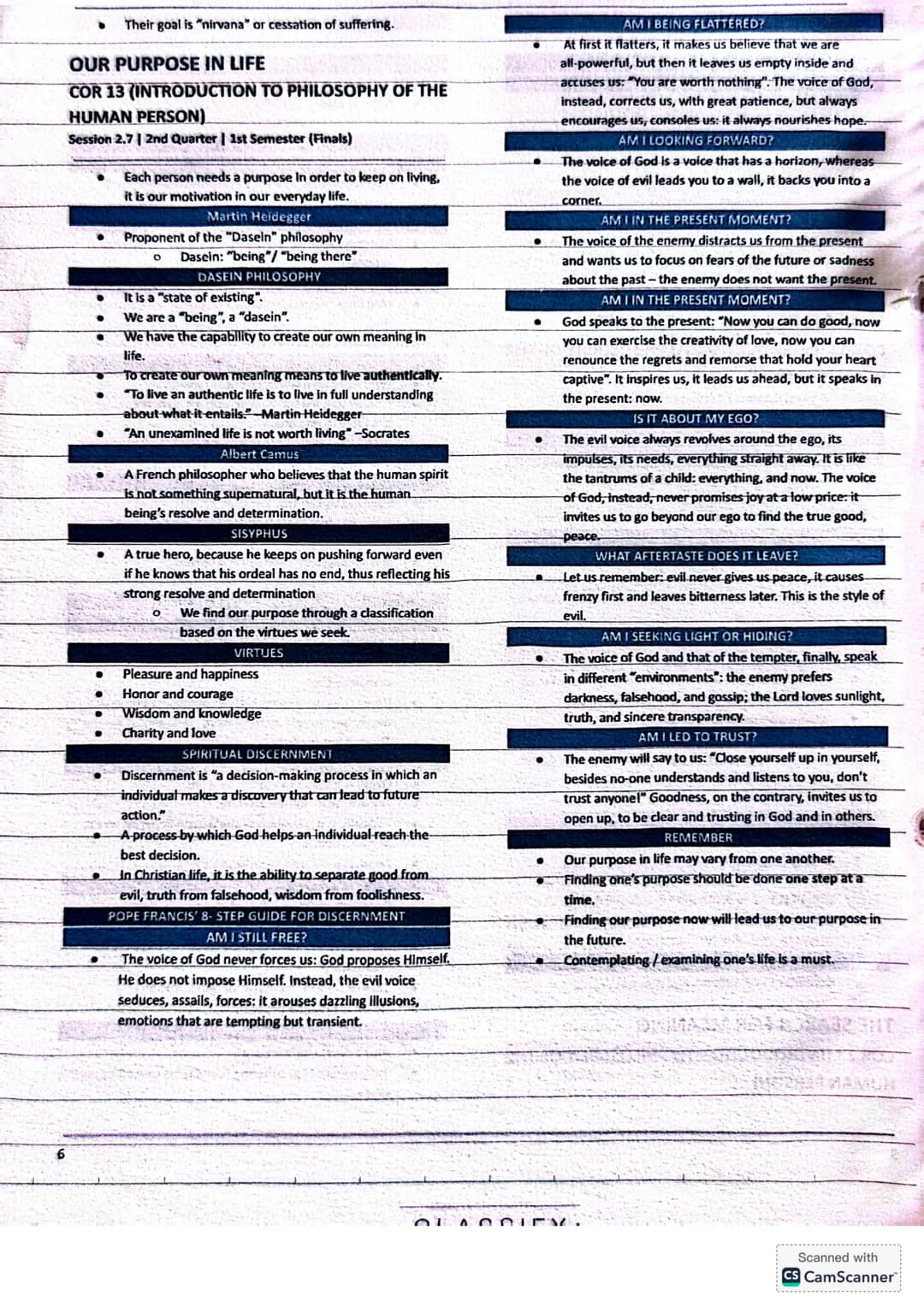
Finding Your Life's Purpose and Spiritual Discernment
Everyone needs a reason to get up in the morning - that's your purpose. Martin Heidegger's Dasein philosophy teaches that you're a "being" with the power to create your own authentic meaning. Like Socrates said, "An unexamined life is not worth living."
Albert Camus used the story of Sisyphus (a guy condemned to push a boulder uphill forever) to show that real heroism is keeping going even when life seems meaningless. Your virtues - whether you value pleasure, honor, wisdom, or love - help determine your purpose.
Spiritual discernment is a decision-making process where you figure out what's truly good for you versus what just looks appealing. Pope Francis gives practical steps like asking yourself: "Am I being flattered?" and "What aftertaste does this leave?"
Different religions view death and life's meaning differently. Christians see death as going home to God, Muslims view life as a test for the afterlife, while Buddhists and Hindus believe in reincarnation and the cycle of rebirth.
Bottom line: Your purpose might be different from everyone else's, and that's okay. Take time to examine your life regularly - your purpose now is preparing you for your purpose later.
We thought you’d never ask...
What is the Knowunity AI companion?
Our AI companion is specifically built for the needs of students. Based on the millions of content pieces we have on the platform we can provide truly meaningful and relevant answers to students. But its not only about answers, the companion is even more about guiding students through their daily learning challenges, with personalised study plans, quizzes or content pieces in the chat and 100% personalisation based on the students skills and developments.
Where can I download the Knowunity app?
You can download the app in the Google Play Store and in the Apple App Store.
Is Knowunity really free of charge?
That's right! Enjoy free access to study content, connect with fellow students, and get instant help – all at your fingertips.
Most popular content in Pre-Cal
9 Pre-Cal
UPCAT Reviewer: Mathematics
general coverage of the mathematics section for UPCAT
G127,072397
OtherCreative Writing - 1st Sem
Complete 1st Semester Notes of Creative Writing for HUMSS Students.
G123,12580
OtherContemporary Philippine Arts from the Regions
Contemporary Philippine Arts from the Regions (CPAR) Focuses on modern art forms and local artists from different regions in the Philippines.
G122,02831
Other21st Century Literature from the Philippines and the World
Importance of Literature, Philippine Literary Periods and Literary Genres
G112,52426
OtherContemporary Arts 1, 1st Sem
Topics: Arts in the Philippines, Contemporary Art Forms from Regions, Elements of Arts, National Artists, Gawad Sa Manlilikha ng Bayan
G123,14655
 GenBio
UNDERSTANDING THE SELF LESSON 1
understanding the self lesson one
College3,27880
OtherNOTES f o r G r a d e 12STUDENTSContemporary Philippine Artsfrom the Region
NOTES f o r G r a d e 12 STUDENTS Contemporary Philippine Arts from the Region
G122,09324
OtherThe Reproductive System (SCIENCE 10)
Know more about the reproductive system!
G102,18844
OtherContemporary Philippine arts from the region
Second sem
G122,46546
Most popular content
9 Math
MathMathematics Grade 10 Quarter 1
Grade 10 Math topics
G1010,218250
Iba paEl Filibusterismo (FILIPINO 10)
Kilalanin ang mga karakter at alamin ang mga pangyayari mula Kabanata 1 hanggang 39.
G1011,183240
ScienceScience 9 Quarter 1 Lesson 1
Topics: The Respiratory System and The Circulatory System
G911,069383
 Gen Physics
General Physics 1, First Sem
Units of Measurement, Vectors, and Kinematics. All with formulas
G116,247168
 Filipino
Filipino 8 Reviewer
Filipino Reviewer for 4th Quarter for Grade 8 students
G88,088127
ScienceSCIENCE Grade 9 Quarter 3 Reviewer
All about the lessons in Grade 9 Quarter 3 SCIENCE, all complete, highlighted, printable, and has extra informations.
G914,627303
Pre-CalUPCAT Reviewer: Mathematics
general coverage of the mathematics section for UPCAT
G127,072397
ScienceThe Human Digestive System
Science Grade 8 1st Quarter Lesson
G84,78386
GenMathGeneral Mathematics
Notes including the following: Simple and Compound Interest, Simple Annuity, Simple Annuity Due, Regular Payment of an Annuity, Propositions and Symbols, and Truth Table.
G114,25865
Can't find what you're looking for? Explore other subjects.
Students love us — and so will you.
4.6/5App Store
4.7/5Google Play
The app is very easy to use and well designed. I have found everything I was looking for so far and have been able to learn a lot from the presentations! I will definitely use the app for a class assignment! And of course it also helps a lot as an inspiration.
Stefan SiOS user
This app is really great. There are so many study notes and help [...]. My problem subject is French, for example, and the app has so many options for help. Thanks to this app, I have improved my French. I would recommend it to anyone.
Samantha KlichAndroid user
Wow, I am really amazed. I just tried the app because I've seen it advertised many times and was absolutely stunned. This app is THE HELP you want for school and above all, it offers so many things, such as workouts and fact sheets, which have been VERY helpful to me personally.
AnnaiOS user
Other3,939 views·Updated Jun 27, 2026·5 pagesGrade 12 Philosophy Notes - 1st Semester Made Easy
A
Anne@anne6
Philosophy might sound intimidating, but it's actually about asking the big questions we all wonder about - like "What's my purpose?" and "How do I know what's true?" This course explores what makes us human, how we find meaning in...
1
of 5
Sign up to see the content. It's free!
- Access to all documents
- Improve your grades
- Join milions of students
Understanding Philosophy and Its Branches
Ever wondered why people have different opinions about literally everything? Philosophy helps you figure out the difference between what's true and what's just someone's opinion. Philosophy comes from Greek words meaning "love of wisdom" - it's basically humanity's attempt to understand reality, knowledge, and existence.
The three main branches are metaphysics (what exists), epistemology (how we know things), and ethics (how we should live). Think of philosophers like Plato and Descartes as the original critical thinkers who weren't satisfied with simple answers.
Logic is the philosopher's main tool - it's about using careful reasoning to separate facts from opinions. When you study philosophy, you're training your brain to think more clearly, express ideas better, and see life from multiple perspectives.
Pro tip: Philosophy won't give you all the answers, but it'll teach you to ask better questions and spot when someone's trying to mislead you with conspiracy theories or logical fallacies.
2
of 5Sign up to see the content. It's free!
- Access to all documents
- Improve your grades
- Join milions of students
Facts vs. Opinions and Critical Thinking
Your social media feed is probably full of people presenting their opinions as facts - philosophy teaches you the difference. Facts are things that can be proven true through evidence and research, while opinions are personal judgments that might be biased or one-sided.
Critical thinking is your superpower for analyzing information before accepting it. It improves your communication skills, helps you catch errors, and boosts your creativity. The goal isn't to become a know-it-all, but to become someone who thinks before believing.
Watch out for fallacies - these are common mistakes in reasoning. For example, thinking your crush likes you back just because they smiled at you (that's jumping to conclusions without evidence).
Remember: Wisdom comes from thinking critically about everything - even your own beliefs. As the saying goes, "The truth will set you free," but first you need to figure out what's actually true.
3
of 5Sign up to see the content. It's free!
- Access to all documents
- Improve your grades
- Join milions of students
The Human Person and Finding Your Purpose
What makes you uniquely human? Philosophers debate whether we have essential qualities (like having a soul) or if we're just a bundle of changing characteristics. David Hume argued that there's no fixed "self" - you're constantly changing. Aristotle disagreed, saying we all have an essence that makes us who we are.
Existentialism flips this around completely. It says you exist first, then you get to decide your own purpose. Think of it like this: God might have a plan for you, but you still have the freedom to choose how to live it out.
Transcendence means going beyond your physical limitations to connect with something infinite - for many people, that's God. It's about finding meaning that's bigger than just your daily routine.
As humans, we're called to be stewards of creation - basically, caretakers of the world around us. This isn't just about recycling; it's about recognizing your responsibility to make the world better.
Key insight: Your limitations don't define you - they're obstacles to overcome on your journey toward finding your true purpose and meaning in life.
4
of 5Sign up to see the content. It's free!
- Access to all documents
- Improve your grades
- Join milions of students
Making Good Choices and Understanding Different Perspectives
Everyone wants a good life, but philosophers disagree on how to get there. Ethics helps you figure out right from wrong and understand what motivates your behavior. Some people chase pleasure (hedonism), others focus on virtue and living according to nature (stoicism).
The Divine Command Theory says God provides moral guidance, but you still have free will to choose. Think of it as having a moral GPS - it shows you the right direction, but you decide whether to follow it.
Intersubjectivity just means different people interact and disagree about stuff. That's normal! We all have different experiences, values, and perspectives. Human freedom isn't just about having choices - it's about making choices based on what you value most.
Understanding existentialism helps you grasp why people search for meaning differently. Theistic existentialists believe God provides purpose, while atheistic existentialists think you're on your own to create meaning.
Life hack: Good choices come from understanding both your freedom to choose and the consequences of those choices. Your decisions shape not just your life, but the world around you.
5
of 5Sign up to see the content. It's free!
- Access to all documents
- Improve your grades
- Join milions of students
Finding Your Life's Purpose and Spiritual Discernment
Everyone needs a reason to get up in the morning - that's your purpose. Martin Heidegger's Dasein philosophy teaches that you're a "being" with the power to create your own authentic meaning. Like Socrates said, "An unexamined life is not worth living."
Albert Camus used the story of Sisyphus (a guy condemned to push a boulder uphill forever) to show that real heroism is keeping going even when life seems meaningless. Your virtues - whether you value pleasure, honor, wisdom, or love - help determine your purpose.
Spiritual discernment is a decision-making process where you figure out what's truly good for you versus what just looks appealing. Pope Francis gives practical steps like asking yourself: "Am I being flattered?" and "What aftertaste does this leave?"
Different religions view death and life's meaning differently. Christians see death as going home to God, Muslims view life as a test for the afterlife, while Buddhists and Hindus believe in reincarnation and the cycle of rebirth.
Bottom line: Your purpose might be different from everyone else's, and that's okay. Take time to examine your life regularly - your purpose now is preparing you for your purpose later.
We thought you’d never ask...
What is the Knowunity AI companion?
Our AI companion is specifically built for the needs of students. Based on the millions of content pieces we have on the platform we can provide truly meaningful and relevant answers to students. But its not only about answers, the companion is even more about guiding students through their daily learning challenges, with personalised study plans, quizzes or content pieces in the chat and 100% personalisation based on the students skills and developments.
Where can I download the Knowunity app?
You can download the app in the Google Play Store and in the Apple App Store.
Is Knowunity really free of charge?
That's right! Enjoy free access to study content, connect with fellow students, and get instant help – all at your fingertips.
Most popular content in Pre-Cal
9Pre-CalUPCAT Reviewer: Mathematics
general coverage of the mathematics section for UPCAT
G127,072397
OtherCreative Writing - 1st Sem
Complete 1st Semester Notes of Creative Writing for HUMSS Students.
G123,12580
OtherContemporary Philippine Arts from the Regions
Contemporary Philippine Arts from the Regions (CPAR) Focuses on modern art forms and local artists from different regions in the Philippines.
G122,02831
Other21st Century Literature from the Philippines and the World
Importance of Literature, Philippine Literary Periods and Literary Genres
G112,52426
OtherContemporary Arts 1, 1st Sem
Topics: Arts in the Philippines, Contemporary Art Forms from Regions, Elements of Arts, National Artists, Gawad Sa Manlilikha ng Bayan
G123,14655
GenBioUNDERSTANDING THE SELF LESSON 1
understanding the self lesson one
College3,27880
OtherNOTES f o r G r a d e 12STUDENTSContemporary Philippine Artsfrom the Region
NOTES f o r G r a d e 12 STUDENTS Contemporary Philippine Arts from the Region
G122,09324
OtherThe Reproductive System (SCIENCE 10)
Know more about the reproductive system!
G102,18844
OtherContemporary Philippine arts from the region
Second sem
G122,46546
Most popular content
9MathMathematics Grade 10 Quarter 1
Grade 10 Math topics
G1010,218250
Iba paEl Filibusterismo (FILIPINO 10)
Kilalanin ang mga karakter at alamin ang mga pangyayari mula Kabanata 1 hanggang 39.
G1011,183240
ScienceScience 9 Quarter 1 Lesson 1
Topics: The Respiratory System and The Circulatory System
G911,069383
Gen PhysicsGeneral Physics 1, First Sem
Units of Measurement, Vectors, and Kinematics. All with formulas
G116,247168
FilipinoFilipino 8 Reviewer
Filipino Reviewer for 4th Quarter for Grade 8 students
G88,088127
ScienceSCIENCE Grade 9 Quarter 3 Reviewer
All about the lessons in Grade 9 Quarter 3 SCIENCE, all complete, highlighted, printable, and has extra informations.
G914,627303
Pre-CalUPCAT Reviewer: Mathematics
general coverage of the mathematics section for UPCAT
G127,072397
ScienceThe Human Digestive System
Science Grade 8 1st Quarter Lesson
G84,78386
GenMathGeneral Mathematics
Notes including the following: Simple and Compound Interest, Simple Annuity, Simple Annuity Due, Regular Payment of an Annuity, Propositions and Symbols, and Truth Table.
G114,25865
Can't find what you're looking for? Explore other subjects.
Students love us — and so will you.
4.6/5App Store
4.7/5Google Play
The app is very easy to use and well designed. I have found everything I was looking for so far and have been able to learn a lot from the presentations! I will definitely use the app for a class assignment! And of course it also helps a lot as an inspiration.
Stefan SiOS user
This app is really great. There are so many study notes and help [...]. My problem subject is French, for example, and the app has so many options for help. Thanks to this app, I have improved my French. I would recommend it to anyone.
Samantha KlichAndroid user
Wow, I am really amazed. I just tried the app because I've seen it advertised many times and was absolutely stunned. This app is THE HELP you want for school and above all, it offers so many things, such as workouts and fact sheets, which have been VERY helpful to me personally.
AnnaiOS user