
Kumusta! Nandito ka na sa mundo ng Oral Communication-...
 Oral Com13,317 views·Updated Jun 28, 2026·11 pages
Grade 11 Oral Communication | Complete 1st Semester Notes

Nicole’s Digital Notes@nicolenotes_2





1 / 10
1
of 10
Communication at ang mga Elements Nito
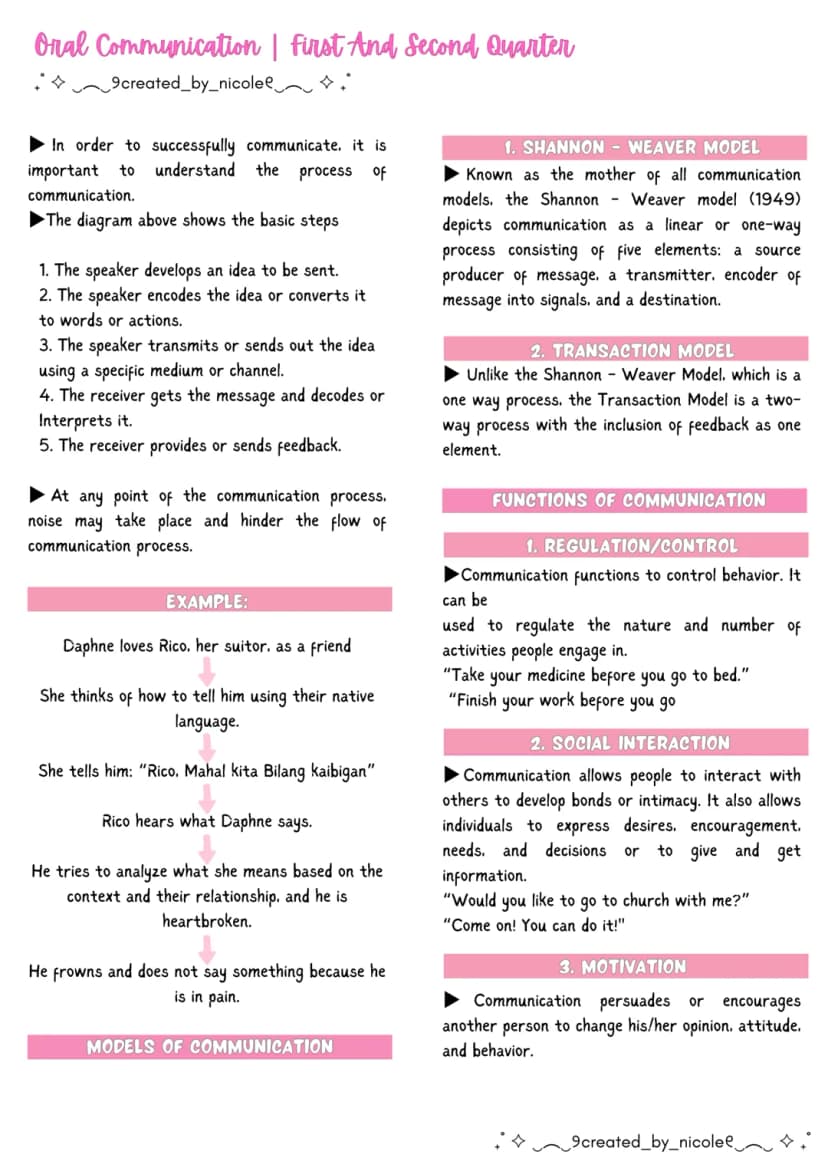
Communication ay hindi lang simpleng pagsasalita - it's a complete process na may mga specific na parts. Isipin mo na parang recipe na kailangan ng lahat ng ingredients para gumana ng maayos.
Ang 9 elements ng communication ay: Speaker/Sender (ikaw na nagsasalita), Message (yung gusto mong sabihin), Encoding , Channel (medium na gagamitin mo), Decoding (paano nila maiintindihan), Receiver (yung nakikinig), Feedback (yung reaction nila), Context (yung environment), at Barriers/Noise (mga hadlang sa communication).
Yung communication process ay parang cycle - hindi siya nagtatapos sa pagsasalita mo lang. May feedback dapat, kaya naging two-way process siya. May Shannon Weaver Model at Transaction Model .
Quick Tip: Remember na communication ay transactional - kailangan active participation ng lahat!
2
of 10
Functions at Features ng Effective Communication
May 5 major functions ang communication na dapat mong malaman: Regulation/Control , Social Interaction , Motivation , Emotional Expression , at Information Dissemination (para magbahagi ng info).
Para maging effective communicator, kailangan mo ng 7 C's: Completeness (complete yung message), Conciseness (walang unnecessary info), Consideration (isipin mo yung receiver), Concreteness (may facts at examples), Courtesy (respetuhin ang culture), Clearness (simple at specific words), at Correctness (tama yung grammar).
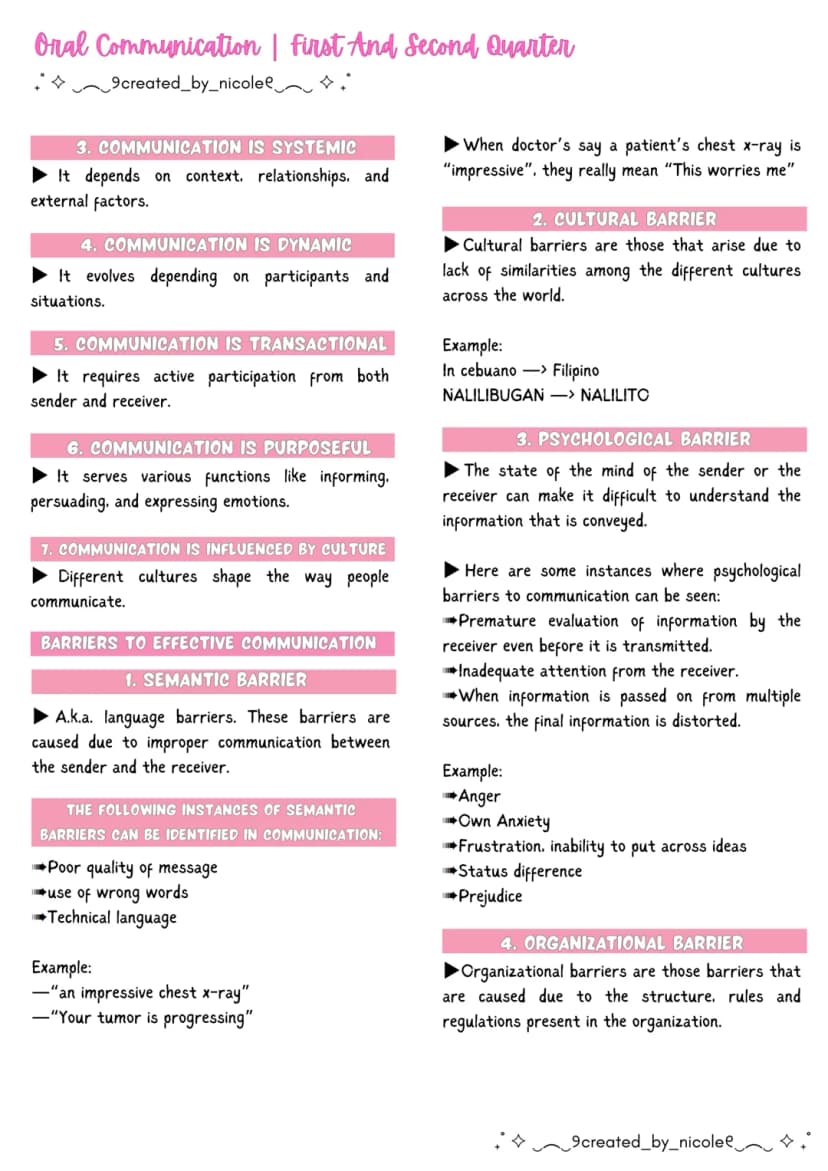
May 7 important tenets din ng communication: process siya, symbolic, systemic, dynamic, transactional, purposeful, at influenced by culture. Lahat ng ito ay interconnected kaya importante na maintindihan mo ang bawat isa.
Real Talk: Effective communication = successful relationships sa school, work, at life!
3
of 10
Communication Barriers na Dapat Mong Iwasan
Maraming barriers sa communication na pwedeng maging hadlang sa pag-unawa. Yung Semantic Barrier ay tungkol sa language problems - like wrong word choice o technical terms na hindi maintindihan ng listener.
Cultural Barriers ay nangyayari kapag magkaiba kayo ng kultura. Perfect example: yung word na "nalilibugan" sa Cebuano ay "nalilito" sa Filipino - malaking misunderstanding yan! Psychological Barriers naman ay tungkol sa mental state ninyo - like anger, anxiety, o status differences.
Organizational Barriers ay dahil sa rules at structure ng institution, Physical Barriers ay mga environmental factors like noise o poor lighting, at Physiological Barriers ay health-related issues na nakakaapekto sa communication ability.
Pro Tip: Aware ka lang sa mga barriers na ito, mas magiging effective ka na communicator!
4
of 10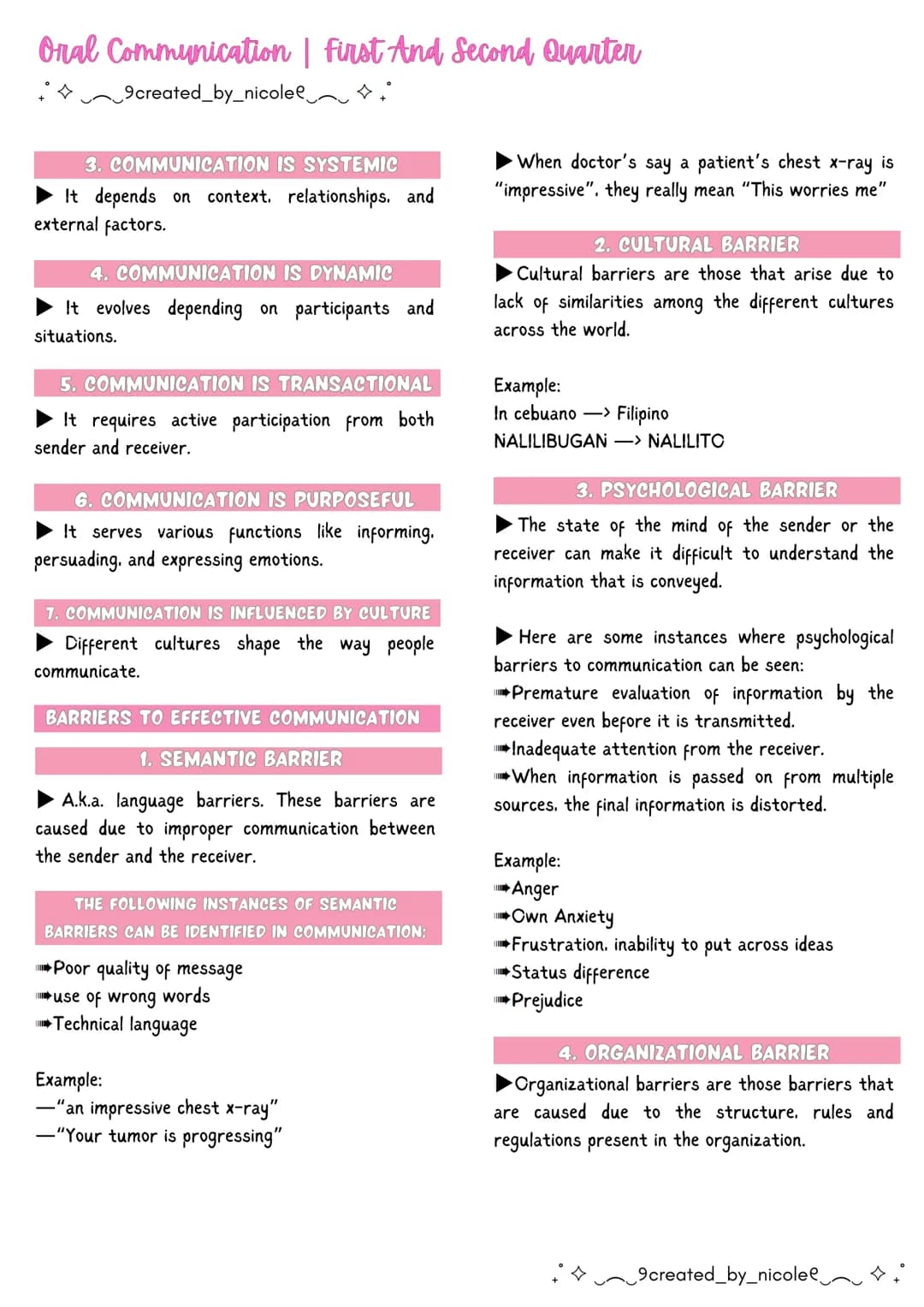
Verbal at Non-Verbal Communication Strategies
Verbal communication ay yung mga spoken o written words na ginagamit mo. Para maging effective dito, dapat maging careful ka sa word choice mo at isipin kung paano ito maiinterpret ng ibang tao.
Maraming factors na nakakaapekto sa verbal communication: personal factors (like hearing issues), opinions and beliefs (cultural norms), topic (dapat clear at hindi complicated), communicative situation (yung environment), at language differences (dapat same understanding kayo sa mga words).
Non-verbal communication naman ay equally important - minsan mas powerful pa ito kaysa sa words mo. Kasama dito ang gestures (pero ingat sa cultural differences), facial expressions (lalo na yung mata), colors (may symbolic meaning), at language of flowers (oo, may meaning din ang mga bulaklak na binibigay mo).
Remember: Hindi lang yung sinasabi mo ang importante - pati na rin kung paano mo sinasabi!
5
of 10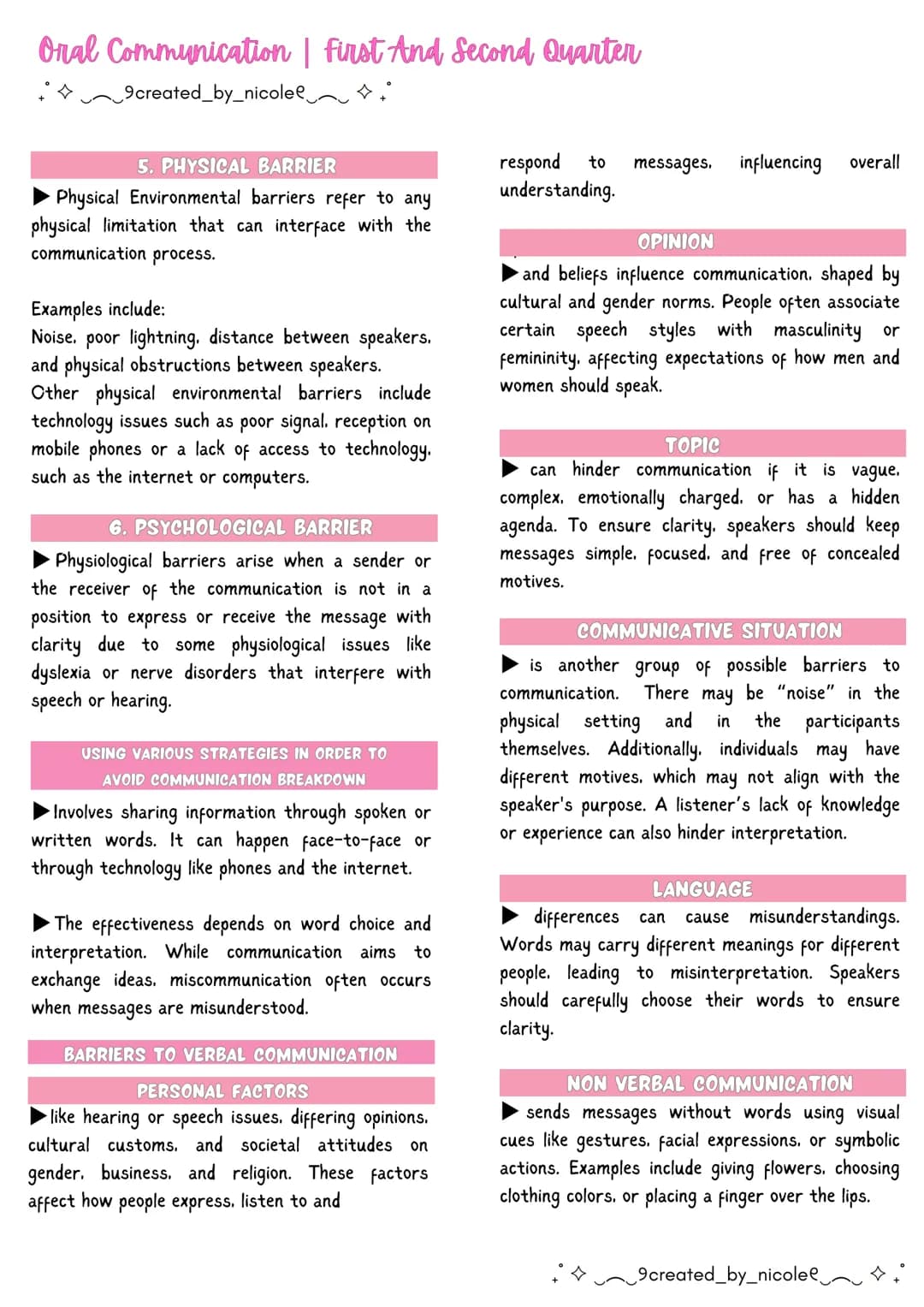
Public Speaking at ang C's
Kapag mag-p-public speaking ka, may 6 C's na dapat mong tandaan: Clarity (malinaw yung ideas mo), Confidence (kaya mo yan!), Connection , Conciseness (direct to the point), Credibility (reliable yung information mo), at Consistency (steady yung tone mo throughout).
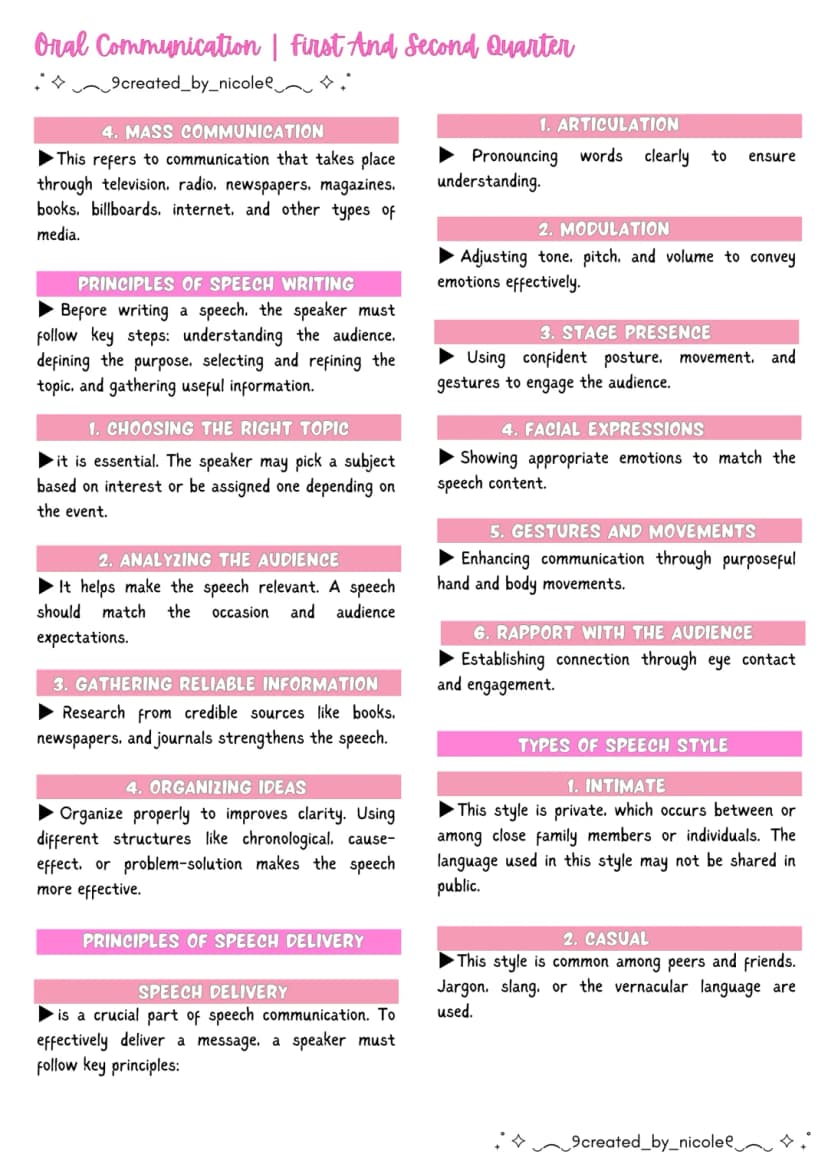
Ang key sa successful public speaking ay preparation. Kailangan mo munang intindihin yung audience mo, malaman kung ano yung purpose ng speech mo, pumili ng tamang topic, at mag-research ng credible information.
Speech delivery naman ay may mga principles din: articulation (clear pronunciation), modulation (adjust yung tone at volume), stage presence (confident posture), appropriate facial expressions, purposeful gestures and movements, at rapport with audience (eye contact at engagement).
Confidence Booster: Practice makes perfect - mas marami kang practice, mas comfortable ka sa harap ng audience!
6
of 10
Intercultural Communication at Cultural Sensitivity
Intercultural communication ay nangyayari kapag may interaction kayo ng mga taong may different cultural backgrounds. Hindi lang ito tungkol sa nationality - kasama din dito ang ethnicity, religion, at sexual orientation.
May Developmental Model of Intercultural Sensitivity na may 6 stages: Denial (hindi nakikita ang cultural differences), Defense (intimidated sa differences), Minimization (focus sa similarities), Acceptance (appreciate ang differences), Adoption (open sa new perspectives), at Integration (beyond own culture na).
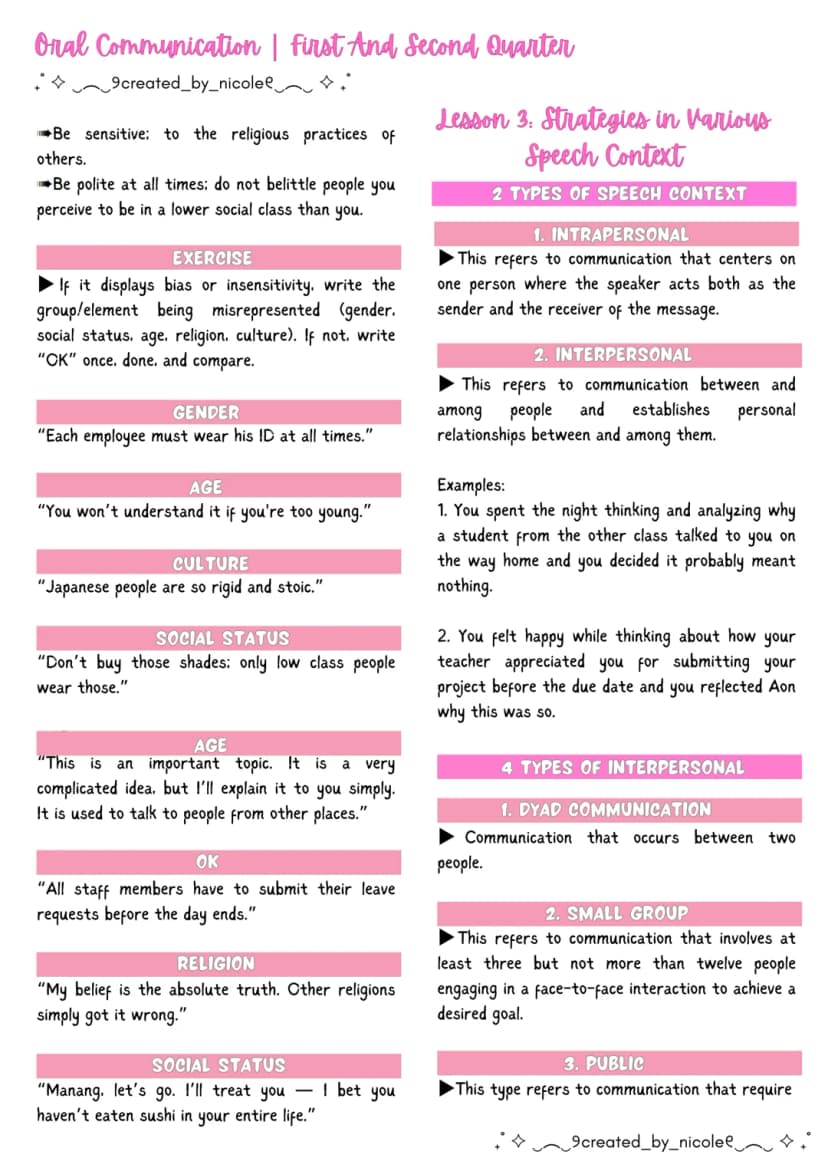
Para maging competent intercultural communicator, kailangan mo ng flexibility, reflectiveness, open-mindedness, sensitivity, adaptability, creative thinking, at politeness. Iwasan mo rin ang mga bias - no stereotypes, challenge gender norms, wag mag-talk down sa younger people o elderly, be sensitive sa religious practices, at be polite sa lahat.
Cultural Awareness: Respect ang key - different doesn't mean wrong, it's just different!
7
of 10
Speech Contexts at Speech Styles
May 2 types ng speech context: Intrapersonal at Interpersonal (communication with other people).
Yung Interpersonal naman ay may 4 types: Dyad Communication (between 2 people), Small Group , Public (one speaker, many listeners), at Mass Communication (through media like TV, radio, internet).
Sa speech styles, may 5 levels tayo: Intimate (family members), Casual (friends, may slang), Consultative , Formal , at Frozen (ceremonies, hindi nagbabago like Preamble).
Style Check: Always match your speech style sa situation - hindi pwedeng casual ka sa formal event!
8
of 10
Speech Acts at Performatives
Speech Act ay yung utterance na ginagawa mo para makamit ang intended effect mo. May 3 types: Locutionary Act , Illocutionary Act (social function ng sinabi mo), at Perlocutionary Act (resulting effect sa listener).
Performatives ay special na statements na nagiging action just by saying it - like "I promise," "I apologize," o "I declare."
Si John Searle naman ay nag-classify ng speech acts into 5: Assertive , Directive , Commissive (commitment mo sa future action), Expressive (express feelings), at Declarative (changes reality through words).
Speech Power: Words have power - piliin mo ng maayos yung mga salita mo kasi may consequences yan!
9
of 10
10
of 10
We thought you’d never ask...
What is the Knowunity AI companion?
Our AI companion is specifically built for the needs of students. Based on the millions of content pieces we have on the platform we can provide truly meaningful and relevant answers to students. But its not only about answers, the companion is even more about guiding students through their daily learning challenges, with personalised study plans, quizzes or content pieces in the chat and 100% personalisation based on the students skills and developments.
Where can I download the Knowunity app?
You can download the app in the Google Play Store and in the Apple App Store.
Is Knowunity really free of charge?
That's right! Enjoy free access to study content, connect with fellow students, and get instant help – all at your fingertips.
Similar Content
 Yabancı Dil
 İngilizce
 Other Languages
Most popular content: Language Learning
5 Filipino
Filipino Grade 8 Quarter 2
Tula, 5 Antas ng Wika, Balagtasan, Pagsang-ayon at Pasalungat, Sarswela, Denotasyon at Konotasyon, Sanaysay, Maikling kuwento, Opinyon
G82,91954
FilipinoFilipino G9 2ND Quarter
A summary to review
G102,48732
FilipinoReviewer for Filipino 7
Reviewer on Filipino so that you can past your Examination
G74,452131
FilipinoFILIPINO Grade 9 Quarter 3 Reviewer
All about the lessons in Grade 9 Quarter 3 FILIPINO, all complete, highlighted, printable, and has extra informations.
G93,55974
Filipino1st Lesson, 2nd Quarter, Filipino 9
Goodluckie
G91,38333
Most popular content in Oral Com
3Most popular content
9 Math
MathMathematics Grade 10 Quarter 1
Grade 10 Math topics
G1010,218250
 Iba pa
El Filibusterismo (FILIPINO 10)
Kilalanin ang mga karakter at alamin ang mga pangyayari mula Kabanata 1 hanggang 39.
G1011,183240
 Science
Science 9 Quarter 1 Lesson 1
Topics: The Respiratory System and The Circulatory System
G911,075383
 Gen Physics
General Physics 1, First Sem
Units of Measurement, Vectors, and Kinematics. All with formulas
G116,247168
FilipinoFilipino 8 Reviewer
Filipino Reviewer for 4th Quarter for Grade 8 students
G88,088127
ScienceSCIENCE Grade 9 Quarter 3 Reviewer
All about the lessons in Grade 9 Quarter 3 SCIENCE, all complete, highlighted, printable, and has extra informations.
G914,629303
 Pre-Cal
UPCAT Reviewer: Mathematics
general coverage of the mathematics section for UPCAT
G127,085397
OtherIntroduction to Philosophy - 1st Semester, Grade 12
A summarized notes for Grade 12 students. Easier learning for the 1st semester’s Philosophy subject.
G123,96856
ScienceThe Human Digestive System
Science Grade 8 1st Quarter Lesson
G84,78386
Can't find what you're looking for? Explore other subjects.
Students love us — and so will you.
4.6/5App Store
4.7/5Google Play
The app is very easy to use and well designed. I have found everything I was looking for so far and have been able to learn a lot from the presentations! I will definitely use the app for a class assignment! And of course it also helps a lot as an inspiration.
Stefan SiOS user
This app is really great. There are so many study notes and help [...]. My problem subject is French, for example, and the app has so many options for help. Thanks to this app, I have improved my French. I would recommend it to anyone.
Samantha KlichAndroid user
Wow, I am really amazed. I just tried the app because I've seen it advertised many times and was absolutely stunned. This app is THE HELP you want for school and above all, it offers so many things, such as workouts and fact sheets, which have been VERY helpful to me personally.
AnnaiOS user
Oral Com13,317 views·Updated Jun 28, 2026·11 pagesGrade 11 Oral Communication | Complete 1st Semester Notes
Nicole’s Digital Notes@nicolenotes_2
Kumusta! Nandito ka na sa mundo ng Oral Communication - isang subject na super practical sa real life mo. Matutuhan mo rito kung paano effective na makipag-communicate sa ibang tao, umiwas sa misunderstanding, at maging confident speaker.
1
of 10
Sign up to see the content. It's free!
- Access to all documents
- Improve your grades
- Join milions of students
Communication at ang mga Elements Nito
Communication ay hindi lang simpleng pagsasalita - it's a complete process na may mga specific na parts. Isipin mo na parang recipe na kailangan ng lahat ng ingredients para gumana ng maayos.
Ang 9 elements ng communication ay: Speaker/Sender (ikaw na nagsasalita), Message (yung gusto mong sabihin), Encoding , Channel (medium na gagamitin mo), Decoding (paano nila maiintindihan), Receiver (yung nakikinig), Feedback (yung reaction nila), Context (yung environment), at Barriers/Noise (mga hadlang sa communication).
Yung communication process ay parang cycle - hindi siya nagtatapos sa pagsasalita mo lang. May feedback dapat, kaya naging two-way process siya. May Shannon Weaver Model at Transaction Model .
Quick Tip: Remember na communication ay transactional - kailangan active participation ng lahat!
2
of 10Sign up to see the content. It's free!
- Access to all documents
- Improve your grades
- Join milions of students
Functions at Features ng Effective Communication
May 5 major functions ang communication na dapat mong malaman: Regulation/Control , Social Interaction , Motivation , Emotional Expression , at Information Dissemination (para magbahagi ng info).
Para maging effective communicator, kailangan mo ng 7 C's: Completeness (complete yung message), Conciseness (walang unnecessary info), Consideration (isipin mo yung receiver), Concreteness (may facts at examples), Courtesy (respetuhin ang culture), Clearness (simple at specific words), at Correctness (tama yung grammar).
May 7 important tenets din ng communication: process siya, symbolic, systemic, dynamic, transactional, purposeful, at influenced by culture. Lahat ng ito ay interconnected kaya importante na maintindihan mo ang bawat isa.
Real Talk: Effective communication = successful relationships sa school, work, at life!
3
of 10Sign up to see the content. It's free!
- Access to all documents
- Improve your grades
- Join milions of students
Communication Barriers na Dapat Mong Iwasan
Maraming barriers sa communication na pwedeng maging hadlang sa pag-unawa. Yung Semantic Barrier ay tungkol sa language problems - like wrong word choice o technical terms na hindi maintindihan ng listener.
Cultural Barriers ay nangyayari kapag magkaiba kayo ng kultura. Perfect example: yung word na "nalilibugan" sa Cebuano ay "nalilito" sa Filipino - malaking misunderstanding yan! Psychological Barriers naman ay tungkol sa mental state ninyo - like anger, anxiety, o status differences.
Organizational Barriers ay dahil sa rules at structure ng institution, Physical Barriers ay mga environmental factors like noise o poor lighting, at Physiological Barriers ay health-related issues na nakakaapekto sa communication ability.
Pro Tip: Aware ka lang sa mga barriers na ito, mas magiging effective ka na communicator!
4
of 10Sign up to see the content. It's free!
- Access to all documents
- Improve your grades
- Join milions of students
Verbal at Non-Verbal Communication Strategies
Verbal communication ay yung mga spoken o written words na ginagamit mo. Para maging effective dito, dapat maging careful ka sa word choice mo at isipin kung paano ito maiinterpret ng ibang tao.
Maraming factors na nakakaapekto sa verbal communication: personal factors (like hearing issues), opinions and beliefs (cultural norms), topic (dapat clear at hindi complicated), communicative situation (yung environment), at language differences (dapat same understanding kayo sa mga words).
Non-verbal communication naman ay equally important - minsan mas powerful pa ito kaysa sa words mo. Kasama dito ang gestures (pero ingat sa cultural differences), facial expressions (lalo na yung mata), colors (may symbolic meaning), at language of flowers (oo, may meaning din ang mga bulaklak na binibigay mo).
Remember: Hindi lang yung sinasabi mo ang importante - pati na rin kung paano mo sinasabi!
5
of 10Sign up to see the content. It's free!
- Access to all documents
- Improve your grades
- Join milions of students
Public Speaking at ang C's
Kapag mag-p-public speaking ka, may 6 C's na dapat mong tandaan: Clarity (malinaw yung ideas mo), Confidence (kaya mo yan!), Connection , Conciseness (direct to the point), Credibility (reliable yung information mo), at Consistency (steady yung tone mo throughout).
Ang key sa successful public speaking ay preparation. Kailangan mo munang intindihin yung audience mo, malaman kung ano yung purpose ng speech mo, pumili ng tamang topic, at mag-research ng credible information.
Speech delivery naman ay may mga principles din: articulation (clear pronunciation), modulation (adjust yung tone at volume), stage presence (confident posture), appropriate facial expressions, purposeful gestures and movements, at rapport with audience (eye contact at engagement).
Confidence Booster: Practice makes perfect - mas marami kang practice, mas comfortable ka sa harap ng audience!
6
of 10Sign up to see the content. It's free!
- Access to all documents
- Improve your grades
- Join milions of students
Intercultural Communication at Cultural Sensitivity
Intercultural communication ay nangyayari kapag may interaction kayo ng mga taong may different cultural backgrounds. Hindi lang ito tungkol sa nationality - kasama din dito ang ethnicity, religion, at sexual orientation.
May Developmental Model of Intercultural Sensitivity na may 6 stages: Denial (hindi nakikita ang cultural differences), Defense (intimidated sa differences), Minimization (focus sa similarities), Acceptance (appreciate ang differences), Adoption (open sa new perspectives), at Integration (beyond own culture na).
Para maging competent intercultural communicator, kailangan mo ng flexibility, reflectiveness, open-mindedness, sensitivity, adaptability, creative thinking, at politeness. Iwasan mo rin ang mga bias - no stereotypes, challenge gender norms, wag mag-talk down sa younger people o elderly, be sensitive sa religious practices, at be polite sa lahat.
Cultural Awareness: Respect ang key - different doesn't mean wrong, it's just different!
7
of 10Sign up to see the content. It's free!
- Access to all documents
- Improve your grades
- Join milions of students
Speech Contexts at Speech Styles
May 2 types ng speech context: Intrapersonal at Interpersonal (communication with other people).
Yung Interpersonal naman ay may 4 types: Dyad Communication (between 2 people), Small Group , Public (one speaker, many listeners), at Mass Communication (through media like TV, radio, internet).
Sa speech styles, may 5 levels tayo: Intimate (family members), Casual (friends, may slang), Consultative , Formal , at Frozen (ceremonies, hindi nagbabago like Preamble).
Style Check: Always match your speech style sa situation - hindi pwedeng casual ka sa formal event!
8
of 10Sign up to see the content. It's free!
- Access to all documents
- Improve your grades
- Join milions of students
Speech Acts at Performatives
Speech Act ay yung utterance na ginagawa mo para makamit ang intended effect mo. May 3 types: Locutionary Act , Illocutionary Act (social function ng sinabi mo), at Perlocutionary Act (resulting effect sa listener).
Performatives ay special na statements na nagiging action just by saying it - like "I promise," "I apologize," o "I declare."
Si John Searle naman ay nag-classify ng speech acts into 5: Assertive , Directive , Commissive (commitment mo sa future action), Expressive (express feelings), at Declarative (changes reality through words).
Speech Power: Words have power - piliin mo ng maayos yung mga salita mo kasi may consequences yan!
9
of 10Sign up to see the content. It's free!
- Access to all documents
- Improve your grades
- Join milions of students
10
of 10Sign up to see the content. It's free!
- Access to all documents
- Improve your grades
- Join milions of students
We thought you’d never ask...
What is the Knowunity AI companion?
Our AI companion is specifically built for the needs of students. Based on the millions of content pieces we have on the platform we can provide truly meaningful and relevant answers to students. But its not only about answers, the companion is even more about guiding students through their daily learning challenges, with personalised study plans, quizzes or content pieces in the chat and 100% personalisation based on the students skills and developments.
Where can I download the Knowunity app?
You can download the app in the Google Play Store and in the Apple App Store.
Is Knowunity really free of charge?
That's right! Enjoy free access to study content, connect with fellow students, and get instant help – all at your fingertips.
Similar Content
Most popular content: Language Learning
5FilipinoFilipino Grade 8 Quarter 2
Tula, 5 Antas ng Wika, Balagtasan, Pagsang-ayon at Pasalungat, Sarswela, Denotasyon at Konotasyon, Sanaysay, Maikling kuwento, Opinyon
G82,91954
FilipinoFilipino G9 2ND Quarter
A summary to review
G102,48732
FilipinoReviewer for Filipino 7
Reviewer on Filipino so that you can past your Examination
G74,452131
FilipinoFILIPINO Grade 9 Quarter 3 Reviewer
All about the lessons in Grade 9 Quarter 3 FILIPINO, all complete, highlighted, printable, and has extra informations.
G93,55974
Filipino1st Lesson, 2nd Quarter, Filipino 9
Goodluckie
G91,38333
Most popular content in Oral Com
3Most popular content
9MathMathematics Grade 10 Quarter 1
Grade 10 Math topics
G1010,218250
Iba paEl Filibusterismo (FILIPINO 10)
Kilalanin ang mga karakter at alamin ang mga pangyayari mula Kabanata 1 hanggang 39.
G1011,183240
ScienceScience 9 Quarter 1 Lesson 1
Topics: The Respiratory System and The Circulatory System
G911,075383
Gen PhysicsGeneral Physics 1, First Sem
Units of Measurement, Vectors, and Kinematics. All with formulas
G116,247168
FilipinoFilipino 8 Reviewer
Filipino Reviewer for 4th Quarter for Grade 8 students
G88,088127
ScienceSCIENCE Grade 9 Quarter 3 Reviewer
All about the lessons in Grade 9 Quarter 3 SCIENCE, all complete, highlighted, printable, and has extra informations.
G914,629303
Pre-CalUPCAT Reviewer: Mathematics
general coverage of the mathematics section for UPCAT
G127,085397
OtherIntroduction to Philosophy - 1st Semester, Grade 12
A summarized notes for Grade 12 students. Easier learning for the 1st semester’s Philosophy subject.
G123,96856
ScienceThe Human Digestive System
Science Grade 8 1st Quarter Lesson
G84,78386
Can't find what you're looking for? Explore other subjects.
Students love us — and so will you.
4.6/5App Store
4.7/5Google Play
The app is very easy to use and well designed. I have found everything I was looking for so far and have been able to learn a lot from the presentations! I will definitely use the app for a class assignment! And of course it also helps a lot as an inspiration.
Stefan SiOS user
This app is really great. There are so many study notes and help [...]. My problem subject is French, for example, and the app has so many options for help. Thanks to this app, I have improved my French. I would recommend it to anyone.
Samantha KlichAndroid user
Wow, I am really amazed. I just tried the app because I've seen it advertised many times and was absolutely stunned. This app is THE HELP you want for school and above all, it offers so many things, such as workouts and fact sheets, which have been VERY helpful to me personally.
AnnaiOS user