
Vogue magazine, established in 1892, represents a fascinating study in...
 Media Studies1,081 views·Updated Jun 17, 2026·7 pages
Exploring Women's Representation in 1960s Vogue Magazine
C
Cristina Mead@cristina_mead


1 / 7
1
of 7
Representation in 1960s Vogue
The July 1965 Vogue magazine cover features Sophia Loren, a celebrated actress of the era known for her "exotic" beauty. Her close-up portrayal, adorned with jewels and elegant clothing, positions her as powerful and aspirational for the female readership.
The representation of Loren's beauty potentially aligns with Stuart Hall's theory about Middle Eastern stereotypes, portraying ethnic minorities as "other" or exotic.
Inside the magazine, we find some counter-typical representations of women:
- An article about women making investments challenges the 1960s norm when husbands typically controlled family finances
- The inclusion of a female finance expert was revolutionary for this period
- This content reflects the emerging influence of second wave feminism, which began challenging traditional gender roles
Key Concept: Second wave feminism in the 1960s focused on issues of financial independence, legal inequalities, sexuality, and workplace rights. Vogue's inclusion of financial content for women represents this shifting cultural landscape.
However, contradictions exist within the magazine:
- Basic definitions of financial terms suggest an assumption that women lack economic understanding
- The article implies women still rely on husbands and cannot keep finances secret
- Most other pages present conventional 1960s female representations (domestic or sexualised)
The financial content appears specifically targeted at Vogue's primarily AB socioeconomic readership, suggesting financial independence was considered appropriate for wealthier women.
2
of 7
"Bare Essentials" Advertisement
The Cutex advert in Vogue employs provocative imagery and language to sell beauty products through sexualised female representation.
The advertisement features:
- A woman with bare shoulders suggesting nudity
- Phrases with sexual connotations: "bare essentials," "birthday suit," and "barely decent" (lipstick shade names)
- A rhetorical question asking "are you woman enough?" linking femininity directly to nakedness and sexual appeal
Important Note: This advertisement demonstrates how 1960s media frequently defined women's worth through their sexual attractiveness, a perspective challenged by second wave feminism.
Similar representations appear in the Revlon advert, which:
- Describes women as "alluring" and "beguiling"
- Uses language suggesting a woman's primary purpose is visual attraction
- Reinforces the idea that beauty products are essential to femininity
These advertisements reflect the dominant media narrative of the 1960s that a woman's primary value was in her appearance, despite the emerging feminist movement challenging these perspectives.
3
of 7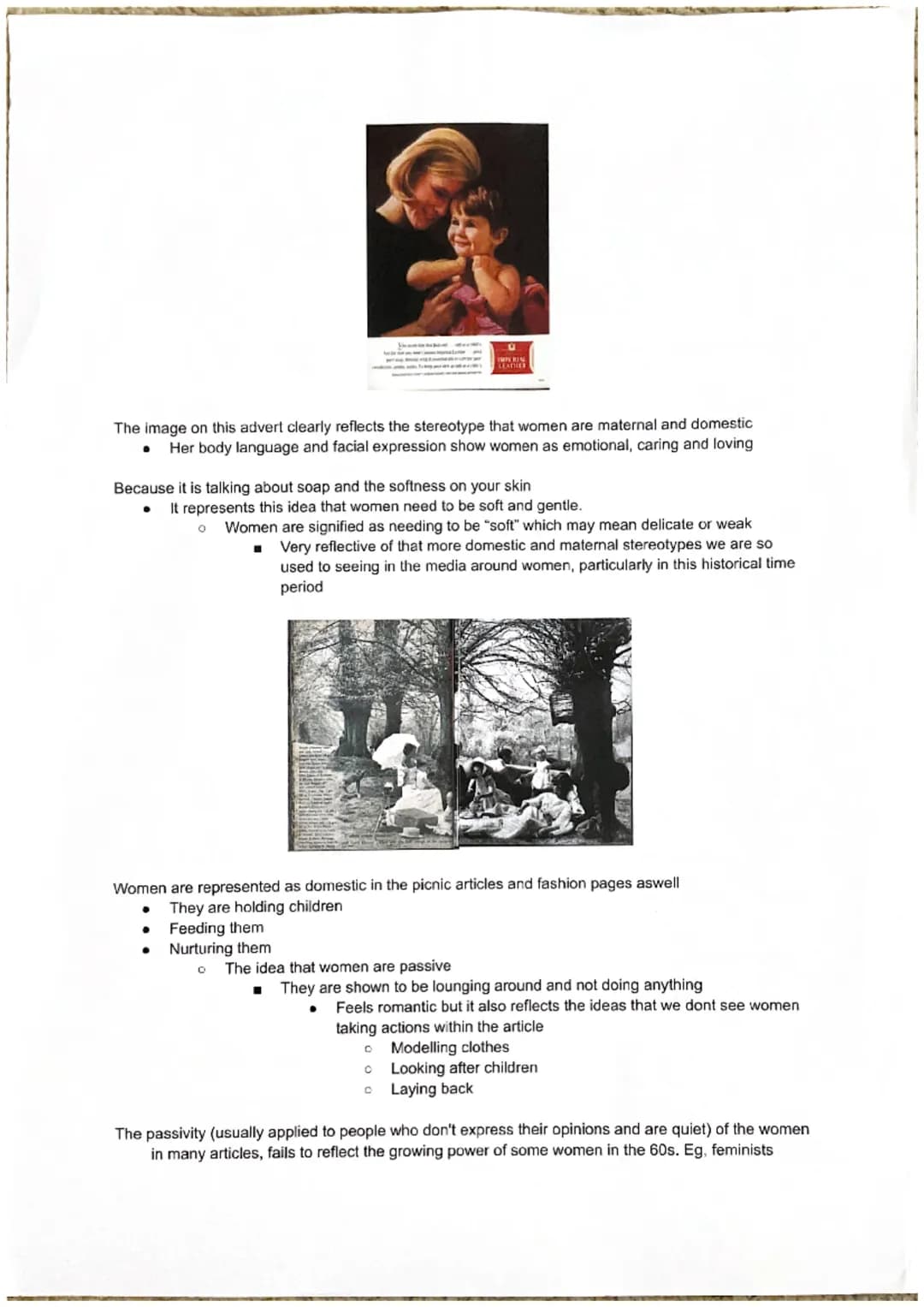
Domestic Representation
The leather advertisement exemplifies how Vogue portrayed women as inherently maternal and domestic through carefully constructed imagery.
Key elements include:
- Body language and facial expressions conveying emotionality and nurturing qualities
- References to softness and gentleness reinforcing stereotypical feminine traits
- Implications that women should be "soft" (potentially meaning delicate or weak)
Cultural Context: These representations align with traditional 1960s expectations that women should prioritise domestic roles despite the growing feminist movement advocating for expanded opportunities beyond the home.
This domestic portrayal continues throughout the magazine:
- Picnic articles and fashion pages show women primarily holding and feeding children
- Women are consistently depicted in nurturing roles
- Female models are portrayed as passive rather than active
The consistent passivity of women in these articles—shown lounging, modelling clothes, or caring for children rather than taking decisive action—fails to acknowledge the growing feminist movement and changing roles of women in 1960s Britain.
This contrast between women's passive representation and their increasing real-world power highlights the tension between traditional media portrayals and evolving social realities.
4
of 7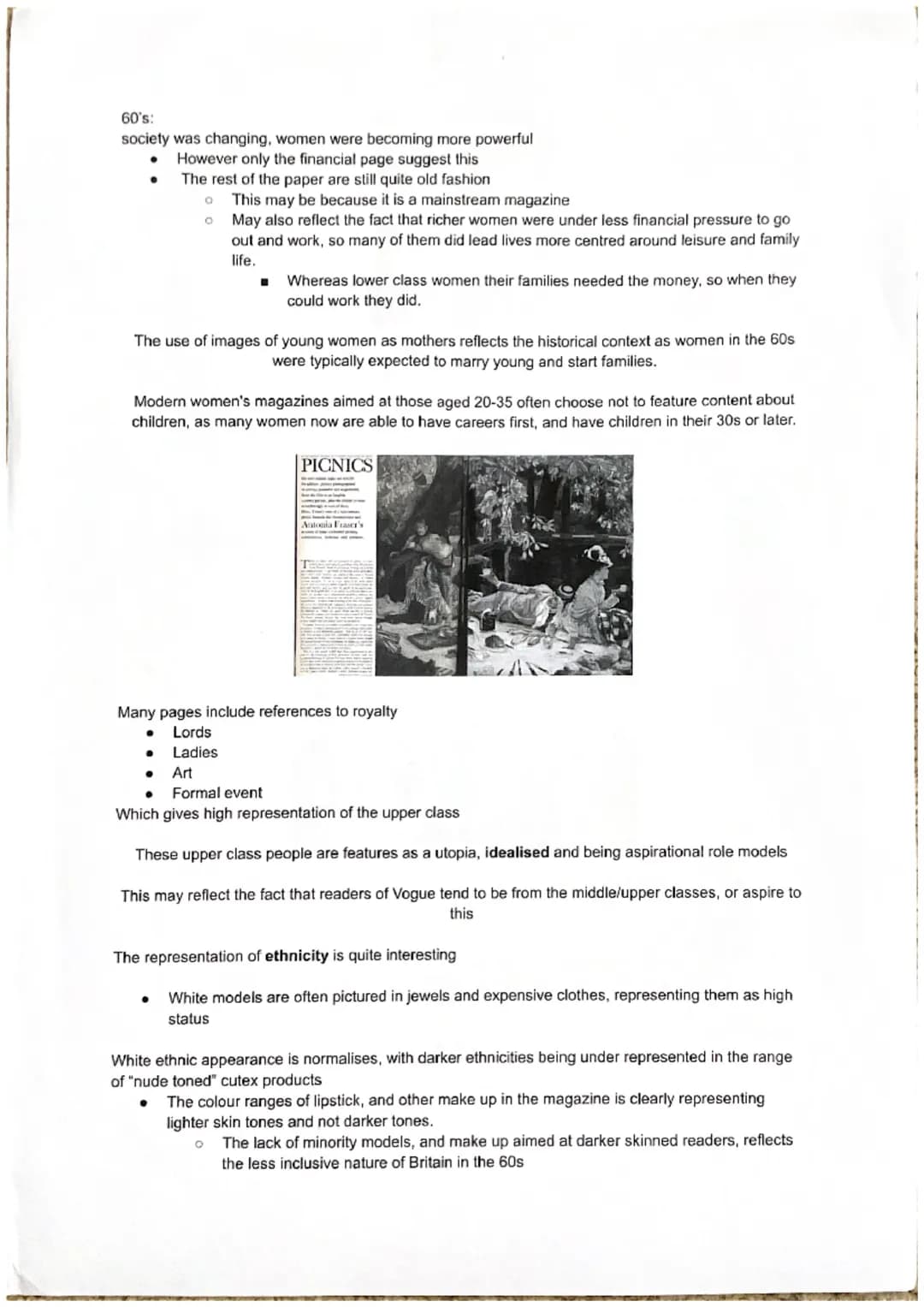
Social Change and Class Representation
The 1960s marked significant social change with women gaining more power, yet Vogue's content reflected this unevenly.
Contradictions in female representation:
- Only the financial page suggests women's growing independence
- Most content remains traditional, reflecting Vogue's mainstream position
- Upper-class women featured may have faced less economic pressure to work, unlike working-class women who often needed employment for financial survival
Class Analysis: Vogue predominantly represented upper-class lifestyles, with frequent references to royalty, lords, ladies, art, and formal events—positioning these as aspirational ideals for readers.
The magazine's portrayal of young mothers reflects 1960s expectations of early marriage and family formation. This differs dramatically from modern women's magazines aimed at 20-35 year-olds, which often omit content about children, acknowledging that contemporary women frequently establish careers before starting families in their 30s.
Ethnic representation in the July 1965 Vogue reveals significant biases:
- White models are frequently shown with jewels and expensive clothing, symbolising high status
- White ethnic appearance is normalised as the standard
- "Nude-toned" Cutex products cater exclusively to lighter skin tones
- The limited makeup range for darker skin reflects Britain's less inclusive 1960s society
This representation aligns with the magazine's primary audience of middle/upper-class readers, while marginalising other perspectives.
5
of 7
Ethnic Representation
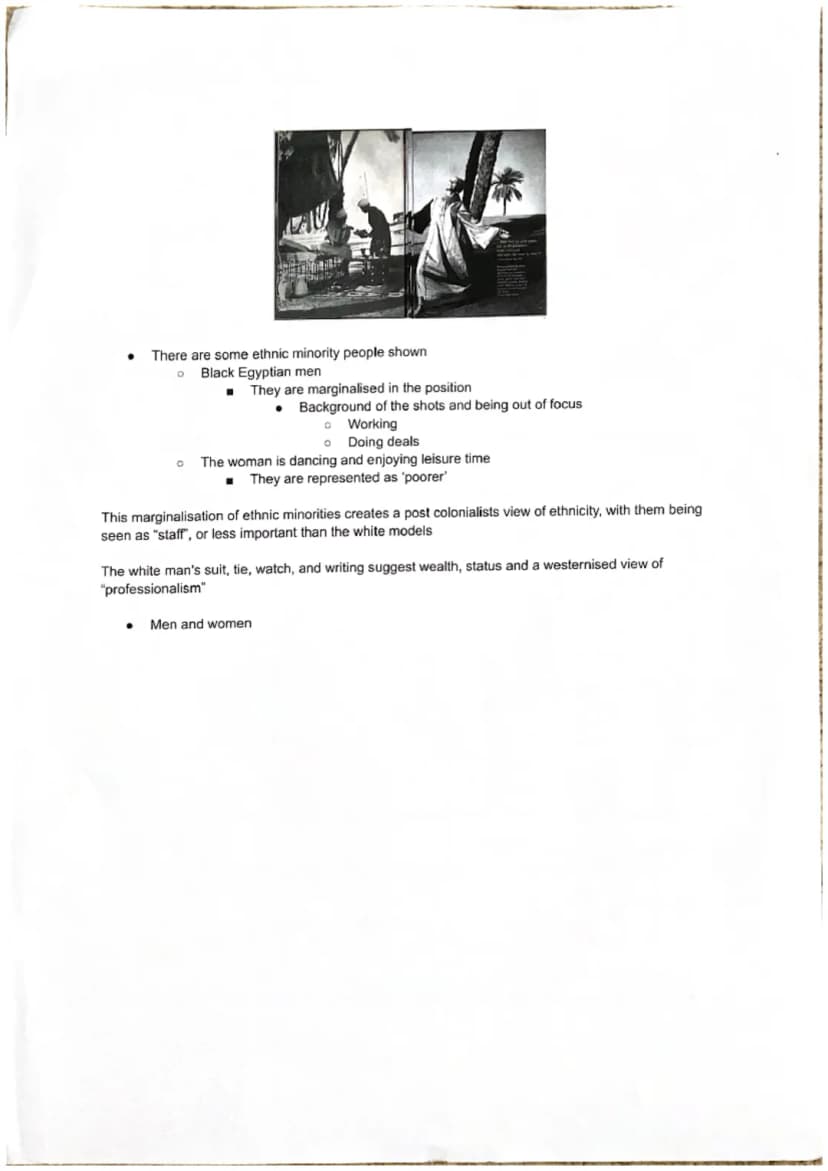
The July 1965 Vogue's treatment of ethnic minorities reveals problematic representational patterns consistent with post-colonial perspectives.
When ethnic minorities do appear in the magazine, they are:
- Marginalised through positioning (placed in backgrounds or out of focus)
- Depicted primarily in service roles (working or "doing deals")
- Contrasted with white women who are shown enjoying leisure time
- Represented as having lower socioeconomic status
Post-Colonial Perspective: The positioning of ethnic minorities as "staff" or less important than white models reflects what media scholars call a post-colonial view, where Western perspectives and appearances are privileged over others.
The visual coding of status is particularly evident through clothing and accessories:
- White men wear suits, ties, watches and are shown writing, suggesting wealth, status and "professionalism"
- These visual elements reinforce Western standards as the ideal
- Such representations construct a hierarchy with white, Western appearances at the top
These representational choices in Vogue reflect broader Middle Eastern stereotypes in fashion media during this period, positioning non-Western cultures as exotic "others" rather than equal participants in the fashion world.
6
of 7
Vogue's Industry Position
Vogue magazine operates under Conde Nast, one of the UK's largest magazine publishers with global reach.
Historical development:
- Founded in 1892; American version acquired by Conde Nast in 1909
- UK version launched in 1916 as a successful spin-off
- Thrived throughout the early 20th century despite world wars
- Particularly successful in the post-war consumerist era
Media Industry Insight: While many print magazines have struggled in recent decades, Vogue has maintained strong circulation of approximately 200,000 monthly copies, demonstrating exceptional brand resilience.
Vogue's global expansion demonstrates its commercial success:
- Launched multiple international editions (Italian, Brazilian, German, Spanish)
- Further expanded to Japan, China, Russia, India, Mexico and Eastern Europe
- This global strategy both supports and challenges Hesmondhalgh's media theory
Relationship to Hesmondhalgh's theory:
- Supports his idea that powerful companies replicate successful formats to maximise profits
- Challenges his perspective on risk aversion, as Vogue has taken significant creative risks
Vogue established its unique selling proposition through innovation:
- Pioneered colour photography in magazines in the 1930s
- Created a reputation for being cutting-edge and boundary-pushing
- After Advance Publications purchased Conde Nast in the 1960s, they featured the first African-American model on a major magazine cover
7
of 7
Vogue's Business Strategy
Vogue has maintained its position as a leading fashion publication through strategic business approaches that extend beyond traditional magazine publishing.
Celebrity collaborations boost Vogue's profile:
- Features high-profile personalities on covers (like Princess Diana)
- Invites celebrities as guest editors
- Establishes reputation for discovering talent before mainstream recognition
- Secures exclusive content with figures like the Royal family
Business Innovation: Conde Nast has diversified Vogue beyond print media into fashion education, luxury conferences, and hospitality ventures, creating multiple revenue streams from the prestigious brand.
Key business expansions include:
- Establishing a design college for aspiring fashion professionals
- Organising the Conde Nast luxury conference
- Developing a restaurants and bars division including the Vogue Café
- Creating the Vogue Fashion Fund to support new designers (later developed into a reality TV show with Amazon)
Leadership has been crucial to Vogue's success:
- Anna Wintour receives over £2 million annually plus extensive perks
- Wintour initiated the trend of featuring celebrities rather than only models on covers
- Her reputation as a fashion authority enhances the magazine's prestige
Advertising remains vital to Vogue's business model:
- A single full-page advertisement costs £36,000
- Readers value these advertisements as curated lifestyle recommendations
- Vogue functions as an opinion leader influencing consumer behaviour
Conde Nast has acknowledged the importance of embracing modern technology and social media to maintain Vogue's relevance while preserving its luxury positioning in an increasingly digital media landscape.
We thought you’d never ask...
What is the Knowunity AI companion?
Our AI companion is specifically built for the needs of students. Based on the millions of content pieces we have on the platform we can provide truly meaningful and relevant answers to students. But its not only about answers, the companion is even more about guiding students through their daily learning challenges, with personalised study plans, quizzes or content pieces in the chat and 100% personalisation based on the students skills and developments.
Where can I download the Knowunity app?
You can download the app in the Google Play Store and in the Apple App Store.
Is Knowunity really free of charge?
That's right! Enjoy free access to study content, connect with fellow students, and get instant help – all at your fingertips.
Similar Content
 Artes
ArtesMost popular content: Cultural Context
9Media StudiesGCSE Media Studies Essentials
This concise knowledge organiser provides key insights for the GCSE Eduqas Media Studies Paper 1 exam. It includes 5 essential bullet points for each focus area: context, media language, representation, industries, and audiences. Updated for the 2024 exam, this resource is designed to help students grasp critical concepts and succeed in their studies.
102,96670
Media StudiesChannel 4's Super. Human. Analysis
In-depth analysis of Channel 4's 2020 'Super. Human.' advertisement for the Paralympics. Explore the media language, representation, and historical context of the campaign, including audio codes, technical elements, and the impact of social media. Ideal for A Level Media Studies students seeking to understand the nuances of advertising and representation in media. Includes bullet points and visual references.
121,42037
Media StudiesDisability in Media Advertising
Explore the impactful representation of disabled athletes in Channel 4's 'Super. Human.' advertisement. This analysis delves into media strategies, audience reception, and the balance between realism and inspiration in advertising. Key concepts include media representation, equality, and the influence of advertising on societal perceptions of disability. Ideal for media studies students and those interested in advertising analysis.
1255925
Media StudiesEmpowerment in Media
Explore the 'This Girl Can' campaign through a detailed analysis of its context, media language, representation, and underlying theories. This summary highlights key concepts such as empowerment, confidence, and self-belief, making it an essential resource for Eduqas GCSE Media Studies. Perfect for understanding how media shapes perceptions of women in sports.
101,31041
Media StudiesTide Advert Mind map analysis
Tide print advert breakdown with mise-en-scene, product context, audience and representation theorists.
1226716
Media StudiesGender Representation in Bond
Explore the complexities of gender representation in 'The Man With The Golden Gun' through an in-depth analysis of media language, character roles, and historical context. This study note covers key theories such as Propp's Character Types and Mulvey's Male Gaze, highlighting the portrayal of women and men in the 1970s spy genre. Ideal for Eduqas GCSE Media Studies Paper 1 revision.
1163218
Media StudiesVogue
Case study and overview, for exam
122645
Media StudiesBieber's Intentions: Media Analysis
Explore the key themes of representation, audience engagement, and media language in Justin Bieber's 'Intentions' music video. This presentation covers the cultural context, industry impact, and social messages conveyed through dance and storytelling, making it essential for GCSE Media Studies students. Gain insights into how the video promotes community support and addresses important social issues.
1149013
Media Studies1960s Gender Representation Analysis
Explore the cultural and political context of the 1960s through the lens of the 'Kiss of the Vampire' poster. This analysis delves into media representation, gender roles, and feminist theory, highlighting the evolving dynamics between male and female characters. Key concepts include Stuart Hall's representation theory, Judith Butler's gender performativity, and the impact of societal changes on media portrayals. Ideal for A Level Media Studies students seeking to understand the intersection of gender and media.
1388523
Most popular content in Media Studies
9Media StudiesGCSE Media Studies Essentials
This concise knowledge organiser provides key insights for the GCSE Eduqas Media Studies Paper 1 exam. It includes 5 essential bullet points for each focus area: context, media language, representation, industries, and audiences. Updated for the 2024 exam, this resource is designed to help students grasp critical concepts and succeed in their studies.
102,96670
Media StudiesEssential Media Theories Overview
Explore a comprehensive summary of key media theories essential for Eduqas A-Level Media Studies. This concise 4-page resource covers critical concepts such as media representation, audience effects, and industry dynamics, featuring relevant examples for practical application. Perfect for quick revision and flashcard preparation.
122,70174
Media StudiesChannel 4's Super. Human. Analysis
In-depth analysis of Channel 4's 2020 'Super. Human.' advertisement for the Paralympics. Explore the media language, representation, and historical context of the campaign, including audio codes, technical elements, and the impact of social media. Ideal for A Level Media Studies students seeking to understand the nuances of advertising and representation in media. Includes bullet points and visual references.
121,42037
Media StudiesEduqas GCSE Media Studies Overview
Comprehensive notes for the Eduqas GCSE Media Studies Paper 1, covering key topics such as gender representation, media industries, and film analysis. This resource is structured for easy navigation and focuses on essential concepts without delving into theories. Perfect for exam preparation and understanding contemporary media contexts.
104,612117
Media StudiesA-Level Media Vogue (Revision sheet)
(Sorry if the images are placed weirdly) Part of A-Level Eduqas syllabus in Component 2, Section B; asked as either a standalone question (usually 15 marks) or comparison with The Big Issue (30 marks)
1261412
Media StudiesThe 19 Set Media Theories for Eduqas A-level Media Studies
Name of theory, sur- or main name of theorist, quote from the theorist (about the theory), and multiple literal POINTS of the theory
1252315
Media StudiesA-Level Media Black Panther (Revision Sheet)
Part of Eduqas syllabus for Comp 1; comes up in Section B as an industry question (although audience should be considered). Remember that marketing is crucial for the set film texts!
124208
Media StudiesA-Level Media The Big Issue (Revision sheet)
(Sorry if the PDF has placed images weirdly) Part of the A-Level Eduqas syllabus as part of Component 2, Section B; can be assessed on any media aspect, either through a standalone question (usually 15 marks) or comparison with Vogue (30 marks)
126189
M
Media StudiesMedia audience quiz
a quiz on the audience theories in media
131801
Most popular content
9 Sociology
Sociology of Education Overview
Explore comprehensive A-Level Sociology notes on the education system, covering key theories, policies, and sociological perspectives. This resource includes insights on marketisation, gender roles, cultural deprivation, and educational inequalities, providing a thorough understanding of how education shapes social stratification and individual achievement. Ideal for exam preparation and in-depth study.
12102,8693,040
SociologySociology of Families: Comprehensive Revision
Dive into an extensive overview of family dynamics, perspectives, and patterns in sociology. This resource covers key concepts such as family diversity, gender roles, marriage, and the impact of social policies on family structures. Perfect for A-Level Sociology students preparing for Paper 2.
1273,6612,307
CriminologyCriminology: Crime & Punishment Overview
Comprehensive mindmaps covering key concepts in the Crime and Punishment topic for WJEC Criminology Unit 4. This resource includes detailed insights into the Criminal Justice System, crime prevention strategies, sentencing models, and the roles of various agencies. Ideal for A-Level revision, ensuring you grasp essential theories and legislative processes to excel in your exams.
1254,8721,059
SociologyComprehensive Crime & Deviance Overview
Explore an extensive revision of crime and deviance topics, including theories, types of crime, and the impact of media. This resource covers key concepts such as Marxism, functionalism, gender and crime, and the influence of globalization on criminal behavior. Ideal for students seeking a thorough understanding of criminology and its various theories. Type: Full Topic Revision.
1251,6541,399
C
 Biology
Cell Biology and Cell structure
cell structures
93,2490
 English Literature
An Inspector Calls: Character Insights
Explore in-depth analysis and key quotes for characters in J.B. Priestley's 'An Inspector Calls'. This resource covers Gerald Croft, Inspector Goole, Sheila Birling, Mrs. Birling, Eric Birling, and Eva Smith, focusing on themes of class, gender roles, and social responsibility. Ideal for students aiming for Grade 8 and above.
1025,429907
CriminologyWJEC Unit 4 Criminology
Criminology unit 4 detailed revision note
127,151125
CriminologyCriminology Theories Overview
Explore key criminology theories and their implications on crime and deviance. This comprehensive summary covers biological, psychological, and sociological perspectives, including labelling theory, right realism, and the impact of social campaigns on policy development. Ideal for A-Level criminology students seeking to understand the complexities of criminal behaviour and the factors influencing crime prevention strategies.
129,760210
English LiteratureRomeo and Juliet: Key themes
Key Romeo and Juliet themes and analysed quotes
106,708198
Can't find what you're looking for? Explore other subjects.
Students love us — and so will you.
4.6/5App Store
4.7/5Google Play
The app is very easy to use and well designed. I have found everything I was looking for so far and have been able to learn a lot from the presentations! I will definitely use the app for a class assignment! And of course it also helps a lot as an inspiration.
Stefan SiOS user
This app is really great. There are so many study notes and help [...]. My problem subject is French, for example, and the app has so many options for help. Thanks to this app, I have improved my French. I would recommend it to anyone.
Samantha KlichAndroid user
Wow, I am really amazed. I just tried the app because I've seen it advertised many times and was absolutely stunned. This app is THE HELP you want for school and above all, it offers so many things, such as workouts and fact sheets, which have been VERY helpful to me personally.
AnnaiOS user
Media Studies1,081 views·Updated Jun 17, 2026·7 pagesExploring Women's Representation in 1960s Vogue Magazine
C
Cristina Mead@cristina_mead
Vogue magazine, established in 1892, represents a fascinating study in media evolution through the decades, particularly regarding female representation in the 1960s. During this pivotal era of second wave feminism, Vogue presented a complex mixture of traditional gender stereotypes alongside...
1
of 7
Sign up to see the content. It's free!
- Access to all documents
- Improve your grades
- Join milions of students
Representation in 1960s Vogue
The July 1965 Vogue magazine cover features Sophia Loren, a celebrated actress of the era known for her "exotic" beauty. Her close-up portrayal, adorned with jewels and elegant clothing, positions her as powerful and aspirational for the female readership.
The representation of Loren's beauty potentially aligns with Stuart Hall's theory about Middle Eastern stereotypes, portraying ethnic minorities as "other" or exotic.
Inside the magazine, we find some counter-typical representations of women:
- An article about women making investments challenges the 1960s norm when husbands typically controlled family finances
- The inclusion of a female finance expert was revolutionary for this period
- This content reflects the emerging influence of second wave feminism, which began challenging traditional gender roles
Key Concept: Second wave feminism in the 1960s focused on issues of financial independence, legal inequalities, sexuality, and workplace rights. Vogue's inclusion of financial content for women represents this shifting cultural landscape.
However, contradictions exist within the magazine:
- Basic definitions of financial terms suggest an assumption that women lack economic understanding
- The article implies women still rely on husbands and cannot keep finances secret
- Most other pages present conventional 1960s female representations (domestic or sexualised)
The financial content appears specifically targeted at Vogue's primarily AB socioeconomic readership, suggesting financial independence was considered appropriate for wealthier women.
2
of 7Sign up to see the content. It's free!
- Access to all documents
- Improve your grades
- Join milions of students
"Bare Essentials" Advertisement
The Cutex advert in Vogue employs provocative imagery and language to sell beauty products through sexualised female representation.
The advertisement features:
- A woman with bare shoulders suggesting nudity
- Phrases with sexual connotations: "bare essentials," "birthday suit," and "barely decent" (lipstick shade names)
- A rhetorical question asking "are you woman enough?" linking femininity directly to nakedness and sexual appeal
Important Note: This advertisement demonstrates how 1960s media frequently defined women's worth through their sexual attractiveness, a perspective challenged by second wave feminism.
Similar representations appear in the Revlon advert, which:
- Describes women as "alluring" and "beguiling"
- Uses language suggesting a woman's primary purpose is visual attraction
- Reinforces the idea that beauty products are essential to femininity
These advertisements reflect the dominant media narrative of the 1960s that a woman's primary value was in her appearance, despite the emerging feminist movement challenging these perspectives.
3
of 7Sign up to see the content. It's free!
- Access to all documents
- Improve your grades
- Join milions of students
Domestic Representation
The leather advertisement exemplifies how Vogue portrayed women as inherently maternal and domestic through carefully constructed imagery.
Key elements include:
- Body language and facial expressions conveying emotionality and nurturing qualities
- References to softness and gentleness reinforcing stereotypical feminine traits
- Implications that women should be "soft" (potentially meaning delicate or weak)
Cultural Context: These representations align with traditional 1960s expectations that women should prioritise domestic roles despite the growing feminist movement advocating for expanded opportunities beyond the home.
This domestic portrayal continues throughout the magazine:
- Picnic articles and fashion pages show women primarily holding and feeding children
- Women are consistently depicted in nurturing roles
- Female models are portrayed as passive rather than active
The consistent passivity of women in these articles—shown lounging, modelling clothes, or caring for children rather than taking decisive action—fails to acknowledge the growing feminist movement and changing roles of women in 1960s Britain.
This contrast between women's passive representation and their increasing real-world power highlights the tension between traditional media portrayals and evolving social realities.
4
of 7Sign up to see the content. It's free!
- Access to all documents
- Improve your grades
- Join milions of students
Social Change and Class Representation
The 1960s marked significant social change with women gaining more power, yet Vogue's content reflected this unevenly.
Contradictions in female representation:
- Only the financial page suggests women's growing independence
- Most content remains traditional, reflecting Vogue's mainstream position
- Upper-class women featured may have faced less economic pressure to work, unlike working-class women who often needed employment for financial survival
Class Analysis: Vogue predominantly represented upper-class lifestyles, with frequent references to royalty, lords, ladies, art, and formal events—positioning these as aspirational ideals for readers.
The magazine's portrayal of young mothers reflects 1960s expectations of early marriage and family formation. This differs dramatically from modern women's magazines aimed at 20-35 year-olds, which often omit content about children, acknowledging that contemporary women frequently establish careers before starting families in their 30s.
Ethnic representation in the July 1965 Vogue reveals significant biases:
- White models are frequently shown with jewels and expensive clothing, symbolising high status
- White ethnic appearance is normalised as the standard
- "Nude-toned" Cutex products cater exclusively to lighter skin tones
- The limited makeup range for darker skin reflects Britain's less inclusive 1960s society
This representation aligns with the magazine's primary audience of middle/upper-class readers, while marginalising other perspectives.
5
of 7Sign up to see the content. It's free!
- Access to all documents
- Improve your grades
- Join milions of students
Ethnic Representation
The July 1965 Vogue's treatment of ethnic minorities reveals problematic representational patterns consistent with post-colonial perspectives.
When ethnic minorities do appear in the magazine, they are:
- Marginalised through positioning (placed in backgrounds or out of focus)
- Depicted primarily in service roles (working or "doing deals")
- Contrasted with white women who are shown enjoying leisure time
- Represented as having lower socioeconomic status
Post-Colonial Perspective: The positioning of ethnic minorities as "staff" or less important than white models reflects what media scholars call a post-colonial view, where Western perspectives and appearances are privileged over others.
The visual coding of status is particularly evident through clothing and accessories:
- White men wear suits, ties, watches and are shown writing, suggesting wealth, status and "professionalism"
- These visual elements reinforce Western standards as the ideal
- Such representations construct a hierarchy with white, Western appearances at the top
These representational choices in Vogue reflect broader Middle Eastern stereotypes in fashion media during this period, positioning non-Western cultures as exotic "others" rather than equal participants in the fashion world.
6
of 7Sign up to see the content. It's free!
- Access to all documents
- Improve your grades
- Join milions of students
Vogue's Industry Position
Vogue magazine operates under Conde Nast, one of the UK's largest magazine publishers with global reach.
Historical development:
- Founded in 1892; American version acquired by Conde Nast in 1909
- UK version launched in 1916 as a successful spin-off
- Thrived throughout the early 20th century despite world wars
- Particularly successful in the post-war consumerist era
Media Industry Insight: While many print magazines have struggled in recent decades, Vogue has maintained strong circulation of approximately 200,000 monthly copies, demonstrating exceptional brand resilience.
Vogue's global expansion demonstrates its commercial success:
- Launched multiple international editions (Italian, Brazilian, German, Spanish)
- Further expanded to Japan, China, Russia, India, Mexico and Eastern Europe
- This global strategy both supports and challenges Hesmondhalgh's media theory
Relationship to Hesmondhalgh's theory:
- Supports his idea that powerful companies replicate successful formats to maximise profits
- Challenges his perspective on risk aversion, as Vogue has taken significant creative risks
Vogue established its unique selling proposition through innovation:
- Pioneered colour photography in magazines in the 1930s
- Created a reputation for being cutting-edge and boundary-pushing
- After Advance Publications purchased Conde Nast in the 1960s, they featured the first African-American model on a major magazine cover
7
of 7Sign up to see the content. It's free!
- Access to all documents
- Improve your grades
- Join milions of students
Vogue's Business Strategy
Vogue has maintained its position as a leading fashion publication through strategic business approaches that extend beyond traditional magazine publishing.
Celebrity collaborations boost Vogue's profile:
- Features high-profile personalities on covers (like Princess Diana)
- Invites celebrities as guest editors
- Establishes reputation for discovering talent before mainstream recognition
- Secures exclusive content with figures like the Royal family
Business Innovation: Conde Nast has diversified Vogue beyond print media into fashion education, luxury conferences, and hospitality ventures, creating multiple revenue streams from the prestigious brand.
Key business expansions include:
- Establishing a design college for aspiring fashion professionals
- Organising the Conde Nast luxury conference
- Developing a restaurants and bars division including the Vogue Café
- Creating the Vogue Fashion Fund to support new designers (later developed into a reality TV show with Amazon)
Leadership has been crucial to Vogue's success:
- Anna Wintour receives over £2 million annually plus extensive perks
- Wintour initiated the trend of featuring celebrities rather than only models on covers
- Her reputation as a fashion authority enhances the magazine's prestige
Advertising remains vital to Vogue's business model:
- A single full-page advertisement costs £36,000
- Readers value these advertisements as curated lifestyle recommendations
- Vogue functions as an opinion leader influencing consumer behaviour
Conde Nast has acknowledged the importance of embracing modern technology and social media to maintain Vogue's relevance while preserving its luxury positioning in an increasingly digital media landscape.
We thought you’d never ask...
What is the Knowunity AI companion?
Our AI companion is specifically built for the needs of students. Based on the millions of content pieces we have on the platform we can provide truly meaningful and relevant answers to students. But its not only about answers, the companion is even more about guiding students through their daily learning challenges, with personalised study plans, quizzes or content pieces in the chat and 100% personalisation based on the students skills and developments.
Where can I download the Knowunity app?
You can download the app in the Google Play Store and in the Apple App Store.
Is Knowunity really free of charge?
That's right! Enjoy free access to study content, connect with fellow students, and get instant help – all at your fingertips.
Similar Content
Most popular content: Cultural Context
9Media StudiesGCSE Media Studies Essentials
This concise knowledge organiser provides key insights for the GCSE Eduqas Media Studies Paper 1 exam. It includes 5 essential bullet points for each focus area: context, media language, representation, industries, and audiences. Updated for the 2024 exam, this resource is designed to help students grasp critical concepts and succeed in their studies.
102,96670
Media StudiesChannel 4's Super. Human. Analysis
In-depth analysis of Channel 4's 2020 'Super. Human.' advertisement for the Paralympics. Explore the media language, representation, and historical context of the campaign, including audio codes, technical elements, and the impact of social media. Ideal for A Level Media Studies students seeking to understand the nuances of advertising and representation in media. Includes bullet points and visual references.
121,42037
Media StudiesDisability in Media Advertising
Explore the impactful representation of disabled athletes in Channel 4's 'Super. Human.' advertisement. This analysis delves into media strategies, audience reception, and the balance between realism and inspiration in advertising. Key concepts include media representation, equality, and the influence of advertising on societal perceptions of disability. Ideal for media studies students and those interested in advertising analysis.
1255925
Media StudiesEmpowerment in Media
Explore the 'This Girl Can' campaign through a detailed analysis of its context, media language, representation, and underlying theories. This summary highlights key concepts such as empowerment, confidence, and self-belief, making it an essential resource for Eduqas GCSE Media Studies. Perfect for understanding how media shapes perceptions of women in sports.
101,31041
Media StudiesTide Advert Mind map analysis
Tide print advert breakdown with mise-en-scene, product context, audience and representation theorists.
1226716
Media StudiesGender Representation in Bond
Explore the complexities of gender representation in 'The Man With The Golden Gun' through an in-depth analysis of media language, character roles, and historical context. This study note covers key theories such as Propp's Character Types and Mulvey's Male Gaze, highlighting the portrayal of women and men in the 1970s spy genre. Ideal for Eduqas GCSE Media Studies Paper 1 revision.
1163218
Media StudiesVogue
Case study and overview, for exam
122645
Media StudiesBieber's Intentions: Media Analysis
Explore the key themes of representation, audience engagement, and media language in Justin Bieber's 'Intentions' music video. This presentation covers the cultural context, industry impact, and social messages conveyed through dance and storytelling, making it essential for GCSE Media Studies students. Gain insights into how the video promotes community support and addresses important social issues.
1149013
Media Studies1960s Gender Representation Analysis
Explore the cultural and political context of the 1960s through the lens of the 'Kiss of the Vampire' poster. This analysis delves into media representation, gender roles, and feminist theory, highlighting the evolving dynamics between male and female characters. Key concepts include Stuart Hall's representation theory, Judith Butler's gender performativity, and the impact of societal changes on media portrayals. Ideal for A Level Media Studies students seeking to understand the intersection of gender and media.
1388523
Most popular content in Media Studies
9Media StudiesGCSE Media Studies Essentials
This concise knowledge organiser provides key insights for the GCSE Eduqas Media Studies Paper 1 exam. It includes 5 essential bullet points for each focus area: context, media language, representation, industries, and audiences. Updated for the 2024 exam, this resource is designed to help students grasp critical concepts and succeed in their studies.
102,96670
Media StudiesEssential Media Theories Overview
Explore a comprehensive summary of key media theories essential for Eduqas A-Level Media Studies. This concise 4-page resource covers critical concepts such as media representation, audience effects, and industry dynamics, featuring relevant examples for practical application. Perfect for quick revision and flashcard preparation.
122,70174
Media StudiesChannel 4's Super. Human. Analysis
In-depth analysis of Channel 4's 2020 'Super. Human.' advertisement for the Paralympics. Explore the media language, representation, and historical context of the campaign, including audio codes, technical elements, and the impact of social media. Ideal for A Level Media Studies students seeking to understand the nuances of advertising and representation in media. Includes bullet points and visual references.
121,42037
Media StudiesEduqas GCSE Media Studies Overview
Comprehensive notes for the Eduqas GCSE Media Studies Paper 1, covering key topics such as gender representation, media industries, and film analysis. This resource is structured for easy navigation and focuses on essential concepts without delving into theories. Perfect for exam preparation and understanding contemporary media contexts.
104,612117
Media StudiesA-Level Media Vogue (Revision sheet)
(Sorry if the images are placed weirdly) Part of A-Level Eduqas syllabus in Component 2, Section B; asked as either a standalone question (usually 15 marks) or comparison with The Big Issue (30 marks)
1261412
Media StudiesThe 19 Set Media Theories for Eduqas A-level Media Studies
Name of theory, sur- or main name of theorist, quote from the theorist (about the theory), and multiple literal POINTS of the theory
1252315
Media StudiesA-Level Media Black Panther (Revision Sheet)
Part of Eduqas syllabus for Comp 1; comes up in Section B as an industry question (although audience should be considered). Remember that marketing is crucial for the set film texts!
124208
Media StudiesA-Level Media The Big Issue (Revision sheet)
(Sorry if the PDF has placed images weirdly) Part of the A-Level Eduqas syllabus as part of Component 2, Section B; can be assessed on any media aspect, either through a standalone question (usually 15 marks) or comparison with Vogue (30 marks)
126189
M
Media StudiesMedia audience quiz
a quiz on the audience theories in media
131801
Most popular content
9SociologySociology of Education Overview
Explore comprehensive A-Level Sociology notes on the education system, covering key theories, policies, and sociological perspectives. This resource includes insights on marketisation, gender roles, cultural deprivation, and educational inequalities, providing a thorough understanding of how education shapes social stratification and individual achievement. Ideal for exam preparation and in-depth study.
12102,8693,040
SociologySociology of Families: Comprehensive Revision
Dive into an extensive overview of family dynamics, perspectives, and patterns in sociology. This resource covers key concepts such as family diversity, gender roles, marriage, and the impact of social policies on family structures. Perfect for A-Level Sociology students preparing for Paper 2.
1273,6612,307
CriminologyCriminology: Crime & Punishment Overview
Comprehensive mindmaps covering key concepts in the Crime and Punishment topic for WJEC Criminology Unit 4. This resource includes detailed insights into the Criminal Justice System, crime prevention strategies, sentencing models, and the roles of various agencies. Ideal for A-Level revision, ensuring you grasp essential theories and legislative processes to excel in your exams.
1254,8721,059
SociologyComprehensive Crime & Deviance Overview
Explore an extensive revision of crime and deviance topics, including theories, types of crime, and the impact of media. This resource covers key concepts such as Marxism, functionalism, gender and crime, and the influence of globalization on criminal behavior. Ideal for students seeking a thorough understanding of criminology and its various theories. Type: Full Topic Revision.
1251,6541,399
C
BiologyCell Biology and Cell structure
cell structures
93,2490
English LiteratureAn Inspector Calls: Character Insights
Explore in-depth analysis and key quotes for characters in J.B. Priestley's 'An Inspector Calls'. This resource covers Gerald Croft, Inspector Goole, Sheila Birling, Mrs. Birling, Eric Birling, and Eva Smith, focusing on themes of class, gender roles, and social responsibility. Ideal for students aiming for Grade 8 and above.
1025,429907
CriminologyWJEC Unit 4 Criminology
Criminology unit 4 detailed revision note
127,151125
CriminologyCriminology Theories Overview
Explore key criminology theories and their implications on crime and deviance. This comprehensive summary covers biological, psychological, and sociological perspectives, including labelling theory, right realism, and the impact of social campaigns on policy development. Ideal for A-Level criminology students seeking to understand the complexities of criminal behaviour and the factors influencing crime prevention strategies.
129,760210
English LiteratureRomeo and Juliet: Key themes
Key Romeo and Juliet themes and analysed quotes
106,708198
Can't find what you're looking for? Explore other subjects.
Students love us — and so will you.
4.6/5App Store
4.7/5Google Play
The app is very easy to use and well designed. I have found everything I was looking for so far and have been able to learn a lot from the presentations! I will definitely use the app for a class assignment! And of course it also helps a lot as an inspiration.
Stefan SiOS user
This app is really great. There are so many study notes and help [...]. My problem subject is French, for example, and the app has so many options for help. Thanks to this app, I have improved my French. I would recommend it to anyone.
Samantha KlichAndroid user
Wow, I am really amazed. I just tried the app because I've seen it advertised many times and was absolutely stunned. This app is THE HELP you want for school and above all, it offers so many things, such as workouts and fact sheets, which have been VERY helpful to me personally.
AnnaiOS user